Volume 13 — A ROCKY MOUNTAIN HERMIT.
Reading edition
(Concluded.)
By Alfred Terry Bacon.
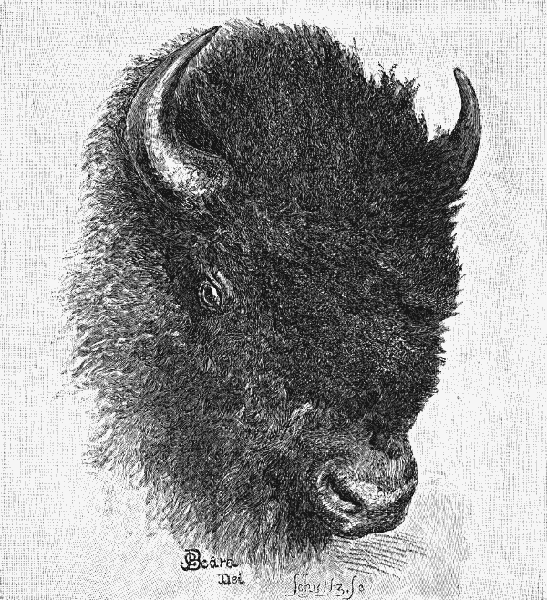
HEAD OF THE BISON, OR AMERICAN BUFFALO. [SEE NEXT PAGE.]
One evening my quiet hermitage seemed more silent than ever before. That small dog, Gip, slept soundly on the earthen floor, tired out with a long day's run through the park. I had just chased away a friendly striped snake that had squirmed in through a mouse-hole and settled itself comfortably, wishing to make its home with me. The field-mice trooped silently about the room in dozens, over the table and under the chairs,—but there is no defense against them. The other night they had the impudence to sit on my pillow and pull out my hair for their nests. "Their tameness is shocking to me," as Alexander Selkirk, the original Robinson Crusoe, complained of the beasts on his island.
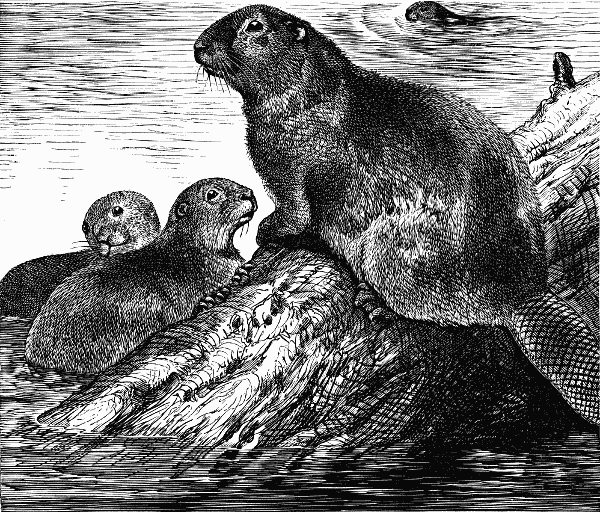
Plotting against the mice, without lighting a lamp I sat by the doorway as the darkness deepened, for the night was too warm and too fine for lamp-light. The long midsummer twilight faded to a narrow band of gray just over the mountain-peak; and looking out, I could hear none of the familiar sounds of the wilderness—even the murmuring pine-woods were hushed in the perfectly calm night. But presently a soft splashing sound came from the pool in the brook behind the house. It reminded me that for nearly a year I had been living within fifty steps of a colony of beavers, and had not yet seen a single one of them; for they are never out by daylight and I am never out by night.
The brook which runs through the park dwindles to a very small stream after the summer heat has melted all the snow from the peak; and there would be too little water for the beavers to swim in if they had not built a number of solid dams across the stream, making as many pretty ponds, where they and the muskrats and the wild ducks lead a jolly life together. There is a chain of five of these beaver-ponds, which begins quite near the house. Often in the early morning, we see places where they have been at work all night, mending their dams, cutting down willow bushes, and even felling trees of some size with a smooth cut that a skillful woodman might be proud of; but all day long there is never a sound of work in the silent village. So, hearing something plunging into the pond in the late twilight, I stole to the bank and looked through an opening in the willow thicket. There by the dim light I saw their round, dark bodies swimming around and around and up and down the pond as silently as fishes, with only a gentle splash now and then as they dipped beneath the surface. It must have been a holiday evening with them, for they were taking a rest from their hard work, and it seemed in the darkness as if they were only playing together in the water.
But I had only a little time to watch them, for some slight noise or the scent of the enemy soon spread an alarm, and in a moment every beaver had disappeared from the pond.
Some years ago, we used to read that all the beavers would soon be killed; for beaver fur had long been fashionable, and the price of every skin was very high. It is strange that the life and happiness of millions of little animals in the backwoods of America and Siberia should depend on the whims of the grand ladies of Paris and London; but so it is. When the beaver fur went out of favor, and the slaughter of the Alaska seals began, the beavers increased wonderfully in all the Western creeks and rivers. But if the Princess of Wales should happen to fancy a garment of beaver fur, woe to the unhappy little beavers of the Rocky Mountains! Thousands of other grand ladies must follow the fashion, and thousands of beavers must furnish the fur.
In riding over the green turf of the open country, one sees everywhere white objects which so reflect the strong sunshine that they almost dazzle the eye. These are the bleaching skulls of the buffaloes that used to roam in thousands through this region. Every one has read how, only fifty years ago, millions of buffaloes wandered over nearly half of the United States; now there are no great herds except in the Territory of Montana, and from that territory more than a hundred thousand skins have been sent to the East in a year. For nearly every skin that is sent away, about half a ton of fine meat is left to decay on the prairie. It is a reckless waste of animal life, and I am sorry to say that our government does very little to stop it. Within ten years there will be no more great herds of buffaloes in the United States. Small bands of them will linger hidden away in valleys, but by the time some boys who read this have lived to be old men, the American bison will probably be seen only where it is kept as a curiosity; just as the one little band of aurochs—the last descendants of the wild cattle which used to roam over all Europe—is kept by the Emperor of Russia. Still, even now, at times, single buffaloes or small bands of them will wander back here to their old grazing-grounds. Last summer a party of hay-makers saw a band of a dozen or more in a remote valley behind the peak. And a few days later, one of our neighbors at the nearest ranch, beyond the mountains, was sitting in the doorway of his snug home one morning, after an early breakfast, when to his astonishment, a great buffalo bull came trotting easily along within a hundred yards of the door. He would hardly have been more surprised had an elephant or a rhinoceros happened in for a morning call; for he had never seen a buffalo, nor had he ever expected to see one at his own ranch. But his surprise left him breath enough to shout, "A buffalo! a buffalo!" The house was full of men just in from the work of gathering beef-cattle for shipment; and at the startling word, every man seized the nearest rifle or pistol or shot-gun, and dashed away to join the chase; only one or two stopping hastily to throw a saddle on a horse. As soon as the chase began, the big beast ran swiftly into the thicket along the creek, and was able to keep out of sight for some time. The chase was long and exciting, but the buffalo's pursuers were too many for him. Some followed up his trail, while others watched the outskirts of the thicket; and at last one of the best marksmen among them, catching sight of the big black body, took a quick line aim and brought the buffalo down with a single bullet; so all the inhabitants of the ranch were feasted with buffalo-meat as long as it could be kept from spoiling. But where the great herds range, there is no such excitement about killing them.
One day a young fellow from the East was listening eagerly with me to the yarns of an old buffalo-hunter, and as the hunter finished his story, the young man said:
"It must be tremendously exciting sport, John!"
"Well, I'll tell you how it is," said John. "It's about as exciting as if you were to go out into the corral and shoot a dozen of those old dairy-cows with a pistol."
With a swift horse, trained to the business, and a heavy revolver, a man who can aim truly may often ride into a herd of buffaloes, overtaking them one by one when they are running their hardest, and, riding close beside them, can put his bullets into the hearts of dozens of them in a single day's hunt. That is the reason why the bison is the first of all the wild animals to disappear at the approach of civilized man—it can not possibly escape from a swift horseman.
“A COLONY OF BEAVERS.”
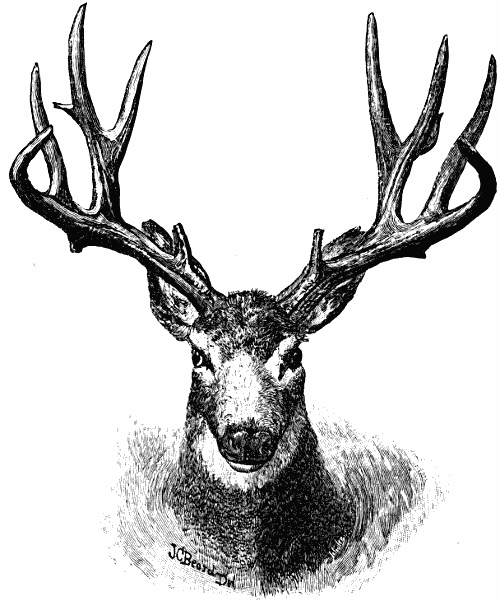
The most abundant game animals among the mountains are the deer. The white-tailed deer is small and much like the antelope in color, but has a far more sleek and handsome coat. The black-tailed or mule deer is twice as large as its white-tailed cousin, and wears a quaker-colored coat, which in summer is tinged with brown. Sometimes, on horseback, I have met the deer in the mountains without giving them any alarm, and we have stood and gazed at one another at our leisure, just to satisfy curiosity. But they know that a man on foot or carrying a rifle is a dangerous creature, and they never stop long to look at him. Usually, even before the hunter catches sight of them, they have seen him. They do not bound away through the forest with a jump and a crash; but, even if taken by surprise, they vanish away between the yellow trunks of the pines as silently as the shadow of the low swooping vulture slides across the grass. They dart so noiselessly through the dark woods that in the distance they seem more like a troop of flying spirits than a herd of animals.
HEAD OF A MULE DEER.
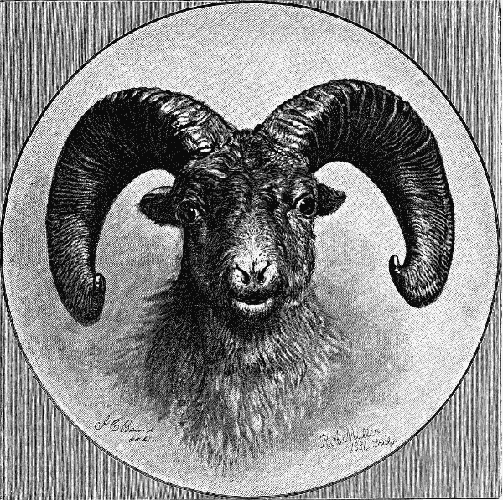
In those parts of the mountains which are so rocky and rough that few animals can approach them, and on the high barrens where the snow lies late in summer, the beautiful big-horn sheep live undisturbed. It is only when they come down to the streams for water, that the hunter can have a fair chance of shooting them. They are swift and handsome animals. Their heads are crowned with ribbed and curving horns larger than those the broad-horned Texas cattle carry. Their coats are not woolly, but are covered with glossy brown hair, shading off in the lower parts to a white as pure as the snow-drifts among which they live. There are no animals, excepting the Swiss chamois and other wild goats, that can run and jump among jagged rocks as they do; and it is useless for any man or beast to try to chase them on the mountain-tops. But a few weeks ago, before the boys went out to work with the cattle, two of them were searching for horses in a cañon opening westward from the valley, and Gip was trotting along behind them, when a turn in the trail suddenly showed them a flock of wild sheep climbing a steep path up the rocky side of the cañon. Both men took quick aim and fired, and the flock went bounding on toward their home among the crags, with one fine young buck lagging behind, his leg broken by a bullet. Yet no man may hope to overtake a wild sheep among the rocks, even though the sheep has but three legs to go on; so, after wounding their fine game, it seemed as if they must lose him. But just as they were making up their minds to the disappointment, Gip took in the trouble with one quick glance and ran to their aid. He has never been taught to hunt, but he is a very wise dog, and does very well without training. He went scrambling up over the rocks ten times faster than a man could go, and soon headed off the wounded sheep. Now Gip is small, and a wild sheep is very large, and tall like a deer; and it seemed impossible that so little a dog could stop it. But the sheep naturally lowered its head to bring its horns to bear on the dog; and Gip, seeing its head within reach, gave a snap at its nose and hung on for dear life, though he was almost lifted from the ground. Even a mountain sheep can not be very nimble with a broken leg, and a dog on the end of its nose; so the boys soon climbed up after him, and when near enough not to endanger the plucky little dog, they ended the sheep's life with another shot. And so, for many days, all the men at the cabin lived on mutton finer even than the famous mutton that is fattened on the English downs.
Not long ago, old Frank, the man who lives alone at the ranch on the western side of the mountains, had the good fortune to come upon two little wild lambs in open ground, where he could easily overtake them; for they were only a few days old. Being a lone man and fond of pets, he carried them home in his arms and fed them every day with milk, until they became as tame as kittens. When they grew to be large sheep, their perfect tameness made them famous curiosities even in the Far West; but they were much greater curiosities when their owner took them to the Eastern States,—for I doubt if a tame big-horn sheep had ever before been seen in an American city. The great price which the rare animals brought well paid the man for all his trouble.
Any of the grazing and browsing animals which live in the Far West may easily be tamed if they are caught young. The antelope and deer are not uncommon pets at the frontier ranches; the mountain sheep and elk can be tamed as readily, but it is more difficult to catch them.
Nearly all the men on the ranches of Wyoming are engaged in the cattle business; and they are so accustomed to throwing the lasso in catching the free cattle and horses, that when they come on the young wild animals, they have little trouble in roping them. The cow-boys, when they are sociable about the roaring hearth-fires in winter, have many curious stories to tell about capturing every kind of wild animal with their ropes. Sometimes when a few of them are away together gathering cattle, they will come on a bear, and, even if unarmed, it is easy for the boys to throw one or two ropes around the bear and hold it until some armed man comes to finish the work. The only trouble is in finding a horse brave enough to run near a bear while his rider throws the rope. One man, very skillful with the rope, has told me how he lassoed a mountain lion. Those great cats are so greedy that when they find a carcass, they will eat until they are stupid and slow in their movements, like a boa constrictor when it is filled with food; so, when this cow-boy found a large old lion just finishing its dinner, he had no difficulty in throwing a noose over its head and dragging it after his horse until another man came up to end its life.
HEAD OF ROCKY MOUNTAIN WILD SHEEP.
Soon this queer, lonely way of living will come to an end for me. Often every day shall I look down the valley, hoping to see the white canvas top of the prairie-schooner heave in sight on the pass leading in from the open country. When all the cow-boys have finished gathering cattle and come home to the peak, the old cabin will be crowded and lively enough. Then the rest of the summer will be filled with hard work in getting together the fat beef-steers and driving them a long journey to the Pacific Railroad, where they will be loaded on trains and carried away to feed the beef-eaters of America and England.
The curlew is still whistling under the plum-bushes not far away, so that the dog sometimes starts up to see who calls him; but now all the fragrant plum-blossoms have fallen away and the small green fruit hangs in clusters. Midsummer has gone; with it came the scorching southeast wind which turns the grass to hay and kills the flowers like a November frost. And, since they are dead, the wilderness is too lonely. While they lived, they were society enough for a hermit; they smiled a sweet good-morning at every sunrise, and filled the evening twilight with fragrance which carried my thoughts away to an old New England home and to happy days spent long ago in gathering forest flowers on the Connecticut hills. There has been enough of hermit life for one year. It has been pleasant; but the end of it will be pleasant, too.