Volume 13 — A LAKE GEORGE CAPSIZE.
Reading edition
By Edward Eggleston.
A QUIET ROW ON THE “BROAD LAKE.”
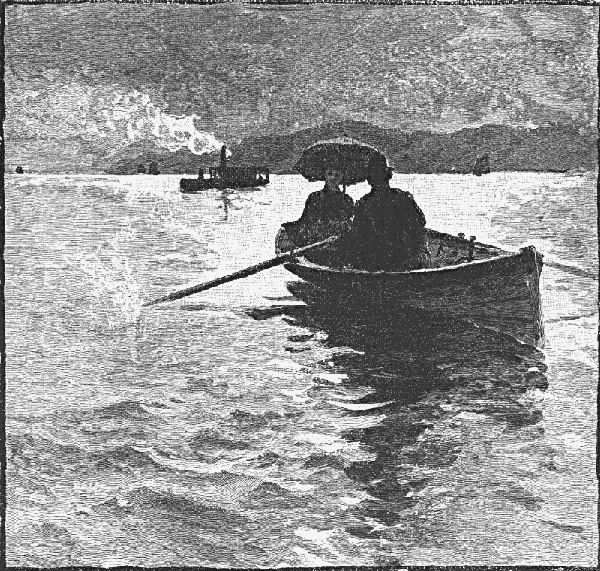
Lake George can be the calmest and loveliest sheet of water that ever was shut in by mountain walls, but like all mountain lakes it is very fickle. If you have never seen it "cut up its didos," you do not yet really know our Lake. In the fall, when the tourists have gone and the hotels and cottages are quiet, Lake George now and then gets into a great rage and becomes quite sublime.
One day in the latter part of October, there came into our bay a trim little sloop-rigged sailboat, with three men aboard. They were after the ducks that always make Dunham's Bay a resting-place on their long autumn journey to the southward. This little yacht, if I may call it one, had not been long in view when there broke upon the lake a fierce, cold, north wind, driving the whitecaps up into the bay like a frightened flock of sheep.
The sailboat could now stand only the mainsail, and even with that it reeled and tumbled about fearfully in the hands of its unskilled crew, and two or three times it was nearly driven ashore, for the men seemed quite unable to make it beat up into the wind.
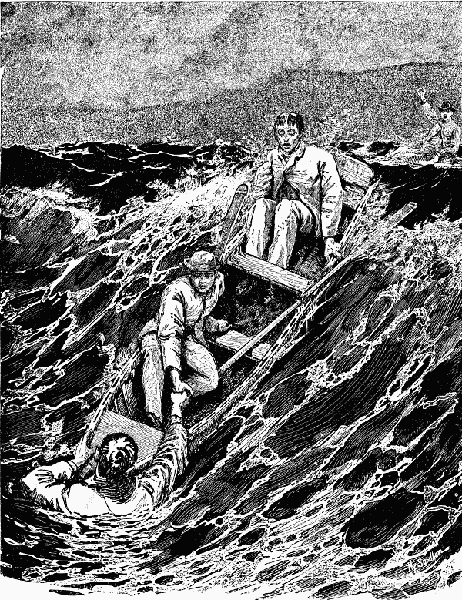
“CHARLIE BROUGHT THE BOW OF THE BOAT TO THE MAN IN THE WATER AND TOOK HIM ABOARD.” (SEE NEXT PAGE.)
While the gale was thus running into the bay, my young friend Charlie Fraser, with a boy's love for excitement, came and asked permission to go out in my rowboat, to see "what kind of a rough-water boat she might be." Though I knew him to be both a good oarsman and a good swimmer, and though the boat had always behaved admirably in a sea, I hesitated, until he proposed not to venture beyond Joshua's Rock, which marks the line between the bay and the "broad lake," as the people call it at this point. After I had let him go, I reproached myself for trusting a boy of sixteen in a gale that was momently increasing in violence. But Charlie did not care to risk too near an approach to the broad lake; he soon saw that there was danger of swamping even in the bay, and therefore he put about for home. In passing the sailboat, which was laboring hard among the rushing, roaring whitecaps, he had shouted to the young men to take in a reef; but they kept the whole mainsail flying, though they had to place all the ballast up to windward and then to sit in a row upon the windward gunwale of the boat to keep it from upsetting. Finding that the gale, which continued to rise, would certainly upset them in spite of all their exertions, one of them eased off the sheet, while the man at the tiller at the same moment brought the boat's head into the wind. This left all the weight of the ballast and the men on one side, with no balancing force of wind in the sail, and the light sloop tipped completely over in the direction opposite to the one they had feared. The sail lay flat upon the water, with one poor fellow under it, while another, encumbered with a big overcoat, was floundering in the waves; the third succeeded in climbing to the upper side of the capsized sloop and sitting astride of it. The wild, frightened cries of the young men rose above the hissing of wind and the roaring of waves, and Charlie brought his boat around and rowed for them. The waves jerked one of his oars from the rowlock, but he soon had it in its place, and was pulling as a strong boy can pull when cries of drowning men are in his ears.
"Help! quick! I'm going! Oh, help! help!" rang in his ears and spurred him to do his utmost, as he headed straight for the sailboat, disregarding the waves that broke now and then into his own boat.
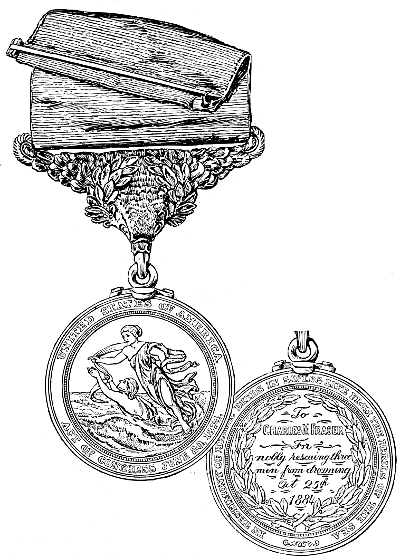
OBVERSE. REVERSE.
When Charlie got up to the wreck, he presented the bow of his boat first to the man who had emerged from under the sail. This young man took hold, then lost his grip and went down as the water tossed the boat; and Charlie held on to the seat to keep from being pitched after him. Then the man came up, gurgling, sputtering, and getting a new hold on the boat succeeded in scrambling in. Holding the boat into the teeth of the wind, Charlie then brought the bow to the other man in the water, and so took him aboard. There were now three people and a great deal of water in the boat; and Charlie concluded that it had all it would carry, and that it would be necessary to land his two passengers before taking the stout young man who maintained an uneasy perch on the capsized yacht. Shouting some words of encouragement to him, Charlie started for the shore; but the young man on the boat, benumbed by his ducking and the icy wind, and perhaps discouraged at seeing the rowboat leave him, fell off the capsized yacht into the water with a cry for help. Charlie put back just in time to grab him as he again let go his hold, and began to sink. But the rowboat had all it would bear in such a sea, and before taking him aboard, it was necessary to make the others throw overboard their wet coats and overcoats. Then the stout young man was pulled in over the stern, and Charlie soon brought the rowboat, staggering under its load of four persons and a great weight of water, safely to dock. A little while after, the three dripping duck-hunters were drying by the kitchen fire.
"I was under the sail," said one of them to me, "and if the boat hadn't come to our help just when it did, it would have been the end of me."
A New York gentleman who heard of this affair wrote to the office of the United States Life Saving Service, at Washington, asking for the silver medal of the Government for Charlie Fraser. Of course there was a great deal of formality to be gone through with; affidavits were made by eye-witnesses, and filed away at Washington, and there the matter rested for months. Meantime Charlie had no recognition of his act except a letter from the mother of one of the young men, though he had, I suppose, what was better—the consciousness of having done his duty manfully in a pinch. One administration at Washington went out, and another came in, and we concluded that the medal had been forgotten. But one day there came to Charlie a very large official envelope, in the corner of which there was boldly printed "Treasury Department." It was also marked "Official Business," and was addressed in big letters and looked very impressive. The inside of it seemed equally important, and it read:
"Mr. Charles M. Fraser:
Sir: I have the pleasure to transmit herewith a silver life-saving medal which has been awarded you under authority of section 7 of the Act of June 20, 1874, section 12 of the Act of June 18, 1878, and section 9 of the Act of May 4, 1882, in recognition of your courage and humanity in saving three persons from drowning October 25, 1884.
"I have the honor to be, very respectfully,
D. Manning, "Secretary."
And the same day there reached him by express the silver medal in a neat case.