X NORTH OF SAN FRANCISCO
Reading edition
SONOMA
Sonoma, the name of the northern county, and of the town in the beautiful Sonoma Valley, forty-five miles north of San Francisco, is of doubtful origin. It is probable that it comes from Indian, rather than Spanish sources. In the native dialect of that region there is the constantly recurring ending tso-noma, from tso (the earth), and noma (village), hence, tsonoma (earth village or earth place). The name was given by missionaries to a chief of the Indians there, and later applied to all the Indians at the mission. From Indian sources it seems there was a captain among them who was commonly called Sonoma, but who was known by a different name among his own people.—(University of California Publications in American Archaeology and Technology.)
The name Sonoma is explained in a different way by Dr. Vallejo, who says it was named for an Indian chief called Sono, a word signifying “nose,” given to the chief as his appellation because of the very large development of that feature of his face. The suffix ma is said by Dr. Vallejo to mean “valley” or “land,” and thus Sonoma would bear the meaning of “nose valley,” or “nose land,”—(Memoirs of the Vallejos, edited by James H. Wilkins, San Francisco Bulletin, January, 1914.)
It has been said that Sonoma means “valley of the moon,” in reference to the shape of the valley, but there is probably more of poetry than of truth in this story.
At this place, San Francisco de Solano, the last of the great chain of missions, was founded July 4, 1823. The mission buildings have been put in a fair state of preservation and the church has been restored by the state.
NAPA VALLEY
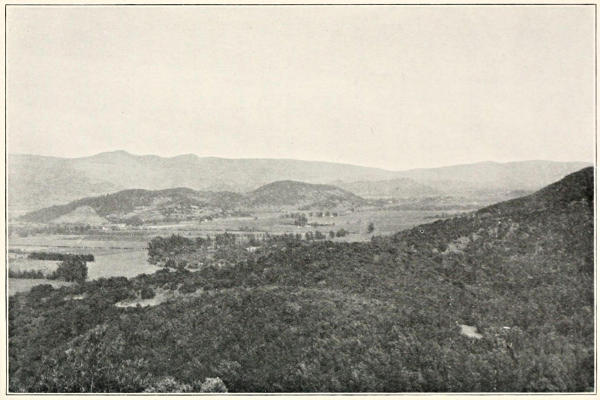
“ ... said to have been the cradle of the Suisún race.”
NAPA
Napa is the name of a county, river and city, the county adjacent to San Pablo Bay, into which the river falls. The town is the county-seat of Napa County, and is on the river of the same name, about thirty-nine miles northeast of San Francisco. The Napa Soda Springs are an interesting natural feature of this place.
Napa, accented in some of the old documents as Napá, was the name of an Indian tribe who occupied that valley, said to have been one of the bravest of the California tribes, and who constantly harassed the frontier posts. The entire tribe was practically wiped out by smallpox in 1838.
According to S. A. Barrett, in the University of California Publications in American Archaeology and Technology, there is a Pomo Indian word, napa, meaning “harpoon point,” between which and the name of the town of Napa there may be some connection.
Dr. Vallejo says the suffix pa signifies proximity, and that Napa means “near mother,” or “near home,” or “mother-land,” and that according to tradition Napa Valley was the cradle of the Suysun race.—(Memoirs of the Vallejos, edited by James H. Wilkins, San Francisco Bulletin, January, 1914.)
CARNE HUMANA
Among the names of the old Spanish land grants are many that hold a suggestion of interesting and sometimes tragic tales, now lost in the dim shadows of the past. Of such is Carne Humana (human flesh), the name of a grant in Napa County, near St. Helena. This spot may have been the scene of one of those horrible acts of cannibalism to which the Indians of the entire Southwest were quite generally addicted. Captain Fages, in his diary of one of the expeditions to San Francisco Bay, mentions that this practice prevailed among the Indians of that region to a certain extent, but seems to have been confined to the eating of the bodies of enemies slain in battle, and only the relatives of the slayer were permitted to take part in the abhorrent feast.
SANTA ROSA
Santa Rosa (St. Rose), the county-seat of Sonoma County, is fifty-seven miles northwest of San Francisco.
An interesting story is told of Santa Rosa de Lima, said to be the only canonized female saint of the New World. She was born at Lima, in Peru, and was distinguished for her hatred of vanity, and her great austerity, carrying these characteristics to such an extreme that she destroyed her beautiful complexion with a compound of pepper and quicklime. When her mother commanded her to wear a wreath of roses, she so arranged it that it was in truth a crown of thorns. Her food consisted principally of bitter herbs, and she maintained her parents by her labor, working all day in her garden and all night with her needle. The legend relates that when Pope Clement X was asked to canonize her, he refused, exclaiming: “India y Santa! Asi como llueven rosas!” (An Indian woman a saint! That may happen when it rains roses!) Instantly a shower of roses began to fall in the Vatican, and did not cease until the Pope was convinced of his error. This saint is the patroness of America, and is represented as wearing a thorny crown, and holding in her hand the figure of the infant Jesus, which rests on full-blown roses.—(Stories of the Saints.)
MENDOCINO COUNTY
Mendocino County, in the northwestern part of the state, is distinguished for its extensive forests of redwoods. The main belt of these trees extends through this county, and they may here be seen in their highest development. They vary in height from 100 to 340 feet, and reach a diameter of from two to sixteen feet, having a red, fibrous bark sometimes a foot in thickness. Notwithstanding their great size, the delicacy of their foliage, which takes the form of flat sprays, gives them a graceful, fern-like appearance. The age of mature redwoods is said to range from 500 to 1300 years. The special characteristics of the wood of these trees are, its durability when buried in the soil, and its resistance to fire. Commercially it is valuable for many purposes, being preferred to steel for water supply conduits, and, in the form of saw-dust, found to be better than cork for packing fresh grapes.—(Notes from The Trees of California, by Professor Willis Linn Jepsen, of the University of California.)
Probably the first written mention of these trees occurs in the diary of Gaspar de Portolá, the discoverer of San Francisco Bay, whose attention was attracted to them while on his way up the coast, and from whom they received the name of palo colorado (redwood). Altogether, the credit of their discovery seems to belong to Portolá, although it has been given by some persons to Archibald Menzies, who wrote a description of the trees in 1795.
The village of Mendocino is on the coast, about 130 miles northwest of San Francisco. The name was first applied to the cape, which was discovered by Juan Rodríguez Cabrillo, in 1542, and named by him for Don Antonio de Mendoza, first viceroy of New Spain.
KLAMATH
Klamath is the name of a village in Humboldt County, but is particularly known as applied to the Klamath River, which flows in a deep and narrow canyon through the counties of Siskiyou and Humboldt.
The word, in its different forms of Klamath, Tlametl, and Clamet, is the name by which these Indians were known to the Chinooks, and through them to the whites, their proper designation in their own language being Lutuami.—(Bancroft’s Native Races, Vol. 1, page 444.)
The meaning of the word has not been positively ascertained, although it is thought by ethnologists to be a possible corruption of Maklaks (people, community,—literally, the encamped). The Klamaths were a hardy people, who had many slaves captured from other tribes. The slave trade seems to have been carried on quite extensively among the California Indians.
MODOC COUNTY
Modoc, the county in the northeastern corner of the state, is notable as having been the home of the only California tribe that ever caused serious trouble to the United States Government. The Modoc wars are a matter of history.
The Modocs were a fierce tribe of Indians who lived at the head-waters of Pit River, and the name is thought by some persons to mean “head of the river,” or “people, community,” but ethnologists are of the opinion that it means “south people,” probably used by tribes living north of the Modocs. Bancroft, quoting from Steele, in Indian Affairs Report of 1864, page 121, says: “The word Modoc is a Shasta Indian word, and means all distant, stranger, or hostile Indians, and became applied to this tribe by white men in early days from hearing the Shastas refer to them by this term.” It does not appear that Bancroft had any genuine scientific authority for this statement.
Powers, in his Tribes of California, states that some persons derive this name from Mo-dok-us, the name of a former chief of the tribe under whose leadership they seceded from the Klamath Lake Indians and became an independent tribe. As it was common for seceding bands to assume the name of their leader, Powers is inclined to accept this explanation of the name.
SHASTA
To account for the name Shasta, a number of theories have been advanced, no one of which seems to be positively established. According to the Bureau of Ethnology, “Shasta may be a corruption of Sus-tí-ka, apparently the name of a well-known Indian living about 1840 near the site of Yreka. The name was applied to a group of small tribes in Northern California, extending into Oregon, who were soon extinguished by the development of mining operations.”
MOUNT SHASTA.
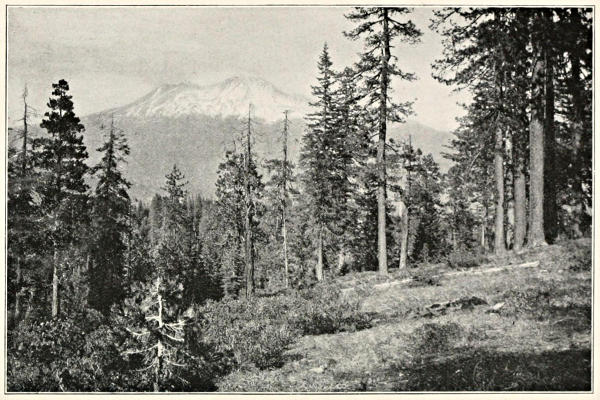
“ ... its summit glistening with snow and visible at a distance of 140 miles down the valley.”
Bancroft, in his Native Races, says, “Shasta was apparently the name of a tribe living about 1840 near Yreka, a tribe made up of several groups. They were a sedentary people, living in small houses, similar to those in use by the Indians on the coast immediately to the west. Their food was made up of acorns, seeds, roots, and fish, particularly salmon. The salmon was caught by net, weir, trap, and spear. Their arts were few. They had dug-out canoes of a rather broad, clumsy type. The bow was their chief weapon, and their carving was limited to rude spoons of wood and bone. Painting was little used, and basketry was limited to basket caps for the women, and small food baskets of simple form. The tribe soon succumbed to the unfavorable environment of the mining camp, and is now almost extinct.... The Shasta Indians were known in their own language as Weohow, a word meaning ‘stone house,’ from the large cave in their country.”
“Shas-ti-ka was probably the tribal name of the Shasta Indians. Wai-re-ka (mountain) was their name for Mt. Shasta.”—(Powers’ Tribes of California.)
Another theory advanced is that Shasta is a corruption of the Russian word tchastal, (white, or pure mountain), and still another that it comes from the French chaste, (pure), but it is likely that its resemblance to these words is purely accidental, and that its origin is Indian.
Whatever may be the derivation of its name, there is no question that Mount Shasta, with its snow-capped summit, has but few rivals for scenic beauty among its mountain sisterhood. It is an extinct volcano, with a double peak, and rises to a height of 14380 feet. There are minor glaciers on the northern slope. Fremont says of it: “The Shastl peak stands at the head of the lower valley, rising from a base of about one thousand feet, out of a forest of heavy timber. It ascends like an immense column upwards of 14000 feet (nearly the height of Mont Blanc), the summit glistening with snow, and visible, from favorable points of view, at a distance of 140 miles down the valley.”
On a United States map of date of 1848, drawn by Charles Preuss from surveys made by Fremont and other persons, the name appears spelled as Tshastl.
Mount Shasta is in Siskiyou County, and is the most conspicuous natural feature in that part of the state.
SISKIYOU COUNTY
Except that it is of Indian origin, nothing authentic has been obtained concerning Siskiyou, the name of the county in the extreme north of the state. Several popular theories have been advanced, one to the effect that Siskiyou means “lame horse.” If that be true the word must have been introduced into the Indian language after the coming of the Spaniards, since horses were unknown to the Indians before that period. Another story, perhaps more pleasing than true, runs as follows: “On the summit of a mountain in Oregon, just over the divide, there is a beautiful, level spot, watered by cool springs, which overlooks the country for miles around. Here the powerful Shasta, Rogue River, and Klamath tribes used to meet to smoke and indulge in dancing and games. They called the place Sis-ki-you, the ‘council ground’.”
Siskiyou County is notable for its mountain scenery, and includes within its borders the famous Mount Shasta.
TRINITY COUNTY
Trinity County received its name from Trinidad Bay, which was discovered and named by Captain Bruno Ezeta, on Trinity Sunday, in the year 1775. Trinidad is the Spanish word meaning Trinity.
Trinity River was so-named through the mistaken belief that it emptied into Trinidad Bay.
Trinidad is also the name of a village in Humboldt County, on the ocean shore, twenty miles north of Eureka.
YREKA
Yreka, the name of the county-seat of Siskiyou County, is an Indian word, of which the spelling has probably been corrupted, perhaps in a spirit of facetiousness, from the original Wai-ri-ka to its present eccentric form. Various theories have been offered in explanation of the word, but the only one apparently based on scientific data seems to be that it means “north place.” One writer advances the whimsical explanation that the word was formed by the transposition of the letters in “bakery,” but fails to explain what becomes of the letter “b.” This is, of course, but an idle invention.
Yreka is said by Powers, in his Tribes of California, to be the Indian word for “mountain,” especially applied to Mt. Shasta. Its former spelling was Wai-ri-ka. Here is a contradiction between scientists.
SUPPLEMENTARY LIST
Agua Caliente (hot water, hot springs), a village in Sonoma County, forty-five miles north of San Francisco.
Altúras (heights), the county-seat of Modoc County, 110 miles north of Reno.
Point Arena (sandy point), is the name of the cape on the Mendocino coast, and of the village in that county, 110 miles northwest of San Francisco.
Bodega (a surname), that of its discoverer, Don Juan de la Bodega y Quadra, Captain of the schooner Sonora, who sailed into Bodega Bay October 3, 1775. This bay, and the town of Bodega Roads are in Sonoma County, about sixty-four miles northwest of San Francisco.
Point Cabrillo (a surname), that of the celebrated Spanish explorer, Juan Rodríguez Cabrillo.
Calistoga, one of those hybrid words of which California has too many. This word was the invention of Samuel Brannan, an early settler, and is compounded of the first syllable of California and the last of Saratoga. It is given here lest it be mistaken for Indian or Spanish.
Cazadero (hunting-place).
Chileno (Chilean, native of Chile).
Punta Delgada (thin or narrow point). See Punta Gorda.
Cape Fortunas (cape fortunes). Fortuna is a village in Humboldt County, twelve miles south of Eureka.
Del Norte (of the north), is the name of the county in the extreme northwestern corner of the state.
García (a surname), the name of a creek in Mendocino County.
Punta Gorda (thick or broad point). Punta Gorda and Punta Delgada are adjacent points on the northern coast whose contrast in shape is indicated by their names. See Punta Delgada.
Gualala, a village in Mendocino County, forty miles west of Cloverdale. This is an Indian word, “probably from walali, a generic term of the Pomo language, signifying the meeting-place of the waters of any in-flowing stream with those of the stream into which it flows, or with the ocean. The present spelling is probably influenced by the Spanish.”—(S. A. Barrett, in California Publications of Archaeology and Ethnology.)
Hoopa, a village in Humboldt County, on the Trinity River, was named for the Hupa Indians, a tribe on the lower Trinity River. Hoopa Mountain was named in the same way.
Point Laguna (lagoon point).
Oro Fino (fine gold), is the name of a village in Siskiyou County, twenty-five miles southwest of Yreka. This name is in contrast to the place called Oro Grande (coarse gold), in the southern part of the state.
Petaluma, the name of a town in Sonoma County, forty-two miles northwest of San Francisco. Petaluma was the name of an Indian village situated near the site of the present town on a low hill, and according to S. A. Barrett the word is compounded of peta (flat), and luma (back), making Petaluma (flat back), but Dr. Vallejo has another explanation of its meaning. He holds that the suffix ma means “valley” or “land,” and that Petaluma is a combination of three Suysun words, Pe-talu-ma, signifying “Oh! fair valley,” or “Oh! fair land.”—(Memoirs of the Vallejos, edited by James H. Wilkins, San Francisco Bulletin, January, 1914.)
Pomo is northeast of Ukiah. “Pomo was an Indian village on the east bank of the Russian River, in the southern end of Potter Valley, a short distance south of the post-office at Pomo. The word is an ending, meaning ‘people of, village of’.”—(S. A. Barrett.)
Tomales Bay is just north of Drake’s Bay, in Marin County. The word is a Spanish corruption of the Indian tamal (bay).
Ukiah is the county-seat of Mendocino County, and is on the Russian River, 110 miles northwest of San Francisco. “The word is said to be derived from the Indian yokaia, yo (south), and ka-ia (valley), the name of a village about six miles southeast of the present town of Ukiah.”