PRONUNCIATION OF SPANISH NAMES.
Reading edition
While it scarcely falls within the province of this book to enter into an elaborate discussion of the matter of pronunciation of Spanish names, it is thought desirable to present a few of the simplest rules, with some examples, so that persons unacquainted with the language may avoid at least the worst of those pit-falls set for their inexperienced feet by our nomenclature. It should be mentioned that in California the Spanish-American usage, rather than the Castilian, is followed in the pronunciation of the c and z. The rules of pronunciation quoted here are those given in Ramsey’s text books, generally regarded as excellent authority.
VOWELS.
A sounds like a in ah, midway between the English a in father and that in fat. Example, Pala, pronounced Pah´lah.
E sounds like a in hay, its sound being slightly varied according to situation. Example, Rode´o, pronounced Ro-day´o.
I sounds like ee in bee. Example, Vista, pronounced Vees´tah.
O sounds like o in hope. Example, Contra Costa, pronounced Cone´trah Coast´ah. This name is frequently mispronounced by using the short sound of o, as in not.
U sounds like u in rule. Example, La Punta, pronounced La Poon´tah.
Y, when a vowel, is equivalent to i. Y is considered a vowel only when standing alone, as in y (the conjunction and), or at the end of a word, as in ley (law), but is sometimes used interchangeably with I at the beginning of a word, as in San Ysidro, pronounced San Ee-see´dro, and sometimes spelled Isidro. In other cases it is a consonant and is pronounced like the y in the English yard.
CONSONANTS.
Only those consonant sounds differing from English usage need be mentioned here.
C has two sounds. Before e and i it is pronounced like s in seat, that is, in Spanish-American usage; examples, Cerro, pronounced Ser´ro, and Cima, pronounced See´mah. In all other cases c has the sound of k; examples, Carlos, pronounced Kar´loce, Colorado, pronounced Ko-lo-rah´do (each o long, as in hope), Cuesta, pronounced Kwes´tah, and Cruz, pronounced Kroos.
Ch has the sound of ch in church. Example, Chico, pronounced Chee´ko.
D is slightly softened, and when occurring between vowels and at the end of words it is almost like th in then. Examples, Andrade, pronounced Ahn-drah´-dthay, and Soledad, pronounced Sole-ay-dadth.
G has two sounds. Before e and i it has the sound of strongly aspirated h. Examples, German´, pronounced Hare-mahn´, and giro, pronounced hee´ro. In all other cases it sounds like g in go. Examples, Gaviota, Goleta, Guadalupe, Granada. In gue and gui the u is regularly silent; exceptions to this rule are marked by the diaeresis, as in Argüello, pronounced Ar-gwayl´yo, or in Spanish-American, Ar-gway´yo.
H is silent except in the combined character ch. Example, La Honda, pronounced La On´dah, with long o, as in hope.
J has the sound of strongly aspirated h. Examples, Pájaro, pronounced Pah´hah-ro, and San José, pronounced San Ho-say´. This letter is one of the worst stumbling-blocks in the pronunciation of Spanish names.
Ll has the sound of the letters lli in the English million, but in many parts of Spanish-America it is pronounced like y in beyond. The latter is not considered an elegant pronunciation. Example, Vallejo, properly pronounced Val-yay´ho, but in Spanish-American, Va-yay´ho.
N has the sound of the letters ni in the English pinion. Example, Cañada, pronounced Can-yah´dthah.
Q only occurs before ue and ui, and sounds like k, the following u being always silent. Example, San Quintín, pronounced San Keen-teen´.
S has the hissing sound of s in say, base, and is never pronounced like sh as in mansion, or z as in rose. Thus in Santa Rosa the s is sharply hissed and is not pronounced as Santa Roza.
Z is sounded in Spanish-America like sharply hissed s, as in say or base. Example, Zamora, pronounced Sah-mo´rah.
A peculiarity of pronunciation common to almost all Spaniards is the confusion of the b and the v so that one can hardly be distinguished from the other. Vowel sounds are pronounced shortly and crisply, never with the drawling circumflex sound sometimes heard in English. Without going into the complications of the division of syllables, it may be stated that the fundamental principle is to make syllables end in a vowel as far as possible; examples, Do-lo-res (not Do-lor-es), Sa-li-nas (not Sal-in-as).
ACCENT.
All words ending in n or s or a vowel are regularly accented on the next to the last syllable; examples, Sausalíto, Altúras, cómen. All others are accented on the last syllable; examples, San Rafael´, Avenal´. In words following the above rules no mark is used, but in the exceptions, which are many, the stress must be indicated by the written accent. Examples, Portolá, Jolón, Álamo, Los Ángeles.
ARTICLES.
In the Spanish language articles agree with their nouns in gender and number. The forms of the definite article are el (singular) and los (plural) for the masculine, la (singular) and las (plural) for the feminine. Examples, El Portal (the portal, or gate), Los Gatos (the cats), La Paz (the peace), Las Vírgenes (the virgins).
LIST OF NAMES MOST LIKELY TO BE MISPRONOUNCED, WITH THEIR PHONETIC PRONUNCIATION.
Agua pronounced Ah´gwah. Spanish Americans often mispronounce this word by leaving out the g, calling it ah´wa.
Aguajito ” Ah-gwah-hee´to.
Alameda ” Ah-lah-may´dthah.
Los Ángeles ” Loce Ahng´hell-ess.
Asunción ” Ah-soon-see-on´, with the o long, as in hope.
El Cajón ” El Kah-hon´, with the o long, as in hope.
Camino Real ” Kah-mee´no Ray-ahl´.
Cañada ” Kahn-yah´dtha, with the d slightly softened like th in then.
Carpintería ” Kar-peen-tay-ree´ah.
Carquínez ” Kar-kee´ness.
Conejo ” Ko-nay´ho.
Corral ” Kore-rahl´.
Dolores ” Do-lo´ress.
Farallones ” Fah-rahl-yo´ness, in Spanish-American, Fa-rah-yo´ness.
Los Gatos ” Loce Gah´tos, the o long, as in hope.
Guadalupe ” Gwa-dah-loo´pay.
La Jolla ” La Hole´yah, or in Spanish-American, Ho´yah.
La Joya ” La Ho´yah.
La Junta ” La Hoon´tah.
Laguna Seca ” Lah-goo´nah Say´cah.
Lagunitas ” Lah-goo-nee´tas.
Matilija ” Mah-tee-lee´hah.
Merced ” Mare-sedth´, with the d slightly softened like th in then.
Mesa ” May´sah.
Ojo ” O´ho, with the j strongly aspirated.
Pájaro ” Pah´hah-ro.
Paso Robles ” Pah´so Ro´blace.
Portolá ” Por-to-lah´.
Punta Arenas ” Poon´tah Ah-ray´nas.
Rodéo ” Ro-day´o.
Salinas ” Sah-lee´nas.
San Gerónimo ” Sahn Hay-ro´nee-mo.
San Jacinto ” Sahn Hah-seen´to.
San Joaquín ” Sahn Wha-keen´.
San José ” Sahn Ho-say´.
San Juan Bautista ” Sahn Whan Bau-tees´ta.
San Julián ” Sahn Hoo-lee-ahn´.
San Luís Obispo ” Sahn Loo-ees´ O-bees´po.
San Martín ” Sahn Mar-teen´.
San Quintín ” Sahn Keen-teen´, colloquially spelled Quentin.
Santa Fé ” Sahnta Fay´.
Santa Inez ” Sahnta Ee-ness´.
San Ysidro ” Sahn Ee-see´dro, also spelled Isidro.
Suñol ” Soon-yole´.
Vallejo ” Val-yay´ho, in Spanish-American Vah-yay´ho.
Las Vírgenes ” Las Veer´hen-ess.
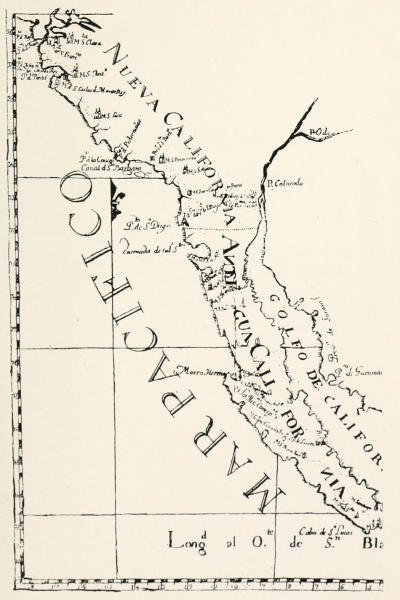
MAP OF THE MISSIONS.
Used by the courtesy of Father Engelhardt.