Volume 8 — SOUTH AFRICAN RAILWAYS
Reading edition
By W. BLELOCH
Author of “The New South Africa”
South Africa is a country of magnificent distances, with the centres of industry situated at points far apart in the wide interior; the country villages are dotted about with thirty to fifty miles of brown karroo or verdant veldt in between; even the homesteads of the Boers are planted at respectful distances from each other. In such a country a comprehensive, efficient, and cheap railway system is absolutely necessary; without railways the development of trade and industry could not be pushed forward on any large scale. The great staple products of the Cape—wool, skins, and hides—could not compete with the like products of Australia and the Argentine. The diamond mines of Kimberley, which support an industrial population of about 50,000, and the great gold mines of the Rand, which at the present stage of development supply the wherewithal to live to 200,000 people, white and black, would be able to work only on a restricted basis; the greater number of the Rand mines would have to shut down, and without railways it may be said that the stimulating production of wealth in the nearly indestructible form of gold and diamonds would practically cease.
To meet the requirements which the circumstances demand, a far-stretching network of railways—with wide meshes it is true—is growing over the country. Instead of the old system of ox transport and coaches drawn by mules, which ten years ago were the only means of approach to the Transvaal and Rhodesia, there are now modern freight trains, drawn by heavy-type locomotives, hauling up the vast import traffic to the Rand, and running down return loads of wool and hides from the grassy uplands of the Orange River Colony, and the barren-looking, but wide and productive, karroo plains of the Cape. There are trains de luxe with corridors and platforms to enable the passenger to stretch his limbs en route, or sit in comfort and view the scenery as the train plods on its twenty-five or thirty miles an hour.
Twelve years ago Bulawayo was the head kraal of a bloodthirsty savage, and was approached only by a few adventurous spirits who recked little of danger and less of time. The journey from the coast to the inland centre took at least three months, and now it can be visited with comfort and despatch. Without alighting from the train the traveller can enjoy his morning bath; he can breakfast, lunch, and dine; he can press a button and call for cool, liquid refreshments at any hour of the day; and he can complete his journey of 1360 miles from Cape Town to the Rhodesian industrial capital in 3½ days. The Cape Town-Johannesburg journey of 1000 miles is done just within 44 hours. These results may not be considered of much account by the English or American traveller accustomed to a speed of 50 miles an hour for long distances, but South African railways have been built to suit the special necessities of the country. The gauge is only 3 feet 6 inches, and on all the lines heavy gradients have to be negotiated.
The interior of South Africa is a great plateau elevated from 4000 to 6000 feet above sea-level. The edge of the plateau runs round the sub-continent at no great distance from the sea, its bold escarpments looking over the 50 to 100 miles of broken, low-lying coast lands which skirt the continent. In consequence, all the railways to the interior, within the first 100 miles from the coast, begin climbing up steep inclines cut along the sides of one or other of the few passes which admit of ascent by railway trains. Whether the journey is made from Cape Town, Port Elizabeth, East London, Durban, or Delagoa Bay, the ascent has to be negotiated. The tedium of the uphill journey is compensated to some extent by the grandeur of the scenery in these initial stages of the routes to the interior. On the Cape line there is the magnificent view of the Hex River which, like Fair Melrose, can best be seen in pale moonlight as towards morning the night train from Cape Town winds along, gradually climbing up and up above the valley lying 1000 feet below. On either side grand brown mountains rise like sentinels to guard the pass. It has often been conjectured what would have been the upshot if the Boers had marched right south and seized this pass at the beginning of the war. It would have been Colenso over again, only worse. On the Port Elizabeth line, from Coerney to Cradock, the line passes up through rugged valleys in places bright with the sub-tropical evergreen bush of South Africa, and hemmed in with massive mountains forming the broken edges of the continent. The line through Graaf Reinet negotiates similar country, as does also the line from East London through King William’s Town. The ascent from Durban is the most difficult of all. Natal is formed almost wholly of great fragments of the South African plateau which seem to have broken off, and now lie in long lines of broken mountain chains running north and south. These mountain ranges lie transverse to the route of the railway, so that ascents and descents have to be made time and again before the Transvaal high veldt is gained. From Durban to Charlestown the aggregate ascent is 12,600 feet. Altitudes of two, three, four, and five thousand feet are gained en route and then partially lost again. Some of the scenery on this line is of surpassing interest and beauty. Near the coast there are fruit gardens, pine and banana plantations, and orange groves, with here and there fields of pasture fenced in. Farther up, mealie fields spread along the slopes of the hills and down the valleys. Then there follow stretches of open grass country alternating with bush. Herds of cattle, fat and sleek, graze on the rich grass lands. Above Pietermaritzburg the line ascends for three thousand feet to highlands to descend again two thousand to Colenso.
Bridge over the Tugela, Zululand Extension (1330 Feet Long) Connecting Natal and Zululand
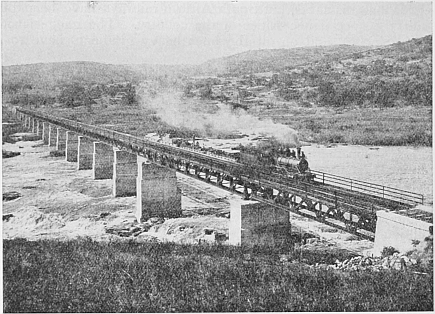
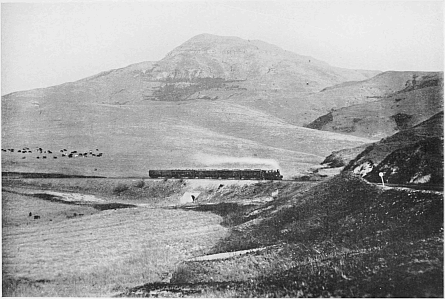
The next stretch of fifty miles has become one of the historic districts of the empire. In a winding of the Tugela lies Colenso. Then Pieters Hill is climbed, and the traveller can realise the desperate nature of the task set to General Buller’s army. Then come Wagon Hill and Cæsar’s Camp, with Bulwan on the right and Ladysmith lying in a hollow in the centre. Beyond Ladysmith the train climbs again to Elandslaagte, and begins in a succession of gradual ascents to climb to the crest of the Drakensberg, the final climb being made under the shadow of Majuba, and through the tunnel of Laing’s Nek. Once at Charlestown the high veldt is gained for good. The ascent from Delagoa Bay is easier, in that there is not the same repetition of ups and downs as on the Natal railway. The line runs through the Komati Poort, and then up the Elands River Valley, a beautiful valley indeed, but a veritable valley of death to the builders of the railway. At Waterval Onder the final steep ascent is begun, part of the way being so steep that the cog-wheel system is required. At Waterval Boven the high veldt is gained, and the main difficulties left behind.
The Beira railway to Salisbury has a similar ascent to make. Having described the approaches, some idea may now be given of the railway routes on the interior plateau itself. The Cape Town line to De Aar and Kimberley after gaining the plateau traverses the Great Karroo, a monotonous stretch of several hundred miles of parched brown, barren-looking plain with isolated, flat-topped mountains, and ranges which serve to give variety, and make a scene of widespread solitude, having a melancholy charm wholly its own. This barren-looking veldt, with its sparse vegetation of stunted shrubs, supports millions of sheep and goats, and however unpromising its aspect, it plays an important part in the railway and general economy of the country. The Midlands railway from Port Elizabeth to De Aar and Norval’s Pont traverses similar country, but not so arid. The Eastern railway, from East London through King William’s Town and Queenstown to Bethulie, traverses more undulating country covered with grass intermixed with karroo shrub. In some districts, notably round King William’s Town and Queenstown, agriculture has made considerable headway. The western line continues from Kimberley through Vryburg (British Bechuanaland) to Mafeking, and on to Bulawayo through grass-covered country, with clumps of Kameeldoorn trees, presenting in many places the appearance of an English park. This is a great cattle country, and provides considerable traffic for the railway over and above the mining traffic of Kimberley and Rhodesia. All the Cape lines connect with one another with two necks which converge at Springfontein for the Orange River Colony and Transvaal traffic. From the Orange River northwards the railways are known as the Central South African Railways. The line through the Orange River Colony runs through flat grassy plains for a distance of 300 miles: plains which, after a devastating war, still hold over a million sheep and 160,000 head of cattle. In time of peace the whole country is one monotonous scene of pastoral prosperity. On entering the Transvaal at Vereeniging—the place of the declaration of peace—the railway enters at once into the rich gold-bearing region of the Transvaal. There is a gradual rise over open country to the Rand. On every side there is evidence of great industrial activity, and at many places along the line beginnings may be seen of Transvaal agriculture, beginnings which promise a great future.
The south-eastern branch of the Central South African Railways connects with the Natal line at Volksrust, and proceeds along the high veldt viâ Standerton and Heidelberg to the Rand. The high veldt of the Transvaal has an average height of 5000 feet above sea-level. It is a vast open grass country with rocky ridges rising a few hundred feet above the ordinary level. A magnificent stock country, and rich in coal, iron, and gold. On the eastern line, the Central South African line connects with the Portuguese line at Komati Poort, and passes up the Elands River Valley already described. From Waterval Boven the railway continues to ascend to the summit of the high veldt at Bergendal, near Belfast. It was here where the last big pitched battle was fought before the break-up of the Boer army into guerilla forces. The line passes along the northern limits of the high veldt viâ Middelburg to Pretoria. The country it passes through is equal in stock-raising capabilities and mineral riches to the south-eastern line. There are enormous areas of coal of good quality and abundance of iron ore, and limestone sufficient for the establishment of a great industry which itself will doubtless bring about and maintain great railway expansion in the future.
From Pretoria, the Pretoria-Pietersburg line, formerly a private company, now taken over by the Central South African Railways, strikes north to Pietersburg into the heart of the tropical part of the Transvaal. The country it traverses is partly flat and partly hilly, at some places thick bush and at others wide grassy plains. In the northern district there is a large population of Kaffirs who cultivate the extremely fertile soil, and produce great quantities of mealies (maize) and Kaffir corn, which products, together with timber for the mines, form the principal items of traffic carried by the railway. The Beira railway to Salisbury, originally a narrow gauge, has now been widened to the standard 3 feet 6 inches gauge of South Africa, and carries all the traffic for the Mashonaland mines.
JOHANNESBURG MAIL TRAIN AT THE FOOT OF MAJUBA
In all, South Africa possesses approximately 5000 miles of railway, having a capitalised value, including rolling stock, of about £50,000,000, or £10,000 per mile. The three important systems are the Cape Government Railways, the Natal Government Railways, and the Central South African Railways (Transvaal and Orange River Colony). The Cape system has a mileage of 2135 miles, and in addition it works 587 miles of the Rhodesian Railways, or a total of 2722 miles. The Natal system covers 612½ miles, and the Central South African system 1312 miles. In addition to these there is the Beira Railway, already briefly described, and there are also several small privately-owned railways. The three chief systems own altogether 1239 engines and 27,806 waggons, and a large but still insufficient equipment of coaches for passenger traffic. Great attention has been given and much money expended in the past two years in bringing the rolling stock up to a state of efficiency for dealing with the greatly-increased traffic anticipated on the establishment of peace in South Africa. The Central South African Railways—the State Railways now owning and working the old Free State and Netherlands systems—have almost doubled the carrying capacity of these railways. Natal had 129 engines before the war; she has now 209. She had 3101 waggons before the war; she has now 6154. The Cape railways have also largely increased their stock. The enormous traffic now being handled, more or less successfully, will justify this provident policy.
All these systems make large annual profits. In its best year, 1896, the Cape Government system showed—
Total Earnings. Total Expenses. Profits.
£4,078,561. £9,921,809. £2,156,752.
Or £10, 7s. 6d. per cent. on the then capital of £20,799,288. This included the Free State share of profit under the then working arrangement. Deducting the Free State share, the profit was at the rate of £8, 19s. 7d. per cent. In the same year the Natal Railway showed—
Total Earnings. Total Expenses. Profits.
£1,136,213, 16s. 1d. £421,989, 14s. 2d. £706,224, 1s. 11d.
Or £11, 9s. 0½d. per cent. on the then capital of £6,236,555.
In the same profitable year the Netherlands Railway returns showed—
Total Earnings. Total Expenses, Plus Interest on Capital. Total Nett Profits.
£2,903,516, 0s. 5d. £1,197,841, 18s. 8d. £1,705,674, 1s. 9d.
The profits of this railway in this year equalled 59 per cent. of the total earnings.
In 1901, notwithstanding the state of war, the Cape Government Railways showed—
Total Earnings. Total Expenses. Profits.
£3,852,871. £2,875,571. £977,300.
Equal to £4, 8s. 4d. per cent. on the then capital of £22,125,085.
In the same year the Natal Railways showed—
Earnings. Total Expenses. Profits.
£1,650,355, 5s. 4d. £1,159,026, 7s. 9d. £491,328, 17s. 7d.
Equal to £5, 15s. 2½d. per cent. on the capital of £8,528,989.
Included in the Natal Railway expenses is the sum of £159,328 expended on permanent work that should have been charged to capital, which, if added to the profits as it should be, would make an actual profit for the year of £650,656, 17s. 7d. There are no returns available to show the result of working the Central South African Railways, formerly the Imperial Military Railways, during the period of the war. Nor are there any available now, but considering the past results and the great volume of present traffic, and the maintenance of the old high rates for freight and passenger fares, it may be estimated that the earnings of the Central South African Railways in the Transvaal and the Orange River Colony will probably be between £5,500,000 and £6,000,000, and the profits between £2,500,000 and £3,000,000, a very important item in the revenues of the two new colonies.
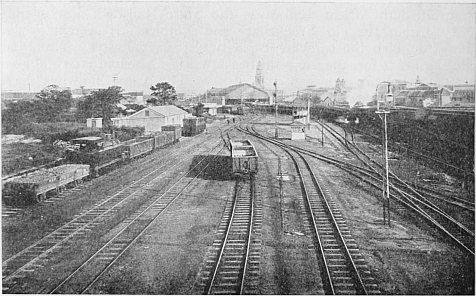
Station Yard, Durban (The Tower of the Town Hall is seen in the background)
In comparison with other railways in the British Empire the South African railways hold an important position as regards mileage, and the average earnings per mile are more than double the average earnings of several important colonial and Indian railways. The combined earnings of all South African railways working 5000 miles may be taken at £11,000,000 for the year. The Canadian Pacific Railway, working 7000 miles, earned £6,002,061. The Grand Trunk of Canada, working 4179 miles, earned £4,407,016. The Victorian Railways, Victoria, Australia, working 3238 miles, earned £3,337,797. The Queensland Railway, working 2801 miles, earned £1,316,936. The Bombay, Baroda, and Central Indian Railways, with 2764 miles, earned £3,253,866. The Great Indian Peninsular and Indian Midland Railways, with 2800 miles, earned £3,063,066. Comparing with important home railways:—
Capital. Miles. Earnings.
London and North-Western Railways £118,126,653 1941 £13,812,000
Great Western Railway 84,424,177 2645 11,181,471
Midland Railway 170,550,931 2019 11,153,792
All South African Railways 50,000,000 5000 11,000,000 (approximate)
These figures show that South African railways make high earnings as compared even with a great railway like the Canadian Pacific, a railway serving one of the most important trade routes in the world, and traversing a rich agricultural country, with a population of 5,000,000, as compared with South Africa’s 700,000 whites and 2,000,000 blacks. The Queensland railways, with more than half the mileage, earn less than one-eighth the total earned by South African railways, while the enormous traffic of the famous London North-Western, with its large capitalised value, only brings in a matter of £3,000,000 a year more than the railways of South Africa, with their moderate capitalisation of £50,000,000.
This comparison should bring home to investors the excellent opening which South Africa affords for safe and profitable participation in the reasonable railway expansion the country still requires, especially is this the case with the two new colonies. Another fifteen hundred miles could well be added. These new railways would have earning capacity little inferior to the existing lines, and the present margin of profits is so wide that a substantial reduction in rates would not materially affect the prospects, because such a reduction would inevitably result in a great increase in the volume of traffic.
The comparison also leads to the conclusion that the present rates are excessive. They have been maintained at their high level through the system of the Colonial Governments looking to the railways for a large proportion of the revenue. The great pivot of South African industry is the Rand, with its goldfields, and both Natal and Cape Colony have for years past taken toll on the Rand traffic, and thereby swelled their own revenues.
The old Free State and Transvaal Governments in a like manner determined to fleece the industrial workers, and so save their own burghers from bearing their due share of the cost of Government. While they were the greatest sinners themselves, they could not with reason ask the southern Governments to take the first step towards moderation. As a consequence, the Rand, dependent for the most part of its food and for the whole of its industrial equipment on over-sea supplies, became one of the most expensive places to live and work in that the wide world knows. Under the new regime there is as yet no improvement; the Imperial Government is looking for revenue. To the despair of British loyalists the old high rates are maintained, with the effect of delaying and perhaps prohibiting the enormous industrial progress which the wealth of the country would under other conditions make possible. All classes feel the burden, and at the forthcoming Congress of the Associated Chamber of Commerce, which will meet at Kimberley, resolutions bearing on the question are to be submitted. The first affirms: “That the railways, being the highways of the country, should be worked solely with a view to furnishing the transit and traffic requirements of the country, and entirely dissociated from the revenual, political, or protective considerations;” and “That the policy of raising revenue through excessive railway rates is an objectionable method of taxation. It is unfair in its incidence, and bears with especial hardship on the inland wage-earner.”
These resolutions reflect the feelings of the whole inland community of South Africa.
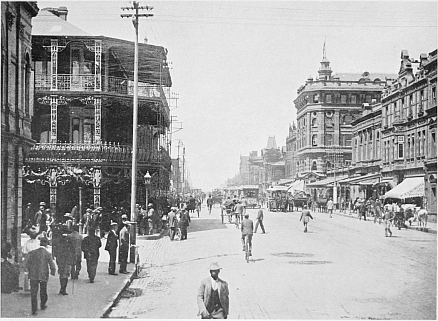
COMMISSIONER STREET, JOHANNESBURG Photo by Barnett & Co., Johannesburg
The Canadian Pacific Railway, with 7588 miles open, makes a net profit of £2,620,000 on a capital of £53,000,000 as against South Africa, with 5000 miles open, and net profits of over £5,000,000 on a similar capital. The Canadian Pacific Railway makes a net profit of £371 per mile against a net profit of Natal railways of £803 per mile, and an approximate net profit of £1800 per mile of the Central South African railways (Transvaal and Orange River Colony railways). New Zealand railway returns for 1902 show net earning of £280 per mile. The through rate for ordinary goods from Durban to Johannesburg is just over 3¾d. per ton per mile. The rate for ordinary goods on the Central South African railways (Transvaal railways) for fifteen miles is 9d. per ton per mile; for fifty miles, 6⅔d. per ton per mile; for longer distances, approximately 6d. per ton per mile. The average rate for goods on the Canadian Pacific Railway is only one-third of a penny per ton per mile. Were this rate charged on a ton of goods brought from Durban—the nearest colonial port—to Johannesburg, the cost would be only 13s. 6d. as against £7, 13s. 4d., the present cost; that is, the South African through rate is ten times as much as the average rate in Canada; and the Transvaal rate for ordinary local traffic of 6d. to 9d. per ton per mile is twenty times higher than the average Canadian rate. The Canadian Pacific Railway is selected for comparison, because it is a railway built to develop new and sparsely-populated territory, its special work being essentially the same as that required of the railways of South Africa. The Canadian Pacific Railway has doubled its earnings since 1895. If its policy were copied in South Africa, where the whole industrial life of the country depends on railways, enormous developments could be looked for. In South Africa it is fully realised that, until the burden of excessive railway rates is got rid of, the costs of living must prohibit any great growth of population, and without growth of population the development of the natural resources of the country can only make the slowest of progress. The people are quite willing to provide the Government with revenue, but they wish to provide it by different methods than those which obtained in the past.
Owing to exorbitant fares the people of Johannesburg are practically confined within the limits of the town and its immediate suburbs. They are compelled to pay high rents. £250 to £300 a year represents the present rent for an ordinary cottage. The passenger fares on the London and North-Western are from a 1½d. to 1¾d. per mile first, 1¼d. second, and fractionally under a 1d. third. A great reduction is made on season tickets. Transvaal railway fares average 3d. per mile first, 2½d. second, and 1½d. third, and only a small reduction is made for season tickets. With high rents and high prices for food, rendered dear by cost of carriage, the workers, in order to live, must obtain high wages. High wages mean high-working costs for all industrial enterprises. Consequently only a few industries, and only the richer mines, can be worked at a profit. Ordinary industries which can carry only moderate working costs cannot be undertaken.
Judging from the results of the past six years sweeping reductions are quite possible while still allowing for a paying railway revenue. Mr. Cooper-Key has shown, that the excess profits made by the Transvaal railways alone, after providing for reasonable interest on capital at the rate of 4¾ per cent., were:—
For 1896 £1,162,925.
" 1897 1,111,964.
" 1898 928,623.
For the present year the excess profits on Transvaal railways, over a 4 per cent. interest on capital, will probably amount to not far short of £1,500,000.
As might be expected after a consideration of the profits and earning capacity of South African railways, important extensions of the previous system are projected and in progress.
In the Cape Colony there is a project to connect Saldanha Bay, the proposed new port, with the main line viâ Hopefield. A southern line viâ Oudtshoorn and Willowmore will bring Cape Town in closer contact with Mossel Bay and Port Elizabeth, and open up the southern districts of Cape Colony. Another line will join the Port Elizabeth midland line with the eastern system at King Williamstown.
In the Orange River Colony the projected lines are from Springfontein to Koffyfontein; from Bloemfontein to Ladybrand and Ficksburg; from Harrismith to Heilbron or Vereeniging. The line from Bloemfontein to Ladybrand is already partly built. It will open up the wheat-growing section of the Orange River Colony.
In the Transvaal the most important projected lines are: A line from Fourteen Streams to Klerksdorp, providing an alternative route from the Cape Ports to the Rand. A line from Krugersdorp to Rustenburg and thence probably to Zeerust and Mafeking, opening up a valuable agricultural country. A line from Springs to Machadodorp or Ermelo, through the best coal and iron districts of the Transvaal, and providing an alternative route from Delagoa Bay to the Rand. This line would greatly relieve the congestion which exists after the high veldt is gained on the present eastern line, owing to the coal traffic and the over-sea imports having to be carried over a single line of railway. A line from Pietersburg to Leydsdorp and thence probably connecting with the Selati railway at its present terminus. There is a private company formed to build a line from Machadodorp to Ermelo, and the Government is constructing a coal line for the mines along the south of the Rand, and another alternative line from Johannesburg to Vereeniging.
In Natal it is a question of doubling the present main line or of constructing another single line of railway from Greytown to the Transvaal. The first plan would be cheaper, and would give more immediate help to Natal in the competition for Transvaal traffic, while the alternative Greytown route would open up new country to railway influence, and materially add to the prosperity of the agricultural population of that section of the colony. Natal is also about to construct a line from Maritzburg to Riverside on the Cape-Natal frontier. The Cape being under promise to connect this point with their eastern system, and thus provide direct railway communication with Durban and Cape Town.
In Rhodesia the line connecting Bulawayo and Salisbury is approaching completion.[13] It is possible that Gwelo, a town on the railway, will be the junction or next starting-point of the “Cape to Cairo” railway, or it may be that the route by another new line from Bulawayo to the Wankie coalfields near the Zambesi may be chosen instead. A line is in course of construction from Bulawayo to the Gwanda goldfields, and a line is proposed from Salisbury north to Lo Maghonda. Altogether over 2000 miles of new railway are projected in South Africa. In the Transvaal the new lines proposed will have a length of over 800 miles, and at least 500 miles may be considered as lines whose construction is a matter of urgent necessity.
This forecast of railway development in the immediate future in South Africa means the raising and spending of another £16,000,000, £8000 per mile being about the lowest figure that can be reckoned on to build the lines and provide rolling stock. Transvaal expenditure for new railways may be estimated for the period of the next three years at not less than £6,000,000. When built, however, these railways will be sound properties, thoroughly sure as to their dividend or interest-earning capacity. Lord Milner referred in a recent speech to what he called the governmental plant which he said was required before private enterprise could get to work on making the country productive. Chief among the governmental plant so referred to are railways, but alongside of the recognition of the necessity of railways it is to be hoped that governmental recognition will also be given to the fact that to be of real use the railways must be run at cheap rates, otherwise the looked-for benefit will never come.
As regards over-sea traffic, it is hoped that rates may be brought down by encouraging competition between the various railways from the coast, and the Transvaal Government has a powerful lever in its eastern line. The distance from Delagoa Bay to the Rand is only 395 miles, of which only 56 belong to the Portuguese.[14] From Durban the distance is 483 miles; from Port Elizabeth, 785 miles, and from Cape Town, 1000 miles. The Transvaal Government has the whip in hand, and it is hoped that it will use it so that all South Africa will be brought into line on the question of moderate freight and passenger rates. At present goods are pouring into the Transvaal at the rate of 21,000 tons per week, and in addition there are 8000 tons being brought up weekly for the military, but if rates are not lowered, this great railway activity will prove only transient, because it is certain that at present the internal industries are making no progress, and consequently trade must fall off.
Map of the Cape Government Railways, Based on the Map Accompanying the General Manager’s Report (Scale = 120 English miles to an inch)
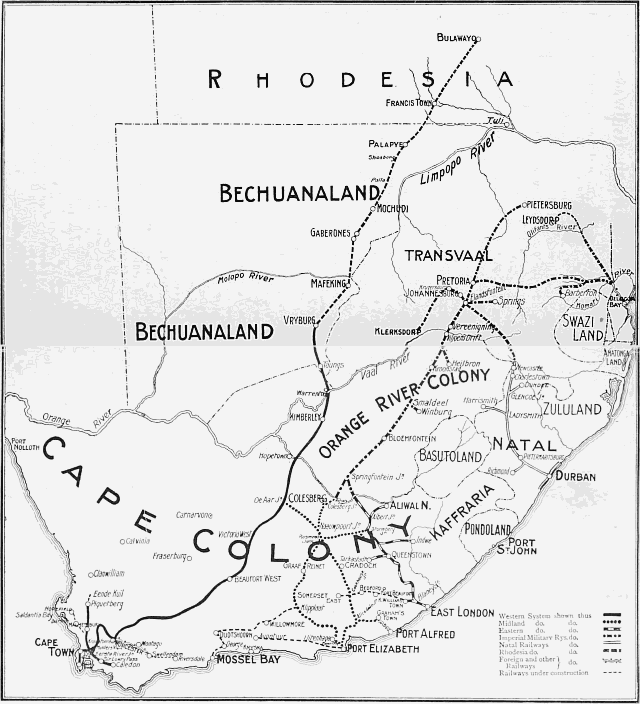
In conclusion, a word may be said of the important part played by South African railways in the late war. A German strategist predicted that with the existing railway systems of South Africa it would be impossible to feed an army of 250,000 men in the interior of the country. Yet it was actually done, and not for a brief period only, but for nearly three years. Besides bringing the food-stuff for this host, and for the civil population besides, the railways transported guns, ammunition, horses and men up and down, back and forward as the commander-in-chief required. The magnitude of this work can be imagined when it is stated that no less than 126 trains were required for the final concentration against Delarey at Klerksdorp. The working of the railways during the war reflects the greatest credit on the managers and employées of all South African railways. It was impossible to tell when a train would run through a band of snipers, one or more of its occupants paying the penalty of death, or when the engine might be hoisted by a hidden charge of dynamite, and the machine and its drivers turned to wreckage. During the war the railway service required qualities of endurance and courage equal to those possessed by the bravest soldier in the field.
MORNING MARKET AT JOHANNESBURG Photo by Barnett & Co., Johannesburg
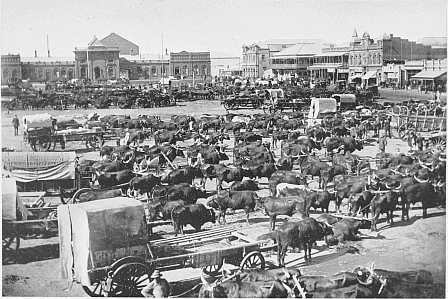
SOUTH AFRICAN INDUSTRIES
At present South African industries (outside of agriculture and pastoral pursuits) may be said to consist of mining and railways. The railways, in spite of heavy rates, have made a great mining industry possible. What could they do in respect of other and ordinary industries? It is a question of rates. Given recognition of the principle that railways should be the most essential part of the governmental plant spoken of by Lord Milner—plainly to be used for developing the country, and not for the use of extracting revenue to which it is at present put, not gold-mining alone, but a hundred industries would presently flourish. On the Rand there are already great engineering works contending against many difficulties, and especially the cost of labour. These works execute repairs for the mines, make castings, and even manufacture new machinery. A great future industry, which for the present is impossible on account of want of railway facilities, is the exploitation of the rich iron ores of the Transvaal. It is stated that a syndicate with large capital has been formed to undertake this work on a large scale when the conditions are favourable, and within the next few years it is probable that the Middelburg district will have smelting furnaces, foundries, rolling mills, and all the varied works of a young iron and steel industry which may eventually take a leading place in the world. Mr. Carnegie recently stated that the iron ores of Britain will be exhausted in twenty-five years, and those of the United States in sixty years. The extensive deposits of the Transvaal should last for centuries.
Another possible future industry is the distillation of oil from the shales of the Eastern Transvaal and the Orange River Colony. These deposits are at present being tested, and give promise of payability. Throughout South Africa there are many flour mills. The chief works being at Port Elizabeth and Cape Town and in the wheat district of the Orange River Colony. Other industries which have found a footing, and are now making steady progress, are leather-making, boot and harness making, wool-washing, jam-making, candle-making, waggon and cart building from colonial woods. All these industries are carried on chiefly in the Cape Colony and Natal. In the Transvaal there are pottery works, a cement factory, many breweries, and one distillery. In the Cape and Natal there are also several large breweries. One great industry which has arisen, owing to the mining wealth of the country, is the manufacture of explosives. There is a large dynamite factory at Cape Town owned by the De Beers Company, and another—the largest explosive factory in the world—at Modderfontein near Johannesburg. The Modderfontein factory cost upwards of three-quarters of a million to build. The works are spread over a large area, the property comprising 5280 acres. This factory was owned by a company with German, English, and French interests, formed to work the dynamite monopoly for the Transvaal Government. The high prices it charged, and the huge profits it made, being additional direct burdens on the already overloaded mining industry, were the causes of great discontent. Since the war the monopoly has been abolished. The company is now practically a British company, and its policy appears to be to meet its customers, and gain their goodwill. Prices have been reduced by 30s. a case The prices now being: blasting gelatine, 67s. 6d.; gelignite, 50s.; and dynamite, 50s. a case, as against 97s. 6d., 87s. 6d., and 77s. 6d. respectively before the war. These prices are fair, and it is stated are just sufficient to give a margin of profit. At present in the Transvaal it is a question of allowing free competition in explosives, or of just granting sufficient protection to the existing factory to enable it to live. As the factory finds employment for nearly 3000 hands, white and black, it would certainly be a national loss if it had to shut down.
In the nature of things in South Africa all classes of industrial undertakings are difficult to establish, and probably a moderate protective tariff would be beneficial to the country in the long run, as in the initial stages it would serve to turn the balance between profit and loss. Every industry successfully established adds to the white population, and is therefore to be welcomed. A policy of moderate protection then for industries, which could be fed by the natural resources of the country itself, should be carefully considered by the Government. Such a policy, together with a thorough cutting down of the present industry-killing railway rates, would go a long way to make a speedy beginning in South Africa of the great industrial activity which is sure to come eventually.