Volume 8 — APPENDIX MR. CHAMBERLAIN AND THE BOER GENERALS
Reading edition
Soon after the conclusion of the war Generals Botha, De Wet, and Delarey, in the hope of making favourable arrangements with the Government on behalf of their fellow-countrymen, sailed for England. They were greeted by the British people with unusual cordiality, not because of any sympathy with the Republics they came to represent, but because it is a characteristic of the British people to honour brave men, even when they are defeated foes. General Botha was received by Mr. Chamberlain, and the Boer future was discussed. A few days later the public was startled to read in the daily journals the following manifesto entitled, “Appeal of the Boer Generals to the Civilised World.”
“It is still fresh in the memory of the world how the Boers, after a terrible struggle lasting more than two and a half years, were at last obliged to accept through their representatives at Vereeniging the terms of peace submitted to them by the Government of King Edward VII. At the same time the representatives commissioned us to proceed to England in order, in the first place, to appeal to the new Government to allay the immense distress everywhere devastating the new colonies. If we did not succeed we were to appeal to the humanity of the civilised world for charitable contributions. As we have not succeeded up to the present in inducing the British Government to grant further assistance to our people in their indescribable distress, it only remains for us to address ourselves to the peoples of Europe and America.
“During the critical days through which we have passed it was sweet for us and ours to receive constant marks of sympathy from all countries. The financial and other assistance given to our women and children in the concentration camps, and to the prisoners of war in all parts of the earth contributed infinitely to mitigate the lot of those poor sufferers, and we take advantage of this opportunity to express in the name of the people of the late Republics our fervent thanks to all those who have charitably assisted us in the past. The small Boer nation can never forget the help it received in its dark hours of suffering.
“The people of the Republics were ready to sacrifice everything for their independence, and now the struggle is over and our people are completely ruined. Though we have not had the opportunity of drawing up an exact inventory of the destruction done, we have the conviction, based on personal experience, that at least thirty thousand houses on Boer farms and a number of villages were burnt or destroyed by the British during the war. Our homes with their furniture were burned or destroyed, our orchards were ruined, all our agricultural implements broken, our mills were destroyed, every living animal was carried off or killed. Nothing, alas, remained to us. The country is laid waste. The war demanded many victims, and the land was bathed in tears. Our orphans and widows have been abandoned. Besides, it is needless to recall the fact how much will be needed in the future for the education of the children of the Burghers, who are in great distress.
“We address ourselves to the world, with the prayer to help us by charitable contributions for our widows and orphans, for the maimed and other needy ones, and for the satisfactory education of our children. We allude to the terrible results of the war in order to bring to the knowledge of the world our urgent needs, by no means to inflame people’s minds. The sword is now sheathed, and all differences are silent in presence of such great misery. The ruin caused by the war is indescribable, so that the small amount which Great Britain is to give us, in accordance with the terms of surrender, even were it multiplied tenfold, would be wholly insufficient even to cover the war losses alone. The widows, orphans, maimed, needy, and children, on whose behalf alone we appeal, will receive little of this sum, and in most cases nothing.
“All contributions will be assigned to a fund to be called ‘General Fund of Help for the Boers,’ which will be devoted solely to supplying the wants of those for whom we are collecting, and to provide for their future. We solicit the hearty co-operation of the committees existing in the various countries of Europe and in America. We are now on the point of visiting these countries in succession with the object of establishing a satisfactory organisation.
“Botha. “De Wet. “Delarey.”
The lamentable representations of this manifesto naturally caused a profound impression—and the effect of them was not removed till late in the year when Mr. Chamberlain’s correspondence in relation to the matter was published. This correspondence merits more than superficial study by those truly interested in the pacification of the new Colonies, for the evil done by the pronouncements of the Boer “appeal” will live after them, while the good effected by the tardy publication of the Colonial Secretary’s refutation will probably be interred in the official mausoleum. To this end the opening despatch from Mr. Chamberlain to General Louis Botha, dated Downing Street, the 6th of November, is here appended:—
“Since the interview which you had with me at this office on the 5th of September an ‘Appeal of the Boer Generals to the Civilised World’ has been issued, many of the statements in which have, according to Press reports, been repeated and enlarged on in the speeches delivered by yourself and General Delarey and General De Wet during your tour on the Continent.
“The appeal, I regret to say, appears to me to convey an incorrect and exaggerated impression of the circumstances to which it refers, and though I have no desire at this time to enter into controversy, I cannot allow it to pass altogether in silence.
“In the first place I am at a loss to understand why the appeal should open with a statement that you have not up to the present succeeded in inducing the British Government to grant further assistance to your people. It is not, indeed, the intention of his Majesty’s Government to ask Parliament to authorise any addition to the free grant of £3,000,000—a grant which is itself without any precedent in the history of the world—but the promise of further assistance by way of loan on very easy terms, as provided by Article 10 of the Terms of Surrender, has never been withdrawn; and I think you will agree, on again consulting the record of our conversation, that there is nothing in the language which I then used which indicates any intention on the part of his Majesty’s Government to withdraw it.
“Further, the expenditure on the Burgher camps which, since the conclusion of peace, have to a great extent been transformed into organisations for enabling the people to return to their homes, and the cost of which has been about £200,000 a month, is being borne by his Majesty’s Government, and constitutes in effect a very considerable addition to the free grant.
“The cost of the camps since their establishment has exceeded £3,000,000, and there is no room for reasonable doubt that they have been the means of preserving the lives of thousands of women and children, and of providing the latter with a better education than they ever had the opportunity of enjoying before.
“I observe that in an article signed by you in this month’s Contemporary Review you make it a complaint that the concentration camps are still being maintained.
“It must be self-evident that, on the score of expense alone, it is the interest of his Majesty’s Government to abolish these camps at the earliest possible moment, and it is only in the cause of humanity that they continue to maintain this costly organisation.
“If they were to accept the inferences to be drawn from your statement they would turn out into the veldt thousands of men, women, and children whom it has been impossible to return to their farms immediately on the termination of the war, owing to the absence of sufficient transport and the scarcity of stock.
“They have, however, already provided for the return of large numbers of the population of the camps which had been reduced from 116,000 at end of May to about 34,000 in the last week of October.
“I observe that you are reported in the Press to have suggested in a speech at Paris that the British military authorities deliberately used the sufferings of women and children to induce their relatives in the field to lay down their arms, and in the resolution passed at Vereeniging on the 31st of May the sufferings of the women and children were given as a reason for surrender.
“No one deplores more than the British Government the high mortality in the camps during the epidemic of measles and pneumonia, but nothing was spared that money or science could afford to reduce it, and for the last six months the average total death-rate in the camps has been about 21 per 1000 per annum, a rate which must be much lower than any which obtained before the war in normal conditions.
“It is, therefore, clear from the statistics that at the actual time of the surrender there could have been no cause for anxiety as to the condition of the women and children then in the British camps; and in confirmation of this view I may remind you that neither at the time of your conferences with Lord Kitchener in February 1901 nor in the discussions which preceded the acceptance of the Terms of Surrender was any request made for special provision for widows and orphans.
“On the contrary, the request made on both these occasions was that the sums offered as a free grant by the British Government should be applied to the payment of notes and receipts for goods requisitioned by the Boer commandoes, in many cases from persons of considerable means. To this proposal his Majesty’s Government objected, and while willing that these notes and receipts should be accepted as evidence of war losses, they stipulated that the grant should be applied for the benefit of the destitute, or, in the words of the Terms of Surrender, ‘for the purpose of assisting the restoration of the people to their homes and supplying those who, owing to war losses, are unable to provide themselves with food, shelter, and the necessary amount of seed, stock, implements, &c., indispensable to the resumption of their normal occupation.’ As at present advised, I believe that the sum allotted will be amply sufficient for the purpose; but, should more be required, there is one source from which a substantial addition may be fairly expected.
“His Majesty’s Government are aware that large sums were remitted from the Transvaal to Europe during the war to be expended in the interests of the South African Republic.
“They have no desire to question the expenditure of this money so far as it was legitimately devoted to the purposes for which it was intended, but they cannot doubt that a large balance still remains which would properly come to them as the successors of the late South African Republic, and which they would be prepared to add to the fund provided for the relief of the distressed burghers and their families. I venture to think that in this matter your wishes will coincide with mine, and that you will give me any assistance in your power to discover the persons to whom the money was entrusted, and to obtain from them a statement of account showing the expenditure and the amount of the balance which remains over.
“I may add, with regard to the camps, that the reference in the manifesto to the pecuniary assistance furnished by foreign sympathisers appears to rest on a misconception. It consisted in the Transvaal of 2646 bales and packages, chiefly containing clothing and miscellaneous stores, which were brought up from the coast at military expense, and in the sum of £562, 2s. 2d. received and distributed through the Burgher Relief Fund. I have not yet received exact information as to the money contributions to the camps in Orange River Colony, but it was on a similar scale, and provides no ground whatever for an unfavourable contrast with British liberality.
“On the general question of your appeal for help for the widows and orphans, the maimed and the needy, and for assistance in the education of the children, I desire to say that the Colonial Government is making itself entirely responsible for the maintenance of all destitute orphans, including their food, clothing, supervision, and education. Large orphanages are already in existence at Irene in the Transvaal, and Brandfort and Springfontein in the Orange River Colony; and suitable provision is also being made for widows.
“The Government have been, and are, making themselves responsible for the education of the children. In the last year of the war £100,000 was spent on education in the Transvaal, and £32,500 in the Orange River Colony. At the date of the signing of peace the number of children in Government schools in the Transvaal was 28,000, and in the Orange River Colony 14,500. As a contrast to these figures it may be mentioned that under the late Governments the total number of children being educated never exceeded 15,000 and 9000, in the South African Republic and Orange Free State respectively.
“With regard to your statements as to the desolation caused by the war, I would point out that it was inevitable that much damage should be caused in consequence of the prolongation of hostilities long after there had ceased to be any reasonable doubt as to the issue of the war. Though the principal centres, such as Bloemfontein, Kroonstad, Winburg, Heilbron, Harrismith, Bethlehem, Ficksburg, Ladybrand, Thaba N’chu, Bethulie, Fauresmith, Jagersfontein, Koffyfontein, Boshof, in the Orange River Colony, and Johannesburg, Pretoria, Potchefstroom, Klerksdorp, Heidelberg, Standerton, Middelburg, Lydenburg, Pietersburg, Nylstroom, Lichtenburg, Zeerust, Rustenburg, in the Transvaal, are practically untouched, it is no doubt the case that a large number of farmhouses and buildings have been damaged or destroyed by one or other of the belligerents or by natives. The value of such buildings in South Africa is, however, in most instances not very great, and the pecuniary loss is probably more than compensated by the increased value of the land. The heaviest loss, and that temporarily pressing most hardly on the people is, no doubt, the loss of their stock; but the statement that every living animal was taken away or killed is a great exaggeration. A recent census taken in the Orange River Colony shows that, excluding animals belonging to the military and Repatriation Department, there are now in the colony over 120,000 head of cattle, 700,000 sheep and goats, and 27,000 horses. Similar figures for the Transvaal are not yet available, but the local government is spending very large sums to supply stock in both colonies. The Repatriation Department in the Transvaal is using 36,000 animals for transport alone. It has already issued some 20,000 head of stock to the farmers, and is in a position to issue another 35,000 by December 1. Assistance is being given in the Orange River Colony on a like scale, and ploughs and implements are being supplied as far as it is possible. So far, indeed, from being a desert the country will, if rain is abundant, be extensively cultivated at the end of the year; and it is the earnest hope of his Majesty’s Government that the strenuous efforts now being made by the local governments, seconded by the co-operation of the people themselves, will result in bringing back a degree of prosperity in no way inferior to that existing before the war.”
This despatch satisfactorily disposed of many vexed questions, and comfortable corroboration of the statements made therein is to be found within the pages of General De Wet’s account of the “Three Years’ War.” There, though the General complains of the hardships endured by women and children, he can offer no suggestion as to how these sufferings might have been averted. On May 16 General Botha is reported to have said:—
“Throughout this war the presence of the women has caused me anxiety and much distress. At first I managed to get them into the townships, but later on this became impossible because the English refused to receive them. I then conceived the idea of getting a few of our burghers to surrender and sending the women in with them.”
On the 29th of May, General De Wet, speaking in favour of continuing the war, said:—
“I am asked what I mean to do with the women and children. That is a very difficult question to answer. We must have faith. I think also we might meet the emergency in this way. A part of the men should be told off to lay down their arms for the sake of the women, and then they could take the women with them to the English in the towns.”
Later, General Botha said:—
“When the war began we had plenty of provisions, and a commando could remain weeks in one spot without the local supply running out. Our families, too, were then well provided for. But now all is changed. One is only too thankful nowadays to know that our wives are under English protection. The question of our women folk is one of our greatest difficulties. What are we to do with them? One man answers that some of the burghers should surrender themselves to the English and take the women with them.”
It is gratifying to note how the horrible charges of barbarity, brought by persons ignorant of the real state of affairs in South Africa at the time of the war, are disposed of by this one sentence from the mouth of General Botha, “One is only too thankful nowadays to know that our wives are under English protection.” We owe General De Wet some gratitude for his book, bitter as it is, since he makes evident that a main reason for the surrender of May 31 was to ensure the safety of the women who were not in the concentration camps, and whom they feared could not be placed in those positions of security. It is plain that if the Boers could have charged the British Government with the protection of those women they would have held out for some time longer. In discussing the question of the destruction done, we have only again to turn to General De Wet’s history to discover how necessary was the burning of certain farms which, worked by Kaffirs under the direction of the women, were provision bases of the Boers; and how imperative too was the shooting of horses, since, to quote the General himself, the Boer is only half a man without his horse. Indeed, though De Wet complains of the methods of the British in carrying on the war, his own narration of his exploits—the wrecking of trains, the destruction of railways, the burnings of the veldt, and the stripping of prisoners—offers the “best explanation yet published of the necessity for the measures of which he complains.”
To return to General Botha. In reply to Mr. Chamberlain he wrote from Horrex’s Hotel, Norfolk Street, Strand, on the 12th of November, stating:—
“... That there were some misunderstandings as to the reasons which led to the appeal to the world on behalf of their fellow-countrymen, which he wished to try to remove. In the first place, however, he sincerely shared Mr. Chamberlain’s desire to avoid controversy, the more so as there were some assurances in the Colonial Secretary’s recent speech—which he (General Botha) was privileged to hear—of a kind to gratify all who had the fortunes of his destitute fellow-countrymen at heart. He wished also to say that he and his colleagues welcomed Mr. Chamberlain’s decision to visit South Africa, and his determination to see the condition of their country with his own eyes, and form a first-hand judgment on its needs.”
Dealing then with the “misunderstandings” which he wished to remove, General Botha wrote:—
“We made no secret in accepting the Terms of Surrender that the compensation or assistance therein promised would be totally inadequate to enable the Burghers of the late Republics who remained in the field or were in the prisons and concentration camps to make a fair start in life again. On the contrary it was made clear by us that in the absence of further help from the British Government we would have at once to appeal to the charity of the civilised world for further help for the widows and orphans of our Burghers, and for those who had been rendered unfit for work by wounds or sickness during the war....
“It was only from your speech of November 5th that we learnt that the grant was intended entirely for all who are destitute, or who cannot make a fresh start in life without help. We always understood that the £3,000,000 were to be given in partial compensation for war losses, and that that was also understood by Lord Milner is clear from his despatch of June 11th (published in Blue Book, Cd. 1163, page 141), in which he expresses his intention of distributing it pro rata to those who can prove losses through the war.
“It therefore appeared to us that the free grant made no general provision for widows, orphans, and the destitute except in so far as they could prove war losses, and we distinctly gathered from your remarks that you could do no more for them. Under these circumstances we issued our appeal. We were, I need not say, highly gratified to learn from your recent speech that the Government would undertake a fuller responsibility for those needing their help, and particularly for the information that if more money than has been voted should be needed, the loan would be increased accordingly. We feel sure that it will ultimately be found that the £3,000,000 already assigned will by no means suffice to meet what is required as a free gift. Meanwhile, the needs of the sufferers are pressing, and we are glad to think that the sums which, through the generosity of the public, we have been able to collect, will to some extent minister to them without any delay, while they will also supplement what is being done by the Government.
“In regard to the loan, the provision lately made and the promise that the amount would be augmented if necessary came as a great relief after the months of waiting and suspense, when we were continually being told of those who, from lack of timely assistance, were compelled to part with their property to meet the urgent wants of themselves and their families. Some further and more detailed information as to the terms and conditions under which loans will be obtainable would be gratefully welcomed by the people interested.
“With regard to your reference to the free grant of three millions as something ‘without any precedent in the history of the world,’ I wish to say nothing that can excite or prolong controversy. You must only allow me to remark that the whole circumstances are unprecedented; that the gift of £3,000,000 was one of the conditions upon which the burghers laid down their arms; and that our view is, that having taken the assets of our Governments, you may fairly be expected to meet their liabilities, not in part, but in full.
“In regard to the large sums of money alleged by you to remain unexpended in Europe out of sums remitted by the Transvaal to Europe during the war, I can only assure you that I have no knowledge of any such remittances, and should be surprised to find that any were made. There is no sum of money belonging to the late Government known to me over which I have any authority whatever. I can only say that should any such sums exist I personally should be very glad to see them devoted to the objects mentioned.”
Passing to the subject of the concentration camps, General Botha said it was not his intention in the references he had made to them to suggest that they ought to be broken up before the people could be brought back to their farms. He proceeded:—
“We recognise that towards the close of the war improvements were introduced into them, in consequence of which the death-rate fell to an ordinary figure; but we do not know on what grounds you asserted that a death-rate of 21 per 1000 was lower than that which obtained before the war in normal conditions, and we are not prepared to agree that that was the case. My remark at Paris about the sufferings of the women and children had reference more particularly to those remaining outside the camps, who had their dwellings, with the furniture, food, and all that they contained, burnt or destroyed by British troops; their herds killed or removed, and themselves left destitute on the veldt. These were certainly sufferings, and they did carry great weight with us, among other reasons, in inducing us to surrender.”
While admitting that the Government was making great efforts to carry on the work of education in the camps, General Botha said he could not help sharing with his colleagues many objections to the large orphanages which had been referred to. He also wished to point out with reference to the pecuniary and other assistance given to the Boers in their misfortunes by “foreign” sympathisers, that in cash and in kind they totalled a value more than a hundredfold what Mr. Chamberlain had been led to suppose. On the subject of the desolation caused by the war, General Botha continued:—
“You are about to proceed to South Africa yourself, and if—as I have no reason to doubt will be the case—you get some of our own people to go over the country of the late Republics with you, you will be able to judge for yourself whether the description of the ruin and desolation as given by myself and others of us was—nay, I might almost say, if it could be—exaggerated.... If your allusion to ‘one or other of the belligerents’ is meant to suggest that the destruction of houses was practised by us you have been misinformed. My orders were definite that no houses should be destroyed; I know of only four cases where the orders were contravened, and in those instances every endeavour was made to trace the perpetrators, and where known they were promptly punished.”
General Botha further stated that he had no definite information relative to the increase in the selling value of the land, but the figures quoted showed to any one who knew the country before the war the fearful loss which had taken place in cattle, sheep, and horses. He concluded:—
“I regret to have to dwell on these points, and have done so only to remove misunderstandings as to the grounds for our appeal for aid. I do not doubt your desire to restore peace and the elements of prosperity to our unhappy country, and I would wish that we might so far as possible avoid controversy as to the past, and address ourselves entirely to the necessities of the present.”
To this letter Mr. Chamberlain replied, on the 15th of November, as follows:—
“I have the honour to acknowledge the receipt of your letter of the 12th of November, in reply to my comments on statements contained in the ‘Appeal of the Boer Generals to the Civilised World,’ and in their speeches on the Continent.
“I appreciate the spirit of the last paragraph of your letter, and share the wish which you express therein, and in view of my approaching visit to South Africa I will not prolong the present correspondence.
“I trust that during my tour I may gain much valuable information which will assist his Majesty’s Government in their efforts to restore peace and prosperity to the countries which have suffered by the war.”
On the 18th of November, General Botha wrote the following answer:—
“I have to thank you for your letter of 15th instant, and wish only to say, in reply, that I cordially join in the hope that your visit to South Africa may be a step towards that restoration of peace and prosperity to our desolate country, which I am sure that it is your desire to promote.”
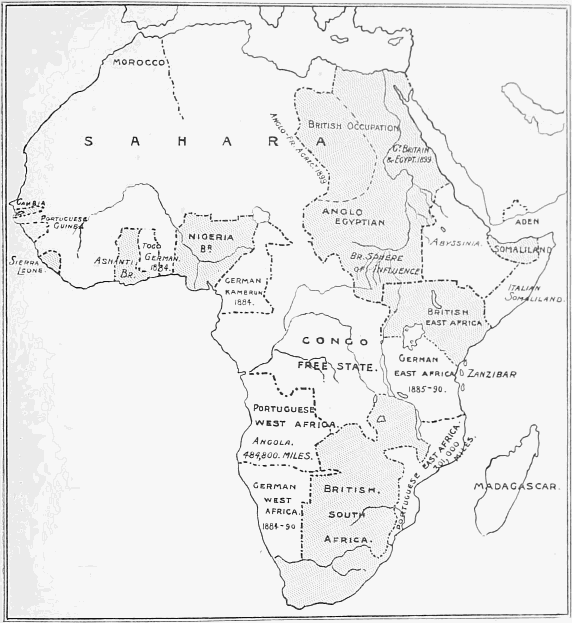
The above map shows the position of the three Powers mainly concerned with the future of South Africa. The total mileage of German territory is said to be about 931,460 miles; that of Portuguese territory about 790,240 miles. The British possessions include the following:—
Sq. miles
Basutoland 10,293
Bechuanaland 213,000
Cape Colony 221,311
Central African Protectorate 42,217
East Africa 1,000,000
Zanzibar Protectorate 1,020
Natal 29,200
Nigeria 400,000
Orange River Colony 48,326
Rhodesia, Southern 144,000
Rhodesia, North-Eastern 120,000
Somaliland 68,000
Transvaal 119,139
Swaziland 8,500
Gold Coast 40,000
Lagos 28,910
Gambia 4,500
Sierra Leone 30,000
Total area 2,528,416
These figures are taken from The Statesman’s Year Book for 1902. The areas of Barotseland, Adansi, and Ashanti are not included in the list, as the figures for these areas are not given.
TRANSCRIBERS' NOTES
General: Variable hyphenation of gold(-)fields, over(-)sea, food(-)stuffs and break(-)down as in the original text
General: Variable accenting of regime as in the original text
Page 8: millitary corrected to military
Page 10: some corrected to same after "for South Africa generally,"
Page 60: hundered corrected to hundred
Page 64: Winkie standardised to Wankie after "being constructed through the"
Page 72: comphrehensive corrected to comprehensive
Page 84: intercouse corrected to intercourse
Page 101: The last part of the caption for the illustration of DRIVING AN "END" IN MAY CONSOLIDATED MINE, JOHANNESBURG is illegible and has been omitted.
Page 125: Oliphants as in the original text
Page 131: Kafirs as in the original text
Page 147: Candian corrected to Canadian in "The Canadian Pacific Railway"
Page 150: Machadadorp standardised to Machadodorp after "A line from Springs to"
Page 154: employées as in the original text
Page 159: Teneriffe as in the original text
Page 162: redwater standardised to red-water
Page 169: toxines as in the original text