Volume 8 — SOUTH AFRICAN FEDERATION
Reading edition
VIEWS OF COLONIAL PREMIERS
By E. B. OSBORN
Author of “Greater Canada”
I
Unification has always been an ideal of South African statesmen, and twice, at least, it has been within measurable distance of realisation. In 1858 Sir George Grey, who had federated the New Zealand settlements despite the intensity of their local jealousies, promulgated the first practical scheme of South African Federation. So well had he ruled the Kaffir tribes on the eastern border of Cape Colony, that the Free State, weary of warfare with the Basutos, made overtures for a federal alliance, and the proposition of the Volksraad was actually laid before the Cape Parliament by Sir George Grey, before the opinion of the British Ministry in regard to his scheme of federation on New Zealand lines and their sanction for the course actually pursued had been received. Sir George Grey was recalled; though on his arrival off the British coast he found that he had been reinstated by a new Secretary of State, the delay led to the loss of an excellent opportunity for carrying through a measure comparable in importance with the Act which brought about the legislative union of Upper and Lower Canada.
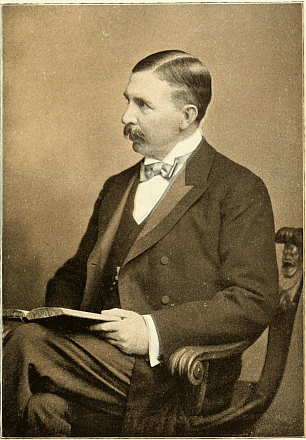
Photo: Elliott & Fry, London.
HON. SIR W. F. HELY HUTCHINSON,
Governor of Cape Colony.
For many years after the failure of Sir George Grey’s attempt, unification was a little-regarded counsel of perfection. It is true that the Duke of Buckingham, Secretary of State for the Colonies in the Disraeli Ministry of 1868, admitted that it would be politic to consider seriously any further overtures for a federal alliance from the Boers, but the Free State was no longer in the mood to make them, our annexation of Basutoland being resented, and the discovery of diamonds on its western border in 1867 having created fresh causes of irritation. When the second Disraeli Ministry came into power, and Lord Carnarvon, who had collaborated with the Canadian Fathers of Federation (he himself may be described as the Godfather of the Dominion), undertook the charge of colonial affairs, the plan proposed by Sir Henry Barkly for a confederation of South Africa, which should be the logical consequence of the grant of autonomy to Cape Colony, was cordially received. Unfortunately the Free State held aloof, the Cape Ministry remembered only too well the object lessons in anti-Imperialism received from Lord Carnarvon’s predecessors, and a grain de sable—the tactlessness of Mr. Froude—caused a vast amount of friction. Even then, but for the revival at home of the belief that political quietism and a policy of non-interference with Colonial affairs would enable Great Britain to retain the commercial hegemony of the world, Lord Carnarvon’s hopes might have been realised; for he had grasped the all-important fact that South Africa was, and must always remain, a single-minded community, whenever the native question was discussed, and that this unity of opinion was a stronger motive for unification than any or all of those political or commercial considerations which had already led to the making of the Dominion, and seemed certain, sooner or later, to bring about the federation of the Australian Colonies.
In more recent years three men of commanding influence have, each in his own way, attempted to realise the ideal of unity. Mr. Kruger’s attempt to lay the foundation of a Dutch confederacy, the future greatness of which would have been based (can we doubt it?) on some form of slavery, may be dismissed as an instance of the adage, corruptio optimi pessima. Mr. Cecil Rhodes worked for a federation on the model of the United States; since the Cape was half Dutch, the Transvaal was to be made half British, and the settlement of Rhodesia was to insure the preponderance of Imperial ideas in the Union of the future. He saw that the Boers must be persuaded to co-operate, and for that reason he allied himself to Mr. Hofmeyr, the unofficial leader of the Boer party in Cape Colony, who also had his federal scheme. Had the two Boer leaders agreed to work loyally together in their disloyalty, it is conceivable that they might have brought about an act of federation in the Boer interest, and have constitutionally demanded from Great Britain the removal of her garrisons from South Africa, a naval station at Simon’s Bay being conceded in order to retain the essential measure of Imperial protection. Such, at any rate, seems to have been Mr. Hofmeyr’s dream. But, instead of being content to widen and deepen the influence of the Afrikander Bond until such time as the term “suzerainty” should have been interpreted by the heirs to Mr. Gladstone’s South African policy, Mr. Kruger decided to make use of his hoarded armaments, and the future of his great raid involved the failure of Mr. Hofmeyr’s long-meditated plan of—shall we call it?—constitutional disloyalty. Nevertheless the twofold ideal of unity, which inspired the acts both of those who deserved and those who did not deserve to succeed, has survived all these vicissitudes, and was never more strong than at the present moment. Indeed it is obvious that not only the British and Dutch inhabitants of South Africa, but also all responsible politicians and competent publicists in Canada and Australia, are now of opinion that complete solutions of the three South African problems of primary importance—the settlement of the native question, agricultural development, and railway administration—can only be obtained through a Federal Parliament, a body which would combine a detailed knowledge of local conditions with the power of seeing each problem as a whole, and devising a general solution.
II
The foregoing contains the gist of many conversations with those who have a special knowledge of South Africa and South African affairs. The opinions of Sir Albert Hime, the Prime Minister of Natal, who may certainly claim to speak in this matter on behalf of the South African loyalists, were expressed as follows in an interview with the writer:—
“I am convinced that the majority of South Africans are anxious to see a ‘United South Africa,’ and I believe they will see it before long. I cannot, of course, speak for the Dutch; but I am sure that every ‘Britisher’ in Natal and in Rhodesia, and nine out of every ten ‘Britishers’ in the rest of South Africa, are in favour of federation. The great problems of South African development can only be completely solved by a central authority. The native problem, for example, which is the most serious of all, is a case in point. The difficulty of obtaining a sufficient supply of native labour—a difficulty only to be overcome by increasing the wants of the natives—is only one phase of this problem, but it will supply an illustration of the necessity of considering the interests of the whole country in dealing with such matters. As things are arranged at present, the planters and farmers of Natal have a reasonable cause of complaint in the fact that all their available supply of native labour is drawn away to the Rand mines. I may add that the solidarity of South African opinion in regard to the treatment of the natives—all white men in South Africa are agreed, for example, that they must never have the franchise, and that no attempt should be made to create a navvy class in South Africa to compete with the natives in the unskilled labour market—is a great unifying influence. The matter of agricultural settlement is another problem which should be considered with reference to the general interests of the whole country. There is an impression current in certain quarters that immigration should be diverted into the new Colonies. But once the conception of a United South Africa is grasped, it is obvious that a new British settler in Natal will do as much for the maintenance of British supremacy as a new British settler in the Transvaal. If South Africa is not to become a country of two or three large cities in a huge, sparsely settled territory, the problem of agricultural development should be dealt with on the broadest lines, and in the interest of the whole country. Natal has no intention whatever of pursuing a selfish policy in regard to the work of procuring settlers or of obtaining a share of the Transvaal traffic.”
Asked to express his opinion as to when the “United South Africa” of his hopes would come into being, Sir Albert Hime naturally enough refused to suggest a date. “But I am strongly of opinion that federation should take place before the new Colonies receive self-government, or, at any rate, concurrently with that event. That would be the safest course; for it is quite possible that the new Colonies, after they had received autonomy, would refuse to join. Once they have attained the privileges of self-government as part and parcel of a ‘United South Africa,’ I do not think there would be any special friction; if there was, it would gradually disappear as local jealousies grew less.”
“Though I do not regard the question of South African Federation as a matter of merely academic interest,” continued Sir Albert Hime, “yet I think it would serve no useful purpose to discuss the details of a federal scheme at the present moment. But, for my own part, I do not regard the arguments of Mr. Cecil Rhodes in favour of making Cape Town the federal capital as conclusive. In a speech at Bulawayo, Mr. Cecil Rhodes summed up those arguments in a forcible manner, and his bequest of Groote Schuur as a residence for the Premier of the United South Africa that is to be, is an additional argument of considerable weight. But I am inclined to think that the fact that the Cape Peninsula is, as Mr. Rhodes said, the seaside sanatorium of South Africa, would not compensate for the remoteness of Cape Town from the centre of the new federation. And, again, if Cape Town were chosen there would be a tendency to make too much of Cape politics, and the spirit of Cape politicians might tend to dominate the Federal Parliament. Johannesburg would be a bad choice. Living will always be costly there, and the influence of cosmopolitan capitalists might be exerted with bad results. Of course we should be glad to have the capital in Natal, but I do not expect we shall have that honour. All things considered, Bloemfontein would perhaps be the best choice. Or we might follow the example of the United States, Canada, and Australia, and settle the claims of the existing capitals by creating a new city for our federal capital.”
III
Sir Edward Barton was at first unwilling to express an opinion on a subject “in which many with better knowledge have a deep interest.” “But I am confident,” he continued, “that before many years have passed away we shall see a Federated South Africa, and that no South African will wish to return to the old order of things once that federation has come into being. I still believe that the form chosen for the constitution of the Australian Commonwealth was the best available, and I think that it would be better suited to South Africa than the Canadian form. But whichever form is chosen, the whole community will benefit by federation.
“We in Australia have had great difficulties to overcome, and a certain amount of friction has necessarily arisen between the States and the federal authority, but the history of the United States and of the Dominion shows that such difficulties and friction cannot be avoided, but can always be surmounted. With the exception of a few discontented persons, I think nobody in Australia would be in favour of a return to the old order of things, and it is already clear that the local jealousies which hampered Australian progress are vanishing. When I was in British Columbia nine years ago, I tried hard to find a man who believed that the act of confederation should be undone; but I could not discover such a person. There may be a few ‘Blue Noses’ in Nova Scotia who would like to see confederation abolished, but I never met one. In either case, the fact that Annexationists are few—too few to be counted—in Canada, explains my failure. And once South African Federation is an accomplished fact—and though the racial antithesis, as was the case in Canada, renders the accomplishment more difficult than in Australia, where a difference in opinion as to fiscal policy was the chief obstacle—I am very sure that the vast majority of South Africans, whether British or Dutch, will refuse to contemplate a change to the old state of local jealousies. The sooner South African Federation comes, the better for South Africa.”
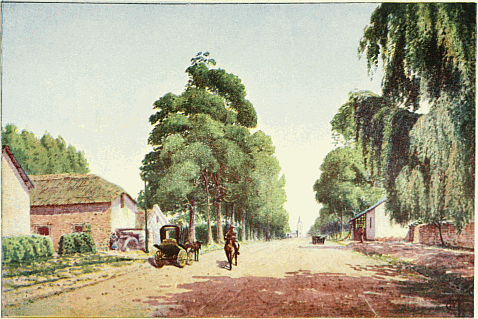
CHURCH STREET, PRETORIA THE APPROACH TO THE TOWN. Drawn by Donald E. M’Cracken.
Asked to answer the question: Should federation come before the new Colonies receive self-government, or concurrently with that event? Sir Edward Barton replied that in his opinion either course would create difficulties for the future.
“Australian Federation,” he continued, “came out of the will of the people. The result of a referendum proved that a majority of the people was in favour of federation, and all the States consented to the terms thereof. Now if the Transvaal and the Orange River Colonies, communities that have enjoyed a form of self-government in the past, had not free choice of assent or refusal, and joined the South African Federation under compulsion (no matter how slight a measure of compulsion), constitutional difficulties might spring up in the hereafter. Disputes might arise between the federal authority and these two States, and they would say, ‘We were not asked for our consent, we had not complete freedom of choice.’ In any case, representation must be given to them, and it would be awkward if two out of the five Federal States or Provinces were trying to overthrow the federation. I do not say this would happen, but the possibility of such an emergency should be seriously considered. It would be safe, I think, to work and wait for a majority in favour of federation; more especially as there has existed and still exists, as I am informed, a strong feeling that the interests of both peoples in South Africa would be furthered by such a measure.”
IV
Neither Mr. Seddon nor Sir Wilfrid Laurier granted the writer’s request for an expression of opinion in regard to the possibility or probability of South African Federation. Mr. Seddon, though he is always ready to advise the various Provinces of the Empire in commercial matters, is averse to interfering in other people’s politics. Moreover the word “federation” has a discomfortable sound in the ears of his New Zealand constituents; to a few it suggests Rossetti’s “might-have-been,” to most its echo is a more or less decided “certainly not.”
Sir Wilfrid Laurier, who has suffered much from the too imaginative interviewer, both in the United States and in France, makes it a principle not to be interviewed. But a day or two after he had courteously declined to grant the writer’s request, he was good enough to allude to the subject of South African Federation in a speech at Edinburgh, from which the following excerpt is taken: “In my humble opinion,” said the Canadian Premier, with reference to the attempt of Mr. Rhodes to secure the unification of South Africa, “Mr. Rhodes made one mistake. He made the mistake of being too impatient. Had he allowed time for development, had he allowed the Dutch population to get reconciled to the idea of British citizenship, they would have had much sooner than will be the case the federation of South Africa, which is the only future of that great country.”
To judge from the spirit of his utterances in Canada on the subject of South Africa, it would appear that Sir Wilfrid Laurier’s opinions as to the best means of working towards the end of South African Federation do not materially differ from those of Sir Edmund Barton. He believes that the free consent of the new Colonies should be obtained, and that the policy pursued with regard to Manitoba by the “Fathers of Confederation”—a policy of which he disapproved at the time, a policy which led to a long series of disputes between Manitoba and the Dominion Government—should not be pursued in the case of the Transvaal and Orange River Colonies. It will be remembered that the “Red River Settlement” received Provincial status on condition of becoming a member of confederation, and that the terms of membership were accepted under compulsion, and in the hope that they could be bettered.