Volume 8 — PROBLEMS AND POSSIBILITIES
Reading edition
By JAMES STANLEY LITTLE
Author of “South Africa,” “The Progress of the British Empire in the Nineteenth Century,” “The United States of Britain,” &c. &c.
The magnificent vagueness of the subject the editor of this volume has, in his wisdom, thought fit to apportion to me might have its conveniences, were it not that such pregnant matters as emigration, federation, education, irrigation, and half-a-dozen subjects besides, all of which bristle with problems and possibilities of the most clamant kind, are ruled out of this paper, in that their consideration has been entrusted to highly competent and patriotic writers, upon whose preserves it would be unbecoming to poach. Nevertheless, it must be obvious to everybody that it will not be possible to attempt a comprehensive analysis of the problems and possibilities of the future, and to keep entirely clear of these all-important factors in the case; seeing that every political, ethnical, financial, and economic problem impinges on these special subjects of which one and all are a part.
THE RESETTLEMENT OF THE TRANSVAAL A BOER FAMILY RETURNING TO THEIR FARM. Drawing by Chas. M. Sheldon.
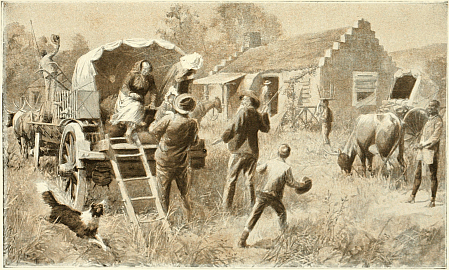
As to the political situation to-day, it seems scarcely to be apprehended in this country that the lines of cleavage between parties and factions at the Cape, and indeed in the new colonies, are by no means simple ones. In South Africa generally it is not merely a case of Briton versus Boer; it is not in Cape Colony simply a case of Dutch Africander versus British loyalist. In the Transvaal the problem is not solely how to bring the Boers and English together, or how to conciliate and retain the loyalty of those men, largely of British origin, formerly known as Uitlanders. A labour party, championing a programme practically identical with that with which all students of later-day politico-social questions are familiar, is coming into existence, and is, I think, certain to make itself a power in the land as time advances. It has been frequently, if somewhat hastily, assumed that in South Africa generally parties will follow the lines of division common to most civilised communities, and range themselves in camps, the composition of which will be determined respectively by the place of residence and occupation of the units of the people; the interests, sentiments, and aspirations of the town dwellers being at variance with those of the rural inhabitants. In a sense, we may take the people of Johannesburg to represent what passes for the urban population of old-settled countries. Roughly speaking, the citizens of the older established and smaller towns were dependent for their existence, and are likely to continue to be so dependent, on the agriculturists, since outside the Rand the Transvaal had no industries, no manufactures worth considering: for some time to come she is not likely to have any. So the Rand stood and stands for the towns, and the Uitlanders for the townsmen. The rest of the State stood and stands for the country, and, the agriculturists being mainly Dutch, the Boers stand for the countrymen. In the future, however, the race question, which has practically overruled any dividing lines drawn on the basis of townsmen and countrymen in Cape Colony, should cease to govern, in quite the old way, the political antagonisms of the inhabitants of the Transvaal; in any case, if the various schemes for settling British farmers in the land are crowned with reasonable success, it will no longer be possible to regard the rural Transvaalers as simply Boers, and the townsmen as simply Britishers. At present in the Transvaal there exists, of course, the great and principal division of its people, the British and philo-British versus the Dutch and philo-Dutch. But the interests of the great mining companies are not now, and never can be, on all-fours with those of the operatives; while the traders are likely to find their ideals at variance with those of the mining magnates and operatives alike. Obviously there will be no immediate community of interest and aim between the old Boer farmers and the new British elements introduced on to the land. The differences of the townsmen are likely to be more strictly economic than political; but they must necessarily take a political complexion in the process of their devolution. It would be rash to attempt anything in the shape of a precise forecast; but it certainly seems to me quite unlikely that the future divisions into parties of the citizens of the Transvaal can take the simple form of Briton versus Boer. No doubt the existence of the two races, living side by side, with the remembrance of a century’s differences between them, will continue to give a decided tincture to the parties to be formed in the future. It depends entirely on the kind of statecraft Great Britain brings to bear on the settlement of the new colonies and on its results, whether the progressive elements in the existing population—the population waiting for the gates to be opened to it may, for the purposes of this argument, be considered as entirely progressive—range themselves on the side of British imperialism, or whether they will join themselves to those forces, already existing, which openly or secretly aim at the establishment of a republican régime. It is quite a mistake to suppose that these forces—republican sympathies, that is to say—are at the moment entirely to be sought for in the Boer camp. It is, or it ought to be, common knowledge that the internal movement for reform on the Rand, and for the elimination of the Dopper-Hollander dominance of Pretoria, was not exactly inspired or sustained by men who wished to see the Transvaal an integral portion of the British Empire. At the same time, it is not denied that a great many sympathisers with this movement, and not a few of its active supporters—the late Mr. Rhodes, for instance—were above all things anxious that when the Transvaal flag was hauled down the Union Jack should be run up.
Apart, however, from such considerations, matters of history, it may be allowed that whatever the nationality or preferences of respective Uitlanders at that time of day, a rough sense of justice would reconcile most of them now to the flag of the country, which at enormous sacrifice of treasure and men has procured their release from the bondage of Pretoria. It is equally certain, more so in fact, that their acceptance of the British flag, now and hereafter, is and will be contingent on the treatment they receive at the hands of the new Government. Already many voices are heard in the land declaring that, so far from the new Government having brought relief to the mining industry and to the Uitlanders—and it must be clearly understood by all Englishmen, however much they may resent the fact, that upon the prosperity of the mines not only the welfare of the Transvaal but of all South Africa depends—it has increased its burdens. The limits of space will not permit any exhaustive examination into the basis of this complaint. Mr. Chamberlain, before these lines are in the hands of the public, will doubtless be on the spot examining into the grounds of the complaint. It would be clearly impossible for any one to accuse me, of all persons, of favouring the millionaires, or of holding a brief for their views and interests. But this is not a millionaires’, or a mining question; it is the question of the to be or not to be of South Africa as a British dependency. It may be said at once, that if, as Mr. Chamberlain at one time indicated, the somewhat contradictory and superficial report drawn up by Sir David Barbour, full of inconsistencies and injustices as it is, is to be accepted by the British Government, then I would not care to purchase at any price a seven years’ repairing lease—a repairing lease with a vengeance—of British tenure of South Africa, much less the freehold of the property. Whether he be a financial expert or not, no man who possesses a sound working knowledge, personal knowledge, of South Africa and its affairs can study this report and preserve his equanimity. It fills one with fear and trembling. Sir David Barbour’s proposals savour of the arbitrary confiscation of mining profits. This perhaps, standing alone, would not matter much from a South African point of view, since the loss would mainly fall on the hundreds of thousands of English and foreign shareholders interested in the mines; according to the Statist, the British public has something like £250,000,000 invested in the mines. However, it is not with such losses we are at present concerned. My contention is that if the Transvaal is taxed out of all proportion to its wealth—its immediate or permanent prospects even; if the new colonies, despite the heavy losses from the war, and the serious—for a long time to come it will be serious—dearth of labour contingent thereon, is burdened with taxation, the incidence of which is to be double, or in any case greatly in excess of the monstrous charges levied by Kruger and his advisers; if the Transvaal is to be saddled with a heavy war debt, then the financial, political, and economic ruin of South Africa in general, and the Transvaal in particular, must follow as an inevitable consequence, and this will happen even should a short respite be given. I have set forth again and again, in the columns of the Times and Post, and in the Anglo-African journal I formerly conducted, that apart from the uneconomic and impolitic nature of these suggestions, they are morally unsound. He who calls the tune must pay the piper. The British people, by allowing themselves to be ruled and betrayed by men who persisted in blinding their eyes to the writing on the wall, though there were Daniels in abundance to interpret it to them; by allowing themselves to be served by an army wholly inadequate in numbers, and largely composed of inefficients, are responsible for the cost of a war which never would have taken place had British pro-consuls and colonists on the spot been trusted; their counsel listened to here, and their hands freed and actions upheld yonder.
Moreover, all such heroic schemes of taxation in the interest of the British taxpayer, of which Sir David Barbour’s report is a type, are based on proleptic statistics of an expansion which after all is problematical, and which in any case will not become solid fact if onerous conditions are imposed upon the Rand in advance of that expansion. The profits from the mines, great as they ought to be if we do not strangle the goose right away, are ephemeral profits—thirty to fifty years will see the last of them. Possibly the high-water mark of production will be reached twenty years hence, and from that time the decline will begin as in the case of the Australian and Californian mines. It is obvious, therefore, that a heavy war debt must press disastrously on the industry during its growth and during its decline. Taxation seems to have been proposed on the basis of the anticipation, as if it were already an accomplished fact, of the most prosperous days possible of attainment by the industry, and in entire obliviousness of the fact that no sooner is the zenith reached than gradual decline, ending in extinction, must supervene. Unjust taxation would be a suicidal policy; it would retard the flow of capital, render all but a few higher-grade mines unprofitable, with the result that the budgets of the new colonies would show deficits year after year. Not only would capital awaiting employment be frightened into other channels, but schemes of federation would remain sterile schemes; and the hope of a prosperous and united South Africa would continue a mere day-dream, impossible of accomplishment.
I have put this question of the taxation of the Transvaal in the forefront of this paper, because it is of pressing importance and immediate interest. Scarcely less important, though the subject will probably be dealt with more fully by another pen, is the question of land settlement. We are approaching this matter too parochially and timidly. If the land companies and burghers will not part with suitable land to settlers on reasonable terms, they must be made to do so. The example of New Zealand must be followed. It is absolutely essential that we should plant out settlers on a large scale; especially is it essential in view of the fact that the loyalty of the dwellers in Johannesburg and other mining centres is not to be counted on confidently. With these men commercial considerations are certain to be dominant. Even if they are not given the solid reasons for discontent already foreshadowed, reasons, real and imaginary, in plenty are certain to crop up. Hence their loyalty will not be a matter of sentiment, but one of calculation. Further, every help and encouragement must be given to the right kind of settlers; the country which spent over two hundred millions sterling in making South Africa a possible place for Englishmen to live in, should not grudge another ten, twenty, or if necessary thirty millions to make the conditions of life sufficiently attractive to the emigrating English agriculturist. The conditions underlying land settlement have been carefully studied by Mr. Arnold Forster’s Land Commission, and they were lucidly set forth in the report of that Commission. It remains for the Imperial Government to make them operative, by coming to the country for generous support. I can do no more here than record my absolute conviction, for what it may be worth, that if land settlement in the new colonies is to find its own level, so to speak; if we are trusting to men with the necessary capital, some £300 or more, to come forward in anything like sufficient numbers to affect appreciably the question of British versus Boer in favour of the British, or the problem of self-seeking Cosmopolitanism (purely commercial interests) versus sentimental and patriotic Imperialism, we are building our hopes on sand. The drawbacks to farming in Africa are many: absence of transport (and obviously without well-devised and speedily carried out railway schemes the internal development of South Africa is impossible); absence of navigable rivers; recurrent droughts (here again I may say that nothing less can avail than grand schemes of organised irrigation such as those favoured by Mr. Hedger Wallace and by Mr. Willcocks in his luminous report); cattle disease and locusts. The ignis fatuus of the Rand, it must always be remembered, is ever present to lure away the settler when he has once been induced to settle. To the Englishman the love of isolation is not generally the strongly developed vice or virtue it is with the Boer. Consequently, we must go before the settler and prepare the way for him. Large and well-organised schemes of planting families on communal principles, freely scattered over the land in the midst of the Boers, both from an economic and political point of view, are absolutely necessary if we are to retain our hold on the country, or ensure its permanent prosperity. Under proper conditions and safeguards, generous schemes of female immigration must be initiated. It has been said, and I do not gainsay it, that South Africa requires almost immediately 70,000 more women. Also the Children of the State, the waifs and strays, the foundlings, those who are physically and morally fit, of course, should be sent out to South Africa, there to be carefully prepared in proper establishments for colonial life. In this matter we may well learn wisdom from the early Dutch settlers, who, under an arrangement with the Amsterdam authorities, received into their midst a number of foundlings. From these the present race of sturdy burghers has sprung. The subject is too vast for detailed treatment here; else much might be said about the policy of obliging all male settlers to bind themselves to a course of military training and contingent service, and as to the expediency of encouraging a respectable number of Canadians and Australians to make their home in South Africa. It is, in any case, obvious that no tentative tinkering with the question of land settlement can avail.
The sooner we face this necessity the better; since the sooner it is in a fair way to being faced, mastered, and provided for, the sooner can those electoral and legislative concessions we have promised the Boers, and which honour, justice, and expediency oblige us to grant at the earliest possible date, be granted. As things now are, we have a British autocracy in power, alternating in turn between the desire to repress the clamant demands of the one great industry of South Africa—the gold mines, and dread of that powerful confederacy—the Rand magnates. The methods and example of the great financial corporations and financial princes are not, to write temperately, conducive to the elevation of public morals; nor do they tend to give to the public life of a colony a high or healthy tone. Students of Mr. Cecil Rhodes’ career cannot fail to notice the disintegrating effect on that great patriot’s manners, and on his public and private procedure, which resulted from his close association with, and inexplicable reliance on, men, most of whom (it would be invidious to specialise the exceptions) lived and moved and had their being on a plane infinitely lower than Rhodes’ natural one. The destinies of the new colonies are for the moment nominally in the hands of British officials. These officials have practically nobody to go to for counsel but the mining and financial experts. This is not as it should be. The sooner there is a free play of interests and opinions between the Boers, British settlers, and Johannesburgers the better. These divergent classes, all colonial, however antagonistic their interests and prejudices, must fight out their differences among themselves as best they may. The British official, excellent as he is in dealing with subject races, is not seen at his best in controlling men of his own flesh and blood—men, I should say, of his own colour—when these men are in a position of political inferiority to himself.
The mention of this subject reminds me, that one of the most effective arguments in favour of granting representative institutions to the new colonies as quickly as may be is to be found in the native question. In this matter, as indeed in every matter, colonial opinion asserting itself through the necessarily imperfect, but only possible, system of parliamentary institutions, must be respected. As to the native question, an enormous majority of British South Africans, though it may reprobate certain tendencies to undue harshness, brutality even, still observable in the conduct of Boers of the baser sort, is nevertheless convinced that the Dutch attitude toward the native is, in its essence, the only possible or safe one. There is not the smallest fear that anything in the shape of compulsory labour will be sanctioned by any legislature in South Africa. But that the principles and provisions of that most statesmanlike Act, the Glen Grey Act, will be further extended there can be no doubt.
That the labour question throughout South Africa, and especially as it affects the mining industry, is among the more difficult problems of the future, most persons are aware. It is said that in five years’ time 320,000 natives will be required at Johannesburg to work the mines, irrespective of enormous domestic requirements there. To this total we must add the hundreds of thousands needed for industrial and household work throughout South Africa. It is estimated that in five years’ time there will be no more than 600,000 working Kaffirs south of the Zambesi. It is obvious that under the most favourable computation the supply is certain to continue to be totally inadequate to the demand. This is the more apparent when it is remembered, that it is only possible to get a small proportion of able-bodied Kaffirs to work at all, and that the average service of these willing ones is not more than four months a year, taking one year with another. Doubtless the new laws as to capitation tax, and the modifications in the direction of greater stringency in the hut tax, alterations which must have the effect of reducing the economic evil of polygamy, will effect some amelioration in the conditions now obtaining. But the lowering of wages and the prohibition of the liquor sale have retarded the immediate supply. I have had to listen before now to arguments in favour of the unrestricted sale of liquor to the natives, and in advocacy of establishing drinking booths from one end to the other of the Rand. This would be as suicidal, politically and socially, and in the long run as uneconomic a policy as could well be devised, to say nothing as to its cynical immorality. Of course, when schemes of organisation are perfected, and labour is largely drawn from Central Africa, the employers will enjoy some measure of relief; but in the end, unless relief comes from that highly debatable source—the importation of coolie labour—the prejudice against white labour in Africa will have to break down: a way out, I am sure, always provided the whites can be differentiated and segregated from the blacks, which cannot but be fraught with results of lasting benefit to the country, in procuring for it a solid substratum of Caucasian settlers who will become the industrial backbone of the country. The indirect advantages of such an innovation cannot be reaped, however, if schemes of heavy taxation are to be sanctioned. The margin between loss and profit in working most of the mines—they are what are called in city slang “low-grade propositions”—is so small, that a slight increase even in the price of labour would often make mining unprofitable.
The employment of white labour would have the effect of disabusing the minds of the natives of the growing conviction that they are necessary to our well-being and existence. The truth is not so far short of this; but we must not make it apparent: we must try to make it less true than it is. During the war the native, spoiled by the military, did not gain respect for the Englishman. He is a shrewd fellow, and although our arms were victorious in the end, he cherished no delusions. Man for man, he has seen for himself how much more effective as a fighter the Boer was than the Briton. Enjoying special advantages—his knowledge of the country and his control over the Kaffirs—the Boer was enabled to make the best use of his superior marksmanship, tactics, and mobility; with the result that it was easy for him to inflict much greater damage on his opponents than that opponent, with all his courage and spirit, could inflict in return. The native has seen our men lying in ghastly, mutilated masses. He has seen few such spectacles on the Boer side. The native is no sentimentalist. He is much like a prevalent type of modern young woman—fond of laughing, enjoyment, gew-gaws and sweets, while viewing everything from the standpoint of self-interest. In brief, despite his jollity he is as hard as nails. It is perfectly right that we should show him some consideration as the descendant of tribes who conquered the land some century or so earlier than we conquered it; for, except so far as being an inhabitant of the continent is concerned, it is absurd to talk of the existing South African tribes as aborigines. But if the “nigger” will not work, he must in the long run give place to men who will, to British and Continental labourers and to other British subjects—the coolies of India, for instance—men who will work, and who are now starving, or are on the brink of starvation, for the want of it. That this step is not to be taken lightly I am free to admit. It is fraught with grave difficulties and dangers—political, economic, and ethnical—considerations which are by no means to be minimised even if for a larger good—South Africa cannot be allowed to languish for lack of labour—they will have to be ignored.
LORD MILNER By Mortimer Menpes. From “War Impressions,” by arrangement with Messrs A. & C. Black, London.
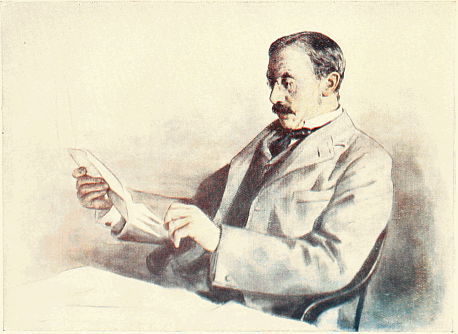
There can many, indeed in most directions, the civil administration of the new colonies, so far as it has been provided, is highly creditable to Lord Milner and the able men associated with him. So excellent and so thorough is the work accomplished—in education, in replacing the machinery of the higher civil administration throughout the colonies—that, without hyperbole, it may be said to fill one with admiration and wonder. If one could always be sure of getting such a man as Joseph Chamberlain at the Colonial Office, and such a man as Alfred Milner as High Commissioner, one would be strongly in favour of retaining permanently as much power as possible in the hands of the holders of these two offices. But it is not possible to count upon a succession of such ministers. It is noteworthy, and I would especially emphasise the point in view of what is to follow, that the appointment of Lord Milner and Mr. Chamberlain to their respective offices may be said to have been in defiance of precedent. Since the institution of the Colonial Secretaryship half-a-century ago, ministers appointed to the office have almost invariably been noblemen of little or no importance. Again, Lord Milner’s earliest career was not official. He was quite out of the groove in which the men who become colonial governors usually run. It is regrettable, that the success of these two statesmen does not give the Government heart of grace to put appointments in the new colonies more largely into the hands of men of proved initiative and originality—men who have not had any good which may have been in them strangled by red tape and flummery in the public offices. The complaint as to the appointments made in the Transvaal—appointments of untried striplings and callow fledglings from the universities, is doubtless exaggerated; but it is well to remember that putting power into the hands of the “curled darlings of the nation” was one of the chief causes, among many contributory causes, of the failure of Sir Theophilus Shepstone’s policy; the reason why the annexation of the Transvaal, with the tacit consent and approval of the majority of its people, was subsequently repudiated by them.
However that may be, it is extremely regrettable that a country, possessing so many good men, men in every way indicated by their abilities and achievements as successful administrators in posse, is constantly at a deadlock for the lack of suitable public servants. I could mention spontaneously, without having time for reflection and for selection, a round dozen, probably a score, men of parts full of the sense of our imperial responsibilities, and certain to be able and zealous in the Empire’s service: men accustomed to positions in which initiative and sound judgment are demanded of them, who, pining to be men of action, to play their part, however humble, in affairs of State, affairs of which they possess a firm grip, are condemned to enforced inactivity, buried away in country houses, or, let us say, wasting their energies in mere constructive synthesis or destructive criticism, for which, alas! no one is much the better. These men, the born administrators of our over-seas dominions, are lost to the Empire, because of the red-tape exclusiveness and jealousy of the ruling classes of this country.
I have been betrayed for the moment into an academic consideration, and let me say here that I sorrowfully endorse—I might add that in a large measure I have publicly anticipated—most of the strictures on our system of misgovernment, corruption, and panoplied vice set forth in the letters of that sturdy Africander signing himself by his true initials “P. S.” Under these abuses we groan, and it is difficult to continue to hope that we shall escape from their tyranny, and rise again to that full manhood of our race asserted in the spacious days of Elizabeth, and again when Napoleon threatened our shores. Our grand old country is sinking deeper and deeper into the morass of spiritual and intellectual indifferentism, sordid materialism, and time-serving opportunism. One sees scant justification for optimism, unless, indeed, Judgment should descend upon us and beneficently scourge us back to our nobler past.
It is not, however, with these larger issues I am at this moment directly concerned. Despite the constant drains upon our best and most vital manhood the possession—protection and administration—of the most extensive empire of this or any age impose upon the United Kingdom, upon, that is to say, a small and no longer rapidly increasing nation, I do not believe that there would be any ground for the fear that we have annexed more territory than we can effectively administer, or that we have incurred greater responsibilities than we can sustain, if we had the presence of mind, the initiative and sense to utilise those latent sources of unexhausted supply we now wilfully neglect. The immediate bearing of these remarks reveals itself when the serious problem of the personnel of the magistracy of the new colonies is mentioned. Every one knows that the landdrosts under the old régime, men for the most part rough and unlettered, were habitually underpaid and habitually corrupt. The inadequate salaries paid to these men are, it seems, now being continued to the new magistracy, and this despite the enormous increase in the cost of living, with the result that men of quite inferior parts are mainly available for the positions; while, when from stress of life and circumstance, men of the right stamp, men to whom Boer and Kaffir can look up as their natural superiors, chance to fill these offices, they are unable, by reason of their poverty, to live in a way or to comport themselves in a manner consistent with the dignity of their offices.
In the Transvaal, and indeed in South Africa generally, it behoves us to welcome all comers from Europe and America, not being adventurers or wastrels—all and sundry who can contribute to the good of the country and who are willing to become loyal citizens. It will be madness to attempt to build up a South African nation from these islands alone. England is a small country and the English are gradually ceasing—and this tendency is certain to increase—to rear large families. In the past, in our own land as well as in our realms beyond the seas, our chief glory has been in our genius in amalgamating different strains, bringing them all into the fold as patriotic Britons. The British Empire is now more than ever a crucible wherein metals, precious and base, may be wrought into a fine amalgam. Whether as a limb of a great and regenerated British Empire, and therein my individual hopes lie, or as a powerful republic on the pattern of the United States, there ought to be no question as to the future of South Africa. Mr. Chamberlain said again only the other day that the prosperity of South Africa in the not far distant future would doubtless exceed the dreams of the most sanguine visionary. So let it be. Many shrewd Americans are of the same mind. No doubt the immediate expansion in South Africa’s import trade is due to military requirements, while the shrinkage of its export trade may be attributed mainly to the war having put a stop to the recovery and exportation of gold. The cost of living throughout South Africa, at present extraordinarily high, is certain to be reduced to more reasonable limits when the railways are permanently relieved from the control of the military. It must be remembered, too, that while a fair proportion of favoured individuals among the colonists have reaped huge harvests by the war, a far greater number have been crippled and ruined outright by it. It is not for me to deal with the problems of trade; but I may say that even should some scheme of the favoured-nation kind be extended to British imports by the South African Realm to be, that in itself would not serve, nor will the spirit of patriotic preference for British goods suffice to preserve the trade of South Africa for this country. The matter rests with our manufacturers, exporters, and their agents; and no one, not being a self-deceived egoist, can pretend that the more alert, adaptive, and modern methods of American and German houses are not certain, unless our countrymen turn over a new leaf, to prove too much for our laissez-faire, self-sufficiency, and careless indifference.
In this matter the best men, be they English, German, or Yankee, will win. But this is a home rather than a South African question. In any case, we may expect soon to see a considerable influx of capitalists, farmers, and traders, and they cannot but give an impetus to South Africa’s reviving fortunes, let political ineptitude do its worst. I have endeavoured to show wherein lie the chief obstacles to progress in the new colonies. In the old—Natal would in any case seem to have an era of immediate prosperity before her—the future is darkened by considerations all too apparent for the most optimistic or blind to overlook or ignore. The Africander Bond and the Dutch Reformed Church have not buried the hatchet. Throughout South Africa it is, of course, the duty of the loyal South African of British origin or British sympathies to endeavour to recognise at their best the many sterling qualities of the Dutch, and to forgive with what charity he may their besetting sins, condoning them as the resultants of environment and circumstance. It is also their duty to recognise that the past mistakes of Downing Street were chiefly due to lack of brain and thought, rather than to lack of heart, and to determine to work with all true patriots for the lasting good and welfare of South Africa.
Unhappily there is ample evidence to show that the Dutch Reformed Church and the Africander Bond are as active for evil as ever. How great is the terrorism exercised by the Commissie van Toezicht (the Secret Council of the Bond) is illustrated to-day by the abject recantation of the Rev. Mr. Botha, a pastor who, having counselled his countrymen to submit to the inevitable and accept British rule as far back as September 1901, now stands in the white sheet of repentance, and abjectly craves to be forgiven for what he calls his temporary weakness and backsliding! Undoubtedly disloyalty to the British Empire throughout South Africa has its fons et origo not in the Transvaal but at the Cape. For the moment the Bond lies low. It has gained everything it can hope to gain for the present. This the most superficial student of Cape politics can see. The problem of how to reconcile divergent elements at the Cape, and to make the Cape Dutch as loyal to the Empire as the French Canadians to-day, not that their loyalty is unimpeachable, is an extremely complicated one. At the Cape it is by no means merely a question of Dutch versus English or of Town versus Country. Many of the most active enemies of Great Britain are to be found in the houses of the old Dutch families inhabiting the suburban districts of Cape Town—Wynburg, Rondebosch, and so forth. It is also true that among those old Dutch families no more loyal subjects of the king are to be found. Unhappily English associations, close intercourse with Government House, intermarriage with English families, and education at our universities or at the Temple here, do not always ensure that the Dutch Africander will be loyal to Great Britain. Even more to be regretted is the fact that many colonists of pure British descent, birth even, are merely nominally loyal to the Imperial connection, if as much as that. Their loyalty is of the opportunist kind. Because of their hatred of the Dutch propaganda, and because they fear that the Dutch, if left to themselves, would become “top dog,” they tolerate British institutions. We cannot blame them over much for this attitude, when we remember how miserably we have deserted our countrymen in the past; how we have left them to the tender mercies of the Dutch; how we have neglected their warnings and advice, and brought ruin and misery upon them because of our short-sightedness and stiff-neckedness.
Even now the British colonist has many substantial excuses for averring that loyalty does not pay. In view of these facts it behoves Great Britain to admit frankly her past errors and to resolve, if she means to retain her hold on South Africa, to order her footsteps differently in the future. It behoves Great Britain, if she would avoid future risks of triangular disloyalty and the grave disasters, local and international, which might supervene on another period of neglect and snubbing, to trust the men on the spot. It behoves her to govern South Africa firmly, consistently, and unemotionally; to have done with Majubanimity and all its works once and for all; all folly, such as paltering with the language and education questions, whereby the sentiments and interests of loyal British colonists are flouted and ignored. Great Britain must, however, do everything that she can consistently do to bring the two European races—English and Dutch—together. If she is to do this, if England is to retain a firm grip on South Africa, we must continue strong, let it be said rather we must renew our strength here in the centre of the Empire. Within the next half-century it is probable that the last ounce of gold will have been extracted from the Transvaal’s deepest deep levels. Within half that time the impending struggle of the world Powers to establish themselves in unassailable positions will have taken place. Germany is forced by an inexorable law of self-preservation to find an outlet for her commerce and her people on the seas. Every thinking German, from the Kaiser downwards, tells us as much frankly. We can see it for ourselves. She must find employment, food, and raiment for her highly prolific people, for their own land is by no means rich in natural wealth. As to Africa, our hold on it depends entirely upon the strength of our national grip. If our hand is growing flabby and listless, and, alas! there are too many indications that such is the case; if France is to gain her ends in the Mediterranean; if sentimental views in regard to the natives are to prompt us to stand idly by while such organisations as the so-called Ethiopian Church of the United States working from the south, and the emissaries of a militant Mahommedanism from the north, conspire informally to undermine their loyalty, then our days in Africa are numbered. In the last event, our hold on that continent in general and South Africa in particular depends upon character, especially the character of our ruling classes. The possibilities of this country in Africa are magnificent; but the problems to be solved, if these possibilities are to be realised, must appal and finally overcome all but the stoutest of heart. The world, and South Africa with it, will fall to the nation which breeds and sustains the best men.