SOIL CULTURE. (continued 7)
Reading edition
ROOT CROPS.
It is important that American farmers learn to attach much greater importance to the culture of roots. The potato is the best of all roots for feeding; but, as the yield has become so light in most localities, and the demand for it for human food has so greatly increased, it will no longer be grown extensively as food for animals. Farmers must, therefore, turn their attention to beets, carrots, and parsnips. Reasonable tillage will produce one thousand bushels to the acre of beets and carrots, and two hundred more of parsnips. These roots, raw or cooked, are valuable for all domestic animals. A horse will do better on part oats and part carrots, or beets, than upon clear oats. For milch cows, young stock, and fattening cattle, and for sheep and fowls, they are highly valuable. With the facilities now enjoyed, they may be raised at a cheap rate. Plant scarlet short-top radish-seed in the rows, to shade the vegetating seed and young plants, and to mark the rows, to facilitate clearing and stirring the ground, while the plants are very young, and using the most approved root-cleaners, and the same amount of food can not be grown at the same price in any other crops.
SAFFRON.
This is a well-known medicinal herb, as easily grown as a bean or sunflower. It is principally used in eruptive diseases, to induce moisture of the skin and keep the eruption out. Sow in any good soil, in rows eighteen inches apart, and keep clean of weeds. When in full bloom, the flowers are gathered and dried.
SAGE.
This is a hardy garden-herb, easily grown. Its value for medicinal and culinary purposes is well known. It is propagated by seeds, or by dividing the roots. With suitable protection in winter, roots will live for a number of years, bearing seed after the first.
Varieties are, the red, the broad-leaved, the green, and the small-leaved green. The red is most used for culinary purposes, and the broad-leaved is most medicinal. All the varieties may be used for the same purposes. Any garden-soil, not decidedly wet, is suitable for sage. Raise new plants once in three or four years. Plants may be renovated, by certain culture and care, but it is better to grow new ones. Cut the leaves two or three times in the season, and dry quickly, and put away in paper bags; or, better, pulverize and cork up in glass bottles. This is the best method of preserving all herbs for domestic use.
SALSIFY, OR VEGETABLE OYSTER.
This is a hardy biennial vegetable, resembling a small parsnip, and as easily grown. When properly cooked, its flavor resembles the oyster, whence its name. Sow and cultivate as parsnips or carrots. It is suitable for use from November to May. It is better for being allowed to remain in the ground until wanted for use, though it may be well kept, in moist sand in the cellar. Care is necessary in saving seed as it shells and blows away like thistle seed, as soon as ripe. It must be sown quite thick, on account of its proneness not to vegetate. It should be more extensively cultivated.
SCRAPING LAND.
This is a process needed only on land that has not been under cultivation long enough to become level. All new land has many knolls of greater or less size. As soon as the roots are out sufficiently to allow it, the knolls should be plowed and leveled with a common scraper. Most farmers neglect it as injurious to the soil, and too expensive. But when we consider that rough land never gets well plowed, and that the gradual wearing away of the knolls will continue their unproductiveness for a number of years, it will be seen that the cheapest way is to plow and scrape the land level at once, and thoroughly manure the places from which the soil has been scraped.
SEEDS.
The best of everything should be saved for seed. Peas, beans, corn, tomatoes, &c., should not be gathered promiscuously, finally preserving the last that matures, for seed. Leave some of the finest and earliest stocks, and from them save seed, not from the first or the last that matures, but from the earliest that grows large and fair. Save tomato-seed from those that grow largest, but near the root. Gather all seeds as soon as mature, as remaining exposed to the weather is unfavorable to vegetation. Dry in a warm place in the shade, but not too near a stove or fire. Keep in paper bags, hung in a dry airy place, beyond the reach of mice.
Trying the quality of seeds is important, as it may save loss and disappointment, from sowing seeds that will not vegetate. A little cotton wool or moss in a tumbler containing a little water, and placed in a warm room, will afford a good means of testing seeds. Seeds placed on that wool, will vegetate sooner than they would do in the soil. But a more speedy, and generally sure method, is by putting a few seeds on the top of a hot stove. If they are good they will crack like corn in parching; otherwise they will burn without noise, and with very little motion. The improvement or declension of fruits, grains, and vegetables, depend very materially upon the manner of gathering and preserving seeds. Gather promiscuously and late, and keep without care, and rapid declension will be the result. Gather the earliest and best, and plant only the very best of that saved, and constant improvement will be secured.
SHEEP.
These are the most profitable of all domestic animals. The original cost is trifling, and the expense of raising and keeping is so light, and the sale of meat, tallow, hide, and wool, is so ready, that sheep-growing is always profitable. So important has this always been considered, that in all ages of the world, there have been shepherds, whose sole business it has been to tend their flocks. Were the flesh of sheep and lambs more extensively substituted for that of swine, in this country, it would be equally healthy and economical. American farmers do not attach to sheep-growing half the importance it deserves. We recommend a thorough study of the subject, in the use of the facilities afforded by the writings of practical men. We can only give the outlines of the subject in a work like this. A theory has been scientifically established by Peter A. Brown LL. D. of Philadelphia, in which it is shown that all sheep are divided into two species, Hair-bearing and Wool-bearing. These species crossed, produce sheep that bear both wool and hair, as the two never change. The hair makes blankets that will not shrink. The wool is good for making fulled cloth. Blankets made from the fleeces of sheep that are the product of the cross of these two species, will shrink in some places and not in others, just as the hair or wool prevails. It is also true that the hair-bearing sheep delight in low, moist situations and sea-breezes, while the wool-bearing sheep does best on high, airy, and dry land. These fleeces all pass as wool, but the microscope shows a marked and permanent difference, and one can easily learn to distinguish it at once, by the touch and with the naked eye. This is thrown out here to induce a thorough examination of the whole subject. There are three staples of wool, short, three inches long, middling, five inches, and long, eight inches. Varieties of sheep are numerous. We shall only mention a few. The question of the best breeds has been warmly controverted. We have no disposition to try to settle it. The question of the best variety must depend upon locality and design. If the wool is the object, then the Vermont Merino for the North, and the pure Saxony for the South, are evidently the best. If located near large cities, where the flesh is the main object, then the large-bodied, long-wooled breeds are much preferable. Among those much esteemed we note the following:—
The Cotswold mature young, and the flesh will vary in weight from fifteen to thirty pounds per quarter. The New Leicester is less hardy than the Cotswold, but heavier, weighing from twenty-four to thirty-six pounds per quarter. The Teeswater sheep, improved by a cross with the Leicester, is considered valuable. The Bampton is one of the very best grown in England. Fat ewes average twenty pounds per quarter, and wethers from thirty to thirty-five pounds. The Sussex, Hampshire, and Shropshire varieties of the Down sheep, are all highly esteemed. The Leicester are very valuable. An ordinary fleece weighs from three to five pounds. Mr. Joseph Beers of New Jersey had one that sheared thirteen pounds at one time, and the live weight of the sheep was 378 pounds.
There are French, Silesian, and Spanish Merinoes, much esteemed in Vermont and elsewhere. The average weight of a flock of ewes of French merinoes after shearing was 103 pounds. Their fleeces averaged twelve pounds and eight ounces. The fleece of one buck of the same flock weighed twenty pounds and twelve ounces.
The French Merino Ram.
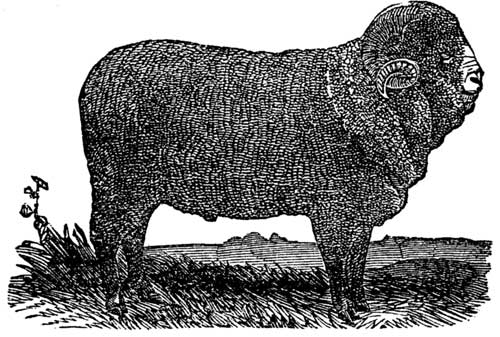
The Silesian Merinoes are smaller, but produce beautiful fleeces. In a flock of nineteen ewes, the average weight of fleece was seven pounds and ten ounces, and that of the buck weighed ten and a half pounds.
A large flock of Spanish Merinoes yielded an average of a little over five pounds of well-washed wool. All these varieties are valuable for wool. The wool of the pure Saxony sheep, however, is best.
The Tartar sheep, called also Shanghae and Broadtail, is a recently-imported breed, of great promise for mutton. Their fleece is a fine silky hair, making fine blankets that will not shrink, but not good for fulled cloths. The ewes are remarkably prolific, producing sometimes five lambs at a time, and often twice a year. One ewe bore seven lambs in one year, all living and being healthy. The flesh is of the highest quality. This may stand at the head of all our sheep as a market animal. The cross of this with our common sheep has proved fine. They need to be further tested in this country. A new kind of sheep has also been imported from Africa, within a few years; a variety unknown to naturalists, but having some points in common with the Tartar sheep.
Diseases of Sheep.—There are several that have been very troublesome, but which experience has enabled us to cure. Scours is often very injurious. A little common soot from the chimney, or pulverized charcoal, is a sure remedy. Mix it with water, not so thick as to make it difficult to swallow, and give a teaspoonful every two hours, and relief will soon be experienced.
Water in the head is a disease caused by long exposure to wet and cold. This is prevented by a small blanket on the back of the sheep. The wool on the backs of sheep will be seen to be often parted, exposing the skin. Water falling on the back will penetrate the wool and run down, and wet and chill the whole body. A small cotton blanket, fifteen inches wide, and long enough to reach from the neck to the tail, fastened to its place by tying to the wool, and painted on the outside, will cause all the water to run off, saving the health of the sheep, and causing him to require less food. In the cold, wet season, every sheep should have such a blanket; they would cost three or four cents each, and be worth many times their cost in the saving of feed for the animals. The more comfortable an animal is, the less food will he require. Applying tar above the noses of sheep at shearing, that they may be compelled to smell it and eat a little for a long time, is considered favorable to their general health, and a preventive of rot.
The foot-rot, in cattle, sheep, and hogs, is a prevalent disease. Boys walking the path, barefoot, where such diseased animals frequently pass, may contract the disease. This is always cured by washing in blue vitriol. Most cases are cured by one application, and the most confirmed by two or three. Make a narrow passage, where only one animal can pass at once. Put in a trough twelve feet long, twelve inches wide, and as many deep. Put in that fifty pounds of blue vitriol and fill with water, throwing a little straw over the top. Cause the diseased animals to pass through that, and they will be cured. This is thought to be an invariable remedy. If sheep do not appear healthy on lowland pasture, give them small quantities of fine charcoal and salt, and they will be as healthy as on the hills. A little salt for sheep is useful during the whole year. The health of sheep is injured more in fall than at any other season; they are very apt to be neglected at the beginning of winter. They grow poor rapidly when their green feed first fails; a little hay and grain and a few roots then will keep them up, prevent disease, and make it less expensive to keep them through the winter. Feed in racks or troughs, when they can not get their food under foot, and as far as practicable, under shelter, and in a warm place. It is much cheaper, and keeps the sheep much more healthy. They should have fresh water, where they can drink, two or three times a day. Salt, mixed with wood-ashes and pulverized charcoal, should also be constantly within their reach. A few beets, carrots, or parsnips, are always valuable. Some green feed is very essential for ewes, for some time before the yeaning season. Corn is good for fattening sheep; but, for increasing the wool, it is not half as valuable as beans. Good bean-straw is better than hay. Corn-fodder is excellent. The product of one and a half acres of land, sowed with corn, will winter, in fine condition, one hundred sheep—the corn sowed the 20th of June, and cut up after it has begun to lose its weight slightly, and shocked up closely, bound round the top with straw, and then allowed to stand till wanted for feeding. To have healthy sheep, do not use a ram under two, or over six or seven years old, and raise no lambs from unhealthy ewes or rams. The expense of keeping sheep, as all other animals, is much less when they are kept warm. Much feed is wasted in keeping up animal heat, which would be saved by warm quarters.
Sheep-manure is better than any other, except that of fowls. No other parts with its qualities by exposure so slowly. Some farmers save all labor of carting and spreading sheep-manure, by having movable wire fences, and putting their sheep on one acre for a few days, and then removing to another. One hundred sheep may thus be made to manure an acre of land in ten days, better than any ordinary dressing of other manure. We should prefer carefully collecting and saving it under cover, mixed with muck or loam, and apply where and when we choose. Keeping a suitable number of sheep on a farm is very important in keeping up the farm. A farm devoted to grain or vegetables, without a suitable number of animals, usually runs down.
The time when lambs should be allowed to come is important. We much prefer letting them come when they please, if we have warm quarters, and can take a little extra care of them. This will give a larger growth, and furnish large lambs for market, at a season of the year when they are most desired, and bring the greatest price. For those who will not take the necessary pains, let them come when the weather has become warm and grass plenty. Sometimes a ewe loses her lamb, and you wish her to raise one of another ewe's, that has two. To make a ewe own another's lamb, take off the skin of her dead lamb, and bind it on to the other lamb, and she will smell it and own the lamb; after which the skin may be removed.
Sheep-culture is a subject to which farmers should give increased attention, until the average weight of sheep in the United States shall become one third greater than at present, and until there shall be ten sheep to one of all we have at present.
SHEPHERDIA OR BUFFALO BERRY.
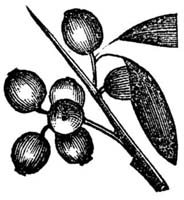
This is an ornamental shrub, growing from six to fifteen feet high, bearing a roundish red fruit, much esteemed for preserves. Trees are of two kinds, male and female, one bearing staminate and the other pistillate flowers. Hence no fruit can be grown without setting out the trees in pairs from six to fifteen feet apart. If you set out only two, and they chance to be of the same kind, you will get no fruit.
SOILS.
The nature and management of soils must be measurably understood by any one who would be a thorough cultivator. The productive power of a soil depends much upon the character of the subsoil. A gravelly subsoil is, on the whole, the best. A thin soil lying on a cold clay subsoil—the hardpan of the East, and the crowfish clay of the West—however rich it may be, will be unproductive; while the same soil, on a gravelly subsoil, would produce abundantly. The best soils, for all purposes, are the brown or hazel-colored. Plowed in wet weather, they do not make mortar, and in dry weather they will not break in clods. Dark-mixed and russet moulds are considered the next best. The worst are the dark-gray or ash-colored. The deep-black alluvial soils of the Western prairies are an exception to all other soils, possessing, under proper treatment, great powers of production. Soils do not, to any considerable extent, afford food for plants. A willow-tree has been known to gain one hundred and fifty pounds' weight, without exhausting more than two or three ounces of the soil, and even that might have been wasted in drying and weighing.
In our article on manures, we have shown that it is the texture of soils, and their power to control moisture and heat, that renders them productive: hence, no soil can be poor that is stirred deep and kept in a friable condition, without being too open and porous; and no soil can be good that is hard and not retentive of moisture, without having water stand upon it. Hence, the great secret of successful farming, is, such a mixture of the soils, and of fertilizers with the soil, as shall keep it friable and moist, and such thorough drainage as will prevent water from standing so as to become stagnant, and to unduly chill the roots of growing plants. Nature has provided, near at hand, all that is essential to productiveness; all that is necessary is to properly mix them. We do not believe that there is an acre of land now under cultivation in the United States, in a latitude where corn will grow, on which we can not raise a hundred bushels of shelled Indian corn, without applying anything but what may be raised out of that soil, and procured in the shape of manure by animals in consuming that product. The poorest farm in America may be brought up to a state of great fertility, without applying one dollar's worth of any foreign substance. Plow deep, turn under all the green substances possible, and feed out the products on the farm and apply the manure, and mix opposite soils, that may be found in different localities. Three years will secure great productiveness, and the same course will increase its value, from year to year, without cost. Three things only are essential to convert poor land into the best; deep and thorough stirring and pulverization, suitable draining, and thorough mixture of soils of different qualities, and the incorporation of such animal and vegetable substances as can be produced on the land itself. We would not declare against foreign manures, but insist that the necessary ingredients are found, or may be manufactured near at hand. The philosophy of deep plowing and thorough pulverization is obvious. A fine soil will retain and appropriate moisture in an eminent degree, on the principle of capillary attraction, or as a sponge or a piece of loaf sugar will take up water. There is also room for excess of water to sink away from the surface, and return again when needed. It also affords room for the roots of plants. Such a soil also receives moisture from the atmosphere. The atmosphere also contains much water, and more in the heat of summer than at any other time. The air also, with a constant pressure of fifteen pounds to the square inch, enters to a considerable depth into the soil, and the deeper it is stirred, and the more thoroughly it is pulverized, the more it will enter. In coming in contact with the cool moisture below, it is condensed and waters the soil, on the principle that a pitcher of cold water in a warm room has large drops of water on the outside; that water is a mere condensation of moisture in the atmosphere. The cool subsoil acts in the same way upon the atmosphere at night. A deeply disintegrated soil, also, seldom washes by rain. Shallow-plowed and coarse land sends off the water after a slight rain, while deep-plowed and thoroughly pulverized land retains it. The philosophy of manures involves the same principles. All the fertilizers act upon soils in such a manner as to render them fine, and open an immense surface to the action of the atmosphere, and form large reservoirs for moisture through their innumerable fine pores. Draining is to carry off an excess of water that would stand on an unfavorable subsoil. That water, on undrained land, causes two evils; it stagnates and renders plants unhealthy, and it is too cool, rendering land what we call cold. Thus, the deeper you plow land, and the finer you make it, the warmer it will be, and the more perfectly it will control moisture. Mixing soils by subsoiling, trenching, and deep plowing, and by carting on foreign substances, is wholly on this principle. Sand that drifts about with the wind is too light to retain moisture, and needs clay carted on. By this means the poorest white sand has often been converted into the most productive soil. Definite rules for this mixture of soils can not be safely given. The rules must differ in different localities and circumstances; it must, therefore, be determined by experiment. Analyzing soils is sometimes of use, but usually has too much importance attached. We do not advise farmers to study it. Let them try applications and mixtures, at first on a small scale: they will soon learn what is best on their farms, and may then proceed without loss. Some lands are of such a character that the carting on, and suitably mixing, the substances in which they are deficient, may cost as much as it did to clear the land of its original forest; but it will pay well for a long series of years. So well are we persuaded of the utility and correctness of these brief hints, that, in selecting a farm, we should regard the location more than the quality of the soil. The latter we could mend easily; while we should find it difficult to move our farm to a more favorable location. Poor land near a city or large town, or on some great thoroughfare, we should much prefer to good land far removed from market, or in an unpleasant location.
SPINAGE, OR SPINACH.
Both these names are correct; the former is the general one among Americans. This plant is used in soups, but more generally boiled alone and served as greens. In the spring of the year, this is one of the most wholesome vegetables. By sowing at different times, we may have it at any season of the year, but it is more tender and succulent in the spring. The male and female flowers are produced on separate plants. The male blossoms are in long, terminal spikes, and the female in clusters, close at the stalk, on each joint.
Varieties—The two best are the broad, or summer, and the prickly, or fall. There are three others—the English Patience Dock, the Holland, or Lamb's Quarter, and the New Zealand. The first two are sufficient. Sow in August and September for winter and spring use, and in spring for summer. Sow in rich soil, in drills eighteen inches apart. Thin to three inches in the row, and when large enough for use, remove every other one, leaving them six inches apart. To raise seed, have male plants at convenient distances, say one in two or three feet. When they have done blossoming, remove the male plants, giving all the room to the others, for perfecting the seed. Success depends upon very rich soil and plenty of moisture.
SQUASH.
There are several varieties of both summer and winter squashes. All the summer varieties have a hard shell, when matured. They are usually eaten entire, outside, seeds and all, while young and tender, from one quarter to almost full grown. They are also used as a fall and winter squash, rejecting the shell and that portion of the inside which contains the seeds. The Summer Crookneck, and Summer Scolloped, both white and yellow, are the principal summer squashes. The finest is the White Scolloped. The best winter varieties are the Acorn, Valparaiso, Winter Crookneck, and Vegetable Marrow or Sweet Potato squash. The latter is the best known.
Cultivate as melons, but leave only two plants in a hill. They do best on new land. Varieties should be grown far apart, and far removed from pumpkins, as they mix very easily, and at a great distance. Bugs eat them worse than any other garden vegetable. The only sure remedy is the box covered with gauze or glass. As they are great runners, they do better with their ends clipped off. Used as a vegetable for the table, and in the same manner as pumpkins, for pies.
STRAWBERRY.
None of our small fruits are more esteemed, or more easily raised, and yet none more frequently fails. Failures always result from carelessness, or the want of a little knowledge of the best methods of cultivation. We omit much that might be said of the history and uses of the strawberry, and confine ourselves to a few brief directions, which, if strictly followed, will render every cultivator uniformly successful. No one need ever fail of growing a good crop of strawberries. In 1857, we saw plats of strawberries in Illinois, in the cultivation of which much money had been expended, and which were remarkably promising when in blossom, but which did not yield the cultivators five dollars' worth of fruit. In the language of the proprietors, "they blasted." Strawberries never blast; but, for the want of fertilizers at suitable distances, they may not fill. There are but three causes of failure—want of fertilizers, excessive drought, and allowing the vines to become too thick. Of most of our best varieties, the blossoms are of two kinds—pistillate and staminate, or male and female—and they are essential to each other. The pistillate plants bear the fruit, and the staminates are the fertilizers, without which the pistillates will be fruitless. There are three kinds of blossom—pistillate, staminate, and perfect, as seen in the cut.
1. Perfect blossom. 2. Staminate blossom. 3. Pistillate blossom.
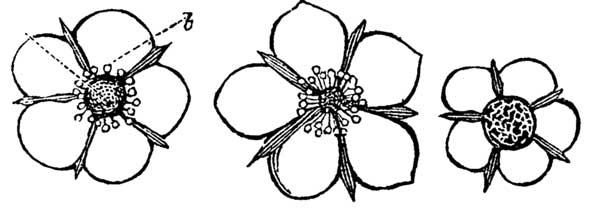
The first (1) is perfect; that is, has both the stamens and pistils well developed: this will produce a fair crop of fruit, without the presence of any other variety. The second (2) has the stamens large, while the pistils (the apparently small green strawberry in the centre) are not sufficiently developed to produce fruit: such plants seldom bear more than a few imperfectly-formed berries. The third (3) has pistils in abundance, but is destitute of stamens, and hence, will not bear alone. The two latter are to be placed near each other, to render them productive; they may be readily distinguished when in blossom. It is always safe to cultivate the hermaphrodite plants; that is, those producing perfect blossoms; but the pistillates and staminates, in due proportions, produce the largest crops, and finer fruit.
Soil.—Much has been said against high fertilization with animal manures, and in favor of vegetable mould only. We feel entirely satisfied that the largest crops of strawberries are grown on land highly manured with common barnyard manure. To plant and manure a strawberry-bed, begin on one side, and dig a trench eighteen inches deep (from two to three feet is much better) and as wide; put six inches of common manure in the bottom; dig another trench as deep, and place the soil upon the manure in the first trench; fill the last with manure as the first, and so on over the whole plat. Manure the surface lightly with very fine manure and wood-ashes.
Transplanting is usually better in the month of August. If done at that season, and it be not too dry, the plants will get such a growth the same season as to produce quite a good crop of fruit the next season. Planted as early in the spring as it will do to stir the soil, they are more sure to grow and yield a very few berries the first season, and very abundantly the next. If you would cultivate in hills, put them two feet apart each way; if otherwise, two feet one way, and one foot the other. Cut off the roots to two or three inches in length, and remove all the dead leaves; dip them in mud, which is a great means of causing them to grow; and set them in fine mould, the crown one inch below the level of the soil around, and leave it in a slight basin, and water it, unless the weather be damp. Many plants are lost from not being set low enough to escape drought. The basin will hold water, and nearly every plant will grow; excessive water will destroy them. Set out three or four rows of pistillate plants, and then one of the staminates, or fertilizers. Some set them out in beds and allow them to cover the whole ground, and cultivate by spading up the bed in alternate sections of eighteen inches or two feet each year, turning under, in the spring, that portion that bore fruit the previous season—which has long been recommended by good authority. This was the lamented Downing's method. We think rows preferable for this reason. The young plants formed by the runners are less vigorous after the first; hence, the tendency is to deterioration by this mode of culture. And this method does not afford so good an opportunity for stirring the soil around the plants as planting in rows; this stirring the soil is a great means of protecting from drought, and securing the most vigorous growth. Deep subsoiling between the rows early in the spring, or after fruiting, is valuable; hence, we always advise to cultivate in hills two feet apart each way, and renew them after they have borne two, or at most three crops.
Hermaphrodites are best for cultivation in beds. Many strawberry-beds do well the first year of their bearing, but are almost useless afterward. The cultivator says they all run to vines. In such cases, they overlook the fact that the staminate plants grow altogether the fastest, because their strength goes to support foliage in the absence of fruit, while bearing vines require much of their strength to mature the fruit; hence, if they are allowed to run together the second, or at most the third year, the fertilizers will monopolize the ground and prevent fruiting. This is the greatest cause of failure of a crop, next to a want of both kinds of plants. This is the origin of fears of having land too rich. It is said it all runs to vines without fruit; this is because the wrong vines have intruded—the staminates have overcome the pistillates. We reject the whole theory of the luxuriance of the vines preventing the production of fruit. The larger the vines the more fruit, provided only the vines are bearers, and not too thick: hence this invariable rule—always have fertilizers within five feet, and never allow the two kinds to run together. Manures should be applied in August, well spaded in. Applying in the spring to increase the crop for that season, is like feeding chickens in the morning to fatten them for dinner—it is too late. Fertilizing in August is a good preparation for a large crop for the next season. Strawberry-vines, in all freezing climates, should be covered, late in the fall, with forest-leaves or straw, to protect from the severity of winter, and enrich the land by what can be dug into the soil in spring. Rotten wood, fine chips, sawdust, &c., are all good for a fall top-dressing. After well hoeing and weeding in spring, until blossom-buds appear, just before the blossoms open, cover the bed thoroughly with spent tanbark, sawdust, or fine straw. This will keep down weeds, preserve moisture in the soil, enrich the ground, and protect the fruit from injury by rains, and in part from worms and insects. This should never be omitted.
Varieties are numerous, and, from the ease with which they are raised from seed, will rapidly increase; it is so frequent to have blossoms fertilized by pollen from several different varieties. Some of the most marked varieties are known in different parts of the country by very different names; hence, we advise cultivators to select the best in their locality. Every valuable variety is soon scattered over the country. The following are good:—
Burr's New Pine.—Originated at Columbus, Ohio, in 1856. Hardy, vigorous, and quite productive; very early; tender for market, but superior for a private garden.
Western Queen.—Originated at Cleveland, Ohio, by Professor J. P. Kirtland, 1849. Very hardy and productive; larger than the Hudson or the Willey; good for market; bears carriage well.
Longworth's Prolific.—Origin, Cincinnati, 1848. Regular, sure, full bearer of large, delicious fruit; good for market; an independent bearer.
M'Avoy's Superior.—Cincinnati, 1848. Received one-hundred-dollar prize from the Cincinnati Horticultural Society in 1851. Exceedingly large; hardy; female or pistillate flowers; needs fertilizers, and then is one of the best ever grown; rather tender for carriage, though it is extensively sold in Western markets.
Jenney's Seedling.—Valuable for ripening late; fruit large and regular; very productive, 3,200 quarts having been gathered from three quarters of an acre.
Hovey's Seedling.—Elliott puts it in his second class; but we can not avoid the conviction that it is one of the best that ever has been raised. It is pistillate, but with fertilizers it yields immense crops, of very fine large fruit. Boston Pine is one of the best fertilizers for the Hovey Seedling.
Hudson Bay.—A hardy and late variety, highly esteemed.
Pyramidal Chilian.—Hermaphrodite, highly valued.
Crimson Cone.—An old variety, quite early, and something of a favorite in Eastern markets.
Peabody's New Hautbois.—Originated in Columbus, Georgia, by Charles A. Peabody. Said to bear more degrees of heat and cold than any other variety. Very vigorous, fruit of the largest size, very many of the berries measuring seven inches in circumference. Flesh firm, sweet, and of a delicious pine-apple flavor. Rich, deep crimson. It may be seen in full size in the patent office report on agriculture for 1856. If this new fruit sustains its recommendations, it will prove the best of all strawberries.
Downing describes over one hundred varieties. We repeat our recommendation to select the best you can find near home. The following rules will insure success:
1. Make the ground very rich.
2. Put fertilizers within five feet of each other, and never allow different kinds to run together.
3. Cover the ground two inches deep with tan-bark, sawdust, or fine straw, just before the blossoms open; tan-bark is best.
4. Never allow the vines to become very thick, but thin them out.
5. Water every day from the appearance of the blossoms until done gathering the fruit; this increases the crop largely, and, at the South, has continued the vines in bearing until November. Daily watering will prolong the bearing season greatly in all climates, and greatly increase the crop.
6. Protect in winter by a slight covering of forest-leaves, coarse straw, or cornstalks.
7. To get a late crop, keep the vines covered deep with straw. You can retard their maturity two weeks, and daily watering will prolong it for weeks.
8. Apply, twice in the fall and once in the spring, a solution of potash, one pound in two pails of water, or two pounds in a barrel of water in which stable-manure has been soaked.
9. The best general applications to the soil, in preparing the bed, are lime, charcoal, and wood-ashes—one part of lime to two of ashes and three of charcoal. The application of wood-ashes will render less dissolved potash necessary.
These nine rules, strictly observed, will render every cultivator successful in all climates and localities.
SUGAR.
There have, until recently, been but two general sources of our supply of sugar—the sugar-cane of the South, and the sugar-maple of the North. Beet-sugar will not be extensively manufactured in this country. We now have added the Sorgho, or Chinese sugar-cane, and the Imphee, or African sugar-cane, adapted to the North and the South, flourishing wherever Indian corn will grow, and raised as easily and surely, and much in the same way. Of the methods of making sugar from the old sugar-cane of the South, we need give no account. It is not an article of general domestic manufacture. It is made on a large scale on plantations, and is in itself simple, and easily learned by the few who become sugar-planters.
The process of manufacturing sugar from the maple-tree is very simple and everywhere known. It is to be regretted that our sugar-maples are being so extensively destroyed, and that those we pretend to keep for sugar-orchards are so unmercifully hacked up, in the process of extracting the sap. To so tap the trees as to do them the least possible injury, is a matter of much importance. Whether it should be done by boring and plugging up with green maple-wood after the season is over, or be done by cutting a small gash with an axe and leaving open, has been a disputed point. Many prefer the axe, and think the tree will be less blackened in the wood, and will last longer, provided it be judiciously performed. Cut a small, smooth gash; one year tap the tree low, and another high, and on alternate sides; scatter the wounds, made from year to year, as much as possible. Another process of tapping is now most popular with all who have tried it. Bore into the tree half an inch, with a bit not larger than an inch, slanting slightly up, that standing sap or water may not blacken the wood. Make the spout out of hoop-iron one and a fourth inches wide; cut the iron, with a cold chisel, into pieces four inches long; grind one end sharp; lay the pieces over a semicircular groove in a stick of hard wood, and place an iron rod on it lengthwise over the groove—slight blows with a hammer will bend it. These can be driven into the bark, below the hole made by the bit. They need not extend to the wood, and hence make no wound at all. If the wound dries before the season is over, deepen it a little by boring again, or by taking out a small piece with a gouge. This process will injure the trees less than any other. The spouts will be cheaper than wooden ones, and may last twenty years. Always hang buckets on wrought nails, that may be drawn out. Buckets made of tin, to hold three or four gallons, need cost only about twenty-five cents each, and, with good care, may last twenty years. A crook in the wire of the rim will make a good place to hang upon the nail. A hole bored in the ear of other buckets will answer the same purpose. In all windy situations, the bucket must be near the end of the spout, or much will be lost by being blown over by the wind. Great care to keep all vessels used, clean and sweet, and not burn the sugar in finishing it, will enable any one to succeed in making good maple-sugar. The various forms in which it is put up, and the manner of draining, are familiar to all makers. It is only necessary to add, that there are few small farms on which the sugar-maple will grow, where there might not be raised two or three hundred maples, within fifteen or twenty years, that would add greatly to the beauty, comfort, and value of the farm. On the highway as shade-trees, or on the side of lots, they would be very ornamental and profitable, without doing injury. We can not too strongly recommend raising sugar-maples. Always cultivate trees that will bear fruit, yield sugar, or be good for timber.
Sorgho, or Chinese sugar-cane, is raised much as Indian corn—only, it will bear some ten or twelve stalks in a hill, instead of three or four. In all parts of our continent, it produces enormous crops of stalks. The trials thus far indicate, that the quantity of saccharine matter it contains is not quite equal to that of the common sugar-cane; but, with the necessary facilities for manufacturing, it makes quite as good sugar and as fine sirups as the other cane. Suitable machinery, that need not be expensive, owned by a neighborhood of farmers, may enable all Northern men, where other cane will not grow, to make their own sugar cheaper than to buy. But it will be made probably by large establishments as other sugar. We give no method of making it. The subject is so new, that every method of manufacture finds its way into all the newspapers, and what might appear the best to-day would be quite antiquated to-morrow. We have seen as fine sugars and sirups, of all the different grades, made from this new cane, as any others we have ever tasted. The question is settled that imphee and sorgho will make good sugar in abundance. A few years will place such sugars among the great staple products of the country.
SUMMER-SAVORY.
This is a hardy annual, raised from seed on any good soil, with no care but keeping free from weeds. The seed is small, and may not vegetate well in dry, warm weather, without a little shade or regular watering. Its use for culinary and medicinal purposes is well known. Gather and dry when nearly ripe. Keep in paper bags, or pulverize and put in glass bottles. For the benefit of persons who keep those sprightly pets called fleas, we mention the fact that dry summer-savory leaves, put in the straw beds, will expel those insects.
SUNFLOWER.
This large, hardy, annual plant would be considered very beautiful, were it not so common. Three quarts of clear, beautiful oil are expressed from a bushel of the seed, in the same way as linseed-oil. The seed, in small quantities, is good for fowls. It may be grown with less labor than corn.
SWEET POTATO.
This is a Southern plant, but is now being acclimated in Northern latitudes. Good sweet potatoes are now grown in the colder parts of Vermont, Wisconsin, and Minnesota. There are many varieties, and they are increasing by seedlings. Not long since, they were said to bear no seed; but recently, in different parts of the country, seeds have been found, and new varieties grown from them. Certain varieties are best in different localities. They will always find their way through growers of plants. The process of growing is simple, but must be carefully followed to insure success. Plant the seed potatoes in a moderate hotbed, at the time when grass begins to start freely. Keep well watered, and do not allow them to get too warm. An hour's over-heating will cause them all to decay. The heat, when it begins to rise too high, is at once checked by a thorough drenching with cold water: if too low, the heat is raised by a tight cover, in a warm sun, and by watering with warm water. Water them every day after they are up. The sprouts, when six inches high, are pulled off from the potato, and set out as cabbage-plants; this should be done as soon as all danger of frost has ceased. The same potatoes will sprout as many times as they are pulled off.
Sweet potatoes need much sun and warmth; they are, therefore, planted on round hills, or, better, on ridges, which may be principally thrown up with a plow, and made from a foot to eighteen inches high. Set the plants in the top, about fifteen inches or two feet apart; keep clear of weeds, making the hill or ridge a little larger by each hoeing. The tops, being long running vines, will soon cover the ground. They produce better tubers for throwing the vines, in a twist, up over the top of the rows. They will take root at each joint of vine, when undisturbed, which roots will draw from the main tuber. These roots would be as good and large as any, if they had time: hence, at the South, one half of the crop is grown from sets, from cuttings of the ends of the early-planted vines. At the North, where seasons are short, these joints must be prevented—by throwing up, as above, or loosening—from taking root. The tubers will need all the strength; the plant and tuber are tender, and a little frost will kill the vines and cause the potatoes to decay. They may be kept for use until January by packing, when dug in a warm day, in the soil in which they grew;—kept through winter, packed in straw or chaff, in boxes that will contain about two or three bushels each, and kept in a room with a fire: the room should be at a temperature of from forty to sixty degrees; fifty-five is best, though seventy will not destroy them; more or less will cause them to decay. The boxes may be placed one upon another, but should be left open, that their moisture may evaporate. Dry sand (kiln-dried), sifted over and close among them, will preserve them. Free circulation of air is indispensable. It is usually cheapest to buy the plants of those who make a business of raising them. They are very hardy—may be transported one thousand miles and do just as well. To transplant with perfect safety in a dry time, after the plant has been put in its place, pour in a pint of water, and cover it with a little dry soil to prevent baking—and not one out of fifty will perish.
These few brief directions will enable any one to be successful wherever corn will grow. A new variety has just been brought into Alabama from Peru, that is pronounced superior to all others; a prodigious bearer, even on poor sandy land, and far more hardy than other varieties, the root retaining its excellence as it came out of the ground till the following May.
SWINE.
Hogs are evil in their propensities, mischievous and filthy in their habits, and yet profitable to the farmer. Every farmer should keep a few in proportion to the refuse grain and various slops that his establishment may afford. Buying hogs and then purchasing grain on which to fatten them in the usual way is the poorest economy. Such pork is often made to cost from twelve to twenty cents per pound.
There are many breeds of swine highly recommended. Some of the varieties of the Chinese are the most prolific and have the greatest tendency to fattening of any known. They have formed the basis of the great improvements in the breeds in Great Britain. Farmers will be able to select the best breed from their own knowledge and observation, better than from any directions we can give them. Every new variety will be introduced by dealers, and farmers must be cautious how they accept their representations.
Age of Swine for Pork.—It is most profitable and least troublesome, to keep over winter, no swine but breeding sows, to have pigs early in spring, to kill in autumn. Of any of the good breeds, they can be made to weigh from 300 to 350 pounds, by the proper time for killing. The practice of keeping swine till eighteen or twenty-four months old, and only fattening them late in the fall and beginning of winter, is very unprofitable. It is best to give pigs about what they will eat, from the time of beginning to feed them until they are slaughtered. This is in every way most economical. It secures fattening in the hot weather in summer, when pork can be made faster and cheaper than at any other time. Many farmers begin to fatten their pork, after the season in which it can most rapidly and cheaply be done.
Hogs having been kept poor, on being fed freely for fattening, become cloyed, and much time is lost, while those that always have had what they would eat, of good wholesome food, always have a good appetite for as much as they need, and not root over and injure more.
Food for Swine.—They do better shut up in a pen, but where they can get access to the ground. All edible roots are good and all the grains. But grain should be ground or soaked. It pays well to cook all food for swine. Boiled potatoes, carrots, beets, and parsnips, are all good. Ground feed should be mixed with cooked vegetables. The disposition that swine have to root deep in the ground, indicates the want of something, not found in sufficient quantities in their ordinary food. Numerous experiments show that that deficiency is abundantly supplied by having charcoal within their reach. The stories of fattening pork wholly on charcoal, which we find in the books, we do not credit. But that small quantities of it are uniformly healthy for swine, is an established fact. The question of sour food has many respectable advocates. Cultivators and writers take different sides of the question, based as they say upon their carefully-tried and noted experiments, one affirming that fermented food is superior, and others that it has done his hogs positive injury. This discrepancy grows out of not carefully distinguishing the different kinds of fermentation, the sweet, the vinous, the acid, and the putrid. The first makes excellent food, the second will do quite well, the third is injurious, and the last absolutely poisonous. As it requires much care and observation to get this right, and mistakes are easy, it is best to take the sure method, give them food in a natural state, ground, and either cooked or fed raw. Either will make good pork at a reasonable cost, but cooked food is preferable.
Sows are prevented from destroying their young by quiet, plenty of food, and little animal food, and but a very little straw in a dry pen, or washing the pig's backs with a strong decoction of aloes.
TOBACCO.
This is a plant abhorred by everything but man and the tobacco-worm. Its use for chewing and snuffing is happily becoming more and more offensive to refined society, and we hope it may, after a long struggle, go out of use. For those who will cultivate it as an article of commerce, the following brief directions are sufficient. Burn over a small bed, on which sow the seed early in March. When the leaves are as large as a quarter of a dollar, transplant them in deep, rich soil, or on new land, in rows three feet apart each way, or four feet one way and two the other. Tend as cabbage. It is necessary, twice in the season, to destroy, by hand, the large green worms that feed on this plant. When the plants are from two and a half to three and a half feet high, according to the richness of the soil on which they grow, pick out the head or blossom-buds, except in the few plants you would have go to seed. Pinch off also the suckers, or shoots behind the leaves, as they come out. When the leaves are full grown and begin to ripen, which is known by the small, dusky spots appearing on the leaves, cut up the stalks and lay them down singly to wilt; when they are thoroughly wilted, lay them together, that they may sweat for forty-eight hours, then hang them up in a tolerably tight room to dry—hang across poles, one on each side. A sharp stick put through the but of the stalks and laid over the pole, leaving one stalk on each side, is a very good method. When it becomes well dried, pick off the leaves, and tie the stems together in small bunches, and pack away in hogsheads or boxes, in a dry place.
We recommend to every agriculturist to cultivate a little tobacco—not for himself or others to chew, snuff, or smoke, but to use in destroying insects. A strong decoction, used in washing animals, will destroy lice on horses and cattle, and ticks on sheep. Tobacco-water applied to plants, or trees, will effectually destroy all insects with which they may be infested. Boil tobacco-stems or stalks, or the refuse-tobacco of the cigar-makers, until you make a strong decoction, and apply with a syringe, or in any other way, and it will prove more effectual than anything else known. Tobacco-stems, stalks, or leaves, laid around peach-trees in the month of May, will protect them from the attacks of the borer. This is also a good manure for peach-trees.
TOMATO.
This vegetable is well known, and has recently come to be generally esteemed. It can always be grown without failure, and more easily and at one fourth of the cost of potatoes. Its use for cooking, eating raw, and pickling in various forms, is known to all. There are several varieties. The best of all is the large red—not the largest, but the smooth ones: although smaller, they contain more, and are much more conveniently used, than the very large rough or scolloped variety. The large yellow are less liable to decay on the vines, and have less of the tomato taste. The small plum-tomato, both red and yellow, and the pear or bell-shaped, are good for preserving as a common sweetmeat, and for pickling whole. They should be started in early hotbed—in February in the Middle States—and transplanted after frosts are over, in rows eight feet apart each way. That distance will leave none too much room for letting in the sun and for the convenience of picking. They will mature on the poorest land; but the amount of the crop is graduated altogether by the richness of the soil, and the care given them. They will produce frequently a bushel to a vine, lying on the ground. But they ripen better, and as the vines are not injured by picking the early ones, they will produce more, by being trained up. A few sticks to hold them up at first, and let them break down over them later, is of no use. Train them, and tie up all the principal bunches, and they will be greatly benefited thereby. Tied to slats, or any board fence, in a kind of fan-training form, they do very well. In all cities and villages, enough for a large family can be grown on twenty-five feet of board-fence, exposed to the southern or eastern sun, and not occupy the ground a single foot from the fence. Drive in nails, and tie up the branches as they grow. Removing some of the branches and leaves, and letting in the sun, or placing the fruit on a shingle or stone, hastens its ripening.
TOOLS.
It is no part of our design to go into any general description of agricultural implements. There are constant changes and improvements, and they are introduced at once to the whole country by the inventors or dealers. We also wish to avoid all participation in the controversies respecting the merits of various new inventions. We have several forms of cultivators, horse-hoes, subsoil-plows, drills, seed-sowers, land-diggers, and drainers, various formed plows, root-cleaners, corn-planters, &c., &c. These possess different degrees of merit; all have their day, and will be superseded by others, in the general advancement that marks the science of soil-culture. We strongly recommend the use of the best tools, especially subsoil-plows, seed-planters, and root-cleaners. Always have a tool-house, as much as you do a kitchen. Use the best tools; never lay them down but in their proper place; and always clean them before putting them away. Keep all the wood-work of tools well painted, and the iron and steel in a condition, by the application of oil and otherwise, to prevent rust. Good tools facilitate and cheapen cultivation, and increase the yield of crops, Money paid out for such tools is well expended.
TRAINING.
This is a matter that has received much attention from all fruit-growers. The influence of different modes of training and pruning is very great on the bearing qualities of trees. The peculiarities demanded by the various fruit-trees, vines, and bushes, are given under these articles respectively. We give here only some general principles. The health, beauty, and profit, of most fruit-trees depend upon judicious pruning and training. The following are the general objects:—
1. To secure regular growth and prevent deformities, and thus promote the health of trees.
2. To secure a sufficient number of fruit-bearing shoots, and in right locations, and to throw sufficient sap into those shoots to enable them to mature the fruit. With a certain amount of pruning, you may double the quantity of fruit, or destroy half that the trees would have produced if not trained at all. One half of the fruit of any orchard depends upon correct pruning. It also has a great influence upon the quality of fruit. The cherry is almost the only fruit-tree that throws out nearly the right number of branches, and in the right places. It needs a very little direction while young, and afterward only the removal of decaying branches. The quince needs considerable trimming at first; but, the head once formed, it will need very little after-pruning. Next comes the plum, needing, perhaps, a little more pruning than the cherry or quince, but much less than the other fruits. The plum is apt to throw out strong branches, in some directions, quite out of proportion with the rest of the top. Such need shortening in, to distribute the sap equally through the tree, and thus produce a symmetrical form. This is all the trimming necessary. The roots of a plum-tree are usually stronger than the top, and absorb more than the leaves can digest; hence some of its diseases. The natural remedy would be root-pruning, and leaving the top in its natural state, except shortening-in the disproportioned branches. Removing much of the top of a plum-tree would ordinarily prove injurious. The apple needs considerable pruning, but not of the spurs and side-twigs which bear the fruit, but of limbs that grow too thick, and of disproportioned luxuriance. (See under Apple.) So the pear must be often slightly pruned to check the too vigorous growth and encourage the too tardy. The peach must be so pruned as to prevent the long bare poles so often seen, and to secure annually the growth of a large number of shoots for next year's bearing, and to check the flow of the sap by cutting off the ends of the growing young shoots, so as to cause the formation on each, of a few vigorous fruit-buds. Peach-trees, so pruned, will be healthy and do well for fifty years, and produce a larger number of better peaches than will grow on trees left in the usual way. By a system of pruning that will equalize the growth and strength, the bearing will be general on all the branches of the tree. This will make the fruit more abundant and of better quality. The following six principles—first stated by M. Dubreuil, of France, and since presented to the American people in Barry's "Fruit-Garden," and still later in Elliott's "Fruit-Book"—will guide any attentive cultivator into the correct method of pruning and training:—
1. The vigor of a tree, subject to pruning, depends, in a great measure, upon the equal distribution of sap in all its branches.
2. The sap acts with greater force, and produces more vigorous growth on a branch pruned short than on one pruned long.
3. The sap, tending always to the extremities, causes the terminal shoots to push with more vigor than the laterals.
4. The more the sap is obstructed in its circulation, the more likely it will be to produce fruit-buds.
5. The leaves serve to prepare the sap for the nourishment of the tree, and to aid in the formation of fruit-buds. Therefore, trees deprived of their foliage are liable to perish, and they are injured in proportion to their defoliation.
6. When the buds of any shoot or branch do not develop before the age of two years, they can only be forced into activity by very close pruning; and this will often fail, especially in the peach.
Observe the foregoing, and never cut large limbs from any tree, except in grafting an old tree (and then only graft a part of the top in one year, especially in the pear), and of old, neglected peach-trees, to renew the top, and any careful cultivator can raise an orchard of healthy, beautiful, and profitable trees. There are different forms of training that have gone the rounds of the fruit-books, that are nearly all more fanciful than useful. There are four forms of fan-training, and several of horizontal and conical. The following only are useful:—
Fan-Training.—A tree but one year from the graft, or bud, is planted and headed down to within four buds of the ground, the buds so situated as to throw out two shoots on each side (see fan-training, first stage).
Fan-training, 1st stage. Fan-training, 2d stage.
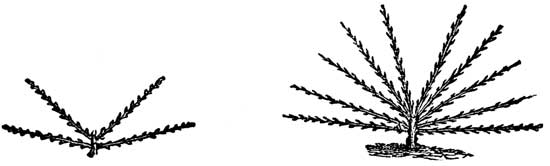
Fan-training, 3d stage.
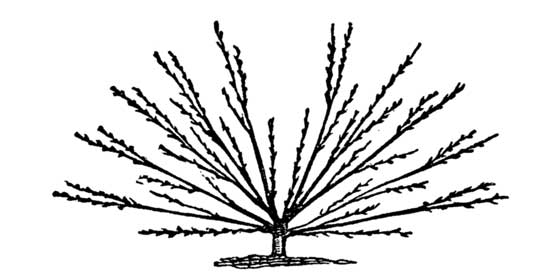
Fan-training, Complete.
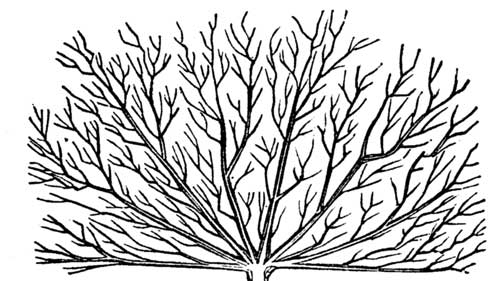
The following season, the two upper shoots are to be cut back to three buds, so as throw out one leading shoot, and one shoot on each side. The two lower shoots are to be cut back to two buds, so as to throw out one leading shoot, and one shoot on the upper side. In this second stage, you will have a tree with five leading shoots on each side (see cut, fan-training, 2d stage). These shoots form the future tree, and should neither be shortened in, nor allowed to bear fruit this year.
Each shoot should now be allowed to produce three shoots, one leading one, and two others on the upper side, one near the bottom, and the other half way up the stem. All others should be pinched off when they first appear. At the end of the third year you will have the appearance in the cut (Fan-training, third stage). After this it may bear fruit, but not too much, as a young tree so trained, is disposed to over-bearing. These shoots, except the leading ones, should be shortened back; but to what length depends upon the vigor of the tree. This is to be continued and extended as the grower may choose, always preventing the top from becoming too dense, and the shoot too long for a proper flow of sap, and maturity of fruit-buds. A good form, though slightly irregular, is seen in the cut (Fan-training, complete). Such trees trained against walls, or better, on trellis-work, are beautiful and very productive.
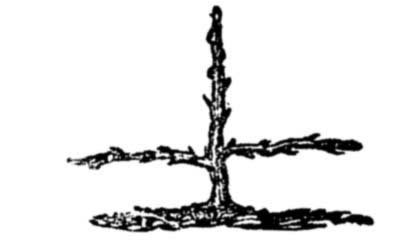
Horizontal Training, first stage.
Horizontal Training, fourth year.
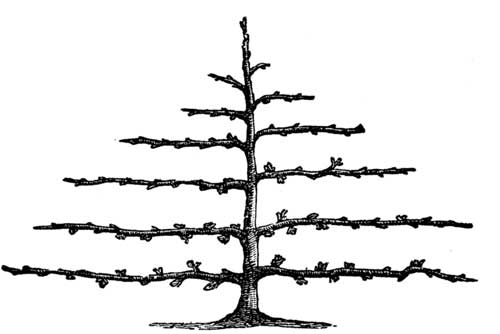
Horizontal Training is another form contributing to fruitfulness, by regulating the flow of the sap. This is done by preserving an upright leader with lateral shoots at regular distances. To secure this, such shoots as you wish to train must be tied in a horizontal position, and all others pinched off on first appearance.
The process is simple and easy, continued as long as you please. Head in the shoots of these lateral branches to two or three buds and they will bear abundantly. As the growth increases, remove all that are not in the right places, and train all you spare, as before. In the fourth year, you will have trees of the appearance in the cut (Horizontal Training, fourth year).
Conical Training.—The Quenouille (pronounced kenoole) of the French, is the best of all forms of training, especially for the pear. To produce conical standards, plant young trees four or five feet high, and after the first year's growth, head back the top, and cut in the side branches, as in the cut (Progressive stages of conical training).
Progressive stages of Conical Training. Conical Training complete.
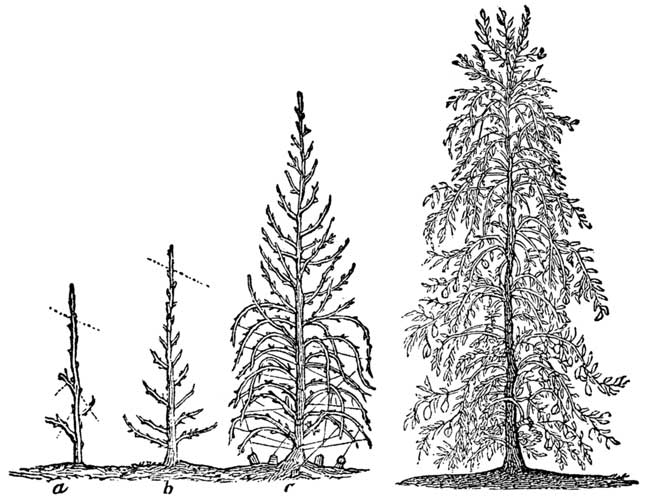
The next season several tiers of side branches will shoot out. The lowest should be left about eighteen inches from the ground, and by pinching off a part, others may be made to grow, at such distances as you may desire. At the end of the second year, the leader is headed back to increase the growth of the side shoots. The laterals will constantly increase, and you must save only a sufficient number. The third or fourth year, the lateral branches may be bent down and tied to stakes. The branches must be tied down from year to year, and the top so shortened in as to prevent too vigorous growth, and throw the sap into the laterals. This may be continued until the tree will exhibit the appearance in the cut (conical training complete). When the tree has become thoroughly formed it will retain its shape without keeping the branches tied. The fan and horizontal training are valuable for fruits that need winter protection, and they are also very ornamental, and enable us to cultivate much fruit on a small place. All these forms of training increase largely the productiveness of fruit-trees. It is recommended for all small gardens and yards, and will pay in growing fruit for market.
TRANSPLANTING.
Trees should be transplanted in spring in cold climates, and in autumn in warm regions. The top should be lessened about as much as the roots have been by removal. Cutting off so large a part of the top as we often see is greatly injurious. Trees frequently lose one or two years' growth, by being excessively trimmed when transplanted. The leaves are the lungs of the tree, and how can it grow if they are mostly removed? All injured roots should be cut off smoothly on the lower side, slant out from the tree, and just above the point of injury. Places for the trees should be prepared as given under the different fruits and the trees set firmly in them an inch lower than they stood in the nursery. The great point is to get the fine mould very close around all the roots, leaving them in the most natural position. Trees dipped in a bucket of soil or clay and water, thick enough to form a coat like paint, just at the time of transplanting, are said to be less liable to die. Every transplanted tree should have a stake, and be thoroughly mulched. Trees properly transplanted will grow much faster, and bear a year or two earlier, than those that have been carelessly set out. For further remarks on this important matter, see under the different fruits.
TURNIP.
This is one of the great root crops of England, and to considerable extent in this country, for feeding purposes. We think it should be displaced, mostly, by beets, carrots, and parsnips. They are more nutritious, as easily raised, and more conveniently fed. The Rutabaga is a productive variety, and possesses a good deal of nutriment. The essentials in raising good turnips of most varieties, are very rich soil, worked deep, and finely pulverized. They should stand in rows two feet apart, and one foot apart in the rows. They may be mainly tended with a small cultivator or root-cleaner.
English turnips are extensively grown as a second crop on wheat stubble, &c. The soil is highly enriched and the seed sown in rows to allow cultivation. The best method, however, is to turn over old greensward say June 1, and yard cattle or sheep on it till July 10, and then harrow thoroughly, and sow the seed broadcast. The yield will usually be large, and they will need very little weeding. If it is not convenient to yard cattle on the turnip-ground, apply fifteen double wagon loads of fine manure with a few bushels of lime to the acre, and the crop will be large. The usual time of sowing turnips is from the 10th to the 25th of July. We think the yield is larger when sown by the middle of June. The only way to get good early turnips is to sow them very early. The flat, or common field turnip, is easily grown on new land, or on any rich soil tolerably free from weeds and not infested with worms.
WHEAT.
This is the most highly esteemed of all grains, and has more enemies, and is more affected in its growth by the weather, than any other. It has engaged more attention in the study and writings of agriculturists than all other cereals. The outlines only of the results of the vast field of investigation and experiment on wheat-growing can be presented here. There are doubts respecting the origin of wheat. The more general and probable theory is, that it is the product of the cultivation, for a series of years, of a species of grass called Ægilops. This is indigenous on the shores of the Mediterranean, in those countries which, from time immemorial, have been the sources of our wheat. No one has ever found wild wheat in any country; it would be as strange as a wild cabbage or turnip. But the practical question is, How can wheat be most surely and profitably grown? The first requisite is a suitable soil. A clay or limestone soil is usually considered best, as there is much lime in wheat-bran. Such soil is better than light sand, or some of the poorer loams. But the large yields of wheat on the Western prairies, and on the rich alluvial soils of California river-bottoms, shows that the best of wheat may grow on other than clay lands. The truth of the matter respecting soils for wheat, is, that any soil good for corn, potatoes, or a garden, may, with proper tillage, produce the best of wheat. Experience in England, and in all the old countries on the continent of Europe, shows us that old land may be made to yield as large crops of wheat as the virgin soil of the New World. The production of wheat at suitable intervals, for a century, on the same land, need not lessen its power to produce good wheat in large quantities. Wheat is a plant demanding a rich soil, worked deep, and not too wet: these three things will produce a good crop on any land. We say to all farmers, raise wheat on any land that you can afford to prepare. First, if your land has not a dry subsoil, underdrain it thoroughly: water standing in the soil, and becoming cold or stagnant, is very injurious to wheat. Drainage is hardly more essential to any other crop than this. Next, plow deep. Subsoiling, on most lands, is very important to wheat. Manure highly, and put the manure between the soil and the subsoil: this attracts the roots deep into the soil, which is the greatest protection against winter-killing, and the effects of excessive drought. Render the surface of the soil as fine as possible. A finely-pulverized soil is as essential for wheat as for onions. Coarse lumpy soils are so open to the action of the atmosphere as to render the growth unequal, and cause the roots of the plant to grow too near the surface, for dry weather or the cold of winter. Always apply lime to wheat-lands, unless it be a limestone soil—not too much at once, but a few bushels to the acre annually. On no other crop do wood-ashes and dissolved potash, applied in the coarse manures, pay so well as on wheat. Sowing the seed is next in importance. The three questions in sowing are the manner, the depth, and the quantity. Shall it be drilled or sowed broadcast? Broadcast sowing requires more seed, and is liable to be less evenly covered; hence, we should prefer drilling. The depth of the seed is to be determined by the texture of the soil. Careful experiments have shown, that on clay land there is no perceptible difference in the growth of the plants, at any of the stages, in seed sown at any depth, from a slight covering to three or four inches. At a greater depth, it comes up less regularly, and in every way is in a worse condition. But on a light soil, it is, no doubt, best to plant it from four to six inches deep. On very loose soils, as muck land and alluvial soils, the roots of the plants grow too near the surface, and are exposed to being thrown out by winter frosts, and destroyed. The remedy is deep sowing and thorough rolling. The quantity of seed now more generally sown is from five pecks to two bushels per acre. Rich land will not bear so much seed as the poorer. It will grow so thick as to render the straw tender, and expose it to lodge and ruin the crop. Wheat tillers, or thickens up at the bottom, making many stalks from a single seed, quite as much as any other grain; hence, we believe that if it be sown at a proper time on very rich land, three pecks to the acre would be better than more. Such sowing would make more vigorous plants, with much stronger roots, which would withstand cold and unfavorable weather better than any other. We should still more strongly recommend another form of sowing, practised by some European cultivators with great success: it is, to drill in wheat, in rows two feet apart, and give it a spring cultivation; this gives great strength to the plants, destroys the weeds, promotes rapid growth by stirring the soil, and favors tillering, so that the rows will meet, and give a great growth. We doubt not this will yet be extensively adopted in this country. All wheat-land had better be rolled after sowing, and light lands, with a very heavy roller. Light sandy land, having a little clay mixed in as recommended under soils, well manured, the seed planted six inches deep, and the whole rolled with a heavy roller, will bear great crops of wheat.
As it respects fall or spring wheat, no positive directions can be given, adapted to all climates. In many localities it is of little use to sow winter wheat, as it is very uncertain. In other localities winter wheat almost always succeeds best. This question then must be determined by circumstances. The time of sowing winter wheat varies in different climates, according as it may be exposed to depredations of worms and insects in the fall. Farmers are not liable to mistake in this matter. Spring wheat, in all climates, should be sowed very early. It is hardly possible in all the Middle and Northern states to prepare the ground in spring, and get in wheat in suitable season.
The yield of a crop of spring wheat, depends materially upon the growth in the cool and moist weather of spring, when it spreads and its roots get a strong hold before the hot weather, that hurries up the stalks and ears to maturity. Hence plow in the fall, and harrow in the wheat, as early as possible, in the spring.
The varieties of wheat are numerous and uncertain. In the state of Maine, an intelligent cultivator, in 1856, recommended Java wheat as having a very stiff straw, and producing a very heavy yield. The Mediterranean wheat is also a favorite variety. Club wheat has also had a great run, and is now very popular at the West. But of varieties no one can be confident. We notice in the discussions of the best agriculturists of England and Scotland, that they have doubts of the proper names of some of the best varieties. In a certain rich part of Illinois we know an unusually popular wheat, sold at high prices for seed, under the name of mud club, as being much better than the ordinary club. We happened to learn that it was nothing but common club wheat, sown on rather low ground, where it happened to grow very fair that season. It is only occasionally that such tricks are successfully played, but it is true that many varieties are the result of extra good or chance cultivation. The celebrated Chidham wheat, named from a place where it was successfully grown, was also called Hedge wheat, because a head found growing in a hedge was supposed to be the origin of it. Now it is not probable that that head was the only one of the kind in all the country, and it would by no means be identified in all localities. And as all wheat is the result of the cultivation of the Ægilops or some other wild grass, it shows us that varieties may be produced by cultivation. Great importance is therefore to be attached to frequently changing seed; especially bringing it from colder into warmer climates, and changing from one soil to a very different one. Thus seed raised on hard hills is highly valuable for alluvial soils. Thus the efforts to introduce so many new varieties from the dominions of the sultan, will prove of vast advantage to wheat culture in America. So let us be constantly importing the best from Great Britain and the British provinces and from California, and all the extremes of our own country. Such wheats are worth more for seeds than others, but any extravagant prices for seed wheat, under the idea of almost miraculous powers of production, are unwise.
It would be useless to go into a more extended notice of varieties, as some do best in certain localities, and all are rapidly spread through the dealers, and by the influence of agricultural periodicals. The best time to harvest wheat is when the straw below the head has turned yellow, and the grain is so far out of the milk as not to be easily mashed between the fingers, but before it has become hard. The grain is heavier and of better quality, and wastes far less in harvesting, than when allowed to ripen and dry standing in the field. Drying in good shocks is far better than drying before cut. Some have gone to extremes in early cutting, and harvested their wheat while in the milk, and suffered serious loss in its weight. We sometimes have rain in harvest, which causes all the wheat in a large region to grow before getting it dry enough to house. A remedy is, to go right on and cut your wheat, rain or shine, and put it up, without binding, in large cocks of from three to five bushels, packing together as close as possible, however wet, and cover the centre with a bundle of wheat to shed rain. It will dry out without growing; and, although the straw will be somewhat mouldy, the grain will be perfectly good, even when it has been so wet as to make the top of the shocks perfectly green with grown wheat. This process is of great value in a wet season. To prepare seed-wheat for sowing, soak it for a day or two in very strong brine; skim off all that rises; remove the grain from the brine, and while wet, sift on fresh-slaked lime until it slightly coats the whole grain; put on a little plaster to render the sowing more pleasant to the hand. Wheat will lie in this condition for days without injury. So prepared, it will exhibit a marked superiority in the growing crop.
Enemies of wheat are numerous, and various remedies are proposed. The wire-worm is sometimes very destructive. Wheat planted with a drill, with a heavy cast-iron roller behind each tooth, will not suffer by them; they will only work in the mellow ground between the drills. Drive over a field of wheat exposed to injury from wire-worms with a common ox-cart, and you will notice a marked difference; wherever the cartwheel passed over, the wheat remains unharmed by the wire-worm, while on either side much of it will be destroyed. But the wheat-midge, or weevil, is the great enemy, rendering the cultivation of wheat in some localities useless. One precaution is, to get the wheat forward so early and fast as to have it out of the way before they destroy it. This is often done by early sowing, high fertilization, and warm land. Sometimes wheat is too late for them, and then a good crop is secured. But this can only be relied on in cool, moist climates. Our hot, dry seasons are not suitable for wheat, late enough to be out of the way of the weevil. The great remedy for this enemy is his destruction. Burning the chaff at thrashing is useless for this purpose. The worm has entered the ground to remain for the winter, before the wheat is harvested. We know of but one way to kill the weevil, and that is, by insect lamps or torches in the field in the evening. The flies are inactive until evening, when, from dusk till eight or nine o'clock, they deposite their eggs in the blossoms and chaff of the wheat. Now, it is ascertained that this fly, like many other insects, will fly several rods to a light. Twenty-five torches at equal distances, in a ten-acre lot of wheat, would be near enough. Nearly all the flies in a field would fly to them in half an hour. These need be lighted only on pleasant evenings, as weevils will not work in wind or rain, and they only commit their depredations during the time the wheat is in blossom. Let twenty-five racks, or holders of some kind, be put up on ten acres of wheat, and have pitch-pine put in them and ignited, after the manner of night fishermen, and let this be done a few nights, during the blossoming season of wheat, and the fly will be destroyed and the crop saved, in the worst weevil-season that ever occurred. In the absence of pitch-pine, some other light can be devised—as, balls of rags dipped in turpentine and sulphur, as in a torchlight procession. Something can be devised that will burn brilliantly for an hour: this will not cost fifty cents an acre, during the weevil-season, and will prove almost a perfect remedy.
Rust in wheat is only avoided by getting your wheat to maturity before the rust strikes it. If it is nearly mature, and the rust strikes it, cut it and shock it up in the shortest time possible.
Wheat is a great subject in agriculture, on which many volumes have been written, and on which it is customary to write long articles. We trust the recapitulation of what we have said, in the following brief rules, is more valuable to the practical wheat-culturist than any large volume could be. Analyses of wheat-bran and straw, the philosophy of rust in wheat, the length, size, and color of the weevil, and the great diversity of opinions on wheat-growing, are not what practical men regard. The one question is, How can I grow wheat surely and profitably? The following rules answer this important question, rendering failure unnecessary:—
1. Make your soil very rich, putting the manure as deep as convenient. Apply lime, wood-ashes, and potash, the latter dissolved and applied to your coarse manure.
2. Under-drain thoroughly all wheat-land, except that on a dry subsoil.
3. Plow deep and subsoil all wheat-lands, except those on a gravelly or sandy bottom.
4. Plant wheat from two to six inches deep, according to the texture of the soil—deepest on the lightest soil. Roll after sowing, and roll light lands with a heavy roller.
5. Always get your wheat in early, and in a finely-pulverized soil, and be careful not to seed too heavy.
6. Sow seed that has not long been grown in your vicinity, and steep it two days, before sowing, in a brine, with as much salt as the water will dissolve, sifting fine, fresh lime over the wet grain, after removing it from the brine; put on, also, plaster-of-Paris or wood-ashes.
7. Harvest wheat before the straw becomes dry, or the grain hard.
8. Destroy weevil by lights in the field, on the pleasant evenings during the blossoming season.
WHORTLEBERRY.
Of this excellent berry there are several varieties, distinguished by the height of the bushes, or by the color of the fruit. The main divisions are, the Swamp and the Plain Whortleberries. The swamp variety has been transferred to gardens, in Michigan, and has proved valuable. The shrub attains considerable size, producing fruit more surely and regularly than in its wild state, and of an improved quality and larger size. It may be grown as well as currants all over the country. The small plain variety is usually found on sandy plains, and is a great bearer of fruit everywhere highly prized. It may be transferred to all our gardens, by making a bed of sand six inches or a foot deep, or it may be so acclimated as to grow well in any good garden soil, and become a universal luxury. We recommend it as a standing fruit for all gardens.
WILLOW.
The cultivation of willow for osier-work is pursued to some extent in this country, and might be greatly increased. At one fourth the present prices, it would pay as well as any other branch of agriculture. Some varieties will grow on land of little value for other purposes, and all on any good land. Willows will take care of themselves after the second or third year. The more usual method of planting is of slips, ten inches long, set in mellow ground about eight inches deep, in straight rows four or six feet apart, and one foot apart in the rows—except the green willow, which is put two feet apart in the row. They should be kept clear of weeds for the first two years. The osiers are to be cut when the bark will peel somewhat easily, and may be put through a machine for the purpose, invented by J. Colby, of Jonesville, Vermont, at the rate of two tons per day, removing all the bark, without injuring the wood. Different opinions prevail respecting the varieties most profitable for cultivation; they vary in different localities. The manufacture of willow-ware will increase with the increased production of osiers, and the consequent reduction of their cost.
WINE.
We have elsewhere stated that our only hope for pure wine in this country is in domestic manufacture. We shall here give two recipes that will insure better articles than are now offered under the name of imported wines.
Currant Wine.—This, as usually manufactured, is a mere cordial, rather than a wine. The following recipe gathered from the Working Farmer, is all that need be desired, on making wine from currants, cherries, and most berries, that are not too sweet. Take clean ripe currants and pass them between two rollers, or in some other way, crush them, put them in a strong bag, and under a screw or weight, and the juice will be easily expressed. To each quart of this juice, add three pounds of double-refined loaf sugar (no other sugar will do) and water enough to make a gallon. Or in a cask that will hold thirty gallons, put thirty quarts of the juice, ninety pounds of the sugar, and fill to the bung with water. Put in the bung and roll the cask until you can not hear the sugar moving on the inside of the barrel, when it will all be dissolved. Next day roll it again, and place it in a cellar of very even temperature, and leave the bung out to allow fermentation. This will commence in two or three days and continue for a few weeks. Its presence may be known by a slight noise like that of soda water, which may be heard by placing the ear at the bung hole. When this ceases drive the bung tight and let it stand six months, when the wine may be drawn off and bottled, and will be perfectly clear and not too sweet. No alcohol should be added. Putting in brandies or other spirituous liquors prevents the fermentation of wine, leaving the mixture a mere cordial. The use of any but double-refined sugar is always injurious, and yet many will persist in using it, because it is cheaper. The reason for discarding, for wine-making, all but double-refined sugar, may be easily understood. Common sugar contains one half of one per cent. of gum, that becomes fetid on being dissolved in water. The quantity of this gum in the sugar, for a barrel of wine, is considerable—enough to give a bad flavor to the wine. This is avoided by using double-refined sugar, which contains no gum. This recipe is equally good for cherry wine.
The following recipe for making Elderberry Wine, produces an article that the best judges in New York and elsewhere have pronounced equal to any imported wine. Its excellence has made quite a market for elderberries in New York. These berries are so easily grown, and the wine so excellent, that their growth will be encouraged throughout the country. It is not only an exceedingly palatable wine, but is better for the sick, than any other known.
To every quart of the berries, put a quart of water and boil for half an hour. Bruise them from the skin and strain, and to every gallon of the juice add three pounds of double-refined sugar and one quarter of an ounce of cream of tartar and boil for half an hour. Take a clean cask and put in it one pound of raisins to every three gallons of the wine, and a slice of toasted bread covered over with good yeast. When the wine has become quite cool, put it into the cask, and place it in a room of even temperature to ferment. When the fermentation has fully ceased, put the bung in tight. No brandy or alcohol of any kind will be necessary. Any one following this recipe exactly, will be surprised at the excellence of the wine that will be the result.
Of Grape Wines, there are several varieties, whose peculiarities are determined mainly by the process of manufacturing. A full treatment of the subject would require a volume. The following brief directions will insure success in making the most desirable grape wines:
1. Let the grapes become thoroughly ripe before gathering, to increase their saccharine qualities and make a stronger wine. All fruits make much better wine for being fully ripe. Cut the bunches with a sharp knife and move carefully to avoid bruising. Spread them in a dry shade to evaporate excessive moisture.
2. Assort the grapes before using, removing all decayed, green, or broken ones, using only perfect berries.
3. Mash the grapes with a beater in a tub, or by passing them through a cider-mill. "Treading the wine vat" was the ancient method of mashing the grapes, not now practised except in some parts of Europe.
4. To make light wines put them at once into press, as apple pomace in a cider-press.
5. To make higher-colored wines let the pomace stand from four to twenty-four hours before pressing. They will be dark in proportion to the length of time the pomace stands.
6. To make wines resembling the Austere wines of France and Spain, let the pomace stand until the first fermentation is over, called "fermenting in the skin."
7. The "must" or grape-juice is to be put into casks, the larger the better, but only one pressing should be put into one cask. Put in a cellar of even temperature, not lower than fifty nor higher than sixty-five degrees of Fahrenheit, and where there is plenty of air.
Prepare the cask by burning in it a strip of paper or muslin, dipped in melted sulphur, and suspended by a wire across the bung-hole. Fermentation commences very soon and will be completed within a few days or weeks according to the temperature. Its completion is marked by the cessation of the escape of gas. No sugar, brandy, or any other substance, should be added to the grape-juice to make good wine. They are all adulterations. The wine having settled after this fermentation, may be racked off into clean casks, prepared as before. A second fermentation will take place in the spring. It should not be bottled until after this second fermentation, as its expansion will break the glass. While in the casks they should always be kept full, being occasionally filled from a small cask, kept for the purpose. When this fermentation ceases, bottle and cork tight, and lay the bottles on their sides, in a cool cellar. The wine will improve with age.
Sometimes it remains on the lees without racking and is drawn off and bottled. Frequently the wine does not become wholly clear and needs fining. Various substances are used for this purpose, as fish-glue, charcoal, starch, rice, milk, &c. The best of these substances is charcoal, or the white of eggs and milk. Add by degrees according to the foulness of the wine. An ounce of charcoal to a barrel of wine is an ordinary quantity; or a pint of milk with the white of four eggs—more or less according to the state of the wine.
Rhine Wine of Germany may be made as follows:—
Take good Catawba or Isabella grapes, and pound or grind them so as to crush every seed and leave them in that state for twenty-four hours. Fumigate the cask by burning strips of muslin dipped in sulphur as in the preceding recipe. Strain or press out the juice into the cask filling it and keeping it entirely full, that impurities may run out of the bung, during fermentation. In the spring prepare another cask in the same way and rack it off into that. When a year old bottle it and it is fit for use.