SOIL CULTURE. (continued 5)
Reading edition
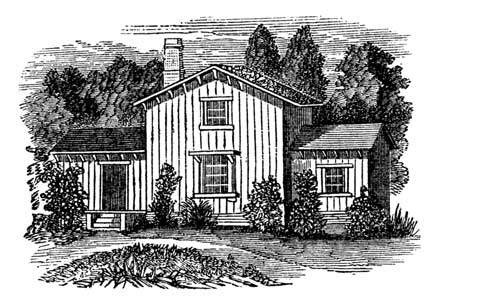
Laborer's Cottage.
Plan of Laborer's Cottage.
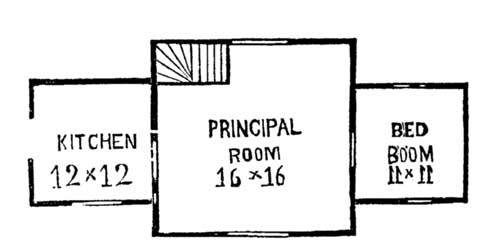
This form of a cheap house is convenient and pleasant. Built of four-inch scantling, the plates and sills being connected only by the upright plank, and the wings thoroughly bracing the upright posts; when lumber is cheap, it may be built for one hundred and fifty or two hundred dollars, with cellar, well, and cistern. Occasional whitewash is as good as paint. With cellar under the whole, filled in with brick, and having blinds, it may cost three hundred and fifty dollars. The plan of the house sufficiently explains itself.
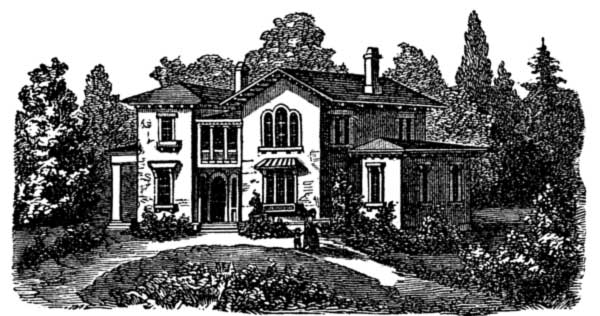
The next cut illustrates a neat country-house, for a family who think more of neatness, comfort, and intellectual pursuits, than of mere ornament, and may serve the purpose of a farmhouse, or the residence of a retired or professional gentleman. It has the unconstrained air of the Italian style, without a rigid adherence to any rules, and may therefore be altered or added to without destroying its effect.
Italian Farmhouse.
Plan of Italian Farm House.
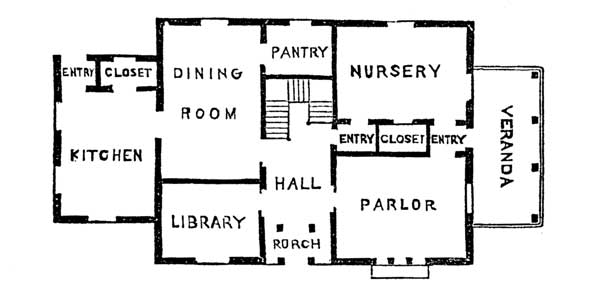
The plan is intelligible without explanation. Built in a plain way, the four large rooms not larger than fifteen by seventeen, and ten feet high, plain in its finish, it would cost about sixteen hundred dollars complete. It may go up from that, according to size and height of rooms, and style of finish, to three thousand dollars. It then makes as good a house as any person ever need to occupy, out of great cities.
HYBRIDS.
Although this subject has received far too little attention, yet our limits will only allow us to mention a few facts, of the most practical moment.
Plants hybridize only through their blossoms. This can only occur in plants of similarity, in nature and habits. Squashes and pumpkins planted near each other mix badly, and the poorer will prevail. Varieties of corn mix at considerable distances, by the falling of pollen from the tassel upon the silk of another variety. Watermelons are always ruined by being planted near citrons. The seeds from melons so grown will not produce one good melon. How far watermelons and muskmelons, or squashes with melons, will hybridize, is uncertain. By planting nutmeg muskmelons with the common roughskinned variety, we have produced a kind about half way between them, that was of great excellence. Two kinds of cabbage or turnip seed should never be raised in the same garden. Cabbage and turnip seed raised near together is valueless. In strawberries, different plants are essential to each other, the quality of the fruit being determined by the plant fertilized, and not by the fertilizer. This subject is further treated under articles on different plants.
INARCHING.
This is a method of effecting a union of trees or branches, while both retain their hold in the ground. Shave off a little wood from each, and put them together, fitting closely, so that the barks will meet, as in grafting; tie firmly, and cover with wax. When they have got well to growing, cut off the top of the old one, and after a while cut the new one from the ground. When you have a tree that it is difficult to propagate in the usual way, you may transplant it to a thrifty stock. Vigorous branches may by this means be transferred to old, poor-bearing, or slow-growing trees. So also may a tree be prolonged beyond its ordinary age, as the pear on the quince, by inarching young shoots. We can only recommend this to the curious experimenter, who has little else to do.
INSECTS.
These are the natural enemies of fruits and plants; and to prevent their depredations requires much care. There is no universal remedy. Birds and young fowls—especially ducks and chickens—are useful in a garden. The ducks must not be kept there too long. They will appropriate a little to their own use, but will save much more for the proprietor. Insects have their peculiar tastes for particular fruits and plants, of which we have treated, under those heads, respectively. Success in many branches of horticulture and pomology, depends upon attention to the habits of insects. The most general remedy is to wash trees or plants with a strong decoction of some offensive herb, or with whale-oil soapsuds. Tobacco is very useful for this purpose.
IRON FILINGS.
It has been ascertained by analysis, that iron enters largely into the composition of the pear. Iron filings spread under them, or worked into the soil, increases the growth of pear-trees, and improves the quality of the fruit.
IRRIGATION.
This is one of the most important matters, that can engage the attention of agriculturists of the present day. A stream of water that may be caused to flow gently over a field, or different parts of a farm, at pleasure, is a mine of wealth. Plants receive their food from the air and water. We shall discuss this more fully when treating of manures. A poor, porous, sandy, or gravelly soil usually produces a fine crop, in a wet season. That is an addition to the soil of nothing but water. Hence all springs and streams can be turned to great account, on a farm or garden. Watering gardens by hand or with a garden-pump, will often pay better than any other expenditure on the land. Employing a man, in a dry season, to spend his whole time in watering five acres of garden, of berries and vegetables, as cabbages, vines, onions, and potatoes, will pay a very large profit. Strawberries will bear twice as much and twice as long, for daily watering, after they begin to bud for blossoms, until the fruit is gone. It is a necessary caution not to water irregularly, and only occasionally, in a dry season. Better not commence than to leave off, or neglect it in a dry time, before a rain. Read further in our article on "Watering."
LABELS.
It is important, on many accounts, to have fruit-trees and shrubs well labelled. Many labels have been invented. We prefer Cole's, as given in his Fruit Book, to any other. Take a piece of sound pine or other soft wood, whittle two sides smooth, leaving one wider than the other, with a sharp corner between them. For one, cut one notch in the edge, and so up to four, four notches for four. For five, cut across the narrow side. For ten cut across the wide side, and a notch for every ten up to forty. For fifty, cut obliquely across the narrow side, and for one hundred cut obliquely across the wide side. Keep the names in a book, with numbers corresponding with the notches or numbers on the labels.
Fasten these to trees, loosely, by a small copper or brass wire. Transported to any distance, exposed to any weather, or buried in the ground, they will not be obliterated. Pieces of sheet lead, tin, or zinc, cut wide at one end, and written on with a sharp awl, and narrow at the other end, to be bent around a limb, will answer a pretty good purpose. Any soft wood, made smooth, and a little white paint applied, and written on with a good pencil, will preserve the mark for a long time. Fasten with small wire. There are many labels, but we know none preferable to the above. By all means make labels accurate and permanent. Otherwise great losses may occur by budding or grafting from wrong varieties.
LANDSCAPE GARDENS.
These deserve much more attention than they receive in this country. On most farms land enough is lying waste, to make a picturesque landscape, at a small expense. Trees planted, weeds destroyed, grass cultivated, and paths made, according to the most approved rules of carelessness, would secure this object. With a wealthy man, the omission of such a park about his dwelling is hardly pardonable. Landscape gardening is an extensive subject. We can only give a few of the most general simple rules, that may be practised, without the possession of very large means.
1. Place the house some distance from the main street.
2. Make the carriage-way leading to the house, at least twelve feet wide, and do not allow it to extend in a straight line, but in gentle curves, around clusters of trees and plats of grass, apparently rendering the curves necessary.
3. Have no large trees directly in front of the house.
4. Plant trees of the thickest and greenest foliage near the house, and those of more open tops at a greater distance. Standard pear, and handsome cherry trees, do well planted among the forest trees. Clusters of them, at suitable distances, are not only beautiful, but they bear exceedingly well. They are well protected by the forest trees, and standing alone are injured less by insects.
5. Never set trees in a landscape garden, in straight rows, nor trees of similar size and form together. Nature never does so.
6. Let none of the walks be straight lines, but curves, meandering among trees and grass. If there be any water in the vicinity, let there be an open space, giving a fair view of it from the house. If you have a stream, make rustic bridges over it, the plainer the better. Here and there have rustic arbors. Attached to all this should be three other gardens, one of flowers, another of vegetables, and the third of fruits. These three should never grow together. Fruit-trees ruin vegetables and injure flowers. And flowers in a vegetable garden are mere weeds. A separate plat for each is the correct rule, both for beauty and profit. All this need require but little time and expense. All landholders can, at a moderate cost, live amid scenes of perpetual beauty, while the rich may spend as much money in this way as they choose.
LAYERING.
This is a method of propagation, by bending down a branch, and fastening it under the soil, leaving the upper end projecting, until it takes root. Cut half way through the branch so as to raise the top, and fasten it at the point where it is cut, in a trench, with a stick thrust into the ground over it nearly horizontally, or with a stick having a hook made by cutting off a limb. Cover well with soil, and mulch it, and water when dry. This done in the spring, in August the branch will be well rooted, and may be cut away from the parent stalk. This is important in any tree or shrub (like the snowball), difficult to propagate by slips or grafting.
LAYING IN TREES.
Dig a trench where water will not stand, and lay the trees in at an angle of forty-five degrees, and cover the roots and lower part, very closely, with earth. In this way they may be well preserved through the winter, if buried so deep that the tap-root will not freeze, which is always injurious to trees that have been removed from their original soil. Such freezing is always destructive to trees out of the ground. Small trees and seedlings may be covered entirely, to be kept through the winter. Put coarse straw manure on the earth, over trees large enough for setting, that are to be preserved heeled in during winter; and straw or corn-fodder over the tops, during the coldest weather, and they will come out perfect in the spring.
If not ready to set out your trees at once, you may preserve them in perfect condition to very late in spring, in this way, by raising them once, to check vegetation, and putting them back, and shading their stems and mulching the roots, after the commencement of warm weather. Trees may thus be preserved in better condition for transplanting than those left in the nursery, and they will make a larger growth the first season.
LEEKS.
These are said to be natives of Switzerland. We think this doubtful, as they are an article of daily food in Egypt, and were so highly esteemed there, centuries ago, as to become an object of worship. They are used as a pot-herb, to give a flavor to soups and stews. They are not bulbous, like onions, but have a long stem, which is principally used. They are transplanted very deep, so as to obtain a long white neck. The ends of the roots are to be cut off when transplanted, and they should be set in rows a foot apart, and from four to six inches in the row. There are several varieties, distinguished mainly by the width of the leaves,—the Flanders (or narrow-leafed), the Scotch, and the Broad London.
We know no use of leeks for which onions would not be equally good, and, hence, do not recommend their cultivation.
LEMON.
This is the finest acid fruit grown, and belongs to warm climates; but by getting good budded trees from the South, and setting in glass-houses, protected from severe frosts, we may grow lemons in abundance at the North.
By a system of acclimation and protection, we anticipate seeing oranges and other Southern fruits grown at the North as a domestic luxury, and perhaps at a profit for market. The houses necessary for protection may be worth more for other purposes than their cost and care, without interfering with their use for orange and lemon culture.
LETTUCE.
The varieties are numerous, and most of them do well on very rich land, well hoed. Only two kinds of summer-lettuce need be cultivated—the ice-head lettuce, and the brown. The ice-head has a very thick and tender leaf, continuing to be excellent up to midsummer, from one sowing; and if not allowed to stand nearer together than six inches, it will produce fine heads. The brown lettuce is very large and very good. There are other, earlier kinds, and many others that form large heads. But we can get the above kinds early, by sowing in a hotbed and transplanting; or by sowing so as to have plants get of considerable size in the fall, and protect by covering in winter. These will be suitable for the table early in the spring. Lettuce does better for transplanting; it forms larger heads than in the original bed, and is a little later. Make the soil very rich with stable-manure. Lettuce is more affected by the quality of the soil than most other vegetables. This is a pleasant and healthy article of food, in spring and early summer.
LICORICE.
This is a hardy plant from Southern Europe. The root in substance, or the extracted dried juice, is much used. Needs a deep, rich soil. It is propagated by cuttings of roots set out in deeply-trenched land, in rows three feet apart, and one foot in the row. Small vegetables may be grown among the plants the first year; afterward keep clear of weeds, and manure every autumn. At the end of the third year, after the leaves are dead, take up the roots and dry them thoroughly. This does well at the South. A few roots are sufficient for a family, and the demand will not be sufficient to require its culture very extensively as an article of commerce. The low price of labor in Southern Europe enables them to supply the demand cheaper than can be afforded in this country.
LIME.
This is a valuable application to the soil. For wheat it is very important, except on soil containing a large proportion of calcareous matter. Usually air-slaked, and applied as a top-dressing, or plowed or harrowed in, its effects are important. On moist, sour land, producing wild grass, it corrects the acidity, introduces other grass, and prepares the soil for cultivation. On hard, stiff lands, it has a tendency to make them friable, and keep them in a mellow condition, thus saving more than its cost, in the labor of cultivation. Very valuable in a compost heap. So much may be applied as to burn the soil and prove injurious. It will not do as a substitute for everything else. See further on "Manures."
LIME.
A fruit resembling the lemon, growing in the same climate, but of smaller size. It is used for the same purposes as the lemon, but is not so valuable. Preserved green, it is highly esteemed. It is cultivated as the orange and lemon, needing the same protection in cold climates. To preserve all these from destruction by insects, wash them in a strong decoction of bitter or offensive herbs, or with whale-oil soap-suds; tobacco is very effectual. These remedies are useful on all fruit-trees.
LOCATION.
This is important to everything we cultivate. But, as everything can not have the best location, we should study it with reference to those things most affected by it, especially fruits. Fruits escape late frosts when growing near rills or small brooks. Orchards near the shores of bodies of water—as on Lake Erie about Cleveland, Ohio—bear luxuriantly when all fruit a few miles back is cut off by late frosts. On the summits of hills, fruits escape late frosts, when they are all cut off in the valleys below. On the Ohio river above Cincinnati, peaches are very liable to destruction by late frosts. We have seen them all frozen through in one night, and turned black the next day, in the month of May, after they had grown to the size of marrowfat-peas. One season, when there were no peaches in any other locality within a hundred miles, we knew an orchard, on a Kentucky hill, so high and steep, that it took miles of winding around the hill, to ascend it with a team. Those trees were perfectly loaded with peaches, that sold on the tree at four dollars per bushel, and in Cincinnati market at seven to eight dollars. In Ohio, Kentucky, and Virginia, there are such hills, that may be turned to more valuable account than any of the rest of their land, that are not now considered good for anything—even for sheep-pastures. The same is true in the hilly parts of all the states. Good fruit of some kind will grow on them all, every year.
LOCUST-TREES.
It will soon be a great object with American farmers to cultivate locust-trees, in all locations to which they are adapted. Even in this new world, we shall soon be dependent on cultivated timber for fence-posts, railroad-ties, and building purposes. Our native forests are rapidly disappearing, while demand for timber is as rapidly increasing. Probably no other tree is so profitable for cultivation in this country as the locust. It is of rapid growth, and hard and durable, and adapted to many uses. The second-growth locust is not so durable as the native forest-tree, as found in parts of Ohio; but, cut at a suitable age and at the right season of the year, it is as durable as white cedar, and much more valuable. The profits of the culture would be great. An acre of locust-trees fifteen or twenty years old would be worth fifteen hundred or two thousand dollars. The expense of growing it, aside from the use of the land, would be trifling. The grove would afford a good place for fowls, while the blossoms would be nearly equal to white clover for honey. The limbs would make excellent wood, and the ground would need no planting for a second growth. Fortunate will be the men on the prairies of the West, and along the railroads and rivers of the land, who shall early plant fields of locust. The profits of it will greatly exceed the increase in the value of the land.
MANURES.
Soils, manures, and preparing the soil—plowing, harrowing, &c.—are the three great subjects in any good agricultural work. We shall treat this subject under the following divisions:—
1. The substances of which manures are composed.
2. Preparation and saving of manures.
3. Time and modes of application.
4. The principles of their action upon plants.
Manures are of two classes—called putrescent and fossil. The putrescent are composed of decayed, or decaying, vegetable and animal substances. The fossil are those dug from the earth, as lime, marl, and gypsum. All vegetable substances not useful for other purposes are valuable for manure. Rotten wood, leaves, straw, and all the vegetable parts of stable manure, and any spoiled vegetables or grain, are all valuable. At the South, their immense quantities of cotton-seed are a mine of wealth, if properly prepared and applied as manure. Animal manures consist of the animal parts of stable manure, dry and liquid, parts of bones, brine, spoiled meat, kitchen slops, soapsuds, and all dead animals. In decaying, these substances all pass through a process of fermentation. Left exposed without suitable care, they become unhealthy and offensive. It is probable that a large share of the diseases suffered in the rural districts are caused by these impurities; and the impossibility of keeping large cities free from these substances is the cause of their increased mortality. In the country, a little timely caution and labor, in removing these substances and regulating their fermentation, would save much sickness; while the labor would pay a larger per-cent. profit than any other performed on the soil. No manures should be allowed to ferment, or decay, without being mixed or covered with enough common earth, sand, peat, or muck, to retain all the gases and exhalations of such putrescence. The smallest quantity that will answer is one load of earth to two of the decaying substances. The proportions reversed would be better: put one bushel of lime to two loads, two quarts of ground plaster, and half a bushel of ashes, and you have the very best compost heap. The following are brief general rules for the preparation of manures. It is always most economical to feed cattle in the stable or under cover, and never have manure exposed to the weather. But if cattle must be fed outdoor, let them be fed in a yard, lowest in the centre, that the liquids and washings may run into the centre, and be absorbed by straw and litter. Put manure on the land, or into heaps for compost, before very warm weather. Always feed sheep under cover, and keep their manure from rain; heap it together with earth in the spring, or apply it to the soil at once. Manure thrown out of a stable should be kept under cover, out of the rain, and not allowed to heat in winter; its best qualities are evaporated by fermentation in the yard. Manures often rained on in winter, or left in large piles without intermixture of earth, lime, plaster, and ashes, will ferment and waste. Construct your stables so that the liquid manure will run into a vat filled with earth; muck is best. Experiments have shown that the liquid manures are at least one sixth better than the solid. A gentleman dug a pit, thirty-six feet square and four feet deep, and walled it in on all sides. He filled his vat from a cultivated field, and so constructed his sewers from the stables adjoining that the urine saturated the whole. He kept fourteen head of cattle there for five months, allowing none but the liquid part of the manure to pass into the vat. He spread forty loads of this on an acre. For ten years he tried equal quantities of this and well rotted and prepared stable-manure, side by side, in the same field, and obtained great crops; but in no stage of their growth could he see that crops on the land manured from the stable were any better than those that had received only the soil from the vat. The latter were quite as good as the former. The contents of his vat manured seven acres, or half an acre to each creature stabled. The result is proof that one cow discharges urine sufficient in five months to manure abundantly half an acre of land. Save the solid manure equally well, and a cow will make manure enough, in five or six months, to increase a crop sufficiently to pay for herself. It is certainly safe to say, that a careful man can make the manure of a cow pay for her body every year. Is not this an important branch of farming operations? Few pay sufficient attention to it. Fowls should roost where their droppings may be mixed with common garden soil or loam. The manure from each fowl, carefully saved and judiciously applied, will pay for its body twice a year. The hogstye may be very productive of manure, one fourth better than that from the stable. Connected with your hogpen, have a yard fifteen feet square for every five hogs; let that yard have no floor. Throw the straw out of their sleeping-room frequently to make room for new; throw into the yard, also, all sorts of weeds, refuse vegetables, corn-husks, peapods, &c.; also the dirt that will naturally accumulate in the backyard of a dwelling, including sawdust, fine chips, cleanings of cellars, scrapings of ditches, and occasionally a load of loam, muck, or clay—and six loads of manure to each hog may be made, that will prove far better than any stable manure; it has been known to produce fifty bushels of corn to the acre, when stable-manure produced but forty bushels. Old wood, brush, and chips, should never be allowed to remain on uncultivated, useless land. Wood throws out the same amount of heat in decaying as it does when consumed as fuel. The action of that heat on the soil is highly beneficial, retaining it long in a mellow state: hence, all wood, too old to be of value for any other purpose, should be put in heaps, covered up till decomposed, and then applied to the soil, as other manures. For potatoes or vines, but especially melons, it is preferable to any other manure. Nothing is so good for muskmelons as old chips from the woodyard. Leaves of fruit and forest trees are also very good; blood and offal of animals, hair, hoofs, bones, horns, refuse feathers, woollen rags, mud from sewers, rivers, roads, swamps, or ponds, turf, ashes, old brine, soapsuds, all kinds of fish, oyster and clam shells—all are valuable, and no part of them should ever be thrown away or wasted; they are all good in compost heaps, or applied directly to the soil. Bones are best ground, but may be used whole, pounded, or chemically dissolved, or mixed with alternate layers of fresh horse-manure, they will be decomposed by the fermentation of the manure (see "Bones"). Perhaps there is as much imprudence in wasting manures as in any part of American domestic economy. One who leaves his stock without care, and so exposed to the weather as to lose half of them and injure the others, is not fit to be a farmer; yet, many waste manure that would produce plants for man and beast, of far more value than the loss of stock complained of, and yet no one notices it—it is a matter of course, exciting no surprise. Wastefulness in a family, if it be of bread, flour, or meat, is considered wicked and impoverishing; while ten times that amount may be wasted in manures, that would enrich the soil, and excite little or no disapprobation. We hope the agricultural periodicals will keep this subject before the people, until these mines of wealth will no longer be neglected or wasted.
Application of Manures is a subject that has been much discussed, and respecting which, intelligent agriculturists differ materially. Some apply them extensively as a top-dressing for grass lands. This does much good, but probably one half of their virtues is lost by washing rains, and by evaporation. A better way is not to keep land down in grass long at a time, and, when under the plow, manure thoroughly. We knew a piece of light land that annually produced half a ton of hay per acre. The owner plowed it up, raised a crop, put a moderate quantity of stable-manure, and ten loads of leached ashes to the acre. We saw it in haying time, the third season after it had been manured and subsoiled and seeded down, and they were then taking fully three tons of timothy hay from an acre, which was the quantity it had yielded three years in succession, without any top-dressing. If a top-dressing of manure is to be applied, harrow the land quite thoroughly, and always apply the manure in the fall—it is worth twice as much as when applied in the spring. The rains and snows of winter cause it to sink into the soil, while the heat of spring and summer evaporate it. A mixture of plaster, lime, ashes, and a very little salt, sowed on meadows, immediately after haying, secures a good growth of feed, much sooner than it will come on other meadows. It also increases, quite considerably, the hay crop of the following season. It is a universal rule not to allow manure to lie long on the surface to which it is applied, before plowing in. Place manure in heaps, as large as will be convenient for spreading, and spread it just before the plow. Never spread manure one day to be plowed in the next. When manuring in the hill, have the planters follow the manure-cart. In manuring potatoes in the hill, drop the potatoes, and put the manure on them and cover at once. In a dry season, the yield will be double that of those planted in the usual way. For fall grains, plow in the manure, just before sowing the seed. This is better than plowing it in under the sod. If the land be not sod land, and you can plow the manure in only deep enough to cover it, and then, just before sowing the seed, plow again very deep, the effect is excellent. Apply manure to land in the fall, or just after harvest, and plow it in, let the land remain till spring, and then plow deep, and you get the best possible effect. On an onion crop, manure does the most good on the surface. On those raised from sets, or on any onions, after they get large enough to give room, put fine manure enough to keep down all weeds, and it will double the crop.
Gypsum is better sowed than in any other way. Mixed with a little lime and salt, or wood-ashes and salt, the effect on corn is better than from either alone. To hoed crops apply these articles twice, and always by sowing, and not by putting it around or upon the hills; the effect is much greater sowed, besides the labor that is saved. In applying guano, do not allow it to come in contact with the plants, as it is apt to destroy them.
It only remains to consider the principles on which manure acts upon soils, and produces growth in plants. The action of manure on the soil, by which it is enabled to retain and appropriate moisture, constitutes its main, if not its whole benefit. It may afford a stimulus to the roots of plants. Even the specific manures, that are supposed to supply organic matter to particular plants, may impart their benefits by their action upon the air and water. Facts are certainly at hand to show that the great and leading benefits of manures are in their control of moisture, and where that control is not needed, plants get a great growth on what we call poor soil. No manures, either fossil or putrescent, afford any considerable food for plants. Vegetation receives its growth mainly from water and from the atmosphere. Facts in support of this theory are abundant.
A trial was made to ascertain whence comes the matter of which a tree is composed. A quantity of kiln-dried earth was weighed and then put into a tight vessel. A willow shrub was also weighed and planted in that earth, and the vessel covered with perforated tin to keep out the dust; for a year and a half it was supplied only with pure water. The tree was then taken out, and found, by weight, to have gained one hundred and sixty pounds. The earth was then kiln-dried, as before, and weighed, and its weight was found to be only two ounces less than it was a year and a half before, when it was deposited there. The tree, then, must have received its growth, not from the soil, but from the water or the atmosphere, or both.
Another fact: take a load of manure, dry it thoroughly, and weigh it. Then moisten it and apply it to the soil, and it will increase the weight of vegetation from ten to thirty or forty times its own weight when dry, and yet most of that manure may still be found in the soil. Hence it can only feed plants in a very limited degree. Its action must be on air and water, or the control it gives the soil over those elements.
It is also matter of common observation that soil well manured, will continue moist for a long time after similar land by its side, but which has not been manured, is dried up. Hard coarse soils dry up very quickly, while soft, mellow, and friable ones will endure a long drought. The gases and moisture generated by the decomposition of manures produce this mellow state. Hence the necessity of having that decomposition take place under the soil, or of plowing in the manure.
Another important fact bearing on this question is, that what are regarded very poor soils, such as light sandy or gravelly land, will produce good crops in a season remarkable for the frequency of showers. On such soils crops are from twice to four times as large, in a wet season as in a dry, and yet there is an addition of nothing but moisture, and in such a manner, as not to have it stand and become stagnant among the roots of the plants.
Yet another evidence is in the strength of clay soils. A hard clay is very unproductive. But so disintegrated that plants can grow in it, it produces a great crop. This is because clay is of so close a texture, that when mixed with manure, turf, sand, or muck, although friable, it retains more moisture, than sand or ordinary loam. This is the reason of the superior fertility of land annually overflowed with water, as Egypt in the vicinity of the Nile. It is not that the Nile brings down deposites from the mountains of the Moon, so rich above all that is in the valleys below. The entire weight of all that a river deposites on ten acres would not equal in weight the increased vegetation of a single acre. The cause of the increased fertility is the fact that the deposite is so fine that it prevents rapid evaporation, and thus causes the soil to retain moisture for the large growth, and maturity of the plants.
One more evidence is found on our sandy pine plains. Our common forest-trees, as beech, maple, elm, or linden, will not flourish there. Such land will produce comparatively no corn, oats, or wheat. But rye that stands drought better than any other grain, grows tolerably well. But such plains always produce an enormous growth of pine timber, hardly equalled in the number of cords to the acre, by the heaviest-timbered land of the river bottoms. Why is this? Does a maple need so much more food than a pine, or is it in the habits of the trees? It is not in the richness or poverty of the soil, but in the adaptation of the trees to reach and appropriate moisture. The roots of the maple and beech, spread out near the surface of the ground. And it being a light, porous, sandy soil, it does not retain moisture enough to promote their growth. But whoever notices a pine-tree that has been turned up from the roots by the wind, will see that the roots run down almost perpendicularly ten or fifteen feet into the sand. There they find plenty of moisture and hence their great growth. This principle explains the comparative productiveness of all soils.
A soil composed of light muck, or a kind of peet-soil, will dry up soon. There is nothing to prevent rapid evaporation; hence it is always unproductive, for want of suitable moisture. Mix with it clay, to render its texture more firm, and it will retain the moisture, and be very productive. Clay alone is too solid to retain moisture; it runs off, as from a brick. Mix sand with it, and it becomes mellow, and retains moisture, and produces great growth. Sand allows so free and rapid an evaporation that it is unproductive. We say it leaches and is hungry, and so it is, because it has little power to retain water. Our manures do it good, only as they are calculated to aid it in controlling moisture. If we apply a light manure as we would to clay, it is comparatively useless; it adds no firmness to the texture of the soil, and hence does not increase its capacity for controlling water. On such land, the only good that manure does, is while decomposition is taking place in the soil, it renders it more moist, and hence more productive. Apply clay to such a soil, and it will increase its firmness and consequent capacity of retaining and appropriating moisture, and thus render it highly valuable. Dry straw manure is sometimes said to dry up land, and ruin crops. So of turf in a dry season. In a wet season they greatly increase the growth of crops. Now they contain just as much food for plants in one season as another. Hence a soil too easily impervious to the atmosphere, will be a poor soil, that is, will produce poorly, simply because it has no power to retain the necessary moisture.
We suppose these facts and reasons to establish our theory, that the principal benefit of manures, and of mixing different soils, is in the control they give over the moisture and the atmosphere. Hence the greatly increased crop of clover from the application of three quarters of a bushel of plaster to an acre. The increased weight of clover on five square rods, would outweigh the plaster applied, and still that plaster remains, in almost its full weight, on the soil. This principle explains the benefit of mulching trees, plants, or vegetables. This is the best means of preserving trees, the first year after transplanting, and of securing a great growth, of any kind of shrubs or plants. This may be done with common straw or leaves. Now wherein is their utility? Not in the nourishment they afford the plants, but in the fact that mulching so covers the surface as to prevent rapid evaporation. In such cases, it is the more abundant moisture that secures the greater growth.
Hence the first study of a soil culturist should be to ascertain how he shall so mix and manage the materials at his command, as to cause them to retain moisture for the longest time, without leaving water to stand about the roots of his plants. On this depends the whole importance of deep plowing and ditching. On this theory we may also account for the fact that certain plants prefer a certain kind of manure to all others. It is that those plants act in a certain manner on the soil requiring a specific action of manure to enable it to appropriate moisture and tax the atmosphere for their growth. This theory explains why too much manure is bad. Not because we give too much food to plants, but because excess of manure dries up the land. But whatever theory we adopt, we all agree in the utility of fertilizers. And the experience of practical farmers is of more value in aiding us to reach right conclusions, than all chemical essays on the subject that have ever been written.
MARL.
This is one of the best distributed and most universal fertilizers. Marl proper contains nearly equal proportions of clay and lime. Sand-marl is spoken of, in which sand and lime are the main ingredients. Clay-marls are to be applied to sandy and gravelly soils, and sand-marls to clayey soils. Shell-marls are very valuable, and seldom contain clay. Marls may easily be known, even by those not at all acquainted with chemistry. Apply any mineral acid, or even very strong vinegar, and if it be a marl, an effervescence will at once be observed: this effect is produced by acid upon lime.
MARJORUM.
There are two varieties in cultivation—the sweet, an annual herb; and the winter, a hardy perennial. They are grown and used as summer savory—used green, or dried for winter. They give a sweet, aromatic flavor to soups, stews, and dressings. The cultivation is, in all respects, like other garden-herbs of the kind, whether for medicinal or culinary purposes.
MELONS.
There are two species—musk and water melons—which are subdivided into many varieties of each. These are among the most delicious of all the products of the garden. A little use makes all persons very fond of them. The climate of the Middle and Southern states is well adapted to raising melons; much better than the same latitudes in Europe. The following brief directions will insure success in their cultivation. A light, rich soil is always desirable. There should always be a little sand in the composition of soil for melons. If not there naturally, supply it; it will always pay. The warm sands of Long Island and New Jersey are the best possible for melons, especially for water-melons. It may be well to trench deep for the hills, and mix in a little well-rotted manure, and cover it with fine mould. A quantity of manure, left in bulk under the hills, will dry them up at the worst possible time. When you plant only a few in a garden, mulch your musk-melons with chips or sawdust from the wood-yard, or leaves and decayed wood from the forest, and you will get a great growth. They will grow luxuriantly in a pile of chips, with a little soil, in a door-yard, where hardly any other plant would flourish. The water-melon does best in almost pure sand, if it be enriched with liquid or some other of the finer manures. Plant musk-melons six feet apart, and water-melons nine feet each way. When the plants become established, never leave more than two or three in a hill. The product will be greatly increased in number and size, by picking off the end bud of the first runners when they show their blossom-buds; this causes them to throw out many strong lateral vines, which will produce abundantly. The attacks of striped bugs, so well known as the enemies of vines, and also of the black fleas, or hoppers (very minute, but quite destructive to tender vines when first up), may be prevented (says Downing) by sprinkling near the plants a little guano. As but a small portion of cultivators will have it, or can obtain it, we recommend to put many seeds in a hill, to provide for the depredations of the bugs, and sprinkle offensive articles around them. These will not always be effectual. We have recommended elsewhere to fence each hill, as the most effectual method. A box, with gauze or a pane of glass over the top, is a certain remedy in every case; it also greatly promotes the growth of the young vines. This is equally effectual against the cutworm and all other insects; and, as the boxes will last a dozen years or so, we should use them if we had ten acres of melons. But by early and late planting, and watchfulness, and replanting, you will succeed without protection. An excessive quantity of stable-manure does not increase the growth, especially of water-melons. Plaster, bonedust, and ashes, are good applications; hog-manure is the best of all. The seeds should be soaked two days, and planted an inch deep on broad hills, raised in the centre four inches above the level of the bed, that water may not stand around them; planted low, they sometimes perish in a few hours in a hot sun, after a rain. Hoe them often, but never when they are wet, and never hoe near them after they have commenced running; the roots spread, about as much as the vines, and hoeing deep near them cuts off the roots, and materially injures them. Many a promising plat of melons has been ruined by stirring the soil when they were wet, and hoeing around them after they had begun to run. In walking among melons, great harm is done by stepping on the ends of vines. No one should be allowed among melons but the one who hoes or picks them. Many are lost by drought, after great care. We have often used an effectual remedy; it consists in turning up the vines, if they have begun to run before the drought, and putting around each hill from a peck to half a bushel of wet, well rotted manure; that from a spent hotbed is excellent for this purpose; and hoe from a distance between the hills, and cover the manure an inch or two deep with fine mould, lay down the vines, and saturate the hill with water, and they will hardly get dry again during the season. A little judicious watering will give you a great crop in the most severe drought.
Varieties of the Musk-melon.—These are numerous, and the nomenclature uncertain. The London Horticultural Society's catalogue enumerates seventy. Most of them are of no use to any one. Two or three of the best are sufficient. There are three general classes of musk-melons—the green-fleshed, as the citron and nutmeg; yellow-fleshed, as the cantelope, or long yellow; and Persian melon. The last is the finest of all, but is too tender for general cultivation with us, requiring much care and very warm seasons. The yellow-fleshed are very large, but much inferior in quality to either of the others. The green-fleshed are the musk-melons for this whole country. The nutmeg has long been celebrated; but, it being much smaller than the citron, and in no way superior in quality, we think the latter the best for all American gardens.
The following are enumerated in "White's Gardening for the South," as adapted to the latitude of the Southern states: Christiana, Beechwood, Hoosainee, Sweet Ispahan, Pineapple, Cassabar, Netted Citron, and Rock. These are doubtless all fine, and would do well at the North, with suitable care and protection. Downing's catalogue is nearly the same, with a very few additions.
Varieties of Water-melons—are also numerous, and names uncertain. The best varieties, however, are well known. The most choice are the following: Imperial, Carolina, Black Spanish, Mountain-Sprout, Mountain-Sweet, Apple-seeded, and Ice-cream. The following excellent water-melons all originated in South Carolina: Souter; Clarendon, or dark-speckled; Bradford, very dark-green, with stripes mottled and streaked with green; Ravenscroft, and Odell's large white. There is a fine little melon, called the orange-melon, because the flesh and skin separate like an orange. These varieties will all do well with care. To preserve any one of them, it must be grown at some distance from other varieties. All water-melons should be far removed from citrons, which resemble them, raised only for preserving. They always ruin the next generation of water-melons. Different varieties of musk-melons planted together produce hybrids, partaking of the qualities of both, and are often very fine. We raised a cross between the yellow-fleshed cantelope and the nutmeg, which was excellent.
Seeds of most vines are better for being two or three years old, as they produce less vines, but more fruit. Melons are a luxury that should grow in every garden, and the state should enact severe laws against stealing them, making the punishment no less than fine and imprisonment.
MILLET.
This is a species of grain, partaking much of the nature of a large grass. Sowed thin, it produces a good yield. The seed is excellent for fowls. Ground, it is good for keeping or fattening all domestic animals. It is about equal to Indian corn for bread. Cut while green, but when nearly ripe, it is a good substitute for hay, producing a much larger quantity per acre. All animals prefer millet, cut in the milk, to hay. It is a less profitable crop for grain, on account of the irregularity of its ripening, and its extreme liability to shell, when dry. It must be cut as soon as the seed begins to harden. It also attracts swarms of birds, which are exceedingly fond of the seed. About three tons per acre is an average crop on tolerably good land. From one to three pecks of seed to the acre are sown broadcast. When sown in drills and cultivated, it grows very large, and requires only four quarts of seed per acre. It will make good fodder sown at any time from April to July. Its more extensive cultivation for fodder is recommended.
MINT.
This genus of plants comprises twenty-four species. Those usually cultivated in gardens are three, Peppermint, Spearmint, and Pennyroyal mint. All mints are propagated by the same methods. Parting the roots, offset young plants, and cuttings from the stalks. Spearmint and peppermint like a moist and even wet soil. Pennyroyal does better in a rich loam. Plants come into use the same season they are set. Set the plants eight inches apart, and on beds four feet wide, leaving a path two feet between them. In field culture, for the oils and essences, place them two feet apart, for the convenience of going between the rows with a horse. Thus cultivation becomes easy. They should be cut in full blossom, and dried in small bunches in the shade, but better by artificial heat, like hops. They should be cut when dry. For domestic uses, dry quickly, and pulverize, and put away in tight glass bottles. They will retain all their strength, keep free from dust, and always be ready for use. The same is true of all the herbs for domestic use. As a field crop, mints are profitable.
MULBERRY.
There are three varieties cultivated in this country. We place them in the order of their qualities:—
1. The Johnson.—A new variety, thus described by Kirtland: "Fruit very large; oblong cylindric; blackish, subacid, and of mild and agreeable flavor. Growth of wood strong."
2. The Black Mulberry.—An Asiatic variety, rather tender for the North, though it succeeds tolerably well in some parts of New England. Fruit large and delicious; tree low and spreading. Easily cultivated on almost any soil. Propagated by seeds, layers, cuttings, or roots.
3. The Red Mulberry.—A native of this country. Fruit small and pleasant, but inferior to the two preceding.
MULCHING.
This is placing around plants or trees, coarse manure or litter of any kind, to keep down weeds, and prevent too rapid evaporation of moisture. All straw, corn stalks, old weeds or stubble, forest leaves, seaweeds, old wood, sawdust, old tanbark, chips, &c., are good for mulching. Any tree taken up and planted with reasonable care, and well mulched and watered, will live. One of fifty need not die. Cover the loose earth deep enough to prevent the springing of weeds. Put a little earth on the outer edge of the manure, leaving it dishing about the tree. Fill that occasionally with water, and you will get a good growth, even in a dry season.
Plant gooseberries or currants, and mulch the whole ground between the bushes, and give them no other cultivation, and the berries will grow nearly twice as large as the same varieties standing neglected, to grow up to weeds, in the usual way. Mulching with clean, dry straw, or with charcoal, is a preventive of mildew. It is the easiest method of taking care of strawberries after they are in blossom; the vines will bear much more and finer fruit, and it will be clean and neat. Mulching vines is a great means of insuring a crop. Every crop that can be mulched will be greatly benefited by it; hence, all the straw and litter that can be saved is money in the pocket; for mulching alone, it is worth five times as much as it can be sold for. Burning or in any way destroying cobs, cornstalks, stubble, old straw, or decaying wood, is extravagant wastefulness.
MUSHROOMS
Are vegetables growing up in old pastures, or on land mulched and the straw partly covered with soil. They are also cultivated in beds for the purpose. Picked at the right stage, they are a fine article of diet, almost equalling oysters. The use of the wild ones, however, is attended with some danger, for the want of knowledge of the varieties, or of the difference between the genuine mushroom, and the toadstools that so much resemble them.
Persons have been poisoned unto death by eating toadstools instead of mushrooms. When of middle size, mushrooms are distinguished by the fine pink or flesh color of their gills, and by their pleasant smell. In a more advanced stage, the gills become of a chocolate color; they are then apt to be confounded with injurious kinds. The toadstool that most resembles the true mushroom is slimy to the touch, and rather disagreeable to the smell. The noxious kind grows in the borders of woods, while the mushroom only grows in the open field. It is better, however, not to eat them unless gathered by a practised hand, so as to be sure of no mistake. With the help of one accustomed to gathering them, you will learn in a few moments, so as to be accurate and safe.
Mushroom Beds.—Prepare a bed in the corner of the hothouse, or, in the absence of that, in a warm, dry cellar. The first of October is the best time. Make the bed four feet wide, and as long as you require. It should be one foot high perpendicularly at the edges, and sloping toward the middle; it should be of horse-manure, well forked, and put in compact and even, so as to settle all alike. Cover it with long straw, to preserve heat and the exhalations that would rise. At the end of ten days, the heat will be such as to allow you to remove the straw, and put an inch of good mould over the top of the bed. On this put the spawn or seed of the mushroom, in rows of six inches apart. The spawn are white fibres, found in old pastures, where mushrooms grow, or in old spent hotbeds, and sometimes under old stable floors. The warmth of the bed will produce mushrooms plentifully for a considerable time. If the production diminishes and nearly ceases, it may be renewed by removing the mould, and putting on good horse-manure to the depth of twelve inches, and covering and planting as before, and the production will be plentiful for a number of weeks.
MUSTARD.
There are two kinds cultivated, the black and the white, annuals, and natives of Great Britain. The white mustard is cultivated in this country principally for greens, and sometimes for a small salad like the cress. It may be sown at any time from opening of spring to the beginning of autumn. But sown in hot weather, the bed must be shaded. The Spaniards prefer the white mustard for grinding for table use, because of its mildness and its whiter flour. White mustard-seed, being much larger than the black, is preferred for mangoes, and all pickling purposes.
Black mustard is cultivated principally in the field, for the mills. It is there ground, and makes the well known condiment found on most tables.
Sow in March or April, broadcast on land tolerably free from weeds, and if you get it too thick, hoe up a part. In July or August, you may get a good crop. Cradle it as wheat, before ripe enough to shell.
Mustard used in various ways is medicinal. It is one of the safest and most speedy emetics. Stir up a table-spoonful of the flour and drink it. Follow it with repeated draughts of warm water, and in half an hour, you will have gone through all the stages of a thorough emetic, without having been weakened by it.
NASTURTIUM.
This annual plant, found in most gardens, is too well known to need description. Were it not so common, its flowers, that appear in great profusion, from early summer till destroyed by frost, would be regarded very beautiful. Its main use is for pickles. Its green berries are nearly equal to capers for that purpose. It grows well on any good garden soil; bears more berries on less vines, planted on land not too rich. Single vines four feet apart, on rich land, do best.
NECTARINE.
This is only a fine variety of the peach, having a smooth skin. Downing gives instances of its return to the peach, and others of the production of nectarines and peaches on the same limb. The appearance of the tree is hardly distinguishable from the peach. It is one of the most beautiful of dessert fruits: it has no down on the skin, being entirely smooth and beautiful, like waxwork. Its smooth skin exposes it to the ravages of the curculio. It is longer-lived on plum-stocks, but is more generally budded on the peach. It is usually productive wherever peaches flourish, if not destroyed by the curculio. It is even more important than in the peach to head-in the trees often, to produce good large fruit.
Varieties—are divided into freestone and clingstone, with quite a number in each class. We give only a few of those most esteemed.
Boston.—Freestone, American seedling; hardy and productive; color deep-yellow, with a bright-red cheek. Time, September 1st.
Due du Telliers.—Freestone, pale-green, with a marbled reddish cheek; flesh whitish, inclining to green; very fine; a great bearer of rather large fruit. Time, last of August.
Hunt's Tawny.—Very fine and early; a great bearer; tree hardy; color, pale-orange, with a dark-red cheek, with many russety specks. Time, forepart of August.
Pitmaston Orange.—A fine yellow nectarine, maturing the last of August.
The Early Violet—is an old French variety, everywhere esteemed; it has sixteen synonyms; fruit high-flavored. Time, last of August.
Newington.—A good clingstone; an English variety that has long been cultivated; it has many synonyms; the color dark-red when exposed. Time, 10th of September.
Newington Early—Is one of the best, earlier, larger, and better, than the preceding; ripens first of September. The same varieties are excellent for the South, where they ripen considerably earlier. The following selection of choice, hardy nectarines for a small garden, is from Downing:—
Early Violet, Elruge, Hardwicke Seedling, Hunt's Tawny, Boston, Roman, and New White.
NEW FRUITS.
That these are constantly appearing, is a matter of common observation; but the manner of their production has given rise to much diversity of opinion. The theory that they are the results of replanting, from the seeds of successive generations of the same tree, is called the Van Mons' theory, after Dr. Van Mons, of Belgium, who devoted many years of close study and application to the improvement of fruit, especially of pears, by this method. His directions may be briefly summed up as follows. Plant seeds from any good variety of fruit; let those seedlings stand without grafting, until they bear. Take the first fruit from the best of those seedlings, and plant it and produce other seedlings, and so on. The peach and plum are said to reach a high state of excellence in the third generation, while the pear requires the fifth. Seeds from old trees are said to have a great tendency to return to their wild origin, while those of young, improving trees will more generally produce a better fruit. The seeds from a graft from a young tree does not produce a better than itself. The succession must be of seedlings. This theory requires long practice, and is exposed to interruptions by the crosses that will necessarily occur between different trees in blossom. And we have in so many cases had a fruit of great perfection arise from a single planting of seed from some known variety, that we must conclude the improvement to be produced by some other principle than that of the Van Mons' theory. The evidence is in favor of the opinion that new varieties of fruit arise from cross-fertilization in the blossoms of different kinds, and that the improvement of the qualities of any given variety is the result of cultivation. Some of the best plums we have are known to have been the product of fertilizing the blossoms of one tree from the pollen of another; this is constantly taking place with our fruits, and is consequent upon our mixed orchards. Let this be attended to artificially, by covering branches with gauze, to prevent the fertilization by bees and winds, and make the cross between any two varieties you choose, and the results may prove highly beneficial. The amateur cultivator may render essential service to pomology by this practice. We know that all our choice fruits have come from those not fit for use. It is not improved cultivation of the old, barely, but the production of new varieties. The subject of further improvement, therefore, demands careful study and practice. The seeds of established varieties, planted at once without drying, will often reproduce the same. We are not certain but they generally would, if not affected by blossoms of contiguous trees.
NURSERY.
Of this subject we can only give the general outlines. This department of soil-culture is so distinct, that the few who engage in it as a business are expected to make it an especial study. In a work like this, it is only desirable to give those general principles that will enable the cultivator of the soil to raise such trees as he may desire on his own premises. These directions may be considered reliable, and, as far as they go, are applicable to all nurseries.
Location.—This is the first point demanding attention. If a piece of land containing a variety of soils can be selected, it will prove beneficial, as different trees require different soils for their greatest perfection. A situation through which a rivulet may run, or in which a pond may be constructed, fed by a spring or hydrant, is of great value for watering. The situation of the nursery, as it respects shade or exposure, is also important. Trees should generally be as much exposed to the elements, in the nursery, as they will be when transplanted in the orchard. Trees removed from shaded situations to the open field will be stinted in growth for some time, and may be permanently injured. Never allow your nursery to be shaded by large trees. Bearing trees, designed to show the quality of your fruit, should occupy a place by themselves.
Soil.—A theory that has had many adherents is that trees raised on poorer and harder land than that they will occupy in the orchard, will grow more vigorously, and do better, than those transplanted from better to worse soil. Thus, trees have often been preferred from high, hard hills, to transplant in good loam or alluvium. On the same principle, a calf or colt should be more healthy, and make a better creature, for having been nearly starved for the first year or two. Neither of these is true. Give fruit-trees as great a growth as possible while young, without producing too tender and spongy wood for cold winters. It is only desirable to check the early growth of fruit-trees on the rich prairies of the West, and that should be done, not by the poverty of the soil, but by root-pruning or heading-in; this prevents a spongy, tender growth, that is apt to be injured by their trying winds. Trees that are brought from a colder to a warmer region, always do better.
Preparation of the Soil.—It should be made quite rich with stable-manure, lime, and wood-ashes, and cultivated in a root-crop the previous year—any roots except potatoes. Those left in the ground will come up so early and vigorous in the spring, that you can not eradicate them without destroying many of your young seedlings. The land should be worked very deep by subsoiling, or better with double-plowing, by which the manure and top-soil are put in the bottom. As manure always works up, the effect will be excellent. Buckwheat is good to precede a nursery; it shades the ground so densely as to protect it from the scorching sun, and effectually destroy all weeds. Trees planted on land prepared by double-plowing (see our article on "Plowing") will make one third greater growth, in a given time, than those on land prepared in the ordinary way. In double-plowing, if the subsoil be very poor, it will be necessary to give a top-dressing of well-rotted manure, worked in with a cultivator. Thorough draining is also very essential to a nursery.
Time of Planting.—The general practice is to plant in the fall, at any time before the ground freezes. The better way is to keep seeds in moist sand, or dry and spread thin, until spring, and plant as early as the ground will allow. Freezing apple-seeds is of no use. Hard-shelled seeds had better be frozen, to open the stones and give them an opportunity to germinate. The advantage of spring-planting is, the ground can be put in much better condition, and the seeds will start quite as early as the weeds, and much labor may be saved in tending.
Method of Planting.—Plant with a drill that will run about an inch deep, putting the seeds in straight rows, not more than an inch wide, and two and a half feet apart; this will allow the use of a small horse and cultivator, which will destroy nearly all the weeds. Use a potato-fork or hoe, across the rows, among the seedlings, and very little weeding will be necessary. It is not more than one fourth of the ordinary work to keep a nursery clean in this way. Two thirds of those thus planted and cultivated will be large enough for root-grafting the first season, and for cleft-grafting the second. When your seedlings are six inches high, if you thoroughly mulch them with fine straw or manure, you will be troubled with no more weeds, and your trees will get a strong growth.
For root-grafting, pull up those of suitable size very late in the fall, cut off the tops eight inches from the root, and pack in boxes, in moist sand, and keep in a cellar that does not freeze; graft in winter, and repack them in the boxes with moist sand, sawdust, or moss, and keep them until time to transplant in spring. They should not be wet, but only slightly moist. In the spring, plant them in rows three feet apart, and ten inches in the row. The second year, if they are not wanted in market, they should be taken up and reset, in rows four feet apart, and two feet in the row. Cut off the ends of large roots, to encourage the growth of numerous fibrous roots. Large nursery-trees, that have not been transplanted, are of little value for the orchard, being nearly destitute of fibrous roots. But large trees, even of bearing size, when transplanted in the orchard, do quite as well as small ones, provided they have been several times transplanted in the nursery. This produces many fibrous roots, upon which the health and life of the tree depend.
In many regions, great care must be taken to prevent destruction of young trees by snow-drifts. This is done by selecting locations, and by constructing or removing fences, to allow the snow to blow off; treading it down as it falls is also very useful, both in protecting the trees from breaking down by the settling of drifts in a thaw, and from the depredations of mice under the snow.
Trees should be taken up from the nursery with the least possible injury to the roots. Do not leave them exposed to the air for an hour, not even in a cloudy day. It is an easy matter to cover the roots with mats, straw, or earth. Protect also from frosts; many trees are ruined by exposure to air and frost, of which the nurseryman is very careful in all other respects. For transportation, they should be closely packed in moist straw, and wound in straw or mats, firmly tied and kept moist. Trees, cared for and packed in this way, may be transported thousands of miles, and kept for two months, without injury.
NUTS.
More attention to the cultivation of nuts, would add materially to our domestic luxuries. There are so many nuts in market, that are the spontaneous productions of other countries, or raised where labor is cheap, that we can not afford to raise them as an article of commerce. But a few trees of the various kinds, would be a great addition to every country residence. We could always be certain that our nuts were fresh and good. A small piece of ground devoted to nuts, and occupied by fowls, would be pleasant and profitable. English walnuts do well here. We have varieties of hickory nuts, native in this country, which, to our taste, are not surpassed by any other. Chestnuts are easily grown here (see our directions elsewhere in this volume). Butternuts, filberts, peanuts (growing in the ground like potatoes), and even our little forest beechnuts, are easily raised.
The dwarf chestnut of the Middle and Southern states is decidedly ornamental in a fruit garden. Its qualities are in all respects like the common chestnut, only the fruit is but half the size, and the tree grows from five to ten feet high. In all our landscape gardens, and in all places where we retain forest trees for ornamental purposes, it is better to cultivate trees that will bear good nuts. The varieties of nut-bearing trees, interspersed with evergreens, make a beautiful appearance.
OAKS.
Raising oak-timber, on a large scale, will soon be demanded in this country. In some sections we have immense quantities of native oaks; but they are fast disappearing, and the present expense of transporting the timber, to places where it is needed, is much greater than would be the cost of raising it. A million of acres of oaks ought to be planted within the next five years. A crop of white oak, of only twenty-five years' growth, would be very valuable; and twenty-five or fifty acres, of forty years' growth, would be worth a handsome fortune, especially in the West. On all the bluffs in the West they grow well, and on the prairies they will do even better, after they have been cultivated a few years. The application of a little common salt on rich alluvial soils, is a great advantage in growing timber.
Preserve acorns in moist sand during winter, and plant in the spring, in rows six feet apart, to give opportunity for other crops among them for a year or two, to encourage good cultivation. Plant a foot apart in the row, that, in thinning out, good straight trees may be left; at three or four years old, thin to four feet in the rows; afterward, only remove as appears absolutely necessary. Trim straight and smooth. The question of transplanting is important. Shall we plant thick, as in a nursery, and then transplant, or shall we plant where they are to grow? In fruit-trees, the object is to get a low, full, and spreading top, of horizontal branches, that will bear much fruit. This is eminently promoted by transplanting, root-pruning, and heading-in. But in raising timber, the object is to get trees of long, straight bodies, with the fewest possible low branches. Such are the native trees of the forest. This is best promoted by planting thick, never transplanting, and keeping all the lower limbs well trimmed off. These directions are for raising timber on good tillable land. Such groves may be good for pastures, and for poultry-yards, for a long time. Beside this, we have large areas of rough land, that will not soon be brought into cultivation for other purposes. Fine timber may be grown on such land, with no care but trimming.
OATS.
This is one of the great staple agricultural products of all regions, sufficiently moist and cool for their successful growth. Oatmeal makes the most wholesome bread ever eaten by man. For all horses, except those having the heaves, oats are the best grain; to such horses they should never be fed—corn, soaked or ground, is best. They are valuable for all domestic animals and fowls.
Varieties.—These are numerous. Those called side-oats yield the largest crops: but of these there are several varieties. The genuine Siberian oats are tall, heavy, dark-colored side-oats, the most productive of any known. Swedish oats, and other new varieties, are coming into notice; most of these are the Siberian, under other names, and perhaps slightly modified by location and culture. The barley-oats, Scotch oats, and those usually cultivated, will yield only about two thirds as much per acre as the true Siberian; the same difference is apparent in the growth of straw. Oats will produce something on poor land, with bad tillage, but repay thorough fertilization and tillage as well as most other crops. Enrich the land, work it deep and thoroughly, and roll after harrowing. Moist, cool situations are much preferable for oats: hence, success in warm climates depends upon very early sowing. Oats sowed as late as the first of July, in latitude forty-two and further north, will mature; yet, all late oats, even with large straw and handsome heads, will be found to be only from one half to two thirds filled in proportion to the lateness of sowing. The entire profits of an oat-crop depend upon early sowing.
Harvest as soon as the grain begins to harden, and the straw to turn yellow. Allowed to get quite ripe, they shell badly, and the straw becomes useless, except for manure. Cut with reaper or cradle, and bind: all grain so cut is more easily handled, thrashed, and fed. Mow no grain that is not so lodged down that a cradle or reaper can not be used. The straw of oats cut quite green is nearly as good as hay.
OKRA.
A valuable garden plant, easily propagated by seeds. It is excellent in cookery, as a sauce. Its ripe seeds, used as coffee, very much resemble the genuine article. The green pods are much used in the West Indies, in soups and pickles. Plant at the usual time of corn-planting, in rows four feet apart, two or three seeds in a place, eight inches apart in the row; leave but one in a place after they get a few inches high, and hoe as peas, and the crop will be abundant.
OLIVES.
These are natives of Asia, but have, beyond date, been extensively cultivated in Southern Europe. Olive-oil is an important article of commerce in most countries. Its use in all kinds of cookery, in countries where it flourishes, renders olives as important, to the mass of the people, as cows are in New England. It should be a staple product of the Southern states, to which it is eminently adapted. It is hardy further north than the orange. With protection, it may be cultivated, with the orange and lemon, all over the country. Olive-trees attain a greater age than any other fruit-tree. An Italian olive-plantation, near Terni, is believed to have stood since the days of Pliny. Once set out, the trees require very little attention, and they flourish well on the most rocky lands, that are utterly useless for any other purpose. Calcareous soils are most favorable to their growth. They are propagated by suckers, seeds, or by little eggs that grow on the main stalk, and are easily detached by a knife, and planted as potatoes or corn. Olives will bear at four or five years from the seed; they bear with great regularity, and yield fifteen or twenty pounds of oil per annum to each tree. There are several varieties. Plantations now growing at the South are very promising.
ONIONS.
Of this well-known garden vegetable there are quite a number of varieties.
1. The Large Red.—One of the most valuable.
2. The Yellow.—Large and profitable, keeping better than any other.
3. The Silver-skin.—The handsomest variety, excellent for pickling, brings the highest price of all, but is not quite so good a keeper as the red or yellow, and does not yield as well.
4. The White Portugal.—A larger white onion, often taken for the true silver-skin. It is a good variety. The preceding are all raised from the black seed, growing on the top.
5. The Egg Onion.—So called from its size and shape. On good rich soil, the average size may be that of a goose-egg, which it resembles in form. It is of a pale-red color, and more mild in flavor than any other. They are usually raised by sowing the black seed, very thick, to form sets for next year. Those sets, put out early, will form large onions for early market, that will sell more readily than any other offered.
6. The Top Onion.—So called because the seed consists of small onions, growing on the top of the stalks, in place of the black seed of other onions. These are good for early use, grow large, but are poor keepers.
7. The Hill or Potato Onion.—Of these there are several kinds, most of which are unworthy of cultivation. The Large English is the only valuable variety. The small onions, for sets, grow in the ground from the same roots, by the side of the main onion. Some of these grow large enough for cooking. The main onion is the earliest known, grows large, and has a mild, pleasant flavor;—they will mature at a certain season, whatever time you plant them; hence, they must be planted very early to produce a good crop. We have planted them on good ground so late as to get little more than the seed. They are fine for summer and fall use, but keep poorly. The foregoing are all that are necessary. They can all be brought forward by early planting of sets raised the previous season, by sowing the black seed so thick that they can not grow larger than peas, or small cherries.
Good sandy loam and black muck are the best soils for onions. Any good garden soil may be made to produce large crops; good, well rotted stable-manure and leached ashes are the best. The theory of shallow plowing, and treading down onion-beds is incorrect. The roots of onions are numerous and long. The land should be well-manured, double-plowed, and thoroughly pulverized. The only objection to a very mellow onion-bed is the difficulty of getting the seed up: this is obviated by rolling after sowing, which packs the mould around the seed, so as to retain moisture and insure vegetation. Fine manure, mixed in the surface of the soil for onions, is highly beneficial; on no other crop does manure on the surface do so much good. Mulching the whole bed, as soon as the plants are large enough, is in the highest degree beneficial, both in promoting growth, and keeping down weeds. An onion-bed must be made very smooth and level, to favor very early hoeing, without destroying the small plants. All root-crops that come up small, are tended with less than half the expense, if the surface be made very smooth and level. Never divide your onion-ground into small beds, but sow the longest way, in straight narrow rows, eighteen inches apart, for convenience of weeding and hoeing. Cultivate while very young, and work the soil toward the rows, so as to hill up the plants; this should be removed after they begin to form large bulbs. Breaking down the tops to induce them to bottom, is a fallacy: it will lessen the crop. Rich soil, deep plowing, thorough pulverizing, early sowing, and frequent hoeings, will insure success. Our system of double-plowing is the best for this crop. They will do equally well, some say improve, for twenty years on the same bed. Work the tops into the soil where the plants grow. Let the rows be very narrow and very straight, and you will save half the ordinary expense of cultivation.
To gather and preserve well, you should house them when very dry. A day's exposure to a warm autumn sun is very beneficial. Keep them in an open barn or shed until there is danger of frost. A warm, damp cellar always ruins them; keep them through winter in the coolest dry place possible, without severe freezing. Once freezing is not injurious, but frequent freezing and thawing ruins them. They are very finely preserved braided into strings and hung in a cool, dry room.
ORANGES.
This name covers a variety of species of the same general habits. It flourishes well on the coast of Florida, and all along the gulf of Mexico. It will stand considerable freezing, if protected from sudden thawing. In southern Europe, they are grown abundantly by being protected by a shed of boards. They may become perfectly hardy, as far north as Philadelphia. And by a thorough system of acclimation, and a little winter protection, they may be grown abundantly, in every state of the Union. The great enemy of the orange-tree is the scaled insect. It has been very destructive in Florida. A certain remedy is said to have been discovered in the camomile. Cultivate the plant under orange-trees, and it will prevent their attacks. The herb hung up in the trees, or the tree and foliage syringed with a decoction of it, will effectually destroy these insects. The orange is long-lived. A tree called "The Grand Bourbon" at Versailles was planted in 1421, and now, being 437 years old, is "one of the largest and finest trees in France." There are several varieties mentioned in the fruit books. The common Sweet Orange, the Maltese, the Blood Red—very fine with red flesh. The Mandarin Orange, an excellent little fruit from China. The St. Michael's is described as the finest of all oranges, and the tree the best bearer. Oranges are propagated by budding, and cultivated much in the same way as the peach.
ORCHARDS.
An orchard is a plat of ground, large or small, occupied by trees for the purpose of bearing fruit. The main directions for orchard culture, are given under the respective fruits. Any soil good for vegetables or grains, is suitable for orchards. Any land where excessive moisture will not stand, to the injury of the trees, may be adapted to any of the fruits. Set pears on the heaviest land, peaches on the lightest, and the other fruits on the intermediate qualities. Although peaches will do quite well on light soil, yet they do better on a rich deep loam, or alluvium. When it is desirable to set out an orchard on land originally too wet, a blind ditch must pass under each row, extending out of the orchard, and the place where each tree is to stand, should be raised a foot above the level around it.
The aspect is also important. A southern or eastern exposure is preferable, in all latitudes where the transitions from summer to winter, and from winter to summer are so sudden as to allow but little alternate thawing and freezing. This would therefore be the rule in high latitudes. In climates of long changeable springs, a northern or western exposure is better. Trees may be made to start and blossom later in the spring by snow and ice about them, well pressed down in winter, and covered with straw. This will prevent the first warm weather from starting the leaves and blossoms, and cause them to be a little later, but surer and better.
Subsoiling ground for an orchard, is of great importance. Plant two orchards, one on land that has been subsoiled very deep, and the other upon that plowed in the ordinary way, and for ten years the difference will be discernable, as far as you can distinguish the trees in the two orchards.
Manures of all kinds, are good for orchards, except coarse stable manure, which should be composted. A bushel of fine charcoal, thoroughly mixed in the soil in which you set a fruit-tree, will exert a very beneficial influence, for a dozen years.
Orchards should be cultivated every alternate three successive years, and the rest of the time be kept in grass. Just about the trees, the ground should be kept loose, and free from weeds and grass. This may be done by spading and hoeing, but better by thorough mulching.
Distances apart.—Apples thirty-three feet. Pears twenty feet. Peaches and plums, sixteen feet. Pruning, destroying insects, and all other matters bearing on successful fruit growing, are treated under the several fruits.
OXEN.
Every farmer who can afford to keep two teams, should have a pair of oxen. For many uses on a farm, they are preferable to horses; especially for clearing up new land. Oxen to be most valuable, should be large, well matched, ruly, and not very fat. They should be kept in good heart, by the quality of their food. Fast walking is one of the best qualities in both horses and oxen, for all working purposes, provided they are judiciously used and not overloaded. Well built, strong animals are best for work. Working oxen should be turned out for beef, at eight or nine years old.
To break oxen well, commence when they are very young. Put calves into yokes frequently, until they will readily yield to your wishes. Yoke them often, and tie their tails together to prevent them from turning the yoke and injuring themselves. If left without training, until they are three or four years old, they will improve every opportunity to run away, to the danger and damage of proprietor and driver. It is quite an art to learn oxen to back a load. Place them before a vehicle, in a locality descending in the rear. As it rolls down hill, they will easily learn to follow, backward. Then try them on level ground. Then accustom them to back up hill, and finally to back a load, almost as heavy as they can draw.
Breaking vicious animals is always best done by gentleness. We have known vicious horses whipped severely, and in every way treated harshly, and finally given up as useless. We have seen those same horses, in other hands, brought to be regular, gentle, and safe, as could be desired, by mild means, without a blow or harsh word. Oxen should be driven in a low tone of voice, and without much use of the goad. The usual manner of driving, by whipping and bawling, to the annoyance of the whole neighborhood, and until the driver becomes hoarse with his perpetual screams, is one of the most pernicious habits on a farm. Oxen will grow lazy and insensible under threat, or scream, or goad. Driven in a low tone of voice, without confusion by rapid commands, and no whoa put in, unless you wish them to stand still, oxen may be made more useful on a farm than horses. Their gears are cheap and never in the way. They can draw more and in worse places than horses, and it costs less to keep them. The various methods of drawing with head or horns, in vogue in other countries, need not be discussed here, as the American people will not probably change their yoke and bows for any other method.
Feed oxen, as other animals, regularly, both in time and quantity. Curry them often and thoroughly. It improves their looks, health, and temper, and attaches them to their owner.
PARSLEY.
This is a hardy biennial, highly prized as a garnish, and as a pot-herb for flavoring soups and boiled dishes. The large-rooted variety is used for the table, as carrots or parsnips. The principal varieties are—the double-curled, the dwarf-curled, the Siberian (single, very hardy, and fine-flavored), the Hamburgh (large-rooted, used as an edible root). The double-curled is well known, easily obtained, and suitable for all purposes. Those who desire the roots instead of parsnips, &c., should cultivate the Hamburgh or large-rooted. It needs the same treatment as beets. Seed should always be of the previous year's growth, or it may not vegetate. It is four or five weeks in coming up, unless it be soaked twelve hours in a little sulphur-water, when it will vegetate in two weeks. By cutting the leaves close, even, and regular, a succession of fine leaves may be had for a whole year from the same plants, when they will go to seed, and new ones should take their place. In cold climates they should be covered in winter with straw or litter. The Siberian is cultivated in the field, sown with grass or the small grains. It is said to prevent the disease called "the rot" in sheep, and is good for surfeited horses. The large-rooted should not be sowed in an excessively rich soil, as it produces an undue proportion of tops.
PARSNIPS.
English authors speak of but one variety of this root in cultivation in England. The French have three—the Coquaine, the Lisbonaise, and the Siam. The first runs down, in rich mellow soil, to the depth of four feet, and grows from six to sixteen inches in circumference; the Lisbonaise is shorter and larger round; the Siam is smaller than the others, of a yellowish color, and of excellent quality. We are not aware that our little hollow-crown carrot, so early and good, is included in the French varieties. We cultivate only the hollow-crown, and a common large variety; both are good for the table, and as food for animals. They need a light, deep, rich soil. A sandy loam is best, as for all roots. Seed kept over one season seldom vegetates. Should be soaked a day or two, and sown in straight rows, covered an inch deep, and the rows slightly rolled. It is much better, with this and the carrot, to sow radish-seed in the same rows. They come up so soon that they protect the parsnips and carrots from too hot a sun while tender, and also serve to mark the rows, so that they may be hoed early, without danger of destroying the young plants. Parsnips may be grown many years on the same bed without deterioration, provided a little decomposed manure or compost be annually added. Fresh manure is good if it be buried a foot deep. The yield will be greater if thinned to eight inches apart. Rows two feet apart, and the plants six inches in the row, are most suitable in field-culture. They will grow till frost comes, and are better for the table, when allowed to stand in the ground through the winter. They may be dug and preserved as other roots. Parsnips contain more sugar than any other edible root, and are therefore worth more per bushel for food. All domestic animals and fowls fatten on them very rapidly, and their flesh is peculiarly pleasant. Fed to cows, they increase the quantity of milk, and impart a beautiful color and agreeable flavor to the butter. It is superior to the beet, that we have so highly recommended elsewhere, in all respects except one—it is less easily tended and harvested. Still, they should be cultivated on every farm where cattle, hogs, or fowls, are kept.
PASTURES.
These are very important to all who keep domestic animals. The following brief directions for successful pasturing are essential. It is very poor economy to have all your pasture-lands in one field, or to put all your animals together. Pasture fields in rotation, two weeks each, allowing rest and growth for six weeks: first horned cattle, next horses, then sheep. Horses feed closer than cattle, and sheep closer than horses; each also eats something that the others do not relish. Pasturing land with sheep thickens the grass on the ground. For the kinds of grass preferable for pastures, see our article on Grasses. Plaster sown on pastures containing clover, materially increases their growth. A little lime, plaster, and common salt, sown on any pasture, will prove very beneficial. Streams or springs in pastures double their value. The idea that creatures need no water when feeding on green grass is a mistake. Every pasture without a spring or stream should have a well. Cattle in a pasture in warm weather need shade. It is usual to advise the growth of trees in the borders, or scattered over the whole field. Sheds are much better. Trees absorb the moisture, stint the growth of the grass, and injure its quality. A pasture containing many trees is not worth more than half price; it will keep about half as much stock, and keep them poorly. Bushes, which so often occupy pastures, should be grubbed up, and by all means destroyed; so should all thistles, briers, and large weeds. Hogs and geese should be kept in no pastures but their own. Never turn into pastures when the ground is very soft and wet, in the spring; the tread of the creatures will destroy much of the turf. Creatures in pasture should be salted twice a week. The age of grass, to make the best feed for animals, is often mistaken: most suppose that young and tender grass is preferable; this is far from correct. Grass that is headed out, and in which the seed has begun to mature, is far more nutritious, as every farmer can ascertain by easy experiments. Tall grass, approaching maturity, will fatten cattle much faster than the most tender young growth. Pasturing land enriches it. It is well to mow pastures and pasture meadows occasionally, though few meadows and pastures should lie long without plowing. Top-dressings of manure, on all grass-lands, are valuable; better applied in the fall than in the spring; evaporation is less, and it has opportunity to soak into the soil.
PEAS.
These are sown in the field and garden. As a field-crop, peas and oats are sown together, and make good ground or soaked feed for horses, or for fattening animals. Early peas and large marrowfats are frequently sown broadcast on rich, clean land, near large cities, to produce green peas for market. It does not pay as well as to sow in rows three feet apart, and cultivate with a horse. All peas, for picking while green, are more convenient when bushed. They may produce nearly as well when allowed to grow in the natural way, but can not be picked as easily, and the second crop is less, and inferior, from the injury to the vines by the first picking. Early Kent peas (the best early variety) mature so nearly at the same time that the vines may be pulled up at once. All other peas had better be bushed, that they may be easily picked, and that the later ones may mature. Bushes need not be set so close as usual. A good bush, put firmly in the ground, to enable it to resist the wind, once in two and a half feet, is quite sufficient. Those clinging to the bushes will hold up the others. To bush peas in this way is but little work, and pays well. It is often said that stable-manure does no good on pea-ground—-that peas are neither better nor more abundant for its use. We think this utterly a mistake. We have often raised twice the quantity on a row well manured, that grew on another row by its side, where no manure had been applied. If peas be sowed thick on thoroughly-manured land, the crop will be small: it is from this fact that the idea has gained currency. They are generally planted too thick on rich land. Peas planted six inches deep will produce nearly twice as much as those covered but an inch. Plowing in peas and leveling the surface is one of the best methods of planting. To get an early crop in a cold climate, they may be forced in hotbeds, or planted in a warm exposure, very early, and protected by covering, when the weather is cold. At the South, it is best to plant so as to secure a considerable growth in the fall, and protect by covering with straw during cold weather.