SOIL CULTURE. (continued 6)
Reading edition
The only known remedy for the bugs that are so common in peas, is late sowing. In latitude forty-two, peas sown as late as the 10th of June will have no bugs. Bugs in seed-peas may be killed by putting the peas into hot water for a quarter of a minute; plant immediately, and they will come up sooner and do well. Seed imported from the more northern parts of Canada have no bugs; it is probably owing to the lateness of the season of their growth. But late peas are often much injured by mildew; this is supposed to be caused by too little moisture in the ground, and too much and too cool in the atmosphere, in dew or rain. Liberal watering then would prevent it.
Varieties—are numerous. Two are quite sufficient. Early Kent the earliest we have ever been able to obtain, ripen nearly all at once; moderate bearers, but of the very best quality. This variety of pea is the only garden vegetable with which we are acquainted that produces more and better fruit for being sowed quite thick. The other variety that we recommend is the large Marrowfat. These should not stand nearer together, on rich land, than three or four inches, and always be bushed. There are many other varieties of both late and early peas, but we regard them inferior to these. White's "Gardening for the South" mentions Landreth's Extra Early, Prince Albert, Cedo-Nulli, Fairbank's Champion, Knight's tall Marrow, and New Mammoth. Whoever wishes a greater variety can get any of these under new names. The large blue Imperial is a rich pea, like many of the dwarfs, both of the large and small, but is very unproductive. We advise all to select the best they can find, and plant but two kinds, late and early.
Plant at intervals to get a succession of crops. But very late peas, in our dry climate, amount to but little, without almost daily watering.
PEACH.
This native of Persia is one of the most healthy and universally-favorite fruits. In its native state, it was hardly suitable for eating, resembling an almond more than our present fine peaches. Perhaps no other fruit exhibits so wide a difference in the products of seeds from the same tree. All the fine varieties are what we call chance products of seeds, not one out of a thousand of which deserved further cultivation. The prevailing opinion is, that planting the seeds is not a certain method of propagating a given variety; hence the general practice of budding (which see). Others assert that there are permanent varieties, that usually produce the same from the seed, when not allowed to mix in the blossoms. Some prefer to raise the trees for their peach-orchards from seed, thinking them longer-lived and more healthy. Whole peaches planted when taken from the tree, or the pits planted before having become dry, are said to be much more certain to produce the same fruit. We know an instance in which the fruit of an early Crawford peach, thus planted, could not be distinguished from those that grew on a budded tree in the same orchard. One of the difficulties in reproducing the same from seed, is the great difficulty in getting the seed of any variety pure. We everywhere have so many varieties of fruit-trees in the same orchard, that the seeds of no one can be pure; they mix in the blossoms. On this account, the surest method of perpetuating a variety is by budding. This tree is of rapid growth, often bearing the third year from the seed, and producing abundantly the fifth. The peach-tree is often called thrifty when its growth is very luxuriant, but tender and unhealthy, perishing in the following winter. A moderate, steady, hardy growth is most profitable. The following directions, though brief, are complete:—
Raising Seedlings.—Dry the pits in the shade; put them away till the last of winter; then soak them two days in water, and spread them on some place in the garden where water will not stand, and cover them an inch deep with wet sand, and leave them to freeze. When about time to plant them (which is early corn-planting time), take them up and select all those that are opened by the frost, and that are beginning to germinate, and plant in rows four feet apart and one foot in the row. These will grow and be ready for budding considerably earlier than those not opened by frost. Crack the others on a wooden block, by striking their side-edge with a hammer; you thus avoid injury to the germ that is endangered by striking the end. Plant these in rows like the others, but only six inches apart in the row, as they will not all germinate. Plant them on rich soil covering an inch or two deep. Keep them clear of weeds, and they will be ready for budding from August 15th to September 10th, according to latitude or season. In a dry season, when everything matures early, budding must not be deferred as long as in a wet season.
For full directions for budding, see our article on that subject.
Transplanting.—Perhaps no other fruit-tree suffers so much from transplanting when too large. This should always be done, after one year's growth, from the bud. The best time for transplanting is the spring in northern latitudes subject to hard frosts, and in autumn in warmer climates.
Soil and Location.—All intelligent fruit-growers are aware that these exert a great influence upon the size, quality, and quantity, of all varieties of fruits. An accurate description of a variety in one climate will not always identify it in another. Some few varieties are nearly permanent and universal, but most are adapted to particular localities, and need a process of acclimation to adapt them to other soils and situations. Light sandy soils are usually regarded best for the peach: it is only so because nineteen out of twenty cultivators will not take pains to suitably prepare other soils. Some of the best peaches we have ever seen grew on the richest Illinois prairie, and others on the limestone bluffs of the Ohio river. Thorough drainage is indispensable for the peach, on all but very light, porous soils: with such drainage, peaches will do best on soil best adapted to growing corn and potatoes. Bones, bonedust, lime, ashes, stable-manure, and charcoal, are the best applications to the soil of a peach-orchard. Whoever grows peaches should put at least half a bushel of fine charcoal in the earth in which he sets each tree. Mix it well with the soil, and the tree will grow better, and the fruit be larger and finer, for a dozen years. Any good soil, well drained and manured with these articles, will produce great crops of peaches. For the location of peach-orchards, see our general remarks on "Location of Fruit-trees." But we would repeat here the direction to choose a northern exposure, in climates subject to late frosts. Elevations are always favorable, as are also the shores of all bodies of water. In our remarks on location, we have shown by facts the great value of hills, so high as to be useless for any other purpose. Between Pittsburgh and the mouth of the Ohio river, there are enough high elevations, now useless, to supply all the cities within fifty miles of the rivers, down to New Orleans, with the best of peaches every year. In no year will they ever be cut off by frost on those hills. Warm exposures, with a little winter protection, will secure good peaches in climates not adapted to them. In some parts of France, they grow large quantities for market by training them against walls, where they do not flourish in the open field. By this practice, and by enclosures and acclimation, the growth of this excellent fruit may be extended to the coldest parts of the United States.
Transplanting—should be performed with care, as in the case of all other fruit-trees. Every injured root should be cut off smooth from the under side, slanting out from the tree. Leave the roots, as nearly as possible, in the position in which they were before. Set the tree an inch lower than it stood in the nursery; it saves the danger of the roots getting uncovered, and of too strong action of the atmosphere on the roots, in a soil so loose. The opposite is often recommended, viz., to allow the tree in its new location to stand an inch or two higher than before; but we are sure, from repeated trials, that it is wrong. Shake the fine earth as closely around the roots as possible, mulch well, and pour on a pailful of tepid water, if it be rather a dry time, and the tree will be sure to live and make a good growth the first year. When a peach-tree is transplanted, after one year's growth from the bud, it should have the top cut off within eighteen inches or two feet of the ground, and all the limbs cut off at half their length. This will induce the formation of a full, large head. A low, full-branching head is always best on a peach-tree.
Pruning is perhaps the most important matter in successful peach culture. The fruit is borne wholly on wood of the previous year's growth. Hence a tree that has the most of that growth, in a mature state, and properly situated, will bear the most and the finest fruit. A tree left to its natural state, with no pruning but of a few of the lower limbs from the main trunk, will soon exhibit a collection of long naked limbs, without foliage, except near their extremities (see the cut overleaf). In this case fruit will be too thick on what little bearing wood there is, and it should be thinned. But very few cultivators even attend to that. The fruit is consequently small, and it weakens the growth of the young wood above, for next year's fruiting, and thus tree and fruit are perpetually deteriorating.
Observe a shoot of young peachwood, you will see near its base, leaf-buds. On the middle there are many blossom-buds, and on the top, leaf-buds again. The tendency of sap is to the extremity. Hence the upper leaf-buds will put out at once. And for their growth, and the maturity of the excessive fruit on the middle, the power of the sap is so far exhausted, that the leaf-buds at the base do not grow. Hence when the fruit is removed, nothing is left below the terminal shoots, but a bare pole. This is the condition in which we find most peach-trees.
For this there is a certain preventive. It consists in shortening in, by cutting off in the month of September, from a third to a half of the current season's growth. If the top be large, cut off one half the length of the new wood. If it be less vigorous and rank, and you fear you will not have room for a fair crop of peaches, cut off but one third. This heading-in is sometimes recommended to be done in the spring. For forming a head in a young tree the spring is better. But to mature the wood, and increase the quantity, and improve the quality of the fruit, September is much the best.
Such shortening in early in September, directs the sap to maturing the wood, already formed and developing fruit-buds, instead of promoting the growth of an undue quantity of young and tender wood, to be destroyed by the winter, or to hinder the growth of the fruit of the next season. This heading-in process, with these young shoots, is most easily performed with pruning shears, with wooden handles, of a length suited to the height of the tree.
Neglected Peach-Tree. Properly-trimmed Peach-Tree.
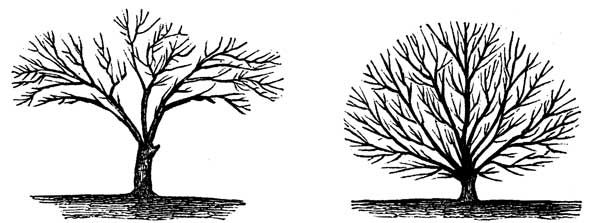
But a work to precede this annual shortening-in, is the original formation of a head to a peach-tree. Take a tree a year old from the bud, and cut it down to within two and a half feet from the ground. Below that numerous strong shoots will come out. Select three vigorous ones and let them grow as they please, carefully pinching off all the rest. In the fall you will have a tree of three good strong branches. In the next spring cut off these three branches, one half. Below these cuts, branches will start freely. Select one vigorous shoot to continue the limb, and another to form a new branch. Check the growth of the shoots below, by cutting off their ends, but do not rub them off, as they will form fruit branches. At the close of the season you will have a tree with six main branches, and some small ones for fruit, on the older wood. Repeat this process the third year, and you have a tree with twelve main branches, and plenty smaller ones for fruit. All these small branches on the old wood, should be shortened in half their length, to cause the leaf-buds near their base to start, so as to produce large numbers of young shoots. Continue this as long as you please, and make just as large a head and just such a form as you may wish, being careful only to control the shape of the top so as to let the sun and air freely into every part.
Trees thus trained may be planted thick enough to allow four hundred to stand on an acre, and will bear an abundance of the finest fruit, and all low enough to be easily picked. This method of training is much better than allowing the tree to shoot out on all sides from the ground: in that case, the branches are apt to split down and perish. This system of heading-in freely every year, preserves the life and health of the tree remarkably. Many of the finest peach-trees in France are from thirty to sixty years old, and some a hundred. We may, in this country, have peach-trees live fifty years, in the most healthy bearing condition. By trimming in this way, and carrying out fully this system, some have thrifty-looking peach-trees, more than a foot in diameter, bearing the very best of fruit. It is sheer neglect that causes our peach-orchards to perish after having borne from three to six years. Let every man who plants a peach-tree remember, that this system of training will make his tree live long, be healthy, grow vigorously, and bear abundantly.
Diseases of peach-trees have been a matter of much speculation. The result is, that the hope of the peach-grower is mainly in preventives.
The Yellows is usually regarded as a disease. Imagination has invented many causes of this evil. Some suppose it to be produced by small insects; others that it is in the seed. Again, it is ascribed to the atmosphere. It has been supposed to be propagated in many ways—by trimming a healthy tree with a knife that had been used on a diseased one; by contagion in the atmostphere, as the measles or small-pox; by impregnation from the pollen, through the agency of winds or bees; by the migration of small insects; or by planting diseased seeds, or budding from diseased trees. This great diversity of opinion leaves room to doubt whether the yellows in peach-trees be a disease at all, or only a symptom of general decay. The symptoms, as given in all the fruit-books, are only such as would be natural from decay and death of the tree, from any cause whatever. This may result from neglect to supply the soil with suitable manures, and to trim trees properly, and especially from over-bearing. This view of the case is more probable, from the fact that none pretend to have found a remedy. All advise to remove the tree thus affected at once, root and branch. We have seen the following treatment of such trees tried with marked success. Cut off a large share of the top, as when you would renew an old, neglected tree; lay the large roots bare, making a sort of basin around the body of the tree, and pour in three pailfuls of boiling water: the tree will start anew and do well. This is an excellent application to an old, failing peach-tree. The sure preventive of the yellows is, planting seeds of healthy trees, budding from the most vigorous, heading-in well, supplying appropriate manures, and general good cultivation.
Curled Leaves is another evil among peach-trees, occurring before the leaves are fully grown, and causing them to fall off after two or three weeks. Other leaves will put out, but the fruit is destroyed, and the general health of the tree injured. Elliott says the curl of the leaf is produced by the punctures of small insects. One kind of curled leaf is, but not this. But we have no doubt that Barry's theory is the correct one, viz., that it is the effect of sudden changes of the weather. We have noticed the curled leaf in orchards where the trees were so close together as to guard each other. On the side where the cold wind struck them, we noticed they were badly affected; while on the warm side, and in the centre where they were protected by the others, they exhibited very few signs of the curl. In western New York, unusual cold east winds always produce the curled leaves, on trees much exposed: hence, the only remedy is the best protection you can give, by location, &c.
Mildew is a minute fungus growing on the ends of tender shoots of certain varieties, checking their growth, and producing other bad effects. Syringe the trees with a weak solution of nitre, one ounce in a gallon of water, which will destroy the fungus and invigorate the tree.
The Borer has been the great enemy of the peach-tree, since about the close of the last century. The female insect, that produces the worms, deposites her eggs under rough bark, near the surface of the ground. This is done mostly in July, but occasionally from June to October. The eggs are laid in small punctures, and covered with a greenish glue; in a few days they come out, a small white worm, and eat through the bark where it is tender, just at, or a little below, the surface of the ground; they eat under the bark, between that and the wood, and, consuming a little of each, they frequently girdle the tree; as they grow larger, they perforate the solid wood; when about a year old, they make a cocoon just below the surface of the ground, change into a chrysalis state, and shortly come out a winged insect, to deposite fresh eggs. But the practical part of all this is the remedy: keep the ground clean around the trees, and rub off frequently all the rough bark; place around each tree half a peck of air-slaked lime, and the borer will not attack it. This should be placed there on the first of May, and be spread over the ground on the first of October; refuse tobacco-stems, from the cigar-makers, or any other offensive substance, as hen-manure, salt and ashes, &c., will answer the same purpose. We should recommend the annual cultivation of a small piece of ground in tobacco, for use around peach-trees. We have found it very successful against the borer, and it is an excellent manure; applied two or three times during the season, it proves a perfect remedy, and is in no way injurious, as an excessive quantity of lime might be.
Leaf Insects.—There are several varieties, which cause the leaves to curl and prematurely fall. This kind of curled leaf differs from the one described as the result of sudden changes and cold wind; that appears general wherever the cold wind strikes the tree, while this only affects a few leaves occasionally, and those surrounded by healthy leaves. The remedy is to syringe them with offensive mixtures, as tobacco-juice, or sprinkle them when wet with fine, air-slaked lime.
Varieties.—Their name is legion, and they are rapidly increasing, and their synonyms multiplying. A singular fact, in most of our fruit-books, is a minute description of useless kinds, and such descriptions of those that they call good, as not one in ten thousand cultivators will ever try to master—they are worse than useless, except to an occasional amateur cultivator.
Elliott, in his fruit-book, divides peaches into three classes: the first is for general cultivation; under this class he describes thirty-one varieties, with ninety-eight synonyms. His second class is for amateur cultivators, and includes sixty-nine varieties, with eighty-four synonyms. His third class, which he says are unworthy of further cultivation, describes fifty-four varieties, with seventy-seven synonyms. Cole gives sixty-five varieties, minutely described, and many of them pronounced worthless. In Hooker's Western Fruit-Book, we have some eighty varieties, only a few of which are regarded worthy of cultivation. Downing gives us one hundred and thirty-three varieties, with about four hundred synonyms. In all these works the descriptions are minute. The varieties of serrated leaves, the glandless, and some having globose glands on the leaves, and others with reniform glands. Then we have the color of the fruit in the shade and in the sun, which will, of course, vary with every degree of sun or shade. We submit the opinion that those books would have possessed much more value, had they only described the best mode of cultivating peaches, without having mentioned a single variety, thus leaving each cultivator to select the best he could find. Had they given a plain description of ten, or certainly of not more than fifteen varieties, those books would have been far more valuable for the people. We give a small list, including all we think it best to cultivate. Perhaps confining our selection to half a dozen varieties would be a further improvement:—
1. The first of all peaches is Crawford's Early. This is an early, sure, and great bearer, of the most beautiful, large fruit;—a good-flavored, juicy peach, though not the very richest. It is, on the whole, the very best peach in all parts of the country. Time, from July 15th to September 1st. Freestone.
2. Crawford's Late is very large and handsome; uniformly productive, though not nearly so good a bearer as Crawford's Early. Ripens last of September and in October. Fair quality, and always handsome; freestone; excellent for market.
3. Columbia.—Origin, New Jersey. It is a thoroughly-tested variety, raised and described by Mr. Cox, who wrote one of the earliest and best American fruit-books. Fine specimens were exhibited in 1856, grown in Covington, Ky. Excellent in all parts of the United States. Freestone.
4. George the Fourth.—A large, delicious, freestone peach, an American seedling from Mr. Gill, Broad street, New York. The National Pomological Society have decided the tree to be so healthy and productive as to adapt it to all localities in this country. It has twenty-five synonyms.
5. Early York.—Freestone; the best, and first really good, early peach. Time July at Cincinnati, and August at Cleveland. Time of ripening of all varieties varies with latitude, location, and season.
6. Grass Mignonne.—A foreign variety, a great favorite in France, in the time of Louis XIV. Very rich freestone, flourishing in all climates from Boston south. The high repute in which it has long been held is seen in its thirty synonyms. One of the best, when you can obtain the genuine. Time, August.
7. Honest John.—A large, beautiful, delicious, freestone variety. Highly prized as a late peach, maturing from the middle to the last of October. Indispensable in even a small selection.
8. Malacatune.—A very popular American freestone peach, derived from a Spanish, and is the parent of the Crawford peaches, both early and late.
9. Morris White.—Everywhere well known; a good bearer; best for preserving at the North; a good dessert peach South.
10. Morris Red Rare-ripe.—A favorite, freestone, July peach. The tree is healthy and a great bearer.
11. Old Mixon.—Should be found in all gardens and orchards; it is of excellent quality and ripens at a time when few good peaches are to be had; it endures spring-frosts better than any other variety; profitable.
12. Old Mixon Cling.—One of the most delicious early clingstones. Deserves a place in all gardens.
13. Monstrous Cling.—Not the best quality, but profitable for market on account of its great size.
14. Heath Cling.—Very good South and West. Wrapped in paper and laid in a cool room, it will keep longer than any other variety. Tree hardy and often produces when others fail. Excellent for preserving, and when quite ripe, is superior as a dessert fruit.
15. Blood Cling.—A well-known peach, excellent for pickling and preserving. It sometimes measures twelve inches in circumference. The old French Blood Cling is smaller. Many of these varieties will be found under other names. You will have to depend upon your nursery-man to give you the best he has, and be careful to bud from any choice variety you may happen to taste. Difficulties and disappointments will always attend efforts to get desired varieties.
PEAR.
The pear is a native of Europe and Asia, and, in its natural state, is quite as unfit for the table as the crab-apple. Cultivation has given it a degree of excellence that places it in the first rank among dessert-fruits. No other American fruit commands so high a price. New varieties are obtained by seedlings, and are propagated by grafting and budding: the latter is generally preferred. Root-grafting of pears is to be avoided; the trees will be less vigorous and healthy. The difficulty of raising pear-seedlings has induced an extensive use of suckers, to the great injury of pear-culture. Fruit-growers are nearly unanimous in discarding suckers as stocks for grafting. The difficulty in raising seedling pear-trees is the failure of the seeds to vegetate. A remedy for this is, never to allow the seeds to become dry, after being taken from the fruit, until they are planted. Keep them in moist sand until time to plant them in the spring, or plant as soon as taken from the fruit. The spring is the best time for planting, as the ground can be put in better condition, rendering after-culture much more easy. The pear will succeed well on any good soil, well supplied with suitable fertilizers. The best manures for the pear are, lime in small quantities, wood-ashes, bones, potash dissolved, and applied in rotten wood, leaves, and muck, with a little stable-manure and iron-filings—iron is very essential in the soil for the pear-tree. In all soils moderately supplied with these articles, all pear-trees grafted on seedling-stocks, and those that flourish on the foreign quince, will do well. A good yellow loam is most natural; light sandy or gravelly land is unfavorable. It is better to cart two or three loads of suitable soil for each tree on such land. The practice of budding or grafting on apple-stocks, on crab-apples, and on the mountain-ash, should be utterly discarded. For producing early fruit, quince-stocks and root-pruning are recommended.
Setting out pear-trees properly is of very great importance. The requisites are, to have the ground in good condition, from manure on the crop of the last season, and thoroughly subsoiled and drained. Pear-trees delight in rather heavy land, if it be well drained; but water, standing in the soil about them, is utterly ruinous. Pear-trees, well transplanted on moderately rich land, well subsoiled and well drained, will almost always succeed. By observing the following brief directions, any cultivator may have just such shaped tops on his pear-trees as he desires. Cut short any shoots that are too vigorous, that those around them may get their share of the sap, and thus be enabled to make a proportionate growth. After trees have come into bearing, symmetry in the form of their heads may be promoted by pinching off all the fruit on the weak branches, and allowing all on the strong ones to mature.
Those two simple methods, removing the fruit from too vigorous shoots, and cutting in others, half or two-thirds their length, will enable one to form just such heads as he pleases, and will prove the best preventives of diseases.
Diseases.—There are many insects that infest pear-orchards, in the same manner as they do apples, and are to be destroyed in the same way. The slugs on the leaves are often quite annoying. These are worms, nearly half an inch long, olive-colored, and tapering from head to tail, like a tadpole. Ashes or quicklime, sprinkled over the leaves when they are wet with dew or rain, is an effectual remedy.
Insect-Blight.—This has been confounded with the frozen-sap blight, though they are very different. In early summer, when the shoots are in most vigorous growth, you will notice that the leaves on the ends of branches turn brown, and very soon die and become black. This is caused by a worm from an egg, deposited just behind or below a bud, by an insect. The egg hatches, and the worm perforates the bark into the wood, and commits his depredations there, preventing the healthy flow of the sap, which kills the twig above. Soon after the shoot dies, the worm comes out in the form of a winged insect, and seeks a location to deposite its eggs, preparatory to new depredations. The remedy is to cut off the shoots affected at once, and burn them. The insect-blight does not affect the tree far below the location of the worm. Watch your trees closely, and cut off all affected parts as soon as they appear, and burn them immediately, and you will soon destroy all the insects. But very soon after the appearance of the blight they leave the limb; hence a little delay will render your efforts useless. These insects often commit the same depredations on apple and quince-trees. We had an orchard in Ohio seriously affected by them. We know no remedy but destruction as above.
The Frozen-Sap Blight is a much more serious difficulty. Its nature and origin are now pretty well settled. In every tree there are two currents of sap: one passes up through the outer wood, to be digested by the leaves; the other passing down in the inner bark, deposites new wood, to increase the size of the tree. Now, in a late growth of this kind of wood, the process is rapidly going on, at the approach of cold weather, and the descending sap is suddenly frozen, in this tender bark and growing wood. This sudden freezing poisons the sap, and renders the tree diseased. The blight will show itself, in its worst form, in the most rapid growing season of early summer, though the disease commenced with the severe frosts of the previous autumn. Its presence may be known by a thick, clammy sap, that will exude in winter or spring pruning, and in the discoloration of the inner bark and peth of the branches. On limbs badly affected on one side, the bark will turn black and shrivel up. But its effects in the death of the branches only occur when the growth of the tree demands the rapid descent of the sap: then the poisoned sap which was arrested the previous fall, in its downward passage, is diluted and sent through the tree; and when it is abundant, the whole tree is poisoned and destroyed in a few days; in others more slightly affected, it only destroys a limb or a small portion of the top. Another effect of this fall-freezing of sap and growing wood, is to rupture the sap-vessels, and thus prevent the inner bark from performing its functions. This theory is so well established, that an intelligent observer can predict, in the fall, a blight-season the following summer. If the summer be cool, and the fall warm and damp, closed by sudden cold, the blight will be troublesome the next season, because the plentiful downward flow of sap, and rapid growth of wood, were arrested by sudden freezing. If the summer is favorable, and the wood matures well before cold weather, the blight will not appear. This is of the utmost practical moment to the pear-culturist. Anything in soil, situation, or pruning, that favors early maturity of wood, will serve as a preventive of blight; hence, cool, moist situations are not favorable in climates subject to sudden and severe cold weather in autumn. Root-pruning and heading-in, which always induce early maturity of wood, are of vast importance; they will, almost always, prevent frozen-sap blight. If, in spite of you, your pear-trees will make a late luxuriant growth, cut off one half of the most vigorous shoots before hard freezing, and you will check the flow of sap, by removing the leaves and shoots that control it, and save your trees. If blight makes its appearance, cut off at once all the parts affected. The effects will be visible in the wood and inner bark, far below the external apparent injury. Remove the whole injured part, or it will poison the rest of the tree. When this frozen sap is extensive, it poisons and destroys the whole tree; when slight, the tree often wholly recovers. If a spot of black, shrivelled bark appears, shave it off, deep enough to remove the affected parts, and cover the wound with grafting-wax. Remove all affected limbs. These are the only remedies. But the practice of pruning both roots and branches will prove a certain preventive. A tree growing in grass, where it grows more slowly, and matures earlier in the season, will escape this blight; while one growing in very rich garden soil, and continuing to grow until cold weather, will suffer severely. The effects on orchards, in different soils and localities everywhere, confirm this theory. A little care then will prevent this evil, which has sometimes been so great as to discourage attempts at raising pears. In some localities, some of the finer varieties of pears, as the virgalieu, are ruined by cracking on the trees before ripening. Applications of ashes, salt, charcoal, iron-filings, and clay on light lands, will remedy this evil.
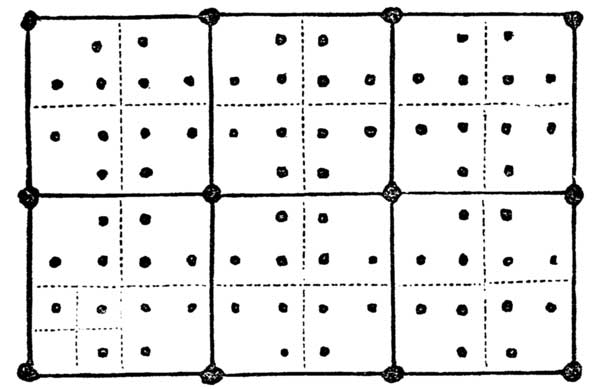
Distances apart.—All fruit-trees had better occupy as little ground as is consistent with a healthy vigorous growth. They are manured and well cultivated, at a much less expense. The trees protect each other against inclement weather. The fruit is more easily harvested. And it is a great saving of land, as nothing else can be profitably grown in an orchard of large fruit-trees. The two kinds of pear-trees, dwarf and standard, may be planted together closely and be profitable for early and abundant bearing. The plan given on the next page of a pear-orchard, recommended in Cole's Fruit Book, is the best we have seen.
In the plan the trees on pear-stocks, designed for standards, occupy the large black spots where the lines intersect. They are thirty-three feet apart. The small spots indicate the position of dwarf-trees on quince stocks. Of these there are three on each square rod. An acre then would have forty standard trees, and four hundred and eighty dwarfs. The latter will come into early bearing, and be profitable, long before the former will produce any fruit. This will induce and repay thorough cultivation. They should be headed in, and finally removed, as the standards need more room. One acre carefully cultivated in this way, will afford an income sufficient for the support of a small family.
Plan of a Pear-Orchard.
Gathering and Preserving.—Most fruits are better when allowed fully to ripen on the tree. But with pears, the reverse is true; most of them need to be ripened in the house, and some of them, as much as possible, excluded from the light. Gather when matured, and when a few of the wormy full-grown ones begin to fall, but while they adhere somewhat firmly to the tree. Barrel or box them tight, or put them in drawers in a cool dry place. About the time for them to become soft, put them in a room, with a temperature comfortable for a sitting-room, and you will soon have them in their greatest perfection. They do better in a warm room, wrapped in paper or cotton. A few only ripen well on the trees. Those ripened in the house keep much longer and better.
Varieties.—The London Horticultural Society have proved seven hundred varieties, from different parts of the world, in their experimental garden. Cole speaks of eight hundred and Elliott of twelve hundred varieties. There are now probably more than three thousand growing in this country. Many seedlings, not known beyond the neighborhood where they originated, may be among our very best. From six to ten varieties are all that need be cultivated. We present the following list, advising cultivators to select five or six to suit their own tastes and circumstances, and cultivate no more. We do not give the usual descriptions of the varieties selected. The mass of cultivators, for whom this work is specially intended, will never learn and test the descriptions. They will depend upon their nursery-man, and bud and graft from those they have tasted.
We give their names and some of their synonyms, their adaptation to quince or pear stocks, their manner of growth, and time of maturity. These will enable the culturist to select whatever best suits his taste; adapted to quince or pear stocks; for the table or kitchen; for summer, fall, or winter use, and for home or the market.
Belle Lucrative.—Fondante d' Automne, Seigneur d' Esperin. Tree of moderate growth, but a great bearer. A fine variety, on quince or pear, better perhaps on the pear stock. Season, last of September.
Beurré Easter with fifteen synonyms that few would ever read. Best on quince. Requires a warm soil and considerable care in ripening, when it proves one of the best. Its season—from January to May—makes it very desirable. Large, yellowish-green, with russet spots.
Bartlett.
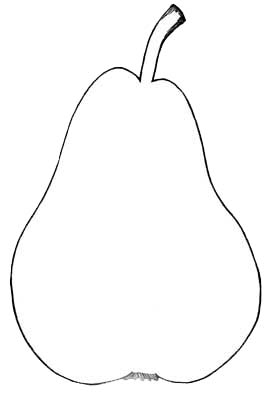
Bartlett.—William's, William's Bon Chretien, Poire Guilliaume. Tree, a vigorous grower, and a regular, early, good bearer, of long, handsome, perfectly-formed fruit; on the quince or pear stock. Time, August and September.
Beurré Diel.
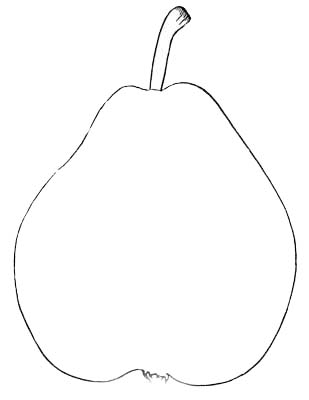
Beurré Diel.—Diel, Diel's Butterbirne, Dorothee Royale, Grosse Dorothee, Beurré Royale, Des Trois Tours, De Melon, Melon de Kops, Beurré Magnifique, Beurré Incomparable. Grows well on quince or pear, but perhaps does best on quince. Large, beautiful, luscious fruit. Season, October to last of November.
White Doyenne.
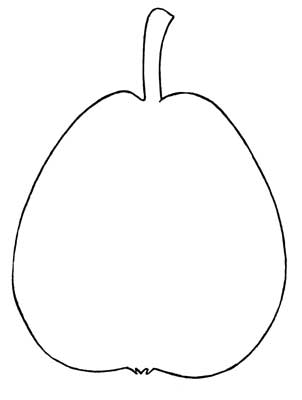
White Doyenne.—Virgalieu. Tree vigorous and hardy on pear or quince. Everywhere esteemed as one of the very best. Needs care in supplying proper manure and clay on light soils, to prevent the fruit from cracking. September to November. If we could have but one we should choose this.
Columbia.—Columbian Virgalieu. Native of New York, bearing abundantly, a uniformly smooth, fair, large fruit. Color, fine golden yellow, dotted with gray. Season, December and January.
Flemish Beauty.
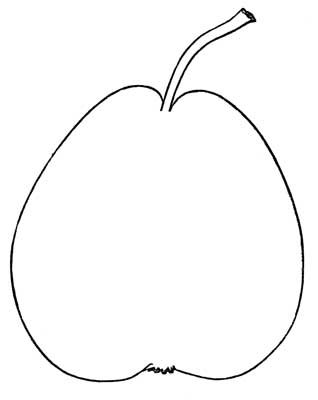
Flemish Beauty.—Belle de Flanders, &c. This is a large, beautiful, and delicious pear. One of the finest in its season, but does not last long. Ripens last of September. Very fine on the quince, and is excellent on the rich prairie-lands of the West. Deserves increased attention.
Beurré d'Aremberg.—Duc d'Aremberg, and eight other synonyms. Tree very hardy, does well on the pear stock, and bears early, annually, and abundantly. A very fine foreign variety. The fruit hangs on the tree well, and may be ripened at will from December to February, by placing in a warm room, when you would ripen them.
Buffum.—A native of Rhode Island, and very successful wherever grown. A great bearer of handsome fruit, though not of the best quality. It is, however, an excellent orchard pear. Fruit, medium size, ripening in September.
Louise Bonne of Jersey.—William the Fourth, and three other useless foreign synonyms. Not surpassed, on the quince. Tree very vigorous, producing a great abundance of large fruit. Season, October.
Madeleine.—Magdalen, Citron des Carmes. This bears an abundance of small but delicious fruit. Is valuable also on account of its season—the last half of July. Good on pear or quince. Must be checked in its growth, on very rich land, or it will be subject to the frozen sap-blight.
Onondaga.—American origin. Equally good on pear or quince. Large, hardy, and very productive tree. The fruit is very large, fine golden yellow when ripe. Excellent for market. Season, October and November.
Pound Pear.—Winter Belle, and twelve other synonyms, which are unimportant. This is the great winter-pear for cooking. The tree is a very vigorous grower and great bearer. A very profitable orchard variety. December to March.
Prince's St. Germain.—New St. Germain, Brown's St. Germain. Hardy and productive. Good keeper, ripening as easily and as well as an apple. December to March.
Seckel.
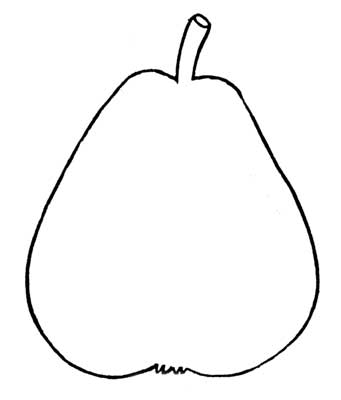
Seckel.—There are a number of synonyms, but it is always known by this name. Tree is small, but a good and regular bearer of small excellent fruit. Time in warm climates, September and October.
Steven's Genesee.—Stephen's Genesee, Guernsey. Desirable for all orchards and gardens, on quince or pear. Fine grower and very productive. Fruit large and excellent. Elliott says "even the wind-falls are very fine."
Vicar of Wakefield.—Eight synonyms, but it will hardly be mistaken by nursery-men. Does well on quince. It is thrifty and very productive of fruit of second quality. Yet it is generally profitable. November to January.
Winter Nellis.—Its six foreign synonyms are of no consequence. This is the best of all winter-pears, grown on quince or pear. Exceedingly well adapted to the rich western prairies. An early and great bearer. November to January 15.
Gray Doyenne.
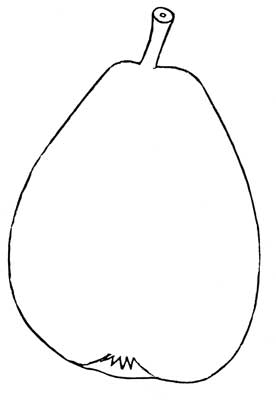
Gray Doyenne.—A superior October pear. Tree hardy and productive on both pear or quince. Partakes much of the excellence of the White Doyenne.
From these you can select five or six just adapted to your wishes. The diversity of views, of the merits of different varieties of pears, arises mainly from the influence of location, soil, and culture. The established known varieties, may be grown in great perfection anywhere, with suitable care. At the West they must be root-pruned and headed-in until they are ten years old, after which they will be hardy and productive. If allowed to grow as fast as they will incline to, on alluvial soils, when they are exposed to severe winters, they will disappoint growers. With care they will be sure and profitable.
PEPPERS.
The red peppers, cultivated in this country, are used for pickling, for pepper-sauce, as a condiment for food, and as a domestic medicine.
Varieties—are named principally from their shape. The large squash-pepper is best for green pickles, on account of its size and tenderness. The Cayenne, a small, long variety, much resembling the original from which it is named, is very pungent, used mostly for pepper-sauce. Grind, not very fine, any of the varieties, and they are useful on any food of a cold nature and not easily digestible. They are all good for medicinal purposes. The capsicum needs a dry, warm soil, with exposure to the sun. Plants should stand two feet apart each way; as they are slow growers, they should be started in an early hotbed. Many will ripen during summer, and may be gathered. In the fall, when frost comes, the vines will be covered with blossoms and with peppers of all sizes. Fall-grown green ones, strung on a thread, and hung in a warm, dry room, will ripen finely. They are very hardy, and may be transplanted without injury. Hen-manure is best for them.
PEPPERGRASS.
This is a variety of cress, of quick growth, used as lettuce. On a rich, finely-pulverized soil, sow the seeds in drills, fifteen inches apart, and cover very lightly. Sow thick and water in dry weather. For use, cut the tops while they are very tender. A second crop will grow, but inferior to the first. The water-cress, growing spontaneously by rills and springs, is a kind of wild peppergrass, and is by some persons more esteemed than the garden variety. We prefer early lettuce to cresses or peppergrass, and see no reason for their cultivation, but their rapid growth.
PLOWING.
This is one of the most important matters in soil-culture. When, how, and how much, shall we plow? are the three questions involving the whole. When should plowing be done? As it respects wet or dry, plow sandy or gravelly land whenever you are ready. It will neither be hard when dry, nor injured by being plowed when very wet. Good loams may be plowed at all times except when excessively wet. Clays can only be worked profitably when neither excessively wet or dry. Plowing land in a warm rain is almost equal to a coat of manure. Plowing in a light snow in the spring will injure it the whole season. We have noticed a marked difference in corn growing but a rod apart, on land where snow was plowed in, and the other plowed two or three days later, after the snow was gone; this difference was noticeable in the rows throughout the entire field. Spring or fall plowing is a question that has been much discussed. Sod-land is better plowed in the fall. The action of winter rains and frosts on the turf is beneficial. The same is true of land trenched deep, where much of the hard, poor subsoil is brought to the surface: it is benefited by winter exposure. Other cultivated fields are injured by fall-plowing, unless it be very early. All stubble-land is much benefited by being plowed as soon as the grain is taken off. The weeds and stubble, plowed under, will be decomposed by the warm weather and rains, and benefit the soil almost as much as an ordinary coat of manure. Plowed late, such action does not take place, and the surface is injured by winter-exposure: hence, do all the early fall-plowing possible, but plow nothing late in the fall but sod-land.
How shall we plow? All land should be subsoiled, except that having a light, porous subsoil; one deep plowing on such land is sufficient. Subsoiling is done by using two teams at once—one with a common plow, running deep, and the other with a subsoil-plow with no mould-board, and which will, consequently, stir and disintegrate the earth to the depth at which it runs, without throwing it to the surface. The next surface-furrow will cover up this loosened subsoil. In this way, land may be plowed eighteen inches deep, to the great benefit of any crop grown on it. If the surface be well manured, this method of plowing will place the manure between the first furrow and the subsoil, and increase its value. Such plowing is very valuable on land for young fruit-trees. There is another method, which we denominate double-plowing, which is more beneficial than ordinary subsoiling: it is performed by two common plows, one following in the furrow of the other; the first furrow need not be very deep—let the furrow in the bottom of the first be as deep as possible, and thrown out upon the surface; the next furrow will throw the surface and manure into the bottom of the deep furrow; the next furrow will cover this surface-soil and manure very deep, and, as manure always works up, it will impregnate the whole. This, for garden-vegetables, berries, nurseries, or young orchards, is the best form of plowing that we have ever tried. It may be done with one team, by simply changing the gauge of the clevis every time round, gauging it light for the first furrow, and deep for the second. We once prepared a plat in this way with one team, on which cabbages made a remarkable growth, even in a dry season. Still a farther improvement would be a light coat of fine manure on the surface. All furrows, in every description of plowing, should be near enough together to move the whole, leaving no hard places between them. The usual "cut and cover" system, to get over a large area in a day, is miserable economy. The more evenly and flatly land can be turned over in plowing, the better it will be; it retards the growth of weeds, and secures a better action upon substances plowed under. An exception to deep plowing is in breaking up the original prairies of the West: they have to be broken with plows kept sharp as a knife, and not more than two inches deep. The grass then dies and the sod rots. But plowed deep, the grass comes up through the turf, and will prove troublesome for two or three years. It must also be broken at a certain season of the year, to insure success. It may be profitably done for two months after the grass gets a good start in the spring.
How much is it best to plow land? Once double-plowed, or thoroughly subsoiled, and well turned over, is better than more. Land once plowed so as to disintegrate the whole to the depth of the furrow, will produce more, and require less care, than the same would do if cross-plowed once or twice. Excessive plowing is a positive injury. All land should be broken up once in three or four years, and not kept longer than that under the plow at one time. Some farmers keep land perpetually in grass, refusing to have a plow touch it on any condition. They see wrong tillage produce barrenness. But by this practice they are great losers; they never get over one half the hay or pasturage that could be obtained by frequent tillage and manuring, and a rotation of crops.
PLUM.
This is one of our best fruits, but suffers more from enemies than any other.
Propagation is by seeds or layers, budding or grafting. Seeds from trees not exposed to mixture with other varieties in the blossom, will produce the same; hence, this is the best method of propagating a given variety, standing alone. But, for most situations, budding is preferable to any other method. This should be performed earlier than on the peach. The plum matures earlier, and hence should be budded about the last of July, or first of August. Bud on the north side of the tree to avoid the hot sun; and tie more tightly than in budding other trees. Bud plum-trees the second year from the seed. Grafting should be resorted to only when buds have failed, and there is a prospect that the trees will be too large for budding another season. The common wild plums make good stocks, if grafted at the ground. Thoroughly mulch all newly-grafted plum-trees. Root-grafting will succeed, but should never be practised. In all grafting of plums, put the graft in at the surface of the ground, and cover with sawdust or mould, leaving but one bud on the graft exposed.
Soil.—All soils are good for the plum, provided they be thoroughly drained, and properly fertilized.
Hard soils are recommended as being almost proof against the curculio. That a soil affording a rather hard, smooth surface, will afford less burrows for curculio, and consequently lessen their ravages, is no doubt true. But it is not a perfect remedy, and, on other accounts, such a soil is no better. A good firm loam is best. Plums will do well also on light land, but are more exposed to injury from the curculio.
Transplanting.—The plum being perfectly hardy, we recommend transplanting in autumn. Shorten in the top, cut off considerable of the tap-root, and the ends of the long roots, transplant well, and mulch so thoroughly as to prevent too strong action of the frost on the roots, and they will start early and do well. Twelve feet apart for small varieties, and twenty feet for larger growers, are the distances usually recommended. We think a rod apart each way will do well for all varieties.
Pruning.—Once started in a regular growth, in such a shape as you desire, no further pruning will be necessary but occasionally heading-in a too luxuriant shoot, and removing diseased and cross limbs. On rich Western lands, and in warm Southern climes, young plum-trees must be root-pruned and headed-in, or they will be unfruitful and unhealthy. Root-pruning should be done in August, in the following manner. In case of a tree ten feet high, take a sharp spade, and in a circle around the tree, two feet from the trunk (making the circle four feet in diameter), cut off all the roots within reach. In smaller trees, make the circle smaller, and in larger ones, larger. At the same time, shorten in the current year's growth, by cutting off one half the length of all the principal shoots; this will give vigor, symmetry, and fruitfulness, and prove a valuable preventive of disease. Plum-trees should always have good, clean cultivation.
Manures from the stable and slaughter-house, with wood-ashes, lime, and plenty of salt, are the best for the plum. The following analysis, by Richardson, of the fruit of the plum, will aid the culturist in his selection of manures:—
Potash59.21
Soda.54
Lime10.04
Magnesia5.46
Sulphuric acid3.83
Silicic acid2.36
Phosphoric acid12.26
Phosphate of iron6.04
Hence, as wood-ashes contains much potash, and as this is the largest ingredient in the plum, it must be the best application to the soil for this fruit. Bones, dissolved in sulphuric acid, would also be very valuable. Bones, bonedust, salt, wood-ashes, and barnyard manure, with a little lime, will be all that will be necessary.
Diseases.—In most northern latitudes, the black wart, or knot, is fatal to many plum-trees. It is less prevalent at the South: its origin is not known. Many theories respecting it are put forth by different cultivators; they are unsatisfactory, and their enumeration here would be useless. It may be either the result of general ill health in the tree, from budding on suckers and unhealthy stocks, and a want of proper elements in the soil, or of improper circulation of sap, caused by the roots absorbing more than the leaves can digest. In the latter case, root-pruning and heading-in would be an effectual preventive. In the former, supply suitable manures, and give good cultivation. In every case, remove at once all affected parts, and wash the wounds and whole tree, and drench the soil under it, with copperas-water—one ounce of copperas to two gallons of water. This is stated to be a complete remedy.
Defoliation of seedlings and bearing trees often occurs in July and August. Land well supplied with the manures recommended, especially wood-ashes, salt, and the copperas-water, has not been known to produce trees that drop their leaves.
Decay of the Fruit is another serious evil. Professor Kirtland and others suppose it to be a species of fungus. Poverty of soil, and wet weather, may be the cause. If the season be unusually wet, thin the fruit, so that no two plums shall touch each other. Keep the soil properly manured, and spread charcoal or straw under the tree, and you will generally be able to preserve your fruit.
The Curculio is the great enemy of the plum, and frequently of all smooth-skinned fruits, as the grape, nectarine, &c.
(1) Curculio, in the beetle-form, life-size. (2) Its assumed form when disturbed or shaken from the tree. (3) Larva, or worm, as found in the fallen fruit. (4) Pupa, or chrysalis state, in which it lives in the ground.

Many remedies are proposed: making pavements, or keeping the ground hard and smooth, under the trees; pasturing swine and keeping fowls in the plum-orchard; syringing the whole tops of the trees four or five times with lime and salt water, or lime and sulphur-water—the proportions are not material, provided it be not excessively strong. It is recommended to apply with a garden-syringe. But, as few cultivators will have that instrument, they may sprinkle the mixture on the trees in any way most convenient. Salt, worked into the soil under plum-trees, is said to destroy this insect in its pupa state. At any rate, the salt is a good manure for the plum-tree. We know a remedy for the ravages of the curculio, unfailing in all seasons and localities—that is, to kill them: spread a cloth under the tree, and with a mallet having a head, covered with India-rubber or cloth that it may not injure the bark, strike the body and large limbs sudden blows, which will so jar them as to cause the insects to fall upon the cloth, and you can then burn them. Do this five or six times in the season, commencing when the fruit begins to set, and continuing till it becomes nearly full-grown. This is best done in the cool of the morning, while the insects are still; their habits of fear and quiet, when there is a noise about, are greatly in favor of their destruction by this method. This is somewhat laborious, but is a sure remedy, and will pay well in all plum-orchards, large or small. After two or three years of this treatment, there will be few or none of those insects left.
Uses of the plum are various. The fine varieties, well ripened, are a good dessert-fruit; for sweetmeats and tarts they are much esteemed; they are one of the better and more wholesome dried fruits. The foreign ones are called prunes, and are an article of commerce. With a little care, we can raise much better prunes than the imported. Like all fruits, they are better for quick drying by artificial heat. The French prunes, the process of drying which is minutely described by Downing in his fruit-book, are no better than our best varieties, quickly dried by artificial heat in a dry house, or moderately-heated oven. All dried fruit is much better for having become perfectly ripe before picking. It is a great mistake to suppose unripe fruit will be good dried.
Lawrence's Favorite.
Varieties are numerous, and many of them ought to be forgotten, as is the case with all other fruits. We give a small list, containing all the good qualities of the whole:—
Bleecker's Gage.—A hardy tree and sure bearer. Time, August.
Imperial Gage. Egg.
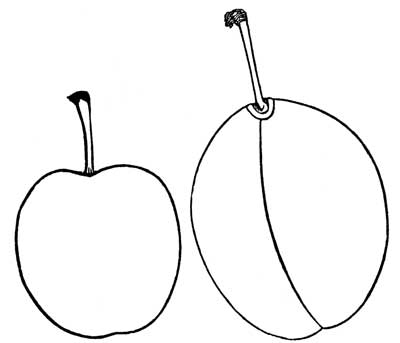
Imperial Gage.—This is an American variety. It is of a lightish-green color, and excellent flavor. Season, July at the South, and September at the North.
Egg.—The above cut represents one of the egg-plums, of excellent quality in all respects. There are many of this name.
Lawrence's Favorite.—This is a fine plum, of the gage family. It was raised from the seed of the green gage; its qualities are seldom surpassed.
Washington.—This is a very good plum for high latitudes. At the South it is too dry.
Green Gage. Jefferson.
Green Gage.—With fifteen synonyms. Excellent.
Jefferson.—One of the very best. Time, last of August.
Denniston's Purple, or Red.—Vigorous grower and very productive. Time, August 20.
Madison.—A hardy, productive, and excellent October plum.
The foregoing varieties, with the little black damson-plum, so hardy and productive, and so much esteemed for preserving, will answer all needful purposes. You will find long lists in the fruit-books. Some of them are the above varieties, under different names. Procure four or five of the best you can find in your vicinity, and cultivate them, and you will need no others.
Washington.
POMEGRANATE.
This is one of the most delicious and beautiful of all the dessert-fruits. Native in China, and much cultivated in Southern Europe. It will do quite well as far north as the Ohio river. Trained as an espalier, with protection of straw or mats, it will do tolerably well throughout the Middle states. The fruit is about as large as an ordinary apple, and has a tough, orange-colored skin, with a beautiful red cheek. The tree is of low growth. Blossoms are highly ornamental, as is also the fruit, during all the season. It is cultivated as the orange.
There are several varieties: the sweet-fruited, the sub-acid, and the wild or acid-fruited. The first is the best, and the second the one most cultivated in this country; the latter yields a very pleasant acid, making an excellent sirup. Pomegranates should be extensively cultivated at the South, and form an important article of commerce for Northern cities.
POTATO.
This is far the most valuable of all esculent roots; supposed to be a native of South America. It is called the Irish potato, because it was grown extensively first in Ireland. It was first planted on the estate of Sir Walter Raleigh in 1602. It was introduced into England in 1694. It has been represented as having been introduced into England from Virginia as early as 1586, but attracted no attention, and for two centuries formed no considerable part of British agriculture. It has become naturalized in all temperate regions, and in many locations in high latitudes. In tropical climates, it flourishes on the mountains, at an elevation sufficient to secure a cool atmosphere. Cool moist regions, as Ireland and the northern parts of the United States, are most favorable for potatoes. In warm climates the potato grows less luxuriantly, yields much less, and is liable to be ruined by a second growth. In the latitude of southern Ohio, a severe drought, while the tubers are small, followed by considerable rain, causes the young potatoes to sprout, and send up fresh shoots, and often make a very luxuriant growth of tops, to the complete ruin of the tubers. This is called second growth. In cooler climates this second growth simply makes prongs on the tubers, thus injuring the appearance and quality, but increasing the crop. The only preventive is watering regularly in a dry time. This can be done advantageously in a garden, and on a small scale. In field culture, when second growth occurs, dig your potatoes at once, if they are large enough to be of much use. If not they will all be lost.
Propagation is by annually planting the tubers. No mixture of sorts ever takes place from planting different varieties together. This can only be done in the blossoms, and will consequently appear in young seedlings. To raise good potatoes, always plant ripe seed, and the largest and best, and leave them whole. Selecting small potatoes for seed, and cutting them up, and planting mere eyes and pearings as some do, has done much to injure the health, quality, and quantity of yield of the potato. Selecting the poorest for seed, will run out anything we grow in the soil. New varieties have been multiplying within the past few years from seed. Some gentlemen are raising varieties by thousands. Not more than one out of a thousand prove truly valuable. The quality of a new variety can not be established earlier than the fifth year. Many that promised well at first proved worthless.
To raise from seed, gather the balls after they have matured, hang them in a dry place till they become quite soft, when separate the seeds and dry them as others, and plant as early as the temperature of the soil favors vegetation. Chance varieties from seed of balls left to decay in the fall, as tomatoes, are recorded. Probably our present best varieties had such an origin. Raising new varieties requires much care and patience. Keep each one separate, plant only the best, and then you must wait four or five years to determine whether, out of a thousand, you have one good variety.
Varieties.—These are numerous. Those best adapted to one locality, are often inferior in another. That excellent potato, the Carter, so firm in New England and western New York, is ill-shapen and inferior in many localities in Illinois. The Neshannock or common Mercer produces a larger yield in Illinois than in the Eastern states, but of a slightly inferior quality. Most seeds do better transported from a colder to a warmer climate, but with the potato the reverse is true. The best potatoes of Ireland are usually inferior in the warmer latitudes of this country. In ordering potatoes for seed it is better to describe the quality than to order by the name. We omit any list, of even the best varieties. They are known by different names, and are not equally good in all localities. And all varieties are scattered over the whole country, very soon, by dealers, and through the agency of agricultural societies and periodicals. Different varieties should be kept separate, as they look better for market, and no two will cook in precisely the same time.
Plant the large potatoes and plant them whole. From a small eye or a small potato to the largest they will vegetate equally well. And in a wet, cool season, the small seed will produce nearly as good a crop as the large. But the large seed matures earlier, and in a dry season produces a much larger crop. The moisture in a large potato decaying in the hill, is of great use to the growing plants, in a dry season. It is also generally conceded that potatoes growing from cut seed are more liable to be affected by the rot.
Quantity of seed per acre.—The practices of farmers vary from five to twenty bushels. It takes a less number of bushels per acre when the seed is cut. The quantity is also affected by the size of the seed, the larger the potatoes the more will it take to seed an acre.
Plentiful, but not excessive, seeding is best. It is a universal fact that you can never get something for nothing. Hence light seeding will bring a light yield. We think it best to put one good-sized potato in a place and make the rows three feet apart each way. We think they yield better than at any other distances or in any other way. We have often tried drills, and found them more trouble, with no greater yield. The soil should be disintegrated to the depth of sixteen inches and the potatoes planted four inches deep, and cultivated with subsoil plow, and other suitable tools, in a manner to leave the surface nearly flat. Hilling up potatoes never does any good. We advise always to harrow the crop, as soon as they begin to appear through the soil.
Soil.—Any good rich garden soil is good for this crop, provided it be well drained. Potatoes like moisture, but are ruined by having water stand in the soil. New land and newly broken-up old pastures are best.
Manures.—All the usual fertilizers are good for potatoes, but especially ashes and plaster. The application above all others, for potatoes, is potash. Dissolve it in water, making it quite weak, and saturate your other manures with it, and the effect will always be marked. The tops contain a great deal of potash, and should always be plowed in and decay in the soil where they grow, otherwise they will rapidly exhaust the land. It is supposed that nothing will do more to restore the former vigor and health of the potato than a liberal application of potash in the soil in which they grow. The crop will be much increased in a dry season by manuring in the hill, dropping the potato first and putting the manure on the top of it.
Gathering and Preserving.—The usual hand-digging with hoe or potato-fork are well known, and do well when the crop is not large. But for those who grow potatoes for market, it is better to employ the plow in digging. Modern inventions for this purpose can everywhere be found in the agricultural warehouses. Potatoes are well preserved in a good cool cellar, in boxes or barrels; and are better for being covered with moist sand. The usual method of burying them outdoor is effectual and safe, if they be covered beyond the reach of frost, and have a small airhole at the apex, filled with straw.
The Potato Disease.—This is altogether atmospherical. A new piece of land was cleared for potatoes. In the middle was a close muck, on a coarse, gravelly subsoil. In the lowest place a ditch was dug, to carry off the superabundance of water; from that ditch the coarse gravel was thrown out on one side, and suffered to remain at considerable depth. Only two or three rods distant, on one side the plat extended over a knoll of loose sand. Potatoes were planted, from the same seed, at the same time, and in the same manner, on these three kinds of land, side by side. They were all tended alike, needing little hoeing or care, the land being new. The rot prevailed badly that season. On digging the potatoes, it was found that in the coarse gravel, where the air could circulate almost as freely as in a pile of stove-wood, all the potatoes were rotten: on the muck, which was unlike a peat-bog, very fine and tight, almost impervious to the atmosphere, they were nearly all sound; on the sand, which was quite open, but tighter than the gravel, part were decayed and the rest sound. Their condition was graduated entirely by the condition of the soil. It is an apparent objection to this theory, that when the rot prevails, the best potatoes are raised on light, sandy soils. It is said that they are open to the action of air. To this it is replied, that whether they rot or not, in sandy soils, depends on the kind of sand. On some sand they rot very badly, on others hardly at all. Sandy soils differ very materially: some are almost pure silex; while others are filled with a fine dust, and, although apparently loose, are much more nearly impervious to the air than heavier soils; on the former, nearly all will decay, and on the latter, most will be preserved.
Look at the immense potato crops near Rochester, N. Y., on sandy land. We have personally examined it, and find it to be filled with dust, that excludes the air, and saves the potato from rot. Why, then, is a heavy clay useless for potatoes? Is not clay a very tight soil? Unbroken it is; but, when plowed, it is always left in larger particles than other land—it is but seldom pulverized. The spaces between the particles are all open to the free action of the air; hence, instead of being close, it is one of the most open of all our soils. This confirms the theory.
The influence of manuring land is still another confirmation. We are directed not to manure our land for potatoes when the disease prevails. It is said we can raise no sound potatoes on rich land when the rot is abroad. This is an error. The richness of the soil does not promote the disease; but if any kind of manure be applied that, from its bulk and coarseness, keeps the soil open to the air, the potatoes will rot. But fertilize to the highest extent, in any way that does not make the soil too open, and let in the air, and the crop will be greatly increased with perfect safety. Thus, this theory, like every truth, perfectly fits in all its bearings.
There is, then, no perfect remedy for the disease but in the power of Him who can purify the atmosphere. Numerous remedies and preventives have been recommended, by those who suppose they have tried them with success. But in other localities and soils, all their remedies have failed, as will all others that will yet be discovered. A careful examination of the texture of the soils, upon the principles here indicated, and a repetition of their experiments, will show the discoverers that their success depended upon their soils, while others failed in using the same remedies on other soils. The practical uses of this theory are obvious. When the disease is abroad, we should select soil that excludes, as much as possible, the atmosphere, and plant deep; on all land not liable to have water stand on the subsoil. Do not be deceived into the belief that all sandy land will bear good potatoes, in the seasons when the disease prevails. The worst rot we ever had was in 1855, on very sandy land. This year (1857) we have witnessed the worst rot in open sand and gravel. Add to this, great care in preserving the health of the tubers. Plant very early, only whole potatoes, and of mature growth, thoroughly ripe; apply a little salt and lime, plaster rather plentifully, and potash, or plenty of wood-ashes—and you will succeed in the worst of seasons.
PRESERVING FRUITS, &c.
The essentials in preserving fruits, berries, and vegetables, during the whole year, are, a total exclusion from atmospheric action, and, in some vegetables, a strong action of heat. We have a variety of patent cans, and several processes are recommended. The patent cans serve a good purpose, but, for general use, are inferior to those ordinarily made by the tinman. The patent articles are only good for one year, and are used with greater difficulty by the unskilful. The ordinary tin cans, made in the form of a cylinder, with an orifice in the top large enough to admit whatever you would preserve, will last ten years, with careful usage, and they are so simple that no mistakes need be made. It is usually recommended to solder on the cover, which is simply a square piece of tin large enough to cover the orifice. Soldering may be best for those cans that are to be transported a long distance, but it is troublesome, and is entirely unnecessary for domestic use. A little sealing-wax, which any apothecary can make at a cheap rate, laid on the top of the can when hot, will melt, and the cover placed upon it will adhere and cause it to be air-tight. All articles that do not part with their aroma by being cooked, may be perfectly preserved in such cans, by putting them in when boiling, seasoned to your taste, and putting on the covers at once. The cans should be full, and set in a cool place, and the articles will remain in a perfect state for a year. The finest articles of fruit, as peaches and strawberries, may be preserved so as to retain all their peculiar aroma, by putting them into such cans, filled with a sirup of pure sugar, and placing the cans so filled in a kettle of water, and raising it to a boiling heat, and then putting on the cover as above; the heat expels the air, and the cover and wax keep it out. Stone jugs are used for the same purposes, but are not sufficiently tight to keep out the air, unless well painted after having become cold. Wide-mouthed glass bottles are excellent. But, in using glass or stone ware, the corks must be put in and tied at the commencement, leaving a small aperture for the escape of steam, and the process of raising the water to a boiling heat must be gradual, requiring three or four hours, or the bottles will be broken by sudden expansion. Make the corks air-tight by covering with sealing-wax on taking from the boiling water. Some vegetables, as peas, beans, cauliflowers, &c., need considerable boiling, in order to perfect preservation. Tin cans may stand in the water and boil an hour or two, if you choose, and then be sealed. The bottles should be corked tight, have the cork tied in, and then be immersed and boil for an hour: take them out, and dip the cork and mouth of the bottles in sealing-wax, and all will be safe.
By one of these processes, exclusion of the atmosphere and thorough boiling, we may preserve any fruit or vegetable, so as to have an abundance, nearly as good as the fresh in its season, the whole year, and that at a trifling expense. All fruits and vegetables may also be preserved by drying. By being properly dried, the original aroma can be mostly retained. The essentials in properly drying are artificial heat and free circulation of the air about the drying articles. Fruit dried in the sun is not nearly so fine as that dried by artificial heat. An oven from which bread has just been taken is suitable for this purpose; but a dry-house is better. A tight room, with a stove in the bottom, and the fruit in shallow drawers, put in from the outside, serves a good purpose. Construct the room so as to give a draft, the heated air passing out at the top, and the process of drying will be greatly facilitated, and the more rapid the process, without cooking the fruit, the better will be its quality. This process is applicable to all kinds of vegetables. Roots, as beets, carrots, parsnips, or potatoes, should be sliced before drying. The object in drying the latter articles would be to afford the luxury of good vegetables for armies and ships' crews, in distant regions, and in climates where they are not grown. Milk can be condensed and preserved for a long time, and, being greatly reduced in quantity, it is easily transported. It is not generally known in the country that Mr. Gail Borden, of New York, has invented a method of condensing milk, fresh from the cow, so that it will perfectly retain all its excellences, including the cream, and by being sealed up in tin cans, as above, may be kept for many months. The milk and the process of condensation have been scientifically examined by the New York Academy of Medicine, and pronounced perfect, and of great value to the world. We have used the condensed milk, which was more than a month old; it had been kept in a tin can without sealing and without ice, but in a cool place. It was sweet and good, differing in no respect from fresh milk from the cow, except that the heat employed in condensing it gave it the taste of boiled milk. If kept in a warm place, and exposed to the atmosphere, it may sour nearly as soon as other milk: but it may be sealed up and kept cool so as to be good for a long time. The condensation is accomplished by simple evaporation of the watery part, in pans in vacuo. No substance whatever is put into the milk. Four gallons of fresh milk are condensed into one. When wanted for use, the quantity desired is put into twice the quantity of water, which makes good cream for coffee; or one part to four of water makes good new milk; and one part to five or six makes a better milk than that usually sold in cities. Steamers now lay in a supply for a voyage to Liverpool and return, and on arrival in New York, the milk is as good as when taken on board. The advantages will be numerous. Such milk will be among regular supplies for armies and navies, and for all shipping to distant countries. All cities and villages may have pure, cheap milk, as the condensation will render transportation so cheap that milk can be sent from any part of the country where it is most plenty and cheapest. The process is patented, but will be granted to others at reasonable rates, by Borden & Co.; and eventually it will become general, when farmers can condense and lay by, in the season when it is abundant, milk for use in the winter, when cows are dry. This will make milk abundant at all seasons of the year, and plenty wherever we choose to carry it. It will also save the lives of thousands of children, in cities, that are fed on unwholesome milk or poisonous mixtures. There is no temptation to adulterate such milk, for the process of condensation is cheaper than any mixture that could be passed.
Preserving hams is effectually done by either of the following methods. After well curing and smoking, sew them up in a bag of cotton cloth, fitting closely, and dip them into a tub of lime-whitewash, nearly as thick as cream, and hang up in a cool room. This is a good method, though they will sometimes mould. The other process, and the one we most recommend, is to put well cured and smoked hams in a cask, or box, with very fine charcoal; put in a layer of charcoal, and then one of hams; cover with another layer of coal and then of hams, and so on, until the cask is full, or all your hams are deposited. No mould will appear, and no insect will touch them. This method is perfect.
Another process, involving the same principles as the preceding, is to wrap the hams in muslin, and bury them in salt. The muslin keeps the salt from striking in, and the salt prevents mould and insects.
PUMPKIN.
There are some five or six varieties in cultivation. Loudon says six, and Russell's catalogue has five. The number is increasing, and names becoming uncertain. Certain varieties are called pumpkins by some, and squashes by others. The large yellow Connecticut, or Yankee pumpkin, is best for all uses. The large cheese pumpkin is good at the South and West. The mammoth that has weighed as high as two hundred and thirty pounds, is a squash, more ornamental than useful. The seven years' pumpkin is a great keeper. It has doubtless been kept through several years without decay. Pumpkins will grow on any good rich soil, but best on new land, and in a wet season. Do best alone, but will grow well among corn and better with potatoes. A good crop of pumpkins can seldom be raised, two years in succession, on the same land. Care in saving seed is very important. The spot on the end that was originally covered by the blossom, varies much in dimensions, on pumpkins of the same size. Seeds from those having small blossom-marks, bear very few, and from those having large ones, produce abundantly.
They are good fall and winter feed for most animals. They will cause hogs to grow rapidly, if boiled with roots, and mixed with a little grain. Fed raw to milch cows and fattening cattle, they are valuable. Learn a horse to eat them raw, and if his work be not too hard, he will fatten on them. They may be preserved in a dry cellar, in a warm room as sweet potatoes, or in a mow of hay or straw, that will not freeze through. But for family use they are better stewed green, and dried.
QUINCE.
This fruit, with its uses, for drying, cooking, marmalades, flavors to tarts and pies made of other fruits, and for preserving as a sweetmeat, is well known and highly esteemed.
The quince is rather a shrub than a tree. It should be set ten feet apart each way, in deep, rich soil. It needs little pruning, except removing dead or cross branches, and cutting off and burning at once, twigs affected with the insect-blight, as mentioned under pears. The soil should be manured every year, by working-in a top-dressing of fine manure, including a little salt.
Propagation—is by seeds, buds, or cuttings. Budding does very well. Seedlings are not always true to the varieties. Cuttings, put out early and a little in the shade, nearly all take. This is the best and easiest method of propagation.
There are several varieties; the apple-shaped, pear-shaped, and the Portugal, are the principal.
The apple-shaped, or orange quince (and perhaps the large-fruited may be the same) is, on the whole, the best of all. Early, a great bearer, and excellent for all uses. The pear-shaped is smaller, harder, and later. It may be kept longer in a green state, and therefore be carried much farther. The only reason for cultivating it would be its lateness and its keeping qualities. The Portugal quince is the finest fruit of all, but is such a shy bearer as to be unprofitable. The Rea quince is a seedling raised by Mr. Joseph Rea, of Greene county, New York, and is pronounced by Downing "an acquisition." The fruit is very handsome, and one third larger than the common apple or orange quince. The tree is thrifty, hardy, and productive. It is a valuable modification of the apple-shaped or orange quince, superior to the original. Such varieties may be multiplied and improved, by new seedlings and high cultivation.
RABBITS.
To prevent rabbits and mice from girdling fruit-trees in winter, is very important to fruit-growers. The meadow-mouse is very destructive to young trees, under cover of snow. Rabbits will girdle trees after the green foliage on which they delight to feed is gone. Take four quarts of fresh-slaked lime, the same quantity of fresh cows' dung, two quarts of salt, and a handful of flour of sulphur; mix all together, with just enough water to bring it to the consistency of thick paint. At the commencement of cold weather, paint the trunks of the trees two feet high with this mixture, and not a tree will suffer from rabbits or mice. Treading own the snow does good, but it is very troublesome, and not a perfect remedy. Experience has never known the foregoing wash to fail.
RADISH.
This is a well-known root, eaten only raw, and when young and tender. A rich sandy soil is best. Like most turnips, the roots are more tender and perfect when grown in rather cool weather; hence, those grown in early spring are better than a summer growth. They do well in an early hotbed.
The Scarlet and White Turnip-rooted are fine for early use. They are always small, but fair, and very early.
The Scarlet Short-top comes next, and is a very fine variety. These may be had through the whole season, by sowing at proper intervals; hence, others are unnecessary. Other good varieties are the Summer, or Long White Naples; Long Salmon, a large, gray radish, not generally described in the books (a splendid variety in southern Ohio); and the Black Spanish for fall and winter use. This grows large like a turnip, and is preserved in the same way. The best method of guarding against worms is to take equal quantities of fresh horse-manure and buckwheat-bran, and mix and spade them into the bed. Active fermentation follows, and toadstools will grow up within forty-eight hours, when you should spade up the bed again and sow the seed; they will grow very quickly, be very tender, and entirely free from worms.
Radish-seed is sown with slow-vegetating seeds, as carrots, beets, parsnips, &c. The radishes mark the rows, so that they may be cleared of weeds, and the ground stirred before the plants would otherwise be discernible, and also shade the germinating seeds and the young plants from destruction from a hot sun. The radishes may be pulled out when the main crop needs the ground and sun. For this purpose the scarlet short-top variety is used, because the long root loosens the soil in pulling; and as the crown stands so much above the surface, they may be crushed down with a small roller, and thus destroyed without the labor of pulling. Sowing radish-seed among root-crops, and cultivating early with a root-cleaner, an acre of roots can be raised with about the same labor as an acre of corn.
RASPBERRY.
The common black raspberry we have noticed elsewhere as one of the most profitable in cultivation. The other varieties, worthy of general cultivation, are the Franconia, the Fastollf, the red, and the white or yellow Antwerp. Any good garden-soil is suitable for raspberries. It should be worked deep, and have decayed wood and leaves mixed with barnyard manure and wood-ashes. In all but very cold latitudes, raspberries should be planted where they may be a little shaded. None of the finer old varieties produce a good crop of fruit without winter-protection. The canes may live without it, but will bear but little fruit. The best method of protection is to bend down the canes at the beginning of winter, before the ground freezes, and cover them lightly, with the soil around them. They should first have some well-rotted manure put around the canes. Stools should be four feet apart, and have about five or six canes in a stool. Cut away the rest. The best of all manures for raspberries is said to be spent tan-bark. Put it around in the fall to the depth of two inches; work it into the soil in the spring, and put around fresh tan-bark, to the same depth.
The varieties for general cultivation are few. The common black is one of the best. The common wild American red, native in all the Middle and Eastern states, is greatly improved by cultivation. As it is perfectly hardy, and a great and early bearer, it should have a place in every collection. The Franconia is a fine fruit, and, among those generally cultivated, occupies the first place. The yellow Antwerp is fine-flavored and good-sized, but too soft for a general market-berry. The same is true of the Fastollf. The red Antwerp is good, but quite inferior to the new red Antwerp, or Hudson River Antwerp. The Ohio Evergreen is a new variety, hardy, prolific, and a long bearer, fine fruit in considerable quantities having been picked on the 1st of November. On this account, it should be in every garden. There are two kinds of red raspberries brought to notice by Mr. Lewis P. Allen, of Black Rock, N. Y., that deserve extensive cultivation, if they warrant his recommendation. Mr. Allen says he has cultivated them for a number of years, and, with no winter protection, they have borne a large crop of excellent fruit every year, pronounced by dealers in Buffalo market superior to any other variety. Should these varieties prove equally good elsewhere, they deserve a place in every garden in the land.
RHUBARB.
There are several varieties of rhubarb now in cultivation.
The Victoria, Mammoth, and Scotch Hybrid, all of which (if they be really distinct) are fine and large, under proper culture. There is much of the old inferior kind, which generally affords only small short leaves, and which is of no value, compared with the large varieties. The method of growing is very simple, and yet the value of the plant depends mainly on right cultivation.
Propagation is by seeds, or by dividing the roots. By seed is preferable. The idea that the largest kinds will not produce seed is incorrect. We raised four or five quarts of seed from a single plant of the largest variety, in one season. Young plants are suitable for transplanting after the first year's growth. They should be set three feet apart each way. The soil should be thoroughly enriched and trenched two feet deep, with plenty of well-rotted manure in the bottom, and mixed in all the soil. Plant the crowns two or three inches below the surface to allow stirring the ground in the spring, without injury. After this they will only want enriching with well-rotted manure in rather liberal quantities, worked in with a fork in the fall or spring. Covering up with manure in the fall is good. Those who raise the largest leaves, lay bare the crowns in spring, and with a sharp knife, remove all the smaller crown-buds. The leaves will be greatly reduced in number, but increased in size. We have often seen a single stem of a leaf that weighed a full pound.
The roots live many years. We know a single root, in St. Lawrence county, N. Y., from which we ate pies and tarts twenty-two years ago, and which is now so vigorous as to yield more than a supply for two families through the season. The only care it has ever had, has been liberal supplies of well-rotted manure. The seed stocks have generally been broken off. They should always be, unless you wish to raise seed, then save one or two of the strongest. New crowns come out on the sides, from year to year, until each plant will cover a considerable space. The one mentioned, as being twenty-two years old, has never been moved during the whole time. It is not the giant kind, but the leaves are large and long. Rhubarb has a better flavor and requires much less sugar, by blanching. This is best done by placing an old barrel, without a bottom, over the hill as it begins to grow. The leaves will grow long, with white tender stems. Use it when the leaves are half or full grown, as you please.
RICE.
This, in its value to the world as an article of food, is next to Indian corn. It is the main article of diet for one third of the human race. It is produced only in certain parts of the world, and its cultivation is so simple and easy, and so much a department of agriculture by itself, that we omit directions for growing it. The ravages of the rice-weevil, so destructive to rice lying in bulk, are prevented by the application of common salt, at the rate of half a pound to the bushel.
ROCKS.
We frequently find, on some of our best land, large boulders, very hard, and too large to be removed, with any team we can command, and which would be in the way, in any place to which we might remove them. The best way to get rid of them, when it can be afforded, is to burn or blast them into pieces small enough to be easily handled. When this can not be afforded, the best method is to make an excavation by the side of them, deep enough to let them sink below the reach of the plow, and allow them to fall in, being careful not to get caught by them.
ROLLER.
This is quite as indispensable to good farming and gardening as any other tool. It serves a great variety of useful purposes. The first is to pulverize soils. No man can get a full crop on a soil not made fine on the surface, however rich that soil may be. It is often the case that land needs rolling two or three times before the last harrowing and sowing the seed. Another purpose is, on all light soils, to place the soil close around the seeds after they have been covered. When this is not done, seeds will vegetate very unevenly, and, in dry weather, some of them not at all. Another advantage of rolling a field-crop is the greater facility and economy with which it can be harvested. It makes a level, smooth surface, sinking small stones out of the way of the scythe or reaper. Rolling makes grass-seed catch, when sown with a spring-crop. All beds of small seeds—as onions, beets, carrots, parsnips, &c.—should be rolled after planting. It will so smooth the surface, that hoeing and cultivating can be done without injury to the plants. The rows are also much more easily seen while the plants are young. Any crop will grow better and larger by not being too much exposed to the action of the atmosphere on its roots. When the soil is coarse, part of the seeds and roots are greatly exposed to the action of the atmosphere, and this exposure is very irregular. The roller so crushes the lumps and fills up the openings in the soil as to cause the atmosphere to act regularly on the whole crop. Few farmers stop to think that the pressure of the atmosphere on their soils is fifteen pounds' weight on every square inch, and that, hence, the air must penetrate to a considerable depth into the soil; and where the soil is coarse, the air enters too freely, and acts too powerfully for the good of the plants. Rollers are made of wood, iron, or freestone. For most purposes, wood is best. A log made true and even, or, better, narrow plank nailed on cylindrical ends, are the usual forms. From eighteen inches to three feet in diameter is the better size. Iron or stone rollers, in sections, are best for pulverizing soil disposed to cake from being annually overflowed with water, or from other causes.