SOIL CULTURE. (continued 3)
Reading edition
There are three species of cotton: tree-cotton, shrub-cotton, and herbaceous cotton. The tree-cotton is cultivated to considerable extent in northern Africa, and produces a fair staple of cotton for commerce; being produced on trees from ten to twenty-five feet high, it is not so easily gathered. The shrub-cotton is cultivated in various parts of the world, particularly in Asia and South America. Growing in the form of small bushes, it is convenient, and the staple is fair. But these are both inferior to the herbaceous cotton. This is an herb growing annually, like corn, a number of feet in height, more or less according to soil and season, and producing the best known cotton. Under these species there are many varieties: we need speak only of the varieties of herbaceous cotton. Writers vary in their estimates of varieties; some say there are eight, and others put them as high as one hundred. This is a question of no practical moment. The sea-island cotton, called also "long staple" on account of its very long silky fibres, is the finest cotton known. Its name arose from the fact of its production in greatest perfection on the low, sandy islands near the coasts of some of the Southern states. It does well on low land near the seashore. The saltness and humidity of such locations seem peculiarly favorable to its greatest perfection. It yields about half as much as the "short staple" called Mexican and Petit gulf cotton, and known in commerce as upland cotton. But the sea-island, or long staple, sells for three or four times as much per pound, and, hence, is most profitable to the planter, in all regions where it will flourish well. The Mexican is very productive on most soils, and is easily gathered and prepared for market. There are quite a number of other varieties; as, banana, Vick's hundred-seed, Pitt's prolific, multibolus, mammoth, sugar-loaf, &c., &c. The sugar-loaf is highly commended, as are some of the others named. They have had quite a run among seed-sellers. Most of these varieties are the improved Mexican. It is well to get seed frequently from a distance; but any extravagant prices are unwise. Improvement of cotton-seed is an important part of its most profitable culture. While much said about it by interested parties is doubtless mere humbug, yet there is great importance to be attached to improvement of seed. This is true of all agricultural products, and no less so of cotton than of others. Two things only are essential to constant improvement in cotton-seed—selection and care. Select from the best quality, producing the largest yield, and maturing early; pick it before much rain has fallen on it after ripening; dry it thoroughly before ginning, and dry it very thoroughly after it is clear of the fibre, before putting it in bulk. Cotton-seed, without extra care in drying, has moisture enough to make it heat in bulk, by which its germinating power is greatly impaired. It is this, and the effects of fall rains, that causes seed to trouble planters so seriously by not coming up: this makes it difficult to obtain good even stands, and causes much loss by diminished crops. Care in these respects would add many pounds to the acre in most cotton-fields of the land.
Preparing the Soil for Planting.—On all land not having a porous subsoil, plow very deep; it gives opportunity for the long tap-root of the plant to penetrate deep, and guard against excessive drought. The usual custom is to lay the ground into beds, elevated a little in the middle, and a depression between them, in which excessive moisture may run off; also to increase the action of the sun and air. The surface of the soil to be planted should be made very fine and smooth. This is true of everything planted—it should be in finely-pulverized soil; it comes up more readily and evenly. Soil left in coarse lumps or particles gives the air too much action on the germinating seeds and young plants, and retards and stints their growth. Deep plowing guards alike against too much or too little moisture. Too much water has room to sink away from the surface and allow it to dry speedily. It also forms a sort of reservoir to hold water for use in a drought. The seed should be planted in as straight a line as possible, from three and a half to five and a half feet apart one way, and from fourteen to twenty-five inches the other, according to the quality of the land, and the growth of the variety planted. Rich lands will not bear the plants so close as the poor. Many are great losers by not securing plants enough on the ground. Straight lines greatly facilitate culture, as it can mostly be done with the plow or cultivator. Turning land over deep, just before planting, is the best known remedy for the cut-worm; it is said to put them back until the plants grow beyond their reach. The best planters generally cover with a piece of plank drawn over the furrow in which the seed is dropped. It would be far better to roll it, as some few planters do; the effect on the early vegetation of the seed and rapid growth of the young plant would be very great, on the general principles given on "Rolling." The object of cultivation is to keep down the grass, which is the great enemy of the cotton. Plowing the last thing before planting aids this, by giving the cotton quite as early a start as the weeds or grass. Cultivate early, and the grass will be easily covered and killed. Always plant when it will come up speedily and grow rapidly; this is better than very early planting, and certainly much better than very late. Thin out to one in a place, as early as the plants are out of danger of dying. Gathering should commence as soon as bolls enough are in right condition to allow a hand to gather forty pounds per day. It is better and cheaper than to risk the injury from rains after the crop is ripe.
Manures.—Perhaps this is, at the present time, the greatest question for cotton-planters. The application of all the most approved principles and agents of fertilization would do more for the interests of the cotton crop than anything else. Cotton-plantations are sometimes said to run down so as to render it necessary to abandon portions of the land, and select new. Instead of this, land may not only be kept up with proper manuring, but made to yield larger crops from year to year. The following analysis of the ash of the cotton-plant will indicate the wants of the soil in which it grows:—
1. Potash29.58
2. Lime24.34
3. Magnesia3.73
4. Chloride0.65
5. Phosphoric acid34.92
6. Sulphuric acid3.54
7. Silica3.24
——
100.00
This analysis shows that the soil for cotton needs much lime, bones or bone-dust, and wood-ashes, besides the ordinary barn-yard and compost manures. All the preparations and applications of manures specified in this work, under the head of "Manures," are applicable to cotton. The usual recommendations of rotation in crops is, perhaps, more important in cotton culture than anywhere else. Judicious fallowing, on principles adapted to a Southern climate, is another great means of keeping up and improving the land. This is also the only effectual means of guarding against the numerous enemies and diseases of the cotton-plant. The health of the plants is secured, and they are made to outstrip their enemies only by the fertility and fine tilth of the soil in which they grow. This is confirmed on every hand by the correspondence of the most intelligent planters of the South. Let cotton-growers go into a thorough system of fertilization of their soils, and attend personally to the improvement of their cotton-seed, by selection, as recommended above, and the result will be an addition of one eighth, or one fourth, to the products of cotton in the United States, without adding another acre to the area under cultivation. When this comes to be understood, men of small means will cultivate a little cotton by their own individual labor, as the poorer men do corn and other agricultural products, and thus improve their condition. The above suggestions are the conclusions to which we come, from a thorough examination of what has been published to the world on this subject. We recommend the careful perusal of "The Cotton-Planter's Manual," by Turner (published by Saxton and Co., New York), and increased attention to the subject, by the intelligent, educated, and practical men with whom the cotton-growing regions abound.
COWS.
The cow occupies the first place among domestic animals, in value to the American people, not excepting even the horse. From the original stock, still kept as a curiosity on the grounds of some English noblemen, cattle have been greatly improved by care in breeding and feeding. Those wild animals are still beautiful, but only about one third of the weight of the ordinary improved cattle, and not more than one fourth that of the most improved. Improving the breed of cattle is a subject by itself, demanding a separate treatise. It is not to be expected that we should go into it at length in a work like this. But so much depends upon the cow, that we can hardly write an article on her without giving those general principles that lie at the foundation of all improvement in cattle. The few suggestions that follow, if heeded, would be worth many times the value of this book to any farmer not already familiar with the facts. The cow affects all other stock in two ways; first, the form of calves, and consequently of grown cattle, is affected as much by the cow as by the bull. The quality and quantity of her milk, also, has a great influence upon the early growth of all neat stock. Cattle are usually named from their horns, as "short horns," &c. It is a means of distinction, like a name, but not expressive of quality. The leading marks of a good cow are, medium height for her weight, small neck, straight and wide back, wide breast—giving room for healthy action of the lungs—heavy hind-quarters, and soft skin with fine hair, skin yellowish, with much dandruff above the bag behind. A smart countenance is also expressive of good qualities; there is as much difference in the eyes and expression of cattle as of men. Select only such cows to raise stock from, and allow them to go to no bull that has not good marks, and is not of a superior form. Another important matter is to avoid breeding in and in. This is injurious in all domestic animals and fowls. Always have the cow and the bull from different regions: attention to this would constantly improve any breed we have, and by improving the size of cattle, and milking qualities of cows, would add vast amounts to the wealth of farmers, without the necessity of purchasing, at a great price, any of the high-bred cattle. We have observed, in our article on calves, that abundant feeding during the first year has much to do with the excellence of stock. Unite with these regularity in feeding, watering, and salting, keeping dry and warm in stormy, cold weather, and well curried and clean, and a farmer's stock will be much more profitable to him. But this brief mention of the general principles must suffice, while we give all the further space we can occupy with this article to—
The Infallible Marks of the Milking Qualities of Cows.—M. Francis Guenon, of France, has published a treatise, in which he shows, by external marks alone, the quality and quantity of milk of any cow, and the length of time she will continue to give milk. These marks are so plain, that they are applicable to calves but a few weeks old, as well as to cows. Whoever will take a little pains to understand this, can know, when he proposes to buy a cow, how much milk she will give, with proper feed and treatment, the quality of her milk, and the length of time she will give milk after having been gotten with calf. If the farmer has heifer-calves, some of which he proposes to send to the butcher and others to raise, he may know which will make poor milkers, and which good ones, and raise the good and kill the poor. Thus, he may see a calf that his neighbor is going to slaughter, and, from these external marks, he may discover that it would make one of the best milking cows of the neighborhood; it would then pay to buy and raise it, though he might have to kill and throw away his own, which he could see would make a poor cow if raised. Thus, all extraordinary milkers would be raised, and all poor ones be slaughtered: this alone would improve the whole stock of the country twenty-five per cent. in as many years. Attention has been called to this, in the most emphatic manner, by The New York Tribune—a paper that always takes a deep interest in whatever will advance the great industrial interests of the whole people—and yet, this announcement will be new to a vast number of farmers into whose hands this volume will fall. To many it will be utterly incredible, especially when we inform them that the indications are, mainly, the growth of the hair, on the cow behind, from the roots of the teats upward. "Impossible!" many a practical, common-sense man will say. But that same man will acknowledge that a bull has a different color, different neck, and different horns, left in his natural state, from those he would exhibit if altered to an ox. Why is it not equally credible that the growth of the hair, &c., should be affected by the secretion and flow of the milk on that part of the system where those operations are principally carried on? But, aside from all reasonings on the subject, the fact is certain, and whoever may read this article may test its correctness, as applied to his own cows or those of his neighbor. The great agriculturists of France (and it is no mean agricultural country) have tested it, under the direction of the agricultural societies, and pronounced it entirely certain. This was followed by an award, by the French government, of a pension of three thousand francs per annum to Guenon, as a benefactor of the people by the discovery he had made. The same has been amply tested in this country, with the same certain results. It now only remains for every farmer to test it for himself, and avail himself of the profits that will arise from it. Guenon divides cows into eight classes, and has eight orders under each class, making sixty-four cows, of which he has cuts in his work. He also adds what he calls a bastard-cow in each class, making seventy-two in all. Now, to master all these nice distinctions in his classes and orders would be tedious, and nearly useless. Efforts at this would tend to confusion. We desire to give the indications in a brief manner, with a very few cuts; and yet, we would hope to be much better understood by the masses than we believe Guenon to be. We claim no credit; Guenon is the discoverer, and we only promulgate his discovery in the plainest language we can command; and if we can reach the ear of the American farmers, and call their attention to this, we shall not have labored in vain.
The appearance of the hind-part of the cow, from a point near the gambrel-joint up to the tail, Guenon calls the escutcheon. The following cuts show the marks of all of Guenon's eight classes, the first and the last in each class. The intermediate ones are in regular gradation from the first to the eighth order. Each class is divided into high, medium, and low, yielding milk somewhat in proportion to their size. We give the quantity of milk which the large cows will yield. This also supposes cows to be well fed on suitable food. Smaller cows of the same class and order, or those that are poorly cared for and fed, will, of course, give less.
The names of all these eight classes are entirely arbitrary—they mean nothing. M. Guenon adopted them on account of the shape of the escutcheon, or from the name of the place from which the cows came. But cows with these peculiar marks are found among all breeds, in all countries, and of all colors, sizes, and ages. These marks are certain, except the variations that are caused by extra care or neglect.
Fig. 1. FIRST CLASS. Fig. 2. Order 1. Flanders Cow. Order 8.
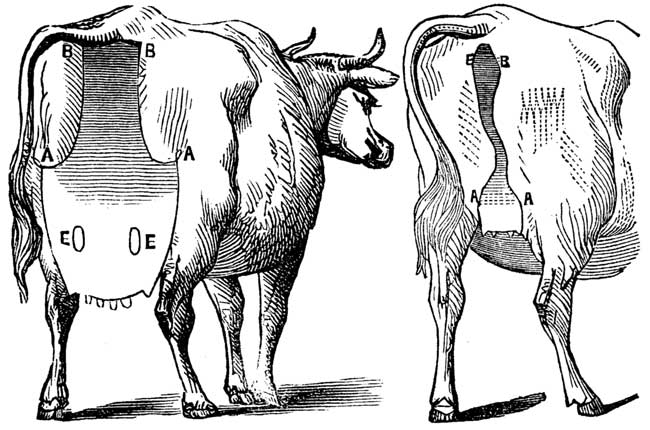
This class of cows has a delicate bag, covered with fine downy hair, growing upward from between the teats, and, above the bag behind, it blends itself with a growth of hair pointing upward, and covering the region marked in figure 1. This upward growth of hair begins on the legs just above the gambrel-joint, covers the inside of the thighs, and extends up to the tail, as in figure first. Above the hind teats they generally have two oval spots, two inches wide by three long, formed by hair growing downward, and of paler color than the hair that surrounds them (E, E, in fig. 1). The skin covered by the whole of this escutcheon is yellowish, with a few black spots, and a kind of bran, or dandruff, detaches from it. Cows of this class and order, when well kept, give about twenty-two quarts of milk per day, when in full flow, and before getting with calf again; after this a little less, but still a large quantity. They will continue to give milk till eight months gone with calf, or till they calve again, if you continue to milk them. This, however, should never be done; it exposes the health of cows at the time of calving, and injures the young. From this there is a gradual diminution in the quantity of milk through the orders, down to the eighth.
Cows of this order (fig. 2), or with the marks you see in the drawing, will never yield more than about five quarts per day in their best state, and they will only continue to give milk until two months with calf: hence, these are only fit for the butcher. The intervening six in Gruenon's classification are gradually poorer than the first, and better than the last, in our cuts. The marks are but very slightly different from the above, except in size; the difference is so trifling, that any one can at once see that they belong to this class;—and the comparative size of this mark will show, infallibly, their value compared with the above. In the intermediate grades, the spots (E, E, fig. 1) are smaller, and as the orders descend, these spots are wanting, and some slight changes in the form of the whole mark are observed, yet the general outline remains the same. Now, as the decrease in the eight orders in each class is about from two and a half to three or three and a half quarts, no man with eyes need be deceived in buying a cow, or raising a calf, in the quantity of milk she may be made to give. Any man can tell, within one or two quarts, the yield of any cow or heifer. The only chance for mistake is in the case of bastard-cows, which rapidly dry up on getting with calf.
Fig. 3. SECOND CLASS. Fig. 4. Order 1. Selvage Cow. Order 8.
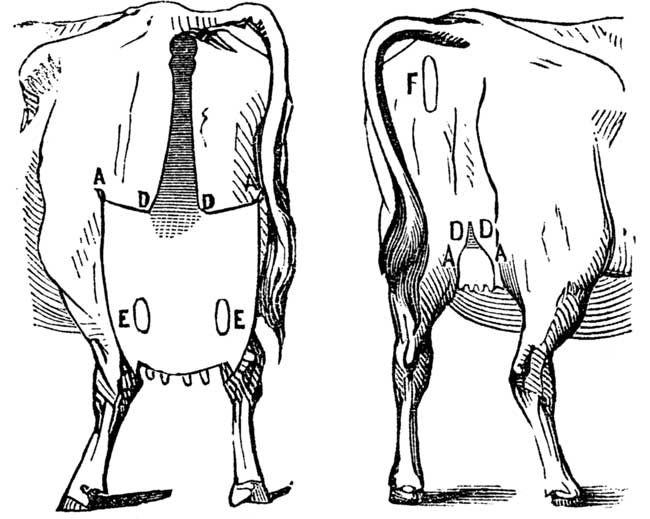
In this class, the shape of the escutcheon is entirely distinct, so that no one will confound it with the first. The gradations are the same as in the preceding, only this class, all through, is inferior to the other. The first (fig. 3) will give only twenty or twenty-one quarts, and the poorest only four quarts. This escutcheon is formed by ascending hair, but with a very different outline from the first class; it has the same spots above the hind teats as the first, formed by descending hair. In the lower orders these disappear—first one, then one small one, and then none at all—and as they descend, similar spots appear, formed in the same way, on one or both sides of the vulva (F, fig. 3). The skin of the inside surface of the thigh is yellowish. The time of giving milk—viz., eight months gone with calf, or as long as you continue to milk them—is the same as in the first class. The last order (fig. 4) of this class give very little milk after getting with calf.
Fig. 5. THIRD CLASS. Fig. 6. Order 1. Curveline Cow. Order 8.
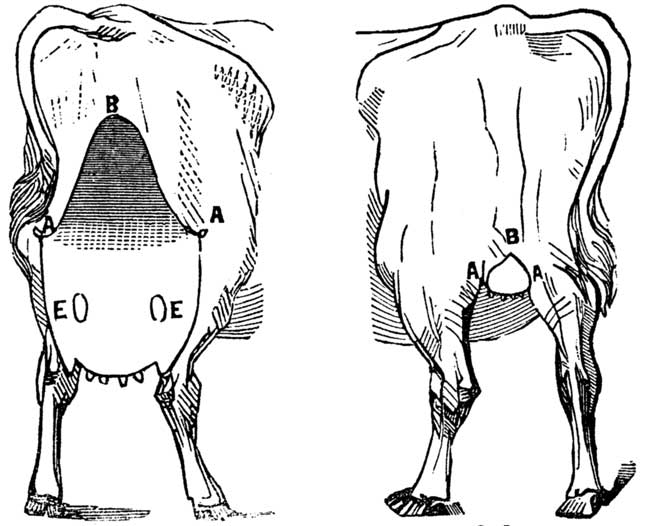
This escutcheon is easily distinguished from the others, by its outline figure. The spots on the bag above the hind teats are formed as in the preceding, and as gradually disappear in the lower orders. In those orders there is a slight difference in the outline, but its general form is the same. The first of this class (fig. 5) yields twenty or twenty-one quarts a day, and gives milk till within a month of calving. The last order of the class (fig. 6) gives only three and a half quarts, and goes dry on getting with calf. The intermediate gradations between the first and eighth orders are the same as in the preceding classes.
Fig. 7. FOURTH CLASS. Fig. 8. Order 1. Bicorn Cow. Order 8.
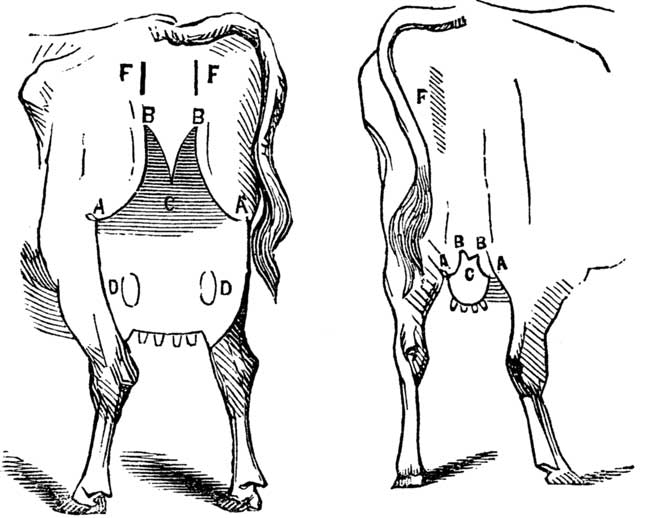
These escutcheons are unmistakably diverse from either of the others; gradations, from first to eighth orders, the same. The first order in this class (fig. 7) will give eighteen quarts a day, and give milk until eight months with calf. The dandruff which detaches from the skin within the escutcheon of the first order is yellowish or copperish color. The two marks on the sides of the vulva are narrow streaks of ascending hair, not in the general mark. The last order of the class (fig. 8) gives three and a half quarts only a day, and goes dry when with calf.
Fig. 9. FIFTH CLASS. Fig. 10. Order 1. Demijohn Cow. Order 8.
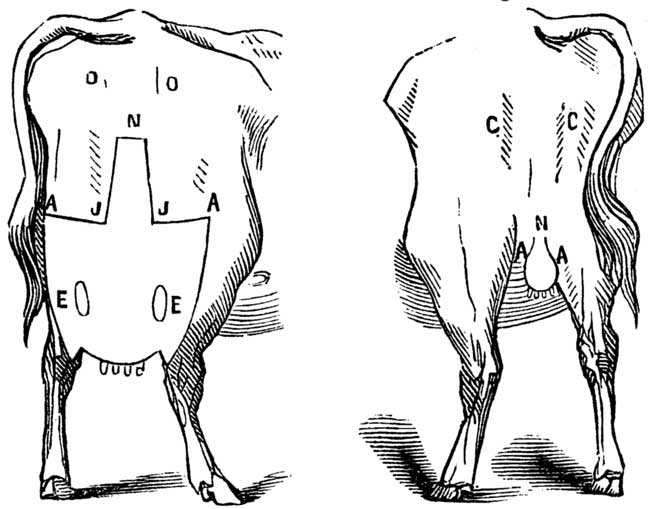
Here is another general mark, easily distinguishable from all the others by its outline. The first order (fig. 9) will give eighteen quarts a day, and give milk eight months, or within a month of calving. Yellowish skin; delicate bag, covered with fine downy hair, as in the higher orders of all the preceding classes. The eighth order of this class (fig. 10) will give only two and a half quarts per day, and none after conceiving anew. The gradation from first to eighth order is regular, as in the others.
SIXTH CLASS.
Yield of first order (fig. 11) eighteen quarts per day; time, eight months. Skin within the escutcheon same color, bag equally delicate, and hair fine, as in all the first orders. Eighth order (fig. 12) yields about two quarts per day, and dries up on getting with calf.
Fig. 11. Fig. 12. Order 1. Square Escutcheon Cow. Order 8.
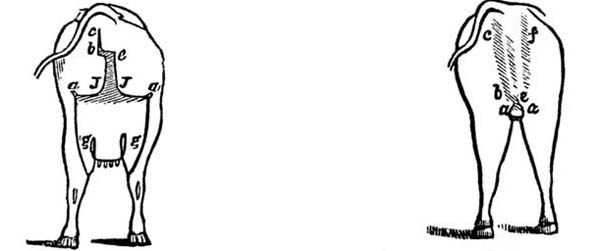
Fig. 13. SEVENTH CLASS. Fig. 14. Order 1. Limousine Cow. Order 8.
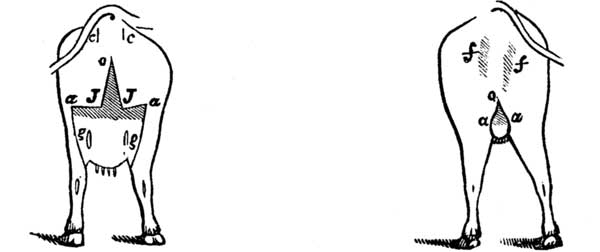
First order in this class (fig. 13) gives fifteen quarts; time, eight months. The skin, bag, and hair, same as in the higher orders in all the classes. The eighth order (fig. 14) will yield two and a half quarts per day, and dry up when with calf.
EIGHTH CLASS.
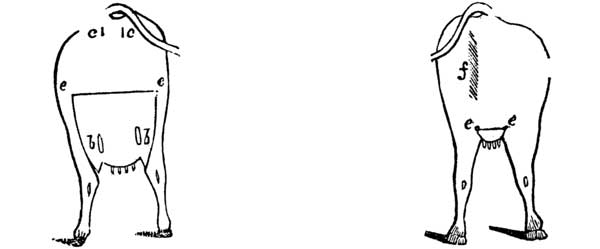
First order (fig. 15) will give fifteen quarts per day; time, eight months. Skin in escutcheon reddish-yellow and silky, hair fine, teats far apart. The eighth order (fig. 16) yields two and a half quarts a day, and dries up on getting with calf.
Fig. 15. Fig. 16. Order 1. Horizontal Cut Cow. Order 8.
Each class of cows has a kind called bastards, among those whose escutcheons would otherwise indicate the first order of their class: these often deceive the most practised eye. The only remedy is to become familiar with the infallible marks given by Guenon by which bastards may be known. This defect will account for the irregularity of many cows, and their suddenly going dry on becoming with calf, and often for the bad quality of their milk. They are distinguished by the lines of ascending and descending hair in their escutcheon.
Fig. 17. Fig. 18. Fig. 19.
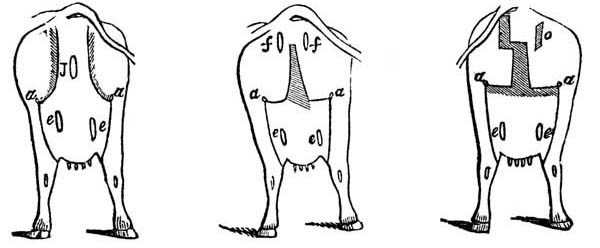
In the Flanders cow (fig. 17) there are two bastards; one distinguished by the fact that the hair forming the line of the escutcheon bristles up, like beards on a head of grain, instead of lying smooth, as in the genuine cow; they project over the intersection of the ascending and descending hair in a very bristling manner. The other bastard of the Flanders cow is known by having an oval patch of downward growing hair, about eight inches below the vulva, and in a line with it; in the large cows it is four inches long, and two and a half wide, and the hair within it always of a lighter color than that surrounding it. Cows of this mark are always imperfect. In the bastards, the skin on the escutcheon is usually reddish; it is smooth to the touch, and yields no dandruff.
Bastards of the SELVAGE COW are known by two oval patches of ascending hair, one on each side of the vulva, four or five inches long, by an inch and a half wide (fig. 18). The larger the spot, and the coarser the hair, the more defective they prove, and vice versa.
Bastards of the CURVELINE COW are known by the size of spots of hair on each side of the vulva (fig. 18). When they are of four or five inches by one and a half, and pointed or rounded at the ends, they indicate bastards. If they be small, the cow will not lose her milk very rapidly on getting with calf.
Bastards of the BICORN COW are indicated precisely as in the preceding—by the size of the spots of ascending hair, above the escutcheon and by the sides of the vulva (F, F, fig. 18).
Bastards of the DEMIJOHN COW are distinguished precisely as the two preceding—size of the streaks (fig. 18).
The SQUARE ESCUTCHEON COW indicates bastards, by a streak of hair at the right of the vulva (fig. 19). When that ascending hair is coarse and bristly, it is a sure evidence that the animal is a bastard.
Limousine cows show their bastards precisely as do the CURVELINE and BICORN, by the size of the ascending streaks of hair, on the right and left of the vulva. (Fig. 19.)
Bastards of the HORIZONTAL CUT COWS have no escutcheon whatever. By this they are always known.
Some bastards are good milkers until they get with calf, and then very soon dry up. Others are poor milkers. Those with coarse hair and but little of it, in the escutcheon, give poor, watery milk. Those of fine, thick hair will give good milk.
Bulls have escutcheons of the same shape as the cows, but on a smaller scale. Whenever there are streaks of descending hair bristling up among the ascending hair of the escutcheon, rendering it quite irregular and rough in its appearance, the animal is regarded as a bastard. Never put a cow to any bull that has not a regular, well-defined, and smooth escutcheon. This is as fully as we have room to go into M. Guenon's details. We fear this will fall into the hands of many who will not take the pains to master even these distinctions. To those who will, we trust they will be found plain, and certain in their results. From all this, one thing is certain, and that is of immense value to the farmer: it is, that on general principles, without remembering the exact figure of one of the indications above given, or one of the arbitrary terms it has been necessary to use, any man can tell the quality and quantity of milk a cow will give, and the time she will give milk, with sufficient accuracy to buy no cow and raise no heifer that will not be a profitable dairy cow, if that is what he desires. The rules by which these things may be known are the following:
No cow, of any class, is ever a good milker, that has not a large surface of hair growing upward from the teats and covering the inner surface of the thighs, and extending up toward or to the tail.
No cow that is destitute of this mark, or only has a very small one, is ever a good milker. Every cow having a scanty growth of coarse hair in the above mark will only give poor, watery milk; and every cow having a thick growth of fine hair on the escutcheon, or surface where it ascends, and considerable dandruff, will always give good rich milk, and be good for butter and cheese.
Every cow on which this mark is small will give but little milk, and dry up soon after getting with calf, and is not fit to be kept.
Observe these brief rules, and milk your cows at certain hours every day—milk very quickly, without stopping, and very clean, not leaving a drop—and you never will have a poor cow on your farm, and at least twenty-five per cent. will be added to the value of the ordinary dairy, that is made up of cows purchased or raised in the usual, hap-hazard way.
If your cows' udders swell after calving, wash them in aconite made weak with water; it is very good for taking out inflammation. Other common remedies are known. If your cow or other creature gets choked, pour into the throat half a pint, at least, of oil; and by rubbing the neck, the obstruction will probably move up or down. Curry your cows as thoroughly as you do your horses; and if they ever chance to get lousy, wash them in a decoction of tobacco.
CRANBERRY.
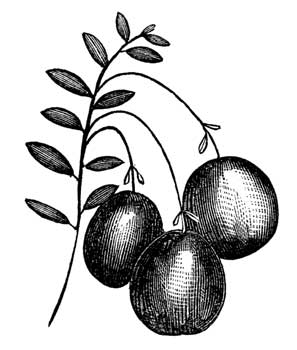
This is native in the northern parts of both hemispheres. In England and on the continents of Europe and Asia, native cranberries are inferior, in size and quality, to the American. Our own have also been greatly improved by cultivation. They have become an important article of commerce, and find a ready sale, at high prices, in all the leading markets of the country. Their successful cultivation, therefore, deserves attention, as really as that of other fruits. Mr. B. Eastwood has written a volume on the subject, which probably contains all the facts already established, together with many opinions of scientific and practical cultivators. The work is valuable, but much less so than it would have been, had the author put into a few pages the important facts, and left out all speculations and diversities of opinion. The objection to most of this kind of literature is the intermixture of facts and valuable suggestions with so much that is not only useless, but absolutely pernicious, by the confusion it creates. We think the following directions for the cultivation of the cranberry are complete, according to our present knowledge:—
Soil.—It is universally agreed that beach sand is the best. Not from the beach of the ocean barely, but of lakes, ponds, or rivers. There is no evidence that any saline quality that may be in sand from the beach of the sea, is particularly useful. It is the cleanness of the sand, on which account it is less calculated to promote a growth of weeds, and allows a free passage of moisture toward the surface. Hence white sand is preferable, and the cleaner the better. Whoever has a moist meadow in the soil of which there is considerable sand has a good place for a cranberry bed. If you have not a sand meadow, select a plat of ground as moist as any you have, upon which water will not stand unless you confine it there, and draw on sand to the depth of four or six inches, having first removed any grass or break-turf, that may be in danger of coming up as weeds to choke the vines. If you make the ground mellow below and then put on the sand, you will have a bed that will give you but little further trouble. Peat soils will do, if you take off the top and expose to the weather, frosts and rains, one year before planting. The first year, peat will dry and crack, so as to destroy young cranberry vines. But after one winter's frost, it becomes pulverized and will not again bake. Hence it is next to sand for a cranberry bed.
Situation.—The shore of a body of water, or of a small pond is best, if it be not too much exposed to violent action of wind and waves. Land that retains much moisture within a foot of the surface, but which does not become stagnant, is very valuable. The bottoms of small ponds that can be drained off are very good. Any land that can be flowed with water at pleasure is good. By flooding, the blossoms are kept back till late spring frosts are gone. Any upland can be prepared as above. But if it be a very dry soil it must have a liberal supply of water during dry weather, or success may not be expected.
Planting.—There are several methods. Sod planting consists in preparing the land and then cutting out square sods containing vines, and setting them at the distances apart, you desire. This was the general method; but it is objectionable, on account of the weeds that will grow out of the sod and choke the vines. This method is improved by tearing away the sod, leaving the roots naked, and then planting. Another method is to cut off a vigorous shoot, and plant the middle of it, with each end protruding from the soil two or three inches apart. Roots will come out by all the leaves that are buried, and promote the springing of many new vines, and thus the early matting of the bed which is very desirable.
Others take short slips and thrust four or five of them together down into the soil as they do slips of currant bushes, thus making a hill of as many plants. And yet another method is, to cut up the vines into pieces of two or three inches in length, and broad cast them on mellow soil, and harrow them in as wheat—Others bury the short pieces in drills. In either case they will soon mat the whole ground, if the land be not weedy. The best plan for small beds is probably the middle planting.
Distances apart depend upon your design in cultivating. If your soil is such that so many weeds will grow as to require cultivating with a horse, or much hoeing, four feet one way and two the other is the best. Better have land so well covered with clean sand, that very few weeds will grow and no cultivation be needed. Then set vines one foot apart and very soon the whole ground will be perfectly matted and will need very little care for years. For two or three years pull out the weeds by hand, and the ground will be covered and need nothing more.
Varieties.—There are three principal ones of the lowland species. The bell, the bugle, and the cherry cranberries. These are named from their shape. Probably the cherry is the best, being the size, shape, and color of the cultivated red cherries. There has recently been discovered an upland variety, on the shores of Lake Superior, that bids fair to be as hardy and productive as the common currant. On all poor, hard, and even very dry uplands, it does remarkably well. It grows extensively in the northern part of the British provinces. The fruit is smaller than the other varieties but is delicious, beautiful in color, and very abundant. It will probably be one of our great and universal luxuries.
Healthy and Unhealthy Plants.—By this cultivators denote those that bear well and those that do not. And yet the unhealthy, or those that bear the least, are the larger, greener-leaved, and rapid-growing varieties. It is difficult to describe them so that an unpractised eye would know them from each other. The best way to be sure of getting the right kind is to purchase of a man you can trust, or visit the beds when the fruit is in perfection and witness where the crop is abundant, mark it, and let it remain until you are ready to plant. This is always best done in the spring, or from May 15th to June 15th.
Gathering—is performed by hand, or with a cranberry-rake. Hand-picking is best for the vines, but is more expensive. If a rake be used, it will draw out some small runners and retard the growth of young vines. But it is such a saving of expense, it had better be used, and always drawn the same way. The fruit should be cleared of leaves and decayed berries; and if intended for a near market, be packed dry in barrels. If to be transported far, put them in small casks, say half-barrels, with good water. They may thus be carried around the globe in good condition. To keep well they should not be exposed to fall frosts, and should not be picked before ripe. A little practice, and at first on a small scale, may enable American cultivators of the soil, generally, to have good cranberry beds. Much of the practical part of this can only be learned by experience. The above suggestions will save much loss and discouragement.
Enemies—are worms that attack the leaves, and another species that attack the berries. There are only two remedies proposed, viz., fire and water. If you can flood your beds you will destroy them. If not, take a time not very dry so as to endanger burning the roots, and burn over your cranberry-beds, so as to consume all the vines. Next season new vines will grow up free from worms.
CUCUMBERS.
There are quite a number of varieties. But a few only deserve attention. The best, for all uses, is the Early Cluster, a great bearer of firm, tender, brittle fruit. Early Frame, Long White, Turkey, and Long Green Turkey, are rather beautiful, but not prolific varieties. Long Prickly, is very good for pickles, and fills a cask rapidly, but is by no means so pleasant as the Early Cluster. The Short Prickly and White Spined are considerably used. The West India or small Gherkin is used only for pickling, and is considered fine. But we regard all these inferior to the Early Cluster.
Soil should be made very rich with compost and vegetable mould, with a liberal application of sand. All vines do better in a sandy soil. Plant in the open air only after the weather has become quite warm. An effort to get early cucumbers by early out-door planting is usually a failure; seeds decay, or having come up, after a long while, they grow slowly, and vines and fruit are apt to be imperfect. Six feet apart, each way, is the best distance; and after the plants get out of the way of insects, and become well established, two vines in each hill is better than more: the fruit will be better and more abundant, and they will bear much longer than when vines are left to grow very thick. They need water in dry weather (see Watering). The first week in July is the best time to plant for pickling. In a warm, dry climate, cucumbers do better a little shaded, but not too much. Planted among young fruit-trees, or in alternate rows with corn, they do well. If allowed to run up bushes like peas, they produce more and better fruit. Forcing for an early crop is often done, by digging a hole in the ground, two feet deep and two feet square, and filling with hot manure, stamped down well, and covered with six inches of fine mould. Put around a frame and cover with glass, at an angle of thirty-five degrees to the sun. Plant one hundred seeds on the two feet square; when they come up, put two plants in a pot, set in a regular hotbed, and keep well watered and aired until the weather be warm enough to transplant in the open air; then remove from the pots without breaking the ball of earth, and plant six feet apart. Four plants left in the original hill will bear earlier than those that have been removed. To get a large quantity of very early ones, plant a corresponding number of hills, with the two feet of manure, as above; whenever the weather becomes hot, they will need to be well watered, or they will dry up. All cucumber-plants forced should have the main runner cut off, after the second rough leaf appears; this brings fruit earlier and twice as abundant. On transplanting cucumbers, or any other vines, cover them wholly from the sun for three days, or, if the weather be dry, for a whole week. We once thought melons and cucumbers very difficult to transplant successfully; but we ascertained the only difficulty to be, the want of sufficient water and shade. When roots and soil were so dry that the dirt all fell off, we have transplanted with perfect success; but for a week the plants appeared to be ruined. We kept them covered and well watered, and they revived and made a great crop, much earlier than seeds planted at the same time. Protection of plants from insects has been a subject of much study and many experiments. Ashes and lime, and various decoctions and offensive mixtures, have been recommended. We discard them all, as both troublesome and ineffectual. Our experience is, most decidedly, in favor of fencing each hill, of all vines, to keep off insects. A box a foot square and fifteen inches high, the lower edge set in the soil, will usually prove effectual. Put over a pane of glass, and it will be more sure, and increase the warmth and consequently the growth of the plants. Put millinet over the boxes, instead of glass, and not a hill will be lost. If a cutworm chances to be fenced in, he will show himself by cutting off a plant. Search him out and kill him, and all will be safe. Such boxes, well taken care of, will last for ten years. This, then, is a cheap as well as effectual method.
Cucumbers are a cooling, healthy article of diet, used in reasonable quantities. They should be sliced into cold water, taken out, and put in sharp vinegar with pepper and salt. Ripe cucumbers make one of the best of pickles: for directions in making, we refer to the cook-books. If you have room near your back door for one large hill of cucumbers, you may obtain a remarkable growth. Dig down deep enough to set in an old barrel, with head and bottom out, leaving the top even with the surface. Fill with manure from the stable, well trod down. In fine rich mould, around on the outside of the barrel, plant twenty or thirty cucumber-seeds. Put a pail of water in the barrel every day. The water comes up through the soil to the roots of the plants, bringing with it the stimulus of the manure, and the effect is wonderful. A large barrel has been filled with pickles from one such hill. If bushes be put up to support the vines, it is still better. Neglect to pour in water, and they will dry up; but continue to water them, and they will bear till frost in autumn.
CURRANTS.
These are among the very best of all the small fruits; immensely productive in all locations, and adapted to a great variety of uses, and hang long on the bushes after ripening.
There is quite a number of varieties, some of which are probably the mere result of cultivation of others well known. The common red is too well known to need description—very acid, and always remarkably productive, in all soils and situations. The size and quality of the fruit are affected by location and culture. The native currants, as found in the north of Europe, are small and inferior; but all excellent modern varieties have sprung from them by cultivation. In working these important changes, the Dutch and French gardeners have been the chief agents: hence our names, Red and White Dutch currants.
The common red and the common white are still cultivated in the great majority of American gardens; and yet, they are not worthy to be named with the White Dutch and the Red Dutch, which may easily be obtained by every cultivator. These two varieties are all that ever need be cultivated. Long lists of currants are described in many of the fruit-books; the result, as in all such cases, is confusion and loss to the mass of growers. We will not even give the list. The common red and the white currants are greatly improved by cultivation. But the Dutch have longer bunches, of larger fruit, the lower ones in the stem holding their size much better than common currants; the stems are usually full and perfect, and the fruit less acid and more pleasant.
A new, strong-growing variety, called the "cherry currant" on account of its large size, is now considerably grown. A few bushes for variety, and for their beautiful appearance, may be well enough; but it is not a very good bearer, and therefore is not so profitable as the Dutch.
The Attractor is a new French variety, said to be valuable. Knight's Early Red has the single virtue of ripening a few days earlier than the others. The Victoria is perhaps the latest of all currants, hanging on the bushes fully two weeks longer than others. The White Grape, the Red Grape, and the Transparent, are all good and beautiful. The utilitarian will cultivate the Red Dutch and the White Dutch as his main crop, with two or three of the others for a variety. The amateur will get all the varieties, and amuse himself by comparing their qualities, and trying his skill at modifying them. As these efforts have resulted, in past time, in the production of our best varieties, so they may, in future, in something far better than we yet have. There is no probability that any of our fruits have reached the acme of perfection.
The common black, or English black currant has long been cultivated. A jam made of it is valuable for sore throat. The highest medical authority pronounces black currant wine the best, in many cases of sickness, of any wine known. The Black Naples possesses the same virtues, and being a much larger fruit, and more productive, should take the place of the English black, and exclude it from all gardens.
Cultivation.—Currant-bushes should be set four feet apart each way, and the whole ground thoroughly mulched; it keeps down all weeds and grass, saving all further labor in cultivation, and greatly increases the size and quantity of the fruit. On nothing does mulching pay better. (See article Mulching.)
Any good garden-soil is suitable for currants. On the north side of a wall or building, or in the shade of trees, they will be considerably later. The same effect may be produced by covering bushes a part of the time with blankets or mats. Some are retarded by this means, so as to be in perfection after others are gone: thus, the currant that naturally comes to perfection about midsummer is preserved on the bushes until October.
Many cultivate currants in the tree form; allowing no sprouts from the roots, and no branches within a foot or two of the ground. This object is secured by cutting from the slip you are to plant, from which to raise a bush, all the lower buds to within two or three of the top, and then pinching off at once all shoots that may start out of the stem below; this makes beautiful little shrubs, but the top is apt to be broken off by the wind, and they must be replaced by new ones every four or five years. Downing strongly recommends it, but we can not do so. Let bushes grow in the natural way, removing all old, decaying branches, and all suckers that rise too far from the parent-bush, and keep the clusters of bushes and leaves thin enough to allow the sun free access, and prevent continued moisture in wet weather, which will rot the fruit, and you will find it the cheapest and best. We have seen quite as large and as fine fruit grow on such bushes, that we knew to be more than twenty years old, as we ever saw of the same variety when cultivated in the tree form.
DAIRY.
For cheese, the dairy should contain three rooms: one for setting the milk, with suitable boilers, &c.; next, a press-room, in which the cheese should be salted, as given under article Cheese; the third, a store-room. In all climates a cheese-house should be made as tight as possible;—thick stone walls are best; windows should be on two sides, north and west, but not on opposite sides, so as to create a draught: this is no better for cheese or butter, and is always dangerous to the operator. Let all persons who would enjoy good health avoid a draught of air as they would an arrow. If your cheese-house can be shaded on the east, south, and west, by trees, and have only a northern exposure, it will aid you much in guarding against extremes of heat and cold. Windows should be fitted closely, and covered with wire-cloth on the outside, so as to exclude all flies.
A dairy for butter needs but two rooms, and a cool, dry cellar, with windows in north and west. The first room should be for setting and skimming the milk, and the other for churning and working the butter, and scalding and cleaning the utensils. If your milk-room can be a spring-house with stone-floor, and a little water passing over it, you will find it a great benefit. The shade, situation of windows, avoiding a current, &c., should be the same as in the cheese-dairy.
To prevent the taste of turnips or other food of cows in milk and butter, put one quart of hot water into eight quarts of the milk just drawn from the cow, and strain it at once. It has been recently declared, by intelligent farmers, that if you feed the turnips to cows immediately after milking, the next milking, twelve hours after feeding the roots, will be free from their taste or odor. The easiest remedy is the boiling water.
DECLENSION OF FRUITS.
That there are instances of decided decline in the quality of fruits is certain. But on the causes of those changes pomologists do not agree. One theory is, that fruits, like animals and vegetables of former ages, may decline and finally become extinct. Should this theory be established, the declension would be so gradual that a century would make no perceptible change. But we do not credit the theory, even as applied to former geological periods in the history of our globe. The changes of past ages, as revealed in geology, have been brought about, not gradually, but by great convulsions of nature, such as volcanoes, or the deluge, that resulted in the destruction of the old order of things, and in a new creation.
The true theory of this declension of varieties of fruits, is, that it is the result of repeated budding upon unhealthy stocks, and of neglect and improper cultivation. Apply the specific manures—that is, those particularly demanded by a given fruit—prune properly, mulch well, and bud or graft only on healthy seedling stocks of the same kind, and, instead of declension, we may expect our best fruits to improve constantly, in quality and quantity.
DILL.
An herb, native in the south of Europe, and on the Cape of Good Hope. It is grown, particularly at the South, as a medicinal herb. The leaves are sometimes used for culinary purposes; but it is principally cultivated for its sharp aromatic seed, used for flatulence and colic in infants, and put into pickled cucumbers to heighten the flavor. The seeds may be sown early in the spring, or at the time of ripening. A light soil is best. Clear of weeds, and thin in the rows, are the conditions of success.
DRAINS.
Drains are of two kinds—under-drains and surface-drains. The latter are simply open ditches to carry off surface-water, that might otherwise stand long enough to destroy the prospective crop. These are frequently useful along at the foot of hills, when they should be proportioned to the extent of the surface above them. They are also very useful on low, level meadow-lands. Properly constructed, they will reclaim low swamps, and make them excellent land. Millions of acres of land in the United States, as good as any we have, are lying useless, and spreading pestilence around, that by this simple method of ditching might be turned to most profitable account. The direction of these drains should be determined by the shape of the land to be drained by them—straight whenever they will answer the purpose, but crooked when they will do better. On low and very level land, they should be not more than five rods apart; they should be three times as wide at the top as they are at the bottom, and as deep as the width at the top; made so slanting, the sides will not fall in;—they should be so shaped as to allow only a very gentle flow of the water: if it flows too rapidly, it will wash down the sides, and obstruct the ditch, and waste the land. Excavations for under-draining are made in the same way, only the top need not be so much wider than the bottom; it would be a waste of labor in excavating a useless quantity of earth. There are four methods of filling up the ditch, viz., with brush; with small stones thrown in promiscuously; with a throat laid in the bottom and filled with small stones; and with a throat made of tile from the pottery. In all cases, that with which the ditch is filled must not come so near the surface as to be reached by the plow. Brush, put in green and covered with straw or leaves, will answer a good purpose for several years, and may be used where small stones can not easily be obtained. The tile is more expensive than either of the others, and not so good as the stones; it is so tight that the water does not enter it so readily; and if by any chance dirt gets into the throat, it obstructs it, and there is no other channel through which the water can pass off. Small stones thrown in promiscuously serve a good purpose for a long time, if they be covered with straw or cornstalks before the earth is put in. But the best method is to make a throat, six inches square, in the bottom of the drain, laying the large stones over the top of it, and filling in the small stones above, and covering with straw;—the water will find its way into the throat through the numerous openings; and if the throat should ever be filled, the water could still pass off between the small stones above. Such drains will last many years, and add one half to the products of all wet springy land. The earth over the new drain should be six inches higher than the surface of the field, that, when well settled, it may be level. Leave no places open for surface-water to run in; that would soon fill up and ruin a drain. Drains made to carry off spring-water are often useless by being in a wrong location. Springs come out near the foot of rising ground. Just where they come out should be the location of the drain, which would then carry off the water and prevent it from saturating and chilling the soil in the field below. Many persons locate their ditch down in the centre of the wet level below the rise of ground; this is of no use to the surface above, to the point where the water springs. Locate the drain just at the point where the land begins to be unduly wet. On very wet, level land, a small drain may also be needed below the first and main one. The cost of a covered drain as described above will be from fifty to seventy-five cents per rod, and an uncovered one will cost from twenty to thirty cents. When you have low swamps to drain, you can realize more than the cost of draining, by carting the excavations upon other land, or into the barnyard as material for compost. Perhaps no expenditure, on land needing it, pays so well as thorough draining. It is important, for all fruit-orchards on low land, to put a drain through under each row of trees: it is indispensable to cherries, and highly favorable to all other fruits.
DUCKS.
There are a number of varieties, the wild Black Spanish, the Canvass-Back, and the ordinary little duck of the farmyard, are all good. The common duck is the only one we recommend for the American poultry-yard. A close pasture, including a rivulet, or a small stream of water, affords facilities for raising ducks at a cheap rate. From one hundred to one thousand ducks may be raised in such an enclosure of an acre or two, quite profitably. If there is plenty of grass, they will still need a little grain. In the winter the cheapest feed is beets or potatoes cut fine, with a very little grain. Each duck, well kept, will lay from fifty to one hundred eggs, larger than hen's eggs, and about as good for cooking purposes. They may be picked as geese, for live feathers, though not quite so frequently. The feathers will nearly pay for keeping, leaving the eggs and increase as profit.
DWARFING.
This has some advantages in its application to fruit-trees. It will enable the cultivator to raise more fruit on a small plat of ground, to get fruit much earlier than from standard trees, and sometimes, with high cultivation, the fruit will be larger. Dwarfing is done by grafting into small slow-growing stocks. Almost all fruits have such kinds. Grafting into other stocks, as the pear into the foreign quince, is a very effectual method. The Paradise stock for the apple, the Canada and other slow-growing stocks for the plum, the dwarf wild cherry of Europe and the Mahaleb for cherries. Dwarfs produced by grafting upon other stocks are short-lived, compared with standards of the same varieties. They should only be used to economize room, to test varieties, and produce fruit while standards are coming into bearing.
Better and much longer-lived dwarfs may be produced by frequent transplanting, thorough trimming of the roots, and repeated heading-in. The fruit on such dwarfs must be well thinned out when young, or it will be smaller than is natural. The effect of heading in is to cause the sap to mature an abundance of fruit-buds. This will tax the tree too much, unless they be well thinned out. Root-pruning is an effectual method of dwarfing (see Pruning). Dwarfing by root-pruning, repeated transplanting, and thorough heading-in, will not render the trees very short-lived, and in many situations it is profitable. The same is true of the dwarf pear on the quince. All other dwarfing is more for the amateur than the utilitarian.
EARLY FRUITS AND VEGETABLES
Are often considered a great luxury, and always command a high price. Early vegetables are secured by hotbeds and the various methods of forcing, as given under the different species. Early fruits are obtained by dwarfing, as given on that subject. Location, soil, and mode of cultivation, also, have much to do with it. Warm location, finely-pulverized soil, often stirred and kept moist, will materially shorten the time of the maturity of fruits and vegetables. Seeds imported from the North, where seasons are shorter, will mature earlier. Another means of hastening maturity is to plant successively, from year to year, the very first that ripens; this tends to dwarf in proportion as the time of maturity is hastened. In this way such dwarfs as the little Canada corn, that will mature at the South in six weeks, have been produced. Various early plants, as tomatoes, cabbages, peppers, and egg-plants, may be started in boxes or flower-pots in the house. Planted in February here, or in January in the South, they will grow as well as house-plants, and acquire considerable size before it is time to place them in the open ground. This is convenient for those who have no hotbeds. They must be kept from frost, and occasionally set out in a warm day to harden, and they will do well.
EGG PLANT.
The white is merely ornamental. The large purple is one of the greatest luxuries of the vegetable garden. Plant seeds in hotbed at the time of planting tomatoes or peppers. Set out in land made very rich with stable-manure and decayed forest-leaves, two feet and a half apart each way. Kept clean, and earthed up a little, and the bugs kept off while the plants are small, they will produce an abundance of fruit. There are two varieties of the purple—large prickly-stem purple, growing sometimes eight inches in diameter; and the long purple, bearing smaller, long fruit, but a large quantity, and considerably earlier than the large. Many do not like them at first; but after tasting a few times, almost all persons become very fond of them. If not properly cooked, they are not at all palatable. Although it belongs to the cook-book, yet, to save this excellent plant from condemnation, we give a recipe for cooking it. It is fit for use from one third grown, until the seeds begin to turn. Without paring, cut the fruit into slices one third of an inch thick; put it in a little water with plenty of salt, and let it stand over night, or six hours at least; take it out, and fry very soft and brown in butter or fresh lard—if not fried soft and brown, it is disagreeable. Salt, ashes, and bonedust, or superphosphate of lime, are the best manures, as more than two thirds of the fruit is made up of potash, soda, and phosphates, as shown by chemical analysis.
EGGS.
Of the quality of eggs you can always judge correctly by looking at them toward the light: if they are translucent they are good; if they look dark they are old—or you may get a chicken, when you only paid for an egg.
Many methods for preserving eggs are recommended. Packed away in fine salt they will keep, but, like salt meat, have not the same flavor as fresh. Set them on their small ends in a tight cask, and fill it with pure lime-water, and they will keep, but it changes their flavor. This, however, is a very common method. The best way known to us, is to pack fresh eggs down in Indian meal, allowing no two to touch each other. Keep very dry in a cool cellar, and they will remain for months unchanged.
ELDERBERRY.
This is a healthy berry, dried and used for making pies, especially mixed with some other fruit. The blossoms are much used as medicine for small children. The common sweet elder is the only kind cultivated. The earlier red are offensive and poisonous. They are easily grown on rough waste land, or in any situation you prefer. Of this berry is made a wine, superior in flavor and effect to any port wine now to be obtained in market; it has had the preference among the best judges in the country;—it is fast coming into notice and cultivation. The wine is so entirely superior to the poisonous substances of that name in commerce, that it would be well for every neighborhood to make enough for their sick. The process is sure and easily intelligible to all. (See article Wine.)
ENDIVE.
This is a well-known winter-lettuce. Sow from July to September, according to latitude. It should come into maturity at the time of the first smart frosts. To get beautiful, white, tender bunches, they should be tied up when the leaves are about six inches long. When frost comes, protect by covering. In very cold climates, place it in the cellar, with the roots in moist earth, and it will keep for a long time. It will not be extensively used in this country for soups and stews, as it is in Europe; and but few of the American people care much about winter-lettuce. This is the best variety of lettuce, except for those who have hot-houses and attend to winter-gardening. They will prefer the other finer varieties. There are two varieties of endive cultivated in this country: green curled, which is the most common, and used principally as a salad; the broad-leaved, or Batavian, has thicker leaves and large heads, and is principally used in stews and soups. Still another variety, called succory, which is used to some extent in Europe as a winter-salad, but is cultivated mainly for the root. It is dried and ground to mix with coffee: some consider it quite as good. This is more cultivated at the South than at the North—their winters are much better adapted to it. The medicinal virtues of this plant are nearly equal to those of the dandelion. When it is bleached, by tying or earthing up, the bitterness is removed, and the taste is pleasant; this must be done when the plants are dry, or they will rot. Plant them in a sunny place and in a light soil.
FEEDING ANIMALS.
Feed as nearly as possible at the same hours. All creatures do much better for being so fed. Do not feed domestic animals too much: animals will be more healthy, grow faster, and fatten better, by being fed almost, but not quite as much as they will eat. Giving food to lie by them is poor economy; always let them eat it all up, and desire a little more;—at the same time, let it be remembered that creatures kept very poorly for a considerable time, especially while young, will never fully recover from it. This is often done under the idea of keeping them cheap, but it is dear keeping. They never can make as fine animals afterward.
All grains and vegetables, except beets and turnips, are better for being boiled or steamed. The increased value is much more than the cost of cooking, provided persons are not so careless as to allow food to be injured by standing after cooking. Cooking is supposed to add one fourth to the value of food. Grinding dry grains adds nearly as much to their value, as feed for animals, as cooking. If you neither grind nor boil hard grain for feed, it will pay well to soak it somewhat soft before feeding. Variety of food is as pleasant and healthy for animals as for men.
FENCES.
These are matters of great importance to the farmers of the whole country, but especially to those on the prairies of the west.
In all localities where stone can be obtained from the fields or quarry, the best and cheapest fence is a stone wall. If the stones are flat, make the wall two feet thick at bottom, and one at top, five feet high. If the stones are very irregular the wall should be thicker. Stone walls should have transverse rows of shingles, boards, or split sticks, about half an inch thick, laid in the wall at suitable distances. If stones are quite flat three rows are desirable, one two, the next three, and the other four feet from the ground. If the wall is made of rough stones it will require one more course of sticks, leaving them only a foot apart. The sticks should be of such lengths as to come out just even with the wall, on each side. The lower courses will be longer than the upper ones. These sticks are to keep the wall from falling down. Dig a ditch one foot deep, two feet from the wall, and throw the earth excavated up against the wall, and the water will run off and prevent heaving by frost, and such a wall will need the merest trifle of attention during a generation, and will last for centuries. A cord of stones will make one rod. We can not too strongly recommend this kind of fence, in all places where stones can be obtained reasonably. The pieces of wood laid in a wall, will keep well for thirty years, when they will need replacing. Next to stone is a good board fence. Well made and of good materials, it is durable and always in its place. Hence it is a cheap fence.
Of the various styles of picket, and other fancy fences for front yards, &c., it is more the province of the architect or the mechanic to treat. Styles vary and are constantly increasing in number. The great point to be secured in all such, to render them most durable, is to have the smallest possible points of contact. A picket fence with horizontal base should never have the pickets standing on the base board. They should be separated, from one quarter to one half an inch. A good style for villages, is a cap, water tight, and wide enough to cover the ends of the posts and pickets with a neat little cornice. It looks well and is very durable.
In all localities where timber is not too valuable, a cheap and substantial fence is made of split rails. The crooked rail-fence, with stakes and riders, is well known. Also that with upright stakes and caps, which is decidedly preferable. It will stand much longer, and the stakes are out of the way. No farmer should ever risk his crop with a rail-fence without stakes. But the best of all rail-fences, is that made of posts and rails. The rails are put in as bars, but so firmly that the fence can not be taken down, without commencing at the end. Where cedar or locust posts, and oak or cedar rails can be obtained, a fence may be made that will not get out of repair for twenty-five years. No creature can tear it down, for human hands can not take it down without tools, or without commencing at the end. This is considered expensive. But as the farmer may prepare his posts and rails in winter, and it will require no attention to keep it up, and is very durable and perfectly effectual against cattle, it is an economical fence. For hedges, see that article.
FENNEL.
This is a hardy perennial plant of Southern Europe, and belongs to both the culinary and the medicinal departments. It grows well on almost any soil, and is propagated by seeds, offshoots, or by parting the roots. It is much inclined to spread. A few roots, kept within reasonable bounds, are enough for a family. It is much used in Europe for soups, salads, and garnishes. The Italians treat it as celery. In this country it is mostly used medicinally. It is stimulant and carminative. Very beneficial to children in cases of flatulency and colic.
FIGS.
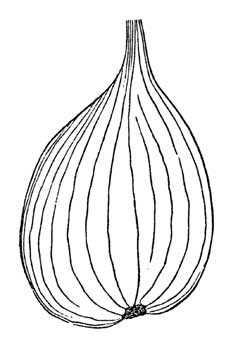
This fruit is native in the warmer parts of Asia: hence, the cold winters of the Middle, Northern, and Western states, and of Canada, would destroy the trees in the open air without protection. But as the trees are low-growing shrubs, they may easily be protected either in cellars, greenhouses, or the open air, and uncovered or planted out in the beginning of warm weather. Frequent removals and transplantings injure the fig less than any other fruit, and our summers are long enough to produce large crops of excellent figs. In New England they are raised in tubs, set out of the cellar in spring, and produce largely. South of Virginia, the fig is hardy, and may be cultivated with profit in the open air. The best method of raising all kinds of fruit, in climates where the winters are too cold for them, is to build a wall twelve feet high on one side, and six feet on the other, with the ends closed, and cover it with glass facing the south. This should only be kept warm enough to prevent freezing, which would require only a small outlay. Men of moderate means might thus have oranges, lemons, figs, &c., of their own raising. In all except our coldest latitudes, such fruits might be raised at a profit.
Soil.—The best is a deep, rich loam, with a dry subsoil.
Propagation is by layers and cuttings. The latter should be taken off in the spring, be of last year's growth, with half an inch of the previous year's growth: they take root better.
Varieties are numerous, and names uncertain. White, in his Gardening for the South, says, some of the best varieties are not in the books, or so imperfectly described that they can not be recognised. This is true of all the fruits, and hence our decision, in this work, not to attempt to describe fruits with a view to their identification. As this fruit is more for the South than the North, we give the whole of White's list, as being adapted to those regions:—
1, Brunswick; 2, Brown Turkey; 3, Brown Ischia; 4, Small Brown Ischia; 5, Black Genoa; 6, Celestial; 7, Common Blue; 8, Round White, Common White, Lemon Fig; 9, White Genoa, White Italian; 10, Nerii; 11, Pregussatta; 12, Allicant; 13, Black Ischia; 14, White Ischia. These, with a few others, are those described in most of our fruit-books. The catalogue of the London Horticultural Society enumerates forty-two varieties. Only a few of them have been introduced into this country. Any of these varieties are good at the South. The five following are the most hardy, and, being in all respects good, are all we need in our more northern latitudes:—
1. Brunswick.—Very hardy, productive, and excellent.
2. Brown Turkey.—The very hardiest, and one of the most regular and abundant bearers.
3. Black Ischia.—Bears an abundance of medium-sized, excellent fruit, very dark-colored.
4. Nerii.—Said to be the richest fig in Britain: from an acid mixture in its flavor, it is exceedingly delicious.
5. Celestial.—This may be the "Malta" of Downing. Under whatever name, though small, it is one of the very best figs grown in this country.
For forcing under glass, the best are the Allicant and Marseilles. With care, the first three of the above list may be raised in the Middle states, without removal in winter. Any variety may be protected by bending and tying down the branches, and covering with four inches of soil. Below Philadelphia, a little straw will be a sufficient protection.
Dried figs are an important article of import into this country; yet they might be raised as plentifully and profitably in the Southern states. Prune only to keep the tree low and regular. The fig-tree is a great and regular bearer, only when the wood makes too strong a growth, as it is somewhat apt to do. The remedy is root-pruning. Cut off, on the first of November, the roots to half the length of the branches from the tree, and occasionally shorten the branches a little, and the fruit will be abundant, and not fall off. The ripening of the fruit may be hastened and perfected by putting a drop of oil in the blossom-end of each fig. This is done by dipping the end of a straw in oil, and then putting it into the end of the fruit. This is extensively practised in France. Compost, containing a pretty liberal proportion of lime, is the best manure for the fig.
FISH.
The cultivation of fish is attracting much attention in this country and in Europe. The study and experiments of scientific and practical men have established important facts upon this subject. Fish may be successfully cultivated wherever water can be conveniently obtained. The creeks, ponds, and small rivers of our land may be well stocked with fish. Fish may be raised as a source of profit and luxury, with as much ease and certainty, and at a much less expense than fowls. This is so important to the whole people, that it demands the earnest attention of our state authorities, as it has engaged that of the government of France. The species of fish best adapted to artificial culture, in particular climates and in different kinds of water, have been ascertained. A man may know what fish to put in his waters, as well as what crops to put on his land, or what stocks on his farm.
The following brief synopsis of the best methods of cultivation will be sufficient to insure success. The first requisite is suitable water for hatching eggs that have been artificially fecundated, and for the occupancy of fish of different ages, and for different species of fish. Fish of different ages are much inclined to destroy each other for food; and hence, in order to multiply them most rapidly, they should be kept in separate ponds until considerably grown, when they will take care of themselves. A spring sending forth a rivulet of clear water, and not subject to overflow in freshets, is the best location. Clear, cool water is essential to the trout, while some other fish will do well in warm and even roily water. The rivulet running from the spring should be made to form a succession of ponds, three or four in number. These ponds should be connected with flumes made of plank. If the space they must occupy be small, make the flumes zigzag, to increase their length. Put across those flumes, once in four or five feet, a piece of plank half as high as the sides of the flume, with a notch cut in the centre of the top, that the fish may easily pass over: this will afford a succession of little falls, in which the trout very much delights. These different ponds are for the occupancy of fish of different ages, one age only inhabiting one pond. The flumes should have four inches of fine and coarse gravel in the bottom, making the most perfect spawning-ground. Although you would not wish the female-trout to deposite her eggs in the natural way, but will extrude them by the hand (as hereinafter directed), yet they must have these natural conveniences, or they will not incline to spawn at all. At the upper end of each of these flumes separating the ponds, there should be a gate of wire-cloth, to prevent the passage of the fish from one pond to the other; also one at the outlet of the lower pond, to prevent egress of the fish. These must all be so arranged that freshets will not connect them all together. When trout are about to spawn in their natural waters, they select a gravelly margin, and remove, from a circle of about one foot or two feet in diameter, all the sediment, leaving only clean gravel, among which they deposite their eggs, where they are hatched. They want running water of three or four inches in depth for this purpose. A male and female occupy each nest. If left to themselves, they will gradually increase; but so many of their eggs fail of being fecundated, and so many are destroyed before they hatch, by enemies, and by the collection of sediment in the nest, that the number of young fish is small compared with the whole number of eggs deposited. Artificial spawning, fecundation, and hatching, are far more productive. The process is simple and easy: when the female-fish first begins to deposite her eggs, catch her with a small net. It can not be done with bait, for fish will bite nothing at the time of spawning. We recollect, often when a boy, of trying to catch trout out of the brooks in October, where we could see large, beautiful fish, lying lazily in the places from which we had caught many in the summer, and put our bait carefully on every side of them, and they would not bite. Then we knew not the cause: since studying the habits of fish, we have learned that they never will bite while spawning; with trout, this is done from the 1st to the 15th of October, some few spawning till the last of November. Having caught two fish, male and female, take the female in one hand, and press her abdomen gently with the other hand, gradually moving it downward, and the eggs will be easily extruded, and should fall into an earthen vessel of pure water. Then take the male-fish, and go through the same process, which will press out the spermatic fluid, which should be allowed to fall into the same vessel with the eggs; stir up the whole together, and, after it has stood fifteen minutes, pour off the water, put in more and stir it up, and let it stand as before. This having been done three times, the eggs will be thoroughly fecundated, and are ready to be deposited in the nests for hatching. If the fish are caught before the time of beginning to spawn, the eggs and the spermatic fluid will not be mature, and will be only extruded by hard pressing, and failing to be fecundated, the eggs will perish. The fluid from one male will fecundate the eggs of half a dozen females. These eggs may be hatched in the flumes described above, though hatching-boxes are preferable. The old fish can be returned to the water, and may live many years and produce thousands of fish. These fish, carefully treated and fed, will become so tame as to eat out of your hand, like the "Naiad Queen" of Professors Ackley and Garlick, of Cleveland, Ohio. Among all the hatching apparatus we have seen described, we regard that of the above professors at Cleveland the best. To these gentlemen the country is much indebted for the knowledge derived from their zeal and success in fish culture. At the head of a spring they built a house eight by twelve feet; in the end of the house toward the spring they made a tank four feet wide, eight feet long, and two feet deep; this was made of plank. Water enters the tank through a hole near the top, and escapes through a similar one at the other end, and is received into a series of ten successive boxes, each one a little lower than the preceding one. These boxes were eighteen inches long, eight inches wide, and six inches deep. These were filled to the depth of two inches with clean sand and gravel. The impregnated eggs were scattered among the gravel, care being exercised not to have them in piles or masses. Clean water is necessary, as the sediment deposited by impure water is very destructive to the eggs. If it be seen to be collecting, it should be removed by agitating the water with a goose-quill or soft brush, and allowing it to run off; continue this till it runs clear. But there is a method of preventing impurities in spring-water, that will be always effectual: just around on the upper side of the spring make a tight fence two feet high, and it will turn aside, and cause to run around the spring, all the water that may flow down the rise above in time of rains. The house being near the head, there will not water enough get into the spring, in any storm, to roil the water. On the side of the boxes where the water escapes should be wire-cloth, so fine as not to allow the eggs to pass through. Such an apparatus will be perfect. This great care is only necessary for trout. All other fish worthy of cultivation, will only need spawning-beds on the margin of their pond. A convenient hatching apparatus is a number of wicker-baskets, fine enough not to allow the eggs to pass through, set in a flume of clear running water.
The method of Gehen and Remy, the great fish-cultivators of France, whose efforts and discoveries have contributed more to this science than those of any, if not of all other men, was to place the eggs in zinc-boxes of about one foot in diameter, having a lid over them—the top and sides of the boxes pierced with small holes, smooth on the inside; these boxes were partly filled with clean sand and gravel, and set in clear running water. M. Costa's method, at the college of France, is to arrange boxes in the form of steps, the top one being supplied with water by a fountain, and that passing from one to the other through all the series, and the eggs placed on willow-hurdles instead of gravel.
Another very simple method may be arranged in the house. It is a reservoir—a barrel or cask—set perhaps two and a half feet from the floor, and a little hatching trough a few inches lower, into which water gradually runs through a faucet, from the reservoir. This water running through the hatching-box, escapes into a tub a little below. Whatever plan be adopted, great care is necessary in preventing sediment from depositing. Cleanliness is a principal condition of success. The eggs of the trout thus fecundated and deposited in October or November will hatch in the spring. Young trout need no feeding for a month after leaving the egg. There is a small bladder or vesicle under the fore part of the body, when they first come out, from which they derive their sustenance. After this disappears, or at the end of about a month, they should be fed, in very small quantities. Too much will leave a portion to decay on the bottom and injure the water. The best possible food (except the angle-worm) is lean flesh of animals, boiled and hashed fine for the young fish. The flesh of other kinds of fish, when they are plenty and not very valuable, would be very good. These young fish should be kept in the first pond until a year old. Then let them into the second pond, closing the gate after them, to make room for another brood in the first pond. The next year let them into the third, and those into the second that are now in the first, and so on till the fourth. In the last pond, those of different ages will all be large enough to take care of themselves. But sometimes a trout two years old is said to swallow one a year old. But when they get to be three or four years old, this sort of cannibalism ceases. These principles can be carried out in small streams, by constructing gates to keep sections separate, and by forming banks and waste ways for water, with wire gates so high, that the water will not overflow in freshets, and carry the fish away. In taking trout use angle-worms or the fly. A fine light-colored small line is best. They are very shy. The following is a list of other fish, beside the trout, that are well worthy of cultivation:—
Black Bass.—When full grown, this fish is from twelve to eighteen inches in length. One of the better fish for the table, and profitable to raise in a pond covering not less than half an acre. Chub, being a very prolific little fish, may be kept in the same pond as food for the black bass and other large fish. They are very fond of them. Minnows are the best bait for these fish, though they will bite a trolling hook of any ordinary kind. You may raise them as given for the trout above, or allow them to deposite their eggs in spawn beds of their own selection in their pond. They will do well in water less pure than is demanded for the trout.
White Bass.—Not so large as the black bass. Seldom weighs more than two pounds. One of the best for food. Thrives well in small ponds. Requires the same treatment as the preceding. Spawns in May and hatches soon. Easily caught, as he is a great biter, at almost any bait.
Grass Bass or Roach.—One of the most beautiful of the bass kind, and as a panfish highly esteemed. It prefers sluggish water, and hence is well adapted to small artificial ponds. Spawns in May. May be treated as the preceding. Bites the angle-worm well, and several other kinds of bait.
Rock Bass.—A small fish seldom reaching a pound in weight, but is fine and very easily raised in small ponds of any kind of water. Spawns in May and may be treated in all respects as the rest of the bass family, only it will flourish well in quite small ponds.
Pickerel.—Is one of the best of fish, weighs from three to fifteen pounds. Suitable only for large ponds. Spawns early in the spring in the marshy edges of sluggish water. The eggs may be procured and treated as the trout, only cold running water is not necessary. Best caught by trolling. It is not a good fish to raise with others, as it is apt to eat them up.
Yellow Perch.—Is everywhere well known as a beautiful little fresh-water fish, and good for the table, at all seasons when the water is cool. Perfectly hardy and adapted to sluggish waters, it is one of the best for artificial ponds. Treat like all the preceding; or allowed to take its own course in the pond, it will increase rapidly.
Sun-Fish.—Rarely weighs more than half a pound, but is a good pan-fish. This and the grass bass and yellow perch may be put together in the same pond.
Eels.—May be cultivated with great success in almost any water. But we are so prejudiced against them, never consenting to taste one, that we can not speak in their favor. Of the methods of introducing fish into our rivers and creeks, from which they have nearly all been taken by the fishermen, it is not our design to treat. That subject may be found fully presented in treatises on fish culture, and should command the immediate attention of the authorities in all the states.
We have here given all that is necessary to success among the masses all over the land. There is hardly a township in the United States or British provinces, where good fish-ponds might not be constructed so as to be a source of profit and luxury to the inhabitants.
Fish are so certainly and easily raised, that the practice of cultivating them should be universally adopted.
Transporting fish alive is somewhat hazardous, especially if they be of considerable size. The difficulty is greatly lessened by keeping ice in the water with the fish. Change water twice a day and keep ice in it, and you may safely transport fish around the globe. Eggs of fish are best transported in boxes six inches square, filled with alternate layers of sand and eggs scattered over. When full, make quite wet, and fasten on the cover. Other methods are adopted which will be easily learned of those engaged in the trade.
FLAX.
Change the seed every season. This will greatly increase the quantity, and improve the quality. In nothing else is it more important. In Ireland, the great flax-growing country of the world, they always sow foreign seed when it can be procured. American seed is preferred, and brings the highest price. Experiments with different seeds, on varieties of soils, are much needed. Changing from all the soils and latitudes of our country would be useful. The general rule, however, as with all seeds, is to change from colder to warmer regions.
Soils.—The best are strong alluvial soils. Any soil good for a garden is good for flax. As much clay as will allow soil soon to become dry and easily to be made mellow, is desirable; black loam, with hard, poor clay-subsoil, is also good. Mellow, friable soils are not more important to any other crop than to flax. Land must not be worked when too wet. The land should be rich from a previous year's manuring. Salt, lime, ashes, and plaster, are good applications to flax after it has come up. On light soil with bad tillage, when the flax was so poor that the cultivator was about to plow it up, the application of three bushels of plaster, in the morning when the dew was on, produced a larger yield of better flax from an acre than adjoining growers got from two acres of their best land.
FLOWERS.
Floriculture is an employment appropriate to all classes, ages, and conditions. No yard connected with a dwelling is complete without a flower-bed. The cultivation of flowers is eminently promotive of health, refinement of manners, and good taste. Constant familiarity with the most exquisite beauties of nature must refine the feelings and produce gentleness of spirit. Association with flowers should be a part of every child's education. Their cultivation is suitable for children and young ladies in all the walks of life.
House-plants, and bouquets in sick-rooms, are injurious; their influence on the atmosphere of the rooms is unhealthy. But the cultivation of flowers in the garden or yard is in every way beneficial. We earnestly recommend increased attention to flowers by the whole American people. The necessary limits of our article will allow us to do but little more than to call attention to the subject. Those who become interested will seek information from some of the numerous works devoted exclusively to ornamental flowers.
Flowers should be planted on rather level land, that the rains may not wash off the seeds and fine mould. Choose a southern or eastern exposure whenever practicable. Avoid, as much as possible, planting in the shade.
Soil—Should be a deep, rich mould, neither too wet nor too dry, and should be enriched with a little compost, every year.
Sowing the Seeds is a most important matter in cultivating flowers. Many fail to come up, solely on account of improper planting. The seeds of most flowers are very fine and delicate. Planted in coarse earth, they will not vegetate; planted near the surface in a dry time, they usually perish. It is best to cover all small flower-seeds, by sifting fine mould upon them; and if the weather does not do it, use artificial means to keep the soil suitably moist until the seeds are fairly up. Stir the soil gently often, and keep out all weeds. It is always best to plant the seeds in rows or hills, with small stakes to indicate their location; you can then stir the ground freely without destroying them. Flowers usually need more watering than most other plants. The usual application of water to the leaves by using a sprinkler is injurious; it may be better than no watering at all, but is the worst way to apply water. Make a basin in the soil near the plants, and fill it with water. The selection of suitable varieties for a small flower-garden is quite important. We shall only mention a brief list. Those who would make this more of a study, are recommended to study "Breck's Book of Flowers," which is quite as complete for American cultivators as anything we have. The principal divisions are, bulbous flowering roots, flowering shrubs, and flowering herbs—annual, biennial, and perennial—the first blossoming and dying the year they are sown; the second blossoming and dying the second year, without having blossomed the first; the last blossoming, and the top dying down and coming up the next spring, for a series of years.