SOIL CULTURE. (continued 4)
Reading edition
Bulbous Flowering Roots.—These need considerable sand in their soil. They should be taken up after the foliage is all dead, and if they are hardy, put the soil in good condition, and dry the bulbs and reset them, and let them remain through the winter. They may need slight protection, by spreading coarse straw, manure, or forest-leaves over them late in the fall; but all the more tender bulbs do better kept in sand until early spring. The best list with which we are acquainted, for a small garden, is the following: the well-known lilies, the tulips, gladiolas, hyacinths, Feraria tigrida, crocus, narcissus, and jonquils.
Flowering Shrubs.—The following is a select small list: Roses, as large a variety as you please, out of the hundreds known; flowering almond, Indigo shrub, wahoo or fire-shrub, the mountain-ash, althea, snowball, lilac, fringe-tree, snow-drop, double-flowering peach, Siberian crab, the smoke-tree, or French tree, or Venitian sumach, honeysuckle, double-flowering cherry.
The list of beautiful herbaceous flowers is very lengthy. We give only a few of those most easily raised, and most showy; the list is designed only to aid the inquiries of those who are unacquainted with them: superb amaranth, tri-colored amaranth, China and German astors—the latter are very beautiful—Canterbury bell, carnation pinks (great variety), chrysanthemum (many varieties and splendid until very late in autumn), morning glory or convolvulus, japonicas, Cupid's car, dahlias, dwarf bush, morning bride or fading beauty, fox-glove, golden coreopsis (we have raised a variety that proved biennial, which was superb all the season), ice-plant, larkspur, passion-flower, peony, sweet pea, pinks, sweet-williams, annual China pink, polyanthus (a great beauty), hyacinth bean, scarlet-runner bean, poppy, portalucca, nasturtium, marigolds (especially the large double French, and the velvet variegated), martineau, cypress vine.
FOWLS.
We are glad to believe that the hen mania, that has prevailed so extensively during the last fifteen or twenty years, has considerably abated. After all the extravagant notions about the profits of hens shall have passed away, the truth will be seen to be about the following: Every farmer who has considerable waste grain about, and plenty more to supply the deficiency when the fowls shall have gathered up all the scatterings, had better keep a hundred hens. If he has sand and gravel, and wheat-bran and lime for shells, within their reach, and plenty of fresh water, they will do well, without much further care, in mild weather. In cold weather in winter, keep not more than forty hens together, in a tight, warm place, well ventilated; give them their usual food, with burnt bones pounded fine and mixed with mush, given warm, with occasionally a little animal food and boiled vegetables, and they will lay more than in summer. They will lay all winter without being inclined to set. Every family, who will treat them as above, may profitably keep one or two dozen through the winter. Most persons who undertake, with a few acres of land, to keep fowls as a business, will lose by it. A few only of the most experienced and careful can make money by it. It may be cheapest for some persons to raise a few chickens for their own use, although they cost them more than the market-price, though it would not be best to raise chickens in that way to sell. "But some one raised the chickens in market for the market-price, and why not I?" Because, they raised a few that got fat on waste grain, and you must buy grain for yours, and give more for it than you can get for your chickens. Whoever would make money by raising fowls on a large scale, must first serve some kind of an apprenticeship at it, as in all other business. Get this experience, and learn by experiment the cheapest and most profitable food, and keep from five hundred to a thousand fowls, and a reasonable though not large profit may be realized. For store-fowls, boiled vegetables and beets cut very fine, with a little meal mixed in, are a good and cheap feed. When keeping fowls out-door in warm weather, keep no more than fifty together, and them on not less than one fourth of an acre of land. The expensive hen-houses and artificial nests are mostly humbugs. Have many places of concealment about, where they can make their nests as they please. When a hen begins to set, remove her, nest and all, to a yard to which layers have no access, and you need have no difficulty with her. Set a hen near the ground, in a dry place, on fifteen fresh eggs, all put under her at once, and they will hatch about the same time at the end of twenty days. Old hens, of the common kind, are best to set. Let them have their own way in everything but running in the wet with their young chickens—and that they will not be much inclined to do if they are well fed. Much is said about the diseases of fowls and their remedies. We have very little confidence in any of it. Sick chickens will die unless they get well. Time spent in doctoring them does not generally pay. Wormwood and tansy, growing, or gathered and scattered, or steeped and sprinkled about the premises occupied by hens, will protect them from small vermin. Never give them anything salt or sour, unless it be sour milk. The eggs of ducks, turkeys, or geese, may be hatched under hens. Time, thirty days. Hence, if put under with hens' eggs, they must be set ten days earlier, that they may all hatch at once. Fattening chickens may be well done in six days, by feeding rice, boiled rather soft in sweet skimmed milk, fed plentifully three times a day. Feed these in pans, well cleaned before each meal, and give only what they will eat up at once, and desire a very little more. Put a little pounded charcoal within their reach, and a little rice-water, milk, or clear water. This makes the most beautiful meal at a low price. Never feed a chicken for sixteen or twenty-four hours before killing it.
Varieties or Breeds.—This has been matter of much speculation. The result has been (what was probably a main object) the sale of many fowls and eggs at exorbitant prices. When chickens have sold at fifty dollars per pair, and eggs at six dollars a dozen, some persons must have made money, while others lost it. Yet, there is some choice in the breed of hens. The kind makes less difference, as far as flesh is concerned, than is usually imagined. It requires about a given quantity of grain to make a certain amount of flesh. Large fowls give us much larger weight of flesh than small ones, but they also eat a much larger quantity of grain. Large fowls are certainly large eaters. The three best layers are the black Polands, the Malayas, and the Shanghaes. Half-bloods, by crossing with the common fowl, are better for this country than either of the above, pure. Fowls are generally improved by frequent crossing. The best we have ever had, for their flesh, we produced by putting a black Poland rooster with common hens; they grew larger than either, and their flesh was very fine. Shanghaes and half-blood Shanghaes have proved permanently the best layers we have ever had. Early pullets make great fall and winter layers, and late chickens are great layers in the spring, when older ones wish to set.
Ducks we have considered in a separate article. We shall do the same with turkeys. Killing, dressing, and preparing all fowls for market, will be treated under the head of "Poultry." Geese will also be considered in another place. We should give drawings of aviaries, but we consider these generally worse than useless, as they are usually constructed. An airy place for summer, and a warm room for winter, poles with rough bark on for roosts, and plenty of feed and water, sand, gravel, and lime, will give abundant success.
FRUIT.
The value of fruit is not fully appreciated in this country. As an article of diet nothing is more natural and healthy. The Creator gave this to man for food, when human nature, physically, was in its normal condition. And why meats have since been allowed, I know not, unless it be the reason why Moses allowed divorce in certain cases, although it was not so in the beginning, viz., the hardness of their hearts. Why the stomach, upon the healthy condition of which all physical, mental, and moral functions so materially depend, should be made the receptacle of dead animals, and especially those so long dead, as much of the meat offered in market, it would puzzle a philosopher to tell.
But we will not write an elaborate article on the healthfulness of a diet composed mainly of milk, fruits, and vegetables. Suffice it to say that experience and observation, as well as analysis and physiology, unite in demonstrating that ripe fruits contain virtues, that go far toward preventing the ordinary diseases of men. They are good, plain or cooked, and for sick or well persons, except in extreme cases. They regulate the bowels and control the secretions, better than any other article of food. They are so highly nutritious, that they sustain nature under arduous toil, better than either meat, fine bread, or the Irish potato. With proper care the fruits are cheaper than any other article of food. They can be raised cheaper than corn or potatoes. They may be enjoyed all the year, are profitable for market, and for food for animals.
FRUITFULNESS.
Inducing it in Fruit-Trees.—Fruit-trees often grow luxuriantly, but bear no fruit, or very little. In nearly all cases the evil may be remedied. One remedy is shortening in. This is done by cutting off half the present year's growth in July. This checks the tendency of the sap to promote so large a growth, and forces it to mature blossom-buds for the next season. Another effectual means is to bend down all the principal branches and tie them down. This has a great influence in checking excessive growth and forming fruit-buds. Frequent transplanting has a tendency also to induce fruitfulness. Root pruning is one of the best means of securing this object. Lay bare the upper roots and cut off all the larger ones two feet from the tree. This will check excessive formation of wood and foliage, render the wood firm, and the organic matter of the sap will form abundance of fruit-buds. These methods will produce fruit in abundance on nineteen twentieths of barren or poor-bearing fruit-trees.
GARDEN.
The garden has been the most delightful abode of man ever since his creation, before and since the fall. One of the most pleasant pastimes, for ladies and children, is gardening. The flower, vegetable, and fruit departments are all pleasant and healthful.
Situation of a garden is important. This varies with climates. In a cold country the warmest exposures are best, and in a hot climate select the coolest. A garden combining both is the best possible. The warmest exposure is good for early vegetables, and the cooler and more shady for the main crop. Much can be done to regulate this by fences and buildings. They will be warm and early on one side, and cool and late on the other.
Soil.—A rich loam is always best. To convert stiff clay, or light sand and gravel, into a good loam, is an easy matter on so small a plat as is usually devoted to a garden. Draw an abundance of sand on clay-ground, plow deep and mix well, and one winter's frost will so pulverize the whole that it will be in excellent condition. In warm climates, the incorporation of the sand with the clay is effected by frequent plowing and rains. On sand and gravel draw plenty of clay and loam, if it can be easily procured; thus it is easy to form a good friable, retentive loam, adapted to every variety of soil-culture. Decayed wood and forest-leaves are excellent for garden-soils. Manure well; but remember that it is possible to overfeed the soil of a garden, so as to render it unproductive. Deep plowing or spading is very important; it is the best possible remedy for excessive drought or unusual rains. The water will not stand on the surface when it first falls, and will be retained long in the soil for the use of the plants. The soil should be very mellow. Plowing or spading too early, in hope of getting earlier vegetables, is often a failure. The earlier the better, if you can pulverize the soil; otherwise not. Plowing when covered with a heavy dew, or when it rains gently, is equal to a good coat of manure. A garden should be on level land well drained; if much inclined, rains will wash off the best of the soil, and destroy many seeds and plants. No weeds should be allowed to grow to any considerable size in a garden. Early and frequent hoeings are important to success. Directions for the cultivation of each garden vegetable and fruit are given under each of those articles respectively. Methods of gardening at the South and the North vary but little in the main articles. At the North we have to guard against too much cool weather, and at the South against too much heat. Some vegetables that need planting on ridges in the North, to obtain more sun and heat, should be planted on level land at the South, to guard against too much heat and drought. Besides this, the main difference is in the time of planting, which varies more or less with every degree of latitude, or every five hundred feet of elevation. Have no fruit-trees in your vegetable or fruit garden, unless it may be a few dwarf-pears on the quince-stock, and these had better be by themselves.
The plan of a garden is a matter of taste, and depends much upon its size and necessary situation. We prefer ornamental shrubs in front of the house, the flowers adjoining it and passing the windows of those rooms that are constantly occupied, and the fruit-department in the rear of the flowers, while the vegetable-garden should be at the right or left of the fruit, and in the rear of the kitchen. On the other side of the house should be the larger fruit-trees, extending back as far as the fruit and vegetable garden, and in the rear of it, the carriage-house and other out-buildings. The best fence is of good wrought iron, sharp and strong enough to exclude all intruders. When this can not be afforded, a good hedge, made of the plants best adapted to hedges in your latitude, is preferred; next to this a good tight board-fence.
All fruit-gardens should have alleys, eight or ten feet wide, within four rods of each other, to afford space for carting on manures, &c. A vegetable-garden of one acre should have such an alley through the centre each way, with a place in the end, opposite the entrance, to turn around a summer-house, arbor, or tool-house. One rod from the fence, on all sides, should be an alley four or five feet wide; other small alleys as convenience or taste may require. The usual way is to sink the alleys three or four inches below the level of the beds, and cover with gravel, tanbark, shells, &c. We strongly recommend raising the alleys in their middle, at least four inches above the surface of the beds. The paths are always neater, and the moisture is retained for the use of the plants. Excessive rains can be allowed to pass off. This making alleys low sluice-ways for water is a great mistake in yards and gardens.
GARLIC.
This is a hardy perennial plant, from the south of Europe, and has been in cultivation, as a garden vegetable, for hundreds of years. It is cultivated as the onion, and needs much ashes, bonedust, and lime, in the soil. It is much esteemed in some countries, in soups. It is but little used in the United States: it is used at the South as a medicinal herb. We know of no important use of garlic for which onions will not answer as well, and therefore do not recommend garlic as an American garden vegetable. Those who wish to cultivate it will pursue the same course as in raising onions from sets. This will always be successful.
GATHERING FRUITS.
This is almost as important as proper cultivation. This is especially true of the pear. Many cultivators raise inferior pears from trees of the very best varieties, for want of a correct knowledge of the best methods of gathering, preserving, and ripening the fruit. Complete directions will be found under each fruit.
GEESE.
Farmers usually are opposed to keeping geese, believing them to destroy more than they are worth. If you have a suitable place to keep them, they may be profitable. They should have a pasture with a fence they can not pass, enclosing a spring, pond, or stream. They do better to have a little grain the year round. This, with plenty of grass in summer and cut roots in winter, will keep them in fine condition. The feathers will pay the cost of keeping, leaving the increase and feathers of the young as profit. On an acre or two, one hundred geese may be kept, and if the proportion of males and females be right, they will yield a profit of two dollars each.
GOOSEBERRY.
This is a native of the north of Europe and Asia, from which all our fine varieties have been produced by cultivation. Our own native varieties are not known to have produced any very desirable ones. Probably the zeal of the Lancashire weavers, in England, will surpass all that Americans will do for the next century in gooseberry culture. They publish a small book annually, giving an account of new varieties. The last catalogue of the London Horticultural Society mentions one hundred and forty-nine varieties, as worthy of cultivation. A few only should receive attention among us. Gooseberries delight in cool and rather moist situations. They do not flourish so naturally south of Philadelphia; though they grow well in all the mountainous regions, and may produce fair fruit in many cool, moist situations. Deep mulching is very beneficial; it preserves the moisture, and protects from excessive heat. The land must be trenched and manured deep. In November, cut out one half of the top, both old and new wood, and a good crop of fine fruit may be expected each year, for five or six years, when new bushes should take the place of old ones. Propagate by cuttings of the last growth. Cut out all the eyes, below the surface, when planted. Plant six inches deep in loam, in the shade. Press the soil close around them. To prevent mildew, it is recommended to sprinkle lime or flour of sulphur over the foliage and flowers, or young fruit. The fruit-books recommend the best varieties, and very open tops, as not exposed to mildew. We recommend spreading dry straw, or fine charcoal, on the surface under the bushes, as a perfect remedy, if the top be not left too thick. There is no necessity for mildew on gooseberries. The fall is much the best season for trimming, though early spring will do. Varieties are divided into red, green, white, and yellow. These are subdivided into hundreds of others, with names entirely arbitrary. The following are the best varieties, generally cultivated in this country:—
1. Houghton's Seedling.—Flavor, superior; skin, thin and tender; color, reddish-brown. Prodigious grower and bearer—none better known. Free from mildew. Native of Massachusetts.
2. Red Warrington.—Later and larger than the preceding; hangs long on the bush without cracking, and improves in flavor.
3. Woodward's Whitesmith—is one of the best of the white varieties.
4. Cleworth's White Lion.—Large and late; excellent.
5. Collier's Jolly Angler—is a good green gooseberry; fruit large, excellent, and late.
6. Early Green Hairy.—Very early; rather small; prolific.
7. Buerdsill's Duckwing—is a good, late, yellow gooseberry; large fruit, and a fine-growing bush.
8. Prophets Rockwood.—Very large fruit of excellent quality, ripening quite early.
The foregoing list, giving two of each of the four colors, and early and late, are all, we think, that need be cultivated. Many more varieties, nearly equalling the above, may be selected; but we are not aware that any improvement would be made. Downing gives the following list for a garden: —
Red.—Red Warrington, Companion, Crown Bob, London, Houghton's Seedling.
Yellow.—Leader, Yellow Ball, Catharine, Gunner.
White.—Woodward's Whitesmith, Freedom, Taylor's Bright Venus, Tally Ho, Sheba Queen.
Green.—Pitmaston Green Gage, Thumper, Jolly Angler, Massey's Heart of oak, Parkinson's Laurel.
Thus you have Downing's authority; his list includes most of those we have recommended above. The varieties are less important than in most fruits, provided only you get the large varieties of English gooseberry. Proper cultivation will insure success. Whoever cultivates, only tolerably well, the Houghton Seedling, will be sure to raise good berries, free from mildew.
GRAFTING.
This is one of the leading methods of obtaining such fruits as we wish, on stocks of such habits of growth and degrees of hardiness, as we may desire. The stock will control, in some degree, the growth of the scion, but leave the fruit mainly to its habits on its original tree. The advantages of grafting are principally the following:—
Good varieties may be propagated very rapidly. A single tree may produce a thousand annually, for a series of years. Large trees of worthless fruit may be changed into any variety we please, and in a very short time bear abundantly. Fruits not easily multiplied in any other way, can be rapidly increased by grafting. Early bearing of seedlings can be secured by grafting on bearing trees.
Tender and exotic varieties may be acclimated by grafting into indigenous stocks. Fruit can be raised on an uncongenial soil, by grafting into stocks adapted to that soil. Several varieties may be produced on the same tree, for ornament or economy of room. Dwarfs of any variety may be produced by grafting on dwarf stocks, and we may thus grow many trees on a small space. A slow-growing variety may be made to form a large top, by grafting into large vigorous-growing stocks. We are enabled to carry varieties to any part of the world, at a cheap rate, as the scions, properly done up, may safely be carried around the globe.
Time of Grafting.—Grafts may be made to live, put in in any month of the year, but the beginning of the opening of the buds in spring, is the preferable season. Stone fruits should be budded; and all fruits may be made to do well budded. Budding is usually only practised on small trees, while grafting may be performed on trees of any size.
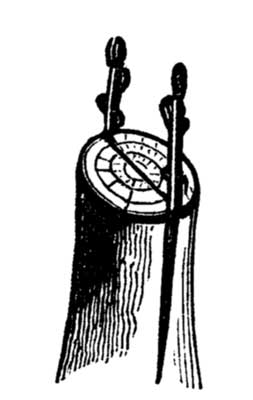
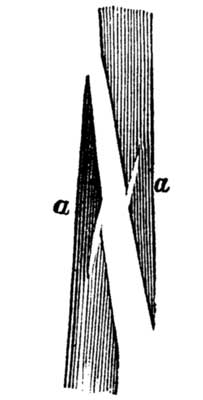
Cutting and preserving Scions.—Mature shoots of the previous year's growth are best. Those of the year before will also do. They may be cut at any time from November to time of setting. Perhaps the month of February is best. They may be well preserved in moist sawdust in tight boxes. The more there are together the better they will keep. They keep better by being cut a little below the beginning of the last year's growth, but it is more injurious to the tree. They may be kept well in fine sand, moist and cool. Too much moisture is always injurious. Put the lower ends in shallow water, and they will look very fine, but not one of them will live. Scions cut in the fall and buried six inches deep in yellow loam or fine sand, will keep well till next spring. There are several methods of grafting only two of which deserve particular attention. These are cleft-grafting and tongue or splice grafting, see figures.
Cleft-Grafting.
Tongue-Grafting.
Cleft-Grafting is performed in most cases, when scions are grafted upon stocks much larger than themselves. It is too well known to need particular description. Tools should be sharp, and it should be performed before the bark slips so easily as to be started by splitting the stock. It endangers the growth of the scions. The requisite to success in all grafting, is to have some point of actual contact, between the inside barks of both the scion and the stock. This is more certainly secured by causing the scion to stand at a slight angle with the stock.
Tongue-Grafting is generally used in grafting on small stocks—seedlings or roots. With a sharp knife, cut off the scion slanting down, and the stock slanting up, split each in the centre, and push one in to the other until the barks meet, and wind with thick paper or thin muslin, with grafting wax on one side. This is generally used in root-grafting. The question of root-grafting has excited considerable discussion recently. Many suppose it to produce unhealthy trees, and that retaining the variety is less certain than by other modes. Root-grafting is a cheap and rapid means of multiplying trees, and hence is greatly prized by nursery men. Practical cultivators of Illinois have assured us, that it is impossible to produce good Rhode Island greenings in that state, by root-grafting—that they will not produce the same variety. We see no principle upon which they should fail, but will not undertake to settle this important question. For ourselves we prefer to use one whole stock for each tree, cutting it off at the ground and grafting there.
Grafting Composition or Wax.—One part beef's tallow, two parts beeswax, and four parts rosin, make the best. Harder or softer, it is liable to be injured by the weather. Warm weather will melt it, and cold will crack it. Melt these together and pour them into cold water, and pull and work as shoemaker's wax. When using, it is to be kept in cool or warm water, as the weather may demand. In its application, it is to be pressed closely over all the wound made by sawing and splitting the limb, and close around the scions, so as to exclude air and water. Clay is often used for grafting, but is not equal to wax. You can use grafting tools, invented especially for the purpose, or a common saw, mallet, knife, and wedge.
GRAPES.
Those cultivated so extensively in Europe were natives of Persia—showing that they may be acclimated far from their native home. Foreign grapes are not suitable for out-door culture in this country, except a very few varieties, which do well in the Southern states. The native grapes of this country have produced some excellent varieties, which are now in general cultivation. Others are beginning to attract notice, and seedlings will probably multiply rapidly, and great improvements in our native grapes may be expected. The subject of grape-culture deserves greatly-increased attention. To all palates the grape is delicious; it is not only one of the most palatable articles of diet, but is more highly medicinal than any other fruit. It is the natural source of pure wine. Pure wine made of grapes is only to be procured, in this country, by domestic manufacture. Probably not one out of a thousand gallons of imported wines, sold as pure, contains a drop of the juice of the grape;—they are manufactured of poisonous drugs and ardent spirits—generally common whiskey. A French chemist discovered a method of imitating fermented liquor without fermentation, and distilled spirits without distillation. His process has been published in this country in book form, and by subscription; and while those books are unknown in the bookstores, they are generally possessed by prominent liquor dealers;—and the practice of those secret arts is terribly dangerous to the community. Antecedent to this chemical manufacture of poisonous liquors, such a disease as delirium tremens was unknown. Thus the Frenchman's discovery filled the liquor-sellers' pockets with cash, and the land with mourning, over frequent deaths by a disease, the horror of which is equalled only by hydrophobia. In self-defence, all should give up the use of everything purporting to be imported wines or liquors. Wine should not be used as a common beverage by the healthy. The best medical authority in the world has pronounced it absolutely injurious. But in many cases of sickness, especially in convalescence from fevers, it is one of the very best articles that can be used; hence, a pure article, of domestic manufacture, should be accessible to all the sick. (See our article on "Wine.") The luxury of good grapes can be enjoyed by every family in the land who have a yard twenty feet square. In the cities, almost every house may have a grapevine or two where nothing else would grow. Allow a vine to run up trellis-work in the rear of the house, and over the roof of a wing, or rear-part, raised two feet above the roof, supported by a rack. In such situations they will bear better than elsewhere, will be out of the way, and decidedly ornamental. In such small yards, from five to twenty-five bushels have often grown in a season. Some climates and soils are much better suited to grape-culture than others. But we have varieties that will flourish wherever Indian corn will mature.
Location.—For vineyards, the sides of hills are usually chosen, sometimes for the purpose of a warm exposure, but generally to secure the most perfect drainage. A northern exposure is preferable for all varieties adapted to the climate. To mature late varieties, choose a southern or eastern exposure.
Soil.—Gravelly, with a little sand, on a dry subsoil, is preferable, though good grapes may be grown upon any land upon which water will not stand. Grapes always need much lime. If the vineyard is not located on calcareous soil, lime must be liberally supplied, especially for wine-making. A dry subsoil, or thorough draining, is indispensable to successful grape-culture. We prefer level land, wherever thorough draining is practicable.
Propagation.—Choice grapes are propagated by grafts, layers, or cuttings. New ones are produced from seeds. The more kinds that are cultivated together, the greater will be the varieties raised from their seeds, by cross-fertilization in the blossoms. A small grape crossed with a large one, or an early with a late one, or two of different flavors, will produce mediums between them. Seeds should be cleaned, and planted in the fall, or kept in sand till spring. In the fall, cover up the young vines. The second or third year, the young vines should be set in the places where they are designed to remain. By efforts to get new varieties, we may adapt them to every latitude, from the gulf of Mexico to Pembina.
Layers.—These produce large vines and abundance of fruit earlier than any other method of propagation. Put down old wood in May or early June, and new wood a month later; fasten down with pegs having a hook to hold the vine, and cover up with earth; they will take root freely at the joints, and may be removed in autumn or spring. If you put down wood too late, or do not keep it covered with moist earth, it will fail; otherwise it is always sure.
Cuttings—may be from any wood you have to spare, and should be about a foot long, having two buds. Plant at an angle of forty-five degrees, one bud and two thirds of the cutting under the soil. A little shade and moisture will cause nearly all to grow. A little grafting-wax on the top will aid the growth, by preventing evaporation. The cutting, so buried as to have the top bud half an inch under fine mould, is said to be surer. Cuttings should be made late in fall, or early in winter, and preserved as scions for grafting. Cuttings made in the spring are less sure to grow, and their removal is much more injurious to the vine. Vines raised from cuttings may be transplanted when one or two years old.
Grafting—should be performed after the leaves are well developed in the spring. The sap becomes thick, which aids the process. Remove the earth, and saw off the vine two or three inches below the surface. Graft with scions of the previous year's growth, but well matured, and apply cement, to keep the sap from coming out. Cover all but the top bud. In stocks an inch in diameter put two scions. Very few need fail.
Budding—maybe done as in other cases, but always after the leaves are well developed, to avoid bleeding. These modes of propagation stand in the following order in point of preference, the best being named first: layers, cuttings, grafting, budding.
Culture and Manure.—Land prepared by deep subsoil plowing, highly manured and cultivated the previous season in a root-crop, is the best for a vineyard. The trenches for the rows should be spaded twenty inches deep, and a part of the surface-soil put in the bottom. After planting the vines, stir the ground often and keep clear of weeds. At first, stir the soil deep; but, as the roots extend, avoid working among them, and never disturb the roots with a plow. Mulching preserves the soil in a moist, loose condition, and is a good preventive of mildew. In many instances it is said to have doubled the crop. Common animal-manures are good for young vines, and in preparing the soil, but are rather too stimulating for bearing vines, often injuring the fruit. Ashes and cinders from the smith's forge, wood-ashes, charcoal, soapsuds, bones and bonedust, lime, and forest and grape leaves and trimmings, carefully dug into the soil around the vines, are all very good. A liberal supply of suitable manures will keep the vines in a healthy condition, and preserve the fruit from disease and decay. This, with judicious pruning, will render the grape-crop regular and sure.
Vineyards—should be in rows five feet apart, with vines four feet apart in the row. Layers of one, and cuttings of two years' growth, will bear the second year, and very plentifully the third year. A good vineyard in the latitude of Cincinnati yields about one hundred and fifty bushels of grapes per acre, making four hundred gallons of wine. The average yield of wine per acre, throughout the country, is estimated at two hundred gallons.
Training under Glass.—By this means the fine foreign varieties may be brought to perfection in our high latitudes. With most of the best kinds, this can be done by solar heat alone. A house covered with glass at an angle of forty-five degrees, facing the south, will answer the purpose. With a slight artificial heat, the finest varieties may be perfected, and others forwarded, so as to have fine grapes at most seasons of the year. The vines are planted on the outside of the grapehouse, and allowed to pass in through an aperture two feet from the ground, and are trained up near the glass on the inside. Protect the roots in winter by a covering of coarse straw manure. Wind the vines on the inside with straw, lay them down on the ground in the grape-house, and keep it closed during the winter. A house one hundred feet long and twenty-five feet wide, filled mainly with Black Hamburg, with a few other choice varieties, would afford a great luxury, and prove a profitable investment. From one such house, near a large city, a careful cultivator may realize a thousand dollars per annum. Native and even hardy varieties are often greatly improved by cultivation under glass, or by a little protection in winter.
The Isabella grape is hardy and productive in western New York. In 1856, we noticed a vine that had been laid down in a dry place and covered slightly with earth, in autumn; the fruit was more abundant, and one fourth larger, than that on a similar vine by its side that had remained on the trellis during winter: this shows the value of protection even to hardy vines.
Training.—There are many methods, and the question of preference depends upon the location of the vines, the space they may occupy, and the taste of the cultivator. There are four principal systems—the cane or renewal system, spur system, fan-training, and spiral or hoop training.
The renewal system we prefer for trellises. Put posts firmly in the ground eight feet apart, allowing them to be seven feet above ground after they are set; put slats of wood or wire across these, a foot apart, commencing a foot above the ground. Set vines eight feet apart; let the vines be composed of two branches, coming out near the ground: these can be formed by cutting off a young vine near the ground, and training two of the shoots that will spring from the bottom. These two vines should be bent down in opposite directions, and tied horizontally to the lower slat of the trellis; cut these off, so as to have them meet similar vines from the next root; upright shoots from these will extend to the top of the trellis, and it is then covered, and the work is complete. After these upright canes have borne, cut off every alternate one, two or three inches from its base, and train up the strongest shoot for a bearer next year: thus cut off and train new alternate ones every year, and the vine will be constantly renewing, and be in the most productive state; keep the vines clipped at the top of the trellis, and the sap will mature strong buds for next year's fruit. We regard this the most effectual of all training. The principle of renewal can be applied to any form of vine, and eminently promotes fruitfulness. Many complain that their vines, though liberally pruned, do not bear well. The difficulty may be that the new wood is principally removed, while the old is left to throw out strong-growing shoots, bearing abundance of foliage and little fruit. More of the old wood removed, and more of the young saved, would have produced less vines and much more fruit.
Pruning—is the most important part of successful grape-culture. Mistakes on this subject are very injurious. Let vines grow in their own way, and you will have much wood and foliage, and very little, poor fruit. Some cut off the shoots in summer just above the fruit, and remove most of the leaves around it to expose the fruit to the sun. This often proves to be a ruinous mistake; the sap ascends to the leaves, and there amalgamates with what they absorb from the atmosphere, and thus forms food for the vine and fruit. It is the leaves, and not the fruit, which need the sun: the leaves are the lungs, upon the action of which the life and health of the fruit depend. Blight of the leaves destroys the fruit, and a frequent repetition of it destroys the vine. Grape-vines should not be pruned at all until three years old, as it retards the growth of the roots, and thus weakens the vines. Older vines should be freely pruned in November or December; pruned in winter they may bleed in the spring, and pruned in the spring they certainly will bleed. Tender vines, not protected, may have an excess of wood left in the fall to allow for what may perish in winter; in this case, cut away the dead and surplus wood in spring, but never until the leaves are well developed, so as to prevent bleeding. Necessary summer-pruning is of much importance. Remove no leaves, except the ends of branches, that have already made as much wood as they can mature. In the Middle states this should be done about the last of July, and at the South a month earlier. Weak lateral branches, that bear no fruit, may be removed, but not all of them, for it is on the wood of this year's growth that the fruit will be found the following season. Old wood does not send out wood in spring that will bear fruit the same season; that wood will bear fruit next season if allowed to remain. Whoever observes will notice that grapes grow on young shoots of the same season; but they are shoots from wood of the previous year's growth, and not from old wood. Many suppose if they trim their vines very closely, as the old vines send forth abundance of new wood, and it is new wood on which the fruit grows, of course they will have abundance of grapes; and they are disappointed by a failure. The explanation of the whole is, fruit grows on new wood, from wood of previous year's growth, and not from old vines; hence, in lessening a vine, remove old wood. This is the renewal system, whatever the form of the vine, and is the whole secret of successful pruning. This accounts for the great success of the Germans in producing such quantities of grapes on low vines. In their best vineyards, they do not allow their vines to grow more than six or seven feet high, and yet they produce abundantly for many years. They so prune as to have plenty of last year's wood for the production of fruit the current season; after this has borne fruit, they remove it to make room for the young wood that will produce the next season. This principle is applicable to vines of any shape or size you may choose to form. The removal, in summer, of excessive growth, and shortening the ends of those you design to retain, throws the strength of the vine into the fruit, and to perfect the wood already formed. Liberal fall-pruning is necessary to induce the formation of new wood the next season, for bearing the following year. Parts that grow late do not mature sufficiently to bear fruit the next season; hence, cut off the ends in summer, and let what remains have the benefit of all the sap.
Reduction of Fruit.—The grape is disposed to excessive bearing, which weakens the vine, and injures the quality of the fruit. Liberal pruning in autumn does much to remedy this evil, by not leaving room for an excessive amount of fruit: hence, when you have a plenty of fruit-bearing wood, cut off the ends, so as to leave spurs with two buds, or at the most only four; when too much fruit sets, remove it very early, before the juices of the vine have been wasted upon it. A vine cut or wounded in spring will bleed profusely. Sheet India-rubber, or two or three thicknesses of a bladder, wet and bound closely around, may prevent the bleeding.
Mildew—is very destructive in confined locations, without a good circulation of air. Sulphur and quicklime, separate or combined, dug into the soil around the vines, is a preventive. Straw or litter of any kind, spread thick under the vines, is, perhaps, the best remedy—the action of it is in every way beneficial.
Insects.—The rosebug, spanworm, great greenworm, and many other insects, infest grapevines, and do much injury. The large worms are most easily destroyed by hand; the small insects by flour-of-sulphur, or by snuff, sprinkled over profusely when the vines are wet. The various applications recommended in this work for the destruction of insects, are useful on the grapevine. The principle is to apply something offensive to the insects, without being injurious to the vines.
Preserving Grapes.—Packed in sawdust or wheat-bran, always thoroughly dried by heat, they will keep well until spring. Another method is packing them in cotton-batting or wadding (the latter is best); or put them in baskets holding no more than four or five quarts, cover tight with cotton, and hang up in a cool, airy place, and they will long remain in good condition. In shallow boxes, six inches deep, put a sheet of wadding, and on it a layer of bunches of grapes, not allowed to touch each other; on the top of the grapes put another sheet of cotton, and then another layer of grapes, and so the third, covering the last with cotton, and put the cover on tight, and keep in a cool place. This is the most successful method.
A new method is to suspend hoops by three cords, like a baby-jumper, and hang the bunches of grapes all around it, as near as possible without touching, on little wire hooks, passing through the lower ends of the clusters, allowing the stem end to be suspended, and the grapes hang away from each other, and if the place be not damp enough to mould them, and not dry enough to cause them to shrivel, they keep exceedingly well. It requires more care and judgment, than the other methods. A very cool situation, without freezing, is essential in all cases. It is also necessary to remove all broken or immature grapes, from the clusters you would preserve.
Varieties are very numerous, and their nomenclature is confused, as that of other fruits. It is utterly useless to cultivate foreign grapes in the open air in this country. They succeed very imperfectly, even in the Southern states. But for cultivation under glass, they are preferable to any of our own. The following foreign grapes are preferred in this country:—
Black Prince, White Muscat, White Constantia, White Muscadine, White Sweet-water, Early White Muscat, Black Cluster, Black Hamburg. The latter is the best of all foreign grapes for cultivation under glass. It is very delicious, a great bearer, of very large clusters. It requires only solar heat to bring it to perfection.
Native Grapes.—Of these we now have a large number, many of which are valuable. We call attention only to a very few of the best. The Isabella as a table luxury is hardly surpassed. In the Eastern, Middle, and Western states, it is generally hardy and prolific. In northern Maine, New Hampshire, and Vermont, it does not ripen well. The seasons are too short. It also feels somewhat the severity of the weather, on the western prairies. It is also apt to decay at the South. For all other parts it is one of the very best. It is an enormous bearer, one vine having been known to produce more than ten bushels, in a single year.
The Isabella Grape. The Catawba Grape.
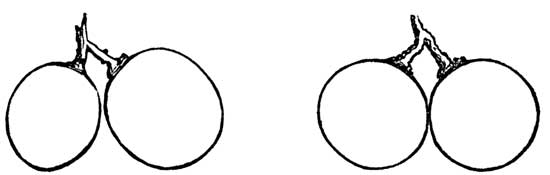
Next is the Catawba, better for wine, more vinous but not so sweet as the Isabella, ripens two or three weeks later, and hence not so good in high latitudes.
The Rebecca Grape.—This is a comparatively new variety, of great promise. White like the Sweet-water, flavor very fine, vine hardy and productive.
The Diana is a small delicious grape, excellent flavor for the dessert, and ripens two weeks earlier than the Isabella. Hence good for northern latitudes.
The Concord.—Large, showy, of good but not the best flavor, and ripens with the Diana. Should be cultivated at the North.
The York Madeira is similar to the Isabella, smaller and a few days earlier.
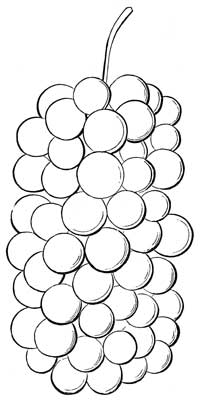
The Rebecca Grape.
The Delaware Grape.
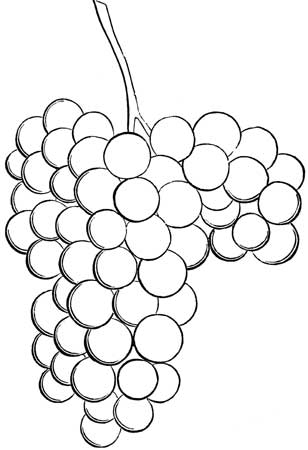
The Delaware is a small brown grape, excellent and hardy. Ripens quite as early as the Isabella. Best outdoor grape, in many localities.
The Canadian Chief.—One of the very best grapes for Canada.
Canby's August.—Very fine; considered better for the table than the Isabella, ripens ten days earlier, and as it is a good bearer, it should be generally cultivated.
The Ohio Grape is a good variety, beginning to attract much notice.
The Scuppernong is the best of all grapes, for general cultivation at the South. It is never affected by the rot. Not easily raised from cuttings. Layers are better. It does best trained on an arbor.
The soil and climate of the South are well adapted to the grape, even the finer varieties that do not flourish well at the North. They are, however, seriously affected by the rot, an evil incident to the heat and humidity of the climate. It being very warm, the dews and rains incline the fruit to decay. We think the evil may be prevented by two very simple means: Keep the vines very open, that they may dry very soon after rain; and train them to trellises, from six to ten feet high, and over the top put a coping of boards, in the shape of a roof, extending eighteen inches on each side of the trellis. It will prevent the rain and heavy dews from falling on the grapes, and is said to preserve them perfectly. This arrangement is about equal, in a warm climate, to cold graperies at the north. We recommend increased attention to this great luxury, in all parts of the country. Seedlings will arise, adapted to every locality on the continent.
GRASSES.
There is a great number of varieties, adapted to cultivation in some countries and climates, but not suitable for American culture. On the comparative value of different grasses there is a diversity of opinions. The best course for the practical farmer is, having the best and surest, therewith to be content. Sir John Sinclair says there are two hundred and fifteen grasses cultivated in Great Britain. We shall notice a very few of them, with a view to their comparative value:—
1. Sweet-scented Vernal Grass.—Small growth; yield of hay light. For pastures it is very early, and grows quickly after being cropped, and is excellent for milch-cows; grows well on almost any soil, but most naturally on high, well-drained meadows. It grows in great abundance in Massachusetts.
2. Meadow Foxtail.—Early like the preceding, but more productive and more nutritious. It is one of the five or six kinds usually sown together in English pastures; best for sheep and horses.
3. Rough Cocksfoot.—Orchard-grass of the United States; cows are fond of it. In England it is taking the place of clovers and rye-grass. About Philadelphia it is supplanting timothy. It is earlier, and therefore better to mix with clover for hay, as they mature at the same time; grows well in the shade, and on both loams and sands; springs rapidly after being cropped. Colonel Powell, one of the best American farmers, says it produces more pasture than any other grass he has seen in this country. Two bushels of seed are sown on an acre.
4. Tall Oat-Grass.—A valuable grass, deserving increased attention. It will produce three crops in a season; grows four or five feet high, and should be cut for hay when in blossom. Of all grasses, it is the earliest and best for green fodder.
5. Tall Fescue.—Cut in blossom, it contains more nutriment than any other known grass. Grows well by the sides of ditches, and is well adapted to wet bogs, as, by its rapid growth, it keeps down coarse, noxious grass and weeds.
6. Rye Grass.—This is extensively cultivated in Scotland and in the north of England. It is mixed with clover. Respecting its comparative value there is a diversity of opinion. Some do not speak well of it.
7. Red Clover and White Clover.—See article "Clover."
8. Lucern.—This yields much more green feed at a single crop than any other grass. For soiling cattle it is one of the best, and may be cut twice as often as red clover. This makes a good crop, soon after time for planting corn. Common corn or pop-corn, and later, Stowell's evergreen sweet corn, are the best for soiling cattle; but for early soiling, use lucern, or some other quick-growing, large grass. Lucern needs clean land, or cultivation at first, as young plants are tender. The tap-root runs down very deep; hence, hard clay or wet soils are not favorable. It stands the cold, in latitudes forty to forty-five degrees in this country, better than red clover.
9. Long-rooted Clover.—This is a Hungarian variety—biennial, but resows itself several years in succession, on good, clean land. Its yield of hay and seed is abundant. Needs a deep, dry soil, and stands a drought better than any other grass. To plow in as a fertilizer, or for soiling cattle, it is valuable, wherever it will flourish.
10. Sain-Foin.—Adapted to calcareous or chalky soils; considered one of the best plants ever introduced into England; but in New England it proves almost a failure—it requires more cool moisture and less frost.
11. Timothy.—In England, Meadow Cats'-tail, and in New England, Herd's-grass. This is the most valuable of all the grasses, and wherever it will thrive well, should never be superseded by anything else for hay. It should be cut when the seed has begun to harden, but before it begins to shell, and never in the blossom. Let every farmer remember that timothy, cut in the seed, contains twice as much nutriment as when cut in the blossom; hence, it is not worth more than half as much for hay, sown among clover, as when sown by itself, as it must be cut too early, to avoid losing the clover.
12. Red Top.—We can not find this described in agricultural books; but we have been familiar with it for thirty-five years, and can not find a New York or New England farmer who does not know it well and prize it highly. For low, moist, rich meadows, the red top is the best for hay of any known grass. It yields abundantly, and may be cut at any time, from July to last of September. The hay is better for cattle than timothy. Many intelligent gentlemen insist that it is the most healthy hay for horses.
After all that has been written on the various grasses, we regard it best for farmers throughout the continent to cultivate only the following:—
For early pastures, vernal grass and meadow foxtail; pastures through the season, white clover, cocks-foot, meadow foxtail, red clover, and timothy; for lowland pastures, red top and tall fescue; for hay, timothy, red top, orchard grass, and tall fescue; for the shade of fruit-trees, orchard grass; to be plowed in as fertilizers, red clover and white clover, for soiling cattle, tall oat-grass and lucern.
Time of sowing grass-seed is important. Some prefer the fall, and others the spring. Fall sowing should be very early or very late. Early sowing will give the young plants strength to endure the frosts of winter, which would kill late sown; but sow so late that it will not vegetate until spring, and it will come up early and get out of the way of the droughts of summer. Grass-seed sown late in the spring will always fail, except when followed by a very wet season. Sow timothy with fall grain, or late in the fall, or on a light snow toward the close of winter. Do not sow clover in the fall, as the young plants will generally fail in the cold winter;—sow it on the last light snow of winter, and it will always succeed. Roll the land in spring on which you have sown grass-seed in the last of winter; it will benefit the grain, and cause the grass-seed to catch well, and get an earlier and more rapid growth. Let all who would not lose their seed and labor, remember that grass-seed not sown so as to form good roots, before the frosts of winter or the drought of summer, will be lost; the plants will be killed. Timothy-seed sown in the fall, one peck to the acre, will produce a good crop the next season.
GREENHOUSE.
Greenhouses vary as much in style and cost as dwellings. The simplest is any tight enclosure, covered with a glass roof at an angle of forty-five degrees, facing the south, and kept warm by artificial heat. The temperature is not allowed to be lower than forty nor higher than seventy degrees of Fahrenheit; this will keep plants growing and make them blossom, and affords a good place for starting plants to be transplanted to out-door hotbeds, and finally to the vegetable garden, after frosts are over. There is but one main danger in greenhouse culture, and that is obviated by a little care: it is, allowing the air to become too much heated for the health of the plants; they require but little heat, but need it regularly. Some greenhouses are warmed by stoves, and serve a good purpose; others have a stove set in a flue which is built in the wall, gradually rising until it has passed around two or three sides of the building. Place three or four sheet-iron pans over this flue, at different points, and keep them filled with water; the fire in the flue will heat the water, and impart both warmth and humidity to the atmosphere, which is very favorable to the health and growth of plants. Such a house is favorable to the growth of tender exotic fruits and plants. A similar house without any artificial heat affords an excellent place for the cultivation of the finest varieties of foreign grapes.
GYPSUM, OR PLASTER OF PARIS.
The fertilizing properties of this article were discovered by a German laborer in a quarry, who observed the increased luxuriance of the grass by his path, when the dust fell from his shoes and clothes. This led to experiments which demonstrated its fertilizing power. With the protracted controversies on gypsum we have nothing to do; certain important facts are established which are valuable to agriculturists.
Gypsum is valuable as an application to the soil, at from three fourths to one and a quarter bushels to the acre. On poor land, for a flax crop three bushels per acre, applied after the plants were up, and when wet, produced a great crop. It should be applied only once in two years, or in very small quantities every year. Applied as a top-dressing, it will do no good until a considerable quantity of rain has fallen upon it. If it be applied in the spring, and the summer prove a dry one, its greatest effect will be felt the next season. Its most marked effects are on poor soils; on land already rich it seems to produce but little effect; on dry, sandy or gravelly soils, it will increase a clover crop from one fourth to two thirds; sowed among clover and immediately plowed in, it acts powerfully. Plants of large leaves feel its influence much more than those with small ones, hence its excellence on clover, potatoes, and vines. Some soils contain enough plaster already: the farmer must determine by analysis or experiment. On the compost heap it is valuable in small quantities; it is also useful on all long, coarse, or fresh manures of the previous winter. Seeds rolled in it before planting vegetate sooner and stronger. Mixed with an equal quantity of ashes and a little lime, and applied to any crop immediately after hoeing, or when just coming up, it adds materially to its growth. It is better to apply it twice—on first coming up, and immediately after first hoeing; small quantities are best;—it will ten times repay the cost and labor. Upland pastures and meadows, except clay soils, are greatly benefited by it. A time-saving method of sowing plaster on fields of grass or grain, is to sow out of a wagon driven slowly through the field, the driver being guided by his former tracks, while two men sow out of the wagon. It is customary to put plaster and ashes, mixed, around the hills of corn, or throw it upon the plants. Sown on the field of hoed or hill crops, its effects are much greater than when only put on the hill. It should be sown equally over the whole ground.
HARROWING.
The very liberal use of the harrow is one of the principal requisites of successful farming. No other single tool does so much to pulverize the soil, as the harrow. A full crop can only be raised on a fine mellow soil. Seeds planted in soil left coarse and uneven, will vegetate unevenly, grow unequally, ripen at different times, and produce unequal quantities. Many farmers insist that it is a mere notion, without reason, to harrow land four or five times, and roll it once or twice. Not one in five hundred believes in the full utility of such a thorough working of the soil. Coarse lumpy soils expose the seeds and roots of young plants to drought, and to too strong action of the atmosphere. (See article on Rolling.)
Harrow sandy and sod land whenever you please. If you work any other soil when very wet, it will not recover from the effects of it during the whole season. Harrow land the first time the same way it was plowed.
The form of a harrow is of no importance, except avoiding the butterfly drag, that seldom works well. The square harrow with thirty teeth is usually preferred. Every farmer should have a V drag also.
Corn, potatoes, peas, and other crops that are planted in straight rows, should be harrowed just after coming up, with a V drag, drawn by two horses. The front teeth should be taken out that the row may pass between the teeth, as well as between the horses.
Such a cultivation will do more good than any other single subsequent one. It stirs the whole surface, pulverizing the soil, keeps it mellow and moist, and destroys the weeds, and all at the best possible time, for the benefit of the crop. No other form of cultivation is so good for a young crop. Try two acres, one in the usual way, and the other by harrowing, as we recommend, when it first comes up, and you will never after neglect harrowing all your hoed crops.
HAY.
Farmers differ in their modes of making and preserving hay. The following directions for timothy and clover, are applicable to all grasses suitable for hay, as they are all divided into two classes, broad-leaved, and the fine-leaved, or grasses proper. The principles involved in these directions may be considered comparatively well settled, and they are sufficient for all purposes. Cut clover when half the blossoms are dried, and the other half in full bloom. Cut later, the stalks are so dried, that they are of much less value. Cut earlier, it is so immature, as to be of small value for hay. In case of great growth and lodging down, clover may be cut earlier, as it is better to save hay of less value, than to lose the whole. To cure clover for hay, spread it evenly, immediately after the scythe, let it thoroughly wilt, but not dry. Rake it up, before any of the leaves are dry so as to break, and put it in small cocks, such as a man can pitch upon a cart at once or twice with a fork. This should be laid on and not rolled up from a winrow. In the former case it will shed nearly all the water, and the latter method suffers the rain to run down through the whole.
Unless the weather be very wet, clover will cure in this way, without opening until time to haul it in, and will retain its beautiful green color, almost equal to that of England and Germany, cured in the shade, which, at two or three years old, appears almost as bright as though not cured at all. If the weather be quite wet, cut clover when free from dew or rain, wilt it at once, and draw it in, put as much as possible in thin layers on scaffolds, and under cover, to cure in the shade. Put the remainder in alternate layers with equal quantities of dry straw, with one peck of salt to a ton. A ton may bear half a bushel of salt, less is better, and more is injurious to stock, by compelling them to eat too much salt. The most beautiful and palatable clover hay is that cured in the shade, on scaffolds and afterward mowed away.
Timothy should never be cut, until the seed is far enough advanced to grow. Careful experiments have shown that cut in the blossom, the hay will contain only about one half as much nutriment, as when cut in the full-grown seed, but before it commences shelling. Cure as clover, but in twice as large cocks, and never salt, unless compelled to draw in when damp or too green.
HEDGE.
The question of fencing in this country, so much of which is prairie, and in other parts of which there is such a wanton waste of timber, gives great importance to successful hedging. The same plants are not equally good for hedge in all parts of the country. There are but few plants suitable for hedges in our climate.
The Osage Orange—is the best, in all latitudes where it will flourish. It has no diseases or enemies by which it will be destroyed, except too cold winters. Of Southern origin, yet it flourishes in many places at the North. In cold localities, where there is but little snow, it suffers much until three or four years old. It is being extensively introduced into central and northern Illinois, where unusually cold winters destroy vast quantities of young plants, and kill the tops of much old hedge. It is still insisted that it will succeed; but we consider it too uncertain, and consequently too expensive, for general fencing in such climates. The roots and lower parts of the plants may be preserved, however, by setting them out for a hedge on level ground, instead of ridges as usual, and plowing a furrow three feet from each side of the row, to drain off surplus water. Mulch thoroughly in the fall, and thus protect from frost until they have been set in the hedge for three years, and they may succeed and make a good live fence. To raise the plants, soak the seeds thoroughly, and, at the usual time of corn-planting, plant in straight rows, and keep clean of weeds. Set out in hedge the following spring. The soil of the hedge-row should be deep, mellow, and moderately, not excessively rich. Too rich soil makes a larger growth, of spongy and more tender wood. Plants should have a portion of the tap-root cut off, and be planted a foot apart in the row.
The Hawthorn—will never be extensively cultivated for live fence in this country, being subject to borers, as destructive as in fruit-trees.
The Virginia Thorn—is equally uncertain.
The Buck Thorn—after fifteen years' trial, in New England, bids fair to answer every purpose for American live fence: it is easily propagated, of rapid growth, very hardy, thickens up well at the bottom, and is exempt from the depredations of insects. It may yet prove the great American hedge-shrub.
The Newcastle Thorn—cultivated in New England, is much more beautiful, and promises to rival the buck thorn, but has not been sufficiently tested to settle its claims. Much is anticipated from it.
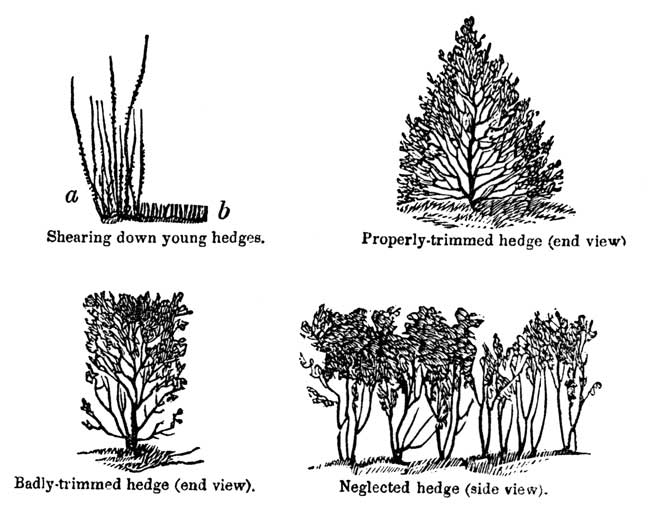
There are plants well adapted to hedge at the South, which are too tender for the North. In White's Gardening for the South, we have the following given as hedge-shrubs, adapted to that region: Osage Orange, Pyracanth, Cherokee, and single White Macartney roses. The Macartney, being an evergreen thorn, and said to make as close a hedge as the Osage Orange and much more beautiful, is quite a favorite at the South. They usually train the rose-shrubs for hedge on some kind of paling or wire fence. They render some of them impenetrable even by rabbits or sparrows; this is done by layers, and trimming twice a year, commencing after the first three months' growth. Pruning is the most important matter in the whole business of hedging. A hedge set out ever so well, and composed of the best variety of plants, if left in the weeds, without proper care in trimming, will be nearly useless. A well-trimmed hedge around a fruit-orchard will keep out all fruit-thieves. The great difficulty is the unwillingness of cultivators to cut off, so short and so frequently, the fine growth.
Shear off the first year's growth (a) within three inches of the ground (b). Cut the vigorous shoots that will rise from this shearing, four inches higher, about the middle of July, and similar and successive cuttings, each a little longer, in the two following years; these will bring the hedge to a proper height. The form of trimming shown in end view of properly-trimmed hedge, protects the bottom from shade by too much foliage on the top: the effects of that shade are seen in neglected hedge in the cut.
HEMP.
This is one of the staple articles of American agriculture. It is much cultivated in Kentucky and other contiguous states. Its market value is so fluctuating that many farmers are giving up its cultivation. The substance of these directions is taken from an elaborate article from the pen of the honorable Henry Clay. Had not the length of that article rendered it inconsistent with the plan of this volume, we should have given it to the American people as it came from the hand of their greatest statesman, who was so eminently American in all his sentiments and labors.
Preparation of the Soil—should be as thorough as for flax;—this can not be too strongly insisted on. Much is lost by neglect, under the mistaken notion that hemp will do about as well on coarse, hard land. Plants for seeds should be sown in drills four feet apart, and separate from that designed only for the lint. The stalks should be allowed to stand about eight inches apart in the rows. Plants are male and female, distinguished in the blossoms. When the farina from the blossoms on the male plants (the female plants do not blossom) has generally fallen, pull up the male plants, leaving only the females to mature. Cut the seed-plants after the first hard frost, and carry in wet, so as to avoid loss by shelling. Seed is easily separated by a common flail. After the seeds are thrashed out, they should be spread thin, and thoroughly dried, or their vegetative power will be destroyed by heat or decay. They should be spread to be kept for the next spring's planting, and not be kept in large bulk. Their vegetation is very uncertain after they are a year old. Sow hemp for lint broadcast, when the weather has become warm enough for corn-planting. Opinions vary as to the quantity of seed, from one bushel to two and a half bushels per acre. Probably a bushel and a peck is best. Plowing in the seed is good on old land; rolling is also useful. If it gets up six inches high, so that the leaves cover the ground well, few crops are less effected by the vicissitudes of the weather. Some sow a part of their hemp at different times, that it may not all ripen at once and crowd them in their labor. Cutting it ten days before it is ripe, or allowing it to stand two weeks after, will not materially injure it. Hemp is pulled or cut. Cutting, as near the ground as possible, is the better method. The plants are spread even on the ground and cured; bound up in convenient handfuls and shocked up, and bound around the top as corn. It is an improvement to shake off the leaves well before shocking up. If stacked after a while, and allowed to remain for a year, the improvement in the lint is worth more than the loss of time. There are two methods of rotting—dew-rotting, andwater-rotting—one by spreading out on grass-land, and the other by immersing in water; the latter is much the preferable mode. The question of sufficient rotting is determined by trial. Hemp is broken and cleaned like flax. The stalks need to be well aired and dried in the sun to facilitate the operation. Extremes in price have been from three to eight dollars per hundred pounds: five dollars renders it a very profitable crop. Thorough rotting, good cleaning, and neat order, are the conditions of obtaining the first market price. An acre produces from six hundred to one thousand pounds of lint—an average of about one hundred pounds to each foot of height of the stalks. Hemp exhausts the soil but a mere trifle, if at all; the seventeenth successive crop on the same land having proved the best. Nothing leaves the land in better condition for other crops; it kills all the weeds, and leaves the surface smooth and even.
HOEING.
Much depends upon the proper and timely use of the hoe. Never let weeds press you; hoe at proper times, and you never will have any large weeds. As soon as vegetables are up, so that you can do it safely, hoe them. The more frequent the hoeing while plants are young, the larger will be the crop. Premium crops are always hoed very frequently. Hoeing cabbages, corn, and similar smooth plants, when it rains slightly, is nearly equal to a coat of manure. But beans, potatoes, and vines, and whatever has a rough stalk, are much injured by stirring the ground about them while they are wet, or even much damp. We have known promising crops of vines nearly destroyed by hoeing when wet. Hoeing near the roots of vines after they have formed runners one or two feet long, will also nearly ruin them;—the same is true of onions: hoe near them, cutting off the lateral roots, and you will lessen the crop one half. In hoeing, make no high hills except for sweet potatoes. High hilling up originated in England, where their cool, humid, cloudy atmosphere demands it, to secure more warmth. In this country we have to guard more against drought and heat.
HOPS.
These are native in this country, being found, growing spontaneously, by many of our rivers. There are four or five varieties, but no preference has been given to any particular one. Moist, sandy loam is the best soil, though good hops may be grown in abundance on any land suitable for corn or potatoes. Plow the land quite deep in autumn; in the spring, harrow the same way it was plowed. Spread evenly over the surface sixteen cords of manure to the acre, if your soil be of ordinary richness; cross-plow as deep as the first plowing; furrow out as for potatoes, four feet apart each way. Plant hops in every other hill of every other row, making them eight feet apart each way. Plant all the remaining hills with potatoes. Four cuttings of running roots of hops should be planted in each hill. Many hop-yards are unproductive on account of being too thick;—less than eight feet each way deprives the vines of suitable air and sun, and prevents plowing them with ease. The first year, they only need to be kept clean of weeds by hoeing them with the potatoes. In the fall of the first year, to prevent injury from hard frosts, put a large shovelful of good manure on the top of each hill. Each spring, before the hops are opened, spread on each acre eight cords of manure; coarse straw manure is preferable. Plow both ways at first hoeing. They require three hoeings, the last when in full bloom in the beginning of August. Open the hops every spring by the middle of May; at the South, by the last of April. This is done by making four furrows between the rows, turning them from the hills; the earth is then removed from the roots with a hoe, and all the running roots cut in with a sharp knife within two inches of the main roots. The tops of the main roots must also be cut in, and covered with earth two inches deep. Set the poles on the first springing of the vines; never have more than two poles in a hill, or more than two vines on a pole, and no pole more than sixteen feet high. Neglect this root-pruning, and multiply poles and crowd them with vines, and you will get very few hops. Select the most thrifty vines for the poles, and destroy all the others. Watch them during the summer, that they do not blow down from the poles. They must be picked as soon as they are ripe, and before frosts. The best picking-box is a wooden bin made of light boards, nine feet long, three feet wide, and two and a half feet deep; the poles are laid across this, and the hops picked into it by hand. In gathering hops, cut the vines two feet from the ground, that bleeding may not injure the roots.
Curing is the most important matter in hop-growing. Hops would all be of one quality, and bring the first price, if equally well cured. The following description (with slight abbreviation) of the process of curing, by William Blanchard, Esq., is, perhaps, as complete as anything that can be obtained. Much depends upon having a well-constructed kiln. For the convenience of putting the hops on the kiln, a side hill is generally chosen for its situation; it should be a dry situation. It should be dug out the same bigness at the bottom as at the top; the side walls laid up perpendicularly, and filled in solid with stone to give it a tunnel form: twelve feet square at the top, two feet square at the bottom, and at least eight feet deep, is deemed a convenient size. On the top of the walls sills are laid, having joists let into them, as for laying a floor, on which laths, about one and a half inches wide, are nailed, leaving open spaces between them three fourths of an inch, over which a thin linen cloth is spread and nailed at the edges to the sills. A board about twelve inches wide is set up on each side of the kiln, on the inner edge of the sill, to form a bin to receive the hops. Fifty pounds, after they are dry, is all such a kiln will hold at once. The larger the stones made use of in the construction of the kiln the better, as it will give a more steady and dense heat. The inside of the kiln should be well plastered with mortar to make it air-tight. Charcoal is the best fuel. Heat the kiln well before putting on the hops; keep a steady and regular heat while drying. Hops must not remain in bulk long after being picked, as they will heat and spoil. Do not stir them while drying. After they are thoroughly dry, remove them into a dry room, and lay in heaps, and not stir unless they are gathering dampness that will change their color; then spread them. This will only occur when they have not been properly dried. They are bagged by laying cloth into a box, so made that it can be removed, and give opportunity to sew up the bag while in the press. The hops are pressed in by a screw. In bulk they will sweat a little, which will begin to subside in about eight days, at which time they should be bagged. If they sweat much and begin to change their color, they must be dried before bagging. The best size for bags is about two hundred and fifty pounds' weight, in a bag about five feet long. Common tow-cloth or Russia-hemp bags are best. Extensive hop-growers build houses over the kiln, that they may be able to use them in wet weather. In this case, keep the doors open as much as possible without letting in the rain. Dried without sufficient air, their color is changed, and their quality and market-value injured. These houses are made much larger than the kiln, in many instances, for the convenience of storing and bagging the hops when dry; in this case, tight partitions should separate the storerooms from the kiln, to avoid dampness from the drying hops.
The form of manuring recommended is contrary to the old practice of putting a little manure only in the hill: that practice exposed vines to decay and destruction by worms, and this does not; our system also produces hops equal to new land.
HORSE.
This noble animal is in general use, and everywhere highly prized. By the last census, we see that there are two thirds as many horses as cows in the United States—4,335,358 horses, and over six millions of cows. But, valuable as is the horse, he suffers much ill treatment and neglect from his master. To give a history of the horse, the various breeds of different countries, and the efforts to improve them, would be interesting, did it fall within the limits of our design. The patronage of the kings and nobility of England has done much to elevate the horse to his present standard of excellence. It has now become the custom for intelligent gentlemen in rural districts, in all enlightened countries, to give much attention to the improvement of horses. Unfortunately, some of that enthusiasm is perverted to the channel of horse-racing, a practice alike injurious to horses and the morals of men. A few brief hints are all we have space for, where a volume would be interesting and useful. The farmer should exercise constant care to improve the breed of his horses: it pays best to raise good horses. This depends upon the qualities of the dam and sire, and upon proper feed and care. This is a subject that farmers should carefully study from books and from their own observation. The most important matter in raising horses, is care in working and feeding. Nineteen out of twenty of all sick horses are made so by bad treatment. The prevention of disease is better than cure. Steady, and even hard work, will not injure a horse that is well and regularly fed. But a few moments of crowding a horse's speed, or of an unnatural strain on his strength, may ruin him. Let it always be remembered that it is speed, and not heavy loads, that most injures a horse. A mile an hour too fast will soon run down your horse. A horse fed with grain, or watered, when warm, is liable to be foundered; and if not so fed as actually to be foundered, he will gradually grow stiff. Horses are liable to take cold by any unreasonable exposure to the weather, in the same circumstances as men, and the effects on health and comfort are very similar. A horse having become warm by driving, should never stand a minute without a blanket. When a man goes from a heated room, or in a perspiration, into inclement weather, he takes cold the moment the cold or storm strikes him: in a few moments the effects on the pores of the body are such that there is no particular exposure. It is so with a horse. He takes cold when you are only going to allow him to "stand but a minute," and during that time you leave him uncovered.
If you are under the necessity of doing an unusual day's work with a horse, do not feed him heavily on that day. Unusual feed the day before and the day after will do him good; but on the day of excessive work it injures him. Never feed horses too much; they will often eat one third more than is good for their health. Keep the bottom of the trough in which you feed your horses grain, plastered over with a mixture of equal parts of salt and ashes, that they may eat a little of it when they please. When the water of your horse becomes thick and yellowish, or whitish, give him a piece of rosin as large as a walnut, pulverized and put in his grain. If a horse has the heaves, give him no hay or oats; corn, ground or soaked, should be his only grain, and green corn-fodder in summer, and cornstalks, cut fine, with a little warm water on them, mixed with meal, should constitute his only food. All except a few of the most confirmed and long-standing cases of heaves are entirely relieved by this course of feeding, and that relief is permanent as long as the feed is continued, and it frequently effects a cure so radical that the disease will not return on a change of food. To bring up horses that have had hard usage and poor feed, and to secure growth in colts, feed them milk. The milk of a butter-dairy is not more profitably used in any other way, than fed to horses and colts. Give them no water for two or three days, and they will readily learn to drink all the sour, thick milk you will give them. Colts will grow faster on milk than on any other food.
Horses should be often rubbed down and kept clean, and when put in the stable wet, they should be rubbed dry. It is very essential to the health of a horse that he have pure air. Stables in this country are usually airy enough. But if the stable be tight, it should be well ventilated. The gases from a wet stable floor are injurious. Disinfecting agents are good remedies; a little plaster-of-Paris spread over a stable-floor is very useful. These brief directions, followed, will prevent most of the diseases to which horses are subject; or in case a horse be attacked, he will have the disease lightly, as temperate men do epidemics.
HORSERADISH.
This is regarded a healthy condiment, especially in the spring of the year. Grated, with a little vinegar, it may be eaten with any food you choose. Small shavings of the root are esteemed in mangoes. When steeped in vinegar for two weeks, it is said effectually to remove freckles from the face. Any pieces of the roots will grow in any good garden-soil. Larger and better roots may be produced, by trenching the bed two feet deep, and putting in the bottom, ten inches of good manure, and planting selected roots, about six inches deep.
HOTBEDS.
These are designed to force an early growth of plants. It is done by the use of solar heat, and that arising from fermenting manures, combined. The following directions for constructing and managing hotbeds will enable every one to be successful. Nail boards on pieces of scantling placed in the inside corners, in the form of a box, sixteen feet long and six feet wide; make it three and a half feet high on the back-side, and two feet high in front, facing the sun; nail a piece of board across the middle, let in at the top, to prevent the box from spreading when filled. Fill that with good, fresh horse-manure, with but little straw; tread it down firmly. Put over the whole, sashes made with cross-pieces but one way, and filled with glass, lapped half an inch, like shingles on a roof, to carry off the rain; putty in the glass lightly, or it may adhere to fresh-painted frames; let the frames be halved on their edges, so as to lap and be tight; put these over the filled hotbed, perfectly fitted all around, and enough of them to cover the whole bed; in two or three days the manure will become pretty warm, when it should be covered, four inches deep, with rich mould, sheltered for the purpose the previous fall, and the seeds planted. When the plants come up, see that they are kept sufficiently moist, and not have the hot sun pour upon them intensely, and they will grow rapidly; when too warm, they should be partly covered with mats, and the frames raised to let in air. Put small wedges between the sash and the boards, which will let in sufficient air. Keep it closed when the air is cold, and covered with mats when the sun is too hot. Plants are often destroyed by over-heating. When in danger of freezing, cover closely with mats or straw, or both. We have had plants growing in such a bed when the thermometer stood eight degrees below zero. If the heat of the manure subsides too early, pack fresh horse-manure all around the outside of the box, and as it heats it will communicate warmth to the inside of the bed. As plants grow up, transplant a part to a fresh bed, so as to give all a chance to grow stocky and strong. Almost everything that grows in the garden may be forwarded greatly in the hotbed. Vines, beets, tomatoes, cabbages, peppers, egg-plants, celery, beans, corn, and potatoes, may be obtained much earlier by this means. Those that are injured most by transplanting should be planted in the hotbed, on inverted sods, or grass turfs, six inches square, which can be removed with the growing plants on them, without seriously disturbing the roots. Plenty of shade and moisture on transplanting will save the most tender plants, and they will speedily recover. Make a hotbed of any size you may desire on the same principle. The boards and frames will last many years, with proper care, and occasional supply of a broken light of glass. Into such sash, broken glass of any size can be put, by cutting it to a proper width in one direction, no matter how far the points lap.
HOUSES.
It is not our design to give an extended view of rural architecture. But this work can not be complete without a brief notice of farm-buildings, and a few plans for such buildings, adapted to the wants of those possessing limited means. We hope these directions and plans will prove important aids in getting up cheap, yet convenient and beautiful, country residences, especially in all the newer parts of the country. Our reading on rural architecture, and an extensive observation in many states of the Union, have made us acquainted with nothing, combining beauty, cheapness, and utility, better than the following.
The scale at the bottom will enable any mechanic to determine the size of each of these buildings, and their relation to each other. They can, on the same general plan, be made of any dimensions, to suit the wishes of the proprietor.
The wagon-house in the range is forty feet long, affording ample shelter for all kinds of vehicles, connected by a covered way with the horse-stables and barn-floor.
Range of Farm-Buildings.
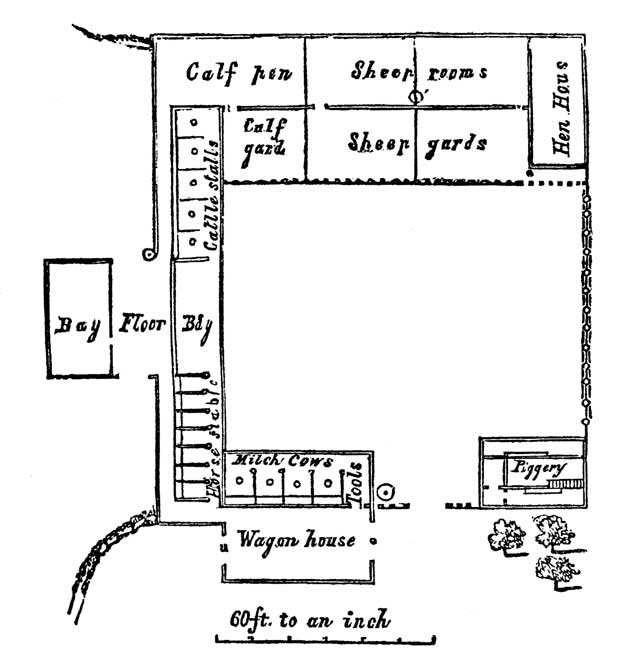
A lean-to is built on the north side of the wagon-house, in which is a tool-house opening into it, and a stable for eight milch-cows, that will thus be convenient for winter-milking; these cows are fed from the loft over the wagon-house. The barn is thirty by forty feet, with floor in the middle and bay on each side: this can be driven into on one side and out on the other. From the floor is a covered way to cattle and horse stables, and into the wagon and tool house, without going outdoor.
The Piggery.—Large and small swine do not do so well together; hence, the larger ones are to occupy the feeding-pen and bed on the right (in the cut), those of medium size on the left, and the smaller ones in the rear. The dimensions and relative size of apartments can be determined from the plan.
The other buildings sufficiently explain themselves in the cut.
Ground-plan of Piggery.
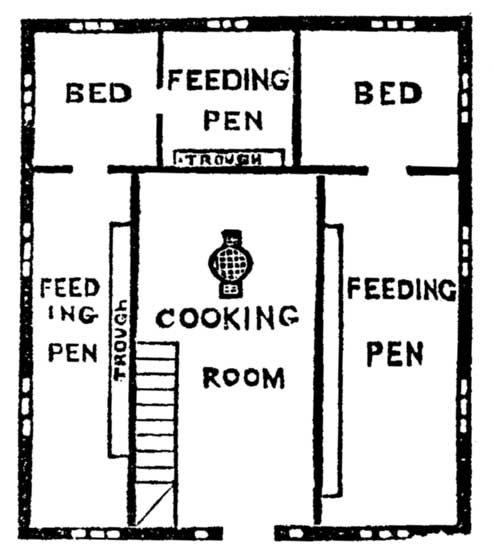
With this range of buildings, let a farmer do his own thrashing, with a small horse-power, and thrash a part at a time during the winter, keeping the straw in an apartment in the bay, dry for litter, and for cut feed for cattle and horses, and it will be the best and most economical method of thrashing and keeping stock. Every farmer should do at least a part of his thrashing in this way, during the winter, for the benefit of fresh straw, &c.
Country Residence.—This includes the range of buildings given opposite, their distance from the house, and all the parts of a complete residence, with all the comforts and conveniences that can be crowded into such a space, and at a very reasonable expense. Three fourths of an acre are devoted to the ornamental grounds; except the walks and small flower-beds, it is all green turf. Plowed very deep and thoroughly enriched, the trees are set out, and all then made very level, and one and a half bushels grass-seed sown on it and brushed in very smooth. This soon makes a very thick green turf, to be cut every ten days during the most growing season, and less frequently as the season advances. The trees, for a few years, need careful working around and mulching. The gravel carriage-road is twelve feet wide, and winding around shrubbery, it leads to the carriage-house in the range of buildings. The foot-walks are five feet wide. The curves in the walks may be accurately laid out in the following manner. Determine the general position by a few points measured off. Lay a pole upon the ground, in the direction of the walk; stick a peg in the ground at the first end and at its middle; move the pole round a little, leaving the middle the same,—then stick a peg at its end, and move it forward—moving it forward and round equally, each time, by measurement. A longer or shorter curve is made by a greater or less side-movement of the pole. In a regular curve, the movements are the same; but in going from a shorter to a longer, or from a longer to a shorter curve, the side-measurement must increase or diminish regularly.
Country Residence, Farm Buildings, Grounds, and Fruit-Gardens.
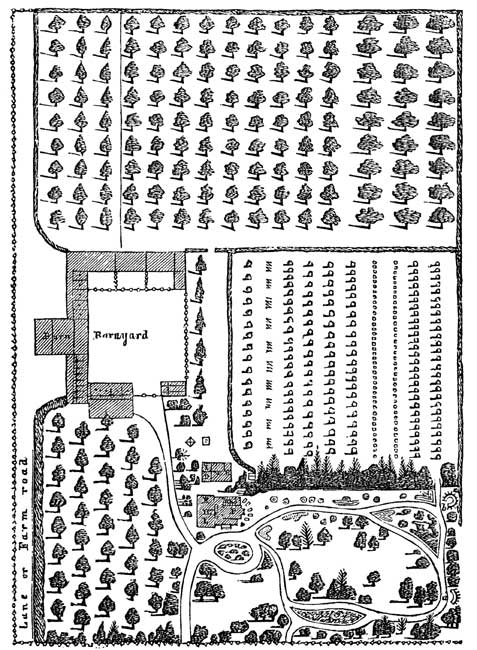
Laying out Curves.
First floor. Chambers.
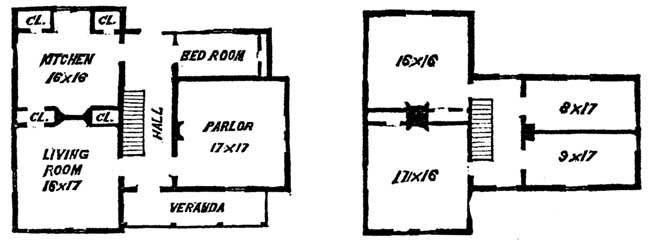
Summer-house.
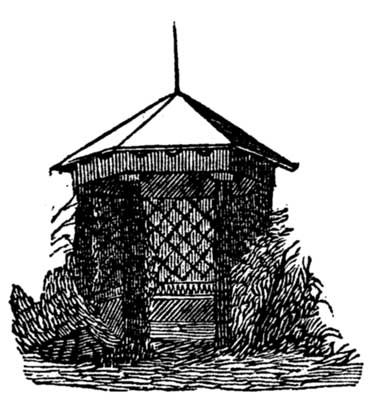
The following cuts show the plan of the house: three principal rooms and a bed-room below, and four rooms above. The hall extends through the house, affording good ventilation in summer, and entrance to each room, without passing through another. The chimney in the centre economizes heat. This small and cheap house affords more conveniences than most large ones. One of the finest things about such a house is a good cellar. For a farm-house, the cellar should be under the whole; make it eight feet deep, gravel and water lime made smooth on the bottom, flagging under the bottom of the wall extending out a foot, the wall above ground built double, the inside four inches thick, with brick, with a space of two inches, and outside stone wall a foot thick. The windows should be double and well fitted, the inside one hung on hinges; the outside one to be removed in spring, and its place supplied with a well-fitted frame, covered with wire-cloth to admit air and exclude intruders during summer. This will not freeze, and never need banking. No rat can enter, for they always work close to the wall, and coming to the projecting flat stone at the bottom, they give it up. On one side of the cellar, under the kitchen, make a large rain-water cistern, with a pump in the kitchen and a faucet in the cellar, and the whole arrangement is perfect. If the farm be large, you will need some of the good, but cheap houses described in the following part of this article, where your men will live and board themselves, which is always the best and cheapest way. An open view from the house in the country residence extends to the summer-house (b) on the right. This is one of the neatest cheap summer-houses that can be made. The following directions for making it may be useful. Set eight cedar posts, six inches in diameter, in the ground, in a circle; saw them off even at the top, and connect them by plank nailed on their tops. Make an eight-sided roof of boards; nail lath from post to post, forming lattice-work, leaving a space between two posts for a door. Put a seat around on the inside. Leave all the materials except the seat unplaned, and cover with a white or brown wash, and it need not cost more than five or six dollars, and, covered with vines of some kind, it will be ornamental.