Part 3 — THE WEAVER’S DAUGHTERS.
Reading edition
In a poor little house that stood almost within the shadow of a great monastery there lived once two sisters, named Agnes and Elthea,—orphans, and heirs of nothing but an honest name and the trade of their parents, which was that of weaving. The elder, Agnes, had black hair, a pale face, hands that were never idle, and a tongue that was always still, except when it repeated prayers or when the prattle of Elthea provoked it to speech.
Mirth ill becomes you, good sister, Agnes often said, with severe voice and frowning brow. Do not the bones of our parents moulder in the dust? and have we not to earn our bread by our weaving? and if we take time to laugh, what will become of the work!
Then Elthea would answer something after this fashion: “I know, my sister, that you are wise and I am simple; I know too that our parents are dead, and that we are poor girls who must weave from morning till night to earn our food and our clothing; but I cannot see that it is wicked to keep the heart light just because the hands have to be busy, or for that other reason that our good father and mother have gone to a better world.”
And having said this, or something like it, she would try to separate the smiles from her rosy mouth, and would weave very quietly for five minutes; then, all unaware, she would break into mockery of the bird at the doorside, and after her little song, ask Agnes how it happened that so often at nightfall the cloth in her loom measured the longer!
“Giddy child,” Agnes would answer, with never a smile, “do you not know that the Devil helps his own?”
This was a dreadful thought, and, pondering it, Elthea would remain silent a whole half-hour sometimes; but in the end laugh again, and reply, “If it be as you say, good sister, I will sing while I may, for the breath I use in singing would not serve me to cool the fires a thousand years hence.”
“O my poor sister!” Agnes would sigh, moistening the threads of her weaving with her tears; and thus from day to day they sat at their looms, roses blooming in the cheeks of one, and wrinkles and pallor making the face of the other old before its time.
At twilight Elthea went with their woven cloth to the neighboring convent, where it was embroidered by the sisters in patterns fine and beautiful enough for queens to wear. If it were summer, she plucked flowers on the way and made crowns for her golden hair, which she sometimes wished might be admired by eyes besides her own, as she bent her head over the still places along the brook.
If Agnes could have seen how nicely she disposed the flowers, and with what vanity she broadened the golden bands of her hair, she would have frowned, even at her prayers; but Elthea never wore home the flowers. She gave them to the brook, whose bright waters carried them lovingly away, and smoothed back the broad bands of her hair before crossing the threshold of the gloomy house, where, till her return, the firelight seemed afraid to shine.
One night, as she was spreading the table with bread and grapes and milk, singing a song so low that it hardly came out of her heart,—a song that was half thanksgiving and half prayer,—the great bell of the monastery began to toll so solemnly that for a moment she grew pale, and crossed herself in silence; for she had been born and reared in the faith that teaches men and women to believe there is some special virtue in the sign of the cross, and she had not learned that there is no virtue at all in the signs, or outward shows of things. No change came over the face of Agnes, and indeed her face was always so gloomy that it would have been difficult for it to look gloomier than common, but her voice had in it some bitter gratification as she said she was glad to see her sister Elthea silent and sad for once!
It was only for a moment, however, that Elthea looked sad. “I was afraid some evil had fallen upon the land, at first,” she said, “but I perceive by the peculiar tolling of the bell that it is not evil, but good that has befallen. And it is probably some sister of the convent that has passed from death into life”; and so saying, she joined her little song where it had been broken off, and went on with her preparations for supper with a face as tenderly bright as the tenderest and brightest of all the May mornings.
“Hush!” said Agnes, lifting up her hand; “I hear the mountain wind coming angrily down; the roof-tree shakes its last leaves off to battle with it. Saints, protect us! it will be a fearful night!”
As she spoke the rain dashed against the roof as if a thunder-cloud emptied itself all at once. Then Agnes began to cry aloud, as a child that is lost in the dark; but Elthea said: “God, who holds the whirlwinds in his hand, will keep us, and we shall not die. Why do you fear, my sister? doth he not love us the same when to our weak vision the way of his providence seems dark?”
And still the bell tolled mournfully, the winds drove dismally, and the rain beat heavily. It was enough to make any soul afraid that could not draw light into the darkness from the sunshine of a past life of pious cheerfulness and resignation.
“Have mercy on us, good saints!” cried Agnes again and again, wringing her hands in dismay.
“Our Father, we thank and bless thee for the fire that makes us warm, and for the roof that shelters us, and for our trust in thee that no storm can beat down,” prayed Elthea.
Directly, in a lull of the storm, there was heard a knocking at the door, and Elthea, smiling, made haste to open it; for she said, “It is, perhaps, some poor wayfarer, whose life is mercifully given into our keeping.” But Agnes reproved her with frowns, saying, “Stir not for your life; it is some murderer who seeks our blood, or at best a robber who takes advantage of the storm.” And when she saw that Elthea would not be hindered from opening the door, she hid herself in the darkest corner of the house, under the cloth that was in her loom; and her trembling shook the floor beneath Elthea’s feet, as her steady hand unlatched the door and set it open wide.
“Now, all good saints and angels bless thee for the sake of thy sweet charity,” said the stranger who stood waiting. “I dreamed not these rude hills held so fair a blossom. Thy goodness—for I am sure thou art good—shalt be my shield as well as thy roof. Bring me straight to thy royal mother, that I may kiss her hand.”
The youth and stranger had crossed the threshold as he spoke, and now stood waiting meekly before Elthea in the light of the burning fire.
“You honor me above my deserts, gentle friend,” replied Elthea, her confusion showing all the more for the blushes in which it tried to hide. “We are but poor girls, the children of weavers, and our parents are dead.”
“Children?” repeated the stranger, turning his fair face toward the dark corners of the room; “I see only thyself.”
Then Agnes came forth from beneath the cloth of the loom, and said, turning her dark face toward the stranger, “My sister, a giddy and thoughtless maiden as you may judge, has spoken truly. We are indeed poor, weaving all day long for our bread, which at the best is scanty enough”; and she broke the small loaf in two pieces as she said this, and offering one piece to Elthea, began to eat the other, for she hoped to drive the stranger away by showing him that they had nothing to spare.
But Elthea forgot her long fast, which she was used to keep all day, and remembering the stranger, who had been beaten by the rain, and must be tired and famished, she offered him what bread was left without tasting any.
The stranger accepted the bread, bowing so low that all his golden locks fell down about his face; and seeing what he did, Agnes not only frowned, but asked, in accents sharp and reproachful, how the poor could work without food. As she spoke, the piece of bread the stranger held seemed to grow into a whole loaf, and the part he gave back to Elthea was more than the whole she had given. And as they ate, the rain drove, and the wind blew, and the great bell of the monastery tolled and tolled. When Agnes spoke, she could hardly hear her own voice for the noise of the storm. Nevertheless, she said she believed the tempest had wellnigh ceased, and a favorable time was offered for wanderers, if any were abroad, to seek shelter in the neighboring convent. The stranger seemed not to hear or to understand her words, for he continued to eat his bread quietly as before. “Had we never so much charity,” continued Agnes, “we could neither shelter nor lodge a wayfarer, even though we knew him to be a pious priest, let alone a vagabond of a minstrel, such as are likeliest to trespass on the poor.”
Now the stranger wore the habit of a minstrel, and carried with him a harp, so that if he heard the words of Agnes he could not mistake their meaning. But he seemed not to hear her words. He seemed only to hear the tolling of the monastery bell; and as he listened, the tears filled his beautiful eyes, and ran silently down his cheeks. It seemed, indeed, as if the shadow of some great affliction were resting upon him.
“Your tears will not be dried by remaining here,” said Agnes, “for we are poor girls who have no comfort for ourselves, let alone for strangers, and we sell the kerchiefs we weave for our bread.”
But Elthea, when she heard this cruel speech, came softly between her sister and him, and in silence that was just as sweet as any spoken words, wiped his tears with her long golden hair. And directly the heart of the young man began to be lighter in his bosom, and he told the little maiden, as she strove to comfort him in her own gentle way, that the king who had ruled in his own country for years and years, so wisely and so well that all his people loved him and came to him in the time of their sorrow as though he had been their own father and not the king, was now dead,—dead and gone,—and all the land was in mourning, and all the bells of all the convents ringing dirges, and all the sisters singing funeral chants. Then he made a dark picture of the king’s empty palace, and of the king’s son, who in his grief had wandered to a strange country.
“And what is all that to a poor minstrel like thee, or to the poor daughters of a weaver like us?” cried Agnes, her words dropping like icicles from her mouth. “The kings may all die and may all be buried, but can we leave our work to weep, though they were twice dead and twice buried!”
And having spoken these chiding words, she climbed into her loom again, and beckoned her sister to follow; but Elthea, who had a mind of her own, sat at the feet of the stranger and wept, saying, “The king was a good king and a lover of his people, doing in the land the things that were lovely and the things that were right, and it is a wise thing and a just thing to pause a little and ponder upon the life and upon the death of such an one.” And the burden seemed lifted more and more from the young man’s heart, for the words spoken by the gentle and kindly maiden.
“O my sister! my foolish sister!” cried Agnes. “What is the king to you, whether he were good or bad, whether he be alive or dead?”
But Elthea, regardless of her sister’s words, continued to sit at the stranger’s feet and to weep, and to speak words that were sweet and pleasant to him. And the wind blew and the bell tolled, and the rain beat against the house, but the moments fled away as fast as the moments of a bright day in the middle of the summer.
And as the firelight shone upon the young man, and Agnes perceived that he was fair in the face, and that his locks were in their beauty like the locks of the morning, she grew only the more impatient and vexed and uncharitable toward him.
“You may perceive how poor we are,” she said, “and that we have but one bed, which cannot be divided”; and then going on more fretfully, she said that strolling minstrels, she supposed, were used to no better shelter than the oak-trees afforded; and as for the harp, the thought of it was displeasing to her, and she would gladly have it out of the house. “What is the good of music?” she said. “Would it help us to weave the better, though we should listen to your harp till cock-crow!”
But the young man still sat contentedly by the fire, his eyes resting on the face of Elthea as though it had been the face of some delightful flower, and the glow of the coals made his beauty radiant, and his curling locks like the brightness of a day in the middle of summer. His milk-white hands were all sparkling with rings, and the weaver’s daughters had never seen lace in their lives that was so fine as the ruffle he wore upon his neck. And seeing that he sat thus contented, and seeing the whiteness of his hands, and the glittering splendor of the rings that adorned them, Agnes, casting upon him a look of scorn, arose and dashed herself across the bed, and made a pretence of sleep; but she did not sleep, you may be sure. Sleep is gentle, and comes not readily to the ungentle, the cold, and the hard.
Then Elthea stirred the coals, and added fresh sticks of wood to the fire, and made all the low room, and the two clumsy looms, and the cloth that was in them, and the yarn that hung on the walls, to shine again, and bringing her shawl from the beam of her loom and the pillow from her bed, she spread them on the hearth for the stranger, saying how sorry she was that such scanty hospitality was all she could offer. And the young man thanked her with his eyes so kindly, and thanked her with his smile so brightly, that she went away, and resting her head on the cloth of her loom, slept never so sweetly in her life.
And all night the rain beat, and the winds drove, and the bell of the convent tolled; but at last the cold gray morning rose over the hill-tops, and the face of Agnes, as she left her pillow, was black with rage as the clouds, for there sat the stranger waiting to share the morning meal. In vain she scowled upon him: he would not be driven away, but leaning his cheek upon his harp, followed Elthea with his eyes, as she went about the humble room; and she, still freely as before, divided her bread with him, and after that broke from her geranium all its pretty flowers and twined them about his harp; for he was going to the monastery to sing dirges and to offer prayers for the rest of the dead king’s soul.
“The king was a good king, and he is dead,” said the young man; “and my faith teaches me to sing thus and to pray thus for the rest of his soul.”
And when he went away, Elthea asked the Lord to bless him; and it seemed as if the blessing came back and rested upon her own head, for her heart had never been so full of peace as it was that day.
“A pretty measure of cloth you will be likely to weave,” said Agnes, flinging her shuttle across the warp so violently as to break her thread; “the sun is an hour high, and be sure I shall not divide my bread with you for your folly!”
Elthea was thinking of the minstrel, and hardly heard what her ill-natured sister said. She was thinking, not so much of his beautiful locks, and not so much of his fair face, as she was thinking of his beautiful spirit, for it was that which made him seem so beautiful after all; and as she thought, her fingers grew nimble, and her shuttle flew just as if it had wings, and the hours of the day seemed almost like moments, and before she had dreamed of it, it was night, and her task was done; and while Agnes still sat scolding and fretting over her unfinished work, she was away to the convent with her full measure of cloth.
A long time she lingered, for the music of the choir had never sounded half so sweet: the minstrel was singing with the rest of them.
Three days went by, and on the evening of each Elthea listened to the music of the choir, and the hour of her listening was like an hour taken out of heaven.
It was an easy thing to weave now, for she was weaving dreams while she wove her cloth,—dreams that stretched away and away, she knew not where.
On the evening of the fourth day she missed the harp of her minstrel, and the convent seemed to her cold and gloomy, and all the world to be changed. And yet it was changed from clouds to sunshine, and from the moaning and beating of the winds to the chirping and singing of the birds,—the storm was broken up and gone, and the land was smiling again. She could not stay in the convent, but hurried away as fast as her feet could carry her; and coming to the brook she sat down on the bank very sad,—it seemed to her as if her heart was being borne away in its waves.
The waters that had leapt and prattled along the stones for the three days past were murmuring and moaning now; the flowers that had seemed to be made of light now seemed to be made of shadows, or of something still darker than shadows; the grass had lost its tender greenness, and the air its balm. Her very face must be changed, she thought, as well as everything else; and looking into the brook where the water lay still and mirror-like, she was startled to see there a face beside her own. It was that of the strange minstrel, who had followed her, and was peeping over her shoulder.
With a cry of joy she turned to him, all her heart blushing in her cheek; and then feeling that she had betrayed an interest deeper than a weaver’s daughter should feel for one whose hands were so much whiter than her own, she covered her face with her long loose hair, and stood silent and trembling before him.
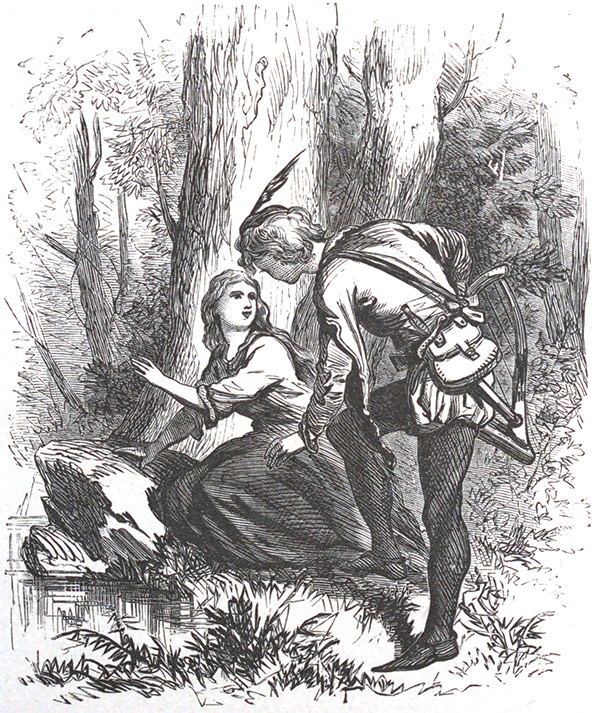
THE WEAVER’S DAUGHTER.
Placing his harp on the grass by the brookside, the minstrel seated himself a little way from where Elthea was; and when the moon came up and looked over the hill, she saw the minstrel kiss the hand of the weaver’s daughter; and then she hid her face in a cloud, for she thought it was not fair that she should look upon that which it was never meant she should see; but when she had gotten over the hill and came nearer, she could not for the life of her help hearing what the minstrel was saying to the weaver’s daughter, and the substance of what she heard was this. When he had laid his hand on her golden hair, he told her that if he had any riches except his harp, he would ask her to go with him to his own country, and to be his companion always.
But what cared Elthea for riches? she knew how to weave, and it would be easy work weaving for him. And there, in the moonlight, they plighted everlasting love with manifold kisses.
Many nights the bosom of the minstrel had been the pillow of Elthea, and many days they had travelled together, her feet bruised and tired, but her heart running over with delight, and her lips singing and prattling all the while, when toward sunset one day they sat down by the wayside to rest. Then it was that the minstrel told his pretty wife another story, the marrow of which was, that he was no minstrel at all, except, indeed, for the season of mourning for the king, his father; for himself was the king’s son; and the poor weaver girl, who had shared with him her bread and her fireside, was henceforth to share with him his broad and beautiful palace, and for the shelter she had given him from one storm, he would shelter her from all the storms of life.
And Elthea was loved and honored by all her people as long as she lived, and many was the real minstrel that blessed her name, and sang songs in her praise; and many was the embroidered train she wore that was made of the cloth she had woven when a poor girl, and the cloudy days and the stormy days were always brightest with the blessing of memory. And to the end of her life Agnes wore coarse frocks, and wove cloth to make embroideries that she never saw, fretting and scolding at her sister’s good-fortune all the while, and spoiling before its time the beauty of a face that might have rivalled her sister’s if she had suffered her heart to shine through it the same.