Part 6 — THE MAN WITH A STONE IN HIS HEART.
Reading edition
Once, in the suburb of a beautiful village, which in our story we will call Heatherford, there lived an old woman whose only wealth was her garden and her little son Elijah, or Ligie, for that was the pet name which the fond mother gave her boy. No cottage in all the village was brighter and prettier with pots of flowers and tidy keeping than that belonging to Ligie’s mother. Indeed, it was no unfrequent thing to see rich people stop their carriages and look into the garden, where the finely cultivated vegetables looked almost as well as the flowers that fringed the beds where they grew. At the foot of the garden, which sloped to the south, a spring broke out of a green wall of grass, and, escaping from the shadow of a willow-tree that grew there, ran crookedly away, shining and laughing as far as you could see. No corn had blades so thick and so green as that which Ligie planted and hoed, and no poppies were so large and so red as those fringing his cornfield.
Sometimes after sunset Ligie’s mother might be seen walking down the clean paths between the lady-slippers and the lilacs, talking to her child in a voice low and soft, and at other times gathering rose-leaves or hops in her white apron, scaring the birds that went early to bed, and making them sing their good-night songs anew. When the dew came there was contention between the rose-bushes and the hop-vines as to which smelled the sweeter, and Ligie and his mother, as they went up and down the paths, could never decide it; the bees loved the roses best, but the birds swung on the hop-vines, and sung in the hop-vines the oftenest.
Often Ligie’s mother praised the industry and skill of her little son; but she loved him more than the beautiful garden. It is probable that the people who admired the blossoming bean-vines and the waving corn saw only in Ligie a homely little gardener; but to his mother no marigold was so bright as his head, and no violet so blue as his eyes, and the spring-water running away in sunshine was to her music less pleasant than his laughter.
As Ligie grew older, however, it was less and less often she heard this pleasant music; for the boy grew silent and thoughtful, and, pitiful to relate, more and more discontented,—sometimes, indeed, he would forget the work, and wander away to the ends of the earth in dreams.
Every day the garden seemed narrower, and every day his thoughts flew higher and more discontentedly away. Grass was seen to grow in places from which it had been carefully kept in former times, the raspberry-vines to lop untied, and the strawberries to blush more and more faintly, as Ligie bent over them less and less often.
Many a time he leaned on his hoe-handle, and, gazing wistfully—I am afraid enviously—after some gay equipage, wished himself anywhere away from his mother’s little garden, and out of sight of her poor little house. He wished there were no gardens in the world, sometimes, and sometimes that he might wake up in the morning and find his pillow a pillow all of gold; for he thought idleness and money were the greatest blessings that could come to anybody, and desired most of all things to wear fine clothes, and to ride horses that were sleek and galloped over the country fleet as the wind.
“My dear son is sick,” thought the good mother of the discontented boy, and she gave him time and times to rest from his work, and baked cakes for him, and made him soft beds, and kissed and petted him very tenderly. But Ligie had been always used to her loving care, and received it as he did the air and the other common blessings of his life.
One day, when the customary meal of bread and milk was set before him, he went away from the table without so much as breaking the bread; he said to his mother he was sick, but in his heart he thought if he could not have meat and honey he would not eat at all. Discontented with his mother, with himself, and with everything, he cast himself on the ground by the spring beneath the willow; but the murmur of the waters could not silence the murmur in his heart, and the hedge of bean-vines near by was not strong enough to keep away wicked thoughts; his hot hands wilted the cool grass on which they lay, and his hot brain withered and blackened all that came into it.
He saw a good many boys dressed in fine clothes, and with shining curls down their shoulders, riding by in splendid coaches; and some of them held up their white hands tauntingly when they saw his tawny ones lying on the grass,—some even sneered at his garden, and said they had much better ones at home. Among the other passers, however, there came one day an old man that looked exceedingly sad, and who was terribly bowed down, and who, when he saw Ligie, called to his coachman to stop; and when his prancing horses stood still, champing their silver bits, spoke to him in words so friendly and so strange that he knew not what to make of it. And no wonder Ligie knew not what to make of it, for, among other things, the old man asked him whether he would not like to be rich, and if he would sell his garden for a piece of gold as big as his mother’s house. Ligie said nothing would make him so happy; to which the old man replied that he did not want the garden, but that he would give him all the gold he wanted if he would consent to perform for him a trifling service; and when Ligie asked what it was, and learned that it was only the carrying of a small burden, he readily agreed to go with the old man. It would be easier than working in the garden, he thought,—O, anything would be easier than that! and then to have all the gold he wanted,—surely, he could not suffer, no matter what he had to do; so, with a bound, he sprang from the grass and into the coach; the door closed, the silver latch shut with a snap, and his mother’s house was hid from him forever. At first he cared very little about this; fortune was his and the great world before him; could he not buy a great palace if he chose, and why should he fret about a poor little cottage in a scarcely-heard-of village? And as for the garden, why, he should be glad never to see it; and, for all he knew, his riches would procure him the pleasure of walking in the king’s garden, and his roses and hops he supposed were poor affairs compared with the king’s roses and hops; probably he should see birds as big as eagles before nightfall,—birds that would make the little brown twitterers at home stay there for shame; and he was surprised as they rode on and on to meet no such birds, and to see no prettier flowers than he had left at home.
But one thing surprised him more than the fact of meeting no birds as big as eagles,—the old man by whose side he rode gave him no burden to carry. At last he ventured timidly to suggest it, for he feared he was not earning his pleasure. “By and by,” said the old man, and that was all.
Directly, however, he began to be secretly glad that no burden was given him, and to say in his heart, “Perhaps the old man will forget it altogether, and I have the gold all for nothing”; for when one bad thought got into his mind, a thousand others ran in behind it.
“What a good thing I have done,” he kept saying, as they went along; “everybody that sees me will envy me, and won’t that make me proud and happy!”
That night he slept in a richly-furnished chamber, where perfumes that seemed to him sweeter than roses loaded the air, and where a brilliant light burned at the head of the bed he slept on,—a bed greatly softer than the one he had left at home.
In the morning a rich repast was served to him on shining plate; he had not only meat and honey, but wine, and stronger drink than wine.
The second day an immense distance was traversed; and once or twice, when the motion of the coach grew tiresome, Ligie thought he heard a voice in him saying, “You might as well have stayed at home, little boy!” And each time he drowned it by inquiring of the old man whether he should not now take the burden agreed upon. “By and by,” the old man said, and that was all. “He is a very strange man,” thought Ligie; and, turning to look at him, he perceived, for the first time, that there was no smile in his face and no light in his eyes, and that his skin was dried like parchment and wrinkled as though it was drawn over dry bones. His hair was very white, and it seemed to Ligie as though it had been dead a long time. Happening to touch one of his fingers, he found it so cold that, shivering, he shrank away. Then first the old man smiled,—a grim, sarcastic smile, as if the child’s motion were one he was well used to, and expected.
Ligie feared he had offended, and the mysterious voice said to him very plainly now, “You had better have stayed at home.” “No, no,” replied Ligie, “I am glad I came away”; but they were only words, and the feeling of gladness was not in his heart. Then came the thought of his mother, and with it a pain shot through his bosom,—a pain that was not only sharp, but hot as fire. “If you please, sir, I will take the burden,” he said; “I am getting tired of doing nothing.” The old man smiled again, and answered, “By and by,” and that was all.
Day after day they travelled so together,—the old man silent and sad, and the boy growing impatient, and tired of the everlasting motion and noise of the close-shut coach in which they rode. Night after night he slept in a soft bed, and morning after morning was served with dainties more dainty than he had ever imagined; but after a few weeks he began to think of the plain fare at home with regret. Then the voice laughed, and said, “Fool that you were to come away!” and this time poor Ligie could make no answer.
And day after day he asked the old man to allow him to carry the burden agreed upon, and day after day the old man replied, “By and by,” and that was all.
At last the rolling and swinging of the coach made him sick, the healthful color went from his cheek, and all the strength he used to have seemed to forsake him. The time was come that people looked enviously upon him as he rode along; but so far from gratifying, it but added to Ligie’s discomfort; no one thought of giving him love and sympathy now, he could very well afford to do without them, so they who saw him believed. Poor Ligie! the less he was pitied, the more he pitied himself; and so, day after day, and week after week, he and the old man journeyed on and on, searching for pleasure which they never found. So weary grew Ligie at length, that he resolved to quit the old man, who had never given him the proposed burden, but still said, “By and by,” whenever reminded of it; and one day, seeing him asleep, and his gray hair fallen low about his eyes, the wretched child softly unlocked the coach-door, and made haste to be gone, or tried to make haste, for, to his horror, he found that it was with the greatest difficulty he could move at all. His limbs were as limbs asleep, and his back was doubled down almost like the old man’s back.
“So ho!” exclaimed his mysterious companion, “you repent your bargain, do you? Well, I am sorry, but a bargain is a bargain; I never fail to fulfil mine.”
“How can you say that?” said Ligie; “have I not been with you the longest year that was ever made, and where is the burden I was to carry? I can’t live this way any longer, for doing nothing is the hardest work I ever did.”
Then the old man laughed aloud, and said, “My son, you have the burden already; it is that that weighs you down.”
“It is not true,” answered Ligie; and he unfolded his arms to convince the old man that he had no burden; but he only shook his head incredulously, and added, “You have it concealed; it is the way rich people carry burdens.”
Ligie was now angry, and opened his clothing even to his bosom, to convince the old man that he concealed nothing.
“You have it for all that,” was the reply; “and because of it you cannot lift yourself up.”
Then Ligie grew pale, and trembled, saying, “How can I have a burden which I cannot see?”
“Is pain the less certain because you cannot see it?” the old man said. “I did not stipulate whether you were to carry the burden in your arms, or on your head, or in your heart”; and he smiled a smile half bitterness and half sadness as he spoke.
Then came the truth crushing through Ligie’s senses,—the burden was in his heart; and covering his face with his hands, he cried a long while.
“In mercy,” said the old man, “I gave you little by little; but it was none the less sure, and ‘By and by’ has come.”
The low voice never spoke so clearly as it spoke now, saying, “O mistaken youth, you have sold your birthright for a mess of pottage!” “O terrible, terrible voice, why do you torment me?” said Ligie; and the voice answered, “Such is my work.”
After a season of despair, however, Ligie began to imagine, very foolishly, that strong drink and strong pleasures would dissolve the stone which he was persuaded had been wickedly gotten into his heart. Without sorrow on the part of either, he and his friend—if friend he might be called—took separate ways. True to his foolish imaginings, he saw dances, and heard music, and drank wine, and stronger drink than wine, and bought great houses and much land, gazed on fine pictures, some of them painted by the greatest artists in the world; but, through all, Ligie remembered his mother’s little house and garden with painful regret, and over all he heard the low voice reproaching him. He even came to walk in the king’s garden, and to speak familiarly with princes; but they seemed to him not unlike other men, and even for their praises he felt none the better, but, while they smiled, often found his thoughts travelling away to the obscure village of Heatherford, and when he drank wine it seemed to him not so sweet as the cool water of his mother’s well.
All his childish dream was fulfilled,—he had waked to find his pillow a pillow of gold; but he would gladly have given it for the pillow of common down which his mother’s hands used to make so pleasant; nevertheless, something held him back. Was he ashamed to have his rich friends know that he was born in a low, little house, and that his mother was a poor woman? I am afraid so.
Years and years went by, and the little gardener was a little gardener no more; and thicker than the years crowded upon each other crowded the wrinkles in his face; and before the pleasure he sought was found, his hair grew white as the frost, and his step slow as the sloth.
Celebrated waters he plunged into, and hired with much gold physicians of great repute to treat his malady, which, in spite of all their skill, grew only the worse; indeed, it seemed to Ligie sometimes that the stone in his heart was grown to be a mountain.
And all the night and all the day the voice within him said to him, “Go home, Ligie”; and all the night and all the day Ligie said to the voice, “At the new year, or in the spring-time, or when the leaves fall, I will go.” And still, as he sailed in vessels or rode on cushions, his prayer was for the feet of his lost youth and the strength of his lost youth, to walk as he used to do. Often he tried to walk, feeling his way along with a stick; but he fancied he frightened the birds and spoiled their songs, for sure was he they sang not as they used to sing among the sweet-smelling hops of his mother’s garden. The little boys that were laughing and kicking up the dust stopped their playing as he came near, and gazed on him with eyes full of fear, instead of sunshine. If flowers fringed the wayside, their tops seemed dusty and dry, and not dewy and sweet as they used to be. The young girl who sat singing her ditty at the window, when she saw his frowning visage and bent form, drew in her breath and her music, and hastily pulled down the sash.
The very cattle ran away from him, stopping not till the width of the meadow in which they pastured was between themselves and him. The hens left their peeping broods and crept away, afraid to fly at him as they did at the urchin who plagued them.
Seeing the sorry effect he had upon bird and beast, he grew more and more dissatisfied, and the burden in his heart weighed heavier and heavier upon him.
Something like the shadow of gladness passed over him, when in a valley before him he saw rising the spires of a quiet village. “I will abide here,” he said, “and try if the air will not soften this terrible stone.” So he hired a house, and physicians, and attendants, and made himself a home, but found little of the peace he sought. Consternation ran up and down the streets, when it was known among the people that an old man with a stone in his heart would thenceforth abide among them, for the physicians pronounced his malady not only incurable, but the most infectious of all diseases; so the attendants he had went away from him, and all his gold could not hire others in their places. In vain he sought religious comfort; the clergyman to whom he applied was of the opinion that Ligie had not only a stone in his heart, but that he had a demon there, into the bargain; and this was certainly poor consolation.
Then the doctors resolved that the poor man should not go abroad any more, for there was never such fright as the stone and the demon occasioned.
When the doomed man was informed of the verdict, he said it was just and right, and he furthermore admitted that when he listened he could hear a voice within him that condemned him. Then the wise men recommended entire abstinence from all exertion of mind and body, and constant listening to the condemning voice, with as much meditation on the stone as possible.
And all the people exclaimed, “Yea, verily, these physicians are wiser men than till now we knew them to be!” and their fame stood before them like a light that made common people almost afraid.
Poor Ligie submitted patiently to the treatment, and also to separation from all human society, and found all the satisfaction he had in hugging his woes. However, he grew no better. Sometimes he would creep to his windows, and indulge in the harmless occupation of looking into the sunshine; but this habit was no sooner discovered than it was resolved by the people that the man with the stone in his heart should be put in irons for the first offence, and that for the second he should be imprisoned for life.
“He has already offended twice,” said one of the most fearful; and upon himself he took the administration of justice, and, stealing to the old man’s house in the night, secured the door with a ponderous bar.
It was dreadful to hear the prisoner’s moans after that; no one who heard them once could be induced to go near him again; so he lay moaning and groaning to himself. Some of the more superstitious believed it was the demon that cried, and not the man himself; but there were some who thought a stone in the heart was enough to make anybody moan.
“We shall have to break his heart, and so free it from the stone,” said the surgeon; and but for an accident it is likely the cruel suggestion might have been carried out.
An old woman, residing in the suburbs of the town, remarkable for nothing but industry, modesty, and strong common sense, chanced to come near this old man’s house one stormy midnight, as she was returning home from having dressed a corpse. She had gone abroad so little, and been so given to minding her own affairs, that she had never once heard of the old man with a stone in his heart, and came fearlessly to the very door. The moon shone bright and friendly through the chinks, and as she peeped in she saw the glitter of two eyes that looked like the eyes of a famished wolf.
In vain the prisoner cried out to her to flee away, saying he had a great stone in his heart, and was possessed of a demon; the assertion sounded so much like nonsense to the ears of the old woman, she refused to go, and furthermore the glitter of the man’s eyes told plainly enough that he was starving; so, notwithstanding his entreaties that she should leave him to his fate, and save herself, she made haste to unbar the door, and, walking straight to the straw where he lay, bade him arise and go with her.
At first he refused, saying that he had a stone in his heart, and a demon in his bosom, and that to go with her was impossible.
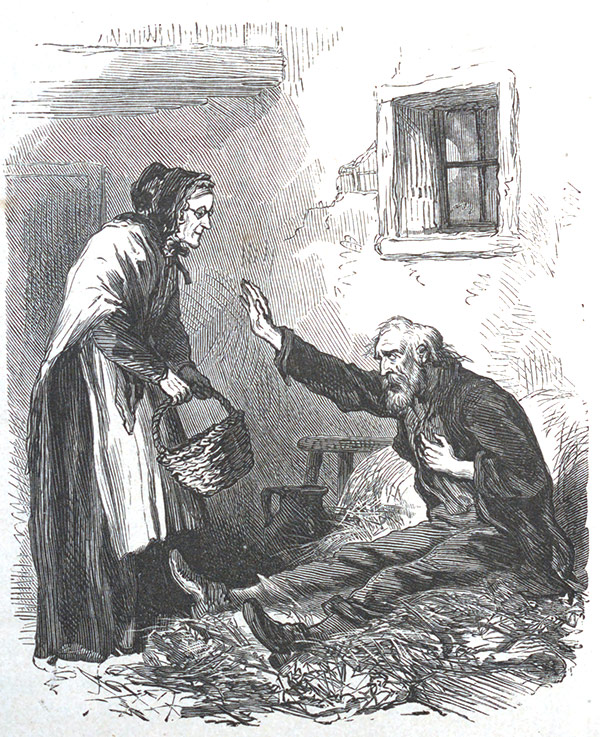
THE MAN WITH A STONE IN HIS HEART.
“Ah, yes,” said the old woman, “I see how it is,” for she knew that too much brooding on light afflictions will sometimes produce heavy ones, and was resolved to humor his disease in order to cure it. “I know a great witch who can cure you,” she said; “there is not a doubt of it; she has brought many back to health and happiness, whose minds were gone far astray, and whose feet were near the borders of the grave. Rise quickly, and come along with me.”
The old man lifted himself on one elbow, and said he had tried all remedies in vain, and that he had no courage for a new trial; but though he said he had no courage, he smiled faintly, and felt a very little courage.
“Ah, it is not such medicine as you have been used to with which the witch cures,” said the old woman; “it is with a charm known only to herself, said to be the pleasantest thing in the world.”
She spoke hopefully and cheerfully, and the man answered, “Let us go to her at once,” and he arose, and looked with shining, hungry eyes close in the old woman’s face; and, taking his limber, weak, and worthless hands in hers, she led him out of his miserable den, and they took their way together through the village, and struck into a sweet-scented clover-field, lighted by the clearest and brightest of moons.
As they went along, Ligie told of the many things he had suffered in the hope of cure, and that withal he had grown worse and worse, till he had come to be the miserable creature she beheld.
At first the old woman was obliged to walk very slowly; but gradually she quickened her steps, and, unaware, her companion quickened his, too; and as he walked faster and faster he straightened himself more, and when they reached the nice little home where the woman lived he stood nearly upright.
The first care of the nurse was to feed her patient with plain but wholesome and nutritious food; and this done, she made him a bed, very clean and comfortable, where he slept soundly till morning.
His first inquiry on waking was for the witch, and his first desire was for an immediate interview.
“The witch lives a good way off,” said the nurse, “and to leave home for so long a journey, I must needs make some preparation; and if you will consent to help a little, only a very little, I shall be ready so much the sooner.”
Ligie said he had not done a chore for years; nevertheless, he would attempt whatever task she would set for the sake of being brought so much the sooner to the witch. So the old woman took him to the garden, and set him to weeding the beds there; and as he worked he gained strength to work, so before noon the garden-beds were as clean as they could be.
When the old woman came out and saw what he had done, she was well pleased, and said she had never found so good a gardener in her life; and she added, “We will soon be ready for the journey at this rate.”
Ligie was a good deal tired and a little hungry with the work, and when the nurse brought a platter containing bread and fruit and meat, and placed it on a bench that stood in a shady place, he quite forgot in the enjoyment of it the stone in his heart; and after the meal he forgot it for an hour longer in the pleasant sleep that came to him as he lay on the cool, grassy bed that Nature had made for him.
Toward sunset the old woman appeared, and directed her patient to cut off all the ends of the bean-vines that were trailing from the tops of the poles toward the ground.
When Ligie hesitated, and said he could not lift himself up for such work, she encouraged him to believe that he might straighten himself sufficiently for the task, and assured him of the impossibility of making the journey to the witch’s house till the bean-vines were attended to. Hearing this, he lifted himself up, and began to clip off the ends of the bean-vines. They were sweet with blossoms, reminding him of the old garden at home; and in the interest of his occupation, he thought nothing about the terrible crook in his back, and when at last he felt for it, it was gone.
He began now to think his hostess was the witch who had charmed the stone out of his heart, and from that time manifested no unwillingness to do whatever she bade.
Day by day she set him harder tasks, professing all the time when such a tree was felled, and such a field ploughed, or the orchard-trees pruned, or some other task accomplished, she would journey with him to the witch’s house. But the work stretched itself out before Ligie as far as he could see; for while he gathered apples he saw the corn ripening, and of itself breaking out of the husk; and as he thought more about his work he thought less about the witch, and finally began to conclude there was no such thing in the world as a witch.
At last the heap in the crib was rounded up with the last golden ears, the oxen turned loose among the corn-stalks, and a bright wood-fire made on the hearth of the good old woman’s house. In the middle of the floor the table was spread with pumpkin-pies, and apple-tarts, and sweetcakes, and all the variety which a country housewife knows so well how to provide. All the friends of the old woman had been invited to rejoice with her over the restoration of her patient; but, strange to say, where one came there were a dozen who stayed away, for they now feared the harmless old woman as much as they had formerly feared Ligie. If he was cured of stone in the heart, she must be a witch, that was all; so hard is it for us to believe in the virtue of simple things, and that we have only to wash and be clean. If Ligie had done some great thing, then it would have been easy to believe.
“O, if my mother were here to rejoice with me, how happy I should be!” sighed Ligie, as he concluded reflections not unlike what I have written; “for though I am old and worn and weary, I might yet do much good; but how much more might I have done if in youth I had improved my opportunities, instead of wasting them in vain and foolish dreaming and repining,—dreaming of impossible things, and repining that good things were not the best things!”
Then in his mind he made a picture of his mother’s little house he had once so come to despise, and of the garden he had grown so tired of, and it seemed to him that the king’s garden was not half so beautiful, that Eden itself could not have been so beautiful. In the light of memory the loveliness, which in reality he had failed to see, came out clear and distinct, and he marvelled that he could have received such blessings and been so unconscious of them.
Tears came to his eyes, and in the anguish of repentance he wept aloud, saying over and over, “O, to have back my lost youth!” Then it was he seemed to hear, between his sobbings, a voice like his mother’s, saying, “My son, my dear, little son!”
A thrill of joy ran through him, which was as if all the heavens had opened, and in the rapture of the moment he awoke,—for he had been all this time in a dream,—awoke to find himself little Ligie, and to see the sunset shadows on the water of the spring, that flowed from its fountain under the willow-tree, by which he remembered to have thrown himself at noonday. But when he was fully awake the thrill of joy kept still thrilling through his bosom; it was not all a dream; he heard the sweet voice of his mother still saying, “My dear, little son,” and all the beauty he had seen shining so clearly in the light of memory he saw shining all round about him.
Over a bank of golden clouds the sun was peeping and smiling his good-night, the birds were hushing in the hop-vines and under the roses, and under his feet the grass was cool and green as it could be. In the distance stood dark, leafy woods, with cows and sheep and lambs feeding along the hills.
But the brightest spot of all the picture was the little house under the apple-tree, and with the morning-glory at the window, and the red creepers over the porch, where stood his mother smiling, and calling, “Ligie, my son, my dear, little son!”
You may be sure he lingered not long even for the sake of the beautiful landscape, glorified as it was by the last red light of the day, and the first white light of the stars, but ran at once up the smooth path between the lilacs and lady-slippers, answering, “I am coming, mother, I am coming!” it was as if he had new feet and new hands and new senses; as if a new world had been made about him; as if, indeed, a great stone had been taken out of his heart. There was the table spread in the middle of the floor with cakes and apple-tarts and meat and milk, just as he had dreamed, and his hair was all unfaded, and his limbs strong and full of health.
What more could he have? Nothing, nothing. Ligie felt this, and clasping his hands, he bowed his head, and said, “How good God is, and how unmindful and bad we are!”
And seeing how his spirit was changed, his mother inquired of him what had happened; and when he told her all his dream, and his thoughts previous to the dream, they laughed and wept together, and wished that everybody could have such a dream, and learn by it to appreciate the blessings they have, rather than mourn for those they have not; and to work with willing hands and a resolute will in whatever field their portion may be cast.