Part 2 — THE GYPSY FORTUNE-TELLER.
Reading edition
Where the bend of a beautiful river kept bright and green a little spot of this goodly earth longer than it stayed bright and green elsewhere, there used to be made, year after year, at the season when the leaves turn yellow and the mosses brown, a gypsy camp.
When the frost first bit the grass, and the rivulets hid themselves away, expectation stood a-tip-toe among the young people, and so continued, till some farmer’s boy, perchance, riding home from mill, along the river road, would see the smoke of their fires curling and rippling high above the tree-tops, and hurrying home, would set the household astir with the news,—“The gypsies have come!”
Then there would be whispering and laughing among the girls, and a missing of the lads when the family circle drew about the evening fire; for it was the habit of the youth of both sexes to steal out to the gypsy camp and have their fortunes told; and many a cock that had been used to crow in the morning, and tell the sleepy inmates of the farm-house it was time to get up and set the breakfast in order, and yoke the steers, had to boil in some gypsy pot to pay for it. Among the vagrants of the camp was an ugly old woman, known to the people of the neighborhood by the name of “Mother Crow.” She seldom strayed from among the tents, and was usually to be found, till after the middle of the night, peeping and muttering over a great kettle of simmering herbs, of wonderful power, if she were to be believed; and indeed some persons said, who had watched her stirring her mess with a crooked and thorny stick, that they had seen sparkles of unearthly light rising out of it and settling along her forehead like a row of stars. However this were, she was certainly more feared and believed in than all her tribe put together. It may be that her wisdom was made up chiefly of cunning, but no matter,—it passed current; it may be too that the snow-white hair, straggling from beneath her cap of rabbit-skins, and veiling the intense glitter of her snaky eyes, had somewhat to do with her fascination. She was very tall, and upright as an oak sapling, but her dimensions in other respects no one could arrive at very definitely, as she was generally loosely wrapt in a big blue blanket, with a border of scarlet stripes.
Many a night the home-going fisherman rowed softly ashore by the gypsy camp, to learn of Mother Crow whether his sweetheart were false or true, and paid her with the choice treasure of his net; and it generally happened that he was richer than before; such exceeding worth is there in a happy heart, and Mother Crow was apt to see the bright side of things.
She could instantly tell, so she used to say, when she stepped on the graves of persons who had been buried a hundred or more years, but she could not tell whether the ground she trod on were to hold a coffin on the morrow or not. She could see future events, she used to say, but not the time at which they would take place, and so she got along very well with her prophecies.
Some persons, too good or too great to seek a gypsy fortune-teller themselves, would gladly listen to the gossip about her; or if they happened near the camp at night, would stop and peep over the shoulder of some lad for the sake of seeing her as she sat inside a ring of eager upturned faces, telling all the girls and boys whether their sweethearts had black eyes or blue, and whether they would marry and make a journey across the sea, and come back with a great deal of gold, and live happy forever afterwards, or whether they would marry, get gold, and be happy without the great journey.
And it is no wonder these people thus stole a glimpse of the strange woman, for she made such a picture as one does not see every day in the week, nor every month in the year, nor every year in ten.
Among those who visited her the oftenest, and upon whom she levied the heaviest taxes, was an old man who lived in a ruinous house by the river-side, alone, and whose strange ways had shut him quite without the pale of society,—in truth, he was supposed to have lost his wits, and was treated accordingly, when, by chance, his neighbors came in contact with him. The columns that once held up the porches of his house fell down one after another, and lay where they fell; the once beautiful garden ran to weeds, and, instead of flower-stalks, thistles stood up very high and proud; spiders made looms in the windows, and wove there all the day long, making curtains so thick it could hardly be told at night whether or not the old man’s candle were alight.
And the truth is, nobody cared whether or not his candle was alight. He wore a shirt of patched flannel, trousers of an old fashion, and shoes quite distinct from the modern style; and instead of riding in a fine carriage he walked on foot. Perhaps it was not altogether his fault that he was shy and unneighborly, for certain it is, nobody stopped to inquire whether it were or not; and Mother Crow herself, skinny and haggish as she was, created a lighter sensation of awe than he. His hair hung over his shoulders white as snow, and his beard fell down his bosom in a profusion of silver waves, that contrasted strangely with the black and wonderfully inquisitive eyes, and made the children hang their heads when he came near, and older people too sometimes, for there was in his face, it must be owned, a look that seemed to accuse men. Indeed, he avoided men and women too, as far as might be; but when he could not help seeing them he was civil in spite of the accusing look, which, if it had been examined closely, would perhaps have been found to be distrust rather than accusation, after all.
“I don’t like him!” people used to say; and it may be that they did not stop to think why they did not like him, and it may be that they would not have seen much to like if they had stopped to think, for we cannot very well see what is lovable in anybody till we first love them. Love not only sees existing good qualities, but creates good qualities.
All sorts of strange stories were told of this man, and in connection with everything belonging to him; this, among the rest.
One of the chimneys of his house had fallen, or had been blown down by the wind, perhaps, and the story ran that it had been tumbled down by the witches who were in the habit of seeking the crazy man’s chamber by this means. Then it was reported, too, that a well of once sweet waters in his door-yard had grown brackish, and had petrified an ox that had chanced to fall into it, and that his horns might be seen any day sticking out of the well’s mouth!
It is strange that such things should ever have been believed; but let a story once get afloat, no matter how improbable, and it will hold its place a long time in spite of everything.
The strangest and most improbable of all the stories related to the wife of the “crazy man,”—for there was a time when his beard was not white, when his flannel shirt was not patched, and when he had as pretty a wife as was to be seen in all the county-side. Most of his neighbors could remember very well when the fallen chimney stood up red and proud as could be; when at night there were lights shining through all the windows, so dark and gloomy now; and when the cedar beams along the porches, against which hung the gray muddy nests of wasps, were bright and sweet, and the rows of pillars white as milk. They could tell about having sometimes seen a gentle-faced and golden-haired woman walking in the garden, and how all the roses bowed their heads down toward her as she went; and about the little child that she used to lead by the hand; and they could whisper too, and they often did whisper dark surmises as to what became of the woman and the child, for they disappeared one after the other, and were never seen or heard of more.
There were even hints of murder, and some people said that the beautiful woman and child were lying petrified away down in the well under the stone ox!
But these things were only spoken under breath, for all that was certainly known was, that a fair-faced woman and a lovely little child used to be seen about the grounds, and that they were seen no more; but that anything mysterious was connected with their disappearance nobody dare positively assert. But it was asserted and believed that often, at night, strange and unearthly sounds were heard about the old house, and in the end it came to be thought that the old house was haunted with witches, if with nothing worse; so that often when these noises were supposed to prevail, the more superstitious of the people would shake their heads, and whisper, apart from the hearing of the children, “They are the echoes of the love-ditties the crazy man used to sing to the beautiful woman!” And then the windows would be put down and the Bibles opened and prayers offered, and sometimes, after all these pious ceremonies, a horseshoe would be hung over the door-case to protect the household against witch-work, so strangely are the minds of men and women constituted. And at such times the frightened children would look wonderingly up into the faces of the old folks, and ask to have the candles trimmed anew, or that another stick might be added to the fire.
The story ran too, that often of winter nights, when the moon shone bright on the snow that had been drifted into fantastic but smooth curves along the meadows, and in the ragged edges of the woods, there used to be heard a footstep going along their edges,—tramp, tramp,—and in the morning it would be seen that the snow was written all over with letters which the crazy man had traced with his finger, and the letters spelled one name, over and over, sometimes a thousand times, and that name was Hesther; but whether it had been borne by the missing woman, or whether it was a fantasy of his bewildered brain, was left to conjecture.
The only person in the world for whom this sad old man appeared to cherish any kindly regard was Mother Crow. Under the straggling boughs of an apple-tree he at length built her a house, a very goodly house for a gypsy, with a roof and door of pine planks; albeit there were gaps between the logs of which it was composed more than wide enough for the moon to peep through and see what was going forward. Many a basket of bright apples he bore to Mother Crow’s house on his shoulder, and many a bag of corn he emptied on her broad clay hearth; and once, at least, during every period of encampment, he might be seen leading thither by the horns a fat heifer or steer, and then be sure there was great feasting among the gypsies.
It was noticeable that during the stay of these people the old man always became more like other men, that he would smile when he met his neighbors, and sometimes speak to them, not only cheerfully, but with great good sense.
It was strange his lucid intervals should always occur at the time of the gypsies’ encampment, people used to say, but they never inquired into the mystery, for the world generally takes but little interest in its old crazy men that live in ruined houses.
Scarcely a midnight came and went that did not find the crazy man by the gypsy’s fire, bowing his white head beneath the skinny hand of the old fortune-teller, and listening to her muttering, which contained always one and the same story; and of course the story was all about the crazy man’s wife and child, for she pretended that she could look back into the past and see what had happened to them, and she commonly begun her story something after this fashion:—
“I see a beautiful river with a border of fine trees, and moonlight shining along the billows; I see herds of cattle grazing, and a great house with porches white as snow; and now there comes to the porch a fair young woman, with curls down her shoulders bright as the sunshine, and eyes blue as a morning sky in May. She wanders toward the river-bank, leading by the hand a child like herself, but even more beautiful,—her eyes being like the color of the morning-glory, and the fingers fair as the fingers of a lily.
“And now there leaps from his boat on the river wave a man, sleek and bright and stealthy as a leopard; he approaches her with smiles and gentle words, but his feet are shod with evil, and his heart is full of all manner of dark things. Now he talks to her and his voice is soft and low as the voice of the wind when it talks to the violet; and now he sings, and the song of the nightingale is not so sweet.”
At this point of the story the old woman would stop and tell her eager, trembling listener that she could not see any more until he had again crossed her palm with silver, and so having got more money she would go on.
“All the scene that I lately saw is vanished, but I see the same woman walking in the fields alone. It is a wild windy night, and the clouds are flying across the face of the moon, and the autumn leaves are blowing about withered and dry, and still the woman walks on alone until she comes to a blackthorn-tree, under which, on a little heap of stones, sits a gypsy fortune-teller,—a wicked woman as I can see by her wolfish face, and her long, lithe, snake-like body; and now she crosses the palm of this old hag with silver, and she tells her a tale that is like a fairy tale, of the splendid fortune that is waiting for her in a far-off country,—how she shall eat from plates of gold, sleep on a bed of swan’s down, wear her hair braided up with diamonds, have gowns with hems embroidered with pearls, ride in a gilded coach, and have a hundred lovely maids of honor to be about her and to tend her day and night, and all just for going with the stranger who sings to her so sweetly, and who, she says, is a man of honor and authority in his own country. And the eyes of the fair woman are dazzled, and she seems almost persuaded to go away with the leopard-like man, and leave forever her comfortable home and her good husband.”
And here again, Mother Crow would pause in her story, and profess that she could not see anything more until she had more silver, and then she would say that she saw a boat sailing down the river, and seated within it three persons, a man and a woman and a child, and that the three looked like the other three which she had seen before.
Then the shadows would come between her and the boat, and her vision would grow dim, so she would say, and not till the old man had paid her more money could she see anything further.
Sometimes she would sit for half an hour holding out her rabbit-skin cap, and not till she heard something clink in it would she speak one word. Then at last she would profess to see the beautiful woman sick and dying, and to see the child, grown to be a beautiful young girl now, standing by her bedside; then she could see the eyes of the woman closed, and a long funeral procession; and after this, no matter by what prices the crazy man sought to buy her vision, Mother Crow could see no further; though she always professed to be growing in prophetic wisdom, and quite sure that at the time of the full moon, or at the falling of the November rain, or at some other designated season, she should be able to trace further the history of the young girl.
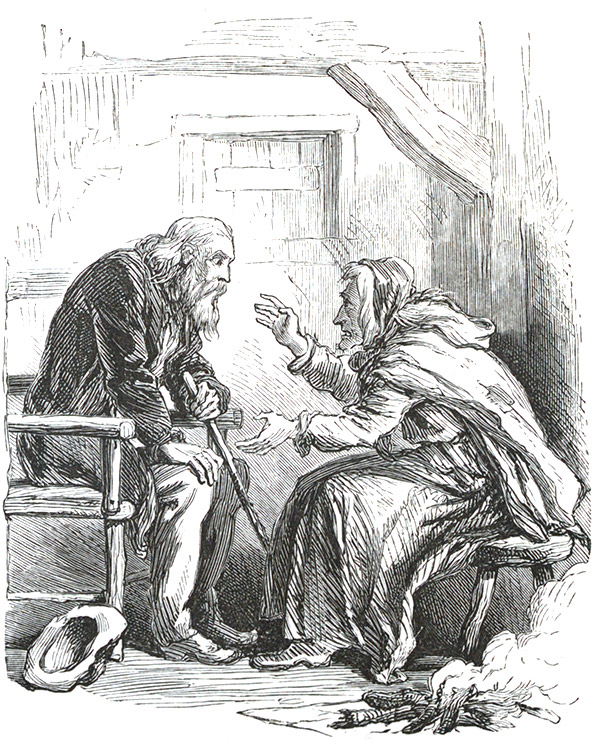
THE GYPSY FORTUNE-TELLER.
And this was the secret of her power over the crazy man, as he was called; and by this means it was that the entire gypsy camp fared so well year after year. But the more liberal the old man was, the more the fortune-teller demanded; and at last one night when the fumes of her bitter stew had gotten into her brain a little more than common, it may be, she professed to see the fate of the beautiful young girl. She saw that she was living in the castle of a nobleman, and that she was become a lovely woman, with golden hair and blue eyes like her mother’s, and that she saw little shining letters along her forehead which spelled the name of Hesther. But in what castle Hesther was, and how she was to be obtained by the old man, she would not tell until twelve pots of rum had been ranged along her clay hearth, with a beehive full of new honey at their head. This request was no sooner complied with, however, than Mother Crow declared that her vision was become dim, and that the anxious inquirer must wait another day. Of course she had her way; but, alas! things turned out as she little expected.
Having feasted to excess on the honey and rum, she lay down in her cabin to sleep, and feeling presently that the lease of her mercies was run out, and that the pains of death were hold of her, she called the old man back, and taking from her bosom the picture of his wife, she gave it into his hand, and also a piece of yellow parchment written over with clumsy and curious characters; but the eyes of love can decipher hard things, and the old man read all the parchment contained, as if it had been written by a scribe.
Mother Crow watched him as he read, and at the close of the reading lifted up her hands and hid the light from her eyes, even before death hid it, and turned her face to the wall; so fearful, sooner or later, are the effects of wrong-doing.
It was all a lie that Mother Crow had been telling the old man, after all. There had never been a man who was sweet-voiced and sleek and shining as a leopard, there had never been a little boat that rocked on the river of nights, and there had never been any running away, first or last. She herself had stolen the child in the hope of getting money from the father by telling him where it was, and how he could get it again; but when it came to pass, as it did, that the mother pined for her child till she became crazy, and wandered away and was lost to her house and her husband, and to all who knew her, she was afraid to say aught about the child lest she herself should be accused of murder. She was afraid even to keep it any longer, and pinning to its dress a paper that said it had been stolen and was to be given up if the father should ever come for it, or any one, bearing a certain parchment which the said paper mentioned, she one dark night, having taken it a long way off, shut it up in a rich man’s garden, where the gardener would be likely to hear its cries and take it to the rich man’s house, as indeed he did, and here the girl had lived and was now grown to be a beautiful woman. She had meant always to tell the truth some time or other, but had put it off month after month and year after year, knowing that her palm would no more be crossed with silver by the old man if he once came to know where his child really was. And the story was never told until Death came and put her soul in torture that pressed the secret out of her lips.
And the red leaves drifted in a red heap over the grave of Mother Crow, and the rain beat out the fires, and the pot of bitter herbs simmered no more, and the winter snow fell and lay in smooth curves about the stone house, for there was no name written on it now, and no crazy man anywhere to be seen. All the windows were dark as they could be, the fallen pillars lay one across another along the porches, and the chimney, in a stack of ruins, frowned from the roof, and at night not a sparkle was seen to rise above it. Now it was that the corpse of the old suspicion floated up on the stream of gossip again, more black and malignant than ever.
The crazy man, in addition to his other crimes, it was asserted, had poisoned Mother Crow, and, lest they who saw him should murder him, had shut himself in his own house, and was slowly dying of starvation and cold. Some even declared that they could hear him making the night hideous by his hungry howls.
But no man and no woman sought out the truth, or made one effort to alleviate the miserable condition of the old man.
All at once, and as by magic, the stone house was transformed into its original grandeur; the columns stood in white rows along the porches, the windows shone with curtains of crimson stuff, mixed with satin, white as snow,—the stack of ruins stood up in a high, proud chimney, and above it, at night, there glittered a shower of sparkles red as roses.
And every day, riding along the river road, in a coach with shining panels, was seen the man that his neighbors called crazy when he walked along the road. Magnificent horses, in the most dazzling furniture, drew the carriage; and by the man’s side sat a lovely young woman, who folded his mantle tenderly about him with her sweet white hands.
But the most marvellous thing I have to tell is the change that came to the hearts of the people when they saw the gold trappings of the horses, and the diamonds on the white hands of the young woman,—whose name was Hesther, and the ermine that lined the mantle of the old man. The proudest of them bowed down as he went by, and saluted him as though he had been a king, and his wisdom and beauty were the continual themes of conversation and admiration. The white hair and beard that used to be thought so frightful were considered regal now, and the austerity that used only to excite derision fitted him right royally now.
In short, no man could be found to own he had ever believed the rich man to be crazy. On the contrary, every one was loud in the declaration that it had always been his belief that the owner of the stone house was some great person in disguise, and a very wise person too. And those who had affirmed most vehemently, when the stone house was ruinous and dark, that they could hear its crazy inmate howling with hunger, were the first to make feasts for him, and illuminations, now that his house was full of light, and his board beautiful and shining with plate.
Not a soul could be found to own he had ever believed the rich man’s well had a stone ox in it, and only one or two simple and old-fashioned old women would admit that they had ever heard the story.
Every one who could afford it built a porch against his house; white beards became the fashion, and the rich man’s advice was asked upon the most trivial occasions.
Thus ends the story of Mother Crow and the Crazy Man, and I hope the reader has been taught by it two things,—first, that conscience will find out your sins, though you hide them under heaps of gold, mountain high; and secondly, that those who make feasts for you and do you the humblest reverence while your mantle is lined with ermine, will be the first to cry out Crazy! and see you starved if your chimney chances to tumble down.