Part 4 — THE MAN WHO STOLE A COW.
Reading edition
There once lived in a beautiful country, no matter just where, a young man whose name was David. From his boyhood he was given to idleness and to dreaming, so much so that he came to be called by those who knew him Davy Dreamer, and it was predicted of him that he would never come to any good. But he did come to some good; he married a good wife, and a pretty one too. She was the daughter of a man as poor as himself, but she had habits of industry, and great good sense, which was a good deal better than a dowry of gold or silver; and it was, no doubt, more owing to her management and hard work—for she was never idle—than to anything of his doing, that, at middle life, Davy Dreamer owned a neat cottage and five acres of garden ground. Moreover, it is quite certain that not a flower-bush nor a sweet-scented herb grew on the little farm, if so it might be called, which was not of her planting. A woman who found no time for dreaming was the wife of David. Nevertheless, she was never heard to rate her good man for his indulgence in his favorite pastime, and never seen to frown, and some persons believed it was her smiling which made her face so pretty.
I said at middle life they owned a pretty cottage and a garden, which with careful cultivation would have yielded not only a competence, but many of the luxuries of life; but I am sorry to record that David fell a-dreaming often, at which times the spade was sure to fall out of his hands, and as the pretty-faced woman who was his wife had tasks in the house to do, thistles grew up, and briers and rank grass choked the small vegetables quite down sometimes.
As a natural consequence of this thriftlessness, their wants grew faster than the means of supplying them; for the little house was full of children—I know not how many, but so many that David often desponded and said to his wife in a half-dreaming state,—that it was quite impossible for one little garden to maintain them all; and so he would sit for hours musing and meditating on what could be done for the prevention of want,—of actual starvation in fact.
“There will be some way provided, never fret,” the good wife would answer; “there are more berries ripe than I can get to the market”; or, “I have found two new hen’s nests, both full of white, fresh eggs,” she would say to him, though most likely he heard her not, and often it is supposed he saw not the things which she did for his comfort and for the good of his children; for when the cottage wall was newly whitewashed it was the same to him as before, apparently, and when a pudding was boiled for Sunday, or a plum-cake baked, David took them as matters of course, and ate them without seeming to distinguish them from coarse bread.
If this were so, it was a pity; but I am afraid it was so, for we have all of us seen Davy Dreamers who took the favors that were done them as matters of course. We expect pigs to eat the acorns without looking up to see who thrashes them down; but we have a right, I think, to expect a little more politeness of men and women. However, the sweet disposition of the wife of David could not be soured by any neglect on his part, and, indeed, as he grew impatient and fretful and fault-finding, she grew still more and more patient and gentle and loving,—more industrious and painstaking she could not have been.
Sometimes, when she asked David to assist in digging the ground or in picking the berries, he would answer, “Don’t disturb me now, my dear, I am making a great plan”; and so it often happened that she picked and digged alone.
At last, one day when the good woman came home from market with some money in the bottom of a tow bag, which she had got in exchange for her fruits and such other articles as she had to sell, she ventured to ask David what he had been dreaming about. She had never been known to trouble him so much before, therefore it is reasonable to suppose that his vision had been unusually extended.
“Why,” said he, “I have been thinking that some of the rich folks about here might give us a cow and never miss her, and I am told there is a man living on the other side of the island” (it appears that David lived on an island) “the hills of whose farm are all covered with cattle. Now, if I go to him and tell him how poor we are, and how much one cow would be to us, do you not think he would give us one?”
But the wise woman saw no probability of such good fortune. It was barely possible, she said, but the experiment was not worth trying; and even if successful, the mortification of having been a beggar would imbitter the cow’s milk. The wife of David, it would seem, had her own little pride, and in my opinion she was all the better for it.
After this Davy Dreamer dreamed almost of nothing but cows, and when he talked it was all about the rich man at the other end of the island, who had meadows against meadows all dotted over with beautiful cattle. “He would never miss a cow; and I dare say if he only knew of our poverty, he would gladly give us one!” he used to say; and once or twice he hinted to his wife that she might go to him a-begging. But she only smiled and let him alone with his dreaming, for she thought it quite harmless. She had no idea of begging, however, for her part, and for days and weeks and months worked on, and each return from the market town saw more and more silver money in the tow bag. She was never heard to complain, but often to sing, and often to discourse merrily with her children, who were growing to be blooming men and women. A nice little plan of her own had the wife of Davy the dreamer.
Meantime, his head was filled with all sorts of vain imaginings. Night after night he would start up out of sleep, crying out, “Just see what a pailful!” and morning after morning when he awoke he would peep into the garden to see if a cow were not browsing the cabbages. For hours and hours he would sit facing the highway, wasting the time that he should have used for working; and never a stranger passed along but that he looked wistfully after him, for each one he supposed to be the rich man from the other side of the island come to give him the cow.
But morning after morning came and no cow was found to be browsing in the garden, and stranger after stranger passed along, but if the rich man from the other side of the island were among them he made no pause. And all the time he grew more and more fretful and dissatisfied. He fretted at his wife, and fretted at his children, and fretted at everything.
“What is it troubles you, Davy?” the good wife used to say; but he would always answer, “Nothing, nothing!” so short and cross that she was glad to leave him alone. And then, while he covered his face from the light and moped and moped, she would go forth into the sunshine and work and sing, and make the best of things, bad as they were. “Never mind what father does!” she used to say to the children when they complained. “If father doesn’t help us, it is our place to get along without his help, that is all. We must none of us wait for another, nor depend on another, but each do his own work in the world, and do it cheerfully; and then, let who will be at fault, we are not.”
“Your father will get over his delusions by and by,” she would say, and she really had some reason for this hope: for at last he ceased to tell his dreams. But, alas! if she had known it, it was not because he had ceased to dream. He did not tell them, because they were evil, that was all. If his wife would not hear of his begging, how much less would she hear of what he meant to do now?
It is probable that to his own mind he justified himself, for the mind must work just as the brook must run, else it grows dull and stagnant, and reflects nothing clearly; and it is an easy thing for those who do nothing but dream to let their dreams delude them at last. It is likely that he came to think he was not going to steal at all, but just to take what he had a right to. He was poor and wanted a cow, and the rich man on the other side of the island would not miss her! That, I say, is likely the way he talked to himself, till he came to think stealing was no stealing at all.
And while he was doing nothing but make his bad plans, his wife was working and saving, so that the tow bag had come to have a good deal of silver in it; and one bright morning in May, when Davy had been turning and twisting and groaning all night, she arose early, and having arrayed herself in her best gown and shawl, told him that she was going to the market town, but that she was not coming back by the direct road, and might not be home till midnight. “And you must not be frightened, Davy,” she said, “if I should not be home till moonset. I am going to do something that will surprise you, I think.” Davy expressed no curiosity about what she was going to do, but he seemed wonderfully pleased that she was not coming home till midnight, and said a good deal to make it appear that the drive after nightfall would be much pleasanter than before.
She was surprised and a little disappointed at this, for she had hoped that he would miss her, and would, at least, ask her why she should be away so long; but she could not but see that her absence would be agreeable to him.
“Perhaps he is sick, and perhaps he is dreaming again,” she said to herself by way of excusing him, and so kissed him and departed, but with a heart much less light than it would have been if he had said one loving word.
The old clock in the corner had not counted many minutes after the wife was gone, till the husband, having hastily prepared himself, took his way to the other side of the island.
He walked vigorously on, for the morning air was sweet, and a new project is apt to impart new energy. Gayly sung the blackbirds, hopping along the newly ploughed ground and up and down the fences, and the bluebirds twittered and fluttered almost in his face; and it was not yet noon when he came to the other side of the island, and found that the rich man’s possessions had not been over-estimated. Lying in the faint shadows of the trees there were cows; standing knee-deep in the water of the brooks there were cows; and grazing along the green, thick grass of the hills there were cows,—all with great udders, and looking so gentle and so pretty. He saw, too, the fine house in which the rich man lived; it was not much like his cottage, and its splendor seemed to mock his poverty, so that he grew angry as well as discontented.
There was no person in the field nor in sight, so that he might have driven one of the cows away quite safely, as it appeared; but though he broke a goad from a thorn-tree for that purpose, something seemed to hold him back, and not until nightfall could he persuade himself to single one from the number and drive her away. But when at last the sun was down and the shadows began to darken, there came into the field the keeper of the cows and called them home to be milked; and Davy, who had been waiting all day for this favoring hour, was half glad when he saw the coveted opportunity passing away. But it seems that when our hand is once lifted up to do evil, Satan stands ready to take it, and to lead us; and what we call chance favored the man’s bad designs.
One of the cows, unmindful of the call of her master, stayed feeding along the hollow and was not missed among so many. Suddenly the clouds, which had been floating about during the day, darkened together; so that but for the white face of the cow, the old man could not have seen her a dozen yards away. Summoning up all the resolution of the growth of years, he drove her with the thorn-goad away from her own home. Many times he paused and listened, thinking he heard footsteps pursuing him; and many times he hid in the thickets, for he thought voices called him to stop, and if the harmless cow but turned her face toward him and lowed, he almost shrieked aloud; so trembling and listening, and framing lies to tell to his good wife when he should reach home, he crept slowly forward.
Having fasted all day, he grew faint, and the unaccustomed exercise had made him tired, so that he resolved to rest for a time and drink some of the cow’s milk, and at the rising of the moon, which he apprehended would scatter the clouds, go on refreshed.
Under the shelter of a low-spreading beech, upon which the dead leaves of the last year hung thick, he stopped; and taking a small but stout cord from his pocket, secured the cow, tying her by the horn to the trunk of the tree. She seemed very gentle and quiet, but, though he knew not why, he could not make up his mind to taste her milk, hungry and tired as he was; so leaning against the tree, he resolved to wait the rising of the moon, and to take a nap meantime. But this resolve was much easier made than executed. Sleep would not come to him for any scolding or fretting, as his wife had always been used to do. It was not because his bed was the ground, and not because his grass pillow could not be moved like his feather one at home, that he could not sleep,—though he tried to make himself believe so; it was because he had done that which he should not have done that he could not sleep.
It seemed to him that every step he heard was the step of some one coming to arrest him; and his imagination made pictures of prison walls, of jailers, and of everything that was frightful to think of. The very moon seemed to look reproachfully on him from the sky, and to say: “You are a thief, old man! and you had better go and jump into the river, if you can’t be an honest man!”
The corn-blades, as they rustled, seemed to him to be talking to him, and to say: “Have you ever made a cornstalk grow or an apple-tree bloom and bear? have you planted a wheat-field or sown a meadow, or done anything else to help the world along, or to make it any the better for your having lived?” In the leaves of the tree under which he was lying, the wind seemed to stop and to stay there, fretting and scolding; he had always thought the wind murmured and sung before, but it certainly scolded now. The voice that used to whisper in the leaves seemed now to be saying, “I am ashamed of you! I am ashamed of you!” over and over and over. Poor old man! he was ashamed of himself, and that was why the wind took such a sound.
Two crows alighted near by him, on the dead branch of an old tree, and though it was not the time for them to make a noise, being night, they set up a cry; but instead of saying Caw! caw! as is the way of crows, they seemed to Davy to be saying Cow! cow! So that he concluded that they too knew what he had done. And more than this, he thought everybody would hear them, and the whole world would know of it.
He wished he had never heard of the rich man; he wished he had stayed at home and minded his own business, and never seen a cow, nor heard of a cow, nor thought of a cow! but above all, he wished that he had not stolen a cow! Sometimes he was almost persuaded to drive her back, turn her into her own green pasture, go home to his good wife and confess all the truth, and try to be a better man; but it is hard to turn evidence against ourselves, and the man who has lied once will generally tell forty other lies to conceal the one, rather than own the simple truth. I suppose a man never suffered more from the torment of conscience than Davy the Dreamer suffered as he lay there on the ground by the side of his cow. And yet she looked so beautiful as she stood there chewing the cud in the moonlight, he could not help the thought, now and then, that she would be a great delight to him if he once had her in his own pasture, and if he could be sure that no living mortal would ever know how he came by her! But even this fancy did not quite satisfy him. “There is one person that will know,” said he, “and that is myself! O, misery, misery! if I could only bribe my own thoughts to let me alone!” But this Davy could not do, for no man ever could do it; and feeling how impossible it was to have his own respect, to have anything but his own condemnation, he trembled and hid his face in the wild grass about him like a frightened beast.
At last the full moon got over the trees and the hills and the low clouds, and in the clear sky shone out in full splendor. And with the beautiful light some part of his awful fear vanished; and having listened, and hearing no step, and the crows being now still, he softly untied the cow and drove her homeward. He did not get on very far, however, before he found that he had lost his way. In the first place, he had never been from home, and did not know the roads; and in the next, his mind was so full of terror as to bewilder him, and in fact make him almost like a crazy man. He could not tell north from south, nor east from west, and when he came to where the roads forked, he could not for the life of him conclude which way to go. So he drove his cow into the woods, tied her to a tree, as before, and resolved to wait till morning.
By and by the cow lay down among the dry leaves, and her deep quiet breathing, together with the security of the place, soothed Davy, so that he at length lay down beside her, and, nestled close to her speckled hide, fell asleep, and in his sleep he dreamed, and this was what he dreamed.
It seemed to him that he got safely home with his cow, even to the garden gate. And that on looking up he saw that his house was burned down; and while he stood in consternation, one of his neighbors met him and told him that his wife was dead of a broken heart, and that his children were some of them run away, and some of them in prison for stealing cows!
He awoke with a stifled cry in his heart, and sitting up, saw that it was daylight, and that the gray dew was lying all over his hair and clothes; his limbs were stiff, and he was chilled through and through.
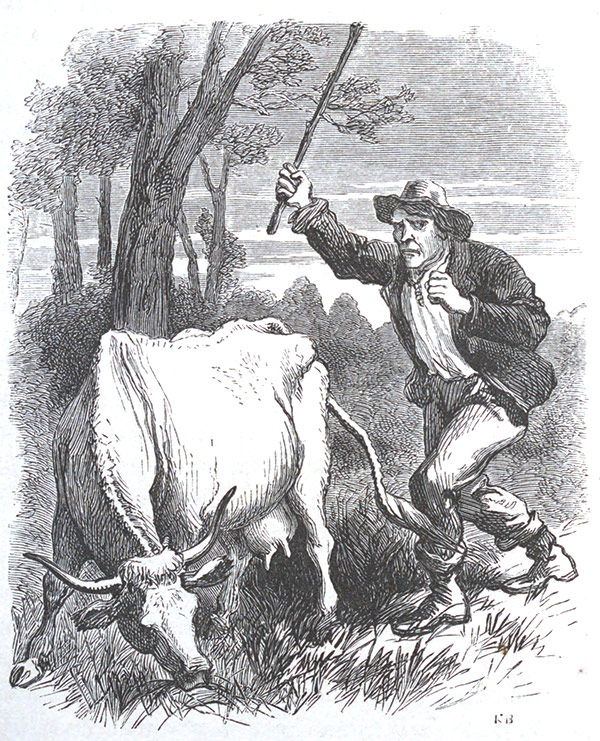
THE MAN WHO STOLE A COW.
A squirrel near by was chattering among the tangled roots of an old tree, and it seemed to Davy that he kept saying, “Good for you! good for you! good for you!” So that it was all the same with him, whether asleep or awake there was no peace.
When he tried to walk his legs dragged under him as if they were half asleep, and his mind was benumbed as well as his body; but still it was filled with strange, crazy notions that tormented him cruelly.
A little way from where he had passed the night there was a mossy stone sticking up out of the ground, three times as big as his head, and at one moment he was tempted to wrench this stone out of its place, and knock the cow on the head with it: if she were only dead, it seemed to him that that would make it as if he had not stolen her.
Chilled, hungry, bewildered, half crazy, he knew not what to do, for he was just as much lost as he had been in the dark. Sometimes he thought he would go and give himself up as a thief; still he did not, nor did he do anything else except stagger blindly about, and almost wish himself dead and buried under the dry leaves of the forest.
By and by the cow got hungry too, and pulled at the rope with which she was tied, and lowed again and again; so loud that Davy thought somebody would certainly hear her; and come and take her away, and himself too, with iron handcuffs on!
At length, he struck the cow in his rage because she lowed so loud, and suddenly jerking at the rope with which she was tied, she broke it, and ran away. Now Davy no sooner saw her escaping from him than the old desire to have a cow for his own, to see her feeding in his garden, and his children drinking her milk, all came back upon him, and he hobbled after her as fast as he could go; but such a wild-goose chase as she led him it is not worth while to describe. Through thistles, briers, and hedges, through woods and across meadows, and up and down hills, it seemed to Davy that he was being led to the end of the earth, and what was his surprise when toward nightfall, he found himself in the identical pasture field from which he had stolen the cow. If he had been afraid before, how much more was he afraid now!
He hid himself behind a stone-wall and waited for the night to fall, not daring even to lift up his head; and when he saw the owner of the cows come to drive them home to be milked, he crouched down into the very earth.
All the cattle seemed delighted that the estray was come back among them, and gathered round her and licked her sides and her neck and her forehead, and made little moans as though they were talking and telling how glad they were.
“I shall never be able to divide her from her mates,” thought Davy; and his heart sank down within him; for, in spite of all he had suffered, he was fully resolved to steal the cow over again. Again fortune favored him. When the owner of the cattle drove the others out of the meadow, he turned this one, the handsomest of all, back, and Davy heard him say to her, “What business have you here? why don’t you stay at home, you foolish creature?”
He could not quite tell what this meant; perhaps some one had bought the cow, and that thought made him doubly anxious to have her. So, just as soon as the gray twilight crept along the meadows, he tied the cow by the horn and led her away.
He was so weak by this time, with fasting, and the trouble he had had, that before he had travelled many miles he fell down, and could not go another step. He milked a little of the cow’s milk in his hand, swallowed it, and then lay down to get a little further strength from sleep. But the sleep of a man who has stolen a cow is not refreshing, as you may well believe, and he arose in the morning chilled and cramped, and altogether in a worse condition than he had yet been.
He was obliged to halt so often during that day, that night again fell while he was yet a long way from home. So for the third night he lodged in the woods, and it is altogether probable that the crows and the squirrels talked to him just as they did before. Just as the sun was going down on the evening of the fourth day of his absence, he reached home and drove the cow in at the garden gate. His house was not burned down, as he had dreamed it was, but it was so changed that he hardly knew it. The front was all whitewashed, and there were curtains of scarlet stuff shining at the windows, and the grass had been clipt in the dooryard, some young trees set, and so many things done that Davy hardly knew it all for the same place.
All at once, while he yet stood amazed, his children came running out with shining faces and sleek hair, and began to cry, “O father, have you fetched her at last!” and then to fondle and caress the stolen cow as though she were an expected guest.
He had just got inside and had latched the gate, when turning round he saw his wife coming forth to meet him, if, indeed, that smiling woman dressed so neatly in a new gown and cap was his wife. “O Davy!” she cries, as she takes his hand and kisses it; “we began to be afraid the cow had run away with you!” And then she asks him as she leads him into the house, if he doesn’t think she has made a pretty good selection of a cow. Davy is so puzzled by all this that he does not know what to say, and least of all does he know how to look in his wife’s face, for he sees plainly that, however things are, she trusts him and believes in him with all her heart. After a time the light began to break in upon his brain. “Did you see the rich man at the other end of the island?” she says; and “O, isn’t it a beautiful place?” and, “Did he tell you how much I paid for the cow? I thought I would come home and surprise you with the good news; but good news travels fast, and when I got home I found that you had already heard it, and was gone to fetch her. How good it was of you, to be sure!” And so she ran on till Davy understood it all. She had bought the identical cow he had stolen, the morning before he reached the rich man’s meadows. He was no thief, after all, and nobody in the world could ever know his secret. At first he felt very happy, and skipped and danced about like a boy; but this could not last with a wicked secret in his bosom, and he soon began to droop and to lose all appetite, especially for milk.
The house had been all brightened up inside as well as out; and besides the scarlet curtains, there was a new rag carpet and an easy-chair for himself, and a good many other things; but none nor all of them could give him pleasure, for all the time he knew himself to be a thief. One day his wife said to him, “I thought, Davy, we were preparing such a happy surprise for you, while you were gone for the cow, but nothing seems to please you, and we did it all for you!”
Then Davy broke down, and crying like a boy, told his wife all the ugly truth; and after that he had great pleasure in the new things, especially the easy-chair, and milk tasted sweet to him, and there was nowhere a happier family than that of Davy Dreamer, for he was cured of his dreaming.