Part 5 — THE CHARMED MONEY.
Reading edition
Jerry Mason had been hoeing two long hours in the garden; the earth was moist and black about the cabbages, the heavy gray leaves of which were lopping earthward to give their, as yet, soft hearts a better chance of maturing in the sun; the red seamy leaves of the beets testified to the good culture they had had, but as if they could not say it plainly enough, the beets themselves were come up half out of the ground to add their testimony, and the pale spiky tops of the onions stood up like soldiers in straight rows, saying, “Behold, there is not a weed among us.” The tomatoes, bright with dew-drops and full of young fruit, gave out their pleasant odor most prodigally in payment for the care they had just received; and some few flowers, common to be sure,—but what flower is not beautiful?—opened bright and honest in the sunshine, causing Jerry to leave his work for a moment, and, leaning on his hoe, contemplate their pinky and purple and yellow colors with an ecstasy of joy. He did not believe, for the moment, that the king’s garden contained anything more delightful than did his mother’s. But even if that were possible, he thought the king could not enjoy its beauties half so much as he, because his pleasure was more than half derived from the fact that himself had ploughed and sowed the garden, and that the fruits and flowers before him were his, as they could not have been if another than himself had done the work. The eyes of the simple see straight to the truth sometimes, when all the curious speculations of the wise are at fault, and I am not sure but that Jerry was wise in feeling that the king could not be so happy as he.
He did not think of his bare feet half buried in the loose earth; he did not think of his patched trousers, and that his shirt was not linen in the wristbands and collar even; and for a minute, at least, he did not think how hot the sun was shining down upon him, and how tired he was.
“Jerry!” called his mother, leaning from the low window of her little house,—“Jerry, my child, you may as well go and feed the old sitting goose, and the change of work will rest you.”
“Yes, mother,” answered Jerry; and as he took off his hat and wiped his face, he looked across the field where Henry Gordon was idly flying his kite, and almost envied him: he was a rich man’s son, and neither had to hoe nor to feed an old goose.
But Jerry was too good, and too happy, for the most part, to envy any one long, and directly, hanging his hoe in the fork of a tree that stood by the garden gate, he prepared the accustomed food, crossed the barn-yard where the hens were cackling and picking the grains from the chaff that was scattered about, passed along the field where the cow was nibbling the short grass, went over the brook on a bridge of stones he had built the last summer, climbed the slope beyond, and suddenly stood still. The old goose sitting in the hollow of a black stump close by was protruding her neck, flopping her wings, and hissing at a terrible rate. “You are crazy, ain’t you, you ugly old goose!” exclaimed Jerry, raising up and clinching one hand as if he would hit her if he had anything with which to do it. “Do you think I am afraid of you? Why I have milked our cow on the wrong side, been all the way to mill for mother, and besides that, have killed two garter-snakes,—one of them half a yard long and striped and checked like a ribbon—Shut up your wings, you old—whew!” and Jerry climbed to the top of a neighboring stump and shouted at the top of his voice,—cutting circles in the air with his hat, and beckoning with his hand in great earnestness. Farmer Hix stopped his team in the adjoining field and listened, thinking Jerry was shouting for help. Mrs. Mason put her head out of the back door; she, too, had heard Jerry, and feared some bad accident had happened. A moment the farmer stood still, his horses turning their heads in the direction of the call, and the mother leaned and listened in trembling anxiety; but the door closed presently, and the farmer ploughed on again: both had heard Jerry say to Henry Gordon, who was seen running with his kite across the field, “Don’t you think, our old goose has got goslings!”
That was enough to make any boy climb to the top of a stump and shout for joy, Jerry thought. How many she had he did not know, but he would not be surprised to find that every egg was hatched,—three of the golden little creatures he saw, he is sure, and if the old goose would only come off the nest he could soon tell; he would dare get a stick and drive her off, but he thinks he won’t.
“What is it! what is it!” cries Henry Gordon, running as fast as he can, and quite regardless of the kite that drags along the ground as he runs. “What is it! have you found a bag of gold?”
He is older by two or three years than Jerry, and wears much finer clothes, but he is not a finer looking boy, for all that. His boots are of the finest leather, and polished very bright,—brighter than Jerry’s best ones, which he only wears of Sundays, which hang over a peg at the head of his bed in his mother’s garret; and his hat is so fresh and new, and the ends of the green ribbon tied around it flutter so gayly, that Jerry is abashed for a moment, and says he fears Henry will not be paid for having run so fast, and especially if he has spoiled his fine kite into the bargain; that he has not anything worth showing,—some little goslings, that is all. But Henry has never seen a gosling, for it is only lately that he has come from a great city; and he says the old kite is of no value, he can get as many better ones as he pleases; he rather hopes it is spoiled, and so by its string he winds it up to him, and, tossing it at the feet of Jerry, bestows it on him in a patronizing sort of way that would have offended him if he had not felt in his heart that he was equal to any boy anywhere.
When the goose had been fed, and the goslings too, Jerry showed his new friend the stone bridge across the brook, which bridge, both concluded, might be greatly beautified and improved if they would unite their strength and ingenuity and give a day to the work. He showed him his mother’s cow, and assured him that he dare plat her tail together, count the rings on her horns, or even go up to her on the “wrong side”!
Then they went to the cow-shed where the straw was in which the hens made their nests, and after this to the garden, where Henry pulled some of the finest flowers for his little neighbor. When it was dinner-time and Jerry’s mother called him, his young friend went into the house with him, and partook, with great relish, of the simple meal that was spread.
When he went away he invited Jerry to come to his house and ride his horse, and go gunning with him, which Jerry felt would be a great delight to him to do, and which he afterward did many times; for from that day Henry and Jerry were excellent friends, working and playing together a great deal. The rich man’s son soon lost a good deal of the foolish pretension he had at first, and what he did not lose Jerry readily forgave. Sometimes, indeed, he would throw off his coat and strip away shoes and stockings, and enter with hearty good-will into whatever was to be done. They went together to the same school, for there was but one in the neighborhood, and once or twice had hats and jackets alike. They gathered nuts together, and berries; made hay together, and picked apples; shouted, and sung, and made whistles, and drove the cows home one with another. Then, too, O idle dreaming! they made plans for the years to come,—plans of what they would do when they were men. They would always be neighbors, and divide whatever they had, just as they did their goslings and hollyhocks now.
“Why don’t you come to see my mother?” said Henry often to Mrs. Mason, for he could not see why the mothers of such friends should not be friends too. And Mrs. Mason always said she would like to do so if she could get time, but somehow it happened that she never did find time, and never went. Mrs. Gordon rode in her fine carriage to a fine church on Sundays, and wore a silk gown and her hair in curls. Mrs. Mason put her hair plainly under a plain cap, and walked across the meadow to the school-house to attend service. Mrs. Gordon dined sumptuously at five, Mrs. Mason simply at twelve; one lived in a big house and was served by a good many maids and men, the other in a very small house serving herself; the one saw the sun shine through a lace curtain, and the other through rose-vines. So it was that Mrs. Gordon said, “Thank you, my dear, it will give me the greatest pleasure when I have an hour to spare,” in answer to Jerry’s invitation of, “You must come and see my mother.” And so it happened that she never found an hour to spare, and never went to see Jerry’s mother.
Three years went by of the closest friendship between the lads, and all this time they did not understand exactly why their mothers could not find time to visit each other. It was the greatest pleasure to Henry to go with bare feet across the nicely scoured floor of Mrs. Mason, and to sit with her and Jerry, where the roses looked in at the window, and partake of her home-made cakes and bread, and eat her preserved fruits, which were never so good at home; the wind came in so fresh and sweet from the hay-field beyond the hollow, and the birds made such music in the garden, and Mrs. Mason had such a sweet voice and a pleasant way, his mother would be delighted, he was sure, if she could only find time to come to the cottage.
Mrs. Mason sat by the fire waiting for Jerry, who had gone to carry a fine yellow pumpkin of his own raising to Henry’s mother, that Henry might have some just such pies as he was to have,—sat rocking and musing before the bright wood-fire, wishing somebody would come in and cheer the lonesomeness a little, for the night was falling and the snow lay cold and smooth everywhere, far as she could see. The straw-roofed shed of the cow was beautified like a queen’s chamber. No king could put such a roof on his house as the snow had put on that. The fences seemed made of pieces of snow, the trees to be trees of snow, and all so still and cold. The cock went early to bed, fluttering the white shower from the limb of the tree that lodged him,—fluttering it down as though he did not care for it at all, and turning his bright eyes to his mates that sat beside him, sober and uncomfortable enough. He was rather glad, for his part, that so cold and snowy a night was come; it brought out his gallantry and his fortitude. But generally the aspect of things without, in spite of all the beauty, was cheerless. The tea, in the old teapot cracked and bound with hoops of tin, had been simmering a good while, the fire began to make a little red light on the snow beneath the window, and a candle to be needed in the dim room where Jerry’s mother sat, when she heard the creaking of the gate, and, rising, looked out of the window. It was growing quite dusky; and though she saw two boys coming toward the door, she could not at first believe it was Jerry and Henry, so quietly they came, arm in arm, and talking so low and so earnestly. What could it mean? Of all times this was the one to make them merry, for there is more exhilaration in snow than in wine, and birds and boys are alike fond of dipping into it, and chirping and chattering when it lies over the ground loose and white. Close came the young friends past rose-bushes and lilacs all wrapped so prettily, and never once did they turn to look or dash the white weights from the bending twigs. Nor did they step aside from the open path and break their way, ploughing off snow-furrows as they came, as boys love to do. No merry voices rang through the clear silence; but soberly and straightforward they came, as if the snow had buried beneath it some great joy.
And so, indeed, it had. They were about to be separated for a long, long while. It had been decided at home that Henry should go away to a military school, not to come home for six months, or it might be for a year.
Jerry’s mother was sad enough when she heard the news; and to keep the moisture from gathering to drops in her eyes, she rubbed the tin hoops of her blue teapot with the towel, till they shone again.
Henry said he was sorry he was to go; but for all of his saying so, he was not as sorry as Jerry was. He had new boots and a new coat and hat, and a number of other things of which he was fully conscious all the while. Then, too, he would write every day, and it would be almost the same as seeing him, and he would come home often, for Henry had been used to having his own way, and could not think but that his will would still be his law, as it always had been.
The next day Jerry climbed to the top of the gate-post, and watched the carriage that took Henry from him drive away. Through tears he caught a glimpse of his little friend, but his little friend did not once look toward him.
That was Jerry’s first sorrow. No number of yellow goslings could have brought the old light into his red eyes that morning; no pinks nor daffodils, though the garden had been full of them, could have seemed to him bright as the smile of his playmate.
A letter was promised him by the first mail; and all the interval seemed to Jerry a blank, a time of nothing, that he would be glad to push right along and have done with. It would not be seeing his friend, but it would be something; it would be a great thing: he had never received a letter in his life, sealed and meant all for him. He wondered how it would begin and how it would end, and what, in fact, his friend would say, and how he would say it. One thing would be in it, that he knew, that Henry was very lonesome and wanted to see him so bad. That would be in the letter, and he was not sure but that it would be in it a great many times; indeed, it was not unlikely the entire letter would be made up of love for him and anxiety to see him. Henry knew so much and would have learned so much, even in three days, at a military school, that he supposed the letter would be a model,—and what an advantage to him to have such a fine friend!
And at last the day on which the mail was expected was come, and at last it went by and was time to go to the post-office, two miles from his mother’s house. The snow was deep and it was cold after sunset, but little cared Jerry for that; he would run because he could not help it, and that would keep him warm; and, besides, if a boy thought much of a boy and wrote him so, he would feel bad to know a boy did not think enough of a boy to go after the letter, because it was a little cold. So buttoning the old coat that was outgrown and a good deal worn, Jerry set out, never minding the still air that almost cut his face, as if it tried to thrust him back into the warm house, never minding the white, cold glimmer of the stars that seemed to say, “It’s no use,” never minding anything, because he was a boy that liked a boy, and supposed a boy liked him back just as well. He was not long in walking the two miles. He did not once think he might have gone faster and with more comfort if Mrs. Gordon had offered him Henry’s pony to ride, when she asked him to bring her letters. He did not think of anything but the pleasure he would have in breaking the seal and reading to his mother every word Henry wrote. The two miles were a good deal longer when Jerry went home, not because he was going home, and not because it was more up hill; it was a good deal colder, too, and his coat seemed thinner; it nearly froze his hand to carry the bundle of letters and papers for Mrs. Gordon, and the sharp wind brought the water to his eyes,—he had no letter from Henry. An ugly distrust came into his heart as he went along,—the moon might drop right down out of the sky, for all he knew, and he hardly thought it unlikely that his mother should have set fire to the house and run away while he was gone. If it was possible that Henry could have broken his “word and honor,” his “double word and honor,” what might not be possible?
Henry was not sick, for there, in a fair, firm hand, was a letter to his parents.
He could not stop and ask Mrs. Gordon if Henry were well; something choked him, and he must go home.
An hour he sat on a stool in the corner and cried, in spite of all his mother could say to soothe him; but at last when she told him to wipe his eyes and run over to Mrs. Gordon’s and see what was in Henry’s letter, he stifled his sobs and obeyed.
Mrs. Gordon looked up from her reading as Jerry came in, in a way that said plainly she was surprised and annoyed; and when little Fanny Gordon ran from listening at her mother’s knee and offered Jerry a chair at the fireside, she shook her head at the little girl, and whispered something which Jerry thought meant she must not ask him to sit down. Fanny half hid her face in her mother’s lap; but she turned her eyes full of tears and sweet pity toward Jerry, and the frown of the mother lost its power on him, and for a moment he scarcely cared whether Henry had said anything about him or not.
Every mail day all the winter, whether it were gusty or mild, freezing or thawing, Jerry went regularly to the post-office, but there was never any letter for him. Once little Fanny had spoken to him through the fence, and told him that her brother Henry had written to know what he was doing now-a-days, and said that he should write to him as soon as he found time. She said, too, that when she went away to school, as she was to do in the spring, she would write a letter to him, and she would not tell her mother nor anybody else what she wrote.
After this Jerry tried to make excuses for Henry,—he was very busy, no doubt, and had as many letters to write home as he could find time to do; and as he worked, spading the garden, he often tried to work out a letter in his brain. But he could not tell very well how to begin, nor how to end, nor what to say,—a boy in a military school might not feel much like a boy spading in his mother’s garden.
The old goose brought out her troop of young goslings again; the flowers all looked over the garden fence toward “Fanny’s house,” as Jerry fancied; the heads of the cabbages were hardening, and their great gray leaves lopping toward the ground again. Jerry could not go to school now as he used to do when he was smaller, but had to stay at home and work. Fanny was gone away to school now, and had kept her promise and written a letter to Jerry,—a very little letter made up of very little sentences, and with a superscription that made three very crooked lines all across and across the envelope. To Jerry’s thinking, however, there never was a much better letter written. All the time he kept it in his pocket, reading it again and again as often as he found leisure, though he knew every word from first to last. He could not bear to put it away with his few books; it seemed like a free ticket to the good-will of everybody; so he kept it, as I said, all the time in his pocket. He found the distrust that he had had in his heart since Henry went away growing rapidly less, and now and then he suspected that he had been very wicked in imagining the moon could fall, or his mother burn up the house and run away. Suddenly he stopped from his working, tired, but looking well pleased; he had been very industrious and done a full day’s work, though it wanted yet three hours of night. He had made up his mind to write to Henry; for since Fanny had written him, “I am very well; I hope you are very well. I don’t like here so well as home. Do your goslings grow? Have you heard from Henry?” he had felt that everybody he knew liked him, and would be glad to know how well he was doing. So the happiness he thought he should give to another was all bright in his face as he hung his hoe in the pear-tree, and breaking three cabbage-leaves, not crooked and deep green, but fair and gray with bloom, made his way to the brookside, where the shadow of a maple lay thick and cool, and near where the stone bridge caused the water to stop and make some silver talk before it went over.
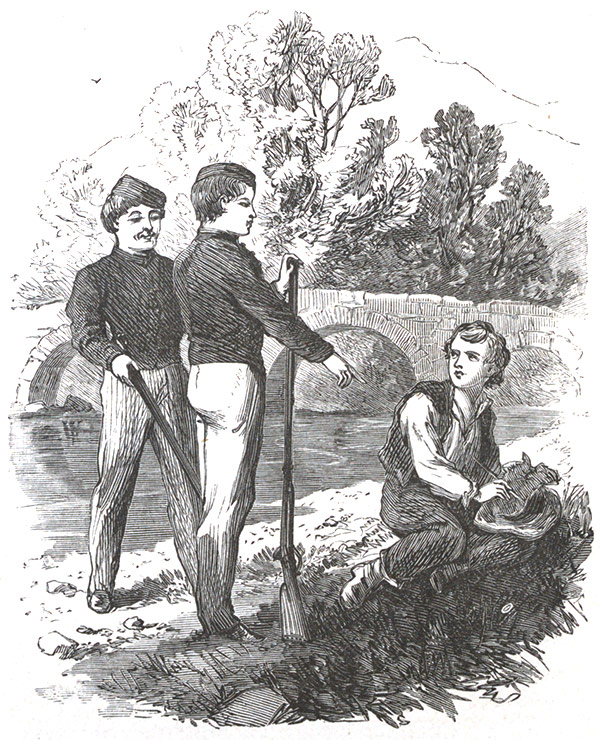
THE CHARMED MONEY.
From the cherry-tree by the door he had brought some little withes, and having sharpened them with his teeth, began the composition of a letter,—using his hat-crown for a desk, the cabbage-leaves for paper, and the twigs for pens. Never was poet wrapped more happily in a dream than he in his work, when all at once he became conscious of footsteps and heard a voice, not unfamiliar, except in its derision, say, “Ha, boy! I say you ought to take out a patent for that sort of paper: how are you, though?” Jerry’s senses were a good deal bewildered, and he could not believe at first it was Henry Gordon who stood before him, resting his polished gun on the ground, holding a cigar in one hand, and surveying him with such cool indifference.
He tried to rise and return civilly the rude salutation of the young cadet; and as he advanced he saw that Henry was not alone, but accompanied by a youth whom he introduced as a classmate, naming Jerry as a boy he used to know; asking Jerry how things were getting on in his line, and saying that, as regarded himself, he hoped his soul had got a little above potatoes during his absence. He did not speak even of Jerry’s mother, who had done him so many favors; and to complete the insult, he tossed at Jerry, as he passed along, a small piece of money, saying, “Take that, boy, and buy you a copy-book and a pen or two.”
Jerry did not speak; he felt as if he could never speak again; he could hardly persuade himself that it was indeed Henry Gordon who had stood but now before him, and as long as he could see gazed the way he was going. The very buttons of his coat seemed to mock him with their shining; and there lay the money on the ground at his feet, and the cabbage-leaves wilting in the sun, for where the shadow had been an hour ago the sun shone hot enough now.
All the world was changed, and it seemed for a little while not only possible, but highly probable, that his mother might set fire to the house and run away, and the moon drop out of the sky; if anything could stay back such events, it would be the letter from Fanny. He put his hand in his pocket, to be sure that it was still there; and, stooping, picked up the piece of money and placed it in the opposite pocket, to keep balance. Fanny’s letter should teach him the world was not all bad; that piece of money, that it was not all good. In itself it was but a harmless piece of money, and he would not have known it from a thousand others, but it had been in contact with the hand that shrunk away from him; it had been flung at him in charity,—at him a boy as good as any other boy, as honest and as honorable. In all respects he was not Henry’s equal, to be sure, but he would set to work that very day and make himself so. If he had not had Henry’s advantages, neither had Henry had his! And straight he set out for home. His heart misgave him almost when he reached the door and saw the tea-table spread in holiday style, and for three. Mrs. Mason had learned that Henry was come home, and was thinking what a pleasant time they would all have once more. It was hard to tell his good dear mother that he had already seen Henry, and how he had seen him. More than once, as they sat together, Jerry’s mother arose from the table to attend some little duty, she said, but in truth it was to dry her eyes; and more than once Jerry said he did not care what Henry Gordon thought of him; but his mother knew it was because he cared a great deal that he said so.
Already his mind was stung into activity, and a development was going on, of which he was not himself aware.
Years of persevering endeavor, of hard work with the hands and harder with the brain, we pass by,—years in which hope has been busy with him, so busy that he has felt the steep way they have climbed together less toilsome. Teachers and schools have not been accessible to him much, except, indeed, the common school of humanity and the great teacher, God, in his works. These works he has read and reread; these he has studied, and he has studied himself, and his duties to himself and his fellows. He feels the nobility of true and honest manhood, afraid of nothing but doing wrong, ambitious of nothing but coining the ability with which he has been endowed to right use. For he is not ambitious to serve the world nor the state,—measured against such great requirements he feels unequal; he is content with making even a little spot of earth greener for his having lived; he thinks it something of an achievement to turn weeds into good rich soil, and make wheat or roses grow where, but for him, barrenness would have been. He does not believe he could have made himself a poet if he had mortised rhymes together never so ingeniously; nor does he suppose he could manage the affairs of nations, because he can manage a plough. Nevertheless, he is a proud man,—proud of his cleared land and of his woodland,—proud of his brooks and of his cows,—of his harvests and of his garden,—of his beautiful cottage,—of the vines about the porch and of the well-bound volumes that shine row over row against the wall,—of his mother, sitting beside him so comfortable and so respectable,—proud that he owes no man anything, and proud that he is not proud in any mean and selfish sense.
A thousand times he might have resented the old insult of the piece of money, but he feels that “time at last sets all things even,” and he is quite contented to wait,—so well content, indeed, that there is no waiting to do. He could not have been so well avenged any way as he is by his indifference.
It is the middle of June, and the garden is full of flowers that still look toward Mrs. Gordon’s a good deal, though Jerry says he don’t care which way they look; but we are quite sure they would not be so many nor so bright if there were no bright eyes looking down upon them from the opposite windows. There are bright flowers immediately under the windows where the bright eyes are gazing forth so often; but to those eyes the flowers in the distance show the best.
Fanny is a woman now, and though she sends no more letters to her friend Jerry that no one knows anything of, she sends a great many glances as full of kindly meaning as were the little sentences sent him so long ago. She has been home from school a whole year; and though many times, in her walks and drives, she has met Jerry, and smiled upon him very sweetly, he has returned her smiles with only formal politeness. Of course Fanny Gordon does not care much for the like of him,—that is what he says to himself, and so he keeps up a show of indifference that he is very far from feeling.
Henry has been at home a long time, too, spending his time in idleness and in worse than idleness, so rumor says, and that things are growing from bad to worse with the Gordons. Still they manage to keep up an outside show, and hold their heads much above working-people like the Masons. But when the foundation is undermined, the time will come that the house must fall, and that time came to the Gordons.
It was early autumn; there was a little fire on the hearth, but the door toward the flower-garden stood open, and Jerry sat in the door watching the moonlight as it played along the grass and shone among the stalks of such of the hardier blossoms as yet remained.
All at once his heart gave a little start,—was it some bird rustling among the dry leaves? No, it was the step of Fanny rustling along the fallen leaves. She came without hesitation, without blushing, straight to where Jerry was sitting. “I could not go away,” she said, putting out her hand to him, “without first coming to bid your mother and you good by!”
“Go away, Fanny! Where are you going, and why?” cried Jerry, surprised into cordiality and earnestness.
Then Fanny sat down beside him in the moonlight and told him where she was going, and why. “Our fortune is all gone, and somebody must do something,” she concluded.
“But why should you go away to do something?”
“Because,” Fanny answered, “we have no friends here!” and then her voice first faltered, and she hid her face in her hands.
“No friends!” said Jerry; “with my mother and myself here? O Fanny, how can you say that?”
Then she told him that she was sure there was no reason why himself and his mother should be their friends; but at any rate, they had no others, and she was going away to teach school, or to learn to sew, or to do something by which she could take care of herself. “Just think, Jerry,” she says, “I have not a glove to my hand!” And she held out her hand to him, red as a rose with the evening chill.
Jerry took it between both his. “And suppose, Fanny, I should always keep it this way,” he said, “you would not need a glove, would you?”
Fanny’s face was all bright with blushes when Mrs. Mason came to say that supper was ready; and the place she took at the table that night became hers for all her life before long; for, of course, she and Jerry were married, and two birds were never happier under the mother’s wing than were they with the mother of Jerry. Everything prospered with them, and by and by they were the rich people in the town where they lived, and not the Gordons at all.
One dreary night, when the outside show could not be kept up any longer, when they were in fact reduced to the last sixpence, they sat together, Mrs. Gordon and her son Henry, lamenting their hard fortune, and blaming each other, and blaming Fanny, whom they had never been to visit, and blaming everything but their own foolish pride and perverseness for the ruin and degradation that was now impending.
Both started at the sound of a footstep; it was a creditor’s, no doubt.
“What brought you here? I don’t owe you anything!” exclaimed Henry, sullenly, when he saw that the visitor was Jerry Mason.
“No,” replied Jerry, “but I owe you a great deal”; and taking from his pocket the piece of money Harry had flung at him so long ago, he laid it down on the table before him. Henry trembled and blushed for shame; but when Jerry took his hand and said, “This piece of money has been a charm that has kept me from idleness and uselessness; it has added to my lands and built me a house, beautified my garden, clothed my mother, and made her old age happy and respectable, developed my own manhood, and crowned me with the love of the best of women. For all this I owe you something, and I am come to pay you. Take first this money and see what it can do for you. You are yet in the prime of life and can retrieve and achieve everything; come with me with as hearty a good-will as you came to look at my goslings, and we will devise the way.” Henry took the hand extended to him, and brushing the tears from his eyes,—the first ones that had wet them for long years,—said in accents that trembled, “I will go, Jerry, if you think I am worth saving; and my mother shall go too. Come, mother!” So all three went together, and Fanny met and embraced them; and then they sat down together and made plans for the future, and that was the happiest night of their lives.