Front matter (continued 6)
Reading edition
"Right." If Fossten suspected that the Tyrant was somewhat less than frank, he did not show it, and the conversation became strictly technical.
"We must not strike until we are completely ready," was Kinnison's first statement, and he repeated it so often thereafter during the numerous conferences with the chiefs of staff that it came almost to be a slogan.
The prime minister did not know that Kinnison's main purpose was to give the Patrol plenty of time to make Klovia utterly impregnable. Fossten knew nothing of the Patrol's sunbeam, to which even the mightiest fortress possible for man to build could offer scarcely more resistance than could the lightest, the most fragile pleasure yacht.
Hence he grew more and more puzzled, more and more at a loss week by week, as Tyrant Gannel kept on insisting upon building up the strongest, the most logically perfect Grand Fleet which all the ability of their pooled brains could devise. Once or twice he offered criticisms and suggestions which, while defensible according to one theory, would actually have weakened Grand Fleet's striking power. These offerings Gannel rejected flatly; insisting, even to an out-and-out break with his co-administrator if necessary, upon the strongest possible armada.
The Tyrant wanted, and declared that he must and would have, more and bigger of everything. More and heavier flying fortresses, more and stronger battleships and superdreadnoughts, more and faster cruisers and scouts, more and deadlier weapons.
"We want more of everything than our operations officers can possibly handle in battle," he declared over and over; and he got them. Then:
"Now, you operations officers, learn how to handle them!" he commanded.
Even the prime minister protested at that, but it was finally accomplished. Fossten was a real thinker, as was Kinnison, and between them they worked out a system. It was crudeness and inefficiency incarnate in comparison with the Z9M9Z, but it was so much better than anything previously known to Boskonia's High Command that everyone was delighted. Even the suspicious and cynical Fossten began to entertain some doubts as to the infallibility of his own judgment.
And these doubts grew apace as the Tyrant drilled his Grand Fleet. He drove the personnel unmercifully, especially the operations officers; as relentlessly as he drove himself. He simply could not be satisfied, his ardor and lust for efficiency were insatiable. His reprimands were scathingly accurate; officer after officer he demoted bitingly during ever more complicated, ever more inhumanly difficult maneuvers; until finally he had what were unquestionably his best men in those supremely important positions. Then, one day:
"QX, Kim, come ahead—we're ready," Haynes Lensed him, briefly.
For Kinnison had been in touch with the port admiral every day. He had learned long since that the prime minister could not detect a Lensed thought, particularly when the Lensman was wearing a thought-screen, as he did practically constantly; wherefore the strategists of the Patrol were as well informed as was Kinnison himself of every move made by the Boskonians.
Then Kinnison called Fossten, and was staring glumly at nothing when the latter entered the room.
"Well, it would seem that we are about as nearly ready as we ever will be," the Tyrant brooded, pessimistically. "Have you any suggestions, criticisms, or other contributions to offer, of however minor a nature?"
"None whatever. You have done very well indeed."
"Unnhh," Gannel grunted, without enthusiasm. "You have observed, no doubt, that I have said little if anything as to the actual method of approach?"
The prime minister had indeed noticed that peculiar oversight, and said so. Here, undoubtedly, he thought, was the rub. Here was where Star A Star's minion would get in his dirty work.
"I have thought about it at length," Kinnison said, still in his brown study. "But I know enough to recognize and to admit my own limitations. I do know tactics and strategy, and thus far I have worked with only known implements toward known objectives. That condition, however, no longer exists. The simple fact is that I do not know enough about the possibilities, the techniques and the potentialities, the advantages and the disadvantages of the hyperspatial tube as an avenue of approach to enable me to come to a defensible decision one way or the other. I have decided, therefore, that if you have any preference in the matter I will give you full authority and let you handle the approach in any manner you please. I shall, of course, direct the actual battle, as in that I shall again be upon familiar ground."
The premier was flabbergasted. This was incredible. Gannel must really be working for Boskonia after all, to make such a decision as that. Still skeptical, unprepared for such a startling development as that one was, he temporized.
"The bad—the very bad—features of the approach via tube are two," he pondered aloud. "We have no means of knowing anything about what happens; and, since our previous such venture was a total failure, we must assume that, contrary to our plans and expectations, the enemy was not taken by surprise."
"Right," Kinnison concurred, tonelessly.
"Upon the other hand, an approach via open space, while conducive to the preservation of our two lives, would be seen from afar and would certainly be met by an appropriate formation."
"Check," came emotionlessly noncommittal agreement.
"Haven't you the slightest bias, one way or the other?" Fossten demanded, incredulously.
"None whatever," the Tyrant was coldly matter-of-fact. "If I had had any such, I would have ordered the approach made in the fashion I preferred. Having none, I delegated authority to you. When I delegate authority I do so without reservations."
This was a stopper.
"Let it be open space, then," the prime minister finally decided.
"So be it." And so it was.
Each of the component flotillas of Grand Fleet made a flying trip to some nearby base, where each unit was serviced. Every item of mechanism and of equipment was checked and rechecked. Stores were replenished, and munitions—especially munitions. Then the mighty armada, the most frightfully powerful aggregation ever to fly for Boskonia—the mightiest fleet ever assembled anywhere, according to the speeches of the politicians—remade its stupendous formation and set out for Klovia. And as it flew through space, shortly before contact was made with the Patrol's Grand Fleet, the premier called Kinnison into the control room.
"Gannel, I simply cannot make you out," he remarked, after studying him fixedly for five minutes. "You have offered no advice. You have not interfered with my handling of the Fleet in any way. Nevertheless, I still suspect you of treacherous intentions. I have been suspicious of you from the first—"
"With no grounds whatever for your suspicions," Kinnison reminded him, coldly.
"What? With all the reason possible!" Fossten declared. "Have you not steadily refused to bare your mind to me?"
"Certainly. Why not? Do we have to go over that again? Just how do you figure that I should so trust any being who refuses to reveal even his true shape to me?"
"That is for your own good," the prime minister stated. "I have not wanted to tell you this, but the truth is that no human being can perceive my true self and retain his sanity."
"I'll take a chance on that," Kinnison replied, skeptically. "I've seen a lot of monstrous entities in my time and I haven't conked out yet."
"There speaks the sheer folly of callow youth; the rashness of an ignorance so abysmal as to be possible only to one of your ephemeral race." The voice deepened, became more resonant. Kinnison, staring into those inscrutable eyes which he knew did not in fact exist, thrilled forebodingly; the timbre and the overtones of that voice reminded him very disquietingly of something which he could not at the moment recall to mind. "I forbear to discipline you, not from any doubt as to my ability to do so, as you suppose, but because of the sure knowledge that breaking you by force will destroy your usefulness. On the other hand, it is certain that if you co-operate with me willingly you will be the strongest, ablest leader that Boskonia has ever had. Think well upon these matters, O Tyrant."
"I will," the Lensman agreed, more seriously than he had intended. "But just what, if anything, has led you to believe that I am not working to the fullest and best of my ability for Boskonia?"
"Everything." Fossten summarized. "I have been able to find no flaw in your actions, but those actions do not fit in with your unexplained and apparently unexplainable reticence in letting me perceive for myself exactly what is in your mind. Furthermore, you have never even troubled to deny accusations that you are in fact playing a far deeper game than you appear upon the surface to be playing."
"That reticence I have explained over and over as an over-mastering repugnance—call it a phobia if you like," Kinnison rejoined, wearily. "I simply can't and won't. Since you cannot understand that, denials would have been entirely useless. Would you believe anything that I could possibly say—that I would swear to by everything I hold sacred—whether it was that I am whole-heartedly loyal to Boskonia or that I am in fact Star A Star himself?"
"Probably not," came the measured reply. "No, certainly not. Men—especially men such as you, bent ruthlessly upon the acquisition of power—are liars ... ah, could it, by any chance, be that the reason for your intractability is that you have the effrontery to entertain some insane idea of supplanting ME?"
Kinnison jumped mentally. That tore it—that was a flare-lit tip-off. This man—this thing—being—entity—whatever he really was—instead of being just another Boskonian big shot, must be the clear quill—the real McCoy—BOSKONE HIMSELF! The end of the job must be right here! This was—must be—the real Brain for whom he had been searching so long; here within three feet of him sat the creature with whom he had been longing so fervently to come to grips!
"The reason is as I have said," the Tellurian stated, quietly. "I will attempt to make no secret, however, of a fact which you must already have deduced; that if and when it becomes apparent that you have any authority above or beyond that of the Tyrant of Thrale I shall take it away from you. Why not? Now that I have come so far, why should I not aspire to sit in the highest seat of all?"
"Hrrummphhh!" the monster—Kinnison could no longer think of him as Fossten, or as the prime minister, or as anything even remotely human—snorted with such utter, such searing contempt that even the Lensman's burly spirit quailed. "As well might you attempt to pit your vaunted physical strength against that of the heaviest forging ram ever built. Now, youth, have done. The time for temporizing is past. As I have said, I desire to spare you, as I wish you to rule this part of Boskonia as my viceroy. Know, however, that you are in no sense essential, and that if you do not yield your mind fully to mine, here and now, before this coming battle is joined, you most certainly die." At the grim finality, the calmly assured certainty of the pronouncement, a quick chill struck into the Gray Lensman's vitals.
This thing who called himself Fossten—who or what was he? What was it that he reminded him of? He thought and talked like ... like ... MENTOR! But it couldn't be an Arisian, possibly—that wouldn't make sense. But then, it didn't make any kind of sense, anyway, any way you looked at it. Whoever he was, he had plenty of jets—jets enough to lift a freighter off of the north pole of Valeria. And by the same token, his present line of talk didn't make sense, either—there must be some good reason why he hadn't made a real pass at him long before this, instead of arguing with him so patiently. What could it be? Oh, that was it, of course. He needed only a few minutes more, now; he could probably stall off the final showdown that long by crawling a bit—much as it griped him to let this zwilnik think that he was licking his boots.
"Your forbearance is appreciated, sire." At the apparently unconscious tribute to superiority and at the fact that the hitherto completely self-possessed Tyrant got up and began to pace nervously up and down the control room, the prime minister's austere mien softened appreciably. "It is, however, passing strange. It is not quite in character; it does not check quite satisfactorily with the facts thus far revealed. I may, perhaps, as you say, be stupid. I may be overestimating flagrantly my own abilities. To one of my temperament, however, to surrender in such a craven fashion as you demand comes hard—extremely, almost unbearably hard. It would be easier, I think, if your supremacy would condescend to reveal his true identity, thereby making plainly evident and manifest that which at present must be left to unsupported words, surmise, and not too much conviction."
"But I told you, and now tell you again, that for you to look upon my real form is to lose your reason!" the creature rasped.
"What do you care, really, whether or not I remain sane?" Kinnison shot his bolt at last, in what he hoped would be taken for a last resurgence of spirit. His time was about up. In less than one minute now the screens of scout cruisers would be in engagement, and either he or the prime minister or both would be expected to be devoting every cell of their brains to the all-important battle of giants. And in that very nick of time he would have to cripple the Bergenholms and thus inert the flagship. "Could it be that the real reason for your otherwise inexplicable forbearance is that you must know how my mind became as it now is, and that the breaking down of my barriers by mental force will destroy the knowledge which you, for your own security, must have?"
This was the blowoff. Kinnison still paced the room, but his pacings took him nearer and ever nearer to a certain control panel. Behind his thought-screen, which he could not now trust for a moment and which he knew starkly would be worse than useless in what was coming, he mustered every iota of his tremendous force of mind and of will. Only seconds now. His left hand, thrust into his breeches pocket, grasped the cigarette case within which reposed his Lens. His right arm and hand were tensely ready to draw and to fire his ray gun.
"Die, then! I should have known from the sheer perfection of your work that you were what you really are—Star A Star!"
The mental blast came ahead even of the first word, but the Gray Lensman, supremely ready, was already in action. One quick thrust of his chin flicked off the thought-screen. The shielded cigarette case flew open, his more-than-half-alive Lens blazed again upon his massive wrist. His weapon leaped out of its scabbard, flaming destruction as it came—a ravening tongue of incandescent fury which licked out of existence in the twinkling of an eye the Bergenholms' control panels and the operators clustered before it. The vessel went inert—much work would have to be done before the Boskonian flagship could again fly free!
These matters required only a fraction of a second. Well indeed it was that they did not take longer, for the ever-mounting fury of the prime minister's attack soon necessitated more—much more—than an automatic block, however capable. But Kimball Kinnison, Gray Lensman, Lensman of Lensmen, had more—ever so much more—than that!
He whirled, lips thinned over tight-set teeth in a savage fighting grin. Now he'd see what this zwilnik was and what he had. No fear, no doubt of the outcome, entered his mind. He had suffered such punishment as few minds have ever endured in learning to ward off everything that Mentor, one of the mightiest intellects of this or of any other universe, could send; but through that suffering he had learned. This unknown entity was an able operator, of course, but he certainly had a thick, hard crust to think that he could rub him out!
So thinking, the Lensman hurled a bolt of his own, a blast of power sufficient to have slain a dozen men—and, amazedly, saw it rebound harmlessly from the premier's hard-held block.
Which of the two combatants was the more surprised it would be hard to say; each had considered his own mind impregnable and invincible. Now, as the prime minister perceived how astoundingly capable a foe he faced, he sought to summon help by ordering the officers on duty to blast their Tyrant down. In vain. For, even so early in that ultimately lethal struggle, he could not spare enough of his mind to control effectively any outsider; and in a matter of seconds there were no minds left throughout that entire room in any condition to be controlled.
For the first reverberations, the ricochets, the spent forces of the monster's attack against Kinnison's shield had wrought grievously among the mentalities of the innocent bystanders. Those forces were deadly—deadly beyond telling—so inimical to and destructive of intelligence that even their transformation products affected tremendously the nervous systems of all within range.
Then, instants later, the spectacle of the detested and searingly feared Lens scintillating balefully upon the wrist of their own ruler was an utterly inexpressible shock. Some of the officers tried then to go for their guns, but it was already too late; their shaking, trembling, almost paralyzed muscles could not be forced to function.
An even worse shock followed almost instantly, for the prime minister, under the incredibly mounting intensity of the Lensman's poignant thrusts, found it necessary to concentrate his every iota of power upon his opponent. This revealed to all beholders, except Kinnison, what their prime minister actually was—and he had not been very much wrong in saying that that sight would drive any human being mad. Most of the Boskonians did go mad, then and there; but they did not rush about nor scream. They could not move purposefully, but only twitched and writhed horribly as they lay grotesquely asprawl. They could not scream or shriek, but only mouthed and mumbled meaningless burblings.
And ever higher, ever more brilliant flamed the Lens as Kinnison threw all of his prodigious will power, all of his tremendous, indomitable drive, through it and against the incredibly resistant thing to which he was opposed. This was the supreme, the climactic battle of his life thus far. Ether and sub-ether seethed and boiled invisibly under the frightful violence of the forces there unleashed. The men in the control room lay still; all life rived away. Now death spread throughout the confines of the vast spaceship.
Indomitably, relentlessly, the Gray Lensman held his offense upon that unimaginably high level; his Lens flooding the room with intensely coruscant polychromatic light. He did not know, then or ever, how he did it. It seemed as though his Lens, of its own volition in this time of ultimate need, reached out into unguessable continua and drew therefrom an added, an extra something. But, however it was done, Kinnison and his Lens managed to hold; and under the appalling, the never-ceasing concentration of force the monster's defenses began gradually to weaken and to go down.
Then sketchily, patchily, there was revealed to Kinnison's sight and sense of perception a ... a ... a BRAIN!
There was a body, of sorts, of course—a peculiarly neckless body designed solely to support that gigantic, thin-skulled head. There were certain appendages or limbs, and suchlike appurtenances and incidentalia to nourishment, locomotion, and the like; but to all intents and purposes the thing was simply and solely a brain.
Kinnison knew starkly that it was an Arisian—it looked enough like old Mentor to be his twin brother. He would have been stunned, except for the fact that he was far too intent upon victory to let any circumstance, however distracting, affect his purpose. His concentration upon the task in hand was so complete that nothing—literally nothing whatever—could sway him from it.
The monster's wall of illusion went down completely and then, step by short, hard, jerky step, Kinnison advanced. Close enough, he selected certain areas upon the sides of that enormous head and with big, hard, open hands he went viciously to work. Right, left, right, left, he slapped those bulging temples brutally, rocking monstrous head and repulsive body from side to side, pendulumlike, with every stunning blow.
His fist would have smashed that thin skull, would perhaps have buried itself deep within the soft tissues of that tremendous brain; and Kinnison did not want to kill his inexplicable opponent—yet. He had to find out first what this was all about.
He knew that he was due to black out as soon as he let go, and he intended to addle the thing's senses so thoroughly that he would be completely out of action for hours—long enough to give the Lensman plenty of time in which to recover his strength.
He did so.
Kinnison did not quite faint. He did, however, have to lie down flat upon the floor; as limp, almost, as the dead men so thickly strewn about.
And thus, while the two immense Grand Fleets met in battle, Boskonia's flagship hung inert and silent in space afar; manned by fifteen hundred corpses, one unconscious Brain, and one utterly exhausted Gray Lensman.
XXI.
Boskonia's Grand Fleet was, as has been said, enormous. It was not as large as the Patrol in total number of ships, since no ordinary brain nor any possible combination of such brains could have co-ordinated and directed the activities of so vast a number of units. Its center was, however, heavier; composed of a number and a tonnage of supermaulers which made it self-evidently irresistible.
In his training of his Grand Fleet operations staff, Kinnison had not overlooked a single bet, had not made a single move which by its falsity might have excited Premier Fossten's all-too-ready suspicions. They had handled Grand Fleet as a whole in vast, slow maneuvers; plainly the only kind possible to so tremendous a force. Kinnison and his officers had in turn harshly and thoroughly instructed the subfleet commanders in the various arts and maneuvers of conquering units equal to or smaller than their own.
That was all; and to the Boskonians, even to Fossten, that had been enough. That was obviously all that was possible. Not one of them realized that Tyrant Gannel very carefully avoided any suggestion that there might be any intermediate tactics, such as that of three or four hundred subfleets, too widely spread in space and too numerous to be handled by any ordinary mind or apparatus to inglobe and to wipe out simultaneously perhaps fifty subfleets whose commanders were not even in communication with each other. This technique was as yet the exclusive property of the Patrol and the Z9M9Z.
And in that exact operation, a closed book to the zwilniks, lay—supposedly and tactically—the Patrol's overwhelming advantage. For Haynes, through his four highly specialized Rigellian Lensmen and thence through the two hundred Rigellian operator-computers, could perform maneuvers upon any intermediate scale he pleased. He could handle his whole vast Grand Fleet and its every component part—he supposed—as effectively, as rapidly, and almost as easily as a skilled chess player handles his pieces and his pawns. Neither Kinnison nor Haynes can be blamed, however, for the fact that their suppositions were somewhat in error; it would have taken an Arisian to deduce that this battle was not to be fought exactly as they had planned it.
Haynes had another enormous advantage in knowing the exact number, rating, disposition, course, and velocity of every main unit of the aggregation to which he was opposed. And third, he had the sunbeam, concerning which the enemy knew nothing at all and which was now in good working order.
It is needless to say that the sunbeam generators were already set to hurl that shaft of irresistible destruction along the precisely correct line, or that Haynes' Grand Fleet formation had been made with that particular weapon in mind. It was not an orthodox formation; in any ordinary space battle it would have been sheerly suicidal. But the port admiral, knowing for the first time in his career every pertinent fact concerning his foe, knew exactly what he was doing.
His fleet, instead of driving ahead to meet the enemy, remained inert and practically motionless well within the limits of Klovia's solar system. His heavy stuff, instead of being massed at the center, was arranged in a vast ring. There was no center except for a concealing screen of heavy cruisers.
When the far-flung screens of scout cruisers came into engagement, then, the Patrol scouts near the central line did not fight, but sped lightly aside. So did the light and heavy cruisers and the battleships. The whole vast center of the Boskonians drove onward, unopposed, into—nothing.
Nevertheless they kept on driving. They could, without orders, do nothing else, and no orders were forthcoming from the flagship. Commanders tried to get in touch with Grand Fleet operations, but could not; and, in failing, kept on under their original instructions. They had, they could have, no suspicion that any minion of the Patrol was back of what had happened to their admirals. The flagship had been in the safest possible position and no attack had as yet been made. They probably wondered futilely as to what kind of a mechanical breakdown could have immobilized and completely silenced their High Command, but that was—strictly—none of their business. They had had orders, very definite orders, that no matter what happened they were to go on to Klovia and to destroy it. Thus, however wondering, they kept on. They were on the line. They would hold to it. They would blast out of existence anything and everything which might attempt to bar their way. They would reach Klovia and they would reduce it to its component atoms.
Unresisted, then, the Boskonian center bored ahead into nothing, until Haynes, through his Rigellians, perceived that it had come far enough. Then Klovia's brilliantly shining sun darkened almost to the point of going out entirely. Along the line of centers, through the space so peculiarly empty of Patrol ships, there came into being the sunbeam—a bar of quasi-solid lightning into which there had been compressed all the energy of well over four million tons per second of disintegrating matter.
Scouts and cruisers caught in that ravening beam flashed briefly, like sparks flying from a forge, and vanished. Battleships and superdreadnoughts the same. Even the solid war head of fortresses and maulers was utterly helpless. No screen has ever been designed capable of handling that hellish load; no possible or conceivable substance can withstand, save momentarily, the ardor of a sunbeam. For the energy liberated by the total annihilation of four million tons per second of matter is in fact as irresistible as it is incomprehensible.
The armed and armored planets did not disappear. They contained too much sheer mass for even that inconceivably powerful beam to volatilize in any small number of seconds. Their surfaces, however, melted and boiled. The controlling and powering mechanisms fused into useless pools of molten metal. Inert, then, inactive and powerless, they no longer constituted threats to Klovia's well-being.
The negaspheres also were rendered ineffective by the beam. Their antimasses were not decreased of course—in fact, they were probably increased a trifle by the fervor of the treatment—but, with the controlling super-structures volatilized away, they became more of menace to the Boskonian forces than to those of Civilization. Indeed, several of the terrible things were drawn into contact with ruined planets. Then negasphere and planet consumed each other, flooding all nearby space with intensely hard and horribly lethal radiation.
The beam winked out, Klovia's sun flashed on. The sunbeam was—and is—clumsy, unwieldy, quite definitely not rapidly maneuverable. But it had done its work; now the component parts of Civilization's Grand Fleet started in to do theirs.
Since the Battle of Klovia—it was and still is called that, as though it were the only battle which that warlike planet has ever seen—has been fought over in the classrooms of practically every civilized planet of two galaxies, it would be redundant to discuss it in detail here.
It was, of course, unique. No other battle like it has ever been fought, either before or since—and let us hope that no other such ever will be. It is studied by strategists, who have so far offered many thousands of widely variant profundities as to what Port Admiral Haynes should have done. Its profound emotional appeal, however, lies only and sheerly in its unorthodoxy. For in the technically proper space battle there is no hand-to-hand fighting, no purely personal heroism, no individual deeds of valor. It is a thing of logic and mathematics and of science, the massing of superior fire power against a well-chosen succession of weaker opponents. When the screens of a spaceship go down that ship is done, her personnel only memories.
But here how different! With the supposed breakdown of the lines of communication to the flagship, the subfleets carried on in formation. With the destruction of the entire center, however, all semblance of organization or of co-operation was lost. Every staff officer knew that no more orders would emanate from the flagship. Each knew chillingly that there could be neither escape nor succor. The captain of each vessel, thoroughly convinced that he knew vastly more than did his fleet commander, proceeded to run the war to suit himself. The outcome was fantastic, so utterly bizarre that the Z9M9Z and her trained co-ordinating officers were useless. Science and tactics and the million lines of communication could do nothing against a foe who insisted upon making it a ship-to-ship, yes, man-to-man affair!
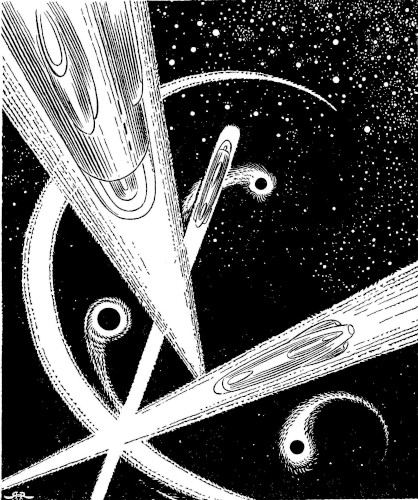
The result was the most gigantic dog fight in the annals of military science. Ships—Civilization's perhaps as eagerly as Boskonia's—cut off their projectors, cut off their screens, the better to ram, to board, to come to grips personally with the enemy. Scout to scout, cruiser to cruiser, battleship to battleship, the insane contagion spread. Haynes and his staff men swore fulminantly, the Rigellians hurled out orders, but those orders simply could not be obeyed. The dog fight spread until it filled a good sixth of Klovia's entire solar system.
Board and storm! Armor—DeLameters—axes! The mad blood lust of hand-to-hand combat, the insensately horrible savagery of our pirate forebears, multiplied by millions and spread out to fill a million million cubic miles of space!
Haynes and his fellows wept unashamed as they stood by helpless, unable to avoid or to prevent the slaughter of so many splendid men, the gutting of so many magnificent ships. It was ghastly—it was appalling—it was WAR!
And far from this scene of turmoil and of butchery lay Boskonia's great flagship, and in her control room Kinnison began to recover his strength. He sat up groggily. He gave his throbbing head a couple of tentative shakes. Nothing rattled. Good—he was QX, he guessed, even if he did feel as limp as nine wet dish rags. Even his Lens felt weak; its usually refulgent radiance was sluggish, wan, and dim. This had taken plenty out of them, he reflected soberly; but he was mighty lucky to be alive. But he'd better get his batteries charged. He couldn't drive a thought across the room, the shape he was in now, and he knew of only one brain in the Universe capable of straightening out this mess.
After assuring himself that the highly inimical brain would not be able to function normally for a long time to come, the Lensman made his way to the galley. He could walk without staggering already—fine! There he fried himself a big, thick, rare steak—his never-failing remedy for all the ills to which flesh is heir—and brewed a pot of the coffeelike beverage affected by Thralians; making it viciously, almost corrosively strong. And as he ate and drank, his head cleared magically. Strength flowed back into him in waves. His Lens flamed into its normal splendor. He stretched prodigiously; inhaled gratefully a few deep breaths. He was QX.
Back in the control room, after again checking up on the still quiescent brain—he wouldn't trust this Fossten as far as he could spit—he hurled a thought to far-distant Arisia and to Mentor, its ancient sage.
"What's an Arisian doing in this Second Galaxy, working against the Patrol? Just what is somebody trying to pull off?" he demanded heatedly, and in a second of flashing thought reported what had happened.
"Truly, Kinnison of Tellus, my mind is far from capable," the deeply resonant, slow simulacrum of a voice resounded within the Lensman's brain. The Arisian never hurried; nothing whatever, apparently, not even such a cataclysmic upheaval as this, could fluster or excite him. "It does not seem to be in accord with the visualization of the Cosmic All which I hold at the moment that any one of my fellows is in fact either in the Second Galaxy or acting antagonistically to the Galactic Patrol. It is, however, a truism that hypotheses, theories, and visualizations must fit themselves to known or observed facts, and even your immature mind is eminently able to report truly upon actualities. But before I attempt to revise my Cosmos to conform to this admittedly peculiar circumstance, we must be very sure indeed of our facts. Are you certain, youth, that the being whom you have beaten into unconsciousness is actually an Arisian?"
"Certainly I'm certain!" Kinnison snapped. "Why, he's enough like you to have been hatched out of half of the same egg. Take a look!"—and he knew that the Arisian was studying every external and internal detail, part, and organ of the erstwhile prime minister of Thrale.
"Ah, it would appear to be an Arisian, at that, youth," Mentor finally agreed. "I do not know him, however, and I have been quite confident that I am acquainted with each member of my race. He is old, as you said—as old, perhaps, as I am. This will require some little thought—allow me therefore, please, a moment of contemplation." The Arisian fell silent, presently to resume:
"I have it now. Many millions of your years ago—so long ago that it was with some little difficulty that I recalled it to mind—when I was scarcely more than an infant, a youth but little older than myself disappeared from Arisia. It was determined then that he was aberrant—insane—and since only an unusually capable mind can predict truly the illogical workings of a diseased and disordered mind for even one year in advance, it is not surprising that in my visualization that unbalanced youth perished long ago. Nor is it surprising that I do not recognize him in the creature before you, for at the time of vanishment no permanent pattern had as yet been formed."
"Well, aren't you surprised that I could get the best of him?" Kinnison asked naïvely. He had really expected that Mentor would compliment him upon his prowess, he figured that he had earned a few pats on the back; but here the old fellow was mooning about his own mind and his own philosophy, and acting as though knocking off an Arisian were something to be taken in stride. And it wasn't, by half!
"No," came the flatly definite reply. "You have a force of will, a totalizable and concentratable power, a mental and psychological drive that no mind in the macrocosmic universe can break. I perceived those latent capabilities when I assembled your Lens, and developed them when I developed you. It was their presence which made it certain that you would return here for that development; they made you what you intrinsically are."
"QX, then—skip it. What shall I do with him? It's going to be a real job of work, any way you figure it, for us to keep him alive and harmless until we can get him back there to Arisia."
"We do not want him here," Mentor replied without emotion. "He has no present or future place within our society. Nor, however I consider the matter, can I perceive that he has any longer a permissible or condonable place in the all-inclusive Scheme of Things. He has served his purpose. Destroy him, therefore, forthwith, before he so much as recovers consciousness; lest much and grievous harm befall you."
"I believe you, chief. You chirped it then, if anybody ever did. Thanks"—and communication ceased.
The Lensman's ray gun flamed briefly and what was mortal of Fossten the prime minister became a smoking, shapeless heap.
Kinnison noticed then that a call light was shining brightly upon a communicator panel. This thing must have taken longer than he had supposed. The battle must be over, otherwise all space would still be filled with interference through which no long-range communicator beam could have been driven. Or—could Boskonia have—No, that was unthinkable. The Patrol must have won. This must be Haynes, calling him—
It was. The frightful Battle of Klovia was over. While many of the Patrol ships had yielded, either by choice or by necessity, to the Boskonians' challenge, most of them had not. And the majority of those who did so yield, came out victorious.
While fighting in any kind of recognized formation against such myriads of independently operating, widely spaced individual ships was, of course, out of the question, Haynes and his aids had been able to work out a technique of sorts. General orders were sent out to subfleet commanders, who in turn relayed them to the individual captains by means of visual beams. Single vessels, then, locked to equal or inferior craft—avoiding carefully anything larger than themselves—with tractor zones and held grimly on. If they could defeat the foe, QX. If not, they hung on; until shortly one of the Patrol's maulers—who had no opposition of their own class to face—would come lumbering up. And when the dreadful primary batteries of one of those things cut loose that was, very conclusively, that.
Thus Boskonia's mighty fleet vanished from the skies.
The all-pervading interference was cut off and Port Admiral Haynes, brushing aside a communications officer, sat down at his board and punched a call. Time after time he punched it. Finally he shoved it in and left it in; and as he stared, minute after minute, into the coldly unresponsive plate his face grew gray and old.
With a long, slightly tremulous sigh he was turning away from the plate when suddenly it lighted up to show the smiling, deeply space-tanned face of the one for whom he had just about given up hope.
"Thank God!" The commander in chief's exclamation was wholly reverent; his strained old face lost twenty years in half that many seconds. "Thank God you are safe. You did it, then?"
"I managed it, Pop, but just by the skin of my teeth—I didn't have half a jet to spare. It was Old Man Boskone himself, in person. And you?"
"Clean-up—one hundred point oh, oh, oh, oh percent."
"Fine business!" Kinnison exulted. "Everything's on the exact center of the green, then—come on!"
And Civilization's Grand Fleet went.
The Z9M9Z flashed up to visibility, inerted, and with furious driving blasts full ablaze, matched her intrinsic velocity to that of the Boskonian flagship—the only Boskonian vessel remaining in that whole vast volume of space. Tractors and pressors were locked on and balanced. Flexible—or, more accurately, not ultimately rigid—connecting tubes were pushed out and sealed. Hundreds, yes—thousands, of men—men in full Thralian uniform—strode through those tubes and into the Thralian ship. The Directrix unhooked and a battleship took her place. Time after time the maneuver was repeated, until it seemed as though Kinnison's vessel, huge as she was, could not possibly carry the numbers of men who marched aboard.
Those men were all human or approximately so—nearly enough human, at least, to pass as Thralians under a casual inspection. More peculiarly, that army contained an astounding number of Lensmen. So many Lensmen, it is certain, had never before been gathered together into so small a space. But the fact that they were Lensmen was not apparent; their Lenses were not upon their wrists, but were high upon their arms, concealed from even the most prying eyes within the heavy sleeves of their tunics.
Then the captured flagship, her Bergenholms again at work, the Z9M9Z, and the battleships which had already assumed the intrinsic velocity possessed originally by the Boskonians, spread out widely in space. Each surrounded itself with a globe of intensely vivid red light. Orders as to course and power flashed out. The word was given and spectacular fire flooded space as that vast host of ships, guided by those red beacons and by the ever-watchful observers of the Directrix, matched in one prodigious and beautiful maneuver its intrinsic velocity to theirs.
Finally, all the intrinsics in exact agreement, Grand Fleet formation was remade. The term "remade" is used advisedly, since this was not to be a battle formation. For Traska Gannel had long since sent a message to his capital; a terse and truthful message which was, nevertheless, utterly misleading. It was:
"My forces have won, my enemy has been wiped out to the last man. Prepare for a two-world broadcast, to cover both Thrale and Onlo, at hour ten today of my palace time."
The formation, then, was not one of warfare, but of boasting triumph. It was the consciously proud formation of a Grand Fleet which, secure in the knowledge that it has blasted out of the ether everything which can threaten it, returns victoriously to its Prime Base to receive as its just due the plaudits and the acclaim of the populace.
Well in the van—alone in the van, in fact, and strutting—was the flagship. She, having originated upon Thrale and having been built specifically for a flagship, would be recognized at sight. Back of her came, in gigantic co-axial cones, the subfleets; arranged now not class by class of ships, but world by world of origin. One mauler, perhaps, or two; from four or five to a dozen or more battleships; an appropriate number of cruisers and of scouts; all flying along together in a tight little group.
But not all of the Patrol's armada was in that formation. It would have been very poor technique indeed to have had Boskonia's Grand Fleet come back to home ether forty percent larger than it had set out. Besides, the Directrix simply could not be allowed to come within detector range of any Boskonian lookout. She was utterly unlike any other vessel ever to fly: she would not, perhaps, be recognized for what she really was, but it would be evident to the most casual observer that she was not and could not be of Thrale or of Boskonia.
The Z9M9Z, then, hung back—far back—escorted and enveloped by the great number of warships which could not be made to fit into the roll call of the Tyrant's original Grand Fleet.
The subfleet which was originally from Thrale could land without any trouble; without arousing any suspicion. Boskonian and Patrol designs were not identical, of course; but the requirements of sound engineering dictated that externals should be essentially the same. The individual ships now bore the correct identifying symbols and insignia. The minor differences could not be perceived until after the vessels had actually landed, and that would be—for the Thralians—entirely too late.
Thralian hour ten arrived. Kinnison, after a long, minutely searching inspection of the entire room, became again in every millimeter Traska Gannel, the Tyrant of Thrale. He waved a hand. The scanner before him glowed: for a full minute he stared into it haughtily, to give his teeming millions of minions ample opportunity to gaze upon the inspiring countenance of His Supremacy the Feared.
He knew that the scanner revealed clearly every detail of the control room behind him, but everything there was QX. There was not even a chance that some person would fail to recognize a familiar face at any post, for not a single face except his own would be visible. Not a head back of him would turn, not even a rear quarter profile would show: it would be lese majeste of the most intolerable for any face, however inconspicuous, to share the limelight with that of the Tyrant of Thrale while his supremacy was addressing his subjects. Serenely and assuredly enough, then, Kinnison as Tyrant Gannel spoke:
"My people! As you have already been told, my forces have won the complete victory which my foresight and my leadership made inevitable. This milestone of progress is merely a repetition upon a grander scale of those which I have already accomplished upon a somewhat smaller; as extension and a continuation of the carefully considered procedure by virtue of which I shall see to it that My Great Plan succeeds.
"As one item in that scheduled procedure I removed the weakling Alcon, and in the stead of his rule of oppression, short-sightedness, corruption, favoritism, and greed, I substituted my beneficent regime of fair play, of mutual co-operation for the good of all.
"I have now accomplished the next major step in my program; the complete destruction of the armed forces which might be, which would be employed to hamper and to nullify the development and the fruition of My Plan.
"I shall take the next step immediately upon my return to my palace. There is no need to inform you now as to the details of what I have in mind. In broad, however, it pleases me to inform you that, having crushed all opposition, I am now able to institute and shall proceed at once to institute certain changes in policy, in administration, and in jurisdiction. I assure you that all of these changes will be, ultimately, for the best good of all, save the enemies of society.
"I caution you therefore to co-operate fully and willingly with my officers who may shortly come among you with instructions; some of these, perhaps, of a nature not hitherto promulgated upon Thrale. Those of you who do so co-operate will live and will prosper; you who do not will die in the slowest, most hideous fashions which hundreds of generations of Thralian torturers have been able to devise."
XXII.
Up to the present, Kinnison's revolution, his self-advancement into the dictatorship, had been perfectly normal; in perfect accordance with the best tenets of Boskonian etiquette. While it would be idle to contend that any of the others of the High Command really approved of it—each wanted intensely that high place for himself—none of them had been strong enough at the moment to challenge the usurper effectively and all of them knew that an ineffective challenge would mean certain death. Wherefore each perforce bided his time. Gannel would slip, Gannel would become lax or overconfident—and that would be the end of Gannel.
They were, however, loyal in their way to Boskonia. They were very much in favor of the rule of the strong and the ruthless. They believed implicitly that might made right. They themselves bowed the knee to anyone strong enough to command such servility from them; in turn they enforced brutally an even more degrading slavishness from those over whom they held in practice, if not at law, the power of life and death.
Thus Kinnison knew that he could handle his cabinet easily enough as long as he could make them believe that he was a Boskonian. There was, there could be, no real unity among them under those conditions; each would be fighting his fellows as well as working to overthrow His Supremacy the Tyrant. But they all hated the Patrol and all that it stood for with a whole-hearted fervor which no one adherent to Civilization can really appreciate. Hence at the first sign that Gannel might be in league with the Patrol they would combine forces instantly against him; automatically there would go into effect a tacit agreement to kill him first and then, later, to fight it out among themselves for the prize of the Tyrantcy.
And that combined opposition would be a formidable one indeed. Those men were really able. They were as clever and as shrewd and as smart and as subtle as they were hard. They were masters of intrigue; they simply could not be fooled. And if their united word went down the line that Traska Gannel was in fact a traitor to Boskonia, an upheaval would ensue which would throw into the shade the bloodiest revolutions of all history. Everything would be destroyed.
Nor could the Lensman hurl the metal of the Patrol against Thrale in direct frontal attack. Not only was it immensely strong, but also there were those priceless records, without which it might very well be the work of generations for the Patrol to secure the information which it must, for its own security, have.
No. Kinnison, having started near the bottom and worked up, must now begin all over again at the top and work down; and he must be very, very sure that no alarm was given until at too late a time for the alarmed ones to do anything of harm to the Lensman's cause. He didn't know whether he had jets enough to swing the load or not—a lot depended on whether or not he could civilize those twelve devils of his—but the scheme that the psychologists had worked out was a honey and he would certainly give it the good old college try.
Thus Grand Fleet slowed down, and, with the flagship just out of range of the capital's terrific offensive weapons, it stopped. Half a dozen maulers, towing a blackly indetectable, imperceptible object, came up and stopped. The Tyrant called, from the safety of his control room, a conference of his cabinet in the council chamber.
"While I have not been gone very long in point of days," he addressed them smoothly, via plate, "and while I, of course, trust each and every one of you, there are certain matters which must be made clear before I attempt to land. None of you has, by any possible chance, made any effort to lay a trap for me, or anything of the kind?" There may have been a trace of irony in the speaker's voice.
They assured him, one and all, that they had not had the slightest idea of even considering such a thing.
"It is well. None of you have discovered, then, that by changing locks and combinations, and by destroying or removing certain inconspicuous but essential mechanisms of an extremely complicated nature—and perhaps substituting others—I made it quite definitely impossible for any one or all of you to render this planet inertialess, I have brought back with me a negasphere of planetary antimass, which no power at your disposal can affect. It is here beside me in space; please study it attentively. It should not be necessary for me to inform you that there are countless other planets from which I can rule Boskonia quite as effectively as from Thrale; or that, while I do not relish the idea of destroying my home planet and everything upon it, I would not hesitate to do so if it became a matter of choice between that action and the loss of my life and my position."
They believed the statement. That was the eminently sensible thing to do. Any one of them would have done the same; hence they knew that Gannel would do exactly what he threatened—if he could. And as they studied Gannel's abysmally black ace of trumps they knew starkly that Gannel could. For they had found out, individually, that the Tyrant had so effectively sabotaged Thrale's Bergenholms that they could not possibly be made operative until after his return. Consequently repairs had not been started—any such activity, they knew, would be a fatal mistake.
By outguessing and outmaneuvering the members of his cabinet Gannel had once more shown his fitness to rule. They accepted that fact with a good enough grace; indeed, they admired him all the more for the ability thus shown. No one of them had given himself away by any overt moves; they could wait. Gannel would slip yet—quite possibly even before he got back into his palace. So they thought, not knowing that the Tyrant could read at will their most deeply hidden plans; and, so thinking, each one pledged anew in unreserved terms his fealty and his loyalty.
"I thank you, gentlemen." The boss did not, and the officers were pretty sure that he did not, believe a word of their protestations. "As loyal cabinet members, I will give you the honor of sitting in the front of those who welcome me home. You men and your guards will occupy the front boxes in the Royal Stand. With you and around you will be the entire palace personnel—I want no person, except the usual guards, inside the buildings or even within the grounds when I land. Back of these you will have arranged the Personal Troops and the Royal Guards. The remaining stands and all of the usual open ground will be for the common people—first come, first served.
"But one word of caution. You may wear your side arms, as usual. Bear in mind, however, that armor is neither usual nor a part of your full-dress uniform, and that any armored man or men in or near the concourse will be blasted by a needle ray before I land. Be advised also that I myself shall be wearing full armor. Furthermore, no vessel of the fleet will land until I, personally, from my private sanctum, order them to do so."
This situation was another poser; but it, too, they had to take. There was no way out of it, and it was still perfect Boskonian generalship. The welcoming arrangements were therefore made precisely as the Tyrant had directed.
The flagship settled toward ground, her under jets blasting unusually viciously because of her tremendous load; and as she descended Kinnison glanced briefly down at the familiar terrain. There was the immense space field, a dock-studded expanse of burned, scarred, pock-marked concrete and steel. Midway of its extreme northern end, that nearest the palace, was the berth of the flagship, Dock No. 1. An eighth of a mile straight north from the dock—the minimum distance possible because of the terrific fury of the under jets—was the entrance to the palace grounds. At the northern end of the western side of the field, a good three-quarters of a mile from Dock No. 1 and somewhat more than that distance from the palace gates, were the Stands of Ceremony. That made the Lensman completely the master of the situation.
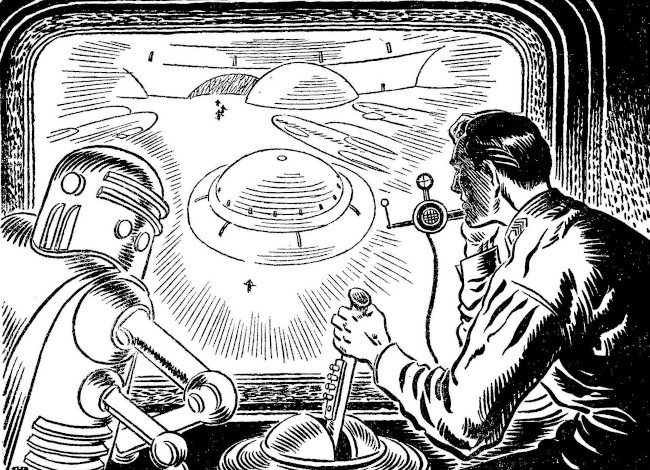
The flagship landed, her madly blasting jets died out. A car of state rolled grandly up. Air locks opened. Kinnison and his bodyguards seated themselves in the car. Helicopters appeared above the stands and above the massed crowds thronging the western approaches to the field; hovering, flitting slowly and watchfully about.
Then from the flagship there emerged an incredible number of armed and armored soldiers. One small column of these marched behind the slowly moving car of state, but by far the greater number went directly to and through the imposing portals of the palace grounds. The people in general, gathered there to see a major spectacle, thought nothing of these circumstances—who were they to wonder at what the Tyrant of Thrale might choose to do?—but to Gannel's Council of Advisers they were extremely disquieting departures from the norm. There was, however, nothing that they could do about them, away out there in the grandstand; and they knew with a stark certainty what those helicopters had orders to do in case of any uprising or commotion anywhere in the crowd.
The car rolled slowly along before the fenced-back, wildly cheering multitudes, with blaring bands and the columns of armored spacemen marching crisply, swingingly behind it. There was nothing to indicate that those selected men were not Thralians; nothing whatever to hint that over a thousand of them were in fact Lensmen of the Galactic Patrol. And Kinnison, standing stiffly erect in his car, acknowledged gravely, with upraised right arm, the plaudits of his subjects.
The triumphal bus stopped in front of the most outthrust, the most ornate stand, and through loud-voiced amplifiers the Tyrant invited, as a signal honor, the twelve members of his Advisory Cabinet to ride with him in state to the palace. There were exactly twelve vacant seats in the great coach. The advisers would have to leave their bodyguards and ride alone with the Tyrant: even had there been room, it was unthinkable that any one else's personal killers could ride with the Presence. This was no honor, they knew chillingly, no matter what the mob might think—it looked much more like a death sentence. But what could they do? They glanced at their unarmored henchmen; then at the armor and the semiportables of Gannel's own heelers; then at the ranks of heavily armed and armored troopers; and finally at the 'copters now clustering thickly overhead, with the narrow snouts of needle-ray projectors very much in evidence.
They accepted.
It was in no quiet frame of mind, then, that they rode into the pretentious grounds of the palace. They felt no better when, as they entered the council chamber, they were seized and disarmed without a word having been spoken. And the world fairly dropped out from beneath them when Tyrant Gannel emerged from his armor with a Lens glowing upon his wrist.
"Yes, I am a Lensman," he gravely informed the stupefied but unshrinking Boskonians. "That is why I know that all twelve of you tried while I was gone to cut me down, in spite of all that I told you and all that you have seen me do. If it were still necessary for me to pose as Traska Gannel, I would have to kill you here and now for your treachery. That phase is, however, past.
"I am one of the Lensmen whose collective activities you have ascribed to 'the' Lensman or to Star A Star. All those others who came with me into the palace are Lensmen. All those outside are either Lensmen or tried and seasoned veterans of the Galactic Patrol. The Fleet surrounding this world is the Grand Fleet of that Patrol. The Boskonian force was destroyed in toto—every man and every ship except your flagship—before it reached Klovia. In short, the power of Boskonia is broken forever; Civilization is to rule henceforth throughout both galaxies.
"You are the twelve strongest, the twelve ablest men of the planet, perhaps of your whole dark culture. Will you help us to rule according to the principles of Civilization that which has been the Boskonian Empire, or will you die?"
The Thralians stiffened themselves rigidly against the expected blasts of death, but only one spoke. "We are fortunate at least, Lensman, in that you do not torture," he said coldly, his lips twisted into a hard, defiant sneer.
"Good!" and the Lensman actually smiled. "I expected no less. With that solid bottom, all that is necessary is to wipe away a few of your misconceptions and misunderstandings, correct your viewpoints, and—"
"Do you think for a second that your therapists can fit us into the pattern of your Civilization?" the Boskonian spokesman demanded bitingly.
"I don't have to think, Lanion—I know," Kinnison assured him. "Take them away, fellows, and lock them up—you know where. Everything will go ahead as scheduled."
And it did.
And while the mighty vessels of war landed upon the space-field and while the thronging Lensmen took over post after post in an ever-widening downward course, Kinnison led Worsel and Tregonsee to the cell in which the outspoken Thralian chieftain was confined.
"I do not know whether I can prevent you from operating upon me or not," Lanion of Thrale spoke harshly, "but I will certainly try. I have seen the pitiful, distorted wrecks left after such operations and I do not like them. Furthermore, I do not believe that any possible science can eradicate from my subconscious the fixed determination to kill myself the instant you release me. Therefore you had better kill me now, Lensman, and save your time and trouble."
"You are right, and wrong," Kinnison replied quietly. "It may very well be impossible to remove such a fixation." He knew that he could remove any such, but Lanion must not know it. Civilization needed those twelve hard, shrewd minds and he had no intention of allowing an inferiority complex to weaken their powers. "We do not, however, intend to operate, but only and simply to educate. You will not be unconscious at any time. You will be in full control of your own mind and you will know beyond peradventure that you are so in control. We shall engrave, in parallel with your own present knowledges of the culture of Boskonia, the equivalent or corresponding knowledges of Civilization."
They did so. It was not a short undertaking, nor an easy one; but it was thorough and it was finally done. Then Kinnison spoke.
"You now have completely detailed knowledge both of Boskonia and of Civilization, a combination possessed by but few intelligences indeed. You know that we did not alter, did not even touch, any track of your original mind. Being fully en rapport with us, you know that we gave you as unprejudiced a concept of Civilization as we possibly could. Also, you have assimilated completely the new knowledge."
"That is all true," Lanion conceded. "Remarkable, but true. I was, and remained throughout, myself; I checked constantly to be sure of that. I can still kill myself at any moment I choose."
"Right." Kinnison did not smile, even mentally, at the unconscious alteration of intent. "The whole proposition can now be boiled down into one clear-cut question, to which you can formulate an equally clear-cut reply. Would you, Lanion, personally, prefer to keep on as you have been, working for personal power, or would you rather team up with others to work for the good of all?"
The Thralian thought for moments, and as he pondered an expression of consternation spread over his hard hewn face. "You mean actually—personally—apart from all consideration of your so-called altruism and your other sissyish weaknesses?" he demanded resistantly.
"Exactly," Kinnison assured him. "Which would you rather do? Which would you, personally, get the most good—the most fun—out of?"
The bitter conflict was plainly visible in Lanion's bronzed face; so was the direction in which it was going.
"Well ... I'll ... be ... damned! You win, Lensman!" and the ex-Boskonian big shot held out his hand. Those were not his words, of course; but as nearly as Tellurian English can come to it, that is the exact sense of his final decision. And the same, or approximately the same, was the decision of each of his eleven fellows, each in his turn.
Thus it was, then, that Civilization won over the twelve recruits who were so potently instrumental in the bloodless conquest of Thrale, and who were later to be of such signal service throughout the Second Galaxy. For they knew Boskonia with a sure knowledge, from top to bottom and from side to side, in every aspect and ramification; they knew precisely where and when and how to work to secure the desired ends. And they worked—how they worked!—but space is lacking to go into any of their labors here.
Specialists gathered, of a hundred different sorts; and when, after peace and security had been gained, they began to attack the stupendous files of the Hall of Records, Kinnison finally yielded to Haynes' insistences and moved out to the Z9M9Z.
"It's about time, young fellow!" the admiral snapped. "I've gnawed my fingernails off just about to the elbow and I still haven't figured out how to crack Onlo. Have you got any ideas?"
"Thrale first," Kinnison suggested. "Everything QX here, you sure?"
"Absolutely," Haynes grunted. "As strongly held as Tellus or Klovia. Primaries, helices, supertractors, Bergenholms, sunbeam—everything. They don't need us here any longer, any more than a hen needs teeth. Grand Fleet is all set to go, but we haven't been able to work out a feasible plan of campaign. The best way would be not to use the Fleet at all, but a sunbeam—but we can't move the Sun and Thorndyke has not as yet succeeded in making it hold together that far. I don't suppose that we could use a negasphere?"
"I don't see how," Kinnison pondered. "Ever since we used it first they've been ready for it. I'd be inclined to wait and see what Nadreck works out. He's a wise old owl, that bird—what does he tell you?"
"Nothing. Nothing, flat." Haynes' smile was grimly amused. "The fact that he is still 'investigating'—whatever that means—is all that he will tell me. Why don't you try him—you know him better than I do or ever will."
"It wouldn't do any harm," Kinnison agreed. "Nor good, either, probably. Funny egg, Nadreck. I'd tie fourteen of his arms into lover's knots if it'd make him give, but it wouldn't—he's a plenty tough number." Nevertheless he sent out a call, which was acknowledged instantly.
"Ah, Kinnison, greetings. I am even now on my way to Thrale and the Directrix to report upon the investigation."
"You are? Fine!" Kinnison exclaimed. "How did you come out?"
"I did not—exactly—fail, but the work was very incompletely and very poorly done," Nadreck submitted, the while the Tellurian's mind felt very strongly the Palainian equivalent of a painful blush of shame. "My report of the affair will be put and will forever remain under Lensman's Seal."
"But what did you do?" both Tellurians demanded as one.
"I scarcely know how to confess to such blundering," and Nadreck actually squirmed. "Will you not permit me to leave my shame to the spool of record?"
They would not, they informed him definitely.
"If you must have it, then, I yield. The plan was to make all of the armed forces upon Onlo destroy themselves. In theory it was sound and simple, but my execution was pitifully imperfect. My work was so poorly done that the commanding officer in each one of three of the domes remained alive, making it necessary for me to slay them personally, by the use of crude force. I regret exceedingly the lack of finish of this undertaking, and I apologize profoundly for it. I trust that you will not allow this information to become a matter of public knowledge"—and the apologetic, mentally sweating, really humiliated Palainian broke the connection.
Haynes and Kinnison stared at each other, for moments completely at a loss for words. The admiral first broke the silence.
"Hell's—jingling—bells!" he wrenched out, finally, and waved a hand at the points of light crowding so thickly his tactical tank. "A thing that the whole Grand Fleet couldn't do, and he does it alone, and then he apologizes for it as though he ought to be stood up in a corner or sent to bed without any supper!"
"Uh-huh, that's the way he is," Kinnison breathed, in awe. "What a brain!—what a man!"
Nadreck's black speedster arrived and a three-way conference was held. Both Haynes and Kinnison pressed him for the details of his really stupendous achievement, but he refused positively even to mention any phase of it.
"The matter is closed—finished," he declared, in a mood of anger and self-reproach which neither of the Tellurians had ever supposed that the gently scientific monster could assume. "I practically failed. It is the poorest piece of work of which I have been guilty since cubhood, and I desire and I insist that it shall not be mentioned again. If you wish to lay plans for the future, I will be very glad indeed to place at your disposal my small ability—which has now been shown to be even smaller than I had supposed—but if you insist upon discussing my fiasco, I shall forthwith go home. I will not discuss it. The record of it will remain permanently under Lensman's Seal. That is my last word."
And it was. Neither of the two Tellurians mentioned the subject, of course, either then or ever, but many other persons—including your historian—have done so, with no trace whatever of success. It is a shame, it is positively outrageous, that no details are available of the actual fall of Onlo. No human mind can understand why Nadreck will not release his Seal, but the bitter fact of his refusal to do so has been made all too plain.
Thus, in all probability, it never will become publicly known how those monstrous Onlonians destroyed each other, nor how Nadreck penetrated the defensive screens of Onlo's embattled domes, nor in what fashion he warred upon the three surviving commanders. These matters, and many others of perhaps equal interest and value, must have been of such an epic nature that it is a cosmic crime that they cannot be recorded here; that this, one of the most important incidents of the campaign, must be mentioned merely and baldly as having happened. But, unless Nadreck relents—and he apparently never does—that is the starkly tragic fact.
Other Lensmen were called in then, and admirals and generals and other personages. It was decided to man the fortifications of Onlo immediately, from the several fleets of frigid-blooded poison breathers which made up a certain percentage of Civilization's forces. This decision was influenced markedly by Nadreck, who said in part:
"Onlo is a beautiful planet. Its atmosphere is perfect, its climate is ideal; not only for us of Palain VII, but also for the inhabitants of many other planets, such as—" and he mentioned some twenty names. "While I personally am not a fighter, there are many who are; and while those of a more warlike disposition man Onlo's defenses and weapons, my fellow researchers and I might very well be carrying on with the same type of work, which you fire-blooded oxygen breathers are doing upon Thrale and similar planets."
That was such an eminently sensible suggestion that it was adopted at once. The conference broke up. The selected subfleets sailed. Kinnison sought out the commander in chief.
"Well, sir, that's it—I hope. What do you think? Am I, or am I not, due for a spot of free time?" The Gray Lensman's face was drawn and grim.
"I wish I knew, son—but I don't." Eyes and voice were deeply troubled. "You ought to be ... I hope you are ... but you're the only judge of that, you know."
"Uh-huh ... that is, I know how to find out ... but I'm afraid to—afraid he'll say no. However, I'm going to see Chris first—talk it over with her. How about having a gig drop me down to the hospital?"
For he did not have to travel very far to find his fiancée. From the time of leaving Lyrane until the taking over of Thrale she had as a matter of course been chief nurse of the hospital ship Pasteur, and with the civilizing of that planet she had as automatically become chief nurse of the Patrol's Base Hospital there.
"Certainly, Kim—anything you want, whenever you please."
"Thanks, chief. Now that this fracas is finally over—if it is—I suppose that you'll have to take over as president of the Galactic Council?"
"I suppose so—after we clean Lyrane VIII, that you've been holding me away from so long—but I don't relish the thought. And you'll be Co-ordinator Kinnison."
"Uh-huh"—gloomily. "By Klono, I hate to put my Grays away! I'm not going to do it, either, until after we're married and really settled down onto the job."
"Of course not. You'll be wearing them for some time yet, I'm thinking." Haynes' tone was distinctly envious. "Getting your job settled down into a routine one will take a long, long time. It will take years even to find out what it is really going to be."
"That's so, too," Kinnison brightened visibly. "Well, clear ether, President Haynes!" and he turned away, whistling unmelodiously—in fact, somewhat raucously—through his teeth.
XXIII.
At Base Hospital it was midnight. The two largest of Thrale's four major moons were visible, close together in the zenith, almost at the full; shining brilliantly from a cloudless, star-besprinkled sky upon the magnificent grounds.
Fountains splashed and tinkled musically. Masses of flowering shrubs, bordering meandering walks, flooded the still air with a perfume almost cloying in its intensity. No one who has once smelled the fragrance of Thralian thorn flower at midnight will ever forget it—it is as though the poignant sweetness of the mountain syringa has been blended harmoniously with the heavy, entrancing scent of the jasmine and the appealing pungency of the lily of the valley. Statues of gleaming white stone and of glinting metal were spaced infrequently over acres and acres of springy, close-clipped turf. Trees, not overhigh but massive of bole and of tremendous spread and thickness of foliage, cast shadows of impenetrable black.
"QX, Chris?" Kinnison Lensed the thought as he arrived on the grounds. She had known that he was coming. "Kinda late, I know, but I wanted to see you, and I know that you don't have to punch the clock."
"Surely, Kim"—and her low, infectious chuckle welled out. "What's the use of being a Red Lensman, else? This is just right—you couldn't make it any sooner, and tomorrow would have been too late—much too late."
They met at the door and with each an arm around the other strolled wordless down a walk. Across the resilient sward they made their way and to a bench beneath one of the spreading trees.
Kinnison swept her into both arms, hers went eagerly around his neck. How long, how unutterably long it had been since they had stood thus, nurse's white crushed against Lensman's Gray!
"Chris ... my Chris. How I love you!" he whispered, tense. "And now that I've got you again, by Klono's crimson claws, I'll never let you go!"
"Oh ... oh, Kim, dear. I've missed you so terribly, Kim. If they separate us again, it will simply break my heart," she breathed, her low, rich voice pure music. Then womanlike, she faced the facts and made the man face them, too. "Let's sit down, Kim, and have this out. You know as well as I do that we can't go on if ... if we can't ... that's all."
They sat down upon the bench, arms still around each other. They had no need, these Lensmen, of sight. No need of language, either, although upon this page their thoughts must be put into words. They did, however, have need—a profound need—of physical contact.
"I do not," the man declared vigorously. "We've got a right to some happiness, Chris, you and I. They can't keep us apart forever, sweetheart—we're going straight through with it this time."
"Uh-uh, Kim," she denied gently, shaking her spectacular head. "What would have happened if we'd have gone ahead before, leaving these horrible Thralians free to ruin Civilization?"
"But Mentor stopped us then," Kinnison argued. Deep down, he knew that if the Arisian called he would have to answer, but he argued nevertheless. "If the job wasn't done, he would have stopped us before we got this far—I think."
"You hope, you mean," the girl contradicted. "What makes you think—if you really do—that he might not wait until the ceremony has actually begun?"
"Not a thing in the universe. He might, at that," Kinnison confessed, bleakly.
"You've been afraid to ask him, haven't you?" Clarrissa pursued.
"But the job must be done!" Kinnison insisted, avoiding the question. "The prime minister—that Fossten—must have been the top; you know very well that there couldn't possibly be anything bigger than an Arisian to be back of Boskone. It's unthinkable! They've got no military organization left—not a beam hot enough to light a cigarette or a screen that would stop a firecracker. We have all their records—everything. Why, it's just a matter of routine now for the boys to uproot them completely; system by system, planet by planet."
"Uh-huh." Chris eyed him shrewdly, there in the dark. "Cogent. Really pellucid. As clear as so much crystal—and twice as fragile. If you're so sure, why not call Mentor and ask him, right now? You're not afraid of just the calling part, like I am; you're afraid of what he will say."
"I'm going to marry you before I do another lick of work of any kind, anywhere," he insisted doggedly.
"I just love to hear you say that, even if I do know that you're just blasting off!" She giggled sunnily and snuggled deeper into the curve of his arm. "I feel that way, too, but both of us know very well that if Mentor stops us ... even at the altar—" Her thought slowed, became intense, solemn. "We're Lensmen, Kim, you and I. We both realize to the full just what that means. We'll have to muster jets enough, some way or other, to swing the load. Let's call him now, Kim, together. I just simply can't stand this not knowing ... I can't, Kim ... I can't!" Tears come hard and seldom to such a woman as Clarrissa MacDougall; but they came then—and they hurt.
"QX, ace." Kinnison patted her back and her gorgeous head. "Let's go—but I tell you now that if he says 'no' I'll tell him to go hunt up an asteroid out on the Rim and take a swan dive off into intergalactic space."
She linked her mind with his, thinking in affectionate half reproach, "I'd like to, too, Kim, but that's pure baloney. You couldn't—" she broke off as he hurled their joint thought to Arisia the Old, going on frantically:
"You think at him, Kim, and I'll just listen. He scares me into a shrinking, quivering pulp!"
"QX, ace," he said again. Then: "Is it permissible that we do what we are about to do?" he asked crisply of Arisia's ancient sage.
"Ah, 'tis Kinnison and MacDougall; once of Tellus, henceforth of Klovia," the calmly unsurprised thought rolled in. "I was expecting you at this time. Any mind, however far from competent, could have visualized this event in its entirety. That which you contemplate is not merely permissible; it has now become necessary." And as usual, without tapering off or leave-taking, Mentor broke the line of thought.
The two clung together rapturously then for minutes, but something was obtruding itself disquietingly upon the nurse's mind.
"But his thought was 'necessary,' Kim?" she asked, rather than said. "Isn't there sort of a sinister connotation in that, somewhere? What did he mean?"
"Nothing—exactly nothing," Kinnison assured her, comfortably. "He's got a complete picture of the macrocosmic universe in his mind—his 'visualization of the Cosmic All,' he calls it—and in it we get married now, just as I've been telling you we are going to. Since it gripes him no end to have even the tiniest thing not to conform to his visualization, our marriage is NECESSARY, in capital letters. See?"
"Uh-huh.... Oh, I'm glad!" she exclaimed. "That shows you how scared of him I am." And thoughts and actions became such that, although they were no doubt of much personal pleasure and satisfaction, they do not require detailed treatment here.
Clarrissa MacDougall resigned the next day, without formality or fanfare. That is, she thought that she did so then, and rather wondered at the frictionless ease with which it went through; it had simply not occurred to her that in the instant of being made an Unattached Lensman she had been freed automatically from every man-made restraint. That was one of the few lessons hard for her to learn; it was the only one which she refused consistently even to try to learn.
Nothing was said or done about the ten thousand credits which had been promised her upon the occasion of her fifteen-minutes-long separation from the Patrol following the fall of Jarnevon. She thought about it briefly, but with no real sense of loss. Some way or other, money did not seem important. Anyway, she had some—enough for a fairly nice, if limited, trousseau—in the bank upon Tellus. She could undoubtedly get it through the Disbursing Office here.
She took off her Lens and stuffed it into a pocket. That wasn't so good, she reflected. It bulged, and besides, it might fall out; and anyone who touched it would die. She didn't have a bag; in fact, she had with her no civilian clothes at all. Wherefore she put it back upon her wrist, pausing as she did so to admire the Manarkan star drop flashing pale fire from the third finger of her left hand. Of all his gems, Cartiff had retained only this one, the loveliest. It was a beauty.
It was not far to the Disbursing Office, so she walked; window-shopping as she went. It was a peculiar sensation, this being out of harness—it felt good, though, at that—and upon arriving at the bank she found to her surprise that she was both well known and expected. An officer whom she had never seen before greeted her cordially and led her into his private office.
"We have been wondering why you didn't pick up your kit, Lensman MacDougall," he went on, briskly. "Sign here, please, and press your right thumb in this box here, after peeling off this plastic strip, so." She wrote in her boldly flowing script, and peeled, and pressed; and watched fascinatedly as her thumbprint developed itself sharply black against the bluish off-white of the Patrol's stationery. "That transfers your balance upon Tellus to the Patrol's general fund. Now sign and print this, in quadruplicate. Thank you. Here's your kit. When this book of slips is gone you can get another one at any bank or Patrol station anywhere. It has been a real pleasure to have met you, Lensman MacDougall; come in again whenever you happen to be upon Thrale." And he escorted her to the street as briskly as he had ushered her in.
Clarrissa felt slightly dazed. She had gone in there to get the couple of hundred credits which represented her total wealth; but instead of getting it she had meekly surrendered her savings to the Patrol and had been given—what? She leafed through the little book. One hundred blue-white slips; small things, smaller than currency bills. A little printing, two lines for description, a blank for figures, a space for signature, and a plastic-covered oblong area for thumbprint. That was all—but what an all! Any one of those slips, she knew, would be honored without hesitation or question for any amount of cash money she pleased to draw; for any object or thing she chose to buy. Anything—absolutely anything—from a pair of half-credit stockings up to and beyond a hundred-million-credit spaceship. ANYTHING! The thought chilled her buoyant spirit, took away her zest for shopping.
"Kim, I can't!" she wailed through her Lens. "Why didn't they give me my own money and let me spend it the way I please?"
"Hold everything, ace—I'll be with you in a sec." He wasn't—quite—but it was not long. "You can get all the money you want, you know—just give them a chit."
"I know, but all I wanted was my own money. I didn't ask for this stuff!"
"None of that, Chris—when you get to be a Lensman, you've got to take what goes with it. Besides, if you spend money foolishly all the rest of your life, the Patrol knows that it will still owe you plenty for what you did on Lyrane II. Where do you want to begin?"
"Brenleer's," she decided, after she had been partially convinced. "They aren't the largest, but they give real quality at a fair price."
At the shop the two Lensmen were recognized at sight and Brenleer himself did the honors.
"Clothes," the girl said succinctly, with an all-inclusive wave of her hand. "All kinds of clothes, except nurse's uniforms."
They were ushered into a private room and Kinnison wriggled as mannequins began to appear before them in various degrees of enclothement.
"This is no place for me," he declared. "I'll see you later, Chris. How long—half an hour or so?"
"Half an hour!" The nurse giggled, and:
"She will be here all the rest of today, and most of the time for a week," the couturier informed him severely—and she was.
"Oh, Kim, I'm having the most marvelous time!" she told him excitedly, a few days later. "But it makes me feel sick to think of how much of the Patrol's money I'm spending."
"You may think that you're spending money, but you aren't," he informed her, cryptically.
"Huh? What do you mean?" she demanded, but he would not talk.
She found out, however, after the long-drawn-out business of selecting and matching and designing and fitting was over.
"You have seen me in civvies only a couple of times, and I got myself all prettied up in the beauty shop." She posed provocatively. "Do you like me, Kim?"
"Like you!" The man could scarcely speak. She had been a seven-sector call-out in faded moleskin breeches and a patched shirt. She had been a thionite dream in uniform. But now—radiantly, vibrantly beautiful, a symphony in her favorite dark green. "Words fail, ace. Thoughts, too. They fold up and quit. The universe's best, is all I can say—"
And—later—they sought out Brenleer.
"I would like to ask you to do me a tremendous favor," the merchant said hesitantly, without filling any of the blanks upon the credit slip the girl had proffered. "If, instead of paying for these things, you would write upon this voucher the date and 'my fall outfit and much of my trousseau were made by Brenleer of Thrale—'?" His voice expired upon a wistful note.
"Why ... I never even thought of such a thing. Would it be quite ethical, do you think, Kim?"
"You said that he gives value for price, so I don't see why not. Lots of things they never let any of us pay for—" Then, to Brenleer, "Never thought of that angle, of what a terrific draw she would be. I suppose that this business of yours is worth fifty thousand credits more right now than it was before she cut loose here, and that it'll be worth twice that much when you have this chit unobtrusively displayed in a gold-and-platinum frame four feet square."
The man nodded. "Twice that already, but there isn't money enough upon Thrale to buy it."
"I'm not surprised," Kinnison grinned understandingly. "But you might as well give him a break, Chris. What tore it was your buying the stuff here, not admitting the fact over your signature and thumbprint."
She did so and they went out.
"Do you mean to tell me that I'm so ... so—"
"Famous? Notorious?" he helped out.
"Uh-huh. Or words to that effect." A touch of fear darkened her glorious eyes.
"All of that, and then some," he declared. "I never thought of what your buying so much plunder in one store would do, but it'd have the pulling power of a planetary tractor. It's bad enough with us regulars—half the chits we sign are never cashed—but you are absolutely unique. The first Lady Lensman—the only Red Lensman—and what a Lensman! Wow! As I think it over one gets you a hundred if any chit you ever sign ever will get cashed. There have been collectors, you know, ever since Civilization began—maybe before."
"But I don't like it!" she stormed.
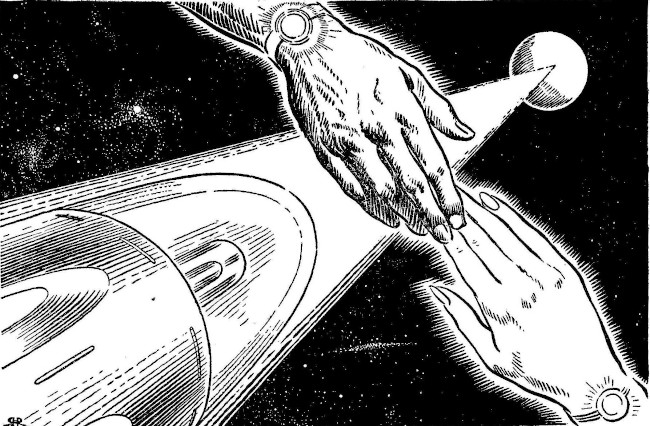
"That won't change the facts," he countered, philosophically. "Are you ready to flit? The Dauntless is hot, they tell me."
"Uh-huh, all my stuff is aboard." And soon they were en route to Klovia.
The trip was uneventful, and even before they reached that transformed planet it became evident that it was theirs from pole to pole. Their cruiser was met by a horde of spaceships of all types and sizes, which formed a turbulent and demonstrative escort of honor. The seething crowd at the spaceport could scarcely be kept out of range of the dreadnought's searing landing blasts. Half the brass bands of the world, it seemed, burst into "Our Patrol" as the Lensmen disembarked, and their ground car and the street along which it slowly rolled were decorated lavishly with deep-blue flowers.
"Thorn flowers!" Clarrissa choked. "Thralian thorn flowers, Kim—how could they?"
"They grow here as well as there, and when they found out that you liked them so well they imported them by the shipload"—and Kinnison himself swallowed a lump.
Their brief stay upon Klovia was a hectic one indeed. Parties and balls, informal and formal, and at least a dozen telenews poses every day. Receptions, at which there were presented the personages and the potentates of a thousand planets; at which the uniforms and robes and gowns put the solar spectrum to shame.
And from tens of thousands of planets came Lensmen, to make or to renew acquaintance with the Galactic Co-ordinator and to welcome into their ranks the Lensman-bride. From Tellus, of course, they came in greatest number and enthusiasm, but other planets were not too far behind. They came from Manark and Velantia and Chickladoria and Alsakan and Vandemar, from the worlds of Canopus and Vega and Antares, from all over the Galaxy. Human, near-human, nonhuman, monstrous; there even appeared briefly quite large numbers of frigid-blooded Lensmen, whose fiercely laboring refrigerators chilled the atmosphere for yards around their insulated and impervious suits. All those various beings came with a united purpose, with a common thought—to congratulate Kinnison of Tellus and to wish his Lensman-mate all the luck and all the happiness of the universe.
Kinnison was surprised at the sincerity with which they acclaimed him; he was amazed at the genuineness and the intensity of their adoption of his Chris as their own. He had been afraid that some of them would think that he was throwing his weight around when he violated precedent by making her a Lensman. He had been afraid of animosity and ill will. He had been afraid that outraged masculine pride would set up a sex antagonism. But if any of these things existed, the keenest use of his every penetrant sense could not discover them.
Instead, the human Lensmen literally mobbed her as, en masse, they took her to their collective bosom. No party, wherever or for what reason held, was complete without her. If she ever had less than ten escorts at once, she was slighted. They ran her ragged, they danced her slippers off, they stuffed her to repletion, they would not let her sleep, they granted her the privacy of a goldfish—and she loved every tumultuous second of it.
She had wanted, as she had told Haynes and Lacy so long ago, a big wedding; but this one was already out of hand and was growing more so by the minute. The idea of holding it in a church had been abandoned long since; now it became clear that the biggest armory of Klovia would not hold even half of the Lensmen, to say nothing of the notables and dignitaries who had come so far. It would simply have to be the Stadium; a bowl so vast that no previous crowd had filled one tenth of its seats. Seeing and hearing there were excellent, however, as the spectators did not look at the scene itself, but into visiplates comfortably close.
Even the Stadium could not accommodate that throng, hence speakers and plates were run outside, clear up to the space-field fence. And, although neither of the principals knew it, this marriage had so fired public interest that Universal Telenews men had already arranged the hookup which was to carry it to every planet of Civilization. The number of entities who thus saw and heard that wedding has been estimated, but the figures are too fantastic to be repeated here.
But it was in no sense a circus. No ceremony ever held, in home or in church or in cathedral, was ever more solemn. For when half a million Lensmen concentrate upon solemnity, it prevails—no levity is possible within a radius of miles.
The whole vast bowl was gay with flowers—it seemed as though a state must have been stripped of blooms to furnish so many—and ferns and white ribbons were everywhere. There was a mighty organ, which pealed out triumphal melody as the bridal parties marched down the aisles, subsiding into a lilting accompaniment as the betrothed couple ascended the white-brocaded stairway and faced the Lensman-chaplain in the heavily garlanded little open-air chapel. The minister raised both hands. The massed Patrolmen and nurses stood at attention. A profound silence fell.
"Dearly beloved—" The grand old service—short and simple, but utterly impressive—was soon over. Then, as Kinnison kissed his wife, half a million Lensed members were thrust upward in silent salute.
Through a double lane of flowing Lenses the wedding party made its way up to the locked and guarded gate of the space-field, upon which lay the Dauntless—the superdreadnought "yacht" in which the Kinnisons were to take a honeymoon voyage to distant Tellus. The gate opened. The couple, accompanied by the port admiral and the surgeon general, stepped into the car, which sped out to the battleship; and as it did so the crowd loosed its pent-up feelings in a prolonged outburst of cheering.
And as the newlyweds walked up the gangplank, Kinnison turned his head and shouted to Haynes:
"You've been griping so long about Lyrane VIII, chief—I forgot to say that you can go mop up on it now!"
ACKNOWLEDGMENT
Your historian, not wishing to take credit which is not rightfully his, wishes to say here that without the fine co-operation of many persons and entities this history must have been of much less value and importance than it now is.
First, of course, there were the Lensmen. It is unfortunate that Nadreck of Palain VII could not be induced either to release his spool of the Fall of Onlo or to enlarge upon his other undertakings.
Co-ordinator Kinnison, Worsel of Velantia, and Tregonsee of Rigel IV, however, were splendidly co-operative, giving in personal conversations much highly useful material which is not heretofore of public record. The gracious and queenly Red Lensman also was of great assistance.
Dr. James R. Enright was both prolific and masterly in deducing that certain otherwise necessarily obscure events and sequences must have in fact occurred, and it is gratefully admitted here that the author has drawn heavily upon "Dr. Jim's" profound knowledge of the mind.
The Galactic Roamers, those intrepid spacemen, assisted no little: E. Everett Evans, their chief communications officer, Paul Leavy, Jr., Alfred Ashley, F. Edwin Counts; to name only a few who aided in the selection, arrangement, and presentation of material.
Verna Trestrail, the exquisite connoisseuse, was of help, not only by virtue of her knowledge of the jewels of Lonabar, but also in her interpretations of many things concerning Illona Potter of which Illona Henderson—characteristically—will not speak.
To all these, and to many others whose help was only slightly less, the writer extends his sincere thanks.
Edward E. Smith.