Front matter (continued 3)
Reading edition
"I ask what I asked."
"Ah, Kinnison of Tellus, you truly grow. You at last learn to think. It is wise," and the telepathic link snapped.
Kinnison slumped down in relief. He had not known what to expect. He would not have been surprised if the Arisian had pinned his ears back; he certainly did not expect either the compliment or the clear-cut answer. He knew that Mentor would give him no help whatever in any problem which he could possibly solve alone; he was just beginning to realize that the Arisian would aid him in matters which were absolutely, intrinsically, beyond his reach.
Recovering, he flashed a call to Surgeon General Lacy.
"Lacy? Kinnison. I would like to have Sector Chief Nurse Clarrissa MacDougall detached at once. Please have her report to me here aboard the Dauntless, en route, at the earliest possible moment of rendezvous."
"Huh? What? You can't ... you wouldn't—" the old Lensman gurgled.
"No, I wouldn't. The whole corps will know it soon enough, so I might as well tell you now that I'm going to make a Lensman out of her."
Lacy exploded then, but Kinnison had expected that.
"Seal it!" he counseled, sharply. "I am not doing it entirely on my own—Mentor of Arisia made the final decision. Prefer charges against me if you like, but in the meantime please do as I request."
And that was that.
VIII.
A few hours before the time of rendezvous with the cruiser which was bringing Chris out to him, the detectors picked up a vessel whose course, it proved, was set to intersect their own. A minute or so later a sharp, clear thought came through Kinnison's Lens.
"Kim? Raoul. Been flitting around out Arisia way, and they called me in and asked me to bring you a package. Said you'd be expecting it. QX?"
"Hi, Spacehound! QX." Kinnison had very decidedly not been expecting it—he had thought that he would have to do the best he could without it—but he realized instantly, with a thrill of gladness, what it was. "Inert? Or can't you stay?"
"Free. Got to make a rendezvous. Can't take time to inert—that is, if you'll inert the thing in your cocoon. Don't want it to hole out on you, though."
"Can do. Free it is. Pilot room! Prepare for inertialess contact with vessel approaching. Magnets. Messenger coming aboard—free."
The two speeding vessels flashed together, at all their unimaginable velocities, without a thump or jar. Magnetic clamps locked and held. Air-lock doors opened, shut, opened; and at the inner port Kinnison met Raoul la Forge, his classmate through the four years at Wentworth Hall. Brief but hearty greetings were exchanged, but the visitor could not stop. Lensmen are busy men.
"Fine seeing you, Kim—be sure and inert the thing—clear ether!"
"Same to you, ace. Sure, I will—think I want to tear a guy's arm off?"
Indeed, inerting the package was the Lensman's first care, for in the free condition it was a frightfully dangerous thing. Its intrinsic velocity was that of Arisia, while the ship's was that of Lyrane II. They might be forty or fifty miles per second apart; and if the Dauntless should go inert that harmless-looking package would instantly become a meteorite inside the ship. At the thought of that velocity he paused. The cocoon would stand it—but would the Lens? Oh, sure, the Arisian knew that this was coming; the Lens would be packed to stand it.
Kinnison wrapped the package in heavy gauze, then in roll after roll of spring steel mesh. He jammed heavy steel springs into the ends, then clamped the whole thing into a form with tool-steel bolts an inch in diameter. He poured in two hundred pounds of metallic mercury, filling the form to the top. Then a cover, also bolted on. This whole assembly went into the "cocoon," a cushioned, heavily padded affair suspended from all four walls, ceiling, and floor by every shock-absorbing device known to the engineers of the Patrol.
The Dauntless inerted briefly at Kinnison's word and it seemed as though a troop of elephants were running silently amuck in the cocoon room. The package to be inerted weighed no more than eight ounces—but eight ounces of mass, at a relative velocity of fifty miles per second, possesses a kinetic energy by no means to be despised.
The frantic lurchings and bouncings subsided, the cruiser resumed her free flight, and the man undid all that he had done. The Arisian package looked exactly as before, but it was harmless now; it had the same intrinsic velocity as did everything else aboard the vessel.
Then the Lensman pulled on a pair of thick rubber gloves and opened the package; finding, as he had expected, that the packing material was a dense, viscous liquid. He poured it out and there was the Lens—Chris' Lens! He cleaned it carefully, then wrapped it in heavy insulation. For of all the billions of unnumbered billions of living entities in existence, Clarrissa MacDougall was the only one whose flesh could touch that apparently innocuous jewel with impunity. Others could safely touch it while she wore it, while it glowed with its marvelously polychromatic cold flame; but until she wore it, and unless she wore it, its touch meant death to any life to which it was not attuned.
Shortly thereafter another Patrol cruiser hove in sight. This meeting, however, was to be no casual one, for the nurse could not be inerted from the free state in the Dauntless' cocoon. No such device ever built could stand it—and those structures are stronger far than is the human frame. Any adjustment which even the hardest, toughest spacehound can take in a cocoon is measured in feet per second, not in miles.
Hundreds of miles apart, the ships inerted and their pilots fought with supreme skill to make the two intrinsics match. And even so the vessels did not touch, even nearly. A space line was thrown; the nurse and her space roll were quite unceremoniously hauled aboard.
Kinnison did not meet her at the air lock, but waited for her in his con room; and the details of that meeting will remain unchronicled. They were young, they had not seen each other for a long time, and they were very much in love. It is evident, therefore, that Patrol affairs were not the first matters to be touched upon. Nor, if the historian has succeeded even partially in portraying truly the characters of the two persons involved, is it either necessary or desirable to go at any length into the argument they had as to whether or not she should be inducted so cavalierly into a service from which her sex had always, automatically, been barred. He did not want to make her carry that load, but he had to; she did not—although for entirely different reasons—want to take it.
He shook out the Lens and, holding it in a thick-folded corner of the insulating blanket, flicked one of the girl's fingertips across the bracelet. Satisfied by the fleeting flash of color which swept across the jewel, he snapped the platinum-iridium band around her left wrist, which it fitted exactly.
Chris stared for a minute at the smoothly, rhythmically flowing colors of the thing so magically sprung to life upon her wrist; awe and humility in her glorious eyes. Then:
"I can't, Kim. I simply can't. I'm not worthy of it," she choked.
"None of us is, Chris. We can't be—but we've got to do it, just the same."
"I suppose that's true—it would be so, of course. I'll do my best—but you know perfectly well, Kim, that I'm not—can't ever be—a real Lensman."
"Sure, you can. Do we have to go over all that again? You won't have some of the technical stuff that we got, of course, but you carry jets that no other Lensman ever has had. You're a real Lensman; don't worry about that—if you weren't, do you think that they would have made that Lens for you?"
"In a way I see that that must be true, even though I can't understand it. But I'm simply scared to death of the rest of it, Kim."
"You needn't be. It'll hurt, but not more than you can stand. Don't think we'd better start that stuff for a few days yet, though; not until you get used to using your Lens. Coming at you, Lensman!" and he went into Lens-to-Lens communication, broadening it gradually into a wide-open two-way.
She was appalled at first, but entranced some thirty minutes later, when he called the lesson to a halt.
"Enough for now," he decided. "It doesn't take much of that stuff to be a great plenty, at first."
"I'll say it doesn't," she agreed. "Put this away for me until next time, will you, Kim? I don't want to wear it all the time until I know more about it."
"Fair enough. In the meantime I want you to get acquainted with a new girl friend of mine," and he sent out a call for Illona Potter.
"Girl friend!"
"Uh-huh. Study her. Educational no end, and she may be important. Want to compare notes with you on her later, is why I'm not giving you any advance dope on her—here she comes."
"Mac, this is Illona," he introduced them informally. "I told them to give you the cabin next to hers," he added, to the nurse. "I'll go with you to be sure that everything's on the green."
It was, and the Lensman left the two together.
"I'm awfully glad you're here," Illona said, shyly. "I've heard so much about you, Miss—"
"Mac to you, my dear—all of my friends call me that," the nurse broke in. "And you don't want to believe everything you hear, especially aboard this space can." Her lips smiled, but her eyes were faintly troubled.
"Oh, it was nice," Illona assured her. "About what a grand person you are, and what a wonderful couple you and Lensman Kinnison make ... why, you really are in love with him, aren't you?" This in surprise, as she studied the nurse's face.
"Yes," unequivocally. "And you love him, too, and that makes it—"
"Good heavens, no!" the Aldebaranian exclaimed, so positively that Clarrissa jumped.
"What? You don't? Really?" Gold-flecked, tawny eyes stared intensely into engagingly candid eyes of black. Mac wished then that she had left her Lens on, so that she could tell whether this bejeweled brunet hussy was telling the truth or not.
"Certainly not. That's what I meant—I'm simply scared to death of him. He's so—well—so over-powering. He's so much more—tremendous—than I am. I didn't see how any girl could possibly love him—but I understand now how you could, perhaps. You're sort of—terrific—yourself, you know. I feel as though I ought to call you 'Your Magnificence' instead of just plain Mac."
"Why, I'm no such thing!" Clarrissa exclaimed; but she softened noticeably, none the less. "And I think that I'm going to like you a lot."
"Oh-h-h—honestly?" Illona squealed. "It sounds too good to be true, you're so marvelous. But if you do, I think that Civilization will be everything that I've been afraid—so afraid—that it couldn't possibly be!"
No longer was it a feminine Lensman investigating a female zwilnik; it was two girls—two young, intensely alive, human girls—who chattered on and on.
Days passed. Mac learned the use of her Lens as well as any first stage Lensman had ever known it. Then Kinnison, one of the few then existent second stage Lensmen, began really to bear down. Since the acquirement of the second stage of Lensmanship has been described in detail elsewhere, it need be said here only that Clarrissa MacDougall had mental capacity enough to take it without becoming insane. He suffered as much as she did; after every mental bout he was as spent as she was; but both of them stuck relentlessly to it.
As is now well known, the prime requisite of all such advanced treatment is to know with the utmost precision exactly what knowledge or ability is required. Mac had no idea as to what she wanted or needed; but Kinnison did.
He could not give her everything that the Arisian had given him, of course. Much of it was too hazy yet; more of it did not apply. He gave her everything, however, which she could handle and which would be of any use to her in the work she was to do; including the sense of perception. He did it, that is, with a modicum of help; for, once or twice, when he faltered or weakened, not knowing exactly what to do or not being quite able to do it, a stronger mind than his was always there.
At length, approaching Tellus fast, Mac and Kim had a final conference; the consultation of two Lensmen settling the last details of procedure in a long-planned and highly important campaign.
"I agree with you that Lyrane II is a key planet," the nurse was saying, thoughtfully. "It must be, to have those expeditions from Lonabar and the as yet unknown planet 'X' centering there."
"'X' certainly, and don't forget the possibility of 'Y' and 'Z' and maybe others," he reminded her. "The Lyrane-Lonabar linkage is the only one we are sure of. With you on one end of that and me on the other, it'll be funny if we can't trace out some more. While I'm building up an authentic identity to tackle Bleeko, you'll be getting chummy with Helen of Lyrane. That's about as far ahead as we can plan definitely right now, since this ground-work can't be hurried too much."
"And I report to you often—frequently, in fact." Mac widened her expressive eyes at her man.
"At least," he agreed. "And I'll report to you between times."
"Oh, Kim, it's nice, being a Lensman!" She snuggled closer. Some way or other, the conference had become somewhat personal. "Being en rapport will be almost as good as being together—we can stand it, that way, at least."
"It'll help a lot, ace, no fooling. That was why I was afraid to go ahead with it on my own hook. I couldn't be sure that my feelings were not in control, instead of my judgment—if any."
"I'd have been certain that it was your soft heart instead of your hard head if it hadn't been for Mentor," she sighed, happily. "As it is, though, I know that everything is on the green."
"All done with Illona?"
"Yes, the darling. She's the sweetest thing, Kim—and a storehouse of information if there ever was one. You and I know more of Boskonian life than anyone of Civilization ever knew before, I am sure. And it's so ghastly! We must win, Kim—we simply must, for the good of all creation!"
"We will." Kinnison spoke with grim finality.
"But back to Illona. She can't go with me, and she can't stay here with Hank aboard the Dauntless taking me back to Lyrane, and you can't watch her. I'd hate to think of anything happening to her, Kim."
"It won't," he replied, comfortably. "Ilyowicz won't sleep nights until he has her as the top-flight solo dancer in his show—even though she doesn't have to work for a living any more."
"She will, though, I think. Don't you?"
"Probably. Anyway, a couple of Haynes' smart girls are going to be her best friends, wherever she goes. Sort of keep an eye on her until she learns the ropes—it won't take long. We owe her that much, I figure."
"That much, at least. You're seeing to the selling of her jewelry yourself, aren't you?"
"No, I had a new thought on that. I'm going to buy it myself—or rather, Cartiff is. They're making up a set of paste imitations. Cartiff has to buy a stock somewhere; why not hers?"
"That's a thought—there's certainly enough of them to stock a wholesaler. 'Cartiff'—I can see that sign," she snickered. "Almost microscopic letters, severely plain, in the lower right-hand corner of an immense plate-glass window. One gem in the middle of an acre of black velvet. Cartiff, the most peculiar, if not quite the most exclusive, jeweler in the Galaxy. And nobody except you and me knows anything about him. Isn't that something?"
"Everybody will know about Cartiff pretty soon," he told her. "Found any flaws in the scheme yet?"
"Nary a flaw." She shook her head. "That is, if none of the boys overdo it, and I'm sure they won't. I've got a picture of it," and she giggled merrily. "Think of a whole gang of sleuths from the homicide division chasing poor Cartiff, and never quite catching him!"
"Uh-huh—a touching picture indeed. But there goes the signal, and there's Tellus. We're about to land."
"Oh, I want to see!" and she started to get up.
"Look, then," pulling her down into her original place at his side. "You've got the sense of perception now, remember; you don't need visiplates."
And side by side, arms around each other, the two Lensmen watched the docking of their great vessel.
It landed. Jewelers came aboard with their carefully made wares. Assured that the metal would not discolor her skin, Illona made the exchange willingly enough. Beads were beads, to her. She could scarcely believe that she was now independently wealthy—in fact, she forgot all about her money after Ilyowicz had seen her dance.
"You see," she explained to Mac and Kinnison, "there were two things I wanted to do until Hank gets back—travel around a lot and learn all I can about your Civilization. I wanted to dance, too, but I didn't see how I could. Now I can do all three, and get paid for doing them besides—isn't that marvelous? And Mr. Ilyowicz said that you said that it was QX. Is it, really?"
"Right," and Illona was off.
The Dauntless was serviced and Mac was off, to far Lyrane.
Lensman Kinnison was supposedly off somewhere, also, when Cartiff appeared. Cartiff, the ultra-ultra; the, oh, so exclusive! Cartiff did not advertise. He catered, word spread fast, to only the very upper flakes of the upper crust. Simple dignity was Cartiff's keynote, his insidiously spread claim; the dignified simplicity of immense wealth and impeccable social position.
What he actually achieved, however, was something subtly different. His simplicity was just a hair off beam; his dignity was an affected, not a natural, quality. Nobody with less than a million credits ever got past his door, it is true. However, instead of being the real crème de la crème of Earth, Cartiff's clients were those who pretended to belong to, or who were trying to force an entrance into, that select stratum. Cartiff was a snob of snobs; he built up a clientele of snobs; and, even more than in his admittedly fine and flawless gems, he dealt in equally high-proof snobbery.
Betimes came Nadreck, the Unattached Lensman of Palain VII, and Kinnison met him secretly at Prime Base. Soft-voiced as ever, apologetic, diffident; even though Kim had learned that the Palainian had a record of accomplishment as long as any one of his arms. But it was not an act, not affectation. It was simply a racial trait, for the intelligent and civilized race of that planet is in no sense human. Nadreck was utterly, startlingly unhuman. In his atmosphere there was no oxygen, in his body there flowed no aqueous blood. At his normal body temperature neither liquid water nor gaseous oxygen could exist.
The seventh planet out from any sun would, of course, be cold, but Kinnison had not thought particularly about the point until he felt the bitter radiation from the heavily insulated suit of his guest; perceived how fiercely its refrigerators were laboring to keep its internal temperature down.
"If you will permit it, please, I will depart at once," Nadreck pleaded, as soon as he had delivered his spool and his message. "My heat dissipators, powerful though they are, cannot cope much longer with this frightfully high temperature."
"QX, Nadreck—thanks a million," and the weird little monstrosity scuttled out. "Remember, Lensman's Seal on all this stuff until Prime Base releases it."
"Of course, Kinnison. You will understand, however, I am sure, that none of our races of Civilization are even remotely interested in Lonabar—it is as hot, as poisonous, as hellish generally as is Tellus itself!"
Kinnison went back to Cartiff's; and very soon thereafter it became noised abroad that Cartiff was a crook. He was a cheat, a liar, a robber. His stones were synthetic; he made them himself. The stories grew. He was a smuggler; he didn't have an honest gem in his shop. He was a zwilnik, an out-and-out pirate; a red-handed murderer who, if he wasn't there already, certainly ought to be in the big black book of the Galactic Patrol. This wasn't just gossip, either; everybody saw and spoke to men who had seen unspeakable things with their own eyes.
Thus Cartiff was arrested. He blasted his way out, however, before he could be brought to trial, and the newscasters blazed with that highly spectacular, murderous jail break. Nobody actually saw Cartiff escape, nobody actually saw any lifeless bodies. Everybody, however, saw the telenews broadcasts of the shattered walls and the sheeted forms; and, since such pictures are and always have been just as convincing as the real thing, everybody knew that there had been plenty of mangled corpses in those ruins and that Cartiff was a fugitive murderer. Also, everybody knew that the Patrol never gives up on a murderer.
Hence it was natural enough that the search for Cartiff, the jeweler-murderer, should spread from planet to planet and from region to region. Not exactly obtrusively, but inexorably, it did so spread; until finally anyone interested in the subject could find upon any one of a hundred million planets unmistakable evidence that the Patrol wanted one Cartiff, description so-and-so, for murder in the first degree.
And the Patrol was thorough. Wherever Cartiff went or how, they managed to follow him. At first he disguised himself, changed his name, and stayed in the legitimate jewelry business; apparently the only business he knew. But he never could get even a start. Scarcely would his shop open than he would be discovered and forced again to flee.
Deeper and deeper he went, then, into the noisome society of crime. A fence now—still and always he clung to jewelry. But always and ever the bloodhounds of the law were baying at his heels. Whatever name he used was nosed aside and "Cartiff" they howled; so loudly that a thousand million worlds came to know that despised and hated name.
Perforce he became a traveling fence, always on the go. He flew a dead-black ship, ultrafast, armed and armored like a superdreadnought, crewed—according to the newscasts—by the hardest-boiled gang of cutthroats in the known universe. He traded in, and boasted of trading in, the most bloodstained, the most ghost-ridden gems of a thousand worlds. And, so trading, hurling defiance the while into the teeth of the Patrol, establishing himself ever more firmly as one of Civilization's cleverest and most implacable foes, he worked zigzagwise and not at all obviously toward the unexplored spiral arm in which the planet Lonabar lay. And as he moved farther and farther away from the Solarian System his stock of jewels began to change. He had always favored pearls—the lovely, glorious things so characteristically Tellurian—and those he kept. The diamonds, however, he traded away; likewise the emeralds, the rubies, the sapphires, and some others. He kept and accumulated Borovan firestones, Manarkan star drops, and a hundred other gorgeous gems, none of which would be "beads" upon the planet which was his goal.
He visited planets only fleetingly now; the Patrol was hopelessly out-distanced. Nevertheless, he took no chances. His villainous crew guarded his ship; his bullies guarded him wherever he went—surrounding him when he walked, standing behind him while he ate, sitting at either side of the bed in which he slept. He was a king snipe now.
As such he was accosted one evening as he was about to dine in a garish restaurant. A tall, somewhat fish-faced man in faultless evening dress approached. His arms were at his sides, fingertips bent into the "I'm not shooting" sign.
"Captain Cartiff, I believe. May I seat myself at your table, please?" the stranger asked, politely, in the lingua franca of deep space.
Kinnison's sense of perception frisked him rapidly for concealed weapons. He was clean. "I would be very happy, sir, to have you as my guest," he replied, courteously.
The stranger sat down, unfolded his napkin, and delicately allowed it to fall into his lap, all without letting either of his hands disappear from sight, even for an instant, beneath the table's top. He was an old and skillful hand. And during the excellent meal the two men conversed brilliantly upon many topics, none of which were of the least importance. After it Kinnison paid the check, despite the polite protestations of his vis-à-vis. Then:
"I am simply a messenger, you will understand, nothing else," the guest observed. "No. 1 has been checking up on you, and has decided to let you come in. He will receive you tonight. The usual safeguards on both sides, of course—I am to be your guide and guarantee."
"Very kind of him, I'm sure." Kinnison's mind raced. Who could this No. 1 be? The ape had a thought-screen on, so he was flying blind. Couldn't be a real big shot, though, so soon—no use monkeying with him at all. "Please convey my thanks, but also my regrets."
"What?" the other demanded. His veneer of politeness had sloughed off; his eyes were narrow, keen, and cold. "You know what happens to independent operators around here, don't you? Do you think that you can fight us?"
"Not fight you, no." The Lensman elaborately stifled a yawn. He now had a clue. "Simply ignore you—if you act up, smash you like bugs, that's all. Please tell your No. 1 that I do not split my takes with anybody. Tell him also that I am looking for a choicer location to settle down upon than any I have found as yet. If I do not find such a place near here, I shall move on. If I do find it I shall take it, in spite of man or the devil."
The stranger stood up, glaring in quiet fury, but with both hands still above the table. "You want to make it a war, then, Captain Cartiff!" he gritted.
"Not 'Captain' Cartiff, please," Kinnison begged, dipping one paw delicately into his finger bowl. "'Cartiff' merely, my dear fellow, if you don't mind. Simplicity, sir, and dignity; those two are my key words."
"Not for long," prophesied the other. "No. 1 will blast you out of the ether before you can swap another necklace."
"The Patrol has been trying to do that for some time now, and I'm still here," Kinnison reminded him, gently. "Caution him, please, in order to avoid bloodshed, not to come after me in only one ship, but a fleet; and suggest that he have something hotter than Patrol primaries before he tackles me at all."
Surrounded by his bodyguards, Kinnison left the restaurant, and as he walked along he reflected. Nice going, this. It would get around fast. This No. 1 couldn't be Bleeko; but the king snipe of Lonabar and its environs would hear the news in short order. He was now ready to go. He would flit around a few more days—give this bunch of zwilniks a chance to make a pass at him if they felt like calling his bluff—then on to Lonabar.
IX.
Kinnison did not walk far, nor reflect much, before he changed his mind and retraced his steps; finding the messenger still in the restaurant.
"So you got wise to yourself and decided to crawl while the crawling's good, eh?" he sneered, before the Lensman could say a word. "I don't know whether the offer is still good or not."
"No—and I advise you to muffle your exhaust before somebody rams a ray gun down your throat." Kinnison's voice was coldly level. "I came back to tell you to tell your No. 1 that I'm calling his bluff. You know Checuster?"
"Of course." The zwilnik was plainly discomfited.
"Come along, then, and listen, so you'll know that I'm not running a blazer."
They sought a booth, wherein the native himself got Checuster on the visiplate.
"Checuster, this is Cartiff." The start of surprise and the expression of pleased interest revealed how well that name was known. "I'll be down at your old warehouse day after tomorrow night about this time. Pass the word around that if any of the boys have any stuff too hot for them to handle conveniently, I'll buy it; paying for it in either Patrol credits or bar platinum, whichever they like."
He then turned to the messenger. "Did you get that straight, Lizard Puss?"
The man nodded.
"Relay it to No. 1," Kinnison ordered and strode off. This time he got to his ship, which took off at once.
Cartiff had never made a habit of wearing visible arms, and his guards, while undoubtedly fast gunmen, were apparently only that. Therefore there was no reason for No. 1 to suppose that his mob would have any noteworthy difficulty in cutting this upstart, Cartiff, down. He was, however, surprised; for Cartiff did not come afoot or unarmed.
Instead, it was an armored car that brought the intruding fence through the truck entrance into the old warehouse. Not a car, either; it was more like a twenty-ton tank except for the fact that it ran upon wheels, not treads. It was screened like a cruiser; it mounted a battery of projectors whose energies, it was clear to any discerning eye, nothing short of battle screen could handle. The thing rolled quietly to a stop, a door swung open, and Kinnison emerged. He was neither unarmed nor unarmored now. Instead, he wore a full suit of G-P armor or a reasonable facsimile thereof, and carried a semiportable projector.
"You will excuse the seeming discourtesy, men," he announced, "when I tell you that a certain No. 1 has informed me that he will blast me out of the ether before I swap a necklace on this planet. Stand clear, please, until we see whether he meant business or was just warming up his jets. Now, No. 1, if you're around, come and get it!"
Apparently the challenged party was not present, for no overt move was made. Neither could Kinnison's sense of perception discover any sign of unfriendly activity within its range. Of mind reading there was none, for every man upon the floor was, as usual, both masked and screened.
Business was slack at first, for those present were not bold souls and the Lensman's overwhelmingly superior armament gave them very seriously to doubt his intentions. Many of them, in fact, had fled precipitately at the first sight of the armored truck, and of these more than a few—No. 1's thugs, no doubt—did not return. The others, however, came filtering back as they perceived that there was to be no warfare and as cupidity overcame their timorousness. And as it became evident to all that the stranger's armament was for defense only, that he was there to buy or to barter and not to kill and thus to steal, Cartiff trafficked ever more and more briskly, as the evening wore on, in the hottest gems of the planet.
Nor did he step out of character for a second. He was Cartiff the fence, all the time. He drove hard bargains, but not too hard. He knew jewels thoroughly by this time, he knew the code, and he followed it rigorously. He would give a thousand Patrol credits, in currency good upon any planet of Civilization or in bar platinum good anywhere, for an article worth five thousand, but which was so badly wanted by the law that its then possessor could not dispose of it at all. Or, in barter, he would swap for that article another item, worth fifteen hundred or so, but which was not hot—at least, not upon that planet. Fair enough—so fair that it was almost morning before the silently running truck slid into its storage inside the dead-black spaceship.
Then, in so far as No. 1, the Patrol, and Civilization were concerned, Cartiff and his outfit simply vanished. The zwilnik subchief hunted him viciously for a space, then bragged of how he had run him out of the region. The Patrol, as usual, bided its time, watching alertly. The general public forgot him completely in the next sensation to arise.
Fairly close although he then was to the rim of the Galaxy, Kinnison did not take any chances at all of detection in a line toward that rim. The spiral arm beyond Rift 85 was unexplored. It had been of so little interest to Civilization that even its various regions were nameless upon the charts, and the Lensman wanted it to remain that way, at least for the time being. Therefore he left the Galaxy in as nearly a straight nadir line as he could without coming within detection distance of any trade route. Then, making a prodigious loop, so as to enter the spiral arm from the nadir direction, he threw Nadreck's map into the pilot tank and began the computations which would enable him to place correctly in that three-dimensional chart the brilliant point of light which represented his ship.
In this work he was ably assisted by his chief pilot. He did not have Henderson now, but he did have Watson, who rated No. 2 only by the hair-splitting of the supreme Board of Examiners. Such hair-splitting was, of course, necessary: otherwise no difference at all could have been found within the ranks of the first fifty of the Patrol's master pilots, to say nothing of the first three or four. And the rest of the crew did whatever they could.
For it was only in the newscasts that Cartiff's crew was one of murderous and villainous pirates. They were, in fact, volunteers; and, since everyone is familiar with what that means in the Patrol, that statement is as efficient as a book would be.
The chart was sketchy and incomplete, of course; around the flying ship were hundreds, yes, thousands, of stars which were not in the chart at all; but Nadreck had furnished enough reference points so that the pilots could compute their orientation. No need to fear detectors now, in these wild, waste spaces; they set a right-line course for Lonabar and followed it.
As soon as Kinnison could make out the continental outlines of the planet upon the plates he took over control, as he alone of the crew was upon familiar ground. He knew everything about Lonabar that Illona had ever learned; and, although the girl was a total loss as an astronaut, she did know her geography.
Kinnison docked his ship boldly at the spaceport of Lonia, the planet's largest city and its capital. With equal boldness he registered as "Cartiff," filling in some of the blank spaces in the spaceport's routine registry form—not quite truthfully, perhaps—and blandly ignoring others. The armored truck was hoisted out of the hold and made its way to Lonia's largest bank, into which it disgorged a staggering total of bar platinum, as well as sundry coffers of hard, gray steel. These last items went directly into a private vault, under the watchful eyes and ready weapons of Kinnison's own guards.
The truck rolled swiftly back to the spaceport and Cartiff's ship took off—it did not need servicing at the time—ostensibly for another planet unknown to the Patrol, actually to go, inert, into a closed orbit around Lonabar and near enough to it to respond to a call in seconds.
Immense wealth can command speed of construction and service. Hence, in a matter of days, Cartiff was again in business. His salon was, upon a larger and grander scale, a repetition of his Tellurian shop. It was simple, and dignified, and blatantly expensive. Costly rugs covered the floor, impeccable works of art adorned the walls, and three precisely correct, flawlessly groomed clerks displayed, with the exactly right air of condescending humility, Cartiff's wares before those who wished to view them. Cartiff himself was visible, ensconced within a magnificent plate-glass-and-gold office in the rear, but he did not ordinarily have anything to do with customers. He waited; nor did he wait long before there happened that which he expected.
One of the superperfect clerks coughed slightly into a microphone.
"A gentleman insists upon seeing you personally, sir," he announced.
"Very well, I will see him now. Show him in, please," and the visitor was ceremoniously ushered into the Presence.
"This is a very nice place you have here, Mr. Cartiff, but did it ever occur to you that—"
"It never did and it never will," Kinnison snapped. He still lolled at ease in his chair, but his eyes were frosty and his voice carried an icy sting. "I quit paying protection to little shots a good many years ago. Or are you from Menjo Bleeko?"
The visitor's eyes widened. He gasped, as though even to utter that dread name were sheer sacrilege. "No, but No.—"
"Save it, slob!" The cold venom of that crisp but quiet order set the fellow back onto his heels. "I am thoroughly sick of this thing of every half-baked tinhorn zwilnik in space calling himself No. 1 as soon as he can steal enough small change to hire an ape to walk around behind him packing a couple of ray guns. If that louse of a boss of yours has a name, use it. If he hasn't, call him 'The Louse.' But cancel that No. 1 stuff. In my book there is no No. 1 in the whole damned Universe. Doesn't your mob know yet who and what Cartiff is?"
"What do we care?" The visitor gathered courage visibly. "A good big bomb—"
"Clam it, you squint-eyed slime-lizard!" The Lensman's voice was still low and level, but his tone bit deep and his words drilled in. "That stuff?" he waved inclusively at the magnificent hall. "Sucker bait, nothing more. The whole works cost only a hundred thousand. Chicken feed. It wouldn't even nick the edge of the roll if you blew up ten of them. Bomb it any time you feel the urge. But take notice that it would make me sore—plenty sore—and that I would do things about it; because I'm in a big game, not this petty-larceny racketeering and chiseling that your mob is doing, and when a toad gets in my way I step on it. So go back and tell that No. 1 of yours to case a job a lot more thoroughly than he did this one before he starts throwing his weight around. Now scram, before I feed your carcass to the other rats around here!"
Kinnison grinned inwardly as the completely deflated gangster slunk out. Good going. It wouldn't take long for that blast to get action. This little-shot No. 1 wouldn't dare to lift a hand, but Bleeko would have to. That was axiomatic, from the very nature of things. It was very definitely Bleeko's move next. The only moot point was as to which his nibs would do first—talk or act. He would talk, the Lensman thought. The prime reward of being a hot shot was to have people know it and bend the knee. Therefore, although Cartiff's salon was at all times in complete readiness for any form of violence, Kinnison was practically certain that Menjo Bleeko would send an emissary before he started the rough stuff.
He did, and shortly. A big, massive man was the messenger; a man wearing consciously an aura of superiority, of boundless power and force. He did not simply come into the shop—he made an entrance. All three of the clerks literally cringed before him, and at his casually matter-of-fact order they hazed the already uncomfortable customers out of the shop and locked the doors. Then one of them escorted the visitor, with a sickening servility he had never thought of showing toward his employer and with no thought of consulting Cartiff's wishes in the matter, into Cartiff's private sanctum. Kinnison knew at first glance that this was Ghundrith Khars, Bleeko's right-hand man. Khars, the notorious, who kneeled only to his supremacy, Menjo Bleeko himself; and to whom everyone else upon Lonabar and its subsidiary planets kneeled. The big shot waved a hand and the clerk fled in disorder.
"Stand up, worm, and give me that—" Khars began, loftily.
"Silence, fool! Attention!" Kinnison rasped, in such a drivingly domineering tone that the stupefied messenger obeyed involuntarily. The Lensman, psychologist par excellence that he was, knew that this man, with a background of twenty years of blind, dumb obedience to his every order, simply could not cope with a positive and self-confident opposition. "You will not be here long enough to sit down, even if I permitted it in my presence, which I very definitely do not. You came here to give me certain instructions and orders. Instead, you are going to listen merely; I will do all the talking.
"First. The only reason you did not die as you entered this place is that neither you nor Menjo Bleeko knows any better. The next one of you to approach me in this fashion dies in his tracks.
"Second. Knowing as I do the workings of that which your bloated leech of a Menjo Bleeko calls his brain, I know that he has a spy-ray on us now. I am not blocking it out, as I want him to receive ungarbled—and I know that you would not have the courage to transmit it accurately to his foulness—everything I have to say.
"Third. I have been searching for a long time for a planet that I like. This is it. I fully intend to stay here as long as I please. There is plenty of room here for both of us without crowding.
"Fourth. Being essentially a peaceable man, I came in peace and I prefer a peaceable arrangement. However, let it be distinctly understood that I truckle to no man or entity, dead, living, or yet to be born.
"Fifth. Tell Bleeko from me to consider very carefully and very thoroughly an iceberg; its every phase and aspect. That is all—you may go."
"Bub-bub-but," the big man stammered. "An iceberg?"
"An iceberg, yes—just that," Kinnison assured him. "Don't bother to try to think about it yourself, since you've got nothing to think with. But his putrescence, Bleeko, even though he is a mental, moral, and intellectual slime-lizard, can think—at least in a narrow, mean, small-souled sort of way—and I advise him in all seriousness to do so. Now get out of here, before I burn the seat of your pants off."
Khars got, gathering together visibly the shreds of his self-esteem as he did so, the clerks staring the while in dumfounded amazement. Then they huddled together, eying the owner of the establishment with a brand-new respect—a subservient respect, heavily laced with awe.
"Business as usual, boys," he counseled them, cheerfully enough. "They won't blow up the place until after dark."
The clerks resumed their places then and trade did go on, after a fashion; but Cartiff's force had not recovered its wonted blasé aplomb even at closing time.
"Just a moment." The proprietor called his employees together and, reaching into his pocket, distributed among them a sheaf of currency. "In case you don't find the shop here in the morning, you may consider yourselves on vacation at full pay until I call you."
They departed, and Kinnison went back to his office. His first care was to set up a spy-ray block—a block which had been purchased upon Lonabar and which was, therefore, certainly pervious to Bleeko's instruments. Then he prowled about, apparently in deep and anxious thought. But as he prowled, the eavesdroppers did not, could not know that his weight set into operation certain devices of his own highly secret installation, or that when he finally left the shop no really serious harm could be done to it except by an explosion sufficiently violent to demolish the neighborhood for blocks around. The front wall would go, of course. He wanted it to go; otherwise there would be neither reason nor excuse for doing that which for days he had been ready to do.
Since Cartiff lived rigorously to schedule and did not have a spy-ray block in his room, Bleeko's methodical and efficient observers always turned off their beams when the observee went to sleep. This night, however, Kinnison was not really asleep, and as soon as the ray went off he acted. He threw on his clothes and sought the street, where he took a taxi to a certain airport. There he climbed into a rocketplane which was already warmed up and waiting for him.
Hanging from her screaming props the fantastically powerful little plane bulleted upward in a vertical climb, and as she began to slow down from lack of air her projectors took over. A tractor reached out, seizing her gently. Her wings retracted and she was drawn into Cartiff's great spaceship; which, a few minutes later, hung poised above one of the largest, richest jewel mines of Lonabar.
This mine was, among others, Menjo Bleeko's personal property. Since overproduction would glut the market, it was being worked by only one shift of men—the day shift. It was now black night; the usual guards were the only men upon the premises. The big black ship hung there and waited.
"But suppose they don't, Kim?" Watson asked.
"Then we'll wait here every night until they do," Kinnison replied, grimly. "But they'll do it tonight, for all the tea in China. They'll have to, to save Bleeko's face."
And they did. In a couple of hours the observer at a high-powered plate reported that Cartiff's salon had just been blown to bits. Then the Patrolmen went into action.
Bleeko's mobsmen hadn't killed anybody at Cartiff's, therefore the Tellurians wouldn't kill anyone here. Hence, while ten immense beam-dirigible torpedoes were being piloted carefully down shafts and along tunnels into the deepest bowels of the workings, the guards were given warning that, if they got into their fliers fast enough, they could be fifty miles away and probably safe by zero time. They hurried.
At zero time the torpedoes let go as one. The entire planet quivered under the trip-hammer shock of detonating duodec. For those frightful, those appalling charges had been placed, by computations checked and rechecked, precisely where they would wreak the most havoc, the utmost possible measure of sheer destruction. Much of the rock, however hard, around each one of those incredible centers of demolition was simply blasted out of existence. That is the way duodec, in massive charges, works. Matter simply cannot get out of its way in the first instants of its detonation; matter's own inherent inertia forbids.
Most of the rock between the bombs was pulverized the merest fraction of a second later. Then, the distortedly spherical explosion fronts merging, the total incomprehensible pressure was exerted as almost pure lift. The field above the mine works lifted, then; practically as a mass at first. But it could not remain as such. It could not move fast enough as a whole; nor did it possess even a minute fraction of the tensile strength necessary to withstand the stresses being applied. Those stresses, the forces of the explosions, were to all intents and purposes irresistible. The crust disintegrated violently and almost instantaneously. Rock crushed grindingly against rock, practically the whole mass reducing in the twinkling of an eye to an impalpable powder.
Upward and outward, then, the ragingly compressed gases of detonation drove, hurling everything before them. Chunks blew out sidewise, flying for miles; the mind-staggeringly enormous volume of dust was hurled upward clear into the stratosphere.
Finally that awful dust cloud was wafted aside, revealing through its thinning haze a strangely and hideously altered terrain. No sign remained of the buildings or the mechanisms of Bleeko's richest mine. No vestige was left to show that anything built by or pertaining to man had ever existed there. Where those works had been, there now yawned an absolutely featureless crater; a crater whose sheer geometrical perfection of figure revealed with shocking clarity the magnitude of the cataclysmic forces which had wrought there.
Kinnison, looking blackly down at that crater, did not feel the glow of satisfaction which comes of a good deed well done. He detested it—it made him sick at the stomach. But, since he had had it to do, he had done it. Why in all the nine hells of Valeria did he have to be a Lensman, anyway?
Back to Lonia, then, the Lensman made his resentful way, and back to bed.
And in the morning, early, workmen began the reconstruction of Cartiff's place of business.
X.
Since Kinnison's impenetrable shields of force had confined the damage to the store's front, it was not long before Cartiff's reopened. Business was and remained brisk; not only because of what had happened, but also because Cartiff's top-lofty and arrogant snobbishness had an irresistible appeal to the upper layers of Lonabar's peculiarly stratified humanity. The Lensman, however, paid little enough attention to business. Outwardly, seated at his ornate desk in haughty grandeur, he was calmness itself, but inwardly he was far from serene.
If he had figured things right, and he was pretty sure that he had, it was up to Bleeko to make the next move, and it would pretty nearly have to be a peaceable one. There was enough doubt about it, however, to make the Lensman a bit jittery inside. Also, from the fact that everybody having any weight at all wore thought-screens, it was almost a foregone conclusion that they had been warned against, and were on the lookout for, THE Lensman—that never-to-be-sufficiently-damned Tellurian Lensman who had already done so much hurt to the Boskonian cause. That they now thought that one to be a well-hidden, unknown director of Lensmen, and not an actual operative, was little protection. If he made one slip, they'd have him, cold.
He hadn't slipped yet, they didn't suspect him yet; he was sure of those points. With these people to suspect was to act, and his world-circling ship, equipped with every scanning, spying, and eavesdropping device known to science, would have informed him instantly of any untoward development anywhere upon or near the planet. And his fight with Bleeko was, after all, natural enough and very much in character. It was of the very essence of Boskonian culture that king snipes should do each other to death with whatever weapons came readiest to hand. The underdog was always trying to kill the upper, and if the latter was not strong enough to protect his loot, he deserved everything he got. A callous philosophy, it is true, but one truly characteristic of Civilization's inveterate foes.
The higher-ups never interfered. Their own skins were the only ones in which they were interested. They would, Kinnison reflected, probably check back on him, just to insure their own safety, but they would not take sides in this brawl if they were convinced that he was, as he appeared to be, a struggling young racketeer making his way up the ladder of fame and fortune as best he could. Let them check—Cartiff's past had been fabricated especially to stand up under precisely that investigation, no matter how rigid it were to be!
Hence Kinnison waited, as calmly as might be, for Bleeko to move. There was no particular hurry, especially since Chris was finding heavy going and thick ether at her end of the line, too. They had been in communication at least once every day, usually oftener; and Clarrissa had reported seethingly, in near-masculine, almost deep-space verbiage, that that damned red-headed hussy of a Helen was a hard nut to crack.
Kinnison grinned sourly every time he thought of Lyrane II. Those matriarchs certainly were a rum lot. They were a pigheaded, self-centered, mulishly stubborn bunch of cockeyed knotheads, he decided. Non-galaxy minded; as shortsightedly antisocial as a flock of mad Radeligian cateagles. He'd better—no, he hadn't better, either—he'd have to lay off. If Chris, with all her potency and charm, with all her drive and force of will, with all her sheer power of mind and of Lens, couldn't pierce their armor, what chance did any other entity of Civilization have of doing it? Particularly any male creature? He'd like to half wring their beautiful necks, all of them; but that wouldn't get him to the first check station, either. He'd just have to wait until Chris broke through the matriarchs' crust—she'd do it, too, by Klono's prehensile tail!—and then they'd really ride the beam.
So Kinnison waited—and waited—and waited. When he got tired of waiting he gave a few more lessons in snobbishness and in the gentle art of self-preservation to the promising young Lonabarian thug whom he had selected to inherit the business, lock, stock, and barrel—including good will, if any—if, as, and when he was done with it. Then he waited some more; waited, in fact, until Bleeko was forced, by his silent pressure, to act.
It was not an overt act, nor an unfriendly—he simply called him up on the visiphone.
"What do you think you're trying to do?" Bleeko demanded, his darkly handsome face darker than ever with wrath.
"You." Kinnison made succinct answer. "You should have taken my advice about pondering the various aspects of an iceberg."
"Bah!" the other snorted. "That silliness?"
"Not as silly as you think. It was a warning, Bleeko, that that which appears above the surface is but a very small portion of my total resources. But you could not or would not learn by precept; you had to have it the hard way. Apparently, however, you have learned. That you have not been able to locate my forces I am certain. I am almost as sure that you do not want to try me again, at least until you have found out what you do not know. But I can give you no more time—you must decide now, Bleeko, whether it is to be peace or war between us. I still prefer a peaceful settlement, with an equitable division of the spoils; but if you want war, so be it."
"I have decided upon peace," the big shot said, and the effort of it almost choked him. "I, Menjo Bleeko the Supreme, will give you a place beside me. Come to me here, at once, so that we may discuss the terms of peace."
"We will discuss them now," Kinnison insisted.
"Impossible! Barred and shielded as this room is—"
"It would be," Kinnison interrupted with a nod, "for you to make such an admission as you have just made."
"—I do not trust unreservedly this communication line. If you join me now, you may do so in peace. If you do not come to me, here and now, it is war to the death."
"Fair enough, at that," the Lensman admitted. "After all, you've got to save your face, and I haven't—yet. And if I team up with you I can't very well stay out of your palace forever. But before I come there I want to give you three things—a reminder, a caution, and a warning. I remind you that our first exchange of amenities cost you a thousand times as much as it did me. I caution you to consider again, and more carefully this time, the iceberg. I warn you that if we again come into conflict you will lose not merely a mine, but everything you have, including your life. So see to it that you lay no traps for me. I come."
He went out into the shop. "Take over, Sport," he told his gangster protégé. "I'm going up to the palace to see Menjo Bleeko. If I'm not back in two hours, and if your grapevine reports that Bleeko is out of the picture, what I've left in the store here is yours until I come back and take it away from you."
"I'll take care of it, boss—thanks," and the Lensman knew that in true Lonabarian gratitude the youth was already, mentally, slipping a long, keen knife between his ribs.
Without a qualm, but with every sense stretched to the limit and in instant readiness for any eventuality, Kinnison took a cab to the palace and entered its heavily guarded portals. He was sure that they would not cut him down before he got to Bleeko's room—that room would surely be the one chosen for the execution. Nevertheless, he took no chances. He was supremely ready to slay instantly every guard within range of his sense of perception at the first sign of inimical activity. Long before he came to them, he made sure that the beams which were set to search him for concealed weapons were really search beams and not lethal vibrations.
And as he passed those beams each one of them reported him clean. Rings, of course; a stickpin, and various other items of adornment. But Cartiff, the great jeweler, would be expected to wear very large and exceedingly expensive gems. And the beam has never been projected which could penetrate those Worsel-designed, Thorndyke-built walls of force to show that any one of those flamboyant gems was not precisely what it appeared to be.
Searched, combed minutely, millimeter by cubic millimeter, Kinnison was escorted by a heavily armed quartet of Bleeko's personal guards into his supremacy's private study. All four bowed as he entered—but they strode in behind him, then shut and locked the door.
"You fool!" Bleeko gloated from behind his massive desk. His face flamed with sadistic joy and anticipation. "You trusting, greedy fool! I have you exactly where I want you now. How easy! How simple! This entire building is screened and shielded—by my screens and shields. Your friends and accomplices, whoever or wherever they are, can neither see you nor know what is to happen to you. If your ship attempts your rescue, it will be blasted out of the ether. I will, personally, gouge out your eyes, tear off your nails, strip your hide from your quivering carcass—" Bleeko was now, in his raging exaltation, fairly frothing at the mouth.
"That would be a good trick if you could do it," Kinnison remarked, coldly. "But the real fact is that you haven't even tried to use that pint of blue mush that you call a brain. Do you think that I am an utter idiot? I put on an act and you fell for it—"
"Seize him, guards! Silence his yammering—tear out his tongue!" His supremacy shrieked, leaping out of his chair as though possessed.
The guards tried manfully, but before they could touch him—before any one of them could take one full step—they dropped. Without being touched by material object or visible beam, without their proposed victim having moved a muscle, they died and fell. Died instantly, in their tracks; died completely, effortlessly, painlessly, with every molecule of the all-important compound without which life cannot even momentarily exist shattered instantaneously into its degradation products; died not knowing even that they died.
Bleeko was shaken, but he was not beaten. Needle-ray men, sharp-shooters all, were stationed behind those walls. Gone now the dictator's intent to torture his victim to death. Slaying him out of hand would have to suffice. He flashed a signal to the concealed marksmen, but that order, too, went unobeyed. For Kinnison had perceived the hidden gunmen long since, and before any of them could align his sights or press his firing stud each one of them ceased to live. The zwilnik then flipped on his communicator and gobbled orders. Uselessly; for death sped ahead. Before any mind at any switchboard could grasp the meaning of the signal, it could no longer think.
"You fiend!" Bleeko screamed, in mad panic now, and wrenched open a drawer in order to seize a weapon of his own. Too late. The Lensman had already leaped, and as he landed he struck—not gently. Lonabar's tyrant collapsed upon the thick-piled rug in a writhing, gasping heap; but he was not unconscious. To suit Kinnison's purpose he could not be unconscious; he had to be in full possession of his mind.
The Lensman crooked one brawny arm around the zwilnik's neck in an unbreakable strangle hold and flipped off his thought-screen. Physical struggles were of no avail: the attacker knew exactly what to do to certain nerves and ganglia to paralyze all such activity. Mental resistance was equally futile against the overwhelmingly superior power of the Tellurian's mind. Then, his subject quietly passive, Kinnison tuned in and began his search for information. Began it—and swore soulfully. This couldn't be so—it didn't make any kind of sense—but there it was.
The ape simply didn't know a thing about any ramification whatever of the vast culture to which Civilization was opposed. He knew all about Lonabar and the rest of the domain which he had ruled with such an iron hand. He knew much—altogether too much—about humanity and Civilization, and plainly to be read in his mind were the methods by which he had obtained those knowledges and the brutally efficient precautions he had taken to make sure that Civilization would not, in turn, learn of him.
Kinnison scowled blackly. His deductions simply couldn't be that far off—and besides, it wasn't reasonable that this guy was the top or that he had done all that work on his own account. He pondered deeply, staring unseeing at Bleeko's placid face; and as he pondered, some of the jig-saw blocks of the puzzle began to click into a pattern.
Then, ultracarefully, with the utmost nicety of which he was capable, he again fitted his mind to that of the dictator and began to trace, one at a time, the lines of memory. Searching, probing, coursing backward and forward along those deeply buried time tracks, until at last he found the breaks and the scars for which he was hunting. For, as he had told Illona, a radical mind operation cannot be performed without leaving scars. It is true that upon cold, unfriendly Jarnevon, after Worsel had so operated upon Kinnison's mind, Kinnison himself could not perceive that any work had been done. But that, be it remembered, was before any actual change had occurred; before the compulsion had been applied. The false memories supplied by Worsel were still latent, nonexistent; the true memory chains, complete and intact, were still in place.
This lug's brain had been operated upon, Kinnison now knew, and by an expert. What the compulsion was, what combination of thought stimuli it was that would restore those now nonexistent knowledges, Kinnison had utterly no means of finding out. Bleeko himself, even subconsciously, did not know. It was, it had to be, something external, a thought pattern impressed upon Bleeko's mind by the Boskonian higher-up whenever he wanted to use him; and to waste time in trying to solve that problem would be the sheerest folly. Nor could he discover how that compulsion had been or could be applied. If he got his orders from the Boskonian high command direct, there would have to be an intergalactic communicator; and it would in all probability be right here, in Bleeko's private rooms. No force-ball, or anything else that could take its place, was to be found. Therefore Bleeko was, probably, merely another Regional Director, and took orders from someone here in the First Galaxy.
Lyrane? The possibility jarred Kinnison. No real probability pointed that way yet, however; it was simply a possibility, born of his own anxiety. He couldn't worry about it—yet.
His study of the zwilnik's mind, unproductive although it was of the desired details of things Boskonian, had yielded one highly important fact. His supremacy of Lonabar had sent at least one expedition to Lyrane II; yet there was no present memory in his mind that he had ever done so. Kinnison had scanned those files with surpassing care, and knew positively that Bleeko did not now know even that such a planet as Lyrane II existed.
Could he, Kinnison, be wrong? Could somebody other than Menjo Bleeko have sent that ship? Or those ships, since it was not only possible, but highly probable, that that voyage was not an isolated instance? No, he decided instantly. Illona's knowledge was far too detailed and exact. Nothing of such importance would be or could be done without the knowledge and consent of Lonabar's dictator. And the fact that he did not now remember it was highly significant. It meant—it must mean—that the new Boskone or whoever was back of Boskone considered the solar system of Lyrane of such vital importance that knowledge of it must never, under any circumstances, get to Star A Star, the detested, hated, and feared Director of Lensmen of the Galactic Patrol! And Mac was on Lyrane II—ALONE! She had been safe enough so far, but—
"Chris!" he sent her an insistent thought.
"Yes, Kim?" came flashing answer.
"Thank Klono and Noshabkeming! You're QX, then?"
"Why, of course. Why shouldn't I be, the same as I was this morning?"
"Things have changed since then," he assured her, grimly. "I've finally cracked things open here, and I find that Lonabar is simply a dead end. It's a feeder for Lyrane, nothing else. It's not a certainty, of course, but there's a very distinct possibility that Lyrane is IT. If it is, I don't need to tell you that you're on a mighty hot spot. So I want you to quit whatever you're doing and run. Hide. Crawl into a hole and pull it in after you. Get into one of Helen's deepest crypts and have somebody sit on the lid. And do it right now—five minutes ago would have been better."
"Why, Kim!" she giggled. "Everything here is exactly as it has always been. And surely, you wouldn't have a Lensman hide, would you? Would you, yourself?"
That question was, they both knew, unanswerable. "That's different," he, of course, protested, but he knew that it was not. "Well, anyway, be careful," he insisted. "More careful than you ever were before in your life. Use everything you've got, every second, and if you notice anything, however small, the least bit out of the way, let me know, right then."
"I'll do that. You're coming, of course." It was a statement, not a question.
"I'll say I am—in force! 'By, Chris—BE CAREFUL!" and he snapped the line. He had a lot to do. He had to act fast, and had to be right—and he couldn't take all day in deciding, either.
Kinnison's mind flashed back over what he had done. Could he cover up? Should he cover up, even if he could? Yes and no. Better not even try to cover Cartiff up, he decided. Leave that trail just as it was; wide and plain—up to a certain point. This point, right here. Cartiff would disappear here, in Bleeko's palace.
He was done with Cartiff, anyway. They would smell a rat, of course—it stunk to high heaven. They might not—they probably would not—believe that he had died in the ruins of the palace, but they wouldn't know that he hadn't. And they would think that he hadn't found out a thing, and he would keep them thinking so as long as he could. The young thug in Cartiff's would help, too, all unconsciously. He would assume the name and station, of course, and fight with everything Kinnison had taught him. That would help—Kinnison grinned as he realized just how much it would help.
The real Cartiff would have to vanish as completely, as absolutely without a trace as was humanly possible. They would, of course, figure out in time that Cartiff had done whatever was done in the palace, but it was up to him to see to it that they could never find out how it was done. Wherefore he took from Menjo's mind every iota of knowledge which might conceivably be of use to him thereafter. Then Menjo Bleeko died. His corpse fell into a heap upon the floor and the Lensman strode along corridors and down stairways. And wherever he went, there Death went also.
This killing griped Kinnison to the core of his being, but it had to be. The fate of all Civilization might very well depend upon the completeness of his butchery this day; upon the sheer mercilessness of his extermination of every foe who might be able to cast any light, however dim, upon what he had just done.
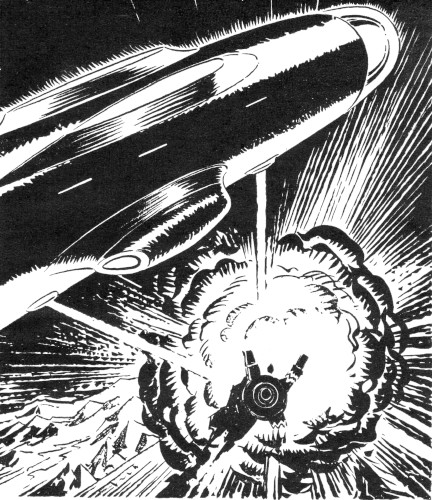
Straight to the palace arsenal he went, where he labored briefly at the filling of a bin with bombs. A minute more to set a timer and he was done. Out of the building he ran. No one stayed him; nor did any, later, say that they had seen him go. He dumped a dead man out of a car and drove it away at reckless speed. Even at that, however, he was almost too slow—hurtling stones from the dynamited palace showered down scarcely a hundred feet behind his screeching wheels.
He headed for the spaceport; then, changing his mind, braked savagely as he sent Lensed instructions to Watson. He felt no compunction about fracturing the rules and regulations made and provided for the landing of spaceships at spaceports everywhere by having his vessel make a hot blast, unauthorized, and quite possibly highly destructive landing to pick him up. Nor did he fear pursuit. The big shots were, for the most part, dead; the survivors and the middle-sized shots were too busy by far to waste time over an irregular incident at a spaceport. Hence nobody would give anybody any orders, and without explicit orders no Lonabarian officer would act. No, there would be no pursuit. But They—the Ones Kinnison was after—would interpret truly every such irregular incident; wherefore there must not be any.
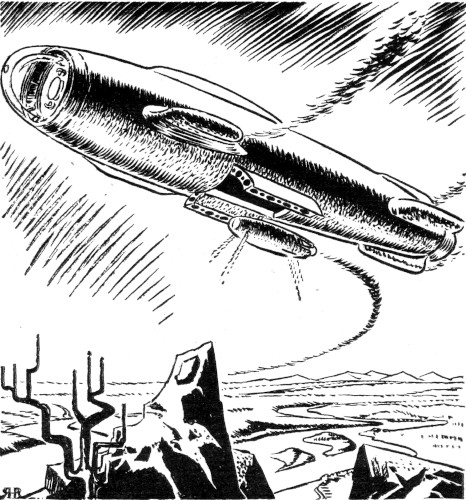
Thus it came about that when the speeding ground car was upon an empty stretch of highway, with nothing in sight in any direction, a spaceship eased down upon muffled under jets directly above it. A tractor beam reached down; car and man were drawn upward and into the vessel's hold. Kinnison did not want the car, but he could not leave it there. Since many cars had been blown out of existence with Bleeko's palace, for this one to disappear would be natural enough; but for it to be found abandoned out in the open country would be a highly irregular and an all-too-revealing occurrence.
Upward through atmosphere and stratosphere the black cruiser climbed; out into interstellar space she flashed. Then, while Watson coaxed the sleek flier to do even better than her prodigious best, Kinnison seated himself at the ultrabeam communicator and drilled a beam to Prime Base and Port Admiral Haynes.
"Lens-to-Lens, chief, please," Kinnison cautioned, when the handsome old face, surmounted now by a shock of bushy gray hair, appeared upon his plate. "Didn't want to interrupt anything important, is why I called you through the office instead of direct."
"You always have the right of way, Kim, you know that—you're the most important thing in the Galaxy right now," Haynes said, soberly.
"Well, a minute or so wouldn't make any difference—not that much difference, anyway," Kinnison replied, uncomfortably. "I don't like to Lens you unless I have to," and he began his report.
Scarcely had he started, however, when he felt a call impinge upon his own Lens. Clarrissa was calling him from Lyrane II.
"Just a sec, admiral!" he thought, rapidly. "Come in, Chris—make it a three-way with Admiral Haynes!"
"You told me to report anything unusual, no matter what," the girl began. "Well, I finally managed to get almost chummy with Helen, and absolutely the only unusual thing I can find out about the whole planet or race is that the death rate from airplane crashes began to go up awhile ago and is still rising. I don't see how that fact can have any bearing, but am reporting it as per instructions."
"Hm-m-m. What kind of crashes?" Kinnison asked.
"That's the unusual feature of it. Nobody knows—they just disappear."
"WHAT?" Kinnison yelled the thought, so forcibly that both Clarrissa and Haynes winced under its impact.
"Why, yes," she replied, innocently. "But I don't see yet that it means—"
"It means that you do, right now, crawl into the deepest, most heavily thought-screened hole in Lyrane and stay there until I, personally, come and dig you out," he replied, grimly. "It means, admiral, that I want Worsel and Tregonsee as fast as I can get them—not orders, of course, but very, very urgent requests. And I want Van Buskirk and his gang of Valerians, and Grand Fleet, with all the trimmings, within easy striking distance of Dunstan's Region as fast as you can possibly get them there. And I want—"
"Why all the excitement, Kim?" and "What do you know, son?" The two interruptions came almost as one.
"I don't know anything." Kinnison emphasized the verb very strongly. "However, I suspect a lot. Everything, in fact, grading downward from the Eich."
"But they were all destroyed, weren't they?" the girl protested.
"Far from it." This from Haynes. "Would the destruction of Tellus do away with all mankind? I am beginning to think that the Eich are to Boskonia exactly what we are to Civilization."
"So am I," Kinnison agreed. "And, such being the case, will you please get hold of Nadreck of Palain VII for me? I don't know his pattern well enough to Lens him from here."
"Why?" Clarrissa asked, curiously.
"Because he's a frigid, poison-breathing second stage Gray Lensman," Kinnison explained. "As such he is much closer to the Eich, in every respect, than we are, and may very well have an angle that we haven't." And in a few minutes the Palainian Lensman became en rapport with the group.
"An interesting development, truly," his soft thought came in almost wistfully when the status quo had been made clear to him. "I fear greatly that I cannot be of any use, but I am not doing anything of importance at the moment and will be very glad indeed to give you whatever slight assistance may be possible to one of my small powers. I come at speed to Lyrane II."
XI.
Kinnison had not underestimated the power and capacity of his as yet unknown opposition. Well it was for him and for his Patrol that he was learning to think; for, as has already been made clear, this phase of the conflict was not essentially one of physical combat. Material encounters did occur, it is true, but they were comparatively unimportant. Basically, fundamentally, it was brain against brain; the preliminary but nevertheless prodigious skirmishing of two minds—or, more accurately, two teams of minds—each trying, even while covering up its own tracks and traces, to get at and to annihilate the other.
Each had certain advantages.
Boskonia—although we know now that Boskone was by no means the prime mover in that dark culture which opposed Civilization so bitterly, nevertheless, "Boskonia" it was and still is being called—for a long time had the initiative, forcing the Patrol to wage an almost purely defensive fight. Boskonia knew vastly more about Civilization than Civilization knew about Boskonia. The latter, almost completely unknown, had all the advantages of stealth and of surprise; her forces could and did operate from undeterminable points against precisely plotted objectives. Boskonia had the hyperspatial tube long before the Conference of Scientists solved its mysteries; and even after the Patrol could use it, it could do Civilization no good unless and until something could be found at which to aim it.
Upon the other hand, Civilization had the Lens. It had the backing of the Arisians; maddeningly incomplete and unsatisfactory though that backing seemed at times to be. It had a few entities, notably one Kimball Kinnison, who were learning to think really efficiently. Above all, it had a massed purpose, a loyalty, an esprit de corps backboning a morale which the whip-driven ranks of autocracy could never match and which the whip-wielding drivers could not even dimly understand.
Kinnison, then, with all the powers of his own mind and the minds of his friends and coworkers, sought to place and to identify the real key mentality at the destruction of which the mighty Boskonian Empire must begin to fall apart; that mentality, in turn, was trying with its every resource to find and to destroy the intellect which, pure reason showed, was the one factor which had enabled Civilization to throw the fast-conquering hordes of Boskonia back into their own galaxy.
Now, from our point of vantage in time and in space—through the vistas of years of time and of parsecs of space—we can study at leisure and in detail many things which Kimball Kinnison could only surmise and suspect and deduce. Thus, he knew definitely only the fact that the Boskonian organization did not collapse with the destruction of the planet Jarnevon.
We know now, however, all about the Thralian solar system and about Alcon of Thrale, its unlamented tyrant. The planet Thrale—planetographically speaking, Thrallis II—so much like Tellus that its natives, including the unspeakable Alcon, were human practically to the limit of classification; and about Onlo, or Thrallis IX, and its monstrous natives. We know now that the duties and the authorities of the Council of Boskone were taken over by Alcon of Thrale; we now know how, by reason of his absolute control over both the humanity of Thrale and the monstrosities of Onlo, he was able to carry on.
Unfortunately, like the Eich, the Onlonians simply cannot be described by or to man. This is, as is already more or less widely known, due to the fact that all such non-aqueous, subzero-blooded, nonoxygen-breathing peoples have of necessity a metabolic extension into the hyper-dimension; a fact which makes even their three-dimensional aspect subtly incomprehensible to any strictly three-dimensional mind.
Not all such races, it may be said here, belonged to Boskonia. Many essentially similar ones, such as the natives of Palain VII, adhered to our culture from the very first. Indeed, it is held that sexual equality is the most important criterion of that which we know as Civilization. But, since this is not a biological treatise, this point is merely mentioned, not discussed.
The Onlonians, then, while not precisely describable to man, were very similar to the Eich—as similar, say, as a Posenian and a Tellurian are to each other in the perception of a Palainian. That is to say practically identical; for to the unknown and incomprehensible senses of those frigid beings the fact that the Posenian possesses four arms, eight hands, and no eyes at all, as compared with the Tellurian's simply paired members, constitutes a total difference so slight as to be negligible.
But to resume the thread of history, we are at liberty to know things that Kinnison did not. Specifically, we may observe and hear a conference which tireless research has re-constructed in toto. The place was upon chill, dark Onlo, in a searingly cold room whose normal condition of utter darkness was barely ameliorated now by a dim blue glow. The time was just after Kinnison had left Lonabar for Lyrane II. The conferees were Alcon of Thrale and his Onlonian cabinet officers. The armor-clad Tyrant, in whose honor the feeble illumination was, lay at ease in a reclining chair; the pseudoreptilian monstrosities were sitting or standing in some obscure and inexplicable fashion at a long, low bench of stone.
"The fact is," one of the Onlonians was radiating harshly, "that our minions in the other galaxy could not or would not or simply did not think. For years things went so smoothly that no one had to think. The Great Plan, so carefully worked out, gave every promise of complete success. It was inevitable, it seemed, that that entire galaxy would be brought under our domination, its Patrol destroyed, before any inkling of our purpose could be perceived by the weaklings of humanity.
"The Plan took cognizance of every known factor of any importance. When, however, an unknown, unforeseeable factor, the Lens of the Patrol, became of real importance, that Plan, of course, broke down. Instantly, upon the recognition of an unconsidered factor, the Plan should have been revised. All action should have ceased until that factor had been evaluated and guarded against. But no—no one of our commanders in that galaxy or handling its affairs ever thought of such a thing—"
"It is you who are not thinking now," the Tyrant of Thrale broke in. "If any underling had dared any such suggestion, you yourself would have been among the first to demand his elimination. The Plan should have been revised, it is true; but the fault does not lie with the underlings. Instead, it lies squarely with the Council of Boskone—by the way, I trust that those six of that council who escaped destruction upon Jarnevon by means of their hyperspatial tube have been dealt with?"
"They have been liquidated," another officer replied.
"It is well. They were supposed to think, and the fact that they neither coped with the situation nor called it to your attention until it was too late to mend matters, rather than any flaw inherent in the Plan, is what has brought about the present absolutely intolerable situation.
"Underlings are not supposed to think. They are supposed to report facts; and, if so requested, opinions and deductions. Our representatives there were well trained and skillful. They reported accurately, and that was all that was required of them. Helmuth reported truly, even though Boskone discredited his reports. So did Prellin, and Crowninshield, and Jalte. The Eich, however, failed in their duties of supervision and correlation; which is why their leaders have been punished and their operators have been reduced in rank—why we have assumed a task which, it might have been supposed and was supposed, lesser minds could have and should have performed.
"Let me caution you now that to underestimate a foe is a fatal error. Lan of the Eich prated largely upon this very point, but in the eventuality he did, in fact, underestimate very seriously the resources and the qualities of the Patrol; with what disastrous consequences we are all familiar. Instead of thinking, he attempted to subject a purely philosophical concept, the Lens, to a mathematical analysis. Neither did the heads of our military branch think at all deeply, or they would not have tried to attack Tellus until after this new and enigmatic factor had been resolved. Its expeditionary forces vanished without sign or signal—in spite of its primaries, its negative-matter bombs, its supposedly irresistible planets—and accursed Tellus still circles untouched about Sol, its sun. The condition is admittedly not to be borne; but I have always said, and I now do and shall insist, that no further action be taken until the Great Plan shall have been so revised as reasonably to take into account the Lens. What of Arisia?" he demanded of a third cabineteer.
"It is feared that nothing can be done about Arisia at present," that entity replied. "Expeditions have been sent, but they were dealt with as simply and as efficiently as were Lan and Amp of the Eich. Planets have also been sent, but they were detected by the Patrol and were knocked out by far-ranging dirigible planets of the enemy. However, I have concluded that Arisia, of and by itself, is not of prime immediate importance. It is true that the Lens did in all probability originate with the Arisians. It is hence true that the destruction of Arisia and its people would be highly desirable, in that it would insure that no more Lenses would be produced. Such destruction would not do away, however, with the myriads of the instruments which are already in use and whose wearers are operating so powerfully against us. Our most pressing business, it seems to me, is to hunt down and exterminate all Lensmen; particularly the one whom Jalte called THE Lensman, who, Eichmil was informed by Lensman Morgan, was known to even other Lensmen only as Star A Star. In that connection, I am forced to wonder—is Star A Star in reality only one mind?"
"That question has been considered both by me and by your chief psychologist," Alcon made answer. "Frankly, we do not know. We have not enough reliable data upon which to base a finding of fact. Nor does it matter in the least. Whether one or two or a thousand, we must find and we must slay until it is feasible to resume our orderly conquest of the universe. We must also work unremittingly upon a plan to abate the nuisance which is Arisia. Above all, we must see to it with the utmost diligence that no iota of information concerning us ever reaches any member of the Galactic Patrol. I do not want either of our worlds to become as Jarnevon now is."
"Hear! Bravo! Nor I!" came a chorus of thoughts, interrupted by an emanation from one of the sparkling force-ball intergalactic communicators.
"Yes? Alcon acknowledging," the Tyrant took the call.
It was a zwilnik upon far Lonabar, reporting through Lyrane VIII everything that Cartiff had done. "I do not know—I have no idea—whether or not this matter is either unusual or important," the observer concluded. "I would, however, rather report ten unimportant things than miss one which might later prove to have had significance."
"Right. Report received," and discussion raged. Was this affair actually what it appeared upon the surface to be, or was it another subtle piece of the work of that never-to-be-sufficiently-damned Lensman?
The observer was recalled. Orders were given and were carried out. Then, after it had been learned that Bleeko's palace and every particle of its contents had been destroyed, that Cartiff had vanished utterly, and that nobody could be found upon the face of Lonabar who could throw any light whatever upon the manner or the time of his going; then, after it was too late to do anything about it, it was decided that this must have been the work of THE Lensman. And it was useless to storm or to rage. Such a happening could not have been reported sooner to so high an office. The routine events of a hundred million planets simply could not be reported, nor could they have been considered if they were. And since this Lensman never repeated—his acts were always different, alike only in that they were drably routine acts until their crashing finales—the Boskonian observers never had been and never would be able to report his activities in time.
"But he got nothing this time, I am certain of that," the chief psychologist exulted.
"How can you be so sure?" Alcon snapped.
"Because Menjo Bleeko of Lonabar knew nothing whatever of our activities or of our organization except at such times as one of my men was in charge of his mind," the scientist gloated. "I and my assistants know mental surgery as those crude hypnotists, the Eich, never will know it. Even our lowest agents are having those clumsy and untrustworthy false teeth removed as fast as my therapists can operate upon their minds."
"Nevertheless, you are even now guilty of underestimating," Alcon reproved him sharply, energizing a force-ball communicator. "It is quite eminently possible that he who wrought so upon Lonabar may have been enabled—by pure chance, perhaps—to establish a linkage between that planet and Lyrane—"
The cold, crisply incisive thought of an Eich answered the Tyrant's call.
"Have you of Lyrane perceived or encountered any unusual occurrences or indications?" Alcon demanded.
"We have not."
"Expect them, then," and the Thralian despot transmitted in detail all the new developments.
"We always expect new and untoward things," the Eich more than half sneered. "We are prepared momently for anything that can happen, from a visitation by Star A Star and any or all of his Lensmen up to an attack by the massed Grand Fleet of the Galactic Patrol. Is there anything else, your supremacy?"
"No. I envy you your self-confidence and your assurance, but I mistrust exceedingly the soundness of your judgment. That is all." Alcon turned his attention to the chief psychologist. "Have you operated upon the minds of those Eich and those self-styled Overlords as you did upon that of Menjo Bleeko?"
"No!" the mind surgeon gasped. "Impossible! Not physically, perhaps, but would not such a procedure interfere so seriously with the work that it—"
"That is your problem—solve it," Alcon ordered, curtly. "See to it, however it is solved, that no traceable linkage exists between any of those minds and us. Any mind capable of thinking such thoughts as those which we have just received is not to be trusted."
As has been said, Kinnison-ex-Cartiff was en route for Lyrane II while the foregoing conference was taking place. Throughout the trip he kept in touch with Mac. At first he tried, with his every artifice of diplomacy, cajolery, and downright threats, to make her lay off; he finally invoked all his Unattached Lensman's transcendental authority and ordered her summarily to lay off.
No soap. How did he get that way, she wanted furiously to know, to be ordering her around as though she were an uncapped probe? She was a Lensman, too, by Klono's curly whiskers! She had a job to do and she was going to do it. She was on a definite assignment—his own assignment, too, remember—and she wasn't going to be called off of it just because he had found out all of a sudden that it might not be quite as safe as dunking doughnuts at a down-river picnic. What kind of a sun-baked, space-tempered crust did he have to pull a crack like that on her? Would he have the barefaced, unmitigated gall to spring a thing like that on any other Lensman in the whole cockeyed universe?
That stopped him—cold. Lensmen always went in; that was their code. For any Tellurian Lensman, anywhere, to duck or to dodge because of any possible personal danger was sheerly, starkly unthinkable. The fact that she was, to him, the sum total of all the femininity of the Galaxy could not be allowed any weight whatever; any more than the converse aspect had ever been permitted to sway him. Fair enough. Bitter, but inescapable. This was one—just one—of the consequences which Mentor had foreseen. He had foreseen it, too, in a dimly unreal sort of way, and now that it was here he'd simply have to take it. QX.
"But be careful, Chris, anyway," he surrendered. "Awfully careful—as careful as I would myself."
"I could be ever so much more careful than that and still be pretty reckless." Her low, entrancing chuckle came through as though she were present in person. "And by the way, Kim, did I ever tell you that I am fast getting to be a gray Lensman?"
"You always were, ace—you couldn't very well be anything else."
"No—I mean actually gray. Did you ever stop to consider what the laundry problem would be upon this heathenish planet?"
"Chris, I'm surprised at you—what do you need of a laundry?" he derided her, affectionately. "Here you've been blasting me to a cinder about not taking your Lensmanship seriously enough, and yet you are violating one of the prime tenets—that of conformation to planetary customs. Shame on you!"
He felt her hot blush across all those parsecs of empty space. "I tried it at first, Kim, but it was just simply terrible!"
"You've got to learn how to be a Lensman or else quit throwing your weight around like you did a while back. No back chat, either, you insubordinate young jade, or I'll take that Lens away from you and heave you into the clink."
"You and what regiment of Valerians? Besides, it didn't make any difference," she explained, triumphantly. "These matriarchs don't like me one bit better, no matter what I wear or don't wear."
Time passed, and in spite of Kinnison's highly disquieting fears, nothing happened. Right on schedule the Patrol ship eased down to a landing at the edge of the Lyranian airport. Mac was waiting; dressed now, not in nurse's white, but in startlingly nondescript gray shirt and breeches.
"Not the gray leather of my station, but merely dirt color," she explained to Kinnison after the first fervent greetings. "These women are clean enough physically, but I simply haven't got a thing fit to wear. Is your laundry working?"
It was, and very shortly Sector Chief Nurse Clarrissa MacDougall appeared in her wonted immaculately white stiffly starched uniform. She did not, then or ever, wear the gray to which she was entitled; nor did she ever—except when defying Kinnison—lay claims to any of the rights or privileges which were so indubitably hers. She was not, never had been, and never would or could be a real Lensman, she always did insist. At best, she was only a synthetic—or an imitation—or a sort of an amateur—or maybe a "Red" Lensman—handy to have around, perhaps, for certain kinds of jobs, but absolutely and definitely not a regular Lensman. And it was this attitude which was to make the Red Lensman not merely tolerated, but loved as she was loved by Lensmen, Patrolmen, and civilians alike throughout the length, breadth, and thickness of Civilization's bounds.
The ship lifted from the airport and went north into the uninhabited temperate zone. The matriarchs did not have a thing which the Tellurians either needed or wanted; the Lyranians disliked the visitors so openly and so intensely that to move away from the populated belt was the only logical and considerate thing to do.
The Dauntless arrived a day later, bringing Worsel and Tregonsee; followed closely by Nadreck in his ultrarefrigerated speedster. Five Lensmen, then, studied intently a globular map of Lyrane II which Clarrissa had made. Four of them, the oxygen breathers, surrounded it in the flesh, while Nadreck was with them only in essence. Physically he was far out in the comfortably subzero reaches of the stratosphere, but his mind was en rapport with theirs; his sense of perception scanned the markings upon the globe as carefully and as accurately as did theirs.
"This belt which I have colored pink," Mac explained, "corresponding roughly to the torrid zone, is the inhabited area of Lyrane II. Nobody lives anywhere else. Upon it I have charted every unexplained disappearance that I have been able to find out about. Each of these black crosses is where one such person lived. The black circle—or circles, for frequently there are more than one—connected to each cross by a black line, marks the spot—or spots—where that person was seen for the last time or times. If the black circle is around the cross, it means that she was last seen at home. I'm sorry that I couldn't get any real information; that this jumble is all that I could discover for you."
The crosses were distributed fairly evenly all around the globe and throughout the populated zone. The circles, however, tended markedly to concentrate upon the northern edge of that zone; and practically all of the encircled crosses were very close to the northern edge of the populated belt. To four of the Lensmen present the full grisly meaning of the thing was starkly plain.