Front matter (continued 5)
Reading edition
"How do you know all these things?" Kandron asked, unmoved. "Merely from the report of the Overlord and from the highly questionable testimony of one of the Eich, who was absent from the scene during all of the most important time?"
"You suspect, then, that—" Alcon broke off, shaken visibly.
"I do," the psychologist replied, dryly. "I suspect very strongly indeed that there is working against us a mind of a power and scope, but little inferior to my own. A mind able to overcome that of an Overlord; one able at least if unsuspected and hence unopposed, to deceive even the admittedly capable minds of the Eich. I suspect that the Lensman Morgan was, if he existed at all, merely a puppet. The Eich took him too easily by far. It is, therefore, eminently possible that he had no physical actuality of existence—"
"Oh, come, now! Don't be ridiculous!" Alcon snapped. "With all Boskone there as witnesses? Why, his hand and Lens remained!"
"Improbable, perhaps, I admit—but still eminently possible," Kandron insisted. "Admit for the moment that he was actual, and that he did lose a hand—but remember also that the hand and the Lens may very well have been brought along and left there as reassurances; we cannot be sure even that the Lens matched the hand. But admitting all this, I am still of the opinion that Lensman Morgan was not otherwise tortured, that he lost none of his vital force, that he and the unknown I have already referred to returned practically unharmed to their own galaxy. And not only did they return, they must have carried with them the information which was later used by the Patrol in the destruction of Jarnevon."
"Utterly preposterous!" Alcon snorted. "Tell me, if you can, upon what facts you have been able to base such fantastic opinions."
"Gladly," Kandron assented. "I have been able to come to no really valid conclusions, and it may very well be that your fresh viewpoint will enable us to succeed where I alone have failed. I will, therefore, summarize very briefly the data which seem to me most significant. Attend closely, please:
"For many years, as you know, everything progressed smoothly. Our first setback came when a Tellurian warship, manned by Tellurians and Valerians, succeeded in capturing almost intact one of the most modern and most powerful of our vessels. The Valerians may be excluded from consideration, in so far as mental ability is concerned. At least one Tellurian escaped, in one of our own, supposedly derelict, vessels. This one, whom Helmuth thought of, and reported, as 'the' Lensman, eluding all pursuers, went to Velantia; upon which planet he so wrought as to steal bodily six of our ships sent there especially to hunt him down. In those ships he won his way back to Tellus in spite of everything Helmuth and his force could do.
"Then there were the two episodes of the Wheelmen of Aldebaran I. In the first one a Tellurian Lensman was defeated—possibly killed. In the second our base was destroyed—tracelessly. Note, however, that the base next above it in order was, so far as we know, not visited or harmed.
"There was the Boyssia affair, in which the human being Blakeslee did various unscheduled things. He was obviously under the control of some far more powerful mind; a mind which did not appear, then or ever.
"We jump then to this, our own galaxy—the sudden, inexplicable disappearance of the planet Medon.
"Back to theirs again—the disgraceful and closely connected debacles at Shingvors and Antigan. Traceless both, but again neither was followed up to any higher headquarters."
Nadreck grinned at that, if a Palainian can be said to grin. Those matters were purely his own. He had done what he had been requested to do—thoroughly—no following up had been either necessary or desirable.
"Then Radelix," Kandron's summary went concisely on. "The female agents, Bominger, the Kalonian observers—all wiped out. Was or was not some human Lensman to blame? Everyone, from Chester Q. Fordyce down to a certain laborer upon the docks, was suspected, but nothing definite could be learned.
"The senselessly mad crew of the 27L462P—Wynor—Grantlia. Again completely traceless. Reason obscure, and no known advantage gained, as this sequence also was dropped."
Nadreck pondered briefly over this material. He knew nothing of any such matters nor, he was pretty sure, did Kinnison. The Lensman apparently was getting credit for something that must have been accidental or wrought by some internal enemy. QX. He listened again:
"After the affair of Bronseca, in which so many Lensmen were engaged that particularization was impossible, and which again was not followed up, we jump to the Asteroid Euphrosyne, Miners' Nest, and Wild Bill Williams of Aldebaran II. If it was a coincidence that Bill Williams became William Williams and followed our line to Tressilia, it is a truly remarkable one—even though, supposedly, said Williams was so stupefied with drugs as to be incapable either of motion or perception.
"Jalte's headquarters was, apparently, missed. However, it must have been invaded—tracelessly—for it was the link between Tressilia and Jarnevon, and Jarnevon was found and was destroyed.
"Now, before we analyze the more recent events, what do you yourself deduce from the above facts?" Kandron asked.
While the Tyrant was cogitating, Nadreck indulged in a minor gloat. This psychologist, by means of impeccable logic and reasoning from definitely known facts, had arrived at such erroneous conclusions! However, Nadreck had to admit, his own performances and those in which Kinnison had acted indetectably, when added to those of some person or persons unknown, did make a really impressive total.
"You may be right," Alcon admitted finally. "At least two entirely different personalities and methods of operation. Two Lensmen are necessary to satisfy the above requirements—and, as far as we know, sufficient. One of the necessary two is a human being, the other an absolutely unknown. Cartiff was, of course, the human Lensman. A masterly piece of work, that—but, with the co-operation of the Patrol, both logical and fairly simple. This human being is always in evidence, yet is so cleverly concealed by his very obviousness that nobody ever considers him important enough to be worthy of a close scrutiny. Or—perhaps—"
"That is better," Kandron commented. "You are beginning to see why I was so careful in saying that the known Tellurian factor 'may be,' not 'is,' of any real importance."
"But he must be!" Alcon protested. "It was a human being who tried and executed our agent; Cartiff was a human being—to name only two."
"Of course," Kandron admitted half contemptuously. "But we have no proof whatever that any of those human beings actually did, of their own volition, any of the things for which they have been given credit. Thus, it is now almost certain that that widely advertised 'mind-ray machine' was simply a battery of spotlights—the man operating them may very well have done nothing else. Similarly, Cartiff may have been an ordinary gangster controlled by the Lensman—we may as well call him Star A Star as anything else—or a Lensman or some other member of the Patrol acting as a dummy to distract our attention from Star A Star, who himself did the real work, all unperceived."
"Proof?" the Tyrant snapped.
"No proof—merely a probability," the Onlonian stated flatly. "We know, however, definitely and for a fact—visiplates and long-range communicators cannot be hypnotized—that Blakeslee was one of Helmuth's own men. Also that he was the same man, both as a loyal Boskonian of very ordinary mental talents and as an enemy having a mental power which he as Blakeslee never did and never could possess."
"I see," Alcon thought deeply. "Very cogently put. Instead of there being two Lensmen, working sometimes together and sometimes separately, you think that there is only one really important mind and that this mind at times works with or through some Tellurian?"
"But not necessarily the same Tellurian—exactly. And there is nothing to give us any indication whatever as to Star A Star's real nature or race. We cannot even deduce whether or not he is an oxygen breather—and that is bad."
"Very bad," the Tyrant assented. "Star A Star, or Cartiff or both working together, found Lonabar. They learned of the Overlords, or at least of Lyrane II—"
"By sheer accident, if they learned it there at all, I am certain of that," Kandron insisted. "They did not get any information from Menjo Bleeko's mind; there was none there to get."
"Accident or not, what boots it?" Alcon impatiently brushed aside the psychologist's protests. "They found Bleeko and killed him. A raid upon the cavern of the Overlords upon Lyrane II followed immediately. From the reports sent by the Overlords to the Eich of Lyrane VIII we know that there were two Patrol ships involved. One, not definitely identified as Cartiff's, took no part in the real assault. The other, the superdreadnought Dauntless, did that alone. She was manned by Tellurians, Valerians, and at least one Velantian. Since they went to the trouble of taking the Overlords alive, we may take it for granted that they obtained from them all the information they possessed before they destroyed them and their cavern?"
"It is at least highly probable that they did so," Kandron admitted.
"We have, then, many questions and few answers," and the Tyrant strode up and down the dimly blue-lit room. "It would be idle, indeed, in view of the facts, to postulate that Lyrane II was left, as were some others, a dead end. Has Star A Star attempted Lyrane VIII? If not, why has he delayed? If so, did he succeed or fail in penetrating the defenses of the Eich? They swear that he did not, that he could not—"
"Of course," Kandron sneered. "But while asking questions, why not ask why the Patrol chose this particular time to invade our galaxy in such force as to wipe out our Grand Fleet? To establish themselves so strongly as to make it necessary for us of the High Command to devote our entire attention to the problem of dislodging them?"
"What!" Alcon exclaimed, then sobered quickly and thought for minutes. "You think, then, that—" His thoughts died away.
"I do so think," Kandron thought, glumly. "It is very decidedly possible—yes, perhaps even probable—that the Eich of Lyrane VIII were able to offer no more resistance to the penetration of Star A Star than was Jalte the Kalonian. That this massive thrust was timed to cover the insidious tracing of our lines of communication or whatever other leads the Lensman had been able to discover."
"But the traps—the alarms—the screens and zones!" Alcon exclaimed, manifestly jarred by this new and disquietingly keen thought.
"No alarm was tripped, as you know; no trap was sprung," Kandron replied, quietly. "The fact that we have not as yet been attacked here may or may not be significant. Not only is Onlo very strongly held, not only is it located in such a central position that their lines of communication would be untenable, but also—"
"Do you mean to admit you may have been invaded and searched—tracelessly?" Alcon fairly shrieked the thought.
"Certainly," the psychologist replied, coldly. "While I do not believe that it has been done, the possibility must be conceded. What we could do, we have done; but what science can do, science can circumvent. To finish my thought, it is a virtual certainty that it is not Onlo and I who are their prime objectives, but Thrale and you. Especially you."
"You may be right. You probably are right; but with no data whatever upon who or what Star A Star really is, with no tenable theory as to how he could have done what actually has been done, speculation is idle."
Upon this highly unsatisfactory note the interview closed. Alcon the Tyrant went back to Thrale; and as he entered his palace grounds he passed within forty inches of his Nemesis. For Star A Star-Kinnison-Traska Gannel was, as Alcon himself so clearly said, rendered invisible and imperceptible by his own obviousness.
Although obvious, Kinnison was very busy indeed. As a lieutenant of Guardsmen, the officer in charge of a platoon whose duties were primarily upon the ground, he had very little choice of action. His immediate superior, the first lieutenant of the same company, was not much better off. The captain had more authority and scope, since he commanded aërial as well as ground forces. Then, disregarding side lines of comparative seniority, came the major, the colonel, and finally the general, who was in charge of all the regular armed forces of Thrale's capital city. Alcon's personal troops were, of course, a separate organization, but Kinnison was not interested in them—yet.
The major would be high enough, Kinnison decided. Big enough to have considerable authority and freedom of motion, and yet not important enough to attract undesirable attention.
The first lieutenant, a stodgy, strictly rule-of-thumb individual, did not count. He could step right over his head into the captaincy. The real Gannel had always, in true zwilnik fashion, hated his captain and had sought in devious ways to undermine him. The pseudo-Gannel despised the captain as well as hating him, and to the task of sapping he brought an ability enormously greater than any which the real Gannel had ever possessed.
Good Boskonian technique was to work upward by stealth and treachery, aided by a carefully built-up personal following of spies and agents. Gannel had already formed such a staff; had already selected the man who, in the natural course of events, would assassinate the first lieutenant. Kinnison retained Gannel's following, but changed subtly its methods of operation. He worked almost boldly. He himself criticized the captain severely, within the hearing of two men whom he knew to belong, body and soul, to his superior.
This brought quick results. He was summoned pre-emptorily to the captain's office; and, knowing that the company commander would not dare to have him assassinated there, he went. In that office there were a dozen people; it was evident that the captain intended this rebuke to be a warning to all upstarts, forever.
"Lieutenant Traska Gannel, I have had my eye upon you and your subversive activities for some time," the captain ordered. "Now, purely as a matter of form, and in accordance with Paragraph 5, Section 724 of General Regulations, you may offer whatever you have of explanation before I reduce you to the ranks for insubordination."
"I have a lot to say," Kinnison replied, coolly. "I don't know what your spies have reported, but to whatever it was I would like to add that having this meeting here as you are having it proves that you are as fat in the head as you are in the belly—"
"Silence! Seize him, men!" the captain commanded, fiercely. He was not really fat. He had only a scant inch of equatorial bulge; but that small surplusage was a sore point indeed. "Disarm him!"
"The first man to move dies in his tracks," Kinnison countered; his coldly venomous tone holding the troopers motionless. He wore two hand weapons more or less similar to DeLameters, and now his hands rested lightly upon their butts. "I cannot be disarmed until after I have been disrated, as you know very well; and that will never happen. For, if you demote me, I will take an appeal, as is my right, to the colonel's court, and there I will prove that you are stupid, inefficient, cowardly, and unfit generally to command. You really are, and you know it. Your discipline is lax and full of favoritism; your rewards and punishments are assessed, not by logic, but by whim, passion, and personal bias. Any court that can be named would set you down into the ranks, where you belong, and would give me your place. If this is insubordination and if you want to make something out of it, you pussy-gutted, pusillanimous, brainless tub of lard, cut in your jets!"
The maligned officer half rose, white-knuckled hands gripping the arms of his chair, then sank back craftily. He realized now that he had blundered; he was in no position to face the rigorous investigation which Gannel's accusation would bring on. But there was a way out. This could now be made a purely personal matter, in which a duel would be de rigueur. And in Boskonian dueling the superior officer, not the challenged, had the choice of weapons. He was a master of the saber; he had outpointed Gannel regularly in the regimental games. Therefore he choked down his wrath and:
"These personal insults, gratuitous and false as they are, take the matter out of military channels," he declared smoothly. "Meet me, then, tomorrow, half an hour before sunset, in the Place of Swords. It will be with sabers."
"Accepted." Kinnison meticulously followed the ritual. "To first blood or to the death?" This question was superfluous—the stigma of the Lensman's epithets, delivered before such a large group, could not possibly be expunged by the mere letting of a little blood.
"To the death"—curtly.
"So be it, O Captain!" Kinnison saluted punctiliously, executed a snappy about-face, and marched stiffly out of the room.
QX. This was fine—strictly according to Hoyle. The captain was a swordsman, surely; but Kinnison was no slouch. He didn't think that he would have to use a thought beam to help him. He had had five years of intensive training. Quarterstaff, nightstick, club, knife, and dagger; foil, épée, rapier, saber, broadsword, scimitar, bayonet, what have you—with practically any nameable weapon any Lensman had to be as good as he was with fists and feet.
The Place of Swords was in fact a circular arena, surrounded by tiers of comfortably padded seats. It was thronged with uniforms, with civilian formal afternoon dress, and with modish gowns; for such duels as this were sporting events of the first magnitude.
To guard against such trickery as concealed armor, the contestants were almost naked. Each wore only silken trunks and a pair of low shoes, whose cross-ribbed, flexible composition soles could not be made to slip upon the corrugated surface of the corklike material of the arena's floor.
The colonel himself, as master of ceremonies, asked the usual perfunctory questions. No, reconciliation was impossible. No, the challenged would not apologize. No, the challenger's honor could not be satisfied with anything less than mortal combat. He then took two sabers from an orderly, measuring them to be sure that they were of precisely the same length. He tested each edge for keenness, from hilt to needle point, with an expert thumb. He pounded each hilt with a heavy testing club. Lastly, still in view of the spectators, he slipped a guard over each point and put his weight upon the blades. They bent alarmingly, but neither broke and both snapped back truly into shape. No spy or agent, everyone then knew, had tampered with either one of those beautiful weapons.
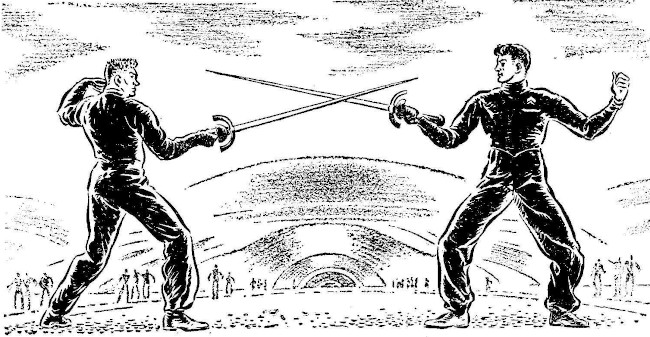
Removing the point guards, the colonel again inspected those slenderly lethal tips and handed one saber to each of the duelists. He held out a baton, horizontal and shoulder high. Gannel and the captain crossed their blades upon it. He snapped his stick away and the duel was on.
Kinnison fought in Gannel's fashion exactly; in his characteristic crouch and with his every mannerism. He was, however a trifle faster than Gannel had ever been—just enough faster so that by the exertion of everything he had of skill and finesse, he managed to make the zwilnik's blade meet steel instead of flesh during the first long five minutes of furious engagement. The guy was good, no doubt of that. His saber came writhing in, to disarm. Kinnison flicked his massive wrist. Steel slithered along steel; hilt clanged against heavy basket hilt. Two mighty right arms shot upward, straining to the limit. Breast to hard-ridged breast, left arms pressed against bulgingly corded backs, every taut muscle from floor-gripping feet up to powerful shoulders thrown into the effort, the battlers stood motionlessly en tableau for seconds.
The ape wasn't fat, at that, Kinnison realized then; he was as hard as cordwood underneath. Not fat enough, anyway, to be anybody's push-over; although he was probably not in good-enough shape to last very long—he could probably wear him down. He wondered fleetingly, if worse came to worst, whether he would use his mind or not. He didn't want to—but he might have to. Or would he, even then—could he? But he'd better snap out of it. He couldn't get anywhere with this body-check business; the zwilnik was fully as strong as he was.
They broke, and in the breaking Kinnison learned a brand-new cut. He sensed it coming, but he could not parry or avoid it entirely; and the crowd shrieked madly as the captain's point slashed into Gannel's trunks and a stream of crimson trickled down Gannel's left leg.
Stamp! Stamp! Cut, thrust, feint, slash and parry, the grim game went on. Again, in spite of all he could do, Kinnison was pinked; this time by a straight thrust aimed at his heart. He was falling away from it, though, so got only half an inch or so of the point in the fleshy part of his left shoulder. It bled spectacularly, however, and the throng yelled ragingly for the kill. Another—he never did know exactly how he got that one—in the calf of his right leg; and the bloodthirsty mob screamed still louder.
Then, the fine edge of the captain's terrific attack worn off, Kinnison was able to assume the offensive. He maneuvered his foe into an awkward position, swept his blade aside, and slashed viciously at the neck. But the Thralian was able partially to cover. He ducked frantically, even while his parrying blade was flashing up. Steel clanged, sparks flew; but the strength of the Lensman's arm could not be entirely denied. Instead of the whole head, however, Kinnison's razor-edged weapon snicked off only an ear and a lock of hair.
Again the spectators shrieked frenzied approval. They did not care whose blood was shed, so long as it was shed; and this duel, of two superb swordsmen so evenly matched, was the best they had seen for years. It was, and promised to keep on being, a splendidly gory show indeed.
Again and again the duelists engaged at their flashing top speed; once again each drew blood before the colonel's whistle shrilled.
Time out for repairs: to have either of the contestants bleed to death, or even to the point of weakness, was no part of the code. The captain had outpointed the lieutenant, four to two, just as he always did in the tournaments; but he now derived very little comfort from the score. He was weakening, and knew it, while Gannel's arm seemed as strong and as rock-steady as it had been at the bout's beginning. Kinnison also knew these facts.
Surgeons gave hasty but effective treatment, new and perfect sabers replaced the badly nicked weapons, the ghastly thing went on. The captain tired slowly but surely; Gannel took, more and more openly and more and more savagely, the offensive.
When it was over Kinnison flipped his saber dexterously, so that its point struck deep into the softly resilient floor beside that which had once been his captain. Then, while the hilt swung back and forth in slow arcs, he faced one segment of the now satiated throng and crisply saluted the colonel.
"Sir, I trust that I have won honorably the right to be examined for fitness to become the captain of my company?" he asked, formally; and:
"You have, sir," the colonel as formally replied.
XVII.
Kinnison's wounds, being superficial, healed rapidly. He passed the examination handily. He should have; since, although it was rigorous and comprehensive, Traska Gannel himself could have passed it and Kinnison, as well as knowing practically everything that the Thralian had ever learned, had his own vast store of knowledge upon which to draw. Also, if necessary, he could have read the answers from the minds of the examiners.
As a captain, the real Gannel would have been a hard and brilliant commander, noticeable even among the select group of tried and fire-polished veterans who officered the Guards. Hence Kinnison became so; in fact, considerably more so than most. He was harsh, he was relentless and inflexible; but he was absolutely fair. He did not punish a given breach of discipline with twenty lashes one time and with a mere reprimand the next; fifteen honest, scarring strokes it became for each and every time, whoever the offender. Whatever punishment a man deserved by the book he got, promptly and mercilessly; whatever reward was earned was bestowed with equal celerity, accompanied by a crisply accurate statement of the facts in each case, at the daily parade review.
His men hated him, of course. His noncoms and lieutenants, besides hating him, kept on trying to cut him down. All, however, respected him and obeyed him without delay and without question, which was all that any Boskonian officer could expect and which was far more than most of them ever got.
Having thus consolidated his position, Kinnison went blithely to work to undermine and to supplant the major. Since Alcon, like all dictators everywhere, was in constant fear of treachery and of revolution, war games were an almost constant form of drill. The general himself planned and various officers executed the mock attacks, by space, air, and land; the Royal Guards and Alcon's personal troops, heavily outnumbered, always constituted the defense. An elaborate system of scoring had been worked out long since, by means of which the staff officers could study in detail every weak point that could be demonstrated.
"Captain Gannel, you will have to hold Passes 25, 26, and 27," the obviously worried major told Kinnison, the evening before a particularly important sham battle was to take place.
The Lensman was not surprised. He himself had insinuated the idea into his superior's mind. Moreover, he already knew, from an intensive job of spying, that his major was to be in charge of the defense, and that the colonel, who was to direct the attacking forces, had decided to route his main column through Pass 27.
"Very well, sir," Kinnison acknowledged. "I wish to protest formally, however, against those orders. It is manifestly impossible, sir, to hold all three of those passes with two platoons of infantry and one squadron of speedsters. May I offer a suggestion—"
"You may not," the major snapped. "We have deduced that the real attack is coming from the north, and that any activity in your section will be merely a feint. Orders are orders, captain!"
"Yes, sir," Kinnison replied, meekly, and signed for the thick sheaf of orders which stated in detail exactly what he was to do.
The next evening, after Kinnison had won the battle by disregarding every order he had been given, he was summoned to the meeting of the staff. He had expected that, too, but he was not at all certain of how it was coming out. It was in some trepidation, therefore, that he entered the lair of the big brass hats.
"Har-rumph!" he was greeted by the adjutant. "You have been called—"
"I know why I was called," Kinnison interrupted, brusquely. "Before we go into that, however, I wish to prefer charges before the general against Major Delios of stupidity, incompetence, and inefficiency."
Sheer astonishment resounded throughout the room in a ringing silence, broken finally by the general.
"Those are serious charges indeed, Captain Gannel; but you may state your case."
"Thank you, sir. First, stupidity: He did not perceive, at even as late a time as noon, when he took all my air away from me to meet the feint from the north, that the attack was not to follow any orthodox pattern. Second, incompetence. The orders he gave me could not possibly have stopped any serious attack through any one of the passes I was supposed to defend. Third, inefficiency: No efficient commander refuses to listen to suggestions from his officers, as he refused to listen to me last night."
"Your side, major?" And the staff officers listened to a defense based upon blind, dumb obedience to orders.
"We will take this matter under advisement," the general announced then. "Now, captain, what made you suspect that the colonel was coming through Pass 27?"
"I didn't," Kinnison replied, mendaciously. "To reach any one of those passes, however, he would have to come down this valley"—tracing it with his forefinger upon the map. "Therefore I held my whole force back here at Hill 562, knowing that, warned by my air of his approach, I could reach any one of the passes before he could."
"Ah. Then, when your air was sent elsewhere?"
"I commandeered a flitter—my own, by the way, and sent it up so high as to be indetectable. I then ordered motorcycle scouts out, for the enemy to capture; to make the commander of any possible attacking or reconnaissance force think that I was blind."
"Ah—smart work. And then?"
"As soon as my scout reported troop movements in the valley, I got my men ready to roll. When it became certain that Pass 27 was the objective, I rushed everything I had into preselected positions commanding every foot of that pass. Then, when the colonel walked into the trap, I wiped out most of his main column. However, I had a theoretical loss of three-quarters of my men in doing it"—bitterly. "If I had been directing the defense, I would have wiped out the colonel's entire force, ground and air both, with a loss of less than two percent."
This was strong talk. "Do you realize, Captain Gannel, that this is sheer insubordination?" the general demanded. "That you are in effect accusing me also of stupidity in planning and in ordering such an attack?"
"Not at all, sir," Kinnison replied instantly. "It was quite evident, sir, that you did it deliberately, to show all of us junior officers the importance of thought. To show us that, while unorthodox attacks may possibly be made by unskilled tacticians, any such attack is of necessity fatally weak if it be opposed by good tactics. In other words, that orthodox strategy is the only really good strategy. Was not that it, sir?"
Whether it was or not, that viewpoint gave the general an out, and he was not slow in taking advantage of it. He decided then and there, and the always subservient staff agreed with him, that Major Delios had indeed been stupid, incompetent, and inefficient; and Captain Gannel forthwith became Major Gannel.
Then the Lensman took it easy. He wangled and phenagled various and sundry promotions and replacements, until he was once more surrounded by a thoroughly subsidized personal staff and in good position to go to work upon the colonel. Then, however, instead of doing so, he violated another Boskonian precedent by having a frank talk with the man whom normally he should have been trying to displace.
"You have found out that you can't kill me, colonel," he told his superior, after making sure that the room was really shielded. "Also that I can quite possibly kill you. You know that I know more than you do—that all my life, while you other fellows were helling around, I have been working and learning—and that I can, in a fairly short time, take your job away from you without killing you. However, I don't want it."
"You don't want it!" The colonel stared, narrow-eyed. "What do you want, then?" He knew, of course, that Gannel wanted something.
"Your help," Kinnison admitted, candidly. "I want to get onto Alcon's personal staff, as adviser. With my experience and training, I figure that there's more in it for me there than here in the Guards. Here's my proposition—if I help you, by showing you how to work out your field problems and in general building you up however I can instead of tearing you down, will you use your great influence with the general and Prime Minister Fossten to have me transferred to the Household?"
"Will I? I'll say I will!" the colonel agreed, with fervor. He did not add "if I cannot kill you first"—that was understood.
And Kinnison did build the colonel up. He taught him things about the military business which that staff officer had never even suspected; he sounded depths of strategy theretofore completely unknown to the zwilnik. And the more Kinnison taught him, the more eager the colonel became to get rid of him. He had been suspicious and only reluctantly co-operative at first; but as soon as he realized that he could not kill his tutor and that if the latter stayed in the Guards it would be only a matter of days—at most of weeks—until Gannel would force himself into the colonelcy by sheer force of merit, he pulled in earnest every wire that he could reach.
Before the actual transfer could be effected, however, Kinnison received a call from Nadreck.
"Excuse me, please, for troubling you," the Palainian apologized, "but there has been a development in which you may perhaps be interested. This Kandron has been given orders by Alcon to traverse a hyperspatial tube, the terminus of which will appear at co-ordinates 217-493-28 at hour eleven of the seventh Thralian day from the present."
"Fine business! And you want to chase him, huh?" Kinnison jumped at the conclusion. "Sure—go ahead. I'll meet you there. I'll fake up some kind of an excuse to get away from here and we'll run him ragged—"
"I do not," Nadreck interrupted, decisively. "If I leave my work here, it will all come undone. Besides, it would be dangerous—and foolhardy. Not knowing what lies at the other end of that tube, we could make no plans and could have no assurance of safety, or even of success. You should not go, either—that is unthinkable. I am reporting this matter in view of the possibility that you may think it significant enough to warrant the sending of some observer whose life is of little or no importance."
"Oh ... uh-huh ... I see. Thanks, Nadreck." Kinnison did not allow any trace of his real thought to go out before he broke the line. Then:
"Funny ape, Nadreck," he cogitated, as he called Haynes. "I don't get his angle at all—I simply can't figure him out. Haynes? Kinnison"—and he reported in full.
"The Dauntless has all the necessary generators and equipment, and the place is far enough out so that she can make the approach without any trouble," the Lensman concluded. "We'll burn whatever is at the other end of that tube clear out of the ether. Send along as many of the old gang as you can spare. Wish we had time to get Cardynge—he'll howl like a wolf at being left out—but we've got only a week—"
"Cardynge is here," Haynes broke in. "He has been working out some stuff for Thorndyke on the sunbeam. He is finished now, though, and will undoubtedly want to go along."
"Fine!"
And explicit arrangements for the rendezvous were made.
It was not unduly difficult for Kinnison to make his absence from duty logical, even necessary. Scouts and observers reported inexplicable interferences with certain communications lines. With thoughts of the Lensman suffusing the minds of the higher-ups, and because of Gannel's already demonstrated prowess and keenness, he scarcely had to signify a willingness to investigate the phenomena in order to be directed to do so.
Nor did he pick a crew of his own sycophants. Instead, he chose the five highest-ranking privates of the battalion to accompany him upon this supposedly extremely dangerous mission; apparently completely unaware two of them belonged to the colonel, two to the general, and one to the captain who had taken his place.
The colonel wished Major Gannel good luck, verbally, even while hoping fervently that the Lensman would make cold meat of him in a hurry; and Kinnison gravely gave his well-wisher thanks as he set out. He did not, however, go near any communications lines; although his spying crew did not realize the fact. They did not realize anything; they did not know even that they became unconscious within five minutes after leaving Thrale.
They remained unconscious while the speedster in which they were was drawn into the Dauntless' capacious hold. In the Patrol ship's sick bay, under expert care, they remained unconscious during the entire duration of their stay on board.
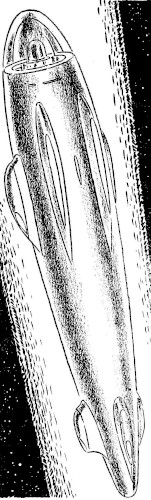
The Patrol pilots picked up Kandron's flying vessel with little difficulty; and, nullifiers full out, followed it easily. When the zwilnik ship slowed down to feel for the vortex, the Dauntless slowed also, and baffled her driving jets as she sneaked up to the very edge of electrodetector range. When the objective disappeared from three-dimensional space the point of vanishment was marked precisely, and up to that point the Patrol ship flashed in seconds.
The regular driving blasts were cut off, the special generators were cut in. Then, as the force fields of the ship reacted against those of the Boskonian "shore" station, the Patrolmen felt again in all their gruesome power the appallingly horrible sensation of interdimensional acceleration. For that sensation is, literally, indescribable. A man in good training can overcome seasickness, airsickness, and spacesickness. He can overcome the nausea and accustom himself to the queasily terrifying endless-fall sensation of weightlessness. He can, and does, become so inured to as to regard as perfectly normal the outrages to the sensibilities incident to inertialessness in its crudest forms. No man has, however, been able to get used to interdimensional acceleration.
It is best likened to a compression; not as a whole, but atom by atom. A man feels as though he were being twisted—cork-screwed in some monstrously obscure fashion which permits him neither to move from his place nor to remain where he is. It is a painless but utterly revolting transformation, progressing in a series of waves; a rearrangement, a writhing, crawling distortion, an incomprehensibly impossible extrusion of each ultimate particle of his substance in an unknowable, ordinarily nonexistent direction.
The period of acceleration over, the Dauntless traveled at uniform velocity along whatever course it was that the tube took and the men, although highly uncomfortable and uneasy, could once more move about and work. Sir Austin Cardynge in particular was actually happy and eager as he flitted from one to another of the automatic recording instruments upon his special panel. He resembled more closely than ever a lean, gray tomcat, Kinnison thought—he almost expected to see him begin to lick his whiskers and pur.
"You see, my ignorant young friend"—the scientist almost did pur as one of the recording pens swung widely across the ruled paper—"it is as I told you—the lack of exact data upon even one tiny factor of this extremely complex phenomenon is calamitous. While my notes were apparently complete and were certainly accurate, our experimental tubes did not function perfectly. The time factor was irreconcilable—completely so, in every aspect, even that of departure from and return to normal space—and it is unthinkable that time, one of the fundamental units, is or can be intrinsically variable—"
"You think so?" Kinnison broke in. "Look at that"—pointing to the ultimate of timepieces, Cardynge's own triplex chronometer. "No. 1 says that we have been in this tube for an hour, No. 2 says a little over nine minutes, and according to No. 3 we won't be starting for twenty minutes yet—it must be running backward—let's see you comb that out of your whiskers!"
"Oh-h ... ah ... a-hum." But only momentarily was Sir Austin taken aback. "Ah, I was right all the time!" he cackled gleefully. "I thought it practically impossible for me to commit an error or to overlook any possibilities, and I have now proved that I did not. Time, in this hyperspatial region or condition, is intrinsically variable, in major degree!"
"And what does that get you?" Kinnison asked, pointedly.
"Much, my impetuous youngster, much," Cardynge replied. "We observe, we note facts. From the observations and facts we theorize and we deduce; thus arriving very shortly at the true inwardness of time."
"You hope," the Lensman snorted, dubiously; and in his skepticism he was right and Sir Austin was wrong. For the actual nature and mechanism of time remained, and still constitute, a mystery, or at least an unsolved problem. The Arisians—perhaps—understand time; no other race does.
To some of the men, then, and to some of the clocks and other time-measuring devices, the time seemed—or actually was?—very long; to other and similar beings and mechanisms it seemed—or was—short. Short or long, however, the Dauntless did not reach the Boskonian end of the hyperspatial tube.
In midflight there came a crunching, twisting cloonk! and an abrupt reversal of the inexplicably horrible interdimensional acceleration—a deceleration as sickeningly disturbing, both physically and mentally, as the acceleration had been.
While within the confines of the hyperspatial tube every eye of the Dauntless had been blind. To every beam upon every frequency, visible or invisible, ether-borne or carried upon the infinitely faster waves of the sub-ether, the murk was impenetrable. Every plate showed the same mind-numbing blankness; a vague, eerily shifting, quasi-solid blanket of formless, textureless grayness. No lightness or darkness, no stars or constellations or nebulae, no friendly, deep-space blackness—nothing.
Deceleration ceased; the men felt again the wonted homeliness and comfort of normal pseudoinertia. Simultaneously the gray smear of the visiplates faded away into commonplace areas of jetty black, pierced the brilliantly dimensionless varicolored points of light which were the familiar stars of their own familiar space.
But were they familiar? Was that our galaxy, or anything like it? They were not. It was not. Kinnison stared into his plate, aghast.
He would not have been surprised to have emerged into three-dimensional space anywhere within the Second Galaxy. In that case, he would have seen a Milky Way; and from its shape, apparent size, and texture he could have oriented himself fairly closely in a few minutes. But the Dauntless was not within any lenticular galaxy—nowhere was there any sign of a Milky Way!
He would not have been really surprised to have found himself and his ship out in open intergalactic space. In that case he would have seen a great deal of dead-black emptiness, blotched with a hundred or so lenticular bodies which were in fact galaxies. Orientation would then have been more difficult; but, with the aid of the Patrol charts, it could have been accomplished. But here there were no galaxies—no nebulae of any kind!
XVIII.
Here, upon the background of a blackness so intense as to be obviously barren of nebular material, there lay a multitude of blazingly resplendent stars—and nothing except stars. A few hundred were of a visual magnitude of about minus three. Approximately the same number were of minus two or thereabouts, and so on down; but there did not seem to be a star or other celestial object in that starkly incredible sky of an apparent magnitude greater than about plus four.
"What do you make of this, Sir Austin?" Kinnison asked, quietly. "It's got me stopped like a traffic light."
The mathematician ran toward him and the Lensman stared. He had never known Cardynge to hurry—in fact, he was not really running now. He was walking, even though his legs were fairly twinkling in their rapidity of motion. As he approached Kinnison his mad pace gradually slowed to normal.
"Oh—time must be cockeyed here, too," the Lensman observed. "Look over there—see how fast those fellows are moving, and how slow those others over that way are?"
"Ah, yes. Interesting—intensely interesting. Truly, a most remarkable and intriguing phenomenon," the fascinated mathematician enthused.
"But that wasn't what I meant. Swing this plate—it's on visual—around outside, so as to get the star aspect and distribution. What do you think of it?"
"Peculiar—I might almost say unique," the scientist concluded, after his survey. "Not at all like any normal configuration or arrangement with which I am familiar. We could perhaps speculate, but would it not be preferable to secure data first? Say by approaching a solar system and conducting systematic investigations?"
"Uh-huh"—and again Kinnison stared at the wispy little physicist in surprise. Here was a man! "You're certainly something to tie to, ace, do you know it?" he asked, admiringly. Then, as Cardynge gazed at him questioningly, incomprehendingly:
"Skip it. Can you hear me, Henderson?"
"Yes—just barely."
"Shoot us across to one of those nearer stars, stop, and go inert."
"QX, chief." The pilot obeyed.
And in the instant of inerting, the visiplate into which the two men stared went blank. The thousands of stars studding the sky a moment before had disappeared as though they had never been.
"Why.... What.... How in all the yellow hells of space can that happen?" Kinnison blurted.
Without a word, Cardynge reached out and snapped the plate's receiver over from "visual" to "ultra," whereupon the stars reappeared as suddenly as they had vanished.
"Something's screwy somewhere!" the Lensman protested. "We can't have an inert velocity greater than that of light—it's impossible!"
"Few things, if any, can be said definitely to be impossible; and everything is relative, not absolute," the old scientist declared, pompously. "This space, for instance. You have not yet perceived, I see, even that you are not in the same three-dimensional space in which we have heretofore existed."
Kinnison gulped. He was going to protest about that, too, but in the face of Cardynge's unperturbed acceptance of the fact he did not quite dare to say what he had in mind.
"That is better," the old man declaimed. "Do not get excited—to do so dulls the mind. Take nothing for granted, do not jump at conclusions—to commit either of those errors will operate powerfully against success. Working hypotheses, young man, must be based upon accurately determined facts; not upon mere guesses, superstitions, or the figments of personal prejudices."
"Bub-bub-but ... QX—skip it!" Nine-tenths of the Dauntless' crew would have gone out of control at the impact of the knowledge of what had happened; even Kinnison's powerful mind was shaken. Cardynge, however, was—not seemed to be, but actually was—as calm and as self-contained as though he were in his own quiet study. "Explain it to me, will you please, in words of as nearly one syllable as possible?"
"Our looser thinkers have for centuries speculated upon the possibility of an entire series of different spaces existing simultaneously, side by side in a hypothetical hypercontinuum. I have never indulged in such time-wasting; but now that actual corroborative data have become available, I regard it as a highly fruitful field of investigation. Two extremely significant facts have already become apparent; the variability of time and the non-applicability of our so-called 'laws' of motion. Different spaces, different laws, it would seem."
"But when we cut our generators in that other tube we emerged into our own space," Kinnison argued. "How do you account for that?"
"I do not as yet try to account for it!" Cardynge snapped. "Two very evident possibilities should already be apparent, even to your feeble brain. One, that at the moment of release your vessel happened to be situated within a fold of our own space. Two, that the collapse of the ship's force fields always returns it to its original space, while the collapse of those of the shore station always forces it into some other space. In the latter case, it would be reasonable to suppose that the persons or beings at the other end of the tube may have suspected that we were following Kandron, and, as soon as he landed, cut off their forces deliberately to throw us out of space. They may even have learned that persons of lesser ability, so treated, never return. Do not allow yourself to be at all impressed by any of these possibilities, however, as the truth may very well lie in something altogether different. Bear it in mind that we have as yet very little data upon which to formulate any theories, and that the truth can be revealed only by a very careful, accurate, and thorough investigation. Please note also that I would surely have discovered and evaluated all these unknowns during the course of my as yet incomplete study of our own hyperspatial tubes; that I am merely continuing here a research in which I have already made noteworthy progress."
Kinnison really gasped at that—the guy was certainly terrific! He called the chief pilot. "Go free, Hen, and start flitting for a planet—we've got to sit down somewhere before we can start back home. When you find one, land free. Stay free, and watch your Bergs—I don't have to tell you what will happen if they quit on us."
Then Thorndyke. "Verne? Break out some personal neutralizers. We've got a job of building to do—inertialess"—and he explained to both men in flashing thoughts what had happened and what they had to do.
"You grasp the basic idea, Kinnison," Cardynge approved, "that it is necessary to construct a station apart from the vessel in which we propose to return to our normal environment. You err grievously, however, in your insistence upon the necessity of discovering a planet, satellite, asteroid, or other similar celestial body upon which to build it."
"Huh?" Kinnison demanded.
"It is eminently possible—yes, even practicable—for us to use the Dauntless as an anchorage for the tube and for us to return in the lifeboats," Cardynge pointed out.
"What? Abandon this ship? Waste all that time rebuilding all the boats?"
"It is preferable, of course, and more expeditious, to find a planet, if possible," the scientist conceded. "However, it is plain that it is in no sense necessary. Your reasoning is fallacious, your phraseology is deplorable. I am correcting you in the admittedly faint hope of teaching you scientific accuracy of thought and of statement."
"Wow! Wottaman!" Kinnison breathed to himself, as, heroically, he "skipped it."
Somewhat to Kinnison's surprise—he had more than half expected that planets would be nonexistent in that space—the pilots did find a solid world upon which to land. It was a peculiar planet indeed. It did not move right, it did not look right, it did not feel right. It was waterless, airless, desolate; a senseless jumble of jagged fragments, mostly metallic. It was neither hot nor cold—indeed, it seemed to have no temperature of its own at all. There was nothing whatever right about it, Kinnison declared.
"Oh, yes, there is!" Thorndyke contradicted. "Time is constant here, whatever its absolute rate may be, these metals are nice to work with, and some of this other stuff will make insulation. Or hadn't you thought of that? Which would be faster, cutting down an intrinsic velocity of fifteen lights to zero or building the projector out of native materials? And if you match intrinsics, what will happen when you hit our normal space again?"
"Plenty, probably ... uh-huh, faster to use the stuff that belongs here. Careful, though, fella!"
And care was indeed necessary; extreme care that not a particle of matter from the ship was used in the construction and that not a particle of the planet's substance by any mischance got aboard the spaceship.
The actual work was simple enough. Cardynge knew exactly what had to be done. Thorndyke knew exactly how to do it, as he had built precisely similar generators for the experimental tubes upon Tellus. He had a staff of experts; the Dauntless carried a machine shop and equipment second to none. Raw material was abundant, and it was an easy matter to block out an inertialess room within which the projectors and motors were built. And, after they were built, they worked.
It was not the work, then, but the strain which wore Kinnison down. The constant, wearing strain of incessant vigilance to be sure that the Bergenholms and the small units of the personal neutralizers did not falter for a single instant. He did not lose a man, but again and again there flashed into his mind the ghastly picture of one of his boys colliding with the solid metal of the planet at a relative velocity fifteen times that of light! The strain of the endless checking and rechecking to make certain that there was no exchange of material, however slight, between the ship and the planet.
Above all, the strain of knowing a thing which, apparently, no one else suspected: that Cardynge, with all his mathematical knowledge, was not going to be able to find his way back! He had never spoken of this to the scientist. He did not have to. He knew that without a knowledge of the fundamental distinguishing characteristics of our normal space—a knowledge even less to be expected than that a fish should know the fundamental equations and structure of water—they never could, save by sheerest accident, return to their own space. And as Cardynge grew more and more tensely, unsocially immersed in his utterly insoluble problem, the more and more uneasy the Gray Lensman became. But this last difficulty was resolved first, and in a totally unexpected fashion.
"Ah, Kinnison of Tellus, here you are—I have been considering your case for some twenty-nine of your seconds," a deep, well-remembered voice resounded within his brain.
"Mentor!" he exclaimed, and at the sheer shock of his relief he came very near indeed to fainting. "Thank Klono and Noshabkeming you found us! How did you do it? How do we get ourselves out of here?"
"Finding you was elementary," the Arisian replied, calmly. "Since you were not in your own environment you must be elsewhere. If my mind had been really competent, I would have foreseen this event in detail. Even though I did not so foresee it, however, it required but little thought to perceive that it was a logical, in fact, an inevitable, development. Such being the case, it needed very little additional effort to determine what had happened, and how, and why; likewise precisely where you must now be. As for departure therefrom, your mechanical preparations are both correct and adequate. I could give you the necessary knowledge, but it is rather technically specialized and not negligible in amount; and since your brain is of very limited capacity, it is better not to fill any part of it with mathematics for which you will have no subsequent use. Put yourself en rapport, therefore, with Sir Austin Cardynge. I will follow."
He did so, and as mind met mind there ensued a conversation whose barest essentials Kinnison could not even dimly grasp. For Cardynge, as has been said, could think in the universal language of mathematics; in the esoteric symbology which very few minds have ever been able even partially to master. The Lensman did not get it, nor any part of it; he knew only that in that to him completely meaningless gibberish the Arisian was describing to the physicist, exactly and fully, the distinguishing characteristics of a vast number of parallel and simultaneously coexistent spaces.
If that was "rather" technical stuff, the awed Lensman wondered, what would really deep stuff be like? Not that he wanted to find out! No wonder these mathematical wizards were nuts—went off the beam—he'd be pure squirrel food if he had half that stuff in his skull!
But Sir Austin took to it like a cat lapping up cream or doing away with the canary. He brightened visibly; he swelled; and, when the Arisian had withdrawn from his mind, he preened himself and swaggered as he made meticulous adjustments of the delicate meters and controls which the technicians had already built.
Preparations complete, Cardynge threw in the switches and everything belonging to the Dauntless was rushed aboard. The neutralizers, worn so long and cherished so assiduously, were taken off with profound sighs of relief. The vessel was briefly, tentatively inerted. QX—no faster-than-light meteorites tore volatilizingly through her mass. So far, so good.
Then the ship's generators were energized and smoothly, effortlessly the big battle wagon took the interdimensional plunge. There came the expected, but nevertheless almost unendurable acceleration; the imperceptible, unloggable flight through the drably featureless grayness; the horrible deceleration. Stars flashed beautifully upon the plates.
"We made it!" Kinnison shouted in relief when he had assured himself that they had emerged into "real" space inside the Second Galaxy, only a few parsecs away from their point of departure. "By Klono's golden grin, Sir Austin, you figured it to a red whisker! And when the Society meets, Tuesday week, won't you just blast that ape Weingarde to a cinder? Hot dog!"
"Having the basic data, the solution and the application followed of necessity—automatically—uniquely," the scientist said, austerely. He was highly pleased with himself, he was tremendously flattered by the Lensman's ebullient praise; but not for anything conceivable would he have so admitted.
"Well, the first thing we had better do is to find out what time of what day it is," Kinnison went on, as he directed a beam to the Patrol headquarters upon Klovia.
"Better ask 'em the year, too," Henderson put in, pessimistically—he had missed Illona poignantly—but it was not that bad.
In fact, it was not bad at all; they had been gone only a little over a week of Thralian time. This finding pleased Kinnison immensely, as he had been more than half afraid that it had been a month. He could explain a week easily enough, but anything over two weeks would have been tough to handle.
The supplies of the Thralian speedster were adjusted to fit the actual elapsed time, and Worsel and Kinnison engraved upon the minds of the five unconscious Guardsmen completely detailed—even though equally completely fictitious—memories of what they and Major Gannel had done since leaving Thrale. Their memories were not exactly alike, of course—each man had had different duties and experiences, and no two observers see precisely the same things even while watching the same event—but they were very convincing. Also, and fortunately, not even the slightest scars were left by the operations, for in these cases no memory chain had to be broken at any point.
The Dauntless blasted off for Klovia; the speedster started for Thrale. Kinnison's crew woke up—without having any inkling that they had ever been unconscious or that their knowledge of recent events did not jibe exactly with the actual occurrences—and resumed work.
Immediately upon landing, Kinnison turned in a full official report of the mission, giving himself neither too much nor too little credit for what had been accomplished. They had found a Patrol sneak-boat near Line 11. They had chased it so many parsecs, upon such-and-such a course, before forcing it to engage. They had crippled it and boarded, bringing away material, described as follows, which had been turned over to Space Intelligence. And so on. It would hold, Kinnison knew; and it would be corroborated fully by the ultraprivate reports which his men would make to their real bosses.
The colonel made good; hence with due pomp and ceremony Major Traska Gannel was inducted into the Household. He was given one of the spy-ray-screened cigarette boxes in which Alcon's most trusted officers were allowed to carry their private, secret insignia. Kinnison was glad to get that—he could carry his Lens with him now, if the thing was really ray proof, instead of leaving it buried in a can outside the city limits.
The Lensman went to his first meeting of the Advisory Cabinet with his mind set on a hair trigger. He hadn't been around Alcon very much, but he knew that the Tyrant had a stronger mind shield than any untreated human being had any right to have. He'd have to play this mighty close to his chest—he didn't want any zwilnik reading his mind, yet he didn't want to create suspicion by revealing the fact that he, too, had an impenetrable block.
As he approached the cabinet chamber he walked into a zone of hypnosis, and practically bounced. He threw up his head: it was all he could do to keep his barriers down. It was general, he knew, not aimed specifically at him—to fight the hypnotist would be to call attention to himself as the only man able either to detect his work or to resist him; would give the whole show away. Therefore he let the thing take hold—with reservations—of his mind. He studied it. He analyzed it. Sight only, eh? QX—he'd let Alcon have superficial control, and he wouldn't put too much faith in anything he saw.
He entered the room; and, during the preliminaries, he reached out delicately, to touch imperceptibly mind after mind. All the ordinary officers were on the level; now he'd see about the prime minister. He'd heard a lot about this Fossten, but had never met him before—he'd see what the guy really had on the ball.
He did not find out, however. He did not even touch his mind, for that worthy also had an automatic block; a block as effective as Alcon's or as Kinnison's own.
Sight was unreliable; how about the sense of perception? He tried it, very daintily and gingerly, upon Alcon's feet, legs, arms, and torso. Alcon was real, and present in the flesh. Then the premier—and he yanked his sense back, canceled it, appalled. Perception was blocked, at exactly what his eyes told him was the fellow's skin!
That tore it—that busted it wide open. What in all the nine iridescent hells did that mean? He didn't know of anything except a thought-screen that could stop a sense of perception. He thought intensely. Alcon's mind was bad enough. It had been treated, certainly; mind shields like that didn't grow naturally on human or near-human beings. Maybe the Eich, or the race of super-Eich to which Kandron belonged, could give mental treatments of that kind. Fossten, though, was worse.
Alcon's boss! Probably not a man at all. It was he, it was clear, and not Alcon, who was putting out the zone of compulsion. An Eich, maybe? No, he was a warm-blooded oxygen breather; a frigid-blooded super-big-shot would make Alcon come to him. A monster, almost certainly, though; possibly of a type Kinnison had never seen before. Working by remote control? Possibly; but probably he was smaller than a man and was actually inside the dummy that everybody thought was the prime minister—that was it, for all the tea in China—
"And what do you think, Major Gannel?" the prime minister asked, smoothly, insinuating his mind into Kinnison's as he spoke.
Kinnison, who knew that they had been discussing an invasion of the First Galaxy, hesitated as though in thought. He was thinking, too, and ultracarefully. If that ape was out to do a job of digging he'd never dig again—QX, he was just checking Gannel's real thoughts against what he was going to say.
"Since I am such a newcomer to this Council I do not feel as though my opinions should be given too much weight," Kinnison said—and thought—slowly, with the exactly correct amount of obsequiousness. "However, I have a very decided opinion upon the matter. I believe very firmly that it would be better tactics to consolidate our position here in our own galaxy first."
"You advise, then, against any immediate action against Tellus?" the prime minister asked. "Why?"
"I do, definitely. It seems to me that shortsighted, half-prepared measures, based upon careless haste, were the underlying causes of our recent reverses. Time is not an important factor—the Great Plan was worked out, not in terms of days or of years, but of centuries and millennia—and it seems self-evident that we should make ourselves impregnably secure, then expand slowly; seeing to it that we can hold, against everything that the Patrol can bring to bear, every planet that we take."
"Do you realize that you are criticizing the chiefs of staff who are in complete charge of military operations?" Alcon asked, venomously.
"Fully," the Lensman replied coldly. "I ventured this opinion because I was asked specifically for it. The chiefs of staff failed, did they not? If they had succeeded, criticism would have been neither appropriate nor forthcoming. As it is, I do not believe that mere criticism of their conduct, abilities, and tactics is sufficient. They should be disciplined and demoted. New chiefs should be chosen; persons abler and more efficient than the present incumbents."
This was a bomb shell. Dissentions waxed rife and raucous, but amidst the turmoil the Lensman received from the prime minister a flash of coldly congratulatory approval.
And as Major Traska Gannel made his way back to his quarters two things were starkly plain:
First, he would have to cut Alcon down and himself become the Tyrant of Thrale. It was unthinkable to attack or to destroy this planet. It had too many too promising leads—there were too many things that didn't make sense—above all, there were the stupendous files of information which no one mind could scan in a lifetime.
Second, if he wanted to keep on living he would have to keep his detector shoved out to maximum—this prime minister was just about as touchy and just about as safe to play with as a hundred kilograms of dry nitrogen iodide!
XIX.
Nadreck, the Palainian Lensman, had not exaggerated in saying that he could not leave his job, that his work would come undone if he did.
As has been intimated, Nadreck was cowardly and lazy and characterized otherwise by traits not usually regarded by humankind as being noble. He was, however, efficient; and he was now engaged in one of the most colossal tasks ever attempted by any one Lensman. Characteristically, he had told no one, not even Haynes or Kinnison, what it was that he was trying to do—he never talked about a job until after it was done, and his talking then was usually limited to a taped, Lensman's-sealed, tersely factual report. He was "investigating" Onlo; that was all that anybody knew.
Onlo was at that time perhaps the most heavily fortified planet in the Universe. Compared to its massed might Jarnevon was weak; Tellus, except for its sunbeams and its other open-space safeguards, a joke. Onlo's defenses were all, or nearly all, planetary; Kandron's strategy, unlike Haynes', was to let any attacking force get almost down to the ground and then blast it out of existence.
Thus Onlo was in effect one tremendously armed, titanically powered fortress; not one cubic foot of its poisonous atmosphere was out of range of projectors theoretically capable of puncturing any defensive screen possible of mounting upon a mobile base.
And Nadreck, the cowardly, the self-effacing, the apologetic, had tackled Onlo—alone!
Using the technique which has already been described in connection with his highly successful raid upon the Eich stronghold of Lyrane VIII, he made his way through the Onlonian defensive screens and settled down comfortably near one of the gigantic domes. Then, as though time were of no consequence whatever, he proceeded to get acquainted with the personnel. He learned the identifying symbol of each entity and analyzed every one psychologically, mentally, intellectually, and emotionally. He tabulated his results upon the Palainian equivalent of index cards, then very carefully arranged the cards into groups.
In the same fashion he visited and took the census of dome after dome. No one knew that he had been near, apparently he had done nothing; but in each dome as he left it there had been sown seeds of discord and of strife which, at a carefully calculated future time, would yield bitter fruit indeed.
For every mind has some weakness, each intellect some trait of which it does not care to boast, each Achilles his heel. That is true even of Gray Lensmen—and the Onlonians, with their heredity and environment of Boskonianism, were in no sense material from which Lensmen could be made.
Subtly, then, and coldly and callously, Nadreck worked upon the basest passions, the most ignoble traits of that far-from-noble race. Jealousy, suspicion, fear, greed, revenge—quality by quality he grouped them, and to each group he sent series after series of horridly stimulating thoughts.
Jealousy, always rife, assumed fantastic proportions. Molehills became mountains overnight. A passing word became a studied insult. No one aired his grievances, however, for always and everywhere there was fear—fear of discipline, fear of reprisal, fear of betrayal, fear of the double cross. Each monster brooded, sullenly intense. Each became bitterly, gallingly, hatingly aware of an unwarranted and intolerable persecution. Not much of a spark would be necessary to touch off such explosive material as that!
Nadreck left the headquarters dome until the last. In one sense it was the hardest of all; in another the easiest. It was hard in that the entities there had stronger minds than those of lower station; minds better disciplined, minds more accustomed to straight thinking and to logical reasoning. It was easy, however, in that those minds were practically all at war already—fighting either to tear down the one above or to resist the attacks of those below. On the whole, therefore, the headquarters dome was relatively easy, since every mind in it already hated, or feared, or distrusted, or was suspicious of or jealous of some other.
And while Nadreck labored thus deviously his wonders to perform, Kinnison went ahead in his much more conventional and straightforward fashion upon Thrale. His first care, of course, was to surround himself with the usual coterie of spies and courtiers.
The selection of this group gave Kinnison many minutes of serious thought. It was natural enough that he had not been able to place any of his own men in the secret service of Alcon or the prime minister, since they both had minds of power. It would not be natural, however, for either of them not to be able to get an agent into his. For to be too good would be to invite a mental investigation which he simply could not as yet permit. He would have to play dumb enough so that his hitherto unsuspected powers of mind would remain unsuspected.
He could, however, do much. Since he knew who the spies were, he was able quite frequently to have his more trusted henchmen discover evidence against them, branding them for what they were. Assassinations were then, of course, very much in order. And even a strong suspicion, even though it could not be documented, was grounds for a duel.
In this fashion, then, Kinnison built up his entourage and kept it reasonably free from subversive elements; and, peculiarly enough, those elements never happened to learn anything which the Lensman did not want them to know.
Building up a strong personal organization was now easy, for at last Kinnison was a real Boskonian big shot. As a major of the Household he was a power to be toadied to and fawned upon. As a personal adviser to Alcon the Tyrant he was one whose ill will should be avoided at all costs. As a tactician who had so boldly, and yet so altruistically, put the skids under the chiefs of staff, thereby becoming a favorite even of the dreaded prime minister, he was marked plainly as a climber to whose coat tails it would be wise to cling. In short, Kinnison made good in a big—it might almost be said in a stupendous—way.
With such powers at work the time of reckoning could not be delayed for long. Alcon knew that Gannel was working against him; learned very quickly, since he knew exactly the personnel of Kinnison's "private" secret service and could read at will any of their minds, that Gannel held most of the trumps. The Tyrant had tried many times to read the major's mind, but the latter, by some subterfuge or other, had always managed to elude his inquisitor without making an issue of the matter. Now, however, Alcon drove in a solid questing beam which, he was grimly determined, would produce results of one kind or another.
It did: but, unfortunately for the Thralian, they were nothing which he could use. For Kinnison, instead either of allowing the Tyrant to read his whole mind or of throwing up an all-too-revealing barricade, fell back upon the sheer native power of will which had made him unique in his generation. He concentrated upon an all-inclusive negation; which in effect was a rather satisfactory block and which was entirely natural.
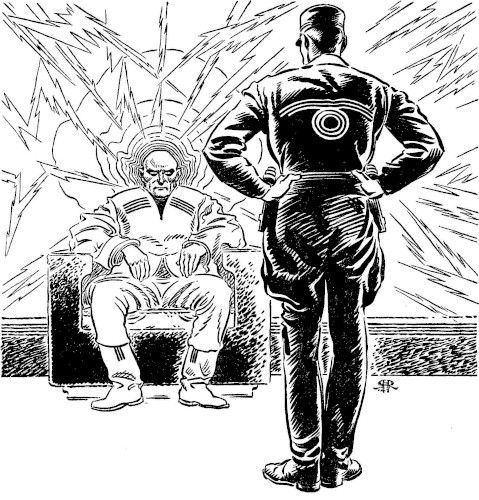
"I will not have my mind invaded," Kim snapped. "That is a violation of my personal privacy I will not yield!"
"I don't know what you are trying to do, Alcon," he informed his superior, stiffly, "but whatever it is I do not like it. I think that you are trying to hypnotize me. If you are, know now that you cannot do it; that no possible hypnotic force can overcome my definitely and positively opposed will."
"Major Gannel, you will—" the Tyrant began, then stopped. He was not quite ready yet to come openly to grips with this would-be usurper. Besides, it was now plain that Gannel had only an ordinary mind. He had not even suspected all the prying that had occurred previously. He had not recognized even this last powerful thrust for what it really was; he had merely felt it vaguely and had supposed that it was an attempt at hypnotism!
A few more days and he would cut him down. Hence Alcon changed his tone and went on smoothly, "It is not hypnotism, Major Gannel, but a sort of telepathy which you cannot understand. It is, however, necessary; for in the case of a man occupying such a high position as yours, it is self-evident that we can permit no secrets whatever to be withheld from us—that we can allow no mental reservations of any kind. You see the justice and the necessity of that, do you not?"
Kinnison did. He saw as well that Alcon was being superhumanly forbearing. Moreover, he knew what the Tyrant was covering up so carefully—the real reason for this highly unusual tolerance.
"I suppose you are right; but I still don't like it," Gannel grumbled. Then, without either denying or acceding to Alcon's right of mental search, he went to his own quarters.
And there—or thereabouts—Kinnison wrought diligently at a thing which had been long in the making. He had known all along that his retinue would be useless against Alcon, hence he had built up an organization entirely separate from, and completely unknown to any member of, his visible following. Nor was this really secret outfit composed of spies or sycophants. Instead, its members were hard, able, thoroughly proven men, each one carefully selected for the ability and the desire to take the place of one of Alcon's present department heads. One at a time he put himself en rapport with them; gave them certain definite orders and instructions.
Then he put on a mechanical thought-screen. Its use could not make the prime minister any more suspicious than he already was, and it was the only way he could remain in character. This screen was, like those of Lonabar, decidedly pervious in that it had an open slit. Unlike Bleeko's, however, which had their slits set upon a fixed frequency, the open channel of this one could be varied, both in width and in wave length, to any setting which Kinnison desired.
Thus equipped, Kinnison attended the meeting of the Council of Advisers, and to say that he disrupted the meeting is no exaggeration. The other advisers perceived nothing out of the ordinary, of course, but both Alcon and the prime minister were so perturbed that the session was cut very short indeed. The other members were dismissed summarily, with no attempt at explanation. The Tyrant was raging, furious; the premier was alertly, watchfully intent.
"I did not expect any more physical privacy than I have been granted," Kinnison grated, after listening quietly to a minute or two of Alcon's unbridled language. "This thing of being spied upon continuously, both by men and by mechanisms, while it is insulting and revolting to any real man's self-respect, can—just barely—be borne. I find it impossible, however, to force myself to submit to such an ultimately degrading humiliation as the surrender of the only vestiges of privacy I have remaining; those of my mind. I will resign from the Council if you wish, I will resume my status as an officer of the line, but I cannot and will not tolerate your extinction of the last spark of my self-respect," he finished, stubbornly.
"Resign? Resume? Do you think that I will let you off that easily, fool?" Alcon sneered. "Don't you realize what I am going to do to you? That, were it not for the fact that I am going to watch you die slowly and hideously, I would have you blasted where you stand?"
"I do not, no, and neither do you," Gannel answered, as quietly as surprisingly. "If you were sure of your ability, you would be doing something instead of talking about it." He saluted, turned, and walked out.
Now the prime minister, as has been intimated, was considerably more than he appeared upon the surface to be. He was in fact the power behind the throne. His, not Alcon's, was the voice of authority, although he worked so subtly that the Tyrant himself never did realize that he was little better than a figurehead.
Therefore, as Gannel departed, the premier thought briefly but cogently. This major was smart—too smart. He was too able, he knew too much. His advancement had been just a trifle too rapid. That thought-screen was an entirely unexpected development. The mind behind it was not quite right, either—a glimpse through the slit had revealed a flash of something that might be taken to indicate that Major Gannel had an ability which ordinary Thralians did not have. This open defiance of the Tyrant of Thrale did not ring exactly true—it was not quite in character. If it had been a bluff, it was too good—much too good. If it had not been a bluff, where was his support? How could Gannel have grown so powerful without his, Fossten's, knowledge?
If Major Gannel were bona fide, all well and good. Boskonia needed the strongest possible leaders, and if any other man showed himself superior to Alcon, Alcon should and would die. However, there was a bare possibility that—Was Gannel bona fide? That point should be cleared up without delay. And the prime minister, after a quizzical, searching, more than half contemptuous inspection of the furiously discomfited Tyrant, followed the rebellious, the contumacious, the enigmatic Gannel to his rooms.
He knocked and was admitted. A preliminary and entirely meaningless conversation occurred. Then:
"Just when did you leave Eddore?" the visitor demanded.
"What do you want to know for?" Kinnison shot back. That question didn't mean a thing to him. Maybe it didn't to the big fellow, either—it could be just a catch—but he didn't intend to give any kind of an analyzable reply to any question that this ape asked him.
Nor did he, through thirty minutes of viciously skillful verbal fencing. That conversation was far from meaningless, but it was entirely unproductive of results; and it was a baffled, intensely thoughtful Fossten who at its conclusion left Gannel's quarters. From those quarters he went to the Hall of Records, where he requisitioned the major's dossier. Then to his own private laboratory, where he applied to those records every test known to the scientists of his ultrasuspicious race.
The photographs were right in every detail. The prints agreed exactly with those he himself had secured from the subject not twenty-four hours since. The typing was right. The ink was right. Everything checked. And why not? Ink, paper, fiber, and film were in fact exactly what they should have been. There had been no erasures, no alterations. Everything had been aged to the precisely correct number of days. For Kinnison had known that this check-up was coming, and the experts of the Patrol would make no such crass errors as those.
Even though he had found exactly what he had expected to find, the suspicions of the prime minister were intensified rather than allayed. Besides his own, there were two unreadable minds upon Thrale, where there should have been only one. He knew how Alcon's had been treated—could Gannel's possibly be a natural phenomenon? If not, who had treated it, and why?
He left the palace then, ostensibly to attend a function at the military academy. There, too, everything checked. He visited the town in which Gannel had been born—finding no irregularities whatever in the records of the birth. He went to the city in which Gannel had lived for the greater part of his life; where he assured himself that school records, club records, even photographs and negatives, all dead-centered the beam.
He studied the minds of six different persons who had known Gannel from childhood. As one they agreed that the Traska Gannel who was now Traska Gannel was in fact the real Traska Gannel, and could not by any possibility be anyone else. He examined their memory tracks minutely for scars, breaks, or other evidences of surgery; finding none. In fact, none existed, for the therapists who had performed those operations had gone back clear to the very beginnings, to the earliest memories of the Gannel child.
In spite of the fact that all the data thus far investigated were so precisely what they should have been—or because of it—the prime minister was now morally certain that Gannel was, in some fashion or other, completely spurious. Should he go further, delve into unimportant but perhaps highly revealing side issues? It would be useless, he decided. The mind or minds who had falsified those records so flawlessly—if they had in fact been falsified—had done a beautiful piece of work: as masterly a job as he himself could have done. He himself would have left no traces; neither, in all probability, had they.
Who, then, and why? This was no ordinary plot, no part of any ordinary scheme to overthrow Alcon. It was bigger, deeper, far more sinister. Nothing so elaborate and efficient originating upon Thrale could possibly have been developed and executed without his knowledge and at least his tacit consent. Was there behind this thing someone who knew who and what he was and who was seeking his life and his place? Highly improbable. No—it must be—it was—the Patrol!
His mind flashed to Star A Star, reviewing everything that had been ascribed to that mysterious personage. Then something clicked—in fact, it stuck out.
BLAKESLEE!
This was much finer than the Blakeslee affair, of course; more subtle and more polished by far. It was not nearly as obvious, as blatant, but the basic similarity was nevertheless there. Could this similarity have been accidental? No—unthinkable. In this undertaking accidents could be ruled out—definitely. Whatever had been done had been done deliberately and after meticulous preparation.
But Star A Star never repeated. Therefore, this time, he had repeated; deliberately, to throw Alcon and his psychologists off the trail. But he, Fossten, was not to be deceived by even such clever tactics.
Gannel was, then, really Gannel, just as Blakeslee had really been Blakeslee. Blakeslee had obviously been under control. Here, however, there were two possibilities. First, Gannel might be under similar control. Second, Star A Star might have operated upon Gannel's mind so radically as to make an entirely different man of him. Either hypothesis would explain Gannel's extreme reticence in submitting to any except the most superficial mental examination. Each would account for Gannel's calm certainty that Alcon was afraid to attack him openly. Which of these hypotheses was the correct one could be determined later. It was unimportant, anyway, for in either case there was now accounted for the heretofore inexplicable power of Gannel's mind.
In either case it was not Gannel's mind at all, but that of THE Lensman, who was making Gannel act as he could not normally have acted. Somewhere hereabouts, in either case, there actually was lurking Boskonia's Nemesis; the mentality whom above all others Boskonia was raving to destroy; the one Lensman who had never been seen or heard or perceived; the feared and detested Lensman about whom nothing whatever had ever been learned.
That Lensman, whoever he might be, had at last met his match. Gannel, as Gannel, was of no importance whatever; the veriest pawn. But he who stood behind Gannel—Ah! He, Fossten himself, would wait and he would watch. Then, at precisely the correct instant, he would pounce!
And Kinnison, during the absence of the prime minister, worked swiftly and surely. Twelve men died, and as they ceased to live twelve others, grimly ready and thoroughly equipped for any emergency, took their places. And during that same minute of time Kinnison strode into Alcon's private sanctum.
The Tyrant hurled orders to his guards—orders which were not obeyed. He then went for his own weapons, and he was fast—but Kinnison was faster. Alcon's guns and hands disappeared and the sickened Tellurian slugged him into unconsciousness. Then grimly, relentlessly, he took every item of interest from the Thralian's mind, slew him, and assumed forthwith the title and the full authority of the Tyrant of Thrale.
Unlike most such revolutions, this one was accomplished with very little bloodshed and with scarcely any interference with the business of the realm. Indeed, if anything, there was an improvement in almost every respect, since the new men were more thoroughly trained and were more competent than the previous officers had been. Also, they had arranged matters beforehand so that their accessions could be made with a minimum of friction.
They were as yet loyal to Kinnison and to Boskonia; and in a rather faint hope of persuading them to stay that way, without developing any queer ideas anent in turn overthrowing him, the Lensman called them into conference.
"Men, you know how you got where you are," he began, coldly. "You are loyal to me at the moment. You know that real co-operation is the only way to achieve maximum productivity, and that true co-operation cannot exist in any regime in which the department heads, individually or en masse, are trying to do away with the dictator.
"Some of you will probably be tempted very shortly to begin to work against me instead of for me and with me. I am not pleading with you, nor even asking you out of gratitude for what I have done for you, to refrain from such activities. Instead, I am telling you as a simple matter of fact that any or all of you, at the first move toward any such disloyalty, will die. In that connection, I know that all of you have been exerting every resource to discover in what manner your predecessors came so conveniently to die, and that none of you have succeeded."
One by one they admitted that they had not.
"Nor will you, ever. Be advised that I know vastly more than Alcon did, and that I am far more powerful. Alcon, while in no sense a weakling, did not know how to command obedience. I do. Alcon's sources of information were meager and untrustworthy; mine are comprehensive and reliable. Alcon very often did not know that anything was being plotted against him until the thing was well along; I shall always know of the first seditious move. Alcon blustered, threatened, and warned; he tortured; he gave some offenders a second chance before he killed. I shall do none of those things. I do not threaten, I do not warn, I do not torture. Above all, I give no snake a second chance to strike at me. I execute traitors without bluster or fanfare. For your own good, gentlemen, I advise you in all seriousness to believe that I mean precisely every word that I have uttered."
They slunk out, but Boskonian habit was too strong. Thus, within three days, three of Kinnison's newly appointed headmen died. He called another cabinet meeting.
"The three new members have listened to the recording of our first meeting, hence there is no need to repeat what I said at that time," the Tyrant announced, in a voice so silkily venomous that his listeners cringed. "I will add to it merely that I will have full co-operation, and only co-operation, if I have to kill all of you and all of your successors to get it. You may go."
XX.
This killing made Kinnison ill; physically and mentally sick. It was ruthless, cowardly murder. It was worse than stabbing a man in the back; the poor devils didn't have even the faintest shadow of a chance. Nevertheless he did it.
When he had first invaded the stronghold of the Wheelmen of Aldebaran I, he had acted without thinking at all. Lensmen always went in, regardless of consequences. When he had scouted Jarnevon he had thought but little more. True—and fortunately—he took Worsel along; but he did not stop to consider whether or not there were minds in the Patrol better fitted to cope with the problem than was his own. It was his problem, he figured, and it was up to him to solve it.
Now, however, he knew bitterly that he could no longer act in that comparatively thoughtless fashion. At whatever loss of self-esteem, of personal stature, or of standing, he had to revise the Tellurian Lensmen's Code. It griped him to admit it, but Nadreck was right. It was not enough to give his life in an attempt to conquer a halfway station; he must remain alive in order to follow through to completion the job which was so uniquely his. He must think, assaying and evaluating every factor of his entire task. Then, without considering his own personal feelings, he must employ whatever forces and methods were best fitted to do the work at the irreducible minimum of cost and of risk.
Thus Kinnison sat unharmed upon the throne of the Tyrant of Thrale, and thus the prime minister returned to the palace to find a fait accompli awaiting him. That worthy studied with care every aspect of the situation then obtaining before he sought an audience with the new potentate.
"Allow me to congratulate you, Tyrant Gannel," he said, smoothly. "I cannot say that I am surprised, since I have been watching you and your activities for some little time—with distinct approval, I may add. You have fulfilled—more than fulfilled, perhaps—my expectations. Your regime is functioning superbly; you have established in this very short time a smoothness of operation and an esprit de corps among the rank and file which are decidedly unusual. There are, however, certain matters about which it is possible that you are not completely informed."
"It is possible," Kinnison agreed, with the merest trace of irony. "Such as?"
"In good time. You know, do you not, who is the real authority here upon Thrale?"
"I know who was," the Tellurian corrected, with the faintest perceptible accent upon the verb. "In part only, however, for if you had concerned yourself wholly, the late Alcon would not have made so many nor so serious mistakes."
"I thank you. That is, as of course you know, because I have only recently taken over. I want the Tyrant of Thrale to be the strongest man of Thrale, and I may say without flattery that I believe he now is. And I would suggest that you add 'sire' when you speak to me."
"I thank you in turn. I will so address you when you call me 'your supremacy'—not sooner."
"We will let it pass for the moment. To come to your question, you apparently do not know that the Tyrant of Thrale, whoever he may be, opens his mind to me."
"I have suspected that such a condition has existed in the past. However, please be informed that I trust fully only those who so trust me; and that thus far in my short life such persons have been few. You will observe that I am still respecting your privacy in that I am allowing your control of my sense of sight to continue. It is not because I trust you, but because your true appearance is to me a matter of complete indifference. For, frankly, I do not trust you at all. I will open my mind to you just exactly as wide as you will open yours to me—no wider."
"Ah—the bravery of ignorance. It is as I thought. You do not realize, Gannel, that I can slay you at any moment I choose, or that a very few more words of defiance from you will be enough." The prime minister did not raise his voice, but his tone was instinct with menace.
"I do not, and neither do you, as I remarked to the then Tyrant Alcon in this very room not long ago. I am sure that you will understand without elaboration the connotations and implications inherent in that remark." Kinnison's voice also was low and level, freighted in its every clipped syllable with the calm assurance of power. "Would you be interested in knowing why I am so certain that you will not accept my suggestion of a mutual opening of minds?"
"Very much so."
"Because I suspect that you are, or are in league with, Star A Star of the Galactic Patrol." Even at that astounding charge, Fossten gave no sign of surprise or of shock. "I have not been able as yet to obtain any evidence supporting that belief, but I tell you now that when I do so, you die. Not by power of thought, either, but in the beam of my personal ray gun."
"Ah—you interest me so strangely," and the premier's hand strayed almost imperceptibly toward an inconspicuous button.
"Don't touch that switch!" Kinnison snapped. He did not quite see why Fossten was letting him see the maneuver, but he would bite, anyway.
"Why not, may I ask? It is merely a—"
"I know what it is, and I do not like thought-screens. I prefer that my mind be left free to roam."
Fossten's thoughts raced in turn. Since the Tyrant was on guard, this was inconclusive. It might—or might not—indicate that Gannel was controlled by or in communication with Star A Star.
"Do not be childish," he chided. "You know as well as I do that your accusations are absurd. However, as I reconsider the matter, the fact that neither of us trusts unreservedly the other may not after all be an insuperable obstacle to our working together for the good of Boskonia. I think now more than ever that yours is the strongest Thralian mind, and as such, the logical one to wield the Tyrant's power. It would be a shame to destroy you unnecessarily, especially in view of the probability that you will come later of your own accord to see the reasonableness of that which I have suggested."
"It is possible," Kinnison admitted, "but not, I would say, probable." He thought that he knew why the lug had pulled in his horns, but he wasn't sure. "Now that we have clarified our attitudes toward each other, have decided upon an armed and suspicious truce, I see nothing to prevent us from working together in a completely harmonious mutual distrust for the good of all. The first thing to do, as I see it, is to devote our every effort to the destruction of the planet Klovia and all the Patrol forces based upon it."