Front matter (continued 2)
Reading edition
"They tried it once, but the race began to deteriorate," she admitted.
"Exactly. Your whole set-up is cockeyed—unbalanced. You can think of me only as a male—one to be destroyed on sight, since I am not like one of yours. Yet, when I could kill you and had every reason to do so, I didn't. We can destroy you all, but we won't unless we must. What's the answer?"
"I don't know," she confessed, frankly. Her frenzied desire for killing abated, although her ingrained antipathy and revulsion did not. "In some ways, you do seem to have some of the instincts and qualities of a ... almost of a person."
"I am a person—"
"You are not! Do you think that I am to be misled by the silly coverings you wear?"
"Just a minute. I am a person of a race having two equal sexes. Equal in every way. Numbers, too—one man and one woman—" and he went on to explain to her, as well as he could, the sociology of Civilization.
"Incredible!" she gasped the thought.
"But true," he assured her. "And now are you going to lay off me and behave yourself, like a good little girl, or am I going to have to do a bit of massaging on your brain? Or wind that beautiful body of yours a couple of times around a tree? I'm asking this for your own good, kid, believe me."
"Yes, I do believe you," she marveled. "I am becoming convinced that ... that perhaps you are a person—at least of a sort—after all."
"Sure I am—that's what I've been trying to tell you for an hour. And cancel that 'of a sort,' too—"
"But tell me," she interrupted, "a thought you used—'beautiful.' I do not understand it. What does it mean, 'beautiful body'?"
"Holy Klono's whiskers!" If Kinnison had never been stumped before, he was now. How could he explain beauty, or music, or art, to this ... this matriarchal savage? How explain cerise to a man born blind? And, above all, who had ever heard of having to explain to a woman—to any woman, anywhere in the whole macrocosmic universe—that she in particular was beautiful?
But he tried. In her mind he spread a portrait of her as he had seen her first. He pointed out to her the graceful curves and lovely contours, the lithely flowing lines, the perfection of proportion and modeling and symmetry, the flawlessly smooth, firm-textured skin, the supple, hard-trained fineness of her whole physique. No soap. She tried, in brow-furrowing concentration, to get it, but in vain. It simply did not register.
"But that is merely efficiency, everything you have shown," she declared. "Nothing else. I must be so, for my own good and for the good of those to come. But I think that I have seen some of your beauty," and in turn she sent into his mind a weirdly distorted picture of a human woman. The zwilnik he was following, Kinnison decided instantly.
She would be jeweled, of course, but not that heavily—a horse couldn't carry that load. And no woman ever born put paint on that thick, or reeked so of violent perfume, or plucked her eyebrows to such a thread, or indulged in such a hairdo.
"If that is beauty, I want none of it," the Lyranian declared.
Kinnison tried again. He showed her a waterfall, this time, in a stupendous gorge, with appropriate cloud formations and scenery. That, the girl declared, was simply erosion. Geological formations and meteorological phenomena. Beauty still did not appear. Painting, it appeared to her, was a waste of pigment and oil. Useless and inefficient—for any purpose of record the camera was much more precise and truthful. Music—vibrations in the atmosphere—would of necessity be simply a noise; and noise—any kind of noise—was not efficient.
"You poor little devil." The Lensman gave up. "You poor, ignorant, soul-starved little devil. And the worst of it is that you don't even realize—and never can realize—what you are missing."
"Don't be silly." For the first time, the woman actually laughed. "You are utterly foolish to make such a fuss about such trivial things."
Kinnison quit, appalled. He knew, now, that he and this apparently human creature beside him were as far apart as the Galactic Poles in every essential phase of life. He had heard of matriarchies, but he had never considered what a real matriarchy, carried to its logical conclusion, would be like.
This was it. For ages there had been, to all intents and purposes, only one sex; the masculine element never having been allowed to rise above the fundamental necessity of reproducing the completely dominant female. And that dominant female had become, in every respect save the purely and necessitously physical one, absolutely and utterly sexless. Men, upon Lyrane II, were dwarfs about thirty inches tall. They had the temper and the disposition of a mad Radeligian cateagle, the intellectual capacity of a Zabriskan fontema. They were not regarded as people, either at birth or at any subsequent time. To maintain a static population, each person gave birth to one person, on the grand average. The occasional male baby—about one in a hundred—did not count. He was not even kept at home, but was taken immediately to the "maletorium," in which he lived until attaining maturity.
One man to a hundred or so women for a year, then death. The hundred persons had their babies at twenty-one or twenty-two years of age—they lived to an average age of a hundred years—then calmly blasted their male's mind and disposed of his carcass. The male was not exactly an outcast; not precisely a pariah. He was tolerated as a necessary adjunct to the society of persons, but in no sense whatever was he a member of it.
The more Kinnison pondered this hookup the more appalled he became. Physically, these people were practically indistinguishable from human, Tellurian, Caucasian women. But mentally, intellectually, in every other way, how utterly different! Shockingly, astoundingly so to any really human being, whose entire outlook and existence is fundamentally, however unconsciously or subconsciously, based upon and conditioned by the prime division of life into two fully co-operant sexes. It didn't seem, at first glance, that such a cause could have such terrific effects; but here they were. In cold reality, these women were no more human than were the ... the Eich. Take the Posenians, or the Rigellians, or even the Velantians. Any normal, stay-at-home Tellurian woman would pass out cold if she happened to stumble onto Worsel in a dark alley at night. Yet the members of his repulsively reptilian-appearing race, merely because of having a heredity of equality and co-operation between the sexes, were in essence more nearly human than were these tall, splendidly built, actually and intrinsically beautiful creatures of Lyrane II!
"This is the hall," the person informed him, as the car came to a halt in front of a large structure of plain gray stone. "Come with me."
"Gladly," and they walked across the peculiarly bare grounds. They were side by side, but a couple of feet apart. She had been altogether too close to him in the little car. She did not want this male—or any male—to touch her or to be near her. And, considerably to her surprise, if the truth were to be known, the feeling was entirely mutual. Kinnison would have preferred to touch a Borovan slime-lizard.
They mounted the granite steps. They passed through the dull, weather-beaten portal. They were still side by side—but they were now a full yard apart.
IV.
"Listen, my beautiful but dumb guide," Kinnison counseled the Lyranian girl as they neared their objective. "I see that you're forgetting all your good girl scout resolutions and are getting all hot and bothered again. I'm telling you now for the last time to watch your step. If that zwilnik person has even a split second's warning that I am on her tail, all hell will be out for noon—and I don't mean perchance."
"But I must notify the Elder One that I am bringing you in," she told him. "One simply does not intrude unannounced. It is not permitted."
"QX. Stick to the announcement, though, and don't put out any funny ideas. I'll send a thought along, just to make sure."
But he did more than that, for even as he spoke, his sense of perception was already in the room to which they were going. It was a large room, and bare; filled with tables except for a clear central space upon which at the moment a lithe and supple person was doing what seemed to be a routine of acrobatic dancing, interspersed with suddenly motionless posings and posturings of extreme technical difficulty. At the tables were seated a hundred or so Lyranians, eating.
Kinnison was not interested in the floor show, whatever it was, nor in the massed Lyranians. The zwilnik was what he was after. Ah, there she was, at a ringside table—a small, square table seating four—near the door. Her back was to it—good. At her left, commanding the central view of the floor, was a redhead, sitting in a revolving, reclining chair, the only such seat in the room. Probably the Big Noise herself—the Elder One. No matter, he wasn't interested in her, either—yet. His attention flashed back to his proposed quarry and he almost gasped.
For she, like Dessa Desplaines, was an Aldebaranian, and she was everything that the Desplaines woman had been—more so, if possible. She was a seven-sector call-out, a thionite dream if there ever was one. And jewelry! This Lyranian tiger hadn't exaggerated that angle very much, at that. Her breast shields were of gold and platinum filigree, thickly studded with diamonds, emeralds and rubies, in intricate designs. Her shorts, or rather trunks, were of Manarkan glamorette, blazing with gems. A cleverly concealed dagger, with a jeweled haft and a vicious little fang of a blade. Rings, even a thumb ring. A necklace which was practically a collar flashed all the colors of the rainbow. Bracelets, armlets, anklets and knee bands. High-laced dress boots, jeweled from stem to gudgeon. Earrings, and a meticulous, micrometrically precise coiffure held in place by at least a dozen glittering buckles, combs and barrettes.
"Holy Klono's brazen tendons!" the Lensman whistled to himself, for every last, least one of those stones was the clear quill. "Half a million credits if it's a millo's worth!"
But he was not particularly interested in this jeweler's vision of what the well-dressed lady zwilnik will wear. There were other, far more important things. Yes, she had a thought-screen. Its battery was mighty low now, but it would still work; good thing he had blocked the warning. And she had a hollow tooth, too, but he'd see to it that she didn't get a chance to swallow its contents. She knew plenty, and he hadn't chased her this far to let her knowledge be obliterated by that hellish Boskonian drug.
They were at the door now. Disregarding the fiercely driven mental protests of his companion, Kinnison flung it open, stiffening up his mental guard as he did so. Simultaneously he invaded the zwilnik's mind with a flood of force, clamping down so hard that she could not move a single voluntary muscle. Then, paying no attention whatever to the shocked surprise of the assembled Lyranians, he strode directly up to the Aldebaranian and bent her head back into the crook of his elbow. Forcibly but gently he opened her mouth. With thumb and forefinger he deftly removed the false tooth. Releasing her then, mentally and physically, he dropped his spoil to the cement floor and ground it savagely to bits under his hard and heavy heel.
The zwilnik screamed wildly, piercingly at first. However, finding that she was getting no results, from Lensman or Lyranian, she subsided quickly into alertly watchful waiting.
Still unsatisfied, Kinnison flipped out one of his DeLameters and flamed the remains of the capsule of worse than paralyzing fluid, caring not a whit that his vicious portable, even in that brief instant, seared a hole a foot deep into the floor. Then and only then did he turn his attention to the redhead in the boss' chair.
He had to hand it to Elder Sister—through all this sudden and to her entirely unprecedented violence of action she hadn't turned a hair. She had swung her chair around so that she was facing him. Her back was to the athletic dancer who, now holding a flawlessly perfect pose, was going on with the act as though nothing out of the ordinary were transpiring. She was leaning backward, far backward, in the armless swivel chair, her right foot resting upon its pedestal. Her left ankle was crossed over her right knee, her left knee rested lightly against the table's top. Her hands were clasped together at the nape of her neck, supporting her red-thatched head; her elbows spread abroad in easy, indolent grace. Her eyes, so deeply, darkly green as to be almost black, stared up unwinkingly into the Lensman's—"insolently" was the descriptive word that came first to his mind.
If the Elder Sister was supposed to be old, Kinnison reflected as he studied appreciatively the startlingly beautiful picture which the artless chief person of this tribe so unconsciously made, she certainly belied her looks. As far as looks went, she really qualified—whatever it took, she in abundant measure had. Her hair was not really red, either. It was a flamboyant, gorgeous auburn, about the same color as Chris' own, and just as thick. And it wasn't all haggled up. Accidentally, of course, and no doubt because on her particular job her hair didn't get in the way very often, it happened to be a fairly even, shoulder-length bob. What a mop! And damned if it wasn't wavy! Just as she was, with no dolling up at all, she would be a primary beam on any man's planet. She had this zwilnik here, knockout that she was and with all her war paint and feathers, blasted clear out of the ether. But this queen bee had a sting; she was still boring away at his shield. He'd better let her know that she didn't even begin to have enough jets to swing that load.
"QX, ace, cut the gun!" he directed crisply. "Ace," from him, was a complimentary term indeed. "Pipe down—that is all of that kind of stuff from you. I stood for this much of it, just to show you that you can't get to the first check station with that kind of fuel, but enough is a great plenty." At the sheer cutting power of the thought, rebroadcast no doubt by the airport manager, Lyranian activity throughout the room came to a halt. This was decidedly out of the ordinary. For a male mind—any male mind—to be able even momentarily to resist that of the meanest person of Lyrane was starkly unthinkable. The Elder's graceful body tensed; into her eyes there crept a dawning doubt, a peculiar, wondering uncertainty. Of fear there was none; all these sexless Lyranian women were brave to the point of foolhardiness.
"You tell her, draggle-pate," he ordered his erstwhile guide. "It took me hell's own time to make you understand that I mean business, but you talk her language—see how fast you can get the thing through Her Royal Nibs' skull."
It did not take long. The lovely dark-green eyes held conviction now; but also a greater uncertainty.
"It will be best, I think, to kill you now, instead of allowing you to leave—" she began.
"Allow me to leave!" Kinnison exploded. "Where do you get such funny ideas as that killing stuff? Just who, Toots, is going to keep me from leaving?"
"This." At the thought a weirdly conglomerate monstrosity which certainly had not been in the dining hall an instant before leaped at Kinnison's throat. It was a frightful thing indeed, combining the worst features of the reptile and the feline, a serpent's head upon a panther's body. Through the air it hurtled, terrible claws unsheathed to rend and venomous fangs outthrust to stab.
Kinnison had never before met that particular form of attack, but he knew instantly what it was—knew that neither leather nor armor of proof nor screen of force could stop it. He knew that the thing was real only to the woman and himself, that it was not only invisible, but nonexistent to everyone else. He also knew how ultimately deadly the creature was, knew that if claw or fang should strike him, he would die then and there.
Ordinarily very efficient, to the Lensman this method of slaughter was crude and amateurish. No such figment of any other mind could harm him unless he knew that it was coming; unless his mind was given ample time in which to appreciate—in reality, to manufacture—the danger he was in. And in that time his mind could negate it. He had two defenses. He could deny the monster's existence, in which case it would simply disappear. Or, a much more difficult, but technically a much nicer course, would be to take over control and toss it back at her.
Unhesitatingly he did the latter. In midleap the apparition swerved, in a full right-angle turn, directly toward the quietly poised body of the Lyranian. She acted just barely in time; the madly reaching claws were within scant inches of her skin when they vanished. Her eyes widened in frightened startlement; she was quite evidently shaken to the core by the Lensman's viciously skillful riposte. With an obvious effort she pulled herself together.
"Or these, then, if I must," and with a sweeping gesture of thought she indicated the roomful of her Lyranian sisters.
"How?" Kinnison asked, pointedly.
"By force of numbers; by sheer weight and strength. You can kill many of them with your weapons, of course, but not enough or quickly enough."
"You yourself would be the first to die," he cautioned her; and, since she was en rapport with his very mind, she knew that it was not a threat, but the stern finality of fact.
"What of that?" He in turn knew that she, too, meant precisely that and nothing else.
He had another weapon, but she would not believe it without a demonstration, and he simply could not prove that weapon upon an unarmed, defenseless woman, even though she was a Lyranian.
Stalemate.
No, the 'copter. "Listen, Queen of Sheba, to what I tell my boys," he ordered, and spoke into his microphone.
"Ralph? Stick a three-second needle down through the floor here; close enough to make her jump, but far enough away so that you won't blister her. Say about fifteen feet or so back—Fire!"
At Kinnison's word a narrow, but ragingly incandescent pencil of destruction raved downward through ceiling and floor. So inconceivably hot was it that if it had been a fraction larger, it would have ignited the Elder Sister's very chair. Effortlessly, insatiably it consumed everything in its immediate path, radiating the while the entire spectrum of vibrations. It was unbearable, and the auburn-haired creature did indeed jump, in spite of herself—halfway to the door. The rest of the hitherto imperturbable persons clustered together in panic-stricken knots.
"You see, Cleopatra," Kinnison explained, as the dreadful needle beam expired, "I've got plenty of stuff if I want to—or have to—use it. The boys up there will stick a needle like that through the brain of anyone or everyone in this room if I give the word. I don't want to kill any of you unless it's necessary, as I explained to your misbarbered friend here, but I am leaving here alive and all in one piece, and I'm taking this Aldebaranian along with me, in the same condition. If I must, I'll lay down a barrage like that sample you just saw, and only the zwilnik and I will get out alive. How about it?"
"What are you going to do with the stranger?" the Lyranian asked, avoiding the issue.
"I'm going to take some information away from her, that's all. Why? What were you going to do with her yourselves?"
"We were—and are—going to kill it," came flashing reply. The lethal bolt came even before the reply; but, fast as the Elder One was, the Gray Lensman was faster. He blanked out the thought, reached over and flipped on the Aldebaranian's thought-screen.
"Keep it on until we get to the ship, sister," he spoke aloud in the girl's native tongue. "Your battery's low, I know, but it'll last long enough. These hens seem to be strictly on the peck."
"I'll say they are—you don't know the half of it." Her voice was low, rich, vibrant. "Thanks, Kinnison."
"Listen, Scarlet-top, what's the percentage in playing so dirty?" the Lensman complained then. "I'm doing my damnedest to let you off easy, but I'm all done dickering. Do we go out of here peaceably, or do we fry you and your crew to cinders in your own lard, and walk out over the grease spots? It's strictly up to you, but you'll decide right here and right now."
The Elder One's face was hard, her eyes flinty. Her fingers were curled into ball-tight fists. "I suppose, since we cannot stop you, we must let you go free," she hissed, in helpless but controlled fury. "If by giving my life and the lives of all these others we could kill you, here and now would you two die—but as it is, you may go."
"But why all the rage?" the puzzled Lensman asked. "You strike me as being, on the whole, reasoning creatures. You in particular went to Tellus with this zwilnik here, so you should know—"
"I do know," the Lyranian broke in. "That is why I would go to any length, pay any price whatever, to keep you from returning to your own world, to prevent the inrush of your barbarous hordes here—"
"Oh! So that's it!" Kinnison exclaimed. "You think that some of our people might want to settle down here, or to have traffic with you?"
"Yes." She went into a eulogy concerning Lyrane II, concluding, "I have seen the planets and the races of your so-called Civilization, and I detest them and it. Never again shall any of us leave Lyrane; nor, if I can help it, shall any stranger ever again come here."
"Listen, angel face!" the man commanded. "You're as mad as a Radeligian cateagle—you're as cockeyed as Trenco's ether. Get this, and get it straight. To any really intelligent being of any one of forty million planets, your whole Lyranian race would be a total loss with no insurance. You're a God-forsaken, spiritually and emotionally starved, barren, mentally ossified, and completely monstrous mess. If I, personally, never see either you or your planet again, that will be exactly twenty-seven minutes too soon. This girl here thinks the same of you as I do. If anybody else ever hears of Lyrane and thinks he wants to visit it, I'll take him out of ... I'll knock a hip down on him if I have to, to keep him away from here. Do I make myself clear?"
"Oh, yes—perfectly!" she fairly squealed in schoolgirlish delight. The Lensman's tirade, instead of infuriating her further, had been sweet music to her peculiarly insular mind. "Go, then, at once—hurry! Oh, please, hurry! Can you drive the car back to your vessel, or will one of us have to go with you?"
"Thanks. I could drive your car, but it won't be necessary. The 'copter will pick us up."
He spoke to the watchful Ralph, then he and the Aldebaranian left the hall, followed at a careful distance by the throng. The helicopter was on the ground, waiting. The man and the woman climbed aboard.
"Clear ether, persons!" The Lensman waved a salute to the crowd and the Tellurian craft shot into the air.
Thence to the Dauntless, which immediately did likewise, leaving behind her, upon the little airport, a fused blob of metal that had once been the zwilnik's speedster. Kinnison studied the white face of his captive, then handed her a tiny canister.
"Fresh battery for your thought-screen generator; yours is about shot." Since she made no motion to accept it, he made the exchange himself and tested the result. It worked. "What's the matter with you, kid, anyway? I'd say that you were starved, if I hadn't caught you at a full table."
"I am starved," the girl said, simply. "I couldn't eat there. I knew that they were going to kill me, and it ... it sort of took away my appetite."
"Well, what are we waiting for? I'm hungry, too—let's go eat."
"Not with you, either, any more than with them. I thanked you, Lensman, for saving my life there, and I meant it. I thought then and still think that I would rather have you kill me than those horrible, monstrous women, but I simply can't eat."
"But I'm not even thinking of killing you—can't you get that through your skull? I don't make war on women; you ought to know that by this time."
"You will have to." The girl's voice was low and level. "You didn't kill any of those Lyranians, no, but you didn't chase them a million parsecs, either. We have been taught ever since we were born that you Patrolmen always torture people to death. I don't quite believe that of you personally, since I have had a couple of glimpses into your mind, but you'll kill me before I'll talk. At least, I hope and I believe that I can hold out."
"Listen, girl." Kinnison was in deadly earnest. "You are in no danger whatever. You are just as safe as though you were in Klono's hip pocket. You have some information that I want, yes, and I will get it, but in the process I will neither hurt you nor do you mental or physical harm. The only torture you will undergo will be that which, as now, you give yourself."
"But you called me a ... a zwilnik, and they always kill them," she protested.
"Not always. In battles and in raids, yes. Captured ones are tried in court. If found guilty, they used to go into the lethal chambers. Sometimes they do yet, but not usually. We have mental therapists now who can operate on a mind if there's anything there worth saving."
"And you think that I will wait to stand trial upon Tellus, in the entirely negligible hope that your bewhiskered, fossilized therapists will find something in me worth saving?"
"You won't have to," Kinnison laughed. "Your case has already been decided—in your favor. I am neither a policeman nor a narcotics man; but I happen to be qualified as judge, jury and executioner. I am a therapist to boot. I once saved a worse zwilnik than you are, even though she wasn't quite such a knockout. Now do we eat?"
"Really? You aren't just ... just giving me the needle?"
The Lensman flipped off her screen and gave her unmistakable evidence. The girl, hitherto so unmovedly self-reliant, broke down. She recovered quickly, however, and in Kinnison's cabin she ate ravenously.
"Have you a cigarette?" she sighed with repletion when she could hold no more food.
"Sure. Alsakanite, Venerian, Tellurian, most anything—we carry a couple of hundred different brands. What would you like?"
"Tellurian, by all means. I had a package of Camerfields once—they were gorgeous. Would you have those, by any chance?"
"Uh-huh," he assured her. "Quartermaster! Carton Camerfields, please." It popped out of the pneumatic tube in seconds. "Here you are, sister."
The glittery girl drew the fragrant smoke deep down into her lungs.
"Ah, that tastes good! Thanks, Kinnison—for everything. I'm glad that you kidded me into eating; that was the finest meal I ever ate. But it won't take, really. I have never broken yet, and I don't believe that I will break now. And if I do, I'm dead certain that I won't be worth a damn, to myself or to anybody else, from then on." She crushed out the butt. "So let's get on with the third degree. Bring on your rubber hose and your lights and the drip can."
"You're still on the wrong foot, Toots," Kinnison said, pityingly. What a frightful contrast there was between her slimly rounded body, in its fantastically gorgeous costume, and the stark somberness of her eyes! "There'll be no third degree, no hose, no lights, nothing like that. In fact, I'm not even going to talk to you until you've had a good long sleep. You don't look hungry any more, but you're still not in tune, by seven thousand kilocycles. How long has it been since you really slept?"
"A couple of weeks, at a guess. Maybe a month."
"Thought so. Come on; you're going to sleep now."
The girl did not move. "With whom?" she asked, quietly. Her voice did not quiver, but stark terror lay in her mind and her hand crept unconsciously toward the hilt of her dagger.
"Holy Klono's claws!" Kinnison snorted, staring at her in wide-eyed wonder. "Just what kind of a bunch of hyenas do you think you've got into, anyway?"
"Bad," the girl replied, gravely. "Not the worst possible, but from my standpoint plenty bad enough. What can I expect from the Patrol except what I do expect? You don't need to kid me along, Kinnison. I can take it, and I'd a lot rather take it standing up, facing it, than have you sneak up on me with it after giving me your shots in the arm."
"What somebody has done to you is a sin and a shrieking shame," Kinnison declared, feelingly. "Come on, you poor little devil." He picked up sundry pieces of apparatus, then, taking her arm, he escorted her to another cabin.
"That door," he explained carefully, "is solid tool steel. The lock is on the inside, and it cannot be picked. There are only two keys to it in the Universe, and here they are. There is a bolt, too, that cannot be forced by anything short of a hydraulic jack. Here is a full-coverage screen, and here's a twenty-foot spy-ray block. There is your stuff out of the speedster. If you want help, or anything to eat or drink, or anything else that can be expected aboard a star wagon, there's the communicator. QX?"
"Then you really mean it? That I ... that you ... I mean—"
"Absolutely," he assured her. "Just that. You are completely the master of your destiny, the captain of your soul. Good night."
"Good night, Kinnison. Good night, and th ... thanks." The girl threw herself face downward upon the bed in a storm of sobs.
Nevertheless, as Kinnison started back toward his own cabin, he heard the massive bolt click into its socket and felt the blocking screens go on.
V.
Some twelve or fourteen hours later, after the Aldebaranian girl had had her breakfast, Kinnison went to her cabin.
"Hi, Cutie, you look better. By the way, what's your name, so we'll know what to call you?"
"Illona."
"Illona what?"
"No what—just Illona, that's all."
"How do they tell you from other Illonas, then?"
"Oh, you mean my registry number. In the Aldebaranian language there are not the symbols—it would have to be 'The Illona who is the daughter of Porlakent the potter who lives in the house of—'"
"Hold everything—we'll call you Illona Potter." He eyed her keenly. "I thought your Aldebaranian wasn't so hot—didn't seem possible that I could have got that rusty. You haven't been on Aldebaran II for a long time, have you?"
"No, we moved to Lonabar when I was about six."
"Lonabar? Never heard of it—I'll check up on it later. Your stuff was all here, wasn't it? Did any of the red-headed person's things get mixed in?"
"Things?" She giggled sunnily, then sobered in quick embarrassment. "She didn't carry any. They're horrid, I think—positively indecent—to run around that way."
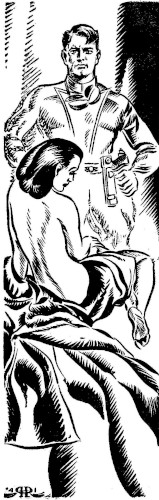
"Hm-m-m. Glad you brought the point up. You've got to put on some clothes aboard this ship, you know."
"Me?" she demanded, "Why, I'm fully dressed—" she paused, then shrank together visibly. "Oh, Tellurians—I remember, all those coverings! You mean, then ... you think I'm shameless and indecent, too?"
"No. Not at all—yet." At his obvious sincerity Illona unfolded again. "Most of us—especially the officers—have been on so many different planets, had dealings with so many different types and kinds of entities, that we're used to anything. When we visit a planet that goes naked, we do also, as a matter of course; when we hit one that muffles up to complete invisibility we do that, too. 'When in Rome, be a Roman candle,' you know. The point is that we're at home here, you're the visitor. It's all a matter of convention, of course; but a rather important one. Don't you think so?"
"Covering up, certainly. Uncovering is different. They told me to be sure to, but I simply can't. I tried it back there, but I felt naked!"
"QX—we'll have the tailor make you a dress or two. Some of the boys haven't been around very much, and you'd look pretty bare to them. Everything you've got on, jewelry and all, wouldn't make a Tellurian sunsuit, you know."
"Then have them hurry up the dress, please. But this isn't jewelry, it is—"
"Jet back, beautiful. I know gold, and platinum, and—"
"The metal is expensive, yes," Illona conceded. "These alone," she tapped one of the delicate shields, "cost five days of work. But base metal stains the skin blue and green and black, so what can one do? As for the beads, they are synthetics—junk. Poor girls, if they buy it themselves, do not wear jewelry, but beads, like these. Half a day's work buys the lot."
"What!" Kinnison demanded.
"Certainly. Rich girls only, or poor girls who do not work, wear real jewelry, such as ... the Aldebaranian has not the words. Let me think at you, please?"
"Sorry, nothing there that I recognize at all," Kinnison answered, after studying a succession of thought-images of multicolored, spectacular gems. "That's one to file away in the book, too, believe me. But as to that 'junk' you've got draped all over yourself—half a day's pay—what do you work at for a living, when you work?"
"I'm a dancer—like this." She leaped lightly to her feet and her left boot whizzed past her ear in a flashingly fast high kick. Then followed a series of gyrations and contortions, for which the Lensman knew no names, during which the girl seemed a practically boneless embodiment of suppleness and grace. She sat down; meticulous hairdress scarcely rumpled, not a buckle or bracelet awry, breathing hardly one count faster.
"Nice." Kinnison applauded briefly. "Hard for me to evaluate such talent as that. However, upon Tellus or any one of a thousand other planets I could point out to you, you can sell that 'junk' you're wearing for—at a rough guess—about fifty thousand days' work."
"Impossible!"
"True, nevertheless. So, before we land, you'd better give them to me, so that I can send them to a bank for you, under guard."
"If I land." As Kinnison spoke Illona's manner changed; darkened as though an inner light had been extinguished. "You have been so friendly and nice, I was forgetting where I am and the business ahead. Putting it off won't make it any easier. Better be getting on with it, don't you think?"
"Oh, that? That's all done, long ago."
"What?" she almost screamed. "It isn't! It couldn't be!"
"Sure. I got most of the stuff I wanted last night, while I was changing your thought-screen battery. Menjo Bleeko, your big-shot boss, and so on."
"You didn't! But ... you must have, at that, to know it. You didn't hurt me, or anything. You couldn't have operated—changed me—because I have all my memories—or seem to. I'm not an idiot, I mean any more than usual—"
"You've been taught a good many sheer lies, and quite a few half-truths," he informed her, evenly. "For instance, what did they tell you that hollow tooth would do to you when you broke the seal?"
"Make my mind a blank. But one of their doctors would get hold of me very soon and give me the antidote that would restore me exactly as I was before."
"That is one of the half-truths. It would certainly have made your mind a blank, but only by blasting nine-tenths of your memory files out of existence. Their therapists would 'restore' you by substituting other memories for your own—whatever other ones they pleased."
"How horrible! How perfectly ghastly! That was why you treated it so, then; as though it were a snake. I wondered at your savagery toward it. But how, really, do I know that you are telling the truth?"
"You don't," he admitted. "You will have to make your own decisions after acquiring full information."
"You are a therapist," she remarked, shrewdly. "But if you operated upon my mind you didn't 'save' me, because I still think exactly the same as I always did about the Patrol and everything pertaining to it—or do I? Or is this—" Her eyes widened with a startling possibility.
"No, I didn't operate," he assured her. "No such operation can possibly be done without leaving scars—breaks in the memory chains—that you can find in a minute if you look for them. There are no breaks or blanks in any chain in your mind."
"No—at least, I can't find any," she reported after a few minutes' thought. "But why didn't you? You can't turn me loose this way, you know—a z ... an enemy of your society."
"You don't need saving," he grinned. "You believe in absolute good and absolute evil, don't you?"
"Why, of course—certainly! Everybody must!"
"Not necessarily. Some of the greatest thinkers in the Universe do not." His voice grew somber, then lightened again. "Such being the case, however, all that you need to 'save' yourself is experience, observation and knowledge of both sides of the question. You're a colossal little fraud, you know."
"How do you mean?" She blushed vividly, her eyes wavered.
"Pretending to be such a hard-boiled egg. 'Never broke yet.' Why should you have broken, when you have never been under pressure?"
"I have so!" she flared. "What do you suppose I'm carrying this knife for?"
"Oh, that." He mentally shrugged the wicked little dagger aside as he pondered. "You little lamb in wolf's clothing—but at that, your memories may, I think, be altogether too valuable to monkey with. There's something funny about this whole matrix—damned funny. Come clean, angel face—why?"
"They told me," Illona admitted, wriggling slightly, "to act tough—really tough. As though I were an adventuress who had been everywhere and had done ... done everything. That the worse I acted the better I would get along in your Civilization."
"I suspected something of the sort. And what did you zwil ... excuse me, you folks ... go to Lyrane for, in the first place?"
"I don't know. From chance remarks I gathered that we were to land upon one of the planets—any one, I supposed—and wait for somebody."
"What were you, personally, going to do?"
"I don't know that, either—not exactly, that is. Whoever it was that we were going to meet was going to give us instructions."
"How come those women killed your men? Didn't they have thought-screens, too?"
"No. They were not agents, just soldiers. They killed about a dozen of the Lyranians when we first landed—to demonstrate their power—then they dropped dead."
"Um. Poor technique, but typically Boskonian. Your trip to Tellus was more or less accidental, then?"
"Yes. I wanted her to take me back to Lonabar, but she wouldn't. She learned about Tellus and the Patrol from our minds—none of them could believe at first that there were any inhabited worlds except their own—and wanted to study them at first hand. So she took our ship and used me as ... as a sort of blind, I think."
"I see. I'm not surprised. I thought that there was something remarkably screwy about those activities—they seemed so aimless and so barren of results—but I couldn't put my finger on it. And we crowded her so close that she decided to flit for home. You drove the ship and picked her up. You could see her, but nobody else could—that she didn't want to."
"That was it. She said that she was being hampered by a mind of power. That was you, of course?"
"And others. Well, that's that, for a while."
He called the tailor in. No, he didn't have a thing to make a girl's dress out of, especially not a girl like that. She should wear glamorette, and sheer—very sheer. He didn't know a thing about ladies' tailoring, either; he hadn't made a gown since he was knee-high to a duck. All he had in the shop was coat linings. Perhaps nylon would do, after a fashion. He remembered now, he did have a bolt of gray nylon that wasn't any good for linings—not stiff enough. Far too heavy, of course, but it would drape well.
It did. She came swaggering back, an hour or so later, the hem of her skirt swishing against the tops of her high-laced boots.
"Do you like it?" she asked, pirouetting gayly.
"Fine!" he applauded, and it was. The tailor had understated tremendously both his ability and the resources of his shop.
"Now what? I don't have to stay in my room all the time now, please?"
"I'll say not. The ship is yours. I want you to get acquainted with every man on board. Go anywhere you like—except the private quarters, of course—even to the control room. The boys all know that you're at large."
"The language—but I'm talking English now!"
"Sure. I've been giving it to you right along. You know it as well now as I do."
She stared at him in awe. Then, her natural buoyancy asserting itself, she flitted out of the room with a wave of her hand.
And Kinnison sat down to think. A girl—a kid who wasn't dry behind the ears yet—wearing beads worth a full-grown fortune, sent somewhere—to do what? Lyrane II, a perfect matriarchy. Lonabar, a planet of zwilniks that knew all about Tellus, but that Tellus had never even heard of, sending expeditions to Lyrane. To the System, perhaps not specifically to Lyrane II. Why? For what? To do what? Strange, new jewels of fabulous value. What was the hookup? It didn't make any kind of sense yet—not enough data.
And faintly, waveringly, barely impinging upon the outermost, most tenuous fringes of his mind he felt something: the groping, questing summons of an incredibly distant thought.
"Male of Civilization ... Person of Tellus ... Kinnison of Tellus ... Lensman Kinnison of Sol III.... Any Lens-bearing officer of the Galactic Patrol—" Endlessly the desperately urgent, almost imperceptible thought implored.
Kinnison stiffened. He reached out with the full power of his mind, seized the thought, tuned to it, and hurled a reply—and when that mind really pushed a thought, it traveled.
"Kinnison of Tellus acknowledging!" His answer fairly crackled on its way.
"You do not know my name," the stranger's thought came clearly now. "I am the 'Toots,' the 'Queen of Sheba,' the 'Cleopatra,' the 'Elder Person' of Lyrane II. Do you know me, O Kinnison of Sol III?"
"I know you," he shot back. What a brain—what a terrific brain—that sexless woman had!
"We are invaded by manlike beings in ships of space, who wear screens against our thoughts and who slay without cause. Will you help us with your ship of might and your mind of power?"
"Just a sec, Toots—Henderson!" Orders snapped. The Dauntless spun end-for-end.
"QX, Helen of Troy," he reported then. "We're on our way back there at maximum blast. Say, that name 'Helen of Troy' fits you better than anything else I have called you. You don't know it, of course, but that other Helen launched a thousand ships. You're launching only one; but, believe me, Babe, the old Dauntless is SOME ship!"
"I hope so." The Person of Lyrane II, ignoring the byplay, went directly to the heart of the matter in her usual pragmatic fashion. "We have no right to ask; you have every reason to refuse—"
"Don't worry about that, Helen. We're all good little boy scouts at heart. We're supposed to do a good deed every day, and we have missed a lot of days lately."
"You are what you call 'kidding,' I think." A matriarch could not be expected to possess a sense of humor. "But I do not lie to you or pretend. We did not, do not now, and never will like you or yours. With us now, however, it is that you are much the lesser of two terrible evils. If you will aid us now, we will tolerate your Patrol."
"And that's big of you, Helen, no fooling." The Lensman was really impressed. The plight of the Lyranians must be desperate indeed. "Just keep a stiff upper lip, all of you. We're coming loaded for bear, and we are not exactly creeping."
Nor were they. The big cruiser had plenty of legs and she was using them all; the engineers were giving her all the oof that her drivers would take. She was literally blasting a hole through space; she was traveling so fast that the atoms of substance in the interstellar vacuum, merely wave forms though they were, simply could not get out of the flier's way. They were being blasted into nothingness against the Dauntless' wall shields.
And throughout her interior the Patrol ship, always in complete readiness for strife, was being gone over again with microscopic thoroughness, to be put into more readiness, if possible, even than that.
After a few hours Illona danced back to Kinnison's "con" room, fairly bubbling over.
"They're marvelous, Lensman!" she cried, "simply marvelous!"
"What are marvelous?"
"The boys," she enthused. "All of them. They're here because they want to be—why, the officers don't even have whips! They like them, actually! The officers who push the little buttons and things and those who walk around and look through the little glass things and even the gray-haired old man with the four stripes, why they like them all! And the boys were all putting on guns when I left—why, I never heard of such a thing!—and they're just simply crazy about you. I thought it was awfully funny that you took off your guns as soon as the ship left Lyrane and that you don't have guards around you all the time because I thought sure somebody would stab you in the back or something, but they don't even want to and that's what's so marvelous and Hank Henderson told me—"
"Save it!" he ordered. "Jet back, angel face, before you blow a fuse." He had been right in not operating—this girl was going to be a mine of information concerning Boskonian methods and operations, and all without knowing it. "That's what I have been trying to tell you about our Civilization; that it is founded upon the freedom of the individual to do pretty much as he pleases, as long as it is not to the public harm. And, as far as possible, equality of all the entities of Civilization."
"Uh-huh, I know you did," she nodded brightly, then sobered quickly, "but I couldn't understand it. I can't understand it yet; I can scarcely believe that you all are so—You know, don't you, what would happen if this were a Lonabarian ship and I would go running around talking to officers as though I were their equal?"
"No—what?"
"It's inconceivable, of course; it simply couldn't happen. But if it did, I would be punished terribly—perhaps, though, at a first offense, I might be given only a twenty-scar whipping." At his lifted eyebrow she explained, "One that leaves twenty scars that show for life.
"That's why I'm acting so intoxicated, I think. You see," she hesitated shyly, "I am not used to being treated as anybody's equal, except of course other girls like me. Nobody is, on Lonabar. Everybody is higher or lower than you are. I'm going to simply love this when I get accustomed to it." She spread both arms in a sweeping gesture. "I'd like to squeeze this whole ship and everybody in it—I just can't wait to get to Tellus and really live there!"
"That's a thing that has been bothering me," Kinnison confessed, and the girl stared wonderingly at his serious face. "We are going into battle, and we can't take time to land you anywhere before the battle starts."
"Of course not. Why should you?" she paused, thinking deeply. "You're not worrying about me, surely? Why, you're a high officer! Officers don't care whether a girl is shot or not, do they?" The thought was obviously, utterly new.
"We do. It's extremely poor hospitality to invite a guest aboard and then have her killed. All I can say, though, is that if our number goes up, I hope that you can forgive me for getting you into it!"
"Oh—thanks, Gray Lensman. Nobody ever spoke to me like that before. But I wouldn't land if I could. I like Civilization. If you ... if you don't win, I couldn't go to Tellus, anyway, so I'd much rather take my chances here than not, sir, really. I'll never go back to Lonabar, in any case."
"'At a girl, Toots!" He extended his hand. She looked at it dubiously, then hesitantly stretched out her own. But she learned fast; she put as much pressure into the brief hand-clasp as Kinnison did. "You'd better blast off now, I've got work to do.
"Go anywhere you like until I call you. Before the trouble starts I'm going to put you down in the center, where you'll be as safe as possible."
The girl hurried away and the Lensman got into communication with Helen of Lyrane, who gave him then a resumé of everything that had happened. Two ships—big ships, immense space cruisers—appeared near the airport. Nobody saw them coming, they came so fast. They stopped, and without warning or parley destroyed all the buildings and all the people nearby with beams like Kinnison's needle beam, except much larger. Then the ships landed and men disembarked. The Lyranians killed ten of them by direct mental impact or by monsters of the mind, but after that everyone who came out of the vessel wore a thought-screen and the persons were quite helpless. The enemy had burned down and melted a part of the city, and as a further warning were then making formal plans to execute publicly a hundred leading Lyranians—ten for each man they had killed.
Because of the screens no communication was possible, but the invaders had made it clear that if there were one more sign of resistance, or even of non-co-operation, the entire city would be rayed and every living thing in it blasted out of existence. She herself had escaped so far. She was hidden in a crypt in the deepest subcellar of the city. She was, of course, one of the ones they wanted to execute, but finding any of Lyrane's leaders would be extremely difficult, if not impossible. They were still searching, with many persons as highly unwilling guides. They had indicated that they would stay there until the leaders were found; that they would make the Lyranians tear down their city, stone by stone, until they were found.
"But how could they know who your leaders are?" Kinnison wanted to know.
"Perhaps one of our persons weakened under their torture," Helen replied equably. "Perhaps they have among them a mind of power. Perhaps in some other fashion. What matters it? The thing of importance is that they do know."
"Another thing of importance is that it'll hold them there until we get there," Kinnison thought. "Typical Boskonian technique, I gather. It won't be many hours now. Hold them off if you can."
"I think that I can," came tranquil reply. "Through mental contact each person acting as guide knows where each of us hidden ones is, and is avoiding all our hiding places."
"Good. Tell me all you can about those ships, their size, shape and armament."
She could not, it developed, give him any reliable information as to size. She thought that the present invaders were smaller than the Dauntless, but she could not be sure. Compared to the little airships which were the only flying structures with which she was familiar, both Kinnison's ships and those now upon Lyrane were so immensely huge that trying to tell which was larger was very much like attempting to visualize the difference between infinity squared and infinity cubed. On shape, however, she was much better; she spread in the Lensman's mind an accurately detailed picture of the two space ships which the Patrolmen intended to engage.
In shape they were ultrafast, very much like the Dauntless herself. Hence they certainly were not maulers. Nor, probably, were they first-line battleships, such as had composed the fleet which had met Civilization's Grand Fleet off the edge of the Second Galaxy. Of course, the Patrol had had in that battle ultrafast ships which were ultrapowerful as well—such as this same Dauntless—and it was a fact that while Civilization was designing and building, Boskonia could very well have been doing the same thing. On the other hand, since the enemy could not logically be expecting real trouble in Dunstan's Region, these cans might very well be second-line or out-of-date stuff—
"Are those ships lying on the same field we landed on?" he asked at that point in his cogitations.
"Yes."
"You can give me pretty close to an actual measurement of the difference, then," he told her. "We left a hole in that field practically our whole length. How does it compare with theirs?"
"I can find that out, I think," and in due time she did so; reporting that the Dauntless was the longer, by some twelve times a person's height.
"Thanks, Helen." Then, and only then, did Kinnison leave his private conning room and call his officers into consultation in the control room.
He told them everything he had learned and deduced about the two Boskonian vessels which they were about to attack. Then, heads bent over a visitank, the Patrolmen began to discuss strategy and tactics.
VI.
As the Dauntless approached Lyrane II so nearly that the planet showed a perceptible disk upon the plates, the observers began to study their detectors carefully. Nothing registered, and a brief interchange of thoughts with the Chief Person of Lyrane informed the Lensman that the two Boskonian warships were still upon the ground. Indeed, they were going to stay upon the ground until after the hundred Lyranian leaders, most of whom were still safely hidden, had been found and executed, exactly as per announcement. The strangers had killed many persons by torture and were killing more in attempts to make them reveal the hiding places of the leaders, but little if any real information was being obtained.
"Good technique, perhaps, from a bullheaded, dictatorial standpoint, but it strikes me as being damned poor tactics," grunted Malcolm Craig, the Dauntless' grizzled captain, when Kinnison had relayed the information.
"I'll say it's poor tactics," the Lensman agreed. "If Helmuth or one of the living military hot shots of his caliber were down there, one of those cans would be out on guard, flitting all over space."
"But how could they be expecting trouble 'way out here, nine thousand parsecs from anywhere?" argued Chatway, the chief firing officer.
"They ought to be—that's the point." This from Henderson. "Where do we land, Kim? Did you find out?"
"Not exactly; they're on the other side of the planet from here, now. Good thing we don't have to get rid of a Tellurian intrinsic this time—it'll be a near thing as it is." And it was. Scarcely was the intrinsic velocity matched to that of the planet when the observers reported that the airport upon which the enemy lay was upon the horizon. Inertialess, the Dauntless flashed away, going inert and into action simultaneously when within range of the zwilnik ships. Within range of one of them, that is; for, short as the time had been, the crew of one of the Boskonian vessels had been sufficiently alert to get her away. The other one did not move; then or ever.
The Patrolmen acted with the flawless smoothness of long practice and perfect teamwork. At the first sign of zwilnik activity as revealed by his spy-rays, Nelson, the chief communications officer, loosed a barrage of ethereal and sub-ethereal static interference through which no communications beam or signal could be driven. Captain Craig barked a word into his microphone and every dreadful primary that could be brought to bear erupted as one weapon. Chief Pilot Henderson, after a casual glance below, cut in the Bergenholms, tramped in his blasts, and set the cruiser's narrow nose into his tracer's line. One glance was enough. He needed no orders as to what to do next. It would have been apparent to almost anyone, even to one of the persons of Lyrane, that that riddled, slashed, three-quarters fused mass of junk never again would be or could contain aught of menace. The Patrol ship had not stopped: had scarcely even paused. Now, having destroyed half of the opposition en passant, she legged it after the remaining half.
"Now what, Kim?" asked Captain Craig. "We can't inglobe him and he no doubt mounts tractor shears. We'll have to use the new tractor zone, won't we?"
Ordinarily the gray-haired four-striper would have made his own decisions, since he and he alone fought his ship; but these circumstances were far from ordinary. First, any Unattached Lensman, wherever he was, was the boss. Second, the tractor zone was new; so brand-new that even the Dauntless had not as yet used it. Third, the ship was on detached duty, assigned directly to Kinnison to do with as he willed. Fourth, said Kinnison was high in the confidence of the Galactic Council and would know whether or not the present situation justified the use of the new mechanism.
"If he can cut a tractor, yes," the Lensman agreed. "Only one ship. He can't get away and he can't communicate—safe enough. Go to it."
The Tellurian ship was faster than the Boskonian; and, since she had been only seconds behind at the start, she came within striking distance of her quarry in short order. Tractor beams reached out and seized; but only momentarily did they hold. At the first pull they were cut cleanly away. No one was surprised; it had been taken for granted that all Boskonian ships would by this time have been equipped with tractor shears.
These shears had been developed originally by the scientists of the Patrol. Immediately following that invention, looking forward to the time when Boskone would have acquired it, those same scientists set themselves to the task of working out something which would be just as good as a tractor beam for combat purposes, but which could not be cut. They got it finally—a globular shell of force, very much like a meteorite screen except double in phase. That is, it was completely impervious to matter moving in either direction, instead of only to that moving inwardly. Even if exact data as to generation, gauging, distance, and control of this weapon were available—which they very definitely are not—it would serve no good end to detail them here. Suffice it to say that the Dauntless mounted tractor zones, and had ample power to hold them.
Closer up the Patrol ship blasted. The zone snapped on, well beyond the Boskonian, and tightened. Henderson cut the Bergenholms. Captain Craig snapped out orders and Chief Firing Officer Chatway and his boys did their stuff.
Defensive screens full out, the pirate stayed free and tried to run. No soap. She merely slid around upon the frictionless inner surface of the zone. She rolled and she spun. Then she went inert and rammed. Still no soap. She struck the zone and bounced; bounced with all of her mass and against all the power of her driving thrust. The impact jarred the Dauntless to her very skin; but the zone's anchorage had been computed and installed by top-flight engineers and they held. And the zone itself held. It yielded a bit, but it did not fail and the shear planes of the pirates could not cut it.
Then, no other course being possible, the Boskonians fought. Of course, theoretically, surrender was possible, but it simply was not done. No pirate ship ever had surrendered to a Patrol force, however large; none ever would. No Patrol ship had ever surrendered to Boskone—or would. That was the unwritten but grimly understood code of this internecine conflict between two galaxy-wide and diametrically opposed cultures; it was and had to be a war of utter and complete extermination. Individuals or small groups might be captured bodily; but no ship, no individual, even, ever, under any conditions, surrendered. The fight was—always and everywhere—to the death.
So this one was. The enemy was well armed of her type, but her type simply did not carry projectors of sufficient power to break down the Dauntless' hard-held defensive screens. Nor did she mount screens heavy enough to withstand for long the furious assault of the Patrol ship's terrific primaries.
As soon as the pirate's screens went down the firing stopped; that order had been given long since. Kinnison wanted information, he wanted charts, he wanted a few living Boskonians. He got nothing. Not a man remained alive aboard the riddled hulk; the chart room contained only heaps of fused ash. Everything which might have been of use to the Patrol had been destroyed, either by the Patrol's own beams or by the pirates themselves after they saw they must lose.
"Beam it out," Craig ordered, and the remains of the Boskonian warship disappeared.
Back toward Lyrane II, then, the Dauntless went, and Kinnison again made contact with Helen, the Elder Sister. She had emerged from her crypt and was directing affairs from her—"office" is perhaps the word—upon the top floor of the city's largest building. The search for the Lyranian leaders, the torture and murder of the citizens, and the destruction of the city had stopped, all at once, when the grounded Boskonian cruiser had been blasted out of commission. The directing intelligences of the raiders had remained, it developed, within the "safe" confines of their vessel's walls; and when they ceased directing, their minions in the actual theater of operations ceased operating. They had been grouped uncertainly in an open square, but at the first glimpse of the returning Dauntless they had dashed into the nearest large building, each man seizing one or sometimes two persons as he went. They were now inside, erecting defenses and very evidently intending to use the Lyranians both as hostages and as shields.
Motionless now, directly over the city, Kinnison and his officers studied through their spy-rays the number, armament, and disposition of the enemy force. There were one hundred and thirty of them, human to about six places. They were armed with the usual portable weapons carried by such parties.
Originally they had had several semiportable projectors, but since all heavy stuff must be powered from the mother ship, it had been abandoned long since. Surprisingly, though, they wore full armor. Kinnison had expected only thought-screens, since the Lyranians had no offensive weapons save those of the mind; but apparently either the pirates did not know that or else were guarding against surprise.
Armor was—and is—heavy, cumbersome, a handicap to fast action, and a nuisance generally; hence for the Boskonians to have dispensed with it would not have been poor tactics. True, the Patrol did attack, but that could not have been what was expected. In fact, had such an attack been in the cards, that Boskonian punitive party would not have been on the ground at all. It was equally true that canny old Helmuth, who took nothing whatever for granted, would have had his men in armor. However, he would have guarded much more completely against surprise—but few commanders indeed went to such lengths of precaution as Helmuth did. Thus Kinnison pondered.
"This ought to be as easy as shooting fish down a well—but you'd better put out space scouts just the same," he decided, as he punched a call for Lieutenant Peter Van Buskirk. "Bus? Do you see what we see?"
"Uh-huh, we've been peeking a bit," the huge Dutch-Valerian responded, happily.
"QX. Get your gang wrapped up in their tinware. I'll see you at the main lower stabbard lock in ten minutes." He switched off and turned to an orderly. "Break out my G-P cage for me, will you, Spike? And I'll want the 'copters—tell them to get hot."
"But listen, Kim!" and:
"You can't do that, Kinnison!" came simultaneously from chief pilot and captain, neither of whom could leave the ship in such circumstances as these. They, the vessel's two top officers, were bound to her; while the Lensman, although ranking both of them, even aboard ship, was not and could not be bound by anything.
"Sure, I can—you fellows are just jealous, that's all," Kinnison retorted, cheerfully. "I not only can, I've got to go with the Valerians. I need a lot of information, and I can't read a dead man's brain—yet."
While the storming party was assembling, the Dauntless settled downward, coming to rest in the already devastated section of the town, as close as possible to the building in which the Boskonians had taken refuge.
One hundred and two men disembarked: Kinnison, Van Buskirk, and the full company of one hundred Valerians. Each of those space-fighting wild cats measured seventy-eight inches or more from sole to crown; each was composed of four hundred or more pounds of the fantastically powerful, rigid, and reactive brawn, bone, and sinew necessary for survival upon a planet having a surface gravity almost three times that of small, feeble Terra.
Because of the women held captive by the pirates, the Valerians carried no machine rifles, no semiportables, no heavy stuff at all; only their DeLameters and, of course, their space axes. A Valerian trooper without his space ax? Unthinkable! A dire weapon indeed, the space ax. A combination and sublimation of battle-ax, mace, bludgeon, and lumberman's picaroon; thirty pounds of hard, tough, space-tempered alloy; a weapon of potentialities limited only by the physical strength and bodily agility of its wielder. And Van Buskirk's Valerians had both—plenty of both. One-handed, with simple flicks of his incredible wrist, the smallest Valerian of the Dauntless boarding party could manipulate his atrocious weapon as effortlessly as, and almost unbelievably faster than, a fencing master handles his rapier or an orchestra conductor waves his baton.
With machinelike precision the Valerians fell in and strode away; Van Buskirk in the lead, the helicopters hovering overhead, the Gray Lensman bringing up the rear. Tall and heavy, strong and agile as he was—for a Tellurian—he had no business in that front line, and no one knew that fact better than he did. The puniest Valerian of the company could do in full armor a standing high jump of over fourteen feet; and could dodge, feint, parry, and swing with a blinding speed starkly impossible to any member of any of the physically lesser breeds of man.
Approaching the building they spread out, surrounded it; and at a signal from a helicopter that the ring was complete, the assault began. Doors and windows were locked, barred, and barricaded, of course; but what of that? A few taps of the axes and a few blasts of the DeLameters took care of things very nicely; and through the openings thus made there leaped, dove, rolled, or strode the space black-and-silver warriors of the Galactic Patrol. Valerians, than whom no fiercer race of hand-to-hand fighters has ever been known—no bifurcate race, and but very few others, however built or shaped, have ever willingly come to grips with the armored axmen of Valeria!
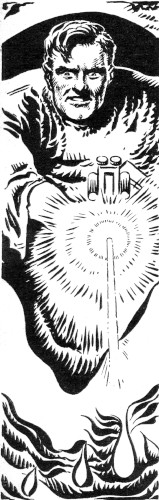
Not by choice, then, but of necessity and in sheer desperation the pirates fought. In the vicious beams of their portables the stone walls of the room glared a baleful red; in spots even were pierced through. Old-fashioned pistols barked, spitting steel-jacketed lead. But the G-P suits were screened against lethal beams by generators capable of withstanding anything of lesser power than a semiportable projector; G-P armor was proof against any projectile possessing less energy than that hurled by the high caliber machine rifle. Thus the Boskonian beams splashed off the Valerian's screens in torrents of man-made lightning and in pyrotechnic displays of multicolored splendor, their bullets ricocheted harmlessly as spent, misshapen blobs of metal.
The Patrolmen did not even draw their DeLameters during their inexorable advance. They knew that the pirates' armor was as capable as theirs, and the women were not to die if death for them could possibly be avoided. As they advanced the enemy fell back toward the center of the great room; holding there with the Lyranians forming the outer ring of their roughly circular formation; firing over the women's heads and between their naked bodies.
Kinnison did not want those women to die. It seemed, however, that die they must, from the sheer, tremendous reflection from the Valerians' fiercely radiant screens, if the Patrolmen persisted in their advance. He studied the enemy formation briefly, then flashed an order.
There ensued a startling and entirely unorthodox maneuver, one possible only to the troopers there at work, as at Kinnison's command every Valerian left the floor in a prodigious leap. Over the women's heads, over the heads of the enemy; but in midleap, as he passed over, each Patrolman swung his ax at a Boskonian helmet with all the speed and all the power he could muster. Most of the enemy died then and there, for the helmet has never been forged which is able to fend the diamond beak of a space ax driven as each of those was driven. The fact that the Valerians were nine or ten feet off the floor at the time made no difference whatever. They were space fighters, trained to handle themselves and their weapons in any position or situation; with or without gravity, with or without even inertia.
"You persons—run! Get out of here! SCRAM!" Kinnison fairly shouted the thought as the Valerians left the floor, and the matriarchs obeyed—frantically. Through doors and windows they fled, in all directions and at the highest possible speed.
But in their enthusiasm to strike down the foe, not one of the Valerians had paid any attention to the exact spot upon which he was to land; or, if he did, someone else got there either first or just barely second. Besides, there was not room for them all in the center of the ring. For seconds, therefore, confusion reigned and a boiler-works clangor resounded for a mile around as a hundred and one extra-big and extra-heavy men, a writhing, kicking, pulling tangle of armor, axes, and equipment, jammed into a space which half their number would have filled overfull. Sulphurous Valerian profanity and sizzling deep-space oaths blistered the very air as each warrior struggled madly to right himself, to get one more crack at a pirate before somebody else beat him to it.
During this terrible melee some of the pirates released their screens and committed suicide. A few got out of the room, but not many. Nor far; the men in the helicopters saw to that. They had needle beams, powered from the Dauntless, which went through the screens of personal armor as a knife goes through ripe cheese.
"Save it, guys—hold everything!" Kinnison yelled as the tangled mass of Valerians resolved itself into erect and warlike units. "No more ax work—don't let them kill themselves—catch them ALIVE!"
They did so, quickly and easily. With the women out of the way, there was nothing to prevent the Valerians from darting right up to the muzzles of the foes' DeLameters. Nor could the enemy dodge, or run, half fast enough to get away. Armored, shielded hands batted the weapons away—if an arm or leg broke in the process, what the hell?—and the victim was held motionless until his turn came to face the mind-reading Kinnison.
Nothing. Nothing, flat. A string of zeros. And, bitterly silent, Kinnison led the way back to the Dauntless. The men he wanted, the ones who knew anything, were the ones who killed themselves, of course. Well, why not? In like case, officers of the Patrol had undoubtedly done the same. The live ones didn't know where their planet was, could give no picture even of where it lay in the Galaxy, did not know where they were going, nor why. Well, so what? Wasn't ignorance the prime characteristic of the bottom layers of dictatorships everywhere? If they had known anything, they would have been under orders to kill themselves, too, and would have done it.
In his con room in the Dauntless his black mood lightened somewhat and he called the Elder Person.
"Helen of Troy? I suppose that the best thing we can do now, for your peace of mind, prosperity, well-being, et cetera, is to drill out of here as fast as Klono and Noshabkeming will let us. Right?"
"Why, I ... you ... um ... that is." The matriarch was badly flustered at the Lensman's bald summation of her attitude. She did not want to agree, but she certainly did not want these males around a second longer than was necessary.
"Just as well say it, because it goes double for me—you can play it clear across the board, toots, that if I ever see you again it will be because I can't get out of it." Then, to his chief pilot:
"QX, Hen, give her the oof—back to Tellus."
VII.
Through the ether the mighty Dauntless bored her serene way homeward, at the easy touring blast—for her—of some eighty parsecs an hour. The engineers inspected and checked their equipment, from instrument needles to blast nozzles; re-lining, repairing, replacing anything and everything which showed any sign of wear or strain because of what the big vessel had just gone through. Then they relaxed into their customary routine of killing time—the games of a dozen planets and the vying with each other in the telling of outrageously untruthful stories.
The officers on watch lolled at ease in their cushioned seats, making much ado of each tiny thing as it happened, even the changes of watch. The Valerians, as usual, remained invisible in their own special quarters. There the gravity was set at twenty-seven hundred instead of at the Tellurian normal of nine hundred eighty, there the atmospheric pressure was forty pounds to the square inch, there the temperature was ninety-six degrees Fahrenheit, and there Van Buskirk and his fighters lived and moved and had their daily drills of fantastic violence and stress. They were irked less than any of the others by monotony; being, as has been intimated previously, neither mental nor intellectual giants.
And Kinnison, mirror-polished gray boots stacked in all their majestic size upon a corner of his desk, leaned his chair precariously backward and thought in black concentration. It still didn't make any kind of sense. He had just enough clues—fragments of clues—to drive a man nuts. Menjo Bleeko was the man he wanted. On Lonabar. To find one was to find the other, but how in the steaming hells of Venus was he going to find either of them? It might seem funny not to be able to find a thing as big as a planet—but since nobody knew where it was, by fifty thousand parsecs, and since there were millions and skillions and whillions of planets in the Galaxy, a random search was quite definitely out. Bleeko was a zwilnik, or tied in with zwilniks, of course; but he could read a million zwilnik minds without finding, except by merest chance, one having any contact with or knowledge of the Lonabarian.
The Patrol had already scoured—fruitlessly—Aldebaran II for any sign, however slight, pointing toward Lonabar. The planetographers had searched the files, the charts, the libraries thoroughly. No Lonabar. Of course, they had suggested—what a help!—they might know it under some other name. Personally, he didn't think so, since no jeweler throughout the far-flung bounds of civilization had as yet been found who could recognize or identify any of the items he had described.
Whatever avenue or alley of thought Kinnison started along, he always ended up at the jewels and the girl. Illona, the squirrel-brained, romping, joyous little imp who by now owned in fee simple half of the ship and nine-tenths of the crew. Why in Palain's purple hells couldn't she have had a brain back of that beautiful pan? But at that, he had to admit, she was smarter than most—you couldn't expect any other woman in the Galaxy to have a mind like Mac's.
For minutes, then, he abandoned his problem and reveled in visions of the mental and physical perfections of his fiancée. But this was getting him nowhere, fast. The girl or the jewels—which? They were the only real angles he had.
He sent out a call for her, and in a few minutes she came swirling in. How different she was from what she had been! Gone were the somberness, the dread, the terror which had oppressed her; gone were the class-conscious inhibitions against which she had been rebelling, however subconsciously, since childhood. Here she was free! The boys were free, everybody was free! She had expanded tremendously—unfolded. She was living as she had never dreamed it possible to live. Each new minute was an adventure in itself. Her black eyes, once so dull, sparkled with animation; radiated her sheer joy in living. Even her jet-black hair seemed to have taken on a new luster and gloss, in its every precisely arranged wavelet.
"Hi, Lensman!" Illona burst out, before Kinnison could say a word or think a thought in greeting. "I'm so glad you sent for me, because there's something I've been wanting to ask you for days. The boys are going to throw a blowout, with all kinds of stunts, and they want me to do a dance. QX, do you think?"
"Sure. Why not?"
"Clothes," she explained. "I told them I couldn't dance in a dress, and they said that I wasn't supposed to, that acrobats didn't wear dresses when they performed on Tellus. I said they lied like thieves and they swore they didn't—said to ask the Old Man—" She broke off, two knuckles jammed into her mouth, expressive eyes wide in sudden fright. "Oh, excuse me, sir," she gasped. "I didn't—"
"'Smatter? What bit you?" Kinnison asked, then got it. "Oh ... the 'Old Man,' huh? QX, angel face, that is standard nomenclature in the Patrol. Not with you folks, though, I take it?"
"I'll say not," she breathed. She acted as though a catastrophe had been averted by the narrowest possible margin. "Why, if anybody got caught even thinking such a thing, the whole crew would go into the steamer that very minute. And if I would dare to say 'Hi' to Menjo Bleeko—" She shuddered.
"Nice people," Kinnison commented.
"But are you sure that the ... that I'm not getting any of the boys into trouble?" she pleaded. "For, after all, none of them ever dare call you that to your face, you know."
"You haven't been around enough yet," he assured her. "On duty, no; that's discipline—necessary for efficiency. And I haven't hung around the wardrooms much of late—been too busy. But at the party you'll be surprised at some of the things they call me—if you happen to hear them. You've been practicing—keeping in shape?"
"Uh-huh," she confessed. "In my room, with the spy-ray block on."
"Good. No need to hide, though, and no need to wear dresses any time you're practicing—the boys were right on that. What do you think of this pseudoinertia as compared to the real thing?" He did not, actually, care what she thought of it; he was merely making conversation to cover up the fact that he was probing the deepest recesses of her mind.
"I like it, even better in some ways. Your legs and arms feel as though they were following through perfectly, but if you kick something, or come down too hard in a forward flip—back flips are easy—it doesn't hurt. It's nice."
"Must be," he agreed, absently. "Got to watch out for yourself, though, when you get back onto a planet. Now I want you to help me. Will you?"
"Yes, sir. In anything I can—anything, sir," she answered, instantly.
"I want you to give me every scrap of information you possibly can about Lonabar; its customs and habits, its work and its play—everything, even its money and its jewelry." This last apparently an afterthought. "To do so, you'll have to let me into your mind of your own free will—you'll have to co-operate to the limit of your capability. QX?"
"That will be quite all right, Lensman," she agreed, shyly. "I know now that you are not going to hurt me."
Illona did not like it at first, there was no question of that. And small wonder. It is an intensely disturbing thing to have your mind invaded, knowingly, by another; particularly when that other is the appallingly powerful mind of Gray Lensman Kimball Kinnison. There were lots of things she did not want exposed, and the very effort not to think of them brought them ever and ever more vividly to the fore. She squirmed, mentally and physically: her mind was for minutes a practically illegible turmoil. But she soon steadied down and, as she got used to the new sensations, she went to work with a will. She could not increase materially the knowledge of the planet which Kinnison had already obtained from her, but she was a mine of information concerning the peculiar gems. She knew all about every one of them, with the completely detailed knowledge one is all too apt to have of a thing long and intensely desired, but supposedly forever out of reach.
"Thanks, Illona." It was over; the Lensman knew as much as she did about everything which had any bearing upon his quest. "You have helped a lot—now you can flit."
"I'm glad to help, sir, really—any time. I'll see you at the party, then, if not before." Illona left the room in a far more subdued fashion than she had entered it. She had always been more than half afraid of Kinnison; just being near him did things to her which she did not quite like. And this last thing, this mind-searching interview, did not operate to quiet her fears. It gave her the screaming meamies, no less!
And Kinnison, alone in his room, called for a tight beam to Prime Base. He wanted something, he explained, when the visage of Port Admiral Haynes appeared upon his plate. Something big, something that had never been tried before. Namely, a wide-open, Lens-to-Lens conference with all the Lensmen—particularly all the Unattached Lensmen—of the whole Galaxy, at the same time. Could it be arranged?
"Whew!" the admiral whistled. "I was in on a wide-open ten-way, once, but that's as high as I ever tried it. What's your thought as to technique?"
"Set a definite time, far enough ahead to give everybody notice. At that time, have everybody tune to your frequency. Since everybody will be en rapport with you, we will all be en rapport with each other, automatically."
"Seems reasonable—can do, I think. It will take at least a day to arrange the hookup. Day and a half, maybe. Say hour twenty tomorrow."
"QX. Hour twenty, on the line."
The next day dragged, even for the always-busy Kinnison. He prowled about, aimlessly. He saw the beautiful Aldebaranian several times, noticing as he did so something which he had not hitherto really observed, but which tied in nicely with a fact he had half seen in the girl's own mind, before he could dodge it—that whenever she made a twosome with any man, the man was Chief Pilot Henderson.
"Blasted, Hen?" he asked, casually, as he came upon the pilot in a corner of a wardroom, staring fixedly at nothing.
"Out of the ether," Henderson admitted. "I want to talk to you."
"G. A., we're alone—or, better yet, on the Lens. About Illona, the Aldebaranian zwilnik, I suppose."
"Don't Kim," Henderson flinched. "She isn't a zwilnik, really—I'd bet my last millo on that?"
"Are you telling me, or asking me?" the Lensman asked.
"I don't know," Henderson hesitated. "I wanted to ask you ... you know, you've got a lot of stuff that the rest of us haven't. I'm punctured plenty, and it's getting worse. Is there any reason, chief, why I shouldn't, well ... er ... get married?"
"Every reason in the book why you should, Hen. Why, when I get to be as old as you are, I hope to be retired, married, and the father of two or three kids."
"Damnation, Kim! That isn't what I meant, and you know it!"
"Think clearly, then; for your own sake and Illona's; not mine," Kinnison ordered. "Yes, I know what you mean, but you've got to bring it out into the open, yourself, to do any good."
"QX. Have I the permission of Kimball Kinnison, Unattached Lensman of the Galactic Patrol, to marry Illona Potter, if I've got jets enough to swing it?"
Mighty clever, the Lensman thought. Since all the men of the Patrol were notoriously averse to going sloppy or maudlin about it, he wondered just how the pilot was going to phrase his question. Hen had done it very neatly, by tossing the buck right back at him. But he wouldn't get sloppy, either. The "untarnished-meteors-upon-the-collars-of-the-Patrol" stuff was QX for Earthly spellbinders, but it didn't fit in anywhere else. So:
"That's better," Kinnison approved. "As far as I know—and in this case I bashfully admit that I know it all—everything is on the green. All you've got to worry about is the opposition of twelve hundred or so other guys in this can, and the fact that Illona will probably blast you to a cinder."
"Huh? Those apes? That? Watch my jets!" Henderson strode away, doubts all resolved; and Kinnison, seeing that hour twenty was very near, went to his own room.
Precisely upon the hour the Lensman tuned his—not his Lens, really, since he no longer needed that, but in all probability his very ego to that of Port Admiral Haynes. He had wondered frequently what it was going to feel like; but, having experienced it, he could never afterward describe it even in part.
It is difficult for any ordinary mind to conceive of its being in complete accord with any other, however closely akin. Consider, then, how utterly impossible it is to envision that merging of a hundred thousand, or five hundred thousand, or a million—nobody ever did know how many Lensmen tuned in that day—minds so utterly different that no one human being can live long enough even to see each of the races there represented! Probably less than half of them were even approximately human. Many were not mammals, many were not warm-blooded. Not all, by far, were even oxygen breathers—oxygen, to many of those races, was sheerest poison. Nevertheless, they had much in common. All were intelligent; most of them very highly so; and all were imbued with the principles of freedom and equality for which Galactic Civilization stood and upon which it was fundamentally based.
That meeting was staggering, even to Kinnison's mind. It was appalling—yet it was ultimately thrilling, too. It was one of the greatest, one of the most terrific thrills of the Lensman's long life.
"Thanks, fellows, for coming in," he began, simply. "I will make my message very short. As Haynes may have told you, I am Kinnison of Tellus. It will help greatly in locating the head of the Boskonian culture if I can find a certain planet, known to me only by the name of Lonabar. Its people are human beings to the last decimal; its rarest jewels are these," and he spread in the collective mind a perfect, exactly detailed and pictured description of the gems. "Does any one of you know of such a planet? Has any one of you ever seen a stone like any of these?"
A pause—a heartbreakingly long pause. Then a faint, soft, diffident thought appeared; appeared as though seeping slowly from a single cell of that incredibly linked, million-fold-composite Lensmen's BRAIN.
"I waited to be sure that no one else would speak, as my information is very meager, and unsatisfactory, and old," the thought apologized.
"Whatever its nature, any information at all is very welcome," Kinnison replied. "Who is speaking, please?"
"Nadreck of Palain VII, Unattached. Many cycles ago I secured, and still have in my possession, a crystal—or rather, fragment of a supercooled liquid—like one of the red gems you showed us; the one having practically all its transmittance in a very narrow band centering at point seven, oh, oh."
"But you do not know what planet it came from—is that it?"
"Not exactly," the soft thought went on. "I saw it upon its native planet, but unfortunately I do not now know just what or where that planet was. We were exploring at the time, and had visited many planets. Not being interested in any world having an atmosphere of oxygen, we paused but briefly, nor did we map it. I was interested in the fusion because of its peculiar filtering effect, hence bought it from its owner. A scientific curiosity merely."
"Do you believe that you could find the planet again?"
"By checking back upon the planets we did map, and by retracing our route, I should be able to ... yes, I am certain that I can do so."
"And when Nadreck of Palain VII says that he is certain of anything," another thought appeared, "nothing in the macrocosmic universe is more certain."
"I thank you, Twenty-four of Six, for the expression of confidence."
"And I thank both of you particularly, as well as all of you collectively," Kinnison broadcast. Then, as intelligences by the tens of thousands began to break away from the linkage, he continued to Nadreck:
"You will map this planet for me, then, and send the data in to Prime Base?"
"I will map the planet and will myself bring the data to you at Prime Base. Do you want some of the gems, also?"
"I don't think so," Kinnison thought swiftly. "No, better not. They'll be harder to get now, and it might tip our hand too much. I'll get them myself, later. Will you inform me, through Haynes, when to expect you upon Tellus?"
"I will so inform you. I will proceed at once, with speed."
"Thanks a million, Nadreck—clear ether!" and everyone cut loose.
The ship sped on, and as it sped, Kinnison continued to think. He attended the "blowout." Ordinarily he would have been right in the thick of it; but this time, young though he was and enthusiastic, he simply could not tune in. Nothing fitted, and until he could see a picture that made some kind of sense he could not let go. He listened to the music with half an ear, he watched the stunts with only half an eye.
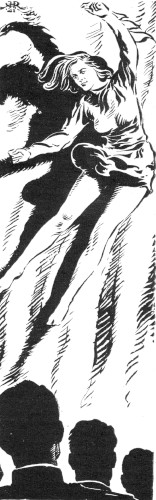
He forgot his problem for a while when, at the end, Illona Potter danced. For Lonabarian acrobatic dancing is not like the Tellurian art of the same name. Or rather, it is like it, except more so—much more so. An earthly expert would be scarcely a novice on Lonabar, and Illona was a Lonabarian expert. She had been training, intensively, all her life, and even in Lonabar's chill social and psychological environment she had loved her work. Now, reveling as she was in the first realization of liberty of thought and of person, and inspired by the heartfelt applause of the spacehounds so closely packed into the hall, she put on something more than an exhibition of coldly impersonal skill and limberness. And the feelings, both of performer and of spectators, were intensified by the fact that, of all the repertoire of the Dauntless' superb orchestra, Illona liked best to dance to the stirring strains of "Our Patrol." "Our Patrol," which any man who has ever worn the space black-and-silver will say is the greatest, grandest, most glorious, most terrific piece of music that ever was or ever will be written, played, or sung! Small wonder, then, that the dancer really "gave," or that the mighty cruiser's walls almost bulged under the applause of Illona's "boys" at the end of her first number.
They kept her at it until Captain Craig stopped it, to keep the girl from killing herself. "She's worn down to a nub," he declared, and she was. She was trembling. She was panting; her almost lacquered-down hair stood out in wild disorder. Her eyes were starry with tears—happy tears. Then the ranking officers made short speeches of appreciation and the spectators carried the actors—actual carrying, in Illona's case, upon an improvised throne—off for refreshments.
Back in his quarters, Kinnison tackled his problem again. He could work out something on Lonabar now, but what about Lyrane? It tied in, too—there was an angle there, somewhere. To get it, though, somebody would have to get close to—really friendly with—the Lyranians. Just looking on from the outside wouldn't do. Somebody they could trust and would confide in—and they were so damnably, so fanatically non-co-operative! A man couldn't get a millo's worth of real information—he could read any one mind by force, but he'd never get the right one. Neither could Worsel or Tregonsee or any other nonhuman Lensman; the Lyranians just simply didn't have the galactic viewpoint. No, what he wanted was a human woman Lensman, and there weren't any—
At the thought he gasped; the pit of his stomach felt cold. Chris! She was more than half Lensman already—she was the only un-Lensed human being who had ever been able to read his thoughts. But he didn't have the gall, the sheer, brazen crust, to shove a load like that onto her—or did he? Didn't the job come first? Wouldn't Chris be big enough to see it that way? Sure, she would! As to what Haynes and the rest of the Lensmen would think—let them think! In this, he had to make his own decisions.
He couldn't. He sat there for an hour; teeth locked until his jaws ached, fists clenched.
"I can't make that decision alone," he breathed, finally. "Not jets enough by half," and he shot a thought to distant Arisia and Mentor the Sage.
"This intrusion is necessary," he thought coldly, precisely. "It seems to me to be wise to do this thing which has never before been done. I have no data, however, upon which to base a decision and the matter is grave. I ask, therefore—is it wise?"
"You do not ask as to repercussions—consequences—either to yourself or to the woman?"