Front matter (continued 4)
Reading edition
Nadreck was the first to speak. "Ah, very well done, Lensman MacDougall," he congratulated. "Your data are amply sufficient. A right scholarly and highly informative bit of work, eh, friend Worsel?"
"It is so—it is indeed so," the Velantian agreed, the while a shudder rippled along the thirty-foot length of his sinuous body. "I suspected many things, but not this—certainly not this, ever, away out here."
"Nor I." Tregonsee's four horn-lipped, toothless mouths snapped open and shut; his cabled arms writhed in detestation.
"Nor I," from Kinnison. "If I had, I'd've had a hundred Lyranians mob you, Chris, and tie you down. It would be just about here, I'd say, from the trend of the lines of vanishment." He placed a fingertip near the north pole of the globe. He thought for a moment, his jaw setting and his eyes growing hard, then spoke aloud to the girl. "Chris, the next time I tell you to hide and you don't do it I'm going to take that Lens away from you and flash it with a DeLameter—then you'll go back to Tellus and you'll stay there." His voice was grimmer than she had ever before heard it.
"You don't mean ... why, it can't be ... you're all thinking ... Overlords!" she gasped. Her face turned white; both hands flew to her throat.
"Just that. Overlords. Nothing else but." He pictured in imagination his fiancée's body writhing in torment upon a Delgonian torture screen until his mind revolted; all unconscious that his thoughts were as clear as a telescreen picture to all the others. "If they had detected you—You know that they would do anything to get hold of a mind and a vital force like yours—But, thank all the gods of space, they didn't." He shook himself and drew a tremendously deep breath of relief. "Well, all I've got to say is that if we ever have any kids and they don't bawl when I tell them about this, I'll certainly give them something to bawl about!"
XII.
"But listen, Kim!" Clarrissa protested. "What makes you all so sure that it's Overlords? There's nothing on my map there to prove—Why, it might be anything!"
"It might not, too," Kinnison stated. "Barring the contingency of the existence of a life form unknown to any one of the four of us and which operates exactly as the Overlords do operate, that hypothesis is the only one both necessary and sufficient to explain all the facts which you have plotted upon your chart. Think a minute—you know how they work. They tune in on some one mind, the stronger and more vital the better. The fact that the Lyranians have such powerful minds is undoubtedly one big reason why the Overlords are here. In that connection, it's a mystery to me how Helen has lived so long—all the persons who disappeared had high-powered minds, didn't they?"
She thought for a space. "Now that you mention it, I believe that they did; as far as I know, anyway."
"Thought so. That clinches it, if it needed any clinching. But to go on, they tune in and blank out the victim's mind completely, filling it with an overwhelming urge to rush directly to the cavern. How else can you explain the number of these disappearances; and above all, the fact that the great majority of those lines of yours point directly to that one spot? For your information, I will add that the ones that do not so point are probably observational errors—the person was seen before she disappeared, instead of afterward."
"But that's so ... so evident," she began. "Would they do anything—"
"It wasn't evident to you at first, was it?" he countered. "And, evident or not, they always have worked that way; and, as far as anyone has been able to find out, they never have worked any other way. Quite probably, therefore, they can't. The Eich undoubtedly told them to lay off, just as they did before; but apparently they can't do that, either—permanently. This torturing and life eating of theirs seems to be a racial vice—like a drug habit, only worse. They can quit it for a while, but after about so long they simply have to go on another bender. Convinced?"
"Wel-l-l, I suppose so," she admitted doubtfully, and Kinnison turned to the group at large.
"There is no doubt, I take it, as to what course of action we are to pursue in the matter of this cavern of Overlords?" he asked, superfluously.
There was none. The decision was unanimous and instant that it must be wiped out. The two great ships, the incomparable Dauntless and the camouflaged warship which had served Kinnison-Cartiff so well, lifted themselves into the stratosphere and headed north. The Lensmen did not want to advertise their presence and there was no great hurry, therefore both vessels had their thought-screens out and both rode upon baffled jets.
Practically all of the crewmen of the Dauntless had seen Overlords in the substance; so far as is known they were the only human beings who had ever seen an Overlord and had lived to tell of it. Twenty-two of their former fellows had seen Overlords and had died. Kinnison, Worsel and Van Buskirk had slain Overlords in unscreened hand-to-hand combat in the fantastically incredible environment of a hyperspatial tube—that uncanny medium in which man and monster could and did occupy the same space at the same time without being able to touch each other; in which the air or pseudoair is thick and viscous; in which the only substance common to both sets of dimensions and thus available for combat purposes is a synthetic material so treated and so saturated as to be of enormous mass and inertia.
It is easier to imagine, then, than to describe the emotion which seethed through the crew as the news flew around that the business next in order was the extirpation of a flock of Overlords.
"How about a couple or three nice duodec torpedoes, Kim, steered right down into the middle of that cavern and touched off—powie!—slick, don't you think?" Henderson insinuated.
"Aw, let's not, Kim!" protested Van Buskirk, who, as one of the three Overlord slayers, had been called into the control room. "This ain't going to be in a tube, Kim; it's in a cavern on a planet—made to order for ax work. Let me and the boys put on our screens and bash their ugly damn skulls in for 'em. How about it, huh?"
"Not duodec, Hen—not yet, anyway," Kinnison decided. "As for ax work, Bus—maybe, maybe not. Depends. We want to catch some of them alive, so as to get some information—but you and your boys will be good for that, too, so you might as well go and start getting them ready." He turned his thought to his snakish comrade in arms.
"What do you think, Worsel, is this hide-out of theirs heavily fortified, or just hidden?"
"Hidden, I would say from what I know of them—well-hidden," the Velantian replied promptly. "Unless they have changed markedly; and, like you, I do not believe that a race so old can change that much. I could tune them in, as I have done before, but it might very well do more harm than good."
"Certain to, I'm afraid." Kinnison knew as well as did Worsel that a Velantian was the tastiest dish which could be served up to any Overlord. Both knew also, however, the very real mental ability of the foe; knew that the Overlords would be sure to suspect that any Velantian so temptingly present upon Lyrane II must be there specifically for the detriment of the Delgonian race; knew that they would almost certainly refuse the proffered bait. And not only would they refuse to lead Worsel to their cavern, but in all probability they would cancel even their ordinary activities, thus making it impossible to find them at all, until they had learned definitely that the hook-bearing titbit and its accomplices had left the Lyranian solar system entirely. "No, what we need right now is a good, strong-willed Lyranian."
"Shall we go back and grab one? It would take only a few minutes," Henderson suggested, straightening up at his board.
"Uh-uh," Kinnison demurred. "That might smell a bit on the cheesy side, too, don't you think, fellows?" And Worsel and Tregonsee agreed that such a move would be ill-advised.
"Might I offer a barely tenable suggestion?" Nadreck asked diffidently.
"I'll say you can—come in."
"Judging by the rate at which Lyranians have been vanishing of late, it would seem that we would not have to wait too long before another one comes hither under her own power. Since the despised ones will have captured her themselves, and themselves will have forced her to come to them, no suspicion will be or can be aroused."
"That's a thought, Nadreck—that is a thought!" Kinnison applauded. "Shoot us up, will you, Hen? 'Way up, and hover over the center of the spread of intersections of those lines. Put observers on every plate you've got here—you, too, Captain Craig, please, all over the ship. Have half of them search the air all around as far as they can reach for an airplane in flight; have the rest comb the terrain below, both on the surface and underground, with spy-rays, for any sign of a natural or artificial cave."
"What kind of information do you think they may have, Kinnison?" asked Tregonsee the Rigellian.
"I don't know." Kinnison pondered for minutes. "Somebody—around here somewhere—has got some kind of a tie-up with some Boskonian entity or group that is fairly well up the ladder; I'm pretty sure of that. Bleeko sent ships here—one speedster, certainly, and there's no reason to suppose that it was an isolated case—"
"There is nothing to show, either, that it was not an isolated case," Tregonsee commented quietly, "and the speedster landed, not up here near the pole, but in the populated zone. Why? To secure some of the women?" The Rigellian was not arguing against Kinnison; he was, as they all knew, helping to subject every facet of the matter to scrutiny.
"Possibly—but this is a transfer point," Kinnison pointed out. "Illona was to start out from here, remember. And those two ships—coming to meet her, or perhaps each other, or—"
"Or perhaps called there by the speedster's crew, for aid," Tregonsee supplied the complete thought.
"One but quite possibly not both," Nadreck suggested. "We agreed, I think, that the probability of a Boskonian connection is sufficiently large to warrant the taking of these Overlords alive in order to read their minds?"
They were; hence the discussion then turned naturally to the question of how this none-too-easy feat was to be accomplished. The two Patrol ships had climbed and were cruising in great, slow circles; the spy-ray men and the other observers were hard at work. Before they had found anything upon the ground, however:
"Plane, ho!" came the report, and both vessels, with spy-ray blocks out now as well as thought-screens, plunged silently into a flatly slanting dive. Directly over the slow Lyranian craft, high above it, they turned as one to match its course and slowed down to match its pace.
"Come to life, Kim—don't let them have her!" Clarrissa exclaimed. Being en rapport with them all, she knew that both unhuman Worsel and monster Nadreck were perfectly willing to let the helpless Lyranian become a sacrifice; she knew that neither Kinnison nor Tregonsee had as yet given that angle of the affair a single thought. "Surely, Kim, you don't have to let them kill her, do you? Isn't showing you the gate or whatever it is, enough? Can't you rig up something to do something with when she gets almost inside?"
"Why ... uh ... I s'pose so." Kinnison wrenched his attention away from a plate. "Oh, sure, Chris. Hen! Drop us down a bit, and have the boys get ready to spear that crate with a couple of tractors when I give the word."
The plane held its course, directly toward a range of low, barren, precipitous hills. As it approached them it dropped, as though to attempt a landing upon a steep and rocky hillside.
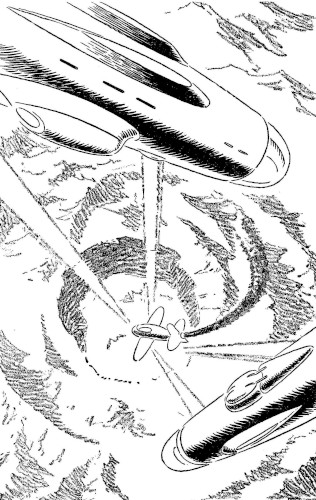
Immaterial fingers of tractor rays snatched at the plane an instant before it crashed—
"She can't land there," Kinnison breathed, "and Overlords would want her alive, not dead—suppose I've been wrong all the time? Get ready, fellows!" he snapped. "Take her at the very last possible instant—before—she—crashes—now!" As he yelled the command the powerful beams leaped out, seizing the disaster-bound vehicle in a gently unbreakable grip. Had they not done so, however, the Lyranian would not have crashed; for in that last split second a section of the rugged hillside fell inward. In the very mouth of that dread opening the little plane hung for an instant; then:
"Grab the woman, quick!" Kinnison ordered, for the Lyranian was going to jump.
And, such was the awful measure of the Overlords' compulsion, she did jump; without a parachute, without knowing or caring what, if anything, was to break her fall. But before she struck ground a tractor beam had seized her, and passive plane and wildly struggling pilot were both borne rapidly aloft.
"Why, Kim, it's Helen!" Clarrissa shrieked in surprise, then voice and manner became transformed. "The poor, poor thing," she crooned. "Bring her in at No. 6 Lock. I'll meet her there—you fellows keep clear. In the state she's in a shock—especially such a shock as seeing such a monstrous lot of males—would knock her off the beam, sure."
Helen of Lyrane ceased struggling in the instant of being drawn through the thought-screen surrounding the Dauntless. She had not been unconscious at any time. She had known exactly what she had been doing; she had wanted intensely—such was the insidiously devastating power of the Delgonian mind—to do just that and nothing else. The falseness of values, the indefensibility of motivation, simply could not register in her thoroughly suffused, completely blanketed mind. When the screen cut off the Overlords' control, however, thus restoring her own, the shock of realization of what she had done—what she had been forced to do—struck her like a physical blow. Worse than a physical blow, for ordinary physical violence she could understand.
This mischance, however, she could not even begin to understand. It was utterly incomprehensible. She knew what had happened; she knew that her mind had been taken over by some monstrously alien, incredibly powerful mentality, for some purpose so obscure as to be entirely beyond her ken. To her narrow philosophy of existence, to her one-planet insularity of viewpoint and outlook, the very existence, anywhere, of such a mind with such a purpose was in simple fact impossible. For it actually to exist upon her own planet, Lyrane II, was sheerly, starkly unthinkable.
She did not recognize the Dauntless, of course. To her all spaceships were alike. They were all invading warships, full of enemies. All things and all beings originating elsewhere than upon Lyrane II were, perforce, enemies. Those outrageous males, the Tellurian Lensman and his cohorts, had pretended not to be inimical, as had the peculiar, white-swathed Tellurian near-person who had been worming itself into her confidence in order to study the disappearances; but she did not trust even them.
She now knew the manner of, if not the reason for, the vanishment of her fellow Lyranians. The tractors of the spaceship had saved her from whatever fate it was that impended. She did not, however, feel any thrill of gratitude. One enemy or another, what difference did it make? Therefore, as she went through the blocking screen and recovered control of her mind, she set herself to fight; to fight with every iota of her mighty mind and with every fiber of her lithe, hard-schooled, tigress' body. The air-lock doors opened and closed—she faced, not an armed and armored male all set to slay, but the white-clad person whom she already knew better than she ever would know any other non-Lyranian.
"Oh, Helen!" the girl half sobbed, throwing both arms around the still-braced Chief Person. "I'm so glad that we got to you in time! And there will be no more disappearances, dear—the boys will see to that!"
Helen did not know, really, what disinterested friendship meant. Since the nurse had put her into a wide-open two-way, however, she knew beyond all possibility of doubt that these Tellurians wished her and all her kind well, not ill; and the shock of that knowledge, superimposed upon the other shocks which she had so recently undergone, was more than she could bear. For the first and only time in her hard, busy, purposeful life, Helen of Lyrane fainted; fainted dead away in the circle of the Earthgirl's arms.
The nurse knew that this was nothing serious; in fact, she was professionally quite in favor of it. Hence, instead of resuscitating the Lyranian, she swung the pliant body into a carry—as has been previously intimated, Clarrissa MacDougall was no more a weakling physically than she was mentally—and without waiting for orderlies and stretcher she bore it easily away to her own quarters. And there, instead of administering restoratives, she took out her ubiquitous hypodermic and made sure that her patient would rest quietly for many hours to come.
XIII.
In the meantime the more warlike forces of the Dauntless had not been idle. In the instant of the opening of the cavern's doors Captain Craig erupted orders, and as soon as the Lyranian was out of the line of fire, keen-eyed needle-ray men saw to it that those doors were in no mechanical condition to close. The Dauntless settled downward; landed in front of the entrance to the cavern. The rocky, broken terrain meant nothing to her; the hardest, jaggedest boulders crumbled instantly to dust as her enormous mass drove the file-hard, inflexible armor of her midzone deep into the ground. Then, while alert beamers watched the entrance and while spy-ray experts combed the interior for other openings which Kinnison and Worsel were already practically certain did not exist, the forces of Civilization formed for the attack.
Worsel was fairly shivering with eagerness for the fray. His was, and with plenty of reason, the bitterest by far of all the animosities there present against the Overlords. For Delgon and his own native planet, Velantia, were neighboring worlds, circling about the same sun. Since the beginning of Velantian space flights, the Overlords of Delgon had preyed upon the Velantians; in fact, the Overlords had probably caused the first Velantian spaceship to be built. They had called them, in a never-ending stream, across the empty gulf of space. They had pinned them against their torture screens, had flayed them and had tweaked them to bits, had done them to death in every one of the numberless slow and hideous fashions which had been developed by a race of sadists who had been specializing in the fine art of torture for thousands upon thousands of years. Then, in the last minutes of the long-drawn-out agony of death, the Overlords were wont to feed, with a passionate, greedy, ineradicably ingrained lust utterly inexplicable to any civilized mind, upon the life forces which the mangled bodies could no longer contain.
This horrible parasitism went on for ages. The Velantians fought vainly; their crude thought-screens were almost useless until after the coming of the Patrol. Then, with screens that were of real use, and with ships of power and with weapons of might, Worsel himself had taken the lead in the clean-up of Delgon. He was afraid, of course. Any Velantian was and is frightened to the very center of his being by the mere thought of an Overlord. He cannot help it; it is in his heredity, bred into the innermost chemistry of his body; the cold grue of a thousand thousand fiendishly tortured ancestors simply will not be denied or cast aside.
Many of the monsters had succeeded in fleeing Delgon, of course. Some departed in the ships which had ferried their victims to the planet, some were removed to other solar systems by the Eich. The rest were slain; and as the knowledge that a Velantian could kill an Overlord gained headway, the emotions toward the oppressors generated within minds such as the Velantians' became literally indescribable. Fear was there yet, and in abundance—it simply could not be eradicated. Horror and revulsion. Sheer, burning hatred; and, more powerful than all, amounting almost to an obsession, a clamoring, shrieking, driving urge for revenge which was almost tangible. All these, and more, Worsel felt as he waited, twitching.
The Valerians wanted to go in because it meant a hand-to-hand fight. Fighting was their business, their sport, and their pleasure; they loved it for its own sweet sake, with a simple, whole-hearted devotion. To die in combat was a Valerian soldier's natural and much-to-be-desired end; to die in any peaceful fashion was a disgrace and a calamity. They did and do go into battle with very much the same joyous abandon with which a sophomore goes to meet his date in Lovers' Lane. And now, to make physical combat all the nicer and juicier, they carried semiportable tractors and pressors, for the actual killing was not to take place until after the battle proper was over. Blasting the Overlords out of existence would have been simplicity itself; but they were not to die until after they had been forced to divulge whatever they might have of knowledge or of information.
Nadreck of Palain wanted to go in solely to increase his already vast store of knowledge. His thirst for facts was a purely scientific one; the fashion in which it was to be satisfied was the veriest, the most immaterial detail. Indeed, it is profoundly impossible to portray to any human intelligence the serene detachment, the utterly complete indifference to suffering exhibited by practically all of the frigid-blooded races, even those adherent to Civilization, especially when the suffering is being done by an enemy. Nadreck did know, academically and in a philological sense, from his reading, the approximate significance of such words as "compunction," "sympathy" and "squeamishness"; but he would have been astounded beyond measure at any suggestion that they would apply to any such matter-of-fact business as the extraction of data from the mind of an Overlord of Delgon, no matter what might have to be done to the unfortunate victim in the process.
Tregonsee went in simply because Kinnison did—to be there to help out in case the Tellurian should need him.
Kinnison went in because he felt that he had to. He knew full well that he was not going to get any kick at all out of what was going to happen. He was not going to like it, any part of it. Nor did he. In fact, he wanted to be sick—violently sick—before the business was well started. And Nadreck perceived his mental and physical distress.
"Why stay, Friend Kinnison, when your presence is not necessary?" he asked, with the slightly pleased, somewhat surprised, hellishly placid mental immobility which Kinnison was later to come to know so well. "Even though my powers are admittedly small, I feel eminently qualified to cope with such minor matters as the obtainment and the accurate transmittal of that which you wish to know. I cannot understand your emotions, but I realize fully that they are essential components of that which makes you what you fundamentally are. There can be no justification for your submitting yourself needlessly to such stresses, such psychic traumata."
And Kinnison and Tregonsee, realizing the common sense of the Palainian's statement and very glad indeed to have an excuse for leaving the outrageous scene, left it forthwith.
There is no need to go into detail as to what actually transpired within that cavern's dark and noisome depths. It took a long time, nor was any of it gentle. The battle itself, before the Overlords were downed, was bad enough in any Tellurian's eyes. Clad in armor of proof although they were, more than one of the Valerians died. Worsel's armor was shattered and rent, his almost steel-hard flesh was slashed, burned and mangled before the last of the monstrous forms was pinned down and helpless. Nadreck alone escaped unscathed—he did so, he explained quite truthfully, because he did not go in there to fight, but only to learn.
What followed the battle, however, was infinitely worse. The Delgonians, as has been said, were hard, cold, merciless, even among themselves; they were pitiless and unyielding and refractory in the extreme. It need scarcely be emphasized then, that they did not yield to persuasion either easily or graciously; that their own apparatus and equipment had to be put to its fullest grisly use before those stubborn minds gave up the secrets so grimly and so implacably sought. Worsel, the raging Velantian, used those torture tools with a vengeful savagery and a snarling ferocity which are at least partially understandable; but Nadreck employed them with a calm capability, a coldly, emotionlessly efficient callousness the mere contemplation of which made icy shivers chase each other up and down Kinnison's spine.
At long last the job was done. The battered Patrol forces returned to the Dauntless, bringing with them their spoils and their dead. The cavern and its every molecule of contents were bombed out of existence. The two ships took off; Cartiff's heavily armed "merchantman" to do the long flit back to Tellus, the Dauntless to drop Helen and her plane off at her airport and then to join her sister superdreadnoughts which were already beginning to assemble in Rift 94.
"Come down here, will you please, Kim?" came Clarrissa's thought. "I've been keeping her pretty well blocked out, but she wants to talk to you—in fact, she insists upon it—before she leaves the ship."
"Hm-m-m—now that is something!" the Lensman exclaimed, and hurried to the nurse's cabin.
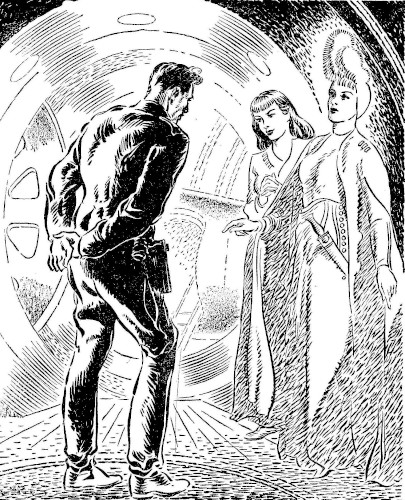
There stood the Lyranian queen; a full five inches taller than Mac's five feet six, a good thirty-five pounds heavier than Mac's not inconsiderable one hundred and forty-five. Hard, fine, supple; erectly poised she stood there, an exquisitely beautiful statue of pale bronze, her flaming hair a gorgeous riot. Head held proudly high, she stared only slightly upward into the Earthman's quiet, understanding eyes.
"Thanks, Kinnison, for everything that you and yours have done for me and mine," she said simply, and held out her right hand in what she knew was the correct Tellurian gesture.
"Uh-uh, Helen," Kinnison denied, gently, making no motion to grasp the proffered hand—which was promptly and enthusiastically withdrawn. "Nice, and it's really big of you, but don't strain yourself." This was neither slang nor sarcasm; he meant precisely and only what he said. "Don't overdrive in trying to force yourself to like us men too much or too soon; you must get used to us gradually. We like you a lot, and we respect you even more, but we have been around and you haven't. You can't be feeling friendly enough yet to enjoy shaking hands with me—you certainly haven't got jets enough to swing that load—so this time we'll take the thought for the deed. Keep trying, though, Toots old girl, and you'll make it yet. In the meantime we're all pulling for you, and if you ever need any help, shoot us a beam on the communicator Chris is giving you. Clear ether, ace!"
"Clear ether, MacDougall and Kinnison!" Helen's eyes were softer than either of the Tellurians had ever seen them before. "There is, I think, something of wisdom, of efficiency, in what you have said. It may be ... that is, there is a possibility ... you of Civilization are, perhaps, persons—of a sort that is—after all. Thanks—really thanks, I mean, this time. Good-by."
Helen's plane had already been unloaded. She disembarked and stood beside it; watching, with a peculiarly untranslatable expression, the huge cruiser until it was out of sight.
"It was just like pulling teeth for her to be civil to me," Kinnison grinned at his fiancée, "but she finally made the lift. She's a grand girl, that Helen, in her peculiar, poisonous way."
"Why, Kim!" Mac protested. "She's nice, really, when you get to know her. And she's so stunningly, so ravishingly beautiful!"
"Uh-huh," Kinnison agreed, without a trace of enthusiasm. "Cast her in chilled stainless steel—she'd just about do as she is, without any casting—and she'd make a mighty fine statue."
"Kim! Shame on you!" the girl exclaimed. "Why, she's the most perfectly beautiful thing I ever saw in my whole life!" Her voice softened. "I wish that I looked like that," she added wistfully.
"She's beautiful enough—in her way—of course," the man admitted, entirely unimpressed. "But, then, so is a Radeligian cateagle, so is a spire of frozen helium, and so is a six-foot-long, armor-piercing punch. As for you wanting to look like her—I'm terrifically glad that you don't. That's sheer tripe, Chris, and you know it. If you want to look at something really beautiful, get a mirror—beside you, all the Helens that ever lived, with Cleopatra, Dessa Desplaines and Illona Potter thrown in, wouldn't make a baffled flare—"
That was, of course, what she wanted him to say; and what followed is of no particular importance here.
Shortly after the Dauntless cleared the stratosphere, Nadreck reported that he had finished assembling and arranging the data, and Kinnison called the Lensmen together in his con room for an ultraprivate conference. Worsel, it appeared, was still in the surgery.
"'Smatter, doc?" Kinnison asked, casually. He knew that there was nothing really serious the matter—Worsel had come out of the cavern under his own power, and a Velantian recovers with startling rapidity from any wound which does not kill him outright. "Having trouble with your stitching?"
"I'll say we are!" the surgeon grunted. "Have to bore holes with an electric drill and use linemen's pliers. Just about done now, though—he'll be with you in a couple of minutes," and in a very little more than the stipulated time the Velantian joined the other Lensmen.
He was bandaged and taped, and did not move at his customary headlong pace, but he fairly radiated self-satisfaction, bliss and contentment. He felt better, he declared, than he had at any time since he cleaned out the last cavern upon Delgon.
Kinnison stopped the interplay of thoughts by starting up his Lensman's projector. This mechanism was something like the ordinary three-dimensional color-and-sound machine, except instead of emitting sounds it radiated thoughts. Sometimes the thoughts of one or more Overlords, at other times the thoughts of the Eich or other beings as registered upon the minds of the Overlords, at still others the thoughts of Nadreck or of Worsel explaining or amplifying a preceding thought passage or some detail which was being shown at the moment. The spool of tape now being run, with others, formed the Lensmen's record of what they had done. This record would go to Prime Base under Lensman's Seal; that is, only a Lensman could handle it or see it. Later, after the emergency had passed, copies of it would go to various Central Libraries and thus become available to properly accredited students. Indeed, it is only from such records, made upon the scene and at the time by keen-thinking, logical, truth-seeking Lensmen, that such a factual, minutely detailed history as this can be compiled; and your historian is supremely proud that he was the first person other than a Lensman to be allowed to study a great deal of this priceless data.
Worsel knew the gist of the report, Nadreck the compiler knew it all; but to Kinnison, Mac and Tregonsee the unreeling of the tape brought shocking news. For, as a matter of fact, the Overlords had known more, and there was more in the Lyranian solar system to know than Kinnison's wildest imaginings had dared to suppose. That system was one of the main focal points for the zwilnik business of an immense volume of space; Lyrane II was the meeting place, the dispatcher's office, the nerve center from which thousands of invisible, immaterial lines reached out to thousands of planets peopled by warm-blooded oxygen breathers. Menjo Bleeko had sent to Lyrane II not one expedition, but hundreds of them; the affair of Illona and her escorts had been the veriest, the most trifling incident.
The Overlords, however, did not know of any Boskonian in the Second Galaxy. They had no superiors, anywhere. The idea of anyone or anything anywhere being superior to an Overlord was unthinkable. They did, however, co-operate with—here came the really stunning fact—certain of the Eich who lived upon eternally dark Lyrane VIII, and who managed things for the frigid-blooded, poison-breathing Boskonians of the region in much the same fashion as the Overlords did for the warm-blooded, light-loving races. To make the co-operation easier and more efficient, the two planets were connected by a hyperspatial tube.
"Just a sec!" Kinnison interrupted, as he stopped the machine for a moment. "The Overlords were kidding themselves a bit there, I think—they must have been. If they didn't report to or get orders from the Second Galaxy or some other higher-up office, the Eich must have; and since the records and plunder and stuff were not in the cavern, they must be upon Eight. Therefore, whether they realized it or not, the Overlords must have been inferior to the Eich and under their orders. Check?"
"Check," Nadreck agreed. "Worsel and I concluded that they knew the facts, but were covering up even in their own minds, to save face. Our conclusions, and the data from which they were derived, are in the introduction—another spool. Shall I get it?"
"By no means—just glad to have the point cleared up, is all. Thanks—" and the showing went on.
The principal reason why the Lyranian system had been chosen for that important headquarters was that it was one of the very few outlying solar systems, completely unknown to the scientists of the Patrol, in which both the Eich and the Overlords could live in their natural environments. Lyrane VIII was, of course, intensely, bitterly cold. This quality is not rare, since all No. 8 planets are; its uniqueness lay in the fact that its atmosphere was almost exactly like that of Jarnevon.
And Lyrane II suited the Overlords perfectly. Not only did it have the correct temperature, gravity and atmosphere, but also it offered that much rarer thing without which no cavern of Overlords would have been content for long—a native life form possessing strong and highly vital minds upon which they could prey.
There was more, much more; but the rest of it was not directly pertinent to the immediate question. The tape ran out, Kinnison snapped off the projector, and the Lensmen went into a five-way.
Why was not Lyrane II defended? Worsel and Kinnison had already answered that one. Secretiveness and power of mind, not armament, had always been the natural defenses of all Overlords. Why hadn't the Eich interfered? That was easy, too. The Eich looked after themselves—if the Overlords couldn't, that was just too bad. The two ships that had come to aid and had remained to revenge had certainly not come from Eight—their crews had been oxygen breathers. Probably a rendezvous—immaterial, anyway. Why wasn't the whole solar system ringed with outposts and screens? Too obvious. Why hadn't the Dauntless been detected? Because of her nullifiers; and if she had been spotted by any short-range stuff she had been mistaken for another zwilnik ship. They hadn't detected anything out of the way upon Eight because it had not occurred to anybody to swing an analyzer upon that particular planet. They would find that Eight was defended plenty. Had the Eich had time to build defenses? They must have had, or they wouldn't be there—they certainly were not taking that kind of chances. And, by the way, hadn't they better do a bit of snooping near Lyrane VIII before they went back to join the Z9M9Z and the Fleet? They had.
Thereupon the Dauntless faced about and retraced her path toward the now highly important system of Lyrane. In their previous approaches the Patrolmen had observed the usual precautions to avoid revealing themselves to any zwilnik vessel which might have been on the prowl. Those precautions were now intensified to the limit, since they knew that Lyrane VIII was the site of a base manned by the Eich themselves.
As the big cruiser crept toward her goal, nullifiers full out and every instrument of detection and reception as attentively outstretched as the whiskers of a tomcat slinking along a black alley at midnight, the Lensmen again pooled their brains in conference.
The Eich. This was going to be no push-over. Even the approach would have to be figured to a hair; because, since the Boskonians had decided that it would be poor strategy to screen in their whole solar system, it was a cold certainty that they would have their own planet guarded and protected by every device which their inhuman ingenuity could devise. The Dauntless would have to stop just outside the range of the electromagnetic detection, for the Boskonians would certainly have a five-hundred-percent overlap. Their nullifiers would hash up the electros somewhat, but there was no use in taking too many chances. Previously, on right-line courses to and from Lyrane II, that had not mattered, for two reasons—not only was the distance extreme for accurate electro work, but also it would have been assumed that their ship was a zwilnik. Laying a course for Eight, though, would be something else entirely. A zwilnik would take the tube, and they would not, even if they had known where it was.
That left the visuals. The cruiser was a mighty small target at interplanetary distances; but there were such things as electronic telescopes, and the occultation of even a single star might prove disastrous. Kinnison called the chief pilot.
"Stars must be thin in certain regions of the sky out here, Hen. Suppose you can pick us out a line of approach along which we will occult no stars and no bright nebulae?"
"I should think so, chief—just a sec; I'll see—Yes, easily. There is a lot of black background, especially to the nadir"—and the conference continued.
They would have to go through the screens of electros in Kinnison's inherently indetectable black speedster. QX, but she was nobody's fighter—she didn't have a beam hot enough to light a match. And besides, there were the thought-screens and the highly probable other stuff about which the Lensmen could know nothing.
Kinnison quite definitely did not relish the prospect. He remembered all too vividly what had happened when he had scouted the Eich's base upon Jarnevon; when it was only through Worsel's aid that he had barely—just barely—escaped with his life. And Jarnevon's defenders had probably been exerting only routine precautions, whereas these fellows were undoubtedly cocked and primed for the Lensman. He would go in, of course, but he'd probably come out feet first—he didn't know any more about their defenses than he had known before, and that was nothing, flat.
"Excuse the interruption, please," Nadreck's thought apologized, "but it would seem to appear more desirable, would it not, to induce the one of them possessing the most information to come out to us?"
"Huh?" Kinnison demanded. "It would, of course—but how in all your purple hells do you figure on swinging that load?"
"I am, as you know, a person of small ability," Nadreck replied in his usual circuitous fashion. "Also, I am of almost negligible mass and strength. Of what is known as bravery I have no trace—in fact, I have pondered long over that, to me, incomprehensible quality and have decided that it has no place in my scheme of existence. I have found it much more efficient to perform the necessary tasks in the easiest possible manner, which is usually by means of stealth, deceit, indirection and other cowardly artifices."
"Any of those, or all of them, would be QX with me," Kinnison assured him. "Anything goes, with gusto and glee, as far as the Eich are concerned. What I don't see is how we can put it across."
"Thought-screens interfered so seriously with my methods of procedure," the Palainian explained, "that I was forced to develop a means of puncturing them without upsetting their generators. The device is not generally known, as it is still in a very crude, experimental form; but it does function, in a meager, unsatisfactory way. Might I suggest that the four of you put on heated armor and come with me to my vessel in the hold? It will take some little time to transfer my apparatus and equipment to your speedster."
"Is it nonferrous—undetectable?" Kinnison asked.
"Of course," Nadreck replied in surprise. "I work, as I told you, by stealth. My vessel is, except for certain differences necessitated by racial considerations, a duplicate of your own."
"Why didn't you say so?" Kinnison wanted to know. "Why bother to move the gadget? Why not use your speedster?"
"Because I was not asked. We should not bother. The only reason for using your vessel is so that you will not suffer the discomfort of wearing armor," Nadreck replied, categorically.
"Cancel it, then," Kinnison directed. "You've been wearing armor all the time you were with us—turn about for a while will be QX. Better that way, anyway, as this is very definitely your party, not ours. Not?"
"As you say; and with your permission," Nadreck agreed. "Also it may very well be that you will be able to suggest improvements in my device whereby its efficiency may be increased."
"I doubt it." The Tellurian's already great respect for this retiring, soft-spoken, "cowardly" Lensman was increasing constantly. "But we would like to study it, and perhaps copy it, if you so allow."
"Gladly."
And so it was arranged.
The Dauntless crept among a black backgrounded pathway and stopped. Nadreck, Worsel and Kinnison—three were enough and neither Mac nor Tregonsee insisted upon going—boarded the Palainian speedster.
Away from the mother ship it sped upon muffled jets, and through the far-flung, heavily overlapped electromagnetic detector zones. Through the outer thought-screens. Then, ultra-slowly, as space speeds go, the speedster moved forward, feeling for whatever other blocking screens there might be.
All three of those Lensmen were in fact detectors themselves—their Arisian-imparted special senses made ethereal, even sub-ethereal, vibrations actually visible or tangible—but they did not depend only upon their bodily senses. That speedster carried instruments unknown to space pilotry, and the Lensmen used them unremittingly. When they came to a screen they opened it, so insidiously that its generating mechanisms gave no alarms. Even a meteorite screen, which was supposed to forbid the passage of any material object, yielded without protest to Nadreck's subtle manipulation.
Slowly, furtively, a perfectly absorptive black body sinking through blackness so intense as to be almost palpable, the Palainian speedster settled downward toward the Boskonian fortress of Lyrane VIII.
XIV.
This is perhaps as good a place as any to glance in passing at the fashion in which the planet Lonabar was brought under the aegis of Civilization. No attempt will or can be made to describe it in any detail, since any adequate treatment of it would fill a volume—indeed, many volumes have already been written concerning various phases of the matter—and since it is not strictly germane to the subject in hand. However, some knowledge of the modus operandi in such cases is highly desirable for the full understanding of this history, in view of the vast number of planets which Co-ordinator Kinnison and his associates did have to civilize before the Second Galaxy was made secure.
Scarcely had Cartiff-Kinnison moved out than the Patrol moved in. If Lonabar had been heavily fortified, a fleet of appropriate size and power would have cleared the way. As it was, the fleet which landed was one of transports, not of battleships, and all the fighting from then on was purely defensive.
Propagandists took the lead; psychologists; Lensmen skilled not only in languages but also in every art of human relationships. The case of Civilization was stated plainly and repeatedly, the errors and the fallacies of autocracy were pointed out. A nucleus of government was formed; not of Civilization's imports, but of solid Lonabarian citizens who had passed the Lensmen's tests of ability and trustworthiness.
Under this local government a pseudodemocracy began haltingly to function. At first its progress was painfully slow; but as more and more of the citizens perceived what the Patrol actually was doing, it grew apace. Not only did the invaders allow—yes, foster—free speech and statutory liberty; they suppressed ruthlessly any person or any faction seeking to build a new dictatorship, whatever its nature, upon the ruins of the old. That news traveled fast; and laboring always and mightily upon Civilization's side were the always-present, however deeply buried, urges of all intelligent entities toward self-expression.
There was opposition, of course. Practically all of those who had waxed fat upon the old order were very strongly in favor of its continuance. There were the hordes of the down-trodden who had so long and so dumbly endured oppression that they could not understand anything else; in whom the above-mentioned urges had been beaten and tortured almost out of existence. They themselves were not opposed to Civilization—for them it meant at worst only a change of masters—but those who sought by the same old wiles to re-enslave them were foes indeed.
Menjo Bleeko's sycophants and retainers were told to work or starve. The fat hogs could support the new order—or else. The thugs had to choose between honest co-operation with their fellow men and flitting to some zwilnik planet. Those who tried to prey upon and exploit the dumb masses were extirpated, one and all.
Little could be done, however, about the dumb themselves, for in them the spark was feeble indeed. The new government nursed that spark along, the while ruling them as definitely, although not as harshly, as had the old; the Lensmen backing the struggling young Civilization knowing full well that in the children or in the children's children of these unfortunates the spark would flame up into a great, white light.
It is seen that this government was not, and could not for many years become, a true democracy. It was in fact a benevolent semiautocracy; autonomous in a sense, yet controlled by the Galactic Council through its representatives, the Lensmen. It was, however, so infinitely more liberal than anything theretofore known by the Lonabarians as to be a political revelation, and since corruption, that cosmos-wide curse of democracy, was not allowed a first finger-hold, the principles of real democracy and of Civilization took deeper root year by year.
To get back into the beam of narrative, Nadreck's blackly indetectable speedster settled to ground far from the Boskonians' central dome; well beyond the far-flung screens. The Lensmen knew that no life existed outside that dome and they knew that no possible sense of perception could pierce those defenses. They did not know, however, what other resources of detection, of offense or of defense the foe might possess; hence the greatest possible distance at which they could work efficiently was the best distance.
"I realize that it is useless to caution any active mind not to think at all," Nadreck remarked as he began to manipulate various and sundry controls, "but you already know from the nature of our problem that any extraneous thought will wreak untold harm. For that reason I beg of you to keep your thought-screens up at all times, no matter what happens. It is, however, imperative that you be kept informed, since I may require aid or advice at any moment. To that end I ask you to hold these electrodes, which are connected to a receptor. Do not hesitate to speak freely to each other or to me; but please use only a spoken language, as I am averse even to Lensed thoughts at this juncture. Are we agreed? Are we ready?"
They were agreed and ready. Nadreck actuated his peculiar drill—a tube of force somewhat analogous to a Q-type helix except in that it operated within the frequency range of thought—and began to increase, by almost infinitesimal increments, its power. Nothing, apparently, happened; but finally the instruments upon the speedster's board registered the fact that it was through.
"This is none too safe, friends," the Palainian announced from one part of his multicompartmented brain, without distracting any part of his attention from the incredibly delicate operation he was performing. "Might I suggest, Kinnison, in my cowardly way, that you place yourself at the controls and be ready to take us away from this planet at speed and without notice?"
"I'll say you may!" and the Tellurian complied, with alacrity. "I'd a lot rather be a live coward than a dead hero!"
But through course after course of screen the hollow drill gnawed its cautious way without giving alarm; until at length there began to come through the interloping tunnel a vague impression of foreign thought. Nadreck stopped the helix, then advanced it by tiny steps until the thoughts came in coldly clear—the thoughts of the Eich going about their routine businesses. In the safety of their impregnably shielded dome the proudly self-confident monsters did not wear their personal thought-screens; which, for Civilization's sake, was just as well.
It had been decided previously that the mind they wanted would be that of a psychologist; hence the thought sent out by the Palainian was one which would appeal only to such a mind; in fact, one practically imperceptible to any other. It was extremely faint; wavering uncertainly upon the very threshold of perception. It was so vague, so formless, so inchoate that it required Kinnison's intensest concentration even to recognize it as a thought. Indeed, so starkly unhuman was Nadreck's mind and that of his proposed quarry that it was all the Tellurian Lensman could do to so recognize it. It dealt, fragmentarily and in the merest glimmerings, with the nature and the mechanisms of the First Cause; with the fundamental ego, its raison d'étre, its causation, its motivation, its differentiation; with the stupendously awful concepts of the Prime Origin of all things ever to be.
Unhurried, monstrously patient, Nadreck neither raised the power of the thought nor hastened its slow tempo. Stolidly, for minute after long minute he held it, spraying it throughout the vast dome as mist is sprayed from an atomizer nozzle. And finally he got a bite. A mind seized upon that wistful, homeless, incipient thought; took it for its own. It strengthened it, enlarged upon it, built it up. And Nadreck followed it.
He did not force it; he did nothing whatever to cause any suspicion that the thought was or ever had been his. But as the mind of the Eich busied itself with that thought he all unknowingly let down the bars to Nadreck's invasion.
Then, perfectly in tune, the Palainian subtly insinuated into the mind of the Eich the mildly disturbing idea that he had forgotten something, or had neglected to do some trifling thing. This was the first really critical instant, for Nadreck had no idea whatever of what his victim's duties were or what he could have left undone. It had to be something which would take him out of the dome and toward the Patrolmen's concealed speedster, but what it was, the Eich would have to develop for himself: Nadreck could not dare to attempt even a partial control at this stage and at this distance.
Kinnison clenched his teeth and held his breath, his big hands clutching fiercely the pilot's bars; Worsel unheedingly coiled his supple body into an ever smaller, ever harder and more compact bale.
"Ah!" Kinnison exhaled explosively. "It worked!" The psychologist, at Nadreck's impalpable suggestion, had finally thought of the thing. It was a thought-screen generator which had been giving a little trouble and which really should have been checked before this.
Calmly, with the mild self-satisfaction which comes of having successfully recalled to mind a highly elusive thought, the Eich opened one of the dome's unforcible doors and made his unconcerned way directly toward the waiting Lensmen; and as he approached, Nadreck stepped up by logarithmic increments the power of his hold.
"Get ready, please, to cut your screens and to synchronize with me in case anything slips and he tries to break away," Nadreck cautioned; but nothing slipped.
The Eich came up unseeing to the speedster's side and stopped. The drill disappeared. A thought-screen encompassed the group narrowly. Kinnison and Worsel released their screens and also tuned in to the creature's mind. And Kinnison swore briefly, for what they found was meager enough. It was well, however, that they got what they did when they did; for, as has been seen, even that little was very shortly thereafter to be removed.
He knew a great deal concerning the zwilnik doings of the First Galaxy; but so did the Lensmen; they were not interested in them. Neither were they interested, at the moment, in the files or in the records. Regarding the higher-ups, he knew of two, and only two, personalities. By means of an intergalactic communicator he received orders from, and reported to, a clearly defined, somewhat Eichlike entity known to him as Kandron; and vaguely, from occasional stray and unintentional thoughts of this Kandron, he had visualized as being somewhere in the background a human being named Alcon. He supposed that the planets upon which these persons lived were located in the Second Galaxy, but he was not certain, even of that. He had never seen either of them; he was pretty sure that none of his group ever would be allowed to see them. He had no means of tracing them and no desire whatsoever to do so. The only fact he really knew was that at irregular intervals Kandron got into communication with this base of the Eich.
That was all. Kinnison and Worsel let go and Nadreck, with a minute attention to detail which would be wearisome here, jockeyed the unsuspecting monster back into the dome. The native knew fully where he had been, and why. He had inspected the generator and had found it in good order. Every second of elapsed time was accounted for exactly. He had not the slightest inkling that anything out of the ordinary had happened to him or anywhere around him.
As carefully as the speedster had approached the planet, she departed from it. She rejoined the Dauntless, in whose control room Kinnison lined out a solid communicator beam to the Z9M9Z and to Port Admiral Haynes. He reported crisply, rapidly, everything that had transpired.
"So our best bet, chief, is for you and the Fleet to get out of here as fast as Klono will let you," he concluded. "Go straight out Rift 94, staying as far away as possible from both the spiral arm and the Galaxy proper. Unlimber every spotting screen you've got—put them to work along the line between Lyrane and the Second Galaxy. Plot all the punctures, extending the line as fast as you can. We'll join you at max and transfer to the Z9M9Z—her tank is just what the doctors ordered for the job we've got to do."
"Well, if you say so, I suppose that's the way it's got to be," Haynes grumbled. He had been growling and snorting under his breath ever since it had become evident what Kinnison's recommendation was to be. "I don't like this thing of standing by and letting zwilniks thumb their noses at us, like Prellin did on Bronseca. That once was once too damned often."
"Well, you got him, finally, you know," Kinnison reminded, quite cheerfully, "and you can have these Eich, too—sometime."
"I hope," Haynes acquiesced, something less than sweetly. "QX, then—but put out a few jets. The quicker you get out here the sooner we can get back and clean out this hooraw's nest."
Kinnison grinned as he cut his beam. He knew that it would be some time before the port admiral could hurl the metal of the Patrol against Lyrane VIII; but even he did not realize just how long a time it was to be.
What occasioned the delay was not the fact that the communicator was in operation only at intervals: so many screens were out, they were spaced so far apart, and the punctures were measured and aligned so accurately that the periods of non-operation caused little or no loss of time. Nor was it the vast distance involved; since, as has already been pointed out, the matter in the intergalactic void is so tenuous that spaceships are capable of enormously greater velocities than any attainable in the far denser medium filling interstellar space.
No; what gave the Boskonians of Lyrane VIII their greatly lengthened reprieve was simply the direction of the line established by the communicator-beam punctures. Reasoning from analogy, the Lensmen had supposed that it would lead them into a star cluster, fairly well away from the main body of the Galaxy in either the zenith or the nadir direction. Instead of that, however, when the Patrol surveyors got close enough to the Second Galaxy so that their cone of possible error was very small in comparison with the gigantic lens of the island universe which they were approaching, it became clear that their objective lay deep within the Galaxy itself. At least, the prolongation of their line led well into it, and that fact gave the Lensmen to pause.
"I don't like this line a bit, chief," Kinnison told the admiral then. "Maybe it runs into a cluster on this side, but we can't figure on it. It'd smell like Limburger to have a fleet of this size and power nosing into their home territory, along what must be one of the hottest lines of communication they've got."
"Check," Port Admiral Haynes agreed. "QX so far, but it would begin to stink pretty quick now. We've got to assume that they know about spotting screens, whether they really do or not. If they do, they'll have this line trapped from stem to gudgeon, and the minute they detect us they'll cut this line out entirely. Then where'll you be?"
"Right back where I started from—that's what I'm yapping about. And to make matters worse, it's a thousand to one that the ape we are looking for is not going to be anywhere near the end of this line."
"Huh? How do you dope that out?" Haynes demanded.
"Logic. We're getting up now to where these zwilniks can really think. You have already assumed that they know that we can trace their beam, and we know that they know about our detector nullifiers. Go further. Assume that they have deduced, from things we have already done, that we have ships—one or two, at least—that are inherently indetectable and almost perfectly absorptive. Where does that land you?"
"Hm-m-m. I see. Since they can't change the nature of the beam, they would run it through a series of relays, with each leg trapped with everything they could think of, and at the first sign of interference with any one of them they would switch to another, maybe halfway across the Galaxy. Also, they might very well move it around once in a while, anyway, just on general principles."
"Check. That's why you had better take the Fleet back home, leaving Nadreck and me to work the rest of this line with our speedsters."
"Don't be silly, son—I thought you could think"—and Haynes gazed quizzically at the younger man.
"What else? Where am I overlooking a bet?" Kinnison demanded.
"It is elementary tactics, young man," the admiral instructed, "to cover up any small, quiet operation with a large and noisy one. Thus, if I want to make an exploratory sortie in one sector I should always attack in force in another."
"But what would it get us?" Kinnison expostulated. "What's the advantage to be gained, to make up for the unavoidable losses?"
"Don't be dumb. Advantage? Listen!" Haynes' bushy gray hair fairly bristled in eagerness. "We've been on the defensive long enough. They must be weak, after their losses at Tellus; and now, before they can rebuild, is the time to strike. It's good tactics, as I said, to make a diversion to cover you up, but I want to do more than that. I think that we had better start an actual, serious invasion, right now. When you can swing it, the best possible defense—even in general—is a powerful offense, and we're all set to go. We will begin it with this fleet, and then, as soon as we are sure that they haven't got enough power to counter-invade, we will bring up everything we have except for some purely defensive stuff, such as sunbeams and so on, around Tellus and the other most important bases. We'll hit them so hard that they won't be able to worry about such a little thing as a communicator line."
"Hm-m-m. Never thought of it from that angle, but it'd be nice. We are coming over here sometime, anyway—why not now? I suppose that you'll start on the edge, or in a spiral arm, just as though you were going ahead with the conquest of the whole Galaxy?"
"Not 'just as though,'" Haynes declared. "We are going through with it. Find a planet on the outer edge of a spiral arm, as nearly like Tellus as possible—"
"Make it nearly enough like Tellus and maybe I can use it for our headquarters on this 'co-ordinator' thing." And Kinnison grinned.
"More truth than poetry in that, fellow. We find it and take it over. Comb out the zwilniks with a fine-tooth comb. Make it the biggest, toughest base the Universe ever saw—like Jarnevon, only more so. Bring in everything we've got and expand from that planet as a center, cleaning everything out as we go. We'll civilize 'em!"
And so, after considerable ultrarange communicator work, it was decided that the Galactic Patrol would forthwith assume the offensive.
Haynes assembled the Fleet. Then, while the two black speedsters kept unobtrusively on with the task of plotting the line, Civilization's mighty armada moved a few thousand parsecs aside and headed at normal touring blast for the nearest out-cropping of the Second Galaxy.
There was nothing of stealth in this maneuver, nothing of finesse, excepting in the arrangements of the units. First, far in the van, flew the prodigious, irregular cone of scout cruisers. They were comparatively small, not heavily armed or armored, but they were ultrafast and were provided with the most powerful detectors, spotters and locators known. They adhered to no rigid formation, but at the will of their individual commanders, under the direct supervision of Grand Fleet Operations in the Z9M9Z, flashed hither and thither ceaselessly—searching, investigating, mapping, reporting.
Backing them up came the light cruisers and the cruising bombers—a new type, this latter, designed primarily to bore in to close quarters and to hurl bombs of negative matter. Third in order were the heavy defensive cruisers. These ships had been developed specifically for hunting down Boskonian commerce raiders within the Galaxy. They wore practically an impenetrable screen, so that they could lock to and hold even a superdreadnought. They had never before been used in Grand Fleet formation; but since they were now equipped with tractor zones and bomb tubes, theoretical strategy found a good use for them in this particular place.
Next came the real war head—a solidly packed phalanx of maulers. All the ships up ahead had, although in varying degrees, freedom of motion and of action. The scouts had practically nothing else; fighting was not their business. They could fight, a little, if they had to; but they always ran away if they could, in whatever direction was most expedient at the time. The cruising bombers could either take their fighting or leave it alone, depending upon circumstances—in other words, they fought light cruisers, but ran away from big stuff, stinging as they ran. The heavy cruisers would fight anything short of a mauler, but never in formation: they always broke ranks and fought individual dog fights, ship-to-ship.
But that terrific spearhead of maulers had no freedom of motion whatever. It knew only one direction—straight ahead. It would swerve aside for an inert planet, but for nothing smaller; and when it swerved it did so as a whole, not by parts. Its function was to blast through—straight through—any possible opposition, if and when that opposition should have been successful in destroying or dispersing the screens of lesser vessels preceding it. A sunbeam was the only conceivable weapon with which that stolid, power-packed mass of metal could not cope; and, the Patrolmen devoutly hoped, the zwilniks didn't have any sunbeams—yet.
A similar formation of equally capable maulers, meeting it head-on, could break it up, of course. Theoretical results and war game solutions of this problem did not agree, either with each other or among themselves, and the thing had never been put to the trial of actual battle. Only one thing was certain—when and if that trial did come there was bound to be, as in the case of the fabled meeting of the irresistible force with the immovable object, a lot of very interesting by-products.
Flanking the maulers, streaming gracefully backward from their massed might in a parabolic cone, were arranged the heavy battleships and the superdreadnoughts; and directly behind the bulwark of flying fortresses, tucked away inside the protecting envelope of big battle wagons, floated the Z9M9Z—the brains of the whole outfit.
There were no free planets, no negaspheres of planetary antimass, no sunbeams. Such things were useful either in the defense of a Prime Base or for an all-out, ruthlessly destructive attack upon such a base. Those slow, cumbersome, supremely powerful weapons would come later, after the Patrol had selected the planet which they intended to hold against everything which the Boskonians could muster. This present expedition had as yet no planet to defend, it sought no planet to destroy. It was the vanguard of Civilization, seeking a suitable foothold in the Second Galaxy and thoroughly well equipped to argue with any force mobile enough to bar its way.
While it has been said that there was nothing of stealth in this approach to the Second Galaxy, it must not be thought that it was unduly blatant or obvious—any carelessness or ostentation would have been very poor tactics indeed. Civilization's Grand Fleet advanced in strict formation, with every routine military precaution. Its nullifiers were full on, every blocking screen was out, every plate upon every ship was hot and was being scanned by alert and keen-eyed observers.
But every staff officer from Port Admiral Haynes down, and practically every line officer as well, knew that the enemy would locate the invading fleet long before it reached even the outer fringes of the galaxy toward which it was speeding. That stupendous tonnage of ferrous metal could not be disguised; nor could it by any possible artifice be made to simulate any normal tenant of the space which it occupied.
The gigantic flares of the heavy stuff could not be baffled, and the combined grand flare of Grand Fleet made a celestial object which would certainly attract the electronic telescopes of plenty of observatories. And the nearest such 'scopes, instruments of incredible powers of resolution, would be able to pick them out, almost ship by ship, against the relatively brilliant background of their own flares.
The Patrolmen, however, did not care. This was, and was intended to be, an open, straightforward invasion; the first wave of an attack which would not cease until the Galactic Patrol had crushed Boskonia throughout the entire Second Galaxy.
Grand Fleet bored serenely on. Superbly confident in her awful might, grandly contemptuous of whatever she was to face, she stormed along; uncaring that at that very moment the foe was massing his every defensive arm to hurl her back or to blast her out of existence.
XV.
As Haynes and the Galactic Council had already surmised, Boskonia was now entirely upon the defensive. She had made her supreme bid in the effort which had failed so barely to overcome the defenses of hard-held Tellus. It was, as has been seen, a very near thing indeed, but the zwilnik chieftains did not and could not know that. Communication through the hyperspatial tube was impossible, no ordinary communicator beam could be driven through the Patrol's scramblers, no Boskonian observers could be stationed near enough to the scene of action to perceive or to record anything that had occurred, and no single zwilnik ship or entity survived to tell of how nearly Tellus had come to extinction.
And, in fine, it would have made no difference in the mind of Alcon of Thrale if he had known. A thing which was not a full success was a complete failure; to be almost a success meant nothing. The invasion of Tellus had failed. They had put everything they had into that gigantically climactic enterprise. They had shot the whole wad, and it had not been enough. They had, therefore, abandoned for the nonce humanity's galaxy entirely, to concentrate their every effort upon the rehabilitation of their own depleted forces and upon the design and construction of devices of hitherto unattempted capability and power.
But they simply had not had enough time to prepare properly to meet the invading Grand Fleet of Civilization. It takes time—lots of time—to build such heavy stuff as maulers and flying fortresses, and they had not been allowed to have it. They had plenty of lighter stuff, since the millions of Boskonian planets could furnish upon a few hours' notice more cruisers, and even more first-line battleships, than could possibly be used in Grand Fleet formation, but their backbone of brute force and firing power was woefully weak.
Since the destruction of a solid center of maulers was, theoretically, improbable to the point of virtual impossibility, neither Boskonia nor the Galactic Patrol had built up any large reserve of such structures. Both would now build up such a reserve as rapidly as possible, of course, but half-built structures could not fight.
The zwilniks had many dirigible planets, but they were too big. Planets, as has been seen, are too cumbersome and unwieldy for use against a highly mobile and adequately controlled fleet.
Conversely, humanity's Grand Fleet was up to its maximum strength and perfectly balanced. It had suffered staggering losses in the defense of Prime Base, it is true; but those losses were of comparatively light craft, which Civilization's inhabited worlds could replace as easily and as quickly as could Boskonia's. Very few maulers had been lost, and those empty places were filled by substitutes withdrawn from minor bases or other stations at which they were not imperatively necessary.
Hence, Boskonia's fleet was at a very serious disadvantage as it formed to defy humanity just outside the rim of its galaxy. At two disadvantages, really, for Boskonia then had neither Lensmen nor a Z9M9Z; and Haynes, canny old master strategist that he was, worked upon them both.
Grand Fleet so far had held to one right-line course, and upon this line the zwilnik defense had been built. Now Haynes swung aside, forcing the enemy to re-form—they had to engage him, he did not have to engage them. Then, as they shifted—raggedly, as he had supposed and had hoped that they would—he swung again. Again, and again; the formation of the enemy becoming more and more hopelessly confused with each shift.
The scouts had been reporting constantly; in the seven-hundred foot lenticular tank of the Directrix there was spread in exact detail the disposition of every unit of the foe. Four Rigellian Lensmen, now thoroughly trained and able to perform the task almost as routine, condensed the picture—summarized it—in Haynes' ten-foot tactical tank. And finally, so close that another swerve could not be made, and with the line of flight of his solid fighting core pointing straight through the loosely disorganized nucleus of the enemy, Haynes gave the word to engage.
The scouts, remaining free, flashed aside into their pre-arranged observing positions. Everything else went inert and bored ahead. The light cruisers and the cruising bombers clashed first, and a chill struck at Haynes' stout old heart as he learned that the enemy did have negative-matter bombs.
Upon that point there had been much discussion. One view was that the Boskonians would have them, since they had seen them in action and since their scientists were fully as capable as were those of Civilization. The other was that, since it had taken all the massed intellect of the Conference of Scientists to work out a method of handling and of propelling such bombs, and since the Boskonians were probably not as co-operative as were the civilized races, they could not have them.
Approximately half of the light cruisers of Grand Fleet were bombers. This was deliberate, for in the use of the new arm there were involved problems which theoretical strategy could not solve definitely. Theoretically, a bomber could defeat a conventional light cruiser of equal tonnage one hundred percent of the time, provided—here was the rub!—that the conventional cruiser did not blast her out of the ether before she could get her bombs into the vitals of the foe, in order to accommodate the new equipment, something of the old had to be decreased—something of power, of armament, of primary or secondary beams, or of defensive screen. Otherwise the size and mass must be so increased that the ship would no longer be a light cruiser, but a heavy one.
And the Patrol's psychologists had had ideas, based upon facts which they had gathered from Kinnison and from Illona and from various and sundry spools of tape—ideas by virtue of which it was eminently possible that the conventional light cruisers of Civilization, with their heavier screen and more and hotter beams, could vanquish the light cruisers of the foe, even though they should turn out to be negative-matter bombers.
Hence the fifty-fifty division of types; but, since Haynes was not thoroughly sold upon either the psychologists or their ideas, the commanders of his standard light cruisers had received very explicit and definite orders. If the Boskonians should have bombs and if the high-brows' ideas did not pan out, they were to turn tail and run, at maximum and without stopping to ask questions or to get additional instructions.
Haynes had not really believed that the enemy would have negabombs, they were so new and so atrociously difficult to handle. He wanted—but was unable—to believe implicitly in the psychologists' findings. Therefore, as soon as he saw what was happening, he abandoned his tank for a moment to seize a plate and get into full touch with the control room of one of the conventional light cruisers then going into action.
He watched it drive boldly toward a Boskonian vessel which was in the act of throwing bombs. He saw that the agile little vessel's tractor zone was out. He watched the bombs strike that zone and bounce. He watched the tractor men go to work and he saw the psychologists' idea bear splendid fruit. For what followed was a triumph, not of brute force and striking power, but of morale and manhood. The brain men had said, and it was now proved, that the Boskonian gunners, low class as they were and driven to their tasks like the slaves they were, would hesitate long enough before using tractor beams as pressors so that the Patrolmen could take their own bombs away from them!
For negative matter, it must be remembered, is the exact opposite of ordinary matter. It is built up of negative mass; in every equation of physics and mechanics where mass appears, a minus sign appears when negative matter is concerned. To it a pull is, or becomes, a push; the tractor beam which pulls ordinary matter toward its projector actually pushes negative matter away.
The "boys" of the Patrol knew that fact thoroughly. They knew all about what they were doing, and why. They were there because they wanted to be, as Illona had so astoundingly found out, and they worked with their officers, not because of them. With the Patrol's gun crews it was a race to see which crew could capture the first bomb and the most.
Aboard the Boskonian how different it was! There the dumb cattle had been told what to do, but not why. They did not know the fundamental mechanics of the bomb tubes they operated by rote, did not know that they were essentially tractor beam projectors. They did know, however, that tractor beams pulled things toward them; and when they were ordered to swing their ordinary tractors upon the bombs which the Patrolmen were so industriously taking away from them, they hesitated for seconds, even under the lash.
This hesitation was fatal. Haynes' gleeful gunners, staring through their special finders, were very much on their toes; seconds were enough. Their fierce-driven tractors seized the inimical bombs in midspace, and before the Boskonians could be made to act in the only possible opposition hurled them directly backward against the ship which had issued them. Ordinary defensive screen did not affect them; repulsor screen, meteorite and wall shields only sucked them inward the faster.
And ordinary matter and negative matter cannot exist in contact. In the instant of touching, one atom of negative matter and one of normal matter unite and disappear. One negabomb was enough to put any cruiser out of action, but here there were usually three or four at once. Sometimes as many as ten; enough, almost, to consume the total mass of a ship.
A bomb struck; ate in. Through solid armor it melted. Atmosphere rushed out, to disappear en route—for air is normal matter. Along beams and trusses the hellish hypersphere traveled freakishly, although usually in the direction of greatest mass. It clung, greedily. Down stanchions it flowed; leaving nothing in its wake, flooding all circumambient space with lethal emanations. Into and through converters. Into pressure tanks which blew up enthusiastically. Men's bodies it did not seem to favor—not massive enough, perhaps—but even them it did not refuse if offered. A Boskonian, gasping frantically for air which was no longer there and already half mad, went completely mad as he struck savagely at the thing and saw his hand and his arm to the shoulder vanish instantaneously, as though they had never been.
Satisfied, Haynes wrenched his attention back to his tank. Most of his light cruisers were through and in the clear; they were reporting by thousands. Losses were very small. The conventional-type cruisers had won either by using the enemies' own bombs, as he had seen them used, or by means of their heavier armor and armament. The bombers had won in almost every case; not by superior force, for in arms and equipment they were to all intents and purposes identical with their opponents, but because of their infinitely higher quality of personnel. To brief it, scarcely a handful of Boskonia's light cruisers were able to flee the fatal scene.
The heavy cruisers came up, broke formation, and went doggedly to work. They were the blockers. Each took one ship—a heavy cruiser or a battleship—out of the line, and held it out. It tried to demolish it with every weapon it could swing, but even if it could not vanquish its foe, it could and did hang on until some big bruiser of a battleship could come up and administer the coup de grâce.
And battleships and superdreadnoughts were coming up in the thousands and the myriads. All of them, in fact, but those enough to form a tight globe, packed screen to screen, around the Z9M9Z.
Slowly, ponderously, inert, the war head of maulers came crawling up. The maulers and fortresses of the Boskonians were hopelessly outnumbered and were badly scattered in position. Hence this meeting of the ultra-heavies was not really a battle at all, but a slaughter. Ten or more of Haynes' gigantic structures could concentrate their entire combined fire power upon any luckless one of the enemy; with what awful effect it would be superfluous to enlarge upon.
When the mighty fortresses had done their work they englobed the Directrix, enabling the guarding battleships to join their sister moppers-up; but there was very little left to do. Civilization had again triumphed; and, this time, at very little cost. Some of the pirates had escaped, of course; observers from afar might very well have had scanners and recorders upon the entire conflict; but, whatever of news was transmitted or how, Alcon of Thrale and Boskonia's other master minds would or could derive little indeed of comfort from the happenings of this important day.
"Well, that is that—for a while, at least, don't you think?" Haynes asked his Council of War.
It was decided that it was; that if Boskonia could not have mustered a heavier center for her defensive action here, she would be in no position to make any really important attack for months to come.
Grand Fleet, then, was reformed; this time into a purely defensive and exploratory formation. In the center, of course, was the Z9M9Z. Around her was a close-packed quadruple globe of maulers. Outside of them in order, came sphere after sphere of superdreadnoughts, of battleships, of heavy cruisers, and of light cruisers. Then, not in globe at all, but ranging far and wide, were the scouts. Into the edge of the nearest spiral arm of the Second Galaxy the stupendous formation advanced, and along it it proceeded at dead-slow blast—dead-slow, to enable the questing scouts to survey thoroughly each planet of every solar system as they came to it.
And finally an Earthlike planet was found. Several approximately Tellurian worlds had been previously discovered and listed as possibilities; but this one was so perfect that the search ended then and there. Apart from the shape of the continents and the fact that there was somewhat less land surface and a bit more salt water, it was practically identical with Tellus. As was to be expected, its people were human to the limit of classification. Entirely unexpectedly, however, the people of Klovia—which is as close as English can come to the native name—were not zwilniks. They had never heard of, nor had they ever been approached by, the Boskonians. Space travel was to them only a theoretical possibility, as was atomic energy.
They had no planetary organization, being still divided politically into sovereign states which were all too often at war with each other. In fact, a world war had just burned itself out, a war of such savagery that only a fraction of the world's population remained alive. There had been no victor, of course. All had lost everything—the survivors of each nation, ruined as they were and without either organization or equipment, were trying desperately to rebuild some semblance of what they had once had.
Upon learning these facts the psychologists of the Patrol breathed deep sighs of relief. This kind of thing was made to order; civilizing this planet would be simplicity itself. And it was. The Klovians did not have to be overawed by a show of superior force. Before this last, horribly internecine war, Klovia had been a heavily industrialized world, and as soon as the few remaining inhabitants realized what Civilization had to offer, that no one of their neighboring competitive states was to occupy a superior position, and that full, world-wide production was to be resumed as soon as was humanly possible, their relief and joy were immeasurable.
Thus the Patrol took over without difficulty. But they were, the Lensmen knew, working against time. As soon as the zwilniks could get enough heavy stuff built they would attack, grimly determined to blast Klovia and everything upon it out of space. Even though they had known nothing about the planet previously, it was idle to hope that they were still in ignorance either of its existence or of what was in general going on there.
Haynes' first care was to have the heaviest metalry of the Galactic Patrol—loose planets, sunbeams, fortresses, and the like—rushed across the void to Klovia at maximum. Then, as well as putting every employable of the new world to work, at higher wages than he had ever earned before, the Patrol imported millions upon millions of men, with their women and families, from hundreds of Earthlike planets in the First Galaxy.
They did not, however, come blindly. They came knowing that Klovia was to be primarily a military base, the most supremely powerful base that had ever been built. They knew that it would bear the brunt of the most furious attacks that Boskone could possibly deliver; they knew full well that it might fall. Nevertheless, men and women, they came in their multitudes. They came with high courage and high determination, glorying in that which they were to do. People who could and did so glory were the only ones who came; which fact accounts in no small part for what Klovia is today.
People came, and worked, and stayed. Ships came, and trafficked. Trade and commerce increased tremendously. And further and further abroad, as there came into being upon that formerly almost derelict planet some seventy-odd gigantic defensive establishments, there crept out an ever-widening screen of scout ships, with all their high-powered feelers hotly outstretched.
Meanwhile Kinnison and frigid-blooded Nadreck had worked their line, leg by tortuous leg, to Onlo and thence to Thrale. A full spool should be devoted to that working alone; but, unfortunately, as space here must be limited to the barest essentials, it can scarcely be mentioned. As Kinnison and Haynes had foreseen, that line was heavily trapped. Luckily, however, it had not been moved so radically that the searchers could not rediscover it; the zwilniks were, as Haynes had promised, very busily engaged with other and more important matters. All of those traps were deadly, and many of them were ingenious indeed—so ingenious as to test to the utmost the "cowardly" Palainian's skill and mental scope. All, however, failed. The two Lensmen held to the line in spite of the pitfalls and followed it to the end. Nadreck stayed upon or near Onlo, to work in its frightful environment against the monsters to whom he was biologically so closely allied, while the Tellurian went on to Thrale, to try conclusions with that planet's physically human tyrant, Alcon.
Again he had to build up an unimpeachable identity and here there were no friendly thousands to help him do it. He had to get close—really close—to Alcon, without antagonizing him or in any way arousing his hair-trigger suspicions. Kinnison had studied that problem for days. Not one of his previously used artifices would work, even had he dared to repeat a procedure. Also, time was decidedly of the essence.
There was a way. It was not an easy way, but it was fast and, if it worked at all, it would work perfectly. Kinnison would not have risked it even a few months back, but now he was pretty sure that he had jets enough to swing it.
He needed a soldier of about his own size and shape—details were unimportant. The man should not be in Alcon's personal troops, but should be in a closely allied battalion, from which promotion into that select body would be logical. He should be relatively inconspicuous, yet with a record of accomplishment, or at least of initiative, which would square up with the rapid promotions which were to come.
The details of that man hunt are interesting, but not of any real importance here, since they did not vary in any essential from other searches which have been described at length. He found him—a lieutenant in the Royal Guard—and the ensuing mind study was as assiduous as it was insidious. In fact, the Lensman memorized practically every memory chain in the fellow's brain. Then the officer took his regular furlough and started for home—but he never got there.
Instead, it was Kimball Kinnison who wore the Thralian's gorgeous full-dress uniform and who greeted in exactly appropriate fashion the Thralian's acquaintances and lifelong friends. A few of these, who chanced to see the guardsman first, wondered briefly at his changed appearance or thought that he was a stranger. Very few, however, and very briefly; for the Lensman's sense of perception was tensely alert and his mind was strong. In moments, then, those chance few forgot that they had ever had the slightest doubt concerning this soldier's identity; they knew calmly and as a matter of fact that he was the Traska Gannel whom they had known so long.
Living minds presented no difficulty except for the fact that of course he could not get in touch with everyone who had ever known the real Gannel. However, he did his best. He covered plenty of ground and he got most of them—all that could really matter.
Written records, photographs, and tapes were something else again. He had called Worsel in on that problem long since, and the purely military records of the Royal Guards were QX before Gannel went on leave. Although somewhat tedious, that task had not proved particularly difficult. Upon a certain dark night a certain light circuit had gone dead, darkening many buildings. Only one or two sentries or guards had put their flashlights upon either Worsel or Kinnison, and they never afterward recalled having done so. And any record that has ever been made can be remade to order by the experts of the Secret Service of the Patrol!
And thus it was also with the earlier records. Gannel had been born in a hospital. QX—that hospital was visited, and thereafter Gannel's baby footprints were actually those of infant Kinnison. He had gone to certain schools—those schools' records also were made to conform to the new facts.
Little could be done, however, about pictures. No man can possibly remember how many times he has had his picture taken, or who has the negatives, or to whom he had given photographs, or in what papers, books, or other publications his likeness has appeared.
The older pictures, Kinnison decided, did not count. Even if the likenesses were good, he looked enough like Gannel so that the boy or the callow youth might just about as well have developed into something that would pass for Kinnison in a photograph as into the man which he actually did become. Where was the dividing line? The Lensman decided—or rather, the decision was forced upon him—that it was at his graduation from the military academy.
There had been an annual, in which volume appeared an individual picture, fairly large, of each member of the graduating class. About a thousand copies of the book had been issued, and now they were scattered all over space. Since it would be idle even to think of correcting them all, he could not correct any of them. Kinnison studied that picture for a long time. He didn't like it very well. The cub was just about grown up, and this photo looked considerably more like Gannel than it did like Kinnison. However, the expression was self-conscious, the pose strained—and, after all, people hardly ever looked at old annuals. He'd have to take a chance on that. Later poses—formal portraits, that is; snapshots could not be considered—would have to be fixed up.
Thus it came about that certain studios were raided very surreptitiously. Certain negatives were abstracted and were deftly re-retouched. Prints were made therefrom, and in several dozens of places in Gannel's home town, in albums and in frames, stealthy substitutions were made.
The furlough was about to expire. Kinnison had done everything that he could do. There were holes, of course—there couldn't help but be—but they were mighty small and, if he played his cards right, they would never show up. Just to be on the safe side, however, he'd have Worsel stick around for a couple of weeks or so, to watch developments and to patch up any weak spots that might develop. The Velantian's presence upon Thrale would not create any suspicion—there were lots of such folks flitting from planet to planet—and if anybody did get just a trifle suspicious of Worsel, it might be all the better.
So it was done, and Lieutenant Traska Gannel of the Royal Guard went back to duty.
XVI.
Nadreck, the furtive Palainian, had prepared as thoroughly in his own queerly underhanded fashion as had Kinnison in his bolder one. Nadreck was cowardly, in Earthly eyes, there can be no doubt of that; as cowardly as he was lazy—or at least, if not exactly lazy, highly averse to any unnecessary effort. To his race, however, those traits were eminently sensible; and those qualities did in fact underlie his prodigious record of accomplishment. Being so careful of his personal safety, he had lived long and would live longer; by doing everything in the easiest possible way he had conserved his resources. Why take chances with a highly valuable life? Why be so inefficient as to work hard in the performance of a task when it could always be done in some easy way?
Nadreck moved in upon Onlo, then, absolutely imperceptibly. His dark, cold, devious mind, so closely akin to those of the Onlonians, reached out, indetectably en rapport with theirs. He studied, dissected, analyzed and neutralized their defenses, one by one. Then, his ultra-black speedster securely hidden from their every prying mechanism and sense, although within easy working distance of the control dome itself, he snuggled down into his softly cushioned resting place and methodically, efficiently, he went to work.
Thus, when Alcon of Thrale next visited his monstrous henchmen, Nadreck flipped a switch and every thought of the zwilnik's conference went permanently on record.
"What have you done, Kandron, about the Lensman?" the Tyrant demanded in harsh tones. "What have you concluded?"
"We have done very little," the chief psychologist replied, coldly. "Beyond the liquidation of a few Lensmen—with nothing whatever to indicate that any of them had any leading part in our recent reverses—our agents have accomplished nothing.
"As to conclusions, I have been unable to draw any except the highly negative one that every Boskonian psychologist who has ever summed up the situation has, in some respect or other, been seriously in error."
"And only you are right!" Alcon sneered. "Why?"
"I am right only in that I admit my inability to draw any valid conclusions," Kandron replied, imperturbably. "The available data are too meager, too inconclusive, and above all, too contradictory to justify any positive statements. There is a possibility that there are two Lensmen who have been and are mainly responsible for what has happened. One of these, the lesser, may be—note well that I say 'may be,' not 'is'—a Tellurian or an Aldebaranian or some other definitely human being; the other and by far the more powerful one is apparently absolutely and entirely unknown, except by his works."
"Star A Star," Alcon declared.
"Call him so if you like," Kandron assented, flatly. "But this Star A Star is an operator. As the supposed Director of Lensmen he is merely a figment of the imagination."
"But this information came from the Lensman Morgan!" Alcon protested. "He was questioned under the drug of truth; he was tortured and all but slain; the Overlord of Delgon consumed all his life force except for the barest possible moiety!"