“Them Huggins Boys”
Reading edition
Everybody in the Sandhills, it seemed, knew “them Huggins boys”, and nobody had a good word to say for them. Everywhere I went I heard of them, and everything that I heard was ill.
Just after my arrival, as I was superintending the loading of my trunk onto a most rickety wagon, the station agent touched my arm and, pointing across the tracks, said, “Thar’s one o’ them Huggins boys, suh.”
I caught a fleeting glance of an amazingly long and lank youth jogging away astraddle a dilapidated mule.
“Looks like Ichabod Crane, doesn’t he?” I noted casually.
The station agent was frankly puzzled to find the resemblance. He scratched his sandy head and spat thoughtfully.
“Ah doan reckon,” he drawled, “Ah know What’s-his-name Crane. Is he kin to the Cranes over in Scotland County?”
“No,” I laughed, “he’s a school-master in a book.”
This information relieved him immensely. He would have been touched to the quick in his pride had he failed to recognize anyone in all the Sandhills, but a character in a book was quite a different matter. He grinned appreciatively.
“Oh,” he replied easily, “Ah ain’t much at book readin’; but ef What’s-his-name Crane looked laik them Huggins boys, Ah bet he wasn’t much of a school teacher.”
“Looks are deceiving,” I quoted.
“They shore are—them Huggins boys ain’t more’n half as mean lookin’ as they is.”
It was my turn to be puzzled, but the trunk was loaded now, and by the time I had given Uncle Willis his instructions, the agent had stepped back into his cubbyhole office. I wanted to question him further about “them Huggins boys” and find out the reason for his venomous words, but there were many things to be attended to, and, resolving to drop in on him some day between train times, I hurried over to the store.
Ten minutes later I again heard of “them Huggins boys.” The storekeeper, introductions having been completed and after he had done his duty by the good weather and the abundance of quail in the vicinity, remarked in his cheerful, talkative way that a neighbor of mine had just left.
“Is that so—who was it?” I asked politely.
“One of them Huggins boys.”
I began to be distinctly curious about these mysterious youths.
“’Bout a mile away,” the storekeeper replied to my question, “but Ah reckon you’ll find that close enough.”
“These Huggins boys don’t seem to be very popular,” I said, hoping to lead him on.
“They ain’t,” he answered shortly, adding confidentially, “Doan you lend ’em nawthin’ you set no value on.”
Another customer interrupted us. I thanked him for his advice, and he supplemented it with the information. “We-all doan give ’em no credit here.”
That evening my next door neighbor, who lived half a mile away, dropped in to extend his welcome. He too, warned me about these boys. Later I questioned his overseer, who had ordered them off the plantation, and he characterized them shortly as “the damnedest nuisances in the country”. Uncle Willis, after a deal of questioning, confessed, “Well, Massa Billie, hit’s disaway, dey is jest natcherly meaner dan a mad mule”.
Bits like this, a little here and a little there, I gathered up everywhere. In little scraps too, I collected their history. Their father before them had been a notorious character, famous as a fighter and a leader of moonshiners. All his life he had been a hard-drinking, work-hating good-for-nothing, and his sons, according to common report, were following right in his unsteady footsteps. There was not enough energy among the four of them to cultivate their little farm properly. They raised a little cotton and harbored a scrubby cow and half a dozen gaunt, half-wild hogs, but land and stock, little cabin and dilapidated barn were all going to rack and ruin as fast as abuse and neglect could drive them. Failing to make a living out of what might have been a good little plantation, they hired out for odd jobs and in the winter burned tar. But their services were never greatly in demand, and just how they managed to live, and their old mother and sister too, was a mystery. Some people, with a great show of pretended knowledge, hinted at a blockade still and raw corn liquor sold to the darkies for two bits a quart. Others pointed out that whatever ready money they scraped together was invested in the cheapest and most virulent whisky, which argued against any home-made intoxicants. All this I learned before I made their acquaintance, and our first meeting did not tend to improve the opinion I had formed of them.
One Sunday morning, as I was sitting on the verandah pretending to read, but really luxuriating in the January sun, the Sabbath peace was rudely broken by a quavering falsetto voice whining out a darky song:
“De Lord he thought he’d mak’ a man. Dese bones gwine t’ rise again! Lil’ bit o’ earth an’ lil’ bit o’ sand. Dese bones gwine t’ rise again! Ah knows it: de-ed Ah do know: Ah knows it, Dese bones gwine t’ rise again! Thought He’d mak’ a ’ooman too. Dese bones gwine t’ rise again! Cast about see what He’d do. Dese bones gwine rise again! Ah knows it: de-ed Ah do know: Ah knows it, Dese bones gwine t’ rise again!”
The mournful sound was getting louder and louder. Evidently the singer was coming up the driveway. I laid aside my book and walked around the house to see who it was.
“Took a rib from Adam’s side. Dese bones gwine t’ rise again! Made Miss Eve t’ be his bride. Dese bones gwine rise again! Ah knows it: de-ed Ah——”
I stepped around the corner and the song stopped abruptly. A most remarkable vehicle, an ancient phaeton, all besplattered with red clay mud and held together with odd bits of rope, twine, and wire, was approaching at a slow and dignified pace. It was drawn by a little moth-eaten mule who dragged his hoofs through the sand and flopped his big ears in a distressingly spiritless manner. In violent contrast to their melancholy equipage two cheerful figures sprawled in the carriage. The driver, his great feet thrust over the wobbly dashboard his head resting on the back of the seat, was paying much more attention to the wisps of white clouds overhead than to his steed. His companion, the singer, sat sideways, swinging his legs over the side in time with his song. He broke off in the middle of a word when he caught sight of me, and giving the driver a violent nudge, switched himself around into the carriage. The driver slipped his feet off the dashboard and hunched up into an almost sitting position. The mule just stopped and, for all the world with the Dormouse at the mad tea-party, immediately went to sleep. The singer, too, might have posed for the drawings of the Mad Hatter himself. He had the same lean face with high cheek bones; the same bulging eyes and prominent nose; the same protruding teeth and receding chin. Nor was the driver unlike the March Hare. There was a strange mixture of brazen effrontery and extreme timidity in his manner. His shifting eyes and shuffling feet belied his bold speech.
“Good morning,” I said.
The singer nodded embarrassedly, and the driver, his eyes scanning the landscape, grunted, “Mawnin’”.
“What can I do for you?” I asked.
“Is you the gemmen’s rented dis place?” asked the driver bluntly.
I told them I had and they exchanged glances.
“Ah’m Jim Huggins,” the driver replied to my question, “an’ he’s mah brother Tom,” indicating the singer with a side-wise jerk of his head. “We live ovah yondah.”
“Oh,” I exclaimed, “two of the Huggins boys. I’m glad to meet you. I’ve heard of you.”
They shook hands doubtfully, and Jim questioned me with open suspicion. “What’d you heah ’bout us?”
Tom, who had not spoken till now, shifted uneasily, and before I could reply asked if I didn’t want to buy some eggs.
“MacDougall’s sellin’ ’em at the store,” he added, “fo’ fo’ty cents a dozen, but we-all’l let you have ’em for thirty-five.”
I had bought eggs from MacDougall just the day before for thirty-five cents.
“You say,” I said, “that you’ll sell me eggs for five cents less than the store price?”
He nodded eagerly.
“Well, then. I’ll give you thirty cents a dozen for them—if Sally wants some.”
Again they exchanged glances.
“Ah reckon that’ll be alright,” said Jim, looking everywhere but at me.
I called Sally out of her kitchen, and she explained that “’deed, Massa Billie, we-all has all de aiggs we kin use till ’bout Wednesday,” so I told the Huggins boys to come back then. Their almost proverbial meanness flared up at this. They considered my refusal to buy of them an insult and a great injustice, and muttered threats and abuse.
“Here,” I said, “stop your grumbling and clear out. I didn’t ask you to bring me eggs, and I’ve ordered some for next Wednesday though you lied about the price. Stop your grumbling and get along with you. And next time you come round here leave that home.”
I pointed to an empty flask that lay neglected on the floor of the carriage. Jim kicked it under the seat, jerked at the reins to wake up the mule, and with something about “Jest’s you say, boss,” drove slowly off.
So these were the far-famed Huggins boys. I watched them half way down the driveway, and then went back to my sunny seat and the book. As I settled myself, the quavering tones of Tom’s high voice, taking up again his interrupted song, came floating to me.
‘Put ’em in a gardin fair. Dese bones gwine t’ rise again! Tole ’em eat what they see there. Dese bones gwine rise again! Ah knows it: de-ed Ah do know: Ah knows it, Dese bones gwine ’t rise again. “Sarpint wound around a trunk. Dese bones gwine t’ rise again. At Miss Eve his eye he wunk. Dese bones gwine rise again. Ah knows it: de-ed Ah——”
The words faded gradually in the distance into a thin minor wail.
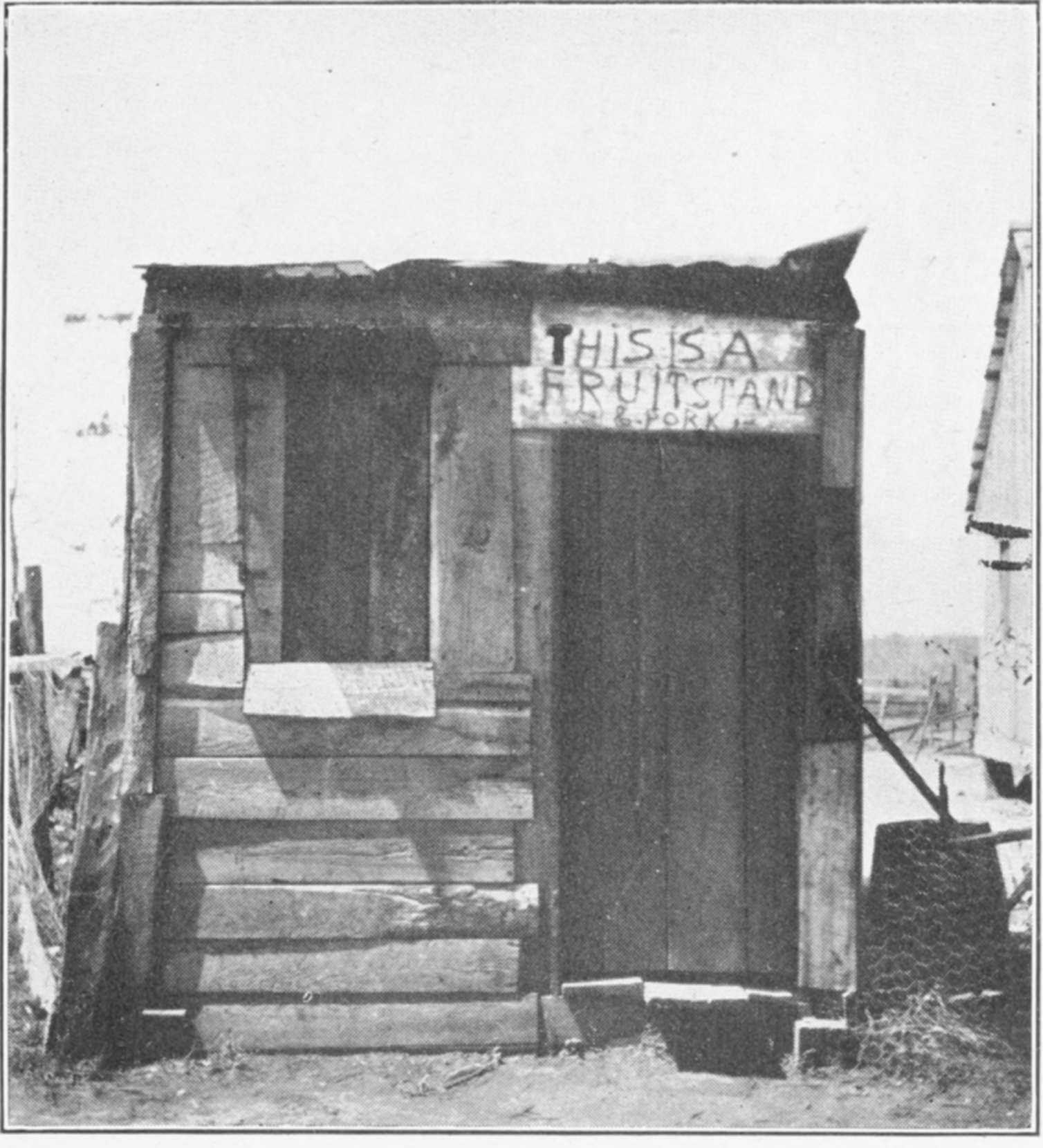
THIS IS A “FRUIT-STAND & PORK”
The very next morning I had another visit from “them Huggins boys”. I was out riding at the time, and when I came back I noticed someone had driven in and out of the driveway. It had rained during the night and the fresh tracks were plain in the sandy road. The hoof prints were long and narrow, evidently of a mule, and I wondered idly who my visitor could have been. Sally told me.
“Hit’s dose shiftless Huggins boys again. They was trying t’ sell mo’ eggs, an’ they got out an’ cum right in de libin’ room. Ah couldn’t stop ’em nohow.”
Evidently they were going to make themselves a first-class nuisance unless I put my foot down firmly. Resolving to read them the riot act next time they came around, I tied the pony and went into the house, Sally protesting all the while against “all dese heah pore white trash”. I went to the mantlepiece to fill my pipe. There was the tobacco pouch, but my pipe, my favorite briar, which I was sure I had put there just before I went out, was not there. Sally remembered seeing it, but had not touched it.
“Hit mus’ a been them Huggins boys tuk hit,” she suggested.
I hurried out and jumped on the pony.
“Ef dey’s been drinkin’ look out fo’ ’em,” Sally called after me. “Dey’s pow’rful mean in liquah.”
“Don’t worry about me, Sally,” I called back. “They wouldn’t hurt anybody.”
By riding ’cross lots I came out on the road to their farm ahead of them. The telltale tracks in the sand told they had driven out, but had not yet returned. I rode back to meet them. Half way to the main road I came up with them. They were coming along at their usual funeral pace, and the musical Tom was whistling a jolly jig tune. I rode up and stopped their mule.
“Good mawnin’, suh,” they chorused.
“Which of you boys smokes a pipe?” I asked.
They were surprised and outdid each other in looking as innocent as lambs.
“Whichever it is, hand over my pipe.”
They shifted uneasily, but neither made a move to restore my property.
“Come, be quick,” I said, moving the pony in closer to their carriage.
Tom slowly reached in his pocket and drew out my pipe. He reached it out to me silently.
“Thanks,” I said. “Now understand this: the next time I catch or hear of one of you boys on my place except on business I am coming after him with this.”
I shook my riding crop and they nodded solemnly. The pony was dancing about and I rode off, leaving them looking after me surprised and disgusted, a little mad, but properly scared. After that we became friends.
Till recently the country where “them Huggins boys” live has been known all over North Carolina as “poor old Moore County”. It lies in the very heart of the Sandhills, and the farmers who “make corn and cotton on the clay” have long scoffed at the sandy slopes where, so the joke runs, “you can hear the cotton grunting trying to make a living in the poor soil”. Too poor even to give a decent stand of grass—except the coarse, useless crab grass—the Sandhills supported a fine growth of long leafed pine, and years ago the Huggins boys’ grandfather and his neighbors eked out their thin crops with the tall, straight timber and with turpentine. Their sons, the best of the timber gone, hewed out railroad ties and burned tar. They were poor farmers on poor soil, a ruinous combination. The roads were bad, and the Sandhills’ natives, having little to sell and nothing with which to buy, lived sufficient unto themselves. Theirs was a narrow life and a hard one, a life of few pleasures and almost no advantages, of much labor and little reward.
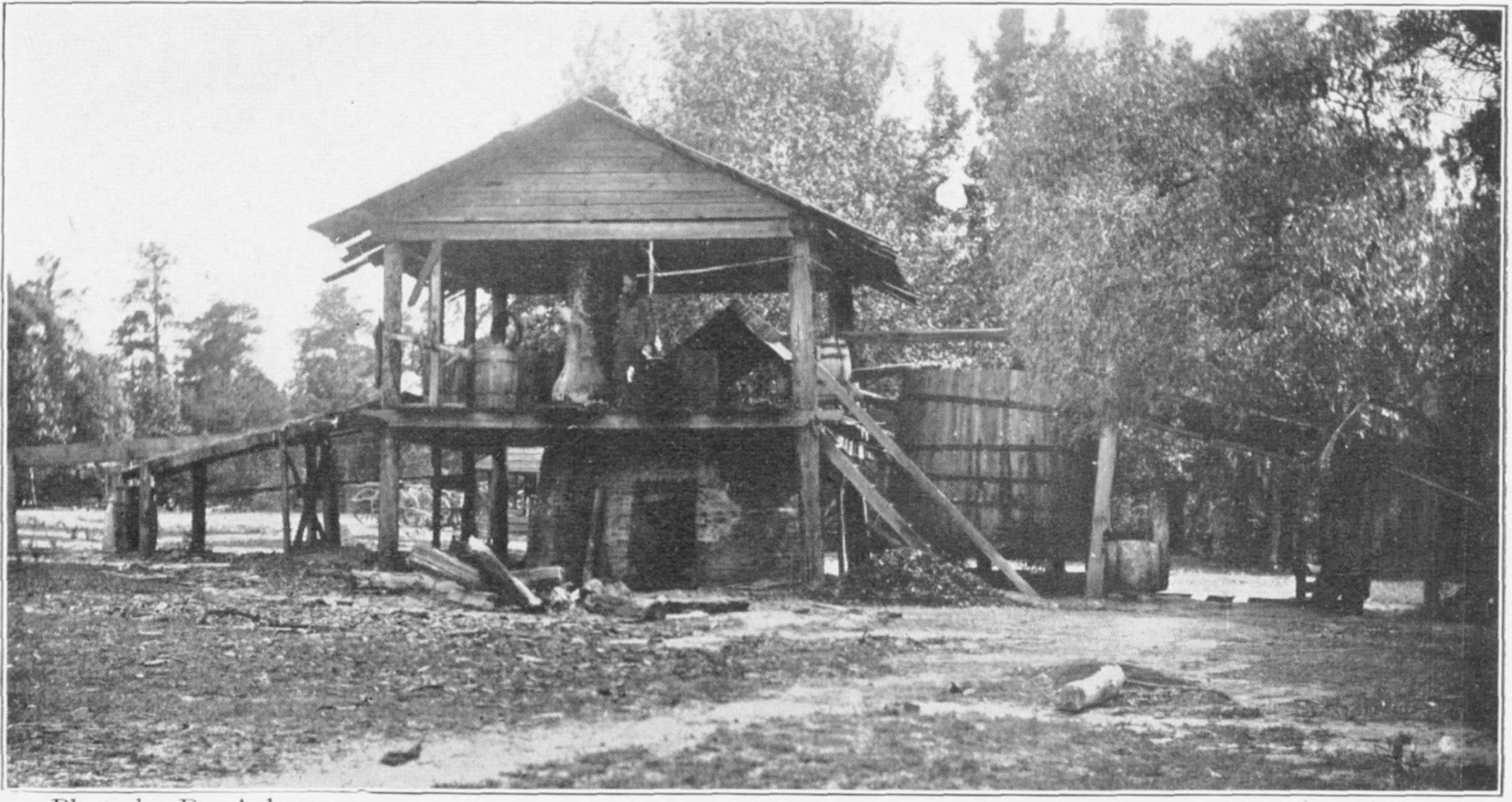
Photo by Dr. Achorn
DESERTED TURPENTINE STILL
A score of years ago new factors entered into the life of the Sandhills. Inspired by the few passengers and little freight on this division of the road, railroad men turned their attention to this country. They sent agricultural and industrial experts who reported back that all the Sandhills had was a glorious winter climate. So the general passenger agent and the traffic manager consulted physicians, and the Sandhills became famous as a resort for tubercular patients. But wiser men nipped the growing sanitoriums in the bud and planted in their stead great winter resorts, big hotels, golf courses, hunting preserves.
Men and women came from all over the country to slip away from Jack Frost and play in the open, and the mysterious spell of the Sandhills was thrown over them.
Under this spell a little group of Northern men, fresh from college, ambitious and full of energy, decided the Sandhills should be good for other things besides golf and quail shooting. Agricultural experts from Raleigh and Washington said things that confirmed this belief, and these young men turned Sandhills farmers. The Huggins boys’ father and his neighbors in poor old Moore County laughed at these soft-handed agriculturists; but they fattened cattle with great profit over at Jackson Springs; they grew tobacco at Samarcand which brought top price in the open market, and their big dairy near Hoffman sold cream to the railroad and fed hogs on the skimmed milk. The pioneers have been followed by others, and most of the Huggins boys’ neighbors from good examples have learned to get bigger crops and sell them for higher prices.
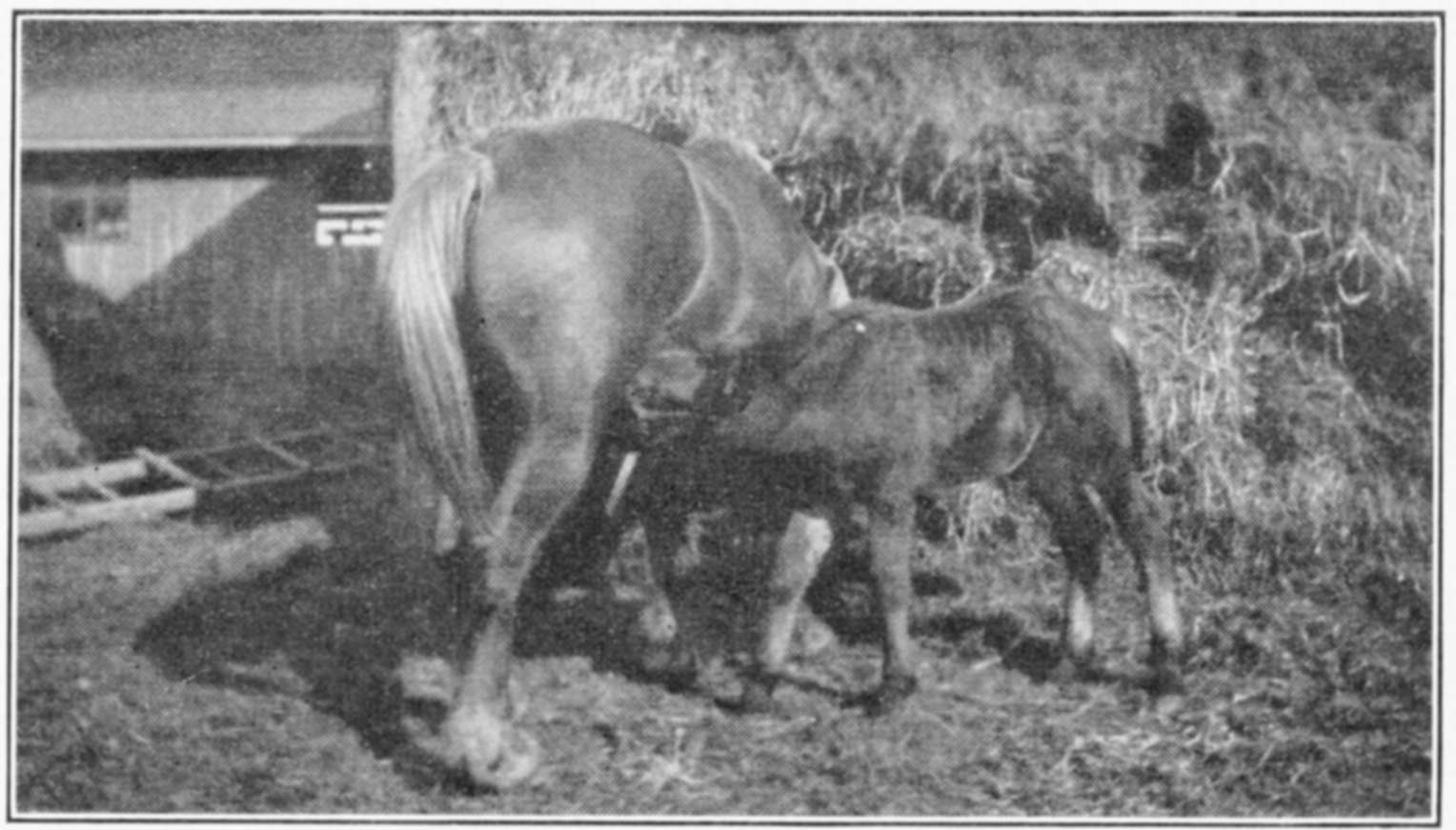
AT THE PINEHURST FARM
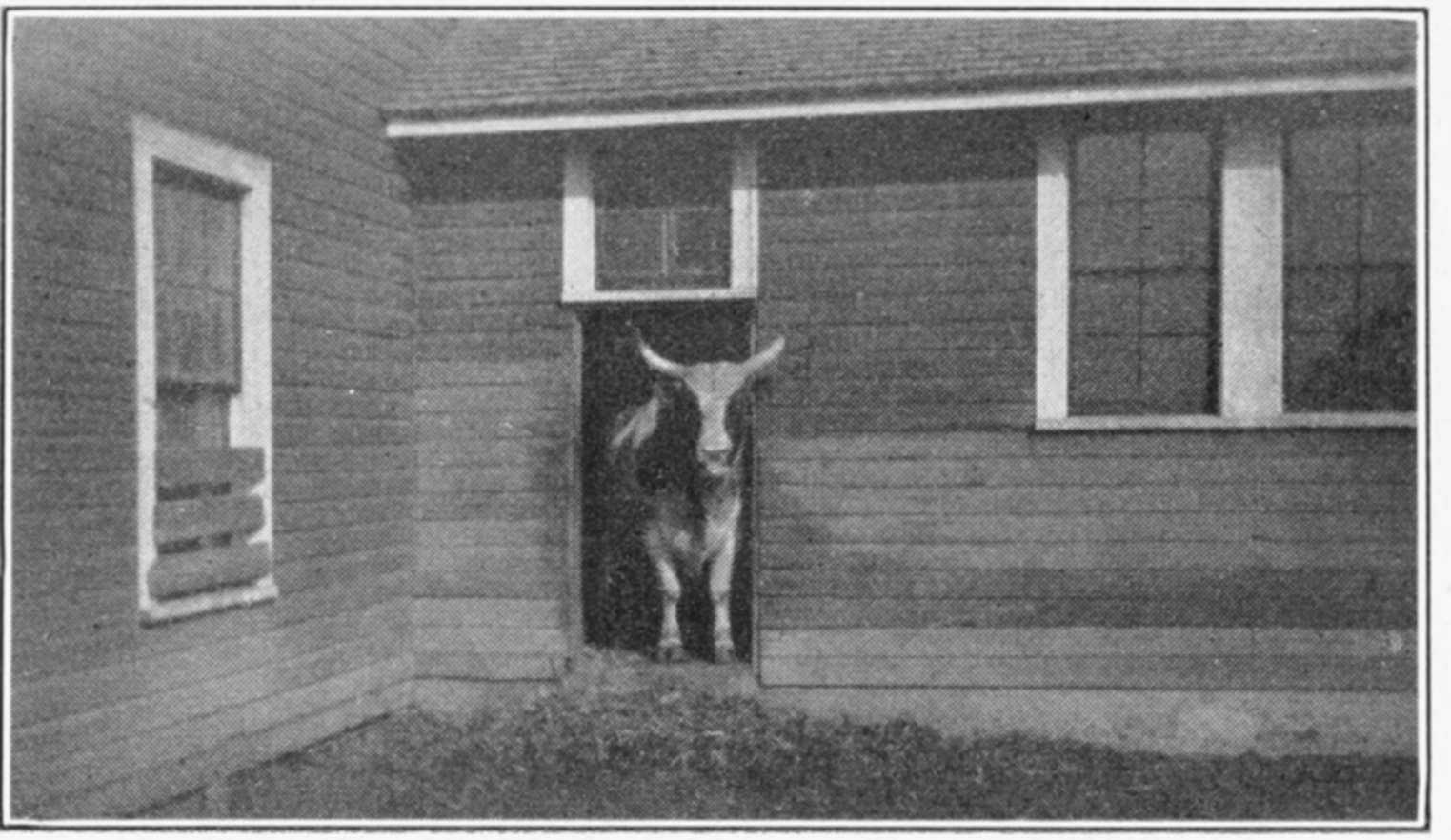
LORD OF THE PINEHURST DAIRY
But in among the hills, a little way back from the railroad and the new automobile highways the old life, the hard, narrow life, is still lived. “Them Huggins boys” and their poor, old mother and drab sister are still drudging along in the old way. That, after I knew them, was the only real fault I found. They are not vicious or mean: they are frightened and suspicious. They are not clever and they are very lazy, so they have no confidence in themselves to cope with the keener competition that the new life has brought. They have neither the speed nor the stamina to stand the swifter pace, and they balk. Underneath their diffidence and sham effrontery they are helpless and hopeless. They are the tattered remnants of an out-worn age.
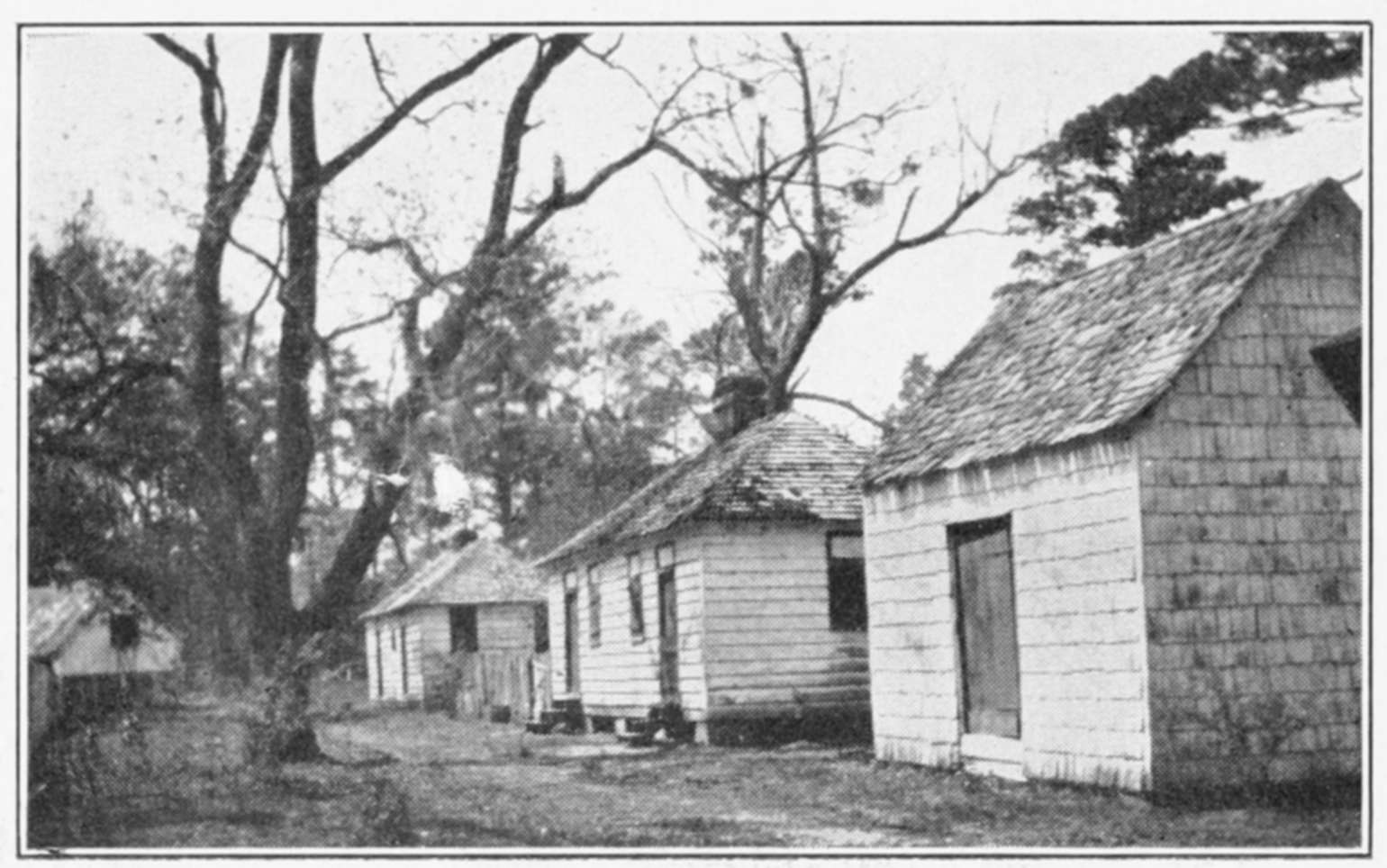
OLD SLAVE QUARTERS