The Clay Birds
Reading edition
We sat round a blazing pine-knot fire in the big hotel’s cozy smoking room, and every man in the group, except the Banker, had been hobby-horse riding. Each had enjoyed a glorious day in the outdoors, pursuing his favorite sport. Each, tired with that delicious, restful tiredness that comes like a benison at the close of every day of keen sport, luxuriated in his deep leather chair. The fresh, pine-scented winds had swept the cobwebs from our brains, and, as the fire snapped and crackled, the bright flashes of friendly repartee, witty thrust and ready parry, flew round the circle.
The Collegian and his Father had started it by holding, as golfers are so very apt to do, a post mortem over their afternoon round. This led the Editor, who had slipped away from the impatient telephone and the ever-hungry presses for a couple of weeks’ winter vacation, to make some caustic comparisons between golf and his favorite tennis. But casualties on this hard and long-fought battlefield were tactfully avoided by the Manufacturer, who boldly asserted that both these good sports paled into utter insignificance before the most glorious sport of quail-shooting. He proved it too—to his own complete satisfaction—and then the polo-player championed his hobby, and was followed very naturally by a hard-riding fox-hunter. Then we had another round of golf, and so back again to the wide-ranging bird-dogs and the whirling quail coveys.
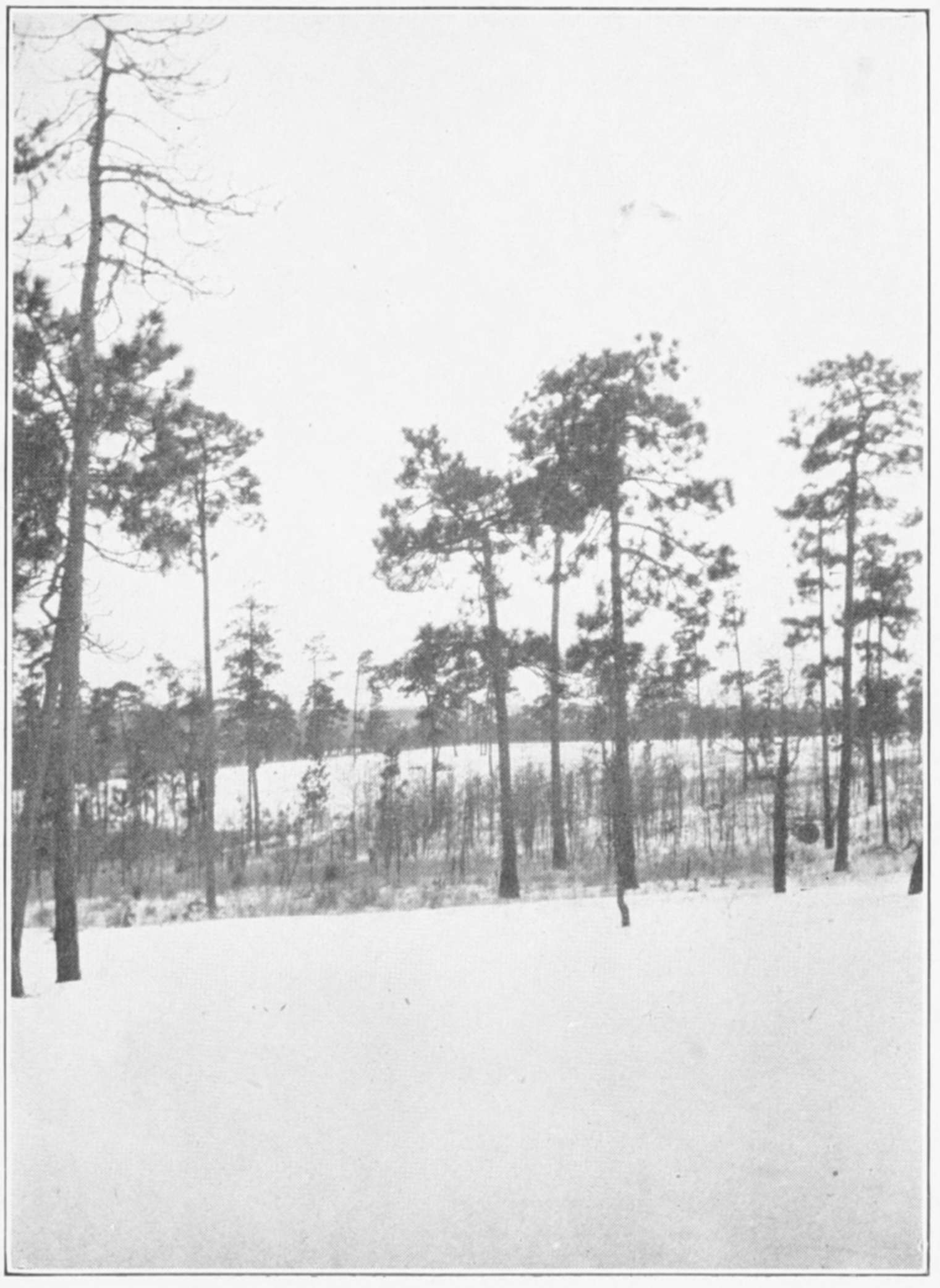
SNOW IN THE SANDHILLS
“I wonder,” put in the Banker, “if you gentlemen have read a poem of Whitcomb Riley’s called ‘His Favorite Fruit?’ It’s a little dialect sketch in which some Hoosier farmers, gathered ’round the iron stove in a little cross-roads grocery, discuss their favorite fruits. Each one holds out for his own personal choice—the apple, the peach, the pear, the watermelon—and slanders unmercifully the taste of the last speaker. But all the time the teller of this story ‘chaws on an’ sez nawthin’.’ Finally one of the party asks him point blank, ‘Jim, what’s yourn fav’rite fruit?’ He chaws on fer quite a spell an’ then he sez, slow an’ solemn-like, ‘Terbaccer,’ an’ you oughter heard ’em roar.”
“You,” continued the Banker, when the laugh had subsided, “have been each slandering the other’s favorite sport, while I have been ‘chawin’ on an’ saying nawthin’,’ and I wonder who of you will laugh at me and my favorite sport as at the Hoosier farmer whose favorite fruit was tobacco.”
“Speaking for myself,” remarked the Editor, “I laugh at no sport except tiddle-de-winks.”
“How about ping-pong?” asked the Collegian.
“That must have been before your day—did you ever play it?”
“No, thank Heaven, but——”
“Ah, I thought not. If you had, you’d not laugh at it, either,” and the Editor chuckled to himself reminiscently.
“I came down here to Pinehurst,” continued the Banker, “to get some good trap-shooting.”
“Huh!”—a short, sarcastic “Huh!”—came from the depths of the chair where the Manufacturer, after a long day tramping over the Sandhills behind his brace of pointers, was resting.
“I expected just that from you, Charlie,” laughed the Banker. “Simply ’huh!’ and nothing more can express your wonder and contempt. For the life of you, you cannot understand why on earth a supposedly sensible man should come down here into the very heart of one of the best quail counties in North Carolina to smash clay birds at the trap, can you?” The Manufacturer shook his head vigorously. “Well,” continued the Banker again, “I felt just as you do a couple of years ago. I followed your favorite sport too many years to start slandering it now. I used to come down here quail-shooting before you were out of school, but I can tell you that trap-shooting is good sport, too. You are a Doubting Thomas, but why don’t you try it sometime? It’s not so simple as it looks.”
Before we broke up an hour later, we had made an appointment to visit the traps next morning to witness the Banker’s promised conversion of the Manufacturer into a trap-shooter. None of us will ever forget that skeptic’s immense surprise when he found the little clay birds so very “gamey” that he only broke nine out of his first string of twenty-five. It was a hard jolt to his pride, but he stuck out his jaw, tucked his gun under his cheek, and tackled another string. He did better later, and soon he got into the habit of joining the little parties at the squatty little gun clubhouse in the center of the big open field over against the great red barns of the model dairy. He came sheepishly at first, but later with brazen effrontery. In the end, he decided to stay over a week longer than he had planned, just to enter in the Mid-Winter Handicap Tournament the last of January.
In no very strict historical sense can the adjective “new” be fairly applied to trap-shooting, and yet there is a newness in the recent vogue of the sport. The live, tame pigeon, thrown into the air, frightened and confused, from a collapsible wooden cage, has long since been supplanted by a little clay disc, hurled with lightning speed from a steel spring trap. This was the starting point of the development of trap-shooting as we know it in America today, and this took place years ago. It is a harder, more sporty thing to smash a whizzing clay bird to smithereens than to knock down a frightened tame pigeon, and it is more humane. This change of targets put a keen zest into trap-shooting and took out a bitter reproach. But till recently, the growth of trap-shooting has been slow. In four short years, however, the number of active trap-shooters has increased fourfold; from about 100,000 to about 425,000. During the same period trap-shooting clubs have increased from 1,000 to 4,000, and it is estimated that about 500,000,000 clay pigeons are thrown into the air each year at the shooter’s sharp command, “Pull!” In one short Presidential term, trap-shooting has sprung forward from a low place among the so-called minor sports to occupy a position second only to baseball in the number of its devotees. We are not apt to appreciate what this really means without the help of the cold figures above.
There is a world of difference in being a “rooter” and in being a “player,” and the one simple little fact that each trap-shooter is a player himself, or herself, is just what gives the sport its strongest grip upon the interest of its followers. That tense moment of “two out and the bases filled”; the jerky, crashing advance of the battling human machine carrying a pigskin ball down the field toward the goal-posts; the rush of the ponies and the hollow click of mallet against polo ball—all these tighten the muscles and quicken the heart-beat of any live sportsman, but, as the psychologist says, these are all external stimuli.
Let the same man—or the same woman, for many women shoot at the traps nowadays—step up to the score, tuck his gun against his shoulder, brace himself and draw a deep breath, glance down the long length of blued barrels, and call “Pull!” Whizz goes the little black disc, hurtling away at a speed that makes the teal and the mallard seem lazy laggards. One moment of intensely concentrated effort and keen enjoyment till the flying saucer is found just above the forward sight; an almost involuntary squeeze of the trigger finger, the thrilling jump of the discharge, and puff!—the clay target is knocked into a thousand bits.
That tremendously concentrated effort of finding the speeding disc—you must find him quick—he will be quite out of range if you stop to say quickly—followed by the physical climax of the almost simultaneous kick of the gun and the shattering of the clay target; these are secrets of the witching spell that lures the shooter back and back again to the traps. I must confess to a thoroughly diabolical delight in knocking the clay birds to powder. I do not do it always—not even often, but when I do I enjoy the keenest pleasure. Other trap-shooters confess the same joy. Please, do not say anything about dangerous destructive tendencies that ought to be rigidly suppressed, or we shall get into an argument, and then I will have to say a lot of things about quickness of eye, correlation of senses and muscles, and a great deal more that has nothing whatever to do with the sport of shooting the clay birds.
Over and above the inherent fascination of knocking the flying clay targets into powder, the fact that there is no closed season on these clay birds and that even a little hand trap in any open field will furnish good game anywhere, goes far towards making “the sport alluring” the sport universal. Nor do the changing seasons at all handicap the trap shooter. The clay birds are always full grown and they have no nesting-time; they are just as plentiful and just as fair sport in November as in May. Indeed, when you mount the trap-shooting hobby-horse, you can make up your mind to settle yourself in the saddle for a long, long gallop over all sorts of country and in all sorts of weather.
There seems to be a delicate touch of sarcasm in the fact that the most important winter trap-shooting tournament should be held within a stone’s throw of grounds so well stocked with quail that they are chosen for the running of one of the largest field trials. The pick of the blooded setters and pointers are tried out for their bird sense and hunting ability almost within hearing of the guns at the Pinehurst traps. But the quail-hunter and the trap-shooter are brothers in arms. Often, like the Manufacturer, converted at the Pinehurst traps last winter, they are sporting Siamese twins. The traps furnish good practice to the field shooter and good sport when the closed season would otherwise keep the gun in its case.
There is a curious connection between these brother sports. How keenly, at the traps, does one miss the tramping over the open fields, scrambling up hillsides, fording the streams, hopping over the rail fences! All the tireless quest of the hunt, that strange, primitive, impelling force that defies physical fatigue and keeps your high boots swishing through the coarse, knotted crab grass with a long, eager stride from daylight to dark! Most of all, you miss the dogs. That to me is the great loss. But there is continual shooting to take the place of the joys of the open fields, and there is a cleaner, keener satisfaction in smashing a target than in knocking down a quail; but what takes the place of the dogs? Nothing. Every shooter loves to shoot—if he says he does not, put him down as a hypocrite. No man lugs six or eight or ten or even twelve pounds of shotgun all day long just for the fun of carrying firearms. He likes to shoot. He may—and probably does—thoroughly enjoy the tramp and the pleasure of watching the dogs work, but if he went hunting for these alone he would not burden himself with a gun. No, the shooter loves to shoot, and at the traps he can shoot till his gun barrels get red hot. Only a lame shoulder and the price of shells need keep him from shooting his head off, as the saying is. To the man who loves action—quick action and lots of it—this is a charm that the traps surely, and the live birds only uncertainly, offer.
But the very kernel of the sport of trap-shooting comes in smashing those flying discs. However keen the hunting instinct there is always just the tinge of regret in blotting out the pretty life of little brown birds. There are times when one feels just a bit ashamed of that fierce pleasure of a good, clean, quick shot. At the traps one can let that pleasure run wild. You can grit your teeth and say, “I’m going to paste you this time,” without qualm of conscience. You can give rein to the passion for destruction without becoming a brute. To do so in the field is to degenerate. We hate the “game hog,” not because he is selfish and cruel, but because he is not a man. We need the strong, elemental passions, and we are in danger of becoming super-refined jelly-fishes, incapable of doing wrong because we are incapable of doing good. It takes more courage to attack a lie than to storm a trench, more passion for destruction to root out a bad habit than to raze a city.