“Tar Burnin’”
Reading edition
When first I went to North Carolina to spend the winter in the Sandhills, my knowledge of tar was limited to schoolboy memories of tar-balls made from material purloined from the contractors who paved New York’s streets and a rather indirect connection through a cousin who had once put a tar roof on his stables and cordially regretted it. Down in the Sandhills, old Uncle Willis Baldwin, by verbose precept and halting example, taught me just how the black, sticky stuff is wrung from the dried wood of the long-leaf pine, barreled up, and brought to market.
Soon the good old-fashioned way that Uncle Willis burns his tar will be replaced by a very efficient, but thoroughly uninteresting machine, a great still, with a gigantic metal retort in a brick oven as big as Willis’ little shanty. The old darky tar burner who considers himself lucky to get a barrel of crude tar from a cord of dry pine is but a faltering competitor of the machine that from the same wood can wring two barrels of tar, valuable creosote, and other important wood oils. Squeezing out fifteen dollars where before but three or four were extracted is all in strict accord with economic progress, and plainly it is very much more profitable—for those who own the stills—but this fine machine is costly beyond the dreams even of Willis’ vivid imagination, and it is but a question of time when the negro tar burner and his handmade tar kilns will be another vanished bit of the Old South.
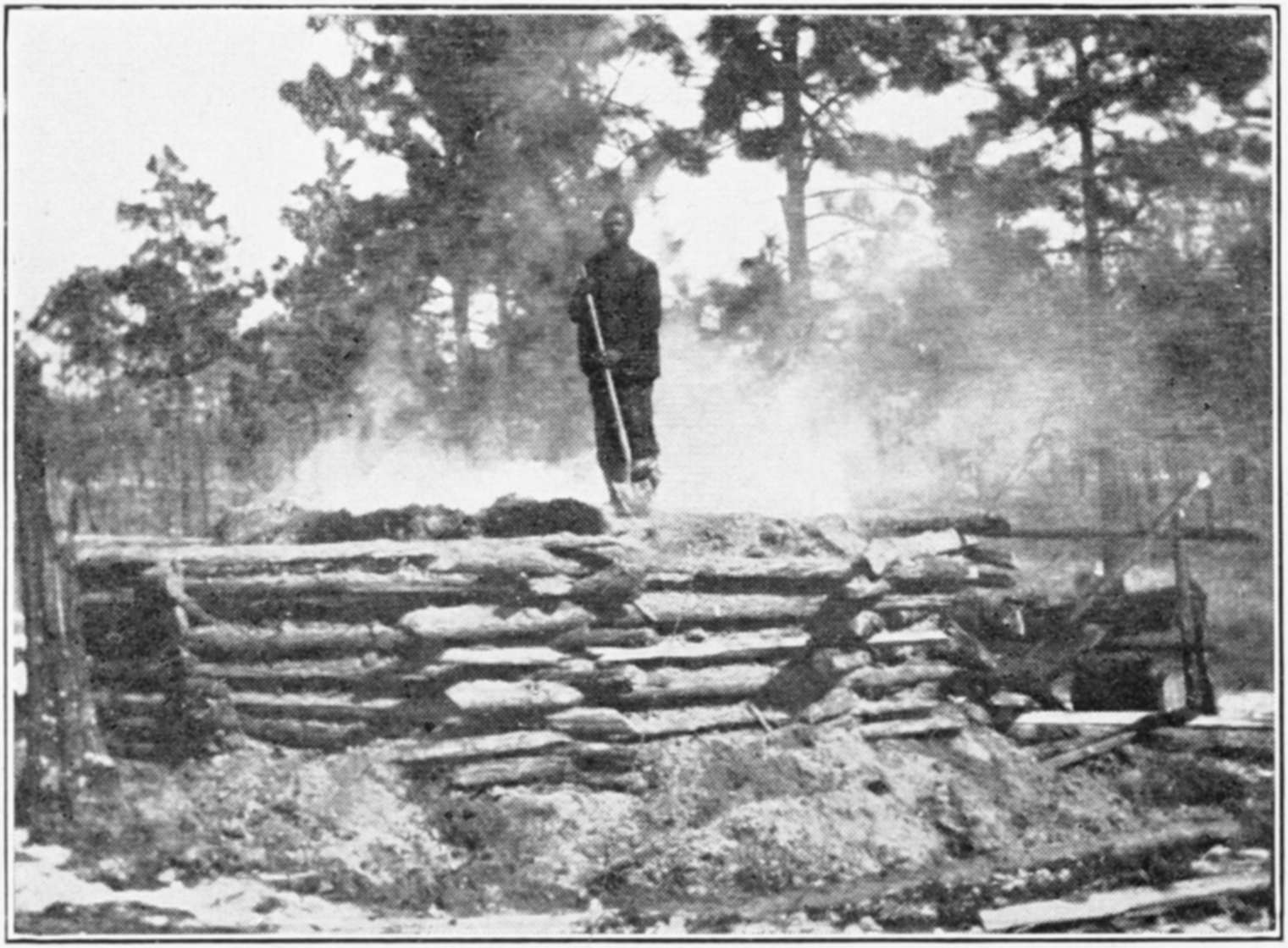
THE BURNING TAR KILN
Willis had made a tar-burning agreement—the usual one in such cases—with Massa Ralph. Massa Ralph supplied the dry pine wood—“light ’ud” Willis calls it—and he further agreed to furnish the barrels to hold the tar. Uncle Willis, on his part, undertook to collect the wood on Massa Ralph’s land, to build and burn the tar-kiln, to fill the barrels and deliver them to the railroad at Hoffman. Each was to receive a half of the receipts from the sale of the tar.
On a piece of level ground, down in the valley beside the little trickling branch, just behind my bungalow, Willis “done built hisself a whalin’ big tar-kil’.” First he dug out a slight hollow, like a great wash basin full twenty feet across, with a trench leading from the center to a deep pit dug just outside the outer edge. Then he and his brother Henry hitched up their old grey mule and scoured all over the land, piling the dilapidated wagon with the dry wood they picked up everywhere and hauling load after load to the site of the kiln. After a great store had been collected, Henry fell to work chopping up the knotty stumps and splitting the long logs, while Willis painstakingly constructed the kiln. This must be carefully and neatly done, for the quantity of the tar yielded depends most directly upon the close and proper building of the kiln. Around the outer edge Uncle Willis laid row upon row of the long, straight, split rails, each pointing due to the center and each one fitted with scrupulous nicety into its place. In the center of the kiln he stowed away the little twisted knots and gnarled bits of root, all so rich in tar. This is rough work too, and were not old Willis’ black hands as tough as sole leather, they would be filled with splinters.
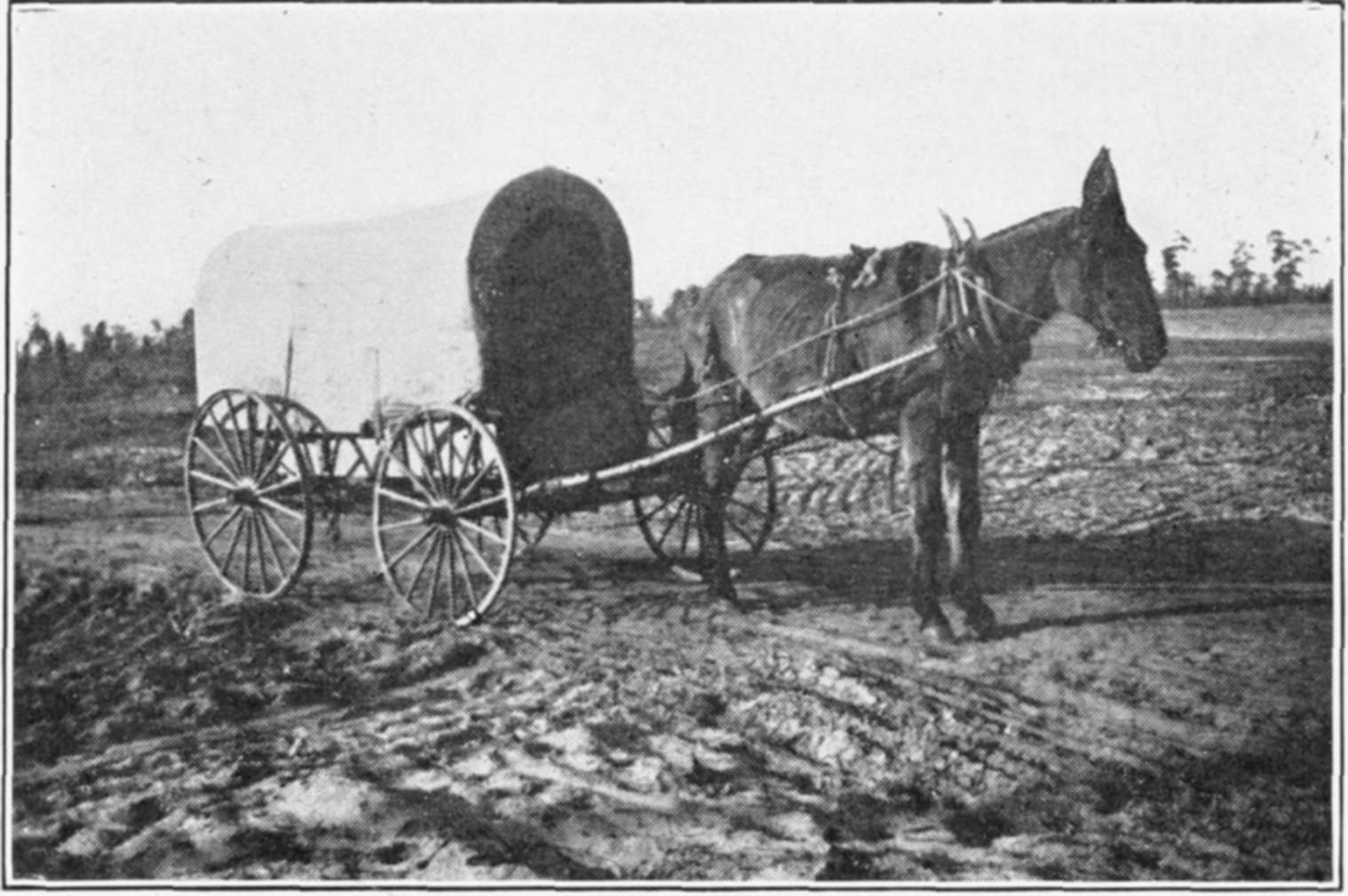
THE TAR BURNER’S WAGON
After the kiln had slowly risen till it was full seven feet high at its outer rim, it was topped off with a roof made of the split rails. Aunt Sally and “de chilluns” were now pressed into service flagging the kiln. On the roof they laid a covering of long-leaf pine boughs, and then they stuck similar branches into the crevices of the sides until the whole looked like a great, regular mound of giant pine needles. Uncle Willis and Henry again took up the work. They now banked the kiln. Starting at the ground, and building up tier on tier, they laid long logs of green wood round the kiln. In between the long logs and the kiln itself they packed sod and dirt, transforming the great heap of pine needles into an octagonal, log block house in miniature. Sand and clay piled six inches deep on the top and then packed down finished the job. Willis was now ready to burn his kiln.
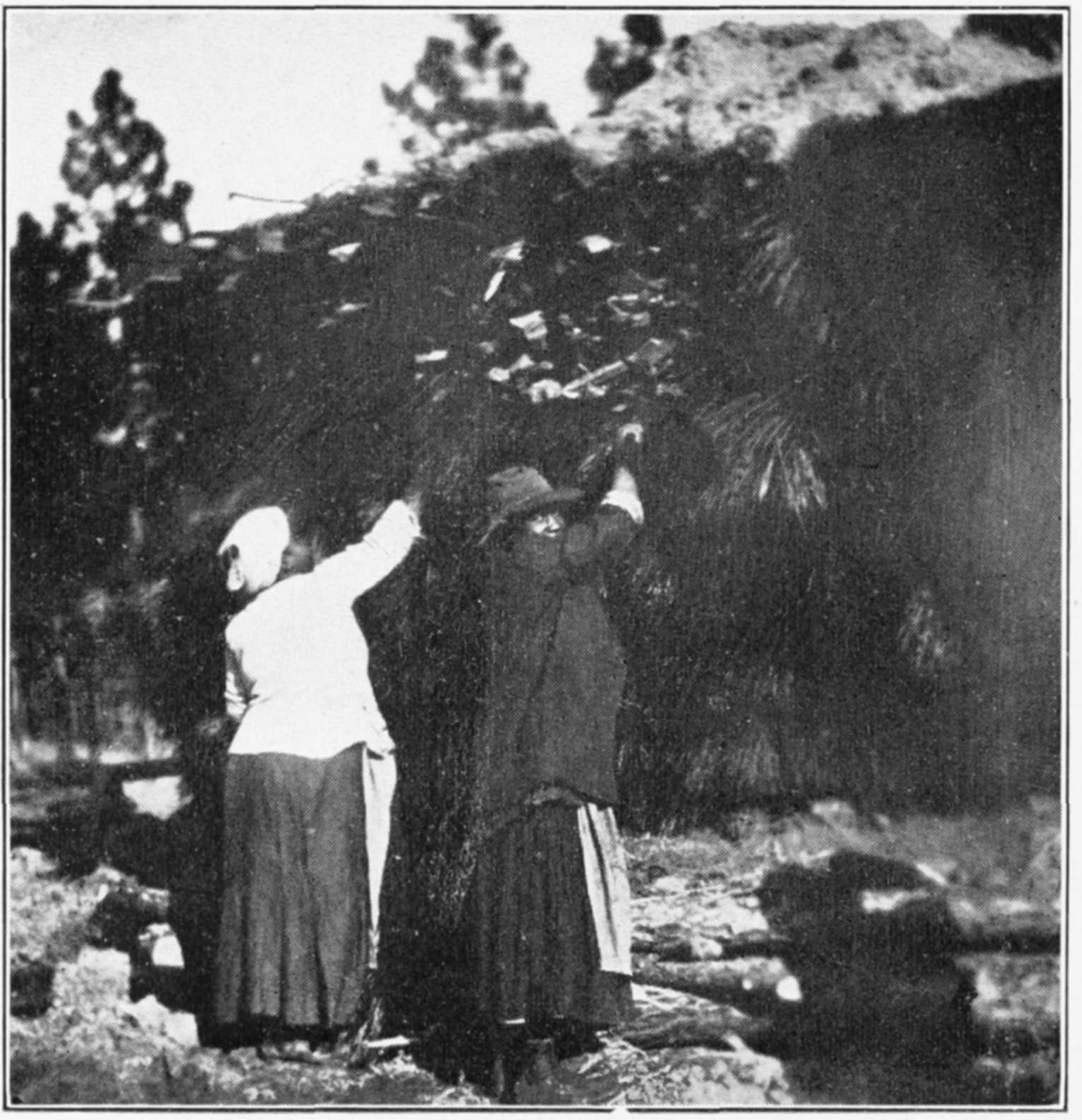
FLAGGING
So far everything had gone swimmingly, but now a long series of troubles began to fall with distressing regularity on Willis’ woolly head. A dozen times a day he would come shuffling up for my consolation and advice. Off would come his battered hat and he would begin, “’Deed, Massa Billie, Ah doan’ know——”, till, had I not felt so sorry for the old man, I would have been driven crazy by these woeful consultations.
In this big tar-kiln he had planned and executed his magnum opus, which should not only re-establish his shaky credit at the store in Hoffman, but must also supply the necessary capital for cotton seed and fertilizer against the fast approaching planting season. He was staking more than his little all on this kiln; he was gambling in futures, futures of slab-side pork and corn meal; a promised dress for the Xantippean Sally and much needed shoes for Carolina, Liza, Sally II, Robert Lee, and a couple of the other children whose names I forget.
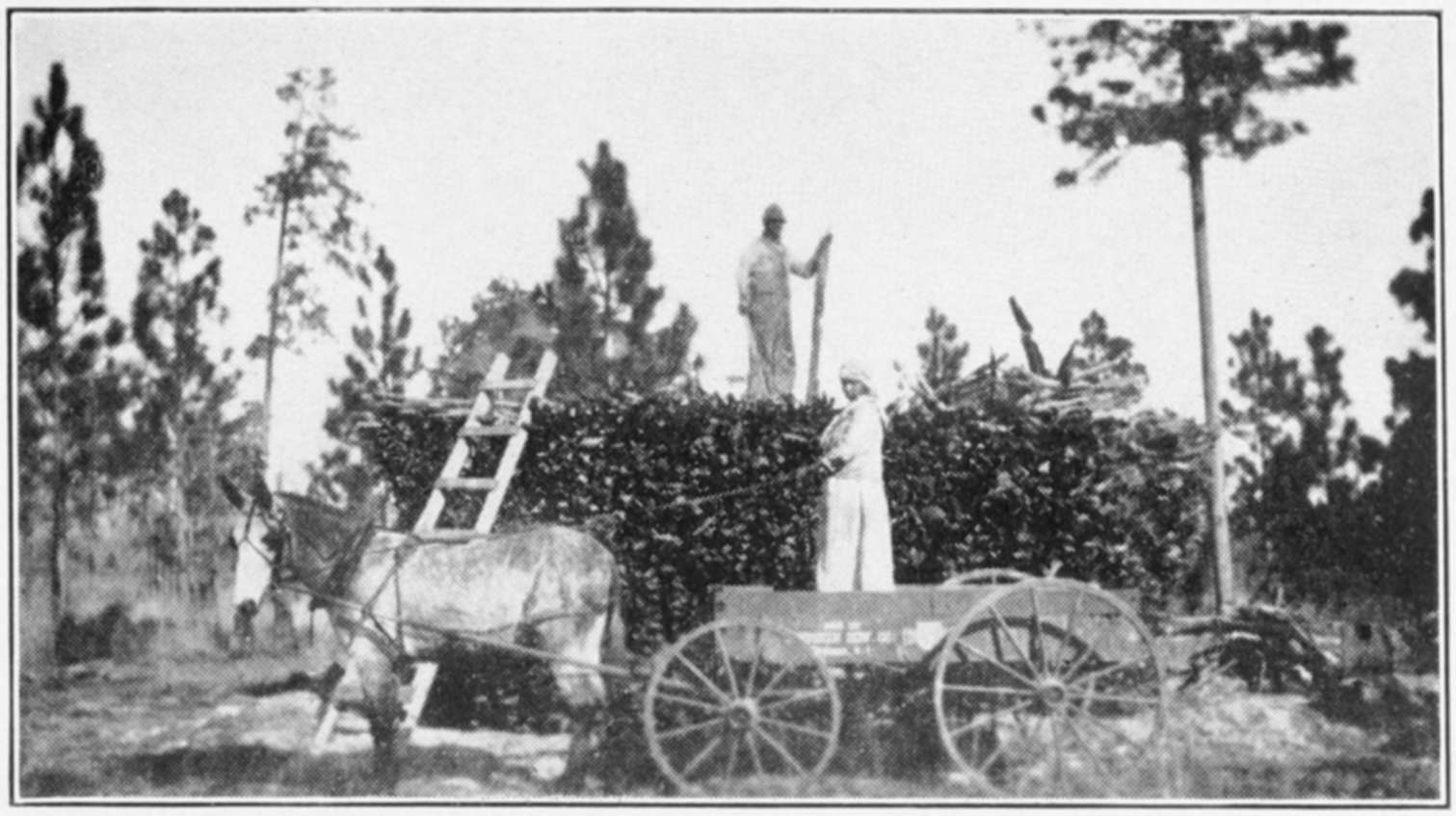
BUILDING THE TAR KILN
His great tar-kiln, built so patiently and with such great expectations, contained about seventy cords of good wood and should, according to all expert calculation, yield about seventy barrels of tar. Massa Ralph’s overseer, deputized to get these seventy barrels, had only been able to collect forty. He scoured the country, mills, cross-road stores, freight offices, but every available source of supply that usually had barrels almost to give away had no barrels now, even at fancy prices. And Willis, because once the kiln was started there would be no stopping nor turning back, was afraid to fire the kiln until he had on hand enough containers to hold his expected quantity of tar. Moreover, poor Willis had agreed to pay Henry fifty cents a day till the tar was all run, and he saw the wages of his helper daily eating deeper and deeper into his profits. To cap the climax, the market price of tar was tumbling down at an amazing rate, and every no-’count nigger that passed along the road took a diabolical delight in stopping at Willis’s cabin and giving him the very latest and most discouraging market quotations. Poor old Willis! Whenever he saw me he implored help in getting him some barrels, and I never rode over to Hoffman without bearing an urgent message to the freight agent—“Fo’ de Lawd’s sake, Massa Billie, tell him t’ hurry hup dat lot ob bar’ls what Massa Ralph done order in Wilmington.”
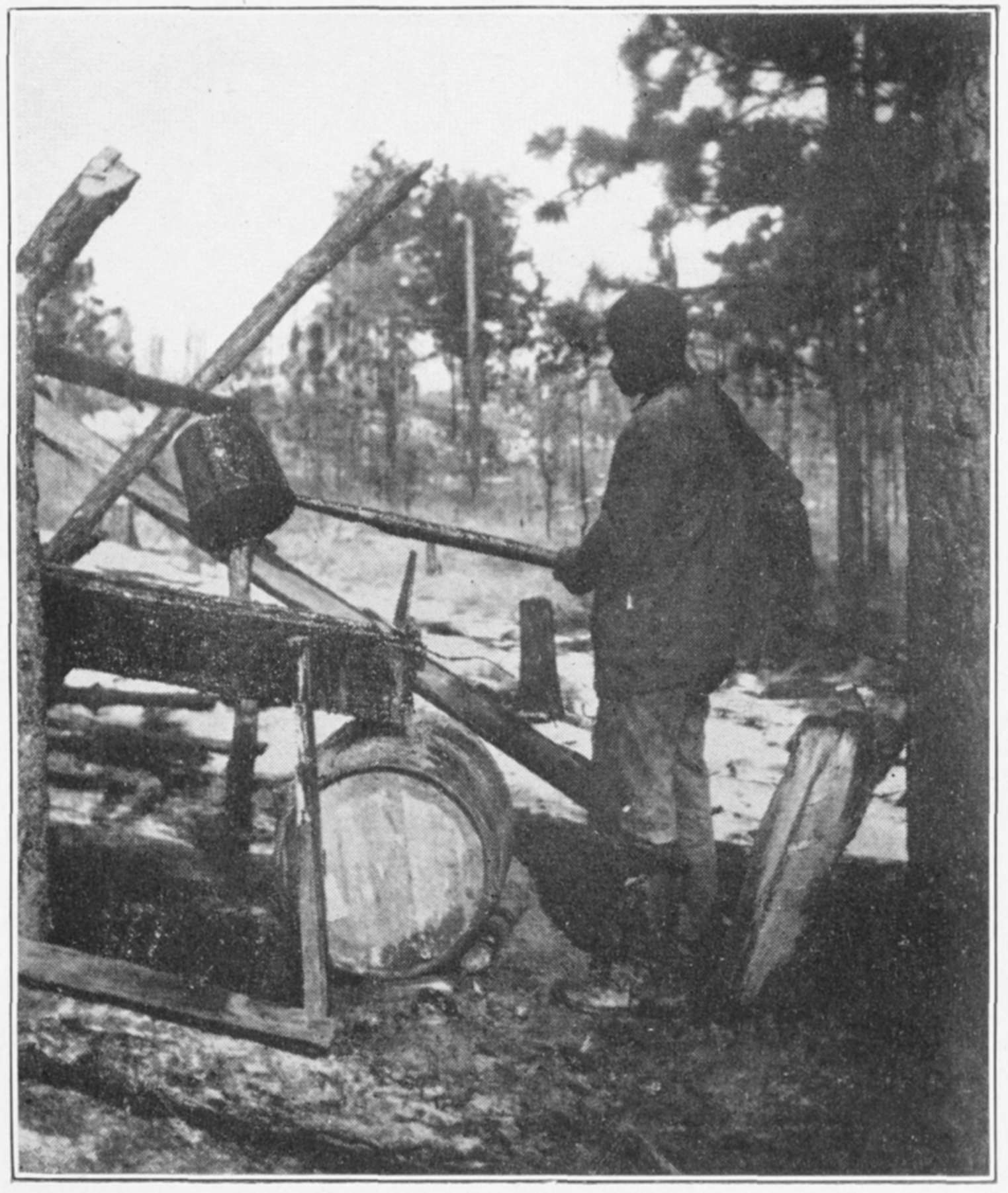
FILLING THE BARRELS
At last the long-expected barrels came, and one evening about dusk Jim Watson scraped the dirt and boughs off the roof of Willis’ kiln for a couple of square feet and applied a match to the dry lightwood underneath. As the red flames darted through the black smoke, Willis heaved a great sigh of relief. Had everything gone smoothly, Willis would have run the kiln himself. So many things had gone wrong and so very much depended on this kiln that he called in Jim Watson, who plays the part of tar burning efficiency expert throughout the Sandhills, in the hope, I believe, of his being able to break the spell of bad luck. In the back of his brain there was some notion that the fee he paid to Jim Watson hired not only his supposedly superior experience, but also bought a charm against further misfortune.
All night long the ruddy glow of the burning kiln lighted up the little valley, and the pungent, piney smell of the black smoke filled the air. Up at the bungalow, two hundred yards away, we could hear the snap and crackle of the burning knots and the thick scent of the pitch penetrated the house. Early in the morning, Willis covered the hole in the banking of the roof under the direction of Jim Watson who, perched on an up-turned barrel, gave directions with a thoroughly expert and professional air. Now the kiln began to smoulder, and the pair sat down, only getting up to patch with great shovelsful of earth any cracks that appeared in the banking.
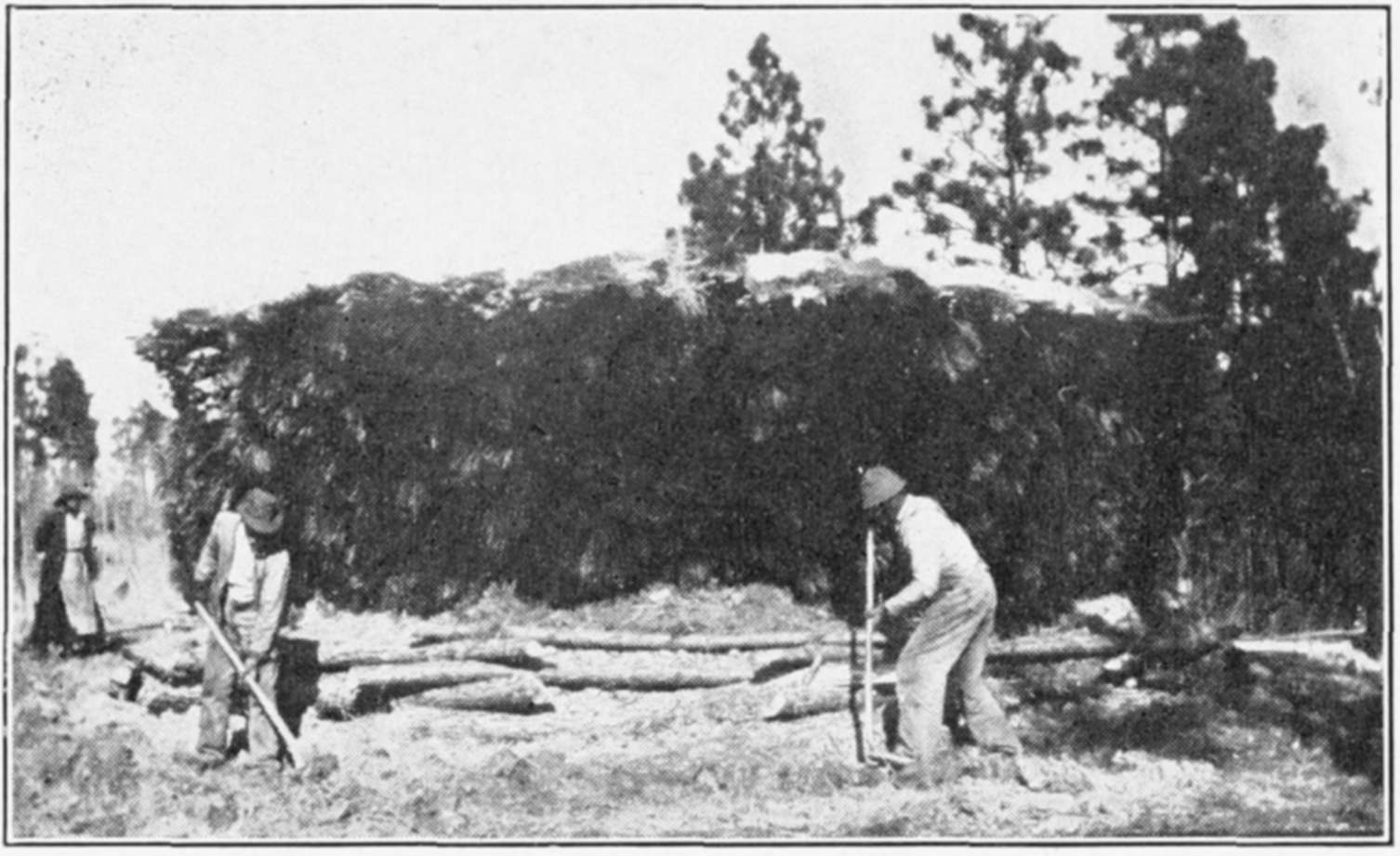
BANKING
About the middle of the afternoon, the tar, sweated out of the pine wood by the intense heat, began to ooze out of the trench. Slowly at first, drop by drop; soon in a little trickle that grew in size, till by nightfall, it was pouring out so that one of the workers must busily ply the bucket all the time. This bucket Willis had fastened on the end of a long pole, and with it he scooped the black, sticky mess out of the pit, pouring it into a rough wooden trough through which it flowed into the waiting barrel. This work must go on day and night, and the kiln must also be carefully watched lest it catch fire; so Willis had built a crude hut for shelter, and here, when not on duty, the burners rested on a great heap of filthy blankets. Sally brought them their meals, and they slept by turns in snatches.
Jim Watson had not brought good luck with him, for just as the tar began to run, it started to rain. A chilly northwest wind sent the shivers chasing each other down old Willis’ sun-loving back, and the water soon came pouring through the chinks in the imperfect shelter. The wet and cold could, at worst, mean a heavy cold or a sharp twinge of the rheumatism; a heavier blow of misfortune awaited Willis.
The great kiln behaved itself very properly indeed for a day and a half, and twenty good barrels were filled with tar. In spite of the bad weather old Willis was jubilant, but his joy was untimely, for despite his expert help, things went wrong with the kiln. Air sneaked in somewhere through some unnoticed crack in the banking, and then the lightwood, instead of smouldering, burst into flame, burning up both wood and tar. What a blaze the tar-soaked pine made! It roared and it snapped. Great jets of red fire, followed by puffs of inky smoke, thrust themselves through the banking. Every now and then a blazing knot, accompanied by a whole train of bright sparks, would be hurled through the roof and shot ten feet into the air. Fifty feet from the kiln I had to hold my hands over my face to keep off the intense heat, but like a great black Satan stoking the brimstone fires, Willis slaved, patching the shattered banking, throwing dirt on the roof in the hope of smothering the fierce fire and saving the remnant of the tar. And Jim Watson worked too, like a Trojan, for the blame and disgrace of the accident were his.
Finally, they succeeded in choking the flames under control, but the seventy barrels of tar for which Willis had worked so hard and waited so long had shrunk to thirty-one. Over at Hoffman he received just four dollars and a quarter a barrel for his tar, and but ten days before the price had been five dollars. He paid off his high-priced expert and settled up with his brother Henry. Then he came over to consult with me. He took the crumpled, little wad of dirty bank notes out of his pocket and looked at it ruefully.
“Hit doan’ mak’ much ob ah show fo’ all dat work an’ all dat time, does hit, Massa Billie?” and then he added earnestly, his black face seamed with doubt and apprehension, “Mebbe so—Ah doan’ know—but hit do ’most seem as eff thar’s sumbuddy conjured dat ole tar kil’.”