A Sandhills Christmas Carol
Reading edition
“Chris’mas gift, Massa Billie, Chris’mas gift!”
Aunt Sally, black and beaming stood at the door of my room, trying at once to waken me and arouse my Christmas spirit. I opened one eye and she redoubled her efforts, laughing.
“Merry Christmas, Sally! What time is it?”
“Merry Chris’mas, yo’self, Massa Billie—’deed hit’s ’most aight o’clock.”
“The dickens it is!” I cried sitting bolt upright in bed, “didn’t I tell you to call me at six?”
“Yassah, yo’ shore did, but Ah jest knowed you’d not want to go shootin’ dis mawnin’. Hit’s rainin’.”
Sally was right; it was raining, a steady, soaking, most un-Christmas-like rain. Out of the little windows I could see the Sandhills drenched and dripping. The great long-leafed pines, so proud and stately in the bright sunlight, stood dejected and tawdry. Even the jovial little holly bush at the corner of the porch had quite lost its gay, holiday air. Down in the valley, at the head of the branch, the rich, warm greens and olives of the magnolias and bluegums seemed grey and melancholy in the fine mist that spread over the lowlands. “Sam,” the most sedate and dignified of pointers, strolled into my room and put his head on the side of the bed.
“No hunting for us today, old man,” I said to him, and he sniffed sympathetically and blinked his yellow eyes as much as to say, “I know it—ain’t it the devil?” He was so very sad about it that I could not help laughing at the old sportsman.
Indeed it was not a pleasing prospect. A rainy Christmas—no shooting—and stuck off in a tiny bungalow, several miles from anywhere, with only the remnants of another man’s library for company—Ugh! I dragged on my clothes without any enthusiasm for the day. But Aunt Sally’s breakfast—golden scrambled eggs heaped up in the center of a fringe of crisp bacon, with corn bread, and steaming cakes smothered in molasses—cheered me wonderfully; and then, after breakfast, Uncle Willis, her husband, came shuffling up from his cabin for his “Chris’mas gift.”
He inspected his present thoughtfully, and thanked me with verbose formality for it. Then he began talking. Willis is always an entertaining conversationalist, though I fear he is not a thoroughly reliable source of exact information. As Toby confided to me one day, “Dat nigger’s de wo’st liar in de Sandhills, ef not on de whol’ state of No’th Carolina, an’ thar’s some tol’ably good liars down disaways.” His vivid imagination made penniless, ragged Willis a Midas. He knew more about cotton than the whole of the Department of Agriculture, and as for tar burning, he could sweat more black, sticky stuff out of a cord of pine wood than any nigger in Moore County, though he would begrudgingly acknowledge that Jim Watson could go him one better in this. There was a wonderful, childlike simplicity in his optimism, but his absolute faith in your belief of his yarns was irritating till you recognized the artist in him. I remember how out of patience I was with him when he solemnly informed me one day “dat ’bout fo’ y’ars ago he’d been huntin’ b’ar wif Massa Teddy Roos’velt down in Drownin’ Creek Swamp.”
“Willis,” I said to him sharply, “you are an unmitigated liar!”
“’Deed I is, Massa Billie, but Ah jest thought you’d like t’ heah ’bout hit.”
So I did, but this Christmas morning I was in no humor to listen to his prattle, and until he got on the subject of “hants and conjurin’,” I gave him but scant attention. The sly rascal knows this way of arousing my flagging interest, and employs it very effectively.
“Massa Billie,” he said, “Ah doan’ su’pose yo’ done heah dat sumbuddy’s been conjurin’ Lee Gordon, has yo’?”
“I haven’t, no—who is Lee Gordon?”
“He’s a cousin of mah Sally’s over at Cognac. He’s been a-workin’ on de railroad wid de section gang, but he done move to Hoffman las’ night.”
“In all the rain? On Christmas eve?” I asked skeptically.
“Yassah, right in de rain an’ on Chris’mas eve. When he come home last evenin’ he done found a conjure layin’ right on de front do’-step. Ah doan’ jest ’actly know what kind ob a conjure, but hit war shore a mighty pow’ful one.” And sure of his audience he launched forth in full details of how the darky had moved his wife and numerous children, all his goods and chattels, right over to Hoffman and was staying with his wife’s brother, Noah Wilson.
“Why did he move last night?” I asked to egg him on.
“But yo’ shore doan’ ’spect him t’ stay in dat cabin wid a conjure layin’ on de front do’-step, does yo’, Massa Billie?”
“Why not?” I replied, New England fashion, to draw him out.
“Eff yo’ steps ober a conjure,” he replied earnestly, “yo’ is laik t’ die, an’ eben eff yo’ doan’ step ober it, yo’ is laik t’ die anyway. But dey all moved out de back do’,” he added reassuringly. He digressed to tell how all the household goods had been taken out the back way, stopping to recount the history of a certain bed, a family heirloom of slavery days. Finally, however, he got back to conjuring, and, expressing in the same breath his most abject fear and his utter contempt for all Black Art, he told me considerable about this mysterious matter. “Eff yo’ has de conjurin’ pow’rs,” so I learned, you can kill your enemies by placing a conjure where they will walk over it. If, however, you are not so terribly vindictive, you can merely drive them crazy by placing a hair of their head in the tough bark of a little, twisted black-jack oak. Should you be very merciful indeed, and if you merely wish to get some objectionable person out of your path, you can pick up a bit of dirt out of his footprint in the high-road and throw it, accompanied by proper chants and incantations, into running water. Henceforth that person will be a hapless wanderer over the face of the earth. There are, I gather, other awful powers that obey the commands of the conjurer, and his poor victims can only be freed from his spell by applying to a witch doctor. He, his palm having been duly crossed, will first determine the exact nature of the spell. He takes a little iron kettle about the size of your two fists, and mounts this upon a little pyramid of dry pine sticks. In the kettle he places cold water from a running stream and into it he throws salt, herbs, and sundry mysterious powders. Then he kindles the fire. While the little blaze crackles, he chants, and then, if the kettle falls off the sticks before the kettle boils it means “yo’ is shore conjured”—a thing that must assuredly happen if the doctor is careful to use dry wood that is fairly steeped with rosin. Then you must cross his palm again, and he will throw about you a counter-charm.
At this point my lesson in Black Art was interrupted.
Jerry, a half-grown negro who lived over by the Tower, knocked on the door, and I could never get Willis to resume his course of instruction. Jerry, grinning and bobbing, delivered a formal invitation from the switch operator over at the signal tower on the railroad, half a mile away, to come and share with him a Christmas box he had received from his wife. I accepted, and we set off, the boy and I, through the warm drizzle that enveloped you and soaked through your clothes as if they had been tissue paper.
The Christmas box was not a perfect success. It had been packed in cardboard and had been sadly damaged in transit, so that you would bite into a crumpled piece of capital, homemade cake to find the frosting—and maybe a brick-like gum drop—embedded in the center. But my host, the operator, is a communicative, ingenuous soul whose spirits no amount of Christmas rain could dampen. On Christmas Eve he had spent two hours of his spare time ploughing through swamps to pick a great bunch of holly. He had even found a mistletoe, a sprig of which dangled at the end of a silver cord, relic of a box of candy, over the levers of his switches. The day was close and muggy, but in honor of the occasion his little, pot-bellied, iron stove glowed ruddy with heat. Over his telegraph instruments was strung a line of garish Christmas post cards, flaming with scarlet and emerald green daubs of color, besprinkled with tinsel, declaring, as through a megaphone, “Peace on Earth—Good Will to Men.” The stuffy little signal tower fairly reeked with the Christmas spirit, and as we sat munching fruit cake I looked over at my happy host and was ashamed that a little rain should wash all the warm, generous Christmas out of me.
Yes, this was decidedly better than moping alone in the bungalow. With every freight that came to a screeching, bumpy stop beneath, a burly brakeman would thrump up the steps of the signal tower for train orders. Dripping rain water from his rubber coat, he would throw open the door with a “Merry Christmas! Say, ain’t this a peach of a Christmas day?” If his train must wait on the switch for another to pass, he would sit down by the fire and between enormous mouthfuls of cake and candy, tell a railroad yarn or retail a bit of railroad gossip. For hours I perched on the telegraph table watching this strange procession. After a short nod they paid little attention to me, for my host never bothered with introductions, and I sat there with the curious feeling that I was at the theatre. Certainly these men were of another world, each so different and yet each so true to the type. A thick-set, square-faced little fellow with the sharp twang of Down East in his voice would be followed by a tall, light stripling whose low drawl betrayed him long before he casually mentioned that he wished he could have been home in Savannah this day. They talked only of railroading. They whirled up and down the length of the country from New York to Florida and back again, many times during the year and saw nothing but switches and roundhouses; they passed nothing but expresses and other freights; they met no one save engineers, conductors, and brakemen like themselves. They lived a life divided into miles and minutes, bounded by the glistening rails, but within this life they found complete absorption, for it is a complicated, dangerous life in which exact knowledge is at a premium.
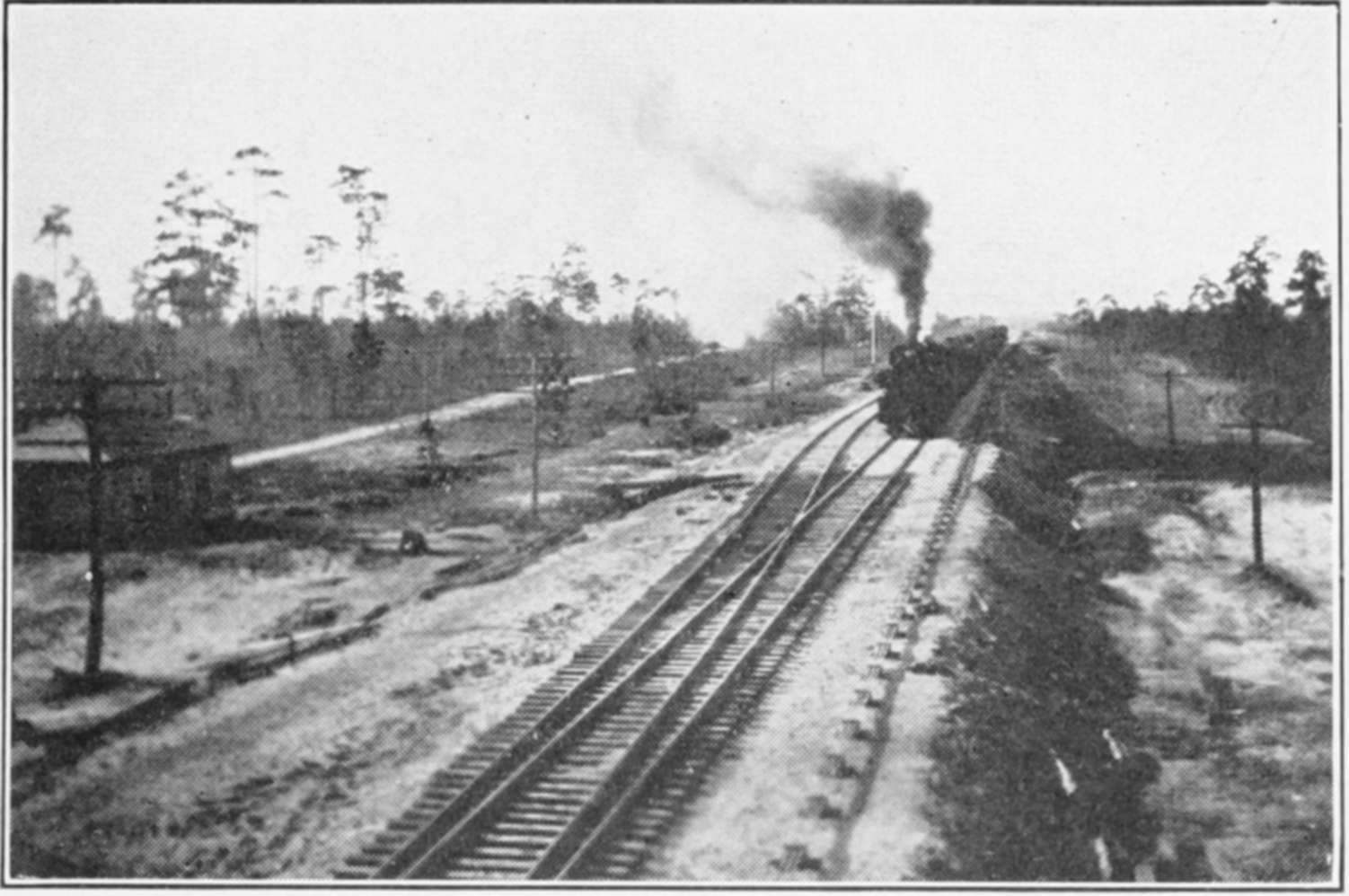
ON THE SWITCH BY THE TOWER
About three o’clock in the afternoon, “Shorty” thrumped in from Cognac. He was working the “second trick,” or as we out of the signal towers would say, the second shift, and he came over on a freight to be ready to take up his duties at four.
“Say,” he exclaimed gleefully, after the season’s greetings had been exchanged and he had sampled the now nearly demolished Christmas box, “McNab sure did play some good trick on some of his niggers last night.”
“He’s like to play one too many tricks on them niggers of his,” said our host. “D’you remember ’bout that section boss over on the L. & N. that was found with his skull stove in with a sledge?”
“Aw, shucks! McNab treats his niggers good, but there was a family of them livin’ in a shack right behind his house, an’ they’d sing an’ howl half the night, so McNab’s been ’bout crazy to get shut of them someway. He tried fifty ways to close them up, but yesterday he took a bit of rabbit skin and rolled it up in a little ball and wrapped it round with a strip of red flannel, and tied it all ’round with a horse hair. Then he went an’ left it on the nigger’s front door step. When the nigger comes home, he starts hollerin’ bloody murder about somebody tryin’ to conjure him. He and his whole tribe moves out last night, an’ every bit of their studdings went out the back door to dodge that conjure of McNab’s.”
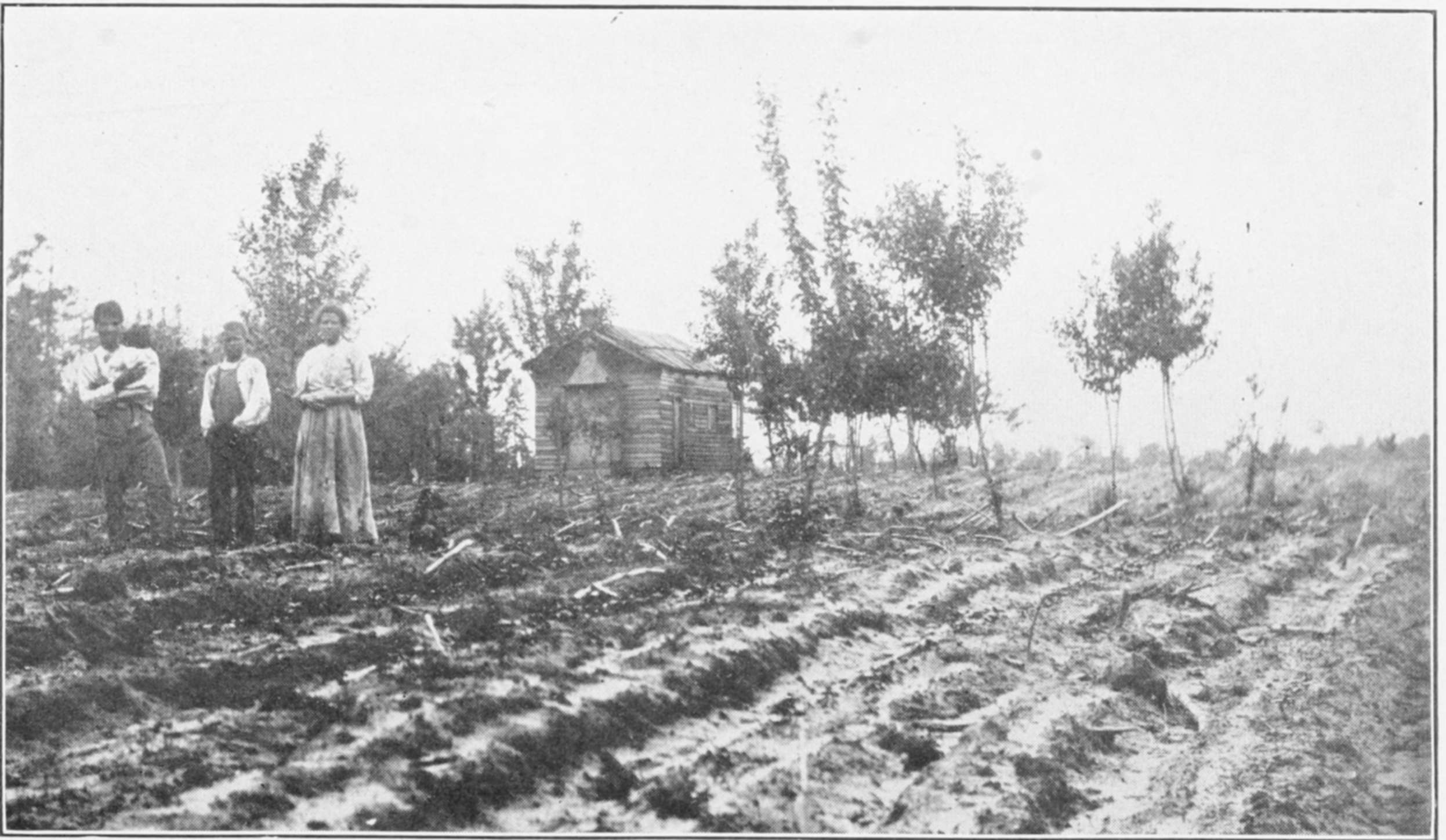
Photo by Dr. Achorn
NEGRO FAMILY AT HOME
Shorty broke off laughing, and I asked, “Was the nigger’s name Lee Gordon?”
“’Deed I don’t know, but they moved to Hoffman. Say, I’ll bet there ain’t a nigger in the whole Sandhills will live in that cabin now,” and Shorty chuckled to himself.
I told Uncle Willis all about it later. All that he would say was, “H’m! Those railroad men am mighty smart, ain’t dey?” He did not, however, mean to be sarcastic, for a couple of weeks later when I suggested that his brother Henry move into Lee Gordon’s old cabin in Cognac he was horrified at the thought. Yet Henry lived in Hoffman and worked in Cognac and was always complaining of the length and expense of his commuting. Although the cabin in Cognac would have solved this problem and was really a first-class house in good condition, Willis could only answer with a shrug and a shuffle, and a “Ah doan’ ’spect Henry’ll care none ’bout livin’ in dat dere shack.”
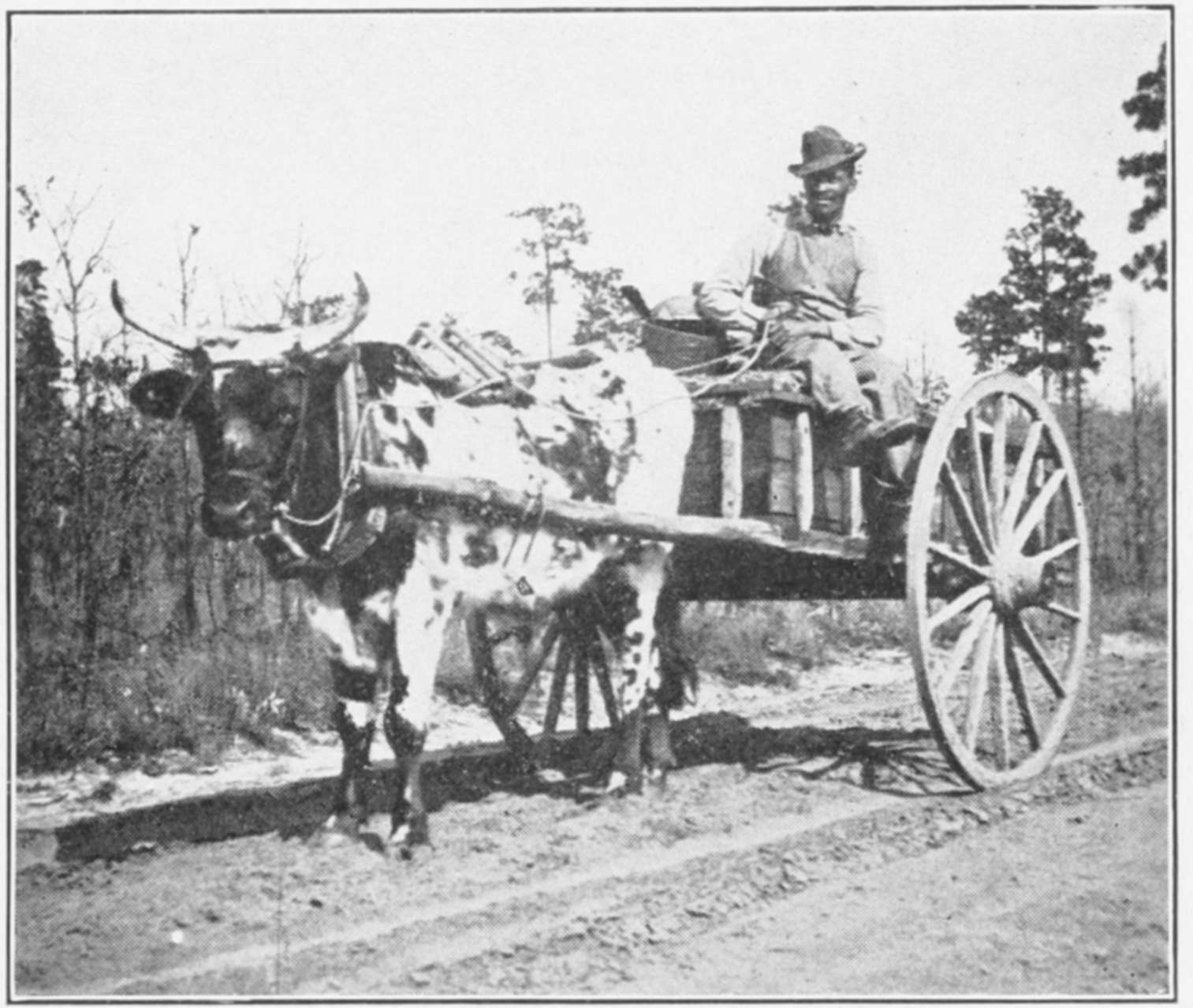
SANDHILLS RAPID TRANSIT