Some Quail Dogs—And Others
Reading edition
“Old Joe” and his daughter “Queen” are as ill-assorted a brace of pointers as ever hunted a covey along the edge of a field of cow peas. In the first place, nobody, to look at them, would ever suspect their relationship.
“Joe” is a strapping, lemon marked dog, with a heavy head and a tail like a couple of feet of garden hose. He has too much “lumber” to please any bench show judge, but no sportsman can look at him without recognizing a sturdy, capable workman. He is one of the stolid, old-time type of “Mainspring,” “Rip Rap,” “Bow,” “Faust” and the other heroes of his race imported in the early days from England. Despite his coarseness, he shows his breeding, but his daughter, on the other hand, is a common looking rat of a pointer, light and racy, thin as a match stick and as nervous as the needle of a pocket compass. She is a thickly ticked liver all splotched over with great patches of solid color. Her nose is snipy, her skull is domed, her tail curls provokingly upwards, and her thin ears are long and pendulous, so that one suspects that somewhere in her mother’s family there may have been a mesalliance with a foxhound. This suspicion is emphatically denied by her owner. Perversely, he worships this ugly duckling of his.
The old dog is a mighty hunter and quail are his favorite sport, but he takes his pleasures sadly. He is as sedate as a senior deacon and as serious as the professor of Sanskrit in a German University. Even when his beloved Master appears in his battered felt hat and stained and faded hunting coat, “Joe,” though he trembles with excitement, never allows his feelings to get the better of him. His self control is marvelous. ’Round and ’round he walks, stiff legged like a terrier boiling for a fight, his tail as straight and stiff as a broom handle, his big nose quivering, his yellow eyes flashing. But “Queen” skips about, barking short, yappy barks, wagging her tail and wriggling her slender body. She is always as flighty as a giggling schoolgirl. Last winter was her first hunting season, and she threw herself into the good sport of finding quail as a giddy debutante abandons herself to the social whirl. She was out for a good time, and she had it. So did we who followed her mad racings over the Sandhills.
In the field, this strange pair carry with them all their differences, but by a system of hunting that the trifling “Queen” invented herself, they managed between them to find an amazing number of birds. “Joe” is blessed with a truly wonderful power of scent and cursed with an excess of caution. Not in the memory of man has he ever been known to over-run his birds. Time and again his fine nose catches the scent of the covey twenty or more yards off. Then he takes so long creeping up to them that they run merrily off, leaving a confusing and exasperatingly tempting foot scent for him to snuffle over. Poor old “Joe”—there is no more snap to his work than there is to pea soup, but “Queen”—she hunts, as a Bobby Watson says, “laik ah bunch o’ fiah-crackers.” She loves to run. Over the Sandhills she races, head up, tail waving.
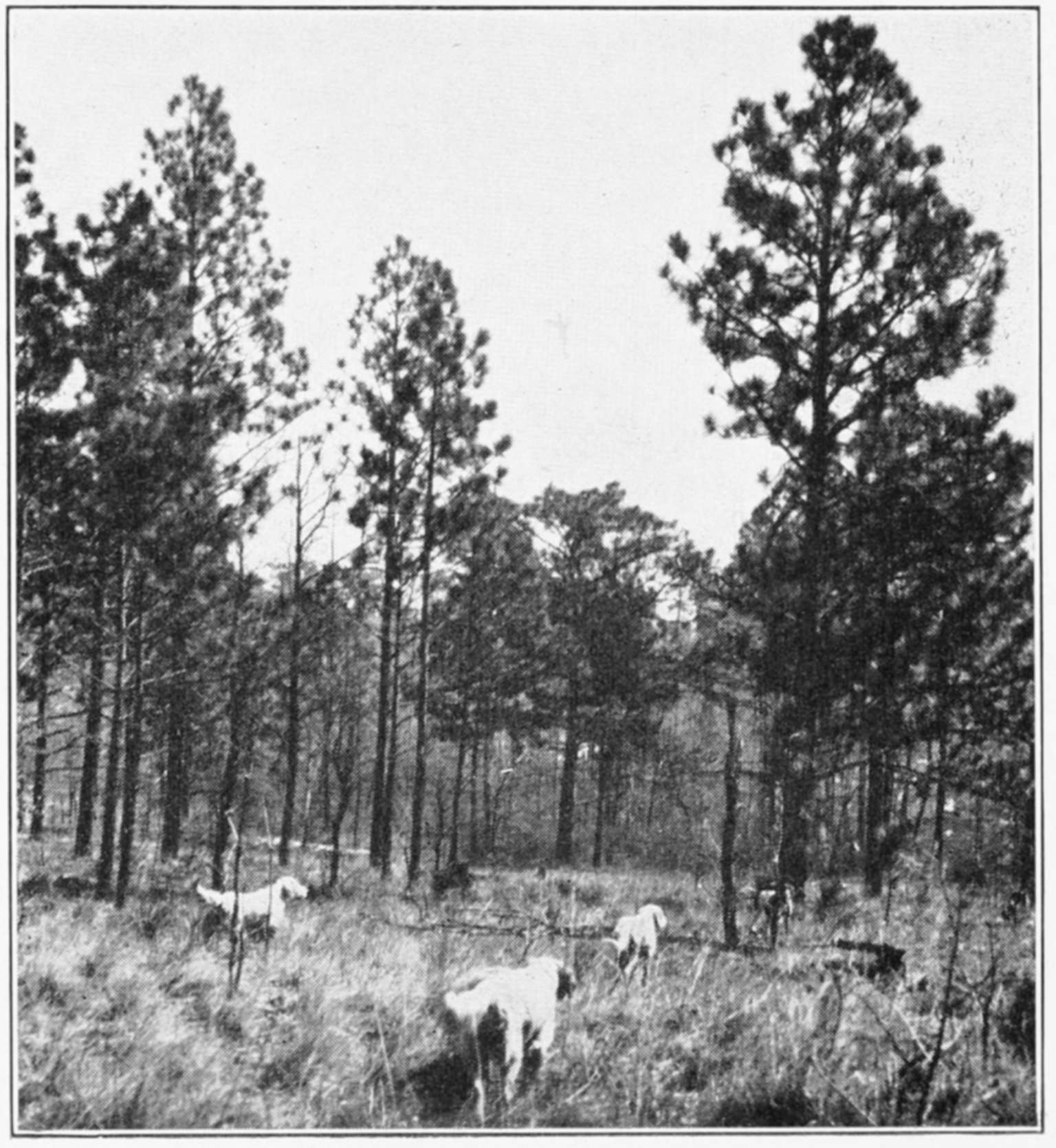
Photo by Mr. Kirkover
A COVEY IN THE LONG-LEAF PINE
At first she often ran plumb into a covey before she had the slightest idea that there was such a thing as a quail within a hundred miles of her. Startled and disgusted she would stand stock still for a moment, and then, as much as to say, “O well, no matter—better luck next time,” she would be off again.
But this was only at first. She soon got the hang of the game, and, while she continued to range far afield, she learned not to flush. “Joe” is too old a dog to learn any new tricks, but the versatile “Queen” has devised an unscrupulous hunting system of her own that is absolutely unorthodox but which fits in admirably with his slow methods. As she prances over the hills, she keeps one eye on her steady sire. When she sees him acting “birdy” she will rush in, dart in front of him, and hold the birds till he comes up. It is, of course, very wrong of her indulgent owner to allow her to ravish points in this high handed manner. He knows it, and will sheepishly excuse her, by saying he hadn’t the heart to leave the old dog home, but he is such a potterer, we should never find birds unless he let “Queen” have her way. In this way of hers she has a splendid good time. Without giving up the sport of running riot, she has the sport of pointing with the warm scent in her quivering nostrils, all the excitement of the shooting, and the pleasant duty of retrieving.
Poor old “Joe” regards this erratic system of hunting with the greatest disfavor. Whenever “Queen” darts in front of him to point the covey he has found, he stops and looks at her, saying, just as plain as English, “Impudent puppy!” Then he turns and looks at his Master, “It’s a disgrace, sir, the disrespect of the younger generation—a disgrace. Whatever are we coming to?” He sniffs an emphatically contemptuous sniff and walks in very dignifiedly to back up her point. How annoyed he is if she breaks ever so little at the sound of the guns, and with what a perfect holier-than-thou air he will wait patiently for the command, “Fetch!” His self-righteousness knows no bounds if, when “Queen” is seeking busily about, he can, as he often does, go straight to the dead bird, pick it up, toss it into his mouth, and walk off, saying, “There, little girl, that’s the proper way to do it.” What a splendid conservative he is! Poor old chap, his hunting days are nearly over now. Though he stoutly refuses to acknowledge it, he has outlived his generation. I don’t suppose that even as a puppy he was a dashing performer, and now, on the verge of his dotage, he has become unbearably deliberate. Yet for all his provoking faults one cannot but admire his stout heart and his passion for hunting. He is the very pattern of the good sportsman of the Old School, kindly, keen, and a bit old fashioned in his ways. He is thoroughly game and will go hunting till he drops. Even now, old as he is, he will face a swamp thicket bristling with briars, at five in the afternoon that many a younger dog would not hunt the first thing in the morning.
There is “Gypsy,” for example—she never will hunt any but the easiest places. She is a little picture setter who comes down to the Sandhills from Connecticut every winter for the quail season. She is clever as an urchin and dainty as a princess. She has a capital nose and all the speed in the world—when it pleases her ladyship to use her gifts. She knows just where to hunt for the birds and she handles them in a truly masterful way, but she has no more real love of hunting than a Berkshire hog and not half the spunk of a cottontail. She is as different from “Joe” as “Queen,” yet I know a very nice old lady whose sons, she says, keep her “horse and dog poor,” who finds all their hunting dogs uninteresting, because forsooth they lack individuality.
I wish that she might know Capt’n Jack Evans’s four dogs. They are all half brothers and sisters, but nobody could fail to note their marked, distinct personalities. The rollicking “Bob” and the timid “Dot” are full brother and sister; brilliant “Bessie” and plodding “Sport” have the same daddy as the others, but different mothers.
The privilege of going hunting with Capt’n Jack and this quartet may be purchased at reasonable rates by the day or the week, but the honor of accompanying him when he himself goes hunting for sport is bestowed upon very few. I was delighted then when one morning he took me aside, as we were waiting for the mail at the post office, and whispered that had found a piece of country back in the hills “whar Ah reckon, suh, thar’s more’n a million quail t’ the acre.” Capt’n Jack knows the Sandhills, and he is not given to making promises he cannot keep. I was sure we should find plenty of good sport.
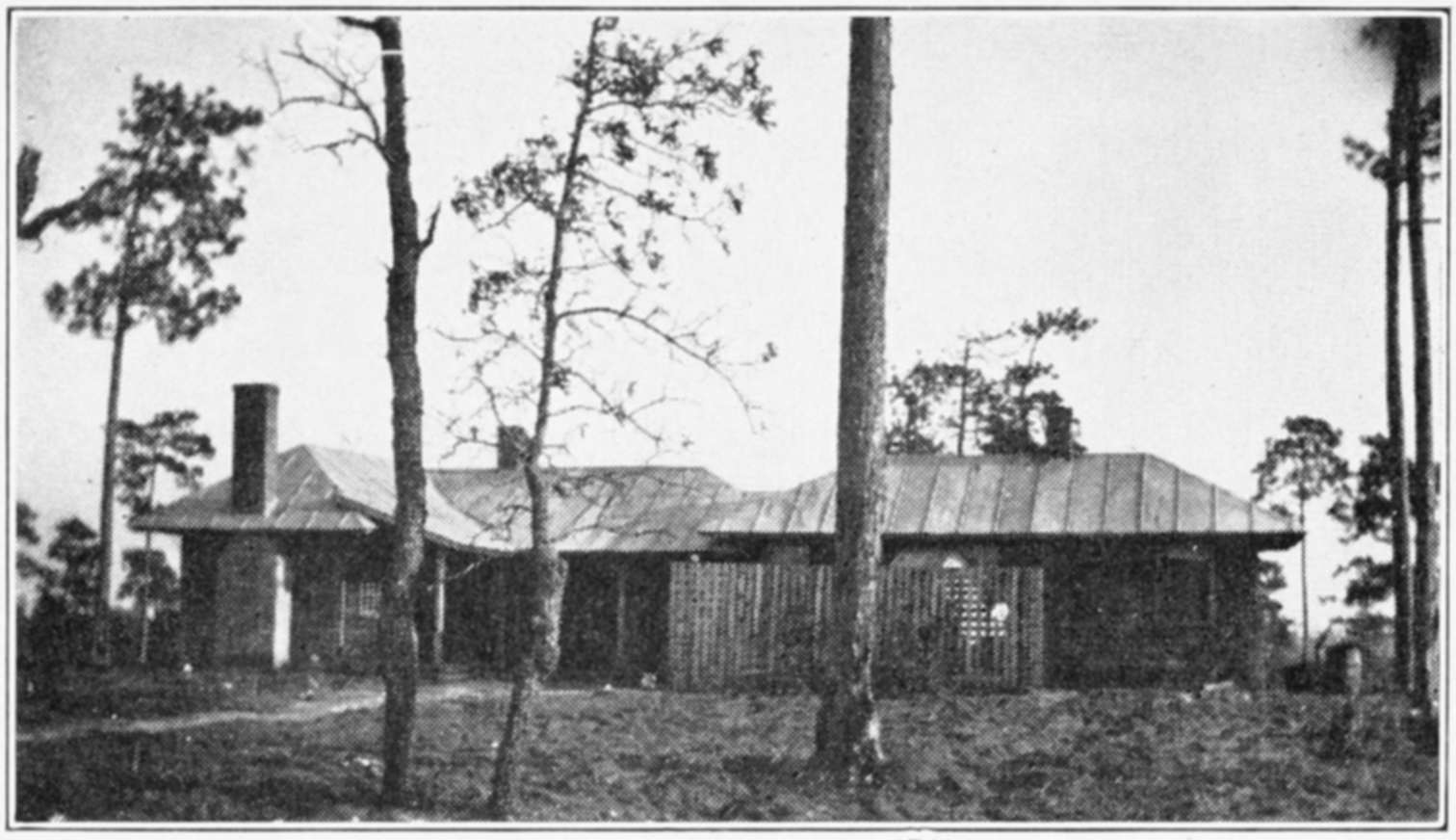
“HUNTER’S HOME”
Bright and early next morning, while the snap of the night frost was still in the air, we set off to hunt this quail metropolis. The four dogs tumbled about in the tonneau over the gun cases and lunch basket. “Bob” jumped from side to side, critically inspecting the country, while “Dot” and “Sport” lay on the floor, and “Bess” bounced about on the rear seat. We left the main road soon and burrowed for five or six miles along a twisting, sandy trail through the pine woods. We stopped on the flat top of a hill, a miniature plateau over the edge of which stood the tree tops of the valley. Right in the middle of the deserted tote road we left the car, and, leaving coats, lunch, extra shells, all, walked off across the hilltop. Through a grove of long-leafed pines we went into the valley and worked forward, skirting the edge of thick growth that marked the course of the winding stream. “Bob” scoured the hilltop. “Dot” and “Sport” hunted carefully along close to the swamp thickets. “Bess” beat up and down the southern side of the hill just under the brow.
“‘Bess’ shore does know what t’ hunt fo’ ah covey on ah cold mawnin’, don’t she”—and the words had hardly slipped lazily from the Capt’n’s lips before she came to a stiff point. A high, shrill whistle and the other dogs came and backed. We walked in; the birds flushed; and the sport began. On up over the crest of the hill, hunting the scattered singles. “Steady thar, you ‘Bob’!” The young dog had found one and was trembling with suppressed eagerness. Before we could get to him, “Sport” was pointing another bird over to the left, and, as we watched, both “Dot” and “Bess” suddenly froze stiff on points. “Ah swear! all fo’ o’ ’em on points on singles.” We separated and flushed our birds at the same moment. Whur-r-r-r, whur-r-r-r-r, whur-r-r-r-r-r! To the right, the left, on in front scattered quail got up on all sides of us. “Bess” broke excitedly, and had to be properly reprimanded, and then, a hundred yards further on, she redeemed herself by finding a second covey. After this we did not hunt singles at all. During the day we got up twenty-seven coveys, which is a pretty good true quail story.
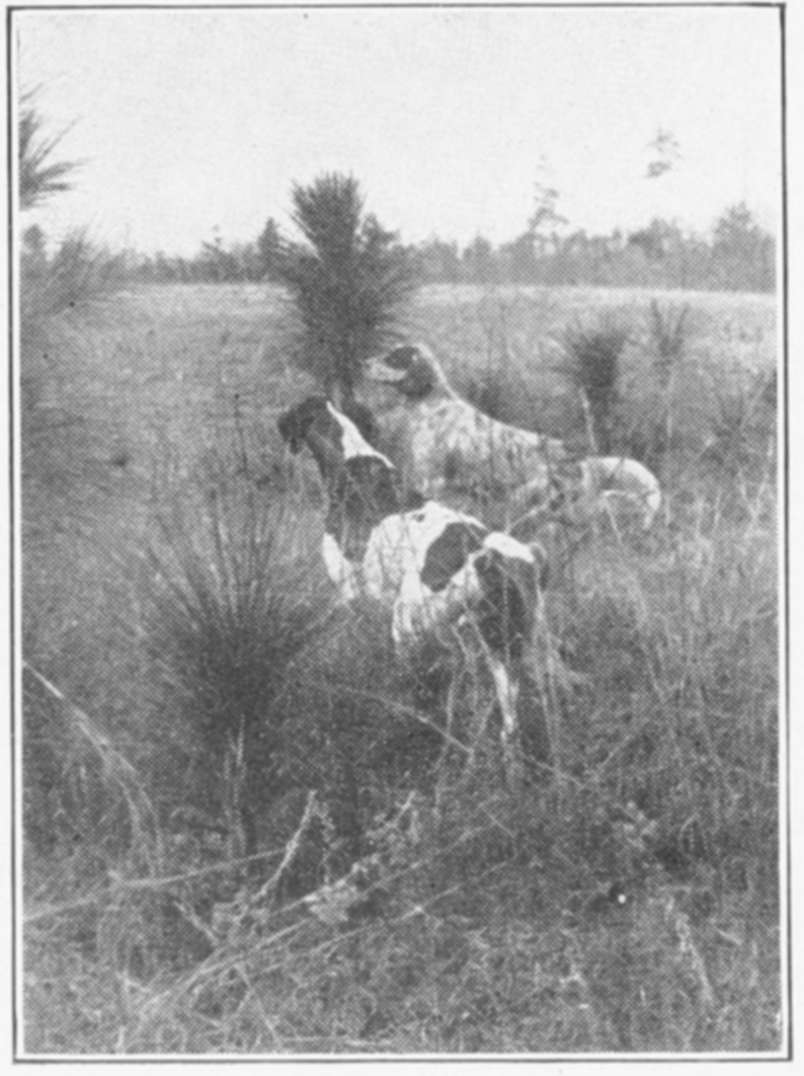
“STEADY!”
Photos by Mr. Kirkover
For a day of good sport anyone in the Sandhills will heartily recommend Capt’n Evans and his quartet, but the true favorite native son of Moore County is a handsome blue belton setter owned by Jim MacDougall. “Prince” has a pedigree that fairly bristles with champions. Both his parents were winners at the field trials, and he himself was trained by Armstrong at High Point. He is the marvel dog of all the Sandhills. What stories they tell of him on the post-office steps and ’round the stove in MacDougall’s store winter afternoons! From Dr. Adams to the youngest black boy who hangs about the freight shed, everyone in town takes a keen personal pride in that dog. Of course, he has pointed dead quail, and quail in trees and under logs, and he has, as can be proved by half the gold watches and every Ingersoll in the township, held a point for two hours and sixteen minutes—some say seventeen minutes.
In the midst of his admirers at the store the handsome rascal is as bored as a young prig back in his home town after his first term at the University, but in the field he is keen sportsmanship personified. With his free open stride, he covers the country, head and tail up, his nose thrust into the air, sniffing first one side and now the other, eager to catch the first faint suggestion of the scent of the little brown birds. A short whistle and he stops in his tracks. A wave of the hand and he is off again in the opposite direction, quartering the ground perfectly. He stops dead on a point. Still as a statue he seems, but as you walk closer you see that he trembles with suppressed excitement, every muscle taut, every nerve straining, he stands there, a perfect picture. Flush the birds and at the command he will retrieve, going quickly and surely to each dead quail and returning it without so much as a feather dampened. He is a splendid dog wonderfully broken.
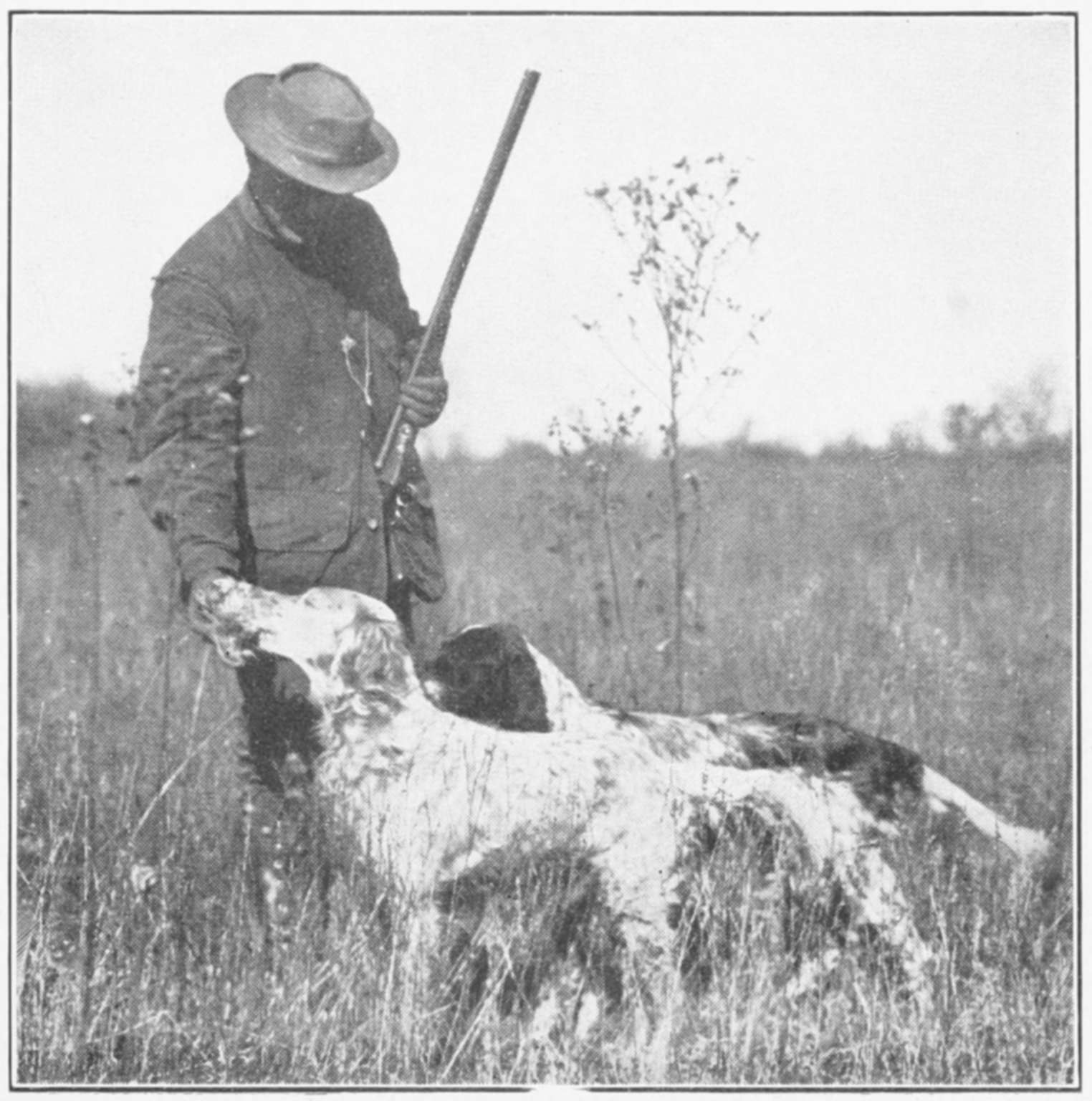
DELIVERING QUAIL
We all applaud the stiff antics of a high school trained horse and wax enthusiastic over the trick of the lion tamer’s tawny pupil, but not one in fifty of us ever thinks that the quail dog displays intelligence and training far beyond these. He ranges over the country as free as the winter wind, but always under perfect control. No bit guides him, yet he turns right or left at the wave of a hand. No snapping whip compels obedience, but he minds the call of a whistle promptly and cheerfully. If a savage tiger or a docile brown cow could be trained thus, scientific gentlemen would investigate the case in the interest of animal psychology. It would be one of the marvels of the world, but nobody thinks it at all “abnormal” in a setter or a pointer. Thousands of rollicking puppies learn the trick each year.
How much more wonderful even is the subversion of the bird dog’s strongest instincts to the will of his master! We have seized upon that momentary pause that precedes the wild dog’s spring at his prey and developed it into the pointing habit, a habit that, through generations of painstaking training and selective breeding, has become stronger than the instinct to pounce upon the birds. What self-control is demanded to stand staunch when the birds flush right under your nose! How many men have the firm hold on their passions that the quail dog displays when he picks up a dead bird in his mouth and returns it gently to his master? “The dog,” Maeterlinck has said, “is the only animal that is the friend of man.” The bird dog has gone even farther: he is the friend and the partner of man as well. He curbs his strongest instincts for the good of the game that he and his Master play together. His is the proud joy of humble service.
Half the sport of quail shooting lies in working and watching the dogs. All day long the quail shooter has before him a living example of strength, of perseverance, of good faith, of self-restraint, the very cardinal virtues of good sportsmanship. It is a spiritual experience that is good for any man. And we love our four-footed partner in sport not alone because he is a splendid animal, good to look at, intelligent, and faithful; not only because he shows us good sport; but also because his own good sportsmanship appeals to the best sportsmanship in ourselves.