PART IV (continued 2)
Yei Theodora Ozaki translation
"Are you not Hayashi who lived in Fukagawa fifteen years ago?"
He was startled by the suddenness of the question, which showed that his identity was revealed and that she knew of his past. He did not answer but searched his brain, wondering who the woman could possibly be.
Seeing his embarrassment she continued, now and again wiping the tears from her eyes: "When you came to the house I thought that your voice was in some way quite familiar to me, but you are so disguised in your present garb that at first I could not recall who you were.
"Fifteen years ago I served in the house of the rich timber merchant in Fukagawa and often helped O Tama San[4] to meet you in secret, for I felt great sympathy with you both, and if a day passed without her being able to see you, Oh! she was very unhappy. Her parents were furious at the unwise part I had played and I was summarily dismissed. I returned home and was almost immediately married. Within a year I gave birth to a little daughter. The child bore a striking resemblance to my late mistress and I gave her the name of Jewel in remembrance of the beloved charge I had nursed and tended for so many years. As she grew older not only her face and figure, but her voice and her movements all vividly recalled O Tama San. Is not this an affinity of a previous existence that my child should be saved by you who loved the first Tama?"
Then Hayashi, who had listened with rapt attention to the woman's strange story, asked her the date of the infant's birth.
Marvellous to relate it was the very day and hour, for ever indelibly engraven on his memory, that Tama, his first love, had appeared to him on the bank of the Sumida river in the springtide fifteen years ago.
When he told her of this uncanny meeting the woman said that she believed her daughter, the second Tama, to be the re-incarnation of the first Tama. The apparition he had seen was the spirit of his love who had thus announced her rebirth into the world to him. There could be no doubt of this, for had not Tama told him herself that she was on her way to her old nurse. So strong was the affinity that bound them to each other that it had drawn Tama from the spirit-land back to this earth.
"Remember the old proverb, the karma-relation is deep," she added in conclusion.
Later on she besought Hayashi to marry the second Tama, for she believed that only in this way would the soul of the first Tama find rest.
But Hayashi, thinking that the great difference in their present ages was an obstacle to a happy union, refused on the score that he was too old and sad a man to make such a young bride happy. He decided, however, to stay on in the little household for a while, and to give any possible comfort and help to the old nurse whose loyal devotion to her mistress had figured so prominently and fatefully in his past.
Thus several months elapsed, bringing with them great and radical changes in the land. The Restoration came to pass, and the new regime was established with the Emperor instead of the Shogun at the helm of State. Schools were founded all over the country, and amongst many other old institutions the order of the Komuso monks, to which Hayashi belonged, was abolished by an edict of State.
Hayashi, during his stay in the village, had won his way into the hearts of the people and they now begged him to remain as teacher in the new school, a position for which he was peculiarly fitted by the classical education he had received from his father. He consented to the proposition which solved the problem of his future, for under the new laws it was forbidden him to return to his old life.
The mayor of the place was also much attracted by Hayashi's superior character and dignity, and learning of the sad and romantic history of his past, and believing, as all Japanese do, in predestined affinities, persuaded him that it was his fate, nay more, a debt he owed to the past, to marry Tama, the second, the re-incarnation of his first love.
The marriage proved a blessed one. The house of Hayashi prospered from that day forth and as children were born to them the joy of their lives was complete.
THE LADY OF THE PICTURE
Many years ago, long before the present prosaic era, there lived in Yedo a young man named Toshika. His family belonged to the aristocratic rank of the hatamoto samurai, those knights who possessed the right to march to battle directly under the Shogun's flag (hata), and his father was a high official in the Tokugawa Shogunate.
Toshika, whose disposition was of a dreamy and indolent nature with scholarly tastes, had no occupation. He took life easily, and when his studies were finished, he went to live at the family villa situated in the suburb of Aoyama.
Toshika was not interested in society, and except for an occasional visit to his home or to his favourite friend, he never went anywhere. Far from the world he spent his days quietly and pleasantly, reading books, tending and watering his flowers, practising the tea-ceremony, and composing poetry and playing on the flute. He was a young man of many accomplishments and studied art. He collected curios and specimens of well-known calligraphy, which all Japanese prize greatly, and he particularly delighted in pictures.
One day a certain friend whom Toshika had not seen for several months, came to call upon him. He had just returned from a visit to the seaport of Nagasaki and knowing the young man's tastes had brought with him, as a present, a Chinese drawing of a beautiful woman, which he begged Toshika to accept.
Toshika was very pleased with this acquisition to his treasures. He examined the painting carefully, and though he could find no signature of the artist, his knowledge of the subject told him that it was probably drawn by the well-known Chinese painter of the Shin era.
It was the portrait of a young woman in the prime of youth, and Toshika felt intuitively that it was a real likeness. The face was one of radiant loveliness, and the longer he gazed at it, the more the charm and fascination of it grew upon him. He carried it to his own room and hung it up in the alcove. Whenever he felt lonely he retired to the solitude of his chamber, and sat for hours before the drawing, looking at it and even addressing it. As the days went by, gradually the picture seemed to glow with life and Toshika began to think of it as a person. He wondered who the original of the portrait could have been, and said that he envied the artist who had been granted the happiness of looking upon her beauty.
Daily the figure seemed more alive and the face more exquisite, and Toshika, as he gazed in rapture upon it, longed to know its history. The haunting pathos of the expression and the speaking wistfulness of the dark soft eyes called to his heart like music and gave him no peace.
Toshika, in fact, became enamoured of the lovely image suspended in the alcove, and as the infatuation grew upon him he placed fresh flowers before it, changing them daily. At night he had his quilts[1] so arranged that the last thing he looked upon before closing his eyes in sleep was the lady of the picture.
Toshika had read many strange stories of the supernatural power of great artists. He knew that they were able to paint the minds of the originals into their portraits, whether of human beings or of creatures, so that through the spiritual force of the merit of their skill the pictures became endowed with life.
As the passion grew upon him the young lover believed that the spirit of the woman whom the portrait represented actually lived in the picture. As this thought formed itself in his mind he fancied that he could see the gentle rise and fall of her breast in breathing, and that her pretty lips, bright as the scarlet pomegranate bud, appeared to move as if about to speak to him.
One evening he was so filled with the sense of the reality of her presence that he sat down and composed a Chinese poem in praise of her beauty.
And the meaning of the high-flown diction ran something like this:
Thy beauty, sweet, is like the sun-flower:[2] The crescent moon of three nights old thy arched brows: Thy lips the cherry's dewy petals at flush of dawn: Twin flakes of fresh-fallen snow thy dainty hands. Blue-black, as raven's wing, thy clustering hair: And as the sun half peers through rifts of cloud, Gleams through thy robes the wonder of thy form.. Thy cheeks' dear freshness do bewilder me, So pure, so delicate, rose-misted ivory: And, like a sharp sword, pierce my breast The glamour of thy dark eyes' messages. Ah, as I gaze upon thy pictured form I feel therein thy spirit is enshrined, Surely thou liv'st and know'st my love for thee! The one who unawares so dear a gift bestowed Was verily the gods' own messenger And sent by Heaven to link our souls in one. 'Tis sad that thou wert borne from thine own distant land Far from thy race, and all who cherished thee; Thy heart must lonely pine so far away, In sooth thou need'st a mate to love and cherish thee. But sorrow not, my picture love, For Time's care-laden wings will never dim thy brow From poisoned darts of Fate so placidly immune; Anguish and grief will ne'er corrode thy heart, And never will thy beauty suffer change: While earthly beings wither and decay Sickness and care will ever pass thee by, For Art can grant where Love is impotent, And dowers thee with immortality. Ah me! could the high gods but grant the prayer Of my wild heart, and passionate desire! Step down from out thy cloistered niche, Step down from out thy picture on the wall! My soul is thirsting for thy presence fair To crown my days with rapture—be my wife! How swift the winged hours would then pass by In bliss complete, and lovers' ecstasy: My life, dear queen, I dedicate to thee, Ah! make it thus a thousand lives to me![3]
Toshika smiled to himself at the wild impossibility of his own chimera. Such a hope as he had breathed to her and to himself belonged to the realm of reverie, and not to the hard world of everyday life. Supposing that beautiful creature to have ever lived and the portrait to be a true likeness of her, she must have died ages ago, long before ever he was born.
However, having written the poem carefully, he placed it above the scroll and read it aloud, apostrophizing the lady of the picture.
It was the delicious season of spring, and Toshika sat with the sliding screens open to the garden. The fragrance of peach blossoms was wafted into the room by the breath of a gentle wind, and as the light of day faded into a soft twilight, over the quiet and secluded scene a crescent moon shed her tender jewel-bright radiance.
Toshika felt unaccountably happy, he could not tell why and sat alone, reading and thinking deep into the night.
Suddenly, in the stillness of the midnight, a rustle behind him in the alcove caused him to turn round quickly.
What was his breathless amazement to see that the picture had actually taken life. The beautiful woman he so much admired detached herself from the paper on which she was depicted, stepped down on to the mats, and came gliding lightly towards him. He scarcely dared to breathe. Nearer and nearer she approached till she knelt opposite to where he sat by his desk. Saluting him she bowed profoundly.
The ravishment of her beauty and her charm held him speechless. He could not but look at her, for she was lovelier than anyone he had ever seen.
At last she spoke, and her voice sounded to him like the low, clear notes of the nightingale warbling in the plum-blossom groves at twilight.
"I have come to thank you for your love and devotion. Such a useless, ugly[4] creature as myself ought not to be so audacious as to appear before you, but the virtue of your poem was irresistible and drew me forth. I was so moved by your sympathy that I felt I must tell you in person of my gratitude for all your care and thought of me. If you really think of me as you have written, let me stay with you always."
Toshika rejoiced greatly when he heard these words. He put out his hand and taking hers said, "Ever since you came here I have loved you dearly. Consent to be my wife and we shall be happy evermore. Tell me your name and who you are and where you come from."
She answered with a smile inexpressibly sweet, while the tears glistened in her eyes.
"My name is Shorei (Little Beauty). My father's name is Sai. He was descended from the famous Kinkei. We lived in China at a place called Kinyo. One day, when I was eighteen years of age, bandits came and made a raid on our village and, with other fair women, carried me away. Thus I was separated from my parents and never saw them more. For many months I was carried from place to place and led a wandering life. Then, alas! who could have foretold it, I was seized by bad men and sold into slavery. The sorrow, the anguish and the horror I suffered in my helpless misery and homesickness you can never know. I longed every hour of the day for some tidings of my parents, for even now, I do not know what became of them. One day an artist came to the house of my captivity and looking at all the women there, he praised my face and described me as the Moon among the Stars. And he painted my picture and showed it to all his friends. In that way I became famous, for everyone talked of my beauty and came to see me. But I could not bear my life, and being delicate, my unhappy lot and the uncertainty of my father's and mother's fate preyed upon my mind, so that I sickened and died in six months. This is the whole of my sad history. And now I have come to your country and to you. This must be because of a predestined affinity between us."
The young man's heart was filled with compassion as he listened to the sorrowful tale of the unfortunate woman, who had told him all her woes.
He felt that he loved her more than ever and that he must make up with his devotion for all the wretchedness she had suffered in the past.
They then began to compose poems together, and Toshika found that Shorei had had a literary education, that she was an adept in calligraphy and every kind of poetical composition. And his heart was filled with a great gladness that he had found a companion after his own heart.
They both became intensely interested in their poetical contest and as they composed they read their compositions aloud in turn, comparing and criticizing each other. At last, while Toshika was in the act of reciting a poem to Shorei, he suddenly awoke and found that he had been dreaming.
Unable to believe that his delightful experiences were but the memories of sleep he turned to the alcove. His cherished picture was hanging there and the lovely figure was limned as usual in living lines upon the paper. Was it all a delusion? As he watched the exquisite face before him, recalling with questioning wonder the events of the evening before, behold! the sweet mouth smiled at him, just as Shorei had smiled in his vision. Impatiently he waited for the darkness, hoping that sleep would again bring Shorei to his side. Night after night she came to him in his dreams, but of his happy adventure he spoke to none. He believed that in some miraculous way the power of poetry had evoked the spirit of the portrait. Centuries ago this ill-fated woman had lived and died an untimely death, and his love led her back to earth through the medium of an artist's skill and his own verse. Six months passed and Toshika desired nothing more in life than to possess Shorei as his bride for all the years to come.
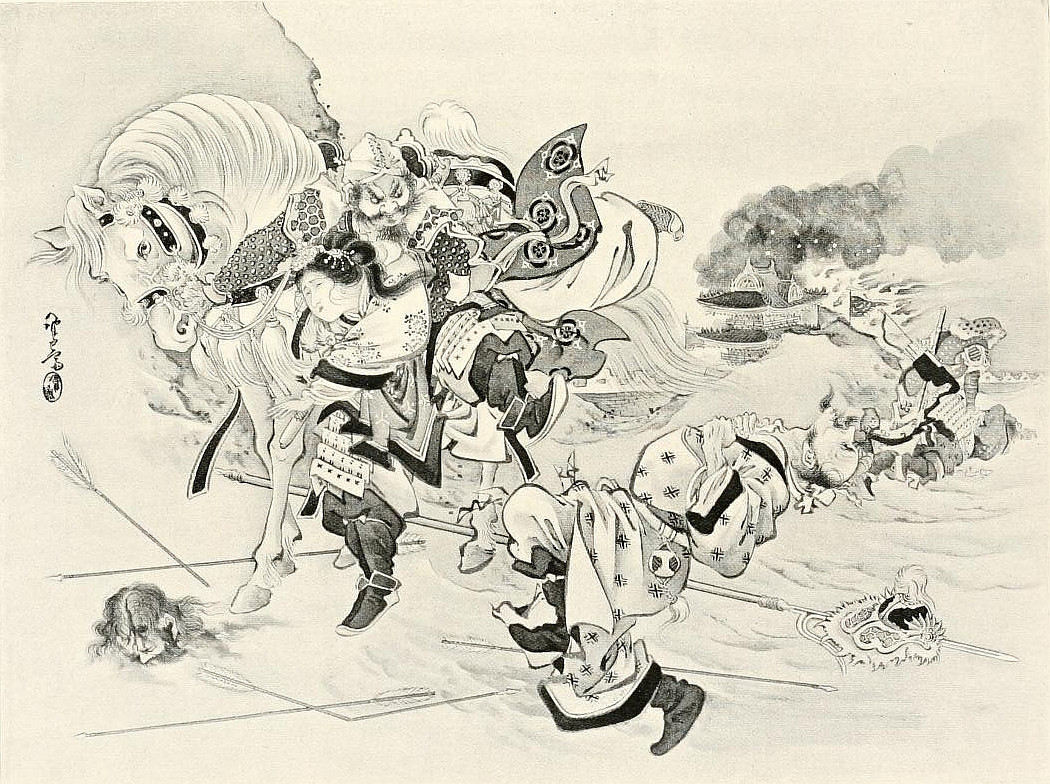
When I was eighteen years of age, bandits ... made a raid on one village and ... carried me away.
He never dreamed of change, but at last, one night, Shorei came looking very sad. She sat by his desk as was her wont, but instead of conversing or composing she began to weep.
Toshika was very troubled, for he had never seen her in such a mood.
"Tell me," he said anxiously, "What is the matter? Are you not happy with me?"
"Ah, it is not that," answered Shorei, hiding her face in her sleeve and sobbing; "never have I dreamed of such happiness as you have given me. It is because we are so happy that I cannot bear the pain of separation for a single night. But I must now leave you, alas! Our affinity in this world has come to an end."
Toshika could hardly believe her words. He looked at her in great distress as he asked:
"Why must we part? You are my wife and I will never marry any other woman. Tell me why you speak of parting?"
"To-morrow you will understand," she answered mysteriously. "We may meet no more now, but if you do not forget me I may see you again ere long."
Toshika had put out a hand and made as if to detain her, but she had risen and was gliding towards the alcove, and while he imploringly gazed at her she gradually faded from his sight and was gone.
Words cannot describe Toshika's despair. He felt that all the joy of life went with Shorei, and he could not endure the idea of living without her.
Slowly he opened his eyes and looked round the room. He heard the sparrows twittering on the roof, and in the light of dawn, as he thought, the night-lantern's flame dwindled to a fire-fly's spark.
He rose and rolled back the wooden storm-doors which shut the house in completely at night, and found that he had slept late, that the sun was already high in the heavens.
Listlessly he performed his toilet, listlessly he took his meal, and his old servants anxiously went about their work, fearing that their master was ill.
In the afternoon a friend came to call on Toshika. After exchanging the usual formalities on meeting, the visitor suddenly said:
"You are now of an age to marry. Will you not take a bride? I know of a lovely girl who would just suit you, and I have come to consult with you on the matter."
Toshika politely but firmly excused himself. "Do not trouble yourself on my account, I pray you! I have not the slightest intention of marrying any woman at present, thank you," and he shook his head with determination.
The would-be go-between saw from the expression of Toshika's face that there was little hope in pressing his suit that day, so after a few commonplace remarks he took his leave and went home.
No sooner had the friend departed than Toshika's mother arrived. She, as usual, brought many gifts of things that she knew he liked, boxes of his favourite cakes and silk clothes for the spring season. Grateful for all her love and care, he thanked her affectionately and tried to appear bright and cheerful during her visit. But his heart was aching, and he could think of nothing but of the loss of Shorei, wondering if her farewell was final, or whether, as she vaguely hinted, she would come to him again. He said to himself that to hold her in his arms but once again he would gladly give the rest of his life.
His mother noticed his preoccupation and looked at him anxiously many times. At last she dropped her voice and said:
"Toshika, listen to me! Your father and I both think that you have arrived at an age when you ought to marry. You are our eldest son, and before we die we wish to see your son, and to feel sure that the family name will be carried on as it should be. We know of a beautiful girl who will make a perfect wife for you. She is the daughter of an old friend, and her parents are willing to give her to you. We only want your consent to the arrangement of the marriage."
Toshika, as his mother unfolded the object of her visit, understood the meaning of Shorei's warning, and said to himself:
"Ah, this is what Shorei meant—she foresaw my marriage, for she said that to-day I should understand; but she pledged herself at the same time to see me again—it is all very strange!"
Feeling that his fate was come upon him he consented to his mother's proposal.
She returned home delighted. She had had little doubt of her son's conformance to his parents' wishes, for he had always been of a tractable disposition. In anticipation, therefore, of his consent to the marriage, she had already bought the necessary betrothal presents, and the very next day these were exchanged between the two families.
Toshika, in the meantime, watched the picture day by day. This was his only consolation, for Shorei, his beloved, visited him no more in his dreams. His life was desolate without her and his heart yearned for her sweet presence. Had it not been for her promise to come to him again he knew that he would not care to live. He felt, however, that she still loved him and in some way or other would keep her promise to him, and for this waited. Of his approaching marriage he did not dare to think. He was a filial son, and knew that he must fulfil his duty to his parents and to the family.
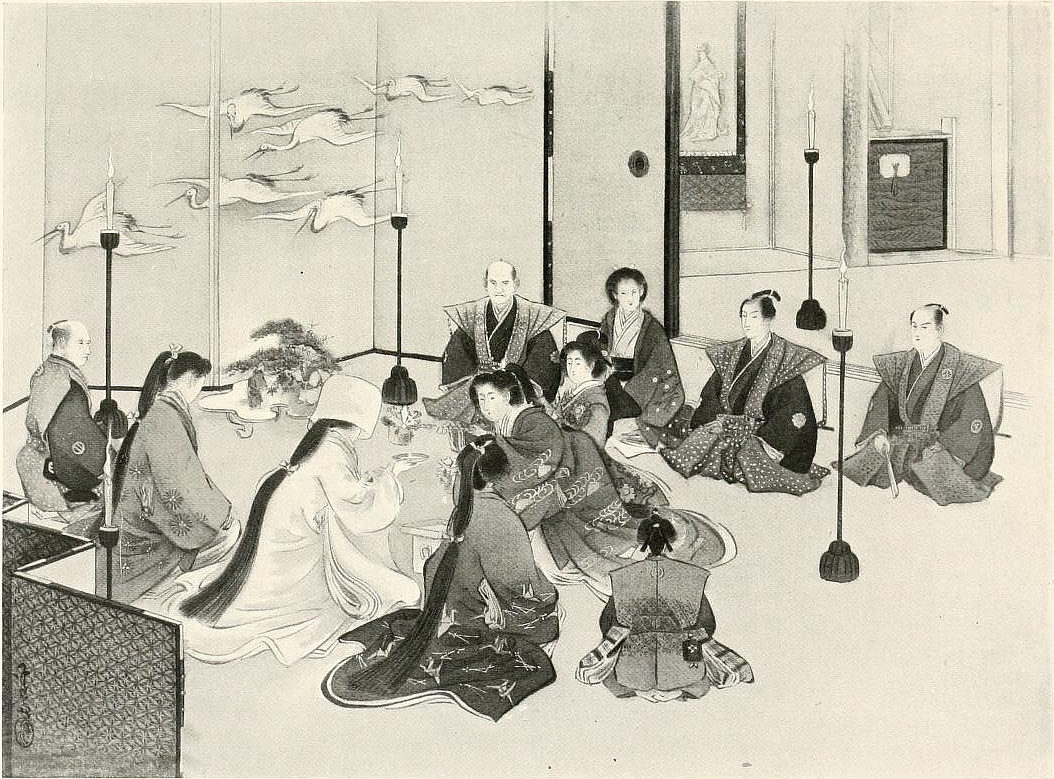
When the bride was led into the room and seated opposite Toshika, what was his bewildering delight to see that she was ... the lady-love of his picture
As the days went by Toshika noticed that the picture lost by degrees its wonderful vitality. Slowly from the face the winning expression and from the figure the tints of life faded out, till at last the drawing became just like an ordinary picture. But he was left no time to pine over the mystery of the change, for a summons from his mother called him home to prepare for the marriage. He found the whole household teeming with the importance of the approaching event. At last the momentous day dawned.
His mother, proud of the product of her looms, set out in array his wedding robes, handwoven by herself. He donned them as in a dream, and then received the congratulations of his relatives and retainers and servants.
In those old days the bride and bridegroom never saw each other till the wedding ceremony. When the bride was led into the room and seated opposite Toshika, what was his bewildering delight to see that she was no stranger but the lady-love of his picture, the very same woman he had already taken to wife in his dream life.
And yet she was not quite the same, for when Toshika, a few days later, joyfully led her to his own home and compared her with the portrait, she was even ten times more beautiful.
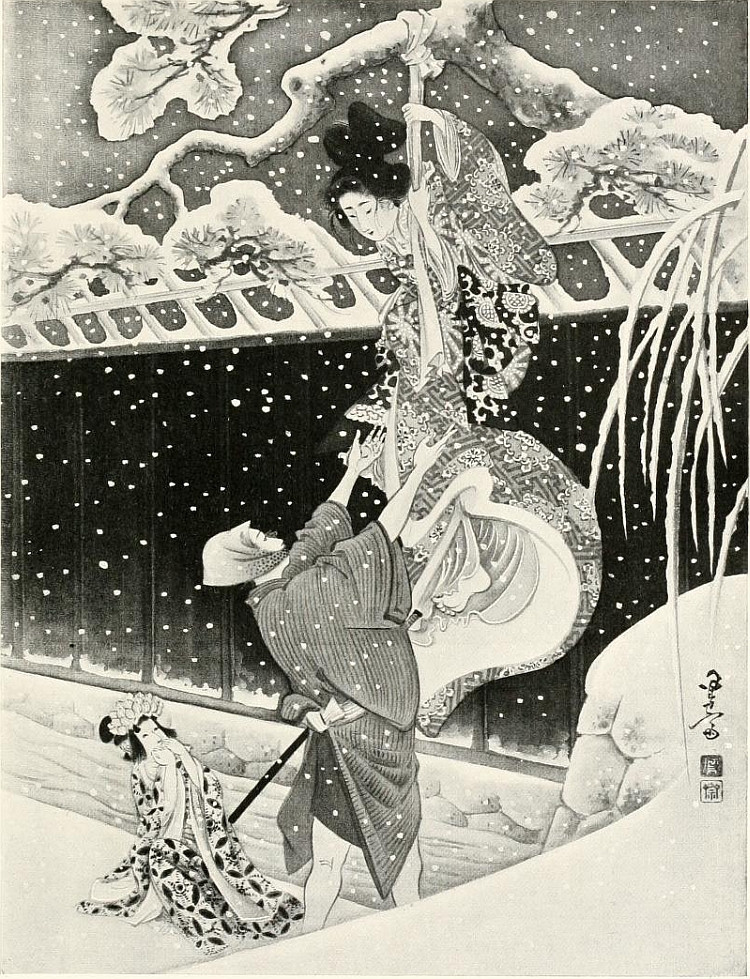
Urasato's escape from the Yamana-Ya
URSATO, OR THE CROWN OF DAWN
THE POSITION AT THE OPENING OF THE STORY
Urasato and Tokijiro are lovers. The child, Midori, is born of this liaison. Tokijiro is a samurai in the service of a Daimyo, and has charge of his lord's treasure department. He is a careless young man of a wild-oat-sowing disposition, and while entirely absorbed in this love affair with Urasato, a valuable kakemono, one of the Daimyo's heirlooms, is stolen. The loss is discovered and Tokijiro, who is held responsible, dismissed.
To give Tokijiro the means of livelihood so that he may pursue the quest of the lost treasure, Urasato sells herself to a house of ill-fame, the Yamana-Ya by name, taking with her the child Midori, who is ignorant of her parentage. Kambei, the knave of a proprietor, is evidently a curio collector, and it is to be gathered from the context that the unfortunate young couple have some suspicion—afterwards justified—that by some means or other he has obtained possession of the kakemono—hence Urasato's choice of that particular house.
Tokijiro's one idea is to rescue Urasato, to whom he is devoted, but for lack of money he cannot visit her openly, and Kambei, seeing in him an unprofitable customer, and uneasy about the picture, for which he knows Tokijiro to be searching, forbade him the house, and persecutes Urasato and Midori to find out his whereabouts, in order, probably, that he may have him quietly put out of the way.
As in all these old love stories the hero is depicted as a weak character, for love of women was supposed to have an effeminizing and debasing effect on men and was greatly discouraged among the samurai by the feudal Daimyo of the martial provinces. On the other hand, the woman, though lost, having cast herself on the altar of what she considers her duty—the Moloch of Japan—often rises to sublime heights of heroism and self-abnegation, a paradox only found, it is said, in these social conditions of Japan. Urasato reminds one of the beautiful simile of the lotus that raises its head of dazzling bloom out of the slime of the pond—so tender are her sentiments, so strong and so faithful in character is she, in the midst of misery and horror.
This recitation, freely rendered into English from the chanted drama, tells the story of Urasato's incarceration, of the lover's stolen interviews, of the inadvertent finding of the picture, and of Urasato's and Midori's final escape from the dread Yamana-Ya.
URSATO, OR THE CROW OF DAWN[1]
The darkness was falling with the tender luminosity of an eastern twilight over the house; the sky was softly clouding, and a gentle wind sprang up and sighed through the pine-trees like a lullaby—the hush that comes at the end of the day with its promise of rest was over all the world, but in spite of the peaceful aspect of nature and of her surroundings, Urasato, as she came from her bath robed in crêpe and silken daintiness, felt very unhappy. To her world the night brought no peace or rest, only accumulated wretchedness and woe.
Midori, her little handmaid, followed her fair mistress upstairs, and as Urasato languidly pushed open the sliding screens of her room and sank upon the mats, Midori fetched the tobacco tray with its tiny lacquer chest and miniature brazier all aglow, and placed it by her side.
Urasato took up her little pipe, and with the weed of forgetfulness lulled for a while the pain of longing and loneliness which filled her heart. As she put the tobacco in the tiny pipe-bowl and smoked it in one or two whiffs and then refilled it again, the tap, tap of the pipe on the tray as she emptied the ashes were the only sounds, interluded with sighs that broke the stillness. "Kachi," "Kachi," "Kachi" sounded the little pipe.
Tokijiro, waiting hopelessly outside the fence in the cold, could not so forget his misery. He kept in the shadow so as not to be seen by the other inmates of the house, for if he were discovered he would lose all chance of seeing Urasato that evening and, perhaps, for ever. What might happen if these secret visits were discovered he dared not think. To catch one glimpse of her he loved he had come far through the snow, and after losing his way and wandering about for hours, he now found himself outside the house, and waited, tired and cold and miserable, by the bamboo fence.
"Life," said Tokijiro, speaking to himself, "is full of change like a running stream. Some time ago I lost one of my lord's treasures, an old and valuable kakemono of a drawing of a garyobai (a plum-tree trained in the shape of a dragon). I ought to have taken more care of the property entrusted to me. I was accused of carelessness and dismissed. Secretly I am searching for it, but till now I have found no clue of the picture. I have even brought my troubles to Urasato, and made her unhappy about the lost treasure. Alas! I cannot bear to live longer. If I cannot see Urasato I will at least look upon little Midori's face once more and then take leave of this life for ever. The more I think, the more our mutual vows seem hopeless. My love for this imprisoned flower has become deeper and deeper, and now, alas! I cannot see her more. Such is this world of pain!"
While Tokijiro thus soliloquized outside in the snow, Urasato in the room was speaking to her child-attendant, Midori.
"Midori, tell me, are you sure no one saw my letter to Toki Sama yesterday?"
"You need have no anxiety about that, I gave it myself to Toki Sama,"[2] answered Midori.
"Hush," said Urasato, "you must not talk so loudly—some one might overhear you!"
"All right," whispered the little girl, obediently. Leaving Urasato's side she walked over to the balcony and looking down into the garden she caught sight of Tokijiro standing outside the fence.
"There, there!" exclaimed Midori, "there is Toki Sama outside the fence."
When Urasato heard these words joy filled her breast, a smile spread over her sad face, her languor vanished, and rising quickly from her seat on the mats, she glided to the balcony and placing her hands on the rail leaned far out so that she could see Tokijiro.
"Oh! Tokijiro San," she exclaimed, "you have come again at last, how glad I am to see you!"
Tokijiro, on hearing her voice calling him, looked up through the pine branches and the tears sprang to his eyes at sight of her, for into the depths of love their hearts sank always deeper and the two were fettered each to each with that bond of illusion which is stronger than the threat of hell or the promise of heaven.
"Oh!" said Urasato, sadly, "what can I have done in a former life that this should be insupportable without the sight of you? The desire to see you only increases in the darkness of love. At first, a tenderness, it spread through my whole being, and now I love—I love. The things I would tell you are as great in number as the teeth of my comb, but I cannot say them to you at this distance. When you are absent I must sleep alone, instead of your arm my hand the only pillow, while my pillow is wet with tears longing for you,—if only it were the pillow of Kantan[3] I could at least dream that you were by my side. Poor comfort 'tis for love to live on dreams!"
As she spoke, Urasato leaned far out over the balcony, the picture of youth, grace and beauty, her figure supple and fragile as a willow branch wafted to and fro by a summer breeze, and about her an air of the wistful sadness of the rains of early spring.
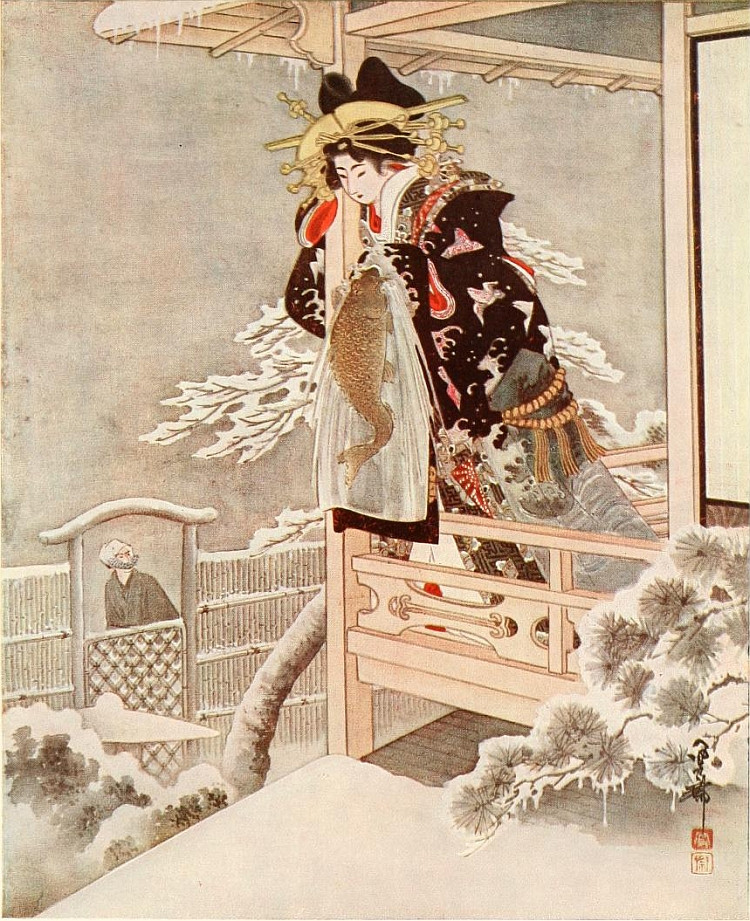
As she spoke, Urasato leaned far out over the balcony, the picture of youth, grace and beauty.
"Oh! Urasato!" said Tokijiro, sadly, "the longer I stay here the worse it will be for you. If we are discovered not only you, but Midori also will be punished, and as she does not know all how unhappy she will be, and what will you do then. Oh! misery!"
Urasato, overcome with the bitterness of their troubles and the hopelessness of their situation, and as if to shield Midori, impulsively drew the child to her and, embracing her with tenderness, burst into tears.
The sound of footsteps suddenly startled them both. Urasato straightened herself quickly, pushed the child from her, and wiped away her tears. Midori, always clever and quick-witted, rolled a piece of paper into a ball and threw it quickly over the fence. It was a pre-arranged signal of danger. Tokijiro understood and hid himself out of sight. The screen of the room was pushed aside and not the dreaded proprietor nor his shrew of a wife, but the kindly and indispensable hair-dresser, O[4] Tatsu, appeared.
"Oh, courtezan," said the woman, "I fear that I have kept you waiting. I wanted to come earlier, but I had so many customers that I could not get away before. As soon as I could do so I left and came to you ... but, Urasato Sama, what is the matter? You have a very troubled face and your eyes are wet with tears ... are you ill? Look here, Midori, you must take better care of her and give her some medicine."
"I wanted her to take some medicine," said Midori, "but she said she would not."
"I have always disliked medicine and, as Midori tells you, I refused to take any. I don't feel well to-day, O Tatsu. I don't know why, but I don't even wish to have the comb put through my hair—so I won't have my hair dressed now, O Tatsu, thank you."
"Oh," answered O Tatsu, "that is a pity—your hair needs putting straight—it is very untidy at the sides; let me comb it back and you will then feel better yourself, too—"
"O Tatsu," said Urasato, hopelessly; "you say so, but—even if the gloom that weighs down my spirit were lifted and my hair done up and put straight both would fall again, and knowing this, I am unhappy."
"Oh," replied O Tatsu, "the loosened hair-knot which troubles you is my work—come to the dressing-table ... come!"
Urasato could not well refuse the kindly woman and reluctantly allowed herself to be persuaded. She sat down in front of the mirror, but her heart was outside the fence with Tokijiro, and to wait till the woman had done her work was a torture to her.
"Listen to me," said O Tatsu, as she took her stand behind Urasato and with deft fingers put the disordered coiffure to rights, "people cannot understand the feelings of others unless they have themselves suffered the same conditions. Even I, in past times, was not quite as I am now. It seems foolish to speak of it, but I always feel for you. If you deign to listen to me I will tell you my story. Even such an ugly woman as I am—there is a proverb you know, that says 'Even a devil at eighteen is fascinating' (oni mo juhachi)—has had her day, and so there was someone who loved even me, and he is now my husband," and O Tatsu laughed softly, "ho-ho-ho." "Well, we plighted our vows and loved more and more deeply. At last he was in need of money and came to borrow of me, saying 'Lend me two bu!'[5] or 'Lend me three bu!' using me in those days only as his money-box. It must have been because our fate was determined in our previous life that I did not give him up. I let things go because I loved him. Youth does not come twice in a life-time. He was in great distress and I sold all my clothes to help him till my tansu[6] were empty, and then I filled them with his love letters. Things came to such a pass that we thought of committing suicide together. But a friend who knew what we were about to do stopped us, and so we are alive to this day. But things have changed since then, and now, when there is some small trouble, my husband tells me he will divorce me, and there are times when I feel I hate him and don't want to work for him any more. There is a proverb that 'the love of a thousand years can grow cold,' and it is true. Experience has taught me this."
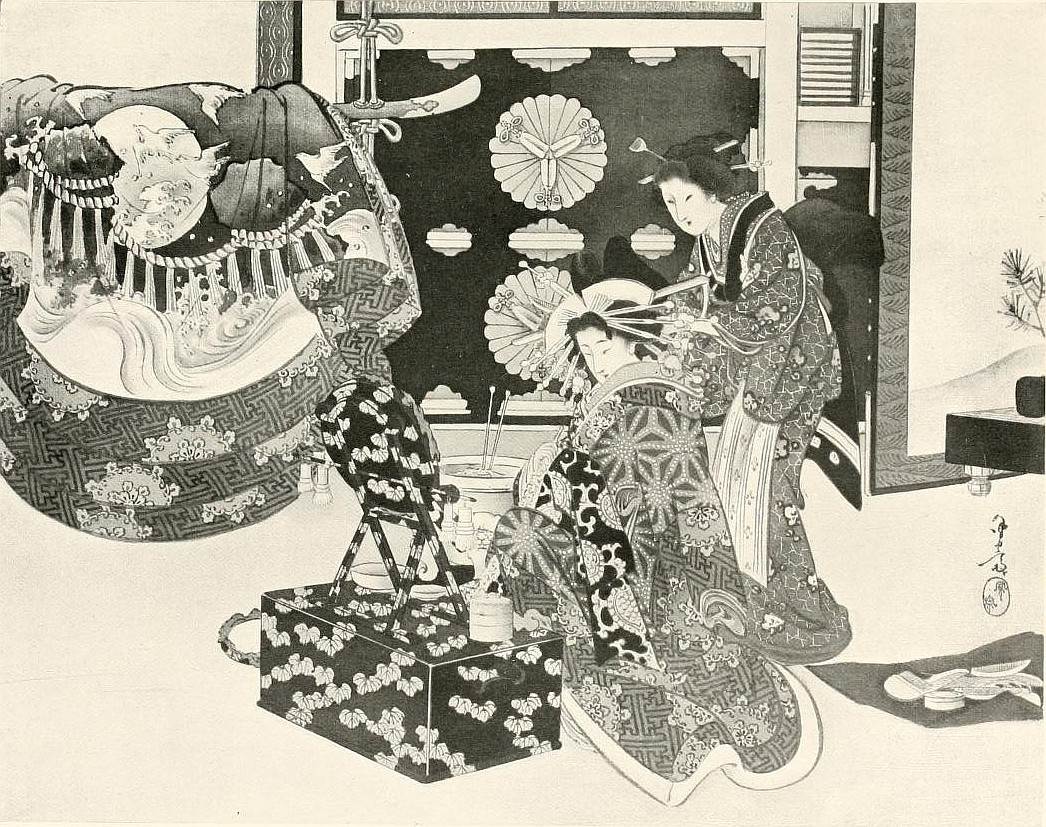
O Tatsu ... took her stand behind Urasato and with deft fingers put the disordered coiffure to rights
"O Tatsu Sama," answered Urasato, "in spite of all you say, I have no one to love me in this wide world, such an unfortunate creature as I am, so devotedly as you loved him."
"You may think thus now," said O Tatsu, "for you have reached the age of love's prime. I know that people in love's despair often cut short their own lives, but while you have Midori to think of you cannot, you must not, commit suicide. Duty and love exist only while there is life. Oh dear, I have talked so much and so earnestly that I have forgotten to put in the tsuto-naoshi," and with the last finishing touches O Tatsu put in the pincer-like clasp which holds together the stray hair at the nape of the neck.
Urasato's eyes were dry, though her heart was full of sympathy and sorrow as she listened to O Tatsu's kind words of sympathy, and as a bedimmed mirror so was her soul clouded with grief. Midori, touched by the sad conversation, dropped tears as she flitted about over the mats, putting away the comb box here and a cushion straight there.
"Well," said O Tatsu, as she bowed to the ground and took her leave, "I am going yonder to the house of Adzumaya, good-bye!" and with these words she glided down the stairs and went out by the side door. Looking back as she did so, she called to Midori:
"Look here, Midori, I am going out by the side gate instead of by the kitchen—will you please fasten it after me." With these words she seized the astonished Tokijiro, who was hiding in the shadow, pushed him inside and shut the gate (pattari) with a snap. With an unmoved face as if nothing unusual had occurred, O Tatsu put up her umbrella, for snow had begun to fall, lighted her little lantern and pattered away across the grounds without once looking back.
Thus, through the compassionate help of another, Tokijiro was at last enabled to enter the house. He ran upstairs quickly, and entering the room, caught hold of Urasato's hand.
"Urasato! I cannot bear our lot any longer. I cannot bear to live away from you—at last I am able to tell you how I long to die with you since we cannot belong to each other any longer. But if we die together thus, what will become of poor little Midori. What misery—oh, what misery! No—no—I have it; you shall not die—I alone will die; but oh! Urasato, pray for the repose of my soul!"
"That would be too pitiless," said Urasato, while the tears fell like rain from her eyes, "if you die to-night what will become of our faithful little Midori and myself left behind? Let parents and child take hands to-night and cross the river of death together. We will not separate now, oh, no—no! Oh! Tokijiro San! you are too cruel to leave us behind."
Some one was now heard calling from below.
"Urasato Sama! Urasato Sama!" said a loud harsh voice, "come downstairs—you are wanted quickly, quickly—come!"
Then the sound of a woman's feet as she began to ascend the stairs reached the three inmates of the room.
Urasato's heart beat wildly and then seemed to stop with fright. Quick as a flash of lightning she hid Tokijiro in the kotatsu[7] and Midori, with her usual quick-wittedness, fetched the quilt and covered him over. Then she glided to the other side of the room. All this was the work of a moment.
"O Kaya San," said Urasato, "what is the matter? What are you making such a fuss about? What do you want with me now?"
"Oh! Urasato," answered the woman as she entered the room, "you pretend not to know why I call you. The master has sent for you—Midori is to come with you—such is his order!"
Urasato made no answer, but followed O Kaya, who had come to fetch her. Anxiety for Tokijiro hidden in the kotatsu, and fear concerning what the sudden summons might mean made her heart beat so that she knew not what to do. Both she and Midori felt that the woman was like a torturing devil driving them along so much against their will—they seemed to feel her fierce eyes piercing them through from behind.
O Kaya led them across the garden to another part of the house. The soft twilight had been succeeded by a dreary night. It was February and the night wind blew sharp and chill—the last snow of winter weighed down the bamboos; while, like an emblem of courage and strength in the midst of adversity, the odour of early plum blossoms hung upon the air. Overcome with anxiety, Urasato felt only the chill, and fear of the night spread through her whole being. She started and shivered when behind her Midori's clogs began to echo shrilly, like the voices of malicious wood-sprites in the trees laughing in derision at her plight. Her heart grew thin with pain and foreboding. "Karakong," "karakong," sounded the clogs, as they scraped along. "Ho, ho, ho!" mocked the echoing sprites from the bamboo wood.
They reached the veranda of the house on the other side of the quadrangle. O Kaya pushed open the shoji disclosing the grizzled-headed master, Kambei, seated beside the charcoal brazier looking fierce and angry. When Urasato and Midori saw him, their heart and soul went out with fear as a light in a sudden blast.
Urasato, however, calmed herself, and sitting down outside the room on the veranda, put her hands to the floor and bowed over them. The master turned and glared at her.
"Look here, Urasato," said he, "I have nothing but this to ask you. Has that young rascal Tokijiro asked you for anything out of this house—tell me at once—is such the case? I have heard so—tell me the truth!"
Urasato, frightened as she was, controlled herself and answered quietly:
"Such are the master's honourable words, but I have no remembrance of anyone asking me for anything whatsoever."
"Um," said the master, "I shan't get it out of you so easily I see," then turning to O Kaya, he said, "Here, O Kaya, do as I told you—tie her up to the tree in the garden and beat her till she confesses."
O Kaya rose from the mats and catching hold of the weeping Urasato dragged her up and untied and pulled off her girdle. The woman then carried the slender girl into the garden and bound her up with rope to a rough-barked, snow-covered pine-tree, which happened to be just opposite Urasato's room. O Kaya, lifting a bamboo broom threateningly, said, "Sa! Urasato, you won't be able to endure this—therefore make a true confession and save yourself. How can you be faithful to such a ghost of a rascal as Tokijiro? I have warned you many times, but in spite of all advice you still continue to meet him in secret. Your punishment has come at last—but it is not my fault, so please do not bear me any resentment. I have constantly asked the master to pardon you. To-night, out of pity, I begged him to let you off, but he would not listen. There is no help for it, I must obey my orders. Come, confess before you are beaten!"
So O Kaya scolded and entreated Urasato; but Urasato made no reply—she only wept and sobbed in silence.
"You are an obstinate girl!" said O Kaya, and she lifted the broom to strike.
Midori now rushed forward in an agony of distress and tried to ward off the blow about to fall on her beloved mistress. O Kaya flung the child away with her left arm, and bringing the broom down, began to beat Urasato mercilessly till her dress was disarranged and her hair fell down in disorder about her shoulders.
Midori could bear the sight no longer. She became frantic, and running to the wretched Kambei, lifted praying hands to him: then back again she darted to catch hold of O Kaya's dress, crying out to both: "Please, forgive her; oh, please, forgive her! Don't beat her so, I implore you!"
O Kaya, now fully exasperated, seized the sobbing child.
"I will punish you too," and tied Midori's hands behind her back.
Tokijiro, looking down from the balcony of Urasato's room, had been a distraught and helpless spectator of the whole scene of cruelty in the garden. He could now no longer restrain himself and was about to jump over the balcony to the rescue. But Urasato happened at that moment to look up and saw what he intended doing. She shook her head and managed to say, unheard by the others:
"Ah! this, for you to come out, no, no, no!"
Then, as O Kaya came back from tying up Midori, she quickly added to her, "No, I mean you who have tied up Midori, you must be pitying her, you must be, O Kaya San—but in the presence of the master for that reason it won't do! It won't do!" and here she spoke, purposely, incoherently to O Kaya, while she signed to Tokijiro with her eyes that he must not come out—that her words were meant for him under cover of being addressed to O Kaya.
Tokijiro knew that he could do nothing—he was utterly powerless to help Urasato, and if he obeyed his first impulse and jumped down into the garden he would only make matters a thousand times worse than they were, so he went back to the kotatsu, and bit the quilt and wept with impotent rage.
"She is suffering all this for my sake—oh! Urasato! oh! oh! oh!"
Kambei had now reached Urasato's side, and catching hold of her by the hair, said in a big voice, "Does not your heart tell you why you are so chastized? It is ridiculous that Tokijiro should come in search of the kakemono that was entrusted to me. Ha! you look surprised. You see I know all. Look! Isn't the picture hanging there in my room? I allow no one so much as to point a finger at it—Sa! Urasato, I am sure Tokijiro asked you to get him that—come—speak the truth now?"
"I have never been asked to steal any such thing," answered Urasato, sobbing.
"Oh, you obstinate woman—will nothing make you confess? Here, Midori—where is Tokijiro? Tell me that first?"
"I don't know," answered Midori.
"There is no reason why Midori should know what you ask," said Urasato, trying to shield the child.
"Midori is always with you," said Kambei—"and she must know," and turning to Midori he struck her, saying: "Now confess—where is Tokijiro hiding now?"
"Oh, oh, you hurt me," cried the child.
"Well, confess then," said the cruel man, "then I won't hurt you any more!"
"Oh ... Urasato," cried Midori, turning to her—"entreat the master to pardon me—if he kills me, before I die I can never meet my father whom I have never seen."
Tokijiro, upstairs in the balcony, heard all that was going on and murmured:
"That is, indeed, natural, poor child."
But Kambei, unaware that he was heard and seen, beat the child again and again.
"I can't make out what you say, little creature," he screamed with rage. "You shall feel the weight of this tekki[8] then we shall see if you will still not answer what is asked you."
Under this hell-like torture Midori could scarcely breathe. The poor child tried to crawl away, but as she was bound with rope, she was unable to do so.
The cruel man once more caught hold of her roughly by the shoulder and began to beat her again. At last the child gave a great cry of pain, lost consciousness, and fell back as though dead.
Kambei was now alarmed at what he had done, for he had no intention of killing the child—only of making her tell him where Tokijiro was living or hiding. He stopped beating her and stood on one side, angry enough at being thwarted by Urasato and Midori.
Urasato raised her head and moaned to herself as she looked at the prostrate child.
"I am really responsible for the child's suffering," she said to herself—"my sin is the cause of it all; forgive me, my child—you know it not, but I am your mother; and although you are only a child you have understood and helped me. You saw that I was in love and always anxious about my lover. This is from a fault in your former life that you have such a mother—ah! this is all, alas, fruit of our sins in another existence," and Urasato's tears flowed so fast that, like spring rain, they melted the snow upon which they fell.
O Kaya now came up to her, saying,
"What an obstinate creature you are! If you don't confess you shall wander in company with your child to the Meido,"[9] and with these words she raised her broom to strike.
Hikoroku, the clerk of the house, now came running upon the scene. He had fallen in love with Urasato and had often pressed his suit in vain. When he saw how matters stood he pushed O Kaya away.
"You are not to help Urasato!" screamed O Kaya, angrily.
"Go away, go away," said Hikoroku, "this punishment is the clerk's work—though I am only a humble servant, however humble I am I don't need your interference."
Then Hikoroku turned to Kambei and said apologetically.
"Excuse me, master, I have something to say to you; the matter is this—that dear Urasato—no, I mean Midori and Urasato—I never forget them, oh, no, no! I know their characters—they are good-hearted. This punishment is the clerk's work. If you will only leave Urasato to me I shall be able to make her confess. I am sure I can manage her. If you will make me responsible for making Urasato confess, I shall be grateful."
Kambei nodded his head, he was already tired, and said:
"Um—I would not allow anyone else to do this, but as I trust you Hikoroku, I will let you do it for a while; without fail you must make her confess, I will rest,"—and with these words he went into the house, intending to put the blame on Hikoroku if his regulation suffered because of his treatment of Urasato.
Hikoroku accompanied his master to the house and bowed low as he entered. He then came back to Urasato.
"Did you hear what the master said? Did he not say that he would not entrust this to anyone else but me—only to me—Hikoroku—don't you see what a fine fellow I am? If only you had listened to me before you need never have suffered so—I would have helped you, Urasato San! Perhaps you suspect me as being to blame for all this; but no—indeed, I am not—you and I are living in another world. Will you not listen to me—Urasato San?—but oh!—you have a different heart—oh! what am I to do?" and he placed his hands palm to palm and lifted them despairingly upwards to Urasato, shaking them up and down in supplication.
O Kaya had been listening to Hikoroku, for she was in love with him herself and was always jealous of the attention he paid to Urasato. She now came up and said, as she shrugged her shoulders from side to side: "Now Hikoroku Sama—what are you doing? What are you saying? Notwithstanding your promise to the master to make Urasato confess, you are now talking to her in this way. Whenever you see Urasato you always act like this without thinking of me or my feelings for you. I am offended—I can't help it! You will probably not get her to confess after all. Well—I will take your place, so go away!"
As O Kaya came up to Hikoroku he pushed her away, saying:
"No, never! You shall not hurt her—this is not your business—the master has entrusted it to me. As for you, it is ridiculous that you should love me. How ugly you are! Ugh!—your face is like a lion's. Are you not ashamed. Before the master I have no countenance left when I think of what you say to me. Now then—go away O Kaya—I am going to untie poor Urasato!"
O Kaya tried to push Hikoroku away. Hikoroku took up the broom and beat her without caring how much he hurt her. Mercilessly did he continue to beat her till she was overcome and, falling down on the snow, lay stunned for some time to come.
Having thus got rid of O Kaya, Hikoroku quickly released Urasato and Midori. As he lifted the child up she opened her eyes.
"Ya, ya! Are you still there, mother?"
Did Midori know that Urasato was her mother, or on returning to consciousness was it instinct or affection that made her use the tender name?
When she heard Midori's voice, Urasato felt that she must be in a dream, for she had feared that the child had been killed by Kambei's beating.
"Are you still alive?" she exclaimed, and caught the child in her arms while tears of joy fell down her pale cheeks.
Hikoroku looked on with a triumphant face, for he was pleased at what he had done.
"Urasato Sama, you must run away, and now that I have saved you both I can't stay here. I, too, shall be tied up and punished for this. I shall run away, too! Well, it is certainly better to escape with you than to remain here. Let us flee together now. Come with me. I must get my purse, however, before I go. Please wait here till I come back with my small savings—then I can help you; don't let anyone find you," and without waiting for Urasato's answer Hikoroku ran into the house.
Urasato and Midori stood clasping each other under the pine tree. They were shaking with cold and fatigue and pain. Suddenly a sound made them look up. Tokijiro suddenly stood before them. He had climbed out on to the roof, and walking round the quadrangle, had reached the spot where they stood and then let himself down by the pine-tree. When the two saw him they started for joy.
"Oh," said Urasato, scarcely able to make herself heard, "how did you get here, Tokijiro?"
"Hush," said Tokijiro, "don't speak so loudly. I have heard and seen all—oh! my poor Urasato, it has caused me much pain to think that you have suffered so much because of me; but in the midst of all this misery there is one thing over which we can rejoice. As soon as I heard what Kambei said about the kakemono I crept downstairs and into the room he pointed out, and there I found my lord's long-lost picture. Look, here it is! I have it safe at last. The very one drawn by Kanaoka. Someone must have stolen it. I am saved at last—I am thankful. I shall be received back into my lord's service—I owe this to you, and I shall never forget it as long as I live."
Footsteps were heard approaching, Tokijiro hid himself behind a post of the gate. He was only just in time.
Hikoroku came stumbling along across the garden from the other side of the house.
"Here, here, Urasato San, we can now fly together—I have got my money—we can get out by the gate. Wait another moment, I will steal in and get the picture for you."
As soon as Hikoroku had gone again Tokijiro rushed forward, and seizing Urasato and Midori by the hand, hurried them out of the garden. Once outside they felt that they had escaped from the horror and death of the tiger's mouth.
Hikoroku, not being able to find the picture, hastened back to the spot where he had left Urasato, when he ran into O Kaya, who had recovered consciousness, and now picked herself up from the ground somewhat bewildered and wondering what had happened.
"Are you Hikoroku? Are you Hikoroku?" she exclaimed, and caught him in her arms.
Catching sight of her face, Hikoroku cried out with disgust and horror.
"Ya! Avaunt evil! Avaunt devil!"
The three fugitives outside the gate heard Hikoroku's exclamation. Tokijiro caught up Midori and put her on his back. Then he and Urasato taking each other by the hand ran away as fast as they could. The dawn began to break and the birds to sing as they left the dread place behind them. From far and near the crows began to wing their way across the morning sky.
Hitherto the crow of dawn had parted them—it now united them. Thinking of this, Tokijiro and Urasato looked at each other with eyes brimming over with tears, yet shining with the light of new-born hope.
TSUBOSAKA
A story of Faith in Kwannon, the Manifestation of Mercy (popularly known as the Goddess of Mercy)
N.B.—The Amida Buddha of the Shinshu sects of Japanese Buddhism is the only Deity, and the Original and the Unoriginated Buddha, Lord of Boundless Life and Light. Amida promises to all, who with full trust and confidence draw near and invoke His name, the safe Heaven of freedom from sin and evil.
KWANNON is the Embodiment of Amida's Compassion, capable of manifestation in many shapes for purposes of practical succour. He is never manifested except for a suffering creation.
The late Professor Lloyd says that it is a mistake to speak of Kwannon as a female deity, that he is the son of Amida, capable of appearing in many forms, male or female, human or animal, according to circumstances. See "Shinran and his Work" (Lloyd, p. 21).
TSUBOSAKA
The shrine of Tsubosaka, where this popular story is placed, has been celebrated for answers to prayers from ancient times. Tradition relates that when the fiftieth Emperor Kwammu lived in the capital of Nara, he was smitten with eye trouble. The head priest, Doki Shonin, of the Tsubosaka shrine offered up prayers to Kwannon, the Manifestation of Mercy, for one hundred and seven days for the Emperor's recovery. The prayer was efficacious and His Majesty's sight was restored. Since that time Tsubosaka has been known as a holy place to which pilgrims journey to pray for blessings and especially for health in time of illness.
In a certain village in the province of Yamato in Japan, close by the hill of Tsubo, there lived a blind man named Sawaichi and his wife, O Sato.
Sawaichi was a honest, good-natured fellow, who earned a bare living by giving lessons on the koto[1] and samisen.[2]
O Sato was a faithful loving woman, who by washing and sewing, and such odd work, earned many an honest penny towards the maintenance of their poor little home.
For some time things had not gone well with the couple; they were growing poorer and poorer, and even the joyful singing of birds, and the sound of the temple bell, near by, emphazised their own wretchedness, and filled their souls with melancholy.
One morning Sawaichi got out his samisen, and striking some chords, began to play.
"Oh, Sawaichi San, what are you doing?" said O Sato, "I am glad to see that you feel in better spirits to-day. It is good to hear you play the samisen again," and she laughed as cheerfully as she could.
"Oh, oh, O Sato, do I look as if I were playing the samisen for amusement? Indeed, I am in no such mood. I am so depressed that I wish I could die. Nay, I am so choked with trouble that I feel as if I were going to die. Now, O Sato, I have something to say that I have been brooding over for a long time, so please sit down and listen to me."
O Sato sank softly on the mats near Sawaichi, and as she looked at the blind man, trying tenderly and carefully to divine what was troubling him, she saw that he was unusually moved, and the tears of pity rose to her eyes.
Sawaichi cleared his throat, after waiting for a moment, and then went on:
"How rapid is the passing of time. The proverb is true that 'Time flies like an arrow.' Three years have passed since our marriage, and I have meant to ask you this many times, O Sato! Why do you hide your secret from me so long? We have been betrothed since our youth upward, and we know each other well. There is no need of secrecy between us. Why not tell me your secret frankly?"
O Sato stared at him helplessly. She could not in the least understand what was the meaning of these mysterious words. At last she said, hesitatingly:
"Whatever is the matter with you to-day, Sawaichi San? What are you talking about? I don't in the least understand. In the whole of our married life I have never had any secret to keep from you. If you find anything in me that does not please you, tell me, and I will try to mend. Is not this the way between husband and wife?"
"Well, then," said Sawaichi, "I will tell you all since you ask me."
"Tell me everything," said O Sato, "whatever it is that is troubling you. I cannot bear to think that you are unhappy," and she drew closer to her poor blind husband.
"Oh, oh, O Sato, I will tell you all—I cannot bear it longer. It hurts me. Listen carefully! We have been married just three years now. Every night between three and four o'clock I awake, and stretch out my arms to you as you lie in your bed, but I have never been able to find you, not even once. I am only a poor blind fellow and smallpox has disfigured me hopelessly. It is quite natural that you cannot love such an ugly creature as myself. I do not blame you for this. But if you will only tell me plainly that you love another, I will not be angry with you, only tell me! I have often heard people say, 'O Sato is a beautiful woman!' It is, therefore, natural that you should have a lover. I am resigned to my fate and shall not be jealous, therefore tell me the truth—it will be a relief to know it."
It was a pitiful sight to see the afflicted man, for though he spoke quietly and with evident resignation, yet the despair in his heart caused the tears to overflow his sightless eyes.
O Sato could not bear to see her husband racked by these terrible doubts. His words pierced her heart with pain. She clung to him sorrowfully.
"Oh, Sawaichi San! how cruel your suspicions are'! However low and mean I may be, do you think that I am the kind of woman to leave you for another man? You are too unjust to say such things. As you know, my father and mother died when I was a child, and my uncle, your father, brought us up together. You were just three years older than I. While we were thus growing up as boy and girl together, you took smallpox and became blind, alas! and your misfortunes accumulating, you were reduced to poverty. But even so, once betrothed, I will go through fire and water with you, and nothing shall ever part us. Not only do I feel that we are united till death, but it has been my one great hope to cure your blindness. To this end, ever since we were wedded, I have risen with the dawn and left the room stealthily, not wishing to disturb you. Thinking nothing of the steep mountain road, I have climbed to the top of Tsubosaka every morning before it was light to pray to Kwannon Sama to restore your sight. Lately I have felt disappointed with Kwannon Sama, for my prayer is never answered, though I have prayed earnestly for three years, rising before the dawn to climb to her temple on the hill. Knowing nothing of all this you condemn me as being faithless to you. It makes me angry, Sawaichi San!" and here poor O Sato burst into tears and sobbed aloud.
Sawaichi realized how false his suspicions had been, and how unworthy they were of his devoted wife. At first he could not speak but stammered pitifully. At last he found his voice and burst out:
"Oh, my wife, my wife! I will say nothing more. I have talked nonsense like the poor blind fellow that I am. Forgive me, forgive me! How could I know what was in your heart?" and here he joined his hands together, raising them in a gesture of entreaty, and then, with his sleeve, wiped away the tears from his eyes.
"Ah—no, no—not this! Do not ask pardon of your own wife, it is too much!" said O Sato, in distress. "I can face even death if your doubts are dispelled."
"The more you say, the more I am ashamed before you. Though you pray so earnestly, O Sato, my eyes will never recover their sight."
"What are you saying? Oh! what are you saying?" exclaimed O Sato. "It is only for you that I have borne all this, walking barefoot to the Shrine of Kwannon Sama every day for three years, thinking nothing of the wind or snow or frosts these wintry dawns."
"I am, indeed, grateful to you for your devotion. But as I harboured suspicions of you for a long time, thinking evil of your good, even if I pray, my prayers to Kwannon can only be rewarded by punishment, and my eyesight will never be restored."
"No, no, Sawaichi San, do not say such things," answered O Sato. "My body is the same as your body. Talk nonsense no more, but control your mind with firmness and come with me to Kwannon Sama and let us pray together."
Sawaichi rose from the mats, the tears falling from his eyes.
"Oh, my good wife, I am indeed grateful to you. If you are so determined I will follow. It is said that the grace of Buddha can make a dead tree to blossom. My eyes are like a dead tree ... oh, oh, if only they might blossom into sight! But though I am a great sinner ... who knows? Perhaps in the next world? .. Now my wife, lead me as ever by the hand!"
O Sato busied herself opening the tansu and getting out Sawaichi's best clothes. She helped him to change, speaking encouraging words the while. Then they set out together and climbed the steep ascent of Tsubosaka, Sawaichi leaning on the staff in his right hand.
The couple at last reached the temple, breathless after the hard climb.
"Here we are, Sawaichi San," said O Sato, "we have come to the temple, we are now before the gate ... though prayer and devotion are important in the recovery of health, they say illness is often due to nerves. If you allow yourself to be so low-spirited, your eyes will only grow worse. Therefore, at such a time, how would it be for you to sing some song to cheer yourself?"
"Yes, yes, O Sato, as you say, anxious brooding over my troubles is not good for my eyes. I will sing some song."
Then beating time with his stick tapping the ground, he began to hum:
"Chin—chin—tsu: chin—chin: tsu—chin—chin—tsu," tinkling in imitation of the samisen.
Sawaichi cleared his throat and began to sing:
Is suffering the cause of love? Or love the cause of suffering? My love must vanish like the dew ...
Aita ... ta ... ta ...
The words of the song were suddenly broken by a cry of pain as Sawaichi entered the gate of the temple and tripped on a stone.
"Oh, dear, I nearly fell over that stone ... I have forgotten the rest of the song ... what does it matter now ... ho—ho—ho," and he laughed to himself strangely and softly.
They had by this time come to the main temple and stood outside, O Sato gazing at the altar where Amida Buddha and Kwannon, the Manifestation of Mercy, reigned above the lotus flowers in the fragrant mists of incense.
"Sawaichi San, we have now come to Kwannon Sama."
"Oh, indeed! Are we already there?" answered Sawaichi, "how grateful I am!" then turning his sightless face towards the altar he lifted beseeching hands, and bowing his head reverently, he repeated the Buddhist invocation:
"Namu Amida Butsu! Namu Amida Dai Butsu!" (All hail, Great Buddha!)
"Listen, Sawaichi," said O Sato, earnestly, "this night let us stay together here and pray through the night without ceasing."
Then they both began to pray. The chanting of their supplication rose up clearly in the stillness of the evening hour, and it seemed as if the sand of Tsubosaka might become the golden streets of Paradise.
Suddenly Sawaichi stopped and clutched hold of his wife.
"O Sato," he said, "I must tell you the truth. I cannot believe. I came simply because it was your wish. But I shall never recover my sight, of that I feel sure."
"Why do you say such sad things?" answered O Sato, clasping her hands. "Listen! When the Emperor Kwammu was in Nara, the ancient capital, he suffered with his eyes as you do. Then he prayed to Kwannon Sama and in a short time he was healed. Therefore, pray without ceasing. Kwannon will make no difference between the Emperor and ourselves, though we are as poor as worms. Believers must be patient and go forward slowly, and with quiet minds trust devoutly in the mercy of Kwannon. So great is his benevolence that He hears all prayers. Worship! Pray! Sawaichi San! Pray! instead of wasting time in vain talk."
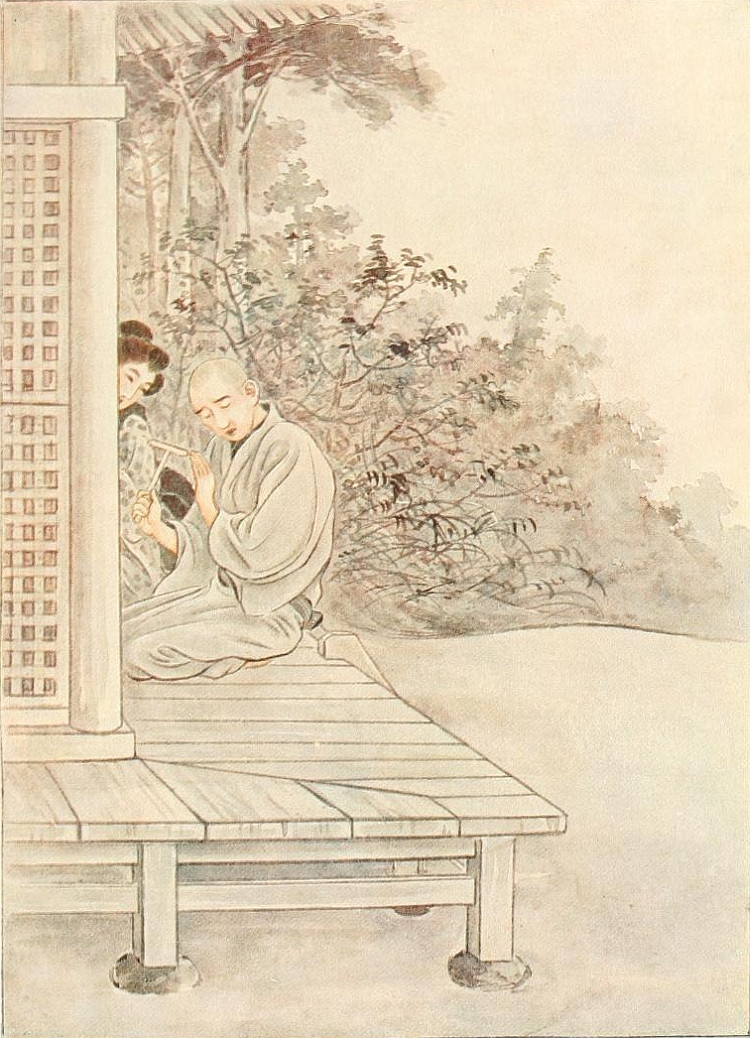
Sawaichi, turning his sightless face towards the altar, repeated the Buddhist invocation "Namu Amida Butsu."
Thus did O Sato encourage her husband. Sawaichi nodded his head and replied:
"What you say is convincing. From to-night I will fast for three days. You must return home, shut up the house and come again. The next three days will decide my fate, whether I recover or not."
"Oh," said O Sato, joyfully, "now you speak wisely. I will go back at once and arrange everything for a three days' absence. But," she added anxiously, "Sawaichi San, remember that this mountain is very steep, and higher up one comes to the top, which falls on the right into a deep precipice. On no account must you leave the temple!"
"Oh, no, never fear, I will put my arms round Kwannon to-night—ho, ho, ho!" and he laughed to himself.
O Sato, never dreaming of what was in her husband's mind, hurried homewards, blissfully content, thinking that her yearning hopes were realized and that he at last believed.
Sawaichi listened to her retreating footsteps. When he could hear them no more, he knew himself to be alone. He fell flat to the earth and cried aloud in the bitterness and darkness of his soul.
"Oh! my wife, you will never know how grateful I am to you for all your devotion to me these long years. Though gradually reduced to the straits of poverty, you have never once lost sympathy with me. You have faithfully loved such a miserable blind wretch as myself. Alas! knowing nothing of what was in your heart I even doubted your fidelity. Forgive me, O Sato. Forgive me! If we part now we may never meet again. Oh, the pity of it!"
Sawaichi lay on the ground and gave vent to the pent-up misery in his heart. After a few minutes he raised a despairing face and said aloud:
"I will not grieve any more. O Sato has prayed devoutly for three years, and yet Kwannon gives no sign of hearing her supplication. What is the use of living any longer? There is only one thing I can do to show my gratitude to you, O Sato! and that is to die and set you free. May you live long, O Sato! and make a happy second marriage! Now, I remember that O Sato told me that there was a deep precipice on the right at the top of the hill. That is the best place for me to die. If I die in this holy place, I may hope to be saved in the next world. Lucky it is that the night is far gone, and that there is no one about ... oh, oh!"
With these words Sawaichi rose to his feet. The temple bell, the last before the dawn, rang out in the silence. Sawaichi knew that there was no time to lose. Groping his way with his stick he hastened to the top of the hill. Stopping to listen, he heard the sound of distant water flowing in the valley beneath. In his distraught state of mind it sounded to him like a call from Buddha. With the prayer "Namu Amida Butsu!" on his lips, he planted his stick on the edge of the hill, and with a desperate leap threw himself out as far as he could over the side of the abyss. For a few moments the sound of the body crashing through the trees and undergrowth was heard as it fell in its progress of increasing impetus down the precipice: gradually growing fainter and fainter, the noise at last altogether ceased; then all was still on the lonely mountain side.
Knowing nothing of all this, O Sato was hurrying back to her husband, slipping and stumbling along the familiar road in her anxiety to get to him quickly. At last she reached the temple and looked round eagerly. Sawaichi was nowhere to be seen.
"Sawaichi San!" she called again and again. "Sawaichi San!"
Receiving no answer to her repeated cries she hunted round the temple courtyard, but with no result. Becoming fearful of what might have befallen him, she called louder than before:
"Sawaichi San! Sawaichi San!"
Running distractedly from the temple precincts, she hastened to the crest of the hill, and there she tripped over her husband's stick. She now knew what he had done. Frantically she rushed to the precipice and gazed far down into the abyss beneath. There in the grey light of the breaking dawn she could see the lifeless form of her husband stretched upon the ground.
"Oh! what shall I do? This is too dreadful!" she cried aloud in her anguish. Her body trembled in a paroxysm of pain. She called to her husband, but only the mountain echoes answered her.
"Oh, my husband, my husband! You are too cruel—too cruel! Only with the hope of saving you from blindness did I persevere in prayer for so long to Kwannon Sama. Alas! what will become of me, now that you have left me alone? Now I remember there was something strange in your manner when you sang that sad song coming up the hill. It may be that you had already made up your mind to die. But how could I know? Oh! Sawaichi San, if only I had known I would never have persuaded you to come to this place. Forgive me, oh, forgive me! There is no such miserable woman in the world as myself. No one but God could know that Death would separate us now. Blind man as you are, who cannot see in this world, how will you travel alone amidst the dark shadows down the road of Death? Who will lead you by the hand now? I feel as if I could see you wandering and groping there all by yourself."
Heartbrokenly she sobbed for some time. At last she shook herself with resolution; then raised her tear-stained face to the seemingly unresponsive heaven above.
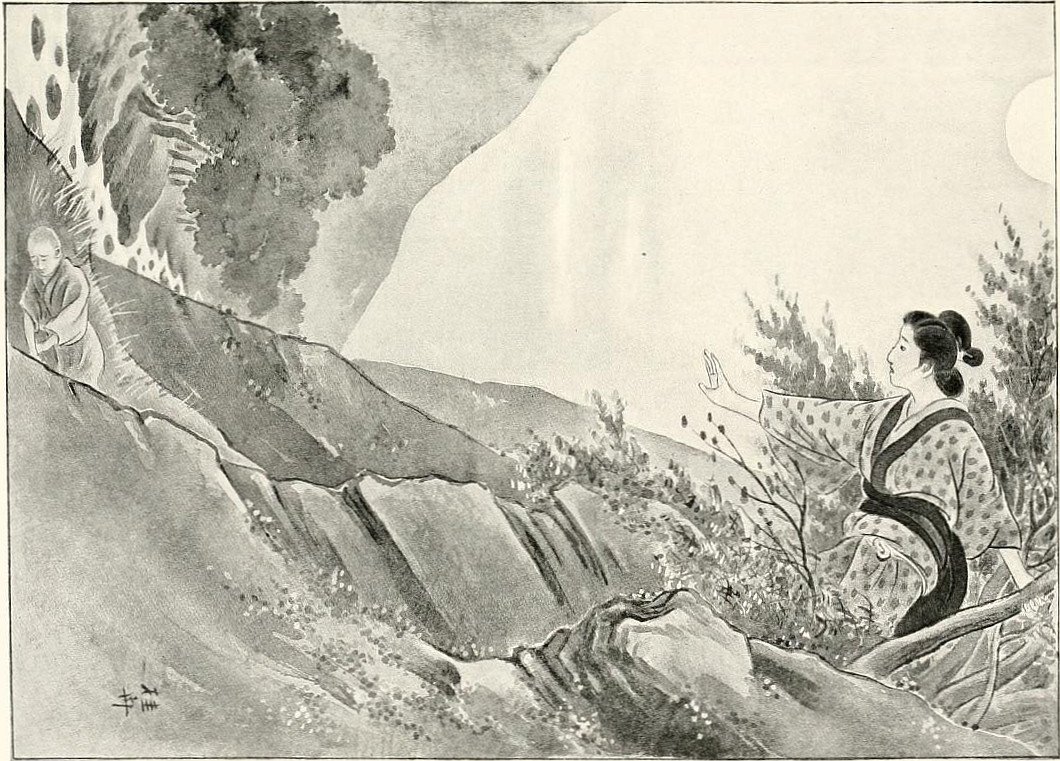
There in the grey light of the breaking dawn she could see the lifeless form of her husband stretched upon the ground
"Oh, oh, I will lament no more. Everything that happens in this life is the result of sin and affinity in our previous state of existence. I will die too, and join Sawaichi in death."
With clasped hands she repeated the Buddhist prayer, "Namu Amida Butsu," and then, gathering all her strength for the fatal leap, sprang over the precipice and was gone.
The February morning broke clear and bright. Nor in the temple nor on the hillside was there any trace of the pitiful tragedy that had taken place during the night. The mists in the valley and over the mountains dispersed as the sun's rays, advancing swiftly from the east, touched the world with the transforming magic of splendour of day. Then suddenly a strange thing happened. In the rose and golden glory of the unfolding pageant of the early rushing morning, there was wafted over the Tsubosaka valley the most wonderful and uplifting strains of music, and above the bodies of Sawaichi and O Sato appeared the holy and yearningly compassionate form of Kwannon shining in a great, all-space-illuminating radiance.
"Listen, Sawaichi!" said the Heavenly Voice, "Your blindness is the result of sin in your former life. The end of this life had come for you both, but through the faith of your wife and the merits of her accumulated prayers, your lives shall be prolonged. Therefore believe and devote your lives to prayer, and make a pilgrimage to the thirty-three holy places, where you must offer up thanks for the grace of Buddha. Awake, O Sato! O Sato! Sawaichi! Sawaichi!"
With these words the divine vision disappeared; the temple bell pealed forth the hour of morning prayer, the birds began to sing, the priests to beat their gongs and drums, and to chant their orisons, and over the hillside villages and in the temple the world woke once more to life and work.
The two bodies lying in the valley rose up, wondering whether the vision which had restored them to life were a dream.
Vaguely they remembered the events of the night. O Sato gazed at Sawaichi:
"Sawaichi San! My husband! Your eyes are open!"
"Yes, yes, my eyes are open indeed! Oh, oh, my eyes are open, open, open! My eyes are open at last! I can hardly believe it," cried Sawaichi, joyfully.
"Remember that it is due to the mercy of Kwannon Sama," said O Sato.
"I am thankful, thankful, thankful!" exclaimed Sawaichi. Then looking at his wife, he asked:
"But who are you?"
"Why, I am your wife O Sato, of course!" answered O Sato.
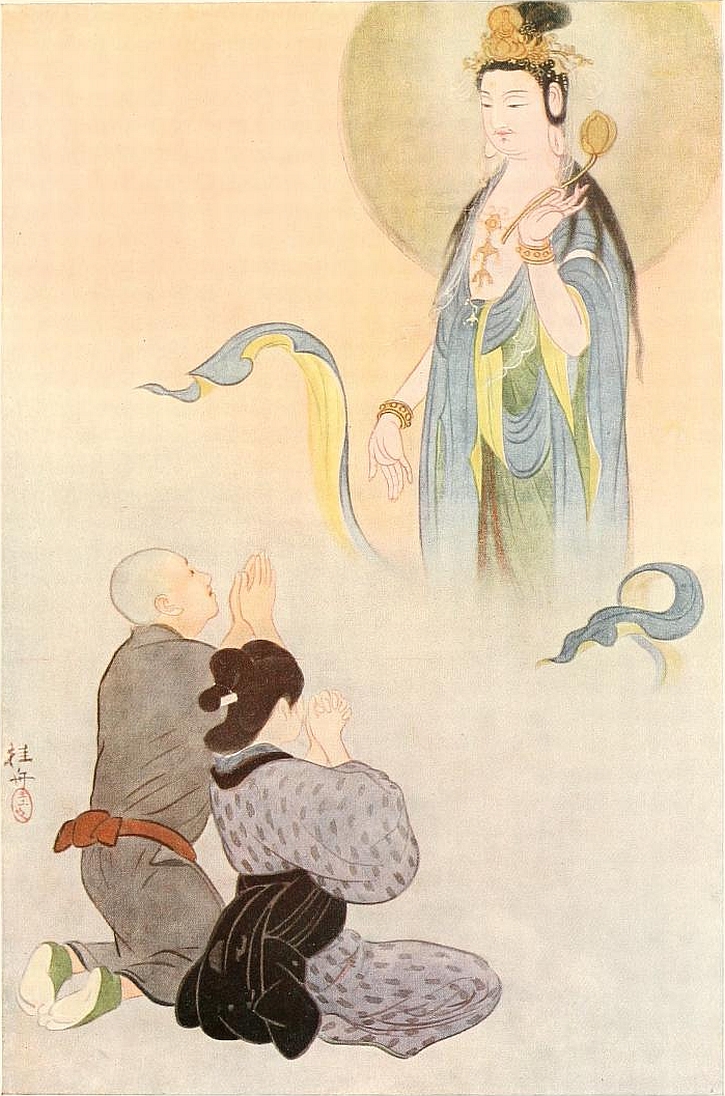
"Listen Saiwachi!" said the Heavenly Voice, "Through the faith of your wife and the merits of her accumulated prayers, your lives shall be prolonged.
"Oh, you are my wife, are you? How happy I am! This is the first time I see you. But how wonderful it all is. When I threw myself over the precipice, I knew nothing more till Kwannon appeared to me in a great and marvellous light and told me that my blindness was the result of misdeeds in a former life."
"I, too," said O Sato, "followed you to death and leaped into the valley where I saw you lying all alone. I, too, knew nothing till Kwannon Sama called me. Your eyes are really open, Sawaichi San! Does it not seem a dream!"
"No, no," said Sawaichi, "it is no dream. The most merciful Kwannon called me back to life and by a miracle restored my sight. Ha, ha, ha! As deep as the sea is my gratitude to Kwannon."
Taking each other by the hand and smiling happily, they climbed to the temple where they had prayed so despairingly the night before. As they went along Sawaichi raised his hands in worship towards the sunlight.
To this poor couple, now so happily restored to life and joy and hope, the hill of Tsubosaka did indeed seem Paradise through the mercy of KWANNON, the Embodiment of Amida's Compassion.
LOYAL, EVEN UNTO DEATH
Or The Sugawara Tragedy
NOTE.—For many centuries the Fujiwara nobles (the Empresses were always chosen from this family) had secured for themselves supreme control and influence over the Mikados in Kyoto. In the ninth century another family of courtiers came into prominence, namely the Sugawara, who eventually gained sufficient power with the Emperor to be a serious menace to the schemes of the Fujiwara. At the end of the ninth century there arose one especially, Lord Michizane Suguwara, brilliant statesman, scholar, high-souled patriot and poet.
The Emperor Uda held him in high esteem and promoted him from the position of his tutor to that of Minister of the Right.[1] In 898 the Fujiwara succeeded in compelling Uda to abdicate in favour of his son, a child of twelve years of age, expecting him to be a more pliant tool in their hands. This boy became the 60th Emperor, Daigo, who, by the advice of his Imperial father, planned to give Michizane absolute authority in state affairs. The jealousy of the vigilant Fujiwara courtiers was fully aroused, and through the machinations of Lord Tokihira (Fujiwara), Minister of the Left, his rival, Michizane, was falsely accused of high treason and banished to Kiushiu where, in the horrors of poverty and exile, he died in 903. Michizane is now known by the posthumous title of Tenjin. Many Shinto temples have been erected in his honour, and students still worship his spirit as the patron god of letters and literature.
The following drama, one of the most popular in Japanese literature, tells the story of one heroic incident in the scattering of the Sugawara family, and of the rescue of Lady Sugawara, and the loyalty of Matsuo and O Chiyo, his wife, vassals of the Sugawara.
Matsuo, the better to serve his lord's cause, feigns to be unfaithful to him and to go over to the enemy—in fact, he acts the dangerous part of a spy. The Fujiwara Minister is completely deceived and, enlisting his aid, reveals to Matsuo his secret plans for the final overthrow of the exiled Sugawara and the murder of his son. So clever and thorough is Matsuo's dissimulation that even his own father and his brothers are deluded, and Matsuo is calumniated by all who know him, accused of disloyalty to his lord (an unpardonable offence in old Japan) and disinherited by his family. Finally, in a crowning act of transcendent devotion to the Sugawara House, Matsuo and O Chiyo, to save their young lord from death, willingly substitute their own child, Kotaro, in his place. In the feudal days loyalty was the one great social obligation of the samurai to his lord. And this spirit of loyalty often involved painful self-sacrifice. "Life was freely offered, not only by him who was bound by fealty to his lord, but by his children."
The following is a typical tragedy of its kind.
PERSONS REPRESENTED
LADY SUGAWARA, wife of the exiled Prime Minister or "Minister of the Right"—hiding from the enemy in Matsuo's house.
MATSUO, a devoted vassal of Lord Michizane Sugawara.
O CHIYO, wife of Matsuo.
KOTARO, the little son of Matsuo and O Chiyo.
SHUNDO GEMBA, the emissary of Lord Fujiwara Tokihira, triumphant enemy of Sugawara.
TAKEBE GENZO, a schoolmaster in the suburbs of Kyoto, also vassal of the Sugawara.
TONAMI, wife of the schoolmaster.
KANSHUSAI, Lord Sugawara's son, a handsome clever boy, eight years of age.
Several village school children and their parents.
SCENE I. Matsuo's cottage in Kyoto. Night.
Lanterns lighted in the room.
LOYAL EVEN UNTO DEATH
Or The Sugawara Tragedy
In the old capital of Kyoto, not far from the Imperial Palace, there lived a samurai named Matsuo with his wife O Chiyo, and their little son Kotaro, eight years of age.
With Kotaro by her side, O Chiyo reverently on her knees pushed aside the sliding screens of an inner room, and disclosed the Lady Sugawara seated on the mats, bending forward with her face buried in her hands, her whole attitude expressive of grief and despair.
O Chiyo bowed low and said with a voice hushed in sympathy:
"It is terrible to me to think that such a great lady as you cannot go even to the veranda in the daytime for fear of being seen by your enemies. You must, indeed, feel like a prisoner—and above all, the separation from the Prime Minister, and your son and daughter. How despondent you must feel! While you were hiding in the capital the secret of your whereabouts leaked out, and you were in danger of being caught—at that crisis my husband saved you and brought you here. You must be sadly ill at ease confined in this poor house, and after what you have been accustomed to the loneliness must be very depressing. But do not despair! You may yet join your husband and son sooner than you think. Till that time comes patiently endure all hardships, hoping for happier days."
"Oh!" answered the Lady Sugawara in melancholy tones, "you are so sympathetic and good, I shall never forget your kindness, even after death. Through the malice of a bad man[2] my husband was banished to a distant place, and my poor boy and myself are refugees. The thought of them haunts me from morning till night. There is nothing but misery in dragging out my existence from day to day in this state—but I will, at least, wait till I can see them again, if but for a moment, and then die, especially as your little Kotaro reminds me vividly of my own son, to whom he bears a great resemblance. My longing to see him again grows ever more and more intense."
With these sad words the unfortunate lady burst into tears; O Chiyo, deeply affected by her sorrowful plight, wept with her, and the silence of the room was only broken by the sobs of the two women.
Suddenly, some one from outside announced in a loud voice that an emissary from an exalted personage had arrived.
Both women started to their feet. O Chiyo barely had time to conceal Lady Sugawara in an inner room, when, preceded by several attendants carrying lanterns, the emissary, Shundo Gemba, arrived in full state as befitting the bearer of an important message—he pompously entered the room and seated himself in the place of honour before the alcove.
O Chiyo's husband, Matsuo, who had secluded himself and was resting in an inner room, overhearing the commotion, came out to welcome the visitor.
"As I am suffering from illness I must beg you to overlook my lack of ceremony in not receiving you in official dress," and he bowed to the ground in a respectful manner.
Gemba replied haughtily:
"However ill you may be you must listen to the command of Lord Tokihira (the new Prime Minister who had supplanted Sugawara). Sugawara's son, whose hiding-place was hitherto unknown, has at last been discovered by some one who has revealed the secret. The boy is now in the house of Takebe Genzo, by profession a teacher of Chinese writing, but in reality a secret and staunch supporter of Michizane. This man passes the young lord off as his own son. There is no one on our side who knows Kanshusai except yourself, so you are commanded to identify the head as soon as it is cut off, and to bring it as a trophy to Lord Tokihira. By way of reward for this service sick leave will be granted you, and on your recovery you will be created Lord of Harima. There is no time to be lost, so you must make preparations at once."
O Chiyo, who was listening with a beating heart in the next room, felt keenly apprehensive, for her husband had been extra moody and reticent of late, and she could neither fathom what was in his mind, nor what answer he would make to the dreadful proposition of this man straight from the enemy's camp.
To her utter consternation Matsuo replied:
"What kindness on the part of our lord! No greater honour could be conferred upon our house. I will obey the command at once. But owing to my illness matters cannot be arranged as speedily as I could wish. If that man Genzo should happen to hear that I am going to attack him and wrest his prize from him, he may escape with the young Sugawara."
"Do not trouble yourself about that," returned Gemba, "it is only a ronin's[3] hut, and need not even be surrounded."
"But Takebe, knowing that Lord Tokihira is instituting a search for the boy, still boldly harbours him—it is certain that the schoolmaster can be no common man—we must be very cautious in dealing with him," objected Matsuo.
"You are quite right," replied the envoy, "if they should manage to escape both of us will be blamed."
"Yes, indeed," Matsuo agreed; and then as if suddenly struck by the thought, "I am sorry to trouble you, but do not fail to let your men keep a sharp watch on every exit of the village during the night."
"All right," responded the other, "you need not trouble on that score, every necessary precaution will be taken."
"Well, then at an early hour to-morrow I will accompany you to Takebe's house," said Matsuo.
"Thank you for your trouble," and the two men took leave of each other, Gemba departing from the house in the same haughty style as he had entered it.
Matsuo, with a troubled heart, watched until the emissary's procession had disappeared in the distance. Before he could carry out his intended plan he must first sound his wife.
During the interview O Chiyo had waited in the next room, a silent witness of all that had taken place between her husband and Lord Tokihira's messenger. As soon as Gemba's party had taken their departure she opened the sliding screens and with some trepidation confronted her husband.
"It seems," said the wife, "by what Gemba had to communicate, that the hiding-place of our young lord is at last discovered. Before the assassin has had time to carry out his murderous work let us send for him here, and try to rescue the poor child before he falls into the hands of the enemy. There is no time to lose."
As Matsuo made no response, O Chiyo pressed him again and again not to delay.
At last he laughed cynically.
"You do not seem to have the slightest idea of what is in my mind! I brought Lady Sugawara here from Kita's house so that I might deliver her up together with her son's head at the same time—that is why I have hidden her here."
"What are you saying?" gasped O Chiyo. "Can it be your real intention to betray them to Tokihira?"
"Yes," answered her husband, calmly looking her in the face, "now is the time to grasp my long-wished for ambition—my fortune has come at last," and he smiled as if well pleased with himself.
This was the first time that Matsuo had given any hint of his sinister intention towards the innocent Lady Sugawara and her son, and O Chiyo was so startled and horrified that for a few moments she was choked for utterance. She had hitherto felt convinced that he was devoted, heart, soul, and body, to the cause of their beloved ex-Prime Minister. Bitter tears fell from her eyes, and she moved nearer to him on the mats; in the earnestness of her appeal she stretched out a hand and laid it on his arm, till she could find words to falter out:
"Oh, my husband, since when has this dreadful scheme taken possession of your heart? For the Sugawara family I have been quite resigned to your being misunderstood and disinherited by your father's house, and the severance of all relationship with your brothers—indeed, so staunch and whole-hearted has been your devotion to this cause that I always intended to apologize and explain matters to your family when the time came. Now suddenly, without the least warning, your lifelong fidelity has been perverted into treachery. However great your ambition for promotion may be, to betray the wife and child of our Lord Sugawara into the hands of Tokihira is impossible. Are you a devil or a dragon? The punishment for such baseness will fall not only on yourself, but on your child. Oh! purify your heart from this evil intention, and conduct the Lady Sugawara and her son safely to the ex-Prime Minister in Tsukushi,[4] I implore you!" and the distraught woman lifted her hands in an attitude of prayer to her husband, while the tears coursed down her cheeks.
But, unmoved by her appeal, Matsuo still laughed contemptuously.
"What silly woman's talk! I have now no parents or brothers—they are strangers to me! It would be foolish to forget our own child's welfare for the sake of exiles banished by the State. You may say it is against reason and righteousness, but I do it for the sake of my boy—there is no treasure more precious than a son."
"Oh! oh!" sobbed O Chiyo, "how heartless you are! If you think so much of your own boy, Lady Sugawara's feelings must be the same for her son. To attain your ambition at the expense of others, sorrow can bring you no good. Your life will end in sorrow and misery as the result of such a deed."
Matsuo became more incensed, and sternly bade his wife be silent.
"If the Lady Sugawara overhear you and escape, everything will be lost, you foolish woman!" and with these words Matsuo turned to leave the room. His wife seized the edge of his robe and tried to hold him back.
"Do not hinder me, whatever you do!" he said, angrily, and pushing her aside, he disappeared in the direction of Lady Sugawara's room.
O Chiyo fell as her husband tore himself from her detaining grasp, and lay prostrate on the mats, stunned with the horror of what he was about to do. After a few minutes she collected herself.
"Oh, oh! it seems like some dreadful dream," she murmured in acute distress. "I have lived happily with Matsuo for so many years, and surely he cannot be such a bad man. For the sake of our boy he has lost his conscience. Poor lady! Poor lady! In total ignorance of his change of heart she has trusted to him as her chief staff and pillar of support. How can I look her in the face after this? To prove to her that I am not one with my husband it is better to kill myself and ask her pardon in another world."