PART IV
Yei Theodora Ozaki translation
It was springtime, and in the town of Tokushima the cherry-blossoms were bursting into bloom. The second of March[7] had come, and Onoto Gunbei was secretly rejoicing in the wicked thought that his schemes for the disgrace of his rival had been successful. Sakurai once removed from his path, his own advancement would be certain. To-morrow Sakurai must take the Kunitsugu sword to the palace and lay it in state before the Daimio. For reasons of his own Gunbei knew that this would be a matter of impossibility. Sakurai would therefore be suspected of having stolen it and his degradation would be the certain result.
Gunbei's sinister features relaxed into a malignant smile as he proudly stalked along the road on his way to the shrine at the western end of the town.
Two of his retainers were following at a respectful distance in his rear.
He had reached the precincts of the temple when one of these men came hurrying up:
"My lord! Jurobei, the man for whom you are constantly on the look out, is in that tea-house close by. I have just recognized him. What steps shall we take?"
"Very good!" said his master. "You have done well. Let us hide ourselves, and when he leaves the place rush upon him unawares and seize him."
Jurobei, after a short time, walked out from the hostelry. His mind was entirely engrossed with the thought that the sword must be retrieved from Gunbei's possession before the morrow, the third of the third month.
As he abstractedly strolled along, the enemy lying in ambush pounced upon him from behind. But his years of ronin's hard and reckless life had trained his muscles to such phenomenal strength that in the tussle that followed, within a few rounds, he came off triumphantly the victor.
Gunbei, who had been a spectator of this unequal contest, drew his sword.
Jurobei, noting his action, caught up one of Gunbei's men and used him as a shield to ward off the blows.
The news of the fight was soon carried to Sakurai, who immediately hurried to the spot.
Directly he became aware of the identity of Gunbei's opponent, he shouted:
"What presumption to stand up and attack your superior. Surrender at once!"
He then turned to Gunbei.
"I will take him, therefore put up your sword."
Jurobei, who understood that this was strategy on his master's part, obediently allowed himself to be bound. Sakurai then handed him over to Gunbei, who gave him in charge of his henchmen and bade them conduct him to his house.
Gunbei's joy was extreme at having Jurobei in his power. He ordered him to be secured to a tree in the inner garden while he stood and mocked at him.
"Ho, Jurobei! I have a grudge to pay off against you. Why did you kill two of my men three months ago—tell me that?"
"I slew them because they intended to murder my master," replied Jurobei.
"Indeed! I believe that you are also the man who stole the sword for which your master is responsible—ho, ho, ho! You are both robbers, you must have connived at the theft of the sword together—confess!"
"You may say what you like of me, but you lie with regard to Shusen."
In a rage Gunbei and his accomplices put their sheathed swords beneath the ropes which bound Jurobei, and twisted them round and round so that they cut into the flesh and inflicted great torture on their victim.
Now it happened that Takao, the Daimio's illegitimate half-sister, whom Izæmon had been enabled to rescue from the infamous quarter through Jurobei's help, had been taking refuge in Sakurai's home. Here she had been seen by Gunbei, who had fallen madly in love with her beauty, and had planned to make her his mistress. One day in the absence of Sakurai he had sent his retainer, Dotetsuke, to carry her off by force.
Takao, now installed beneath Gunbei's roof, was obliged to listen to his dishonourable advances, but so far had managed to repel them. She was in the secret of the lost sword, and her purpose was to use the present occasion as an opportunity of laying hands on it if possible.
On hearing the commotion she opened the shoji and eagerly scanned the direction whence it arose. To her astonishment and distress she recognized in the bound and helpless form none other than her valiant friend Jurobei. The thought that she owed her deliverance from her wretched past to his chivalrous generosity flashed through her mind. Trained to resource and intrigue, on the spur of the moment she resolved to pretend that Jurobei was her brother. This feigned relationship would afford them facilities for consultation concerning the sword. Impetuously advancing to the edge of the veranda, she looked earnestly at the captive and uttered a piteous cry:
"Oh, oh! it is my brother! Oh! my poor brother!"
"This is interesting!" jeered Gunbei. "Are you really brother and sister?"
Takao implored Gunbei to release Jurobei.
"If you listen to me I will set him free," replied Gunbei, whose desire was all the more inflamed by her rejection of his suit. "But if you refuse to obey me, I will torture him with both fire and water."
Takao wept with her face hidden in her sleeves. "Is it possible that you are a samurai?" she sobbed.
"Does your heart know no sympathy—no mercy? This is unendurable! I cannot bear to see it!"
"It is you who know no sympathy either for me or your brother. I have made conditions with you, Takao. It rests entirely with you. Accept my love and you are both free."
"Such a matter cannot be decided of my own will. I am a woman and not a free agent. I must consult my elder brother."
"Very well," responded Gunbei, "if you cannot decide this by yourself, by all means consult with your elder brother Jurobei—and come to a good understanding. I will leave you both for a while."
At a sign Gunbei's henchmen released Jurobei. "Persuade your sister to obey me and I will forgive you all and set you free. I must have Takao's affection. Think well, and give me an answer that will gladden me."
Then turning to Takao he continued:
"If you finally reject my proposals you shall both be cruelly put to death. Your two lives depend upon your will. I shall await your decision in the inner part of the house."
Here Gunbei retired. Blinded by his wild passion for the unfortunate girl he was unable to see the resolution expressed on both their faces. Both his mind and soul were clouded by the desire to possess at all costs the beautiful woman who defied him. Unaware of her high birth, the knowledge of which would have abashed him in his pursuit of her, he considered that she was the legitimate prey to his will.
Takao and Jurobei were left alone. They entered the room, crossing the veranda. Seating themselves, Jurobei made a profound obeisance at a respectful distance from Takao.
"Even though it is for the sake of the Kunitsugu sword, it is a sacrilege that the close relative of our noble Daimio should for one moment be called the sister of such a poor fellow as myself."
"It is not worth while to trouble your mind about these trifles while the finding of the sword is at stake. Think not of who is master or servant. We must find the sword this very night."
"Yes, yes," replied Jurobei, "I have the same purpose as yourself. Now is a good opportunity. Gunbei is madly in love with you. For a time pretend to listen to his wooing—whatever he may say do not let it anger you—then while he is off his guard draw out the sword he is wearing from its sheath: if the habaki (the ring which secures the guard to the blade) is of gold, ornamented with carven butterflies and flowers, and the markings on the edge of the blade is the midare-yake,[8] be sure that it is the missing Kunitsugu sword. Then give me a sign. Till that moment I will be waiting in concealment close at hand."
"Yes, yes," answered Takao. "Although Gunbei's attentions are hateful to me, it is my duty, for the sake of the sword, to pretend to yield to him for a short time. In this way Sakurai will be saved. Let us agree upon a signal. I will go to the stream and, throwing some cherry flowers into it, I will repeat:
Hana wa sakura: Hito wa bushi. The cherry is first among flowers: The warrior first among men."
They separated quietly. Takao sank upon the mats, musing sadly. The prospect that lay before her was utterly revolting to her mind. Meanwhile Gunbei, eager to know the result of the conference he had permitted between the two, quietly entered the room from behind.
Her attitude of dejection greatly enhanced her pale and aristocratic beauty, and Gunbei thought that she looked more ravishingly lovely than he had ever seen her before. The sight of her inflamed his longing to possess her as his own.
"What a woman!" he thought to himself. "She shall be mine!"
As he moved across the room, Takao, who was hitherto unaware of his presence, started to her feet.
"No, no," remonstrated Gunbei in seductive accents, "I cannot allow you to run away—do not deceive yourself for one moment. I have come for your answer, Takao. It is 'Yes,' is it not?"
He thought that as he found her alone and in this pensive frame of mind that Jurobei must have persuaded her to become his paramour. His pulses throbbed and the blood in his veins ran fire. In his overmastering passion he did not notice that his would-be victim shuddered as he took her hand and drew her close to him till she was reclining on his knees. Dreamily he whispered:
"Takao, you are as beautiful as an angel. Yield to my desire and I will make you my wife. Only listen to me, and all shall be as you wish both for yourself and your brother, Jurobei.—Come, come! Let us belong to each other!" and he endeavoured to draw her towards the inner room.
Takao, in the meantime, had rested her hand on the hilt of his sword and was about to draw it from its sheath.
"What are you doing, Takao! Why do you touch my sword?" asked Gunbei sharply, roused out of his reverie of love.
"Think of me no more! With this sword I will cut off my hair and become a nun. You may rest assured that never shall another man touch me all my life."
With these words she attempted to draw the sword from his girdle.
Gunbei, thwarted in his longing for the beautiful woman, now lost his temper. He pushed her roughly to one side:
"You scorn my love then? You are an obstinate creature! Instead of forgetting you I will torture Jurobei. You shall soon know what my hatred means." Clapping his hands, he called his confidential servant:
"Dotetsuke! Dotetsuke!"
When the man appeared his master wrathfully gave the imperious command:
"Tie up that woman to yonder cherry-tree."
Dotetsuke obediently dragged Takao into the garden and bound her with the rope that had a little time before made Jurobei a prisoner to the same tree.
Gunbei, who had watched the execution of his cruel order from the veranda, retired into the room to meditate sulkily on his ill-success. His heart was bitter within him with chagrin and baffled desire.
Suddenly, through a small side gate, there appeared a priest of sinister appearance who, approaching the balcony, saluted Gunbei.
"According to your wishes I have prayed seven days in succession for the Daimio of Tokushima to be seized with mortal illness. Where is my reward?"
"Do not speak so loudly!" reproved Gunbei. "You may be overheard! You shall be duly compensated for your services later. This is not the time. Return at once!"
"Yes, yes, I will obey you, but do not forget to let me have the money soon."
And Kazoin, the wicked priest, fingering his rosary and praying for evil, departed as stealthily as he had come.
Meanwhile the unhappy Takao was left alone. She struggled to free her hands from the cords that cut into her tender flesh, but in vain.
"What shall I do?" she sobbed. "Jurobei must be waiting for my answer. I must find some means of letting him know my condition. Is there no way by which I can get free? I am powerless to find the sword or to help Shusen."
She struggled desperately against the tree and in her anguish she murmured:
"Gunbei is surely a devil in human form. He has stolen the sword himself in order to incriminate others. Shusen will be lost and his house ruined unless we can recover it this very night."
In her violent efforts to wrench herself free the cherry-tree was shaken and several blossoms fell into the stream. The falling flowers brought hope and comfort to Takao's heart.
"The holy Buddha has come to our aid," she reflected. "Jurobei will surely see the flowers in the water, and think that it is the pre-arranged signal."
Meanwhile Jurobei, from his hiding-place, was watching the stream, waiting with impatience for the promised sign. Just as he was beginning to chafe at the unexpected delay he caught sight of a cluster of white blossoms floating down the current of the rivulet.
"Ah, then it was the Kunitsugu sword which Gunbei stole and wore on his person, never letting it out of his sight night or day."
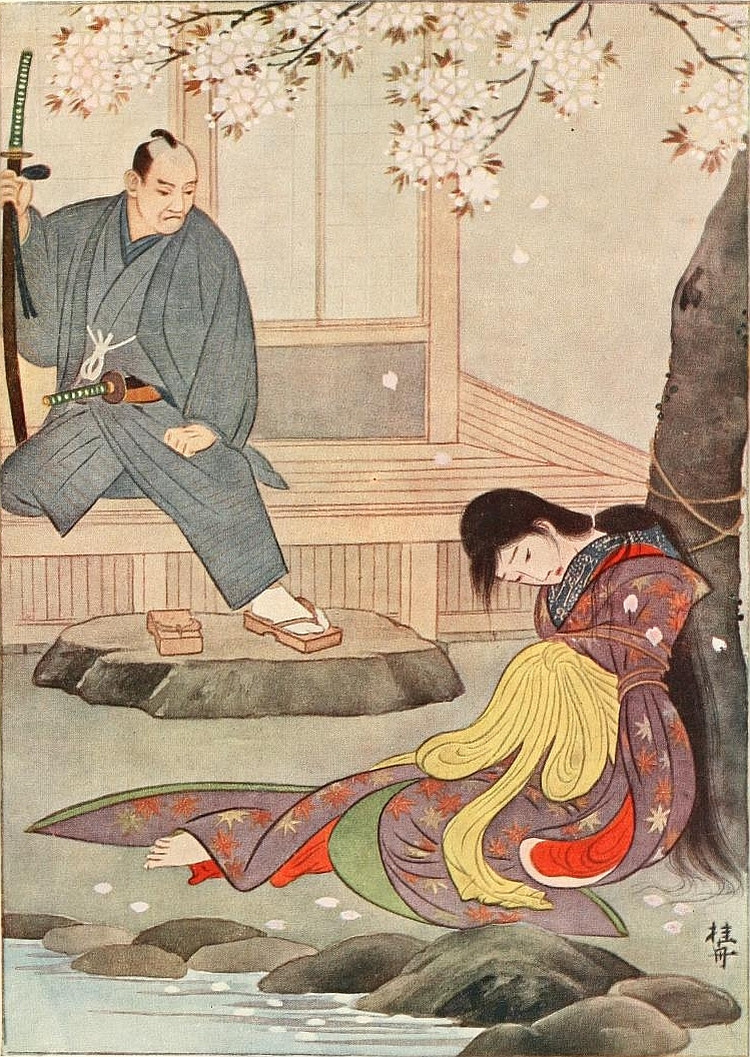
Gunbei had watched the execution of his cruel order from the veranda.
Creeping along within the shadow of the trees he stealthily made his way across the inner garden towards the room where he expected to find Takao.
But what was his surprise when he came upon her bound to the cherry-tree.
"Jurobei, at last you have come!" she gasped.
"Takao Sama, whatever has happened? Why are you treated like this?"
"It is because I could not endure Gunbei's hateful attentions," she answered, weeping. "Help me, I cannot move!"
Jurobei set to work to unfasten the ropes and in a few minutes Takao was released.
"Leave this matter to me!" advised Jurobei. "I will find some means of outwitting Gunbei yet."
And Jurobei, followed by Takao who was endeavouring to arrange her disordered robes, boldly strode into the room of his enemy.
The screens were pushed aside and Gunbei appeared. He glared fiercely at the intruding couple.
"How dare you release that woman without my permission?"
"It is my intention to counsel her to comply with your wishes," replied Jurobei, "therefore have I set her free—to give her to you as my sister."
"Ya, Jurobei, have your powers of persuasion induced your sister to consent to my proposals?" inquired Gunbei in mocking tones.
"Yes, I know not which I am, an elder brother or a go-between. If you have any other work for me, I am at your service."
"Ha, ha!" sneered Gunbei, "then as your sister agrees to please me we shall now be members of the same family. As a sign that we are closely related, take this by way of congratulation," and suddenly drawing his sword, he slashed at Jurobei.
Jurobei's keen eye forestalled the action, and, skilled fencer that he was, like lightning he seized a bucket close at hand and, holding it up, adroitly parried the rain of blows with this improvised shield.
"What does this mean?" he exclaimed. "This is too much attention even from a relative. It is troublesome. Surely so much ceremony between members of the same family is unnecessary. Please take it back."
Gunbei's answer was another wild attack on Jurobei, who nimbly avoided the thrusts.
While his whole attention was engrossed in trying to cut down Jurobei, Takao stole behind him and snatched the long sword hanging at his side from its sheath.
"Here is the Kunitsugu sword," she joyfully exclaimed.
On hearing these words, Gunbei turned like a demon of fury upon her.
"If you have found it I will kill you both," shouted Gunbei.
But before he could execute his threat Jurobei seized him from behind.
Dotetsuke, a secret supporter of Shusen Sakurai, and who all this time has acted the part of a spy and pretended accomplice in Gunbei's vile schemes, now escorted his real master upon the scene.
Sakurai loftily addressed his unmasked foe.
"Your villainous plots are all laid bare, and it is impossible for you to escape justice. Confess all and pray for mercy."
Gunbei, choking with rage, flung off Jurobei and rushed upon his abhorred rival.
Sakurai skilfully parried the onslaught, seized Gunbei, and with a prodigious effort hurled him out into the garden.
"Dotetsuke!" called Sakurai, "come and help us!"
"Yes, yes!" answered the man, as he ran to Jurobei's assistance in holding the wretch down.
Gunbei started.
"What? Are you also on Shusen's side?" and he gnashed his teeth in impotent fury.
"You have won!" He turned to Shusen. "It is useless for me to attempt to conceal the truth. I stole the sword, thereby hoping to bring about your ruin. I can say no more. Take the sword and return to your house. Does not that suffice?"
"The sword is but a small part of the crimes you have committed. Listen, villain that you are! You have done a much greater wrong. Our Lord, the Daimio of Tokushima, has loaded you with favours, and you, like a dastardly traitor, have requited his kindness by conspiring to compass the death of your benefactor."
"Silence, Shusen! That is a lie. I have always hated you as my rival, but I have borne no spite towards our Lord. What proof could you possibly have for such base allegations?" and Gunbei stared hard at his accuser.
Shusen smiled superciliously as he clapped his hands. In answer to the summons, Izæmon led in a prisoner, Kazoin, the wicked priest.
"Here are my witnesses of your schemes against the life of the Lord of Tokushima."
Gunbei realized his checkmate: there was nothing to be gained by lying further. He was a declared traitor. In desperation he attempted to rally his strength and attack Sakurai again, but he was promptly seized and again thrown down into the garden.
"You are a bad man, Gunbei. Our Lord shall judge you." Then turning to the men he gave the command:
"Bind him, hand and foot!"
When the mortified Gunbei lay helpless and cringing at his mercy, Shusen turned to his trusty vassal and addressed him, saying:
"Jurobei, I promote you in my service. You are a true and faithful knight. Let us rejoice, for we have triumphed and our enemy will receive his deserts—he is defeated!"
Takao here brought forward the sword and placed it slowly and ceremoniously before Jurobei who had staked his life, his house, his all, and lost his only child in the tragic search.
"It is found in time!" she said. "Look, the dawn breaks! It is the morning of the third of March!"
Receiving the weapon with a profound bow, Jurobei, on bended knees, raised it aloft in both hands and presented it to his feudal master, saying:
"To your keeping is at last restored the stolen treasure of our Daimio!" and thus ended the
Quest of the Lost Sword
NOTE.—Kunitsugu was the name of a famous swordsmith who lived at the end of the Kamakura Period, 1367.
THE TRAGEDY OF KESA GOZEN
The beautiful tragedy of Kesa Gozen has been familiar to me since the days of my early youth, when hand in hand I walked the school garden with Fumiko, my friend, and listened with the ardour of a romance-loving nature to the many stories of old Japan, and more especially of its heroines of antiquity, with which she loved to make me familiar.
Fumiko was the daughter of a naval officer, well versed in the literature of her own land, and a good English scholar. I had only just come to Japan, an Anglo-Japanese girl who had been brought up in England, knowing nothing of my fatherland. "Friendships are discovered, not made," says a philosopher, and in our case this was true. In her delightful and sympathetic companionship I began to forget the heart-aching homesickness for my motherland, and to learn to accustom myself to the strange country to which fate and my father had brought me. There is nothing more pitiful than the abysmal loneliness and utter hopelessness of the young, cut off from those they love, and planted in antipodal surroundings; they have no experience to tell them that misery, like joy, is but a condition of time, and that both pass and alternate. Who can say what drew us together? Yet never was I happier than when she put her hand in mine and made me her confidante, and great was my sorrow when she married and left me to pace the garden alone and to the memory of all the stories she had told me. To her I owe my awakening to the beauty of Japanese romance and the love of those old tragedies.
Many years have passed since then, but when I was told that Danjiro was acting the drama of Kesa Gozen at the Kabukiza Theatre my mind flashed back to those convent-like days when Fumiko and I
Lo, as some innocent and eager maiden Leans o'er the wistful limit of the world, Dreams of the glow and glory of the distance, Wonderful wooing and the grace of tears, Dreams with what eyes and what a sweet insistence Lovers are waiting in the hidden years,
stirred to life stories of love and duty, old as the dawn which first broke upon the island empire, yet ever new and living while hearts throb to the music of the ideal.
But I am long in coming to the story of Kesa Gozen. This beautiful and touching story of the Japanese ideal of woman's character and morals is told in the drama called Nachi-No-Taki Chikai No Mongaku, "The Priest Mongaku at the Waterfall of Nachi" (it is characteristic of the Japanese that they have ignored the heroine in the title of the drama), which was acted by Danjiro Ichikawa, the star of the Japanese stage, at the Kabukiza Theatre during the month of October 1902. The heights of romance and tragedy are scaled, and the pathos of a woman's unflinching and voluntary sacrifice of life, rends the heart. The heroine is not a Francesca da Rimini, caught up by the whirlwind of passion and blown whithersoever it listeth, but a woman who finds herself confronted by a vehement and determined love, out of the toils of which she sees no escape, and so, in the prime of youth and beauty, to save her husband's name, her mother's life, and her own virtue, she calmly arranges by stratagem to die by the hand of her impetuous and would-be lover.
These tragic events took place in the year 1160, and a full account of them may be found in the "Gempei Seisuiki," a record of the rise and fall of the two great rival clans, the Taira[1] and the Minamoto, whose struggles for supremacy disturbed Japan for many years, and find a parallel in the conflicts of the White and Red Roses in England.
What is known historically of the story is this. Kesa, the heroine, was the only child of a widowed mother called Koromogawa, after the place of her residence during her married life. The word "Koromo" means the vestments of a priest, and her daughter was consequently called "Kesa," which means the "stole," her real name being Atoma. Both her father and grandfather were knights. The mother and daughter led a secluded life, always bordering on poverty, and at times menaced by actual want.
Koromogawa took charge of an orphaned nephew, a boy, a few years older than Kesa, and the two young cousins grew up together, with the old-fashioned result that the lad fell in love with the lass. At the age of sixteen, Yendo Morito, called away probably on business connected with his clan, had to leave Kesa, just then budding into exquisite beauty. Before leaving he entreated his aunt to promise him Kesa in marriage. Koromogawa complied. Yendo did not return for five years, and in the meantime, Watanabe Wataru, a wealthy and handsome young warrior, proposed for the hand of Kesa. The mother, probably in consideration of the advantages of the match from a worldly point of view, neglected her promise to Yendo, and married Kesa to Wataru, who also was the girl's cousin. After they have been married two years Yendo Morito returns and sees his lovely young cousin by accident. His boy's love, cherished fondly during long years of absence, flames into a man's overmastering passion at sight of her. He learns, to his despair, that she is married to another, and in his wrath determines to kill his aunt who, by her faithlessness to her promise, has made his life a misery. He rushes out and entering his aunt's house draws his sword upon her. She, to gain time, weakly promises that he shall see Kesa that very evening. Yendo, fain to be content with this hope, retires, and Koromogawa summons her daughter by a letter.
When Kesa arrives she finds that her mother has made all arrangements to kill herself, and on learning the circumstances she undertakes to see her cousin, and quiets her distressed parent. Then she interviews Morito and tells him that she has always loved him, but before she can be his he must first put her husband out of the way. To this he willingly consents. She bids him come that night to the house, where she will make her husband wash his hair and drink wine so that he may sleep soundly. Yendo is to steal in at midnight and, by feeling for the damp hair, find and slay his rival. Kesa returns home, washes her own hair, and sleeps in the room she has pointed out to Yendo, having carefully put her husband to sleep in an inner room.
This is an interesting psychological point, and is perhaps obscure to the Western reader. The ethical training of a Japanese woman teaches her that in any great crisis she is the one to be sacrificed. Kesa, rather than be the cause of a quarrel which would involve her husband and her mother in a blood-feud with Yendo, puts herself out of the way, and by doing so not only saves the lives of all concerned, but preaches a silent and moving sermon to her kinsman, whose ungoverned conduct is contrary to the teaching of all Japanese moralists.
The mad and reckless lover comes, but when he thinks to gaze with triumph on the severed head of his hated rival he is stricken with horror to find that he has murdered the woman he loved so passionately. He confesses his crime to the husband and they both become monks. Years after, from the obscurity of the monastery, having survived a long interval of austere life and self-inflicted penances, there rises into the prominence of political life a monk called Mongaku, who is the friend and counsellor of the great Shogun, Yoritomo, the head of the Minamoto clan. Mongaku, the monk, is the knight Yendo Morito.
It is the opinion of some that Kesa really loved Yendo, but her filial obedience obliged her to marry the man whom her mother chose for her. Then, when she found how great was her cousin's love for her, and knowing that in her heart she returned his love, but that she could not be his without sin, she went gladly to her death, rejoicing, doubtless, that it was by the sword of her beloved she should perish.[2]
This version is the more beautiful and tragic, for we have a woman triumphant in the face of the strongest temptation that can ever beat against a human heart. The invincible yearning of the flesh must have been there, but the soul battled bravely and won. The power of beauty, the joy of conquest in love, these are hers; but Kesa, remaining faithful to duty, by her death places the honour of the family beyond all danger of blemish through her.
The present drama does not recognize this latter version, but is founded on the former. The tragedy is epic from beginning to end, and "is lifted from the outset into the high region of things predestined." Fate, like some dread spider, weaves her fatal web of love and doom, and Kesa is caught in the meshes. The grand simplicity of the play and the purity of purpose of the heroine recall the Greek drama and the Roman tragedy of Lucretia. Kesa allows herself no petty, despicable dalliance with admiration; vanity lures her not from the narrow path of right. She sees that nothing will swerve Yendo from his irresistible passion, and she resolves to die. "Fear in the face of danger dies," and having quickly made up her mind she never vacillates nor looks back, but moves forward with the dignity of sublime reserve to pre-determined and self-imposed death. And Kesa was only seventeen years of age. Think of it!
Act I. The play begins with a scene in the open air. A new bridge has been built near the town of Osaka, which can be seen with the hills and pine-trees in the distance. Numbers of Buddhist priests appear in gorgeous robes and offer prayers for the safety of the new bridge.
Some village officials, a retainer of Yendo Morito, who is superintendent of the works, and Watanabe Kaoru, a brother-in-law to Kesa, the heroine, appear, and the young knight tells those present that his brother's wife Kesa is coming to see the opening of the new bridge.
In a few minutes Kesa, the picture of youth and grace, in lovely crêpe robes, her face hidden by a gossamer gown held over her head with both hands (an ancient custom resembling the Turkish yashmak), comes fluttering over the bridge like some radiant moth, followed by two attendants, Tamakoto and Otose. Before saluting her brother-in-law Kaoru, she removes the gauze veil and reveals to all a face of surpassing loveliness—gracefully oval in shape, a complexion white as the lily, lips crimson as the bud of the peach blossom, and long almond eyes, surmounted by eyebrows like the crescent of the new moon. She speaks to her brother-in-law, who tells her that he is going to see her cousin, Yendo Morito, the superintendent of the new bridge. Kesa then prepares to retire and, donning the gauze-robe yashmak, her attendants helping, she turns to go home. As she moves away Yendo Morito, on horseback, crosses the bridge and, catching sight of the beautiful woman, watches her disappear into the distance. The priest and officials bow in polite salutation, but he is oblivious to everything near him, for his gaze is riveted on the retreating figure of Kesa. He thrills with rapturous emotion at the sight, and happy memories of their childhood and early youth rush over him.
The tragedy begins here. Yendo Morito, after several years' absence, sees his cousin for the first time and, shaken with a mighty love, now learns that she, who was promised to him in his boyhood, is already the wife of another—of his kinsman, Watanabe Wataru.
Act II. The curtain is pulled aside upon the maternal home of Kesa, a small thatched cottage in the country near Kyoto. The whole aspect of the little home denotes genteel poverty, tranquil retirement, and spotless cleanliness. The two ladies who accompanied Kesa in the first Act, Tamakoto and Otose, are discovered in the little sitting-room discoursing. Koromogawa, an old lady with flowing grey hair, comes out from an inner room and receives her two visitors. In the course of conversation they ask her to tell them the reason why she has lived so long in such a remote place as the province of Mutsu. In compliance with their request, Koromogawa says:
"I am the daughter of a knight who held the province in tenure for his services to his feudal lord. My husband was a retainer of the Governor of Mutsu, and so when we were married we went and lived at Koromogawa. My daughter Kesa was born to me there. Soon after my husband died, and I went back with my child to my old home, and have since lived a quiet and humble life. On my return the people of this neighbourhood called me after the place, Koromogawa, where my married life had been spent, and my daughter was called Kesa, though her real name is Atoma. She grew up here and married Watanabe Wataru."
At this point an official named Gorokuro, who seems to be on friendly terms with the old lady, comes in and sits by the charcoal hearth and makes a cup of tea for every one present. The hearth is square, sunk in the floor, and the kettle hangs, gipsy fashion, over the fire, as is the way in the houses of the poorer classes. While serving tea Gorokuro complains of the behaviour of Yendo Morito during the building of the bridge. This young and impetuous knight treated the workmen in such a rigorous manner that insubordination resulted, and he, Gorokuro, had great trouble in controlling them. This incident gives the key to the young knight's character. Koromogawa apologizes to Gorokuro for the trouble her nephew Yendo has given him.
While this conversation proceeds, Kesa, accompanied by one of her husband's retainers, Kisoda by name, arrives. Having dropped her sandals on the stepping-stone to the veranda, she removes her veiling robe, enters the house, and greets the old lady with low bows. She says that, whilst on her way home from visiting a temple with her husband, she has come to see her mother. In a little while the two ladies, Tamakoto and Otose, take their leave, and Kesa and her mother retire to an inner room.
Yendo Morito is now seen approaching the house along the hana-michi, and announces himself at the gate. Koromogawa, in answer to the call, comes out to receive him and asks his business. He replies that his business is private and that he must speak with her in secret. Koromogawa then ushers her nephew into a back room, and the passing of the daylight is marked by the lighting of a candle. As he enters the house he starts at the sight of a woman's sandals on the steps, and evidently guesses that Kesa is near at hand. Little dreaming of the storm that is brewing, the old lady asks her nephew to be seated. He ominously remains standing with his hand upon his sword. Suddenly the young knight's eyes flash, he snatches the sword from its sheath, and seizing his astonished aunt, his pent-up sense of injury and the misery of his thwarted hopes find vent in these words:
"Prepare to die at once! You are my enemy, and I am of the Watanabe clan, who never allow their enemies to live even for a day."
"What wrong have I done you that you should wish to kill me?" exclaims the terrified woman.
"Five years ago, before I went away, you promised to give me Kesa in marriage. I come back, and at the opening of the Watanabe bridge I see her, but only as the wife of another. I have always loved Kesa, and now I am bitterly disappointed and sick—sick with hopeless love and despair. It is true no correspondence has passed between us, but that has nothing to do with your promise. Ever since I last saw Kesa I have been ill, and I cannot and will not live without her. This is all your fault. You are my enemy, you shall die! and I will then kill myself. We will die together—prepare yourself!"
"Wait a moment!" shrieks the terrified mother. "I did not mean to break my promise, but Wataru compelled me to give her to him. If you really still love her I will get her back somehow or other. Only calm yourself and listen to reason."
But the young knight is reckless to madness; the old woman's pleading is lost upon him and, perhaps guessing that Kesa is in the next room, he determines to appeal to her filial piety so as to make her appear. He raises his sword and seizes his aunt again, but he has no time to strike: the sliding of a screen, the rustle of a woman's silken garments, and between Yendo and the victim of his vengeance there darts the lovely Kesa—his arm is stayed by her small hand, and, tremulous with agitation, a voice he has longed to hear for many lonely years says:
"Spare my poor old mother!"
The mother throws herself between Kesa and Yendo, crying:
"I am ready to die. You must not sacrifice your virtue to save me."
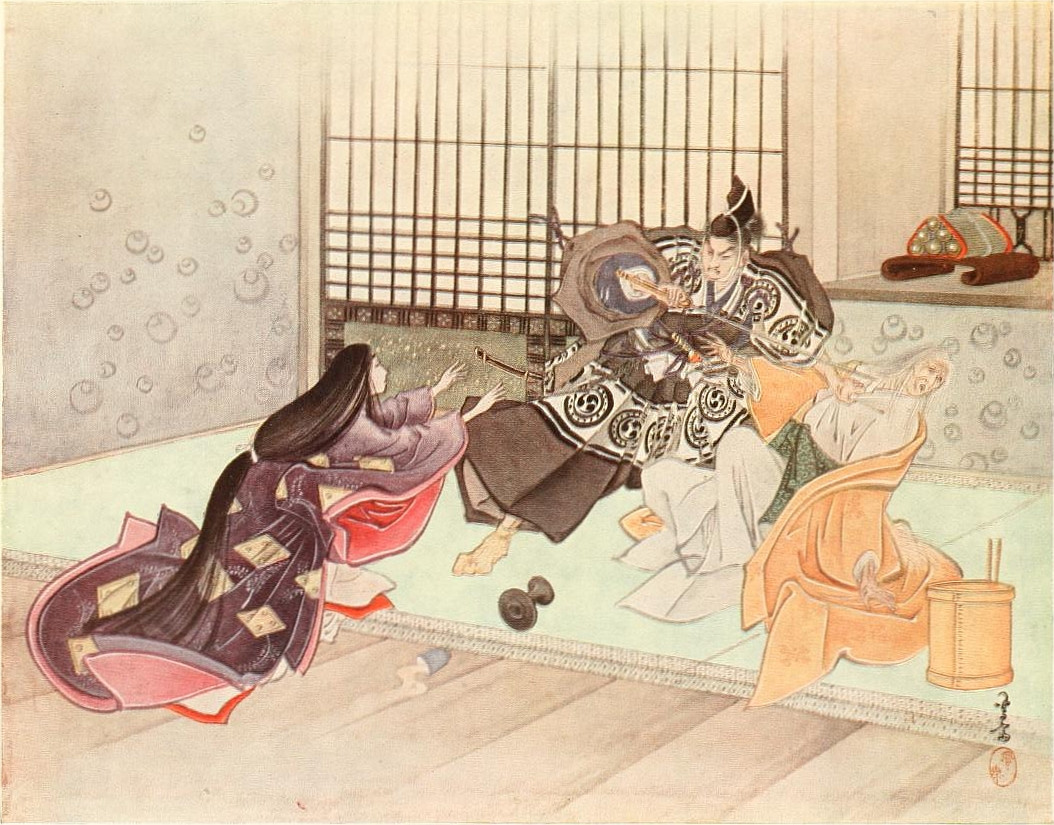
Yendo draws his sword, when between him and the victim of his vengeance there darts the lovely Kesa
Kesa again intervenes between her lover and her mother; again the mother throws herself in an agony of dread between them; but at last Kesa persuades the old woman to retire and to leave all to her discretion. Koromogawa then goes into the next room. The knight fixes his gaze upon his beautiful cousin, he trembles with emotion, and the resolve to possess her strengthens within his storm-tossed soul. She belongs to him by prior right. He had asked for her, and she had been promised to him before Wataru thought of her; what right had her mother to give her to Wataru? Anger sweeps away all remembrance of the past and of what he owes his aunt. Jealousy and desire, and hatred of the one whom he thinks has wronged him, alone remain. In vain Kesa gently pleads and expostulates. As if impatient of the delay of his vengeance, Yendo once more seizes his sword and rushes towards the inner room. Then Kesa wheels round upon him, and with her cheek close to his, her gorgeous crêpe draperies touching him and her hand upon his arm, she whispers in his ear:
"I have always loved you, Yendo. If you really love me as you say, you must first put my husband out of the way, and I am yours."
"How can I kill him?" whispers the determined man.
"Come to-morrow night and steal into the bedroom of my husband. I shall make him drunk with wine. You can identify him by touching his hair, for I shall induce him to wash it before retiring, and you will find the locks wet."
As Kesa whispers her plan the tense figure of the desperate knight relaxes from its stern purpose of murder. Thrilling with hope and passion, he turns to her, and in the attitude of her abandonment and yielding to his will he sees the vision of their united happiness—the gratification of his passionate desires. Little does his wild and lawless nature dream of the escape which the noble woman will force out of the toils fast closing round her. The picture as the two stand together is intensely dramatic, and vibrates with the portent of a mighty crisis.
Act III opens upon the fine residence of Watanabe Wataru, the husband of Kesa. The gleaming cream wood of the veranda and the posts, the fineness of the matting, the dainty white and gold of the walls and screens are all part of the exquisite refinements of a wealthy Japanese home. Kesa and her husband are discovered sitting side by side in a room opening on the garden. A large slab of granite forms the stepping-stone from the veranda and a line of irregular slabs makes a pathway to the bamboo gate which shuts off the outer garden. The whole arrangement and the atmosphere are realistic of a Japanese home.
The young people, both magnificently robed, have only just retired to their sitting-room, for they have been entertaining guests at a banquet. The only furniture in the room is a sword-stand, on which the knight places his long weapon, the insignia of samurai honour. Before them is a small low table[3] (sambo) of white wood, on which stands a white wine-jar and her husband's drinking-cup. Kesa dismisses the two servants in attendance, and then proceeds to pour out some wine for her husband. Wataru little dreams that it is the last cup his wife will ever drink with him, though to her, knowing her premeditated and self-arranged doom, the little ceremony has not only a sacrificial symbolism, but the appalling pathos and irrevocable pitilessness of a last love rite.
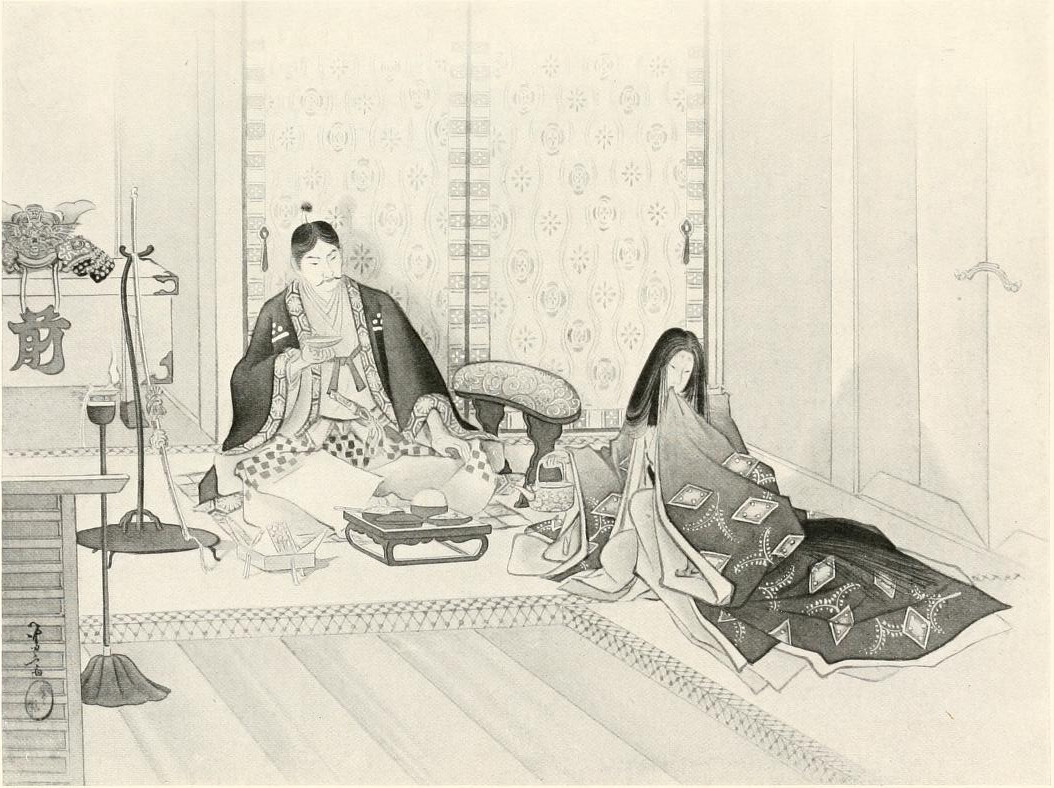
Wataru little dreams that it is the last cup his wife will ever drink with him.
Wataru drains the wine-cup and, handing it to Kesa, pours the wine out for her. Kesa drinks, and then, overcome at last by a sadness which her husband does not understand, turns away and weeps. She explains that her tears spring from the thought of the unchangeable love between husband and wife, which would last even after death. He replies that the knowledge of their mutual faithfulness should be a joy and not a grief. While thus conversing in the hush of night, the deep mellow tone of a temple bell announces the hour of midnight. Kesa persuades her husband to retire to her own bedroom this night. On her knees she pushes aside the screens leading to an inner room, and as he passes in she bows with her head to the floor, and then closes them after him. Never will she see her husband again, yet her self-control is so great that she gives no sign of the emotion which must have surged over her at that moment. She knows that it is an eternal farewell, yet she allows Wataru to pass from her sight with only the usual greeting.
For a little time she stands like one dazed; then, recollecting herself, she disappears for a few minutes and returns along the veranda. Now, for the first time, those that do not know the story divine the tragic end. Her long black hair streams, wet and heavy, over her shoulders, and she feels it as she moves along to make sure that it is quite wet. On her arm she carries one of her husband's kimono and his ceremonial cap, all necessary for the deception of Yendo. Her aspect expresses hopeless grief and resignation. Twice in her slow progress to the outer room she stops and weeps. She looks out upon the still garden, and the coolness of the fragrant air and the soothing silence of the autumn night must seem to mock her woe. At the second outburst of grief it seems for a moment as if her resolution has failed her. She lays her cheek, in a passion of yearning and tenderness, on the robe she carries, and her tears fall fast at the thought of her happy wedded life, so soon to be cut short by the lawless desire of another man. There will be no one to pray for her old mother when she dies—it should be a daughter's duty to offer the daily incense to a mother's departed spirit; she can never know the pride of bearing a son to preserve the name of her husband's family. Oh! the pity of it—the pity of it! These, and more than these, must have been her sad thoughts. That she was loth to leave the world we learn by the poem, written in these moments of anguish, which she left with her farewell letter to her mother. She raises her head at last and comes forward. Her husband's honour, her mother's life, and her own purity are at stake; the weakness of sorrow vanishes—there is no other way than this. Her beauty is the sin, for it has roused Yendo's passion: her beauty must pay the penalty—her life is the sacrifice.
To-night—as she planned when she rushed in upon the tumultuous scene between her mother and Yendo—she will sleep in her husband's room, and when Yendo her cousin comes, instead of killing her husband, his sword will cut off her own head. She lifts the bamboo curtain which hangs before the room at the end of the veranda and passes to her doom.
The stage is darkened and empty. An impressive interval of silence and inaction follows. The audience throbs with the sustained sense of impending catastrophe and fatality hanging over the house. The awful pregnancy of the situation is intensely realistic, and its contrasts are strikingly dramatic. In the inner room—his wife's room, their happy bridal chamber—lies the husband, wrapt in peaceful sleep, pitifully unconscious of the tragedy which is being enacted within a few feet of him. In the outer room the young wife lies waiting in the lonely dark for the sword of her lover. Who can realize the tension of those last minutes, stretched to eternity by the agony of suspense? If by any chance her plan fails, her husband or her cousin will be killed, or both. What if Wataru, roused by some slight noise, come out to find Yendo approaching the room where she has arranged to sleep; what construction must he put upon these circumstances. And then, her senses sharpened by suffering and by the unutterable loneliness of the awful situation, she thinks that she catches the first faint sound of Yendo's stealthy footsteps. She counts them as they draw near, and as the bamboo curtain is raised and the swish of the sword falls upon her in the dark, she smiles to think that the struggle is over, that she has triumphed, and thus she faces death with the magnificent courage with which she had planned it.
Yendo Morito arrives. His long sleeves are looped back, ready for his dreadful work, and in his hand he carries a drawn sword. Swiftly and noiselessly he moves along the veranda; pauses for a few moments outside the room where lies asleep, as he imagines, the only obstacle between him and the woman he loves—loves so passionately, madly, and blindly that he is willing to use the murder of his kinsman as a stepping-stone to reach her. He enters.
The stage revolves. The courtyard of a temple is the next scene, surrounded by a wall with stone steps leading up to the outer court. The murderer is seen coming out upon the top of the steps into the moonlight: he carries something covered under his arm. Turning towards the flood of moonlight with a fierce and unholy joy at the thought of gazing on his rival's head, he uncovers what he carries. To his unspeakable horror and amazement the moonlight reveals the head of Kesa—his love—not that of Wataru, whom it was his purpose to kill. Unable to believe his eyes, he raises the head by the wet hair once more into the full light of the moon. There is no mistake. He recoils in a great revulsion of feeling as the truth forces itself upon his unwilling, shrinking mind, all his strength goes from him, he reels and staggers like a drunken man, and gasping for breath, he falls upon the steps overcome with uttermost anguish and remorse. In that awful moment he sees the hideousness of his crime and the wickedness of his heart in its true light. The cloud of darkness, as the Japanese say, rolls back from his soul, and he is smitten to earth with the sense of his guilt and misery.
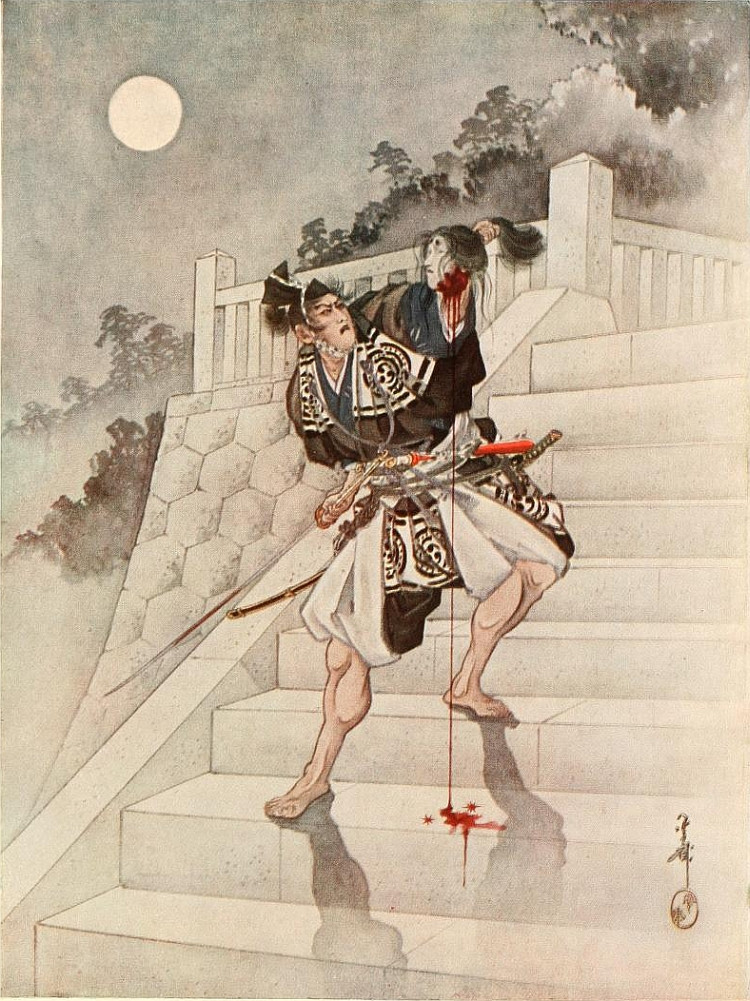
To his unspeakable horror and amazement the moonlight reveals the head of Kesa—his love!
The fourth scene of this Act represents the front gate of Wataru's house. It is the morning following the last scene. Outside stand numerous tradesmen—the rice-man, the fishmonger, and some samurai—all unable to effect an entrance, for, though late in the morning, the house is still closed. After repeated knocking, Kisoda and Otose appear and tell them that, on account of an unfortunate event which has occurred in the house, they must be asked to withdraw for the day. The tradesmen then go grumbling away.
The next scene represents the familiar chamber where Wataru and Kesa sat together the evening before. In the middle of the room lies an ominous pile of quilts covering the remains of Kesa, splendidly dead by her own will. Before the corpse of his young wife sits the husband, the picture of mute and stoic grief. Opposite him is Koromogawa. Behind her again are Tamakoto and Otose. Wataru tells them that last night he slept in his wife's room in compliance with her wish, while she retired to his room. That in the morning he found her killed and her head carried away, and that no clue or trace of the murderer can be discovered. He says he can hardly speak for grief at the loss of Kesa and the disgrace his knighthood has suffered.
An attendant here rushes in and says that Yendo insists on seeing Wataru. Wataru sends a message to say that he cannot receive him now. The servant returns to say that Yendo is forcing his way into the house, and that it is impossible to check him. Yendo rushes in like a whirlwind and seats himself outside the room, on the veranda. He lays the head down before them all and confesses his crime, with all the circumstances relating to it. Then comes the most heart-rending part of the tragedy. The old mother tenderly unwraps the head and, folding it to her bosom, gives way to a loud and long paroxysm of grief. Wail after wail bursts from her. She rocks herself in wild abandonment to the poignancy of an overwhelming and totally unexpected sorrow. The samurai stoicism of the husband avails him not in this hour of bitter trial. He wipes his slow tears furtively away. Tamakoto brings out a letter of Kesa's found in the room where she was killed. Yendo snatches up the letter, spreads it out before him, and reads it aloud. It is addressed to her mother, and may be rendered into English as follows:
"I have always heard [this is a humble form of expression which women are supposed to use—they must never assert a fact] that woman is a sinful creature [because of her beauty, which lures men to sin]. I fear that many people [meaning her mother, husband, and admirer] are in danger of their lives because of me. Mother, I know that you will sorrow much if I die, and I am sorrowful, thinking of the grief which I must cause you. I intend to expiate my sin [meaning the sin of being beautiful, which has caused Yendo to love her] by death. Weep not for me, and though it should be my place to pray for you, I beseech you to pray for the rest of my soul when I have departed on the journey of death. I can understand your sorrow, and this is the only anxiety I feel at this moment."
Morito now presents his sword to Wataru and requests him to take life for life, and to behead him in order to avenge his wife's death. Wataru replies that he has no wish to kill him, since he has confessed and repented of his crime. "Let us forsake this worldly life and become followers of Buddha, and spend the rest of our lives in praying for Kesa."
Then and there the two knights, first Wataru and then Yendo, take their swords and cut off their queues of hair.[4] Tamakoto brings in a low table, and on this Koromogawa places the head of Kesa. A tray with an incense-burner is now placed before the ghastly presence. The stricken mother, having set the incense burning, takes her rosary and bows her head in prayer to the brave departed spirit. Wataru now moves towards the extempore shrine, and worships with his face hidden.
In the presence of transcendent virtue and sublimely unselfish heroism, the sinner is forgotten. The silent scene of woe and desolation is too much for the penitent Yendo; he rises, and with one last-lingering look turns to go into his lifelong retreat from the world. Thus the stupendous tragedy, from the pitch of distraction and calamity, is brought to a quiet and reconciling close.
NOTE.—The title of the play, The Priest Mongaku at the Waterfall of Nachi, is taken from the last scene, which represents the monk Mongaku undergoing his self-inflicted penance of sitting under this famous waterfall where he would have died had not two Buddhist deities descended from Heaven to rescue him. This I have omitted as I considered it an anti-climax. It is an historical fact, however, that Mongaku, to purge himself of his sins, did undergo these terrible austerities and sufferings.
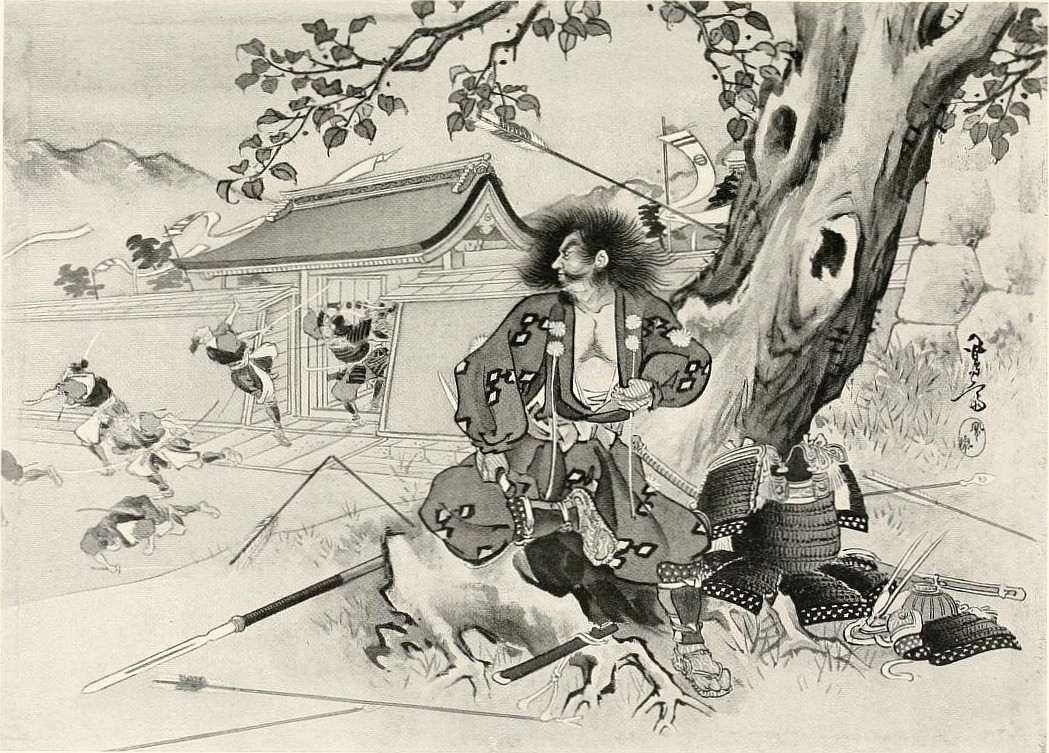
His grandfather had been a retainer of Ota Dokan ... and had committed suicide when his lord fell in battle.
THE SPIRIT OF THE LANTERN
Some three hundred years ago, in the province of Kai and the town of Aoyagi, there lived a man named Koharu Tomosaburo, of well-known ancestry. His grandfather had been a retainer of Ota Dokan,[1] the founder of Yedo, and had committed suicide when his lord fell in battle.
This brave clansman's grandson was Tomosaburo, who, when this story begins, had been happily married for many years to a woman of the same province and was the proud father of a son some ten years of age.
At this time it happened, one day, that his wife fell suddenly ill and was unable to leave her bed. Physicians were called in but had to acknowledge themselves baffled by the curious symptoms of the patient: to relieve the paroxysms of pain from which she suffered, Moxa was applied and burned in certain spots down her back. But half a month passed by and the anxious household realized that there was no change for the better in the mysterious malady that was consuming her: day by day she seemed to lose ground and waste away.
Tomosaburo was a kind husband and scarcely left her bedside: day and night he tenderly ministered to his stricken wife, and did all in his power to alleviate her condition.
One evening, as he was sitting thus, worn out with the strain of nursing and anxiety, he fell into a doze. Suddenly there came a change in the light of the standing-lantern, it flushed a brilliant red, then flared up into the air to the height of at least three feet, and within the crimson pillar of flame there appeared the figure of a woman.
Tomosaburo gazed in astonishment at the apparition, who thus addressed him:
"Your anxiety concerning your wife's illness is well-known to me, therefore I have come to give you some good advice. The affliction with which she is visited is the punishment for some faults in her character. For this reason she is possessed of a devil. If you will worship me as a god, I will cast out the tormenting demon."
Now Tomosaburo was a brave, strong-minded samurai, to whom the sensation of fear was totally unknown.
He glared fiercely at the apparition, and then, half unconsciously, turned for the samurai's only safeguard, his sword, and drew it from its sheath. The sword is regarded as sacred by the Japanese knight and was supposed to possess the occult power assigned to the sign of the cross in mediæval Europe—that of exorcising evil.
The spirit laughed superciliously when she saw his action.
"No motive but the kindest of intentions brought me here to proffer you my assistance in your trouble, but without the least appreciation of my goodwill you show this enmity towards me. However, your wife's life shall pay the penalty," and with these malicious words the phantom disappeared.
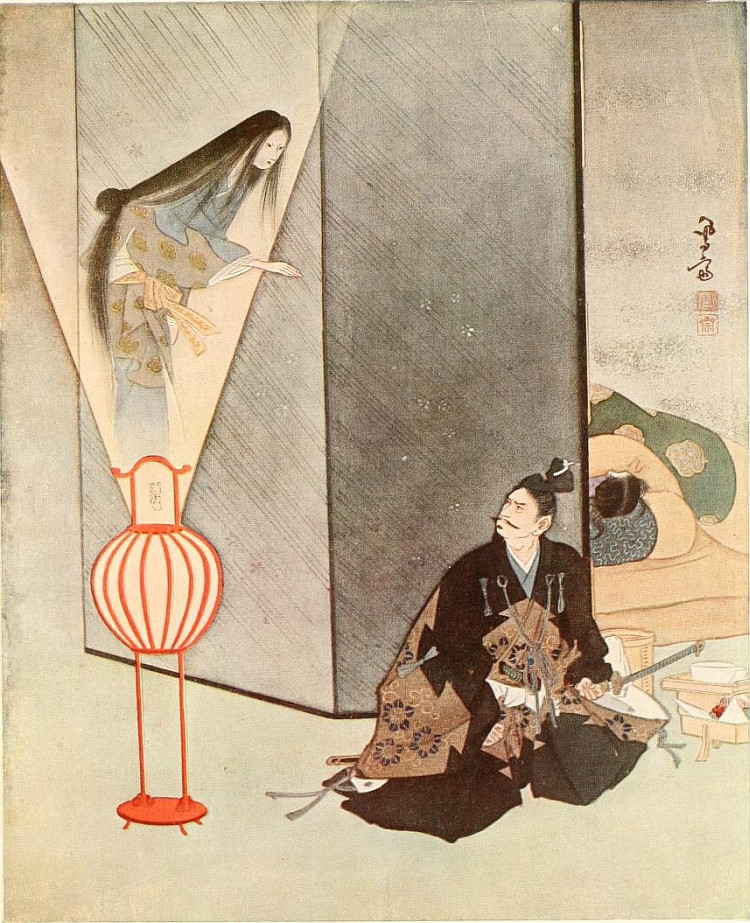
He glared fiercely at the apparition, and then, half unconsciously, turned for the samurai's only safeguard, his sword.
From that hour the unhappy woman's sufferings increased, and to the distress of all about her, she seemed about to draw her last breath.
Her husband was beside himself with grief. He realized at once what a false move he had made in driving away the friendly spirit in such an uncouth and hostile manner, and, now thoroughly alarmed at his wife's desperate plight, he was willing to comply with any demand, however strange. He thereupon prostrated himself before the family shrine and addressed fervent prayers to the Spirit of the Lantern, humbly imploring her pardon for his thoughtless and discourteous behaviour.
From that very hour the invalid began to mend, and steadily improving day by day, her normal health was soon entirely regained, until it seemed to her as though her long and strange illness had been but an evil dream.
One evening after her recovery, when the husband and wife were sitting together and speaking joyfully of her unexpected and almost miraculous restoration to health, the lantern flared up as before and in the column of brilliant light the form of the spirit again appeared.
"Notwithstanding your unkind reception of me the last time I came, I have driven out the devil and saved your wife's life. In return for this service I have come to ask a favour of you, Tomosaburo San," said the spirit. "I have a daughter who is now of a marriageable age. The reason of my visit is to request you to find a suitable husband for her."
"But I am a human being," remonstrated the perplexed man, "and you are a spirit! We belong to different worlds, and a wide and impassable gulf separates us. How would it be possible for me to do as you wish?"
"It is an easier matter than you imagine," replied the spirit. "All you have to do is to take some blocks of kiri-wood [Paulownia Imperialist] and to carve out from them several little figures of men; when they are finished I will bestow upon one of them the hand of my daughter."
"If that is all, then it is not so difficult as I thought, and I will undertake to do as you wish," assented Tomosaburo, and no sooner had the spirit vanished than he opened his tool box and set to work upon the appointed task with such alacrity that in a few days he had fashioned out in miniature several very creditable effigies of the desired bridegroom, and when the wooden dolls were completed he laid them out in a row upon his desk.
The next morning, on awaking, he lost no time in ascertaining what had befallen the quaint little figures, but apparently they had found favour with the spirit, for all had disappeared during the night. He now hoped that the strange and supernatural visitant would trouble them no more, but the next night she again appeared:
"Owing to your kind assistance my daughter's future is settled. As a mark of our gratitude for the trouble you have taken, we earnestly desire the presence of both yourself and your wife at the marriage feast. When the time arrives promise to come without fail."
By this time Tomosaburo was thoroughly wearied of these ghostly visitations and considered it highly obnoxious to be in league with such weird and intangible beings, yet fully aware of their powers of working evil, he dared not offend them. He racked his brains for some way of escape from this uncanny invitation, but before he could frame any reply suitable to the emergency, and while he was hesitating, the spirit vanished.
Long did the perplexed man ponder over the strange situation, but the more he thought the more embarrassed he became: and there seemed no solution of his dilemma.
The next night the spirit again returned.
"As I had the honour to inform you, we have prepared an entertainment at which your presence is desired. All is now in readiness. The wedding ceremony has taken place and the assembled company await your arrival with impatience. Kindly follow me at once!" and the wraith made imperious gestures to Tomosaburo and his wife to accompany her. With a sudden movement she darted from the lantern flame and glided out of the room, now and again looking back with furtive glances to see that they were surely following—and thus they passed, the spirit guiding them, along the passage to the outer porch.
The idea of accepting the spirit's hospitality was highly repugnant to the astonished couple, but remembering the dire consequences of his first refusal to comply with the ghostly visitor's request, Tomosaburo thought it wiser to simulate acquiescence. He was well aware that in some strange and incomprehensible manner his wife owed her sudden recovery to the spirit's agency, and for this boon he felt it would be both unseemly and ungrateful—and possibly dangerous—to refuse. In great embarrassment, and at a loss for any plausible excuse, he felt half dazed, and as though all capacity for voluntary action was deserting him.
What was Tomosaburo's surprise on reaching the entrance to find stationed there a procession, like the train of some great personage, awaiting him. On their appearance the liveried bearers hastened to bring forward two magnificent palanquins of lacquer and gold, and at the same moment a tall man garbed in ceremonial robes advanced and with a deep obeisance requested them not to hesitate, saying:
"Honoured sir, these kago[2] are for your august conveyance—deign to enter so that we may proceed to your destination."
At the same time the members of the procession and the bearers bowed low, and in curious high-pitched voices all repeated the invitation in a chorus:
"Please deign to enter the kago!"
Both Tomosaburo and his wife were not only amazed at the splendour of the escort which had been provided for them, but they realized that what was happening to them was most mysterious, and might have unexpected consequences. However, it was too late to draw back now, and all they could do was to fall in with the arrangement with as bold a front as they could muster. They both stepped valiantly into the elaborately decorated kago; thereupon the attendants surrounded the palanquins, the bearers raised the shafts shoulder high, and the procession formed in line and set out on its ghostly expedition.
The night was still and very dark. Thick masses of sable cloud obscured the heavens, with no friendly gleams of moon or stars to illumine their unknown path, and peering through the bamboo blinds nothing met Tomosaburo's anxious gaze but the impenetrable gloom of the inky sky.
Seated in the palanquins the adventurous couple were undergoing a strange experience. To their mystified senses it did not seem as if the kago was being borne along over the ground in the ordinary manner, but the sensation was as though they were being swiftly impelled by some mysterious unseen force, which caused them to skim through the air like the flight of birds. After some time had elapsed the sombre blackness of the night somewhat lifted, and they were dimly able to discern the curved outlines of a large mansion which they were now approaching, and which appeared to be situated in a spacious and thickly wooded park.
The bearers entered the large roofed gate and, crossing an intervening space of garden, carefully lowered their burdens before the main entrance of the house, where a body of servants and retainers were already waiting to welcome the expected guests with assiduous attentions. Tomosaburo and his wife alighted from their conveyances and were ushered into a reception room of great size and splendour, where, as soon as they were seated in the place of honour near the alcove, refreshments were served by a bevy of fair waiting-maids in ceremonial costumes. As soon as they were rested from the fatigues of their journey an usher appeared and bowing profoundly to the bewildered new-comers announced that the marriage feast was about to be celebrated and their presence was requested without delay.
Following this guide they proceeded through the various ante-rooms and along the corridors. The whole interior of the mansion, the sumptuousness of its appointments and the delicate beauty of its finishings, were such as to fill their hearts with wonder and admiration.
The floors of the passages shone like mirrors, so fine was the quality of the satiny woods, and the richly inlaid ceilings showed that no expense or trouble had been spared in the selection of all that was ancient and rare, both in materials and workmanship. Certain of the pillars were formed by the trunks of petrified trees, brought from great distances, and on every side perfect taste and limitless wealth were apparent in every detail of the scheme of decoration.
More and more deeply impressed with his surroundings, Tomosaburo obediently followed in the wake of the ushers. As they neared the stately guest-chamber an eerie and numbing sensation seemed to creep through his veins.
Observing more closely the surrounding figures that flitted to and fro, with a shock of horror he suddenly became aware that their faces were well known to him and of many in that shadowy throng he recognized the features and forms of friends and relatives long since dead. Along the corridors leading to the principal hall numerous attendants were gathered: all their features were familiar to Tomosaburo, but none of them betrayed the slightest sign of recognition. Gradually his dazed brain began to understand that he was visiting in the underworld, that everything about him was unreal—in fact, a dream of the past—and he feebly wondered of what hallucination he could be the victim to be thus abruptly bidden to such an illusory carnival, where all the wedding guests seemed to be denizens of the Meido, that dusky kingdom of departed spirits! But no time was left him for conjecture, for on reaching the ante-room they were immediately ushered into a magnificent hall where all preparations for the feast had been set out, and where the Elysian Strand[3] and the symbols of marriage were all duly arranged according to time-honoured custom.
Here the bridegroom and his bride were seated in state, both attired in elegant robes as befitting the occasion. Tomosaburo, who had acted such a strange and important part in providing the farcical groom for this unheard-of marriage, gazed searchingly at the newly wedded husband, whose mien was quite dignified and imposing, and whose thick dark locks were crowned with a nobleman's coronet. He wondered what part the wooden figures he had carved according to the spirit's behest had taken in the composition of the bridegroom he now saw before him. Strangely, indeed, his features bore a striking resemblance to the little puppets that Tomosaburo had fashioned from the kiri-wood some days before.
The nuptial couple were receiving the congratulations of the assembled guests, and no sooner had Tomosaburo and his wife entered the room than the wedding party all came forward in a body to greet them and to offer thanks for their condescension in gracing that happy occasion with their presence. They were ceremoniously conducted to seats in a place of honour, and invited with great cordiality to participate in the evening's entertainment.
Servants then entered bearing all sorts of tempting dainties piled on lacquer trays in the form of large shells; the feast was spread before the whole assemblage; wine flowed in abundance, and by degrees conversation, laughter, and merriment became universal and the banquet-hall echoed with the carousal of the ghostly throng.
Under the influence of the good cheer Tomosaburo's apprehension and alarm of his weird environment gradually wore off, he partook freely of the refreshments, and associated himself more and more with the gaiety and joviality of the evening's revel.
The night wore on and when the hour of midnight struck the banquet was at its height.
In the mirth and glamour of that strange marriage feast Tomosaburo had lost all track of time, when suddenly the clear sound of a cock's crow penetrated his clouded brain and, looking up, the transparency of the shoji[4] of the room began to slowly whiten in the grey of dawn. Like a flash of lightning Tomosaburo and his wife found themselves transported back, safe and sound, into their own room.
On reflection he found his better nature more and more troubled by such an uncanny experience, and he spent much time pondering over the matter, which seemed to require such delicate handling. He determined that at all costs communications must be broken off with the importunate spirit.
A few days passed and Tomosaburo began to cherish the hope that he had seen the last of the Spirit of the Lantern, but his congratulations on escaping her unwelcome attentions proved premature. That very night, no sooner had he laid himself down to rest, than lo! and behold, the lantern shot up in the familiar shaft of light, and there in the lurid glow appeared the spirit, looking more than ever bent on mischief. Tomosaburo lost all patience. Glaring savagely at the unwelcome visitant he seized his wooden pillow[5] and, determining to rid himself of her persecutions once and for all, he exerted his whole strength and hurled it straight at the intruder. His aim was true, and the missile struck the goblin squarely on the forehead, overturning the lantern and plunging the room into black darkness. "Wa, Wa!" wailed the spirit in a thin haunting cry, that gradually grew fainter and fainter till she finally disappeared like a luminous trail of vanishing blue smoke.
From that very hour Tomosaburo's wife was again stricken with her former malady, and no remedies being of any avail, within two days it took a turn for the worse and she died.
The sorrow-stricken husband bitterly regretted his impetuous action in giving way to that fatal fit of anger and, moreover, in appearing so forgetful of the past favour he had received from the spirit. He therefore prayed earnestly to the offended apparition, apologizing with humble contrition for his cruelty and ingratitude.
But the Spirit of the Lantern had been too deeply outraged to return, and Tomosaburo's repentance for his rash impulse proved all in vain.
These melancholy events caused the unhappy husband to take a strong aversion to the house, which he felt sure must be haunted, and he decided to leave that neighbourhood with as little delay as possible.
As soon as a suitable dwelling was found and the details of his migration arranged, the carriers were summoned to transport his household goods to the new abode, but to the alarm and consternation of every one, when the servants attempted to move the furniture, the whole contents of the house by some unseen power adhered fast to the floor, and no human power was available to dislodge them.
Then Tomosaburo's little son fell ill and died. Such was the revenge of the Spirit of the Lantern.
THE REINCARNATION OF TAMA
"Felt within themselves the sacred passion of the second life. Hope the best, but hold the Present fatal daughter of the Past. Love will conquer at the last." TENNYSON
N.B.—It is a common Japanese belief that the soul may be re-born more than once into this world. A Buddhist proverb says:
Oya-ko, is-sé Fufu wa, ni-sé, Shu ju wa, sansé. Parent and child for one life; Husband and wife for two lives; Master and servant for three lives.
Under the strong provocation of the passions of love, loyalty and patriotism, the soul may be reincarnated as many as seven times. The hero Hirose, before Port Arthur in 1904, wrote a poem during the last moments of his life saying that he would return seven times to work for his country.
THE REINCARNATION OF TAMA
Many years ago in Yedo,[1] in the district of Fukagawa, there lived a rich timber merchant. He and his wife dwelt together in perfect accord, but though their business prospered and their wealth increased as the years went by, they were a disappointed couple, for by the time they had reached middle age they were still unblessed with children. This was a great grief to them, for the one desire of their lives was to have a child.
The merchant at last determined to make a pilgrimage to several temples in company with his wife, and to supplicate the gods for the long yearned-for joy of offspring. When the arduous tour was over they both went to a resort in the hills noted for its mineral springs, the woman hoping earnestly that the medicinal waters would improve her health and bring about the desired result.
A year passed and the merchant's wife at last gave birth to a daughter. Both parents rejoiced that the Gods had answered their prayers. They reared the child with great care, likening her to a precious gem held tenderly in both hands, and they named her Tama, the Jewel.
As an infant Tama gave promise of great beauty, and when she grew into girlhood she more than fulfilled that promise. Their friends all declared that they had never seen such loveliness, and people compared her to a morning-glory, besprinkled with dew and glowing with the freshness of a summer dawn.
She had a tiny mole on the side of her snowy neck. This was her sole and distinguishing blemish.
Tama, the Jewel, proved a gifted child. She acquired reading and the writing of hieroglyphics with remarkable facility, and in all her studies was in advance of girls of her own age. She danced with grace, and sang and played the koto enchantingly, and she was also accomplished in the arts of flower-arrangement and the tea-ceremony.
When she reached the age of sixteen her parents thought it was time to seek a suitable bridegroom for her. Very early marriages were the custom of the day, and besides that her parents wished to see her happily established in life before they grew older. As she was the only child, her husband would become the adopted son, and thus the succession to the family would be secured. However, it proved exceedingly difficult to find anyone who would meet all their requirements.
Now it happened that near-by in a small house there lived a man by the name of Hayashi. He was a provincial samurai, but for some reason or other had left his Daimio's domain and settled in Yedo. His wife was long since dead, but he had an only son whom he educated in the refinements of the military class. The family was a poor one, for all samurai were trained to hold poverty in high esteem; and to despise trade and money-making.
Both father and son led simple lives and eked out their small patrimony by giving lessons in the reading of the classics and in calligraphy, and by telling fortunes according to the Confucian system of divination. Both were respected by all who knew them for their learning and upright lives.
At the time this story opens the elder Hayashi had just died and the son, though only nineteen years of age, carried on his father's work.
The young man was strikingly handsome. Of the aristocratic type, with long dark eyes, aquiline features and a pale, cream-like complexion, he attracted notice wheresoever he went, and though shabbily dressed he always bore himself with great dignity. He was a musician and played the flute with unusual skill, and the game of go[2] was his favourite pastime, a taste which made him very popular with older men.
He often passed the rich merchant's house and Tama, the Jewel, noticed the young man coming and going with his flute. Questioning her nurse, she learned all there was to know about his history, his poverty, his scholarly attainments, his skill as a musician and the recent sorrow he had sustained in the death of his father.
Besides being attracted by his good looks, the beautiful Tama's heart went out in sympathy to the young man in his misfortune and loneliness, and she asked her mother to invite him to the house as her music-master, so that they might play duets together—he performing on the flute to her accompaniment on the koto.
The mother consented, thinking the plan an excellent one, and the young samurai became a frequent visitor in the merchant's house. Tama's father was delighted when Hayashi proved to be an expert at go, and often asked him to come and spend the evening. As soon as dinner was over the merchant would order the chequer-board to be brought and Hayashi was then invited to try his hand at a game.
In this way the intimacy deepened till by degrees the young man was treated like a trusted member of the family.
The young master and pupil thus meeting day by day, presently fell in love, for heart calls to heart when both are young and handsome and the bond of similar tastes cements the friendship. Choosing themes and songs expressive of love they communicated their sentiments to one another through the romantic medium of music, and the two instruments blended in perfect harmony, the koto's accompaniment giving an ardent response to the plaintive melody of the young man's flute, which wailed forth the hopeless passion consuming his soul for the lovely maiden.
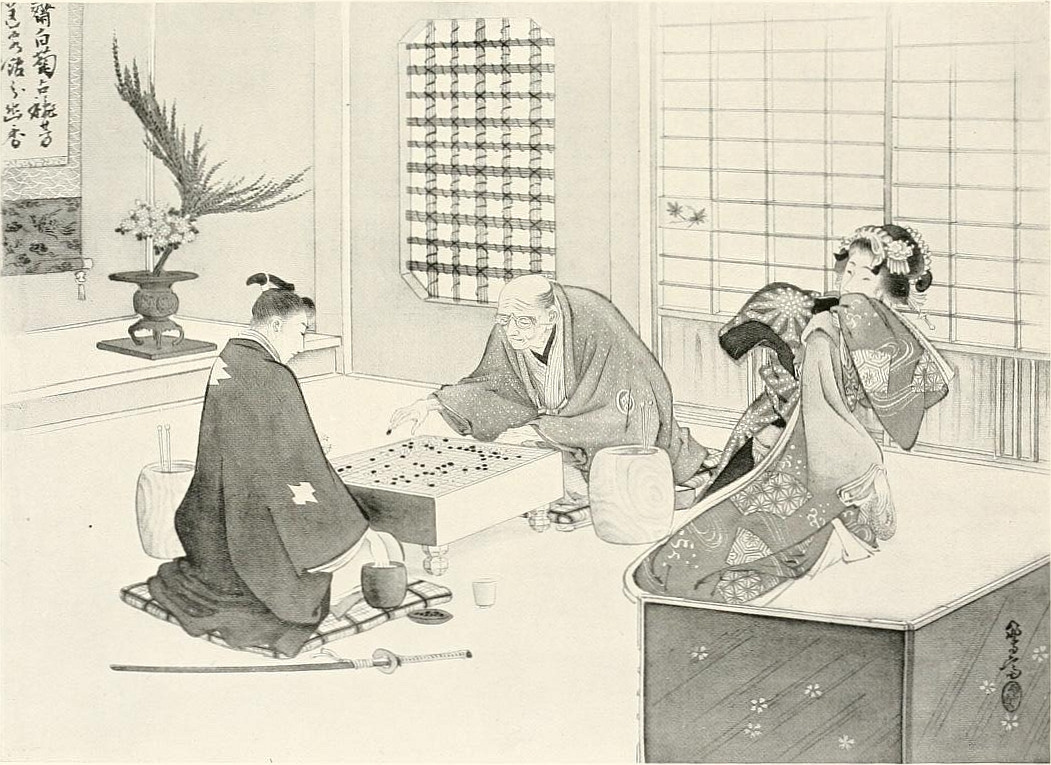
Tama's father was delighted when Hayashi proved to be an expert at go, and often asked him to come and spend the evening
Tama's parents were totally unaware of all that was happening, but her nurse soon guessed the secret of the young couple. The woman, who loved her charge faithfully and devotedly, could not bear to see her unhappy, and foolishly helped the lovers to meet each other in secret. With these unexpected opportunities they pledged themselves to each other for all their lives to come, and tried to think of some way by which they could obtain the old people's consent to their marriage. But Hayashi guessed that the merchant was ambitious for his daughter, and knew that it was improbable that he would accept a son-in-law as poor and obscure as himself. So he postponed asking for her hand until it was too late.
At this time a rich man whom Tama's parents deemed a suitable match for their daughter presented his proposals, and Tama was suddenly told that they approved of the marriage and that she must prepare for the bridal.
Tama was overwhelmed with despair. That day Hayashi had promised to come and play his favourite game with her father. The nurse contrived that the lovers should meet first, and then Tama told Hayashi of the alliance which had been arranged. Weeping, she insisted that an elopement was the only solution to their difficulties. He consented to escape to some distant place with her that very night. Gathering her in his arms he tried to still her sobbing, and Tama clung to him, declaring that she would die rather than be separated from him.
They were thus surprised by her mother, and their secret could no longer be concealed. Tama was taken from him gently but firmly and shut up like a prisoner in one room. The vigilance of the parents being in this manner rudely awakened, the mother never allowed the girl out of her sight, and Hayashi was peremptorily forbidden the house.
The young man, fearing the wrath of her parents, went to live in another part of the city, telling no one of his whereabouts.
Tama was inconsolable. She pined for her lover and soon fell ill. Her elaborate trousseau and the outfit for the bridal household was complete but the wedding ceremony had to be postponed.
Both parents became very anxious for, as the days went by, instead of getting better their daughter visibly wasted away and sometimes could not leave her bed, so weak did she become. To distract her mind they took her to places of amusement like the theatre, or to gardens noted for the blossoming of trees and flowers. Then finally they carried her to places like Hakone and Atami, hoping that the mineral baths and the change of air and scene would cure her. But it was all to no purpose, Tama grew worse in spite of the devotion lavished upon her. Seriously alarmed, the parents called in a doctor. He declared Tama's malady to be love-sickness, and said that unless she were united to the man she pined for that she might die.
Her mother now begged the father to allow the marriage with Hayashi to take place. Though he was not the man of their choice in worldly position, yet if their daughter loved him, it were better that she should marry him than that she should die.
But now arose a difficulty of which they had not dreamed. Hayashi had moved away no one knew whither, and all their frantic efforts to trace him were fruitless.
A year passed slowly by. When Tama was told that her parents had consented to her marrying her beloved, she brightened up with the hope of seeing him again, and appeared to regain her health for a short time. But as month followed month and he never came, the waiting and the sickening disappointment proved too much for the already weakened frame of the young girl. She drooped and died just as she had attained her seventeenth birthday.
It was springtime when the sad event occurred. Hayashi had never forgotten the beautiful girl nor the vows they had mutually plighted, and he swore never to accept another woman as his wife. He longed for news of Tama, but he realized how imprudent and blameable his conduct had been in entering into a secret love-affair with a young girl, and he feared that her father might kill him were he to return even for a single day to the vicinity. Weakly he told himself that she had in all probability forgotten him by this time and was surely married to the man of her parents' choice.
One fine morning he went fishing on the Sumida river. When evening began to fall he turned homewards. As he sauntered along the river embankment, the water lapping softly and dreamily at his feet, he was suddenly startled to see a girlish form coming towards him in the wavering shadows of declining day. Light as a summer zephyr she glided from under the arches of the blossom laden cherry-trees with the sunset flaming behind her. He remembered long afterward that she had seemed rather to float over the ground than to walk.
To his utter astonishment he at once recognized Tama, and his heart leapt with joy at sight of her. After the first salutations he looked at her closely and congratulated her on her good health and ever-increasing beauty. He then asked her to tell him all that had happened since they were cruelly parted.
In the saddest of tremulous voices Jewel answered: "After you left the house my old and devoted nurse was dismissed for having helped us to meet in secret. From that day to this I have never seen her, but she sent me word that she had returned to her old home."
"Then you are not married yet?" asked Hayashi, his heart beating wildly with hope as he interrupted her.
"Oh, no," replied Tama, looking at him strangely, "do you think that I could ever forget you? You are my betrothed forever, even after death. Do you not know that the dread of that marriage being forced upon me and my pining for you made me ill for a long time. Sympathizing with my unhappiness, my parents broke off my engagement and then tried to find you. But you had entirely disappeared leaving no trace behind. To-day I started out, resolved to find you with the help of my old nurse. I am on my way to her now. How happy I am to find you thus. Will you not take me to your house and show me where you live?"
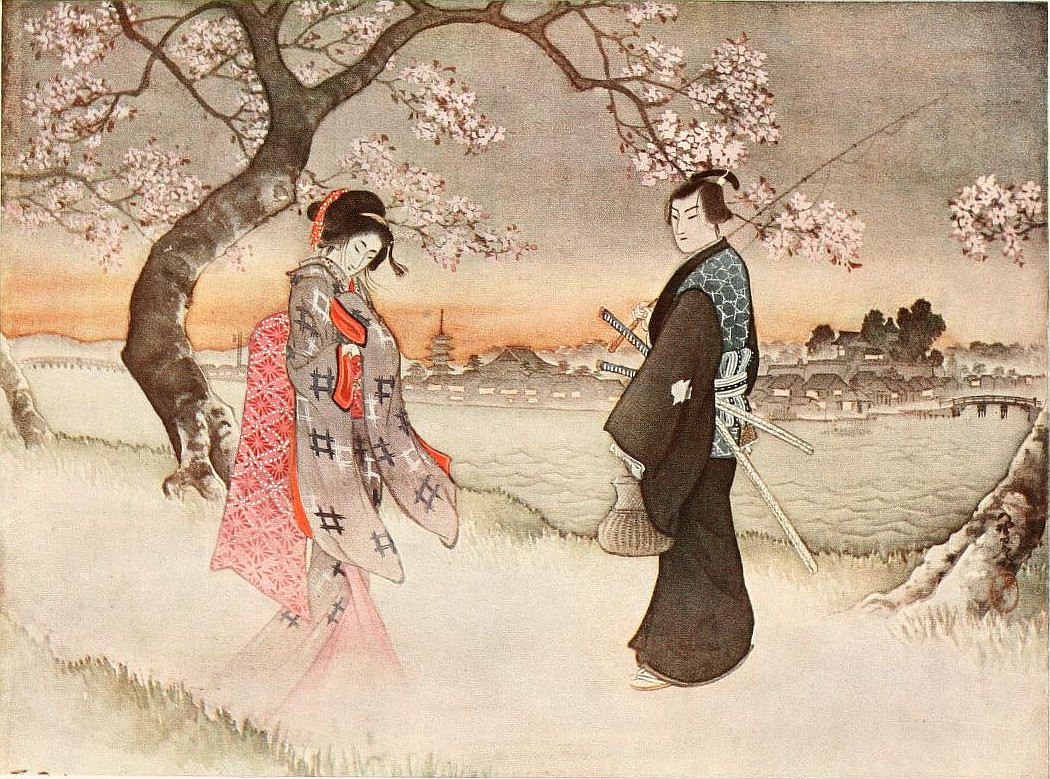
He was suddenly startled to see a girlish form coming towards him in the wavering shadows
She then turned and walked with him as he led the way to their humble dwelling. Now that her parents had consented to her marrying him they need not wait long, he told himself. How fortunate he was that he should have gained such faithful and unchanging love as that of his beautiful Tama.
As they went along exchanging blissful confidences as to their undying love for one another, he told her of his oath never to wed another woman for her dear sake.
They entered the house together, the nearness of her sweet presence thrilling him to his finger-tips. Impatiently he knelt to light the lamp, placed ready on his low writing table, then with joy inexpressible at the anticipation of all that the future held for them, he turned to speak to her.
But to his utter bewilderment Tama was gone. He searched the house and garden, and with a lantern went and peered down the road, but she was nowhere to be seen. She had vanished as suddenly and mysteriously as she had appeared.
Hayashi thought the incident more than strange; it was eerie in the extreme. Returning alone to his empty room, he shivered as a chill of foreboding seemed to penetrate his whole being, withering as with an icy breath the newly awakened impulses of hope and longing. A thousand recollections of his love crowded upon him, and kept him tossing uneasily upon his pillow all through the night. With the first break of dawn he was no longer able to control his feverish anxiety for news of her, and rising hurriedly, he at once set out for Fukagawa.
Eagerly he hastened to the house of an old friend to make inquiries regarding the merchant's family and especially about Tama. To his dismay he learned that she had passed away but a few days before, and listened with an aching heart to the account of her long illness. And he knew that she had died for love of him.
He returned to his home stupefied with grief and tormented with self-reproach.
"Oh, Tama! Tama! My love!" he cried aloud in his anguish, as he threw himself down in his room and gave way to his despair. "Had I but known of your illness I would have come to you. It was your spirit that appeared to me yesterday. Oh! come to me again! Tama! Tama!"
For weeks he was ill, but when he recovered and was able to think collectedly, he could not endure to live longer in such a world of misery. He felt that he was responsible for the untimely death of the young girl. To escape from the insupportable sorrows of life he decided to enter a Buddhist monastery, and joined the order of itinerant monks called Komuso.[3]
Like the monks in the middle ages in Europe the Komuso enjoyed sanctuary. They were chiefly samurai who wished to hide their identity. Sometimes a breach of the law, such as the killing of a friend, obliged the samurai to cut the ties which bound him to his Daimio; sometimes a family blood-feud forced him to spend his years in tracking down his enemy; sometimes it was disgust of the world, sorrow or disappointment, as in the case of Hayashi: these various reasons often caused men to bury themselves out of remembrance in the remote life of these wandering monks.
The Komuso were always treated with great respect, they enjoyed the hospitality of inns and ships, and a free pass unquestioned across all government barriers.
They wore the stole but not the cassock, and they did not shave their heads like the priesthood. They were distinguished by their strange headgear, which was a wicker basket worn upside down, reaching as far as the chin and completely hiding the face. The rules of their order forbade them to marry, to eat meat, or to drink more than three cups of wine, and when on duty they might not take off their hats or bow to anyone, even to their parents. Outside these restrictions, though nominally priests, their lives were practically those of laymen, and when not on service they spent their time much as they liked in practising the military arts or in study.
As a mental discipline the Komuso were under obligation to go out daily to beg for alms, holding a bowl to receive whatever was bestowed upon them. They affected flute playing. This instrument was cut from the stem nearest the root, the strongest part of the bamboo, and was thus able to serve a double purpose. It gave the monk, who carried nothing with him, the means of earning his daily food, and when necessary was used as a weapon in self-defence.
Hayashi, being skilful with his flute, chose the life of the Komuso as being the best suited to him.
Before leaving Tokyo he visited the temple where his lost love was buried and knelt before her tomb. He dedicated his whole life to praying for the repose of her soul and for a happier rebirth. Her kaimyo (death-name) he inscribed on heavy paper, and wheresoever he went he carried this in a fold of his robe where it crossed his breast. It was, and still is, the custom of the Komuso to perform upon the flute as a devotional exercise at religious services.
As each year came round he always made his way to some tranquil spot and rested from his penitential wanderings on the anniversary of the death of Tama.
Staying in an isolated room he then set up her kaimyo in the alcove, and placing an incense burner before it, kindled the fragrant sticks and kept them alight from sunrise to sunset. Kneeling before this temporary altar he took out his flute, and pouring the passionate breath of his soul into the plaintive, quivering notes, he reverently offered the music to her sweet and tender spirit, remembering the delight she had always taken in those melodies before the blossom of their love had been defrauded of its fruit of consummation by the blighting blast of interference.
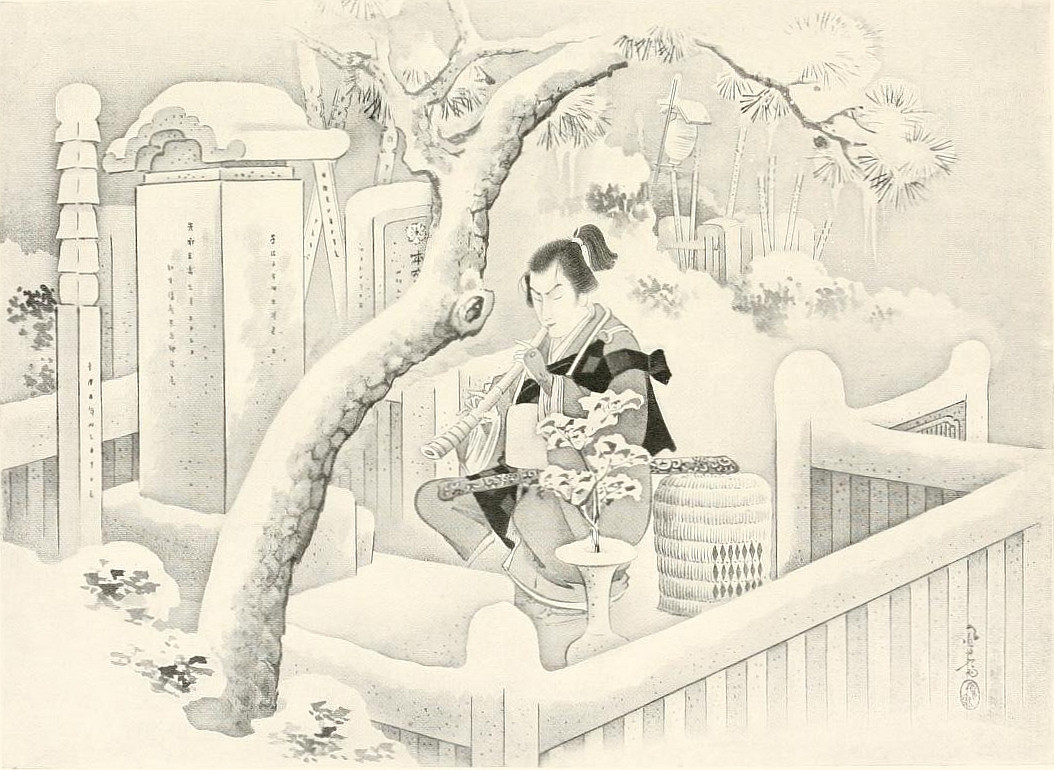
Hayashi visits the temple where his lost love was buried, and dedicates his whole life to praying for the repose of her soul.
And gradually, as time went by, the burden of sorrow and the tumult of remorse slipped from his soul, and peace and serenity, the aftermath of suffering, came to him at last.
He roamed all over the country for many years, and finally his journeyings brought him to the mountainous province of Koshu. It was nightfall when he reached the district and he lost his way in the darkness. Worn out with fatigue, he began to wonder where he should pass the night, for no houses were to be seen far or near, and everywhere about him there was nothing but a heaping of hills and a wild loneliness.
For hours he strayed about, when at last, peering into the gloom far up on the mountain side, a solitary light gleamed through the heavy mists. Greatly relieved he hastened towards it.
As soon as he knocked at the outer door of the cottage a ferocious looking man appeared. When the stranger asked for a night's shelter he morosely and silently showed him into the single room which, flanked by a small kitchen, comprised the whole dwelling. Hayashi, furtively gazing round him, noticed that there were no industrial implements to be seen, but that in one corner were standing a sword and a gun.
The host clapped his hands. In answer to the call a young girl of about fifteen years of age appeared. He ordered her to bring the brazier and some food for the guest. Then arming himself with his weapons, he left the house.
The damsel waited on Hayashi attentively, and as she went to and fro from the kitchen she often glanced appealingly at him. Her attitude was that of one frightened in submission, and Hayashi wondered how she came to be there, for, though begrimed with work, he could see that she was fair and comely, and her deportment was superior to her surroundings.
When they were left alone the girl came and knelt before him, and bursting into tears sobbed out "Whoever you may be I warn you to escape while there is yet time. That man whose hospitality you have accepted is a brigand and he will probably kill you in the hope of plunder."
Hayashi, with his heart full of compassion for the young girl, asked her how it was that she came to be living in so wild and desolate a place, and the tale she told him was a pitiful one of wrong.
"My home is in the next province," she said, as she wiped away the tears with her sleeve. "Just after my father's death this robber entered our house and demanded money of my mother. As she had none to give him he carried me away, intending to sell me into slavery. Soon after he brought me to this house, he was wounded on a marauding expedition, and has since been confined to the house for a month. Thus it is that you find me here still. But he is now recovered and able to go out once more. I implore you to take me with you, otherwise I shall never see my mother again and my fate will be unendurable."
Being of a chivalrous nature Hayashi's heart burned within him at the sad plight of the little maid, and catching her up he fled out of the robber's den into the night.
After some time, when well away from the place, he set her down and they walked steadily all night. By dawn they had crossed the boundary of Koshu and entered the neighbouring province. Once on the high road the district was familiar to the girl and she gladly led the way to her own home.
The delight of the sorrowing mother on finding her kidnapped child restored to her was great and unrestrained. She fell at his feet in a passion of gratitude and thanked him again and again.
In the meantime the rescued girl came to thank her deliverer. Hayashi gazed at her in astonishment. Her appearance had undergone an extraordinary transformation. No longer the forlorn, neglected drudge of the day before, a beautiful girl stood before him. And wonder of wonders! She was the living image of what his lost Tama had been years ago. The tide of the past swept over him with its bitter-sweet memories, leaving him speechless and racked with the storm of his feelings. Not only was the likeness forcibly striking, but he also beheld a little mark, the exact replica of the one he so well remembered on Tama's snowy neck.
He had thought that in the long years of hardship and renunciation of the joys of life the tragic love of his youth lay buried, but the shock of the unmistakable resemblance left him trembling.
In a few minutes he was able to control his emotion and the power of speech returned to him.
"Tell me," he said, turning to the mother, "have you not some relatives in Tokyo? Your daughter is like one whom I knew many years ago, but who is now dead."
The woman regarded him searchingly and after a few moments of this close scrutiny, she inquired: