Part 2 — PART II
Yei Theodora Ozaki translation
SCENE: A village school kept by Takebe Genzo and his wife Tonami, both devoted vassals of the exiled Prime Minister, Michizane Sugawara. Among Takebe's pupils is the young Sugawara. This boy they disguise and pass off as their own child. The little lord, though only eight years of age, excels in everything among the pupils and, inheriting the ability from his father, writes Chinese hieroglyphics with great skill. The senior pupil is a lazy, stupid, and incorrigibly mischievous fellow, fifteen years of age, who will not study at all.
"While our teacher is out it is a great waste of time to practise writing. Look! I have done all my writing on my head." and the lazy boy came forward and showed his school-fellows a shaved pate all blackened with Indian ink.
The little Sugawara looked at him and said:
"If you learn one new character every day you will acquire three hundred and sixty-five characters in a year. Instead of wasting your time playing like that, you must study."
But the older boy only laughed at him, and left his desk to prance about the room.
The other boys took the part of little Sugawara and, growing disgusted with the idle boy, wanted to punish him. There arose a great clamour in the school-room, all the boys shouting together and leaving their places to attack him.
Disturbed by the noise, the schoolmaster's wife came out from the inner room.
"What is the matter? Are you quarrelling again? To-day the master is away. He has been invited by a friend, and I do not know when he will come back. As we are expecting a new pupil to-day I am anxious for his return. Now, if you are good boys and will work hard this morning, I will give all of you a half-holiday this afternoon."
The boys were delighted with this promise. All promptly returned to their seats, and opening their books and their inkstands, became diligently absorbed in their tasks of reading and writing.
Just then a sound at the porch made Tonami draw aside the screens. A gentle and aristocratic-looking woman was standing there with a pretty boy of about eight years of age by her side. A manservant, carrying a desk, was in attendance.
After an exchange of civilities, the visitor explained:
"Our home is at the other end of the village. The reason for my visit is to ask you to take this naughty boy into your care, as arranged the other day. I am told that you have a child of your own about his age. I should like to see him!"
Tonami beckoned to the little Sugawara.
"Why, certainly; this is our son and heir!"
"Oh, what a nice little fellow! And how clever he looks!" Then looking round the school-room, she added:
"How busy you must be with such a number of scholars in your care. They must be a great trouble and responsibility."
"Yes, you may imagine it is no easy work to look after them all. Is this the boy you wish us to take charge of? What is his name?"
"His name is Kotaro!" answered the mother.
"What an intelligent-looking child!" exclaimed Tonami.
"Unfortunately my husband has been obliged to keep an appointment with some friends. But if you are in a hurry and cannot wait, I will go and fetch him."
"No, no," protested Matsuo's wife, "as I have an errand elsewhere I will call in on my way back. He may have returned by then."
Then calling her servant, she ordered him to bring in the presents she had brought, one for the master, and some cakes to distribute amongst the schoolboys. In a few graceful words the gratified hostess acknowledged her visitor's kind thought.
"Oh, it is nothing—only a little token of thanks from my heart for all the trouble my boy is going to give you." Then turning to Kotaro, she added:
"I am going to the next village, so you must wait for me here like a good child—don't forget all I have told you!"
"Oh, mother, I want to come with you!" Kotaro suddenly cried, catching her by the sleeve as she was stepping into the porch.
"Now, do not be naughty!" remonstrated his mother, "a big boy like you ought not to run after your mother. Look, Tonami San, what a baby he is still!"
"Oh, it is quite natural, poor little fellow. Look here, Kotaro! Come with me and I will give you something nice." Then, turning to O Chiyo, she added "Try to come back as soon as possible."
"Yes, yes, I will come back at once, if you are a good boy, Kotaro."
Seizing the opportunity she slipped out through the porch gate, followed by her servant, who closed it after her, and the two briskly clattered away on their clogs. The poor mother yearned to turn back once more, for she knew that she would never see her little son again in this world; but she kept bravely on her way.
While Tonami was trying to console Kotaro, and to distract his attention by introducing him to the little Sugawara, her husband returned. His face was pale, and he was evidently profoundly agitated. As he entered the school-room he sharply scrutinized each of the boys in turn. His wife saw at a glance that something unusual must have occurred.
"Oh, what common fellows they are!" he muttered, crossly. "Such country-bred louts can never serve my purpose, however great the trouble I take with their education," and he gloomily regarded them with knitted brows, as though something was weighing heavily on his mind.
His wife approached him and anxiously inquired: "What is the matter? You seem unusually worried to-day. You knew from the first that those village lads can never become intellectual. People will not think well of you, if you speak against your own scholars in this way. Besides, we have another pupil to-day. Please try to recover your good temper and look at the new boy." With these words she brought forward Kotaro, but Takebe had become absorbed in his own preoccupation, and took no notice of the child.
Kotaro came forward, bowed respectfully, and said: "Please, sir, I look to you to teach me from now."
At these words, spoken in a clear, sweet treble, Takebe started from his reverie and fixed his eyes upon the new-comer; by degrees his face gradually brightened as though struck by a new train of thought.
"What a handsome and dignified boy. You might easily pass for the son of a nobleman or any other exalted personage. Well, you are a fine fellow!"
"He is, indeed," responded Tonami, with a smile. "I thought you would be glad to see such a promising pupil."
"Yes, yes," assented the master—"nothing could be better," he muttered, in an undertone, as if speaking to himself; and then aloud, "where is the mother who brought him here?"
"As you were not at home, she went to the next village on an errand," replied his wife.
"That is capital!" said Takebe, growing more and more pleased. "Send this child with our boy to an inner room, and let them play together."
"Now," said Tonami, turning to the class of schoolboys, who had been more assiduous than ever since their master's return, "all of you may have a holiday. Run away and play in the garden!"
After sending her two special charges into the next room, and looking around with suspicious eyes that no eavesdropper was lingering behind, she lowered her voice and half-whispered to her husband:
"When you came in you looked so harassed and troubled, but since you have seen that boy, your demeanour has suddenly undergone a complete change. What can be the reason for this? Something unexpected must have happened! Won't you let me share the secret?"
"It is quite natural that I should have been so perplexed and dumbfounded," answered Takebe. "To deceive me they pretended to be giving a feast, and invited me to the residence of the village mayor, but when I arrived I soon found the feast was all a myth, and the house was in the occupation of Shundo Gemba, vassal of Tokihira, and another man, Matsuo by name, who is under great obligations of gratitude to the ex-Prime Minister, but who has deserted the house of Sugawara, and now shamefully serves the enemy, Tokihira. It seems as though he must have been appointed to examine the head of our young lord, for it has leaked out that he is here under our guardianship, and Tokihira has ordered him to be beheaded. These two men, with some hundred followers, surrounded me in a hostile manner, with this threat:
"We have received information that you are secreting the only son of the ex-Prime Minister in your house, disguised as your own child. Unless you kill him at once and bring his head to us, we will attack you and slay him ourselves.
"As no alternative was left me, I was compelled to pretend to assent to their proposal. I thought that amongst our pupils surely there would be one sufficiently like to be sacrificed in his stead, but when I came home and was confronted by all that row of plebian faces, it was an obvious fact that not a single one would answer the purpose. All those young boors are of a common and vulgar type, and as unlike as possible to the aristocratic face and noble bearing of our palace-reared boy. Despair seized me, but—when I saw the new pupil—it seemed as if he had been specially sent by Providence as a substitute. The difference between them is not so great as that between a crow and a white heron. If I can deceive them but for a short time with that boy's head, I intend to escape to Kawachi with the young prince."
His wife broke in:
"But that man, Matsuo, has known Kanshusai intimately since he was three years old. How could he be deceived?"
"There lies the difficulty," said Genzo, "but after death faces always change to some extent, and as Kotaro unmistakably bears some resemblance to our young master, even Matsuo may be deceived. At any rate we will risk it. In the event that the ruse is discovered, I am determined to kill Matsuo at once, and try to cut my way through the guards as best I can, but if they are too strong for me, I will die with the young prince. Such is my decision, but the chief anxiety at present is concerning the mother of that boy. If she should come back before this can be achieved, what course of action can we decide on?"
"Leave her to me! I will try to throw dust in her eyes!" suggested Tonami.
"No, no, that won't do—a great plan often fails through some small mistake." Then, after a moment's reflection, he added, "Oh, well—I suppose she must die, too!"
"What!" cried his wife, in alarm.
"Be quiet," admonished her husband. "For the young lord's sake we must stop at nothing. It is for our master's sake, remember that!"
"Yes, yes, if we are weak we shall fail in our great scheme. Let us become devils. There is not much difference between pupils and one's own children. That boy became our pupil at this critical moment—heaven must have delivered him into our hands as the result of his mother's sin in a former existence. Oh, well! the same fate may overtake us before long—" At this point their pent-up feelings gave way, and both of them shed tears.
Shortly afterwards Gemba and Matsuo arrived at the gate. They were closely followed by a number of villagers, the parents of the common pupils in the school. In great excitement, one and all were loudly clamouring for the safety of their own children.
Matsuo almost laughed. The situation was one of such grim comedy. Each peasant evidently thought his own son might easily pass for the young aristocrat!
"Oh, mine is a beautiful boy," shouted one man. "You mustn't make any mistake between my son and the real victim. Give me my boy—" he turned fiercely to Gemba.
"You need have no apprehension whatever regarding your children," said Gemba, calmly addressing the alarmed parents, who now squatted on the ground with their heads bowed in the dust, "if you want them, you are at liberty to take them away at once!"
Matsuo, who was in a kago,[7] here stepped out, using his long sword as a stick to lean upon. Both he and Gemba sat on stools, which their attendants placed ready.
"Just wait a little," said he—"we cannot be too careful even with these villagers. The reason why I accepted the office of examiner is because there is no one else who knows the young prince's head as well as I do. These people allowed the young Sugawara to live in this village, so very likely they may have sympathy with the ex-Prime Minister and may claim his son now, pretending that he is one of their own family, and so aid him to escape! Who knows?"
Then, turning to the agitated peasants, he said to them, "Now, my men, you may call out your children's names one by one. I will examine each face carefully. Your own boys shall be safely restored to you, rest assured of that!"
The schoolmaster and his wife, from the house, overheard all that was going on, and Matsuo's determined and arrogant demeanour only served to intensify their fears. It was going to be even more difficult than they had apprehended.
An elderly man came forward, and in a loud voice, called out:
"Chomatsu, Chomatsu!"
In answer, an ill-favoured, pock-marked boy ran out, his face covered with smudges of Indian ink.
Matsuo glanced at him.
"The difference is as great as between snow and charcoal. He may go!" In turn, all the rest of the pupils were searchingly inspected, but not one bore the slightest resemblance to the ill-fated Kanshusai. When the pacified villagers had carried away all their offspring in triumph, Gemba and Matsuo entered the schoolmaster's house.
"Genzo!" began Gemba, in tones of authority, "you promised to behead the young Sugawara—I will receive that head now!"
Without betraying the least sign of feeling, Genzo replied:
"Yes, but he is the son of the ex-Prime Minister. We cannot slaughter him like a common boy. Please wait for a short time!"
"Oh, you cannot deceive us," said Matsuo, quickly. "Dallying in this way is merely pretext for gaining time. But it is useless for you to attempt to disappear now, the rear of the house is guarded by some hundred men, and there is no room even for an ant to escape. You may produce a substitute head, with the explanation that a dead and a living face have a different appearance. I shall not be taken in by a subterfuge. Such tricks on your part will only lead to repentance!"
This last thrust hit Genzo hard, but he did not lose his self-possession and answered Matsuo quietly,
"What a far-fetched idea! Your eyes, after your long illness, may not be able to see things clearly, but I will surely give you the head of the young lord you demand."
"Before your tongue is dry," exclaimed Gemba, impatiently, "behead him at once!"
"It shall be done!" replied Takebe, and went into an inner room. His wife, who had listened to all that transpired, was in an agony of anxiety, pale and trembling. Matsuo, with sharp eyes, was looking round the room.
"It is rather mysterious," he said, suddenly, "eight pupils have gone home, and yet, there are nine desks. What has become of the owner of that extra desk?"
Tonami started. She began to explain that there was a new pupil. Matsuo saw her vacillation. In an undertone, he said: "What a fool you are! Keep quiet!" Then, realizing how fatal such a mistake would be—Tonami collected herself and managed to stammer out. "That is the young Sugawara's desk!"
But her confusion had been noticed by the enemy. Gemba started to his feet and shouted in furious tones,
"This trifling will cause the frustration of our plans!"
At that moment the sound of a sword broke the silence as it fell swishing through the air, the screens of the room shook, and before Matsuo and Gemba could reach the partition which separated the inner from the outer room, Takebe appeared, carrying a white wooden tray. A cover hid what was beneath, but a thin trail of crimson blood was ominously oozing from the edge. Kneeling on the mats before the two men, he placed his ghastly burden before them.
"There was no alternative, so I was forced to behead the young lord. May Heaven forgive me! As it is a matter of such importance that there should be no mistake—please examine it carefully."
With these words, Takebe's hand stealthily fell upon his sword-hilt. Every fibre was on the alert to cut down Matsuo the moment he realized the deception that had been practised on him.
"I will certainly do so," replied Matsuo, nonchalantly, then, addressing some of the soldiers who had followed him into the room, he peremptorily gave them the command:
"Now surround the Takebe couple!"
From the rear of the house several guards entered and took up their posts at the porch, and just behind Genzo and his wife.
The strain was almost too great for the poor woman, and she was well-nigh fainting with the sickening uncertainty of what might be the last act of that dreadful drama. Gemba, looking on, took note keenly of the proceedings.
Everything hung on Matsuo's decision. The suspense of the moment was agonizing in its intensity.
He slowly lifted the blood-rimmed cover from the wooden tray. A boy's decapitated head was exposed to view. It was the head of little Kotaro.
Takebe's eyes were riveted on Matsuo. Defiantly he swore that Matsuo should draw his last breath the moment he declared the head to be a subterfuge. As a tiger ready to spring on its prey, the desperate man watched the judge on whose next word hung all their lives.
Tonami was praying to the Gods in silent fervour that the truth might not be discovered, tremblingly she clutched a short sword hidden beneath her robe, which her husband had surreptitiously handed her, in preparation for the worst.
Matsuo deliberately examined the head of his own son—carefully and searchingly from every side he scrutinized the little face, now so still and pallid, sometimes his eyes blinked to hide the gathering tears, and once his face contracted with pain, but at last he loudly pronounced the momentous verdict:
"Oh, there can be no doubt that this is the head of Kanshusai, the son of the Lord Sugawara." Triumph, at the success of his loyal plot, conquered every other feeling and he slammed the lid back into place.
Gemba, delighted that there had been no mistake, and that the gruesome commission had been successfully carried out, accorded words of praise to Takebe for beheading the boy.
"As a reward for this deed, you will be pardoned for harbouring him so long! Let us hasten to take the head to Lord Tokihira," he said, turning to Matsuo.
"Yes, it is better that no time should be lost," responded the latter, "but as my duty is now finished, may I request to be discharged on sick leave?"
"Certainly," Gemba replied, "as your mission is satisfactorily concluded, you may go."
He then took up the tray with the bleeding head, strode to the door, and calling his attendants, pompously set out at once for Tokihira's palace. Outside the gate he stopped and mockingly addressed Takebe: "Ha, ha, ha!" he laughed, "though you take great care of the boy usually, when your own life is in danger you do not fail to cut off his head! ha, ha, ha!" and the cruel man, with this parting sneer, went on his ruthless way. Matsuo silently followed him out of the house and got into his kago.
The husband and wife, now that they were left alone, were quite exhausted from the emotion and stress of the past hour. They went out and closed the gates. Both were speechless with joy for some minutes. The master, sighing with relief, bowed his head and turned to the four points of the compass, silently returning thanks to the deities whose help he had invoked.
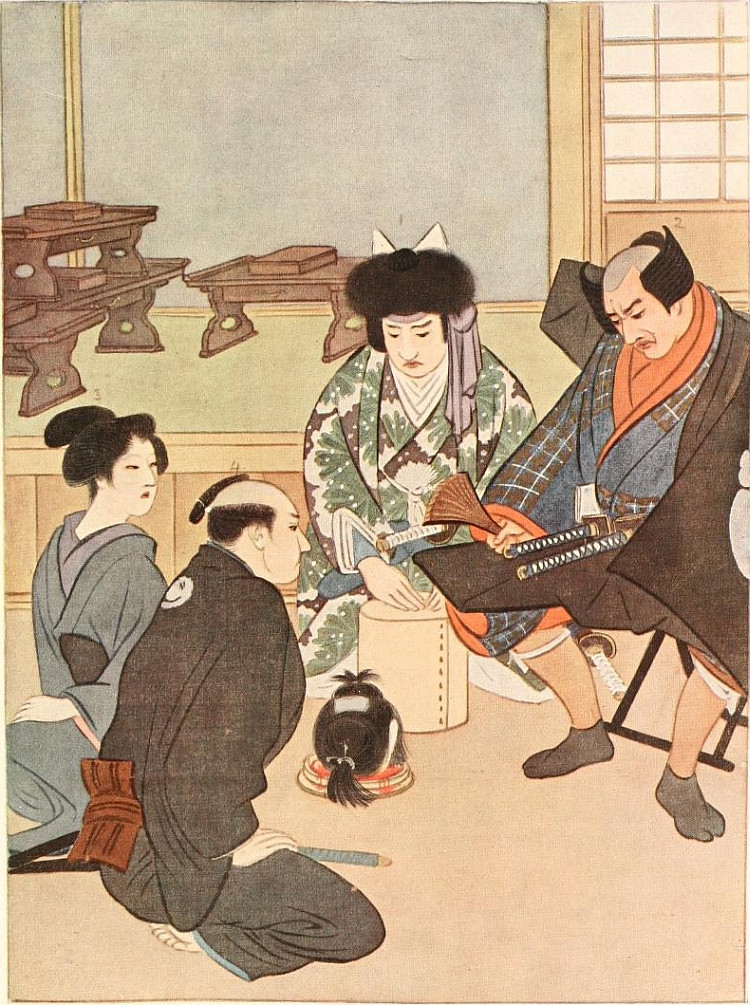
This is the head of Kanshusai, the son of the Lord Sugawara.
"Oh, Heaven be praised!" he exclaimed at last. "The Gods have accorded their mighty aid to our cause and mercifully caused Matsuo's eyes to be dimmed, so that he mistook the other boy's head for that of our young prince. Heaven has clearly interposed to help our lord. Let us rejoice, my wife!"
"Yes, yes," she answered, "what a terrible strain it has been! In some unfathomable way the spirit of our lord must have cast a veil over Matsuo's eyes, or that head may have become a golden Buddha to help our cause. Though there was a slight resemblance between the two boys, yet they differ in reality as much as brick from gold. I was so transported at the success of our plan, that I almost wept aloud with the poignancy of joy when I saw that Matsuo was deceived."
When the loyal couple had given vent to their feelings, simultaneously they rushed to the side-room, where they had concealed their precious charge. The one from the side and the other from the front pushed aside the screens. Genzo then raised one of the tatami (a padded mat three feet by six feet), disclosing a cavity in the floor, out of which rose up the aristocratic form of Kanshusai, safe and untouched by his enemies. They gazed at him in silence—overwhelmed.
Suddenly, a knocking at the gate and the voice of Kotaro's mother disturbed them.
"I am the mother of the new pupil. Let me in!"
Startled, they hastily closed the screens. At this turn of events Tonami was at her wits' end, and knew not what to do for the best. She ran to and fro across the room like one demented.
Seeing that Tonami was losing her self-control and was about to burst out into excited speech, her husband enveloped his hand in the sleeve of his robe and covered her mouth. He held her still with grim determination.
"Remember what I said a short time ago. It means simply this—nothing is so precious as our young lord. You weak creature!" he added, with disdain, as he saw his wife's trepidation. Then he turned and went to the entrance.
"I fear my naughty boy must be giving you a great deal of trouble," said the new-comer, as Takebe let her in, "but what has become of him now?"
To gain time, Takebe replied, little knowing that he was confronted by a soul as strong in loyalty to the Sugawara as his own:
"He is in the house playing with the other children—school is over for to-day, so you must take him back with you."
"Very well," she assented, and started towards the house.
Directly her back was turned, Takebe drew his sword and tried to cut her down from behind. O Chiyo, a samurai woman, was a trained fencer. She swiftly comprehended the meaning of Takebe's movement, even before he drew his sword, the sound, as it left its sheath, confirming what her alert senses divined. Quick as lightning she darted aside, barely escaping the deadly weapon as it tried to compass her destruction. Again and again the desperate man thrust at her. All would be lost even now, if this woman discovered that her boy had been slain to save their lord's son. With a box which she carried in her hand, O Chiyo skilfully parried the blows.
"Wait, wait! What is the matter?" she gasped out. But her frenzied antagonist was far too excited to listen, and he struck out with such good-will that the box, which served her as a shield, was speedily cut in two, and there appeared, unfolding and fluttering in the breeze as they fell, a little winding sheet, and a sacred banner used for the dead, bearing in black hieroglyphics, the inscription, "Namu Amida Butsu!" (All hail, Great Buddha!)
Takebe's hand was paralyzed by this unexpected apparition. Bewildered as to what this could mean, he glanced inquiringly at O Chiyo.
"Was my boy considered worthy to take the place of our young lord or not?" she asked, meeting his gaze steadily with her clear eyes. "Tell me the truth!"
At such totally unlooked-for words, Takebe was confounded more than ever. Was it possible that the enemy he was seeking to destroy had unexpectedly become a friend?
"Oh, oh!" he stammered, "Did you understand and anticipate all this?"
"Yes, of course," answered the brave mother. "As I anticipated everything, I prepared and brought these things in Kotaro's box."
"Whose wife are you?" cried the astonished man, as he sheathed his sword.
Before she could answer a voice from outside the gate chanted a poem:
Ume wa tobi Sakura wa karuru Yono naka ni Nani tote Matsu[8] wa Tsure na kakuran. In my service Plum blossom has fled The Cherry has withered How then can the Pine be Heartless to me?
"Rejoice, my wife! Our boy has done his duty!" When these brief words conveyed to the heroic woman that the sacrifice had been consummated in the tragic fate of her cherished son, her brave spirit failed her, and she fell unconscious to the ground.
"What a poor creature you are!" exclaimed her husband, as he entered the room.
At the unexpected arrival of Matsuo, the schoolmaster and his wife were more confused than ever, but with an effort Takebe attempted to regain his self-possession.
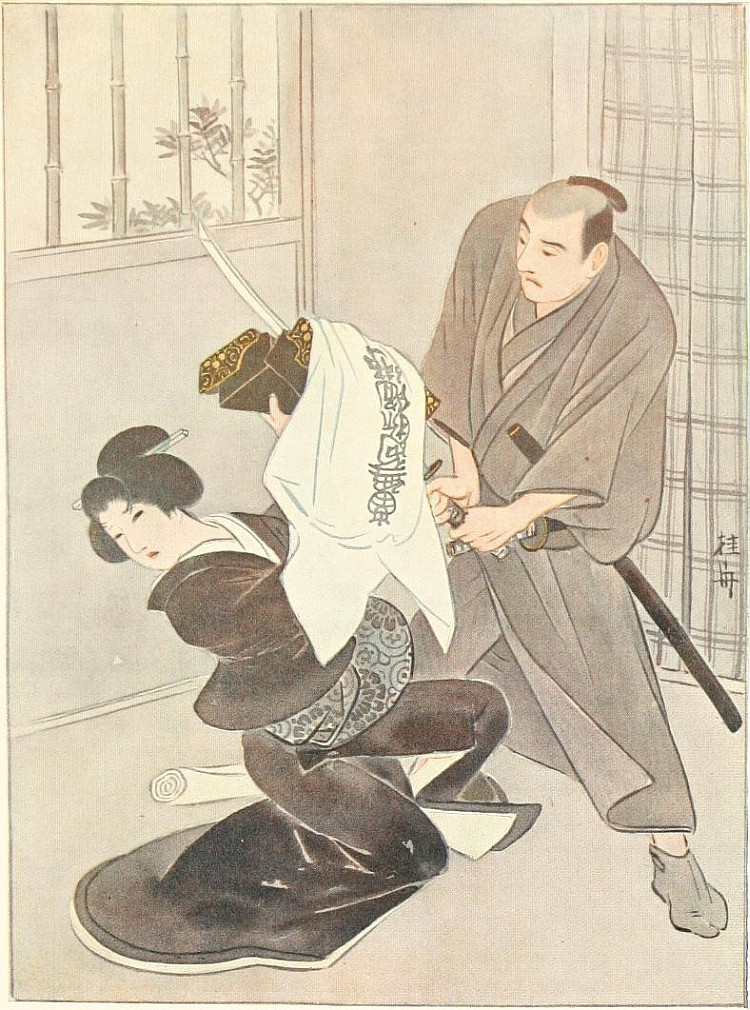
The box, which served her as a shield, was speedily cut in two, and there appeared, unfolding and fluttering in the breeze, a little winding-sheet and a sacred banner for the dead
"I will use more ceremonious speech afterwards. You Matsuo, whom we all believed a traitor to behave like this! What is the meaning of it all?"
"It is quite natural that you cannot understand. We were three brothers. All were faithful vassals of Michizane, the Minister of the Right, to whom my family was deeply indebted. I, Matsuo, latterly entered the service of Tokihira, and on this account I was disowned by my father. I dissimulated thus, the better to serve Lord Sugawara. However, the position proved intolerable, and to get my dismissal I feigned illness. It was at this juncture that the news of where Kanshusai was concealed reached the ears of Tokihira. A messenger informed me that I would be released from office if I would undertake the mission of securing the head of our young lord. I felt sure that you would never commit such a crime, but if no substitute could be procured I knew that you would be desperate. Thinking that the time had come to repay the debt of gratitude to our generous benefactor, I consulted with my wife, and we sent our own boy to take the place of his son. That is why I counted the number of desks, to see if he were already here or not. Lord Sugawara composed the poem I quoted just now, showing his discernment of my character. In that poem he asks, 'How can the pine be heartless towards me?' But the world, in general, interpreted those lines in a contrary sense, and everyone denounced me as a cowardly deserter. You may imagine, Genzo, how I resented this. If I had had no son, I must have passed as a traitor all my life. There is no possession so precious as a son."
O Chiyo, who had meanwhile recovered from her faint, was intently listening to her husband's explanations with a composed demeanour. But at these words she could restrain her emotion no longer, and sobbed aloud.
"Oh, how our Kotaro must rejoice although in another world, to hear such sentiments from his father. Those words are his best requiem. When I left him a short time ago, he looked unusually sad—for his childish mind understood that he was about to die. I intended to go home and deceive him, saying that I was going to the next village and would return soon. But I could not go home. Oh! the yearning to see even his dead face once more was so great that I came back. You may scoff at my weakness, but my sorrow is well-nigh unendurable. Had our Kotaro been born ugly, and brought up as a common child, he might not have suffered such a death. But as he was beautiful, obedient, and good, he was chosen for the sacrifice. Could I have known his untimely fate I would never have found fault with him. Oh, my son, my little, little son!"
And the poor woman, overcome with the poignancy of her grief and the bitterness of her renunciation, fell with her face to the mats, trying to suppress the rending sobs which seemed to tear her breast asunder.
Here Tonami came close to the sorrowing mother and murmured in tones of sympathy:
"Only a short hour ago, when my husband had decided that he should be the substitute for the young prince, Kotaro came up to him and said, innocently, 'Master, please take care of me!' When I think of this, though I am but a stranger, I feel as if my heart would break. I can imagine how desolate his true mother must be to lose such a sweet child," and the tears fell from her eyes.
"No, no, Tonami! No, no, my wife! You must not weep. It was our own decision to let him die in the place of our young lord. You, O Chiyo, ought to be ashamed to give way like this before strangers. But," and Matsuo turned anxiously to Takebe, "although I carefully explained to my boy the reason for his fate, and how he should die with dignity, tell me, did he meet death in a miserable way, or did he die like a samurai?"
"Yes, oh, yes!" Takebe quickly replied. "When I told the brave boy that his head must be cut off to save our young lord, the child of his benefactor, he calmly and courageously, without a word, placed his neck in readiness for the sword—he did not attempt either to hide or to escape from his impending doom. You must have taught him well—he even smiled at the last—rest assured of that!"
The schoolmaster could say no more, with strong restraint he tried to hide his feelings and pretended to laugh, but the forced mirth ended with a choking sound in his throat.
At this point the stoic father broke down and wept, and as he wiped away the slow tears, he said, in a low voice: "He was both good and clever, was our little Kotaro. Even at the age of nine he takes the place of his parents to prove our gratitude to our lord. He is a filial child—a fortunate child to be able to do that I The more I think of it the more it recalls my brother, Sakura Maru. He died without being able to make any return for the obligation he was under to his lord. How he must envy our boy!"
"Oh, Kotaro soon followed him to another world!" wailed O Chiyo, and with these words she burst into another paroxysm of grief.
The young Sugawara, the innocent cause of this tragedy, overhearing the poor mother's heart-rending sobs, came out from an inner room, pale and awe-stricken:
"If I had only known that he was going to die for me, I would not have allowed it—oh—how sad! how sad!" he exclaimed, and with his long sleeve, he wiped away the tears from his eyes.
Matsuo and his wife turned and bowed to the little fellow while he spoke. For this boy's sake their family must sink into oblivion and nothingness, and be no longer remembered among the living; for his sake there would be no one to keep up the rites of the dead before their ancestors' tombs or their own, when they should be no more. On this altar of loyalty to his father's house they had offered all that this world held for them of joy, hope, and ambition. On this altar they had laid up for themselves a cheerless, desolate, childless old age. To this sublime ideal of duty, unhesitatingly, unflinchingly, regardless of themselves and the acuteness of their sufferings, these simple martyr-souls had made this great renunciation. That the young lord should realize this sacrifice they had not in the least expected. His words surprised them. It was balm to their stricken hearts, that even in some small measure he could appreciate what they had done for him.
Then Matsuo rose and went to the porch.
"I have brought a present for our young master," and with a whistle, he summoned a kago that had been waiting in the garden. As soon as the bearers set it down out stepped the Lady Sugawara.
"Oh, my mother! My mother!" almost shouted the boy, as she quickly entered the house, her long mantle of gold brocade and crimson linings flashing colour as she moved.
"Oh, my son, my beloved son!" cried the overjoyed mother, folding the child to her heart.
The schoolmaster and his wife exclaimed with joy when they realized the identity of the new-comer After their respectful greetings, Takebe said:
"I have been long striving to discover your hiding place. Where can your ladyship have taken refuge all this time?"
Matsuo answered for her:
"When her ladyship was hiding in the suburbs, Tokihira's retainers got scent of her retreat and nearly succeeded in taking her prisoner. Knowing her danger I disguised myself as a yamabushi[9] and managed to rescue her just in time, so she has been concealed in my house ever since. Without delay you must now escort her and Kanshusai to Kawachi,[10]—so that they may once more be a united family, safe from the pursuit of their enemies."
Then, turning to his wife, he added, "Now let us carry home the body of Kotaro and begin the preparations for his funeral rites."
But before O Chiyo could answer, Tonami reverently carried the headless body of the slain child to the kago. O Chiyo followed, and kneeling, placed over Kotaro the white shroud and the sacred banner.
Matsuo and his wife then took off their outer robes, revealing the white garments of ceremonial mourning in readiness for the obsequies. Takebe and his wife made a gesture of surprise and deprecation.
"It is against custom that parents should attend the funeral of their own son. Let us spare you this trial—we will do everything in your place!" they cried.
"No, no," said Matsuo, loyal unto death, even the death of his only son for the sake of his lord, "this is not the body of my boy. We are going to bury our young lord!"
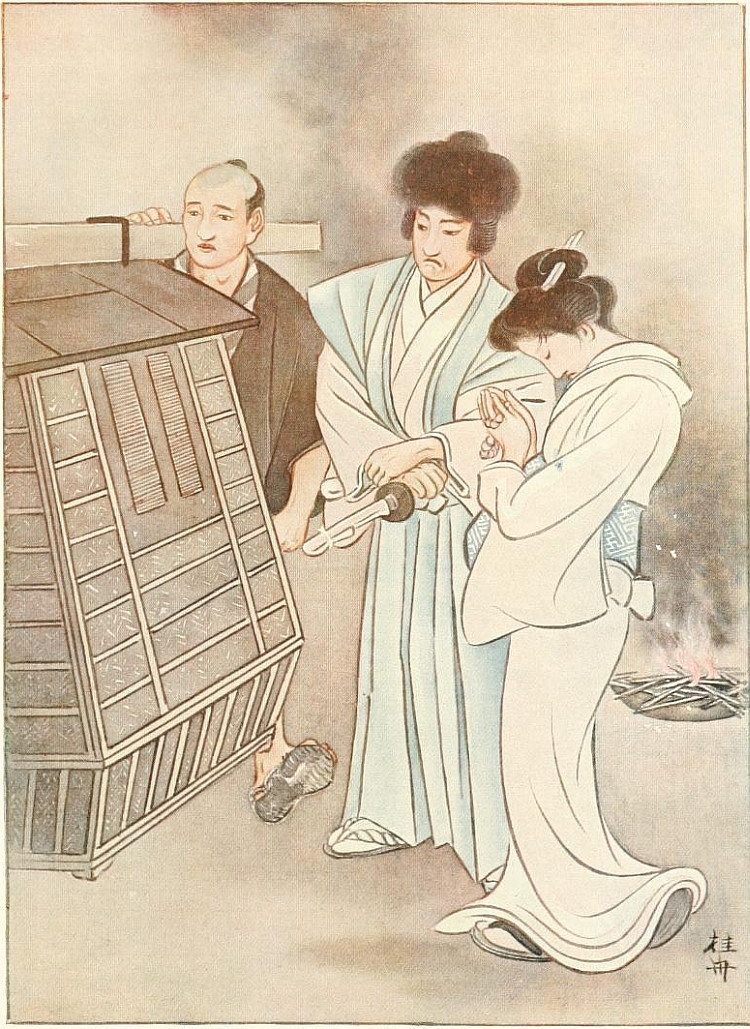
"No, no," said Matsuo ... "this is not the body of my boy.... We are going to bury our young lord!"
With these words, Matsuo and his wife took their farewells. Then, turning in silence, they followed the impromptu bier which bore all that was left to them of their well-beloved child, and with bowed heads reverently wended their way towards their now desolate and empty home. Lady Sugawara, her son, Genzo and Tonami, with tears falling from their eyes, watched the little procession slowly disappear down the road into the deepening shadows of the night.
Note.—"The memory of the unfortunate statesman, Sugawara-no-Michizane, is surrounded by a halo of romance which affords an insight into Japanese character. He belonged to an ancient family of professional litterateurs, and had none of the titles which in that age were commonly considered essential to official preferment. By extraordinary scholarship, singular sweetness of disposition, and unswerving fidelity to justice and truth he won a high reputation, and had he been content with the fame his writings brought him, and with promoting the cause of scholarship, through the medium of a school which he endowed, he might have ended his days in peace. But, in an evil hour, he accepted office, and thus found himself required to discharge the duties of statesmanship at a time of extreme difficulty, when an immense interval separated the rich and the poor, when the arbitrariness and extortions of the local governors had become a burning question, when the nobles and the princes were crushing the people with merciless taxes, and when the finances of the Court were in extreme disorder. Michizane, a gentle conservative, was not fitted to cope with these difficulties, and his situation at Court was complicated by the favour of an ex-Emperor (Uda) who had abdicated but still sought to take part in the administration, and by the jealousy of the Fujiwara representative, Tokihira, a young, impetuous, arrogant, but highly gifted nobleman. These two men, Michizane and Tokihira, became the central figures in a very unequal struggle, the forces on the one side being the whole Fujiwara clan, headed by the unscrupulously daring and ambitious Tokihira; those on the other, a few scholars, the love and respect of the lower orders, and the benevolent tolerance of the self-effacing Michizane. The end was inevitable. Michizane, falsely accused of conspiring to obtain the throne for his grandson—an Imperial prince had married his daughter—was banished to Dazaifu, and his family and friends were either killed or reduced to serfdom. The story is not remarkable. It contains no great crises or dazzling incidents. Yet if Michizane had been the most brilliant statesman and the most successful general ever possessed by Japan, his name could not have been handed down through all generations of his countrymen with greater veneration and affection."—BRINKLEY, "Japan: Its History Arts and Literature," p. 256.
HOW KINU RETURNED FROM THE GRAVE
In the good old days of long, long, ago, there lived in the city of Osaka a rich merchant. Fortune had smiled upon his enterprises, and his business prospered tenfold, until he possessed in abundance all that this world had to bestow: moreover, he was proud in the possession of a little daughter, named Kinu, beautiful as a ten-no-tsukai, one of the angels of the Buddhist heaven; her fame spread far and wide, and all who saw her marvelled at her exceeding loveliness.
In contrast to the opulence and grandeur of this wealthy man, next door, in a poor and mean house, there dwelt a humble vendor of tobacco, who was also blessed with an unusually handsome child, a boy named Kunizo, and who chanced to be of the same age as his little neighbour.
From earliest times Kinu and Kunizo were accustomed to play together almost daily, and shared all their childish joys and sorrows, so that gradually a deep and enduring affection sprang up between the two. All who saw them took great delight in watching the grace and beauty of the two children, who seemed so well suited to each other, and who made a perfect picture when seen together.
As, however, the little playfellows grew older, from motives of prudence, the rich merchant and his wife sought to discourage their intimacy, and their daughter was gradually removed as much as possible from the companionship of the lowly neighbour's son.
But although Kinu and Kunizo could no longer enter into each other's daily life and play as formerly, yet the strong bond of sympathy and affection that linked them together never grew less, and silently within their hearts they cherished the remembrance of all the happy days they had spent in each other's company.
At last, when Kinu reached the age of seventeen, her beauty and charm had become so celebrated, and the merchant's wealth and position so well established in the city, that she was sought in marriage by the son of a great nobleman. The parents, highly elated at the distinction of such a lofty alliance for their lovely daughter, immediately gave their consent, and all preliminaries were speedily arranged for the nuptials to take place at an early date.
Just at that time, Kinu, with some of her girl friends, and under the escort of her old nurse, paid a visit to the theatre. Her mother, expecting her to be the cynosure of all eyes as the bride-elect of the heir of a well-known noble family, attired her daughter in the most exquisite robes that could possibly be procured. The fashions of that period were brilliant in hue, and especially suited to Kinu's luxuriant beauty, so that when she appeared all eyes gazed with admiration and envy at the radiant vision; indeed, the audience gazed more at her than at the play.
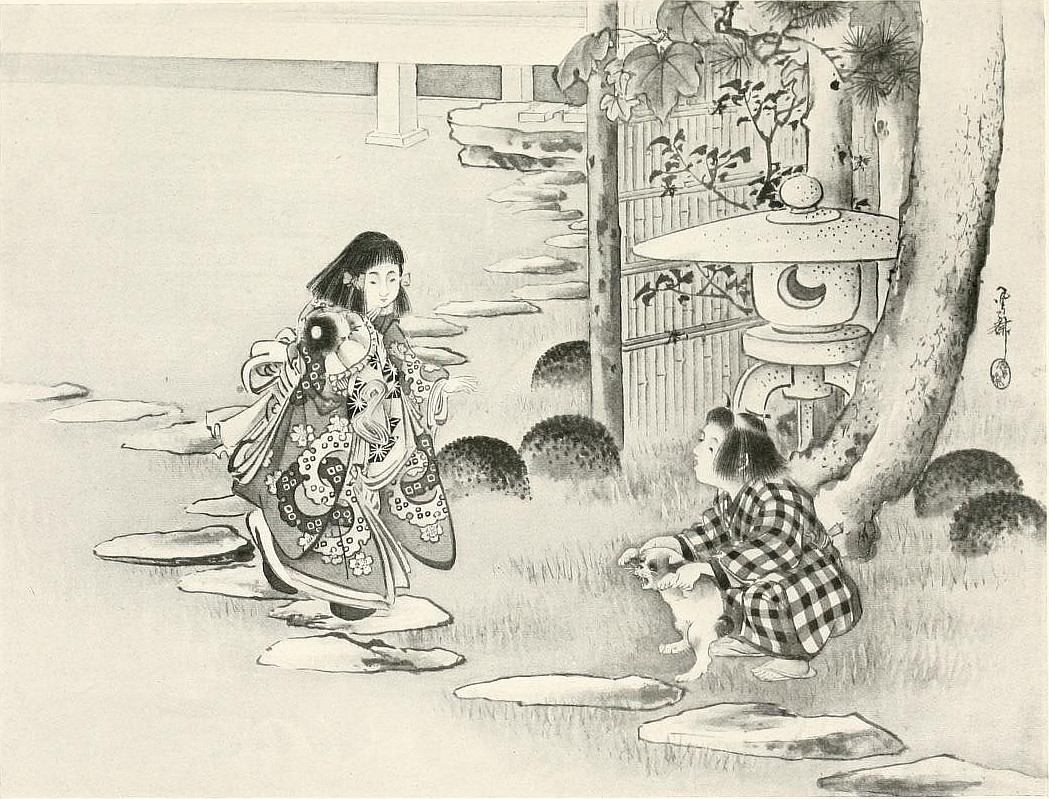
From earliest times Kinu and Kunizo were accustomed to play together
How inexorable are the decrees of Destiny! That day it happened that Kunizo also visited the same theatre.
From his humble seat in the pit, his eyes followed the direction where everyone else was turning, and he soon descried his former friend and playfellow, seated in a prominent place and surrounded by friends and attendants as befitting her approaching exalted position.
Kunizo felt a great impulse to go and speak to her, but dared not. His only solace was to gaze with ardent longing at the lovely apparition, that now seemed as far removed from him as the moth from the star.
Meanwhile, it was not long before Kinu singled out, from amongst the sea of faces, the familiar features of her dear comrade of earlier days, and their glances were soon exchanging reciprocally tender messages across the intervening space.
Memories of their childhood's friendship had long been secretly smouldering in their hearts, and opportunity alone was needed to fan the flame into unquenchable passion.
As the lovers gazed at each other in that crowded place, both their young hearts were carried away beyond the bounds of time and circumstances, and they realized, with an overwhelming conviction, how strong were the golden fetters of love that riveted their souls to each other for all eternity.
That night Kunizo returned to his humble home in a very sad and downcast frame of mind. His thoughts were busily contrasting the happy times of those bygone days, when he could frequently enjoy the society of his beloved Kinu, with now, when, as he bitterly reflected, a gulf yawned between them, as impassable as that which separates Heaven from Hell!
And, brooding over the miseries of an unjust world, poor Kunizo fell sick, and was confined for days to his room.
Meanwhile, the beautiful bride-elect returned to her father's mansion with her heart strangely agitated. The sight of his handsome face, so full of hopeless longing, when his eyes sought her in the theatre, had deeply affected her, and she could not forget him. At last she also fell ill, and after a time became too weak to leave her bed.
She felt like a poor insect caught in the entangling meshes of a cruel Fate. The mere thought of the brilliant marriage that had been arranged by her parents became detestable to her, and tossing on her fevered pillow, long and earnest were her daily supplications to the powers above to find her some means of escape.
To the faithful old nurse alone did Kinu dare to confide her tormenting troubles, and the old woman, sorely distressed at the constant fits of weeping and increasing melancholy of her stricken foster-child, at last promised to be the bearer of a message to Kunizo.
Then Kinu embodied her woes in a little poem to which she composed an accompaniment on the koto, and she found much solace singing it repeatedly to herself in the solitude of her chamber.
The nurse's sympathies being with the hapless pair, she soon found an opportunity to inform Kunizo of the love-poem that Kinu had dedicated to him, and the knowledge that his affection was requited brought such joy to his sad heart that all traces of sickness left him, and he was able to resume his usual mode of life.
But not so with Kinu. Day and night the image of Kunizo alone filled her thoughts, and the more fervently she longed to see him the more her malady increased.
The merchant and his wife were plunged into deep distress and anxiety concerning the mysterious ailment that had so suddenly attacked their beloved daughter: the most skilful doctors were hastily summoned to her bedside, but all their ministrations proved of no avail, and the love-smitten patient, like a wilted flower, continued to fade and droop.
Now, although Kunizo had grown up amidst poor and obscure surroundings, yet he had received a good education, and had always cherished a great devotion to literature, and especially poetry, for the composition of which he had a natural gift. So when the news reached him that his lady-love was lying on a bed of sickness, he composed a little poem for her, revealing the state of his mind, and entrusted it to the care of the faithful nurse:
To O KINU SAMA So near Belovèd, yet long leagues apart, The ladder to thy Heaven so far and dim, Its steps I dare not scale! One night my soul a butterfly became: Straight to its goal thy presence sweet, It fluttered softly through the starlit dusk Behind thy purple tasselled sudare[1]. What ecstasy was mine! From KUNIZO
This message brought great comfort to Kinu's heart, for until then she had merely guessed Kunizo's affection for her, and had no certain proof of it. Joyfully she wrote a little stanza in response:
To KUNIZO SAMA What matter that our weary feet Tread thorny paths and wastes forlorn If only we together climb? What matter that a hermit's hut Is all our shelter from the blast? Beyond the mists one shining star, Our heart's true guide bright beckons us! Earth's dust shake off, and hand in hand Set out in faith to Love's lone peak! From KINU
From that time, day by day, the enamoured pair existed on the exchange of their love-tokens, while the happiness of being in such constant and intimate intercourse with her old friend led to Kinu's sudden and complete recovery.
In the meantime her parents, overjoyed at their daughter's restoration to health, and in total ignorance of all that was taking place, hastened to select an auspicious day for the marriage, and began with enthusiasm the elaborate preparations for the important event.
When the hapless Kinu realized that her destiny was irrevocably sealed, and that she was condemned to become the wife of another man, she became almost frantic.
Disobedience and defiance of her parent's wishes being out of the question, she pondered morning, noon, and night over the dreadful situation: but it seemed that nothing short of a miracle could prevent or even delay the marriage ceremony with the hated bridegroom.
After long days and nights of futile scheming, it seemed to her distraught brain that the only line of action left to her was this: once arrived at the nobleman's house she determined, on pretence of illness, to ask permission to isolate herself in her own apartments; but should he insist on her presence, there would be but one course left to her to follow, and since it was doomed that she should not be the Bride of Love, she would become the Bride of Death.
This desperate decision she communicated in her last farewell to the distracted Kunizo, and as a pledge of finality and her unshakeable resolve, she wrote the letter in blood, drawn from a self-inflicted wound on one of her fingers, and tied this ominous missive with a long tress of her silken, ebony hair.
The fateful day arrived. Passively the unwilling, shrinking bride submitted to the obsequious attendants, who robed her slender form in the gorgeous wedding-garments and applied the adornments of art to enhance her pale beauty, so that when she appeared before them, the relatives and friends, who had assembled for the occasion, were enchanted, and all were loud in praise of her surpassing loveliness.
At last the evening came and the hour of departure was at hand. Kinu took formal leave of her parents, and then, steeling her heart with the firm resolution to escape from the hateful bondage of this forced marriage, entered her kago, and was slowly borne to the house of the bridegroom, closely followed by a long procession of her parents, the go-between, and attendants.
Now, it happened that some years before the young nobleman had formed a liaison with a woman, a famous danseuse and singer, to whom he had been deeply attached. According to the custom of those times he had installed her in his house, and being of an ambitious nature, from the first she had cherished the hope that in time her devotion would be rewarded by becoming his legal wife, and the mistress of that noble house. When, therefore, she learnt of the death-blow to her aspirations in her lover's approaching marriage to a young bride of peerless beauty, the shock was so great as to unhinge her reason.
Secretly she nursed her bitter feelings: vainly she hoped that her agonized prayers to the Gods might be heard, and that the dreaded marriage might yet be cancelled.
But when the evening of the wedding-day arrived, and the lights of the bridal procession had already come into view along the road, and were slowly nearing the house, her fury could no longer be restrained. Mad with jealousy and disappointment she rushed into the garden, stabbed herself through the breast, and in a last convulsive frenzy, cast her bleeding body down the well.
At that moment the massive gates were thrown open, and the bride's sumptuously lacquered kago appeared, surrounded by a numerous retinue, carrying lanterns and torches.
Suddenly, an unearthly gust of cold wind arose whirling wildly round the mansion, and all the lights were extinguished. In the dense gloom of that moonless night, what was the terror of everyone to behold in front of them, barring the way before the passage of the bride, the spectre of the deserted mistress! Shrouded in a cloud of pale-bluish mist, her ghastly face and blood-stained garments struck terror to the souls of the petrified spectators—her long dishevelled hair streamed behind her in the breeze, which was not of this world, and her hands were uplifted in menace towards the bride, from whose kago a wild and heartpiercing shriek was heard.
The bridegroom, who with a group of retainers had been impatiently awaiting the advent of Kinu at the entrance to the house, was a horrified spectator of the fearful scene. His wrath was uncontrollable. With drawn sword he rushed to the gate and made a wild attempt to cut down the wraith of his jealous paramour—but as his sword fell, in a flash the whole apparition vanished.
Great was the commotion that followed, but by degrees the alarmed servants and bearers recovered from their fright, the torches and lanterns were relighted, and the door of the palanquin was opened.
Alas! to all appearances the beautiful bride was dead. Like a white lily she lay back on her cushions, pale and still.
Physicians were summoned in all haste, but they declared that remedies were of no avail—life was extinct.
The hapless Kinu had perished. Coming as a climax to the mental anguish she had suffered, the horror of the ghastly welcome that had greeted her, was beyond the endurance of her frail spirit, and on the threshold of her new and dreaded home, it had taken wing.
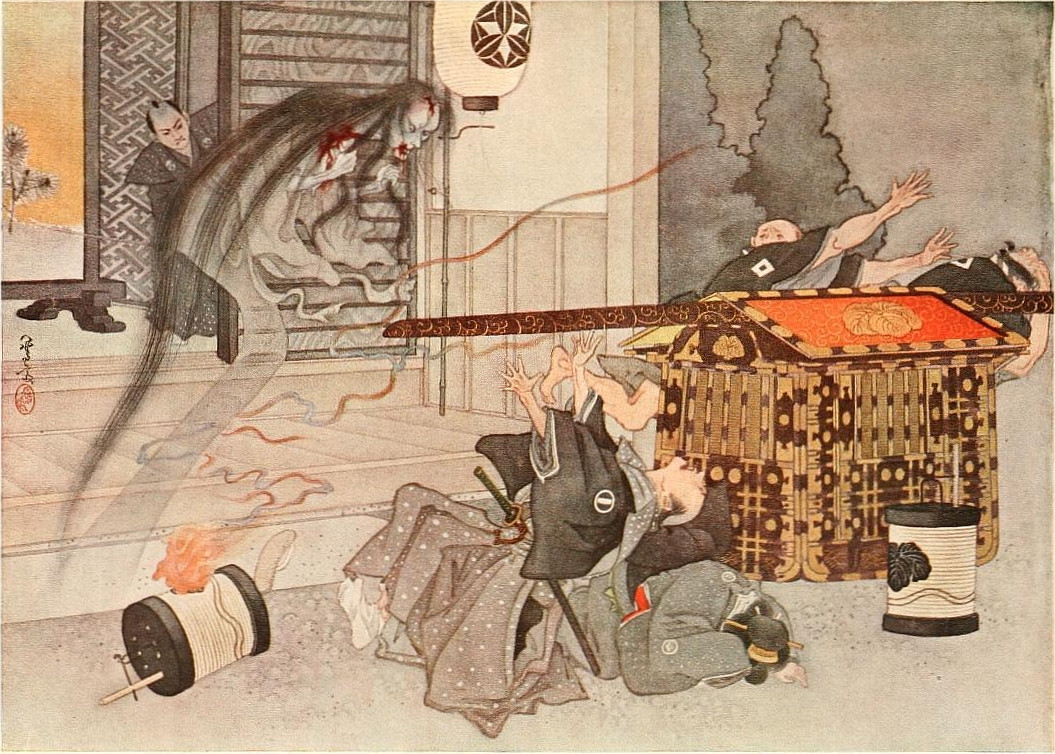
Her ghastly face and blood-stained garments struck terror to the souls of the petrified spectators
The woe of that night was unutterable.
Amidst the general lamentations, Kinu's afflicted parents returned to their home, bearing with them the lifeless body of their beloved daughter: all their pride obliterated and their hopes in her brightly opening future swept away for ever by the tragedy of that fearful night.
Two days later, with poignant grief, the stricken couple laid in the tomb all that was left of their cherished child, so irrevocably and cruelly torn from them by a sudden unexpected doom, and they resolved to dedicate the remnant of their days to her memory.
Kunizo was the first to hear the dire news. With a breaking heart he had watched his love depart on her ill-starred journey, and, numbed with despair, from the same spot he witnessed the mournful return of the procession.
Stupefied at the turn events had taken, he at once determined that her spirit should not go forth on its way alone into the darkness of the Land of Shadows, and since their paths had been so ruthlessly parted in life, compassionate Death should unite them for many lives to come. However, before he made his final exit from this world of pain, he would at least gaze once again upon the beautiful face of his beloved Kinu.
With this resolve, on the night of her interment he found his way to the cemetery; the coffin was easily disinterred, and with the tools brought for that purpose, he soon succeeded in wrenching off the lid. No sooner had this been done than a miracle was wrought. Instead of lying there a pallid wraith of her former self, as Kunizo so fully expected to find the corpse of his lost love, with a faint sigh she raised herself in the narrow coffin, and turned her bewildered gaze upon her astounded deliverer.
It was indeed true, the sudden rush of cold air had brought back the wandering spirit of poor Kinu. The hideous events of her wedding night had completely suspended her animation, and she had fallen into a deep trance, which had deceived everyone by its faithful semblance of Death.
Who can depict the joy and transports of the young lovers, who after enduring such torments and vicissitudes, were thus miraculously restored to each other! Kunizo, almost beside himself with happiness, did his utmost to minister to his beloved lady, and when she had sufficiently recovered, he tenderly wrapped her in his outer garment and carried her in all haste to the house of an aunt, who lived at some distance, where she could be safely concealed.
This relative was considerably surprised at such a visitation in the dead of night, and still more so at the almost incredible narrative of the fugitive couple. However, clearly discerning the will of Heaven in all that had passed, she willingly afforded them a shelter, and did all in her power to aid them escape from that part of the country.
Under cover of the darkness they fled, and crossing the sea, arrived safely in the island of Shikoku. There, in a place called Marugame, they found another member of Kunizo's family, to whom they had been directed, who was the prosperous master of a yadoya, or inn, in the vicinity of the famous temple of Kompira,[2] for which that region had become famous.
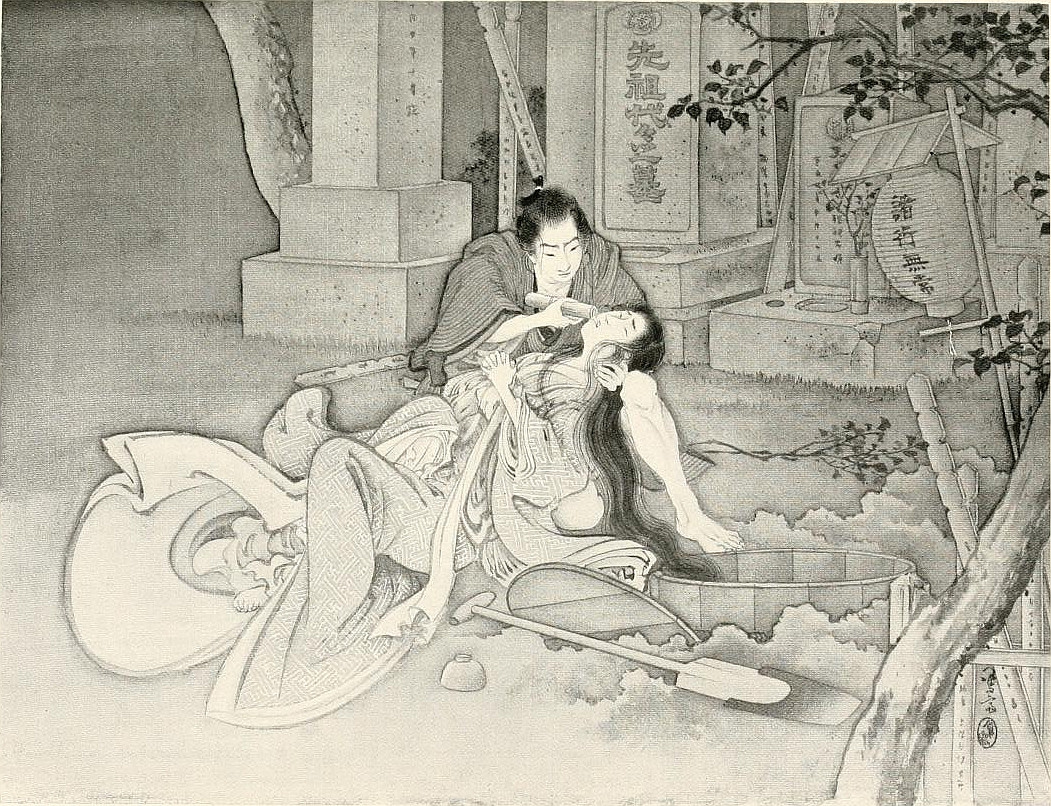
Kunizo, almost beside himself with happiness, did his utmost to minister to his beloved lady.
The fugitives received a kindly welcome, and then after all their trials and sorrows, they made their home in that flourishing country town, annually visited by thousands of pilgrims, Kinu's beauty and accomplishments winning all hearts and proving of great assistance to their benefactor. In this way, far from their native place, the united lovers spent happy years in the joy of each other's company, secure in their deep affection, which, like the flower of the enchanted bowers of Horai, the Elysian Isle, fades not, but blooms on fragrant for all eternity.
Haunted by the fear that they might again be pitilessly separated from each other, and Kinu forced to fulfil her engagement to the luckless nobleman, who had been defrauded of his happiness in such a gruesome and unforeseen manner, they lived in the strictest retirement and never dared to disclose to their respective sorrowing families the wonders that had been worked in their behalf.
However, some years later, Kinu's parents, who had all this time been mourning and inconsolable for their daughter's tragic end, undertook an extensive pilgrimage age to certain celebrated temples for requiem services and prayers for the repose and well-being of the soul of their lost child.
In the course of their journeying they arrived at Marugame, for the temple of Kompira was included in their tour, and by a strange coincidence they came to stay at the very inn presided over by Kunizo's uncle.
When they were shown into the room allotted them, the first object to meet their astonished gaze was a handsome screen on which was written a poem in skilled calligraphy. The characteristic handwriting was the facsimile of Kinu's, and the poem constantly and fondly read at home—they knew it by heart, for it was one of the treasured relics left to them by their beloved daughter.
Their imaginations were deeply stirred, and in a state of great emotion at this strange occurrence, they hastily summoned their host. In a long interview the astounding story of Kinu's resurrection from the tomb and the escape of the lovers was revealed to them.
Deep and boundless was their joy and gratitude to Providence at thus restoring to them, in such an amazing manner, their lost one, whom they never expected to meet again this side of the Meido[3] and at that happy reunion all shed tears of joy, and also of sorrow, in recalling the past.
Further separation being out of the question, the old couple insisted on carrying back with them to Osaka their newly restored son and daughter, and there they all lived together long and happily: the whole neighbourhood never ceasing to marvel at the wonderful history of "how Kinu returned from the grave."
A CHERRY-FLOWER IDYLL
About one hundred years ago, in the old capital of Kyoto, there lived a young man named Taira Shunko. At the time this story opens he was about twenty years of age, of pre-possessing appearance, amiable disposition, and refined tastes, his favourite pastime being the composition of poetry. His father decided that Shunko should finish his education in Yedo, the Eastern capital, where he was accordingly sent. He proved himself an apt scholar, more clever than his comrade-students, which won him the favour of the tutor in whose charge he had been placed.
Some months after his arrival in Yedo, he went to stay at his uncle's house during convalescence from a slight illness. By the time he was well again the spring had come, and the call of the cherry-flower season found a ready response in Shunko's heart, so he determined to visit Koganei, a place famous for its cherry trees.
One fine morning he arose at dawn, and, equipped with a small luncheon box and a gourd filled with sake, set out on his way.
In the good old days, as now, Koganei was celebrated for the beauty of its scenery in the springtime. Thousands of spreading trees formed a glorious avenue on either side the blue waters of the River Tama, and when these burst into clouds of diaphanous bloom, visitors from far and near came in crowds to join in the revel of the Queen of Flowers. Beneath the shade of the over-arching trees, tea-houses were dotted along the banks of the stream. Here, with the shoji[1] hospitably open on all sides, tempting meals of river-trout, bamboo shoots, and fern-curls, and sundry and manifold dainties were served to the pleasure-seeking traveller.
Shunko rested at one of these river-side hostelries, refreshing himself with generous draughts from his gourd, and then opened his tiny luncheon box, the contents of which he supplemented with the delicate river-trout, fresh from the pellucid waters of the stream and artistically prepared by the tea-house cuisine.
Under the influence of wine, the homesickness which had been oppressing his soul gradually took wings; he became merry, and felt as if he were at home in his own beautiful city of Kyoto. He sauntered along under the trees, singing snatches of songs in praise of this favourite flower. On every side the whole world was framed in softest clouds of ethereal bloom, which seemed to waft him along between earth and heaven.
Lost in admiration at the fairy like beauty of the scene, he wandered on and on, oblivious of time, till he suddenly realized that daylight was on the wane. A zephyr sprang up, scattering the petals of the blossoms like a fall of scented snow, and as Shunko gazed around, he became aware that the last visitors had gone, and that he was left alone with only the birds twittering on their way to their nests to remind him that he, too, like the rest of belated humanity, ought to be wending his way home.
However, sinking down upon a mossy bank beneath a cherry-tree, he became lost in meditation. With the aid of a portable ink-box and brush he composed some stanzas, a rhapsody on the transcendent loveliness of the cherry flowers.
SONG TO THE SPIRIT OF THE CHERRY-BLOSSOM[2]
Throughout the land the Spring doth hold high Court, Obedient to the call from far I come To lay my tribute at thy matchless shrine, To vow allegiance to the Queen of Flowers. How can I praise aright thy perfume sweet, The heavenly pureness of thy blossom's snow: Spellbound I linger in thy Kingdom fair That rivets me, love's prisoner! Take this poor bud of poesy to thy fragrant breast, There let it hang, symbol of homage true: Ne'er can perfection be acclaimed right, Much less thy beauties, which are infinite! Thy by fragile petals fluttering on my robes Pluck at my heart, and bind me to thy realm. With fairy fetters—ne'er can I leave thy bowers But worship thee for evermore, my peerless Queen of Flowers!
Having tied the slip of paper to a branch of the tree in whose shade he had been reclining, he turned to retrace his steps, but realized, with a start, that the twilight had merged into darkness, and the pale gleams of the crescent moon were already beginning to illumine the deep blue vault above him. During his abstraction he had wandered off the beaten-track, and was following a totally unknown path which grew more and more intricate among the hills. It had been a long day, and he was growing faint with hunger and weary from fatigue when, just as he was beginning to despair of ever finding an escape from such a labyrinth, suddenly a young girl appeared from the gloom as if by magic! By the fitful light of the lantern she was carrying, Shunko saw that she was very fair and dainty, and concluded that she was in the service of some household of rank. To his surprise she took his presence as a matter of course, and politely addressed him, with many bows:
"My mistress is awaiting you. Please come and I will show you the way."
Shunko was still more astonished at these words. He had never been in this wild and unknown place before, and could not imagine what human soul could know and summon him thus, at this late hour.
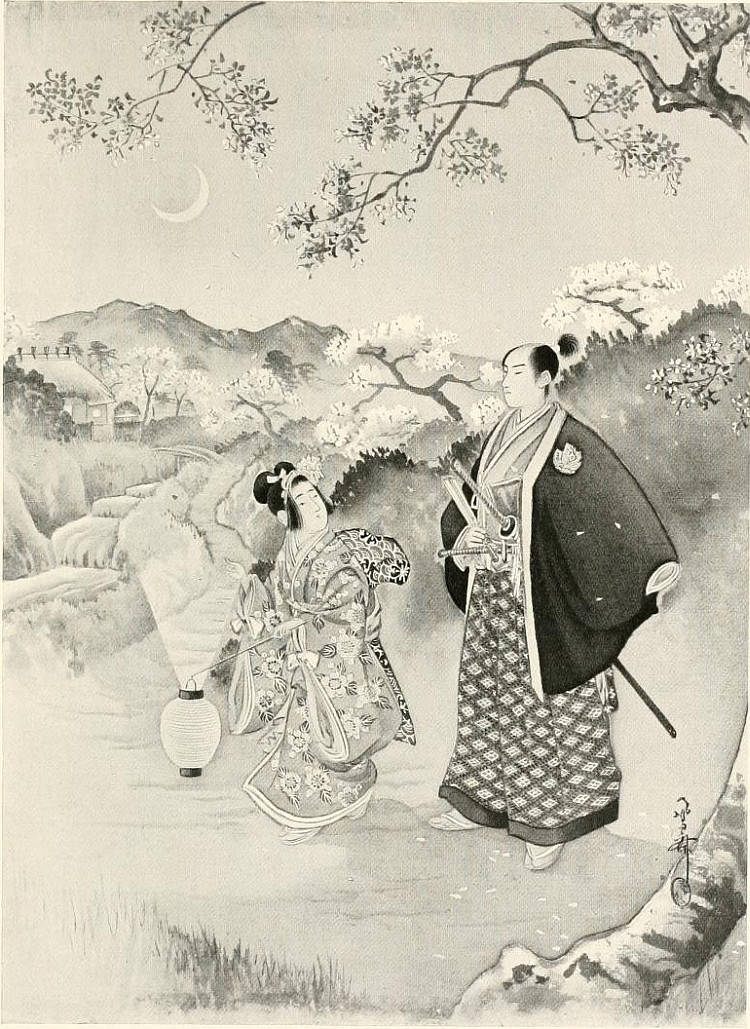
Suddenly a young girl appeared from the gloom as if by magic!
After a few moment's silence he inquired of the little messenger, "Who is your mistress?"
"You will understand when you see her," she replied. "My lady told me that as you had lost your way, I was to come and guide you to her house, so kindly follow me without delay."
Shunko's perplexity was only increased by these words, but after reflection, he told himself that probably one of his friends must be living in Koganei without his knowledge, and he decided to follow the fair messenger without further questioning.
Setting out at a swift pace, she guided him into a small valley, through which a mountain stream was murmuring in its rocky bed. It was a remote and sheltered spot. Presently a turn in the path led them to a tiny dwelling, completely surrounded and over-shadowed by a cluster of cherry-trees in full bloom. The girl stopped before the little bamboo gate. Shunko hesitated, but she turned to him with a smile.
"This is the house where my mistress dwells. Be so good as to enter!"
Shunko obeyed, and passed up a miniature garden to the entrance. Another little maiden appeared with a lighted candle, and ushered Shunko through several anterooms leading to a large guest-chamber, which seemed to be overhanging the crystal waters of a lake, in whose depth, like golden flowers, he could see the reflection of myriad stars. He noticed that the appointments were all of a most sumptuous description. Cherry-blossoms formed the keynote of the decorations; the screens were all planted with the flowering branches, clusters of them adorned the tokonoma; while the high-standing candlesticks were of massive silver, as were also the charcoal braziers, the glow of which drove out the chill of the spring evening. Beautiful crêpe cushions were placed beside the braziers, as if in expectation of a welcome guest; while the perfume of rare incense, mingling with the delicious fragrance of cherry-blossom, floated through the room.
Shunko was too bewildered and too exhausted by his long wanderings to indulge in reflections. With the unreal sensations of an errant hero of a fairy tale, he sank upon the mats and waited, wondering what would happen next.
Suddenly, the rustle of silken garments arrested his attention; noiselessly the screens of the room slid back, and the apparition of a beautiful maiden appeared, exquisitely graceful in her trailing robes.
She was in the prime of youth, and could not have been more than seventeen years of age. Her dress, in which the skies of spring seemed to be reflected, was the hue of a rich azure blue, and the crêpe fabric was half concealed beneath sprays of cherry-bloom so deftly worked, and with such a moonlit sheen upon them, that Shunko thought that they must have been woven from the moonbeams of the serene far-off moon for the Goddess of Spring. Her face was so perfect that the wondering guest was speechless at the loveliness of the vision before him. Never had he dreamed of such beauty, although he came from Kyoto, the city of beautiful women.
The fair hostess, noting his embarrassment, laughed softly, as she took her seat beside one of the silver braziers, and with a gentle gesture of the hand assigned him the companion place opposite her.
Bowing to the ground, she said:
"Ever have I lived alone in this place with only the river and the hills for my friends. So that your coming is a great joy and consolation to me. It is my wish to prepare a feast of welcome for you, but alas! in the depths of the woods, there is nothing meet for an honoured guest, but, poor as our entertainment is, I beg you, not to despise it."
A servant then appeared bearing trays of delicious dishes, with a golden wine flagon and a crystal cup.
At the sound of her voice, enchantment seemed to weave a subtle net around the bewildered Shunko; a languorous feeling of delight stole over his senses, and he yielded himself to the mysterious charm of the hour.
His lovely hostess proffered to her guest the crystal winecup, and filled it to the brim with amber wine from the golden flask.
As Shunko quaffed it, he thought never had such delicious nectar been tasted by mortal man. He could not resist cup after cup, till gradually all apprehension of the unknown surroundings passed away, and a strange gladness filled his heart as he succumbed to the charm of the hour, while servants silently went to and fro bearing fresh and tempting dainties to lay before him.
While they were conversing happily together the lady left his side, and seating herself beside the koto, began to sing a wild and beautiful air. Strange and wonderful to relate, the song was none other than the self-same poem which Shunko had composed that very evening, and had left fluttering from the branch of the cherry-tree beneath whose canopy of bloom he had rested. Falling completely under the bewitchment of his surroundings, Shunko felt that he wished to stay there for evermore, and a pang smote his breast at the thought that he soon must separate, if only for a few hours, from his mystic lady of the vale of cherry-blossoms.
As the last plaintive chord throbbed into silence, a chime in the next room struck two in the morning.
Laying the instrument aside, she said:
"At this late hour it is impossible for you to return home to-night. Everything is prepared in the next room. Honourably deign to rest. Forgive me that I cannot entertain you in a more befitting manner, in this, our poor home."
Attendants then entering, the screens were drawn aside for their guest, and he passed into the adjoining chamber, which had been prepared as a sleeping apartment. Sinking to rest among the silken coverlets and luxurious quilts, he was soon lost in heavy slumber.
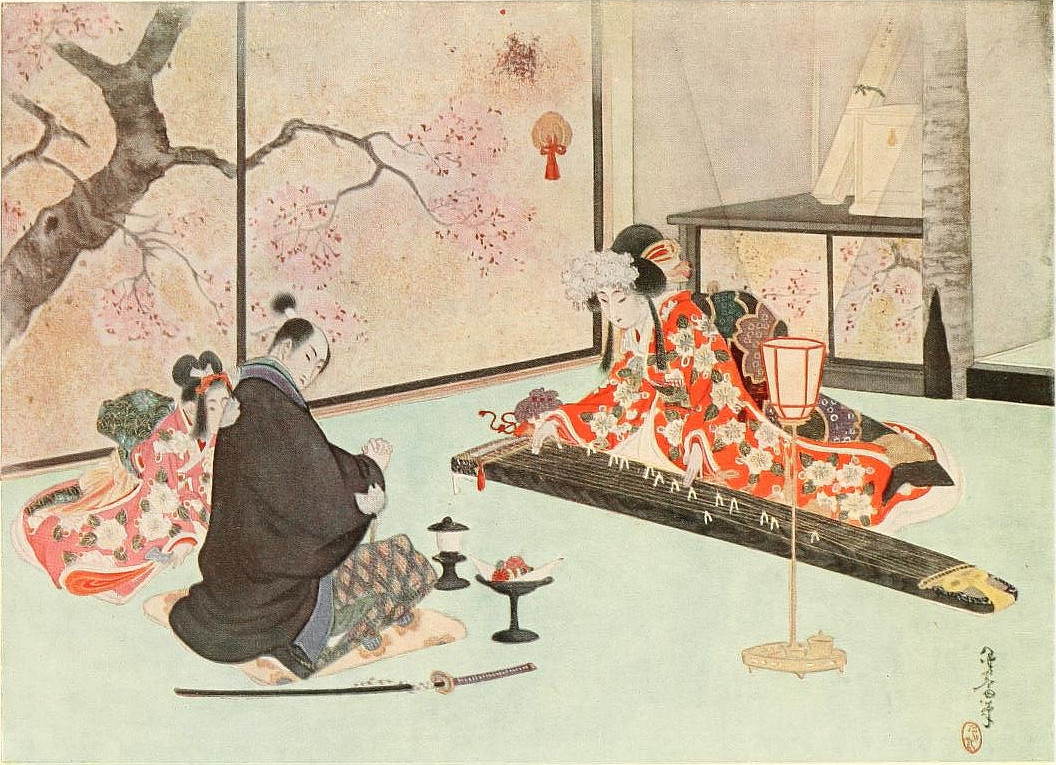
His beautiful hostess, seating herself beside the koto began to sing a wild and beautiful air.
Suddenly, in the morning, he was awakened by a cold wind blowing across his face. Day had broken, and the rosy dawn was flushing the horizon in the east. Slowly returning to his senses, he found himself lying on the ground beneath the very cherry-tree that had inspired his poem of the day before; but his wonderful adventure, his charming hostess, and her waiting maidens were no more! Shunko, lost in wonder, recalled over and over again the glowing memories of the preceding evening, but the vision had been so vivid that he felt assured it must have been something more than the mere phantoms of a dream. An overpowering conviction crept over him that the lovely maiden had her living counterpart in this world of realities.
From his earliest childhood he had always offered a special devotion to the cherry-flowers. Year after year, in the springtime, he had taken special joy in visiting some place noted for their blossoms. Could it be that the spirit of the cherry-tree, to whose beauty he had dedicated his poem, had appeared to him in human form to reward him for his life-long fidelity?
At last he rose and stretched his cramped limbs, and musing only on the vanished wonders of the night, wandered aimlessly along. At length he regained the main road and slowly turned his errant footsteps towards home.
Although he took up his usual life again, he could not forget his experiences in the cherry-blossom valley, they haunted him not only in the silent watches of the night, but in the bright noontide of day. Three days later he returned to Koganei, with the fond hope of evoking once again the longed-for vision of the lovely girl who had so bewitched him with her beauty and her charm.
But, alas for human hopes! In those short days all had changed. What so ephemeral as the reign of the cherry-flower in the spring! Grey were the skies that had been so blue and fair; bleak and deserted was the scene that had been so gay and full of life; bare of blossom, and stripped of their fairy beauty were the trees, whose petals of blushing-snow the relentless wind had scattered far and wide.
As before, he rested at the same little tea-house by the river and waited for the shades of evening to fall. Roaming about in the deepening twilight, he anxiously sought some sign or token, but vain were all his efforts to find the valley of dream again. Vanished was the little dwelling in the shadow of the cherry groves. Nowhere by unfamiliar paths could he find the fair messenger who had guided him to the bamboo gate. All had faded and suffered change.
Year after year, in the springtime, did Shunko make a pilgrimage of loving memory to the same spot, but though his faithfulness was never rewarded by a sight of her, who had so completely taken possession of his heart and soul, yet the flower of hope never faded, and firm was his resolution, that none other than the maiden of Koganei should ever be his wife.
About five years passed. Then a sudden summons from his home arrived, bearing the sorrowful tidings that his father had been stricken with severe illness, and begging him to return without delay.
That very day he made all arrangements, and disposed of his few student's belongings in readiness to set out at daybreak.
It happened to be the season of autumn when, in the Orient, the deer cries for its mate in the flaming maple glades of the forest, and a young man's heart[3] is filled with what the Japanese call mono no aware wo shiru ("the Ah-ness of things").
Shunko was sad. He yearned for the lovely girl who had so bewitched him, and in addition to this sorrow his heart was heavy at the thought of his father's illness.
As Shunko proceeded on his journey his depression increased, and sadly he repeated aloud the following lines:
Cold as the wind of early spring Chilling the buds that still lie sheathed In their brown armour with its sting, And the bare branches withering— So seems the human heart to me! Cold as the March wind's bitterness; I am alone, none comes to see Or cheer me in these days of stress.
Now it chanced that an old man heard this mournful recital, and took pity on Shunko.
"Pray pardon a stranger intruding upon your privacy," said the old man, "but we sometimes take a gloomy view of life for want of good cheer. It may be that you have travelled far and are footsore and weary. If that is so, be honourably pleased to accept rest and refreshment in my humble house in yonder valley."
Shunko was pleased with the old man's kindly manner, and warmly accepted his hospitality.
After a hearty meal and a long chat with the old man, Shunko retired to bed.
The youth had no sooner closed his eyes than he found himself dreaming of Koganei and of the beautiful woman he had met there. A gentle breeze was full of the scent of flowers. He noticed a cloud of cherry-blossom falling like a little company of white butterflies to the ground. While watching so pleasing a scene he observed a strip of paper hanging to one of the lower branches. He advanced close to the tree to discover that some one had written a poem on the wind-blown paper.
A thrill passed through him as he read the words:
Lingers still the past within thy memory, East of the Temple let thy footsteps stray And there await thy destiny!
Earnestly he repeated the lines over and over again, and awoke to find himself still reciting the little verse that seemed so full of meaning. Deeply he pondered over his dream. How could he solve the enigmatic message it surely bore for him? What did it portend?
The next day he set out on his journey to the west. His father was in the last stages of his malady, and the doctors had given up all hope of his recovery. In a few weeks the old man died, and Shunko succeeded to the estate. It was a sad winter, and the young man with his widowed mother, were secluded in the house for some months, observing the strictest retirement during the period of mourning.
But youth soon recovers from its griefs, and by the time that April had come with the dear beguilement of her blue skies and flowering landscapes, Shunko, in company with an old friend, set out to assuage his sorrows in the viewing of his favourite cherry-trees, and to find balm for his soul in the golden sunshine of spring. His father's death, and the business of attending to the affairs of succession, had left him but little leisure for vain regrets, and the family upheaval he had experienced the last few months had somewhat dimmed the memory of the mysterious dream, which had come to him the night before his return home.
But now, with a strange and eerie sensation, he realized that, unwittingly, Fate had guided their footsteps to the Eastern Mountain, and that the way they had chosen was East of the Temple Chionin. The message on the scroll flashed into his mind as he sauntered along:
Lingers still the past within thy memory? East of the Temple let thy footsteps stray, And there await thy destiny!
By this time they had reached the famous avenue of cherry-trees, and the pearly mist of bloom, that seemed to envelope them like a fragrant cloud, at once recalled to Shunko's mind how striking was the resemblance this fairy-like spot bore to Koganei.
Just at that moment he espied a small glittering object lying on the ground at the root of one of the cherry-trees. It proved to be a golden ring, and engraven on it was the hieroglyphic "Hana," which may be interpreted as meaning either "Flower" or "Cherry-Blossom."
As the afternoon began to wane they came to a tea-house, which seemed to look especially inviting, and here they rested and refreshed their weariness as the shadows gradually lengthened into the twilight.
In the next room were two or three girls' voices talking gaily together, and their laughter sounded soft and musical as it floated out into the balmy air of that soft evening of spring.
By degrees Shunko found himself overhearing snatches of their conversation, and at length he distinctly caught the words:
"The day has been a perfect one except for one little cloud. O Hana San's ring...."
Then a silvery voice made answer: "The mere loss of the ring is nothing, but as it bears my name, it grieves me that it should fall into the hands of a stranger."
At these words Shunko impetuously rose and entered the adjoining chamber.
"Pardon me," he cried, "but can this be the lost ring?" and he held out to the little group the trinket which he had found beneath the cherry-tree that afternoon.
The youngest of the trio, a graceful girl of about seventeen or eighteen summers, bowed to the ground, murmuring her thanks, while an elderly woman, who was evidently her foster-nurse, came forward to receive the missing treasure.
As the young girl raised her head, Shunko felt a thrilling shock of recognition quiver through his frame. At last the gods had granted his fervent prayers. Before him, as a living and breathing reality, he beheld the long sought maiden of the vision at Koganei. The room, its occupants, and all around him faded away, and his soul was wafted back through the vista of years to the lonely valley of dreams, so far away.
This, then, was the significance of the mystic writing in the deserted house, that now he had served his term of probation and was at last deemed worthy of the beloved one for whom he had waited and longed for so many years.
The elderly nurse was aware of his embarrassment, and tactfully attempted to come to his aid. She proffered wine and refreshments, and made several inquiries as to where he had found the ring and where he lived.
After replying to these queries, Shunko, who was in no mood for talking, withdrew with deep obeisances, and slowly wended his way homewards, lost in abstraction.
Oh, the delight of it! To be alone with his reverie and thoughts of her, whom he had scarcely hoped to see again, the lady of his dreams! Both head and heart were in a whirl. And the wonder of his adventure kept him awake through the midnight darkness. Only at the break of dawn did he fall into a troubled sleep.
Towards noon his belated slumbers were disturbed by a servant, who came to announce the advent of a visitor, who urgently desired an interview. He arose in haste, and there awaiting him in the guest-room was the foster-nurse of the day before. Rich gifts of silk lay on the mats, and with the explanation that she had been sent by the parents of her young charge, she came to express their thanks for the incident of the day before.
When the formalities of greeting were exchanged, Shunko could no longer keep silence regarding the subject nearest his heart, and begged the nurse to tell him, in confidence, all she could concerning O Hana San.
"My young mistress belongs to a knightly family. There are three children in all, but she is the only girl, and the youngest child. She is just seventeen years of age, and is quite renowned for her beauty, which, as you have seen her, you may perhaps understand. Many have ardently desired her hand in marriage, but hitherto all have been declined. She cares nothing for worldly things and devotes herself to study."
"Why does she refuse to marry?" asked the young man, with a beating heart.
"Ah! there is a strange reason for that!" replied the nurse, and her voice dropped to a whisper. "Several years ago, when she was not much more than a child, her mother and I took her to visit the beautiful Kiyomidzu Temple in the springtime to see the cherry-flowers. As you know, Kwannon, the Goddess of Mercy of that temple, takes under her protection all lovers who pray to her for a happy union, and the railings round her shrine are white with the tying of paper-prayer love-knots innumerable. O Hana's mother told me afterwards that when we passed before Kwannon's altar, she had offered up a special prayer for her daughter's future happiness in marriage.
"While we were walking in the vicinity of the waterfall below the temple, we suddenly lost sight of Hana for a few minutes. It seems that, wrapt in wonder at the beauty of the blossoming trees, she had strayed away, and was listening to the foaming water as it dashed over the boulders of rock. Suddenly, a gust of wind blew over us. It was icy cold! We looked round for O Hana San, and you can imagine the fear that seized our hearts when we found that she had disappeared. In a frenzy of anxiety I ran hither and thither, and at last caught sight of her prostrate on the ground at some distance away. She had fallen into a deep faint near the cascade, and was lying there pale and senseless, and drenched with spray. We carried her to the nearest tea-house, and tried every means in our power to restore her to consciousness, but she remained sunk in a deep swoon all through that long, long day. Her mother wept, fearing that she was dead. When the sun set and no change took place, we were lost in the anguish of despair. All of a sudden an old priest appeared before us. Staff in hand, and clad in ancient and dilapidated garments, he seemed an apparition from some past and bygone age. He gazed long at the senseless girl, lying white and cold in the semblance of death, and then sank on his knees by her side, absorbed in silent prayer, now and again gently stroking her inanimate body with his rosary.
"All through the night we watched thus by O Hana San, and never did hours seem so interminable or so black. At last, towards the dawn, success crowned the old man's efforts; the spell that had so mysteriously changed her youth and bloom into a pallid mask, was gradually exorcised, her spirit returned, and with a gentle sigh, O Hana San was restored to life.
"Her mother was transported with joy. When she was able to speak, she murmured, 'Praise be to the mercy of the holy Kwannon of Kiyomidzu!' and again and again she expressed her fervent gratitude to the queer priest.
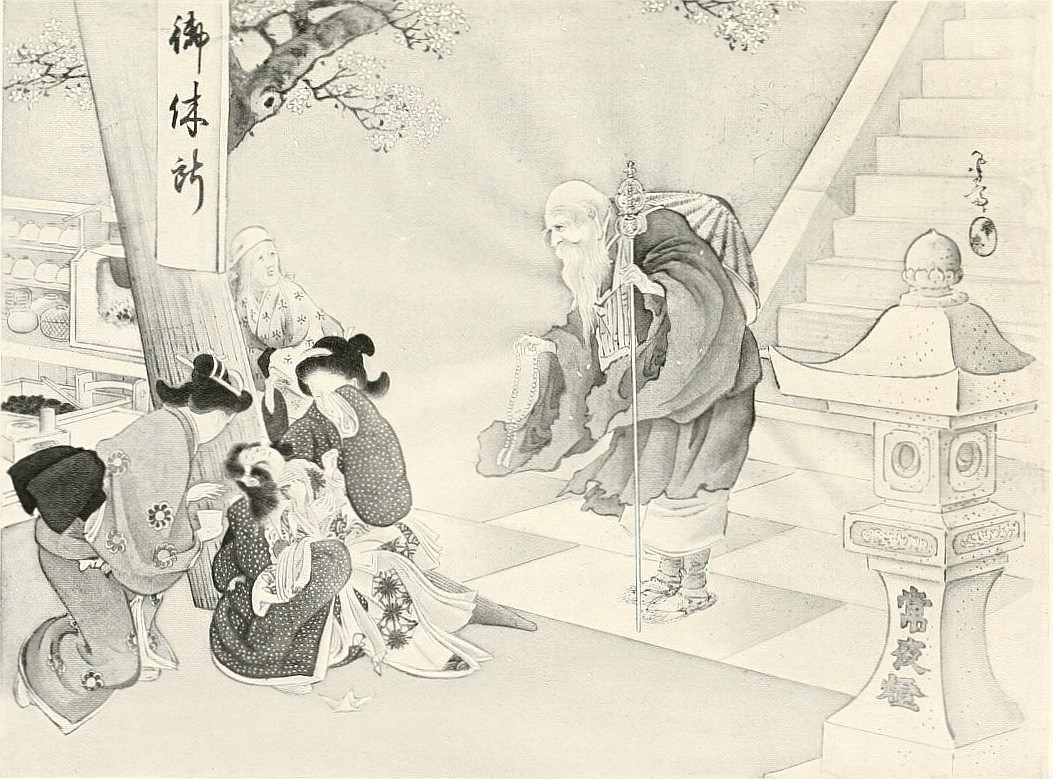
An old priest suddenly appeared ... staff in hand and clad in ancient and dilapidated garments.
"In answer he took from the folds of his robe a poem-card, which he handed to my mistress.
"'This,' said he, 'was written by your daughter's future bridegroom. In a few years he will come to claim her, therefore keep this poem as the token.'
"With these words he disappeared as unexpectedly and mysteriously as he had come. Great was our desire to know more of the meaning of those fateful words, but though we made inquiries of everyone in the temple grounds, not a soul had seen a trace of the ancient priest. O Hana San seemed none the worse for her long swoon, and we returned home, marvelling greatly at the extraordinary events that had happened to us that day and night in the temple of Kiyomidzu.
"From that time onwards I noticed a great change in O Hana San. She was no longer a child. Though only thirteen years of age, she grew serious and thoughtful, and studied her books with great diligence. In music she especially excelled, and all were astonished at her great talent. As she grew in years, her amiability and charm became quite noted in the neighbourhood: her mother realizes that she is at the zenith of her youth and beauty, and, many a time, has tried to find the author of the poem, but hitherto her efforts have been of no avail.
"Yesterday we had the good fortune to meet you, and if you will forgive my boldness, it seemed to me as though Fate had especially directed you to my foster-child. On our return home, we related all that had befallen us to my mistress. She listened to our recital with deep agitation, and then exclaimed, with joy: 'Thanks be to Heaven I At last the long-sought for one has come!'"
Shunko felt as if in a trance. Full well he knew that the Gods had guided his footsteps to their yearned-for goal, and the maiden to whom he had restored the little golden circlet, was none other than the one for whom his heart had hungered for many years.
It was, indeed, a supreme Fate that had linked their lives in one.
In taking farewell of the old nurse, Shunko entrusted to her his message to his bride-elect—the mysterious token of affinity composed beneath the cherry-tree five years ago.
There was no longer any doubt but that O Hana's destiny was indeed fulfilled. The bridegroom, foretold by the age-old priest, had come at last. Her mother's prayer offered up at the temple of the Kwannon of Kiyomidzu had been heard. Both parents rejoiced at the happy fate that the Powers above had vouchsafed to their beloved child, an eminent sooth-sayer was consulted, and a specially auspicious day was chosen for the wedding.
When the excitement of the bridal feast was over and Shunko was left alone with his lovely bride, he noticed that her wedding-robe of turquoise blue, scattered over with embroideries of her name-flower, was the self-same one that had been worn by his visionary hostess; and, moreover, comparisons proved that the date of her long trance at Kiyomidzu was identical with that of his prophetic vision at Koganei.
A great gladness filled the bridegroom's heart, for he felt that in some mystical way his bride and dream-love were one and the same incarnate. The spirit of the cherry-tree had surely entered into Hana when she had lost consciousness at the Kiyomidzu temple, and En-musubi no Kami, the God of Marriage, had assumed the disguise of the old priest, and with the magnetic threads of love, had woven their destinies together.
And Shunko tenderly caressed his bride, saying:
"I have known and loved and waited for you ever since your spirit came to me from the Kiyomidzu temple."
And he told her all that had befallen him at Koganei.
The young lovers thereupon pledged their love to each other for many lives to come, and lived blissfully to the end of their days.
THE BADGER-HAUNTED TEMPLE[1]
Once long ago, in southern Japan, in the town of Kumamoto, there lived a young samurai, who had a great devotion to the sport of fishing. Armed with his large basket and tackle, he would often start out in the early morning and pass the whole day at his favourite pastime, returning home only at nightfall.
One fine day he had more than usual luck. In the late afternoon, when he examined his basket, he found it full to overflowing. Highly delighted at his success, he wended his way homewards with a light heart, singing snatches of merry songs as he went along.
It was already dusk when he happened to pass a deserted Buddhist temple. He noticed that the gate stood half open, and hung loosely on its rusty hinges, and the whole place had a dilapidated and tumbledown appearance.
What was the young man's astonishment to see, in striking contrast to such a forlorn environment, a pretty young girl standing just within the gate.
As he approached she came forward, and looking at him with a meaning glance, smiled, as if inviting him to enter into conversation. The samurai thought her manner somewhat strange, and at first was on his guard. Some mysterious influence, however, compelled him to stop, and he stood irresolutely admiring the fair young face, blooming like a flower in its sombre setting.
When she noticed his hesitation she made a sign to him to approach. Her charm was so great and the smile with which she accompanied the gesture so irresistible, that half-unconsciously, he went up the stone steps, passed through the semi-open portal, and entered the courtyard where she stood awaiting him.
The maiden bowed courteously, then turned and led the way up the stone-flagged pathway to the temple. The whole place was in the most woeful condition, and looked as if it had been abandoned for many years.
When they reached what had once been the priest's house, the samurai saw that the interior of the building was in a better state of preservation than the outside led one to suppose. Passing along the veranda into the front room, he noticed that the tatami were still presentable, and that a sixfold screen adorned the chamber.
The girl gracefully motioned her guest to sit down in the place of honour near the alcove.
"Does the priest of the temple live here?" asked the young man, seating himself.
"No," answered the girl, "there is no priest here now. My mother and I only came here yesterday. She has gone to the next village to buy some things and may not be able to come back to-night. But honourably rest awhile, and let me give you some refreshment."
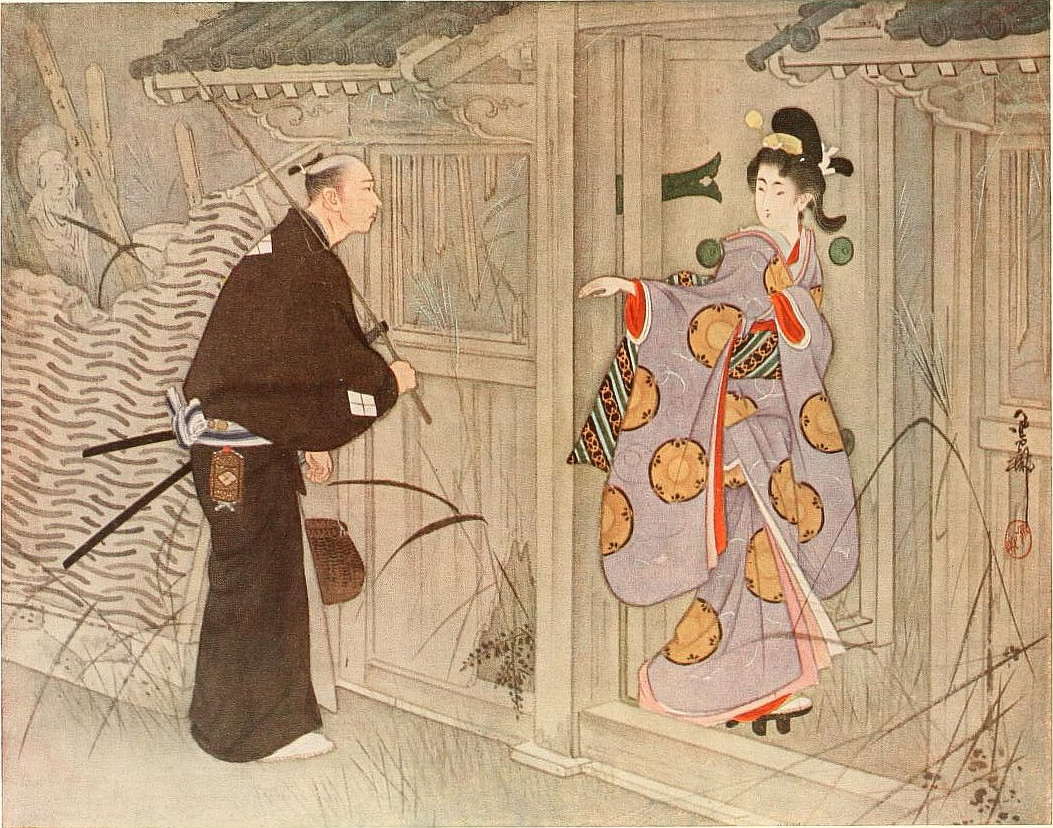
What was the young man's astonishment to see a pretty young girl standing just within the gate
The girl then went into the kitchen apparently to make the tea, but though the guest waited a long time, she never returned.
By this time the moon had risen, and shone so brightly into the room, that it was as light as day. The samurai began to wonder at the strange behaviour of the damsel, who had inveigled him into such a place only to disappear and leave him in solitude.
Suddenly he was startled by some one sneezing loudly behind the screen. He turned his head in the direction from whence the sound came. To his utter amazement, not the pretty girl whom he had expected, but a huge, red-faced, bald-headed priest stalked out. He must have been about seven feet in height, for his head towered nearly to the ceiling, and he carried an iron wand, which he raised in a threatening manner.
"How dare you enter my house without my permission?" shouted the fierce-looking giant. "Unless you go away at once I will beat you into dust."
Frightened out of his wits, the young man took to his heels, and rushed with all speed out of the temple.
As he fled across the courtyard he heard peals of loud laughter behind him. Once outside the gate he stopped to listen, and still the strident laugh continued. Suddenly it occurred to him, that in the alarm of his hasty exit, he had forgotten his basket of fish. It was left behind in the temple. Great was his chagrin, for never before had he caught so much fish in a single day; but lacking the courage to go back and demand it, there was no alternative but to return home empty-handed, before had he caught so much fish in a single day; but lacking the courage to go back and demand it, there was no alternative but to return home empty-handed.
The following day he related his strange experience to several of his friends. They were all highly amused at such an adventure, and some of them plainly intimated that the seductive maiden and the aggressive giant were merely hallucinations that owed their origin to the sake flask.
At last one man, who was a good fencer, said:
"Oh, you must have been deluded by a badger who coveted your fish. No one lives in that temple. It has been deserted ever since I can remember. I will go there this evening and put an end to his mischief."
He then went to a fishmonger, purchased a large basket of fish, and borrowed an angling rod. Thus equipped, he waited impatiently for the sun to set. When the dusk began to fall he buckled on his sword and set out for the temple, carefully shouldering his bait that was to lead to the undoing of the badger. He laughed confidently to himself as he said: "I will teach the old fellow a lesson!"
As he approached the ruin what was his surprise to see, not one, but three girls standing there.
"O, ho! that is the way the wind lies, is it, but the crafty old sinner won't find it such an easy matter to make a fool of me."
No sooner was he observed by the pretty trio than by gestures they invited him to enter. Without any hesitation, he followed them into the building, and boldly seated himself upon the mats. They placed the customary tea and cakes before him, and then brought in a flagon of wine and an extraordinarily large cup.
The swordsman partook neither of the tea nor the sake, and shrewdly watched the demeanour of the three maidens.
Noticing his avoidance of the proffered refreshment, the prettiest of them artlessly inquired:
"Why don't you take some sake?"
"I dislike both tea and sake," replied the valiant guest, "but if you have some accomplishment to entertain me with, if you can dance or sing, I shall be delighted to see you perform."
"Oh, what an old-fashioned man of propriety you are! If you don't drink, you surely know nothing of love either. What a dull existence yours must be! But we can dance a little, so if you will condescend to look, we shall be very pleased to try to amuse you with our performance, poor as it is."
The maidens then opened their fans and began to posture and dance. They exhibited so much skill and grace, however, that the swordsman was astonished, for it was unusual that country girls should be so deft and well-trained. As he watched them he became more and more fascinated, and gradually lost sight of the object of his mission.