Volume 8 — CONTENTS OF VOLUME VIII. (continued 6)
Reading edition
At that critical instant, the Spaniard brought his pistol to bear, and discharging it in the breast of the Indian, laid him prostrate upon the earth. Bruised and bleeding, he rose from the ground and made his way to Marina. At first, the girl shrunk back with horror, imagining that it was the victorious Yorika, who had come to claim her as his own. But when her reason was restored, and she learned the truth, she expressed her joy and gratitude alike for the safety of her lover and her own.
Such was one of the tales of my guide, which beguiled the weariness of our journey over the Pampas. He related several narratives respecting the jaguar, which is a kind of tiger infesting the thickets which border upon the road. One day, as we were passing through an immense forest of thistles, ten feet in height, and spreading out like an interminable sea on every side, he pointed to a spot where a traveller, on descending from his horse, had been seized and torn in pieces by one of these furious beasts.
Day after day, we continued our monotonous course. Although it was winter, the weather by no means answered to the common idea of that season. We had occasional rain, but it was seldom colder than during our April or May. Few incidents occurred to break the uniformity of our journey. One day appeared like another, and as we had no objects by which we could mark our progress, we seemed, like a ship in the waste of waters, to stand still in the midst of the shoreless desert. As we stood alone upon the bosom of the mighty prairie, stretching out on every side, and blending itself with the sky, we seemed dwindled into insects. Never have I felt such a sense of nothingness as in the presence of that mighty plain. In measuring myself by the gigantic scale which the Pampas presented, it seemed that I might be blotted from existence like the veriest moth that fluttered in the breeze. It was not until I turned my mind upon my plans and prospects, my hopes and fears, that my bosom began to swell again with those powerful emotions which seem to give importance to our existence and enable us to triumph over the despondency which often besets the heart, and might otherwise sink us in despair.
The sense of loneliness, the yearning for society, the longing to be restored to the sympathy of human beings which beset one in these solitudes, can only be understood by experience. I doubtless felt these the more from my youth and the want of that stern habit of self-reliance which is acquired by men who pursue a life of hazard and adventure. But I was becoming trained in the school of experience, and day by day was learning to sustain myself with my own thoughts, plans and prospects.
We met few travellers upon the road. Four men on horseback, and a company with two vehicles, were all that we encountered in a distance of more than 500 miles. The latter consisted of some five and twenty persons. They had a baggage cart, which was a capacious, rude uncouth-looking vehicle, with cane sides and a roof covered with hides. The body was balanced upon two prodigiously high wheels for the convenience of passing through rivers. The other vehicle was a long coach, called a galera, and resembled the modern omnibus; the seats ran sideways, and the door was at the end. To each of these carriages there were four horses, and a postilion to each horse. Such is the ordinary equipment of travellers upon the Pampas.
The post houses upon the road were miserable tenements, generally of mud, and affording scanty accommodation. The lazy inhabitants seem to offer the commonest civility with reluctance or languid indifference. We occasionally met with huts inhabited by squalid Indians, who seemed sunk in indolence and apathy. They were nearly naked, yet they possessed a gentle and kindly character. The herds of cattle upon the plains furnish them abundance of meat, and they parted with it freely, seeming to be almost indifferent whether they received compensation or not.
At the end of twenty days, we reached the verge of the Pampas, and now began to ascend the highlands, which rise by gradations for the distance of nearly two hundred miles, at the foot of the Andes. Industriously pursuing our journey, we rose step by step, and at last reached a village situated in a deep gorge at the foot of mountains that seemed to reach the skies. Here we sold our horses, and purchased mules, these animals being considered safer in climbing the dizzy precipices, over which our road now lay.
Being duly equipped, and having rested three days, we departed and began to creep up the frowning battlements of the Andes. Sometimes we seemed lost in deep and dark ravines; sometimes we threaded our way amid rocks that lifted their shaggy pinnacles over our heads, which seemed to threaten us with destruction, and sometimes, we reached a lofty peak from which we could see the rugged valley stretched out behind, and still loftier pinnacles rising up to the heavens in front. How striking the contrast between these savage mountains and the level prairie!—yet the emotions they excited were nearly the same; the same overpowering sense of vastness in nature; the same oppressive sense of my own insignificance, visited me here as upon the Pampas. There was, indeed, something exhilarating in the mountain air, and the consciousness of danger frequently experienced as we wound along the edges of the mountains with a yawning chasm of five hundred feet below, imparted something of a romantic interest to our journey. The scenery, too, was often amazingly grand, and when at last we reached the highest ridge of the Andes, and I gazed upon its glittering peaks covered with everlasting snow, I experienced a sensation which I shall never forget. They seemed indeed like bluish-white clouds piled up to the very heavens. They appeared like the ghosts of mountains, dreamy and mist-like, rather than those eternal barriers of snow-capped granite which they really are.
Winding for several days along the devious path, amid the wilderness of rocky peaks and cliffs, we began to emerge from the labyrinth, and the western slope of the Andes soon opened before us. Creeping over a succession of ridges, we finally reached the undulating plain, and from an eminence, we caught a distant view of the Pacific. Proceeding through a country of great fertility we arrived at the place of our destination, thankful indeed that I had reached it in safety.
CHAPTER XII.
I found the city of Valparaiso to be much smaller than its commercial importance had led me to suppose. It is the chief port on the western coast of America. From this point, the principal commerce is carried on with the Islands of the Pacific and the coast of Asia. Indeed, Valparaiso is the centre of trade in this quarter of the world. Still, at the time I was there, more than twenty years ago, its population did not exceed 15,000. In 1822, it suffered from a dreadful earthquake, but it has now increased, and since the independence of Chili, it has become even more important than in former times. It is built along a bending beach, at the foot of a high bluff, which overlooks the town. The buildings are ornamented with piazzas, painted with different colors, giving the place a very lively appearance. The present number of inhabitants is about 25,000.
It may well be believed that the business which brought me to this place, engrossed my thoughts, and that immediately after my arrival, I began to devote my attention to it. I delivered the letters of introduction I had brought, and pursued my enquiries in relation to my uncle, in the channels which had been pointed out. To my great mortification, I soon found that he was not in Valparaiso.
The only clue I could obtain which seemed to offer the least chance of his discovery, was that a man bearing the Spanish name of Signor Morales, had come to this city some fifteen years before. He engaged in commerce, and being a man of enterprise, was very successful, and speedily amassed a large estate. Suddenly, and without any known cause, he became poor, closed his business and lived a life of seclusion. At last, he disappeared and no one seemed to know with certainty whither he had gone.
I found various rumors respecting him. One person said he had gone to the Island of Juan Fernandes, and now lived there alone as Alexander Selkirk had done before him. I was told by another that he had become a friar, and lived as a hermit near the foot of one of the snow-capped mountains of the Andes. Another story was, that the mysterious merchant had gone to Potosi, where he had purchased a silver mine and become immensely rich.
Amid these various rumors, one thing only seemed to be clear, and this was, that the individual to whom they related was in fact my uncle. The description of his person, manners, and appearance was exact. Everything else however was uncertain. It seemed probable, indeed, that he had himself set afloat the contradictory rumors as to his residence, with a view of concealing his real purpose.
I remained several months at Valparaiso, following out every suggestion that seemed to offer a clue to the object of my search. At last there seemed some reason to suppose that the story of my uncle’s being at Potosi, was not altogether without foundation. Faint, indeed, was the hope thus offered, but in the absence of every other, I determined to visit that celebrated place. My guide across the Pampas had continued with me and again setting out on horseback, we laid our course for southern Peru, a country which is now known by the title of Bolivia.
The road led to the north, and lay at a distance of sixty or seventy miles from the ocean. For the most part we travelled over a wavy table-land, nearly a thousand feet above the level of the sea. On our right, lay the mighty range of the Andes; on our left, the almost boundless Pacific. The country was thinly settled, there being here and there a small village; or, more frequently, the villa of some Spanish planter. The country was exceedingly fertile, and the cattle seemed as abundant as upon the prairies of Buenos Ayres. As we rode along, the grass, now in its fullest bloom, frequently concealed the pasturing herds from view, and often as we rode along, the coarse herbage seemed to form a wall on either side of the path, rising even as high as my head. Never have I seen a more lovely climate, or a more fruitful soil.
Though we met with few adventures, our journey was delightful. In ten days we approached the celebrated desert of Atacama, which stretches four hundred and fifty miles along the Pacific, and forms the maritime district of the present republic of Bolivia. Upon this spot, as if it were deserted of Heaven, the rain never falls, and it is accordingly given up to everlasting blight and desolation. It is a sandy waste, and is not only destitute of vegetation, but it is said that no animal, not even a spider, a cricket, or a worm, is found throughout its vast extent.
Our road, for two days, lay along the verge of this waste. It seemed marked with a peculiar aspect of solitude and desertion. No word can express the emotions which it suggested, but that of death. Neither life, nor motion, nor verdure were visible throughout its measureless bosom. No sound seemed to stir the atmosphere, in that region of silence. I paused as we rode over its surface; and such was the absolute void of nature—such the settled silence of the very atmosphere—that I felt oppressed, and moved forward to throw off a feeling that my heart would cease to beat in the midst of this pulseless creation.
Taking leave of the desert, our course turned more to the eastward, and we began to enter a more mountainous territory. One evening, as the sun went down, we saw before us a lofty peak, covered with snow. From its top, issued a perpendicular column of dark smoke, which, at the elevation of a few hundred feet, expanded into a thin cloud. Its shape was that of a pine tree, divested of branches, except at the top.
We knew this mountain to be a volcano, and we gazed upon it with intense interest. We soon arrived at a small village, and took up our lodgings for the night. Being greatly fatigued, I retired early to bed, and was speedily wrapped in profound repose. I was at length awaked by a violent shaking, and the most terrific sounds I ever heard. I sprang out of bed, and rushed to the window. The whole heavens seemed to be on fire, and as I caught a view of the volcanic peak, I perceived that it was vomiting forth torrents of lava, smoke and flame. The inhabitants of the village were already in the street, and seemed to be frantic with alarm, if not despair. I hurried on my clothes, and descended also to the street.
The volcano was in full blast, rumbling to its foundation, and keeping up at its mouth a roaring sound, like the continued discharge of artillery. Amid the columns of black smoke that rose to the sky, hundreds of rocks, red with heat, seemed shot upward, like blazing rockets, while the molten lava—a river of fire—was seen pouring over the edge of the crater, and making its way toward the village. But this was not the greatest danger. The thick masses of snow and ice, around the peak of the crater, were melted, and roaring torrents were already bursting down the declivity.
The confused sound of the raging waters was audible, even amid the thunder that shook the fabric of the mountains. The valley was situated in a gorge, through which the river must pour its flood. Conscious of the peril, the people were preparing for flight. But the danger was even more near at hand than was anticipated. While I stood gazing at the sublime pinnacle of the volcano, I heard a rush at a little distance, and suddenly I perceived the tumbling waters gushing between the houses and filling the narrow street. Most of the people had already fled, and I followed in their train. Scarcely had we reached a rocky eminence on the side of an adjacent ridge, when the whole village was engulphed, and speedily swept away.
So sudden had been the alarm, so rapid our retreat, that I had not saved a single article, except the clothes upon my back. My own horse, as well as that of my guide, with every particle of baggage, money, papers, letters—every vestige was swallowed up by the inundation; I was even uncertain of the fate of my guide, till at last I discovered him, half wild with terror, amid the throng that had now gathered upon the cliff.
During the remainder of the night the volcano remained in violent agitation, and the swollen torrent of water continued to flow down its side and sweep over the buried village. One by one, the people departed to seek shelter at a small town about two miles distant, and when morning came, finding no hope of recovering my horse or baggage, I followed the rest, and took up my lodgings at the post-house.
CHAPTER XIV.
My situation was now in the highest degree embarrassing and painful. I was at least three hundred miles from Potosi, and excepting a small piece of gold, and a few dollars in silver, which I happened to have in my pocket, in all amounting to about seven dollars, I was absolutely destitute of money. I was in the midst of strangers, and had no means of obtaining credit, by which I might repair my losses. I spent two or three days in walking up and down the river, which had swept away our horses and baggage; but the torrent continued to increase, rather than subside, and had now the aspect of a permanent river. Not the slightest hope was therefore presented of retrieving our fortunes. No other alternative was offered but to make our way to Potosi on foot.
No sooner was my resolution taken than I departed, still accompanied by Balbo, my Indian guide. When I was once again in action, my spirits rose, and with a cheerful heart I pursued my way over the rugged country that lay before me. For several days, the tall pyramidal top of the smoking volcano was in view, and indeed, as we proceeded, it seemed to lift its head above the surrounding mountains as if to watch us, or to keep us company. It was not till we had travelled a distance of more than forty miles, that it began to dwindle in the distance, and sink down amid the mountain peaks that encircled it.
It was a beautiful season, and on every side, there were objects to attract my attention. The strange but gorgeous flowers that were scattered in profusion on every hand; the gaudy birds; the contrast between the mountain scenery on one side, and the waving plain, marked with cultivation, on the other, afforded constant topics for observation and reflection. No very remarkable incidents occurred, yet there were passages in our journey which were by no means devoid of interest. We met with no towns, and few villages.
The Indians constituted the chief inhabitants upon the route. These were marked with a peculiar character of gentleness, and their hospitality was unbounded. They allowed us freely to share in whatever food they possessed, and would seldom accept of payment. Their houses were of the simplest materials, consisting of poles set upright in the ground, the sides and roof being firmly thatched with palm leaves. Their furniture was rude and scanty. They seemed to sail down the stream of life, resigning themselves with easy indolence to its current. They had most of them some cattle, and milk furnished a leading article of their food.
In one instance, we met with an exciting adventure. As we were crossing a broken range of mountains, we perceived a small animal, resembling a deer, pursued by a bird of enormous size. My guide immediately informed me that the quadruped was a vicuna, and that the pursuer was a species of vulture, which is familiar to most readers under the name of condor. When we first saw them, the vicuna was straining every nerve to escape, while the condor hung over his back, and at every opportunity struck his talons into his flesh.
They both swept by us, so close that we could distinctly see every feature of the pursuer and pursued. The little quadruped was foaming at the mouth; his eye was wild and glaring, and his sides streaming with blood. The vulture, with his merciless gaze fixed upon his prey, held his talons ready for the blow, while he seemed to glance through the air on his outspread wings, like an arrow from the bow. On they went, till at last the vicuna came to a precipice of nearly two hundred feet in depth. Pressed by his remorseless enemy, he hesitated not for a moment, but taking the fatal leap, fell crushed and lifeless into the depths of the rocky gorge beneath. The condor wheeled round and round, and finally stooped with an easy motion to partake of his feast.
I had some curiosity to see the monster at his meal. After winding round for a considerable distance, we reached the bottom of the ravine. We approached the savage bird, and perceived that he had already commenced his feast; he had torn open the bowels of the vicuna, and seemed to cut and rend the flesh with his enormous beak as easily as if it had been a butcher’s knife. As we drew near, he glared upon us fiercely, and seemed to deliberate for a moment whether he should not repel the unwelcome intrusion. Finding us not disposed to retreat, he seized his prey in his claws, and beating his wings with a furious impulse rose heavily upon the air. Bending his course slightly downward along the distant slope of the mountains, he continued for some time in view, and at last disappeared amid the mazes of the forest.
Pursuing our way with diligence, we now began to ascend the mountains which encircled the valley of Potosi. Winding our way through deep vales, and often climbing along the dizzy edges of beetling cliffs, we reached the top of the mountain range and looked down upon the scene below. The wild and rugged ramparts which encircle this famous city, bear a desolate and wintry aspect. Scarcely a tree crowns their summits, and nothing but mosses and lichens seem to flourish in the chill and ungenial climate. Yet below, we could perceive bright patches of vegetation, seeming to indicate a milder temperature.
Beginning now to descend, we proceeded with caution, and were soon lodged in the celebrated city of Potosi.
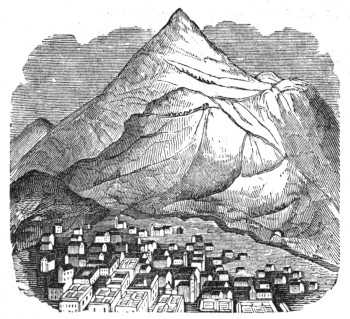
City of Potosi.
CHAPTER XV.
Before I proceed with my narrative, I must give some little account of the celebrated town in which I now found myself. Potosi is situated within a circle of mountains, and stands at the foot of a lofty peak which rises far above the rest. In this are the rich mines of silver which have given such fame to the place.
The number of inhabitants in Potosi was once 100,000, but it has greatly diminished, and the present number does not exceed 15,000; half of these are Indians. The towns of South America are not famous for their neatness; in this respect, however, Potosi has the advantage over most other cities in this quarter of the world. It is the custom to whitewash the houses on the outside, which gives them a very cheerful aspect.
Potosi is very remarkable in several respects. In the morning the air is keen and cold, but in the middle of the day it is burning hot. At night, the cold returns, and it seems almost as chill as during our New England March. Potosi is situated at an elevation of 13,265 feet above the level of the sea, and is the highest inhabited place on the face of the globe.
After my arrival here, my first business was to despatch letters to my friends at Valparaiso for a supply of money, and letters of introduction. I then sallied forth to take a view of the town. On my return I stated the manner in which I had lost my baggage to the landlord of the hotel, and having informed him that I had come on important business, requested him to supply me with such articles as I needed till I could obtain remittances. The man looked in my face with a gaze of amazement, and then laughed outright at what he deemed my brazen impudence.
I was, in fact, miserably clad, and my servant was worse off than myself. We looked, indeed, like a couple of vagabonds, and though I was at first angry, I did not think the conduct of the landlord unreasonable when I reflected upon the whole matter. But what was to be done? I was out of money and totally unknown to everybody in the place. It was necessary to do something for immediate support, and I therefore determined that my guide, Balbo, should go to work in the mines if I could get him a place, hoping that he would obtain the means of subsistence for us both.
Everybody has heard how the silver mines of Potosi were discovered. An Indian hunter was pursuing a vicuna up the slope of the mountain. In order to aid his ascent, he seized upon a small tree. This gave way, and beneath its roots, he saw a shining mass of silver. This occurred three hundred years ago, and since that time, more than a thousand millions of dollars have been taken from the mines in the mountain where this accidental discovery was made.
I had heard the story of the Indian hunter, and fancied that silver in Potosi was almost as abundant as common earth. When I reached the mines, however, I found the fact to be otherwise. The openings to these mines are small holes, which are entered by getting down upon the hands and knees. In this manner, you crawl along for a number of yards, when the space widens, and you are able to stand upright. There are a great many of these shafts, and some of them penetrate to a considerable distance into the bowels of the mountain. The silver ore is found in veins, and in following these, the miners have wrought out irregular winding caverns, sometimes ascending, and again descending. They work by blasting the rock with gunpowder. The ore, thus broken off, is carried out in the leather aprons of the workmen.
Most persons have no other than pleasant ideas in regard to silver; but if they could see the miserable Indians toiling in the mines, shut out from the light of day, grimed with soot and gunpowder, and haggard from the want of pure air, and all to obtain this precious metal, they would ever after feel that even this is purchased at almost too dear a rate.
I was not a little shocked and disgusted to observe the severe and painful toil required at the mines. After the ore is obtained, it is broken into pieces about the size of a hen’s egg. It is then put into a mill, and reduced to powder. In this state, it is mixed with salt and quicksilver, and remains fifteen days. By this time the silver has become mixed with the quicksilver. The earthy particles are then washed away, and the silver is separated from the quicksilver by squeezing. Such is the laborious process of mining; yet, notwithstanding the severe nature of the occupation, I found the wages to be but fifteen cents a day. The urgency of the case conquered my feelings, and I agreed that Balbo should go to work the next day.
This he accordingly did, and I found that, by the utmost economy, we could both of us subsist upon his earnings. I was now at leisure to pursue my inquiries in relation to the object of my journey. It is unnecessary to detail the careful investigation that I made, or to say with what anxiety I pursued my search. I may sum up the whole in stating that my uncle was not in Potosi, and that if he had ever been there, he had removed to some other part of the country at least three years before.
At the end of two months, I expected an answer from Valparaiso, but none was received; and after two months more I was forced to adopt the conclusion that my letters had miscarried, or my correspondents had refused to comply with my request. My situation was again in the highest degree embarrassing. After revolving a great many schemes in my mind, I determined to join a company of merchants who were going at that time to Quito. I offered myself as a mule-driver, and Balbo as a servant. Both were accepted, and we speedily set forward. I have not space to detail the incidents of this journey of more than 1500 miles in length. My story has, perhaps, already extended beyond the patience of the reader. It will be enough to say, that, after travelling over mountains and plains, and beholding some of the most sublime scenery in the world, we reached the capital of Equador.
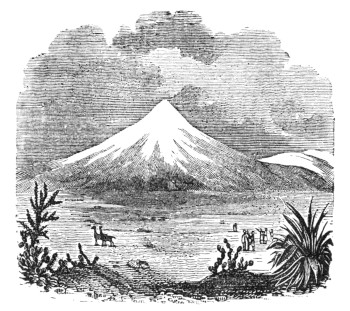
Chimborazo.
CHAPTER XVI.
There are few places in the world more remarkable than Quito. It lies nearly under the equator, yet, being more than 9,000 feet above the level of the sea, it has a climate like that of our June during the whole year. The face of nature seems to be covered with perpetual bloom. While some of the people are sowing their wheat, others are harvesting theirs.
The city of Quito is itself built upon the skirt of the volcanic mountain of Pichinca. It is a fine city, with many elegant buildings, though the streets are irregular, and arches are frequently necessary in order to cross the yawning chasms created by the eruptions of the mountain.
In a southerly direction, at the distance of about a hundred miles, is the celebrated peak of Chimborazo. It is 21,440 feet in height, and is capped with everlasting snow. In a clear day, I could see this sublime mountain, seeming like a thin blue cloud, and appearing almost to blend with the distant sky. I had now given up every hope of meeting with my uncle, and thought only of finding my way back to Guiana. An opportunity was soon offered for setting out for my return. Three Spanish travellers were about to proceed to Assumption on the Pilcomayo, and then descend the Amazon to its mouth. Balbo and myself were engaged as servants, and we speedily set forward.
We crossed the mountains on mules, sometimes employing llamas for carrying our baggage. These animals are about twice the size of the sheep, and have a gentleness of character that seems to win kindness from every one. They have indeed one habit which seems incompatible with their general course of non-resistance; for if you offend them, they will spit in your face. Yet they cannot endure chastisement. They will perform the utmost labor of which they are capable; but if you strike them in order to urge them beyond this, they will lie down and die.
In a fortnight we reached the small town of Assumpcion. We here embarked upon the Amazon in a boat, being liberally provided with everything needful for our voyage.
After a diversity of incidents, we reached the town of Barra, just below the point where the Rio Negro enters the Amazon. We here parted with our bateau and joining some other travellers, hired a larger craft and proceeded on our way. The weather was exceedingly hot, and several of our company were taken sick, and the Spaniard in whose service I was engaged, died of fever. Proceeding to the shore, which at this point was occupied with impenetrable forests, we made a grave in the earth, and left the body to its solitary repose.
Among the strangers who had joined us at Barra was a gentleman who appeared marked with care and bowed with years. He was now among the sick, and I was engaged as his attendant. He had caught the fever common to this climate, and it seemed rapidly advancing to its crisis. We had no physician on board, but the stranger seemed competent to give directions, and these I scrupulously followed. At last we came to a small settlement on the banks of the river, and he concluded to be set on shore, in order to obtain medical aid, and have the comforts necessary to his condition. I went with him to his lodgings, and saw him placed in his new quarters.
I had felt an interest in him from the beginning, and I now offered to continue with him, at the same time expressing my desire to return to Paramaribo. The name seemed to excite his curiosity, and he looked me steadily in the face for a moment. “Are you going to Paramaribo?” said he. I replied in the affirmative. “I was going thither myself,” said he, “but I may never reach that place. Take this, young man, and on your arrival, deliver it according to its address.” He then handed me a parcel, and as I took it, I saw upon it the name of M. Scager.
At this moment an agitating thought took possession of my mind. “Who—what is this stranger? May it not after all be the individual whom I have sought so long?” Struck with this suggestion, I gazed at the sick man with such intensity as to attract his attention. “What is the matter, young man?” said he. “Oh, tell me, sir, tell me your name. For heaven’s sake tell me your name,” said I. The stranger rose from his pillow, and with a startled aspect demanded, “Why this curiosity? what mean these questions?”
“Pray sir,” said I, “are you not my uncle?” The sick man leaned back upon his pillow, and with a broad smile upon his countenance as if I had said something exceedingly ludicrous, replied, “I think not; but what is your name?” “Richard Boldhero,” said I. The stranger once more rose from his pillow, saying, “Indeed, indeed, Richard Boldhero?” “Yes, yes,” said I, “and you are my father’s brother—I know you now—you are indeed my uncle.”
I need not describe the remainder of the scene. The object of my long search was found. For seven weeks I watched by his bedside, during which period he seemed hovering betwixt life and death. By slow degrees he recovered, and in due time we took passage down the river, and at last reached its mouth. I had now traversed nearly the whole length of this giant stream—a distance of about 3,500 miles.
At Mazago we took passage in a brig for Paramaribo, and in two weeks we reached that place. During our voyage, my uncle gave me an account of his life after his departure from thence. He had settled for a time at Valparaiso, and had acquired a considerable amount of property. This he converted into cash, and remitted it to Mr. Hartley, for the purpose of discharging his debts, as we have already related. Since that period, he had led an unsettled life, being engaged at different times in various enterprises. Finding himself advancing into the vale of years, a desire to return to the scenes of his youth took possession of his mind, and when I met him, he was on his way to fulfil this wish. He had not heard of the turn of fortune in his favor, but considered his name as still disgraced in Paramaribo. It may be readily believed that the information I gave him brought back the sunshine which had long departed from his bosom.
I must pass over my own meeting with Mirabel as well as that of her father. The imagination of the reader will doubtless do better justice to the scene than any words I can supply. I had been absent a year and eleven months, and during that period had often suffered the deepest anxiety for my mother and sister. I now found letters from well, and enjoying as much happiness as their humble condition would permit. In a few weeks I set out to return to Connecticut, my uncle having promised soon to follow me, and bring Mirabel with him.
I reached home in due season, and four months after, his promise was fulfilled. He settled at Middletown, having recovered a sum of money sufficient to make him wealthy from the insurance company that had inflicted upon him such gross injustice and so many sorrows. On hearing the conduct of Dexter to my father, he caused a suit to be instituted against him, in the course of which, it was proved that he had been guilty of embezzling property belonging to the concern. He was obliged to pay a large sum to my mother, and his own reputation which he had built up with such hypocritical care, was blasted forever.
In the course of my life, viewing the hard fortune of my father and my uncle, I had sometimes distrusted the justice of Providence; but I now saw that the persecutors of both had been made to suffer the severest retribution. With this reflection I must close my story, only adding that Mirabel no longer calls me cousin, but many years ago exchanged that pleasant title for one of a still dearer character.
“Let us remove temptation from the path of youth,” as the frog said when he plunged in a pond, at seeing a boy pick up a stone.
He who swims in sin will sink in sorrow.
The Squirrel and Rattlesnake.
Rattlesnakes hunt and secure for their prey, with ease, grey squirrels that abound in our woods; therefore, they must be possessed of swiftness to obtain them. Having enjoyed the pleasure of beholding such a chase in full view, in the year 1821, I shall detail its circumstances:
Whilst lying on the ground, to watch the habits of a bird which was new to me, previous to shooting it, I heard a smart rustling not far from me, and turning my head that way, saw, at the same moment, a grey squirrel, full grown, issuing from the thicket, and bouncing off in a straight direction, in leaps of several feet at a time; and, not more than twenty feet behind, a rattlesnake of ordinary size, pursuing, drawn out, apparently, to its full length, and sliding over the ground so rapidly, that, as they both moved away from me, I was at no loss to observe the snake gain upon the squirrel.
The squirrel made for a tree, and ascended its topmost branches as nimbly as squirrels are known to do. The snake performed the same task considerably more slowly, yet so fast, that the squirrel never raised his tail nor barked, but eyed the enemy attentively as he mounted and approached. When within a few yards, the squirrel leaped to another branch, and the snake followed by stretching out two thirds of his body, whilst the remainder held it securely from falling. Passing thus from branch to branch, with a rapidity that astonished me, the squirrel went in and out of several holes, but remained in none, knowing well, that wherever his head could enter, the body of his antagonist would follow; and, at last, much exhausted and terrified, took a desperate leap, and came to the earth with legs and tail spread to their utmost, to ease the fall. That instant the snake dropped also, and was within a few yards of the squirrel before it began making off.
The chase on land again took place, and ere the squirrel could reach another tree, the snake had seized it by the back, near the occiput, and soon rolled itself about it in such a way, that although I heard the cries of the victim, I scarcely saw any portion of its body. So full of its ultimate object was the snake, that it paid no attention to me, and I approached it to see in what manner it would dispose of its prey. A few minutes elapsed, when I saw the reptile loosening gradually and opening its folded coils, until the squirrel was entirely disengaged, having been killed by suffocation. The snake then raised its body from the ground, and passed its head over the dead animal in various ways, to assure itself that life had departed; it then took the end of the squirrel’s tail, swallowed it gradually; bringing first one and then the other of the hind legs parallel with it, and sucked with difficulty, and for some time, at them and the rump of the animal, until its jaws became so expanded, that, after this, it swallowed the whole remaining parts with apparent ease.
This mass of food was removed several inches from the head in the stomach of the snake, and gave it the appearance of a rouleau of money in a purse with both ends towards its centre; for, immediately after the operation of swallowing was completed, the jaws and neck resumed their former appearance. The snake then attempted to move off, but this was next to impossible; when, having cut a twig, I went up to it, and tapped it on the head, which it raised, as well as its tail, and began for the first time to rattle. I was satisfied that, for some lapse of time, it could not remove far, and that the woods being here rather thin, it would soon become the victim of a vulture. I then killed it, and cut it open, to see how the squirrel lay within.
I had remarked that after the process of swallowing was completed, singular movements of the body had taken place; a kind of going to and fro for a while, not unlike the convulsive motions of a sick animal, as a dog, for instance, going to vomit. I concluded that some internal and necessary operation was going on. This was proved, when I found the squirrel lying perfectly smooth, even to its hair, from its nose to the tip of its tail. I noted all this on the spot. This over, I sought my game again, and felt a great satisfaction; but having met my friend, Mr. James Perry, on whose lands, in Louisiana, I was then hunting, and having related what had just happened, he laughingly said, “Why, my dear sir, I could have told you this long ago, it being nothing new to me.” These facts, I trust, are quite sufficient to exemplify the faculties of swiftness, and the powers of extension and diminution, in the rattlesnake.—Mr. Audubon’s Notes on the Rattlesnake.
Butter was not known to the Greeks; they have no word which gives an idea of it.
There is Time Enough.
This is one of the most mischievous sentences in the English language. Not that it is bad in itself—for it is strictly true, as we intend to show presently. But its meaning is sadly perverted, and what was meant for good, becomes the occasion of evil.
Many a good thing might have been done had it been begun in season; but because there was time enough, it was let alone, and let alone, and so not started until too late, or never moved at all.
But there is such a thing as bringing good out of evil. The bee extracts honey, as sweet, if not as abundant, from the thistle, as from the rose. And he who would profit by studying human nature, and watching divine providence, may learn wisdom from his past errors, and turn over his misfortune to some good account.
The wisest man in ancient days, (and we believe he was fully as wise as people commonly are at present,)—the wisest man of ancient days has given us to understand that there is a time for everything under the sun. A time for laughter and for tears, for sorrow and for joy. A time for business, a time for recreation, and a time for rest; but he does not say a word about leisure time, or time for idleness. He speaks too of a time to die, leaving us to infer, as we may very naturally, that He, who made the sun to rule the day, the moon and stars to govern the night, has given us time enough, just time enough, and none to spare, to perform all our duties, and to enjoy every rational pleasure—to make the world better for our having lived in it, and to become better fitted ourselves, for “another and a better world.”
There is time enough, says the schoolboy; whose time runs out, and he goes half fitted to the counting room, or enters half fitted at college.
Time enough, thinks many a young man, if he does not say so, to commence habits of frugality and economy, and thus provide for future wealth; but the time never, never comes, and he, to use a homely phrase of Dr. Franklin’s, “scratches a poor man’s head as long as he lives.”
How many designs have we formed, of doing this and that good thing, which fell through, not because we had little time, but because we had time enough, and so wasted one hour after another till the time had passed.
Time enough to work says the idler and spendthrift; but his clothes wear out before he finds time to earn new ones; and his pockets are emptied, and he has no time to replenish them.
Franklin has a homely saying to this effect,—that he who loses an hour in the morning, must run all day, and ’tis a wonder if he overtakes his business before night. So, if any one finds himself pinched for time, it is likely he has thrown away an hour, when he thought he had time enough and a little to spare.
Time enough—say we, when in a serious mood we resolve to be more diligent, more systematic, more punctual; when we resolve upon any reform.
We do not mean to procrastinate; but while we muse, the moment passes, and is irrecoverably lost.
Do you say, “We knew all this before?”
No doubt of it. Yet we are apt to think there is not only time enough, but some to spare.
But this is an error, and should be corrected.
The different length of different lives is nothing against our position, that life is just long enough. The oldest person has enough of duty and enough of pleasure too, if he lives aright, to occupy his threescore years and ten, while he whose sun goes down at noon, has time enough, if he will but improve it, to make his life here a blessing to others, and that hereafter blessed and glorious to himself.
——“That life alone is long, Which answers life’s great end.”
The Folly of War.—A few days since a farmer in the town of Jefferson, heard loud talking and angry words bandied about among his dunghill fowls, and being a man of a pacific disposition, no ways inclined to countenance family quarrels, and withal being a little curious to know the cause of the disturbance, and who was in the right, and who was in the wrong, with divers other causes him thereunto moving, he leisurely bent his course towards the scene of cackling and confusion, aforesaid, which, as is recorded in the case of Bullum vs. Boatum, was “very natural for a man so to do.” Arrived in the vicinity of the disturbance above particularly referred to, he observed his dunghill cock, who is a great pugilist, and in the enjoyment of all his physical strength, engaged in mortal combat with a striped snake of about eighteen or twenty inches in length, the cock to all appearance having the decided advantage over his more wily, though less nervous adversary, dealing his blows in quick succession, employing alternately his bill and spurs with true pugilistic skill and science. But the cunning serpent, well aware that the victory must declare against him by fair combat, brought into requisition a portion of that innate cunning for which that reptile has been celebrated from the beginning of the world to the present time; and seizing his antagonist by the thigh, in the rear, he completely secured himself from any further danger from him. Thus situated, the cock very naturally thought his only “safety was in flight,” he accordingly “cleaved the air majestically with his wings,” the snake keeping fast the hold, and dangling like a taglock, underneath, until the cock, overcome by fatigue, alighted on a neighboring apple tree. The snake immediately coiled his tail around a branch of the tree—the cock again attempted flight, but he could scarcely clear the limb, from which he hung with his head downwards, making every effort to escape, but all in vain, until the farmer came to his assistance—killed the snake and set him at liberty.
Wager Lost.—In the year 1765, a waterman having laid a wager that he and his dog would both leap from the centre arch of Westminster bridge, and land at Lambeth within a minute of each other; he jumped off first and the dog immediately followed, but not being in the secret, and fearing that his master would be drowned, he laid hold of him by the neck and dragged him on shore, to the great diversion of the spectators.
Anecdote of a Cat.—Sometime ago a respectable lady from Glasgow, having been on a visit at the house of a friend in Edinburgh, fancied a beautiful cat of the Muscovy species, which graced the fireside of the hostess. The latter, being pressingly solicited, at length consented to present her visiter with the animal, and puss was accordingly enclosed in a basket, and transported along with her new proprietrix in the inside of a carriage to the city of Glasgow. For seven or eight weeks after the animal’s arrival at her new residence, she was watched, lest, not being reconciled to the change, she should make her escape.
At the termination of that time, she littered two kittens; and this circumstance was considered a sufficient guarantee for her remaining, for some weeks at least, in her new house. Some days afterwards, however, puss with both her kittens disappeared, and no traces could be obtained of the place to which she had been removed, until about eight days from the time of her disappearance from her Glasgow residence, when her well-known mew was recognized by her former mistress at the door of her drawing room. The door was opened; and there was seen poor puss with her brace of kittens—they in excellent condition—but she worn to a skeleton. The distance betwixt Edinburgh and Glasgow is upwards of forty miles; and as the sagacious animal could only carry one of her kittens such a distance at a time, she must, after having placed the one, in someplace of concealment in Edinburgh, have returned to Glasgow for the other—thus travelling altogether upwards of one hundred and twenty miles. There is no doubt but puss chose the darkness and silence of the night as the most eligible season for the performance of her singular journey.
Examination of a School Boy.—The following anecdote illustrates the danger of trusting to memory alone, in the acquisition of knowledge.
“Now, my boy,” said the master, “pray inform me who was the first man in the world?” “Adam,” replied the youth, with quickness.
So far so good; the next attempt was not equally fortunate. “And pray, who was the wisest man in the world?” “Eve,” replied the boy, with a triumphant air; at which all the boys burst into a loud fit of laughter, which the authority of the master calling silence, could not suppress for some minutes.
“You mistook the question, my boy,” said the master; “you imagined, no doubt, that I asked who was the wisest woman in the world; and to that question your answer is very accurate; for, as Eve was the first woman in the world, she must at that time have also been the wisest.”
But the mortified pupil was too much disturbed by the laughter of his schoolfellows to avail himself of this ingenious hint. He appealed to the ready-made answers of his catechism, to prove that his master alone was the cause of his distress.
“Look there; question fourth, ‘Who was the first woman in the world?’ answer, ‘Eve;’ but instead of that, when I expected question fourth, you asked question fifth, that you did!”
A Sly Couple.—A gentleman in the county of Stirling kept a greyhound and a pointer, and being fond of coursing, the pointer was accustomed to find the hares, and the greyhound to catch them. When the season was over it was found that the dogs were in the habit of going out together and killing hares for their own amusement. To prevent this a large iron ring was fastened to the pointer’s neck by a leather collar and hung down so as to prevent the dog from running, or jumping over dykes, &c.
The animals, however, continued to stroll out to the fields together, and one day the gentleman suspecting that all was not right, resolved to watch them, and to his surprise found that the moment they thought they were unobserved, the greyhound took up the iron ring in his mouth, and carrying it they set off to the hills and began to search for hares as usual. They were followed and it was observed, that whenever the pointer scented the hare, the ring was dropped and the greyhound stood ready to pounce upon poor puss the moment the other drove her from her form, but that he uniformly returned to assist his companion after he had caught the prey.
The Philosopher Puzzled.—De la Croix relates the following instance of sagacity in a cat, which, even under the receiver of an air pump, discovered the means of escaping a death that appeared to all present inevitable.
“I once saw,” says he, “a lecturer upon experimental philosophy place a cat under the glass receiver of an air pump, for the purpose of demonstrating that very certain fact, that life cannot be supported without air and respiration. The lecturer had already made several strokes with the piston, in order to exhaust the receiver of its air, when the animal, that had begun to feel herself very uncomfortable in the rarefied atmosphere, was fortunate enough to discover the source from whence her uneasiness proceeded. She placed her paw upon the hole through which the air escaped, and thus prevented any more from passing out of the receiver.
“All the exertions of the officer were now unavailing; in vain he drew the piston; the cat’s paw effectually prevented its operation. Hoping to effect his purpose, he let air again into the receiver, which as soon as the cat perceived, she withdrew her paw from the aperture; but when he attempted to exhaust the receiver, she applied her paw as before. All the spectators clapped their hands in admiration of the wonderful sagacity of the animal, and the lecturer found himself under the necessity of liberating her, and substituting another in her place, that possessed less penetration, and enabled him to exhibit the cruel experiment.”—Naturalist.
Rising Genius.—A boy who displayed a long dangling watch-chain, was asked, “What’s the time of day, Josiah?” The lad drew out his watch very ceremoniously, and after examining it for a while referred to another boy and said, “Is this the figure nine, or the figure seven?” He was told that it was the figure seven, “Well then,” said the genius, “it lacks just about half an inch of eight.”
The French Officer and his Mastiff.—A French officer, more remarkable for his courage and spirit than his wealth, had served the Venetian republic for some years with great valor and fidelity, but had not met with that preferment which he merited. One day he waited on a nobleman whom he had often solicited in vain, but on whose friendship he had still some reliance. The reception he met with was cool and mortifying; the nobleman turned his back upon the necessitous veteran, and left him to find his way through a suit of apartments magnificently furnished. He passed them lost in thought; till casting his eyes on a sumptuous sideboard, where a valuable collection of Venetian glass, polished and formed in the highest degree of perfection, stood on a damask cloth, as a preparation for a splendid entertainment, he took hold of a corner of the linen, and turning to a faithful English mastiff which always accompanied him, said to the animal, in a kind of absence of mind, “Here, my poor old friend, you see how these haughty tyrants indulge themselves, and yet how we are treated.”
The dog looked his master in the face and gave tokens that he understood him. The master walked on, but the mastiff slackened his pace, and laying hold of the damask cloth with his teeth, at one hearty pull brought all the glass on the sideboard in shivers to the ground, thus depriving the insolent noble of his favorite exhibition of splendor.
A rusty shield prayed to the sun and aid, “Oh sun, illumine me with thy ray!” To which the sun replied, “Oh shield, make thyself clean!”
Laconic.—Perhaps our readers are not all aware that the style of speaking called laconic was taken from a practice at Sparta, anciently Laconia. Lycurgus, the lawgiver, exercised the young people in conversation while at their meals. Questions were asked them at the table, to which short and ready answers were required. This was both the amusement and business of old men, and great attention was paid by those who watched over education, both to the expression and manner of these replies. The boys, accustomed to have their answers listened to, corrected and applauded by men for whom they had the greatest esteem, acquired a quickness and propriety in answering, with a manner of speaking, at once graceful, respectful, and determined; while that strict obedience which was required of the young, that watchful eye that was kept over them by the aged, in whose hands all the authority of the laws was placed, produced that modesty in youth, and that reverence for age, for which Sparta became so famous.
A wise Parrot.—There is an Eastern story told of a person who taught his parrot to repeat only the words, “What doubt is there of that?” He carried it to market for sale, fixing the price at one hundred rupees. A Mogul, seeing the parrot, asked him “Are you worth one hundred rupees?” The parrot answered, “What doubt is there of that?” The Mogul was delighted and bought the bird. He soon found out that it was all he could say. Ashamed now of his bargain, he one day exclaimed, “I was a fool to buy this bird.” The parrot replied, “What doubt is there of that?”
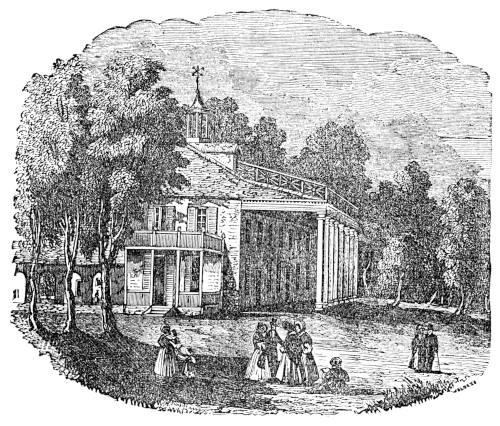
Mount Vernon.
This name does not mean a town or village, but an estate, which was for many years the residence of Washington. We give above, a view of the house, which still remains, though it is a good deal dilapidated since it was inhabited by the great and good man to whom it owes its celebrity.
Mount Vernon is a large farm, near the Potomac, and lies about eight or ten miles below Alexandria, in the District of Columbia. The house is an old-fashioned one, of ample size, with a deep piazza in front. It commands a view of the river and surrounding country, and is a very pleasant spot. But its chief interest lies in the fact that here was the house of Washington, and that good, hospitable companion of his fortunes, lady Washington.
Many people, from all parts of the world, visit this place every year, and as they walk over the grounds, and tread the halls of the mansion, the image of the father of his country arises before the fancy, and the stranger seems to realize the scenes that have long since passed away. What a power there is in greaness and goodness, to impart an interest to everything that has been associated with those who, in life, displayed these noble qualities; and in death, have left behind a name and fame, which it is the delight of mankind to cherish!
“Nine Tailors make a Man.”—This sentence, which had its origin in the grateful mind of one who had received a start in life from the charity of tailors, has now, from an ignorance of the circumstance, entirely lost its meaning. The term had its origin in the following manner.
In 1742, an orphan beggar boy applied for alms at a fashionable tailor’s shop in London, in which nine journeymen were employed. His interesting and forlorn appearance touched the hearts of the benevolent tailors, who immediately contributed nine shillings for the relief of the little stranger. With this capital, our young hero purchased fruit, which he retailed at profit. From this beginning, by industry and perseverance, he finally rose to wealth and distinction, and when he set up his carriage, he caused to be painted on the pannel, “Nine tailors made me a man.”
Socrates.—It is said of Socrates, the great Grecian philosopher, that he never allowed his temper to overcome him, but displayed the utmost tranquillity on all occasions. Feeling at one time displeased with one of his servants, he said, “I would beat thee, if I were not angry.”
The word “gentleman,” is evidently no mark of wealth or station. “You are no gentleman,” said a waiter in a tavern to a person who had given him three-pence. Three-pence more would have constituted the gentleman in the eyes of the waiter, while in truth the three-pence might have been withheld through poverty.
“What sort of a person,” said an individual to his landlady, “is that who occupies your back parlor?” “He is a tailor by trade,” said she, “but very much the gentleman.” This meant that he paid his five shillings a week regularly!
A Sailor in a Coach.—Sailors are favorites, from a general belief in their superior frankness and gallantry; but an early association with tar and oakum is by no means calculated to purify the taste or give the manners the highest finish. We shall not easily forget the sensation once produced by the arrival of a distinguished naval officer at an archery meeting in England; he was pleased to descend the steps of his carriage stern foremost, as if he were descending an accommodation ladder!
Criticism upon Preaching.—“I didn’t like our minister’s sermon last Sunday,” said the deacon who had slept all the sermon time, to a brother deacon. “Didn’t like it, brother A.; why I saw you nodding assent to every proposition of the parson.”
Want of punctuality is a species of falsehood.
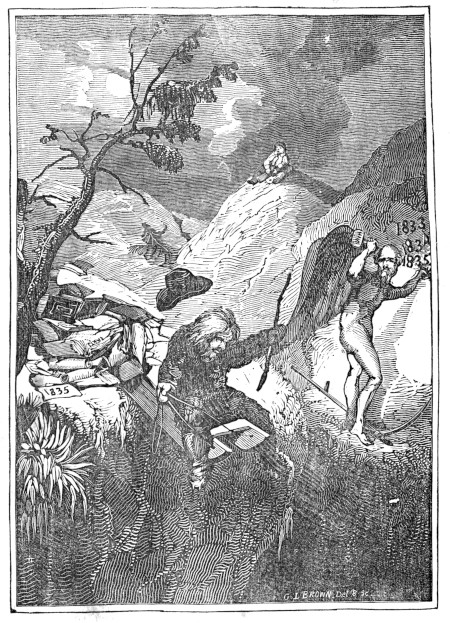
Farewell to the Old Year.
Well—so it is—so it must be. “Time and tide will wait for no man.” The world rolls round, and what mortal can stay its revolutions? Let us be careful then, to see that this most precious of gifts be diligently and wisely used. If we have spent our time well, we have no reason to lament its departure: if we have used it amiss—if we have squandered it in the pursuit of folly, or used it in the indulgence of sin—then, then indeed we have reason to mourn over its irreparable loss. But the moment we are aware of such an error, let us arrest our downward progress; adopt new and wise resolves, that we may reclaim the loss of the past, as far as may be, by the more diligent and faithful use of the future.
And while we talk to others, let not Bob Merry forget his own duty. For the last twelve months, we have plodded on, bringing forth things new and old, to the best of our feeble ability, in fulfilment of our vocation, which is to please and profit our gentle friends and readers. That we have done well, we cannot presume to say; that we have intended well, is all we can venture to assume. Amid the cares and toils of our journey,—the flaws, cross-currents, and tempests of our voyage—we have at least one comfort—perhaps but one—and that is, that our little Black Eyes and Blue are still good-humored, and still cheer us with their confidence and favor. This joyous breeze still fills our sails—and with this encouragement we shall start upon the voyage of 1845.
We hope to perform every trip this year, under some new advantages. We not only retain our old publishers, Messrs. Bradbury, Soden & Co.,—who commenced the Museum and have carried it on so successfully through eight volumes—but we have taken on board a new captain,—D. Mead of New York, who is an experienced sailor, and who intends to make a dashing voyage. To drop the metaphor, and speak in plain language—the Museum is hereafter to be issued from two points—the office of Bradbury, Soden & Co., No. 12 School street, Boston, and that of the aforesaid D. Mead, 148 Nassau street, New York. The work will appear with promptitude, and we shall be careful to see that, every month, the patrons of the work shall find a palatable assortment of literary varieties. We shall still be happy to receive the favors of our correspondents, addressed to Bradbury, Soden & Co., 12 School St., Boston.
[Audio content is not currently supported on your device.
Pleasant Things.
MUSIC BY G. J. WEBB.
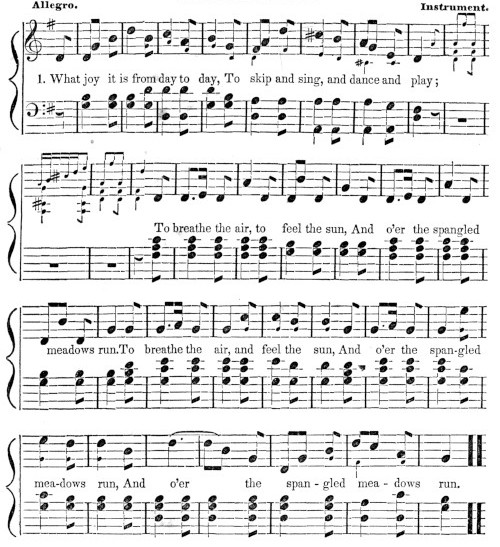
1. What joy it is from day to day, To skip and sing, and dance and play; To breathe the air, to feel the sun, And o’er the spangled meadows run. To breathe the air, and feel the sun, And o’er the spangled meadows run, And o’er the spangled meadows run. What joy to move my limbs about, To whoop and halloo, call and shout, Among the woods and feel as free As any bird upon a tree. What joy, when hungry, ’tis to eat, What pleasure in our daily meat; How sweet, when sleep the eyelids close, To sink in calm and soft repose. But who bestows the constant joy On every little girl and boy? ’Tis God, our Father, great and wise, Whose goodness every joy supplies. Then let me love and praise the Lord, And strive to know his holy word,— To do no wrong, and think no ill, And evermore perform his will.
Transcriber’s Note
This book was written in a period when many words had not become standardized in their spelling. Words may have multiple spelling variations or inconsistent hyphenation in the text. These have been left unchanged unless indicated below. Obsolete words, jargon, and alternative spellings were not changed.
Obvious printing errors, such as letters that were backwards, upside down, partially printed, or in reverse order, were corrected. Unprinted punctuation, final stops missing at the end of sentences and abbreviations were added. Duplicate letters at line endings or page breaks were removed. One footnote was moved to the end of the story in which the anchor occurs.
Links to audio files were added for music. The music files are the music transcriber’s interpretation of the printed notation and are placed in the public domain. At the time of this writing, music file links will not work in mobile e-book formats like epub or Kindle/mobi. Users who are reading the e-book in one of these formats can listen to the music or download music files in the HTML version. Lyrics to musical scores are presented as poetry following the illustration of the music.
Noted:
There may be a number missing from the puzzle at the end of the October issue: My 2, 8, 10 and is numbered.
The illustration on page 186 shows the year 1835 coming to its end while the text referring to the illustration speaks of the year 1844 coming to an end.
Text likely missing at a page break:
I now found letters from ... well, and enjoying as much happiness as their humble condition would permit.
There is no Chapter numbered XIII in the Dick Boldhero story.
The following items were changed:
fond and [axious] anxious hope
one hundred [rix] six dollars
[sackened] slackened his pace
[acession] accession of a single rivulet
opposite side of the [rixer] river
[but-end] butt-end upon the head
[may] many people do not wish
[Sarcely] Scarcely had we
Missing word added:
be [a] matter of surprise