Volume 8 — CONTENTS OF VOLUME VIII. (continued 3)
Reading edition
At Thebes, the coffins of mummies are burnt for fire-wood, and the ruins of limestone are burned for lime.
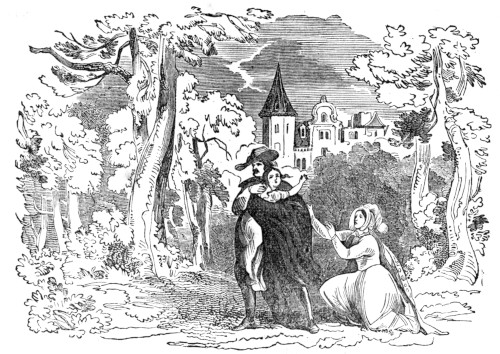
The stranger carrying off Katrina.
Bill and the Boys.
The story of Dirk Heldriver, continued.
In a preceding number we have given an account of the manner in which Katrina was taken from her mother and borne away into the woods. We must now continue the story, as it was related by Bill to his companions.
Nothing could exceed the state of excitement produced upon M. Hielder by the news of the carrying off of his daughter; for a few moments, he seemed to be in a frenzy of rage, muttered the name of Hieldover between his teeth, clenched his fist, and uttered the most terrific imprecations. But in a short time, he conquered his passion, and, ordering six men to attend him, they all set out in pursuit of the offender. They had learned as well as they could from Madam Hielder the direction which the robber had taken, which appeared to be towards the mountains. They soon found the traces of footsteps which led along the bank of a small river that swept down from the heights. They followed these for about two miles, when the ground became rocky and broken, and they could no longer trace them. It seemed certain, however, that the stranger had ascended the mountain, directing his course to a deep and wild dell that lay between two rugged cliffs, that seemed to rear their naked heads to the clouds.
The party drew themselves out in a lengthened line, and proceeded to search the tangled valley that lay before them. The impatience of Hielder led him in front of the pursuers, and the excited state of his feelings made him almost forget his attendants. It was not long before he saw, or thought he saw, the object of his pursuit. He rushed forward, urging his way between the branches of the trees and the thick mass of underwood, regardless of the obstacles that lay in his path, his garments torn, and his hair streaming in the wind. He was soon separated from his companions, and entirely forgetting them, urged his way through the wilderness.
Again he fancied that he saw the figure of a man, at a considerable distance, bearing a child in his arms. He seemed to be straining up the sides of the mountains, and at a considerable distance. Hielder redoubled his efforts, and in his agony of mind, shouted aloud, filling the hollow of the mountain with his cries. For a long time he continued his pursuit, occasionally catching glimpses of the flying robber and his daughter, or objects that seemed to be such. At length he came to an open space, and on a rocky eminence before him, he imagined that he saw the form of Hieldover, holding out his child in triumphant mockery. Hielder was armed with pistols, and, snatching one of these from his belt, he aimed it at the form of Hieldover, and fired. This was instantly followed by a scream, which seemed to be that of the child. Smitten with horror at the idea that he had killed his daughter, the father sank down on the ground in a state of insensibility.
It was now evening, and M. Hielder, as we have stated, had been for a considerable time separated from his attendants. They had discovered his absence from their line, and for some hours had been in search of him. One of them heard the report of the pistol, and directed his steps towards the spot from which the sound seemed to proceed. In the darkness, however, he passed the body of his master, and continued to push forward. The pursuit was continued till morning, when the party collected together by means of signals, and began to deliberate upon what was to be done.
While they were thus occupied, they saw M. Hielder approaching. They were all struck with amazement at his strange appearance. His clothes were torn in fragments; his hat was gone, and there were traces of blood upon his face. His countenance was pale as ashes, and his eye had the startled and wild expression which belongs to a madman. He said not a word, and when the men addressed him he gave no answer. After a little deliberation, they concluded to return, and two of them, taking their master by the arms, led him homeward. He made no resistance, and, in the course of a few hours, they reached the house.
M. Hielder continued in a state of derangement for nearly two weeks. He was not violent, but his mind seemed constantly occupied with the vision of some object before him, which he earnestly sought to reach. Sometimes in his eagerness, he would spring out of his bed, and endeavor to pursue the phantom, which fled before him and eluded his grasp. At others, he would beckon to it, and again reach out his arms, beseeching it to come to him. He often uttered the name of Hieldover, and would frequently say, “Give me back my child; give me my daughter, and I will restore all. Be satisfied, Hieldover, with your revenge. Take the money, but give me my child. Is there such cruelty in the heart of man? will you wring the heart that is broken? will you grind in the dust the form that crouches at your foot? Do as you please—kill me, if you will, but restore to me once more my child.”
The wife of the poor man was unceasing in her attentions. Day and night she was at his bedside, seeking to allay the fever of his mind, and administering to him such medicines as the physician prescribed. Nor were these kind and skilful ministrations without their due effect. By degrees the symptoms of the patient became alleviated, and, in the space of a few weeks, his reason seemed to be restored. Yet his form was wasted almost to a shadow, and his mind seemed to participate in the exhausted condition of his body. He however gradually rose from this state of depression, and at last seemed once more in the possession of health and vigor.
His countenance, however, was greatly changed. The stern, dark, moody expression which formerly brooded over his countenance, had given place to settled melancholy, tinged with a somewhat startled aspect. His firm nerves, too, had become shaken, and the sudden rustling of the wind, or the sound of an unwonted footstep, made him tremble from head to foot. There was still a haughty feeling in him, which taught him to conquer these humiliating symptoms; but in the struggle between pride and weakness, an effort often took place, which was manifested by the large cold drops standing upon his forehead.
The early history of M. Hielder was unknown to the people around him. They were ignorant of the visit paid him by the stranger, who called himself Hieldover, and which we have already described. They were at a loss, therefore, to account for the events which had recently transpired. Who could have carried off the child? What motive could any one have for such an act? Why was the master of the house wrought up into such a frenzy? Why was he cheated with illusions, and finally driven to a state of madness in the mountains? These were the questions discussed by the gossips around the house; and as no better answer to these inquiries could be found, they were all resolved by the conclusion that the dark and mysterious being who carried off the girl, was the devil himself.
I am sorry to have anything to say about this personage; but a century ago, when these things happened, it was very much the fashion to lay everything to him which could not be otherwise explained. Of course, whoever undertakes to tell a story of that day, is likely to have something to say about him. We need only add, that we shall have as little as possible to do with him on this, as on every other occasion.
The suggestion having been once made that the scenes we have described were the work of a being of the other world, it soon grew into the established opinion of the people attached to Hielder house. Nor were confirmations of this wanting. Several of the servants declared that they had seen, in the evening twilight, a dark figure, with a slouched hat and wrapped in a cloak, moving mysteriously along the avenues around the house. Others insisted that they had seen a strange light dancing in the hollow of the mountain, where M. Hielder had met the strange apparition.
These tales soon reached the ears of their master, and he readily concluded that they might be founded in truth. He determined, therefore, to investigate the subject for himself. In the course of a few evenings, he saw a dusky figure standing in the shadow of the trees at no great distance from the house. He approached it, but it glided from him, and was soon lost in the depths of the forest. He, however, pursued the retreating spectre. He soon saw it again, and it seemed now to pause. He approached it, and could distinctly recognize the tall and majestic figure of Hieldover. At this moment, the latter spoke—“Approach me not, as you value your life; but if you wish to know the fate of your child, visit me to-morrow at this hour. You will find me at home in the mountains.” Saying this, the form departed, and was immediately buried in the mazes of the wood.
M. Hielder was thrilled with a kind of horror, but he determined to accept the fearful invitation. At the appointed time, he left the house alone, and set out for the mountains. It was now autumn, and the leaves were beginning to fall from the trees. The night was gloomy, and the wind swept in hollow gusts through the forest. The tops of the trees waved with an uneasy and troubled motion in the gale. There was no human voice to disturb the night, but many strange and ominous sounds came upon the ear of the adventurer, as he now began to ascend the shaggy sides of the highlands. The creaking of the trees, whose branches rubbed against each other, the shrill wailing of the owl, and the continued roar of the wind, served to increase his excitement, though not in any degree to shake his purpose.
Resolutely striding on through the mass of crumpled leaves that covered the ground, he reached, at last, a position that commanded a view of the spot where he had seen his child in the arms of Hieldover. This consisted of a mound of rocks, which rose in the form of a pyramid in the centre of a valley, scooped out of the side of a mountain. The whole scene was covered with trees, except a small space which encircled the mound. This consisted of a grassy belt, through which a small stream passed on either side of the pyramidal rock.
M. Hielder paused a moment to consider what course he should take, when a small flame gleamed upward from the very point where Hieldover was standing with his child, when he discharged the pistol, as we have related. Receiving this as a signal, he plunged down into the valley, crossed the stream, and, with an almost frenzied energy, began to climb the rocky mound. Seizing upon the branches of trees and shrubs, he clambered upward, and soon attained the point from which the light was still gleaming.
(To be continued.)
“I won’t be trod upon with impunity,” as the steel-trap said to the fox.
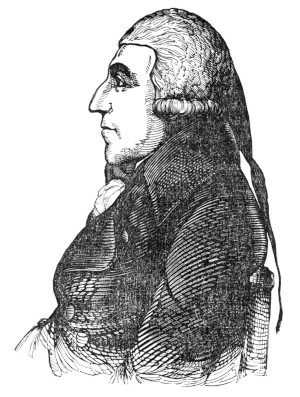
John Howard.
This eminent and laborious philanthropist was born in 1727. His father was a London tradesman, who, dying early, left him in possession of a handsome fortune. Having always been fond of travelling, he conceived a desire to visit Lisbon immediately after the great earthquake. He embarked accordingly, but was captured by a French privateer. To this accident the world is probably indebted for the exertions made afterwards by Howard for the relief of prisoners. The sufferings which he endured himself and witnessed in his fellow-captives, made an ineffaceable impression upon his mind.
This was strengthened by his being made sheriff of Bedfordshire, when he had charge of all the prisons in the county. Shocked by the miseries and abuses which he found prevailing in these abodes of crime and misfortune, he set himself diligently to work to inquire into the nature of the evil, and, if possible, to find a remedy. During the year 1773, he visited most of the county gaols in England, and having obtained information on their management, he laid the result of his inquiries before the House of Commons. In 1774, two acts were passed; one for relieving acquitted prisoners from the payment of fees; the other for preserving the health of the prisoners.
Howard being once actively engaged, became more and more devoted to his benevolent pursuits. He travelled repeatedly over Great Britain, sometimes even extending his journeys to the continent, visiting the most noisome places, and relieving the wants of the most wretched objects. In 1777, he published a quarto volume containing details of prisons in various places, and containing a mass of information really astonishing, when we consider that it was obtained at the constant hazard of his life from infection, and by untiring and unassisted labor.
The importance, both in prisons and hospitals, of preventing the spreading of infectious diseases, produced in Mr. Howard the desire to witness the success of the Lazaretto system in the south of Europe, more especially as a safeguard against the plague. Danger or disgust never turned him from his path, and on this occasion he went without a servant, not thinking it right, for convenience’ sake, to expose another person to such a risk.
In 1785, he travelled through France, Italy, and thence to Smyrna, where the plague was raging, in order that he might undergo the quarantine at Venice, to which place he sailed. In 1787, this devoted man returned home and published the result of his foreign travels. Two years after, he renewed his travels on the continent, intending to go to Turkey. He had, however, proceeded no further than the Crimea, when a rapid illness, which he believed to be an infectious fever, caught in prescribing for a lady, put an end to his life, January 20th, 1790. He was buried at Cherson, and the utmost respect was paid to his memory by the Russian government.
Mr. Howard’s character was pure and simple; without great talents, but accomplishing much by devoting his whole energies to one good object. He was abstemious in his habits, and capable of going through great fatigue, spending freely both his fortune and constitution in the cause to which his life was devoted. He was twice married, and lived at Cardington, near Bedford. He had one son, who unfortunately became insane.
Lovewell’s War.
There are few passages in history more remarkable than that which is known by the above title. It displays the daring character of the settlers of New England at the period, as well as the ferocious and crafty spirit of the savages. It is a bloody story; yet it may be well to make our readers acquainted it.
Before the subjugation of Canada by the British, the New England settlements were constantly exposed to the hostilities of the eastern Indians, and a spirit of jealousy and revenge was kept up, not only between the different nations, but also between individuals. The boundaries of the different territories being loosely defined, left both sides exposed to real or fancied encroachments; so that pretexts for war were always at hand. The French Jesuits had planted themselves among the Indian tribes at an early period; and at the beginning of the eighteenth century, they had two churches among the eastern Indians, the one at Penobscot, and the other at Norridgewock, within the boundaries of the present State of Maine.
At the latter resided the Jesuit Sebastian Rasle, a man of talent, learning and address, who, by accommodating himself to the Indian mode of life, and maintaining a gentle, condescending deportment, had completely won the affection of the savages, and his influence over them was supreme. Knowing the power of superstition over their minds, he took advantage of this, and of their prejudice against the English, to strengthen the interest of the French among them. He even made the offices of devotion serve as incentives to their ferocity, and kept a banner on which was depicted a cross surrounded by bows and arrows, which he was accustomed to hoist on a pole at the door of his church, and gave the Indians absolution, previous to their setting out on a warlike expedition.
The governor of Canada held a constant correspondence with this Jesuit, and received through his hands information of anything that transpired among the tribes in that quarter. From these individuals, the savages received every encouragement to assert their title to lands occupied by the English, and to molest the settlers, by killing their cattle, burning their haystacks, and robbing and insulting them. Many of the inhabitants, alarmed by these demonstrations of hostility, removed from the frontiers in 1720. The garrisons were reinforced, and scouting parties were sent abroad, which checked, for a time, the hostile movements of the Indians, who were compelled, the same year, to give hostages for their good behavior. This last requisition was highly disrelished by the governor of Canada, who renewed his efforts to keep up the quarrel, and secretly promised to supply the Indians with arms and ammunition, although, as Great Britain and France were not then at war, he could not openly assist them. The New England governments obtained information of these intrigues; yet, though highly incensed, they judged it best not to rush into hostilities. The main dispute lay between the Indians and the proprietors of the eastern lands, and the public were not directly concerned in it. No blood had as yet been shed within the limits of the English territory.
Rasle was considered to be the principal instigator of the Indians, and it was thought that if he were removed, all would be quiet. A proposal was made to send the sheriff of York county with a posse of a hundred and fifty men, to seize him and bring him to Boston; but this bold stroke was not ventured upon. In the summer of 1721, Rasle, in company with the Count de Castine from Penobscot, and Croisil from Canada, appeared at one of the English garrisons, and presented a letter, written in the name of the several Indian tribes, to Governor Shute of Massachusetts, declaring that “if the English did not remove in three weeks, they would kill them and their cattle, and burn their houses.” The lands in question were comprehended within the limits of the English patents, and the settlers were considered the only legal proprietors. They had been accustomed to obtain regular deeds of sale from the Indians, and pay them a valuable consideration; but some of these titles were of obscure and uncertain original, and the memory of such transactions is soon lost among people who possess no written records. The Indians easily forget the sales made by their ancestors, or imagine that such bargains are not binding upon their posterity.
The Massachusetts government, on receiving this menacing epistle, sent an additional force to the Maine frontier, and being desirous to avoid a rupture, invited the Indians to a conference, from which the French emissaries were to be excluded. This invitation was treated with neglect; and in the succeeding winter, a party under Colonel Westbrooke was ordered to Norridgewock, to seize Rasle. They reached the village undiscovered, but before they could surround his house, he had escaped into the woods, leaving his papers in his strong box, which they brought away without committing any act of violence. Among these papers were his letters of correspondence with the governor of Canada, which afforded positive proof that he was deeply engaged in intrigues to incite the Indians to hostilities. The savages were enraged at this attempt to seize their spiritual father, and resolved upon revenge. In the summer of 1722, they made a descent upon the settlements at Merry Meeting Bay, and captured nine families. Dismissing some of the prisoners, they retained enough to secure the redemption of their hostages in the hands of the English, and sent them off to Canada. Their next attack was on the fort at St. George, on the Ameriscoggin, where they were repulsed with considerable loss. They afterwards surprized some fishing vessels in the eastern harbors; and at length made a furious attack on the town of Brunswick, which they destroyed. These hostilities determined the government of Massachusetts to issue a declaration of war against them, which was published in form at Boston and Portsmouth, on the 25th of July, 1722.
(To be continued.)
Echoes.
Echoes reside, for the most part, in ruined abbeys, in caverns, and in grottoes; they reverberate among mountains, whisper in the areas of antique halls, in the windings of long passages and in the melancholy aisles of arched cathedrals. There is an ancient portico near the temple of Clymenos, in the district of Cythonias, which repeats every given sound three times.
At Woodstock there was one which was said to have returned seventeen syllables during the day, and twenty in the night. In the sepulchre of Metella, the wife of Sylla, an echo repeated five different times, in five different keys; and it is said that on the banks of a river, near Coblentz, an echo recited seventeen times. He who spoke or sung could scarcely be heard, and yet the responses were loud and distinct, clear and various; sometimes appearing to approach, and at other times to come from a great distance, much after the manner of an Æolian harp.
In the cemetery of the Abercorn family, at Paisley, in the county of Renfrew, there is an echo exceedingly beautiful and romantic. When the door of the chapel is shut, the reverberations are equal to the sound of thunder. Breathe a single note in music, and the note ascends gradually with a multitude of echoes, till it dies in soft and most bewitching murmurs. If the effect of one instrument is delightful, that of several in concert is captivating, exciting the most tumultuous and rapturous sensations. In this chapel, lulled by ethereal echoes, sleeps Margery, the daughter of Bruce, the wife of Wallace and the mother of Robert, king of Scotland.
A singular echo is heard in a grotto near castle Comber, in Ireland. No reverberation is observed till the listener is within fifteen or sixteen feet of the extremity of the grotto; at which place a most delightful echo enchants the ear. Most travellers have heard of the eagle’s nest near Mucross Abbey, on the banks of the lake of Killarney. This celebrated rock sends forth the most fascinating repercussion. Sound a French or bugle horn, and echoes, equal to a hundred instruments, answer to the call! Report a single cannon, and the loudest thunders reverberate from the rock and die in endless peals along the distant mountains.
A nobleman’s seat about two miles from Milan produces such a surprising echo as can scarcely be equalled in the world. Mr. Addison observed that upon firing a pistol, he heard the sound returned fifty-six times, though the air was then foggy, and consequently not proper for making an experiment to advantage. At first, the repetitions were very quick, but the intervals were greater in proportion as the sound decayed. This astonishing echo was probably never designed by the architect, but it is occasioned by two parallel walls of a considerable length, between which the sound is reverberated from one to the other till the undulation is quite spent. Some persons assert that the sound of one musical instrument in this place resembles a great number of instruments playing in concert.
Dick Boldhero.
CHAPTER VII.
Although I was gradually recovering from the state of extreme weakness to which I had been reduced, still, I continued so feeble as to render it impossible for me to proceed on my journey. I continued therefore with my kind friends at Maroontown, occasionally taking a short walk about the place. I soon became acquainted with a number of the people. I was very much gratified by the good-natured manner in which everybody treated me. The houses were extremely slight, many of them consisting only of sticks set in the ground, the roof and sides being formed of a thatch of palm leaves. Others were a little more substantial, the walls being framed of mud and stone. The place hardly seemed like the abode of human beings, and when I gazed upon it, I fancied that it was only the village of some ingenious animals, a little elevated in the scale of being above the beavers.
But notwithstanding this rude aspect of their dwellings, the people themselves seemed the most light-hearted and merry set I ever beheld. Every night there was music, and dancing, and laughter, and frolic, and what seemed strange, there was very little of riot or violence. A good feeling seemed to pervade all classes, and if they were poor, ignorant, and in some respects degraded, they seemed at least happy and kind-hearted. There was very little government among them, and though they had magistrates, it was seldom necessary for these to make any great show of authority.
While I was at this place, the old woman, who spoke English, as I have already mentioned, told me a good many tales relating to the history of the place, one of which I will give to my readers.
One of the earliest inhabitants of Maroontown was King Congo. This personage was born on the African coast, and was the eldest son of one of the petty kings in that quarter. He was captured by a party of slavers, brought to Paramaribo, and offered for sale as a slave. He was a good-looking fellow, about twenty years of age, of great strength and daring courage. He was readily purchased by a merchant of the city, and became a servant in his family. Submitting to his fate, he performed the duties required of him with a tolerable grace, though occasionally the remembrance of his birth and former dignity crossed his mind, and for a moment caused his feelings to revolt from the drudgery required of him.
It happened that one day, when he was a little moody from reflections like these, his master demanded of him some service of more than ordinary servility. Congo seemed to hesitate for a moment, and stood looking his master in the face, as if about to question his right thus to command him. The latter, greatly incensed, struck the negro in the face. Congo, surprised and irritated, seized his master by the collar, and was about to dash him to the floor, when suddenly recollecting himself, he unclenched his hand and said, sneeringly, “I scorn to wrestle with one so much weaker than myself; but I will not serve a man who treats me with such indignity.”
The rage of the master now knew no bounds. He called aloud for his servants, and as about a dozen of them rushed into the room, he commanded them to seize the offender. But Congo was now thoroughly roused. As the men seemed about to seize him, he retreated to a corner of the room, seized a chair, and, whirling it before him, defied the whole party. These, knowing his prodigious strength, and frightened by his wild and threatening aspect, stood aloof, afraid to grapple with such an enemy. In vain were the threats of the master. Finding it impossible to urge them on, he seized a pair of pistols, and, taking deliberate aim, discharged them both at the offender. One of the balls missed; the other entered the right arm of Congo, and, shattering the bone, the uplifted chair fell to the floor, and the broken limb swung useless by his side.
Finding it in vain to resist farther, the negro yielded, and being strongly bound, was immediately taken to a public establishment, kept for the purpose, and received a hundred lashes upon the naked back. The poor fellow was now shut up in a small room, almost without light or air, it being the purpose of his master to subdue him by privation and suffering. His arm was dressed, and care was taken that he should not die, for this would have been a serious loss to the pocket of the proprietor.
At length, Congo recovered; but his strength was wasted, and he could only totter about with great effort. He was now released, and his master, not fearing him in his present enfeebled condition, took him once more into his house. Here he was treated with the greatest harshness. He was required to labor beyond his strength, and when he was tardy from exhaustion, he was buffeted either with the hand or foot of his lordly proprietor.
Congo submitted to all this with apparent humility, but a feeling was burning within him which was destined ere long to work out his deliverance.
In a few months his health and strength were completely restored, and though he continued to perform his duties with alacrity, he was meditating some plan by which he might escape from his bondage. In this state of things, it chanced that he was one day passing by the public whipping-house, when, hearing the lashes and screams of the sufferer, he opened the door and went in. He there saw a young woman drawn upward by the wrists, so that her feet were three or four inches from the ground, while the executioner was inflicting upon her back the number of lashes commanded by her master.
For a moment the blood rushed to Congo’s brain, and a dizzy feeling came over him; but soon recovering, he rushed up to the whipping-master, wrenched the whip from his hand, threw him upon the ground, and laid the weapon lustily upon his back. He then cut the rope which tied the hands of the suffering girl, and rushed out of the place. Bewildered with his own emotions, he walked along the street, apparently unconscious of his situation; but a loud shout, and a posse of people at his heels, roused him from his revery. Congo turned round, faced his pursuers sternly for a moment, and then, with a swift foot, set out for the country.
For two miles he ran like a deer, but finding that he was pursued by men on horseback, he leaped over the banks of the river Surinam, and plunged into the water. Several of the horsemen came up and discharged their pistols at the fugitive, but he was beyond their reach. He swam across the river; but here a new danger awaited him. An immense alligator lay upon the bank, and, as he approached, sprung upon him. Nothing could have saved Congo at this moment but his strength and courage. As he was approaching the shore, he saw the alligator, and, drawing his knife from his belt, he faced the monster, and, plunging his knife down his open jaws, killed him in an instant.
Delivered from this peril, Congo turned round, shook his fist triumphantly toward his pursuers who lined the opposite bank of the river, and set forward upon his journey toward the woody districts that lay in the distance. These he at last reached, and burying himself in the recesses of the forest, he lived like a wild animal upon the fruits that nature afforded.
A party was soon made up and set forth, for the purpose of capturing the daring negro. They were provided with guns, and attended by several blood-hounds. The latter soon came upon the track of the fugitive, and their deep bellowing at once announced to him his danger, and to the hunters that the game was near at hand. Being armed with a stout bludgeon, Congo departed, and for nearly two days the hounds were unable to overtake him. At last, finding himself excessively fatigued, he paused and determined to await the approach of the dogs, and give them battle. They soon came up, and the leader sprang upon him. With a single whirl of his club, the negro laid the animal prostrate upon the earth.
In an instant, however, three more were before him, ready to bury their fangs in his flesh! With his uplifted weapon, Congo looked the fierce animals steadily in the eye. They paused for a moment; but, overcoming their fear, they sprang upon him. Two of them were soon stretched lifeless upon the ground, but a third seized Congo by the leg, and brought him to the earth. The animal then sprang at his throat, but the nimble knife of the negro despatched him in the very act. Wounded and bloody, the poor fellow arose and dragged himself forward. He was soon too faint to proceed, and fell to the earth.
The hunters now came up, and seeing that their dogs were killed, began to deliberate as to the course they should pursue. Congo, sheltered in the bushes, saw and heard all that passed. They concluded that it was in vain to pursue the fugitive farther, and resolving to rest themselves for a while, determined then to return. Taking off their knapsacks, they laid them down with their guns, and three of the party went in search of water, leaving the fourth behind. This individual sat down upon the ground, and, leaning against a tree, was soon asleep.
It may well be imagined that Congo watched these proceedings with great interest. Waiting till the three men were out of view, he issued from his hiding-place, and carefully crept forward, toward the slumbering hunter. The latter, however, was but partially asleep, and awaked by the rustling of the leaves, saw the negro creeping upon him. Amazement paralyzed him for a moment, then springing to his feet, he seized his gun and fired. The ball missed, and, the instant after, he was grappled in the arms of his formidable enemy. After a momentary struggle, they both fell, and Congo was uppermost.
What was his surprise, in looking in the face of his prisoner, to see his former master. Congo drew his knife from his belt; the blade glittered aloft, and was already descending to inflict a fatal blow, when his purpose changed, and he said, “It was your intention to kill me, and were I in your place I should not have a moment to live. But I will not imitate a white man.” Saying this, he took the straps of one of the knapsacks that lay near him, and bound his prisoner firmly on his back to the roots of a tree. Then seizing the four muskets, the ammunition and the knapsacks, he said, with a smile, to the prostrate gentleman, “Good-bye, massa,” and departed.
The huntsmen soon returned and released their companion, but finding that their guns were now in the hands of the enemy, they thought it most prudent to make a hasty retreat. While they returned to Paramaribo, to be laughed at for their defeat, Congo, well armed and provisioned, secreted himself in the forest. He was now too formidable to be pursued, and soon meeting some of his countrymen, who, like himself, had become inhabitants of the wilderness, they repaired to the present site of Maroontown, and began to make a settlement. Here they were speedily joined by other fugitives, and the village, thus commenced, soon became a considerable town. Congo received the title of king, and for many years continued to exercise authority over the settlement.
(To be continued.)
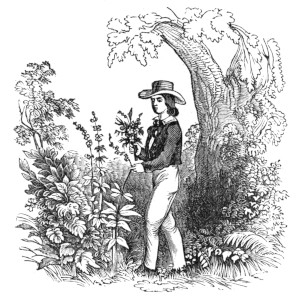
Inquisitive Jack.
CHAPTER VI.
It is time to fulfil our promise in respect to Inquisitive Jack. We have but two or three chapters more to give, in respect to his life and adventures, and here is one of them. We have told how Jack had become acquainted with insects, birds, quadrupeds, and other living things. We have now to give some account of the manner in which he became interested in botany, which means the science of plants, trees and flowers. Of course, everybody is fond of pretty flowers, roses, and lilacs, and lilies, and peonies, and pinks, and sweet peas, and other pretty blossoms. And everybody must be interested in trees, which furnish us with fruit, and fuel, and shade; and they must be interested in shrubs, which yield us so many berries. But there is something more in the history of these things, than what at first meets the eye; and I am now going to tell you something about them.
Jack happened one day to go down into the cellar, and he there saw a potato which had been left upon the ground, and which had now begun to put forth several shoots. These were perfectly white, and Jack asked himself why the stalks of a potato in the cellar should be white, while the stalks in the open air were green. He watched the potato for several days, and perceived that it was growing quite rapidly. At length, one thing greatly excited his curiosity. The potato itself was lying behind a barrel, and the stalk had grown around this, and was now pointing its head upward toward a low, narrow window, which permitted a little light to enter the cellar. The vine of the potato seemed to be actually directing its course toward this window, as if it really wanted to see the light, and breathe the fresh air.
Greatly excited by these observations, Jack continued to watch the potato from day to day, at the same time musing with himself as to what it could mean. “Has this potato,” said he, thoughtfully, “got sense and feeling? does it feel itself to be a prisoner, and want to go out to see the light and breathe the air? Who has taught this plant to bend its way toward the light, and lift up its head and point its leaves toward that which it seems to require?” Not being able to satisfy these inquiries, the boy at last went to his Aunt Betsey, and opened the subject to her. This led to explanations, the substance of which was as follows.
Plants or vegetables are organized substances, which live and grow by the aid of light, air, and moisture. They need to be fed as much as animals, and will as soon die without food, as an insect, bird, or quadruped. Instead of taking in their sustenance by means of a mouth, they suck it up by means of roots. These draw from the soil the particular nutriment that is required in the form of sap, and this is distributed to the branches and leaves of the plant. Heat and moisture are necessary in order to set the sap in motion. Air and light are imbibed by the leaves of the plants. The various colors of plants are drawn from the rays of the sun.
All plants are propagated by seeds. These, however minute, contain all the members of the parent plant—stalk, leaf and flower. These are so nicely folded up as not to be distinguished; but when the plant begins to grow, you can see, with the microscope, the several parts unfolding, one by one, until at last they assume the form of the plant from which they sprung. It is said that the acorn, which is the seed of the oak, contains all the members of the future tree.
Jack was exceedingly delighted with these curious facts, and, according to his custom, he pursued the investigation of the subject by his own observations, by reading books, and by inquiries of his intelligent and obliging aunt. In the progress of his studies, he learned many other curious facts, some of which we must relate, for they are quite amusing.
Although plants have no sense or thought, yet nature seems to have made provision which supplies all their wants. To prevent chestnuts and walnuts from being devoured before they are ripe, the former are covered with a prickly burr, and the latter with an exceedingly bitter rind. When these are ripe, the outer coating bursts open, and lets out the imprisoned fruit or seed. Similar contrivances are observed in respect to a multitude of other plants.
Some seeds, as those of apples, peaches, plums, pears, cherries, currants, &c., are covered up in a fleshy or pulpy substance, which we call fruit. Here a double purpose is answered. The seeds are nicely taken care of, while mankind, with many other creatures, are provided with an ample store of delicious food. But lest the seed should be destroyed before it is brought to maturity, the fruit is very sour or bitter, until the seeds are quite ripe.
Thus we see that God, who has taken such kind care of animals, by giving them the power and skill to acquire their food and perpetuate their existence, has also taken care even of the life and prosperity of plants. As these depend entirely upon seeds for their propagation, he has provided that these seeds shall be wrapped up, protected, and nursed, almost as carefully as little children. Nor is this all. We might suppose that a seed would fall from the tree, and finding no other soil than that beneath the shadow of its parent, it would shoot up and perish for the want of light, and heat, and air. But as children are able to go from the parent roof and find homes for themselves, so God has provided that seeds shall emigrate from their homes, and, scattering themselves abroad, cover the face of nature with diversified vegetation.
You will be curious to know how this emigration of the seeds is brought about. I will tell you. You have seen the thistle down, in the autumn, rise upon the air and go sailing along to a great distance. That down has got a thistle-seed attached to it, and it is carrying it along to some place where it may rest, and being imbedded by the rain in the soil, it will shoot up into a thistle. Thus you see the little seed is supplied with wings, upon which it flies away from home, and sets up for itself. One thistle will throw off many thousands of these downy seeds, and thus the race is multiplied.
There are many other plants that have winged seeds, which are distributed in the same way. Perhaps you think the rough winds of autumn are unpleasant and mischievous, but remember that they shake myriads of seeds from the plants and trees, and scatter them abroad over the land. Nor is this the only way in which seeds are disseminated. Birds carry the stones of cherries, and the seeds of various kinds of berries, from the place where they are produced, to other distant points.
Quadrupeds disperse the seeds of various grasses and grains, by carrying them from one point to another. The burdock and the cockle seeds attach themselves to the woolly fleece of animals, and are thus dispersed. Rains carry seeds down the slopes of hills and mountains, and rivers bear them from one region to another.
Some seeds scatter themselves by means of springs in their covering, furnished by the plant itself. If you slightly pinch the ripe seed-case of the pretty flower of the gardens called the balsam, it will burst asunder, and scatter the seed in all directions. The pouch which contains the seeds of the wood-sorrel, also bursts and scatters them around on all sides. The capsules of ferns open with a spring. The seeds of some species of this plant, when viewed through a microscope, upon paper, seem to be endowed with a kind of leaping movement.
These and many other curious particulars Jack learned about plants; but he was not yet able to answer some of the questions which had been suggested by the potato in the cellar. How did this plant know that it wanted light and air? and what made it bend round the barrel, and move forward toward the window? Are plants endowed with feeling and knowledge, which teaches them their wants, and points out the means by which these are to be satisfied? These inquiries were pursued, and Jack at last became acquainted with what is thought by learned men upon these interesting topics.
Animals are endowed with what is called instinct, which is inherent or implanted by God. The purpose of this is to make them act in a manner to secure food, to protect themselves from injury, and in general to promote their happiness. This instinct is sometimes distinct from intelligence, and sometimes mixed with it. In its simplest form, it seems to be as involuntary as the beating of the heart, or the circulation of the blood. Thus a hen sits upon her eggs, but the reason she does not know. She is guided by some power as distinct from her own knowledge, as is the beating of her heart.
Now, we know nothing of this instinct, except that it is a principle implanted by God to promote the benefit of the species to which it belongs; and that, at the same time, it is totally different from that intelligence which springs from knowledge, and leads its possessor to act in a particular manner, from its own reflections. A species of instinct of a lower grade is doubtless imparted to plants. If seeds are cast into the soil in the shade, as they require light, this instinct impels them to creep, bend, and rise, as the case may be, where it may receive the light and air it requires. Such was the conclusion to which our young botanist arrived; and here we must leave him for the present.
Bonaparte’s Ways.—The great roads constructed by Napoleon over the Alps, are, that over Cenis, 30 miles long and 18 yards wide; that over Semplon, 36 miles long and 25 yards broad; one partly through galleries hewn in the rocks, 683 feet; that over Genevre, 6,000 feet high; that from Nice to Monaco; and that over St. Gothard, 8,264 feet high. They are altogether the most gigantic efforts of labor since the pyramids of Egypt.
Lady Jane Grey.
(Continued from page 61.)
After her marriage, Lady Jane led a life of almost as great seclusion as before; she pursued her studies and maintained a correspondence in Latin with the most eminent reformers in Germany. She took little heed of the ambitious designs of her parents; nay, it is almost certain that she was purposely kept in entire ignorance of them, and that the first intimation which she had of her destiny, was when the two dukes, attended by other nobles, came to announce to her the death of Edward, approaching her with the respect and ceremony appropriate to a sovereign. The intelligence caused her both surprise and grief. She refused to receive the crown, pleading the superior right of her cousins Mary and Elizabeth, and the little probability that the people would recognize her title. “But,” she continued, “if fortune would give me warranties of her favor and her constancies, should I be well advised to take upon me this crown of thorns, which would not fail to torment me, though I were assured not to be strangled with it? My liberty is better than the chain you offer me, with what precious stones soever it be adorned, or of what gold soever framed. I will not exchange my peace for honorable and precious jealousies, for magnificent and glorious fetters; and if you love me in earnest, you will rather wish me a secure and quiet fortune, though mean, than an exalted condition exposed to the world, and followed by some dismal fall.”
But the nobles had proceeded too far to be thwarted in their purpose by the scruples or the disinclinations of a young girl. Northumberland commanded and threatened, Suffolk begged and entreated, yet Lady Jane did not yield, notwithstanding the habits of implicit obedience in which she had been educated. A new auxiliary was then brought into the field; Lord Guilford Dudley, dazzled by the brilliant destiny which seemed to await him, was induced to exert his influence; the wife could not withstand his wishes, and surrendered her own judgment to the will of her relations.
The sovereigns of England were wont to pass the first days after their accession at the Tower, in London; and, in compliance with this custom, Lady Jane proceeded thither, accompanied by a brilliant cavalcade of nobility, of both sexes. The streets through which she passed were crowded with people, but it was from curiosity rather than satisfaction; no acclamations of joy saluted her,—an omen which gave great encouragement to the friends of Mary.
That princess, who was in the country at the time of Edward’s death, in the mean time was not idle, nor content to yield her birthright without a struggle. As soon as she learned what was passing at London, she summoned the nobles to attend upon her, and wrote to the council, expressing her surprise, that she, the heir to the throne, had yet received no official notice of the death of the late sovereign. Those members of this body, who, for the most part, had yielded their assent to the usurpation, through fear of Northumberland, were now alarmed at the little support which the act received from the people, and were devising means to escape from the imprisonment, in which, under the honorable name of attendance upon Queen Jane, they were held in the Tower. Their confinement was not of long duration. On the 11th of July, 1553, Jane removed to the Tower, and caused proclamation to be made of her accession, at the usual places in London; the people listening to the herald in silence. On the 19th of the same month, proclamation was made, at the same places, of the accession of Queen Mary; but the attendant circumstances were far different on the occasion; the civic authorities of the city seemed to accept Mary as queen, and with such applause was she received by the people, that, from the commencement, not a word more could be heard for the general acclamations. A contemporary letter-writer says that “the like triumphe was never seen. The number of capps that were thrown up at the proclamation weare not to be tould. The Earl of Pembroke threwe awaye his cap full of angels. The bonfires weare without number; and what with shoutynge and criange off the people, and ringing of belles, theare could no one man hear almost what another sayd; besides banketynge and skipping the streete for joy.”
The news of what was passing in the city produced a rapid change of policy in the Tower. Many of the very counsellors, who the day before had set their hands to resolutions to stand by the Lady Jane, hastened to be present at the proclamation of Queen Mary, and despatched messengers to that princess, humbly soliciting her pardon for their offences. Suffolk, as much dejected as he had before been exalted, proceeded to his daughter’s apartments, ordered all the ceremonials of royalty to cease, and admonished her to bear, with what patience she could, a return to private life. She was not at all discomposed; the news, she said, was more welcome than the summons which forced her against her will to such an elevation. “In obedience to you, my lord,” continued she, “and to my mother, I acted a violence on myself, and have been guilty of a grievous offence; but the present is my own act, and I willingly resign to correct another’s fault, if so great a fault can be corrected by my resignation and sincere acknowledgment.” From this interview, Suffolk proceeded to Tower Hill, where he himself proclaimed Mary to be queen; and then going to the council, set his name to an order to Northumberland, who was in command of the troops raised by his partisans, to lay down his arms and submit. That nobleman, upon receipt of the news, had retreated to Cambridge, “with more sad thoughts within him than soldiers about him.” He there proclaimed Queen Mary, “the beholders whereof more believing the grief in his eyes, when they let down tears, than the joy professed by his hands, when he threw up his cap.”
One of the first acts of the new council, was to issue an order for the separation of Lady Jane from her husband, and the removal of both from the royal apartments to those designed for prisoners of state. The execution of the order was entrusted to Bishop Gardiner. We have no historical record of the manner in which he executed the task, which his zeal for popery made a work of pleasure; but we can readily believe that Shakspere has truly delineated the scene.
Gardiner. Lieutenant of the Tower, take hence your prisoners; Be it your care to see them kept apart; That they hold no commerce with each other. Guilford. Wilt thou part us? Gard. I hold no speech with heretics and traitors. Lieutenant, see my orders are obeyed. Guilf. Inhuman, monstrous, unexampled cruelty! O tyrant! but the task becomes thee well; Thy savage temper joys to do death’s office, To tear the sacred bonds of love asunder, And part those hands which Heaven itself hath joined. Duchess. To let us waste the little rest of life Together, had been merciful. Guilf. (to Lady J.) Thou standest unmoved; Calm temper sits upon thy beauteous brow; Thy eyes, that flowed so fast for Edward’s loss, Gaze unconcerned upon the ruin round thee, As if thou hadst resolved to brave thy fate And triumph in the midst of desolation. Lady Jane. And dost thou think, my Guilford, I can see My father, mother, and e’en thee, my husband, Torn from my side, without a pang of sorrow? How art thou thus unknowing in my heart? Words cannot tell thee what I feel; there is An agonizing softness busy here That tugs the strings, that struggles to get loose, And pour my soul in wailings out before thee. Guilf. Give way, and let the gushing torrent come. * * * Lady J. Guilford! no. The time for tender thoughts and soft endearments Is fled away and gone; joy has forsaken us; Our hearts have now another part to play; They must be steeled with some uncommon fortitude, That fearless we may tread the paths of horrors, And, in despite of fortune and our foes, E’en in the hour of death be more than conquerors. Guilf. O teach me! say, what energy divine Inspires thy softer sex and tender years With such unshaken courage? Lady J. Truth and innocence; * * * Lieut. My lords, my orders— Guilf. See! we must—must part! Lady J. Yet surely we shall meet again. Guilf. Fain would I cheer my heart with hopes like these, But my sad thoughts turn ever to the grave, To that last dwelling whither now we haste. Lady J. ’Tis true, by those dark paths our journey leads, And through the vale of death we pass to life; But what is there in death to blast our hopes? Behold the universal works of nature, Where life still springs from death. Mark with what hopes upon the furrowed plain The careful ploughman casts the pregnant grain; There hid, as in a grave, awhile it lies, Till the revolving season bids it rise; Then large increase the buried treasures yield, And with full harvest crown the plenteous field.
But to return to history. The conduct of Lady Jane in this sudden transition was such as was to be expected from one so humble, gentle, and pious. “She had,” says Bishop Burnet, “a mind wonderfully raised above the world; and at the age wherein others are but imbibing the notions of philosophy, she had attained to the practice of the highest precepts of it; for she was neither lifted up with the hope of a crown, nor cast down when she saw her palace made afterwards her prison; but carried herself with an equal temper of mind in those great inequalities of fortune that so suddenly exalted and depressed her.” In the words of the quaint Fuller, “she made misery itself amiable by her pious and patient behavior; adversity, her night clothes, becoming her, as well as her day dressing, by reason of her pious disposition.”
On the 19th of November, Lady Jane and her husband were arraigned for high treason. Conscious that a defence would be useless, they each pleaded guilty. The description of the scene, as given by contemporaries, has been well embodied by the poet already quoted. Bishop Gardiner, in reply to the expostulations of one of the council in favor of mercy, is represented as speaking thus:—
“These are romantic, light, vain-glorious dreams. Have you considered well upon the danger? How dear to the fond many, and how popular, These are whom you would spare? Have you forgot When at the bar, before the seat of judgment, This Lady Jane, this beauteous traitress, stood, With what command she charmed the whole assembly? With silent grief the mournful audience sat, Fixed on her face, and listening to her pleading: Her very judges wrung their hands for pity; Their old hearts melted in them as she spoke, And tears ran down upon their silver beards. E’en I myself was moved, and for a moment Felt wrath suspended in my doubtful breast, And questioned if the voice I heard was mortal. But when her tale was done, what loud applause, Like bursts of thunder, shook the spacious hall! At last, when sore constrained, the unwilling lords Pronounced the fatal sentence on her life; A peal of groans ran through the crowded court As every heart was broken, and the doom, Like that which waits the world, were universal.”
It has been supposed that Mary had, at this moment, no sanguinary purposes in view, but merely hoped by the terrors of a scaffold, and in the seclusion of a prison, to recall the youthful pair from the path of heresy. With this view, she caused the most solemn promises of life and fortune to be made to Lady Jane, if she would recant; the most learned divines of the Catholic faith were sent to reason with her, and to endeavor to turn her from that faith which she had held from her cradle; “each striving by art, by flattery, by threatening, by promise of life, or whatever else might move most in the bosom of a weak woman, who should become master of so great a prize; but all their labors were bootless, for she had art to confound their art, wisdom to withstand their flatteries, resolution above their menaces, and such a true knowledge of life, that death was to her no other than a most familiar acquaintance.”
Indeed, supported as she was by the almost unanimous voice of the English people, Mary had little cause to fear her innocent rivals. She seems to have felt thus, for many little indulgences were granted to them; though not permitted to see one another, they were allowed such freedom within the walls of the Tower, as was not inconsistent with their safe-keeping.
But whatever hopes they might have entertained were quickly taken away by an unhappy event, which it was impossible for them to foresee, and in which it is not so much as pretended that they were parties. The cruelty and bigotry of Philip of Spain had made his very name detestable in England; when, therefore, the queen announced her determination to marry him, the whole kingdom was thrown into consternation. The most strenuous efforts were made to dissuade her from her purpose; but, these failing, a general insurrection was concerted, having for its object the substitution of the protestant Elizabeth for Mary upon the throne.
Their plans were not yet fully matured, when the arrest of some of those concerned, though for some entirely distinct cause, alarmed Sir Thomas Wyatt, the leader, and drove him into premature rebellion. The queen, when she heard of his rising, sent a herald to command him to dismiss his followers. The herald found the moat about Sir Thomas’ house filled with water, and the drawbridge up; at one spot a ford seemed to offer a safe passage. “On the inside thereof walked the proper case of a man well habited, and his face carrying no despair of wisdom therein. The herald asked him, ‘whether he might safely go over there?’ To whom the other slily replied, ‘Yea, yea;’ but had not the strength of his horse been more than ordinary, he either had been drowned in the water, or buried in the mud.” The herald, on arriving at the house, made loud complaints of the deceit practised upon him; when Sir Thomas summoned all his household to answer the charge. “The herald challengeth the party at the first sight of him. ‘Alas!’ said Sir Thomas, ‘he is a mere natural, as will appear, if you will please to examine him.’ ‘Why, sirrah,’ said the herald, ‘did you direct me to come over where it was almost impossible to pass without drowning?’ To whom the other answered, ‘The ducks came over not long before you, whose legs were shorter than your horse’s.’ Hereat the herald smiled out his anger, adding withal, ‘Sir Thomas, hereafter let your fool wear his motley, that he may deceive no more in this kind.’”
The infatuation of Suffolk sealed his daughter’s fate. No sooner did he hear of Wyatt’s being in arms than he hastened down into Leicestershire and summoned the people to join him in rebellion; but his own tenants disregarded the call; he was seized by the queen’s officers and carried to London. The father’s treason was imputed to the daughter, and one of the first acts of the queen and her council, after the suppression of the rebellion, was to order the execution of the sentence which had been hanging over the head of Lady Jane and her husband. Jane heard the annunciation with gladness; she was prepared for death, which she looked upon as the termination of her miseries and her entrance into eternal happiness. But she was not suffered to pass the four days of life which were allowed her, in quiet; her devotions were disturbed by the priests who, by the queen’s command, sought, by perpetual disputations, to bring about what they called a timely conversion. But their efforts, though renewed on each day, were unsuccessful; “her faith, being built on the rock of Christ, was by no worldly persuasion or comfort to be either moved or shaken; so that after the expense of time, and the loss of much speech, they left her, a lost and forsaken member; but she prayed for them, and with a most charitable patience endured their worst censures.”
It had been the original intention of the queen that the youthful couple should suffer together on Tower-hill, but the council, dreading the compassion of the people for their youth, beauty, and innocence, changed the orders, and gave directions that Lord Guilford should suffer on the Hill, but that Lady Jane should be executed within the walls of the Tower. On the morning of the fatal day, Lord Guilford desired permission to see his wife. The queen granted the permission, but Lady Jane refused to permit the interview; sending him word, that the tenderness of their parting would overcome the fortitude of both, and would too much unbend their minds from the constancy which was required of them. She added, that their separation would be but for a moment; and that they would soon rejoin each other in a scene where their affections would forever be united, and where death and disappointment could no longer have access to them to disturb their happiness.
On his way to the gate, Lord Guilford passed directly under the window of his wife, and from thence she took one last parting look in the world, giving him a signal of remembrance; and when he was no more to be seen she sat down with apparent tranquillity, and waited the arrival of her own appointed hour. When she heard the rumbling of the cart which brought back the lifeless remains of her husband, she rose, and walked to the window under which it passed. Her attendants would have prevented her, but she declared that the constancy of his end had given a confirmation to her mind adequate to counterbalance the shock of this sad spectacle; and she is then said to have exclaimed, “O Guilford! Guilford! the antepast is not so bitter that you have tasted, and that I shall soon taste, as to make my flesh tremble; but that is nothing compared to the feast that you and I shall this day partake of in heaven!”
When the officer appeared to summon her to the scaffold, she followed him with the most perfect calmness; there was no change of countenance, nor any evidence of discomposure. She mounted the steps without hesitation, and waited quietly till silence was procured, and then addressed a few simple words to the spectators; avowing her steadfastness in the Protestant faith. The executioner, on his knees, besought her forgiveness, which she sweetly and willingly accorded to him. She then bound the handkerchief over her eyes, and feeling for the block, said, “What shall I do? Where is it!” At these questions one of the persons on the scaffold guided her towards the block, on which she instantly laid her head, and then stretching forth her body, exclaimed,—“Lord, into thy hands I commit my spirit!” A pause of one moment ensued, the axe fell,—and the lovely and pious victim to ambition and bigotry rejoined her husband in heaven!
ANA are maxims, anecdotes, and original fragments of eminent men. The French have a multitude of such works. In England there are Walpoliana, Addisonia, Swiftiana, and Knoxiana and Londoniana.
Sir Isaac Newton, on being asked his opinion of poetry, replied, that it was a kind of ingenious nonsense.
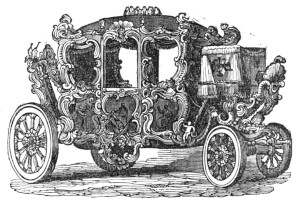
Lord Mayor’s Show.
The chief officer of the city of London is called the Lord Mayor. He is chosen by the citizens of that metropolis, and on the day in which he assumes his office, he rides about the streets of London in a splendid gilt coach, attended by other coaches, and men dressed up in military hats, with tall feathers. Their coats and pantaloons are almost covered with gold lace. The heads of the horses and the harnesses are decorated with gilt stars and bouquets of ribbons.
The driver of the Lord Mayor’s coach looks almost smothered with his big hat, and the immense mass of gilt lace upon the collar of his coat. The Lord Mayor himself is very gaily dressed. I once saw this show, and it appeared to me that the Lord Mayor and all his attendants looked more like images or idols, bedizened with finery, than like human beings.
The Lord Mayor goes to Black Friar’s bridge, where he and his attendants enter a splendid barge. They are then rowed to Westminster bridge, where they land and proceed to the Westminster Hall, where the Lord Mayor takes the oath of office. He then returns to his barge, lands at Black Friar’s bridge, and reënters his coach. The grand procession is attended by the banners of the city companies, and, after marching about the principal streets, they proceed to Guildhall, where they have a sumptuous dinner.
Wherever the Lord Mayor goes on this occasion, there are crowds of boys and other persons following him. When he is on the river, he is surrounded by a multitude of boats, with flags waving in the air, and when he passes along the streets, the ladies wave their handkerchiefs from the windows.
The people of London seem very much delighted with this exhibition. Indeed, they seem to think that he who gives them the best show is the best mayor.
These spectacles are of very ancient date. Formerly the kings and queens used to parade the streets of the city, dressed up in gaudy finery, and all the young people admired these things, for it was always a holiday, when such a spectacle took place. In modern times, kings and queens are not so fond of showing themselves. The present queen, Victoria, seems to have partially restored the old custom, for she may be frequently seen travelling about the country. She has the good sense, however, to dress modestly, and like other ladies.
But as the pageantry of kings and queens has grown into disuse, the people of London seem to think more of Lord Mayor’s day. In 1837, the Lord Mayor’s procession was attended by two gigantic figures on horseback, called Gog and Magog. In 1841, the procession was accompanied by a model of a full-rigged ship; she was manned by boys from the naval school, who performed all the evolutions like thorough-bred sailors. It was placed in a car, drawn by six horses.
The Lord Mayor’s coach was built in the year 1757, almost one hundred years ago. It cost about five thousand dollars, and its pannels were decorated with paintings by Cipriani, a celebrated artist of that day. The engraving at the head of this article gives a good idea of this famous vehicle.
Joan of Arc.
CHAPTER I.
The village of Domremi, near Vaucouleurs, on the borders of Lorraine, is distinguished as the birth-place of the celebrated Joan of Arc, in the year 1402. Born in a humble sphere of life, her education was limited. Her parents, James D’Arc and Isabella Romé, were poor, and not being able to educate Joan, sent her, when still young, to take the situation of servant in a small inn. Having a robust frame, and an active temper, she employed herself in a manner rather unsuited to her sex, in currying the horses of the people who frequented the inn, and riding them to water. In short, she took pleasure in all the active occupations attending the situation, at the same time that her conduct and manners were entirely free from reproach.
At this time, the situation of France was very interesting and critical, roused the attention, and formed a constant theme for conversation in all parts of the kingdom, and among all ranks of people. The prince having been expelled from his throne, the kingdom was of course in a state of division and anarchy. At the same time, the English army were laying siege to Orleans, whose inhabitants were making the greatest efforts to avert their probable fate. Joan listened with interest to the news, as it was repeated by the changing guests of the inn; all the “rumors of wars” reached her ears, and struck her imagination. She listened with daily increasing interest to the story of the unfortunate dauphin, till her bosom was filled with a sentiment of loyal attachment to his cause. She pondered on the probable means of his deliverance, and dwelt upon the miseries of her country till her mind became disordered and bewildered, and she thought that she was impelled, by supernatural voices, to expel the enemies of her bleeding country. Her mind was filled with visions, her heart with high hopes, and her habits of life and fearless temper urged her on to the accomplishment of that which her youth and sanguine ardor led her to deem possible.
Filled with these fancies, she could no longer remain in the inactive sphere in which her parents had placed her; she was no longer content, and, packing up her small wardrobe, she returned to her family, and communicated to them her projects and her hopes. Touched by her enthusiasm, her friends accompanied her to Vaucouleurs, where the governor, whose name was Baudricourt, resided. Having obtained admission, she imparted her mission, told him her high hopes, painted to him in glowing colors the visions that had visited her from above, and conjured him to aid her in effecting the great object she had at heart. Above all, she warned him not to treat with neglect or contempt the revelations of God. The governor at first deemed her insane and unworthy of attention, but at length, impressed by her perseverance, and by the representations of a gentleman by the name of Longport, who had conceived a high idea of the character of Joan, he had her conducted to the French court, which was then residing at Chinon.
It is pretended by those addicted to the marvellous, that Joan, having offered in the name of the Supreme Being, to raise the siege of Orleans, to conduct the dauphin to Rheims, and there to anoint him king, she impressed him with a strong sense of her divine authority, by confiding to him a secret which he supposed only known to himself. She is said to have described minutely a sword which was kept in a certain church, and which she had never seen. She also required this instrument to aid her in the victories that she expected and promised to perform. Hope and enthusiasm now combined to animate the drooping spirits of the royalists. Heaven itself appeared to smile on their cause, and declare itself in their favor. The affairs of the king were in too desperate a state to reject any means, however insufficient or romantic, which might flatter the hopes of his adherents, and faith and confidence silenced the cold suggestions of reason.
After many debates in parliament, many scruples among the king and his ministers, and various investigations by the divines of the pretensions of the prophetess, her wishes were complied with, and, mounted on horseback, and armed cap-a-pie, Joan exhibited herself to the admiring populace. Her fine figure, animated face, and the graceful manner in which she managed her pawing steed, added to the popular enthusiasm. Shouts and acclamations rent the air; her former occupations were forgotten; chivalry, religion and sentiment united to captivate the fancy and influence the hearts of the multitude.
All things being now ready, preparations were made to put in execution the plans of the heroine. A large convoy, escorted by ten thousand men, and headed by Joan, were ordered to march to Orleans. Mounted on a white horse, her head crowned with a helmet, she bore in her hand a consecrated banner. In her prophetic character, she insisted that the convoy should enter Orleans by the direct road from the side of Beausse; but Dunois thought proper to differ from the maid, and conducted his troops on the opposite side of the river, where the enemy were less strongly entrenched. Previous to their march, Joan had addressed a letter to the English generals, exhorting them to leave the country, and not to resist the will of God, whose commission she bore. The officers treated her pretensions with derision and scorn, and ridiculed the desperate situation of the dauphin, who had recourse to so absurd an expedient to improve his condition. The soldiers, however, were affected with superstitious terror by the stories which had reached their camp, and were many of them nearly deprived of courage and confidence.
While the convoy approached the river, the inhabitants of Orleans sent boats to receive the provisions, while Joan protected them with her troops. The English did not venture to attack her, and after accomplishing their purpose, the French returned in safety to Blois. The complete success of this undertaking produced a corresponding effect upon the minds of both parties. Joan made a triumphal entry into Orleans, and was received as one sent from heaven by the enraptured citizens.
The next convoy which was sent to Orleans, entered, as formerly desired by Joan, on the other side of the river. Struck with panic, the besiegers offered no resistance, but allowed the convoy to proceed straight through their redoubts, in silence and consternation. The English general saw himself placed in a most extraordinary and perilous situation; the minds of his troops were unnerved by a fanatic influence, against which valor had no effect, their spirits were depressed, and thus everything conspired in favor of the besieged, and led the way to further triumphs.
Joan, reading at a glance the situation of the English soldiers, and profiting by the ardor inspired by this fortunate train of circumstances, now addressed the garrison, and exhorted them to make a sally upon the enemy. Waving her consecrated banner, she called upon the generals to aid her, and the troops, thus assured of the assistance of Heaven, poured with fury upon the English, whose forces, unnerved by superstition, were cut to pieces, and many of them taken captive. Such was the panic, that Sir John Talbot, who arrived at this time with troops for the relief of the garrison, retired again, not daring to attack the victorious and heaven-led army.
The maid and her followers, excited by success, and not doubting that they could carry everything before them, now proposed to attack the main body of the enemy. Dunois, who had more discretion, though equal zeal, urged them rather to attack the English forts, which lay on the opposite side of the river. To this Joan consented; the forts were assailed, and, for a moment, the French were repulsed, but the inspired maid, animating her troops by her voice, her gestures, and her lofty bearing, rallied her recreant troops, led them back to the charge, and was completely victorious. Having received a wound in the neck from an arrow, she retired behind the troops, and extracting the weapon with her own hands, she exclaimed, “It is glory, and not blood, which flows from this wound.” After having it slightly dressed, she returned, placed herself again at the head of her victorious troops, and succeeded in planting her victorious standard on the enemy’s ramparts.
(To be continued.)
The musical instrument called the trombone is the sackbut of the ancients. It was revived in 1790, after a model found at Pompeii. It produced every semitone by sliding out and in, like a telescopic tube.
Our Correspondence.
We have the pleasure to acknowledge the letter of a subscriber from Holliston. The communication of J. Q. is also received. His curiosity in respect to the tale of Dirk Heldriver will be satisfied in the progress of the story. Our little friend, George G——, must have patience. He shall know all about Dick Boldhero in good time. His adventures will carry us through a number of chapters. The following letter sufficiently explains itself:
Point Shirley, August 21st.
Mr. Merry,—Although the weather is very hot in Boston, it is very cool down here. To prove this, I send you answers to two puzzles, which are to be found in your Museum. That for the one in the June number, is Buonaparte. The true spelling of this name is Bonaparte. Do you think it right, Mr. Merry, to puzzle your readers with a false spelling?
The answer to the puzzle in the August number is Norwich, a town in Connecticut; and a very pleasant town it is.
Now, Mr. Merry, I have answered the puzzles, and though they were not very deep, yet I should hardly have done this had I been spending the dog-days in Boston. But here I feel as lively as if it were October. I walk along the sea-shore every morning and evening, and sometimes I ramble as far as Chelsea Beach. I love the blue sea, and I think I shall make a voyage upon it as soon as I am old enough.
Yours, J. H.
Cleveland, Ohio, August 4th.
Mr. Robert Merry,—Though we are eight hundred nines from Boston, we get Merry’s Museum every month. Sometimes it comes late, and this disappoints me; but I am glad to get it after all. I see that some of your subscribers write you letters; I venture to follow their example, and shall tell you something about Cleveland.
It is quite a pleasant town—at least, I think so, for it is my birth-place. It is situated on a bluff eighty feet high, upon the south side of Lake Erie. The streets are straight, and cross each other at right angles. You can look out upon the lake from many of the streets, and as it is seventy miles wide, on the north side you cannot see the land.
The streets are very level, and many of the houses are handsome. I was once at New Haven, in Connecticut, and I think some of the streets in Cleveland look like some of those in New Haven. We have, however, no mountains, like East and West Rock. Indeed, the country is flat around Cleveland, and, far as the eye can reach, you can see nothing like a mountain.
The river Cayahogo empties into the lake west of the town. At the mouth of this is our harbor, and here you see a great many small vessels. Some of these come from Buffalo, some from Detroit, some from Canada, some from Sandusky, and some from other places. They often carry away four or five thousand barrels of flour in a single day. Fine steamboats come here every day, and at this season we see many people in them from Boston, New York, and Philadelphia.
Thus you see, Mr. Merry, though we are so far from Boston, we are not quite out of the world. The steamboats go almost a thousand miles farther north and west than we are, and I am told that some of the emigrants, when asked to what place they are going, say, “to Sun Down.”
I have now filled my paper, though I ought to tell you that this is a very cheap place to live in. You can buy a barrel of flour for three dollars; a ton of excellent coal for two dollars and fifty cents; eggs for six cents a dozen; and a wild turkey for twenty-five cents. If any of your friends can’t find room enough in Boston, let them come out here, and we will take care of them. A letter of introduction from you will ensure them a welcome.
Yours, S. P——t.
[Audio content is not currently supported on your device.
The Lark.
MUSIC COMPOSED FOR MERRY’S MUSEUM.
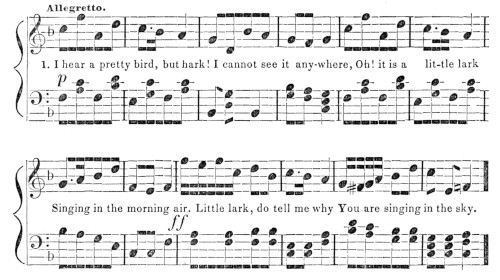
1. I hear a pretty bird, but hark! I cannot see it any-where, Oh! it is a little lark Singing in the morning air. Little lark, do tell me why You are singing in the sky. Other little birds at rest Have not yet begun to sing; Every one is in its nest, With its head behind its wing; Little lark, then tell me why You’re so early in the sky? You look no bigger than a bee, In the middle of the blue, Up above the poplar tree, I can hardly look at you. Little lark, do tell me why You are mounted up so high? ’Tis to watch the silver star Sinking slowly in the skies, And beyond the mountain far, See the glorious sun arise. Little lady, this is why I am mounted up so high. ’Tis to sing a merry song To the pleasant morning light; Why stay in my nest so long When the sun is shining bright? Little lady, this is why I sing so early in the sky. To the little birds below I do sing a merry tune; And I let the ploughman know He must come to labor soon. Little lady, this is why I am singing in the sky.
MERRY’S MUSEUM.
Vol. VIII. OCTOBER, 1844. No. 4.
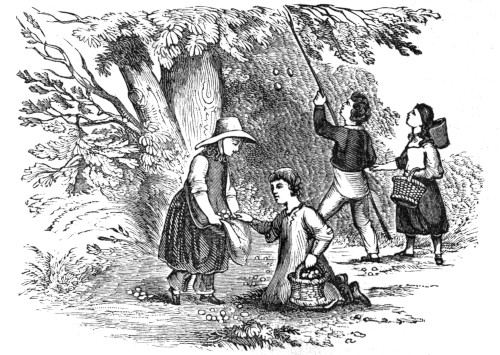
It is October. The “sere and yellow leaf” is in the forest; the birds, one by one, have departed, and stillness begins to settle over the scenes where the ceaseless minstrelsy of the feathered tribes had prevailed. Yet the landscape is still beautiful: the woods have put on their “coat of many colors;” the nuts are beginning to fall, and the squirrels have to dispute with the boys and girls the possession of their first fruits.
Every season has its appropriate work to perform in the great household of nature: the winds of October and November disseminate the seeds which have been matured during the summer. The thistle down is now seen emigrating on its noiseless wing, bearing its little seed to some place where it may “settle.” A thousand other seeds are scattered by the winds and the waters, and thus the face of nature is covered with its variegated garments of vegetation.
We cannot do better than to close our notice of October, with an old piece of wit, which, however common, will bear repeating.
ECHO GIVES A LESSON.
It is October; the winds have left the forest and the field; the busy birds have ceased their labors, and have either departed, or sit songless upon the trees. Stillness settles at noon-day over the landscape. Step over into the valley, and see how your voice will be repeated to the hills. I suppose you to speak in the character of a glutton.
Glutton. My joy is a feast, my wish is wine! Echo replies,—catching the last sound,—swine!!! Do you not feel rebuked? But go on with the dialogue. Glutton. We epicures are happy truly. Echo. You lie. Glutton. Will it hurt me if I drink too much? Echo. Much. Glutton. Thou mockest me! I’ll not believe it. Echo. Believe it. Glutton. Is it drink that brings infirmities? Echo. It is. Glutton. Then Temperance I’ll love thee. Echo. I love thee. Glutton. If that be true which thou dost tell, Then Sensuality farewell. Echo. Farewell!
Such is the lesson, which, according to an old book, Echo read to a glutton, some two hundred years ago. It is worth learning now.
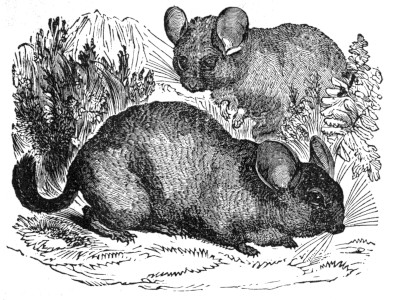
The Chinchilla.
This pretty little animal is six inches long, with small rounded ears, large black eyes, and a tail of moderate length. It is a species of field rat, found in the northern parts of Chili, in South America. It lives in burrows, and feeds upon the roots of bulbous plants. Its fur is in great esteem, being very fine and of an ash gray color. It is very docile in temper, and extremely timid. If placed in the bosom, it remains as still and quiet as if it were in its own nest. It is very agile, and can leap to the height of several feet, its hind legs being longer than the fore legs. It usually sits upon its haunches, and is able to raise itself up and stand upon its hinder feet. It feeds in a sitting posture, grasping its food in its fore paws, in the same manner as the squirrel.
There is a variety of the chinchilla in Peru, but it is larger in size, and the fur is not so fine as that of the Chilian animal. It is equally good-tempered, and mild in its disposition, and, when domesticated, is very tame and playful.
Great numbers of these animals are caught, by boys with dogs, and sold to traders, who take them to Santiago. The extensive use of the fur has occasioned great destruction of them. The ancient Peruvians made coverlets for beds of this fur.
A Spanish writer, in 1591, thus mentions this animal: “The chinchilly is a kind of small beasts, like squirrels; they have a wonderful smooth and soft skin, which the people wear as a healthful thing to cover those parts which have need of a moderate heat.”
A seaman, in 1593, also describes them: “In Peru, they have little beastes, like unto a squirrel, but that hee is gray; his skinne is the most delicate, soft, and curious furre that I have seene, and of much estimation as is reason; few of them go into Spain, because difficult to be come by, for that the princes and nobles laie waite for them. They call this beast Chinchilla, and of them they have great abundance.”
The Branch of Elder.
A FABLE.
A hunter was wandering along over the fields with his son, and a deep brook flowed between them. The boy wished to go over to his father, but was unable, for the brook was very wide. Immediately he cut a branch from a bush, placed it in the brook, leaned fearlessly upon it, and with all his force gave a sudden spring. But behold! it was the branch of an elder-tree, and as the boy was swinging over the brook, the staff broke in the middle, he fell into deep water, a splash was heard, and the tide closed over him.
A shepherd saw what had happened, from a distance, and raising an alarm, ran towards the brook. But the boy blew the water from him, and swam, laughing, to the shore.
Then the shepherd said to the hunter, It appears that your son has been well instructed, but one thing you have forgotten. Why have you not taught him to examine within, before he opens his heart to confidence? Had he discovered the weak pith that was concealed, he would not have trusted the deceiving bark!
Friend, answered the hunter, I have sharpened his eye, and improved his strength, and I can now trust him to experience. Time must teach him to be suspicious. But he will persevere in the discovery, for his eye is clear, and his strength is practised.
The Oak Tree does not attain its full growth until it is two hundred years old.
Dick Boldhero.
CHAPTER VIII.
It was more than two months after my arrival at Maroontown, before I was in a condition to depart. Finding that I should not be able to return to Paramaribo in season to go back to Connecticut with my vessel, I sent word to the captain, requesting him to see my mother and sister, and tell them what detained me.
When I had sufficiently recovered to travel, I set out from Maroontown, having taken leave of my kind friends there. The negro who had rescued me, together with his family, had done everything in their power to make me comfortable and happy. The neighbors too had shown the greatest interest in my behalf; they were constantly sending me every sort of delicacy, such as small game and the choicest fruits. Never have I met with a people so little selfish, and to whom hospitality seemed to be so natural. Some of them really shed tears as I departed, and even offered to accompany me on my journey. I accepted the latter proposition in part, and accordingly a young man set out to be my guide for the first day.
I had heard at Maroontown something about the Englishman whom I was going to visit. I learned that he was a coffee planter with a large estate; but I had discovered that his residence, instead of being a hundred miles from Paramaribo, was nearly double that distance. This taught me a good lesson, which I recommend to the attention of my readers; it is this—before setting out upon a journey, be sure to ascertain how far you have to go.
It was now December—a time when the winter had already commenced in New England, but it was very different in Guiana. I found the weather very warm, and my strength was so impaired by my sickness, that the first day I did not proceed more than eight miles. I slept at a small plantation, and the next morning, having taken leave of my guide, I proceeded alone upon my journey. For three days, nothing particular occurred. The country was slightly undulating, and portions of it were exceedingly fertile. Here and there was a plantation, but a large part of the land was covered with forests. On the fourth day after my departure, I met with a curious adventure. There is in this region a species of wild hog called peccary. In some parts, they are numerous, and I had frequently seen them crossing my path in the course of my travels. They seemed not to be very shy, yet, as I approached them, they would usually start off with a kind of grunt, or bark, and hide themselves in the bushes.
On the occasion just referred to, I chanced to see a peccary, with a litter of young ones, lying by the side of my path. When I came near, they sprang up and ran away. I however gave chase, and soon caught one of the little pigs. The fellow instantly set up the most vociferous squealing—upon this, the mother turned back and came upon me with savage ferocity. Her mouth was open, and she uttered a sort of bellowing that was quite frightful. I was not disposed to yield my prize at once, but holding on to the hind legs of the pig with the left hand, and flourishing my club in the right, I faced the infuriated dam. She hesitated a little, but kept up her cry. In a few minutes, I saw issuing from the adjacent thickets several other peccaries, apparently coming to the rescue. They immediately advanced, and I was soon surrounded with more than forty of these raging beasts.
Affairs were now getting serious, and I thought it best to release the little prisoner, hoping that this would pacify the tumult. But the tempest was not so easily appeased. The bristly mob still encircled me, grunting, squealing, barking, and bellowing, while, at the same time, their tusks were displayed, ready to rend me in pieces. I was obliged to keep wheeling round, brandishing my club, occasionally giving an obtrusive snout a pretty hearty thump by way of caution. The storm, however, seemed to thicken, and it was obvious that the whole troop would soon rush upon me. In this extremity, discretion seemed the better part of valor, and concluding that I had better risk my honor than my life, I took advantage of an open space, sprang through the circle, and leaped into the branches of a tree that was near by.
The disappointed assailants pursued me, and encircling the tree, vented their rage in grunts and groans. Never did I see such a hubbub. Sitting upon the limbs of the tree in perfect safety, I looked down and laughed very heartily at the scene. There was one boar who seemed particularly anxious to signalize himself. He had enormous long tusks, and in his fury, he frothed at the mouth, and kept up a great outcry. He was probably the captain of the troop, for he generally led the way, and a party of a dozen supporters were always at his heels.
I could not forbear the pleasure of stirring up this Hector of the field with an occasional poke across the back with my shillaleh. It was amusing to see his indignation, blent with his courage. He rose upon his hind legs, and looked defiance with all his might. There was something about him which seemed to say—“Come down here, you coward; come down, and we’ll give you a peeling.” I did not, however, accept the challenge, though I would have been willing to have tried my hand with him in single combat. Forty to one was rather too many, and so I remained in my castle.
Rage, like everything else, must have its end; so, in the course of half an hour, the chivalry of these pigs began to abate. Two or three of them slipped off into the bushes, and their example was soon followed by others. In the course of half an hour, they were all dispersed except the commander-in-chief, and even he, at last, took his departure, having expressed his contempt and defiance in a few significant grunts. I waited till the whole troop had vanished. I then cautiously descended, and proceeded with a light step upon my way. I looked back several times, and scrutinized the thickets that lay along my path. I travelled pretty rapidly for three or four miles, and I may as well confess that I breathed much more freely when I found I had distanced the enemy. It may seem ridiculous that one should be seriously frightened at such an attack, yet the scene dwelt for some time in my memory, and for several nights, my dreams were embellished with images drawn from the swinish mob that had assailed me in the woods.