Volume 8 — CONTENTS OF VOLUME VIII. (continued 2)
Reading edition
Several years passed, and the little girl, who was named Katrina, might now be seen walking with her mother amid the long, straight, shady avenues that were cut in the forest. Excepting the persons connected with the establishment, few persons visited the spot; it was therefore marked with peculiar loneliness, which seemed to increase the gloomy and mysterious aspect of the place. The proprietor of the mansion had no intercourse whatever with the people of the vicinity, and never, except once a year, when he made a short visit to the city of New York, did he leave his residence. He spent much of his time in reading, and devoted several hours each day to the instruction of his child, who now seemed to be the only object of his affections. It appeared indeed that there was some deep-rooted bitterness at his heart, which he attempted to alleviate by the education of his daughter.
The child was indeed worthy of all his care, yet she seemed the very opposite of everything around her. She had light, flaxen hair, blue eyes, snowy complexion, and an ever-laughing expression of countenance. Seated in the gloomy library with her father, she seemed like a spot of playful sunshine, lighting the recesses of a cavern.
It was remarkable, that although she was the favorite of all around, and evidently the object of the deepest interest to her parents, the father still seemed not to reflect from his own heart any portion of the child’s cheerfulness and vivacity. Though she romped, frolicked, laughed and toyed, a ray of pleasure, or even a passing smile never lighted his countenance. Her spirit shone upon him, but it was like light falling upon a black surface, which absorbed, but did not throw back, its rays. A keen observer, indeed, would have said that the moody father felt even a rebuke in the joyous gaiety of his child.
With the mother there was this difference, that though she was generally sorrowful, the springs of happiness seemed not wholly dried up. She felt a mother’s pride in the surpassing beauty of the child, and was often cheered by the little creature’s hoyden mirth. In the presence of the master, the servants were habitually silent and gloomy. But if at any time they found the little girl apart, they not unfrequently indulged in a game of romps.
Such was little Katrina, a playful, happy creature, in the midst of shadows and gloom—the idol of all, and apparently the object in which the affections of the parents, as well as the rest of the household were centred. It was when she had reached the age of about six years, that an incident occurred of the deepest interest. At the close of a summer evening, a small sloop anchored in the river, near the house we have described. A boat was let down, and a man, wrapped in a cloak, was landed upon the beach. He proceeded to the mansion, and, inquiring for the master, was conducted to the library. The room was vacant, but the stranger sat down, and occupied himself in gazing around the apartment. At length, the proprietor came, his countenance being marked with something of anxiety. The stranger arose, laid aside his cloak, and stood before his host. For a moment he did not speak; but, at last, he said, “You pass, I understand, by the name of Hielder. I know your real name, and I presume you know mine.”
“I know you not,” said Hielder, sternly.
“Then you shall know me,” said the stranger. “My name is Hieldover, the victim of your perfidy, and I am here to avenge my wrongs.”
“This is a pretty tale,” said Hielder; “and you bear yourself bravely. Perhaps you are one of Robert Kidd’s men, and have come here in search of gold; but you have mistaken your errand. I have but to ring the bell, and my servants will execute my will upon you.”
“This bullying will not answer your purpose,” said Hieldover; “nothing shall turn me from my purpose, which is to extort from you the fortune that you have obtained by the basest perfidy and fraud. You pretend not to know me; I will refresh your memory. Fifteen years since you were made my guardian at Amsterdam, by my father’s will. You possessed yourself, by forgery, of my ample fortune. You departed from the country in secrecy, and I was left a beggar. I have since been a wanderer over the earth, and have known toil, and suffering, and sorrow, while you have been revelling in the wealth which was mine. I have traced you through the four quarters of the globe, and had sworn in my heart to follow upon your track like the bloodhound, till I could find you and bring you to justice.”
During this speech, the pale countenance of Hielder was frequently flushed with anger. At last, he said, sneeringly, “You have spoken freely—have you done? If so, I will show you the door.” Hieldover seemed to be on the point of giving vent to his rage; but he checked himself, and said, “You deny my claim, then? You refuse to do me justice?”
“I have no answer to make,” said Hielder, “to an idle braggart.”
“Beware, then, of my vengeance,” said the other, clenching his fist, and looking defiance in the eye of Hielder. He then took his leave.
This scene passed without the knowledge of any individual, except the parties concerned. Yet for several days the master of the house seemed even more gloomy than usual. He spoke little to any one, and remained almost wholly in the seclusion of his library. After a month, however, had passed away, he seemed to be restored to his former condition, and resumed his wonted occupations. He seemed more than ever devoted to his child, although he maintained his accustomed sternness. For a time he would hardly allow the child to be out of his presence, but at length the mother was permitted to resume her walks, attended by her daughter.
One day, she went out in the morning, but did not return at the usual hour. Some anxiety was excited, and the servants were sent forth in search of their mistress and the child. They returned without being able to find her. All was now alarm. Hielder himself went forth, and the people were directed to scour the woods in every direction. They soon brought tidings to their master that the lady was found, but the child was missing. When discovered, she was insensible; but when she came to herself, she stated that while she was walking in the woods, a stranger suddenly sprung upon the child, and bore it away. He fled toward the mountains, and she pursued till she swooned and fell to the ground. Here she remained, in a state of insensibility, till she was taken up by the people who were in search of her.
(To be continued.)
Curran and the Miller’s Dog.—“Curran,” says Barrington, in his memoirs, “once related, with infinite humor, an adventure between him and a mastiff, when he was a boy. He had heard somebody say, that any person, throwing the skirts of his coat over his head, stooping low, holding out his arms, and creeping along backwards, might frighten the fiercest dog, and put him to flight. He accordingly made the attempt on a miller’s animal in the neighborhood, who would never let the boys rob the orchard; but he found to his sorrow, that he had a dog to deal with, who did not care which end of a boy went first, so that he could get a good bite of it.
“‘I pursued the instructions,’ said Curran; ‘and as I had no eyes save those in front, I fancied the mastiff was in full retreat, but I was painfully mistaken; for, at the very moment I fancied myself victorious, the enemy attacked my rear, and, having got a reasonably good mouthful of it, was fully prepared to take another, before I was rescued.’”
Natural Curiosity.—In Scotland, at the entrance of the river Leven, is a lofty rock, occupied as a castle. On the surface of this, there is a huge figure, formed by nature, which makes an excellent profile of the celebrated Duke of Wellington. It is an object that always attracts the attention of the passengers of the steamboats, as they are passing the castle.
“Be content with what you have,” as the rat said to the trap, when he left his tail in it.
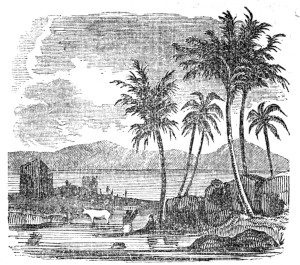
Inundation of the Nile.
The River Nile.
The whole northeastern part of Africa consists of a mighty expanse of desert sand, extending for upwards of a thousand miles in each direction. The chains of wild and rocky mountains by which it is traversed, give only a more rugged and dreary character to this immense waste. One vast feature alone breaks this terrible monotony. From the high chains of Abyssinia, and from the still loftier mountains of the moon, that traverse Central Africa, descend numerous and ample streams, which, long before entering Egypt, unite in forming the Nile, a river of the first magnitude.
Although the Nile in its whole progress through this desert does not receive the accession of a single rivulet, it brings so vast an original store as enables it to reach and pour a mighty stream into the Mediterranean. For many hundred miles in the upper part of its course, confined between high and rocky banks, it is merely bordered by a brilliant belt of fertility, the sandy waste stretching indefinitely on both sides; this is Nubia.
After traversing the barrier of the cataracts, it passes through a broader valley between mountains of some height, and on its banks are many shaded or inundated tracts, which yield products of considerable value; this is Upper Egypt. Emerging from these mountains, the Nile enters a flat and extensive plain, where it separates, and by two great and divided streams, with various intersecting branches, enters the Mediterranean; this is Lower Egypt.
In the last part of its course, the Nile is nearly on a level with the district which it intersects, and when swelled by the autumnal rains of Central Africa, overflows it entirely. The waters begin to rise about the 18th or 19th of June, attain their greatest height in September, and subside as gradually as they rise, and within about an equal space of time. The land thus covered with the fertilizing alluvial deposit, collected during so long a course, becomes the most productive, perhaps, on the face of the globe; and notwithstanding its limited extent, and the mighty wastes on which it borders, has always maintained a numerous population.
Thus it appears that the fertility of Egypt is solely dependent on the Nile, and that, but for this, it would be, like the rest of Africa in this quarter, a sandy and desolate waste.
The Old Man in the Corner.
THE PHILOSOPHER REBUKED.
There was once a learned man, or philosopher, who was fond of prying into the works of nature, and every other source of knowledge. At last he became vain of his great stores of information, and was somewhat rash in forming his opinions.
One evening, as this philosopher was conversing with a friend, the discourse turned upon the Bible, and the former declared that he did not believe in it. A somewhat warm dispute ensued, in the course of which the philosopher said that he rejected the Bible, because it contained many doctrines which he could not comprehend; “and I make it a rule,” said he emphatically, “never to believe anything which I cannot understand.”
It happened that there was a little girl in the room, the daughter of the philosopher. She was about eight years old, and though of a lively and playful turn, she was remarkably intelligent and observing. While the father and his friend were engaged in conversation, she was occupied with her toys upon the floor, and seemed absorbed in her sports. Yet she listened to the discourse, and though she did not understand it all, yet she caught the remark of her father which we have noticed above, and treasured it up in her heart. She also noticed the inferences which her father drew from the proposition to which we have alluded.
Without paying the least attention to the little girl, the gentlemen pursued their conversation, and the philosopher declared, that, as he could not understand how the death of Christ could contribute to the salvation of the sinner, he rejected the doctrine of the atonement, as unworthy of belief.
“It appears to me,” said his friend, “that if you reject everything which you cannot wholly conceive or comprehend, you must not only reject the Bible, but adopt the views of the atheist, and deny the existence of a God.” The philosopher admitted the force of this observation, and declared, that, as he had no sensible, or visible, proof of the existence of the Deity, he disbelieved the existence of such a Being.
Thus far the watchful ear and quick sense of the child caught and comprehended the conversation, and as her mother had given her a religious education, she was not a little startled and surprised at the opinions which her father had uttered.
She said nothing about it, however, at the time, and two or three weeks passed before she gave any indications of having noticed the conversation. She was one day walking with her father, when they chanced to discover a single violet—the first they had seen, for it was the beginning of spring. She stooped down to pick it, but paused a moment, and looking her father in the face, inquired, “What makes this little flower grow, father?”
“The heat and moisture and the principle of vegetable life,” was the reply.
“But how does it grow?” said she. “Can heat and water and seeds make a flower?”
“It is the course of nature, my child,” said the philosopher.
“But I want to know,” said she, “what this course of nature is? I want to know how it operates? Is nature alive? Has it power to make flowers? and by what means does it work?”
“I cannot tell you, child,” was the answer. “We do not understand these things,—we only know the fact that such things are.”
“Well, don’t you believe that the flower grows, father?” said the child.
“Certainly,” was the reply. “Why do you ask?”
“Because I heard you tell Mr. B., the other day, that you never believed anything you could not understand.”
The philosopher here turned the conversation, and they walked on.
A few days after this the child was taken sick of a fever. As she lay upon her bed, she could distinctly feel the beatings of her heart, which shook her whole frame. Her father was by the bedside. Though suffering from disease, the mind of the little girl was perfectly clear.
“What makes the heart beat?” said she to her father.
“It is the principle of life,” said he.
“And what is this principle of life?” said the child.
“I cannot explain it to you,” said the philosopher; “we do not comprehend it; we only know that there is such a thing, and that by its impulse the heart beats and the blood circulates.”
“Put your hand on my breast,” said the child. The father did as requested.
“Does not my heart beat, father?”
“Yes,” was the reply.
“And yet you cannot comprehend how this is. You said we must believe nothing which we cannot explain. Yet I know that my heart beats, though you cannot tell me how, or why. Dear father, may I not believe in a God, though I cannot comprehend his nature or existence; and may I not believe in the Bible, and its wonderful doctrines, even though they may be beyond my feeble reason?”
The philosopher stood rebuked, but again he turned the conversation.
The fever which had attacked the little girl proceeded in its rapid course, and in a few days she drew near her end. As her spirit was about to depart, she called, in a faint whisper, for her father. He placed his ear near to her lips, and caught her last words; “Father, may I not believe that Christ died for sinners? may I not believe, though I cannot fully comprehend, the doctrine of the atonement?”
The philosopher wept, and answered, “Believe, my child; you have conquered my unbelief!”
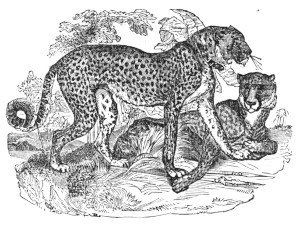
The Hunting Leopard.
This handsome animal of the Cat family,—sometimes called the Ounce, and also the Chetah,—is of the size of a large dog, and has a very long tail. It is of a pale yellow above and white beneath,—the body being marked with irregular black spots. It is of a slender make, and its agility is surprising. It is less ferocious than the tiger, panther and true leopard; and having blunted claws, like a dog, is used, in the southern parts of Asia, for hunting the antelope and other game. It is a native, also, of Africa, but it has never been trained for this purpose.
The chetah is chiefly used in hunting by the nobles of India. The mode of proceeding is thus described. The animals are carried to the field in low chariots, being tied and hooded. This is done in order to deprive them of the power and temptation to anticipate the word of command by leaping forth before the appointed time. When they are thus brought within view of a herd of antelopes, which generally consists of five or six females and a male, they are unchained, and their hoods are removed, their keeper directing their attention to the prey, which, as they do not hunt by smell, it is necessary that they should constantly have in sight.
When this is done, the wily animal does not at once start forward towards the object of his pursuit, but, seemingly aware that he would have no chance of overtaking an antelope in the fleetness of the race, in which the latter is beyond measure his superior, winds cautiously along the ground, concealing himself as much as possible from sight, and, when he has in this covert manner nearly reached the unsuspecting herd, breaks forth upon them unawares, and, after five or six tremendous bounds, which he executes with almost incredible velocity, darts at once upon his terrified victim, strangles him in an instant, and takes his fill of blood.
In the mean while the keeper quietly approaches the scene of slaughter, caresses the successful animal, and throws to him pieces of meat to amuse him and keep him quiet while he blinds him with the hood, and replaces him upon the chariot, to which he is again attached by the chain. But if, as is not unfrequently the case, the herd should have taken the alarm, and the chetah should prove unsuccessful in his attack, he never attempts to pursue them, but returns to his master with a mortified and dejected air, to be again let slip at a fresh quarry whenever a fit opportunity occurs.
Conjugal Affection.
CHAPTER II. [Concluded.]
Victoria immediately saw the propriety of the latter suggestion, and on the following day she disguised herself as a Moorish fruit-seller; and with a basket of vegetables on her head, and her little daughter by her side disguised in the same manner, she got admittance to the outward wards of the castle; and while disposing of her fruit to the governor and his dependants, got into conversation with the soldiery, from whom, however, she could obtain none of the information she wanted.
Her whole time was now occupied by day in visiting the prison in the disguise she had assumed; and at night in keeping up the correspondence of so much importance. By this means, at the suggestion of Albert, she supplied him, not only with writing materials, but with a file, a chisel, and a hammer; and had got even a rope in readiness, should it be required for future operation.
Albert had in the first instance thought of breaking through the walls of his dungeon; but alas! they were eighteen feet thick, and no effort that he could make upon them with the slight tools he possessed, was sufficient to separate them. He had, with great caution, taken out two or three stones in the wall of his dungeon, but the interior stones were so firmly wedged, that they defied him. The labor of his task was enormous; and this was increased from the necessity of replacing every stone in its respective niche, so as to escape the vigilant eye of the keepers. So, at last, poor Albert began to despair.
Victoria, however, whose inventions were more fertile than those of her husband, still comforted him. She told him that she would never desist in her exertions while he remained a prisoner, and bade him have hope and trust. He, however, had little reason to hope, for he was told by one of his guards, that on the next day, he was to be examined for the fourth time.
And examined he was. Torn from his dungeon at midnight, he was again brought before the Inquisition. The examiners sat before him, in a room hung with black. Behind the chair of the chief commissioner, who wore a square cap, shone, in all the brilliance of pure white silver, an image of the crucified Redeemer; and beneath it, a skull and cross bones. The marquis was bound, and without being asked a single question, was placed at once upon a rack in the corner of the room. A physician stood by his side to watch his agonies, and to stop the torture when beyond human endurance; and the secretary of the fraternity sat ready to record the answers to the questions put to the unhappy man.
Thus tortured to confess crimes which he never committed, the marquis had every bone dislocated; and when nature gave up the contest, and he sunk into stupor, he was removed back to his dungeon. For some days, he remained in the most helpless condition, without being able to move a limb, except in exquisite torture. Yet, after a time, his system recovered its wonted strength, and Albert was again inspired with hope.
Victoria Colonna had pursued the same course of communication previously adopted for several successive days, and receiving no answer to her signs, was at last on the brink of despair. She believed that the wickedness of man had done its worst, and that her husband had escaped by death from the power of the tormentor. Day after day, she watched with anxious longing for some sign of his still being an inhabitant of the earth; but no sign was given to her, and she was on the point of giving up all further exertions, when on one of her nightly walks and watchings round the captive’s tower, her ear was delighted with the well-known clatter of a piece of tile. She ran to the spot, and once more recognized the well-known handwriting of Albert—“I still live for Victoria,” was the only sentence inscribed by the unhappy prisoner.
The faithful wife now lost not a moment in devising some other plan for her husband’s escape. She pondered all the next day, and part of the next night. As soon as it was dark, she again raised her kite by the side of the tower, placed a note under its wing, in which she bade her husband be of good cheer, promising all her assistance, and suggesting his making a breach in the wall with the implements already afforded him. To this, on the following night, Albert replied, stating the utter impracticability of the plan, by reason of the thickness of the wall; but urging her to procure a sufficient quantity of gunpowder, by which the masses of stone might be separated and a breach made.
Victoria seized the hint, and with the rapidity of thought, made her arrangements. By means of the kite, the following night, a stouter line was raised to the aperture, and from this, one still stronger; and by means of the last, the prisoner drew up several other cutting implements—a boring auger, and several parcels of gunpowder. Lastly, a still larger cord was drawn up; and it was then arranged that on the following night, the attempt should be made to blast the massive walls of the tower.
The next day, Victoria was busily employed in arranging the means of escape. She had procured the dress of a friar, both for herself and husband, and wore one over the other; and at midnight, she again took her station below the tower. Again she established the communication between herself and husband; and having raised to himself several other packets of gunpowder, lastly had fastened to the cord the lighted match. But at the very moment of success, she found a strong arm grasping her, and two ruffian soldiers, with unsheathed weapons, close at her breast. She screamed fearfully. The words—“bind her,” startled her still more, for it was the voice of Montalbert, the wretch who had caused the imprisonment of her husband.
“Drag her away,” said the count.
Victoria clung to the projecting walls of the castle, having fixed her fingers within a clamping-iron, and hung to it with the tenacity of one who clings to life; while her screams and lamentations filled the air. Albert heard it, and judged of the cause. He applied the match to the mine he had pierced through the stones of the tower. With a tremendous crack and explosion, the ancient walls opened, shook, collapsed, and fell. The tower was shattered to its foundation; and prisoner and dungeon, turret and battlement, fell down in one prodigious ruin, and with an uproar that shook the city.
Montalbert lay dead among the ruins. The faithful Victoria was miraculously saved, and Albert rose from the fallen stones uninjured. He clasped his beloved wife to his heart, and without losing a moment’s time, both escaped in the confusion and consternation that followed.
They soon proceeded far from Italy, to a land where imprisonment for conscience sake is unknown, where spiritual domination cannot usurp nature’s rights; and where the children of God can walk in security and peace; and that land was England. Here they lived the remainder of their days in all the enjoyment which this country of true liberty always affords to the fugitive and stranger.
A Pointed Blow.—An invalid sent for a physician, the late Dr. Wheelman, and after detaining him for some time with a description of his pains, aches, &c., he thus summed up with—
“Now, Doctor, you have humbugged me long enough with your good-for-nothing pills and worthless syrups; they don’t touch the real difficulty. I wish you to strike the cause of my ailment, if it is in your power to reach it.”
“It shall be done,” said the Doctor, at the same time lifting his cane, and demolishing a decanter of gin that stood upon the sideboard!
Inhabitants of an Oyster.—Observations with the microscope have shown that the shell of an oyster is a world occupied by an innumerable quantity of small animals, compared to which the oyster itself is a colossus. The liquid enclosed between the shells of the oyster, contains a multitude of embryos, covered with transparent scales, which swim with ease; a hundred and twenty of these embryos, placed side by side, would not make an inch in breadth.
This liquor contains besides, a great variety of animalculæ, five hundred times less in size, which give out a phosphoric light. Yet these are not the only inhabitants of this dwelling; there are, also, three distinct species of worms.
“I am transported to see you,” as the convict at New Holland said to the kangaroo.
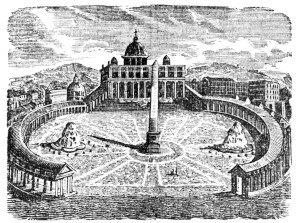
St. Peter’s Church.
Church of St. Peter’s at Rome.
This sublime edifice is by far the most costly and stupendous religious building in the world. It was begun by one of the popes of Rome, Julius II., in 1506. His object was, to have a church that might become the seat and centre of the great Catholic Church throughout the world. The first architect employed was Lazzari, but he died soon after, and the task devolved upon the famous Michael Angelo. It required, indeed, a man of great genius to design and carry forward so stupendous a work. The building was one hundred and fifteen years in progress, and extended through the reigns of no less than eighteen popes. The cost of it was amazing, being equal to one hundred and sixty millions of dollars at the present day. A period of one hundred and fifty years or more was required to complete the colonnade and other ornaments after the body of the structure was finished. Great numbers of people are now constantly at work to keep the enormous mass in repair. The annual expense of this is estimated at thirty thousand dollars.
The clear length of the church within is 615 feet, its utmost breadth 448, its height 464 feet. The greater part of it is of stone, though some portion is of marble. The foundations are immense, and it is said that they contain a greater mass of stone than the building above the ground. In front of the church, and within the colonnade, is a beautiful obelisk, brought from Egypt almost two thousand years ago. On each side of this is a fountain, the waters of which rise to the height of seventy feet and fall in three cascades; the whole forming a cone of falling waters. They continue to fall day and night, and nothing can be more beautiful than the effect produced. They are supplied by ancient Roman aqueducts, from lake Braccano, which is seventeen miles distant. Every thing is vast in and about this wonderful edifice. The interior is very grand, and strikes the beholder with awe. The figures of the four Evangelists, which adorn the inside of the cupola, are of such enormous size, that the pen in the hand of St. Mark is six feet long. The interior is enriched with a great number of figures of saints and other works of art. In the centre of the church, where the light pours down from the dome, is the tomb of St. Peter, before which one hundred lamps are kept constantly burning.
Some idea of the vastness of this structure may be formed from the fact that great numbers of persons live upon the roof, in buildings which are not seen from below, yet appear almost like the streets of a city!
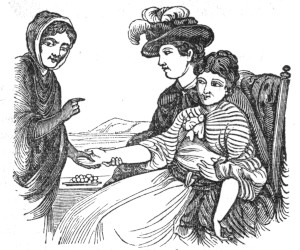
A Gypsy telling fortunes.
Fortune-Telling.
The desire of looking into futurity—of knowing what is going to happen—appears to be universal in mankind. To a certain extent, we may gratify this feeling, but it is to be done by the exercise of a sound judgment. We may thus generally tell what is coming to pass, in respect to most important transactions of life, so far as is necessary for us.
But many people desire to go farther; to unseal the book of fate, and read what is hidden from mortal sight. Young ladies often desire to know who they shall have for husbands: whether they shall be rich or poor; happy or miserable. And instead of leaving these things to time, and the dispensation of Providence, they must often go to some cheat who pretends to tell fortunes. Thus they lose their time and their money, and allow themselves to play the part of folly.
Nor are young ladies the only persons who sometimes yield to such idle nonsense. Young men often do the same—and also old men and old women. It is, I believe, a common notion, that certain strange, odd, eccentric, mysterious persons have the power of reading the future and telling what is coming to pass. So common is this shallow superstition, that fortune-tellers, though they require a good deal of money, to read their riddles, often find pretty good encouragement.
These jugglers generally pretend to tell the fortunes of persons by the stars, or by looking at the lines in the palm of the hand, or by the cast of the countenance, or by all these means combined. They frequently consult books with strange figures in them; and sometimes they seem to make profound calculations. But all these are mere arts to impose upon their dupes. The simple fact is, that fortune-telling is, always and under all circumstances, a cheat. One person can see into the future as well as another, as to all that lies beyond the sagacity of mere human judgment. A person who believes, therefore, that any one has the art or gift of fortune-telling, is the victim of superstition, and the dupe of artifice.
In England, Spain and Germany there are a few wandering people called Gypsies. They are of a dark skin, almost like our Indians: they have black hair, black eyes, and altogether a dark and wild aspect. They speak a strange tongue, have strange habits, and are a very peculiar people.
The women of this race very often pretend to be fortune-tellers. They have great address in making their dupes believe in their mysterious power. They frequently gain some information as to the history of a person; then, presenting themselves before him, offer to tell his fortune. Affecting to know nothing of him—never to have seen him before—they proceed to weave the web of fate; taking care to mingle in some real incidents of his life. The person thus is amazed to find the strange Gypsy, who has never seen him before, telling accurately the leading circumstances of his history; and as she seems to read the past by her mysterious art—he thinks, by the same power, she can of course unravel the future!
Travelling in the north-west of America is effected by dog-trains. Three dogs will draw a man and his provisions. The traders travel all over the wilderness with them over unbeaten snow, generally following the course of rivers. The dogs are easily trained to turn, halt, or go, by the word of command. When the traveller wishes his dogs to turn to the left, he says “chuck,” and cracks his little whip on the right side of the train; if to the right, he says “gee,” and cracks it on the left side. When he wishes them to start or quicken their gait, he says “march,” or “avancez;” when he wishes to turn short about, he says “venez ici,” making a motion with the little whip at the same time.
Ne’er till to-morrow’s light delay What may as well be done to-day.
Ne’er do the thing you’d wish undone Viewed by to-morrow’s midday sun.
The Life of Martin Luther.
(Continued.)
When Luther was fully informed of the operations of Tetzel and his associates, he drew up certain themes or propositions, setting forth his own views of the powers of the church, and denouncing the avarice, impudence and licentiousness of the priests who went about selling indulgences and extorting money, under the pretence of making collections for the church.
Though there was nothing in these themes, but what many Catholics had maintained, they assailed in some points, especially the favorite doctrine of infallibility, the accepted creed of that day. He, however, boldly published them, challenged reply, and defended them in his own pulpit. Multitudes gathered to hear him, and his opinions were rapidly spread over Europe.
Tetzel and his associates were greatly enraged; they formally burnt Luther’s theses, and then proceeded to answer them, chiefly by assuming the supreme authority and infallibility of the pope. This injured their cause, and their reply to Luther was publicly burnt by the students of Wittemberg. Such was the beginning of the storm which shook Europe to its foundation, and finally stripped the pope of his spiritual supremacy. Yet, when Leo heard of the dispute at Wittemberg, he only said, “It is a quarrel between monks;—but brother Luther seems to be a man of parts!”
Luther’s fame was rapidly extended, but as yet he had no idea of separating from the Church of Rome. In 1518, he wrote a submissive letter to the pope, in which he says, “I throw myself prostrate at your feet, most holy father: call or recall me, condemn or approve, as you please: I shall acknowledge your voice as the voice of Christ, who presides and speaks in your person.”
But the pope, who had once thought so lightly of Luther’s influence, was ere long seriously alarmed, and at last summoned him to appear at Rome, to be examined, within sixty days. The danger to Luther in doing this was obvious, and his friend the Elector of Saxony obtained permission to have his examination take place at Augsburg. Here Cardinal Cajetan, or Caietano, was commanded to examine him. Thither Luther went, accompanied by his friend Staupnitz. The cardinal required a recantation of what he had written; but this Luther refused. Warned of danger that threatened him, he left Augsburg, and returned to Wittemberg. The pope now issued a bull, declaring that he, as Christ’s vicar on earth, had power to deliver from all punishment due for sin, to those who repented and were in a state of grace, whether alive or dead. Luther now appealed from the pope to a general council of the church.
Pope Leo now commissioned a prelate, named Milnitz, to endeavor to bring Luther to a recantation. This dignitary was a man of talent and skill, and in an interview with Luther, he greatly conciliated the feelings of the latter. Milnitz condemned the abuse of the sale of indulgences, threw the blame upon Tetzel and his associates, and finally induced Luther to write another submissive letter to the pope, acknowledging that he had carried his zeal too far, and promising to observe silence upon the matter in debate, if his adversaries would adhere to the same line of conduct. This letter has subjected Luther to great scandal, as a retraction of his principles; but it must be regarded only as evidence of the profound reverence with which he regarded the institution of the Church of Rome, in whose faith he had been educated, and the difficulty with which his mind burst asunder the fetters which it had thrown around him. The pope himself at this period wrote a kind letter to Luther, and it is probable that the breach might have been healed, had not Luther’s enemies again opened the controversy.
Eckius of Ingoldstadt challenged Carolstadt, one of Luther’s disciples, to an open discussion at Leipsic. Luther went thither himself, agreeing to take no part in the disputation. The debate attracted the great and the learned, from a vast distance. Among the listeners was the celebrated Melancthon, who was determined by what he here heard to devote himself to the cause of reform.
Eckius was a man of brilliant eloquence, and seemed to have the advantage of his antagonist, after a dispute of six days. It was then agreed, by Eckius’ desire, that Luther himself should enter the lists. The debate was continued for several days, and different accounts were given of the result; but Hoffmann, the rector of the University of Leipsic, who had been appointed judge of the disputation, considering it to be so equally balanced, that he refused to pronounce a decision.
Luther went on to write several works, mostly questioning the lofty assumptions of the Church of Rome. He exposed the fatuity of penance, and pilgrimages; the impiety of worshipping saints; and the abuses of the confessional; he condemned the celibacy of priests, and denounced monastic vows. Leo now assembled a congregation of cardinals, before whom Luther’s works were laid for adjudication. By their advice, a bull was drawn up, in which forty-one propositions, taken from his books, were denounced as heretical; his writings were condemned to be publicly burnt, and he himself was summoned to appear at Rome, and retract his writings on pain of excommunication. Luther again appealed to a general council of the church; and publicly separated himself from the communion of the Church of Rome, by burning the pope’s bull on a pile of wood, without the walls of Wittemberg, in presence of a vast multitude of people. This occurred, December 10th, 1520. Soon after, the pope thundered against him his bull of excommunication.
The situation of the great Reformer was now one to put his moral courage to the severest test. Staupnitz, his early friend, had deserted him, and made peace with the church; Luther had written to Erasmus, of Rotterdam, who had written in behalf of reformation in the church, but that timid and irresolute scholar made him no answer. Even Spalatinus, once his ardent friend, was now seized with fear. Eckius, who had also been his friend, was, as we have seen, in open opposition to him. At the same time, society was violently torn with the questions which Luther had started. While some declared in his favor, the majority, including a vast preponderance of the rich and powerful, continued, even in Germany, to oppose him. By the rigid Catholics he was looked upon with horror. No terms too harsh could be found to heap upon his name; no scandal so vile could be invented, that it did not find believers; he was withal denounced by the papal bull of excommunication, that formidable and fearful curse, which few minds in that age had the iron hardihood to withstand. He was accused in the view of millions, who would have deemed it a service worthy of heaven to have taken the life of one regarded as a disciple of the Devil. The “arch-fiend” was a common title, bestowed upon him by his enemies. Yet, amid these perils, Luther stood as undaunted as the oak before the tempest; and though the lightning fell and the thunder burst upon and around him, he met it all unscathed.
Luther had, indeed, one powerful and steadfast friend,—Frederick the Elector of Saxony. The pope had endeavored to persuade him to give up the dreaded and hated priest, but in vain. He now sought to accomplish his object by other means. Maximilian, the Emperor of Germany, was dead, and Charles V., King of Spain, in 1518, had been elected in his place. Leo applied to him to make an example of Luther, as an obdurate heretic. Frederick interposed, and persuaded Charles to cause him to be tried by a diet of the empire at Worms. Having obtained the emperor’s safe-conduct, Luther set forward upon his journey to that place, for his trial.
His friends trembled for the issue; every heart seemed burthened save his own. Melancthon, now his intimate friend, attended him. Luther, in the pulpit, seemed to breathe only of religion: in society, he was frank, cheerful, and engaging. He cultivated every innocent thing that could make life more agreeable. He went on his way to Worms, which many expected would prove his grave, with perfect equanimity, saying, “If it is God’s will that I die, I am prepared; yet I believe that my time has not yet come.”
He arrived at Worms on the 16th of April, 1521. On entering the town, he began singing the hymn—“Our God is a strong citadel”—and this became the inspiring song of the Reformation. Numbers of Luther’s friends, who were with him, alarmed as they approached the city of Worms, deserted him; but his cheerfulness continued unchanged.
Worms was at that moment the point to which the eyes of all Europe were turned. Thither multitudes had gathered, impelled by an intense desire to see the result of the trial. The questions at issue had evidently entered deeply into the hearts of men; and now the person who had caused this mighty movement was there. And what was he? A simple monk,—a man without station, office, rank or badge; but truth and courage had given him a power which made potentates tremble. They were as the Philistines, and he as Samson, with his arms around the pillars of the temple. With what a feeling of interest did the concourse of people look on Martin Luther that day!
He was conducted, the day after his arrival, to the diet, by the marshal of the empire. There were the cardinals and princes in their badges of office and insignia of rank. It was an august assembly, in which Charles V., Emperor of Germany and King of Spain, presided. Luther came in, wearing a simple black gown, with a belt around his waist. He moved with a modest but tranquil step. Melancthon, Spalatinus and other friends were at his side. Luther was now asked if he acknowledged himself to be the author of certain books bearing his name. When they were enumerated, he said he would not deny them. “Are you ready to retract what has been condemned in these books?” was now asked. He requested time for reply;—a day was given him. The enemies of Luther now triumphed, and his friends feared for him. It was apprehended that he would shrink from the fearful ordeal. When he went to the diet, he was cheered by thousands of voices; as he returned, the enthusiasm had passed away.
The next day, Luther again appeared before the diet, and being asked if he meant to retract his writings, he replied mildly, yet firmly, in Latin, that he did not. He besought the assembly to hear with candor and judge him with fairness. He appealed to the youthful emperor, and mildly warned him against rash judgments.
When one of the assembly demanded of him a direct answer to the question whether he would recant or not—he replied that he would retract nothing, unless it could be shown to be inconsistent with the Bible. To the Scriptures he appealed, as the word of God, and when that sustained him, he would yield nothing. “To act against my conscience,” said he, “is neither safe nor honest. Here I stand—I cannot do otherwise—may God help me. Amen!” The latter words were pronounced in his native German, with a deep and affecting emphasis.
Although the assembly, as Catholics, disapproved of Luther’s views, his noble bearing excited their respect and wonder. The Archbishop of Treves, touched with the sublimity of his conduct, paid him a visit, and sought to win him back to the church. This was, of course, in vain. Luther’s friends were now filled with enthusiastic admiration, and his enemies could not withhold their respect. The decision of the diet was of course against him, and the emperor ordered him forthwith to leave Worms. He left it on the 26th of April.
An edict was now issued by the emperor, to go into effect as soon as his safe-conduct to Luther should expire. In this, he was denounced as the “Devil in the shape of a man and the dress of a monk. All the subjects of the empire,” continued the bull, “are required to seize upon him, and deliver him up to justice.” It may well be believed that dismay now seized upon the friends of Luther. What was their horror, soon after, to hear that as he was travelling with a single attendant towards his house, he was beset in the forests of Thuringia, dragged from his carriage by several men in masks, and hurried away. His companion had escaped to tell the tale. Consternation reigned throughout Germany, and in the town of Wittemberg, sorrow and wailing was in almost every dwelling.
But it was not long before a new work from Luther’s pen was announced, and it was of a date subsequent to his alleged murder. Melancthon also received a letter from him—“Give yourself no uneasiness for me,” said he; “both you and your wife may rest assured of my welfare. I am not only supplied with all the necessaries of life, but if I chose I could command the luxuries; but I trust God will preserve me from such snares. I wish not to receive the reward of my labors in this world, but in the world to come.”
The explanation of the mystery was this. The elector, foreseeing that, in consequence of the emperor’s proclamation, Luther’s life would be in danger, had caused him to be waylaid and carried in safety to the old castle of Wartburg, near Eisenach; while a story of his murder was propagated by his fugitive attendant. Luther, being supplied with every convenience, devoted himself to study, yet was required by the elector by no means to permit his retreat to be known. He was situated in an old castle, built upon a lofty eminence which commanded a delightful prospect. Freed from care and anxiety, his mind seemed to soar aloft like the birds around his dwelling. His letters written at this period are full of poetic fancy, and show that his mind sympathized with the lovely scenes around him.
His confinement lasted for ten months. During this brief period, he translated the New Testament into German, besides writing treatises against auricular confession, monastic vows, clerical celibacy, prayers for the dead, &c. His works spread with amazing rapidity, and produced a wonderful effect, particularly in Saxony. Hundreds of monks quitted their convents and married; the Austin friars of Wittemberg abolished mass. The excitement soon ran into excess, and Carolstadt, a disciple of Luther, demolished the images in a church at Wittemberg, and proposed to banish all books from the university, except the Bible. He even affected to obey to the letter the sentence pronounced on Adam, and went to work a portion of each day in the fields. The mild and polished Melancthon caught the infection, and labored in a baker’s shop.
Luther in his retirement heard of these follies, which were calculated to ruin his cause, and at the risk of his life immediately departed for Wittemberg. He now preached openly his doctrines, with amazing power and effect. He succeeded in quelling the violence of his fanatical followers. These sermons are patterns of moderation, wisdom and popular eloquence; they show a marked contrast to the violence and scurrility which soil his writings directed against the malignity and duplicity with which he had chiefly to contend.
Luther was now the acknowledged head of the reformation. He continued by preaching and writing to aid the great cause of Protestantism. His productions were stained with coarse invective; but this was the taste of the age, and belongs equally to his opponents. In 1524, he threw off his monastic dress, and condemned monastic institutions. Convents both of men and women were now rapidly suppressed, and the reformation in some cases ran into fanaticism. A sect called Anabaptists ran into the wildest extremes at Munster. They made war upon property and law, and in their madness practised the grossest vices and crimes under the sanction of religion. Luther was sorely grieved at these things, and did all in his power to correct them, though not with complete success.
In 1525, he married Catherine de Bora, a young nun, who had left her convent a year before, and resided with Melancthon. He was happy in this marriage, and though at the age of forty-two, seems to have entered into it almost with the affections of youth. In 1534, he completed his great work, the German version of the Bible, which is much admired for its elegance, force and precision, and has rendered the Scriptures really popular in Germany.
The remaining years of his life were passed in comparative quiet. In 1546, being at Eisleben, he fell sick on the 17th of February, and seemed at once to be aware of his approaching end. He grew worse in the evening, and died in the midst of his friends, expressing a firm conviction of the truth of that faith, which he had taught. His body was carried to Wittemberg, and buried with great honors.
Luther’s works are voluminous, and great favorites in Germany. In company, he was always lively, and abounded in sallies of wit and good humor; he gave advice and assistance wherever it was needed; he interested himself for every indigent person who applied to him, and devoted himself with his whole soul to the pleasures of society. Rough and stormy as are his controversial writings, he was no stranger to the elegant arts. His soul was filled with music, and he often solaced himself by singing and playing upon the flute and lute.
Nor is Luther to be regarded only in the light of a religious reformer. He not only burst the bonds of religious tyranny throughout Christendom, but he created in Germany that impulse towards spiritual philosophy, that thirst for knowledge, that logical exercise of the mind, which have made the Germans the most intellectual people in Europe. He was the friend of education, of mental freedom, of religious light, of civil liberty. He rescued the Bible from the exclusive grasp of the Church of Rome; by a gigantic effort he translated it into his native tongue; he not only made it acceptable to forty millions who spoke his native language, but he made it the common property of the people of all Europe. He was no courtly flatterer—but the friend of the poor and the humble; he was as ready to condemn cupidity and extravagance among his followers, as among those who adhered to the Church of Rome.
The life which Luther led was calculated to develop the sterner parts of his character, and we must admit that his writings display many gross and abusive passages; yet he possessed many gentle and attractive qualities. His love of music amounted to a passion; “Old Hundred,” a tune which has guided and elevated the devotion of millions, was his composition, and some of our sweetest hymns were written by him. His familiar letters are full of gentle affections. Even when Tetzel, his special enemy, was deserted by those who had used him, and now, in poverty and desolation, was upon his deathbed, Luther was at his side, pouring into his harassed soul the oil of consolation. One of his last acts, was that of reconciliation, in a noble but distracted house. When we look through the steel mail of the controversialist, the reformer, and observe traits of character like these, we cannot but lift our thoughts with thanks to Heaven, that human nature—with all its drawbacks—when elevated by religion, has such capacities as these.
To estimate Luther’s character, and the work he accomplished, we must bear in mind the circumstances under which he acted. He was educated a Catholic, in a country where the dominion of the Romish Church was complete, as well over the government as the people. All around him, father, mother, friends, society were living in abject submission to the established creed. Doubts were held as the suggestions of the Devil; freedom of thought was infidelity; denial of any received dogma was heresy, and worthy the judgments of the Inquisitor—of punishment here and hereafter. These were the orthodox notions of the age, and Luther was a priest of that church which bound the civilized world to such a system.
What a fearful struggle in his own mind, with his own habits of thought, his associations and convictions, did it involve, for the Reformer first to doubt, and then to repudiate, the faith which thus enthralled him! What courage of soul, to meet the fears that spring up in the bosom; what energy of mind, to rend asunder the chains that fetter the reason, in such a condition! And when he had triumphed over internal difficulties, what a work was still before him! The pope, by the invisible cords of spiritual despotism, held all Europe in subjection. Every monarch was more or less his slave; every prison, like some fearful monster, was ready to open its jaws at his command, and close them upon whomsoever he might designate: the jealous inquisition, with all-seeing eyes, all-hearing ears, spread its net on every hand. All the united powers and prejudices of society—public opinion, laws, institutions, armies, prisons, chains, fire, the rack—were in the hands of the church, and it was against this that one man was called to contend. It was as if a single knight, and he without arms, were called to attack the lordly castle, whose massive walls and towering battlements might look down with disdain upon the assailant.
And yet Luther triumphed. We cannot doubt that he was sustained by a deep conviction of the rectitude of his cause; that a sense of duty raised him above the considerations of personal interest and safety; that he acted as if in the presence of God, and in the hope of a heavenly, not an earthly, recompense. We must not only admit that his abilities were great; his qualities rare and well adapted to his work; that he was a man of peculiar singleness and sincerity of aim; and that he was endowed with the richest graces of religion; but we must admit something more—that truth is mighty; that the abuses of the Church of Rome had risen to such a pitch as to furnish the very elements of revolution; and finally, that the good providence of God shaped events to their great issues in behalf of liberty and light. Can any one explain the revolution achieved by Luther, on any grounds short of these?
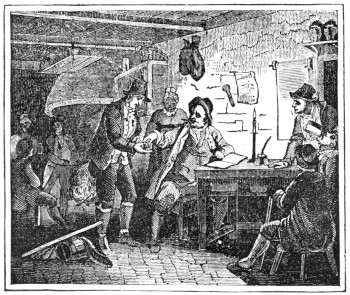
Rent-Day.
English Farmers.
This picture represents a scene very common in England, but more rare with us. A farmer is paying the rent of the house and farm he occupies, to their owner. Here the farmer usually owns the land he tills and the house in which he dwells. It is not always so, but land is so cheap with us, that he may generally be the proprietor of enough for the support of a family, together with a tenement sufficient for their comfort.
In England there is hardly such a class of persons as our independent, prudent, intelligent owners of the soil: the farmers are there, for the most part, persons of some wealth, who hire land upon leases of twenty-one years. They are a highly respectable class of persons, seldom laboring themselves, and only overseeing their numerous workmen. The persons they employ are often exceedingly poor, toiling very hard for small wages, with poor fare.
The wife of the farmer in England is generally a stout, rosy-cheeked, handsome woman, very neatly dressed; she oversees the dairy, and the various operations of the household. She is generally very systematic in her affairs; each person has her particular course of duty, and is expected to do it thoroughly.
The English farm-house is generally of brick or stone; it is irregularly built, and seems to have been put up at many different times, according to circumstances and without any regular plan. It looks ancient, dark, respectable and comfortable. Within, it is a pattern of neatness, and is full of good furniture. The beds are plump, and the sheets white as snow. Every bedroom is furnished with a carpet, table, bureau, &c.
The table of the English farmer is generally well provided, and when the family is seated around it, the scene is a very pleasant one.
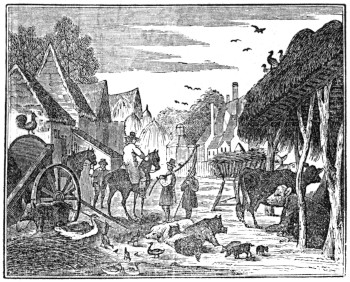
An English Farm-yard.
The barns in England are usually of stone, and often several buildings are crowded together. A good deal of the hay is preserved in stacks. The barnyard of a thriving English farmer is generally a scene which seems to bespeak wealth and abundance; but it must be remembered that we are speaking of the wealthier class. Some of these cultivate several hundred acres, and it is not uncommon for one farmer to pay an annual rent of from five to ten thousand dollars.
London Menageries.—These are very expensive establishments. The expense of Wombell’s collection is 170 dollars a day. The cost of the animals also is very considerable. A fine elephant is worth 4500 dollars; tigers have been sold at 1400 dollars each; a panther is worth 450 dollars, hyenas from 200 to 300; zebras from 700 to 900 dollars; a fine ostrich is worth 900 dollars. A young Indian one-horned rhinoceros cost Cross 5000 dollars; and three giraffes cost the London Zoological Society 3000 dollars, exclusive of expenses.
The word gazette was derived from the name of the small Venetian coin, which was the price of the first newspaper.
A Story of the Revolution.
The following story, related by a mother to her children, a few years since, will show the spirit which existed among the people of New England at that trying period:
“Late in the afternoon of one of the last days in May, ’76, when I was a few months short of fifteen years old, notice came to Townsend, Massachusetts, where my father used to live, that fifteen soldiers were wanted.
“The training band was instantly called out, and my brother, next older than I, was one that was selected. He did not return till late at night, when all were in bed. When I rose in the morning I found my mother in tears, who informed me that my brother John was to march the day after to-morrow morning at sunrise. My father was at Boston, in the Massachusetts Assembly. Mother said that though John was supplied with summer clothes, he must be away seven or eight months, and would suffer for want of winter garments. There were at this time no stores and no articles to be had except such as each family would make itself. The sight of mother’s tears always brought all the hidden strength of the body and mind to action. I immediately asked what garment was needful. She replied, ‘pantaloons.’
“‘O! if that is all,’ said I, ‘we will spin and weave him a pair before he goes.’
“‘Tut,’ said my mother, ‘the wool is on the sheep’s back, and the sheep are in the pasture.’
“I immediately turned to a younger brother, and bade him take a salt dish and call them to the yard.
“Mother replied, ‘Poor child, there are no sleep shears within three miles and a half.’
“‘I have some small shears at the loom,’ said I.
“‘But we can’t spin and weave it in so short a time.’
“‘I am certain we can, mother.’
“‘How can you weave it?—there is a long web of linen in the loom.’
“‘No matter; I can find an empty loom.’ By this time the sound of the sheep made me quicken my steps towards the yard. I requested my sister to bring me the wheel and cards, while I went for the wool. I went into the yard with my brother, and secured a white sheep, from which I sheared, with my loom shears, half enough for a web; we then let her go with the rest of the fleece. I sent the wool in with my sister. Luther ran for a black sheep, and held her while I cut off wool for my filling and half the warp, and then we allowed her to go with the remaining part of her fleece.
“The wool thus obtained was duly carded and spun, washed, sized, and dried; a loom was found a few doors off, the web got in, woven, and prepared, cut and made two or three hours before my brother’s departure—that is to say, in forty hours from the commencement, without help from any modern improvement.”
The good old lady closed by saying, “I felt no weariness, I wept not, I was serving my country. I was assisting poor mother, I was preparing a garment for my darling brother.
“The garment being finished, I retired and wept, till my overcharged and bursting heart was relieved.”
This brother was, perhaps, one of Gen. Stark’s soldiers, and with such a spirit to cope with, need we wonder that Burgoyne did not execute his threat of marching through the heart of America?
Lady Jane Grey.
We think our readers can hardly fail to be interested in the story of this amiable, but unfortunate lady. We shall therefore tell it at some length.
Melancholy as was the fate of this illustrious personage, she was fortunate, in one respect. Though placed in a situation to excite envy and prejudice, and though calumny and misrepresentation might be deemed a road to royal favor, no one of her cotemporaries has dared to say ought that was ill of her; and the more attentive is the examination of her history and character, the more deserving will she be found of those praises, which some, in later times, have hinted to have had their origin in a desire to glorify a political and religious martyr.
She was the daughter of Henry Grey, Duke of Suffolk, and Frances Brandon, a granddaughter of Henry VII., and was born at “a very faire, large, and beautiful house,” called Bradgate, in 1537.
The intercourse between parents and children was not of that pleasing character, now so universal; good discipline was maintained by fear, rather than love; children, especially daughters, were never admitted to any familiarity with their parents; they were obliged, even in womanhood, to stand at the cupboard side during visits, except when permitted to have a cushion to kneel on; and it was not unusual for ladies of the highest rank, to correct their grown-up daughters, even before company, with the large fans which it was the fashion to carry.
The parents of Lady Jane were even more than usually severe; which with one, who from her birth was distinguished for the gentleness of her disposition, was wholly unnecessary; “for what need,” says the quaint Fuller, “of iron instruments to bow wax?” The first care of her parents would doubtless be to instruct her in those matters which were deemed indispensable to a young lady’s education. She was taught music, and not only played on several musical instruments, but accompanied them with a voice exquisitely sweet; her execution in needle-work was beautiful; she was skilled in the art of making confectionary, then an important part of lady-like duty; nor was she deficient in a knowledge of surgery and medicine, for the practice of which arts those boisterous times furnished frequent occasion. At a period a little earlier than this, with a knowledge of these things, a young lady’s education would have been deemed complete; for reading and writing were thought to be dangerous accomplishments, any further than to be able to spell out the Missal. But the reformation in religion had excited a desire for general knowledge, as well as a spirit of inquiry into religious matters; learning, as well with women as with men, became the fashion; “a grete number of noble women,” we are told by a contemporary writer, “were given to the studie of human sciences, and of strange tongues, and it was a common thinge to see young virgins so nouzled and trained in the study of letters, that they willingly set all other vain pastymes at naught for learnynge’s sake.”
The early promise which lady Jane gave of genius and excellence, induced her parents to bestow even more than ordinary pains in the cultivation of her intellect. The most learned men of the day were chosen to be her preceptors, and under their instruction, she, at a very early age, became well skilled in the Latin, Greek, Hebrew, Chaldaic, Arabic, French, and Italian languages, as well as in her own tongue.
The severity of her parents proved of ultimate benefit to Lady Jane, in a manner which she shall herself relate. The celebrated scholar, Roger Ascham, being about to leave England on a diplomatic mission to Germany, went to take leave of the family at Bradgate, who had been his early patrons. He tells us that on his arrival there, he found that the duke and duchess, with all the ladies and gentlemen of their household, were hunting in the park; but that the Lady Jane was in her chamber. Requesting permission to pay his respects to her, to whom he states himself to have been much beholden, he was admitted. He found her reading the Phædon of Plato, in Greek, with as much delight as some gentlemen of that day would have read a merry tale of Boccacio. Having made every respectful inquiry, according to the custom of the times, he asked the youthful student why she would lose such pastime, as was going on in the park? She replied, “I wisse all their sport in the park is but a shadow to that pleasure I find in Plato. Alas, good folk! they never felt what true pleasure means.” Ascham then asked, “How came you, madam, to this deep knowledge of pleasure? and what did chiefly allure you unto it, seeing not many women, but very few men have attained thereunto?” “I will tell you,” replied Lady Jane, “and tell you a truth, which, perchance, you will marvel at. One of the greatest benefits that ever God gave me, is, that he sent me so sharp and severe parents, and so gentle a schoolmaster; for, when I am in presence either of father or mother, whether I speak, keep silence, sit, stand or go, eat, drink, be merry, or sad, be sewing, playing, dancing, or doing anything else, I must do it, as it were, even so perfectly as God made the world, or else I am sharply taunted, so cruelly threatened, yea, presently sometimes with pinches, nibs and bobs, and other ways, (which I will not name, for the honor I bear them,) so without measure disordered, that I long for the time that I must go to Mr. Aylmer, who teacheth me so gently, so pleasantly, with such fair allurements to learning, that I think all the time nothing whiles I am with him; and when I am called from him, I fall on weeping, because whatsoever I do else but learning, is full of great trouble, fear, and whole misliking to me; and thus my book bringeth daily to me more pleasure and more.” This interview made a lasting impression on Ascham, and we find him referring to it in a letter which he addressed to her from Germany. “I have travelled far; I have visited the greatest cities, and have made the most diligent observations upon the manners of nations, their institutions, laws, religion, and regulations; but I have found nothing that has raised in me greater admiration than what I found in regard to yourself last summer; to see one so young and lovely, in the noble hall of her family, at the very moment when all her friends were enjoying the field-sports; to find, I repeat, so divine a maid diligently perusing the divine Phædon of Plato; in this more happy, it may be believed, than in her noble and royal lineage.”
In addition to her own personal claims, there existed on the part of the reformed clergy a new source of interest. Rumor said that she was the destined wife of the young monarch, Edward VI., and as such they looked upon her as the future supporter of the true interests of Christianity. Perhaps, had the youthful parties been allowed to follow their own inclination, the union might have taken place; they were playmates in their infancy, and there was a great sympathy of tastes, as well as similarity of temper. But the choice of each must be controlled and made subservient to the purposes of ambition. Before Lady Jane was eleven years old, the possession of her hand in marriage became the object of political intrigue. Somerset, the Protector, sought it for his son, hoping, also, to bring about the marriage of the young king with his own daughter. But these schemes, by which he trusted to secure the permanence of his power, proved the cause of his downfall. His brother, Lord Sudley, was equally ambitious, and more artful; and finding that Somerset’s plans could not otherwise be counteracted, he became the chief agent in procuring his death. Sudley’s triumph was short; he himself fell before more successful rivals, Northumberland and Suffolk, who soon attained to a degree of power, which left nothing to be desired but to give it permanency.
The health of the king was manifestly failing, and his death would be their destruction; for zealous protestants such as they, had nothing to hope from a Roman Catholic sovereign. The order of succession then, as limited by Henry VIII., must be changed. This was a bold measure, but it might be successful; Mary and Elizabeth had both been declared illegitimate by act of parliament, at Henry’s own suggestion; it was but to procure a confirmation of this, and Lady Jane Grey stood next to the throne.
To cement the union between these ambitious nobles, a marriage was arranged between the Lady Jane and Lord Guilford Dudley, son of the Duke of Northumberland. There was short time for courtship, and the practice of those acts of gallantry which the fashion of the day required. No sweet madrigal softened the way to the lady’s heart; nor had the appointed bridegroom much time for the display, on his breast or in his hat, of the little gold-embroidered and edged handkerchief, with the tassels at each corner and in the middle, which enamored damsels were wont to present to their favorites. The marriage followed close upon the agreement; the king, to show the pleasure which it gave him, was bountiful in his gifts. But even in this his natural love of economy was gratified; for the forfeiture of the effects of the duke and duchess of Somerset had placed at his disposal much rich apparel, not much the worse for wear, which he now bestowed on the bridal party.
Though the match was one of ambition on the part of the parents, it was well calculated to secure the happiness of the parties, for the Lord Guilford Dudley would seem to have possessed every quality fitted to win a lady’s heart, and to keep it. Besides the approval of the king, it met with that of the court and of the public, who, as the bridal procession passed along, were loud in testifying their admiration of the beauty and innocence of the youthful bridegroom and his lovely bride.
The pomp and splendor which attended these nuptials, formed the last beam of joy that shone in the palace of Edward, who grew so weak a few days afterwards, that Northumberland thought it time to carry his project into execution. How he effected his purpose cannot be better stated than in the language of Fuller. “King Edward, tender in years and weak with sickness, was so practised upon by the importunity of others, that, excluding his two sisters, he conveyed the crown to the Ladie Jane, his kinswoman, by that which we may well call the testament of King Edward, and the will of the Duke of Northumberland. Thus, through the pious intents of this prince, wishing well to the Reformation; the religion of Mary obnoxious to exception; the ambition of Northumberland, who would do what he listed; the simplicity of Suffolk, who would be done with as the other pleased; the dutifulness of the Lady Jane, disposed by her parents; the fearfulness of the judges, not daring to oppose; and the flattery of courtiers most willing to comply, matters were made as sure, as man’s policy can make that good which is bad in itself.”
(To be continued.)
The Bamboo.—This is an eastern production, of various and most important uses. It grows from fifteen to sixty feet high, being from five to fifteen inches in diameter. It grows as much as twenty feet in a few weeks. It flourishes wild in many places, but it is cultivated with great care in China and other places. The soft shoots are cut and eaten like asparagus, and sometimes salted and eaten with rice. The hollow joints afford a liquid, and if not drawn off, a concrete, medical substance. Its seeds are eaten as a delicacy; its large joints are used as buckets; and, in many countries, no other wood is used for building. Ships are framed out of it, and it furnishes masts and yards. Its leaves make fans. It is also used to make bows, and to convey water to a distance. It also forms writing-pens, and is woven into baskets, cages, hats, &c. Bruised into a pulp, it makes fine paper, and is also used for many kinds of furniture.
Practical Advantage of Science.—The following illustration of the utility of science, in the common occurrences of life, is from the Genessee Farmer:—“A penknife was by accident dropped into a well twenty feet deep. A sunbeam, from a mirror, was directed to the bottom, which rendered the knife visible, and a magnet, fastened to a pole, brought it up again.”
GRANDMOTHER’S SCHOLAR.
Grandmother. Come hither, my poor orphan boy! Come to your granny’s knee; ’Tis time that you should learn to read, And tell your A, B, C. It is not fit that all the day Should pass in idleness away. Boy. Oh, grandmother! the sun shines bright, The bird sings in the tree, The bees are out—they never go To say their A, B, C. I wish I were a bird to play Among the leaves, and sing all day. Grandmother. My foolish child! the sun shines bright, To ripen corn and fruit; The bird has fled full many a mile, Upon her fond pursuit; And, for the little bees, there’s not A flower in their search forgot. Boy. But, grandmother, they do not learn In little books to read, They tell no crooked letters’ names, And they’re well off, indeed. I too would fly about all day, And glad, so I might be as gay. Grandmother. Poor boy! they cannot think or speak, But what they have been taught, With industry and studious care They practise as they ought; Do you remember, last July, The nest in the hawthorn hard by? Boy. Yes, grandmother, so soft and warm, All twigs and moss without, With quilted wool and slender straws Plaited and twined about, And then inside so smoothly spread, Oh, ’twas a tempting little bed. Grandmother. Aye, child, and all that moss and down Was brought by many a wing, Twigs from the distant upland wood, Moss from beside the spring; Remember, time, and pains, and care, Brought all those things together there. For do you think that in the tree Itself the nest would grow, So firmly built, and nicely wove, And lined?—“Oh, granny, no!”— Then think, how every bird that flies Must labor ere his roof can rise. Boy. But, grandmother—the humming bees,— Well—on a summer’s day, What can you see, from morn to eve, So busy as are they? Into each flower their trunks they dive, And laden cluster round the hive. Grandmother. Learning A B is not so hard As flying all the day; And to a bee’s industrious life Your book is only play; Beside, God gave you speech and thought, To be improved, and ruled, and taught. Boy. Ah, granny, this is very true, But I should like to know, If it is good to speak and think, Why don’t the birds do so? And why did God make them to fly, And us to walk through wet and dry? Grandmother. My child, why did he make the sun Above our heads to glow? Why did he bend upon the cloud His bright and glorious bow? Why did he make the thunder sound, And draw the solemn night around? Why, but because he saw ’twas best?— He gave to flower and tree The power to blossom, bud, and fruit, And for man’s good to be. But man, he made to praise him still, And humbly do his Maker’s will. And we do not his laws obey In wasting time that flies, Or being idle all day long Instead of being wise. Then come, my child, begin, and we Shall soon outgrow our A B C.
Our Correspondence.
Thanks, gentle friends, for your many favors—but you must not expect me to insert them all here. I read them with great satisfaction, and even when you find a little fault, I am not the less pleased—particularly if you tell me how to do better. But as to printing all your epistles, you must consider that I have Bill Keeler’s stories to put in, and the Old Man’s in the Corner, and a great many other things. I have, indeed, so many matters crowding into my columns, that I am this month obliged to leave out Dick Boldhero altogether! However, I find that our subscribers like Our Correspondence very well, and therefore I shall put in as much of it as my space will allow.
I am much obliged to A—— R——, who sends me the following
PUZZLE.
I am composed of seven letters.
My 3, 2, 4, is what boatmen do.
My 5, 3, 2, 1, is the most useful of all metals.
My 5, 1, 6, 7, is the smallest division of long measure.
My 6, 7, 5, 1, is a part of the face.
My 1, 2, 4, is the best time to do what is necessary to be done.
My 4, 5, 1, is what those who try for rewards of merit like to do.
My 3, 5, 6, 7, is what many people like to be.
And my whole is a town in Connecticut.
The following is very acceptable.
Syracuse, July 7, 1844.
Mr. Merry,—I hope you will be willing to have a letter from me, as I am going to tell about the salt works of this place.
Syracuse is a large town, with about 8000 inhabitants. A mile from us, is Salina, a village in which are many salt springs. The water is pumped out and conducted by canals to Syracuse, where salt is made from it. The water is stronger than sea water, and yields a great deal more salt.
The salt is made by vats, which expose the water to the sun and evaporate it, or by boiling it. Both methods are adopted. There are a great many of these establishments, and it is supposed that this year they will all make four millions of bushels.
One establishment puts up 1200 bags of 28 pounds each, a day. They require about 1200 yards of cotton cloth, every day, for the bags. You would be very much interested to go into this establishment. There is a long flue, more than seventy feet long, which runs under a great many kettles, in which the water is constantly boiling. The salt is here formed in crystals, white as snow. It is taken out and put in a bin, where it looks like a great long snow-drift.
It is taken from this place, and put in a trough thirty feet long and ten wide, with fire beneath; a sort of harrow is made to work back and forward in this, thus stirring the salt. It is then ground, and carried by machinery to a place where it is put in bags.
It is really a curious place, and if you were there, you would think salt as plenty as snow in winter at Boston.
The salt made at Syracuse is very much liked; some of it is fine and nice for the table. Some is put up in small, neat boxes and sent all over the country.
When you were here the other day, I got a peep at a man they told me was you; but as he hadn’t a wooden leg, I have some doubts whether it was really you. Perhaps your leg has grown on again, or you have had one put in as good as new—for it is said the Yankees, down east, are very clever at domestic manufactures.
Now, Mr. Merry, if you don’t put this into your Magazine, I hope you will at least say that you have received it. I like the Magazine pretty well, but I didn’t understand what that picture of the big, jumping bull meant at the beginning of the April number. Perhaps you can tell me. Yours,
J——s L——n.
☞ We are obliged to confess that our friend here has given us a good hint; the animal he mentions was meant for Taurus, the Bull, which is the zodiacal sign for April.
Detroit, May 30, 1844.
Mr. Merry,—Will you allow me to tell you that I like your Magazine pretty well—indeed, I may say, very well—but it does not come regular. I go to the post-office a great many times, when it should come, but I am obliged to go away without it. You know “hope deferred makes the heart sick.” So I am often disappointed. Will you do better in this, good Mr. Merry?—and as you tell us many wise things, will you set us an example of punctuality, and oblige your friend,
S——l M——ll.
☞ Thanks to S——. I will talk with the publishers about this.
[Audio content is not currently supported on your device.
The Snow-Drop.
MUSIC COMPOSED FOR MERRY’S MUSEUM, BY GEO. J. WEBB. For one or two voices.
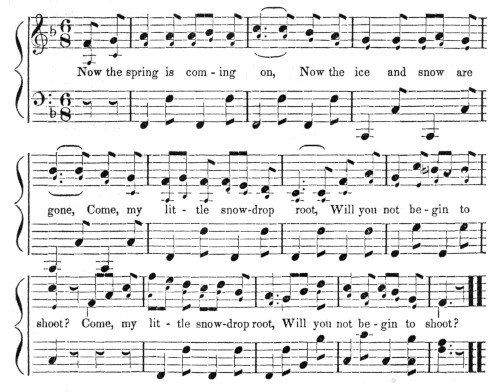
Now the spring is coming on, Now the ice and snow are gone, Come, my little snow-drop root, Will you not begin to shoot? Come, my little snow-drop root, Will you not begin to shoot? Ah! I see your little head Peeping on the flower bed, Looking all so green and gay On this fine and pleasant day. For the mild south wind doth blow, And hath melted all the snow; And the sun shines out so warm, You need not fear another storm. So your pretty flowers show, And your petals white undo; Then you’ll hang your modest head Down upon my flower bed.
MERRY’S MUSEUM.
Vol. VIII. SEPTEMBER, 1844. No. 3.
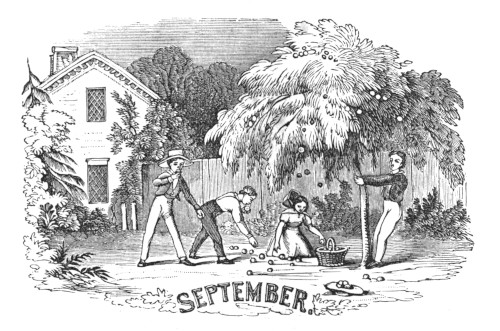
September has come, and it would seem by the picture, that peaches have come with it. This is indeed a fine season for our little friends who are fond of fruit, such as peaches, pears, and plums. Who is there, indeed, that does not like these nice things? But beware, boys and girls; do not indulge in them to excess. Even the best things in this world may be converted into evils by abuse. Even peaches, which are not only delicious but very wholesome, may still become the occasion of disease, if taken in undue quantities.
Thus you see that moderation is required of us in the midst of our enjoyments. But I do not intend now to preach a sermon. It is September, one of the pleasantest months of the year, and I have a few pleasant words to say about it. It is a season of delicious fruits; it is also a period when the excessive heat of summer is succeeded by the mild and gentle coolness of approaching autumn. The landscape has lost something of its brilliant verdure. The fields and forests are tinged with a sober brown. The leaves of the maple, the ash, and the oak are exchanging their green hue for brilliant dyes of red, purple, and yellow. Many of the birds are gathering in flocks, and, with much noisy chattering, are preparing to depart to southern climes, where they may spend the winter. The sparrow, the cat-bird, the thrush, and the towee-bunting have already withdrawn into the thickets. The robin has left the orchard, and retired to the forests, and the young crows, trying to caw like their fathers and mothers, are heard in the mountains.
Whoever will take a walk in the woods will see a great many of that splendid bird, which has so many names, glancing from tree to tree, and seeming to hold some very good-natured discourse with his companions. This is the high-hole, high pole, flecker, yellow jay, or golden-winged wood-pecker, whichever you choose to call him.
The gardener is now rooting up the weeds, and the farmer is getting in his second crop of hay, called rowen. The markets are now full of melons, and other fruits and vegetables, of many kinds,—potatoes, beets, carrots, cabbages, and tomatoes. Surely, September is a fine time.
All Hallow-e’en.
Among the inhabitants of Scotland, the last day of October is called All Hallow-e’en, or Holy evening. The people formerly had many superstitions and some pleasant customs respecting it. These still linger in the Highlands; and the following story, extracted from an English book, will give some account of the manner in which this evening is still commemorated there.
There are few Highlanders in whom the memory of Hallow-e’en does not awaken some pleasing recollections of the past, and with it are associated some of their happiest days. I propose to explain to my young friends some of the joyous festivities of this season.
Among many families in the Highlands, there were none I loved so well as the Graemes of Glennburton. Four merry girls and one quiet boy circled their hearth on the last day of October, the eventful Hallow-e’en. A crowd of young visitors was also there. The cheerful dance over, our dear and kind friend, Mr. Graeme, drank to many happy Hallow-e’ens, in which we noisy youngsters joined most heartily.
The nut basket now appeared. Nell Graeme, the second daughter, a tall girl of seventeen, singled out two nuts and said, “Who shall I burn?” At once, the whole group, who were quite prepared, cried, “Geraldine and Lord Elva.” The two nuts were placed in one bright spot in the fire; they burnt for a time most lovingly; but at last Geraldine bounded out of the fire. Oh! naughty girl—she had fairly quarrelled with him whom her young companions had declared to be her sweetheart.
Geraldine now sprang forward, and revenged herself by burning the blushing Nell with her coz. It was very amusing to watch the countenance of each damsel, as her name was given to the nut, and coupled with another. One girl blushed, a second laughed, a third cast down her eyes, and so on. Tired of this, they at length hurried to tea; and then came the real fun, as that noisy, pretty black-eyed girl, Jessie Graeme, declared.
Now, my young friends, follow me to Mrs. Graeme’s kitchen; yes, to the kitchen,—clean, bright, and pure enough for any one to enter; the floor well scoured and sprinkled with sand; the small copper saucepans and tin covers hung round the walls, shining and bright as burnished gold; the mutton-hams and other delicacies in such famous order hanging overhead. It was the abode of plenty and cleanliness; so I thought, as I entered it, and surveyed with delight the preparations for the “company,” as Mary the cook said.
A huge tub full of crystal water was in the middle of the floor, and a basket of immense rosy-cheeked apples. The company entered. Plump went three dozen apples into the tub, with a splashing that made the ladies retreat speedily. Mr. Graeme put numerous shillings and sixpences into the apples, and we all ducked to fish them out. Happy those who got an apple; thrice happy those who got money in their apples. Many untoward accidents occurred; Jane had fastened her long curls with a comb, and as she stooped and hunted down a rolling apple, Jessie Graeme, lover of mischief and fun, pulled out the comb; down went the ringlets, to assist poor Jane in her search after the apple.
Jessie laughed heartily, and in her turn danced up to the tub. No sooner had she bent over the water, than Hugh slily pushed her in, and the ill-fated Jessie fell plump into the water. Her brother helped her out, and though strongly tempted to cuff his cheeks for his impudence, she was obliged to march off and change her wet clothing. Tired at length of this diversion, “snap dragon” was called. “Hurrah for snap dragon!” cried Harriet Graeme.
A large flat dish, filled with whisky and raisins, cleared from their stalks, was laid upon the table; gloves and mittens were hastily torn off; pocket handkerchiefs, scarfs, and other combustible parts of the ladies’ dresses were put out of the way. There was a rush and a crowd round the dish; Hugh held the match to the spirits, and the blue flame flickered, and the “mountain dew” blazed gloriously. “Begin!” shouted Hugh.
Fifty hands were at once dipped into the snap dragon, and drawn back, carrying streams of the blue and liquid flame. Another plunge! fresh screams, and a river of fire on the table; the dish upset; Harriet’s dress on fire; Donald the gardener’s hair in a blaze. A hearth-rug nearly smothered Harriet, and a bucket of water cooled Donald completely. There was a universal burst of laughter; even Black Kitty, the cook maid, so called, from her jet black hair, was heard to giggle behind the scullery door; and Donald, now recovered from his singeing and ducking, roared himself into convulsions in the back passage. They now all began to count the raisins; whoever had the largest odd number was the lucky one. Merry Jessie was the lucky one.
The happy party now retired to the drawing-room, saying, that of all games, snap dragon was the most amusing. Up stairs, they found a blazing fire, and supper laid on the table. In the centre of it stood, most conspicuously, the Hallow-e’en cake, so delicately iced over and ornamented with a wreath and bunch of the last roses. This cake contained a ring, for marriage; a sixpence for wealth; and a thimble, for an old maid. The cake was cut up by Hugh. The youngest of the party took the first piece, and the gentle fairy, Minna Erskine, found the ring. Jessie Graeme darted forward, and seizing a bit of cake, crumbled it to atoms, and found the sixpence. Happy little pair, who, almost screaming with joy, fairly hugged each other with delight.
Dear mamma was declared a confirmed old maid by finding the thimble. The laughter of the young ones at this knew no bounds; but they were soon brought to order by Mr. Graeme, reminding them that it was within a quarter of an hour of midnight, and that “good nights” must be exchanged. The young ones quickly though reluctantly took the hint, and after affectionate kissings and greetings, from our papas and mammas, we all marched off, once more to talk of the events of the evening, and to anticipate and prepare for fresh sports and merriment.
Bonaparte’s Wit.—Soon after Napoleon had attained the rank of captain, a soldier one day approached him, and showed him his coat which was in rags, at the same time demanding another in a dissatisfied tone. “A new coat?” replied the young officer; “you do not call to mind that your honorable scars would no longer be visible.” This well-timed compliment entirely satisfied the poor soldier.
After Napoleon became emperor, during a parade, a young officer stepped out of the ranks, in extreme agitation, to complain that he had been ill-used, slighted, and passed over, and that he had been five years a lieutenant, without being able to obtain promotion. “Calm yourself,” said the emperor; “I was seven years a lieutenant, and yet you see that a man may push himself forward for all that.” Everybody laughed, and the young officer, suddenly cooled by these words, returned to his place.
The following description of the gardens at the Tusculan villa, Belvidere, in Italy, is given by a traveller. “Behind the palace,” says he, “an aquatic stream dashes precipitately down a succession of terraces, and is tormented below, into a variety of tricks. The whole court seems alive at the turning of the cock. Water attacks you on every side; it is squirted in your face from invisible holes; it darts up in a constellation of jets d’eau; it returns in misty showers, which present against the sun a beautiful iris. Water is made to blow the trumpet of a centaur and the pipe of a cyclops; water plays two organs; makes the birds warble and the muses tune their reeds; it sets Pegasus neighing, and all Parnassus on music. I mention this magnificent touch as a specimen of Italian hydraulics. Its sole object is to surprise strangers.”