Volume 8 — CONTENTS OF VOLUME VIII. (continued 4)
Reading edition
I now continued my journey, and at the end of eight days, I reached the place of my destination. I found the person whom I sought to be a fat, burly Englishman, named Hartley, possessing about a hundred negroes, all of whom were engaged in the cultivation of coffee. When I told him my errand, he looked at me with surprise, and seemed at first to be in doubt whether he should answer my inquiries. At last, having satisfied himself that I had no sinister object in view, he told me the story which shall be related in the next chapter.
CHAPTER IX.
“Your uncle,” said Mr. Hartley, “was directed to Surinam rather by chance than choice. He fled from St. Domingo during the troubles there. The vessel in which he came was the only one which offered him an immediate chance of escape, and as his life was in danger, he went on board of her. When he reached Paramaribo, he had considerable property, and thinking that the place offered him fair prospects, he invested his money in ships, and established himself as a merchant. He was very enterprising, and for a time, successful. His manners were pleasing, and he won the good will of every body around him. He paid his addresses to the daughter of a rich planter, and soon married her.
“He thus became allied to one of the first families in Surinam. This circumstance, added to others of a favorable character, soon gave him an eligible standing in society. But suddenly a blight came over his prospects, and his descent was even more rapid than his elevation.
“After he had been at Paramaribo about three years, he deemed it necessary to go to Amsterdam. Having adjusted his business there, he took passage in one of his own ships, to return. She was said to be richly laden, and, according to his statement, had merchandize on board to the amount of more than two hundred thousand dollars. Previous to her departure, he sent to Surinam, and had insurance effected there to the amount of two hundred and fifty thousand dollars upon the ship and cargo. He returned to Paramaribo, stating that his vessel was wrecked upon one of the West India Islands in a gale, and that the ship and cargo were entirely lost; he, with the captain and two hands only, being saved by swimming to the shore.
“Under these circumstances, he claimed the insurance; but this was refused by the company. Your uncle brought an action against them; but an affidavit was produced in court, signed by the captain and the two hands, declaring that the ship was run on shore by your uncle’s orders; his purpose being to destroy the vessel and then claim the insurance, which was said to be twice the amount of the real cost. The astonishment that prevailed through the city of Paramaribo at these disclosures cannot be described. Your uncle breasted the shock with great courage, declared his innocence, and asked only for time and opportunity to clear up the whole transaction; but the judgment of the court was against him, and public opinion went with it. His popularity vanished at once; his friends deserted him, and his creditors coming upon him, he was unable to pay them, and was consequently thrown into prison.
“Here he remained for two years, during which period his wife died, leaving a daughter, who has since remained with her grandfather, M. Scager, and is now grown up to be a beautiful black-eyed girl.”
At this point of Mr. Hartley’s story, my mind turned back to the place where I spent the first night after my departure from Paramaribo, and it seemed to me probable that the girl whom I had seen there was my cousin. I therefore interrupted the narrative, and said, “Allow me to inquire, sir, where the girl you speak of now lives.” “With her grandfather,” was the reply, “about ten miles from Paramaribo.” “Then I have seen her,” said I. “Indeed,” said the Englishman, “and how did that happen?”
I then related my adventures at the plantation, giving a brief account of my fright at the bat, the hospitality with which I was treated, and the interest that had been excited in the black-eyed girl on learning my name. When I had done, Mr. Hartley proceeded as follows:
It is a strange accident that should have brought you into an acquaintance with your cousin Mirabel. However, to proceed with your uncle’s story. As he continued in prison, no opportunity was afforded for him even to make an attempt to clear up his character. His name, therefore, passed into contempt and infamy. M. Scager, who was a proud and haughty man, was sorely mortified at the disgrace which had fallen upon his family, through the connection, and would permit no one even to speak of his son-in-law.
“Time passed on, and the subject was nearly forgotten. Your uncle seemed as completely lost to the world as if he had been dead and buried; but at length a considerable excitement was produced by the rumor that he had escaped from prison. On inquiry, it was found that he was gone, but no one could tell how he had effected his liberation, nor whither he had fled. This occurred about a dozen years ago. It excited no little curiosity at the time, and various rumors were afloat respecting it.
“There were a few persons who had always entertained the belief that your uncle was the victim of a foul conspiracy between the insurance company and the captain of the ship; that the loss of the vessel was unavoidable; and that, in order to save the immense sum for which insurance had been effected, the captain had been bribed to make oath to a false statement. But these rumors gradually subsided, and for the space of nearly a dozen years, your uncle’s name was hardly mentioned.
“But about a twelve-month ago there was occasion for new surprise. I had known your uncle intimately, for during his residence in Paramaribo, I also lived there. I had the greatest confidence in him, and loved him as if he had been my brother. I never fully credited the charges that were brought against him, and therefore made some efforts in his behalf during his imprisonment, but it became necessary for me to establish myself here, and I was able to render him no effectual assistance. I had no communication from him after I left Paramaribo, and had no better means of judging whither he had gone than any other individual. His escape, however, seemed to be an argument against him, and as nothing was heard from him, my mind gradually yielded to the conviction that he had been guilty of the crime with which he was charged.
“But about a year ago, I was astonished as well as delighted to receive from Amsterdam a remittance amounting to sixty thousand dollars, with directions to pay your uncle’s creditors the full amount due to them, both principal and interest. No explanations whatever were given; no clue was afforded as to the source from which the money came. I proceeded to distribute it according to the directions, and paid every one of the persons to whom your uncle was indebted, and had still a balance of about two thousand dollars in my hands. I have written to the persons at Amsterdam, through whom the money came to me, making inquiries as to your uncle, and asking instructions respecting the surplus that remains, and have had only the naked reply, that no knowledge whatever of your uncle is in possession of the parties, and that they have no directions but those given me in the first letter.
“I have not been able to obtain any precise information respecting your uncle. Upon the payment of his debts, an entire revolution of public opinion took place at Paramaribo, in regard to him. The belief became general that he was what he seemed to be, a high-minded and honorable man, and that he had suffered from a base conspiracy. The uneasiness displayed by a certain lawyer who had been connected with the insurance company, served to confirm these opinions.
“There was also another circumstance which contributed to the same result, and this was, that the captain had never returned to Paramaribo, although he had a wife and family there; and it was reported that he had turned out a desperate character, and had been engaged in several piratical expeditions.”
It may be well believed that I listened to this recital with the most intense interest. Scarcely was it finished, when my determination was formed to set about a search for my uncle. I soon communicated these views to Mr. Hartley. At first he objected, urging my youth, the utter want of a clue by which he could be traced, and my destitution of means for sustaining the expense of the undertaking, as conclusive arguments against it.
He considered the project indeed to be the hair-brained dream of a sanguine boy; but as I persisted in my resolution, and suggested my plan of operation, he began to listen, and in the end, gave me his hearty support and efficient aid. He supplied me with letters to several persons in Paramaribo, who might aid me in my researches, furnished me with money for my immediate expenses, and gave me a letter of credit for what I might farther need. Being thus provided, I soon set out for Paramaribo, with high hopes of success in my proposed search.
(To be continued.)
The cow will eat 276 plants, and reject 218; the goat eats 449, and rejects 126; the sheep, 387 and 341; the horse, 262 and 212; the hog, 72 and 171.
Joan of Arc.
(Continued from page 95.)
The English, driven by these successes from their entrenchments, lost, with their spirit of confidence, more than six thousand men. Joan was once more received by the city as a delivering angel; skepticism itself yielded to these prodigies; the French, as if inspired by a celestial energy, passed from despair to a sanguine enthusiasm, before which obstacles melted away as mists in the sun’s ray.
The English generals, surprised and dismayed, sought to combat fanaticism with its own weapons, by attributing their discomfiture to the ascendancy of malignant demons, of whom they gravely declared the maid to be the implement. To discover and weigh the operation of motives on the human mind, was an effort too arduous for an unenlightened age. The doctrine of demons did little towards raising the drooping spirits of the besiegers, who sagely concluded a contest with superior powers, whether of light or darkness, to be unequal and hopeless. Unable to maintain his ground with a panic-struck army, Suffolk prudently raised the siege, May 8th, 1429, and retreated.
The French, determined to pursue their advantage, allowed the enemy no time to rally; a body of six thousand men were deputed by the Dauphin to attack the English at Jergean, where a detachment had retired with Suffolk. The place was obstinately defended during a siege of ten days. Joan, in leading the attack, descended rapidly into the fosse, where she received a blow on the head from a stone, which stunned her and threw her down; but quickly recovering herself, the assault was carried, and Suffolk was compelled to yield himself a prisoner. The remains of the English army, solicitous only to effect a retreat, sought for a place of safety; while the vanguard of the French, attacking their rear, at the village of Patay, they were wholly routed; two thousand men fell in the action, and two of their generals were taken prisoners. The conduct of the troops, the military operations, and even the decisions of the council, were poetically attributed to Joan, to whose sagacity and promptitude, in availing herself of the suggestions of more experienced commanders, no mean praise is due.
Having performed a part of her mission in raising the siege of Orleans, the crowning of Charles at Rheims only remained to be effected, on which enterprise she now insisted. Rheims, situated in a distant part of the kingdom, was still in the hands of the enemy, whose garrisons occupied the road which led to it; the idea of passing them would, a few weeks before, have been deemed rash and impracticable; but the spirit which now animated the French made them invincible.
To avail himself of the enthusiasm of his troops, and the consternation of the English, for which the belief of a supernatural agency afforded but a delicate and critical support, was undoubtedly the interest of Charles; persuaded by his friends that the safety of the state depended on his person, he had hitherto restrained his military ardor; he now placed himself at the head of his troops, and under the auspices of Heaven and fortune, inspired new zeal into his adherents. At the head of twelve thousand men he began his career. Troye opened to him its gates; Chalons followed the example, while, before his approach, Rheims sent him a deputation with its keys; every obstacle thus overcome, the ceremony of the coronation was performed, July 17th, with the holy oil, brought from heaven by a pigeon to Clovis, on the first establishment of the French monarchy.
The maid, clothed in armor, and displaying her sacred and victorious banner, took her place, on this occasion, by the side of the king; while the people hailed this combination of miracles with shouts and acclamations, Joan, after the ceremony was completed, throwing herself at the feet of the monarch, embraced his knees, and, shedding tears of tenderness and joy, congratulated him and herself on the success of her mission.
The mystical inauguration of Charles shed over him a kind of glory, and gave him in the eyes of the nation new and divine rights; triumph and success, the best proofs of inspiration, by flattering the inclination of the people, gave support and stability to their faith; no one presumed to doubt that, in all that had passed, the finger of Heaven was evident and clear.
Lyons, Soissons, Chateau-Thierre, Provins, with various other towns and fortresses, submitted to the summons of the king and that of the prophetic maid; while the whole country disposed itself to testify its loyalty and zeal. A medal was struck in honor of the heroine, bearing on one side her portrait; on the other, a hand grasping a sword, with this motto, “Consilio confirmata Dei,”—“Sustained by the hand of God.”
The Duke of Bedford, firm, vigilant, and resolute, still preserved his footing in France, where he employed every resource which circumstances had yet left to him; his garrisons were held in postures of defence, and a watchful eye kept over the French; while the Parisians were, by alternate severity and caresses, yet retained in the English interest. An alliance with the Duke of Burgundy, the most important to their sinking credit, was, at the same time renewed and strengthened. The supplies of money from the British parliament were tardy and scanty; while the impression produced on the minds of the troops of the wonderful power and resources of the maid, occasioned daily desertions in the army.
In this perilous state of their affairs, their spirits were revived by the arrival of Cardinal Winchester, who landed at Calais, with a body of five thousand men, which had been levied originally for a crusade. The Cardinal suffered himself to be prevailed upon by the Duke of Bedford to lend hire these troops, for the purpose of opposing the French king, who with his forces was advancing towards Paris.
Charles, having left Rheims, and taken St. Denis and Lagni, proceeded to the capital, to which he laid siege. The barriers of the port of St. Honoré were forced, when Joan, flushed with military ardor, and animated by success, in attempting to pass the fosse, received a wound in her thigh. Pressing forward, regardless of the blood which streamed through her armor, she was at length perceived by the Duke of Alençon, who observing her situation, carried her forcibly back to the camp. The king was, however, compelled, by want of provisions, to raise the siege, and to retreat from before Paris with his troops.
The mission of the maid having been thus accomplished, she expressed a wish to be allowed to retire; but this request was overruled. Charles, still solicitous to retain her in his service, conferred, as a testimony of his gratitude, nobility upon her family and their posterity, both in the male and female line. Armorial bearings were accordingly assigned to her, and her name was changed from Arc to Lys. Domremi, the city which gave her birth, received at the same time a perpetual exemption from subsidies and taxes.
The Duke of Bedford, prudently declining a present engagement with a victorious foe, chose his posts with wisdom and caution, attended the French in all their movements, covered the towns and garrisons which remained in his possession, and attentively watched the steps of the enemy. The French army, consisting mostly of volunteers, were soon after disbanded. The king, having made himself master of various towns in the neighborhood of Paris, retired to Bourges, the place of his ordinary residence.
The Duke of Bedford, with the hope of reviving the courage of the troops, proposed that the young king of England should pass over to France, be crowned at Paris, and receive from his vassals a new oath of allegiance. This ceremony, however, politically planned, afforded but a spiritless spectacle, when compared with the coronation at Rheims. But an event soon after took place, which gave a different aspect to affairs, while it reflected upon both nations lasting dishonor.
The English, supported by the Duke of Burgundy, laid siege to the town of Compéigne, into which Joan threw herself. The garrison, who, with her assistance, believed themselves invincible, received her with transports of joy. On the day following her arrival, May 24th, 1430, she headed a sally made on the quarters of John de Luxemberg. Having thrice driven the enemy from their intrenchments, and finding their numbers increasing every moment, she prudently ordered a retreat. But the pursuers pressing hard upon her, she turned upon them and forced them to recoil. The besieged, protected in the rear by Joan, had in the mean time gained the city in safety, the gates of which were instantly closed. Joan, thus deserted and alone, perceiving herself excluded, surrounded by the enemy, suspecting treachery, and rendered desperate, exerted herself with a courage, deserving a better fate. Her horse at length falling under her, she was compelled, after performing prodigies of valor, to surrender to the enemy. The Burgundians, into whose hands she had fallen, carried their prisoner to Luxemburg, where, for ten thousand livres, they basely sold her to the English. It is believed that the French officers, jealous of the glory of the maid, had designedly exposed her to this fatal catastrophe. Such is human gratitude and the fate of merit, and such the recompense awarded to the benefactors of their species.
The savage triumph of her enemies on her capture, was the unequivocal eulogium of the heroine. Te Deum, a service so often profaned, was celebrated at Paris on the event. The courage of the English, blasted by the successes of Joan, began, on her imprisonment, to revive. The Duke of Bedford, instigated by a policy alike barbarous and disgraceful, commenced a prosecution against his magnanimous captive, who, by the circumstances of her defeat, the gallantry of her conduct, and her irreproachable life, was justly entitled to the privileges of a prisoner of war. Her youth, her sex, whose appropriate decorum she had strictly observed, her extraordinary qualities, added to the services she had performed for her country, gave her novel and singular claims, to which fanaticism alone could have remained insensible. Under the sanction of religion, justice was outraged and humanity violated.
A petition against the maid was presented by the Bishop of Beauvais, who was devoted to the cause of the English, under the pretence that she was taken within the bounds of his diocese, he requested that she might be delivered over to the ecclesiastical court, to be tried for sorcery, impiety, and magic. The University of Paris covered itself with infamy, by joining in this petition. The title of Inquisitor of the Faith was assumed on the occasion by the Bishop of Beauvais.
The court was held at Rouen, where the young king of England then resided, and where Joan, loaded with irons, and clothed in her military apparel, was produced before this prejudiced tribunal. She had previously endeavored to procure her liberty by leaping from the top of the tower in which she was confined; but, stunned by the fall, had been discovered by the sentinel, and retaken. An accusation of intending suicide, was, on this justifiable attempt, added to the offences with which the prisoner was charged. Having requested of her judges to be eased from her chains, she was reproached with her design of escaping. She boldly avowed and justified the fact, declaring at the same time, that if she hesitated to repeat her attempt, it was only from despair of success. Throughout her trial, she discovered equal firmness and courage. Being interrogated respecting the affairs of the court of France, she refused to reply to the questions made to her, alleging that where the secrets of the king were concerned, she owed no obedience to the ecclesiastical powers.
Nearly four months she was continually harassed by questions and persecutions the most ridiculous and absurd. Her enemies termed her a “sorceress and a heretic.” The assembled university, having pronounced her a schismatic, proceeded to threaten her with the stake. She was repeatedly examined respecting her visions, revelations, and intercourse with departed saints, and required to submit to the church the truth of her inspirations. “To God,” she replied, “the fountain of truth, I am willing to submit them.” By this answer, she drew upon herself the charge of denying the authority of the church. She appealed from her judges to the Pope, but her appeal was fruitless.
It was demanded whether she had not put her trust in a standard consecrated by magical incantations? Whether, at the coronation of Charles, she had not still displayed this mysterious standard? “Her trust,” she replied, “was in the image of the Almighty impressed on the banner, and that she, who had shared the danger of the field, was entitled to partake of the glory at Rheims.” Accused of violating the decorums of her sex, by assuming the habits and command over men, she boldly avowed and justified the purpose of this violation—“the defeat of the enemies of her country, and their expulsion from the kingdom.” During these examinations, she betrayed no weakness, nor gave to her persecutors any advantage; she disgraced not, when in the power of her determined adversaries, the heroism she had displayed in the field.
Every species of imposition and baseness was practised upon her; she was required to abjure the masculine habit, and a paper for this purpose was tendered her to sign, to which a promise was subjoined never more to bear arms. Having complied with this proposition, a new deed was substituted in its place, in which she was made to criminate herself by the most odious and false imputations. The malice of her enemies, aggravated by superstition, led them to accuse her of various crimes, particularly of a compact made with infernal spirits. After having received judgment, she was delivered over for sentence to the secular arm.
Harassed by injustice, exhausted by suffering, and subdued by cruelty, the spirit of Joan at length gave way; browbeaten by men of superior rank, condemned by those whose injunctions she had been accustomed to regard as sacred, basely deserted by the monarch she had served, sustained no longer by applause and success, her enthusiasm began to subside; the dreams of inspiration were superseded by the feelings of nature, while before the terrors of impending death, the visions of a distempered fancy faded away. Recanting, she acknowledged that she had been misled by illusions; which she solemnly engaged henceforward to renounce, and prayed to be reconciled to the bosom of the church. In consequence of this humiliation, her sentence was mitigated to perpetual imprisonment.
No steps were taken by Charles to rescue from destruction the deliverer of himself and the saviour of his dominions; nor, while he held in his hands, as prisoners of war, English of the first distinction, were any proposals offered to exchange them for the heroic Joan:—a memorable example of the gratitude of princes.
Political vengeance might here have ceased; but the malignity of the adversaries of the unfortunate Joan, was not yet fully glutted—barbarous and insatiable, they thirsted for her blood! Having consented to abjure the masculine habit, and to assume the habits and attire of her sex, it was determined to tempt her to a violation of her engagement. For that purpose a suit of men’s apparel was placed in her room, and spies were appointed to observe her conduct. Whether the sight of a dress associated with so many flattering, so many glorious ideas, induced her to re-assume it, or whether, as has been alleged, her own clothes were removed while she slept, and were designedly withheld from her, is of little moment; certain it is, that she was tempted in the solitude of her prison, to array herself in the forbidden garb. Seized by her treacherous enemies in this situation, and declared guilty of a relapse into heresy, she was excommunicated, and all pardon, and all mercy refused to her. Crowned with a paper, on which was inscribed the terms “apostate, heretic, and idolatress,” and guarded by armed soldiers, she was soon after delivered over to the stake, which had been erected for the purpose in the market-place of Rouen.
On the right hand of the scaffold, on which she was exposed to the savage fury of the people, were stationed the clergy, and on the left, the secular officers. In this situation, she was with solemn mockery, interrogated on the principles of her faith; principles, which in no respect appeared to differ from those of her merciless persecutors. A discourse was pronounced by Nicholas Midi, towards the conclusion of the ceremony, in which the poor culprit was informed that “the meek and merciful ministers of the Gospel had, for the execution of their sentence, consigned her over to the secular powers.”
The bailli of Rouen, less firm than the preacher, could only say, “Let it be.” The tears of Joan even softened the executioner, while the theologians, incapable of the weakness of humanity, remained firm and unmoved. “Dieu soit bene!”—“Blessed be God!” exclaimed the sufferer, as she placed herself upon the pile. Her body was quickly consumed, and her ashes were scattered to the winds. Thus perished this admirable woman, June 14, 1431, to whom “the more liberal and generous superstition of the ancients would have erected altars.” Thus were the services rendered by Joan to her ungrateful prince and country ultimately rewarded.
The following character of the maid of Orleans, from Fuller, is to be found in the preface to Mr. Southey’s Joan of Arc. “People found out a nest of miracles in her education, that so lion-like a spirit should be bred among sheep like David. Even after she went in man’s clothing, being armed cap-a-pie, and mounted on a brave steed; and which was a wonder, when she was on horseback, none was more bold and daring; when alighted, none more tame and meek; so that one could scarce see her for herself, she was so changed and altered, as if her spirits dismounted with her body.”
Some years after her decease, Joan was, by a bull of Pope Calixtus III., declared a martyr to her religion, her country, and her king. She is made by Chapelain the subject of a French epic poem, entitled La Pucelle.
A Blacksmith’s Shop in the West.—Some years ago a man was travelling in the western country, when one of his horse’s shoes being loose, he inquired of a person he met in the woods, if there was a blacksmith in those parts. “Yes, stranger,” was the reply. “Will you direct me to his shop?” said the traveller. “You are in it now!” said the other. “In it now!” said the stranger; “but my friend—without joking—where shall I find the blacksmith?” “Four miles off,” was the reply. “I do not understand you,” said the horseman. “Well, stranger,” said the woodsman, “I will tell you all about it. The blacksmith’s shop is all out of doors, but his anvil is at the cross road, four miles ahead.”
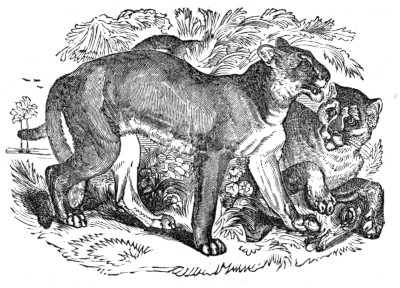
The American Panther.
This animal has as many names as any other felon that ever figured in history. He is called the “American Lion,” the “American Panther,” the “Puma,” the “Cougar,” the “Catamount,” and the “Painter.” The real fact is, that he is a creature peculiar to this continent, and is neither a lion, nor a panther, nor anything indeed, but himself—an independent member of the great family of cats, roaming over the woods of both North and South America, and always doing business on his own hook. He is a creature of great strength, being able to carry off a sheep or deer at a gallop; but he prefers rather to live by his wit than his power. He always creeps upon his victim with a sly and noiseless step, and when at a proper distance, rushes upon it with a bound, and grapples it with his formidable claws and teeth.
The panther was once common in New England, but he does not like meeting-houses and taverns, so he has emigrated westward. The traveller in the western wilds will often hear a noise that seems like the wailing of a child; but after a little examination, he will find it to proceed from a reddish gray animal in the top of a tree, looking down at him with anxious eyes, and seeming to say, “If it’s all the same to you, I should like to make a supper of you or your horse.”
A great many adventures have taken place with this creature in the woods. Here are some of the stories told of it.
“Two hunters, accompanied by two dogs, went out in quest of game near the Catskill mountains. At the foot of a large hill, they agreed to go round it in opposite directions, and when either discharged his rifle, the other was to hasten towards him to aid in securing the game. Soon after parting, the report of a rifle was heard by one of them, who, hastening towards the spot, after some search, found nothing but the dog, dreadfully lacerated and dead. He now became much alarmed for the fate of his companion, and while anxiously looking around, was horror-struck by the harsh growl of a Cougar, which he perceived on a large limb of a tree, crouching upon the body of his friend, and apparently meditating an attack on himself. Instantly he levelled his rifle at the beast, and was so fortunate as to wound it mortally, when it fell to the ground along with the body of his slaughtered companion. His dog then rushed upon the wounded Cougar, which with one blow of its paw laid the poor animal dead by its side. The surviving hunter now left the spot, and quickly returned with several other persons, when they found the lifeless Cougar extended near the dead bodies of the hunter and the faithful dogs.”
“About the close of the last war, a merchant of Piqua, named Herse, received a considerable sum of money in small bills, which made it appear of still greater magnitude to several suspicious looking persons who were present when it was received. Mr. Herse, being unarmed, was apprehensive that an attempt would be made to rob him at the camping ground, and expressed his apprehensions to a single fellow-traveller, who was also unprovided with arms. In consequence, they resolved not to go to the camping ground, but to pass the night in the woods without fire; there, turning their horses loose, they lay down in their blankets on the leaves. In the night they were aroused by hearing the horses snort as they are apt to do on the approach of Indians, and shortly after they were heard to make several bounds through the woods, as if some one had unsuccessfully attempted to catch them.
“After some time had elapsed, they both distinctly heard what they supposed to be a man crawling towards them on his hands and feet, as they could hear first one hand cautiously extended and pressed very gently on the leaves to avoid making a noise, then the other, and finally the other limbs in like manner and with equal care. When they believed that this felonious visitor was within about ten feet of them, they touched each other, sprang up simultaneously, and rushed to some distance through the woods, where they crouched and remained without further disturbance. A short time after they heard the horses snorting and bounding furiously through the woods, but they did not venture to arise until broad daylight, being still ignorant of the character of their enemy.
“When sufficiently light to see, by climbing a sapling they discovered the horses at a considerable distance on the prairie. On approaching them, it was at once evident that their disturber had been nothing less than a Cougar. It had sprung upon the horses, and so lacerated with its claws and teeth their flanks and buttocks, that with the greatest difficulty were they able to drive the poor creatures before them to Shane’s. Several other instances of annoyance to travellers had happened at the same place, and Shane believed by the same Cougar.”
Notwithstanding the ferocious disposition and bad reputation of the panther in his wild and natural state, he can be taught better manners, and it is by no means uncommon to see them around the houses in South America, quite gentle and well-behaved—a fact which strikingly displays the power of education. I have known boys almost as wild as panthers, rendered tame and dutiful by a little birch and a great deal of kindness. Recommending this moral to schoolmasters, parents, and guardians, we bid good-bye to the panther, only adding that the history of great rascals may sometimes teach us a good lesson.
Lovewell’s War.
(Continued from page 76.)
Troops were raised and enlisted for two years’ service, and the government had no scruples in offering a bounty of forty pounds sterling for every Indian scalp. This war obtained the name of “Lovewell’s War,” from Captain John Lovewell, of Dunstable, in New Hampshire, who was the most prominent commander in the enterprise against the enemy, and was killed in a severe engagement. Various incursions were made upon the settlements by the Indians during the year 1723, and several of the inhabitants were killed and carried into captivity. On the 10th of June, 1724, a farmer and his son, being at work on Oyster River, planting corn, went to a brook to drink, and discovered three Indian packs. They immediately ran to give information to a company of volunteers, which had lately been raised in the neighborhood, for the defence of the frontier. The company marched towards the spot, but were fired upon from an ambush, and the farmer and his son, who acted as guides, were both killed. The company then fired and killed one of the Indians, and wounded two others who made their escape, though they were pursued and tracked by their blood to a considerable distance. The slain Indian was a person of distinction, and wore a species of coronet, made of fur, dyed scarlet, with an appendage of four small bells, by the sound of which the others might follow him through the thickets. His hair, contrary to what is almost universal among the natives, was remarkably soft and fine; and he had about him a devotional book, and a muster-roll of one hundred and eighty Indians. From these various circumstances, it was supposed that he was a natural son of the Jesuit, Rasle, by an Indian woman, who served him as a domestic.
Garrison-houses were built among the frontier settlements, to which the inhabitants were warned to repair in time of danger. At Dover there were many families of Quakers, who, doubting the lawfulness of war, could not be persuaded to use any means for their defence, although the Indians never spared them on that account. One of these, John Hanson, lived remote from the garrison, and refused to take shelter in it with his family, although he had a large number of children. A party of thirteen Indians, called French Mohawks, had marked his house for their prey, and lay several days in ambush, waiting for an opportunity to attack it. On the 27th of June, while Hanson and his eldest daughter were gone to attend the weekly meeting, and his two eldest sons were at work in a meadow at some distance, the Indians entered the house, killed and scalped two small children, and took his wife, with her infant of fourteen days old, her nurse, two daughters, and a son, and, after rifling the house, carried them off. This was done so suddenly and secretly, that the first person who discovered it was the eldest daughter, on her return from the meeting. Seeing the two children dead at the door, she uttered a shriek of distress, which was distinctly heard by her mother, then in the hands of the enemy among the bushes, and by her brothers in the meadow. The people, being soon alarmed, went in pursuit of the enemy; but the Indians, cautiously avoiding all beaten paths, went off with their captives undiscovered. The mother, though of a tender constitution, had a firm and vigorous mind, and passed through the various hardships of an Indian captivity with much resolution and patience. When her milk failed, she supported her infant with water warmed in her mouth, till the squaws taught her to beat the kernel of walnuts and boil it with bruised corn, which proved a nourishing food for the babe. The prisoners were all sold to the French in Canada. Hanson redeemed them the following year, one daughter remaining behind.
These and other outrages of the enemy caused the government of Massachusetts to resolve on an expedition against the Indian town of Norridgewock. Two hundred men, under Captains Moulton and Harmon, marched from York in August. They left forty of their men at Teconic Falls, on the Kennebec, and, dividing the remainder into two bodies, one of them, under Harmon, took a circuitous route, hoping to surprise some of the enemy in their cornfields, while the other, under Moulton, marched directly for the village of Norridgewock, which, being surrounded by trees, could not be seen till they were close upon it. All the Indians were in their wigwams, and the English advanced cautiously and in perfect silence. When they had approached very near, an Indian came out of his wigwam, and, discovering the English, set up the war-whoop, ran in, and seized his gun. In a few minutes the warriors were all in arms, and advanced to meet them. Moulton gave orders not to fire till the Indians had made their first discharge. This was done, and, as he expected, they overshot the English, who then immediately fired with great execution. After another volley had been exchanged, the savages fled with precipitation to the river. They were pursued and slaughtered in every quarter, and their wigwams set on fire. Moulton wished to take Rasle alive, and gave strict orders that no one should kill him. But the Jesuit having shut himself up in his house, from which he continued to fire upon the English, one of them burst into it, and shot him through the head. They then set fire to the church, which was a handsome structure, and brought away the plate and furniture of the altar, with the devotional banner, as trophies of their victory. Eighty of the Indians were killed in this attack, and three English captives rescued.
The fate of Norridgewock struck great terror into the savages, and they no longer thought themselves safe at any of their former places of abode, but occupied them as resting-places only, when they were scouting or hunting. This successful undertaking, and the large premium offered for scalps, brought several volunteer companies into the field. In December, Captain Lovewell, with thirty men, made an excursion to the north of Lake Winnipiseogee. They discovered an Indian wigwam, in which were a man and a boy. They killed and scalped the man, and brought the boy alive to Boston, where they received the reward promised by the government, and a considerable gratuity besides. This company was soon increased to seventy, and Lovewell marched again, early in 1725, toward the head of Salmon-Fall River. Their provision falling short, thirty of them, selected by lot, were dismissed, and returned home. The remaining forty continued their march till the 20th of February, when they discovered a track, which they followed till they saw a smoke, just before sunset; from this they judged that the enemy were encamped for the night. They kept themselves concealed till after midnight, when they cautiously advanced, and discovered ten Indians asleep round a fire, by the side of a frozen pond. Lovewell now determined to make sure work, and, stationing his men conveniently, ordered five of them to fire in rapid succession, and the remainder to reserve their shot. He gave the signal by discharging his own gun, which killed two Indians; and the men, firing according to order, despatched five more on the spot. The remaining three started up from their sleep, but two of them were immediately shot dead by the reserve, and the other was wounded. He attempted to escape across the pond, but was seized by a dog, who held him fast until the English came up and dispatched him. Thus, in the space of a few minutes, the whole party was destroyed, and an attempt against the frontiers of New Hampshire prevented;—for these Indians were marching from Canada, well furnished with new guns and plenty of ammunition for that object; they had also a number of spare blankets, moccasons, and snow-shoes, for the use of the prisoners whom they expected to take. The pond near which these events transpired is now known as Lovewell’s Pond. The company, with their ten scalps stretched on hoops, in the Indian fashion, marched to Boston in great triumph, and received their bounty out of the public treasury. The English spoke of this enterprise with great exultation, and pronounced it a capital exploit. In the light of the present day, the barbarity of giving a premium for scalps would be justly censured.
This brilliant success, as it was then termed, encouraged Lovewell to his last and fatal undertaking. Early in March, he again took the field, intending to attack the Indian villages of Piguacket, on the upper part of the Saco, where a formidable tribe anciently had a settled habitation, though at this period they only paid occasional visits there. His company consisted of forty-six men, including a chaplain and a surgeon. Two of them became lame, and returned. Another falling sick, they halted, and built a stockade fort on the west side of Great Ossipee Lake, partly for the accommodation of the sick man, and partly for a stronghold in case of any reverse. Here the surgeon was left with the invalid and eight of the company for a guard. Lovewell, with his thirty-four men, advanced to the northward about twenty-two miles, and encamped on the shore of a pond in the evening of the 7th of May. Early the next morning, while the men were at prayer, they heard the report of a gun, and discovered an Indian about a mile distant, standing on a point of land jutting out into the water. They had been alarmed during the night by noises round their camp, which they imagined were made by Indians, and now suspected that the one whom they saw was placed there to decoy them, and that a body of the enemy was in their front. A council of war was held, and they decided to go forward, and, by marching round the pond, to gain the spot where the Indian stood. That they might be ready for action, they disencumbered themselves of their packs, and left them, without any guard, in a pine plain, where the trees were too thinly set to hide them.
Lovewell, on his march, had crossed a carrying-place, by which two parties of Indians, consisting of forty-one warriors, commanded by the noted chiefs Paugus and Wahwa, who had been on a scout down the Saco, were returning to the lower village of Piguacket, about a mile and a half from the pond. Having fallen on Lovewell’s track, they followed it, and came at last to the baggage, which they carried off. On counting the packs, they found the number of the English to be less than that of their own force. They therefore placed themselves in ambush to attack them on their return. The Indian who had stood on the point, and was turning to the village by another path, met the English and received their fire, which he returned, and wounded Lovewell and another person with small shot. By a second fire the Indian was killed, and they took his scalp. Seeing no other enemy, the company returned toward their packs, and, while they were searching for them, the Indians sprang from their ambush and ran towards them with a horrid yell. A smart firing commenced on both sides, and Lovewell was speedily slain, with eight others. Several of the Indians fell, but, being superior in numbers, they were by no means daunted, and endeavored to surround the English, who, perceiving their design, retreated, hoping to gain a shelter behind a point of rocks and some large pine-trees on the shore of the pond. Here they took their station, having on their right the mouth of a brook, and on their left the rocky point,—their front being partly covered by a deep bog, with the pond in the rear.
The battle now recommenced. The Indians poured in their fire from front and flank, and had so much the advantage of position, that, by a little skill, they might have shot down every man of the English, or compelled them to surrender at discretion, as they were totally unable to extricate themselves, and were entirely destitute of provisions. Under the conduct of Lieutenant Wyman, the latter kept up their fire, and maintained a resolute countenance the remainder of the day,—the action having begun a little after ten in the morning. The chaplain and three others were mortally wounded. The Indians invited them to surrender by holding up ropes to them, and endeavored to intimidate them by hideous yells; but they determined to die rather than to yield, and, by their well-directed fire, the number of the savages was reduced, and their cries became fainter, till, just before night, they quitted their advantageous ground, carrying off their killed and wounded, and leaving the dead bodies of Lovewell and his men unscalped. The shattered remnants of this brave company, on coming together, found three of their number unable to move from the spot, eleven wounded, but able to march, and nine unhurt. It was melancholy to leave their dying companions behind, but there was no possibility of removing them. One of these, Ensign Robbins, desired them to lay his gun beside him loaded, that, if the Indians should return before his death, he might be able to kill one more.
After the rising of the moon, those who were able quitted the fatal spot, and directed their march toward the fort where the surgeon and guard had been left. To their great surprise, they found it abandoned. In the beginning of the action, one man had deserted and fled to the fort, where, in the style of Job’s messengers, he informed them of Lovewell’s death and the defeat of the whole company, upon which they made the best of their way home, leaving a quantity of provisions, which proved a seasonable relief to the retreating survivors. From this place they endeavored to get home. Lieutenant Farwell, and the chaplain, who had the journal of the march in his pocket, and one other, perished in the woods, for want of a dressing for their wounds. The others, after enduring the most severe hardships, reached the settlements, one after another. There were no white residents within fifty miles of the scene of the battle.
A party from the New Hampshire frontier was ordered out to bury the dead. Fourteen bodies were found, which were interred, and their names carved on the trees. Three Indian graves were discovered and opened; one of them contained the body of the warrior-chief, Paugus. Tracks of blood were traced to a great distance from the scene of action, but the exact loss of the enemy never was known. After this battle, the Indians abandoned the neighborhood of Piguacket, and did not return till the war was over.
A doggerel ballad, on the subject of “Lovewell’s Fight,” made its appearance the same year that these events happened, and was for a long time very popular in New England. As the reader may wish to see a specimen of it, we quote the opening stanza, which is as follows:—
“Of worthy Captain Lovewell I purpose now to sing, How valiantly he served his country and his king. He and his valiant soldiers did range the woods full wide, And hardships they endured to quell the Indian’s pride.”
We add the sixteenth stanza, as it notices a striking circumstance.
“Our worthy Captain Lovewell among them there did die. They killed Lieutenant Robbins, and wounded good young Frye, Who was our English chaplain; he many Indians slew, And some of them he scalped, when bullets round him flew.”
The following winter, four chiefs came to Boston to ratify the treaty which followed these hostilities. The government of the colonies prohibited all private traffic with the Indians, as it had been the cause of many troubles. Truckhouses were established in convenient places, at which they were supplied with all the necessaries of life on advantageous terms. Though the government was a loser by the trade, this was deemed the most economical method of preserving peace, and it seems fully to have accomplished its purpose.
The natives throughout the New England provinces, now thinned and weakened, while the English had gained strength and extended their settlements in every direction, made no more serious attempts upon the peace of the country. In the French wars, even down to the period just preceding the Revolution, it is true that incursions were occasionally made, but they produced no lasting results.
There are few Indians now remaining in the New England States. A small number of Mohegans still reside in the vicinity of Norwich, Connecticut, where they have a neat little church, and a missionary has labored among them with some success. A few Penobscot Indians, too, are found in Maine, and here and there, in other places, may be met one or more of the descendants of the aborigines; but they are like the last scattered leaves of autumn,—withered, decaying, and frozen by the wintry blasts; spring finds them not again.
Professor Olmsted says, that a pound of water, falling over Niagara falls, acquires the force of 6000 pounds!
The Lion Fight.
A GERMAN FABLE.
The royal spouse of a powerful ruler of the East, came to him one day, weeping with indignation, to seek revenge against a delinquent and offender of her majesty. Behold, said she, the criminal brought me an ornament of precious stones, but the jewel proved to be false. He is already atoning for his deceit in a gloomy cell, but he shall pay for his wickedness with his life, I swear it by myself! I demand, O king, that you condemn him to a contest with a lion.
Oh, let us not judge in passion, replied the monarch. For how can indignation decree justice? It becomes a prince of the nation to be free from anger. Is he not the representative and vicegerent of the Highest?
Does not God express his anger in the tempest? inquired the queen.
No, replied the king; he displays his benevolence even in the tempest. Ah, my beloved, man is too apt to form his idea of the Eternal from himself.
But the queen’s anger increased, and she said, God also hates and punishes the delinquent, and he has not given the sword to kings without a purpose. I only ask that justice be done the criminal. His death has been announced to him. There is no alternative!
Well, said the king, be it so! To-morrow!
When, on the following day, the hour arrived, and the drums proclaimed the bloody spectacle: the queen arose with a splendid train, and rejoiced in her heart at the triumph of her indignation.
For revenge is like a cooling cordial to the burning mind.
The herald opened the lists, the delinquent stood there trembling, and the drums beat again.
But behold, instead of a lion, came a white harmless lamb, and familiarly approached the trembling man. The drums ceased, and the sweet music of harps and flutes was heard; and the lamb cringed at the feet of the victim, and looked mildly in his face.
Then the eyes of the queen rested on her spouse, and she blushed. But the king said, That look, my beloved, is an evidence to me, that I have exercised the right of retaliation. He who deceived you is deceived in return, and to you will be given the noble instead of the base! The blush on your cheeks, which appears to me more beautiful than the royal purple that adorns you, is also my reward. For your countenance assures me that I have acted like the representative and vicegerent of the Highest!
Then the drums announced the termination of the spectacle, and the people cried, All hail, our king and queen!
Bear and Child.
Leopold, Duke of Lorraine, had a bear called Marco, of the sagacity and generosity of which we have the following remarkable instance. During the winter of 1709, a Savoyard boy, ready to perish with cold, in a barn in which he had been put by a woman with some more of his companions, thought proper to enter Marco’s hut, without reflecting on the danger he incurred in exposing himself to the mercy of the animal which occupied it.
Marco, however, instead of doing any injury to the child, took him between his paws, and warmed him by pressing him to his breast, until the next morning, when he suffered him to depart and ramble about the city. The boy returned in the evening to the hut, and was received with the same affection. For several days he had no other retreat, and it added not a little to his joy to perceive that the bear regularly reserved a part of his food for him.
A number of days passed in this manner without the servants knowing anything of the circumstance. At length, one day, when one of them came to bring the bear his supper rather later than usual, he was astonished to see the child quietly asleep, clasped in the paws of the bear. The animal rolled its eyes in a furious manner, and seemed desirous that he should make as little noise as possible, for fear of waking his favorite. The bear, though ravenous, did not appear in the least moved by the food which was placed before him.
The report of this extraordinary circumstance was soon spread at court, and reached the ears of Leopold; who, with some of his courtiers, was desirous of being satisfied of the truth of Marco’s generosity. Several of them passed the night near his hut, and beheld with astonishment that the bear never stirred so long as his guest showed any inclination to sleep. At break of day, the child awoke, and was very much ashamed to find himself discovered, and fearing that he should be punished for his rashness, begged pardon. The bear, however, caressed him, and endeavored to prevail on him to eat what had been brought him the evening before, which he did at the request of the spectators who conducted him to the prince.
Having learned the whole history of this singular alliance, and the time which it had continued, Leopold ordered that the little Savoyard should be taken care of; but unhappily the child died a short time after.
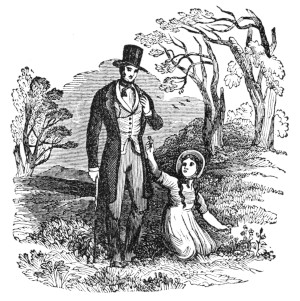
The Last Flower of the Season.
Marion and her father were walking in the fields. It was November, and the sharp frosts had cut down the flowers. Even the asters were withered and perished. But the little girl came at last to a single blossom that had survived. It was a small and humble flower, and it grew upon a barren spot. But it had found shelter between the stones, and its very obscurity had been the means of its protection. The gaudier blossoms around,—those that flourished in the richer soil and in more elevated stations—had fallen before the breath of approaching winter. Marion stooped and plucked the little blossom that seemed to shine like a gem amid the desolation around, and her father made this reflection. “See, Marion, how this blossom has withstood the frost which has swept down its more stately companions. It was humble, and therefore content with a lowly station. This humility has saved it from destruction. It is with us, my child, as with the flowers. The humble and obscure positions of life are often not only the most quiet, but also the most safe from the temptations, sins, and sorrows, which sweep down those who seek and obtain more ambitious situations.”
The Cunning Bear.
A FABLE.
Among the bears that lived in the woods, there was one that thought himself very wise. He was, in fact, very selfish, and cared for nobody but himself. I am now going to tell you a story, which will show you how the cunning beast overreached and ruined himself.
In the country of the bears of which I am speaking, there were a good many Indians. These had set a trap so contrived that if a bear should attempt to get the bait, a heavy stone would fall upon his back and crush him.
The bait consisted of a nice leg of venison, and as one of the bears came that way, its delicious flavor attracted his attention. He approached cautiously, and perceived that the meat was only the bait of a trap. He went and told what he had discovered to some of his companions, and quite a company of bears assembled to take the subject into consideration.
Among the rest was our cunning bear. He listened to the various observations of his friends, and finally, assuming a grave and honest look, he rose upon his hind legs, stretched forth his right paw, and spoke as follows:
“My dear friends, allow me to address you: this piece of meat is placed here to tempt you into the trap; be not deceived, and risk not your lives for a momentary gratification. What folly would it be for you, or any other bear, to purchase pleasure at so high a price. Listen to the words of wisdom: let us all depart, and disappoint the schemes of our deceitful enemies!”
This counsel seemed very wise, and being uttered with a benignant countenance and an air of great sincerity, made a deep impression. Accordingly, the whole troop dispersed, and went their several ways into the wood.
But the cunning bear had spoken for others rather than himself. No sooner was the coast clear, than he turned a short corner, and went slily back to the leg of venison. “Now,” said he, “that I have got rid of my neighbors, I’ll have a feast all to myself. I’m not afraid of the trap. I’ve cheated these Indians many a time. I know how to slip off the meat without springing the trap. What fools there are in the world! These savages catch the deer, and these silly bears leave it for the wise ones. I know a thing or two. Fools kill, and the wise ones eat, the venison.”
With these reflections, our hero stepped slily into the mouth of the trap. He put up his nose very gently, and fixed his teeth in the haunch of venison. He then gave it a gentle pull, and it was nearly free, when the trap sprung, and the enormous stone came down upon Bruin’s back with a tremendous crash!
The poor beast struggled, and groaned, and growled terribly, but all in vain. At last he expired, making this reflection, “After all, I do not see that we cunning people are any better off than anybody else. Soon or late we overreach ourselves, and perish with the miserable consciousness that we deserve our doom.”
Recent experiments have shown the velocity of electricity to be 576,000 miles in a second. At this rate it would perform the circuit of the earth three times in the twinkling of an eye!
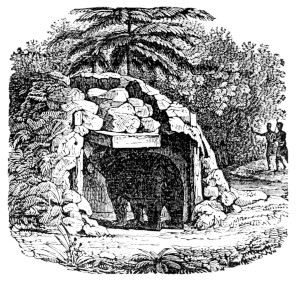
The Tiger’s Cave.
AN ADVENTURE AMONG THE MOUNTAINS OF QUITO.
On leaving the Indian village, we continued to wind round Chimborazo’s wide base; but its snow-crowned head no longer shone above us in clear brilliancy, for a dense fog was gathering gradually around it. Our guides looked anxiously towards it, and announced their apprehensions of a violent storm. We soon found that their fears were well founded. The thunder began to roll, and resounded through the mountainous passes with the most terrific grandeur. Then came the vivid lightning; flash following flash—above, around, beneath,—everywhere a sea of fire. We sought a momentary shelter in the cleft of the rocks, whilst one of our guides hastened forward to seek a more secure asylum. In a short time he returned and informed us that he had discovered a spacious cavern, which would afford us sufficient protection from the elements. We proceeded thither immediately, and with great difficulty and some danger at last got into it.
When the storm had somewhat abated, our guides ventured out to ascertain if it were possible to continue our journey. The cave in which we had taken refuge, was so extremely dark, that, if we moved a few paces from the entrance, we could not see an inch before us; and we were debating as to the propriety of leaving it, even before the Indians came back, when we suddenly heard a singular groaning or growling in the farther end of the cavern, which instantly fixed all our attention. Wharton and myself listened anxiously, but our inconsiderate young friend Lincoln, together with my huntsman, crept about on their hands and knees, and endeavored to discover, by groping, whence the sound proceeded.
They had not advanced far into the cavern, before we heard them utter an exclamation of surprise; and they returned to us, each carrying in his arms, an animal singularly marked, about the size of a cat, seemingly of great strength and power, and furnished with immense fangs. The eyes were of a green color; strong claws were upon their feet; and a blood red tongue hung out of their mouths. Wharton had scarcely glanced at them, when he exclaimed in consternation, “We have come into the den of a ——.” He was interrupted by a fearful cry of dismay from our guides, who came rushing precipitately towards us, calling out, “A tiger, a tiger!” and, at the same time, with extraordinary rapidity, they climbed up a cedar tree which stood at the entrance of the cave, and hid themselves among the branches.
After the first sensation of horror and surprise, which rendered me motionless for a moment, had subsided, I grasped my fire-arms. Wharton had already regained his composure and self-possession; and he called to us to assist in blocking up the mouth of the cave with an immense stone which fortunately lay near it. The sense of imminent danger augmented our strength; for we now distinctly heard the growl of the ferocious animal, and we were lost beyond redemption, if he reached the entrance before we could get it closed. Ere this was done we could distinctly see the tiger bounding towards the spot, and stooping in order to creep into his den by the narrow opening. At this fearful moment, our exertions were successful, and the great stone kept the wild beast at bay.
There was a small open space, however, left between the top of the entrance and the stone, through which we could see the head of the animal, illuminated by his glowing eyes, which he rolled glaring with fury upon us. His frightful roaring, too, penetrated to the depths of the cavern, and was answered by the hoarse growling of the cubs. Our ferocious enemy attempted first to remove the stone with his powerful claws, and then to push it with his head from its place; and these efforts proving abortive, served only to increase his wrath. He uttered a tremendous heart-piercing growl, and his flaming eyes darted light into the darkness of our retreat.
“Now is the time to fire at him,” said Wharton, with his usual calmness; “aim at his eyes; the ball will go through his brain, and we shall then have a chance to get rid of him.”
Frank seized his double-barrelled gun and Lincoln his pistols. The former placed the muzzle within a few inches of the tiger, and Lincoln did the same. At Wharton’s command they both drew their triggers at the same moment; but no shot followed. The tiger, who seemed aware that the flash indicated an attack upon him, sprang growling from the entrance, but finding himself unhurt, immediately turned back, and stationed himself in his former place. The powder in both pieces was wet.
“All is now over,” said Wharton; “we have only now to choose whether we shall die of hunger, together with these animals who are shut up along with us, or open the entrance to the blood thirsty monster without, and so make a quicker end of the matter.”
So saying, he placed himself close beside the stone, which for the moment defended us, and looked undauntedly upon the lightning eyes of the tiger. Lincoln raved, and Frank took a piece of strong cord from his pocket and hastened to the further end of the cave, I knew not with what design. We soon, however, heard a low, stifled groaning; the tiger, which had heard it also became more restless and disturbed than ever. He went backwards and forwards, before the entrance of the cave, in the most wild and impetuous manner; then stood still, and stretching out his neck towards the forest, broke forth into a deafening howl.
Our two Indian guides took advantage of this opportunity, to discharge several arrows from the tree; but the light weapons bounded back harmless from his thick skin. At length, however, one of them struck him near the eye, and the arrow remained sticking in the wound. He now broke anew into the wildest fury, sprang at the tree and tore it with his claws as if he would have dragged it to the ground. But having at length succeeded in getting rid of the arrow, he became more calm, and laid himself down, as before, in front of the cave.
Frank now returned from the lower end of the den, and a glance showed us what he had been doing. In each hand, and dangling from the end of a string, were the two cubs. He had strangled them, and, before we were aware what he intended, he threw them through the opening to the tiger. No sooner did the animal perceive them, than he gazed earnestly upon them, and began to examine them closely, turning them cautiously from side to side. As soon as he became aware that they were dead, he uttered so piercing a howl of sorrow, that we were obliged to put our hands to our ears.
The thunder had now ceased, and the storm had sunk to a gentle gale; the songs of the birds were again heard in the neighboring forest, and the sunbeams sparkled in the drops that hung from the leaves. We saw, through the aperture, how all nature was reviving, after the wild war of elements, which had so recently taken place; but the contrast only made our situation the more horrible. The tiger had laid himself down beside his whelps. He was a beautiful animal, of great size and strength; and his limbs being stretched out at their full length, displayed his immense power of muscle. A double row of great teeth stood far enough apart to show his large red tongue, from which the white foam fell in large drops.
All at once, another roar was heard at a distance, and the tiger immediately rose and answered it with a mournful howl. At the same instant, our Indians uttered a shriek, which announced that some new danger threatened us. A few moments confirmed our worst fears; for another tiger, not quite so large as the former, came rapidly towards the spot where we were.
The howls which the tigress gave, when she had examined the bodies of her cubs, surpassed everything of horrible that we had yet heard; and the tiger mingled his mournful cries with hers. Suddenly her roaring was lowered to a hoarse growling, and we saw her anxiously stretch out her head, extend her wide and smoking nostrils, and look as if she were determined to discover immediately the murderers of her young. Her eyes quickly fell upon us, and she made a spring forward, with the intention of penetrating our place of refuge. Perhaps she might have been enabled, by her immense strength, to push away the stone, had we not, with all our united power, held it against her.
When she found that all her efforts were fruitless, she approached the tiger, who lay stretched out beside his cubs, and he rose and joined in her hollow roarings. They stood together for a few moments, as if in consultation, and then suddenly went off at a rapid pace, and disappeared from our sight. Their howlings died away in the distance, and then entirely ceased.
Our Indians descended from their tree, and called upon us to seize the only possibility of yet saving ourselves, by instant flight, for that the tigers had only gone round the height to seek another inlet into the cave, with which they were no doubt acquainted. In the greatest haste the stone was pushed aside, and we stepped forth from what we had considered a living grave. We now heard once more the roaring of the tigers, though at a distance, and, following the example of our guides, we precipitately struck into a side path. From the number of roots and branches of trees, with which the storm had strewed our way, and the slipperiness of the road, our flight was slow and difficult.
We had proceeded thus for about a quarter of an hour, when we found that our way led along a rocky cliff, with innumerable fissures. We had just entered upon it, when suddenly the Indians, who were before us, uttered one of their piercing shrieks, and we immediately became aware that the tigers were in pursuit of us. Urged by despair, we rushed towards one of the breaks, or gulfs in our way, over which was thrown a bridge of reeds, that sprang up and down at every step, and could be trod with safety by the light foot of the Indians alone. Deep in the hollow below rushed an impetuous stream, and a thousand pointed and jagged rocks threatened destruction on every side.
Lincoln, my huntsman, and myself passed over the chasm in safety, but Wharton was still in the middle of the waving bridge, and endeavoring to steady himself, when both the tigers were seen to issue from the adjoining forest; and the moment they descried us, they bounded towards us with dreadful roarings. Meanwhile, Wharton had nearly gained the safe side of the gulf, and we were all clambering up the rocky cliff, except Lincoln, who remained at the reedy bridge, to assist his friend to step upon firm ground. Wharton, though the ferocious animals were close upon him, never lost his courage or presence of mind. As soon as he had gained the edge of the cliff, he knelt down, and with his sword divided the fastenings by which the bridge was attached to the rock.
He expected that an effectual barrier would thus be put to the further progress of our pursuers; but he was mistaken; for he had scarcely accomplished his task, when the tigress, without a moment’s pause, rushed towards the chasm, and attempted to bound over it. It was a fearful sight to see the mighty animal suspended for a moment in the air, above the abyss; but the scene passed like a flash of lightning. Her strength was not equal to the distance; she fell into the gulf, and, before she reached the bottom, was torn into a thousand pieces by the jagged points of the rocks.
Her fate did not in the least dismay her companion; he followed her with an immense spring, and reached the opposite side, but only with his fore claws; and thus he clung to the edge of the precipice, endeavoring to gain a footing. The Indians again uttered a wild shriek, as if all hope had been lost.
But Wharton, who was nearest the edge of the rock, advanced courageously towards the tiger, and struck his sword into the animal’s breast. Enraged beyond all measure, the wild beast collected all his strength, and, with a violent effort, fixing one of his hind legs upon the cliff, he seized Wharton by the thigh. That heroic man still preserved his fortitude; he grasped the trunk of a tree with his left hand, to steady and support himself, while with his right hand he wrenched and violently turned the sword, that was still in the breast of the tiger. All this was the work of an instant. The Indians, Frank, and myself hastened to his assistance; but Lincoln, who was already at his side, had seized Wharton’s gun, which lay near upon the ground, and struck so powerful a blow with the butt-end upon the head of the tiger, that the animal, stunned and overpowered, let go his hold and fell back into the abyss.—Edinburgh Literary Journal.
The Ingenious Cricket.
In the mountains of Malacca there is a species of cricket, which makes a loud noise with its wings at certain seasons, probably to attract its mate. Not content with the simple sound which it can produce by a natural action, it is said to resort to an exceedingly curious acoustic contrivance to increase it. In the sides of a hole which it forms in the earth, large enough to contain its body, it hollows out seven small tunnels, which, diverging from that common centre, and penetrating towards the surface of the ground, at length open above in a circle of a palm’s breadth in diameter. These cylindrical apertures, being made quite smooth within, expand towards the top, where each may be half an inch wide, like so many minute speaking-trumpets. The insect then taking its stand in the central cavity which communicates with these, and there exercising its fairy minstrelsy, the sound passes through each tube; and, whatever be the use of this peculiar structure, the tiny musician within makes hill-side and thicket ring with the chirping din which he emits from it.—Bennet and Tyerman.
The Power of Bees.
The following incident is related in an English paper. One day, a horse belonging to a farmer strayed from his yard into an adjoining garden belonging to a Mrs. Cox, and kicked down a hive of bees, which instantly attacked him with great fierceness. The poor horse kicked and plunged violently, and a man named Blunt, who happened to be in Mrs. Cox’s house, went out to his rescue. He succeeded in getting hold of the horse, but had scarcely done so, when the bees attacked him, covering his head and face, and every exposed part of his body. It was in vain he strove to beat them off. Wet cloths were thrown over him, and other means were resorted to, but it was a long time before the enemy left him. The unfortunate man was conveyed to his house, but died on his way thither, within ten minutes of the attack. The horse died the next evening. The deceased left several children to lament his untimely end.
HYMN.
I know, when I lie down to sleep, That God is near my bed; That angels watch by his command Around my infant head. I know, when I kneel down to pray, That still my God is there; He hears my words, he sees my thoughts, And will accept my prayer. I know when I go forth to play, That God is by my side; Through every hour, at every step, He is my guard and guide. I know his eye sees everything In earth, and sea and air; That he, in darkness as in light, Can see me everywhere. Then let me guard each thought, each word, Lest he should chance to find Evil within a heart that should Be gentle, meek, and kind.
Our Correspondence.
We have this month to acknowledge the receipt of letters from M. G. D.; J. B., of Princeton; S——, of Cambridge; and W. H. S., of Portsmouth. The following, from the latter place, we insert with pleasure.
Portsmouth, Sept. 3, 1844.
Mr. Merry:
Dear Sir,—I have begun to take your books, and have just received the back numbers, and thus far I feel a great interest in them; and, as you have had but a few puzzles in the late numbers, you would oblige me very much if you would publish the following enigma. We are good hands down here for puzzles, and would like to get hold of one that would stick us. If you can find one of this kind, we wish you to publish it. I send you the following
PUZZLE.
I am composed of twenty letters.
My 12, 16 and 19, is part of the body.
My 15, 4, 20, 9, 3 and 17, is in every house.
My 10, 9, 6, 10, 8 and 18, has no particular home.
My 5, 4, 16 and 7, is part of a factory.
My 3, 15, 13 and 4, is a return.
My 5, 16, 11, 6, 4 and 18, is a city in Europe.
My 17, 8, 15, 4, 16 and 11, is an animal.
My 7, 8, 20, 15 and 13, comes every spring.
My 1, 14, 8 and 17, is to take a part.
My whole is a part of the contents of Merry’s Museum.
H. R. B.
The following letter will probably elicit the thanks of our readers, as it does ours. We shall certainly comply with the request, in our next number.
Natick, September 25th.
Mr. Merry:
There is a great deal said about Texas in the newspapers, and both whigs and democrats are making a great many speeches about it. I should like, myself, to know more about it than I do; what sort of a country it is—how large—how many people there are—how they live—what the climate and productions are. If you could give us a short account of these things, I think it would be acceptable to your readers.
Yours, N. C.
November in London.
No sun—no moon! No morn—no noon— No dawn—no dusk—no proper time of day— No sky—no earthly view— No distance looking blue— No road—no street—no t’other side the way— No end to any row— No indications where the crescents go— No top to any steeple— No recognitions of familiar people— No courtesies for showing ’em— No knowing ’em! No travelling at all—no locomotion— No inkling of the way—no motion— “No go,” by land or ocean— No mail—no post— No news from any foreign coast— No park—no ring—no afternoon gentility— No company—no nobility— No warmth, no cheerfulness, no healthful ease— No comfortable feel in any member— No shade, no shine, no butterflies, no bees, No fruits, no flowers, no leaves, no birds—November!
[Audio content is not currently supported on your device.
The Moon.
MUSIC COMPOSED FOR MERRY’S MUSEUM, BY GEORGE J. WEBB.
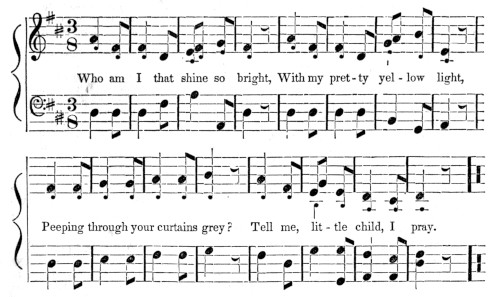
Who am I that shine so bright, With my pretty yellow light, Peeping through your curtains grey? Tell me, little child, I pray. When the sun is gone I rise In the very silent skies; And a cloud or two doth skim Round about my silver rim. All the little stars do seem Hidden by my brighter beam, And among them I do ride, Like a queen in all her pride. Little child, consider well Who this simple tale doth tell; And I think you’ll guess it soon, For I only am the Moon.
MERRY’S MUSEUM.
Vol. VIII. NOVEMBER, 1844. No. 5.
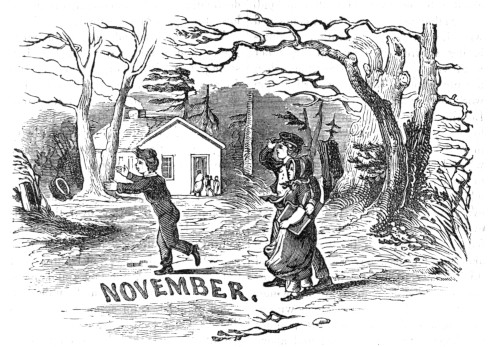
The trees to the blast have surrendered their leaves, The beauties of summer have fled; The warblers departed for sunnier climes, The herbage is withered and dead. The chill wintry blast shall resound through the woods, The skies with rude storms shall be rife; But spring will return and again clothe the trees, The landscape will glow with new life.
According to a French novelist, November is the gloomy month, in which “the people of England hang and drown themselves.” There is something rather sober in the departure of all those interesting charms that have so attached us to summer and the early autumn, yet we can hardly say that there is anything gloomy about it. A pensive, yet pleasing melancholy, is perhaps the predominant feeling in contemplating the changes that take place as the autumn sullenly resigns the year to winter. We have seen the fields stripped of their crops, and the woods of their luxuriant foliage; and now that the great purposes of the season are accomplished, it is not with repining or regret, that we see exhausted nature about to take a short repose.
We have been delighted with the music of the fields and groves, we have admired the springing plants and expanding flowers; now our enjoyments are about to be somewhat of a different kind, though they may still be closely connected with the mysterious operations of slumbering nature; we may still study her work with scarce less interest than when her utmost energies are put forth to the work of spring and summer seasons. Let the Englishman hang or drown, if his fancy inclines that way; for myself, there is much in the gloom of winter which I could yet wish to enjoy for years to come. There are the hard frosts, which show an autumn morning with every twig and every blade of grass, every vegetable fibre, houses, rocks, and fences, coated with a thick covering of alabaster, like ice, converting shrubs and thick-clustering weeds into most gorgeous chandeliers; there are the winter sunshine and storms, and the winter-evening fireside. There is the promise and hope of the future year; and above all, there is the contemplation of the power and goodness of Him who has furnished the earth in all the beauty and riches of the seasons, for the comfort and happiness of his creatures.
The sun, who seems to have the immediate control of these matters, has for a few weeks been getting rapidly to the south, and the summer and autumn follow him. His declination, by the middle of the month, is the same, and the days are as short, as at the latter part of January: but how different the two seasons. Now, we generally have our Indian summer, and then, perhaps, is the coldest part of winter. When the earth has become so thoroughly heated by the longer days and more perpendicular sun of summer, it requires some time, after the sun has attained its greatest southern declination, for it to cool again to the lowest temperature of winter.
We are no great admirers of the mere poetry and sentimentality of life, but, seeing it is November, suppose we indulge a little in the pensive mood. Let us take one of those pure transparent days which are only to be found at this season, and go to the southern declivity of some gentle swell where we may have the woods in our rear. Now look abroad to the south where the retiring summer seems yet to linger, and the autumn lies slumbering over the landscape. Here is no bold and abrupt coloring, no contrast of dark woods with yellow fields; the different features and tints seem blended into one grand mass, forming an extended and unbroken scene of quiet, calm serenity and loveliness. Over head is that deep transparent blue which belongs only to an autumn sky, with here and there a straggling white-edged cloud, which sometimes passing before the sun, we see the shadow as it travels over the plain, darkening successively for a moment the hills and fields until lost in the distance, and giving a transient life and motion to the sleeping scene before us. Now and then a single bird is to be seen, who, as if loth to leave the happy scenes of his summer joys, still lingers behind, long after his companions have departed for southern climes. Occasionally we are startled by the squirrel, who, with a cheek load of hickory nuts, rustles the leaves as he scampers to his hiding place, to finish stocking his cellars with provisions for the winter. For half an hour, not a breath of air is felt, or a sound heard; till presently, the wind, scarcely heard at first, begins to murmur among the trees in the distance; approaching, it increases to a mournful howl, bringing with it a cloud of leaves, which, whirled in eddies across the sky above us, afford us a lecture “more eloquent than words,” on the end there must be to all of the beautiful and fascinating, to which we have set our hearts and engaged our affections here. Now the wind dies away again in moaning sighs, the leaves settle away in the distance, and presently all is again quiet, lonely and silent.
At such times, we feel little inclined to conversation; deeply absorbed in the contemplation of the scene before us, about us, and above us, we find occasion for few words; conscious that each sees and deeply feels the whole, the year going reluctantly on to its grave, we find all comment unnecessary, and words superfluous; we want no communion with anything save our own silent thoughts.
I know not how it is with others, but I have sometimes felt English enough to think, were it proper to choose, that when I am called upon to leave all the beautiful and interesting things that have so long bound me to earth, I could choose this season, and leave them with less regret amid such a scene, when all around is gone to decay, and the earth itself seems to covet the repose of death.
Say well is good, but do well is better.
Experience a Teacher To Birds.—There is much more intellect in birds than people suppose. A curious instance of this once occurred at a slate quarry. A thrush, not aware of the expansive properties of gunpowder, thought proper to build her nest on the ridge of the quarry in the very centre of which they were constantly blasting the rock. At first, she was very much discomposed by the flying of stones in all directions, but still she would not leave her nest. She soon observed that a bell rang whenever a train was about to be fired, and that, at the notice, the workmen retired to safe positions. In a few days, when she heard the bell, she quitted her exposed situation, and flew down to where the workmen sheltered themselves, dropping close to their feet. There she would remain till the explosion had taken place and then return to her nest.
Litigation.—Law is like a country dance; people are led up and down till they are fairly tired out. It is like a book of surgery; there are a great many terrible cases in it. It is like physic too; they that take the least of it are best off. Law is like a new fashion; people are bewitched to get into it; and like bad weather, most people are glad to get out of it.
Scott.—It is related of Sir Walter Scott that when in health he never refused to see any one, however humble, who called upon him; and that he scarcely ever received a letter which he did not answer by his own hand.
Bill and the Boys.
The story of Dirk Heldriver, concluded.
M. hielder having attained the summit of the pyramidal crag, to which he had been invited, now looked around for Hieldover. He saw a fire which had guided him to the spot, made of fagots burning upon the rocks, and at a little distance, he discovered the mouth of a cave. From this, Hieldover soon issued, and presented himself before his visiter. The strong light of the blazing brands, reflected upon the faces and forms of the two men, presented a striking picture. The emaciated form, the haggard features and the torn garments of Hielder, were strongly contrasted with the iron frame, the stern, flinty countenance, and homely sailor’s dress of Hieldover.
The two men met, but no kindly greeting passed between them. They gazed at each other for a moment, and Hieldover then broke the silence. “You have come,” said he, “at my bidding, and I will fulfil my promise. You shall see your daughter—but you must first listen to my story.” Saying this, he pointed to a seat on the rock, and M. Hielder sat down. Hieldover did the same, and then he spoke as follows.
“It is now twelve years since we parted at Amsterdam. I need not go over the story of my father’s death—of his intrusting my fortune and education to your care. I need not say how you discharged your trust, by bringing me up in every species of folly and dissipation; of your embezzlement of my property, and final retreat from the country to parts unknown. The latter event, as you well know, occurred in my absence from Amsterdam. When I returned to the city I found myself a beggar, and what was worse, my character was ruined. You had enjoyed a high reputation for integrity, and had taken advantage of this to denounce me as a graceless wretch, unworthy of protection or sympathy. You had also circulated the story that the vast estate bequeathed by my father had been squandered by my profligacy.
“I was just twenty-one when I returned to Amsterdam, intending to take possession of my estate, but instead of this, I found myself at once ruined in fortune and fame. It is impossible for me to describe the miseries that one after another overwhelmed me. I applied to friends; but they received me with coldness or aversion. I resorted to my companions, upon whom I had lavished favors; but they smiled and put their fingers sneeringly to the side of the nose. I applied to a lawyer; but he would not undertake my cause without a fee, and this I could not give. At length, I bent all the energies of my soul to one single purpose, and that was to pursue you, to traverse the four quarters of the globe, if necessary, to find you, and at last to inflict upon you some punishment adequate to your ingratitude and your crimes.
“Entering upon this design with a fierce and feverish desire, I shipped on board a vessel as a common sailor. I had reason to suppose that you had gone to Surinam, and the vessel I entered was bound to that port. I performed the duties of a sailor with alacrity. In the long and tedious calm, or the raging of the tempest, whether upon the quiet deck or aloft amid the shivering spars, I never for one moment forgot my purpose. I arrived at the destined port, and made inquiries for you, but without success. I engaged in the revels of my companions; but in my maddest moments I thought of you. I shipped for Java, for I had been led to conjecture that you might be there. We performed our long voyage of alternate tempest and tranquillity. To all around me I seemed the most thoughtless of the unthinking men with whom I was associated; yet it was the burning hope of revenge that sustained me.
“You were not at Java. I set out for the Japan Isles, and reached the rock of Nangasaki, to which the Dutch traders are confined. You had been here, but had departed, leaving no clew by which you could be traced. In a daring and reckless mood, I ventured with one of my companions to enter into one of the Japanese towns. We had dressed ourselves like the natives, and for a time were unsuspected. But at last we were seized, severely beaten, put into an open boat and driven out to sea. We were forced along the coast by winds and currents, and at last, were wrecked upon a rocky shore. In a starving condition we clambered up the cliffs, and made our way to a small village. Here we were seized and conducted from post to post, till we reached Meaco, the residence of the dairi or king. Having been examined, we were sentenced to perpetual slavery in the diamond mines. These belonged to the king, and were situated in the mountains. For three years I wrought in gloomy caverns, without once seeing the light of day. Even here I did not forget my revenge, and had still in my bosom a conviction that I should break the chains with which my body was bound, escape from my rocky prison, and fulfil my purpose. My companion wasted away under his toil and confinement, and expired before my eyes; but my body and soul fed upon the hope which had so long animated my bosom.
“I began to meditate an escape. I laid my plans with deliberation, and at the end of eleven months, they were completed. I effected my deliverance, and lived for two years with the wild goats amid the recesses of the mountains. I had learned the language and manners of the country, and leaving my retreat, made my way without difficulty; all suspicion having been lulled by the time which had elapsed since my escape. I had concealed a number of diamonds and other gems of great value, and carried them with me. I was now rich, but I regarded my wealth only as the means by which I might traverse the world in pursuit of you.