Volume 8 — CONTENTS OF VOLUME VIII. (continued 5)
Reading edition
“I reached Nangasaki, and entered a vessel bound for Amsterdam. I returned to my native city, and for a time engaged in the pleasures of fashionable life. I was courted and flattered on every side; but I became weary of blandishments, and the thirst of revenge, which had been forgotten, again revived in my bosom. I came to New York, and spent a year in search of you. At last, I discovered your place of residence, and learned that you had exchanged the name of Brocken for Hielder. I learned that you were married—that you lived aloof from mankind, and that you were regarded as a strange and mysterious being. I visited your abode by night—I hung around your path—I frequently saw you, and was more than once on the point of thrusting my poniard into your bosom.
“It is strange, that, when you were in my power, my hand seemed withheld from striking the blow I had so long meditated. I hesitated—I wavered. At last my desire of revenge returned in its full vigor—I went, determined to fulfil my long meditated design. Concealed in the shrubbery, I saw you approach. I drew my dirk, and stood ready. You came near, but your lovely child was by your side. You paused—you sat down—you embraced that flaxen-haired girl, and gazed in her sunny face with the fond affection of a parent. I had only thought of you before as a demon; but I now saw that you were a father, and possessed a father’s feeling. It was a strange revelation, and it opened a new view to my mind. I cast my poniard away with loathing, and another train of thoughts took possession of my soul.
“I lay in wait, and seizing a favorable opportunity, I carried your daughter away. She is here, and she is well. I have brought you hither; I have told you my story—I have fulfilled my purpose. I have no other revenge to bestow. Keep your ill-gotten wealth—for I know it cannot bless you. I only hope that your innocent child may not share in the misery which your crimes have inflicted upon me, and must continue to inflict upon yourself. I see a fate worse than that of Cain, written on your brow. There is a fire within your breast that consumes you. One solace only is afforded you—your daughter; and even that is mingled with a fear that is of itself torture. How mysterious are the ways of Providence! When there is no other tribunal to inflict punishment, the soul turns upon itself, and becomes an executioner. Dark and desolate as is my lot, I envy not yours.”
Hieldover waited for no reply, but immediately brought out Katrina and placed her in her father’s arms. After a short space, he led them down the cliff, and conducted them to one of the avenues of the mountain. He then spoke to Hielder as follows:
“Farewell—we part forever. You need not fear me—nay, forget me if you can. I forgive the injuries you have done me—the wreck of my existence which you have caused. I am unfit for the world, and I shall continue to occupy this abode. I have lived a life of evil thoughts and wicked passions. I will expiate my crimes by a life of penance in yonder cave. Beware of seeking me—of naming me to others. I seek only oblivion and repose. Adieu.”
The strange man departed, and Hielder saw him no more. Years passed away, and a light was often seen on the mountains. Rumors were afloat that the giant form of a man was sometimes seen upon the cliffs, or gliding through the valley beneath. The light was at last extinguished, and the legend became current that the bones of a man were many years after found in the cave, and by their side a small sack of precious gems. The glen had long the reputation of being haunted, and was anciently known by the name of Heldriver’s castle.
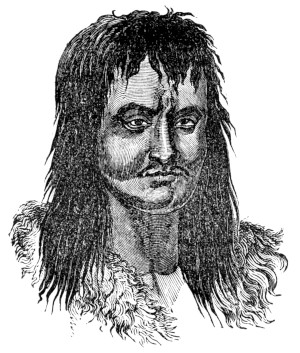
Head of a New Zealander.
New Zealand.
New Zealand consists of two islands, but separated only by a strait, and composing properly only one country, lying between 34° and 48°S lat.; being thus about 1000 miles in length; but the average breadth does not exceed 100 miles. The surface is estimated at 62,160 English square miles. The northern island is known by the name, not very well fitted for English organs, of Eaheinomauwe; the southern by that of T’avai Poenammoo. The first is the smallest, but is distinguished by the finest soil, and by natural features of the boldest and grandest description. Chains of high mountains run through both islands, which, in the former, rise to the height of 12,000 or 14,000 feet, and are buried for two thirds of their height in perpetual snow; presenting on the greatest scale all the Alpine phenomena. From these heights numerous streams flow down, watering in their course the most fertile and enchanting valleys. The huge glaciers and plains of snow which cover their higher regions; the mighty torrents which pour down from them, forming stupendous cataracts; the lofty woods which crown their middle regions; the hills which wind along their feet, decked with the brightest vegetation; the bold cliffs and promontories which breast the might of the southern waves; the beautiful bays decked with numberless villages and canoes—all conspire to present a scene, which even the rude eye of the navigator cannot behold without rapture. The soil in the valleys, and in the tracts of land at all level, is more fertile than in New Holland, and, with due cultivation, would yield grain in abundance. It produces, even spontaneously and plentifully, roots fitted for human food, particularly those of a species of fern, which covers almost the whole country.
The natives breed pigs, and cultivate some maize, yams and potatoes; and there is a species of very strong flax, which serves not only for clothing, but fishing-lines, and various other purposes. The mountains are clothed with a profusion of fir trees, of a variety of species unknown in other countries, and rising to a magnificent height, which the tallest pines of Norway cannot rival.
The natives are of a different race from those of New Holland, belonging to that Malay race which predominates in the South Sea Islands. They are tall and well formed, with large black eyes; they are intelligent, have made some progress in the arts of life, and are united into a certain form of political society. These circumstances, however, have only tended to develop in a still more frightful degree those furious passions which agitate the breast of the savage. Each little society is actuated by the deepest enmity against all their neighbors; their daily and nightly thought is to surprise, to attack, to exterminate them; and when they have gained that guilty triumph, it is followed by devouring their victims.
Yet to the members of their own tribe, or those whom they regard as friends, they are not only mild and courteous, but display the fondest attachment and most tender sensibility. Families live together in great harmony, and are seen assembled in pleasing and harmonious groups. On the death of their relations, they exhibit the most impassioned and affecting symptoms of grief, cutting their faces with pieces of shell or bone, till the blood flows and mixes with their tears.
They have a great turn for oratory, the chiefs making speeches of two or three hours, accompanied with vehement gestures, to which those of the audience correspond. Their war-canoes are very large, adorned with much curious and elaborate carving. Great diligence is also exercised, and great pain endured, in bestowing upon their skins the ornament of tattooing; and the visages of the chiefs are often entirely covered over with various regular figures. This, however, is not effected without severe pain, causing even attacks of fever; but to shrink in any degree from the operation is considered as altogether derogatory to a manly spirit. They have also a horrid art, by which the heads of their enemies, being dried in an oven, and exposed to a stream of fresh air, are maintained in a state of perfect preservation. Their houses are by no means spacious; that of Korra-korra, a powerful chief, measured only nine feet long, six feet wide, and four feet high. They are placed in hippahs, or fortified villages, seated on high and steep hills, ascended by pathways, narrow, winding, and often perpendicular, so as to be most perilous to an European; but the New Zealander leaps up as if it were level ground.
Their original arms consisted of clubs of stone and whalebone, of long and pointed spears, and of the pattoo-pattoo, or wooden battle-axe; but since the musket has been introduced to their knowledge, it has absorbed all their warlike regard; and the strength of a chief is counted, not by his men, but by his muskets. The report of fifty being in the possession of Korra-korra spread the terror of his name for 200 miles round.
Dick Boldhero.
CHAPTER IX.
Mounted upon the back of a small but vigorous Dutch pony, I made my way upon my return much more rapidly than I had done on foot in proceeding into the country. At the end of about eight days, I reached the city. During my ride I had revolved many schemes in my head, and I had determined, not only to find out my uncle, but, if possible, to vindicate his reputation. The scale of my operations was pretty large, considering my youth; but through life our anticipations are very apt to be extensive in proportion as our means are small.
Immediately upon arriving at Paramaribo, I set about my inquiries; but a fortnight passed away, and nothing had transpired to give me the least hope of success. But one night, as I was walking along the quay of the city, a person muffled up in a cloak met me, handed me a letter, and disappeared. I hastened to my room, opened the paper, and read as follows. “Your uncle is an innocent and injured man. There are those in this city who have participated in the means by which his character was rendered infamous. The chief instrument by which the base plot was executed, is the captain of the ship that was lost. He now lives in a splendid villa near the city of Caraccas, under the name of Signor Sevil.”
There was neither date nor signature to this paper, and whether to consider it as a mere imposition, or as founded in truth and designed to aid my researches, I could not determine. I submitted it to my adviser, to whom I had been commended by Mr. Hartley, and he deemed the communication of great importance. It was finally determined that I should proceed to Caraccas, in the hope of ascertaining whether the statement in the paper was true, and if so, how far the fact could be made available to the clearing up of my uncle’s character. Before my departure, I went to see my cousin Mirabel, and proffered my claim to relationship. She received me kindly, and entered with enthusiasm into my projects. I left her, and taking passage in a small coasting vessel, set out for Caraccas.
This city is situated on the northern coast of South America, and is the capital of the fine province of Venezuela. In about twenty days we reached our destined port, and I set out immediately for the city, which lies about fifteen miles from the sea. Our road lay over mountainous ridges, but we were rapidly and safely carried by mules, and reached Caraccas in the space of a few hours.
I found this place to contain some fifty thousand inhabitants, nearly all of them Spaniards. The streets were built at right angles, and were exceedingly narrow. The houses had a gloomy look, there being in each but one or two windows towards the street, but in the rear they had large courts, where there were often very pleasant gardens, with walks and fountains. There were several public squares in the town, among which the Plaça Mayor was the principal. This was about 320 feet square, and here was the chief market of the city. The churches were numerous, and the cathedral was very splendid.
I gave myself little time to survey the city, but immediately entered upon the business that had brought me hither. I soon found that such a person as Signor Sevil actually lived in a handsome edifice in the suburbs of the city. Upon further inquiry I ascertained that he had resided there but a few years, that he was a foreigner, and a degree of doubt and mystery hung over his life and character. There were even suspicions that he had been engaged in certain piratical expeditions; but as all this was surmise, and he appeared to be in the possession of wealth, the subject was little agitated.
I remained for several weeks, endeavoring to trace out the history of this individual, and became satisfied that he was actually the captain who had commanded the vessel in which my uncle’s property was lost, and through whose villany he had been made to suffer so severely. Yet I was unable to obtain any specific proofs that would answer my purpose. I revolved a great many schemes, and finally determined to seek an interview with the captain, tell him my object boldly, and take my chance for the result. If I gained no advantage, I should at least lose nothing.
Accordingly, I wrote a letter to the captain, who bore the name of Signor Sevil, stating that a person from Paramaribo desired to see him on important business. This I despatched to his house, and received for answer that he would call upon me at the place designated, on the morrow. At the time appointed he came, and seemed not a little surprised at the youthfulness of the person with whom he was to have an interview. I began by addressing him as Captain Pierce, remarking that I was well acquainted with his history and character, and that my name was Boldhero. He started to his feet as if he had been stung by an adder, and then seemed about to rush upon me. I had provided myself with a pistol, which I drew from my bosom, and presented to his face. This seemed to have a cooling effect; he immediately forced a smile, resumed his chair, and said, “Well, well, let us hear what you have to say.”
I then stated that my object was to vindicate the reputation of my uncle, and to recover also the large amount of money due from the insurance company at Surinam. I assured him that my purpose was not to bring him to justice, but only to obtain from him a solemn affidavit, retracting his former perjury, with a confession of the means by which he had been bribed to commit so foul a wrong.
When I had done, the man looked at me with a mixture of amazement and mirth. The audacity of my proposition seemed at once to astonish and amuse him. After looking me steadily in the face for a few moments, he said, with great civility, “I will think of this proposition, and when I am prepared to erect a gallows and twist a halter for my own execution, I will perhaps comply with your very reasonable request.” Saying this, the man rose from his seat, saluted me with great politeness, and was about to depart.
Stung with disappointment and indignation, I placed my back to the door, determined to oppose his departure. While I stood a moment in this position, facing the captain, my feet seemed jerked from under me, and I fell to the floor. At the same instant I saw that he was thrown forcibly in an opposite direction, and laid prostrate. I arose, but was instantly thrown down again. I could now perceive that the room was rocking backward and forward; at the same time, my ears were filled with the most terrific sounds I ever heard. With a powerful effort, I arose and rushed down the stairs, into the street.
The earth trembled beneath my feet, and the buildings around seemed to be rushing into a mass of ruins. On every side, I could hear the crash of buildings falling to the earth; the screams of men, women, and children, filled with despair or crushed beneath the falling fragments; together with the heavy and portentous sound, like the deep bellowing of thunder, smothered in the bowels of the earth. Completely bewildered, I rushed along the street, escaping as if by miracle from the bricks and stones and timbers that fell around me. At length I reached the Plaça Mayor, where I had an extended view of the scene.
The whole space was nearly covered with people; priests with their crosses; women with their children; aged men and women, tottering with years; the rich and the poor, the strong and the weak, the young and the old; some silent and some wailing; some prostrate on the earth; others kneeling and telling their beads; others standing erect, and spreading upward their beseeching hands to Heaven. While such was the spectacle before the eye, the ear was stunned with strange and appalling sounds, and at the same time, the earth trembled as if the very stones were filled with fear at the awful visitation.
Around the square, most of the buildings were prostrate; the only edifice that seemed to defy the shock, was the cathedral, which occupied a portion of the open space. The agitation of the earth continued for a few minutes, when it gradually subsided. The trembling at last totally ceased, the air became still, and a deathlike silence settled over the ruined city. It was evident that the earthquake had passed, and the inhabitants by slow degrees began now to recover from their panic.
The desolation that pervaded the place was, however, terrific. Thousands of people had been killed, and many of the living were now houseless and homeless. Endeavoring to shun the sights of misery that presented themselves on every side, I wandered about, scarcely knowing whither I went. At last I found myself near my lodgings. The building was still standing, though considerably injured. While I stood before it, surveying its aspect, I heard a deep groan near at hand. On going to the spot from whence the sound issued, I found the captain half buried beneath a mass of bricks. I went to him, and he instantly recognized me. “For God’s sake give me help,” said he, “though it is perhaps of little consequence, for I have but a few hours to live.”
Touched by the poor man’s sufferings, I immediately fell to work to extricate him, but found the task beyond my strength. I ran for help, which I obtained with some difficulty, and the sufferer was taken up, and carried into the adjacent building, where I had lodged. “I am dying,” said he to me. “I beg you to send for a priest. Be speedy, as you would have mercy on the soul of a great sinner.”
I ran to the Plaça Mayor, and speedily brought a friar to the bedside of the dying man. We were all required to leave the room, and the captain proceeded to make his confession in the ear of the priest. The holy father told him that his crimes were great, and he could only offer him absolution upon condition that he would put his declaration in writing, and in such a form as would enable the parties he had injured to obtain justice.
After a violent struggle with his pride, the sufferer yielded, and a magistrate was called to receive his dying affirmation. This was executed in due form, and in my presence. It completely exculpated my uncle from all blame. It declared that his ship was lost by stress of weather, and that he, the captain, had been bribed to give perjured evidence, in stating that the catastrophe had been brought about by my uncle’s orders. Scarcely had he finished this declaration, and sworn to it, when he was seized with spasms, his mind wandered, and with a struggle that shook his whole frame, he expired.
CHAPTER X.
The object of my visit to Caraccas having been completed in a manner which seemed almost miraculous, I was impatient to return to Paramaribo, and take counsel as to what steps should be adopted for the discovery of my uncle. I therefore took passage in the first vessel bound for that port; and in the space of twenty-four days, found myself again sailing up the Surinam.
We soon landed, and after despatching a letter to Mr. Hartley, informing him of my success, and requesting him immediately to repair to Paramaribo, I hastened to the house of M. Scager, my uncle’s father-in-law; I had seen the old gentleman before my departure for Caraccas, but had not consulted him as to the object of my expedition. Such, indeed, had been the bitterness of his feelings towards my uncle, on account of the disgrace associated with his name, that even an allusion to him excited his anger.
I had, however, seen my black-eyed cousin Mirabel, and imparted to her my scheme, and the hopes I entertained of rescuing her father’s name from reproach, and if successful in this, my determination to range the world until I might discover him.
Young as she was, Mirabel entered into my views with ardor, and I believe that my own resolution was quickened in no small degree by the feelings which animated her own bosom, and which I saw vividly painted upon her countenance.
When I reached the house, M. Scager was absent, and my first interview was with Mirabel. She saw me, indeed, before I reached the door, and was about to fly towards me; but she suddenly stopped and gazed earnestly in my face. Seeming to be satisfied with the tidings it bore, she rushed forward, and I received her in my arms.
It may seem that this proceeding suited my name better than my age and condition; but it must be considered that Mirabel was my cousin, that I had achieved a great service in behalf of her father, and that the girl had very handsome black eyes.
My story was soon told, and I cannot describe the happiness that shone in Mirabel’s face. But in a short time I perceived that it was shaded by a look of the deepest sorrow. I inquired the cause, and begging me to excuse her seeming ingratitude, she told me that her anxiety to know her father’s fate, and to see him if living, was now so great as even to drown the enjoyment derived from knowing that his name would now be rescued from the shame which had long attended it. I spoke cheeringly to her in reply, and promised again to compass sea and land in search of him.
While we were thus engaged, M. Scager returned. I hesitated as to the manner in which I should communicate the intelligence I had brought. Mirabel, seeing my embarrassment, took the papers which I had obtained from Caraccas, and placing them in her grandfather’s hands, begged him to read them at his leisure. The old man sat down, and while he was taking out his spectacles, Mirabel slipped out of the room, beckoning me with a fairy sweep of her finger to follow her.
We had not long been absent, when we were recalled, and M. Scager inquired how these papers came into Mirabel’s hands. She briefly told him how I had obtained them. The old man looked at me steadfastly and doubtingly for a moment, and then, seeming to assent to the truth of the documents he had been perusing, he exclaimed, “After all, Mirabel, your father was what he seemed, a noble and an honest man, and I have done him grievous wrong. Come here, my child.” As he said this, he held out his hand, and Mirabel approaching him, was taken in his arms, and the old man’s tears fell thick and fast upon her face. I felt the scene to be almost more than I could bear, and hastily left the room.
I need not detail the events which immediately followed. It will be sufficient to say that in the course of a few days Mr. Hartley arrived, and upon consulting a lawyer, it was thought that the papers I had procured would be not only sufficient to establish my uncle’s innocence, but to enable him, if living, to recover from the insurance company an immense sum of money, not only for the loss of his cargo, but for interest, and the conspiracy which had been entered into with the captain of the wrecked vessel. If he were dead, these sums, it was thought, could be recovered by his heirs.
It now became a matter of extreme interest to trace my uncle’s career from the time he escaped from the prison and left Paramaribo. M. Scager had received several letters from him, but these did not clearly indicate the place of his abode. After consulting these letters, and putting together all the information that could be obtained, it was determined, that I should proceed with all possible despatch, to Valparaiso, at which place it appeared tolerably certain he had been established in business about ten years before. Being supplied with letters of introduction and plenty of money, I took my departure; not, however, without an affectionate farewell from my gentle cousin.
My plan was to proceed to Buenos Ayres in a vessel, and cross the continent in a westerly direction, to Chili, of which Valparaiso is the chief commercial port. I accordingly entered on board a brig bound for Buenos Ayres. We were soon upon the ocean, and I had now leisure to reflect upon the circumstances which had recently transpired, and the prospects that lay before me.
Although I was still a youth, I had already accomplished something, and was now engaged in an enterprise seldom committed to the charge of one so young as myself. I was surprised to observe the change which had taken place in my feelings and character in the space of a few months. When I first arrived at Paramaribo, I was but a boy. I had now the settled thoughts, plans and purposes of a man. I was bound to a distant country, and dangers and trials lay before me; but these did not in the slightest degree shake my resolution. Though I was calm, I had still the ardent hope and sanguine expectation which belong to youth.
Although I knew the extreme uncertainty of my being able to find my uncle, yet I had still a sort of faith that I should at last succeed in this. “What happiness,” thought I, “would flow from such an event!” I often indulged my imagination in picturing his return—in fancying the meeting between him and his daughter. I thought also of the benefits that might ultimately flow to my mother and sister; and I had likewise some dreams of a vague but agreeable nature which had relation to Mirabel and myself.
Our vessel stole on before a gentle wind, but though I was entirely at leisure, my mind was never more busy; my faculties seemed roused in every respect, and although my thoughts dwelt so much upon the particular purpose of my present expedition, I still noticed with lively interest every object of curiosity that came in my way. I was greatly struck with the splendor of the starry firmament amid these tropical regions. As we proceeded farther and farther south, groups of stars, which I had never seen before, and which are not visible in the northern hemisphere, came to view. Many of these were exceedingly brilliant, and at night, in the absence of the moon, seemed to fill the whole atmosphere with a mild lustre.
Nor were the objects connected with the sea hardly less interesting. Flocks of flying fishes, pursued by dolphins in the water, occasionally burst from the briny element, and shot like arrows for a considerable distance through the air. Huge sharks accompanied our vessel, day after day, and a large species of seal which has often been taken for the mermaid, would occasionally lift its head above the wave, and having surveyed us for a moment, would sink back into the water. The albatross, the largest of seafowl, occasionally swept by us, and myriads of wild ducks, seeming like skeins of thread bending and winding against the verge of the distant horizon, skimmed the surface of the waters, along the shores of the continent.
In about forty days from the time of our departure, we entered the mouth of the mighty river La Plata. Such was its width, that it seemed like the sea; but we gradually approached the shore, and on the southern bank of the river, 150 miles from its mouth, we now saw the city of Buenos Ayres. Anchoring at the distance of seven or eight miles from the town, on account of the shallow water, the captain and myself entered a boat and were rowed to the city.
My stay in this place was short, and I had not an opportunity to examine it with care. It stretches along a high bank for about two miles, and contains about 60,000 inhabitants. These are chiefly of Spanish descent. There are a few negroes, some of whom are slaves. By far the larger portion of the lower class are Indians, who perform the common labor, and discharge the menial offices of society. They speak the Spanish language, and have forgotten alike their original habits and their native tongue.
On inquiry, I found that the distance from Buenos Ayres to Valparaiso was about a thousand miles. The road led across the vast plains called the Pampas, and also over the lofty mountainous chain called the Andes. It was rough and ill wrought, and was therefore seldom travelled with carriages. I learned, also, that it was beset with thieves and robbers.
In four days after my arrival, my preparations were complete, and I departed. I was mounted on a strong horse, which had been caught upon the plains and trained to the saddle. I was attended by a stout Indian, also well mounted, as a guide. We were each armed with a brace of pistols and a dirk. Thus equipped, we set forward.
Soon after leaving the city we entered upon a broken country, which was for the most part entirely in a state of nature. Here and there, was a villa surrounded by a plantation, but with these exceptions, everything had a wild aspect. It was now May—a period at which, in the land of my nativity, the trees and plants are springing into life. But here, it was autumn, and the sere and yellow leaf was visible over the landscape. Still, many of the shrubs and grasses maintained their verdure, and put forth their blossoms. The aspect of nature, however, was strange. The trees were of kinds I had never seen before, and the birds were all different from those with which I had been familiar.
In the course of two days, we were upon the pampas. These resembled the prairies of the west, but they are on a far grander scale. They stretch out to an amazing distance—their whole extent being nearly ten times as great as that of New England. The surface is slightly undulating, and generally covered with grass. A few groups of stunted palm trees are visible, and pools of salt water are occasionally met with.
Along the road we found huts, about twenty miles apart, designed for the accommodation of travellers. We sometimes met persons on horseback, and saw numerous herds of wild cattle and troops of horses grazing upon the plains. We had several opportunities of witnessing the skill of the hunters in taking these animals with the lasso. This is a long rope with a noose at the end. The hunter, who is mounted, carries this in a coil upon his arm; when he approaches his prey, he whirls it in the air, and at last throws it with such skill and precision that the noose falls over the animal’s neck.
We one day saw a hunter noose a wild bull at a short distance from us. When the lasso was thrown, the animal was at full speed, and the hunter in chase, at the distance of about twenty feet. The noose was immediately drawn tight around the neck of the flying beast. Wild with fright and pain, the creature rushed forward, bellowing with all his lungs. The huntsman held on to the rope; the horse, seeming to understand the game, kept in a position to strain it to the utmost, and at the same time to embarrass the progress of the maddened fugitive. At this the creature approached the road, his mouth foaming, his tongue, swollen and black, hanging from his mouth, and his eyeballs seeming ready to gush from their sockets. Attempting to leap across a chasm, he faltered, and fell with a heavy groan into the middle of the path. The hunter sprung from his horse, and plunged a knife deep into his neck. The bull struggled, rose to his feet and plunged furiously forward. But he soon staggered, and reeling round and round, fell dead to the earth.
The Bear and Panther.
It was on as beautiful an autumnal day as ever ushered in the Indian summer, that I made an excursion after game among a group of mountains, or rather on a link in the great chain of the Alleghany range, which runs in a northeastern direction in that part of Pennsylvania which bounds the New York line.
I had kept the summit of the mountains for several miles, without success, for a breeze had arisen shortly after sunrise which rattled through the trees, and made it unfavorable for hunting on dry ground; and indeed the only wild animal I saw was a bear, that was feeding on another ridge across a deep valley, and entirely out of reach of my rifle shot. I therefore descended the mountain in an oblique direction, towards the salt springs, which I soon reached, and after finding others had preceded me here, I left the spot for another mountain on which I intended to pass the remainder of the day, gradually working my way home. This mountain was covered with chestnut trees, and here it was that I caught a glimpse of the bear from the other ridge, and found he had disappeared but a short time previous to my arrival on this mountain. I followed his track for three miles, for chestnuts lay in abundance on the ground, and bears, like hogs, root up the leaves in search of food beneath, and it no doubt had lingered about here eating its meal until my near approach gave warning of its danger. This I could discover, as the leaves having been wet by the melted frost on the top, a path could be traced where the bear in running had turned the dried part of the leaves uppermost. I quickened my pace along the mountain side and around the turn of the mountain, with the hopes of surprising the bear, and after a rapid chase for the distance above mentioned, all proved fruitless, and I relinquished further pursuit. Warm with this exercise, and somewhat fatigued, I descended the mountain side, and took my seat beside a stream of water which gently washed the base of the mountain, and emptied itself into the head of the waters of the Susquehannah.
I had remained, sitting on a fallen tree whose branches extended considerably into the water, for perhaps an hour and a half, when of a sudden I heard a rustling among the leaves on the mountain immediately above my head, which at first was so distant that I thought it merely an eddy in the wind, whirling the leaves from the ground; but it increased as rapidly, and approached so near the spot where I sat, that instinctively I seized my rifle, ready in a moment to meet any emergency which might offer.
That part of the mountain where I was seated, was covered with laurel and other bushes, and owing to the density of this shrubbery, I could not discover an object more than ten yards from me; this, as will afterwards appear, afforded me protection; at any rate it conduced to my success. The noise among the leaves now became tremendous, and the object approached so near, that I distinctly heard an unnatural, grunting noise, as if from some animal in great distress. At length, a sudden plunge into the water, not more than twenty yards from me, uncovered to my view a full-grown black bear, intent upon nothing but its endeavors to press through the water and reach the opposite shore. The water on an average was not more than two feet deep, which was not sufficient for the animal to swim, and too deep to run through; consequently the eagerness with which the bear pressed through the water, created such a splashing noise as fairly echoed through the hills. Without scarcely a thought, I brought my rifle to my shoulder with the intention of shooting, but before I could sight it correctly, the bear rushed behind a rock which shielded it from my view; this gave me a momentary season for reflection, and although I could have killed the bear so soon as it had passed the rock, I determined to await the result of such extraordinary conduct in this animal; for I was wonder-struck at actions which were not only strange but even ludicrous,—there not appearing then any cause for them. The mystery, however, was soon unravelled.
The stream of water was not more than ten rods in width, and before the bear was two thirds across it, I heard another rustling, on the mountain side, among the leaves, as if by jumps, and a second plunge into the water convinced me that the bear had good cause for its precipitation; for here, pressing hard at its heels, was a formidable antagonist in an enormous panther, which pursued the bear with such determined inveteracy, and appalling growls, as made me shudder as with a chill.
The panther plunged into the water not more than eighteen or twenty yards from me, and had it been but one third of that distance, I feel convinced I should have been unheeded by this animal, so intent was it on the destruction of the bear. It must indeed be an extraordinary case which will make a panther plunge into water, as it is a great characteristic of the feline species always to avoid water, unless driven to it, either by necessity or desperation; but here nature was set aside, and some powerful motive predominated in the passions of this animal, which put all laws of instinct at defiance, and unlike the clumsy bustling of the bear through the water, the panther went with bounds of ten feet at a time, and ere the former reached the opposite shore, the latter was midway of the stream. This was a moment of thrilling interest, and that feeling so common to the human breast, when the strong is combating with the weak, now took possession of mine, and espousing the cause of the weaker party, abstractedly from every consideration which was in the wrong, I could not help wishing safety to the bear, and death to the panther. Under the impulse of these feelings, I once more brought my rifle to my shoulder, with the intention of shooting the panther through the heart, but in spite of myself I shrunk from the effort. Perhaps it was well I reserved my fire, for had I only wounded the animal, I might have been a victim to its ferocity.
So soon as the bear found there was no possibility of escape from an issue with so dreadful an enemy, on reaching the opposite bank of the stream, it shook the water from its hair like a dog, and ran about fifteen feet on the bank, and lay directly on its back in a defensive posture; this it had scarcely done when the panther reached the water’s edge, and then, with a yell of vengeance, it made one bound, and sprang, with outstretched claws and spitting like a cat, immediately on the bear, which lay in terror on the ground, ready to receive its antagonist; but the contest was soon at an end. Not more easily does the eagle rend in sunder its terror-stricken prey, than did the enraged panther tear in scattered fragments the helpless bear; it appeared but the work of a moment, and that moment was one of unrelenting vengeance; for no sooner did the panther alight on its victim, than with the most ferocious yells, it planted its hinder claws deep in the entrails of the bear, and by a few rips, tore its antagonist in pieces. Although the bear was full grown, it must have been young and in want of energy, for it was so overcome with dread as not to be able to make the least resistance.
Satisfied with glutting its vengeance, the panther turned from the bear and came directly to the water’s edge to drink, and allay the parching thirst created by so great excitement, after which it looked down and then up the stream, as though it sought a place to cross, that it might avoid the water; and then, as if satisfied with revenge, and enjoying its victory, stood twisting and curling its tail, like a cat, and then commenced licking itself dry.
The animal was now within thirty-five yards of me, and seeing no prospect of its recrossing the stream, I took rest for my rifle on a projecting limb of the tree on which I still sat, and fired directly at the panther’s heart. The moment I discharged my rifle the monster made a spring about six feet perpendicular, with a tremendous growl, which reverberated among the rocks, and fell in the same spot whence it sprang, with its legs extended, and lay in this situation, half crouched, rocking from side to side, as if in the dizziness of approaching death. I saw plainly that my fire was fatal, but I had too much experience to approach this enemy, until I could no longer discover signs of life. I therefore reloaded my rifle, and with a second shot I pierced immediately behind the ear. Its head then dropped between its paws, and all was quiet.
On examining the panther, no marks of violence appeared, except where my rifle balls had passed completely through, within a foot of each other; but on turning the animal on its back, I discovered it to be a female, and a mother, and by the enlargement of her teats, had evidently been suckling her young. From this circumstance, I supposed the bear had made inroads on her lair, and probably had destroyed her kittens. I was the more convinced of this from the fact that I never knew from my own experience, nor could I learn from the oldest hunters of my acquaintance, an instance wherein a bear and a panther engaged in combat;—and again, no circumstance but the above would be sufficient to awaken that vindictive perseverance in the passions of a panther, which would lead to the annihilation of so formidable an animal as a bear.—Cabinet of Natural History, and American Field Sports.
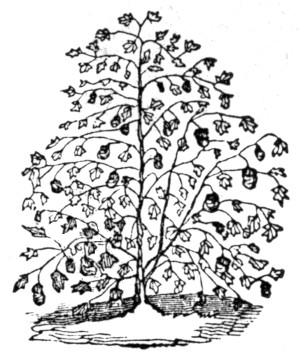
The Cotton Plant.
This plant grows spontaneously in the hot or tropical portions of the globe. It derives its name from the Arabian word Kotôn; and is one of the four great materials designed by Providence for human clothing—flax, wool and silk being the other three. It is remarkable that neither of these useful articles was the natural product of Europe. All were indigenous to Asia. Cotton and flax were also natives of Africa and America.
Cotton, which is the most important of these articles, was the last to be generally diffused. Silk, wool and linen were in use three or four thousand years ago, but cotton was introduced at a later date, and up to the time of our Saviour, was almost unknown as a material for clothing, except in India. Even in the middle ages, we hear no mention of cotton garments in Europe. The Chinese, who have taken the lead in so many arts, did not adopt cotton for use till the eleventh century, though, for four hundred years previous, they had cultivated it as an ornamental shrub in their gardens. Even at the present day, China imports the wool of this plant for manufacture.
Cotton was grown, to a small extent, in the United States, nearly two hundred years ago; but it was not extensively introduced till many years after. In 1786, Mr. Madison, writing to a friend, says, “there is no reason to doubt that the United States will one day become a great cotton producing country.”
In 1792, the whole crop of the country was only 138,328 lbs.; 1795, it was 6,276,300 lbs.; and in 1842, it was 783,221,800 lbs.!!!
About two thirds of this immense quantity goes to Europe, chiefly to England, and some to France. Nearly one third is used in the manufactures of the United States. At Lowell, in Massachusetts, the several establishments make about 75 millions of yards of cotton cloth every year; and use almost 23 millions of pounds of cotton wool, annually.
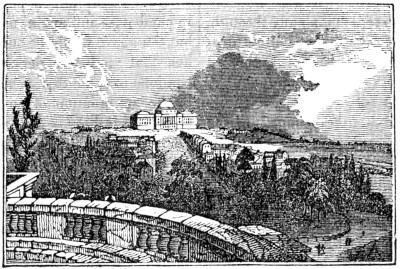
View of Washington.
The Election of President.
What an agitation seems to shake this whole country from Maine to Louisiana! By day we hear the shout of mighty gatherings of the people, and by night, torch-light processions are seen throwing their lights and shadows along the streets. Hickory poles lift their tall tops to the skies on every hand, and flags and streamers are waving in every breeze, and on every side. The names of Polk and Dallas are seen dancing amid the stars and stripes, in one direction, and those of Clay and Frelinghuysen, in another. Even many of the boys and girls have hoisted their flags and play whig and democrat, like their fathers! Perhaps both child and parent, in many cases, know just about as much of what this all means—the one as the other.
It would be a long story to tell all about the election of President; but we must at least say a few words about it. Every four years the people of this country choose a man to rule over this great nation of twenty millions of people. The way the election or choice is made is this: the people of each of the twenty-six states, choose certain persons, called Electors, and these meet together, and cast their votes for President. The person who has the highest number of votes is chosen, and he removes to the city of Washington, where he lives in a fine edifice, called the White House. He holds his office for four years, and then another election of President takes place, as above described.
The two leading candidates for President, at this time, are Henry Clay of Kentucky, and James K. Polk of Tennessee.
Benjamin Constandt.—This celebrated French orator had a cat which was so great a pet that she attended him in the morning before he got up, followed him into his study after breakfast, and played and reposed where she liked. One day, when Constandt was expected to make an important speech in the chamber of deputies, his friends, finding that he was absent after his time from the arena, came to seek him at his house, and going into his study, found him quietly reading some book that had evidently nothing to do with the matter in hand; and when they told him that everybody was waiting for him, “What can I do?” said he; “look there; my cat is sleeping in the sun on the papers I have prepared for my speech, and till she wakes, how can I take her off them?”
Irish Wit.—A poor Irishman, on entering a village in England, observed a board on the corner of the street, prohibiting public begging. He marched straight to the parsonage, and asked to see the minister; after a little hesitation the girl admitted him to the study. Pat immediately slipped up alongside the minister, and whispered into his ear, “Your reverence will please give me something in private, and bad luck catch me if I mention it.” Pat’s plan answered the purpose; the minister was amused at the poor starving fellow before him, and Pat retired from the audience, asking down blessings on the “minister, his wife and childer—good luck to the whole of them!”
He who would reap well, must sow well.
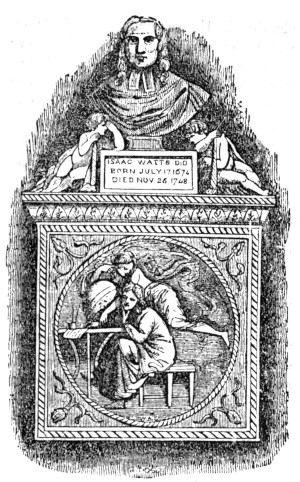
Monument to Dr. Watts.
Dr. Watts.
There are few persons, whose names are recorded in history, to whom mankind are more indebted than Isaac Watts, the author of the Hymns for Infant Minds, and of the version of the Psalms in common use for sacred music. How many thousands of children have had their minds touched with religious emotions, by reading his juvenile rhymes! how many millions of grown up persons have had their piety elevated, by the influence of his sacred songs!
This great and good man was born at Southampton, England, July 17, 1674. He displayed good talents at an early age, and wrote pleasing verses in his childhood. He was educated at London, and became in due time a Dissenting minister. Though his health was always feeble, he discharged his pastoral duties with zeal and fidelity, and found time to write many good books. Those we have already mentioned are the most celebrated, because they have proved to be the most extensively useful.
Dr. Watts’ life affords abundant proof, that a man even of frail constitution, and possessing by no means wonderful genius, may yet do incalculable good to mankind, provided he has a heart warmed with piety toward God, and kind, tender emotions toward his fellow men. How different is such a life, from that of the conqueror, or miser, or lover of pleasure; and how different must be the estimate which the All Wise makes of it, from what he does of the man who lives only for himself—whoever he may be!
Texas.
As the whigs and democrats are talking a great deal about Texas, some of our young readers are desirous of knowing something about it. We therefore propose to give a brief account of it.
This country lies on the Gulf of Mexico, and is bounded on the north and east by the United States, on the south by the Gulf of Mexico, and on the west by Mexico. The people of the republic claim the country to the Rio del Norte on the west. If we take this boundary, its whole extent is about 300,000 square miles, and is eight times as large as New England. It contains nearly 250,000,000 of acres.
The western regions are mountainous, and are said to abound in mineral wealth. The remaining portions of the territory are diversified with hill and dale, though the general aspect has a level character. The rivers are numerous, and the water pure.
Texas presents a variety of soil. This is divided into three kinds, river bottoms, bottom prairies, and high prairies. These are all rich, deep, and productive. The climate of Texas is very fine for a hot country. The low grounds are unwholesome, but the higher portions are otherwise. Snow is seldom known in the southern districts, and the winter seems like our spring.
The productions are numerous. All kinds of grain and garden vegetables thrive here. Besides these, sweet potatoes, sugar cane, tobacco, coffee, indigo, vanilla, cotton, silk, hemp, flax, honey, wax, cochineal, are easily produced. The soil and climate are particularly favorable to cotton. Of this and many other products, two crops may be obtained in a year.
Among the animals, wild horses, buffalo, deer, and a great variety of smaller game are abundant. Gold and silver abound in the mountains, and coal, iron ore, and salt are found in other parts of the country.
Texas formerly belonged to Mexico, but a good many people from the United States having settled there, they began to talk, about ten years ago, of making themselves independent. A convention assembled in March, 1835, and made a declaration to that effect. On the 21st of the following April, a great battle took place, at San Jacinto, in which the Mexican General Santa Anna was defeated and taken prisoner. From this time, the country has remained free from invasion, but Mexico still claims it as a province and threatens to reduce it again to subjection.
The number of inhabitants in all Texas is probably not equal to that of Boston. They are, however, increasing. The people live for the most part in poor huts, but some good houses are to be found. There are a few churches and some schools. But although the climate is fine, and food is abundant, those who go to reside there, from the settled portions of the United States, must live without many of the comforts which they had formerly enjoyed. Slavery is tolerated, and many people do not wish that a new slave region should be added to the United States. The whigs are opposed to its annexation; and the democrats are in favor of it.
The following description of a wedding which took place in 1842, is furnished by a Scotch traveller, and will show how people marry and are given in marriage in this new country.
“After sixteen miles’ journey down a river by moonlight, and as many more across the rough and sea-like bay of Galveston, enlivened by merry jocund talk all the way, we arrived about dawn at the new settlement of the Rock family. It was a large deserted barn or warehouse near Clare Creek. The family was already up and stirring, and engaged in active preparation for the important ceremony; and, to my surprise, the supply of eatables and drinkables was both varied and great—all, however, being presents from the bridegroom, one Luke, a wealthy land owner for Texas, in possession of much cleared ground, and many hundred head of cattle. It may be a matter of surprise that a man well to do in the world should have chosen a bride so every way rude and uneducated; but in Texas women are scarce, and then the lover might have looked far before he could have found a more cheerful and good natured companion, more willing to learn, more likely to be loving, faithful, and true, than Betsy Rock.
“The blushing bride received me in a cotton gown, shoes and stockings, and other articles of civilized clothing previously unknown to her, and in which she felt sufficiently awkward. But Luke had sent them, and Betsy wished to appear somebody on her wedding day. About eight o’clock the visiters began to arrive. First came a boat full of men and women from Galveston, bringing with them a negro fiddler, without whom little could have been done. Then came Dr. Worcester and his lady from St. Leon, in a canoe; after them Col. Brown, from Anahuac, in his dug-out; and, about nine, the bridegroom and four male and an equal number of female companions on horseback, the ladies riding either before or behind the gentlemen on pillions. Ere ten, there were thirty odd persons assembled, when a most substantial breakfast was sat down to, chiefly consisting of game, though pork, beef, coffee, and, rarer still, bread, proved that Luke had had a hand in it.
“This meal being over, the boat in which the party from Galveston had come up, and which was an open craft for sailing or pulling, was put in requisition to convey the bride and bridegroom to the nearest magistrate, there to plight their troth. The distance to be run was six miles with a fair wind going, but dead against us on our return. The party consisted of Luke, who was a young man of powerful frame, but rather unpleasant features; the bride and bride’s maid, (Mary Rock officiating in this capacity,) papa of course, myself as captain, and eight men to pull us back. The breeze was fresh, the craft a smart sailer, the canvass was rap full, and all therefore being in our favor, we reached West Point, the residence of Mr. Parr, the magistrate, in less than an hour.
“We found our Texian Solon about to start in chase of a herd of deer, just reported by his son as visible, and being therefore in a hurry, the necessary formalities were gone through, the fee paid, and the usual document in the possession of the husband in ten minutes. The eye of the old squatter was moistened as he gave his child away; some natural tears she shed, but dried them soon; and presently everybody was as merry as ever.
“No sooner were the formalities concluded, than we returned to the boat, and to our great delight found that, close-hauled, we could almost make the desired spot. The wind had shifted a point, and ere ten minutes, we were again clean full, the tide with us, and the boat walking the waters at a noble rate. All looked upon this as a good omen and were proportionably merrier. About one o’clock Mr. and Mrs. Charles Luke were presented by old Rock to the assembled company at the barn; and, after an embrace from her mother, the bride led the way accompanied by her lord and master, to the dinner table.
“The woods, prairies, and waters, as well as the Galveston market, had all liberally contributed their share of provender. Wild turkeys, ducks, geese, haunches of venison, were displayed, beside roast beaf, pork, red-fish, Irish and sweet potatoes, pumpkin and apple pie, and an abundant supply of whiskey, brandy, and Hollands, without which a fête in Texas is nothing thought of. An hour was consumed in eating and drinking when Sambo was summoned to take his share in the day’s proceedings. Tables, such as they were, were cleared away, the floor swept, partners chosen, and, despite the remonstrance of one of the faculty present, Dr. Worcester, against dancing so shortly after a heavy meal, all present, the dissentient included, began to foot it most nimbly.
“Never was there seen such dancing since the world began, never such laughing, such screaming, such fiddling. Every one took off shoes and stockings. I was compelled to do so, to save the toes of my especial partner, and to the rapid music of the old negro, reels and country dances were rattled off at a most surprising rate. All talked, and joked, and laughed, such couples as were tired retreating to seek refreshment; but the dancing never ceasing, except at rare intervals, when Sambo gave in from sheer fatigue and thirst. Such was the state of things until about nine o’clock, when a sudden diminution in our number was noticed by all present. The bride and bridegroom were missed, as well as the four couples who accompanied Luke. Rushing into the open air, we descried the husband and wife on their fine black horse galloping beneath the pale moon across the prairie, escorted by their friends. A loud shout was given them, and those who remained, returned to the house to renew the dancing which was kept up until a late hour. It was four days after my departure ere I regained my companions at Todville.
“Such was the wedding of one of those hardy pioneers of civilization, whose descendants may yet be members of a great and powerful nation.”
A Physician’s Dog.—An eminent physician of Chenango county, New York, had a faithful dog named Bent, that always attended him in his visits around the neighboring villages. He could never prevail on him to take a place in his vehicle, but he would follow him on foot until the doctor stopped; when, the instant he alighted from the vehicle, Bent would spring in and protect his property. If any one dared to approach the horse, the dog gave him to understand, by a most significant growl, that he must be careful how he trespassed on the rights of his master. At home, when his mistress had been washing, and left her clothes in the yard over night to dry, she had only to call the attention of Bent to the circumstance, and he would keep guard faithfully until morning.
The health of the doctor became seriously impaired, and he made a voyage to Europe with the hope of regaining it. A few days after his departure the dog became very uneasy, and scoured the village in search of him. Having become evidently satisfied that his master was not to be found in the immediate vicinity of his residence, he made an excursion about the country, to the distance of fifty or sixty miles, and stopped at every house where his master had ever been, apparently in the hope of finding him. He was gone nearly three weeks, but finally he came home, and gave up further search in despair. Upon the return of the doctor, the dog manifested his joy in the most sagacious manner. He threw his fore paws around his neck, and embraced him very affectionately. From that moment he was unwilling to go into the kitchen at night, until he had satisfied himself that the doctor had gone to rest. He would insist on entering his bedroom, and would raise himself upon the bed and look in to see if he was there. At the doctor’s death, the dog seemed to be perfectly conscious of the loss he had sustained, and testified his sorrow in so affecting a manner, that it was remarked by every person that saw him.
Generous Revenge.—A young man, desirous of getting rid of his dog, took it along with him to the Seine. He hired a boat, and rowing into the middle of the stream, threw the animal in. The poor creature attempted to climb up the side of the boat, but his master, whose intention was to drown him, constantly pushed him back with his oar. In doing this, he himself fell into the water, and would certainly have been drowned had not the dog, as soon as he saw his master struggling in the stream, suffered the boat to float away, and held him above water, till assistance arrived, and his life was saved.
Prognostics of the Weather.
It is a matter of great convenience, to be able to tell, beforehand, what the weather is to be. Some persons rely upon the Almanac, but let me tell you that anybody can guess at the weather, as well as an Almanac-maker. There are certain signs, however, which foretell changes of weather, many of which have been noticed for thousands of years. Swift says, that
Careful observers may foretell the hour, By sure prognostics, when to dread a shower, &c.
Thus persons who follow the sea, learn to predict, with great certainty, what the weather will be for some time to come. Farmers, and other people also, who live in the country, where the business depends much upon the weather, get to understand the signs which foretell a change with tolerable accuracy.
Dr. Darwin has collected many of these signs in the following verses.
The hollow winds begin to blow; The clouds look black, the glass is low; The soot falls down, the spaniels sleep; And spiders from their cobwebs peep. Last night the sun went pale to bed; The moon in halos hid her head. The boding shepherd heaves a sigh, For, see, a rainbow spans the sky. The walls are damp, the ditches smell, Closed is the light-red pimpernel. Hark! how the chairs and tables crack, Old Betty’s joints are on the rack; Her corns with shooting pains torment her, And to her bed untimely send her. Loud quack the ducks, the sea-fowls cry, The distant hills are looking nigh. How restless are the snorting swine! The busy flies disturb the kine. Low o’er the grass the swallow wings, The cricket, too, how sharp he sings! Puss on the hearth, with velvet paws, Sits wiping o’er her whiskered jaws. The smoke from chimneys right ascends, Then spreading, back to earth it bends. The wind unsteady veers around, Or settling in the south is found. Through the clear stream the fishes rise, And nimbly catch the incautious flies. The glow-worms, numerous, clear, and bright, Illumed the dewy hill last night. At dusk the squalid toad was seen, Like quadruped, stalk o’er the green. The whirling wind the dust obeys, And in the rapid eddy plays. The frog has changed his yellow vest, And in a russet coat is drest. The sky is green, the air is still, The mellow blackbird’s voice is shrill. The dog, so altered is his taste, Quits mutton bones, on grass to feast. Behold the rooks, how odd their flight! They imitate the gliding kite, And seem precipitate to fall, As if they felt the piercing ball. The tender colts on back do lie, Nor heed the traveller passing by. In fiery red the sun doth rise, Then wades through clouds to mount the skies. ’Twill surely rain, we see’t with sorrow, No working in the fields to-morrow.
In order to enable the reader to study the subject of signs of the weather, I will arrange those most relied upon, in alphabetical order, for convenient reference; remarking by the way, that “all signs of rain are said to fail in dry weather.” By this you must understand that the signs here set down are only probable, not infallible, signs.
Aches and Pains in the body, of various kinds, frequently forebode rain. Persons, for example, subject to rheumatism, feel more pain in the affected limb or part of the body before a change of weather, particularly when fair is to be exchanged for wet. Old, carious teeth are also troublesome, and pains in the face, ears, and gums are sometimes experienced. Limbs once broken also ache at the place of their union, and various other aches and pains have been from time immemorial found to be signs of changes of the weather.
Animals, by some peculiar sensibility to electrical or other atmospheric influence, often indicate changes of weather by their peculiar motions and habits.
Ants.—An universal bustle and activity observed in ant hills may be generally regarded as a sign of rain. The ants frequently appear all in motion together and carry their eggs about from place to place.
Asses.—When asses bray more than ordinary, particularly if they shake their ears as if uneasy, it is said they predict rain, and particularly showers. We have noticed, that, in showery weather, a donkey, confined in a yard near the house, has brayed before every shower, and generally some minutes before the rain has fallen, as if some electrical influence, produced by the concentrating power of the approaching rain-cloud, caused a tickling in the windpipe of the animal, just before the shower came up. Whatever this electric state of the air preceding a shower may be, it seems to be the same that causes in other animals some peculiar sensations,—which makes the peacock squall the pintado call “come-back,” and which creates a variety of prognosticative motions in the different species of the animal kingdom.
An expressive English adage says,
When that the ass begins to bray, Be sure we shall have rain that day.
We have, says the writer of the preceding, repeatedly been able to give our hay-makers useful admonitions founded solely on the braying of the ass. Thus the proverb says truly,
’Tis time to cock your hay and corn When the old donkey blows his horn.
Barometer.—There is no instrument now more generally used for ascertaining the coming weather than the barometer. It may however be remarked, that it is more from its rising or falling, than from its height or lowness, that we are to infer fair or foul weather. Generally speaking, the rising of the mercury presages clear fair weather, and its falling, foul weather, as rain, snow, high winds, and storms.
In very hot weather, the falling of the mercury indicates thunder.
In winter, the rising indicates frost, and in frosty weather, if the mercury fall three or four divisions, there will follow a thaw; but in a continued frost, if the mercury rise, it will snow.
When foul weather happens soon after the falling of the mercury, expect but little of it; and, on the contrary, expect but little fair weather when it proves fair shortly after the mercury has risen.
In foul weather, when the mercury rises much and high, and so continues for two or three days before the foul weather is quite over, then expect a continuance of fair weather to follow.
In fair weather, when the mercury falls much and low, and thus continues for two or three days before the rain comes, then expect a great deal of wet, and probably high winds.
The unsettled motion of the mercury denotes uncertain and changeable weather.
The words engraved on the register plate of the barometer, it may be observed, cannot be strictly relied upon to correspond exactly with the state of the weather; though it will in general agree with them as to the mercury rising and falling.
When the thermometer and barometer rise together in summer, with rain in large drops, a wholesome state of the atmosphere is at hand.
A great and sudden rising of the barometer, that is to say, a great accession of atmospherical pressure, will, in some persons, occasion a slight temporary difficulty of hearing and tingling in the ears, similar to that which is experienced in descending from high mountains, or from the air in balloons.
Bats.—When bats return soon to their hiding places, and send forth loud cries, bad weather may be expected.
Beetles flying about late in an evening often foretell a fine day on the morrow.
Blue Sky.—When there is a piece of blue sky seen in the forenoon of a rainy day, big enough, as the proverb says, “to make a Dutchman a pair of breeches,” we shall probably have a fine afternoon.
Calm.—A dead calm often precedes a violent gale; and sometimes the calmest and clearest mornings, in certain seasons, are followed by a blowing showery day. Calms are forerunners of the hurricanes of the West Indies, and other tropical climes.
Candles, as well as lamps, often afford good prognostics of weather. When the flames of candles flare and snap, or burn with an unsteady or dim light, rain, and frequently wind also, are found to follow. The excrescences from the wicks called funguses also denote rain and wind.
Cats are said, when they wash their faces, or when they seem sleepy and dull, to foretell rain. The same is said of them when they appear irritable and restless, and play with their tails.
Cattle, when they gambol about in their pastures more than ordinary, foreshow rain, and in general a change of weather.
Chilliness, and a sensation of cold greater than the indication of temperature by the thermometer leads us to expect, often forebode rain, as they show that there is already an increased moisture in the air, which experience has shown to be referable to the decomposition and the first formation of cloud.
Clouds of any sort, when they increase much, portend rain, particularly at eventide; when they are very red they often foreshow wind; when they form a dapple-gray sky, with north wind, fair weather; when they rapidly form and evaporate, variable weather. Clouds, fretted and spotted, covering the sky after fine weather, or wavy, like the undulation of the sea, forbode rain.
Colors, of various kinds in the sky and clouds, tokens severally of different phenomena. Much red always forebodes wind and rain, particularly in the morning; in the evening it sometimes indicates a fine day, particularly if the morning be gray. A proverb says,
An evening red and a morning gray Will set the traveller on his way; But an evening gray and a morning red Will pour down rain on the pilgrim’s head.
A greenish color of the sky near to the horizon, often shows that we may expect more wet weather. The most beautiful and varied tints are seen in autumn, and in that season the purple of the falling leaf is often a sign of a continuation of fine weather.
When the clouds become more colored than ordinary, and particularly when red prevails, it sometimes indicates an east wind.
Cocks, when they crow at unwonted hours, often foretell a change of weather. We have often noticed this before rain. But this is by no means so certain a sign as many others; because, at particular seasons, and in particular kinds of weather, cocks habitually crow all day. During the calm, still, dry, dark, and warm weather sometimes occurring in the winter months, and which may be called the halcyon days of our climate, cocks keep a constant crowing all night and day. There appear to be three principal cock crowings in ordinary weather, namely, about midnight or soon after, about three in the morning, and at daybreak; the latter is never omitted.
We have noticed, however, that when cocks crow all day, in summer particularly, a change to rain has frequently followed.
Cream and Milk, when they turn sour in the night, often indicate thereby that thunder storms will probably shortly take place. The effect is referable to the electricity of the air at the time.
Currents of Air change their course frequently in the higher regions of the air first, and are afterwards continued to the earth’s surface; hence we can often foresee a change of the wind by observing the way in which the clouds above move. Both the strength of a coming gale, and the point of the compass from which it will blow, may usually be foreseen some time beforehand by noticing the velocity and direction of the clouds floating along in the upper current, or by means of balloons.
Dolphins or porpoises, when they come about a ship, and sport and gambol on the surface of the water, betoken a storm; hence they are regarded as unlucky omens for sailors. According to ancient fable, they formerly offered themselves in times of storm to convey shipwrecked mariners to the shore; but this is, of course, a story of mere human invention.
Dogs, before rain, grow sleepy and dull, and lie drowsily before the fire, and are not easily aroused. They also often eat grass, which indicates that their stomachs, like ours, are apt to be disturbed before a change of weather. It is also said to be a sign of change of weather when dogs howl and bark much in the night; they certainly do this much at the full moon, which has given rise to the saying relative to the dogs that bay at the moon. Dogs also dig in the earth with their feet before rain, and often make deep holes in the ground.
Dreams of a hurrying and frightful nature, also incubus, and other symptoms of oppressed and imperfect sleep, are frequent indications that the weather is changed or about to change. Many persons experience these nocturnal symptoms on a change of wind, particularly when it becomes east. In all these cases the effect seems to be produced immediately on the nervous system, and through it on the stomach, so that the stomach shall again re-act on the sensorium.
Drains, and sespools smell stronger than usual before rain.
Drowsiness and heavy sleep, both in men and animals, often forebode a heavy fall of rain or snow.
Ducks.—The loud and clamorous quackings of ducks, geese, and other waterfowl, are signs of rain. It is also a sign of rain when they wash themselves, and flutter about in the water more than usual.
Ears, when there is a tingling noise, or what is called a singing in them, afford thereby a sign of a change of weather, not simply of rain, as has been said, but of barometrical pressure in general. The sudden increase of pressure, like the descent from high mountains, or from balloons, causes in many persons a temporary deafness and roaring in the ears.
Feathers, pieces of flue, or dry leaves, playing about on the surface of ponds and other waters, as if agitated by light and varying eddies of wind, often forebode rain.
Fishes, when they bite more readily, and gambol near the surface of the streams or ponds, foreshow rain.
Flowers are many of them excellent indicators of the approaching weather by their opening and shutting, and other motions.
Fleeces, and Mares’ Tails, as they are called, seen in the sky, are signs of rain and wind. By fleeces are meant those clouds which look like fleeces of wool.
Flies, and various sorts of volatile insects, become more troublesome, and sting and bite more than usual before, as well as in the intervals of rainy weather, particularly in autumn, when they are very numerous, and often become a great nuisance. This observation applies to several sorts of flies. The horse-flies likewise of all sorts are more troublesome before the fall of rain, and particularly when the weather is warm.
Forests.—The hollow sound of forests, while the wind is roaring among the woods, is a sign of rain and of storms.
Geese washing, or taking wing with a clamorous noise, and flying to the water, portend rain. Geese, by the way, are excellent guards to a house against fire or thieves.
Gnats afford several indications.—When they fly in a vortex in the beams of the setting sun, they forebode fair weather: when they frisk about more widely in the open air at eventide, they foreshow heat; and when they assemble under trees, and bite more than usual, they indicate rain.
Halo.—When this phenomenon is observed round the sun or moon, it shows that hail, snow, or rain, according to the season, will soon follow. Colored or double halos are still more certain indications of rain, and often of wind also. When mock suns or mock moons, bands of light, and other unusual phenomena attend halos, a peculiar condition of the atmosphere is indicated. The proper halo or luminous ring, is distinguished from the corona or luminous disk, which is sometimes a forerunner of rain also, but is a thing of more frequent occurrence. When halos are very red, wind almost always follows.
Headaches often foretell a change of weather in persons subject to such complaints. There is also some obscure change of weather near to the periods of new and full moon, which causes a certain ephemeral headache that begins usually in the morning, gets worse about two o’clock, and subsides in the evening, attended with an irritated stomach; it much resembles the ordinary bilious headache from repletion, but differs from that which follows immediately on a certain sort of indigestion. Indeed, most periodical disorders seem to be connected with some atmospheric changes. And it is very remarkable, that they should so often have their worst paroxysms and the crisis of their terms, about the time of the conjunction and the opposition of the moon.
Hogs, when they shake the stalks of corn and spoil them, often indicate rain: also when they rub in the dust, the same or some similar phenomenon may be expected. When they run squeaking about, and throw up their heads with a peculiar jerk, windy weather is about to commence: hence the Wiltshire proverb, that “Pigs can see the wind.”
Horses, as well as some other domestic animals, foretell the coming of rain by starting more than ordinary, and appearing in other respects restless and uneasy on the road.
Incubus or nightmare, though it commonly comes of a loaded stomach, will nevertheless often occur on the occasion of a change of weather in the night, which seems to produce the effect by disturbing the digestive organs. The same observation holds good with regard to those frightful and impressive dreams which some persons have in particular kinds of weather, and about the period of change.
Lamps, from the manner in which they burn, forebode change of weather. Before rain they burn less bright, the flame snaps and crackles, and a sort of fungous excrescence grows from the wicks, which Virgil was mindful to put among his prognostics of rain and wind.
Mare’s Tails, or cormoid curlclouds in the sky, forebode wind, and sometimes rain.
Moon.—The prognostics from the looks of the moon are various, and were known of old. When she looks fiery, or red, like the color of copper, wind is generally to be suspected; when pale, or confused with ill-defined edges, rain; when very clear and bright, fine weather.
When the moon is near the full, or new, people are more irritable than at other times, and headaches and diseases of various kinds are worse. Insanity at these times has its worst paroxysms, and hence the origin of the term lunacy. Timber cut in the last quarter of the moon is said to be much the most durable. About the time of full moon the weather is generally fair. The changes of the moon are supposed to bring changes of weather.
Thus we have given a chapter upon signs, and, although they are not all to be relied upon, they may be worthy of notice.
“Job Printing—Job Printing!” exclaimed an old woman, the other day, as she peeped over her specs at the advertising page of a country paper—“Poor Job; they’ve kept him printing, week after week, ever since I first larnt to read, and if he wasn’t the most patientest man that ever was, he never could have stood it as long, nohow!”
[Audio content is not currently supported on your device.
The Bird of Paradise.
A SONG. WORDS BY MARY HOWITT. MUSIC BY G. J. WEBB.
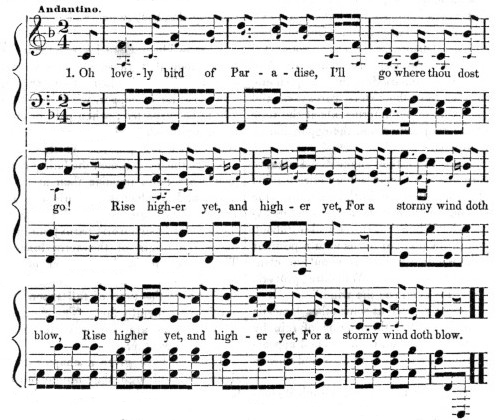
1. Oh lovely bird of Paradise, I’ll go where thou dost go! Rise higher yet, and higher yet, For a stormy wind doth blow, Rise higher yet, and higher yet, For a stormy wind doth blow. Now up above the tempest, We are sailing in the calm, Amid the golden sunshine, And where the air is balm. Oh gentle bird of Paradise, Thy happy lot I’ll share; And go where’er thou goest On through the sunny air. Whate’er the food thou eatest, Bird, I will eat it too; And ere it reach the stormy earth Will drink with thee the dew! Is thy nest made of the sunshine, And the fragrance of the spice, And cradled round with happiness, Sweet bird of Paradise?
MERRY’S MUSEUM.
Vol. VIII. DECEMBER, 1844. No. 6.
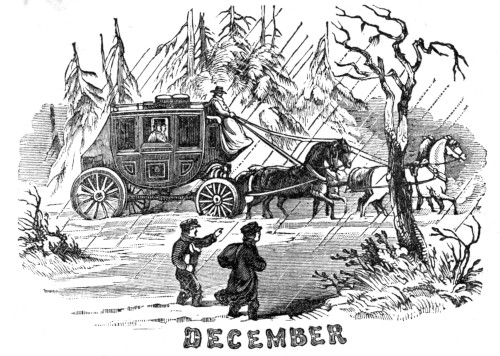
The autumn is past, and winter is upon us. Come, boys, get your caps and mittens, your greatcoats and your thick shoes; come, girls, put on your wadded hoods and your warm shawls, and let us have a ramble.
How changed is the aspect of everything around us! The trees have put off their garments; the flowers have perished; the green grass is withered and dead. How silent is the forest! Of all the merry songsters that made it ring with joyous music, not one remains behind. Even the partridge and the quail have retired to the thick woods, and left their wonted haunts alone and desolate. Even the squirrel now lies late in the morning, and retires early to bed, seeming to take little pleasure in scampering about the woods, now that he has them all to himself.
December is indeed a chill and blustering month; and here in New England, we might almost envy our friends of Georgia, Alabama and Louisiana, where the weather is still mild and pleasant. However, in a few days the snow will come, and the merry sleigh bells will remind us of winter sports,—of snowballing, building snow forts, sliding, skating and coasting. Nor are these the only pleasures of winter in our northern climate. When the day’s sport is done, how pleasant it is to gather around the fire-side; to play blind man’s buff; to tell stories, study the lessons for school, and read Merry’s Museum. After all, winter has its comforts as well as summer.
Hot Water.—An Irish servant discovering one morning that a part of the wood work of the kitchen chimney was on fire, rushed up stairs to his master with the alarming intelligence. Down the master ran, to see the state of the matter. A large kettle of water was upon the fire. “Why, Pat, why don’t you put it out? there’s plenty of water close by.” “I can’t sure; would your honor have me to pour boiling water on it sure?”
There is a small house in the upper part of the city of New York, on which are two signs, put there some years since by a Dutchman. They run thus:
“Apartments to let, either fried, stewed, raw, roasted, or in the shell.”
“Oysters can be furnished with meals and lodgings at $2 per day.”
Flowers.
The love of flowers seems to be universal; even children admire them, and to form a bouquet seems to be almost as natural as to put food into the mouth. The Indians of Mexico, barbarians as they were in many things, were passionately fond of flowers. Even to this day you may see, in the city of Mexico, the Indians, reduced to a state of poverty and degradation, still retaining the passion which marked them in the days of Montezuma. In their stalls where they sell fruits and vegetables, they seem almost smothered with flowers, which are every day renewed.
But there is an interest in flowers beyond their mere beauty. However graceful their forms, however charming their colors, or sweet their perfume, there is still more pleasure to be derived from the study of them in respect to their botanical characters, their formation, their mode of propagation, &c. A person, in looking over a meadow, might fancy that all was confusion, but if he will investigate the subject, he will soon discover that all these various plants can be grouped into certain families, bearing the most curious and interesting relations to each other.
We cannot, therefore, too earnestly recommend the scientific study of plants to our young readers. It is not only an innocent and pleasing pursuit—it not only leads to much useful knowledge, but it lifts the heart in admiration to that great and good Being, who, in providing for the wants of his creatures, has mingled beauty and pleasure with almost every cup of life.
A perfect orchestra consists of eighty-two stringed instruments, twenty-two wind instruments, and one hundred and forty-six voices; in all, two hundred and fifty, with an organ.
Dick Boldhero.
CHAPTER XI.
We continued our journey with great industry, generally travelling about forty miles a day. My Indian guide had the usual taciturnity of his race, but occasionally he entered into conversation, and I then discovered that he had led a life of adventure, and possessed the happy talent of describing what he had seen. I had by this time acquired a knowledge of the Spanish language, and I therefore found his narratives quite a resource during the tedious hours during which we seemed to be creeping like snails over the almost interminable plain.
He had frequently officiated before as a guide over the road we were now travelling, and he gave me an account of several occurrences in which he had taken part, which might have graced the pages of romance.
It appears that the Pampas are inhabited by a peculiar race of men, called Gauchos. These are the descendants of Spaniards of wild and irregular character, who had fled from civilized society and settled upon the plains, subsisting almost entirely by hunting and rearing cattle. The son followed the vocation of the father, and thus several succeeding generations of hunters had been scattered over these prairies. At the time of which I am speaking, they consisted of considerable numbers of people, though they lived apart from each other in families, dwelling in small huts, and spending the greater part of their time on horseback. These men generally respected travellers, but occasionally they would take to the highway and commit desperate acts of robbery.
There were small bands of Indians, also, whose homes were along the southern borders of the Pampas, but possessing fleet horses, they occasionally made incursions even into remote portions of the plains, and after having struck a sudden blow upon some unprotected family, they would speed to another and another, marking their route with blood and conflagration. Of these wild and savage people, my guide told me various anecdotes. I have not space to recount them, but in order to give an idea of the scenes which are constantly occurring in this remote region of the world, I will repeat one of the tales which he told me.
A few years previous to the period of which I am speaking, a wealthy Spanish gentleman, with his daughter about eighteen years of age, was travelling from Chili to Buenos Ayres. They were in a carriage drawn by four horses, and were attended by several servants, two of whom were on horseback. One night, as they were passing through a thicket of tall grass, a terrible cry burst upon their ears, and at the same moment about a dozen savages sprung from their lurking places, and immediately assailed the travelling party. The servants who were armed discharged their pistols, but they were speedily torn from their horses; the coachman was knocked from his seat, and the two post-boys in their fright ran away. The gentleman in the coach threw open the door and rushed out; but at the moment, he was laid prostrate, by a blow, upon the earth.
Frightened at the sounds around them, the horses in the carriage began to rear and plunge, and then, suddenly springing forward, ran with all their might. In a few moments, they were lost to the view, but the rattling of the wheels was heard for a time, and was then suddenly terminated by a heavy and crashing sound.
The pockets of the travellers were soon rifled, and the Indians then departed in pursuit of the coach, leaving two of the servants who had been engaged in the fray dead upon the spot, and the Spanish gentleman himself stunned by the blows he had received.
At the distance of two miles, the savages found the coach overturned, and reduced to a mere wreck. The young lady within, overcome with terror, was in a state of insensibility. Being taken out, she was speedily restored. The coach was then rifled, and the lady being placed on horseback before one of the savages, the party pushed forward across the prairie in a southerly direction.
In the course of four days, they reached their settlements, and the young lady, whose name was Donna Marina, was committed to the charge of a daughter of one of the savage chiefs. Worn out with fatigue and anxiety, she seemed at first indifferent to her fate; but in the course of a few days, having recovered her health and spirits, she became desirous of knowing the fate that awaited her. She then learned that a messenger was to be despatched to Buenos Ayres, where, it was ascertained, her father had arrived, proposing to surrender his daughter for a ransom of 5000 dollars.
Understanding from the savage maiden under whose care she was placed, that no personal injury to herself was intended, she became tolerably calm. But it chanced that there was among the Indians a fiery young warrior, whose father was a Spaniard, his mother being an Indian. He was born at one of the Spanish huts in the vicinity of Buenos Ayres, and in his early days had acquired a taste for the refinements of civilized life. But his natural daring and love of adventure had led him to join the wild inhabitants of the Pampas, among whom he had now become a celebrated leader.
At this period, he was in the bloom of early manhood, and was remarkable alike for the symmetry of his form, the grace of his movements, and the manly beauty of his countenance. Among the women of the tribe, he was an object of universal regard, on account of his fine appearance, and even the stern old warriors could not withhold their admiration at his achievements in the foray and the field. Thus an object of universal adulation, it may well be supposed that the young warrior, whose name was Yorika, had a pretty high estimate of himself. He was not of the party who had captured the fair Marina; but when he heard of the beauty of the maiden, he sought an opportunity to see her. His wishes were easily gratified by means of a little flattery bestowed upon her keeper. Vanity had led the youthful Indian to seek the interview, but a deeper sentiment led him frequently to renew it.
The beauty of the captive stole into his heart, and doubtless, her gentle manners awakened his recollections of scenes that had been familiar in his childhood. At all events, he was deeply enamored of the Spanish maiden, and did not hesitate to avow his passion. His overtures, however, were sternly repelled; and, stung to the quick, the fiery savage determined to obtain by force the maiden he could not win by affection.
During these events, the messenger had communicated with the father of Donna Marina at Buenos Ayres, and brought a favorable answer to the proposition of ransom. In two days a gentleman was to arrive at a designated point to pay the required sum and receive the captive. Preparations were immediately made to carry the treaty into effect, and in due time four men were despatched with Donna Marina to meet the Spanish agent. Yorika had been designated as one of this party, but he excused himself, seeming to disdain a service which offered so little of enterprize or adventure.
The party set forward, and at the place of meeting found the person whom they expected, already in attendance. The negotiation was speedily settled, the money paid and the captive surrendered. The savages, and the Spanish maiden, now under the charge of her affianced lover, also departed. The latter were mounted on horseback, and by the light of a summer moon they made their way across the plain. Rejoicing in their reunion after the distressing events which had transpired, they rode side by side, their hearts being often too full for utterance.
At length their path led them into a shallow vale thickly overgrown with wild thistles. As they were passing through this, a pistol was fired, and a ball whizzed near the breast of the attendant of Donna Marina. A moment after, the athletic form of Yorika rose from the thicket and sprung like a lion upon the object at which his pistol had been aimed. The Spaniard was immediately pulled from his horse, and a desperate conflict ensued. The superior strength of the Indian, however, prevailed, and he soon pressed the form of his antagonist beneath him. He drew his dirk, and was about to plunge it into the breast of his foe.