PORT BURWELL TO FULLERTON AND BACK.
Reading edition
Having crossed the mouth of Ungava bay, a strong headwind greatly delaying the ship, we put into Wakeham bay on the south side of the strait, to test its capabilities as a harbour. A fine clear passage was found into the bay on a line from the east end of Prince of Wales island to the centre of the inlet; there are a few low shoals on both sides of this line, but all are well beyond the course. A high, rounded point connected by a sandy neck to the south side of the bay forms an excellent protected anchorage just inside the heads. A second anchorage was found about five miles farther up on the same side, opposite to an Eskimo encampment and close to a good stream of water. Anchoring at the lower place, we were visited in the evening by a number of natives from the encampment. Several books, given for distribution by the Rev. Mr. Peck, were handed out to them, and they immediately held on deck a service of song and prayer. These natives had never seen a missionary, but had learned to read from others at Fort Chimo who had come in contact with the missionaries on the east coast of Hudson bay.
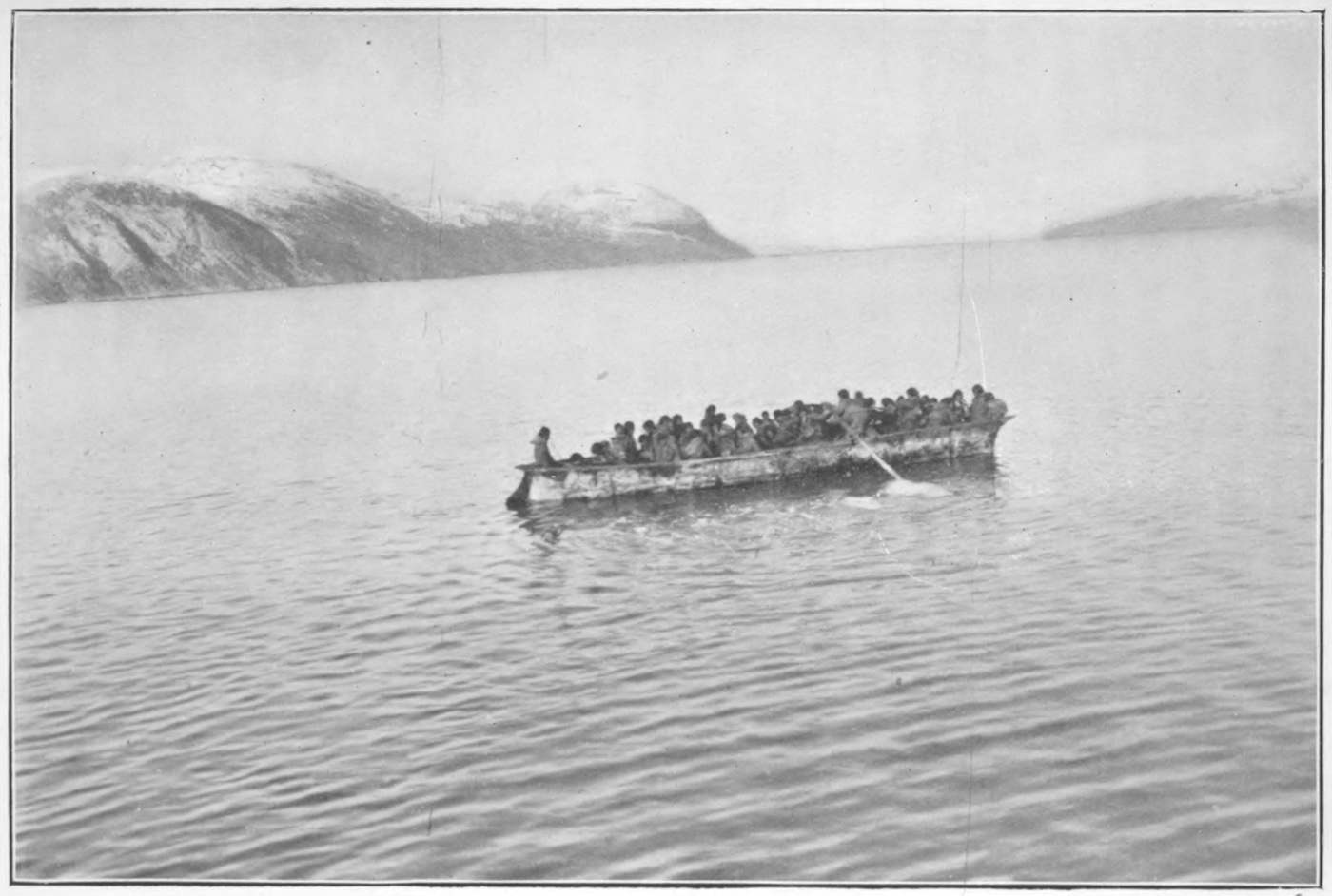
Women’s Boat at Wakeham Bay.
A pilot, well acquainted with the southern coast of the strait as far as Cape Wolstenholme, agreed to accompany us to Fullerton and return again on the ship.
We started early in the morning of the 8th, and passed through King George sound, reaching Douglas harbour at eight o’clock, where we were boarded by two natives, each in his kyak, one of which contained a bear lately killed. A number of walrus were seen about the small islands a few miles east of Douglas harbour. Continuing close to the coast, shallow water was encountered while passing inside of Joy island, a few miles east of Cape Weggs, where suspiciously low islands fringe the shore. After considerable difficulty had been experienced in extricating the ship from this dangerous position, deeper water was followed to the cape, when the course was laid for Charles island. While steaming along the island next morning a ship was seen passing out of the strait, but too far away to signal. She afterwards proved to be the Strom, belonging to the French Fur Company.
The walrus, so plentiful last year about the western end of the island, were now absent; consequently we were unable to obtain a supply of dog-food for Fullerton. The course was next directed southward for Deception bay, in the mainland, opposite the western end of Charles island. When within a few miles of its mouth the water became shallow and the bottom uneven, so that the bay could only be approached with safety by sending the launch ahead to sound. It was thought that too much precious time would be lost in this undertaking, especially as it was known that a good harbour existed in the bay, where the whaler Arctic had twice anchored, so we passed westward close to the land in order to correct the survey made during the night on the trip eastward. About thirty miles west of Deception bay the mouth of another long narrow inlet, known as Sugluk bay, was entered, and the ship continued five miles up it looking for a convenient place for water. A shallow place was crossed at the mouth of the bay, probably due to the ship being too close to the eastern shore, but, inside, the water was found to be very deep, and an anchorage could only be obtained on the edge of the narrow mud banks close under the rocky cliffs of both shores.
In the small launch, the survey of the bay was continued to its head, some five miles beyond, where the ship anchored. At the head of the bay three families of natives were found, living in a state of destitution. This was their first direct contact with white men; they were somewhat shy and frightened, but a present of tobacco and biscuit soon made all good friends. These people do not visit any of the far away trading posts, but trade their furs with their neighbours on the east or west for guns and other articles of civilization.
Considerable difficulty was experienced returning against a very strong tide, and the ship was not reached until long after dark.
The following afternoon the remainder of the south coast was surveyed to Cape Wolstenholme, where we arrived at dark; then the ship was headed north across the strait for Salisbury island, the eastern end of which was reached early next morning. Following close along the steep rocky shores of the northern side, the northeast point was reached at noon. The weather throughout the morning had been bad, a strong northwest breeze bringing down frequent heavy blinding showers of snow. These showers became almost continuous, and towards noon only momentary glimpses of the land were to be obtained at long intervals. The tides here are very swift, and when the sky cleared a strong ice-glint was to be seen ahead. It was considered dangerous to attempt to enter the ice in such weather, with the unknown Mill islands directly in the course; we therefore turned back to pass south of Nottingham island. This decision proved wise, for next day the whole mouth of Fox channel was found completely filled with heavy ice drifted south from the northern parts of that channel. The condition of the Neptune’s stem did not warrant any contact with the ice that could possibly be avoided.
The northern side of Salisbury island rises directly from the water in granite cliffs to elevations varying from 500 to 1,000 feet. The surface of the island appears to be very rugged and barren. As a rule the shores are without harbours along this side, but at both ends there are deep bays protected by rocky islands, where safe harbours would be found if the water did not prove too deep. In all of the many soundings taken along the island, no bottom was obtained at two hundred and twenty fathoms; this is consequently the deepest water in Hudson bay and strait. Two large icebergs were grounded off the eastern end of the island, while a third very large one had penetrated to the head of the bay at the northeastern end and was aground close under the rocks. As these bergs must have come from Davis strait, there being no glaciers on the lands fronting on Hudson bay, they show a strong current from the eastward along the northern side of the strait.
On the 13th, having rounded Salisbury and Nottingham during the night, ice was met with at nine in the morning, twenty-five miles to the westward of the last mentioned island. The course was changed to south of west to skirt the edge of this great pack, and as it continued unbroken to the westward, the idea of passing through Fisher strait was abandoned, and the course was laid to the southward of Coats island. The passage was encumbered by ice until dark, when the ship lay-to awaiting daylight. The low southern shore of Coats was then followed westward to Cape Southampton, after which we headed away direct for Fullerton. When within a few miles of that place, on the evening of the 15th, we came up with the Scotch whaler Active, now bound homeward from Repulse bay. Captain Murray came on board, seeking the doctor. From him we learned that the Active had passed us, on our way out, on the 20th of July, when leaving the eastern entrance to Evans strait. She had come in early in the month, and after landing a number of miners at Lake harbour, on the north side of the strait close to the eastern end of Big island, had taken on board a large number of Eskimos from that place and from the vicinity of Kings cape, at the entrance to Fox channel. Great difficulty had been experienced in the ice while crossing Fox channel. Subsequently, little ice was met with until the ship reached Repulse bay, which was still solidly frozen, so that the Active did not get into the harbour there until the 10th of August. Frozen strait remained full of ice all the season. The Active and the whaling station in connection with it at Repulse bay both had a successful season. The catch of the steamer included thirty-three white whales, thirty-six walrus, and one Right whale affording 1,300 pounds of bone. The returns of the station were twenty-eight musk-ox skins, thirty white whales, and one small Right whale with 500 pounds of bone. In 1903 the combined catch included five Right whales with a total of 40,000 pounds of bone.
The Active on her way out would pass through Fisher strait, in order to hunt walrus at Walrus island and on the floating ice on the eastern side of Fox channel. Part of the large crew of natives would be put ashore at Kings cape and the remainder at the mica mine, where the results of the season’s mining, some thirteen tons, would be taken on board, together with the white men there, and the ship would leave for home about the 1st of October.
The Era had been met in Repulse bay, and had at that time not added to her catch since we left Fullerton. Captain Comer was again to winter in Fullerton harbour, and was on his way south to go into winter quarters. Including the crew, the Active had one hundred and twenty-three persons on board; the ship is quite small, and the accommodation and crowding can be imagined.
Fullerton was reached next morning, and we were soon boarded by the police detachment and our old Eskimo friends of the past winter. During our absence Staff-Sergeant Dee had made an exciting trip to Repulse bay in a whaleboat manned by natives.
The day after our arrival the Era entered the harbour, and Captain Comer reported the lack of success mentioned above.
We remained at Fullerton until the 25th, being busily employed in the meantime with landing provisions and coals for the police, shifting coal, and taking aboard ballast. Two of the policemen who had been left here in the spring were found to be seriously ill, and on the doctor’s certificate were taken on board invalided home.
The homeward voyage from Fullerton to Port Burwell was made in fine weather, and the only incident requiring mention was that the ice from Fox channel had advanced southward and westward nearly twenty miles since we last saw it. This necessitated our keeping close to Mansfield island. Our pilot was safely returned to his home in Wakeham bay, and Port Burwell was reached on the 1st of October.
The ship had not been at anchor in the harbour for an hour, when the Arctic, with Major Moodie and Captain Bernier, came in. Major Moodie brought the welcome word of recall to the Neptune, and after procuring some articles of equipment from us left again that evening, being in a great hurry to reach Fullerton before the harbour froze over.
A heavy gale of southeast wind kept us in the harbour until the morning of the 4th, when we rounded Cape Chidley and turned south bound for home. A fine passage was made down the Labrador coast, and on the evening of the 7th we reached Chateau, where telegrams were sent announcing our safe arrival. The trip across the Gulf of St. Lawrence and along the coast of Nova Scotia was rough. We arrived in Halifax on the 12th, looking somewhat weather-beaten, as was only natural after nearly fifteen months’ absence.
I cannot close this narrative without expressing the deep feelings of gratitude I bear towards Captain Bartlett and the officers and crew of the Neptune, for their unfailing and cheerful attention to duty throughout the voyage, an attention which rendered my leadership both easy and enjoyable.
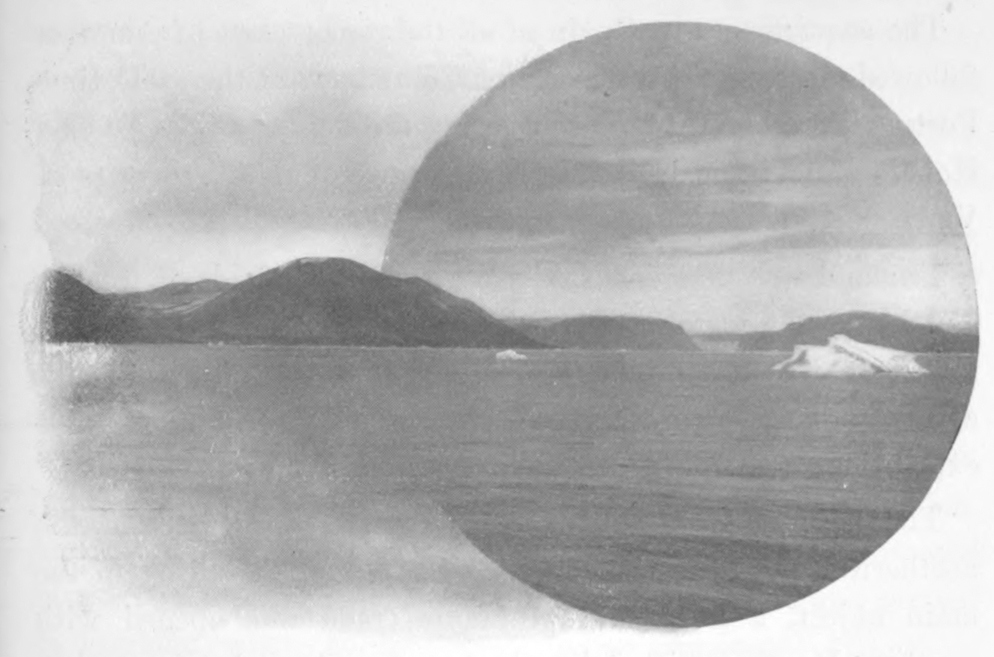
South Coast of North Devon Island.