Chapter II · WINTER QUARTERS AT FULLERTON.
Reading edition
The Neptune had safely arrived at Fullerton harbour on the 23rd September, and had dropped anchor close alongside the Era. Major Moodie, after looking over the ground, decided to erect a Police Post on the large island at the rear of the harbour. The lumber for the building was immediately landed, and before the ship left for Chesterfield inlet the frame of the dwelling had been erected and its sides partly boarded.
The harbour of Fullerton is formed by a number of small islands, situated on the east side at the mouth of a long bay, and about five miles from Cape Fullerton, at the entrance to Roes Welcome. The harbour is quite small, with room for about three ships, and is fully protected by the islands and reefs surrounding it. The usual entrance is from the westward, where the channel is not above fifty yards wide, and the water at high tide is only five fathoms deep. The eastern entrance is narrower, and a ship is obliged to make several sharp turns when passing through it. Owing to the low even coast, without any landmark in the vicinity, the position of the harbour is difficult to locate without entering the wide danger-zone of shoals. The wide fringe of islands to the westward practically ends at Fullerton, so that a ship making the coast may know the position by the presence or absence of islands; but as the islands are very low it is hard to distinguish them from the mainland at a safe distance away, as the shoals and reefs extend more than five miles beyond the harbour. The surveys made in the spring of 1904 show that a fairly safe channel will be found by keeping well to the eastward of the harbour, and by then following a northwest course, keeping in line the beacons on a small island about a mile outside the harbour. When the Beacon island is reached the ship should pass in mid-channel between it and the adjoining island to the westward; passing these, the outer harbour island should be given a wide berth, until the entrance to the harbour is opened fully, a long shoal extending from the western point of the island.
On the return of the Neptune to Fullerton, immediate preparations were made for the coming winter. The first undertaking was the cutting of a large quantity of ice, from a fresh-water pond close to the house and about a mile distant from the ship. The ice was about nine inches thick, and one day’s work, by the entire crew, sufficed to cut and to store enough to supply the ship with fresh water until the ponds melted again in the spring. The detachment of Mounted Police, assisted by some of the crew of the Era, were busily engaged in finishing their house and shed. Floating ice soon hampered landing operations. On the 17th October the ice in the harbour set fast and, soon after, the work of transporting materials to and from the shore was done with sleds.
By the end of the month, the ship had been placed in a north-and-south position, so that her bow faced north into the prevailing cold winds. The decks were covered with a temporary roof, made from a part of the lumber intended for the police buildings. This housing kept the snow from the decks, and greatly increased the inclosed space on the ship. It later proved so comfortable that the carpenter worked in it, almost without interruption, throughout the winter, at the repairs to the launch. The house and shed were made weather-proof, and a supply of provisions and outfit, sufficient to keep the ship’s company until the following summer, was stored in them, as a precaution against the destruction of the ship by fire. The galley was moved from the deck to between-decks, and the range connected with two large copper tanks, in which the daily supply of ice was melted; at the same time all the provisions likely to be injured by frost were stored alongside the range. All the oil and powder were stored on an island away from the provisions, and the boats placed either on shore, or on the ice alongside the ship.
Shortly after our arrival the natives congregated about the ships, and to avoid misunderstanding, an agreement was made with Captain Comer, that he should care for the Aivillik tribe, while the Kenipitu tribe would belong to the Neptune. By this arrangement, about a dozen able-bodied men and their families fell to our portion, and about double that number to the Era. The men were employed, during our stay at Fullerton, in banking the ship with snow, hauling ice and other necessary outside work. Several of them hunted continuously, and at small cost kept the ship in fresh caribou meat throughout the winter. They received little pay beyond their food, which consisted chiefly of the scraps left from the meals.
Dr. Faribault had shown signs of mild insanity, almost from the time of leaving Halifax. On the 1st of November he became violently insane, when, on the advice of Dr. Borden, he was placed in charge of the police as a dangerous lunatic. The poor man had to be confined in a cell, and watched continuously. His condition became worse and worse, until he was happily released by death on the 27th of April following.
As soon as the ice became sufficiently thick to bear the load, a wall of snow about three feet thick was erected around the ship, and raised to the top of the temporary decking. Sails, spread on the roof, were covered with about a foot of snow. By these means all draughts were effectually kept out of the ship, and the temperature of the interior was raised several degrees. Holes were cut in the banking to allow light to enter the ports and windows, and snow porches were erected over the exits on each side; the deep holes at the ports resembled embrasures, and the general appearance of the ship was that of a floating fort.
When the labour for preparing for the winter was finished, the ordinary work about the ship was hardly enough to keep the crew in health, and all were encouraged to hunt or attend lines of fox-traps for exercise. This proved much better than formal exercise at stated times, and the general health remained good throughout this long period of enforced idleness.
Only two meals were cooked daily during the short days of mid-winter, breakfast being at ten and dinner at four, an informal supper being provided in the evening.
Games and cards were provided for the use of all; musical instruments, including a piano, were in frequent use, while a weekly lecture, dance and newspaper went far to agreeably pass away the long winter evenings, which were further relieved by visits between the ships, and to the snowhouses of the natives built on the ice close alongside.
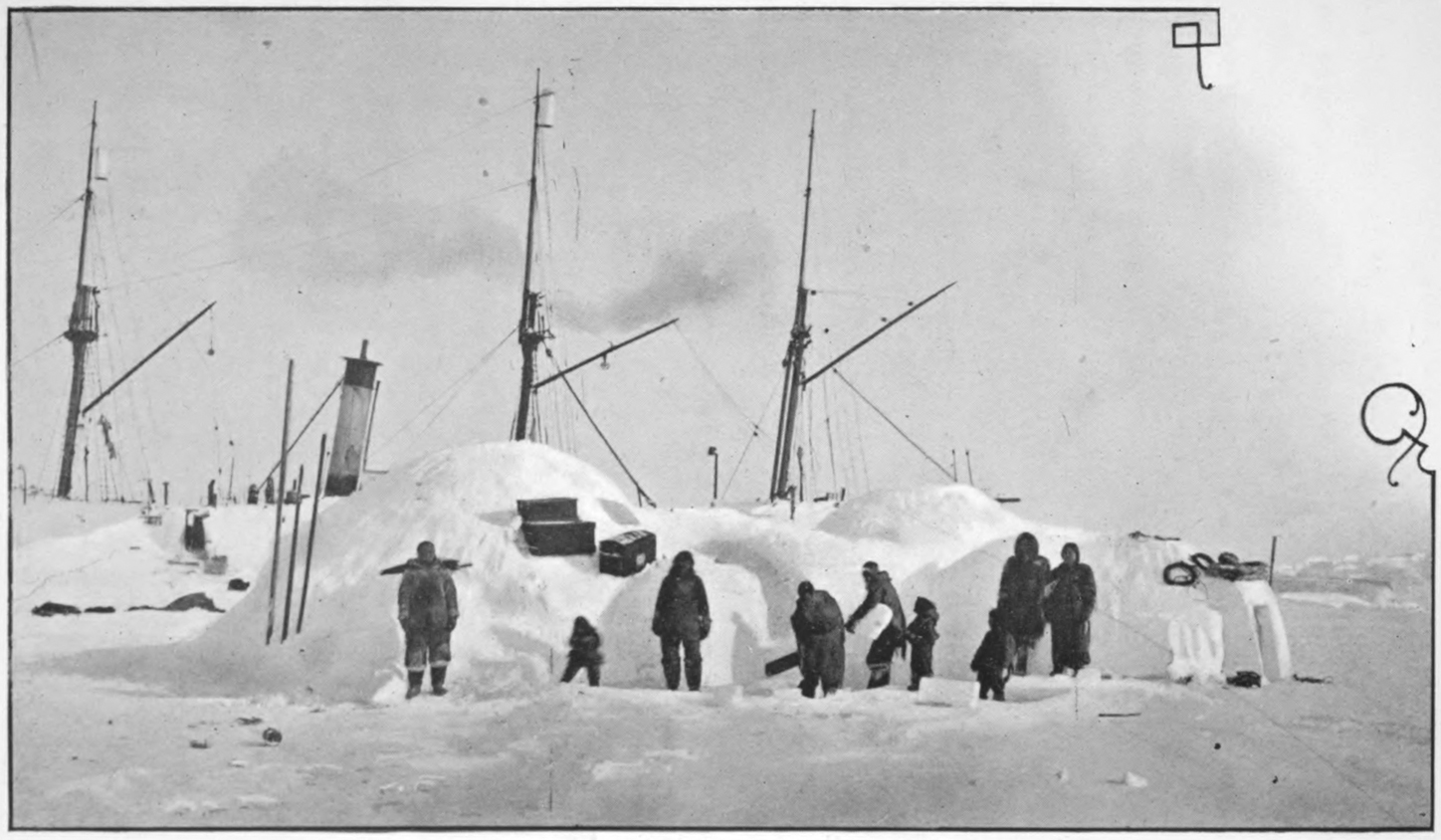
Snowhouses on Ice, near the ‘Neptune.’
On the night of the 11th of December a second sad occurrence happened. When everybody was busy preparing letters for the mail about to be sent to Churchill by a couple of Eskimos from Baker lake, James O’Connel, a cabin-boy of weak mind, left the ship to go to the snowhouses, and wandered away in a snowstorm, which commenced shortly after his departure. He had been in the habit of hiding behind the launch, or in other places about the decks, where he would remain for hours, and, in consequence, his absence was unnoticed by his mess mates until the following morning. Immediately upon the alarm being given, the crews of both ships and all the natives turned out and searched systematically, in all directions from the ship, but, owing to the blizzard, without success. The storm continued to rage during the next two days, so that it was only on the 15th that definite information concerning his fate was obtained by the natives, who traced his track in the snow to the open water in the southwest some three miles from the ship, where the poor fellow had gone before the strong wind. There is no doubt that death came quickly, and we were relieved of the thoughts of his possible sufferings had he continued to wander about the country and finally died of exhaustion and cold.
The short days of mid-winter and the excessive cold of the early spring practically rendered impossible any surveying or other outside scientific work until the month of April, when preparations were made for exploratory and surveying work. During the winter Mr. Crossman made a very efficient ice-boring machine, which worked admirably in making holes for sounding through the thick ice. Weather observations were taken five times daily during our stay at Fullerton, and these, together with the readings taken on the voyage, are printed in Appendix No. I., where also will be found a summary of the climatic conditions, prepared from the observations by Mr. Stupart, Superintendent of the Canadian Meteorological Service. A list giving the thickness, week by week, of the ice in the harbour, will also be found in that appendix, and is interesting as showing to what a late date the ice continues to increase, the maximum thickness of seventy-four inches having been obtained on the 25th April.