RAFAEL ÁNGEL DE LA PEÑA.
Reading edition
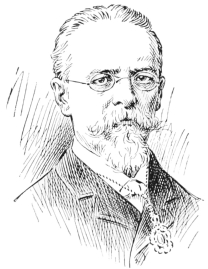
Rafael Ángel de la Peña was born in the City of Mexico, December 23, 1837. His early education was conducted by an older brother and his father. In 1852 he entered the Seminario conciliar, where he pursued the regular studies, including laws, making a brilliant record. From 1858 on, he devoted great attention to the exact sciences, particularly to the mathematics. For three years he taught Latin in the Colegio de San Juan de Letran; in 1862, he was Professor of Logic in the Escuela Nacional Preparatoria (National Preparatory School), and was later Professor of Spanish Grammar, and, for many years past, Professor of Mathematics in the same institution. He is an excellent teacher, leaving a permanent impression upon students.
The writings of Rafael Angel de la Peña are didactic, thoughtful, and chiefly in the fields of language and philosophy. “His diction is chaste and correct; his style careful, pure, and polished; his form elegant, terse, and limpid.” Some of his addresses have attracted notable attention and are in print. Many of his most important studies were submitted to the Mexican Academy and are contained in its Memorias (memoirs). Rafael Ángel de la Peña was elected to membership in the Academy in 1875 and, since 1883, has been its Permanent Secretary. He is a correspondent of the Royal Spanish Academy and contributed upward of four hundred articles to the twelfth edition of its famous Dictionary. He is a member of the Sociedad Humboldt, the Liceo Hidalgo, the Sociedad de Historia Natural, and other Mexican societies, and an honorary member of the Sociedad Mexicana de Geografía y Estadistica. Outside of his important contributions to the Academy and to the Dictionary, his most valuable work is Gramática teórica y práctica de la Lengua castellana (Theoretical and Practical Grammar of the Spanish Language), published in 1898, which has called forth high praise from the most competent judges in Spain and in South America.
THE MEXICAN ACADEMY.
The Mexican Academy has thought well to begin the third volume of its memoirs with a brief summary of its literary labors and of the most notable events which have befallen it since the year 1880.
Perhaps someone may think such a sketch needless, since—the Academy living almost completely isolated, without holding public meetings or participating in those promoted by other literary or scientific societies, printing its productions very slowly, and avoiding publicity so far as it may,—it may be assumed that no one remembers it, or, if knowing that it exists, has an interest in how it discharges the aims for which it was established.
But, if such considerations inclined it to preserve silence regarding its internal life, it has nevertheless felt that it should make a report to the Royal Spanish Academy, as to how it has endeavored to respond to the high honor which that body extended to it, in inviting it to participate in the formation of the last Dictionary. It believed, as well, that it was under obligation to supply notice of its doings to its few devoted friends, who, far from relegating it to oblivion, do not lose sight of it, but stimulate and nourish it by the favor with which they receive its publications.
Already, in an earlier sketch, it has been stated that the Academy has, by preference, from the days of its establishment, dedicated itself to the discussion of the additions and emendations which should be made to the Dictionary of the language. It persevered in this laborious task until the month of August, 1884, when it remitted to the Royal Academy the nineteenth and final list of items for the Dictionary. The definitions proposed by this Academy were twelve hundred and eighty-five in number; of these, six hundred and fifty-two were accepted by the Spanish Academy, some with slight modification, and six hundred and thirty-three were not admitted, the greater part of these being our provincialisms.
It is necessary to admit that the harvest gathered is not large; but, though so scanty, it gave occasion to mature studies, and long discussions, of all of which there remains no other vestige than the brief notice recorded in the proceedings of the meetings.
It can be readily understood that, as the Dictionary invades the domains of the sciences and of philosophy, of the arts and industries, we were forced often to discuss topics so heterogeneous that the only points they had in common were the initial letters of their names. Thus, from the word Prostesis, we passed to study the word Positivismo, considered as the name of a school of philosophy. The mere exposition of this system and its definition occupied long and serious sessions. Equally long and exhaustive were the discussions of the definitions of one and another science, as that of Biology and that of Astronomy, or those fixing the acceptations of technical scientific and philosophic terms. Such discussions were often interrupted by dissertations and discourses upon points of Literature, Philology, and the History of our Literature. Some of these productions have been printed in two preceding volumes of the Memoirs.
The Academy has also undertaken to discover and bring together materials for forming the history of the national literature and an example of this activity is the article entitled Francisco Terrazas and other poets of the Sixteenth Century. Señor Don Francisco Pimentel, member de numero of this corporation has taken the lead in this and has, unaided, written that history and has begun to print it.
With the publication of the last Dictionary of the language, by the Royal Spanish Academy, the Mexican Academy considered the lexicographic work, which had been entrusted to it, as completed; not so with that which it had undertaken for forming a Diccionario de Provincialismos (Dictionary of Provincialisms), which should contain, in addition to those current throughout the Republic, those which have been limited to a certain State or to a district of whatever extent and importance. In order not to delay the publication of this Lexicon, it was decided, as soon as items were secured under each letter of the alphabet, to give the list at once to the press; then to make as many more, with new alphabets, as might be necessary.
The Venezuelan Academy, Correspondent of the Royal Spanish Academy, notified us promptly of its inauguration on the 26th and 27th of July, 1883, the Director being His Excellency, Señor General Don Antonio Guzmán Blanco, then President of that Republic. The Mexican Academy was delighted with such agreeable news and gave a cordial welcome to the Venezuelan. Later that learned body proposed the establishment between the two Academies of an exchange of national printed works and manuscripts of value for literary merit. The Mexican Academy consented with pleasure and later sent such parts of its Memorias as were not exhausted to that of Venezuela, and also to those of Ecuador and Colombia.
The Spanish Academy has given ours constant tokens of esteem and kindness, now, by accepting our additions and emendations to the Dictionary; now, in sending its diplomas of foreign correspondents to those individuals, whom the Mexican Academy recommended; and, again, by naming members for newly-established seats or by filling the chairs left vacant by the death of some Academicians.
Unhappily, there has hardly been a year which has not been mournfully marked by the loss of one or more members of this body....
Being desirous of knowing those provincialisms of each State which combine the conditions necessary for inclusion in the Diccionario, which it is forming, the Academy has considered it necessary to name as Academic Correspondents persons resident outside of the Capital, who are notable for their love of the Castilian tongue and for the knowledge of it which they possess. In this capacity, the following gentlemen belong to it: Señor Melesio Vázquez, Archdeacon of the Church of Tulancingo, Señor José María Oliver y Casares, residing in Campeche, and Señor Audormaro Molina, who resides in Merida.
In truth, the Mexican Academy has been able to do but little in behalf of our language and literature, but it can present in excuse the complete lack of all those means without which it is impossible to achieve the ends for which it was established.
The indispensable funds are lacking to the body and the time necessary for long and serious studies is lacking to the members. Those who compose it do not live entirely by literary pursuits; some give their chief attention to their professional occupations, others to the direction of affairs—personal or other—others, finally, to the discharge of high offices in State or Church.
Academies are, usually, liberally subsidized by their governments; they count upon their own sources of support, and those who compose them are suitably remunerated. The Mexican Academy lacks everything; there only remains to it the will to do what its scanty resources permit. Neither the poverty in which it lives, nor the little time at its disposition of its members and correspondents for carrying out the labors already begun, discourages it. Constant in its purposes, it will continue its labors, slow, it is true, but never interrupted; it will continue, by preference, to collect materials for the Diccionario de Provincialismos, and in a day, perhaps not very distant, will thus make known how the Castilian language is spoken in Mexico.