JOSÉ LÓPEZ-PORTILLO Y ROJAS.
Reading edition
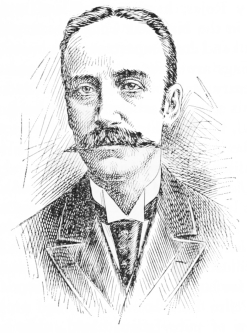
José López-Portillo y Rojas was born at Guadalajara May 26, 1850. His father was an eminent lawyer and teacher in the law school. Son of wealthy parents, the young man was given every opportunity for study, first in his home city and later at the capital. His final studies in law were made at Guadalajara, where, in 1871, he became licenciado. His parents then gave him an opportunity for foreign travel. He visited the United States, Great Britain and Ireland, France and Italy, Egypt and the Holy Land. On his return he published his Impresiones de viaje (Impressions of Travel). Since that time Señor López-Portillo y Rojas, has practiced law, represented his state in the National Congress, taught in the law school and done important work in journalism. His writings are always clear, direct and marked by a literary style of unusual grace and purity. Besides his scattered articles and the book already mentioned, he has edited—with notable scholarship—the interesting Cronica de Jalisco (Chronicle of Jalisco) of Fray Antonio Tello, and written a novel, La Parcela (The Piece of Land). It is from this last work that our selections are taken.
In La Parcela the author presents a sketch of characteristic country life. The novel has for purpose the illustration of the strong, almost morbid, affection for land felt by the native proprietor.
Don Pedro Ruiz is a wealthy and progressive haciendero of pure Indian blood. He is noble-hearted, thoughtful, shrewd, intelligent and a man of resources. A widower, he is devotedly attached to his only son, Gonzalo, a fine young fellow of twenty-three years. The owner of the adjoining property, Don Miguel Diaz, has been a life-long friend, and between them exists the artificial relation of compadre. His wife, Doña Paz, is a cousin of Don Pedro; there is one daughter, a beautiful, gentle but rather weak lady named Ramona. The two young persons—Gonzalo and Ramona—have grown up like brother and sister; their childish affection has ripened into love, and at the beginning of the story they are engaged to be married. Don Pedro is by far the richest man of all the district. Don Miguel is also wealthy, but has seen with some jealousy and dissatisfaction the constantly increasing difference between their fortunes. This dissatisfaction, encouraged by a scheming lawyer, leads to his claiming a worthless bit of property on the borders of his and Don Pedro’s lands. The value of the land is but a trifle to either party; but Don Pedro, sure that right is on his side, refuses to yield to the unjust demands of his neighbor.
Don Miguel at first seizes the property by force, but is dispossessed by Don Pedro’s tenants. The bitter feeling aroused by this incident leads to a battle between two tenants of the two masters; both of the fighters are thrown into jail. Carried into the courts, the boundary line is infamously determined by a corrupted judge; a higher court reverses the decision and Don Pedro is supported in his rights. Furious with anger, Don Miguel seeks to injure his neighbor. Through a wicked scheme plotted with the local authority, the tenant of Don Pedro, who has been in jail, is assassinated. A great dam, which holds back a mighty volume of water for driving mills, irrigating the property, etc., is damaged by Don Miguel’s orders, with the idea that the inundation will ruin the property of Don Pedro.
Throughout these various exciting incidents—seizure, dispossession, law-suit, appeal, assassination and diabolical destruction—the love affairs of the young people are naturally more or less disturbed. Having carried things to such a climax, the author brings about a sudden reconciliation and the story ends.
EXTRACTS FROM LA PARCELA.
“Good morning, compadre Don Miguel,” said Don Pedro as soon as he recognized the horseman who arrived.
“Good morning, compadre,” replied the newcomer, checking his horse and dismounting.
The servant who accompanied him quickly dismounted from his horse and went to hold, by the bridle, that of his master. Then he bent to remove his master’s spurs.
“No, Marcos,” said Don Miguel to him, “do not remove them. We shall go on at once.”
“How! compadre,” said Don Pedro; “then you will not remain to take breakfast with me?”
“No, not today, because I must arrive at Derramadero before 6, and it is yet distant.”
“That is true, compadre; but there will be another day, will there not? Pass in, pass in. Do you desire that we sit down here on the bench to enjoy the fresh air, or shall we go into the office?”
“We are very well here. Do not trouble yourself.”
“Very well. What are you doing so early?”
“It does not please me to visit. I come to treat of our business.”
“What business?”
“That which we have pending.”
“But we have nothing pending.”
“How not? The Monte de los Pericos.”
“What about it?”
“I want you to decide whether you will yield it to me.”
“Why do we speak of this? A thousand times I have told you that the Monte is mine.”
“That is what you say, but the truth is that it belongs to me.”
“Compadre, it is better that we talk of something else; leave this matter. Are we not friends?”
“We are so; but that is not to say that you may deprive me of my things. What sort of friendship is that?”
In fact, at a very short distance from where the group found itself, there were seen down below, through the shrubbery, the four men of Don Miguel. They were stretched out on the ground upon their blankets, and in the shadow of the trees conversed without suspicion, with their eyes fastened on the house of Palmar, which was visible from there. Their horses, unbridled and fastened to the trees, were pasturing on the green herbage.
“But man! How good was that blow?” said one of the mozos. “It still gives me delight.”
“What a surprise for the poor montero!” exclaimed another.
“What will Don Pedro say?”
“He will have to calm his rage.”
And they laughed with their mouths open. Just then they heard the tramp of horses, and turning their heads saw Don Pedro, followed by his men. They tried to rise to draw their pistols.
“Do not stir!” said Don Pedro in a terrible voice, “or we will shoot you.” And he and all his held their arms ready.
There was nothing to be done. The servants of Don Miguel comprehended that all resistance was useless.
“Master, we are taken,” said one of them.
“Do you surrender at discretion?”
“There is no way to avoid it.”
“Then give up your arms. Look, Roque, dismount and take away from the gentlemen their rifles, their pistols, their sabres and their cartridge boxes.”
They gave up with trembling hands the pistols and the cartridge boxes. The rifles were hanging from the saddles of their horses.
“Now,” continued Don Pedro, “tie their hands behind them and help them to get onto their horses. Distribute their arms so that their weight shall not be too great, and let each one take the halter of a horse in order that he may lead it.”
All was done with the rapidity of lightning. The men of Don Pedro strongly tied the hands of the conquered behind their backs with the satisfaction of the tyrant characteristic of all conquerors. One of the captured, Panfilo Vargas, was vexed and said:
“They gain advantage because they are more than we. Tie quickly for some day you will know who I am. We are arrieros, and we go through the country.”
“Shut your mouth, braggart!” said Don Pedro angrily. “How many were you this morning? There were six of you to take the poor montero, who was alone and not expecting anyone. As for you, you were left here to guard and had the obligation of not permitting yourselves to be surprised. You have lost because you are fools. Who told you to be careless? They shall know that I do not sleep nor neglect mine own. Let him who jokes with me be careful.” Then he turned to Oceguera, saying to him, “Where is the montero hidden?”
“Here am I, master,” replied the montero himself, appearing from the bushes.
“I was looking for you to order you to attend to your business in your place. Have no fear. I shall send reinforcements. Do not move from here until I tell you.”
“Very well, sir.”
“Let us go then,” ordered Ruiz. And the party put itself on the road to the hacienda, just as the sun began to set and the great shadows from the mountains were extending themselves across the valley.
Roque passed the arroyo and entered the camp. Some time passed and he did not return. Panfilo began to believe that he did not come to the appointment because he was afraid; but soon he heard a whistle at the foot of the slope and saw Roque on horseback, striking his chest arrogantly, as if saying:
“Here you have me at your orders.”
On seeing him Panfilo hastened to meet him.
“Now yes,” said Roque, “here I am ready to serve you and give you all you want.”
“Well, you know what I want; that we shall have a good tussle.”
“It seems to me that here we have a good place.”
“Well, then, do me the favor,” exclaimed the impetuous Panfilo, drawing a revolver.
“Listen to me,” said Roque, drawing his also; “if really you desire that we shall kill each other, don’t let us create an excitement. Put away your pistol and take your machete.”
“I will do what I please. Are you afraid of the noise?”
“It is you who should be afraid of the noise, lest they hear us and come to part us. If we do not succeed at the first shot nothing will come of it, for they will come and separate us. Is that perhaps what you want?”
“You are right,” replied Panfilo. “Well, then, there is no time to lose. Let us get at it.”
* * * *
Soon they found themselves on foot, lame, covered with dust, pale, horrible. They seemed not men, but fierce beasts.
* * * *
The contest could not prolong itself for the combatants were exhausted. They could scarcely move; but they did not wish to yield, since although strength failed, anger more than abounded.
Chance finally settled the contest. When Roque raised his arm to deal a blow with his machete upon Panfilo’s head, the latter by a quick movement tried to parry the blow, to save his head from being cleft open. But he parried it, not with his blade, but with the haft, and the heavy weapon of his antagonist severed his smaller fingers. With this there fell to the ground the sword and the amputated fingers; that tinged with blood, these livid and convulsed.
“Now, yes, I have lost,” exclaimed the wounded man with a gesture of grief.
“Yes, friend,” replied Roque, filled with consternation. “What need was there of this?”
“It is a thing of bad luck; who may gain may lose. You have proved me a man; you cannot deny that.”
“How have I to deny it? The truth is that you have much courage. Let me bind your hand with this cloth to see if the blood can be staunched.”
Saying this Roque wrapped the hand with his great kerchief.
“Where do you desire that I take you?” he asked. “You cannot go alone.”
“Go and leave me; do not let them take you prisoner,” replied Panfilo.
“Though they take me to jail, I will not leave you.”
“Well, then, help me to get near to Chopo. When we are within sight of the hacienda save yourself.”
“Wherever you wish; let us walk along.”
They started. Panfilo advanced with difficulty; he murmured and suffered with thirst. He stopped frequently to drink in the arroyos and Roque gave him water in the hollow of his hand.
“Friend,” he said, “it gives me sorrow to see you so injured.”
“There is no reason; I am to blame.”
“It had been better that we had not fought.”
“Why do we speak of this? There is now no remedy.”
The wounded man was presently unable to walk. Supported on Roque’s arm he progressed very slowly. Finally it was necessary to carry him like a child. Thus they came in sight of Chopo. Panfilo did not wish Roque to carry him farther.
“May God reward you,” he said to him. “Leave me upon this stone and hurry away that they may not come to seize you.”
“Though they seize me, how can I leave you alone?”
“Every little while the peons and their women pass; they will carry me to my house. Go.”
“Good friend, since you wish it, I will go; but one thing is necessary first; without it I will not go.”
“What?”
“That we may henceforth be good friends.”
“With much pleasure—from now on.”
“Do not hold hatred toward me and forget the things that have happened.”
“Why should I hold hatred?”
“Because of what I did.”
“You did it like a man; it needs naught said.”
“Then give me the good hand.”
“Here it is,” answered the wounded man, extending his hot left hand. Roque grasped it with feeling.
“God grant that you may soon be well,” he murmured.
“With a maimed hand,” added the wounded man, his pallid and dry lips contracted in a sad smile.
“God’s will be done,” said Roque, sympathetically.
At this moment a whistle was heard from near by.
“Indeed it is time that you go,” said Panfilo. “Do you not see that persons are coming?”
He could scarcely speak; he was on the point of losing consciousness.
Roque hesitated.
“How leave you?” he said.
“Go, if you desire that we be friends; if not, remain.”
“Then I leave.”
“Farewell, and run fast that they may not overtake you.”
So urgent and impassioned was his request that the girl was moved in spite of herself. To quench the sympathy which rose in her bosom she recalled to herself that he who thus spoke was the nominal friend of Gonzalo, and on remembering this she felt that for her budding pity was substituted vexation and indignation. Thus this harsh reproach escaped her lips:
“And you call yourself the friend of Gonzalo.”
Had a thunderbolt fallen at the feet of Luis it would not have produced a more prostrating effect.
“Gonzalo is my friend, in fact,” he gasped.
“Not if he knew himself,” insisted Ramona, ironically. “If it were so you could not have spoken as you have just done.”
“Then are you yet in relations with him?”
“You know it very well.”
“No,” replied the unfortunate youth, pale as a corpse; “I give you my word as a gentleman that I did not know it. My father told me some days past that he knew these relations were broken; only for this reason have I forced myself to reveal to you my love. I may endure the fact that you do not love me, since such is my lot, but I cannot be willing that you should consider me disloyal. I desire that you should esteem me even if you may not love me.”
* * * *
The youth in the meantime had arrived at his home, mounted his horse and immediately sallied forth to the house of Luis. He sent a message to his former friend by a servant, begging him that he would come outside, which Medina did immediately, well bred and polite as he was.
“Gonzalo!” said Medina, extending his hand.
“I come to arrange with you a very serious matter,” replied our youth, without extending his.
“You have me at your orders,” replied Luis, exchanging the friendly expression of his face for another more severe.
“Only we cannot do it here. Mount your horse and take your arms. I await you.”
And by the contraction of his features and the pallor of his countenance, Medina knew that Gonzalo had come on a warlike errand, and was not slow in divining what was the cause of his annoyance. Without replying a single word he entered the house and soon reappeared and mounted his horse, with a pistol at his belt and a sword at the saddle. “Here you have me,” he said to Gonzalo.
“Come,” replied Gonzalo, “let us go to the field.”
Together they took the street which most quickly would bring them to the end of the village, and went a considerable stretch outside the town. Leaving the road they went into the meadows and stopped at a little open space formed by four immense camichines, which, extending over the space, their broad, flat and immovable boughs projected a dense and heavy shadow around.
“I have brought you to this spot,” said Gonzalo, stopping his horse, “because it is retired and no one may see or hear us. It is unnecessary to enter into explanations; you know how gravely you have offended me, and in what way. That is sufficient. Now I desire that you shall give me satisfaction with arms in hand.”
“Although I am not valiant, I have some dignity and never will I yield before an enemy who challenges me,” answered Luis, tranquilly; “but I have one remark to make to you, which is, that my conscience does not reproach me with having done anything to offend you.”
“Yes, I was expecting that you would deny responsibility for your acts. Anything else was impossible.”
“Moderate your words. Do not let us pass to a serious occasion without some rational cause.”
“Pretext,” cried Gonzalo; “you do not desire to fight. You are a coward.” Saying this he placed his hand upon his pistol for a moment. Luis was livid and acted as if he would follow his example; but he stopped and left his arm in place, recalling his promise to Ramona at the ball.
“One moment,” he said, “only one moment; if you are a man and not a brute, as you seem to be, you must first hear me. By my mother’s honor, I assure you that I am disposed to fight; but not before we understand each other. What is the matter?”
“You love Ramona. Deny that if you can.”
“God save me from committing such a vile act! It is true.”
“You have courted her.”
“That is true.”
“You danced with her the night of the fiesta.”
“That also is true.”
“You made a declaration of love to her.”
“I cannot deny that.”
“You are a shameless being, because you knew she was my sweetheart and that we were engaged to be married.”
“That is not true.”
Gonzalo threw upon Luis a glance of infinite contempt on hearing these words.
“You are a wretch,” he cried, “and it is necessary that I punish you. Defend yourself.”
“Assassinate me if you wish; I will not draw my pistol until you have heard me. Come, dispatch me; here you have me,” and he exposed his breast to his challenger.
“There is nothing to do but hear you in order to quit you of every excuse for your cowardice. Speak, and hurry, for I am impatient to punish you.”
“I call God to witness that I believed your love relations with Ramona were broken. Don Miguel had told my father that with absolute certainty. Every one in Citala asserted the same. You did not come to town, and as your father and Don Miguel were quarreling it seemed to me probable and I believed it. For this reason I made love to Ramona. Had it not been for this I would have remained silent, as I have been silent for so many years, for my love to her is nothing new. I have always had it. Ramona informed me of my error, and accused me of perversity and treason, as you have just done. She herself can tell you how astonished I was when I learned that it was not true that all was ended between you and that you still loved each other. It caused me infinite grief. Now,” pursued the youth, “that you have heard me, I have done, and am at your orders.”
The caravan for some leagues journeyed silently, but seeing that the storm approached, the sergeant neared himself to one of the soldiers and said to him in a low voice:
“The storm is coming; here is a good place.”
“Yes, we have already gone six leagues and there has not been one person on the road.”
“Well, then, let us at once to what we have to do; then let us get back to the pueblo.”
“That is what I say,” responded the soldier.
“Go on then, you already know what you have to do; see if you can do it. I pretend not to look; I will fall behind.”
“I go then to see what happens.”
The soldier drew near to Roque.
“What cheer, friend? How goes it?”
“Diabolically, friend. How do you expect it goes with me with these cords?” replied the prisoner.
“Yes, it must go very unpleasantly. Why don’t you smoke a cigarette?”
“Friend, impossible. Don’t you see that I go tied?”
“’Tis true, I see it with pity. Now you will see what we will do. At last the sergeant has fallen behind and will not see us. I’m going to untie you to give you a little rest.”
“But will not the sergeant see it? Thank you much; but will he not see?”
“Have no concern; anyway it is very dark.”
And the soldier leaned over and untied the knot which held Roque’s hands.
“May God reward you, friend,” said he, stretching his arms in front of him; “I was very tired. But tell me, why are your hands so cold? Are you chilled?”
“Nothing is the matter with me. The air is damp. But, take a cigarette. Here is the light;”—and he reined up.
The unsuspecting Roque rolled the cigarette and lighted it by that which the soldier was smoking. They then went on, talking. After talking for a little time of indifferent matters the gendarme said:
“Man, friend, I sympathize with you and it pains me that you are going to jail.”
“There is no alternative, friend! Some day I will be out. Anyway the jail does not eat people.”
“Good; but it is always atrocious to be a prisoner, and God knows for how long. Why not escape. I will dissemble and you will run. I will fire into the air and you race along into the country and no one can find you.”
“I am afraid they will shoot me.”
“Don’t be afraid; I will help you.”
The unfortunate man fell into the snare.
“Do you say it seriously? Are you not fooling?”
“I advise you in earnest. All you need is courage.”
“But you tell me when.”
“Right now—race along before the sergeant comes.”
Roque gave rein to his horse and urged it with quick strokes of his heels against its flanks, but he hardly succeeded in making it take a slow and measured gallop. He had gone but a few steps when a report sounded just behind him and a bullet passed, grazing the brim of his sombrero.
“Zounds,” he murmured, “what a scare this man has aimed to give me.”
And instinctively he tried to place himself in the field at one side of the road to hide himself in the brambles. But there was no time for anything. For all his urging the horse would not do better than his little gallop. He heard the nearing band of horses and various shots sounded. Then he understood that he had fallen into a trap and that he was about to lose his life through it. Impelled by the instinct of self-preservation, he tried to dismount to seek shelter; but it was too late. The gendarmes were upon him, firing with their rifles.
“Jesus help me! Mother receive my spirit!” he said in thought, and fell penetrated by the bullets. Two had entered at the shoulders and emerged at the chest, and the third entered at the neck and destroyed the skull.
* * * *
What was it which the terrified Diaz then saw? Upon a plank, borne by four peasants, tied down with coarse cords, was a corpse, rigid and yellow. The miserable clothing which covered it, coarse cotton drawers and shirt, was soaked with blood, principally upon the breast, where the abundant and coagulated flow had darkened and become almost black. Above the forehead, in the black harsh hair, matted and stiffened with blood, were visible clots of red, mingled with whitish bits of brain. The livid face, turned toward heaven, bore an expression of anguish which was heart-rending; the eyes half opened and glazed fascinated by their glance; and the opened mouth, dark and full of earth, seemed to exhale inaudible groans and complaints.
The gendarmes surrounded the body and the curious crowd followed it. In the midst of the group a woman walked, weeping and uttering cries of grief. She carried a babe at her breast—bearing it with her left arm, and as well as she could led with her right another boy about four years old, barefoot and tattered.
“Roque! my Roque! my husband,” cried the miserable woman. “They have killed my husband! They have killed him! Children! My little ones! Poor little ones! They are orphans! What shall I do? What shall I do? What shall I do? Ay! Ay! Ay!”
In passing close to Don Miguel she saw him and said to him, sobbing:
“Señor Don Miguel, do you see? They have killed my husband! That is what is there on the board! What shall I do Señor Don Miguel? What shall I do? Ay! Ay! Ay!”