ALEJANDRO VILLASEÑOR Y VILLASEÑOR.
Reading edition
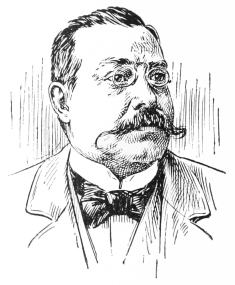
This well-known journalist was born in Mexico, July 15, 1864. His education was gained in the Colegio de la Sociedad Católica (School of the Catholic Society), the Escuela Nacional Preparatoria (the National Preparatory School), and the Escuela Nacional de Jurisprudencia (National School of Jurisprudence). He received the title of Advocate, July 7, 1887. While still a student, in 1885 and 1886, he assisted upon the staff of the Boletin de la Juventud Católica (Catholic Youths Bulletin). In March, 1889, he became associated with the editorial management of El Tiempo (The Time), with which he still continues. He has also written many articles for other leading periodicals. In October, 1895, he founded La Tribuna (The Tribune), which was not a financial success. An article in this was the cause of his imprisonment in the famous city prison of Belem.
Señor Villaseñor y Villaseñor is a member of various learned and literary societies and has participated, as a delegate, in several important congresses. Among the latter is the First Catholic Congress held in the city of Puebla, in February, 1903.
Señor Villaseñor y Villaseñor is an industrious writer. His contributions to El Tiempo alone number more than seven thousand. Of books, he has written Asunto Poirier (The Poirier Incident), La cuestion de Belice (The Belize Question), Guillermo; memorias de un estudiante (William: recollections of a student), Estudios historicos (Historical Studies), Gobernantes de México (Governors of Mexico), Los Condes de Santiago (The Counts of Santiago), Reclamaciones á México por los fondos de California (The California Funds Claims Against Mexico). This last is of high importance, being an exhaustive discussion of this international question—the first to be submitted to The Hague tribunal for settlement. It is particularly in questions of public policy, in history, and in biography, that our author is at his happiest. Our selections are taken from Estudios historicos.
ANTÓN LIZARDO.
We have intentionally been brief in expressing our opinion regarding the attack at Antón Lizardo and have been full in the presentation of documentary evidence; in this manner remembering that these documents proceed from unimpeachable sources, a clear and full realization will result, that what took place at Antón Lizardo was not so simple a matter as the liberal party desires to make it appear.
In instigating foreign warships to seize vessels in Mexican waters, the government of Juarez permitted the national independence, sovereignty, and dignity to be outraged by the soldiers, officers, and warships of the United States; it betrayed its country, permitting an assault against its sovereignty and humiliated the nation by invoking foreign mercenaries to assist it and to treat Mexicans with profound contempt, and to shed Mexican blood, since those wounded on board the Miramon were compatriots; and those same strangers still preserve among their trophies taken from Mexico, the flags of that vessel.
We believe that, after the publication of this study, no one will venture to deny, as recently was done, that the Juarists took part in the Antón Lizardo incident; that Turner’s intervention completely thwarted the plans of Miramon, as a work written by a well-known liberal confesses, and gave great courage to the Juarists; no one will again venture to say that Marin was a pirate and that the commander of the Saratoga did right; this assault was not merely a partisan measure, as those who are ignorant of historical facts or filled with bad faith pretend to believe, seeing in it an insignificant event without serious consequences.
It was not at Silao or Calpulálpam that the conservative party was defeated, but at Antón Lizardo; nor was it the soldiers of Gonzales Ortega and Zaragoza who routed them, but the marines under orders of Turner.
The Juarist party, beaten at all points by Miramon, Castillo, Márquez, Negrete, Robles, Chacon, etc., at the beginning of the year 1860 held no population of importance, and its directory was confined to the plaza of Vera Cruz with the immediately adjacent region, and it was recognized by the United States alone. On account of the MacLane-Ocampo Treaty, which was then awaiting ratification by the United States Senate and with which we shall occupy ourselves in the following pages, public opinion had declared itself, in the most uniform manner throughout the whole country, against the liberal doctrines, which only produced as their bitter fruit the loss of our territory and almost that of our independence.
In order to end at once these parricidal tendencies and to bring to a conclusion the bloody civil war, which was destroying the nation, there was only necessary the effort, which the conservative government was making, to conduct the siege of Vera Cruz by land and sea. Under circumstances so serious for the constitutionalist party, the assault by Turner and the protection given by President Buchanan, gave new life to this party, and a series of disasters like that at Silao or of defections like that of the cavalry at Calpulálpam, opened to it the gates of the capital; but did not give it the final triumph, since the strife still continued.
And, looking a little deeper, it is seen that the events of Antón Lizardo had graver consequences than might be imagined; they brought on the European intervention. They emphasized the ideas expressed by Buchanan in his message to Congress of December 4, 1859, and the unconcealed tendencies of the democrats in the direction of a North American intervention were no longer mere theories, but began to translate themselves into facts. Antón Lizardo and the MacLane Treaty made Europe and the conservative lovers of their country see that Mexican independence was threatened and it was then that it was thought that a radical remedy would save the imperilled nation, and certain combinations, already forgotten, were recalled.
The triumph of the party of demagoguery and the errors which it committed precipitated events and brought on the European intervention, which, when studied with care as to its causes, is clearly demonstrated to be due to the liberal party.
The name of Antón Lizardo will remain, indelible on the pages of our history, a stain of dishonor for that party, which nothing and no one can ever remove.
THE POLICY OF THE UNITED STATES.
The United States have adopted a special policy with reference to Mexican affairs, a policy which may, in time, produce results unhappy for us.
During the time of the Three Years War, the democratic party, which brought so many misfortunes upon that country and America, was in power in the North American Union. After restless and ambitious presidents, like Jackson, Monroe, and Van Buren, who, if they had found their nation more powerful, would have embroiled it in long and bloody wars of conquest, came Polk, who brought the war with Mexico to an end and snatched from us more than one-half our territory; in vain honorable men, like Henry Clay, Daniel Webster, and others, opposed that iniquitous war which has been justly condemned by notable men in our sister nation.
Already owners of the “Far West” and of a great part of the coast of the great ocean, rich by the discovery of gold deposits in California, inflated with pride on account of the great extension already gained by their country, believing themselves the absolute arbiters of the destinies of the Americas, and viewing with disdain the old nations of Europe, to which they owe everything, from their population to their freedom, they seriously thought of putting into practice the theory of “manifest destiny” and of making the starry banner float from the Niagara and the Saint Lawrence to Panama.
The Mexican enterprise, which had resulted so favorably for them, was the school in which were educated many of the adventurers, who afterward gave themselves to filibustering, and the example which many others, who through more than a decade disturbed Latin-American countries, set before themselves for imitation. The government in Washington, which observed this tendency with singular pleasure, while publicly reprobating, in secret nourished and aided it.
During Polk’s administration, the government itself had given an exhibition of the ends which it pursued, proposing to Spain to purchase the Island of Cuba at the price of one hundred million dollars, a proposition which that nation did not choose to entertain. This was but the prelude to the aggressive policy which the people of the United States adopted in their relations with other nations, even attempting to mix themselves in European affairs.
The revolution of Hungary and the efforts of Louis Kossuth met an echo in the United States, and matters were carried even to the point of proposing to aid the Hungarian agitator and his partisans to liberate that country from Austrian domination; it was necessary for Francis Joseph’s government to assume a vigorous attitude and for the nations of Europe to show dissatisfaction before these plans were abandoned, and Kossuth, instead of aid, received only a refuge in the United States.
The island of Cuba was, and yet is, too valuable a prize to escape the eyes of the rapacious Yankees; underhandedly they aided Narciso López to organize his expedition, and it was only when everything was practically arranged, that, for the sake of appearances, President Taylor issued a proclamation, on the 11th of August, 1850, forbidding the fitting out of expeditions to agitate that island and certain Mexican provinces.
Notwithstanding this proclamation, López kept on and completed his preparations and openly sailed from New Orleans, by daylight; defeated, after the attack of Cárdenas, he found a secure refuge for himself, his partisans, and his rich booty, on American soil, and it was only after his second attempt that he fell into the hands of the Spanish authorities.
Gen. Quitman, one of the generals of the Mexican War, was accused of having taken part in an expedition; although the fact was notorious and the accused was arrested on February 3, 1851, the jury discharged him.
Fillmore’s administration demanded the Island of Lobos from Peru; the annexation of the Hawaiian Archipelago was vigorously agitated; with Mexico the voided Garay Concession was disputed and no concealment was made of the intention to secure possession of a right of way across the Isthmus of Tehuantepec, and as little concealment was made relative to the desire of right of way in Nicaragua and Honduras at points where inter-oceanic communication was believed to be easy; it was left to the Governor of Texas, Lane, to gain possession of the Mesilla Valley and to qualify as aggressive the conduct of General Santa Anna and of the Governor of Chihuahua, because they protested against such an invasion and made military preparations; Edward Everett, Secretary of State, refused to take part in the convention to which France and Great Britain invited the United States, to guarantee to Spain the control of the Island of Cuba and to prevent the island from passing to the power of any other nation; the notes of these nations relative to the convention were insolently answered; their conquests in the present century were enumerated, and the advantages which the acquisition of Cuba had to the United States, it being asserted without concealment “that it was essential for her own security.” When, at Ostende, the plenipotentiaries of the United States, accredited to the governments of Spain, France, and England, were treating of the purchase of the Antillean island, for the sum of twenty million dollars, the leaders of these plenipotentiaries, Mr. Soule, was profoundly irritated because negotiations in the matter were not actively undertaken.
So much in regard to the direct participation taken by the American government in these movements, tending solely to augment the territory and the power of the Yankees on sea and land; as regards the expeditions and agitations undertaken by private parties with the indirect support of that government, the list is as long as it is instructive.
Apart from the attempts of Narciso López and other filibusters against Cuba, Rousset Boulbon, although working on his own account, drew all his supplies for the invasion of Sonora from the United States; Crab came into that same district with the hope of conquering it and annexing it, if he had not been opportunely routed by Gabilondo in Caborca; Zerman had an identical purpose in reaching California; Walker proclaimed the Republic of Lower California, placing upon the flag of that newest nation a single star, which, if his adventure had proved successful, would have come to be one more star in the North American flag; routed by General Blanco, he went to Central America, where his presence gave rise to a bloody war and innumerable disturbances.
We should never end if we were to enumerate, one by one, all the schemes which the brains beyond the Rio Grande engender for enlarging their territory and dismembering that of the American republics.
Mexico was compelled to spend great sums in combatting the filibusters who appeared and in shooting or severely punishing them; Spain was obliged to send numerous troops to Cuba and to constantly invoke the moral support of European cabinets; an energetic response had to be given to the proposition to buy Savannah harbor and a round denial to the claims for the island of St. Thomas and others belonging to Denmark and Holland; England was forced to establish long-drawn negotiations, resulting in the Clayton-Bulwer Treaty, which in part assured the independence of Central America; necessarily this unchecked appetite for lands and islands exhibited by the United States caused alarm and apprehension throughout Europe. Finally, it was necessary that the great Secessionist War should came, through which this nation expiated a part of its great crimes, a war which brought it to the verge of ruin, but which taught it, in time, to check itself upon the perilous descent, upon which Polk, Taylor, Fillmore, Pierce, and others had started it—men who, without having the qualities of great statesmen, contributed, by their policy and their counsels, to bring about this great crisis to which their unbounded ambition and the cancer infecting their institutions bore them.
It would seem that those men proceeded with the most refined malice, if they were not blind, when we consider that they said with the greatest calmness, as James Buchanan, in mounting to the Capitol on March 4, 1857, that the great territorial increase which the United States had achieved since its independence was due to pacific and legal measures; now by purchase, now voluntary—as with Texas in 1836—adding: “Our past history prohibits the acquiring of territory in the future, unless the acquisition is sanctioned by the laws of justice and of honor.”
This is equivalent to justifying the conduct of Jackson in Florida, that of Fremont in California, of Austin in Texas, of Gaines in the Sabine district, the continued spoliations of the Indian tribes in the valleys of the Ohio and Mississippi and to the west of the Alleghanies, the scandalous invasion of California in 1842, the no less scandalous war against Mexico, and so many, many deeds which, to the shame of the United States, are recorded in her history.
Thus, as in the preceding chapter, we briefly made known the situation of Mexico in 1859, in this one we have sketched in bold outlines, the neighboring nation, in its tendencies and aspirations, in order that our readers may the better appreciate the bearings of the events which we are about to narrate in the following chapters.