IGNACIO MONTES DE OCA Y OBREGÓN.
Reading edition
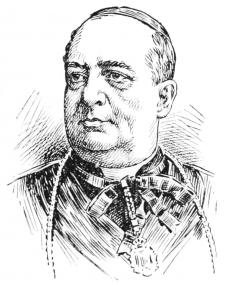
Ignacio Montes de Oca y Obregón was born at Guanajuato, June 26, 1840, his father being Demetrio Montes de Oca, a well-known lawyer, and his mother being Mara de la Luz Obregón. When at the age of twelve years he was sent to England to study, returning to Mexico and entering the Seminario conciliar in 1856. He later went to Rome, where he received the degree of Doctor in Theology, in 1862. In 1863, he was Presbitero at the Basilica of San Juan de Letran in Mexico, and in 1865 became Doctor in Laws. For a time, he served as parish priest at Ipswich, England, but was soon appointed to a similar position in his native city. He was Chaplain of Honor to Maximilian and Pius IX appointed him his Secret Chancellor. Having raised Tamaulipas from a vicariato apostólico into a diocese, Pius IX appointed Señor Montes de Oca y Obregón its first Bishop, in 1871. Without availing himself of the permitted delay of one hundred days, the new-appointed prelate at once took charge of his exceptionally hard field. He was indefatigable in the discharge of his duties, making two pastoral journeys over his whole diocese, establishing a Seminario and founding a cathedral at the episcopal city, and restoring and enlarging churches throughout his domain. After this remarkable career in Tamaulipas, he was made Bishop of San Luis Potosí, where he has continued to display exceptional energy and wisdom.
Bishop Montes de Oca y Obregón writes both poetry and prose. In poetry he has published Poetas bucolicos Griegos (Greek Bucolic Poets), Ocios poeticos (Poetic Loiterings) and Odas de Pindaro (Pindar’s Odes). Of all three, editions have been printed both in Madrid and Mexico. His translations from the Greek poets are close and beautiful. In prose, he has published six volumes of Obras pastorales y oraciones (Pastoral Works and Orations) and a volume of Oraciones funebres (Funeral Orations). Señor Montes de Oca y Obregón especially shines in oratory. Of him Portilla says: “As a sacred orator, he possesses those endowments of spirit essential to oratory—most brilliant talent, vast and agreeable erudition, exquisite literary taste,—and to these spiritual endowments he joins in happy combination the physical qualities which serve for their realization—a fine presence, a noble bearing, a musical quality of voice—all that, in fine, which constitutes the irresistible enchantment of eloquence. All these qualities shine, in never-witnessed brilliancy, in his famous funeral oration on the Literary Dead, magnificent novelty which will make an epoch in the annals of sacred oratory in Mexico.”
Bishop Montes de Oca y Obregón is a member of the famous Arcadian Academy of Rome, bearing in it the name Ipandro Acaico. He was a member of Maximilian’s Academia de Ciencias y Literatura (Academy of Sciences and Literature). He is a Corresponding Member of the Mexican Academy. In 1899, he was Secretary of the Latin-American Council at Rome. In travels in Italy, France, and the United States, during the past three years, he has made several notable addresses.
JOAQUÍN GARCÍA ICAZBALCETA.
Great is my satisfaction at presiding over this meeting. It is more than two years that you have not gathered in general assembly; and on seeing three-months after three-months pass, without your coming to invite me to your regular meeting, I had come to ask myself the question: “Do the Conferences of San Vicente de Paul still exist in my diocese?” The President General of your pious brotherhood has, on various occasions in Mexico, directed to me the same question and with that zeal which distinguished him has asked me, with tears in his eyes: “Is it possible that charity is dead among the distinguished gentlemen of San Luis Potosí? Is it possible that there is no one who can arouse the members and revive the almost extinguished meetings?”
The sign of life, which you now give, coincides with the death of that illustrious President, and it is fitting that, in addressing you, I shall pay a tribute to the eminent savant, the fervent Christian, the exemplary member of your conferences, Don Joaquín García Icazbalceta.
Others have already pronounced his eulogy as a man of letters, as a historian, as the type of a man of wealth and of the flower of Mexican aristocracy. It falls to me to present him to you as a model member of the conferences and to briefly praise before you his charity and his obedience and attachment to the Church.
His was a long life and he employed it all in distributing benefits. Rich from his cradle, he preserved and increased his capital, without ever extorting from the poor, without unduly taking advantage of their labors, without ever practicing usury, that plague of our society which seems to most tempt those who have most wealth, and which the Gospel so clearly anathematizes. In all his vast territorial possessions, that dissimulated slavery, so common in some parts of the country, which chains the peasant for his whole life to one master and to one piece of ground without hope of bettering his condition, was never known. Most exact in his payments, he had further a box of savings, as he called it, for each of his employees, from the humblest to the highest, which really consisted of systematic gifts which he made them on the more important occasions of their lives or of the lives of their wives and children. Were they marrying? He supplied the necessary expenses without making any charge against them. Were children born; did disease come to afflict them; did death arrive? He generously opened his chest and alleviated their pains and necessities.
The works of mercy which he did among his own, he also practiced with strangers. Through long years, the conferences of Mexico found him visiting the houses of the poor and liberally succoring them; when he was their President, he exerted his influence inside and outside of the Capital, maintaining the fervor of the old members, and attracting new ones by his fine demeanor, his opportune appeals and his prudent persistency. How important is such tact in those who occupy the high posts in the conferences! The most ardent zeal, unless accompanied by prudence and judgment, far from attracting, repels, and instead of aiding, hinders good service of the poor and the prosperity of the association.
Great as were his material works of mercy, they are eclipsed when compared with the spiritual. It is, indeed, a meritorious work to teach the ignorant, to correct the erring, to pardon injuries, and all this Joaquín García Icazbalceta did in a high degree. Not only did the Lord give him great wealth, but also the inestimable gift of wisdom. The leisures, which his condition of comfort afforded him, were all employed in gathering an immense store of solid doctrine and in placing this at the service not only of the wise, but also of the humble and the ignorant. The devotional books compiled and printed by him have gained an enormous circulation among the faithful and have greatly fomented piety among Mexicans. Printed by him, I have said, and this is true in the full meaning of the word. Convinced that manual labor dishonors no one, he, personally, worked at his printing, and, to his talent and assiduity, the typographic art owes much.
All these labors, all these studies, were placed at the service of the Church and of the public by Señor García Icazbalceta. How, except for him, would we know how much the early missionaries did for the civilization and the prosperity of the New World? Thanks to his researches, books, and manuscripts, long forgotten, were reborn, and, in circulating, decked in the typographic beauty of Señor García Icazbalceta’s private press, and adorned with his commentaries and notes, they dissipated many prejudices and made those holy men, the apostles of New Spain, who were despised by the few who recalled them, known to the world.
Among them he presents Friar Juan de Zumárraga, how beautiful, how grand! Not without reason did the history of that life, so beautifully written, fly through the world, and, attracting the attention of the highest dignitaries of the Seraphic Order, to which the first Bishop of Mexico belonged, it was translated by one of them into the Tuscan and, in that idiom, circulated about the Vatican and throughout the whole Italian peninsula.
Such pious undertakings could not fail to arouse the envy of the world—and of hell. The demon, disguised as an angel of light, clothed in a religious garb, attacked him, as envy ever attacks, with bitterness, with acrimony, with implacable cruelty. What he had published was malinterpreted and what he had not written was thrown into his face; his intentions were calumniated and productions foreign to his genius were attributed to him.
The fruitful writer replied never a word, nor even attempted to defend himself. At the suggestion of a prelate he cut out one chapter, an entire chapter, from his most cherished work; a chapter which cost him long years of study and diligent labors. Nor did his sacrifices end here. On seeing that those who were most embittered against him were ministers of that Church of which he was an obedient and submissive son and which he desired to defend, he broke, forever, his learned pen. Ah, beloved members of the conferences of San Vicente, how many injuries a misguided zeal inflicts! To the unjust and uncharitable attacks of which he was the victim, we owe it that most important works upon the Mexican Church remained unfinished, that documents of the highest interest lie mouldering in dust, that your learned President General dedicated the last years of his life only to the compilation of dictionaries and to grammatical studies, which could scare no one.
The Lord has already rewarded his ardent charity, his obedience to the prelates of the Church, his readiness to forgive even those injuries which most deeply wound one who is conscious of being a fervent Catholic and a conscientious historian. Without the sufferings of illness, without the bitterness of the final agony, sudden death, though not unforeseen, which is accustomed to be the punishment of sinners and the recompense of the righteous, lately snatched him away. Although a layman, he exercised, upon the earth, an apostleship more fruitful than that of many who are called by God to the highest destinies; and on receiving him to his bosom, the Lord without doubt has given him that reward, which he offered to those, who, without occupying a high place in the Church, duly fulfil their mission, and, being the last in the hierarchic scale, come to be first in heaven.
That which he could not gain in this world by his persistent efforts and courteous appeals to men, he will gain, we trust, in the better land by his prayer to the Almighty—the regeneration of the conferences of San Luis Potosí. May heaven rekindle your fervor, reanimate your charity, and infuse that zeal, as ardent as prudent, and that respect to the ministers of the Church, which animated Don Joaquín García Icazbalceta through his mortal life. Pray for him, and try to imitate him.
MEXICO’S PROTOMARTYR.
Today, it is fifteen months since I terminated the longest pilgrimage of my life, arriving at the shores of that enchanted Japan, in which our Mexican protomartyr was crucified. Terrible are, in all times, the seas of the Far East. The cyclones, which, in the century of Vasco de Gama and Francis Xavier, engulfed so many ships, have not lost their force; and the most that modern science can do is to predict them by a few hours, to indicate their probable course, and to teach mariners, if their vessels are capable of such speed, to fly before these messengers of death.
Just so, steaming at full speed before one of these tremendous hurricanes, our vessel was sailing the night before we reached the desired haven of Nagasaki. Although we were considerably in advance of it, our velocity was not so great but that the effects of what is called the anticyclone overtook us. The waves tossed, the wind whistled, and while, on the one hand, I promised Felipe de Jesús, if he saved me from peril, to honor him in an especial manner on the next centenary of his martyrdom, on the other hand, my thoughts transported me to that galleon of imperishable memory, which, through these same seas, bore the saint, three hundred years ago, to the very coasts whither we were bound. Before entering fully upon the brilliant epic, which through good fortune, it falls to me to narrate to you this happy day, I desire to carry you also on board of it.
Do not expect to see in it a rival of the colossal steamers which today plow the ocean. Although a marvel for that time, it is comparatively small and shows not a few defects in construction, which render it unsafe in tempests. It is scarcely ninety feet in length and its highest mast is of equal measure. In spite of criticisms already beginning to be made among naval architects, the enormous castles of the poop and prow rise high above the rest of the ship; and, that slope, which has begun to be given to the hull of merchant vessels destined for the Indies, in order that the waves in striking may lose some of their force, is impossible here on account of the many heavy pieces of artillery which garrison it. Its hulk is broad and the means of controlling the rudder are crude.
It sailed from the port of Cavite, in the Philippine Islands, July 12, 1596, bound for Acapulco; and, though now it is September 8, far from being near the Mexican coast, it is at 33 degrees of latitude, and the hurricane is constantly driving it toward the northwest. Almost from the start storms have troubled it and contrary winds have driven it from its course; on this night the tempest has culminated, and the Commander, Matéas Landecho, though an expert mariner, despairs of its salvation. The sails have been torn to tatters, the yards float in the sea, it has been necessary to destroy the masts, and the pumps have been worked unceasingly, in vain. To cap all these misfortunes, a wave of irresistible force shattered the rudder, and one of those moments has arrived, when even the most impious of sailors, the last hope gone, looks to God alone.
Officers, soldiers, crew, and passengers, all threw themselves upon the deck and cried with one voice, like Peter on the Lake of Tiberias, Lord, save us, we perish. Among these last were two Augustinian monks, one Dominican, and two Franciscan. Of these, the youngest remained on his knees, holding fast to one of the broken masts, his eyes fixed on heaven, and absorbed in profound prayer. By the gleam of the frequent lightnings, his manly face could be seen, upon which were visible traces, not only of recent privations, but also of long penances, and were observed that fineness of features, that ardent glance, that Roman nose, that sun-darkened skin, peculiar to the Spanish race as modified in the New World. His companion, older than himself, and named Friar Juan de Zamora, has often spoken of the austerity of that youth, during the five years which he had spent in Manila, in the Franciscan community. There he took the habit, May 20, 1591; there he made his vows, and not content with the penances prescribed by the rules, he had given himself up to greater austerities and was accustomed to make daily confession of his sins, before the Seraphic Family. Named enfermero, he had practiced such acts of charity and abnegation with the suffering and dying as are scarcely recorded of the most famous saints, and this not occasionally, but through entire years.
On the other hand, during the first days of the voyage, when the sea, yet tranquil, left opportunity for jests and idle talk, the careless soldiers pointed at him with their fingers and told the story of the young Franciscan, to one another, in terms but little flattering. He is the son of Alonso de las Casas (they say), a rich Spaniard of the City of Mexico, and he has a very pious mother, who came from Ilescas to New Spain, where this young fellow was born. This is not the first time he wears the seraphic habit. Formerly he was a novice in Puebla de los Angeles; but, after a few months, he threw aside his gown and gave himself again to the libertinage, which had distinguished him. His parents sent him to China, for punishment, where not a few of us have seen him living the gay life of a merchant. They say that he goes, now to Mexico, to take sacred orders and console his pious mother. We shall see whether he now gives proof of greater constancy.
Thus passengers and sailors of the galleon San Felipe, painted the youth, Friar Felipe de las Casas, at whom, apparently absorbed in meditation, we look from the bridge. The sea has calmed somewhat and the thick cloud masses, separating a little, permit us to see the constellations of the two bears, and, particularly, the polestar, shining brighter than ever. The Franciscan has his eyes fixed in that direction and after a half hour of silent prayer, he rises majestically and pointing southwest of the Great Bear exclaims with prophetic voice, “Look, look, our ship shall not perish! We shall soon arrive in safety on the coast of Japan.”
“A miracle! a miracle!” exclaim the sailors in chorus, seeing for the first time the prodigy, which Friar Felipe had been watching for a half hour, and the meaning of which the Lord had made known to him by inspiration, as in another time, to the Magi, that of the mysterious star in the East. It is a cross, an immense cross, much larger than that constellation which we call the Southern Cross; a cross, whose pale and peaceful glow at first resembled that of Venus; but which afterward appeared red, the color of blood, (such as we saw the planet Mars in last December), surrounded by a refulgent aureole and afterward enwrapped in a black cloud. It is a cross, but not such as that of Jesus Christ, which we are accustomed to see. Besides the customary arms, it has another transverse piece near the feet and a little protuberance near the centre, all perfectly drawn against the blue of the clear sky.
Passengers and sailors rejoice at the celestial vision. A board is soon rigged out as rudder; those sails, which the wind has not completely destroyed are quickly repaired; the countless holes are covered up and the prow is turned, not toward New Spain indeed, but, in the direction indicated by Providence. Yet there lack thirty-two days of stormy sailing, but they journey gaily in the midst of dangers, and on arriving at the port of Tosa, on October 20, they intone hymns of thanks to the Savior.
They journey gaily; yes, but beyond all Felipe de Jesús de las Casas, to whom God has revealed his high destinies. He knows that martyrdom upon a cross, such as he has seen in the sky, awaits him; martyrdom, the supreme recompense to which we, who run the race of life, aspire, but which the Lord grants to few; the martyrdom which Francis Xavier and his companions in religion and apostolic labors, sought with longing, but which God in His lofty purposes refused to them, to give it to Felipe de Jesús and to some companions, who arrived but yesterday, who did not seek it. Omnes quidem currunt sed unus accipit bravium.
To relate to you the details of that glorious martyrdom, is what I propose in this discourse, longer than usual. Do not refuse me your kind attention. The story is so interesting and so brilliant notwithstanding its dark passages, that the sublimity of the event will compensate for my deficiencies. Furthermore, as the Holy Virgin has never yet refused me her aid, she will surely assist me in this memorable centenary. Invoke her with me, saluting her with the sweet words of the angel—Ave Maria.