LECTURE VIII. INSULAR AND LITTORAL PEOPLES.
Reading edition
Contents.—Variability of islanders and coast peoples. Physical geography of Oceanica. Ethnographic divisions.
I. The Negritic Stock. Subdivisions. 1. The Negritic Group. Members. Former extension. Physical aspect. Culture. 2. The Papuan Group. Location. Physical traits. Culture and language. 3. The Melanesian Group. Physical traits. Habits. Languages. Ethnic affinities of Papuas and Melanesians.
II. The Malayic Stock. Location. Subdivisions. Affinities with the Asian Race and original home. 1. The Western or Malayan Group. Physical traits. Character. Extension. Culture. Presence in Hindostan. 2. The Eastern or Polynesian Group. Physical traits. Migrations. Character and culture. Easter Island.
III. The Australic Stock. Affinities between the Australians and Dravidians. 1. The Australian Group. Tasmanians and Australians. Physical traits. Culture. 2. The Dravidian Group. Early extension. Members. Culture. Languages.
Before proceeding to the ethnography of the American continent, I would have you take a rapid survey of the inhabitants of that extensive archipelago whose islands are thickly dotted in the Indian and Pacific oceans, and ascertain as far as may be the relationship in which they stand to the population of the adjacent coasts.
Scheme of Insular and Littoral Peoples.
I. Negritic Stock. 1. Negrito Group. Mincopies, Aetas, Schobaengs, Mantras, Semangs, Sakaies.
2. Papuan Group. Papuas, New Guineans.
3. Melanesian Group. Natives of Feejee Islands, New Caledonia, Loyalty Islands, New Hebrides, etc.
II. Malayic Stock. 1. Malayan Group. Malays, Sumatrese, Javanese, Battaks, Dayaks, Macassars, Tagalas, Hovas (of Madagascar).
2. Polynesian Group. Polynesians, Micronesians, Maoris.
III. Australic Stock. 1. Australian Group. Tasmanians, Australians.
2. Dravidian Group. Dravidas, Tamuls, Telugus, Canarese, Malayalas, Todas, Khonds, Mundas, Santals, Kohls, Bhillas.
It was Darwin’s theory that the distant progenitor of man was an amphibious marine animal, and certainly from earliest times he has had a predilection for water-ways and the sea-coast. The lines of these have always directed his wanderings, and it is not surprising therefore that nowhere do we find the physical types of the race so confusingly amalgamated as in the insular littoral peoples. Not only is transit easier in these localities, but on islands especially there is a more rapid intermingling and a closer interbreeding than is apt to occur in continental areas. This not only blends types, but it has another effect. It is well known from observation on the lower animals that such close unions result in the formation of more plastic organisms, liable to present wide variations, and to develop into contrasting characters.146 This holds good also of mental products. For instance, you might suppose that the dialects of the same island or the same small archipelago would offer very slight differences. The reverse is the case. In the same area the dialects of an island differ far more than on the mainland. This is a fact well known to linguists, and is parallel to the physical variations.147 The ethnographer, therefore, is prepared to attach less importance to corporeal and linguistic differences in insular than in continental peoples.
Physical Geography of Oceanica.—The island world of the Indian and Pacific Oceans is divided geologically into two regions, Australasia and Polynesia. The former, as its name denotes, is really a southeasterly prolongation of the continent of Asia, and was united to it in late tertiary times. The huge islands of Sumatra, Java and Borneo are separated from the Malayan and Siamese peninsulas by channels scarcely a couple of hundred feet deep; and from these a chain of islands extends uninterruptedly to the semi-continent of Australia. All these islands are of tertiary formation, and the subsidence which separated them from the main took place at the close of that geologic epoch.
The Polynesian islands, on the other hand, are of recent construction. They are submarine towers of coral, erected on the crests of sunken mountain ranges rising on the floor of a profoundly deep sea. Nevertheless the flora and fauna of Polynesia resemble that of Australasia in its strongly Asiatic character.
The islands of the Indian Ocean present some singular anomalies. Ceylon, though so close to the Indian peninsula, is not a geological fragment of it; while Madagascar, though four thousand miles away, was unquestionably once a part of Southern Hindostan.148 This, however, was in remote eocene tertiary times, and long before man appeared. The hypothesis, therefore, advanced by Hæckel and favored by Peschel and other ethnographers, that the Indian Ocean was once filled by the continent “Lemuria,” and that there man appeared on the globe, must be dismissed so far as man is concerned, as in conflict with more accurate observations.
Yet one must acknowledge that it has some plausibility from the present ethnography of the islands and coasts of the Indian Ocean. There is a general consensus of opinion that the earliest occupants of these regions were an undersized black race, resembling in many respects the negrillos of Austafrica. Upon these was superimposed an Asiatic stock represented by the modern Malays; and the union of these two strains gave rise to the anomalous tribes which occupy Southern Hindostan, Australia, and some of the islands.
This historic scheme, which has a great deal in its favor, permits me to classify the great island-world and its adjacent mainland into three ethnographic categories as represented on the diagram.
Of these the most ancient is
I. The Negritic Stock.
This embraces three subdivisions, (1) the Negritos, (2) the Papuas, (3) the Melanesians.
1. The Negrito Group.
The Negritos may be called the western branch of the stock. It is noteworthy that they are located nearer to Africa, and that they more distinctly resemble the Negrillo stock of that continent than do the Papuas. To them belong the natives of the Andaman Islands known as Mincopies, the Semangs, Mantras, and Sakaies of Malacca, the Aetas of the Philippine Islands, and the Schobaengs of the Nicobar Isles.149 It is highly probable that they inhabited a large part of Southern Hindostan, perhaps before it was united to the Himalayan highlands (see p. 88), and some have been reported in Formosa.
They are believed to have been the original possessors of Borneo, Java, Sumatra and the Celebes Islands, as well as parts of Indo-China; but except in some mixed tribes, as the Mois of the latter region, their stock has disappeared from those localities. It is noteworthy that not a trace of their blood has been found in Asia north of the Hindu Cush and Himalaya ranges.150 Some writers have thought that they proceeded along the eastern islands as far north as the Japanese archipelago, and would explain some of the present physical traits of its inhabitants by an ancient infusion of Negritic blood.
In physical aspect they are of small stature, not more than one-fourth of the adult males reaching five feet in height; their color is black, hair woolly, nearly beardless, and the body smooth. The nose is flat, the face moderately prognathic, and the skull generally globular (mesocephalic index 80°-81°), but on the Philippines and in Indo-China rather dolichocephalic. Their forms are symmetrical, though they are thin-legged, without calves; their movements agile and graceful.151
They are averse to culture, and depend on hunting and fishing. As weapons, they know the bow and arrow, the lance, and the sarbacane or blow-pipe, but have not acquired the art of chipping stone. When they use that material, they split it by exposure to fire. They are timid and distrustful of strangers, and they well may be, as they have been pursued remorselessly by slave-catching pirates, and were constantly exposed to the brutal aggressions of their stronger neighbors.
The portrait presented of their tribal customs is rather pleasing. The social organization is based on the family, the heads of which elect the tribal chieftain, and their respect for the dead amounts to a religion. Beyond the ancestral worship they have few rites, though some ceremonies are performed to appease the evil spirits, and others at the time of full moon and thunderstorms, and at births and deaths. Among their myths is one relating to a mythical great serpent, who seems to be a beneficent deity, pointing out to them where game abounds, and where the bees have deposited wild honey. They are monogamous, and neither steal nor buy their wives, the lover arranging the matter with his chosen one, and then sending a present to her father. They have learned the luxury of tobacco, and prize it highly, but for alcoholic beverages they have no longing. As they are migratory, their house building is limited to shelters of light materials, and for clothing a breech-cloth is sufficient.152
In so many respects, geographical as well as physical, do these dwarfish blacks stand between the Negro peoples of Austafrica and Australasia that we are not surprised at the conclusion suggested by Prof. W. H. Flower, that they may be “the primitive type from which the African Negroes on the one hand, and the Melanesians on the other, may have sprung.”153
2. The Papuan Group
Is found in its purity on the great island of New Guinea and the chains east and west of it, but even there it discloses considerable diversity. In color the Papuas vary from a coal black to a dark brown, their hair is woolly, and there is considerable on the body and face, stature medium, legs thin. Their lips are thick, and the nostrils broad, but the nose is high and curved. Yet the best observers agree that they vary extremely in physiognomy, and that in New Guinea, tribes of equally pure blood have the skull sometimes broad, sometimes long. These variations we may attribute to the influence of insular conditions, or to some intermixture of blood.154
The Papuas belong to the lowest stages of culture. Some of their tribes do not know the bow and arrow, and few of them have any pottery. Their languages are agglutinating, but have this peculiarity, that the modifications of the root are generally by prefixes instead of suffixes, in this respect reminding one of the African rather than the Sibiric families of tongues.
Their territory includes parts of the New Hebrides, the Loyalty Isles, New Caledonia, Viti, and a variety of smaller groups. These islanders are usually of mixed type, and are known as “Melanesians.” The natives of the Feejee Islands are an excellent specimen of these, and their archipelago forms the dividing line between the Papuan and Polynesian groups.155
3. The Melanesian Group.
The Melanesians, of all the islanders, present in individual cases the strongest likeness to the equatorial African Negro; yet among these there is that prevailing variability of type so frequent in insular peoples. Their color passes from the black of the typical Negro to the yellow of the Malayan; their hair, generally frizzly, may be quite straight and of any hue from black to blonde. These variations are in individuals or families, and are not owing to mixed blood.156
Unlike the Polynesians, the Melanesians are agricultural in habits, and sedentary. They build artistically decorated houses, are acquainted with the bow and arrow, occasionally make pottery, and construct shapely canoes, though not given to long voyages. The women are modest and chaste, and their religion is principally a form of ancestral worship.
The languages of these islanders betray their compound origin. In form and in the pronominal elements they stand related to the Malayan and Polynesian idioms, and in structure approach sometimes the richness of the former. In the Viti, for example, both prefixes and suffixes are employed, and the possessive is added to the noun. The root words are monosyllables or dissyllables, and drawn from the Papuan idioms, and the phonetics are much richer than the Polynesian.
These facts go to show that the Melanesians are physically and linguistically a mixed people, a compound of the woolly-haired black Papuas, whom we may suppose to have been the aborigines of Melanesia, with the smooth-haired, light-colored Malays, who reached the archipelago as adventurers and immigrants. As their tongues form, as it were, the second stratum of structure when compared with the Polynesian dialects, we can go a step further and say that the ethnic formation of the Melanesian islanders occurred subsequently to the construction of the Polynesian physical type and languages.157
The ethnic relationship of the various adjoining islanders to the Papuas has been studied by many observers, but its solution has not yet been reached. The Papuas themselves impressed Hale as partly Malayan—“a hybrid race,”158 and Virchow calls attention to the fact that a broad zone of wavy-haired peoples intervene between the Papuas and the pure Malays, shading off into the Australians on the one hand and the Veddahs of Ceylon on the other.159 This is very significant of the ethnic origin of the inhabitants of Australasia.
It is borne out by an examination of the Papuan languages. These are quite dissimilar among themselves, and appear to have been derived from a number of independent linguistic stocks. While these were originally distinct from the Malayan, it is a recognized fact that all the Papuan, and still more all the Melanesian dialects, have absorbed extensively from Malayan and Polynesian sources, and we are certain, therefore, that a similar absorption of Malayan blood has taken place.160
II. The Malayic Stock
Is by far the most important group of peoples with whom we have to do in the area we are now studying. Many ethnologists, indeed, set it up as a distinct race, the “Malayan” or “Brown” race, and claim for it an importance not less than any of the darker varieties of the species. It bears, however, the marks of an origin too recent, and presents Asian analogies too clearly, for it to be regarded otherwise than as a branch of the Asian race, descended like it from some ancestral tribe in that great continent. Its dispersion has been extraordinary. Its members are found almost continuously on the land areas from Madagascar to Easter Island, a distance nearly two-thirds of the circumference of the globe; everywhere they speak dialects with such affinities that we must assume for all one parent stem, and their separation must have taken place not so very long ago to have permitted such a monoglottic trait as this.
The stock is divided at present into two groups, the western or Malayan peoples, and the eastern or Polynesian peoples. There has been some discussion about the original identity of these, but we may consider it now proved by both physical, linguistic and traditional evidence.161 The original home of the parent stem has also excited some controversy, but this too may be taken as settled. There is no reasonable doubt but that the Malays came from the southeastern regions of Asia, from the peninsula of Farther India, and thence spread south, east and west over the whole of the island world. Their first occupation of Sumatra and Java has been estimated to have occurred not later than 1000 B. C., and probably was a thousand years earlier, or about the time that the Aryans entered Northern India.
The relationship of the Malayic with the other Asian stocks has not yet been made out. Physically they stand near to the Sinitic peoples of small stature and roundish heads of southeastern Asia.162 The oldest form of their language, however, was not monosyllabic and tonic, but was dissyllabic. Structurally, it was largely of the “isolating” type, the relations of the members of the proposition being expressed by loose words, as is still the case in some of the Polynesian dialects. This is scarcely recognizable in the developed Malayan and Tagala idioms where there is a richly varied structure by suffixes, prefixes and infixes; but the building up of these grammatical resources can be traced back from the simple original tongue, or Ursprache, I have mentioned.163 We cannot be far wrong, therefore, in associating in some remote past the ancestral Malays, with their isolating, dissyllabic speech, yellowish-brown complexion, short skulls and small stature, with the Indo-Chinese group of the Sinitic branch of the Asian race.
1. The Western or Malayan Group.
The purest type of the true Malays is seen in Malacca, Sumatra and Java. They are of medium or slightly under size, the complexion from olive to brown. The hair is black, straight and lank, and the beard is scanty. The eyes are black, often slightly oblique, the nose straight and rather prominent, the mouth large, and the chin well developed. The skull is short (brachycephalic), and the muscular force less than the European average.
This type is found among the Malayans of Malacca and Sumatra, the Javanese, the Madurese and Tagalas. It has changed slightly by foreign intermixture among the Battaks of Sumatra, the Dayaks of Borneo, the Alfures and the Bugis. But the supposition that these are so remote that they cannot properly be classed with the Malays is an exaggeration of some recent ethnographers, and is not approved by the best authorities.164 The chief differences are that the Battak type is larger and stronger than the average Malay, the skull is more oval, the hair finer in texture and lighter in color.
In character the Malays are energetic, quick of perception, genial in demeanor, but unscrupulous, cruel and revengeful. Veracity is unknown, and the love of gain is far stronger than any other passion or affection. This thirst for gold made the Malay the daring navigator he early became. As merchant, pirate or explorer, and generally as all three in one, he pushed his crafts far and wide over the tropical seas through twelve thousand miles of extent.
On the extreme west he reached and colonized Madagascar. The Hovas there, undoubtedly of Malay blood, number about 800,000 in a population of five and a half millions, the remainder being Negroids of various degrees of fusion. In spite of this disproportion, the Hovas are the recognized masters of the island. Their language stands in closest relation to that of the Battaks of Sumatra. In physical appearance they have a striking likeness to the Polynesians, so close, indeed, that the one may readily be mistaken for the other.165
On the great islands near the Malaccan peninsula there are tribes in different stages of culture. Those on the highest plane are the Javanese, whose ancient language, the Kavi, is preserved in their sacred books. The Battaks of Northern Sumatra are an agricultural people, who have not accepted Islam, and belong to the old stock of the Asian immigrants. They are still to some extent cannibals, a convict condemned to death being eaten by the community. The Dayaks of Borneo are not less truculent, being cannibals and famous “head hunters”—that is, their highest trophy of war and proof of manhood is to bring home the head of a slain enemy. Some of them are agriculturists, others sea robbers. Their dwellings are of the communal character, and their religion an idolatry, the figures of the gods being carved in wood.
The Macassars of the Celebes and the Tagalas of the Philippines are Malays of milder habits, and possess commercial importance and literary culture. In these islanders there is a mixed class called Alfures, who have attracted some attention as differing from the prevalent type, but they are of no ethnographic importance.
The Malays probably established various colonies in Southern India. The natives at Travancore and the Sinhalese of Ceylon bear a strongly Malayan aspect. But the latter speak a dialect largely Aryac, and the Veddahs in the interior of the island have a much lower cephalic index than the Malay (about 72), and their language is derived about one-half from Aryac and the rest from Dravidian (Tamil) sources.166
2. The Eastern or Polynesian Group.
Some ethnographers would make the Polynesians and Micronesians a different race from the Malays; but the farthest that one can go in this direction is to admit that they reveal some strain of another blood. This is evident in their physical appearance. They are uncommonly tall, symmetrical and handsome, a stature over six feet not being unusual among them. Their features are regular, their color a light brown. Their hair is black, smooth and glossy, sometimes with a curl or crisp in it, which betrays a touch of Papuan blood. All the Polynesian languages have some affinities to the Malayan, and the Polynesian traditions unanimously refer to the west for the home of their ancestors. We are able, indeed, by carefully analyzing these traditions, to trace with considerable accuracy both the route they followed to the Oceanic isles and the respective dates when they settled them.
Thus, the first station of their ancestors on leaving the western group, was the small island of Buru or Boru, between Celebes and New Guinea. Here they encountered the Papuas, some of whom still dwell in the interior, while the coast people are fair.167 Leaving Boru, they passed to the north of New Guinea, colonizing the Caroline and Solomon Islands, but the vanguard pressing forward to take possession of Savai in the Samoan group and Tonga to its south. These two islands formed a second centre of distribution over the western Pacific. The Maoris of New Zealand moved from Tonga—“holy Tonga” as they call it in their songs—about six hundred years ago. The Society islanders migrated from Savai, and they in turn sent forth the population of the Marquesas, the Sandwich Islands and Easter Island.
The separation of the Polynesians from the western Malays must have taken place about the beginning of our era. This length of time permits the best adjustment of their several traditions, and is not so long as to render it difficult to explain the similarity of their dialects and usages.168
The disposition of the Polynesian is an improvement on that of the Malay. He is more to be trusted, and is more affable. In culture he is backward. Pottery is scarcely known, agriculture is not carried on, cannibalism was nigh universal, polygamy was prevalent, and the relation of the sexes was exceedingly loose, especially among the unmarried. The islanders, as may be expected, are singularly skilful navigators and build excellent canoes. They do not hesitate to undertake voyages of five or six hundred miles, and are such excellent swimmers that if the boat capsizes they are in no danger of drowning. Their weapons were the lance, the sling and club, but they were not acquainted with the bow and arrow.
Their religion, until the introduction of Christianity, was a frank polytheism. The deeds of the gods are related in long chants, which also contain many historic references.169 The word “taboo” comes from Polynesia, and means “sacred,” “holy.” All objects which the priests declared “taboo” were considered to be consecrated to the supernatural powers, and to touch them was to incur sure death. They were accustomed to set apart enclosures which were “taboo,” and served as temples, and the images of the gods, in wood or stone, rudely carved, were there erected.
Although their houses were generally of brush and leaves, on several of the islands they constructed stone edifices. Such are found upon the Caroline islands, on sacred Tonga, on Pitcairn, and on Easter island, the last mentioned have excited particular attention, and have given rise to various foolish theories about a previous race of high culture, and about relationship to the civilized American nations of Peru and Central America. It is enough to say that nothing on Easter island is peculiar to its culture. There are stone platforms with rude stone images on them thirty or forty feet high; there are the foundations of stone houses; there are remains of a primitive ideographic writing. All these occur also on the other islands I have named, and the natives of Rapa-nui, as the island is called by the Tahitians, have nothing in their language or arts to distinguish them from other Polynesians. The pre-historic colossal structures on Ponape, Lalla and others of the Caroline group, are of basalt, and testify to a creditable ambition and skill on the part of the builders; but careful investigations prove that they are “without any doubt” to be attributed to the ancestors of the present inhabitants.170
III. The Australic Stock.
Under the heading of the Australic branch, I would class together the primitive inhabitants of the peninsula of Hindostan and of the semi-continent of Australia.
The collocation may seem hazardous, but it has its reasons. The physical traits of the two are not remote. In both the hair is black and curly, showing Negritic blood, the skull is medium or long, the lips are full, the nose not prominent, the color brown, and there is a beard. The relationship of the Australians to some of the hill tribes of central India has been referred to as possible by the naturalist Wallace, and the linguist Caldwell finds Australian analogies in the Dravidian tongues, and points out that both are of the agglutinative type, and with family resemblances.171 The suggestion seems close at hand that the Australian is a compound of the Negritic stock of Australasia with the Malay, the Dravidian perhaps with the Malay, and also with some other Asian people.172 The English ethnologist, C. Staniland Wake, has advanced an almost equivalent theory to the effect that a straight-haired stock combined with the Australasian Negrito to form the Australians, but this straight-haired people he would attach to the “Caucasian” (Eurafrican) race, for which there is little or no evidence.173
1. The Australian Group
Occupies the whole semi-continent of Australia and the island of Tasmania south of it. The last of the Tasmanians perished some years ago, and Carl Lumholtz, one of the most recent of Australian explorers, calculates the survivors of the native inhabitants of that continent at not over 30,000 individuals of pure blood.
Their appearance differs considerably, although it is generally conceded that they speak related idioms, and originally came from one lineage and language. The Tasmanians had quite frizzly or woolly hair, and according to reliable observers correspond closely in habits and appearance to the Papuas.174 Among the Australians of the north and northeast coast this resemblance is still accentuated, and no wonder, when the islands in Torres straits, one in sight of the other, form natural stepping stones from New Guinea to Australia. On the west coast the hair is straighter, and the signs of Malay blood are obvious. The color varies from dark to light brown, and the beard is generally full, the body being also well supplied with hair.175
The culture status of the Australians is generally put at the very lowest. Their roving tribes are without government, they do not till the ground, they go naked, and do not know the bow and arrow. Their weapons are the spear and the boomerang, a crooked club which they throw at the object. The story that it returns to the thrower is only true of some used in sport (Lumholtz). Marriage among them is by robbery or purchase, and the women are treated with deliberate cruelly. Cannibalism in its most revolting form is usual, and the sick are deserted. Their religion is a low fetichism, and they have no idols nor forms of worship. Certain rites, as fasting, sacrificing, and solemn dancing, clearly have reference to the supposed supernatural powers. In some parts, however, they draw figures of animals with charcoal on the sides of caves, and manufacture rude stone carvings.176 They chip flakes into spear-points, and are skilful in making fire from friction, in catching animals and other simple arts. Their songs are numerous, and are chanted in correct time.
The corroborees, or dances, constitute their principal religious and social festivals. These are usually celebrated at night, by the light of great fires, and accompanied by a horrible clangor, which passes for music, produced from drums, flutes, and a sort of tambourine. The chants relate to adventures in war and love, in boasting recitals, and in descriptions of ancestral power. The initiation of the young of both sexes into the duties of adult life is always accompanied with some solemnities, such as fasting, incising the flesh in lines so as to leave prominent scars, cutting the hair, breaking one or more teeth, and with local mutilations of a painful and shocking character.
As usual among the primitive peoples, sickness and death are regarded, not as natural events, but as the maleficent action of evil spirits or living enemies. When ill, therefore, the services of the priest or magician is called in to counteract the sorcery and to name the adversary who sets it on foot. These adepts employ the same Shamanistic practices, rubbing, blowing, sucking, howling, which are popular with them everywhere, and if these fail, at least at death they can suggest who the hidden enemy has been, and thus furnish a pretext for the avenger of blood to start forth on his murderous mission.
In some parts the dead are burned; in others, the flesh is scraped from the bones, or the body is exposed until they are cleaned by the ants and other animals, and then they are carefully collected and placed in an ossuary; or again, the body is buried in the hut where the death took place, this is torn down and thrown on the grave, and the place is deserted. The spirits of the dead are supposed to haunt the place where the body is left, and as a rule to exercise an evil influence on the living. Food is occasionally placed on the grave, and some ceremonies of mourning are repeated for eleven months; usually, the survivors refrain from repeating the name of the deceased, even if it is a word of common use.177
Rudimentary as was their culture, it is interesting to notice that they had developed the conception of writing. They were accustomed to send information, and even describe events, by incising peculiarly formed notches, lines and figures on pieces of wood, called “message sticks.” These would be sent by runners for hundreds of miles, and could be read by the recipient through the conventional meanings assigned to the characters.178
2. The Dravidian Group.
I have already given you a description of the general appearance of the Dravidas or Dravidians. There is some physical resemblance among them all, but here the similarity ceases, as they vary greatly in culture and language. They are held to have been the pre-Aryac population of India, and one of their tribes, the Brahui, is found north of the mountains, in Beloochistan. When the Aryans entered India, about two thousand years before our era, they either subjugated, destroyed or drove to the south these earlier possessors of the soil. They either became the lowest caste in the Aryac states, the “sudras,” or they fled to the swamps and hills. Their total number at present is about 50,000,000.
Linguistically they are divisible into two distinct groups, the Dravidas proper, and the Mundas. To the former belong the Tamuls, the Telugus, the Canarese, the Malayalas, the Todas, the Khonds, and other tribes of less importance. The skin of all these is brown, the hair curly, the head tending to dolichocephaly. The Todas of the Neilghery hills are regarded as of unusually pure blood. They are tall, with full beards and prominent noses, the hair black and bushy. Undoubtedly many of the Dravidas partake of Aryac blood through the long domination of that stock.
Most of the Dravida nations are cultured, possessing a written language and a literature. They are pastoral and agricultural in habits, and usually the women are well treated, and enjoy a certain degree of freedom. Monogamy is the prevalent custom, but polyandry (see p. 53) is frequent, and infanticide, particularly of female children, is looked upon with approval. Their religion is a nature-worship of a low order, consisting principally of conjurations against evil spirits and divination by sorcerers.
The Munda tribes include the Kohls, the Santals, the Bhillas and others, dwelling on the highlands of the interior, northwest of Calcutta. They are hunting and agricultural peoples, having a better reputation among the Europeans than their Hindoo neighbors. The physical type among them is variable, natives of the same village differing in color and hair, indicating frequent crossings with the Aryac and other foreign stock.
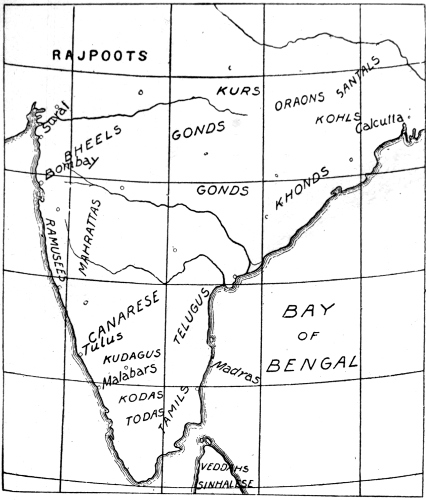
Ethnic Chart of Hindostan.
The languages of the Dravidians, though of the type called agglutinative, have no demonstrative connection with those of the Sibiric (Altaic) stock, and the efforts to connect them historically are visionary. The original roots are monosyllabic, which are modified by the addition of suffixes. These suffixes often show the same “vocalic harmony” to which I have referred in some of the Sibiric idioms (above, p. 212); but its action is reversed, as while in Turkish, for example, the vowel of the suffix alters the vowel of the root, in Telugu it is the latter which controls the former.
Although all the Dravida tongues have borrowed more or less from the Sanscrit, it has been in words only, and their peculiar structure stands as ever wholly apart from all Aryac speech. There is something that looks like inflection in them, but the case-endings are merely particles referring to place, and not true grammatical cases. They are still in that stage of growth where the distinction of verb and noun is ill-defined, and relative pronouns are absent.
The literature which has been developed in these tongues is of respectable extent. That of the Tamils of southern Hindostan and northern Ceylon stands in the front rank. It is in both prose and poetry, special forms of expression being characteristic of the latter. Everywhere it reveals Aryac inspiration, and illustrates the general traits of the Dravidian intellect, ready facility in imitating and adapting the forms of a higher civilization, but limited originality and independence of thought.