LECTURE IV. THE EURAFRICAN RACE; SOUTH MEDITERRANEAN BRANCH.
Reading edition
Contents.—The White Race. Synonyms. Properly an African Race; relative areas; purest specimens. Types of the White Race; Libyo-Teutonic type; Cymric type; Celtic type; Euscaric type. Variability of traits. Primal home of the White Race not in Asia, but in Eurafrica. Early migrations and subdivisions. North Mediterranean and South Mediterranean Branches.
A.—The South Mediterranean Branch.
I. The Hamitic Stock. Relation to Semitic. 1. The Libyan Group. Location. Peoples included. Physical appearance. The Libyan blondes: languages. Early history; European affiliations; relations to Iberian tribes; the names Iberi and Berberi. Government. Migration. The Etruscans as Libyans. Later history; present culture. Syrian Hamites and their influence. 2. The Egyptian Group. Kinship to Libyans. Physical appearance. The stone age in Egypt. Antiquity of Egyptian culture. Its influence. Physical traits. 3. The East African Group. Relations to Egypt.
II. The Semitic Stock.—First entered Arabia from Africa. 1. The Arabian Group. Early divisions and culture. The Arabs. Physical types; mental temperament; religious idealism. 2. The Abyssinian Group. Tribes included. Period of migration. Condition. 3. The Chaldean Group. Tribes included. The modern Jew.
The leading race in all history has been the White Race. It is proper therefore that it should have our chief attention in the study of the distribution of the species. By some writers it is called the Caucasian, by others the Japetic, and by others again the European race—all inaccurate terms, for the race never originated in the Caucasus, never descended from the mythical Japetus or Japheth, and when first it appeared on the horizon of history, its most extensive possessions and the seats of its highest culture were not in Europe, nor yet in Asia, but in Africa.
Scheme of the European Race: South Mediterranean Branch.
(Extinct peoples in italics.)
I. Hamitic Stock.1. Libyan Group. Numidians, Getulians, Libyans, Maurianians,, Guanches, Berbers, Rifians, Zouaves, Kabyles, Tuareks, Tibbus, Ghadumes, Mzabites, Ghanatas, Etruscans, Amorites, Assyrians, Hittites. (?)
2. Egyptian Group. Copts, Fellaheen.
3. East African Group. Gallas, Somalis, Danakils, Bedjas, Bilins, Afars, Khamirs.
II. Semitic Stock. 1. Arabian Group. Himyarites, Sabeans, Nabotheans, Arabs, Bedawin, Ehkilis.
2. Abyssinian Group. Amharnis, Tigris, Tigrinas, Gheez, Ethiopians, Harraras.
3. Chaldean Group. Israelites, Arameans, Samaritans.
This statement may astonish you, and I know no writer who has properly emphasized the fact that the white race is geographically and historically an African race. I have calculated with some care the area of its control of the three continents when their inhabitants first became known. The results are these: The white race then possessed:49
In Asia 2,500,000 square miles.
In Europe 3,000,000 “ “
In Africa 3,500,000 “ “
These figures vindicate for the race the title I have given it—Eurafrican.
More than this: the purest and finest physical specimens of the white race always have been and still are found native to African soil; and the leading nations of the race, those who have most contributed to its glory, and to the advance of the civilization of the world, either have resided in Africa or can be traced to it as their ancestral home.
Types of the White Race.—Let us first define the characteristics, physical and mental, of the white race.
In one of its pronounced types, the individuals are blondes, tall in stature, the eyes blue or grey, the hair yellow or reddish and wavy, the beard full, the nose narrow and prominent (leptorhin), the chin well defined, the jaws straight (orthognathic), the skull long (dolichocephalic) or medium, the eyes narrow (microsemes), the supra-orbital ridges rather prominent, the face moderately oval.
This is the typical appearance of the ancient Goths, Teutons and Scandinavians, and of the modern Swedes and Germans. It was also that of the ancient Libyans, and is still preserved in the greatest purity among their descendants in Morocco and Algiers; hence I shall call it the Libyo-Teutonic type.
A second type is also tall in stature, but red-haired, freckled complexion, the face and forehead broad, the cheek bones prominent, the eyes nearly circular (megasemes), the jaws and mouth projecting (prognathic), the skulls broad and high (brachycephalic-hypsistenocephalic), the chin square and firm.
This is the type we see preserved in some of the Highland Scotch clans, and in the “Tuatha de Danann” of Ireland, recalling the large-limbed and red-haired “Caledonians” of Tacitus, and those ancient Britons who, under Queen Boadicea, withstood so valiantly the Roman legions. The Gauls or Cimbri of Belgium and northern France were of this type, and hence it has been called the “Cymric” type.
But there is a second Celtic type, also of vast antiquity, claimed by some to be the only pure form. In it the skull is also broad—broader than the former variety; but the stature is undersized, the hair and eyes dark-brown, the complexion brunette, the orbits rounded, the forehead full. Modern representatives of this type are the dark clans of the Highlanders, the Irish west of the river Shannon, the Manx, the Welsh, the Bretons of France, the Auvergnats, the Walloons of Belgium and the Ladins of eastern Switzerland.
The most ancient known seats of these dark Celts were in extreme western Europe and the isles adjacent. This location points them out as one of the oldest peoples in Europe, whether their presence is explained by immigration or autochthonous descent. Part of their possessions in early historic times was in the Iberian peninsula, along the Cantabrian mountains in northern Spain. Here they were in immediate contact with members of the white race of a different type, the Euscarians or Basques.
In them the stature is medium, the form symmetrical, hair and eyes are dark but rarely black, the complexion dark and sallow, the face oval, and the skull long, the length being in the posterior (occipital) region. Although the last mentioned is an important distinction between the Celtic and the Euskaric skull, there is unquestionably a closer resemblance physically between the Celts and Basques, who speak totally diverse tongues, than between the Celts and Cymri, whose tongue was the same.
In these four typical groups from the extreme west of Europe we find sharp contrasts within limited areas, among peoples some of whom are unquestionably consanguine. Two of the groups, the Teutonic and Cymric, belong in color and hair and stature to the blonde type, but differ profoundly in shape of skull and facial bones; the two others belong to the brunette type, but differ equally in osseous character. In general physical traits the Celtic differs less from the Euskaric than from the Cymric type, as was recognized by the historian Tacitus.
These facts bring out an ethnic principle of importance—the variability of traits within the racial limits—and this becomes more marked as the race is higher in the scale of organic development. No race remains closer to its type than the Austafrican, none departs from it so constantly as the Eurafrican. Wherever we find the unmixed white race we find its blonde and brunette varieties, its prognathic and orthognathic jaws, its long-skulled and broad-skulled heads.50 To establish genealogic schemes exclusively upon these differences, as has been the work of so many living anthropologists, is to build houses of cards.
These contrasts are presented to us daily. The researches of Virchow, De Candolle, Kollmann, and many others, prove that in the same city, in the same family, the children to-day are born brunettes or blondes, dark or light eyed, to some degree broad or narrow skulled, with but partial reference to their parents’ peculiarities. The aberrant types are usually about twenty per cent. of the whole. It seems generally to have been so in the unmixed white race wherever located.
All such variations, however, remain strictly within the racial lines, and are not approximations to other races. Each race retains to-day the characteristics of its earliest representatives, so far as we know them.
Primal Home of the White Race.—Where should we look for these earliest representatives, for the primal home of the Eurafrican race? The usual answer has been “in Asia,” but now that answer is rejected by all the younger and most earnest ethnologists.
A steady stream of information has of late been contributed by the sciences of linguistics, palæontology, pre-historic archæology and racial anatomy, sufficient to convince even the skeptical that not Asia, but the western water-shed of the Eastern Continent, was the area of characterization which developed this race with its marked physical traits and singular mental endowments. In the previous lecture I have shown you that man himself probably came into being as such within the limits of that region which I have described as Eurafrica; and as its conditions were such as to foster his transformation from some inferior primate, so they continued, though profoundly altered, to favor his growth, as they still do continue to-day. It is by no mere accident or result of political manœuvres that western Europe has for two thousand years produced the mightiest nations and greatest minds of the earth.
The discussion of the precise locality where in Europe the primitive man developed into the white race has occupied many learned pens in the last score of years. But by nearly all of them the discussion has been limited to the birthplace of merely the Aryan linguistic stock—an unfortunate narrowness of view, which has prevented a comprehensive grasp of the question at issue.51
The Aryan peoples present by no means the only, nor yet the purest types of the white race. I have seen quite as noble blondes among the Kabyles of the Djurjura as in Denmark, quite as handsome brunettes among the Basques of the Pyrenees as among the Celts of France or the Italians. A broad construction of the question must include all these, and in this spirit I approach it.
We must search for the first abode, the primitive “area of characterization” of the white race:
1. Where its most ancient residence and greatest numbers were in earliest historic times.
2. Where the prehistoric remains prolong that residence most remotely back.
3. Where the earliest forms of linguistic structure continue to exist in large communities.
4. Where its purest types are retained in considerable numbers.
5. Where the climatic conditions are favorable to the physical traits of the race.
If we can select a locality in which all of these arguments unite, the cumulative evidence is so powerful that we may consider the question settled.
I have already shown that at the dawn of history the white race possessed either in Europe or Africa a far larger area than in Asia, and possessed it practically exclusively. The most recent researches in the pile dwellings of the Swiss lakes and the plain of the Po show that the same race inhabited them from the classic period of Greece to far back in the stone age.
The most ancient shell-heaps or kitchen-middens on the shores of Portugal contain skulls of the peculiar type of the Basques of to-day. The hiatus or gap which was once supposed to exist between palæolithic and neolithic culture in France has been bridged over by numerous observations, showing that the same race continued to live and grow there.52 As for language, every linguist recognizes the agglutinative type of the Basque, and the semi-agglutinative character of the Berber as more antique forms than the inflectional caste of Aryan or Semitic tongues. Nowhere else do white tribes speak an agglutinative tongue, except a few in the Caucasus, where we know they settled at a comparatively recent period.
The purest types of the whites in any large number have always been found in Western Europe and Northwestern Africa. There the blondes were represented by the Suevi, the Goths, the Vandals, the Cymri, the Berbers; the brunettes by the Euskarians, the Celts, and the native Italic tribes. In the Orient, the Parsees, the high-caste Brahmins, the Siagosch of the Hindu Kusch, and some Caucasian tribes, have by close intermarriage retained in a measure the traits of the race; but confessedly not in the same distinctness as the nations of Western Europe; nor do the Semitic peoples of Asia present the purity of the type with anything like the distinctness of the descendants of the Libyans in the valleys of the Atlas. Finally, we do not anywhere in Asia find the physical conditions favorable to the development of the white race—the moist, cool, cloudy climate, the extensive shady forests covering broad areas of low elevation, with absence of malaria and diminished demand on the chylopoietic organs.
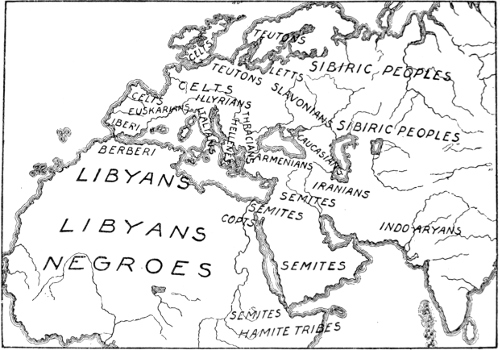
Ethnic Chart of the Eurafrican Race.
Early Migrations and Subdivisions.—It is not necessary to suppose that the different peoples of the race developed themselves from one central point. The contrary is more probable.
Beginning at the extreme West of Europe, and its appendix North Africa, the race pursued an easterly course, divided by the great intervening sea of the Mediterranean into two sections, which for convenience I designate as the “North Mediterranean” and the “South Mediterranean” branches, though it will be seen that these geographical limits are not to be taken absolutely.
The North Mediterranean branch embraces as its most important member the Indo-Germanic peoples. When first heard of in history, this stock extended along the shores and islands of Europe from Cape Finisterre to the Gulf of Finland, occupying all of Central Europe and much of Asia Minor, the regions of Modern Persia, and at a later date the southern vales of the Himalayas. Its northern limits have always been in contiguity with the Asian or Yellow race. Stretch a line on the map from Singapore to St. Petersburg, continue it to the Atlantic, and you have roughly the ethnic boundary which has ever separated the races, and does so to-day.
In western Europe, south of the Aryac was the Euskaric stock, occupying central Spain, central and southern France, portions of Italy, and various islands in the Mediterranean.
As speaking a language of a different family from the prevailing inflectional type of the race, it is spoken of as “allophyllic.” It does not stand alone in this respect. Some of the white Caucasian tribes speak similar agglutinative tongues, and it is supposed by some that the ancient Pictish, Illyrian, Lycian, Van, and Etruscan were of similar character. Probably many such languages obtained which are now extinct.
The South Mediterranean Branch consists of two related stocks, which have been called the Hamitic and the Semitic. These names are not objectionable, in so far as they indicate a distant genealogic unity, still recognizable, between the two branches; but should not in any way be accepted as acknowledging as historic facts the myth of the Deluge and their origin in Asia. The reverse is true. The migrations of both stocks have been from west to east, and the two great branches of the White Race entering Asia, the one by the Bosphorus and the second by the Isthmus of Suez, encountered each other after thousands of years of separation in the region where the venerable myth locates their point of departure.
A. The South Mediterranean Branch.
I shall begin my survey of the race and its distribution with the South Mediterranean branch, as that which has been the more important of the two in history, controlling by far the greater territory, and developing the earlier and more potent civilizations. It has ever been, and still is, the leader in intellectual acumen, and the monuments of its achievements, both in the realms of thought and action, remain unrivalled in the world. With great propriety, therefore, it claims our first attention.
I. The Hamitic Stock.
The affinity between the Hamitic and Semitic stocks is distinctly shown by their physical traits and the character of their languages. The latter statement, which was long in doubt, has now been acknowledged by the most competent students, such as Friedrich Müller and A. H. Sayce.53
Within their own lines the Hamites are divided into three groups, the Libyan, the Egyptian and the East African groups, each distinguished by physical and linguistic differences.
1. The Libyan Group.
Of these the Libyan group occupies the region furthest to the west, and presents the purest type of the stock. From time immemorial it has occupied the land from the Nile Valley to the Atlantic, and from the Mediterranean to the Soudan. In the classical geographies its tribes are referred to as Numidians, Libyans, Mauritanians and Getulians, and at present they are known as Berbers, Rifians, and Shilhas in Morocco, the Tuariks and Tibbus of the desert, the Kabyles and Zouaves in Algeria, the Ghadames, Serkus, Mzabites of the south, the Senegas of Senegal, and many others. The Guanches, who once inhabited Teneriffe, and are now extinct, belonged to the Rifian tribes of this stock,54 and the rulers of the once powerful empire of Ghanata, which for centuries before the rise of Mohammedanism controlled the valley of the Upper Niger, were allied to the Moroccan family.55 Arab historians of the seventh century tell us that at that time the Berbers were “the lords of Maghreb (Africa), from the Arabian Gulf to the western ocean, and from the middle sea to the Soudan.”56
The physical appearance of the Libyan peoples distinctly marks them as members of the White Race, often of uncommonly pure blood. As the race elsewhere, they present the blonde and brunette type, the latter predominant, but the former extremely well marked. Among the Kabyles in Algeria, I have seen many fine specimens of blondes, with yellow hair, light eyes, auburn beard, and tall stature. An English traveller who visited last year some remote villages in the mountains of Morocco, describes their inhabitants as “for the most part fair, with blue eyes and yellow beards, perfectly built and exceedingly handsome men.”57 This has been from the earliest times the characteristic of the Libyans, and there is abundant evidence that it was more general in former centuries than it is now. The Guanches of Teneriffe are described by the first voyagers as unusually tall and fair, their yellow hair reaching below their waists.58
The Greek poet Callimachus, who was librarian of the famous library at Alexandria two hundred and fifty years before the Christian era, applies the same adjective ξανθος, blonde or auburn, to the Libyan women, which Strabo and other Greeks do to the Goths and blonde Celts of Germany.59
Long before this, again, in monuments of the XIXth dynasty of Egypt, the Libyans are painted as of a pronounced blonde type, with light eyes and skins, and are mentioned by a term which signifies fair or blonde.60 The extended researches of ethnologists on this point have accumulated a mass of facts proving that the ancient Libyans were in appearance strikingly similar to the North Germans and Scandinavians, having a fair skin, yellow or auburn hair, blue or grey eyes, full blonde beards, the face medium, the skull dolichocephalic, the orbital ridges prominent, the chin square and firm, forehead vertical or slightly retreating, the stature tall, and the body powerful.61
This identity of type impressed me very much among the Kabyles, and I note that the German ethnologist, Quedlinfeldt, who was among the Berbers in Morocco lately, writes of them: “I very often met individuals with flaxen hair and blue eyes, who in face and form corresponded perfectly to the ordinary type of our North German people.”62 For this reason, I give it the name of the “Libyo-Teutonic” type.
In the pure-blooded clans who still dwell in the fastnesses of the Atlas and the Djurdjura, this antique type is that which is general; but in the valleys, in the desert and in Tunisia the type is darker, having been corrupted by admixture with negro, Arabic and other stocks.63 The fact which I wish especially to impress on you is that nowhere do we find a purer type of the white race than in northern Africa, and that this was recognized by the earliest writers and records as that especially belonging to this stock.
The languages spoken by the various Libyan peoples prove on examination to be dialects of one tongue, all so much alike that a few days’ practice will enable the speaker of any one of them to express himself in another. In its grammatical formation, it is inflectional with agglutinative tendencies. Its radicals are made up of consonants, the indications of time and place being formed by changes in the vowel sounds. In this respect it resembles the Semitic tongues, but differs from them in having radicals of one, two, three, or four consonants, while they have usually those of three consonants only. In many other respects it presents analogies to the Semitic dialects, of such a nature that these latter seem to have developed themselves out of conditions of speech as represented by the Libyan. Hence some writers have called it and its allied tongues “proto-Semitic languages.” It stands in distinct relation to the Coptic or ancient Egyptian, and to some East African dialects.
The Libyans have possessed from time immemorial the country in which we find them. They are its indigenous inhabitants—all others, as Carthaginians, negroes and Arabs, being demonstrably intruders. Can we obtain any clue to their monuments in prehistoric times by the aid of archæology and linguistics? Some able students have thought they could, and have brought forward some singular surmises. There is a series of structures of huge stones, called dolmens, menhirs and cromlechs, extending over northern and central France, southern England, northern Spain, Portugal, Morocco, Algiers, and central Tunisia. They are much alike, and seem to have been constructed by some one people in very ancient times. The skulls in them are often long, like those of the Libyans and Teutons. Hence several French writers have suggested that the ancestors of the white Libyans moved from central Europe into Morocco, along the line of these megalithic structures.64
In spite of a good deal of severe criticism, there remains much in favor of the view that these remains mark a route by which some neolithic people extended their conquests. But it seems to me the trend of migration was in the other direction, toward the east, and not from it. The white race began as such during the glacial epoch; it could scarcely have developed north of the Pyrenees, for the climate was so cold that the reindeer, which to-day cannot breed in Stockholm, found a suitable home in the valley of the Garonne. The Iberian peninsula and the Atlas at that time possessed climatic conditions about like those of Great Britain to-day.
In that peninsula, at that time connected with Morocco by a land bridge at the straits of Gibraltar, are the oldest forms of languages spoken by the race, the Euskaric dialects. There is reason to believe that at the dawn of history these occupied the centre of the peninsula; north of them, in the Cantabrian mountains and along the shores of the Bay of Biscay, were the Celtiberians, the rearguard of the migratory hordes of Aryans; and along the southern shores and in North Africa extended the tribes whose direct descendants are the Libyan peoples. The name Iberi, Iberians applied by the ancients to the inhabitants of the eastern and southern shores of Spain, testifies to this. It means in the Libyan tongue freemen, and in the plural form berberi or Berbers, is that by which the old Egyptians knew them, and which from the same root is their own favorite designation to-day.65
That the Iberians were Hamites, and not Basques, has long been suspected, and is plainly the opinion to be derived from the statements of the ancients and the presence of Libyan proper names in the south of Spain.66
When the Berber chieftain Tarik crossed the straits in the seventh century, and gave to the great rock his name (Gibraltar, Djebel-el-Tarik), he was but returning to seize anew the land from which his ancestors had been driven by Carthaginians and Romans.
From the remotest times the Libyans have had the same form of government—village communities, united by loose bonds into federations. The Egyptians referred to them as “the Nine Bows,” or Bands,67 the Romans as the “Quinquigentes,” the Five Peoples, the Arabs as “Qabail” or Kabyles, Confederates. These confederations were sufficiently powerful, even so far back as 1400 years before Christ, to put in the field an army of 30,000 or more men for an attack on Egypt; and that the general culture of their country was quite high is shown by the character of the spoils obtained by the Egyptians—horses, chariots, vessels of brass, silver, copper and gold, swords, cuirasses, razors, etc.68
At that date the nations of the North Mediterranean branch were yet in the stone age, and the sites of Greece and Rome were the homes of savages.69
It is probable that this defeat of the Libyans by the armies of Rhamses gave a serious shock to their progress, by disintegrating their growing state. It appears that about this time there were various colonies which migrated to sites on the northern shores of the Mediterranean. One of these I have believed to be the Etruscans, who settled on the west coast of Italy about 1200 years before our era. They were tall blondes, dolichocephalic, speaking an un-Aryan language, and by their traditions came by sea from the south.70
The Libyans were at times partially under the dominion of the kings of Egypt, and many of them entered the Egyptian armies as mercenaries. They allowed the Phenicians peaceably to found the great city of Carthage on their shores, and from these early colonists they learned the art of writing. The alphabet which is still preserved among some of their hordes is derived from the Punic letters.71 When Carthage fell, Rome seized the mastery of the coasts and productive valleys, but her legions never penetrated to the inland fastnesses. When the great empire tottered to its fall, Goths and Vandals poured across and over the straits of Gibraltar to found an ephemeral empire in Africa; but these cavalry soldiers, knowing to fight only on horseback, scarcely touched the confines of the Libyan mountain homes. Even the Arabs, sweeping resistlessly across their land in the beginning of the eighth century, failed to penetrate many of these fastnesses. To this day no Arab dares venture into the land of the Rifian Berbers, and many a tribe of the Djurjura keeps its customs and its blood unaltered by the Koranic laws, or the Semitic intruders, or the Code Napoleon of the French invaders.
The ancient elements of their culture are still largely retained. Among the Kabyle and Touareg tribes of to-day, in spite of the liberty authorized by Islam, monogamy is the almost invariable rule, the women are not only respected, but generally possess most of the property, and prostitution is unknown. They are, moreover, usually the learned class, and most of the “tifinar” manuscripts come from the hands of these fair scribes.72 As to the general character of the Berbers of Morocco, we may take Sir Joseph Hooker’s word when he tells us that they are “decidedly superior in intelligence, industry and general activity to their neighbors.”73
The wander-loving Libyan tribes pursued other journeys far to the east. Following the coast of the Mediterranean, they formed settlements on the Syrian shore, and extended their possessions into the Mesopotamian valley, and north into the mountain vales of Asia Minor. The Phenicians and Canaanites, the Amorites, who were blonde Berbers of true Libyan type, the Hittites, and the old Assyrians, who were the builders of Babylon and Nineveh, were of Hamitic stock, as is shown by the accordance of the ancient biblical statement with modern linguistic and archæological research.74
From these culture-centres of the Hamitic stock followed the mighty stream of human progress back along the southern shores of the Mediterranean to Cyrene and Carthage, and along its northern shores to Cyprus, Greece, Italy and beyond; while the Accadian and Summerian learning, preserved for all time in the cuneiform writing, made its beneficient influence felt far into India and China, and reacted beneficially on the older wisdom of Egypt, from which it had at first largely drawn its inspiration.
2. The Egyptian Group.
From this all too hasty survey of this most ancient people we must turn to another, akin to it, which has played an important, yes, the most important part in the culture-history of our species. I refer to the ancient Egyptians. They belonged to the Hamitic stock, but wandering eastward from its primal seats certainly more than ten thousand years before our era, had possessed themselves of the Nile valley from the mouth of the stream quite up to and beyond the first cataract.
Their kinship to the Libyans is proved by numerous linguistic identities between the ancient Coptic and the Libyan dialects, and by their physical appearance. In color they are yellowish-white, passing to a reddish-brown though the women who are not exposed to the sun would pass in Europe as merely dark brunettes. In the bony structure, the skull, the face, and the proportions, they assimilate entirely with the white race and the Libyan type. This has been shown by the researches of Virchow and others.75
The ancient Egyptian is represented to-day by the modern Fellah or field-laborer of the Nile. The type has been very well preserved, for though the riches of this wonderful valley have attracted myriads of foreigners in peace and war from the earliest times, all have suffered greatly in longevity and fertility compared to the native population. This type is of medium stature, the limbs and body symmetrical and delicately moulded; the skull is long, the face oval, the hair dark and straight, or slightly curly; the eyes are brown and small, the nose straight, the lips rather full, the mouth small, the chin not prominent, the beard scanty.
In all respects, in the pure Copt we must recognize a delicate, thorough-bred member of the Eurafrican race, in spite of his reddish-brown hue. These traits are to be explained by the narrow limits of the Nile valley, shut in by trackless deserts from the rest of the world. Here for thousands of years lived this stock, closely intermarrying, and under climatic conditions of singular uniformity.
Whether they were the first inhabitants of the valley has not been ascertained. Certain it is that at a period long before the date we usually assign to Egyptian civilization, a people dwelt on the Nile ignorant of any implements but those of rough stone. Their relics have been found in the stratified gravels of the hills, and on the summits of the arid plateaus.76 I know no reason, however, to suppose that the tribes of the Egyptian stone age were other than the ancestors of those who were brought under the control of the founder of the first dynasty, the historic king Mena.
This was about 4000 B. C. But previous to him the ancient Egyptian priests claimed some 25,000 years of occupation under various gods and demi-gods; and the general accuracy of their claim I am not prepared to dispute.77 Certainly the culture of lower Egypt must have been at a high level for thousands of years before the date of Mena, or he could never have established the state which we know he did. From all that archæology has yet taught us, we must place the beginnings of Egyptian civilization earlier than that in the valley of the Yang tse Kiang, earlier by far than any other on the globe. Its streams have permeated all the lands to which the Eurafrican race have extended; fecund as the waters of its own Nile, its elements have nourished and developed the best intellectual powers of the race through all subsequent ages; to it we owe the seeds of our arts, the germs of our sciences, the forms of our religion, the schemes of our literatures, and the inestimable boon of our written language. Look where you will among the most ancient remains of the Old World culture, you find the impress of Egypt’s Land and mind—in Etruscan tombs, in Guanche mummy caves, in treasure houses of Mycenæ, in Cypriote vaults, in Assyrian mounds, under Carthagenian foundations.78 The species Man owes nowhere else such gratitude as to these African nations of the Eurafrican race.
The Egyptian presents the best known and complete type of the psychical traits of the Hamitic stock. Unideal, laborious, utilitarian, he was devoted to material progress and the gross animal enjoyments of life. His preferred employment was agriculture, his favorite art the huge in architecture, his religion was a polytheism with numberless images and pictures, his pleasures were those of the appetite, his hopes of immortality were bound up with the preservation of the present body.
3. The East African Group.
The singular uniformity of the Egyptian type does not allow us to divide it into several branches, and on account of its segregated position, it does not seem to have had much intercourse with the east African group of the Hamitic stock, living to the south of it.
At present this east African group of the Hamites includes the Bedjas and Bilins between the Nile and the Red Sea, the Afars or Danakils near the mouth of the Red Sea, Gallas and Somalis between the gulf of Aden and the Indian ocean, and the adjacent tribes of the Agaouas, Adals, Khamirs, and others. In appearance these peoples are usually reddish brown in color, with dark wavy hair, of moderate stature and symmetrical form, the face oval and the skull moderately long, the nose aquiline and the chin well shaped, and heavier built than the Egyptians.
Their life is principally nomadic, living in tents of skin, and governed by chiefs who rule over small communities. The descent is reckoned and property passes on the female side. Some are Mahommedans, but hold the faith lightly, and like the Kabyles, attach more importance to the customs of their clan than to the precepts of the Prophet. In many parts they betray admixture with the Negro tribes to whom they are neighbors, and from whom they have always obtained slaves.
Thus the Danakils are described as sooty black, with scanty beards, thin calves, and thick lips, but with features and hair in other respects quite European, their faces rarely prognathic, and their bodies symmetrical.79 The Somalis are lighter in color, but like the Danakils, do not cultivate the soil nor establish fixed abodes.
II. The Semitic Stock.
Owing to the unreasoning acceptance of myths as history, it is generally believed that the Semites originated in Asia. From what I have already said you will appreciate that such an opinion is quite inconsistent with modern research. We may, at the most, concede that the peculiar form of their language and certain physical traits were developed during their long residence in the peninsula of Arabia, where history first finds them. But that they entered Arabia in remote pre-historic times from Africa, and not from Asia, is now acknowledged by an increasing number of learned and unprejudiced writers.80
There is a difference of opinion whether this immigration was by the way of the Isthmus of Suez or the Straits of Bab el Mandeb, but the course of their wanderings in Arabia seems to have been from north to south, the Ethiopian Semites being distinctly emigrants from the other side of the Red Sea. Hence the probability is that the ancestors of the ancient Arabians wandered from the Libyan plateau, or the eastern Atlas, through the Delta into the region of the Sinaitic mountains, whence they spread south and east, forming several distinct groups.81
1. The Arabian Group.
The first of these included the Arabians proper. At a very early period they became divided into a northern and southern portion, the former represented by the Ishmaelites and Bedawins, the latter by the ancient Himyarites, Sabeans and Nabotheans, and the modern Ehkili and kindred clans. The Himyaritic nations had important cities, and possessed a written literature at least 700 B. C., and probably much earlier.82 The Queen of Sheba, who paid a memorable visit to King Solomon, came from one of these cities, and her journey is strong testimony to the admiration for learning which prevailed in her land, and which she so evidently fostered.
At that time, and for centuries afterwards, there were few parts of the world more favored than the southern portions of the peninsula. It was known as “Arabia felix,” Araby the Blest, and was famed for its abundant products, its spices and perfumes, and the wealth and luxury of its inhabitants. Some change of climate apparently, and the inroads of the Ishmaelitic hordes, quite destroyed this happy condition about the fifth century, A. D. The Himyaritic language disappeared, the cities were laid waste, many of the people migrated to Africa or sank into despised outcasts, as the present Ehkili of the Hadramaut. In this manner the whole of the great peninsula fell under the control of the true Arab.
It is he who preserves in his language the oldest and purest form of Semitic speech, and in mind and body its most pronounced mental and physical type. He is rather tall (1.65), his face oval, the nose straight or aquiline, the features sometimes singularly noble and prepossessing, the skull long (index 73°-75°), the complexion ruddy rather than brown, when due allowance is made for the tan, and the hair slightly wavy or straight. Crisp hair is looked upon with disapproval, as indicating mixed and ignoble blood.83 In temperament the Arab is abstemious, and his powers of physical endurance are phenomenal. His mental temperament is that of an idealist; he has added nothing to the grand creations of plastic art, nothing to inventions of utility in life, nothing to the marvels of architecture or the beauties that appeal to the senses; he cares neither for history nor the drama. In his dreams he conquers the world, and it falls at his feet; in fact, his greatest states have been ephemeral bubbles.
Yet his dreams have been realized. The Semite has conquered the world, and it is at his feet. Twice have arisen among his people majestic forms, before whom all civilized nations bow, Jesus and Mahomet.
The religious idealism which led the Semite in the days of Moses to reject the images of stone and wood and proclaim that God is one, overawed in its later expressions the whole of the white race, and now extends its sway to the farthest seas.
Though the Aryan to-day may dislike the Semite and doubt of the God whom he preached, let him not forget that the first vivid impression of such a great idea came from the Semitic stock. If in his marts, his diplomacy and his learned professions, he finds the Semites still pressing him aside, let him remember that this is the people whose destiny seems to be to own no country, but to rule all.
2. The Abyssinian Group
Of tribes is evidently descended from fugitives from the Arabian peninsula. The Ethiopians, or Geez (a word meaning emigrants), speak a dialect the nearest related to the Himyaritic of the inscriptions. It has a literature and an ancient alphabet of its own. The Tigre, the Massawa, the Amhara, and, further to the south, the Harrari, are Semitic dialects, more or less akin to the Ethiopic.
The period when this migration took place is not precisely known, but it was at a calculable period before the beginning of our era. Quite likely it was about the time of the dissolution of the Joktanide monarchy in the Hadramaut. There can be no question but that the course of migration at this point was from Arabia into Africa.
The Tigre is the predominant nation of North Abyssinia, the Amhara in the south of that region. The Harrari extends into the land of the Somalis. All these are of Himyaritic descent, but near them are a number of later Arab tribes who speak dialects of the modern Arabic. These are the Jalin about Khartoum, and others near Senaar and Baqqara, west of the Nile. There are also many Jews, who have inhabited the country from the early centuries of our era.
An infusion of negro blood is visible in much of the population. Their color is dark brown, the hair is crisp, and the features are negroid. Where this mingling is absent, the color is a light or bright brown, the face oval, the nose thin, lips not at all thick, and the hair wavy and straight. In other words, the features are truly European, framed in a brown setting.
The Abyssinians proper have always been an agricultural, pastoral and manufacturing people. The soil is fertile and the climate temperate, but there are no large rivers, and communication is difficult. The crops are barley, dates, millet, sugar-cane, etc. Formerly the country was under one ruler, who was called the Grand Negus. The late “Negus,” Theodoras, could put in the field over fifty thousand fighting men, and made himself so obnoxious to Europeans that the English sent an expedition against him in 1868, and he perished under the ruins of his capital, Magdala.
From the fourth century the principal religion in Abyssinia has been Christianity, but in a corrupt form, mixed with the ancient heathen observances, such as ceremonies at the rise of certain stars, and veneration of holy stones and springs. The clergy are numerous, estimated at about 72,000, and exert a leading influence in the state. There are many monks and nuns living in cloisters, and possessing extensive holdings. The church service is conducted with an effort at pomp, and there is a considerable sacred literature, of very little value. The influence of the religious teaching on the people is scarcely visible except in making them fanatical, superstitious and averse to enlightenment. Abyssinia thus presents the picture of a country which for more than 1500 years has been a Christian state, and where Christianity has wholly failed to render the people moral, intelligent or pure.
3. The Chaldean Group.
The third group of the Semites was the Chaldean, including the Syrians and Arameans, the later Assyrians and Babylonians, the Israelites, Samaritans and Jews. All these were from early times deeply tinged with other blood. The Syrians and Chaldeans removed first from the Arabian peninsula, and their dialects depart the furthest from the pure stock. Abraham, the traditional ancestor of the Israelites, left northeastern Arabia for Mesopotamia about 2000 B. C., to dwell in “Ur of the Chaldees,” a city near the mouth of the Euphrates. Already the Chaldees had secured from the older Hamitic settlers a portion of Mesopotamia, and gradually extended their conquests.
Many of the Syrians united with the Hamitic residents on the coast, so that the Phœnicians became largely Semitized. All these nations were in constant intercourse with the highly developed civilization of Egypt, as is shown by the Mosaic books, and from that source derived most of the germs of their intellectual growth. In spite of their love of travel and commerce, in spite of their dispersion over the earth, this group has retained a striking individuality. Many ethnographers charge it against the Jews that the presence of blondes among them, and of brachycephalic heads, proves a crossing of the blood. This is not the case. The Semitic stock is a markedly white type of the race, and in all ages fair complexion, light eyes and hair, have been admired as especially beautiful. This is repeatedly referred to in the Hebrew Scriptures, and is shown by observation among these people at the present day.84
The physical type of the Jew is well known and unmistakable; wavy hair, dark or blonde, full beard, eyes soft, nose prominent, rather heavy, with an accentuated and peculiar outline, lips full, face oval, skull medium or long. Nor are his mental traits less familiar; a pliant, supple disposition, a distaste for physical labor or the toil of the pioneer or soldier; deficiency in personal courage; subtlety in monetary transactions; quickness in applying social or individual weaknesses to his own benefit; industry in intellectual pursuits; love of display and of position; strong devotion to family ties.
This is the Jew as we know him in the tussle of modern life, a character prominent in all European and American cities, without a nationality, in conflict with the prevailing religion, suspected and disliked, but wielding an influence out of all proportion to the numerical strength of his people. It may be regarded as continuing in his person that remarkable intellectual superiority which the South Mediterranean Branch of the white race has from the earliest time exerted on the history of man.
Scheme of the Eurafrican Race.—North Mediterranean Branch.
(Tribes in italics are extinct.)
I. Euscaric Stock. 1. Euscaric group. Euscaldonac, Basques, Sards, Siculi, Aquitanians, Picts (?), Ligurians (?), Cantabrians.
II. Aryac Stock. 1. Celtic group. Gauls, Highland Scotch, Irish, Welsh, Manx, Bretons, Celtiberians, Cymri.
2. Italic group. Latins, Umbrians, Oscans, Sabines, Italians, French, Spanish, Portuguese, Roumanians, Wallachians.
3. Illyric group. Illyrians, Albanians, Thracians,Japyges (?).
4. Hellenic group. Pelasgi, Phrygians, Lydians, Macedonians, Greeks.
5. Lettic group. Letts, Lithuanians, Old Prussians.
6. Teutonic group. Goths, Vandals, Franks, Angles, Saxons, Suevi, Scandinavians, Germans, Danes, Dutch, English, Anglo-Americans.
7. Slavonic group. Russians, Poles, Czechs, Servians, Croatians, Wends, Bulgarians, Montenegrins.
8. Indo-Eranic group. Armenians, Persians, Bactrians, Hindoos, Kafirs, Dards, Beluchis, Hunzas, Gypsies.
III. Caucasic Stock. 1. Lesghic group. Avars, Laks, Udes, Kurins.
2. Circassic group. Circassians, Abkhasians.
3. Kistic group. Tush, Karaboulaks.
4. Georgic group. Georgians, Mingrelians, Lazs.