LECTURE VI. THE AUSTAFRICAN RACE.
Reading edition
Contents.—Former geography of Africa. Area of characterization of the race. Its early extension. Divisions.
I. The Negrillos. Classical tales of Pygmies. Physical characters. Habits. Relationship to Bushmen. Description of Bushmen and Hottentots.
II. The Negroes. Home of the true negroes. 1. The Nilotic Group. 2. The Sudanese Group. 3. The Senegambian Group. 4. The Guinean group.
III. The Negroids. Physical traits. Early admixtures. 1. The Nubian Group. 2. The Bantu group.
General Observations on the Race. Low intellectual position. Origin of negroes in the United States; in Arabia.
We have seen that the African continent at the period of its first occupancy was divided by the sea (now desert) of the Sahara into two unequal portions, the northern being properly an appendix of Europe. The southern portion began at the Mediterranean on the north, where the tertiary plateau of Tripoli rises above the sea, included the valley of the Nile above the Delta, and the remainder of the continent as it now is, together with the island of Madagascar, with which it was then connected by a land bridge. As the Sahara sea evaporated to become a desert, its vast tracts and also the lower Nile valley and the eastern coast nearly to the Equator were occupied by the Hamitic stock of the white race. The remainder of the continent was in the possession of the Austafrican or black race.
Scheme of the Austafrican Race.
I. Negrillo Branch. 1. Equatorial Group. Akkas, Tikkitikkis, Obongos, Dokos, Vouatoans, Kimos of Madagascar.
2. South African Group. Bushmen, Hottentots, Namaquas, Quaquas.
II. Negro Branch. 1. Nilotic Group. Shillaks, Dinkas, Bongos, Kiks, Baris, Nuers.
2. Sudanese Group. Haussas, Battas, Bornus, Kanoris, Ngurus, Akras.
3. Senegambian Group. Serrerus, Banyums, Wolofs, Foys.
4. Guinean Group. Ashantis, Dahomis, Fantis, Yorubas, Mandingoes, Veis, Krus.
III. Negroid Branch. 1. Nubian Group. Nubas, Barabras, Dongolowis, Pouls, Tumalis, Nyam Nyams, Monbuttus.
2. Bantu Group. Caffirs, Zulus, Bechuanas, Sakalavas, Damas, Herreros, Suahelis, Ovambos, Bassutos, Barolongs, Bengas, Duallas, Wagandas.
This race is divisible into three quite different types or branches, resembling each other in possessing a very dark skin, black eyes, woolly hair, a prognathic face, and generally a dolichocephalic skull, but differing widely in many minor traits. These types are the Negrillos, the Negroes, and the Negroids.
The general characteristics of the Austafrican race are the most positively marked of any of the varieties of our species, and as it is certainly the lowest in zoölogical analogies, by some writers it has been considered the oldest of all. This reasoning is erroneous. The black race developed quite locally, under the influence of intense heat and humidity. Its original habitat must have been where alone its purest representatives have always been permanently residing, that is, on the lowlands of western central Africa, between the equator and 12° north latitude, and from lake Tchad to the Atlantic. The hot and moist depression watered by the great river Niger, may be named as the probable “area of characterization” of the distinctive physical type of this race.
How far from this center was its maximum extension has been variously estimated. There is no evidence that the blacks ever occupied the lower Nile valley, the area of ancient Egypt. On the oldest monuments they are represented as slaves, and the Egyptian type discloses no sign of admixture with Negro blood. They occupied at one time the southern oases of the Sahara, but their dominion never extended as far north as Fezzan. The presence of Negro colonies and mixed breeds which is visible in the northern oases, is owing to the importation of the Soudanese as slaves, and also to the extensive migrations they are still in the habit of making. I learned when visiting some of these oases, that many black families are constantly moving from one to another in pursuit of their various callings.
It is an historical fact that from the beginning of the Christian era at least, and probably much longer, the whole of the southern Sahara and the northern portion of the Niger valley have been under the absolute control of the Berbers, members of the Eurafrican race. They founded in those lands the extensive monarchies of Ghanata and Melle, which maintained their supremacy through many centuries.
On the east it is not likely that the Negroes ever gained prolonged control east of the White Nile. That portion of the continent between this river and the Arabian gulf has been held by the same peoples since the time the ancient Egyptians sent their trading ships to “the land Punt,” the name under which they knew it; and these peoples were not of the Austafrican type or race.
The general tendency of migration in central as in southern Africa, so far as it can be traced in historic times, has been westerly and southwesterly. The densest population has been near the Atlantic coast, as if the various tribes had been crowded to the impassable barrier of the ocean.
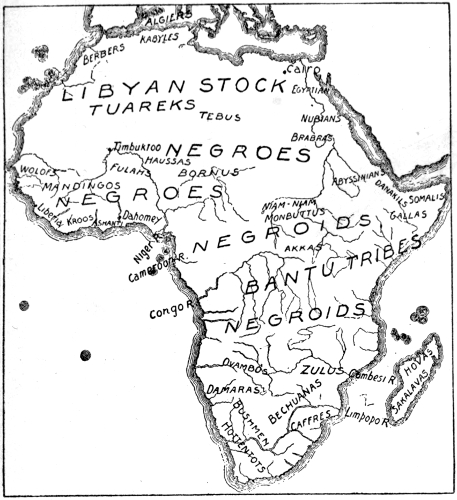
Ethnic Chart of Africa.
Whether the basin of the Congo was ever held by the true Negro race, is an undecided question. If so, they were completely driven thence in proto-historic times. South of that region they certainly never penetrated, as the Hottentot and Bushman type cannot be considered as a derivative from the true Negro, but only as a descendant from a common ancestor, unlike either, and is perhaps a much older member of the family. Hence I shall begin the description of the race with
I. The Negrillos.
This diminutive form of the Spanish word negro, black, is applied to an unusually small variety of the race, which by several careful writers is believed to be the oldest of all the African varieties, and at one time to have occupied the most of the continent. Herodotus and other classical authors speak of the Pygmies of Ethiopia, and there is sufficient evidence to show that in his day they dwelt in localities as far north as the 18th degree of latitude.116
For a long time modern skepticism assigned these statements to the realms of fable, but the rapid exploration of Central Africa in this century proves their general correctness. Many travellers, especially Du Chaillu, Schweinfurth, Stanley, and Emin Bey, have seen and described these dwarfs, and a few of them have been brought to Europe.
At present they are not found more than two degrees north of the equator, whence they extend southward into the territory of the Congo. Their various tribes are known by different names, as Akkas, Tikkitikkis, Batuas, Dokos, Obongos, Vouatouas, etc.
The height of the male is four feet six to eight inches, the body is symmetrical and remarkably agile, the facial angle is exceedingly low (about 60°-65°), the face markedly prognathic, the chin retreating, the lips protruding, and the ears large and ugly. The color is not black, but a dark reddish brown, and the skull has a tendency to a globular form. The nose is flat (about 55°), and there is a strong odor to the skin. The hair is woolly, and in tufts, and the body is covered with coarse short hairs, “so that the surface feels like a piece of felt.”117
These extraordinary people have no settled abodes, build no towns, cultivate nothing. They depend entirely on hunting and fishing, and the barter of the products of the chase to agricultural tribes. They are skilful in the use of the bow, employing small poisoned arrows, and also manufacture spears. Voracious cannibals and unerring marksmen, they are looked on with dread by the negroes around them.
Of their religion we have no knowledge further than that they have an extreme dread of strange objects, lest some malignant influence lurk in them.
In the south of Africa we find another group of tribes, the Bushmen and Hottentots, also of small stature, and in many respects resembling the Akkas. They are equally far removed from the true negroes, and it is the opinion of some very competent observers, notably the German travelers, Schweinfurth and Fritsch, that all these dwarf tribes belong to the same stock.118 The objection to this chiefly is that the Bushmen are often dolichocephalic, but so also are some of the Akkas, and at any rate this consideration is not alone of sufficient weight to be decisive. There is little doubt but that this dwarf stock extended over Madagascar, where they were known as Quimos or Kimos, and are believed still to exist in the southern part of the island.119
The Bushmen are much better known than the Akkas. They dwell in and around the great Kalihari desert, usually in a half-famished condition, and on the lowest social scale. They are wandering hunters, making use of the bow and arrow, and are not cannibals.
The Hottentots are a mixture of the Bushmen and the Negroid-Bantu tribes in their vicinity. They are taller than the Bushmen, better nourished, and lead a pastoral life, possessing herds of cows and fixed habitations. Their language is remarkable for the number of its “inspirates,” or “click” sounds, to form which one must draw in the breath, similar to some we use in urging horses. In form it is agglutinative. In these respects and in others, it resembles the dialects of the Bushmen, and those who are competent to speak on the subject believe that both can be traced to a common source.120
The Hottentot is rather a hopeless case for civilizing efforts. He hates profoundly work, either physical or mental, and is passionately fond of rum and tobacco, or failing the latter, he will stupefy himself by smoking the wild hemp. He is too indolent to attempt agriculture, and is content to live on milk, raw roots, and the product of the chase.
Some of the English travellers, on the other hand, say the Hottentots have as much wit as their neighbors, the Dutch boors! Certain it is that before they were oppressed by the whites, they possessed herds of cows, goats and sheep, dressed hides, dug wells, manufactured pottery, in some places tilled the ground and built fixed villages or kraals.
The oft-repeated assertion that they are destitute of religion is, like all such, utterly false. On the contrary, they have quite a developed mythology, perform rites and say prayers. Their principal deity is Tsunigoam, to whom they appeal as “the father of all things” and “our master.” At the rise of certain stars they hold festivals in honor of the gods of light, and they believe the spirits of the dead wander about and should be placated.121 Their cult, indeed, compares favorably with that of classic Greece.
II. The Negroes.
The true Negroes of Africa are confined to what the Arabs call Beled es Sudan, the Land of the Blacks, the Sudan, and adjacent parts. It is therefore an error to look on that continent as mainly inhabited by negroes. At least a third of it has always been principally peopled by the whites, and another third by tribes not of pure negro stock. The true negro type, such as I have described it in my first lecture (see page 48), is scarcely seen in resident tribes south of the Equator or north of the tropic of Cancer. Within that limit they may be divided for purposes of study into four groups, the Nilotic, the Sudanese, the Senegambian and the Guinean.
1. The Nilotic Group.
These begin with the Changallas, east of Sennaar, in the Egyptian Sudan, between the 10th and 15th degree of north latitude. To the south of them along the White Nile are the Dinkas, the Chilluks, the Nuers, Kiks, Baris, and other tribes. These are wholly black and in a rudimentary stage of culture, depending chiefly on hunting and fishing. They go naked, the women at most wearing little aprons. Some of them are cannibals, and all are of savage dispositions. As a rule they are tall and powerful, and brave in war.
The Nuers are spoken of as of fine physical traits, and building handsome and durable houses. Their bows and arrows, and the helmets of their warriors, resemble those depicted on ancient Egyptian monuments. It is probable that they are of mixed blood, their hair being less woolly than that of their neighbors. The Baris, who live on the White Nile, are described as an intelligent people. They cultivate millet and tobacco, understand the reduction of iron and copper from the ores found in their country, and are skilful merchants, making long voyages to exchange their wares.
2. The Sudanese Group.
The Central Sudan is the site of the most important negro states, the monarchies of Bornu, Bagirmi and Wadai. The two former are in the fruitful depressions which surround Lake Tchad, a large fresh water sea in the center of one of the most delightful tropical basins in the world. The natives are known as Kanoris, Kanembus, Marghis, Haussas, Biddumas, etc. They are true negroes, very black, and of strong body.
Further to the west commences the watershed of the Niger, the great river of Central Africa, describing in its course a vast semicircle more than two thousand miles in length. On its banks are numerous kingdoms and some cities of magnitude, as Sansandig, with 30,000 inhabitants, and the better known Timbuctoo, with 20,000. Many of their houses are built of sun-dried bricks, and an active commerce is carried on. But it must be added that these houses and this commerce have been created by the Arabs, Tauregs, and mixed races, not by the negroes themselves. These are principally tillers of the soil, hunters, fishers and warriors. They nominally govern the states of Gando, Sokoto, Fellata and others, but Arab influence is visible everywhere, and the beneficent results of the introduction of the Mahommedan religion in this part of Africa is strongly attested even by English travellers.
The Haussas, the Todas, and the Tibbus, tribes near the border of the desert, are principally of negro blood, but with a visible strain of Hamitic descent in them. The last mentioned, indeed, should properly be classed with the Berber stock.
3. The Senegambian Group.
The country south of the Senegal river to the coast of Sierra Leone is known as Senegambia, or the western Sudan. It is claimed by the French, who own the shadow of a sway there. The tribes near the coast are the Sereres, the Wolofs, the Baniuns, and many others, all in a low stage of culture. To the east is the important nation of the Mandingoes, occupying an extensive territory adjoining western Guinea on the south, and stretching east to the heights near Timbuctoo.
The Wolofs present a pure type of the Negro race, perfectly homogeneous, and, according to Dr. Tautain, it is impossible to find among them a single physical character hinting at an admixture of any other blood. Their faces are prognathic, and the women have the projecting gluteal region, so marked a trait in the Austafrican. Their language is agglutinative, and is an independent stock. Most of the Wolofs are Mohammedans, and in social organization they maintain a rigid system of castes, based principally on occupation.122
The principal divisions of the Mande or Mandingo nation are the Mallinki, the Soninki, and the Bambaras. They are not so pure in blood as the Wolofs, many among them having regular features, light complexions, and straighter hair. These traits are doubtless owing to their long contact with the Arabs and the Berbers, the latter of whom have controlled their country more or less for two thousand years. They are active in commerce, and cultivate the soil, the men working with the women in the fields.
4. The Guinean Group.
Most of the tribes of the coast of Guinea are in a condition of savagery, and have deteriorated by their contact with the whites. The petty kingdoms of Ashanti, Fanti, and Dahomey are heard of from time to time in our newspapers as the scene of some particularly bloody rite or massacre. For generations this was the central point of the slave trade, and the encouragement it gave to devastating wars led to the destruction of all progress. It is here, on what is called the Pepper Coast, that we established the Republic of Liberia, where about 20,000 negroes from the United States are carrying out a moderately successful experiment of returning to their native continent.
III. The Negroids.
A large portion of the African continent is occupied by tribes of dark hue, but lacking some of the most prominent traits of the true negro. These are the “Negroids,” who are probably the products of a long and close fusion of the Negro with the Hamitic and Semitic types. Their color is not black, but a dark, reddish, coppery brown; the hair is crisp and frizzly, but not woolly; the nose is straight and better formed than that of the negro; the lips are thick, the skull long, and the peculiar odor of the negro is absent.
We find these traits in two groups, both of which unquestionably had their historic origin along the Nile, above the first cataract, and in the region drained by its tributaries—in other words, the locality where for ten thousand years or more the Hamites and the Negroes have been in constant contact.
We can only speculate on the numberless wars and marriages, on the extensive slave trade and commercial intercourse which throughout this period have blended the races into so many intermediate types that it becomes impossible in many cases to say with which a given tribe should be classified. To add to the confusion, a large Semitic element was added at two epochs, one when the Abyssinian branch of the Semites moved across from Arabia to occupy Abyssinia, the other when, under the impulsion of the fanaticism of Islam, the Arabs followed up the Nile in their proselyting campaigns.
The latter event began in the seventh century of our era and has continued ever since. The former probably began in earnest in the height of the power of the Himyaritic states of southern Arabia, which we may roughly put at seven centuries before Christ. A century or two later than this, negro tribes from the Sudan overran the decaying cities of the upper Nile and established a temporary control along its banks; and the emperor Diocletian induced many of them to settle as far north as Assuan.123 These various influences combined to produce the numerous mixed types which one sees along the Nile, rendering its ethnography peculiarly obscure.
Under the pressure of increasing population and external inroads, these mixed peoples divided into two groups, one, the Nubian, remaining in the original district, the other, the Bantu, removing to the south and southwest.
1. The Nubian Group
Includes the Nubas proper, who are partly a mixed people, while some of them are pure negroes from Kordofan; the Barabras, who dwell on both sides of the Nile between the first and second cataracts; the Fundjas and Bertas, further south; and the Monbuttus and Nyam Nyams, or Sandehs, near Lake Victoria Nyanza, besides many tribes of less note. Most of them are more or less agricultural, and live in small villages. Their clothing is very slight, and many tattoo the skin. The Sandeh and Monbuttu are cannibals, and even eat those who die of disease. Nevertheless, they have a knowledge of metals, and are skilful iron-smiths.
The physical appearance of most of these tribes differs equally from the Arab and the negro. They are generally of medium stature with thin limbs and flat feet. The hair is crisp, but not woolly, and the color varies from a black to a white brown. The beard is meagre and the skin hairless. The features are not of the negro cast, but assimilate rather those of the European.
Most of them are agriculturists in a small way. They raise the “caffre corn” and millet, and make some efforts to irrigate their fields where it is necessary. Their dwellings are wretched huts, and their arts are of the rudest.
Not many centuries ago there was a large number of so-called Christians among them, but their religion seems to have left little impression on their character.
At present they are professedly Mohammedans, but really either fetichists or indifferent. Their morals are not well-spoken of, though it is also said that the class with whom travellers usually come into contact are not favorable specimens of the population—as is apt to be the case everywhere.
The Puls, or Fellahs, and the Fans, who live to the west in the Sudan, removed to the regions they now occupy from the Nile valley, and belong to the Negroid type. They have made extensive conquests in the vast unexplored country between Timbuctoo and the equator. Abstaining from alcohol and tobacco, condemning music and dancing, and blindly adhering to the precepts of the Koran, they are unpopular among their negro neighbors, but have brought many of them under subjection. Their occupations are both pastoral and agricultural, while as commercial travellers, and wandering smiths, they roam from one end of the Sudan to the other. They weave cotton cloth, tan and dye leather, and work it into various articles of use which are widely celebrated for their excellence, and in times past were among the most extensive slave dealers of Central Africa.
The languages of this group belong to four diverse linguistic stocks, all of the agglutinative character. It has been called the equatorial family of central Africa. They are usually agreeable to the ear, the verbs are simple, and the syntax not complicated.124
2. The Bantu Group
Occupies nearly the whole of Africa south of the equator, except the territory of the Bushmen and Hottentots. It includes the Suahelis, the Mazimbas and the Caffres on the east coast, the Sakalavas of Madagascar, the Bechuanas west of the Caffres, the Zulus, and nearly all the numerous tribes of the Congo basin, the Angola and Zambesi rivers.125
Their ancestors at one period resided to the northeast, probably somewhere in Ethiopia, where a prolonged fusion of Hamitic blood with the genuine Negro produced their physical type. They are usually tall and well built, the color is a dark coppery brown, the head is long (74), the hair is frizzly, and the nose rather straight.
All the Caffre people are pastoral in habits, and have large herds of cows. Agriculture is practised on a limited scale. Their temperament is turbulent and warlike, and many of them are cannibals. Their social organization is military, but slavery is unusual. Singular to say, they do not know the bow and arrow, their weapons being the war-club and a lance called an assegai. Their religion is a fetichism, and polygamy is universal. On the whole, they are on a higher level of culture than the Negroes of the Sudan. All the Bantu tribes are mono-glottic, that is, they speak dialects traceable to one original stem. These have a peculiar alliteration, and form their words by means of prefixes of elements placed before the root, this being their special method of agglutination. It is divided into three principal dialects, and is the most widely extended of any of the African linguistic stocks, except the Libyan.
The vast basin of the Congo river, including over two million square miles, is now mostly included in the “Congo Independent State.” Its native inhabitants are connected by language with the Negroids of the Bantu group, and several of them retain traditions of their immigration into the districts they now inhabit. The Waganda, for instance, report that their ancestors came from the northeast, the Watuta and Masiti from near the Zambesi river. Many of them are of a light, bright brown, and are devoid of the peculiar odor of the true negro. All the tribes from Lake Tanganyika to the Atlantic speak dialects manifestly akin.
They are divided into independent nations, some of large extent, and are subject to chiefs, who rule with despotic power. Their religion is fetichistic, and though they generally are agricultural, and possess a certain degree of culture, cannibalism is or was frequent among them. Slavery also existed in some of its most deplorable forms, and up to a very recent date, if not still, there was a regular trade in young slaves to be fattened, killed and eaten on certain solemn occasions.
General Observations on the Race.—Although the true Negroes occupied but a small portion of the African continent, the infusion of their blood into their Hamitic and Semitic neighbors, resulting in the Negroid type, was to such a degree that these mixed stocks became assimilated in character much more to the black than to the white race, and were brought approximately to the mental level of the former.
Neither the Negroes nor the Negroids ever carried out a conquest of lands occupied by the Hamites or Semites. We have vague histories of bloody wars on a large scale among themselves, and the erection of apparently powerful monarchies, but which soon fell to pieces.126
The low intellectual position of the Austafrican race is revealed by the facts that in no part of the continent did its members devise the erection of walls of stone; that they domesticated no animal, and developed no important food-plant; that their religions never rose above fetichism, their governments above despotism, their marriage relations above polygamy. It is true that many of them practise agriculture and the pastoral life, but it is significant that the plants which they especially cultivate, the “durra” or sorghum, millet, rice, yams, manioc, and tobacco, were introduced from Asia, Europe or America.127 Their cattle and sheep are descended from the ancient stocks domesticated by the Egyptians, and differ from those represented on the early monuments of Assyria and India. The brick-built cities of the Sudan were constructed under Arab influence, and the ruins of stone towers and walls in the gold-bearing districts of South Africa show clear traces of Semitic workmanship.128 The knowledge of smelting and forging iron is of ancient date throughout Africa, and they can temper steel with skill, but the art of the smith is regarded as degrading, and their long acquaintance with this most useful of metals has not lifted them from a condition of barbarism.129
In many of the useful arts they reveal considerable skill. The weaving of grass into mats and cloth, the tanning and working of leather, the preparation of salt and soap, dyeing and pottery, are occupations which are wide spread. The true negroes are passionately fond of music, singing and dancing, and the invention of one instrument, the marimba, which is played by beating wooden keys with a stick, is attributed to them.
The tendency of the negro race in Africa is that which we observe among negro children in the public schools of the United States. Their powers develop quite as rapidly as those of white children up to a certain point, up to the age of thirteen or fourteen; but then there comes a diminution, often a cessation, of their mental development. The physical overslaughs the psychical, and they turn away from the pursuit of culture. They are unwilling to undertake, they are unequal to, the more arduous intellectual tasks.
I have already remarked that the Austafricans never of their own volition made any serious inroad into the territory of the white race. Yet there are to-day probably more than twenty millions of them, including the mulattoes, living among the whites, seven millions of whom are in the United States. This extraordinary condition is the result of the enormous deportation of the blacks as slaves, which has been going on for thousands of years.
The origin of the negroes in the United States may be traced partly by the physical appearance, partly by the few words of their mother tongues which have survived the acquisition by them of the English language. These words are generally connected with the Mande stem of tongues spoken by the Mandingoes and their neighbors, whom I have already referred to as dwelling in Senegambia and the Western Sudan.130 They were a nation of some importance, and having early become in great part adherents of the Mohammedan faith, established the monarchy of Melli, which in the thirteenth century extended from Timbuctoo to the coast, and forced many of the subjected tribes to learn the Mande tongue.
Scheme of the Asian Race.
I. Sinitic Branch. 1. Chinese Group. Chinese.
2. Thibetan. Thibetans, Ladakis, Nepalese, Bhotanese.
3. Indo-Chinese Group. Birmese, Siamese, Annamese, Cambodians, Cochin-Chinese, Tonkinese.
II. Sibiric Branch. 1. Tungusic Group. Tungus, Manchus.
2. Mongolic Group. Mongols, Kalmucks.
3. Tartaric Group. Turcomans, Yakouts, Turks (Osmanli), Usbeck, Kirghis, Cossacks, Huns.
4. Finnic Group. Finns, Lapps, Esthonians, Ugrians, Magyars, Mordvins, Samoyeds, Ostyaks, Voguls, Livonians, Karelians.
5. Arctic Group. Chukchis, Koraks, Kamschatkans, Namollos, Ghiliaks, Ainos.
6. Japanese Group. Japanese, Koreans.