Volume 153 — LOVELY WOMAN.
Reading edition
If the casual gods send inquiring strangers into my camp, let them (the intruders) be civil, please, or at least be male. Citizens I can at once wave away with a regretful nescio vos; foot-officers are decently reserved in their thirst for knowledge of an essentially Secret Service; but officers' wives—
I was growing to like the Royal Gapshire Cyclists (H.D.), my neighbours in the next field, until last Friday, when they perpetrated their Grand Athletic Tournament. Quite early in the day twos and threes of subalterns, with here and there a company commander, dribbled across with a diffident wish to be shown round the guns, and round we went. By the ninth tour I was wearying fast of the cicerone act, and hoping they would not mistake my dutiful reticence for stuffiness. They had made me free of a mess that has its points. Then, towards tea-time, She came. The Major, who brought, introduced Her, apologised (not for bringing Her) and withdrew. He was due to start the Three-Legged Obstacle Relay. She, on the other hand, was so interested, and would I, etc.? Would I not!
"Lovely woman!" thought I. "Fit soil for a romantic seed! Farewell reserve and half-told truth!" I then proceeded to describe unto her things unattempted yet in Field, Garrison, or High Angle Ballistics. Her first question (pointing to the recoil-controlling gear of No. 2 gun), whether both barrels were fired at once, gave me a cue priceless and not to be missed. My imagination held good for full fifteen minutes, and by the time we were ambling back to the fence I had got on to our new sensitive electrical plant for registering the sound, height, range, speed and direction of hostile aircraft. The fluent ease of it intoxicated, and I was lucky not to mar the whole by working in something crude and trite about the pilot's name.
She departed, smiling radiant thanks, and I thought no more of it until this morning, when Post Orderly handed me the following note:—
"DEAR SIR,—It was too kind of you to tell me all about your guns the other day, and it was too bad of me to let you. I ought to have mentioned that my husband is the Colonel Strokes, of the High Angle Ordnance Council. One of his favourite remarks is that the one woman of his acquaintance who knows more about artillery than a cow does of mathematics is
"Very sincerely yours,
"EVELYN STROKES.
"P.S.—Do you by any chance write?"
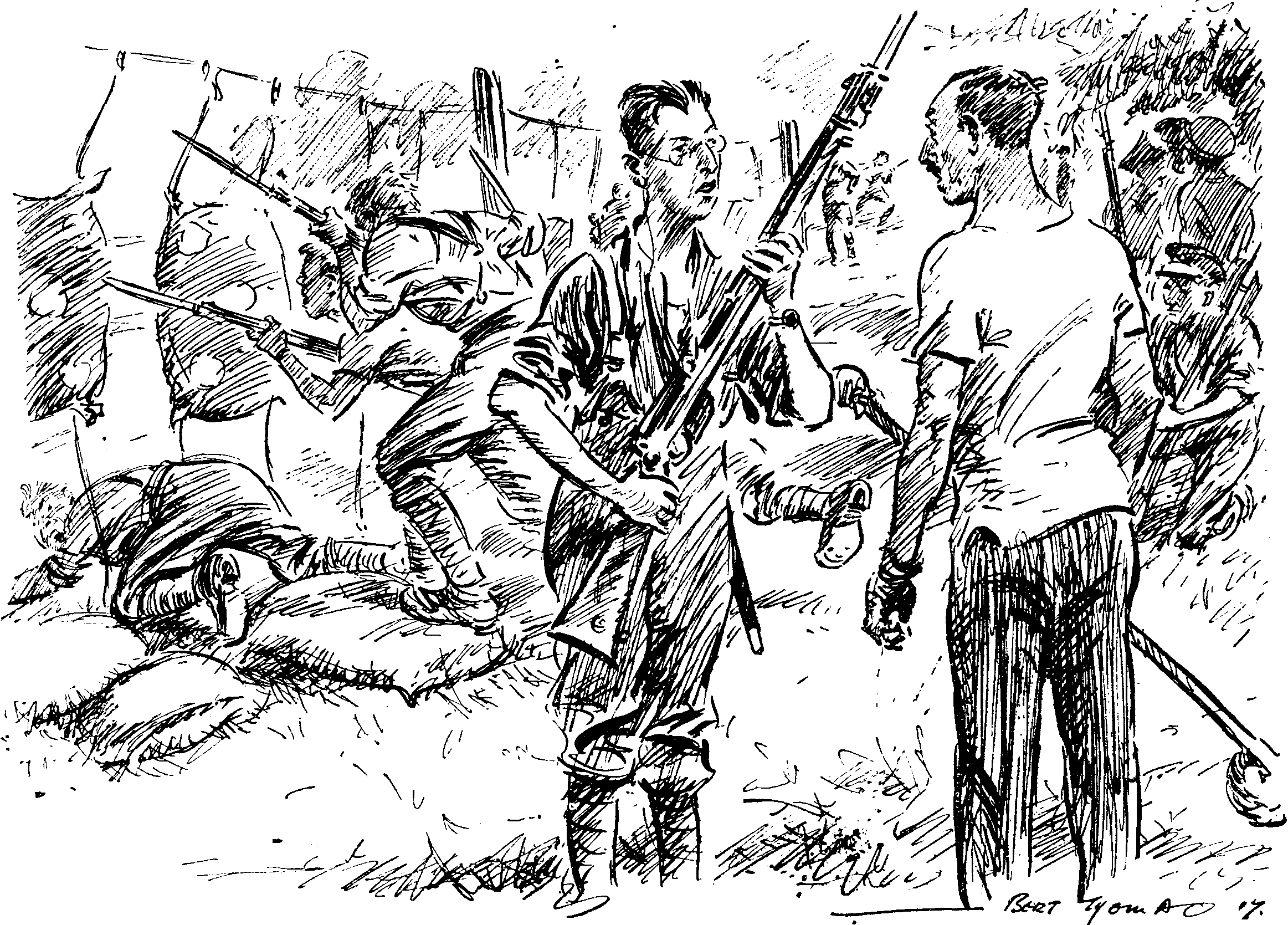
Recruit. "EXCUSE ME, SIR, BUT HAVE THE GERMANS THE SAME METHODS IN BAYONET-FIGHTING AS WE HAVE?"
Instructor. "LET'S HOPE SO. IT'S YOUR ONLY CHANCE."
Commercial Candour.
From a company's report:—
"Interim dividend on the Ordinary snares for half-year ended July 31, 1917, at the rate of 10 per cent. per annum, less income tax."—Evening Paper.
"A twelve-year-old boy was at Aberavon on Thursday sent to a reformatory school for five years. He was charged with stealing 5-1/2 6-5/8 Nbegetable marrows from an allotment."—Western Mail.
It is supposed that he intended to reduce them to decimals.
CRICKET.
There is no truth in the rumour that spectacular cricket is to be resumed. It is perfectly true that a section of the public who are devoted to watching the game and cannot understand why, because the nations happen to be at war, this favourite summer recreation should be denied them, have been agitating for the Government to arrange with the War Office to release all first-class cricketers now in the Forces, so that they may be free to play matches at home. It is also true that the Government, having refused to do this, subsequently, in view of the arguments urged by a deputation of cricket enthusiasts, agreed to do so, since it has always set its face against any pedantic rigidity of purpose. But none the less no such matches will be played, for the simple reason that the cricketers themselves refuse to come back until their job is finished.
"Boots.—Save nearly 50% buying Factory direct."—News of the World.
On second thoughts we think we shall continue buying one pair at a time.
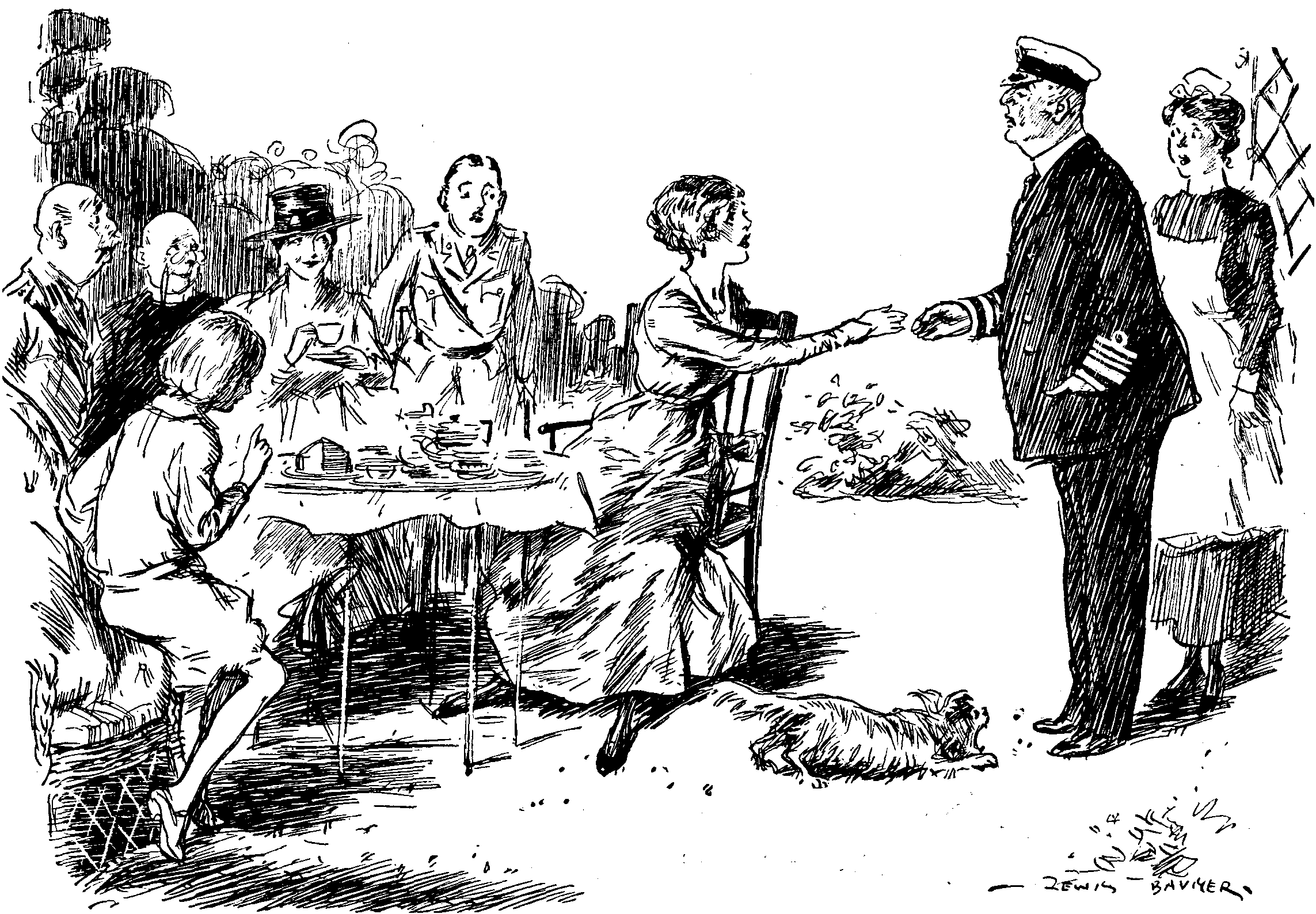
Little Girl (as distinguished admiral enters). "BE QUIET, FIDO, YOU SILLY DOG—THAT'S NOT THE POSTMAN."