Volume 153 — AT THE PLAY.
Reading edition
"BILLETED."
No wonder the Royalty Management, realising how resolutely determined the public was to have nothing to do with anything so witty and workmanlike as The Foundations of Mr. GALSWORTHY, have for their new bill declined upon the pleasantly trivial comedy of errors and tarradiddles, Billeted.
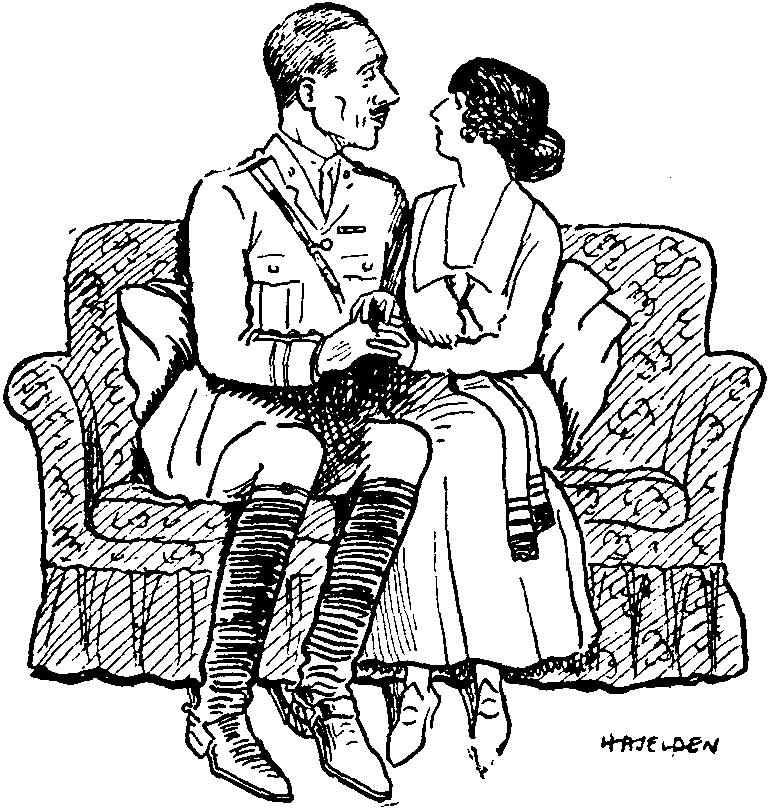
BILLETING AND COOING.
(The happy ending.) Captain Rymill . . MR. DENNIS EADIE. Betty Taradine . . MISS IRIS HOEY.
Betty Taradine is billeting at her pretty manor-house a nice vague Colonel. The Vicar's sister disapproves, because Betty is a grass-widow, and Penelope, the all-but-flapper, an insufficient chaperone. She expresses her disapproval with a hardy insolence which must be rare with vicars' sisters in these emancipated times. Naturally when you have a great deal of palaver about Betty's husband having deserted her two years ago after a serious tiff, and no word spoken or written since, you rightly guess that the expected new Adjutant, Captain Rymill, will be none other than the missing man. But you probably don't guess that Betty, to spoof the Church and keep the Colonel, has decided to kill her husband by faked telegram. So you have a distinctly intriguing theme, which Miss TENNYSON JESSE and Captain HARWOOD handle with very considerable adroitness and embroider with many really sparkling and laughter-compelling lines.
I should like to ask the pleasant authors some questions. How is it that the infinitely susceptible Colonel who loves Penelope, but is so overcome by the pseudo-sorrowing Betty that he is afraid of "saying so much more than he means," and appeals to his invaluable Adjutant for help—how is it he survived a bachelor till fifty? And how did Betty, with her abysmal ignorance of pass-book lore, manage to postpone her financial catastrophe for two whole years? And how do they suppose so popular and personable man as Taradine could come back to England under an assumed name without a number of highly inconvenient questions being asked? More seriously, I would ask if they really expect us to believe in the reconciliation on so deep a note of this nice butterfly and this callous husband, who never intended, but for the War, to come back from his big-game shooting, and who took no pains to arrange suitable guidance (there was a lawyer vaguely mentioned but he seems to have been singularly unobtrusive) for the obviously incompetent spouse whom he professes still to love? I am afraid it will not do. The one real point of weakness in the presentation was that Mr. EADIE could not modulate from the key of agreeable flippancy in which the comedy as a whole was set into that of the solemnly sentimental coda. Thus was the artistic unity of a pleasant trifle destroyed.
Mr. DAWSON MILWARD'S clever careful method made the Colonel a very live and plausible figure. Some of his intimate touches were exceedingly adroit. The authors deserve a fair share of the credit. Indeed there was throughout a suggestion of clever characterisation conspicuously above the average of this genre. Penelope was an excellently developed part, rendered with unexpectedly mature skill by Miss STELLA JESSE. The Vicar promised at first to be a new type, but the authors seemed to have lost interest in him half-way, and not even Mr. LAWRENCE HANRAY'S skill and restraint could quite save him. I rate Mr. EADIE as an actor too high to be much amused by him in obviously EADIE parts. "A man's reach must exceed his grasp." I think it just to Miss HOEY to say that she seemed a little handicapped by efforts of memory, a condition which will duly disappear and leave her charm to assert itself. Mr. GEORGE HOWARD was quite admirable as a Scots bank manager; Miss BLANCHE STANLEY, a really sound combination of essential good-nature and wounded dignity as a cook on the verge of giving notice. Miss GERTRUDE STERROLL tackled a vicaress of the Mid-Victorian era (authors' responsibility this) with a courage which deserves both praise and sympathy.
T.
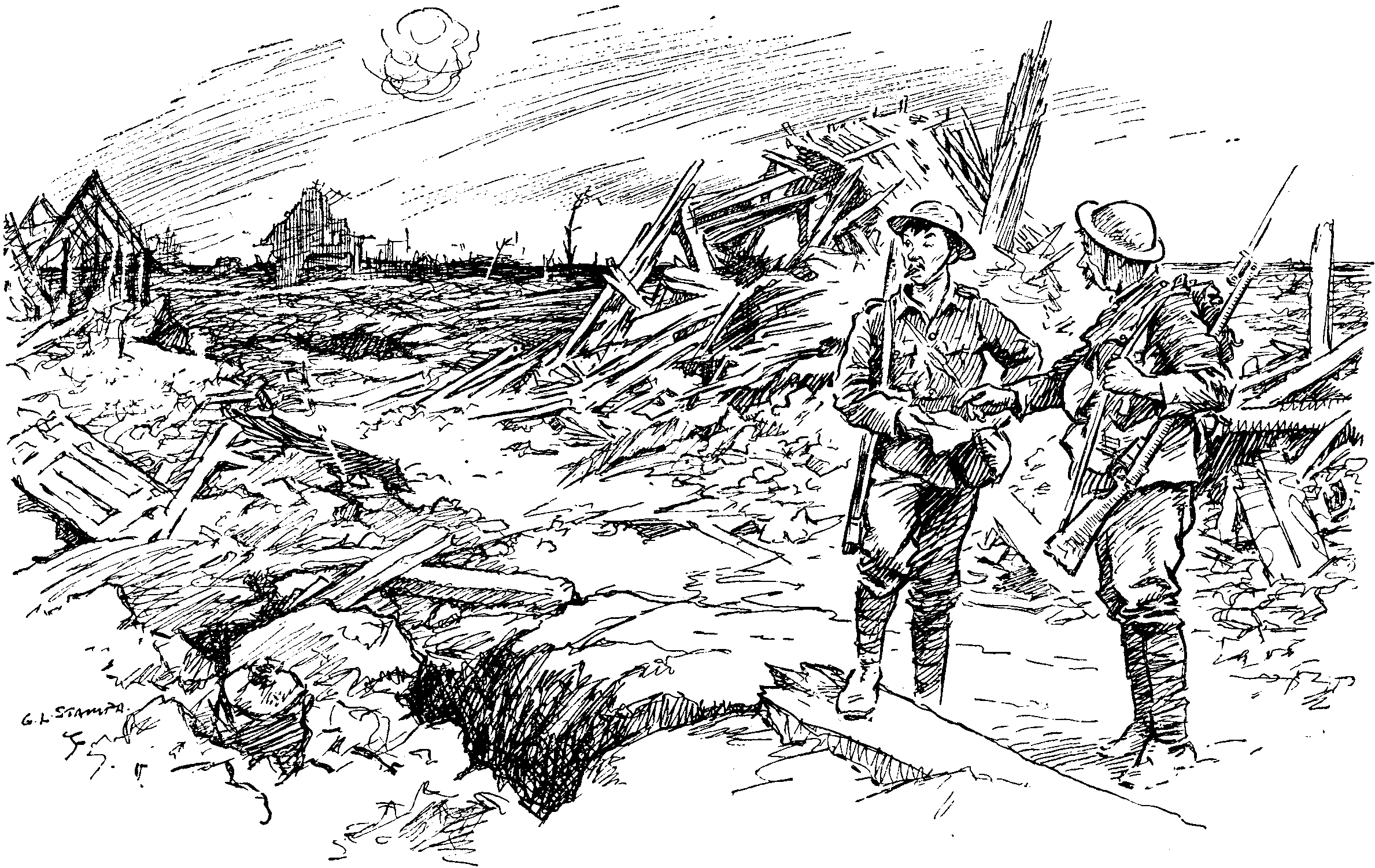
THE OPTIMIST.
"IF THIS IS THE RIGHT VILLAGE THEN WE'RE ALL RIGHT. THE INSTRUCTIONS IS CLEAR—'GO PAST THE POST-OFFICE AND SHARP TO THE LEFT AFORE YOU COME TO THE CHURCH.'"
THE AIRMAN.
Jack loves dreadnoughts, Peggy loves trains, But I know what I love—aeroplanes. Jack will sail the high seas if he can stick it; Peggy'll be the girl in blue who asks to see your ticket; But I will steer my aeroplane over London town And loop the loop till Nurse cries out, "Lor', Master Jim, come down!" Jack will be an admiral if he isn't sick; Peggy'll take the tickets and punch them with a click; But I will make a splendid hum up there in the blue; I'll look down on London town, I'll look down on you. Jack will hunt for U-boats and sink the beasts by scores; Peggy'll have a perfect life, slamming carriage doors; But I shall join the R.F.C. and Nurse herself will shout, "There's Master Flight-Commander Jim has put them Huns to rout."
"A well-known Liverpool shipowner and philanthropist is giving £70,000—£100 for each year of his life—to various charitable and philanthropic objects."—Scotsman.
He might almost have lived in the time of the Patriarchs, but we gather that he preferred the days of the profits.
"Often it was impossible to detect the existence of underground works until their occupants opened fire. At one such spot a white hag was displayed, and when our men charily approached a burst of fire met them."—East Anglian Daily Times.
The enemy is evidently up to his old trick—taking cover behind women.