Chapter III
Reading edition
JAMES BURKE (KNOWN AS “THE DEAF’UN”). 1828–1843.
No one who reads with attention the chequered career of James Burke will deny that “The Deaf’un” deserves to rank as one of the most honest, courageous, hardy, simple-minded, and eccentric fellows who ever sought praise and profit in the Prize Ring. Jem was the son of a Thames waterman who plied at the Strand Lane stairs. Left at an early age to the charge of a widowed mother, young Jem betook himself to the amphibious calling of “Jack-in-the-Water,” at the stairs where his father once plied with his “trim-built wherry.” At the time of which we write, before steam-boats, with their gangways and ugly dumb-lighters (the latter to give way yet later to a noble embankment with its broad granite-stepped landing places) had superseded the “caus’eys,” and “old stairs,” from Wapping to Westminster, the favourite and popular mode of transit of the dwellers in Cockaigne to Lambeth, to the glories of Vauxhall with its al fresco concerts and 30,00 (additional) lamps; to Cumberland Gardens, with its trellised tea-boxes, and “little gold and silver fish that wagged their little tails;” to the Red House, Battersea, with its gardens and pigeon shooting; to “Chelsea Ferry,” with its elm-bordered promenade and Soldiers’ Home, and to the numerous places of riverside resort, was by “oars or sculls,” plied by the brawny arms of the “firemen-watermen,” one of the most laborious and deserving fraternities who devoted their well-earned and well-paid services to the pleasure-seeking public who patronised the broad highway of the Thames. The popularity and consequent prosperity of the stalwart “firemen-watermen” (for most of them wore the handsome coat and badge of, and were retained by, one or other of the great London Insurance Offices, and were the only organised body for the extinguishing of fires and saving of life) extended to the humble “Jack-in-the-Water,” whose duty consisted in wading bare-legged 95 into the rippling tide, dragging the sharp nose of the wherry on to the paved causeway, or by its pile-protected side, and there steadying it, while the “jolly young waterman” politely handed his “fare” over the rocking “thwarts” of his smart, light boat to his or her cushioned seat in the “stern-sheets.” For his services in thus holding on, and thereby securing the balance of the staggering land-lubbers, for a pair of “sea-legs” were never included in the cockney’s qualifications, “poor Jack” seldom went unrewarded by one or more “coppers,” for we had not then come to the “age of bronze.” This humble and weather-beaten calling was by no means an unprofitable one to a hardy, handy, and industrious lad, such as young Jem Burke undoubtedly was.
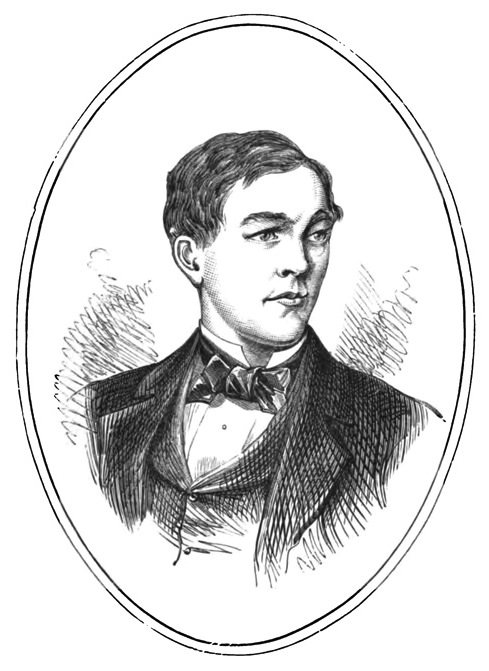
JAMES BURKE (“The Deaf’un”).
The date of Jem’s birth was Dec. 8th, 1809, in the closing years of the “war of giants,” and in his earlier days London was alive with war excitement; with processions on the Thames of the gilded and bannered barges of the Corporation and the public companies, with gaily painted pinnaces, shallops, and house-boats, aquatic fireworks and illuminations, and galas in honour of our victories in Portugal and Spain; to say nothing of frequent grand doings along the then bright river on all sorts of City “gaudy” days. It was moreover the line of procession on the 9th of November and other times when my Lord Mayor went in state to Westminster; and of continually recurring wager matches of skill and strength for prizes given by citizens, public bodies, and aquatic clubs, for the encouragement of the Thames watermen “between the bridges.” All these have vanished with the crowds who enjoyed them. The “fireman-waterman” is as extinct as the dodo. The half-penny or penny steam-boat of an utilitarian age has “improved him off the face of the earth,” and the picturesque silver Thames runs a paddle-churned cloaca maxima of the great towns in its upper course, by the stately buildings of our Palaces of Parliament and Palatial Hospital, sweeping by where once Strand Lane stairs offered itself as a convenient outlet for “taking the water,” along a spacious embankment, with its leafy avenues, bordered by lofty stone-built public edifices. Far different the Thames by which the young Deaf’un earned his “crust,” and added to the poor comforts of a widowed mother. Then the merry-makings we have above alluded to made the miscalled silent highway a lively and populous show-scene, to the profit of such snappers-up of unconsidered trifles as our “poor Jack,” whose Christian name was Jem. As to the “schooling” of our hero—for a hero he unquestionably was—it amounted to that sort of general knowledge which could be picked up in that “university” which Mr. Samuel Weller declares to be the best for 96 sharpening a boy’s wits—the streets. The Society for the Diffusion of Useful Knowledge as yet was not; the “schoolmaster” was altogether “abroad,” in the wrong sense; and the Briarean School-board had not yet “comprehended all vagrom” boys and girls, and taught them the “three R’s” in spite of their teeth. “Reading, ’riting, and ’rithmetic” not being in the curriculum of young Jem’s “’varsity,” he was perfectly innocent of those accomplishments, despite Dogberry’s assertion that to “read and write comes by nature,” though at figures, we can certify from our own personal converse, the Deaf’un had, on special occasions, an almost intuitive aptitude. His knowledge too, upon out-of-the-way subjects, was occasionally surprising; he had much “mother-wit,” a quaint felicity of expression, a sly touch of humour, and a quiet stolidity of look and manner, the outcome of his infirmity of deafness, which amused the hearer, from the apparently unconscious humour with which his comical notions were set forth. Of Jem’s physical powers and muscular endowments, the story of his Ring performances in after years will sufficiently speak.
Thus the young “Jack-in-the-Water,” like Topsy, “grow’d,” and we need not say he was well furnished in these respects to take his own part in the very rough “battle of life” to which he was from his earliest infancy introduced.
That the future Candidate for the Championship, born and bred in those “fighting days,” when Gully and Gregson, Belcher and Cribb, were on every tongue, should have yearnings to “improve his gifts,” as the goody-goody books express it, was but a natural sequence to what philosopher Square calls “the eternal fitness of things.” Hard by the Strand Lane stairs stood a well-frequented public-house, known as “The Spotted Dog,” the landlord of which was an ex-pugilist of no mean renown, hight “Joe Parish, the Waterman.” What wonder, that Joe’s judicious eye noted the good “points” in the sturdy little “Jack-in-the Water’s” build and disposition, and that he befriended the boatman’s orphan, patting his head as he warmed his chilled hands by the tap-room fire, where he dried his always damp and scanty clothing, and, as the Deaf’un himself has told us, saying, “You go straight, Jemmy, and we’ll see if you won’t be a topsawyer among ’em yet”? This early patronage by Joe Parish, as we shall see hereafter, continued down to Burke’s latest days, a fact creditable to both parties.
A passing remark on the pugilistic eminence of watermen may here be in place. Jack Broughton, the Father of the Ring, was a waterman; 97 as also was Lyons, who beat Darts for the Championship in 1769; while, passing over many boxers who plied the oar, the names of Bishop Sharpe, Harris, “The Waterman,” Harry Jones, and the Deaf’un’s “guide, philosopher, and friend,” Joe Parish, occur to us. No wonder, then, that on the 5th of February, 1828, young Jem Burke, under the wing of old Joe, was by the ring-side at Whetstone, near Barnet, an admiring spectator of the eccentric battle which there and then took place between a couple of dwarfs; one a Welshman named David Morgan, a vendor of shrimps and shell fish well known in various sporting and other public-houses, and the other Sandy M’Bean, a Scotch professor of the Highland bagpipes and the “fling.” After a ludicrous display of bantam game, Taffy was declared the conqueror, the second of the canny Scot carrying him out of the ring vi et armis, in spite of his protestations that he “wasna beaten ava’,” though the poor little fellow had not the ghost of a chance.
And now there was a pause, and a purse of £14 being collected, Ned Murphy (who had already fought M’Carthy, and a commoner or two), presented himself as a candidate for the coin. Our hero (who, doubtless, knew something of the challenger), eager of the opportunity of showing the stuff he was made of, at once, with the approval of Joe Parish, stepped into the ropes, and threw down his cap as a reply. No time was wasted in elaborate toilettes, and the ring being cleared, all eyes were bent on the “big fight” of the day, which, on this occasion, was presented as the afterpiece. Mister Murphy was so cock-sure of the money, and so eager to win, that he went off at score to polish off “the boy” for his presumption. Not only was his gallop stopped by some clever straight ’uns from the resolute young Jack, helped by an occasional upper-cut as he went in, but he, in turn, was fain to stand out, and retreat to “draw” his opponent. Young Jem, however, was not to be had twice at this game, and Mister Murphy not quite liking the look of the job, began to fight for darkness, which was fast coming on. Harry Jones, who was picking up Murphy as a “pal,” seeing the dubious state of affairs, stepped up to the referee and asked a “draw.” The men had now fought 50 rounds in the like number of minutes, and were quite capable, if they were of the same sort as the last dozen, of fighting 50 more; so the Young’un was persuaded to “whack” the stakes, and make up matters over a pot and a pipe at “The Spotted Dog,” by which arrangement Mr. Murphy got the “half a loaf” which is proverbially “better than no bread,” while the young “Jack-on-the-water” was in the seventh heaven of delight, not only at 98 his success (for he felt he must win), but at the possession of several golden portraits of His Majesty George the Fourth, of a value which to him seemed to vie with the fabulous treasures of Aladdin’s cave.
Jem was now “a card,” not only at the Strand Lane soirées, but was a free and accepted brother at all the sporting cribs in the hundred of Drury, Wild Street, the pugnacious purlieus of Clare Market, and among the “porterhood” of Covent Garden. Those were rough times, and among other rough entertainments the “rough music” of the butchers of Clare Market was not the least popular. Their marrow-bones and cleavers were always ready to “discourse” loud, if not “sweet music,” upon occasions of a wedding, a birth, or a christening among their own fraternity, or when any popular or well-known inhabitant took unto himself a wife. Foremost in these charivaris was one Tom Hands, who further had the reputation of being “sudden in quarrel,” and with him and the Deaf’un there had passed a sharp round or two at one of these uproarious gatherings, which had ended in their being separated by their friends.
On August 14th, 1828, Ned Stockman and Sweeney were matched to fight at Old Oak Common; the affair being arranged at a dinner at Alec Reid’s, at Chelsea. The ring was pitched, the expectant crowd assembled, and “time” was called. Peter Sweeney showed in battle array, but where was the “Lively Kid”? and echo answered “where?” He didn’t show at all, and a forfeit of the stake being then and there declared, his representative urged as a reason for what Sweeney called “making a fool of the public,” that Stockman “preferred his match with Harry Jones” (in which he was deservedly thrashed on September 16th, 1828). As the day’s draw thus proved a blank, and the meet could hardly separate without sport of some kind, a whip was made for an impromptu fight. The hat went round, and the cash being gathered by Alec Reid and the renowned Frosty-faced Fogo, a hint from one of the Clare Market Guild of Kill-Bulls that Tom Hands would like to cross hands with Jem Burke, there and then, if the namesake of “the author of The Sublime and Beautiful” dared face him, was at once seized with avidity. A shout went up from a hundred lungs as the burly butcher, his hair shiny with grease, and his cheeks red as a peony, drew his blue smock over his head and proceeded to divest himself of his upper clothing; nor was “poor Jack” without friends. Behind him stood Joe Parish and Alec Reid; Hands being seconded by Sweeney and a Clare Market amateur. The fight was a sad exposé of Tom Hands’ want of skill in the opening, and lack of what a slaughterman never should 99 be deficient in—pluck. The Deaf’un, who looked hard as iron and solid as the trunk of a tree, fought the first three or four rounds on the retreat, jobbing the butcher fearfully, and bleeding him from every vein of his fleshy jowl; then, having got him down to his own weight, he reversed the process, and fought him all over the ring so effectively that in the 10th round, 17 minutes only having elapsed, Hands’ second threw up the sponge in token of defeat, the butcher being terribly punished, while the Deaf’un was scarcely marked.
Indeed the effects of this encounter could not have seriously affected him, seeing that, on the day but one afterwards, namely on August 16th, the Deaf’un was again on Old Oak Common, to witness the battle between Mike Driscoll and Pat M’Donnell. This affair disposed of, a new Black offered himself “under distinguished patronage,” as the advertisements say, to box anyone for “a purse.” The Deaf’un, always ready, slipped modestly into the ring, announcing to Mike Brookery, the M.C. on this occasion, that he should like to be “introduced” to Massa Sambo for the next dance. The affair was a mere farce. The black had but one qualification, that of a first-rate receiver; as a paymaster he was nowhere. After rushing in head down a dozen times, and getting upper cuts and sound right-handers on the ear innumerable, he rolled down for the last time at the close of thirty-three minutes, declaring “Me can’t fight no more,” and the purse was handed to the Deaf’un.
In 1829, the Deaf’un, who was now regularly enrolled in the corps pugilistique, was with a sparring party in the Midlands, where, in the month of March, the great contest between Jem Ward and Simon Byrne was to come off near Leicester. The reader will find this fiasco, known as “The Leicester Hoax,” in its proper place in our second volume. On the 10th of March, 1829, an immense gathering from all parts of the kingdom was assembled at Leicester; and the great event having ended in smoke, and Bill Atkinson, of Nottingham, having beaten Joe Randall, in the ring prepared for the big’un’s, the day being yet young, a purse was collected. For this a big countryman named Berridge, of Thormaston, offered to “try conclusions.” The Deaf’un joined issue, and a smart battle ensued. The countryman was so overmatched that after 22 minutes, in which 11 rounds were got through, each ending by Berridge being hit down or thrown, his backers took him away, and Burke walked off with the 10 sovereigns.
Burke was now matched with Fitzmaurice (an Irishman nearly 13 stone, who subsequently defeated Brennan and Tim Crawley), for £25 a side, to 100 come off on Epsom Racecourse in May; the rencontre was prevented by police interference, and the affair postponed to June 9th, 1829.[14] That day being appointed for the fight between Ned Savage and Davis (the Black), at Harpenden Common, near St. Alban’s, it was arranged that the Deaf’un and Fitzmaurice should follow those worthies. It was fortunate for the travellers who went to see the first-named fight that the Deaf’un and Fitz. were in reserve, for the affair of Savage and the bit of ebony proved “a sell;” and so the second couple were on the turf in good time, and in a well-kept and well-ordered ring. Young Dutch Sam and Gaynor, who had come down with Savage, volunteered to second Fitzmaurice. On standing up Fitz. loomed large in height and length, but a survey of the sturdy Deaf’un, his firm attitude and compact strength, brought the betting to even. We shall not attempt to detail the fight, which extended to no less than 166 rounds, fought under a burning sun, and lasting two hours and fifty-five minutes. There was some clever stopping in the earlier portion of the battle on the part of the Deaf’un, but he could not reduce the strength of Fitzmaurice, and he himself became exhausted. After the 70th round the fight became a question of endurance; the Deaf’un at the end of the rounds lying on his stomach on the turf to get wind, declining to be picked up by his seconds, kicking up his heels in a comical manner, and declaring himself “all right,” in reply to their anxious inquiries. On these occasions Young Dutch Sam and Gaynor, knowing the “blown” condition of their man, cunningly kept prolonging the “time” between the rounds, Fitzmaurice generally getting down, and the Deaf’un almost always rolling across, over, or beside him. About the 150th round both men were nearly incapable of delivering a hit, and Fitz. was more than once out of time, but the Deaf’un went in again, and so condoned the offence. At last, at the end of the time mentioned, Fitz. fell in his own corner from a left-handed poke; the sponge was thrown up, after as game and scrambling a fight as could well be imagined, and the Deaf’un was hailed the victor. Burke in a few minutes walked to his carriage, while poor Fitz. was conveyed to Wildbore’s, the “Blue Boar,” St. Alban’s.
At the Deaf’un’s benefit, on the following Wednesday week, Fitzmaurice was unable to put on the gloves as promised, but Young Dutch Sam did so. Although the Deaf’un was certainly a foil to show off the brilliancy of Sam, that accomplished boxer was somewhat mortified at the improved 101 style of Burke, who more than once gave him an opening in order to send in a clever return; keeping his temper so unruffled that loud applause followed his exertions. Indeed not a few of the “knowing ones” expressed their opinion that the Deaf’un would yet puzzle some of the “fashionable” 12-stone men.
About this time, as we learn incidentally from the report of his next battle, the Deaf’un met with a serious accident—a rupture—for which he received surgical treatment, and was compelled to wear a truss. Nevertheless, we find him in August under an engagement to fight Bill Cousens, who is described in Bell’s Life as a fine, fresh young Chichester man (who had already beaten Tom Sweeney and “the Cheshire Hero”), on the 25th of August, on which day they met at Whetstone. Tom Oliver and Frosty-faced Fogo were the M.C.’s, and we are told the “crowd was considerable. Swells and scavengers, drags and dust-carts,” conveying the motley groups to the scene of action. Cousens was seconded by Tom Oliver and a “Sussex friend,” Burke by Ned Stockman and Sweeney. The weather was again intensely hot. Cousens had the advantage in length of reach and height, and a trifle in weight. Cousens, though receiving most punishment, had it all his own way in throwing, and several times gave the Deaf’un such desperate falls, that the battle was supposed to be at an end; but the Deaf’un’s hardy frame seemed to resist all vicissitudes, and he came again and again; on one occasion, about the middle of the fight, so flooring Cousens that the odds went round to 2 to 1 on the Deaf’un. In the 95th round, Cousens got the Deaf’un on the ropes, and kept him there until the stake and rope gave way. The Deaf’un would not leave off, though advised to do so, when Reuben Martin stepped into the ring and threw up his hat in favour of Cousens, and the Deaf’un was withdrawn from the ring, after fighting 101 rounds in two hours and three minutes. The reporter says, “it was stated that Burke was suffering from the effects of a rupture.”
That this was not, at that time, of a very serious nature may be inferred from the fact, that the Deaf’un finished up 1829 by balancing this, his only defeat, with yet another victory. On December 1st all the pugilistic world was on the move into Sussex to witness the great (second) fight between Ned Neale and Young Dutch Sam for £220 to £200, which came to nought, owing to the arrest of Neale on his way to the battle-field on a warrant issued by Mr. Chambers. Sore was the disappointment and loud the complaints of the hundreds who had left London on 102 this hog-shearing expedition, as they surrounded the admirably formed ring at North Chapel, Sussex, and were told that there would be “no fight,” as Messrs. Ruthven and Pople, two “active and intelligent officers,” as the penny-a-liners styled them, had grabbed Neale, and were so strict in their attentions that they had declined to lose sight of him; indeed, they had at once carried him off in a postchaise to the great Metropolis. Harry Holt stepped forward, and addressing “the inner circle and boxes” (the latter represented by several four-in-hand drags and hired wagons), proposed “a collection.” Sam also presented himself amidst applause, rattling some coin in a hat. The money-matter was soon arranged, a big countryman named Girdler stepping into the ropes, and laying claim to the guerdon against all comers. In a few seconds the well-known, hardy mug of the Deaf’un was seen as he made his way through the crowd, and, amidst some cheering, declared that “he didn’t minds a shy at that chaps, if he did lose his sticks,” while Girdler, who had many country friends, said with a grin, “He knowed all about Mister Burke, and didn’t care a varden for ’un.” To give éclat to the affair, Jem Ward and Fogo offered themselves to second the Deaf’un, whereon Young Sam and Cicero Holt volunteered to wait upon the countryman.
THE FIGHT.
Round 1.—Girdler was certainly, as Sam said, “big enough for anything,” and when be threw his hands up, did it in a style that showed he was not the mere yokel he had been supposed. The Deaf’un looked as serious and as stolid as a pig in a pound, and as solid as a stump of a tree. He nodded at his opponent, and pointed down to the scratch, to which Girdler at once advanced, and the Deaf’un went a step back smiling. Girdler let fly his left; it was a little too high, but just reached the Deaf’un’s nut, who returned on Girdler’s cheek sharply; heavy exchanges, in which Burke hit oftenest and last, and both were down on hands and knees. (6 to 4 on the Deaf’un.)
2.—The Deaf’un trying to get his distance hit short with the left; Girdler stopped his right, and popped in a sounding crack with his own right on the Deaf’un’s ribs, who broke away. (“Bravo!” cried Holt, “do that again for me.”) The Deaf’un grinned, licked his lips, and looked down slyly at his opponent’s feet. “Don’t be gammoned,” cried Young Sam. The advice came too late. Girdler rushed in, Burke popped his head aside, and the blow went over his shoulder, the countryman at the same instant receiving such a straight one in the mouth, followed by another over the left eyebrow, that he was brought up “all standing,” while the Deaf’un slipped down from his own blows. There was no mistake about the claim of first blood.
3.—In went Girdler like a bull at a gate. The Deaf’un, not clever enough to prevent him getting on a sort of pole-axe, hit on his impenetrable nob, from which we think the countryman’s knuckles suffered most. Burke hit up, but couldn’t this time stop his man, who bored him to the ropes, and got him down in a scrambling rally.
4.—Girdler again first; but this time Burke stopped him with one, two, and a ding-dong rally ensued, in which Girdler was first on the grass, blowing like a porpoise.
5, 6, 7, 8.—Sam cheering on his man, who answered the call cheerfully, but always got two for one in the rally, and in the 8th round fell over the Deaf’un’s leg on his face so violently that Ward cried out to Holt to take his man away. “Take your man away,” retorted Holt; “he can’t beat mine in a week.”
9.—Girdler came up game, but went in without any aim or precision; the Deaf’un propped him again and again, and at last 103 ran in and threw him a burster. (Cheers for the Deaf’un.)
10, 11, 12.—A one-sided game. Girdler down at the end of each round against his will, and beaten by his own exertions.
13, 14, 15.—Girdler merely staggered up to be hit, and finally went down fearfully punished.
16.—Girdler came once more and made a wild rush; the Deaf’un stepped aside, and sending in his one, two, on the side of the countryman’s head, he fell over anyhow.
17.—Cries of “take him away!” from the Londoners; but Girdler would not have it, and was indulged with one more round, which ended in his being floored in the hitting; whereupon Holt stepped across the ring and beckoned the Deaf’un, who at once crossed and shook hands with his brave but almost insensible antagonist. Time, 89 minutes.
The immense assembly now dispersed, the roads being soon alive, especially that which led towards Chichester and London. On one of the four-in-hands was seated “White-headed Bob” (Ned Baldwin), then in the full sunshine of aristocratic patronage. Bob had spent the overnight, or rather the morning, at the Monday masquerade, then in vogue at “His Majesty’s Theatre,” in the Haymarket, and donning a most remarkable suite of grey moustaches, whiskers, and beard, the resemblance to the then Duke of Cumberland was perfect. As the populace recognised the counterfeit of the unpopular Duke, the fun was uproarious. Pulling up at the “King’s Arms,” mine host hurried out with a decanter of sherry, a waiter following with champagne. H.R.H. cried out, “No, thankee, waiter, the Duke will take something short!” The schnapps was supplied. “I’m glad to see ye, my people,” said His Royal Highness, “but d——e if I like this stopping of fights; when I come next this way I’ll give you a turn, and if there’s no one else to fight, I’ll make one in a fight myself! Drive on, coachee!” And off went His Royal Highness in what the poet Bunn called “a blaze of triumph.”
The topsawyers of the top-weights of the day set their public appearances at too high a figure for the poor, unsophisticated Deaf’un to obtain any hearing for his modest proposal to fight any 12 or 12½ stone man for £25 a side, so he sparred at benefits and at the fairs and tennis courts, and hung about looking for a job until September, 1830, when Gow, who had beaten Ned Savage in December, 1829, offered himself to the Deaf’un’s notice, and articles were signed for a meeting on October 5th. The toss being won by Gow, he named Woolwich, and thither all parties repaired. There, however, they found Superintendent Miller, of the Thames Police, with sundry row-boats, and off they moved into Essex; but they could not shake off the anti-milling Miller, who, calling on a couple of beaks, pursued the excursionists towards Leytonstone, reinforced by the “Essex lions.” A council was held, which decided that as the game was “U.P.” in Essex, a retreat to Temple Mills across the border into Middlesex was the only chance of a quiet meeting. A “horrid whisper” went round that 104 Superintendent Miller had a warrant from the magistrates at Snaresbrook, and that two active constables were already on the track. Jack Carter, changing coat, hat, and handkerchief with the Deaf’un, with the quickness of a clown in a transformation scene, took the Deaf’un’s seat in a one-horse chaise, while both of the men made the best of their way towards Temple Mills. The ruse succeeded. Carter was yet a mile from the Essex frontier, when up rode a couple of mounted men, quickly followed by a posse of the amphibious Thames constables, and called upon the driver of the gig to “Stop, in the King’s name,” which he loyally and dutifully did, and away poor Carter was haled before the nearest beak, and his capture officially announced to the worshipful functionary. The culprit was brought forward. “James Burke,” said the awful representative of Majesty, reading the warrant, “it is my duty to commit you for a contemplated breach of the peace within this county of Essex——” “Excuse me, sir,” interposed Jack, “my name isn’t Burke at all, and why these here gentlemen——” “Then what is your name?” “I can save your worship trouble,” said Superintendent Miller. “I know this man well; his name is Jack Carter, and if I’d been at hand I shouldn’t have mistaken him.” “You are discharged, fellow,” exclaimed his worship, indignantly, and away went Jack, with a low bow to his crestfallen captors. At the bridge at Temple Mills the pursuit ceased, and all got over the river Lea.
The fight that now took place presented no features worth recording. The Deaf’un, who had always a touch of eccentricity, on this occasion appeared in the ring in a grotesque and original costume. His “nether bulk” was encased in a pair of green baize drawers, profusely bound and seamed with yellow braid, and with flying yellow ribbons at the knees, below which his sturdy pedestals were encased in a pair of bright striped worsted stockings and laced highlows. Although the day was waning, Burke managed to polish off his job before dark, Gow never getting a lead during 22 busy rounds, at the end of which his second, Birmingham Davis (who, as will be seen afterwards, fought the Deaf’un), claimed the fight for Burke, Gow not answering to the call of “Time.”
In the interim, before this affair with Gow, a curious incident illustrates the readiness of the Deaf’un, who was then always in training, to “do business at the shortest notice.” Bob Hampson, of Liverpool, visited London, where his fame as the conqueror of one Jack Pye, and subsequently of Wm. Edwards, at Bootle, and Bill Fisher, at Milbray Island, had gone before him. Bob offered himself, at £25 a side, to the notice of Burke; 105 who expressed himself ready, as the Liverpool carpenter wanted to return northwards, to meet him at an early day as might be convenient. Two fights were “on the slate” for the 26th of the current month, one between Sam Hinton and the Bristol baker (Mike Davis), the other between the youthful Owen Swift, and an East End Israelite, of the name of Isaacs. To these the Deaf’un and Hampson were added, and all were satisfactorily got off at Harpenden Common on the same day.
Hampson, with these credentials, was the favourite at 6 and 7 to 4. Indeed, the chance of the Deaf’un looked by no means “rosy,” yet he never lost heart or confidence. Hampson came down to St. Alban’s under the wing of Tom Spring; to whose care he was recommended by no less a person than Jack Langan, Spring’s former foe, but now fast friend. Hampson came on the ground with Tom Oliver and Harry Jones as his seconds, the Deaf’un attended by Fitzmaurice (a former opponent) and Ned Stockman.
THE FIGHT.
Round 1.—As the men stood up Hampson did not impress the London connoisseurs favourably, either as to his boxing skill or his capability for rough work and endurance. He looked leggy, stood wide, and fidgeted, rather than manœuvred, in an anxious and hurried manner, while the Deaf’un, who was the picture of sturdy health, stood firmly facing him, eyeing him sharply, and only just moving so much as to prevent his opponent from stealing a march on him either to right or left. The Liverpool man, after some dodging, let fly his left and caught Burke a tidy smack on the cheek, but got a return on the mouth from the Deaf’un’s left, which more than balanced the account. A brief spar, when Hampson again was first, and reached the Deaf’un’s nob. This led to a smart exchange of blows, Hampson delivering several snowy hits on Burke’s dial, which, however, left hardly a visible mark, while the Deaf’un’s returns seemed to paint and flush the countryman. In the close Hampson got the Deaf’un’s head under his left arm cleverly, and hit up, but he couldn’t hold him, and Burke lifted him over and threw him an awkward side fall. (Cheers for the Deaf’un, but no offers.)
2.—Hampson again let off with the left, but was met with a counterhit, and Burke forced a rally; some sharp half-arm hitting at close quarters, in which the Deaf’un showed most strength. In the close both down.
3.—Hampson came up bleeding from the mouth and nose, and Burke seemed to have damaged his left hand. Hampson hammered away, and hit for hit was the order of the day. The men closed, and after a struggle both were down. (Even betting.)
4.—A short round. Hampson led off, but his blows left scarcely a mark, and after a break and some manœuvring Hampson slipped down.
5.—Counterhits with the left. Burke the best of the exchanges. Hampson the quicker fighter, but Burke the steadier and harder hitter. A long rally and no flinching till Hampson fell on his knees; Burke walking to his corner.
6.—Hampson dodging about and feinting with the left, the Deaf’un solid as a post, but moving his arms defensively. Hampson got in a smack with his left, which the Deaf’un countered, but not effectively. More weaving work, hit for hit, a close, Hampson thrown heavily. (6 to 4 on Burke.)
7.—Hampson seemed a little lame, and sparred for wind; Burke waiting. The Liverpool man, as before, let fly with the left, and reached Burke’s head just above the left eye, stopping the Deaf’un’s return neatly, amidst applause. The Deaf’un shook his wig-block and grinned. Hampson tried it again, and got such a return from Burke’s right in his ribs that he fell on his knees, but was quickly up again, and renewed the round in a lively manner, until the Deaf’un closed and threw him over his hip by a heave. (Applause.)
8.—Hampson came up blowing and coughed two or three times. He was evidently shaken by the last throw. He however kept in good form and led off. Burke shifted a little and retreated, but, biding his time, met Hampson with a fearful jobbing hit on the mouth 106 that staggered him; Hampson returned to the charge and hit away wildly, and once and again the Deaf’un nailed him. This was not done without damage, for Hampson caught him with his right on the ear such a wax-melter, that if the Deaf’un could have been cured by that process he might have heard better for some time afterwards. A close embrace, in which neither man could get a hit, ended by Burke pulling Hampson down; both on the ground, blowing like grampuses.
9.—The last struggle had told most upon Hampson. He was distressed, while the Deaf’un might be described as “much the same as usual.” Hampson pointed to the scratch as they met, Burke shook his head, grinned, toed it, and then made half a step back as Hampson tried a feint with his left. Hampson once more led off, and there were some sharp exchanges. The Deaf’un nodded to Stockman as he got away, and Hampson did not follow, saying, “He can’t hit me hard enough, Mister Neds.” “I believe you, my boy,” replied the Lively Kid. Hampson again got on Burke’s nob, receiving a rib-roaster. Hampson was first down.
10.—Hampson made play, but the Deaf’un met him, and hit for hit was once more persevered in until Burke threw Hampson after a short wrestle.
11.—The Carpenter showed marks of severe punishment, and the Deaf’un’s cast-iron frontispiece was ornamented with some crimson patches and bumps. Hampson was evidently less inclined to go to his man, and worked round him à la distance. The Deaf’un, with a comical grin, in turn pointed down to the scratch with his right hand forefinger; Hampson seized the opportunity, as he thought, and hit straight at Burke’s head, who, quick as lightning, countered with his left on Hampson’s jaw. “Bravo!” cried Stockman, “I’d have told him to do that, only he can’t hear me.” The men were at it again, when Burke drove Hampson on the ropes and chopped him with the right. Hampson rolled down (7 to 4 on Burke).
12, 13, 14, 15.—Hampson came up game, and fought for a turn, but his confidence was gone, and the Deaf’un timed him, now and then putting in an ugly one, and ending the round by getting Hampson down.
16–20.—The Deaf’un still declined to lead off, but always had the best at close quarters. In the last named round Hampson dropped on his knees in the hitting, and the Deaf’un threw up his hands, bowed comically to the spectators, and walked to his corner. (Cheers.)
21.—Hampson, encouraged by his friends, fought vigorously, and at one time seemed to have got a turn; in the close the Deaf’un was under. (Shouts for Hampson.)
22.—Hampson appeared to have got second wind; he manœuvred round his man, and delivered one, two, neatly. The Deaf’un laughed and shook his head, but was short in the return. “That’s the way,” cried Harry Jones, “he’s as stupid as a pig. Hit him again, Bob, he’ll stand it.” Hampson did so, but the Deaf’un countered, and then went in for close work. Hampson could not keep him out, and was forced back on the ropes, where the Deaf’un hit him heavily until he got him down anyhow.
23.—Hampson much shaken by the last round; Burke waiting. “Why don’t you go in, Jem?” shouted Reuben Martin, “it’s all your own.” The Deaf’un nodded, and did as he was bid. The advice was not good, for Hampson nailed him sharply right and left, and in a rally Burke over-reached himself, missed his right, and slipped down.
24.—Some amusement was created by the Deaf’un’s evident attempt at gammoning distress, to induce his opponent to come on. Hampson, however, fought shy. After some sparring they got closer, and again give-and-take was the order of the day, the pepper-box being freely handed from one side to the other. Hampson was thrown, but not heavily.
25.—The tide was turned against Hampson. He retreated before the Deaf’un, who now assumed the offensive, and in a rally the Liverpool man was fairly hit down in his own corner.
26–40.—In all these rounds it was clear that Hampson’s defeat was a mere question of time. In the 40th round he was thrown heavily, and his friends proposed to give in for him; he, however, refused, and came up for the 41st round, when Burke hit him on to the rope, and then let him get down, walking away to his own corner. Hampson’s backer stepped into the ring and desired the sponge to be thrown up, saying it was useless to expose a brave man to further punishment. Time 44 minutes. The Deaf’un crossed the ring, shook hands with his opponent, and then indulged in a sort of hornpipe-step in his own corner, putting on his clothes with little assistance. Hampson was carried to his carriage, severely punished, complaining that he lost his power of wrestling from an injury to his leg in the 5th round.
Remarks.—This battle tells its own tale. The Liverpool man’s friends had much overestimated Hampson’s scientific attainments, and equally miscalculated his opponent’s cunning defence, backed as it was by extraordinary powers of endurance, indomitable pluck, and cool courage. “Hampson was, up to a certain point, the cleverer man, but, that point passed, his chance was gone, and he was beaten by toughness, readiness, and strength. The Deaf’un by this battle has shown himself a dangerous competitor for any 12-stone man on the list. He is now the winner of seven fights, mostly with big men, and must not be meddled with by any mere sparrer. However flash and wide-awake he may think himself, he will find the Deaf’un knows a thing or two that will astonish him when it comes to real work. The 200 and 107 300-pounders, though ‘great guns,’ will do well to take our hint.” These last remarks, which we transcribe from a contemporary sporting paper, show the good opinion which Burke was fast gaining among the most competent judges of boxing merit. Of course the 200 and 300 pounders mean the men who fixed £200 or £300 as the price for a Ring appearance.
We have just seen that our hero fought and won two sharp battles within three weeks, and we have now to record yet another arduous conflict within the three weeks next ensuing, namely, on November 16th, 1830, on which day he met Tim Crawley at the well-fought field of Whetstone, for a stake of £50.
Mister Timothy was a stalwart Milesian coalwhipper, aged twenty-three, hard upon six feet in height, and balancing 13 stone, and though no relation to “Peter the Great,” was only a shade less than the fighting weight and stature of that ponderous ex-champion. Tim was “presented at the Castle,” not of Dublin, but in Holborn, by a distinguished Hibernian field-officer, who intimated to Tom Spring his readiness to post the “needful” for Tim in a trial with any man Spring might select. There was the Deaf’un, rough and ready, “standing idle in the market place;” and as he said, when he was asked as to when he would be ready if a match were arranged, “Well, you see, Misters, I’se ready at any time—the sooner the better—but where’s the moneys to come from? I’ll put down five of my own, buts——” a well-known member of the Stock Exchange struck in immediately, “and I’ll find the second five, and perhaps some more, if it’s wanted.” So the articles were there and then drawn, and Tuesday, the 16th, set down.
East Barnet was the fixture, and on the appointed morning, despite a heavy storm of wind and rain, a numerous cavalcade thronged the roads from Finchley and Southgate to the rendezvous. Crawley came down in a brand-new white upper-benjamin, on the swell drag of his military patron. Tim was radiant, if the weather was gloomy, and assured his friends that “He thought mighty little of Misther Burke’s foightin”—(Tim had seen his battle with Hampson)—“if all he could do was what he did with that tumble down carpenther from Liverpool. By jabers,” he added, “I’m the boy that’ll tache him quite another sort o’ fun.” The storm increased in violence, the time was come, and all were waiting with what patience they could command. Crawley alighted from his vehicle and claimed the stakes, when Reuben Martin hastened up breathless and covered with mud, to announce that the Deaf’un would be there immediately. The Deaf’un had left Soho in a hired gig; the horse had proved a “bolter,” and after a gallop along the Finchley Road, and up a bye-lane into which he had been 108 turned, had smashed the gig and deposited the Deaf’un and his pal in a clayey ditch, the former pitching on his head with no other damage than a mud-bath. The Deaf’un now hove in sight, attended by Welsh Davis (afterwards called “Birmingham”) and Ned Stockman; Crawley had the services of Harry Jones and an Irish “friend.” The colours were tied to the stakes, the ring whipped out, and amid a pelting shower of rain the men stood up for
THE FIGHT.
Round 1.—Crawley stood over the Deaf’un by at least three inches, and topped him in weight by about a stone. He was, indeed, a fine muscular specimen of humanity, though some critical anatomists pronounced him too thick about the shoulder-blades, and, therefore, what is technically termed “shoulder-tied,” a defect which detracts both from the distance and the quickness of a man’s blows. The Deaf’un’s solid, trunk-of-tree look, was by this time familiar to all ring-goers, as he stood with his comparatively short arms, the left slightly in advance, and the right across covering his side and mark. Crawley lost no time in letting his adversary know his “little game,” for in he went, swinging out his left arm rather than hitting straight, and following it with a lunge with the right, both of which would have been ugly visitations had they got well home; but the first was stopped, and the second only just reached the Deaf’un’s ribs as he shifted ground; Crawley followed up his charge with more round hits, or rather misses, in exchange for which the Deaf’un, getting within his guard, hit up so sharply, the right on Tim’s eye and the left on his mouth, that he paused a moment before he renewed his hitting out. The Deaf’un had broke away, and now led Mister Tim a short dance round the ring, during which he propped the big ’un several times. Crawley lost his temper, and made a furious grab at Burke with his open right hand, catching him round the neck, when, to the surprise of all, the Deaf’un, throwing his arms round Crawley’s waist and butting him in the breast with his head, heeled him and threw him a clear back fall, adding his own weight to the concussion, which would have been far more serious but for the fact that the ground was about the consistency of a half-baked Yorkshire pudding. (2 to 1 on Burke.)
2.—Crawley came up with his face painted the colour of the sign of the “Red Lion,” and the claim of first blood for the Deaf’un was admitted. Tim was, however, nothing daunted, and smiled contemptuously at his opponent, who nodded his nob in reply. At it again went Tim, in the style which we at a later day recognised as peculiar to Ben Caunt, whom Crawley (though better looking and not so tall) much resembled in his bust and mode of hitting. The onslaught was again but partially successful, the Deaf’un hitting up at close quarters with unusual precision, while Mister Tim pummelled away, often at the back of Burke’s head, neck, and shoulders, until they closely embraced, when the Deaf’un got his man down somehow.
3.—Crawley came up strong on his pins, but already much disfigured. His left eye was nearly closed, his lips swelled and bleeding, and his cheek-bones and forehead full of “bubukles, and knobs, and whelks;” yet he went to work as before. After a stop or two, the Deaf’un again got his length, and sent in a smasher on Crawley’s damaged kissing organ, but could not escape such a right-handed “polthogue” from Tim’s bunch-of-fives on the top of his head as sent him staggering across the ring, amidst the shouts of the Emerald party. Crawley tried to follow up his advantage, but the Deaf’un recovered himself, was “all there” after a few exchanges, and finished the round by slipping through Crawley’s hands as he tried to grab him at the ropes.
4.—A short round. Burke’s nob again visited; a rally in favour of the Deaf’un and both down.
5, 6, and 7.—Very similar. Crawley showing increasing signs of punishment; the Deaf’un’s left ear tremendously swelled, and some blue marks about his frontispiece. In a rally Crawley missed his right and struck it flush against the stake. Burke was undermost in the last-named round.
8.—Crawley, a deplorable spectacle, rushed in and got jobbed severely; in the close Burke threw Crawley heavily. Tim had no pretence to wrestling skill, and his right hand seemed almost hors de combat from contact with Burke’s granite skull and the oaken stake.
9.—Crawley nearly dark in one window, and the other with the shutter half-up. The Deaf’un now went in in turn. He allowed Crawley to get on his favourite right at the ribs, jumping aside at the moment with a quick step, and sending his own right as a return smash into poor Tim’s frontispiece. Ding-dong till both out of breath and Crawley down.
10–25.—The whole of these rounds were 109 too much alike to deserve particular description. They varied only in which of the men finished the round by being first down at the close, and in this Crawley scored a large majority. In the 25th round Crawley’s remaining daylight became so nearly darkened that his last chance seemed gone. General Barton asked him to leave off, but he refused, saying, “Sure, yer hanner, an’ I can bate that fellow yet.” So he was indulged in seven more short rounds, and then, at the thirty-third, being in total darkness, his backers withdrew him after a slogging battle of 30 minutes only!
Remarks.—Each time the Deaf’un appears in the ring, he surprises us by his manifest improvement. True, Crawley turned out a perfect novice, still the Deaf’un’s style of hitting, stopping, and getting away from a powerful and determined assailant was a clever demonstration of the art of defence; while the way, when the time came, in which he adminstered pepper with both hands at close quarters was something astonishing. Burke walked to his conveyance; he declared himself little hurt by Crawley’s body blows. Poor Tim was carried to his patron’s drag, and was soon conversable. He declared, no doubt with truth, that he “Couldn’t for the life of him make out how he was bate, at all, at all, no more nor a babby.” Some of the fancy suggested that the great Irish champion, Simon Byrne, with whom Jem Ward’s fiasco of Leicester was yet rankling in the public mind, might find his match in the Deaf’un; but this was not yet to be.
The sky had how cleared and the wind abated, when some fun was promised by a proposed fight between two well-known eccentric characters in the fistic world. These were no other than the facetious Tommy Roundhead, the trainer, and in after-time the “Secretary” to Deaf Burke, and the renowned Frosty-faced Fogo, D.C.G. (Deputy Commissary General), C.P.M. (Chief Purveyor of Max), and P.L.P.R. (Poet Laureate to the Prize Ring), for all these honours had been conferred on him by the Press. These illustrious wights had it seems differed (so it is rumoured) about the etymology of a Greek verb, the use of the digamma, or the literary attainments of Jack Scroggins; and in one branch of the disputation Tommy had not only asserted his own superiority in prose and poetry to the Laureate, but had offered to back Scroggins against him in writing blank verse or hexameters. Fired at the insult, the Frosty-faced’un tipped Tommy such a volley of black (letter) chaff that the latter declared himself quiet dumb-founded and nonplushed; so he offered to post five bob, and to fight Fogo in the same ring as Burke and Tim Crawley, just to settle the knotty dispute. Frosty’s official duties having ceased with the exit from the ring of the two principals, the Deputy Commissary stepped into the middle of the ring, and “thrice called aloud for Richmond” (we beg pardon, Roundhead). Before, however, he was “hoarse with calling” Roundhead, Tommy appeared, ready stripped to the waist, hopping through the mud like a pelted frog. Shouts of laughter greeted his entrée to the ropes, and at once he of the Frosty-face, hearing his defiance answered, began (unlike the Homeric heroes) to divest himself of his panoply, and would have been quickly in his natural buff suit, had not the ring filled with curious inquirers, anxious to learn the cause of this unusual commotion. The matter explained, the literati (represented 110 by the ring-reporters), the University wranglers, and the aristocracy of the P.R., decided unanimously and with one voice (remember it was “raining cats and dogs”) that it would be derogatory for so distinguished a votary of Apollo to descend from Parnassus to roll his laurelled brow in Middlesex mud. “Forbid it, Phœbus, and ye Muses nine!” exclaimed Cicero Holt, then, descending to plain prose, he added, “Come, shove on your toggery, Frosty-face, you’ll catch cold, you old muff;” and, suiting the action to the word, he tried to thrust the “pen-hand” of the irate bard into the ragged sleeve-lining of his “upper Ben.” The task was impracticable. “There’s five bob down, and I’ll have a round for it,” cried the Fancy Orpheus. “Oh, d—— your five bob, Frosty, we’ll make that right,” cried half-a-dozen voices. At that moment poor Frosty beheld with dismay the greasy sleeve of his old coat torn clean out at the shoulder, and his own naked arm protruding from the yawning rent. He felt like
“That bard forlorn, By Bacchanals torn On Thracian Hebrus’ side,”
so he cried for quarter; and being reassured that he would be indemnified for the five bob, and “leave the ring without a stain on his character,” as the police reporters have it, he was appeased, pocketed the affront (and the five shillings), and straightway, with assistance, returned to his chariot (a South Mimms farmer’s cart), in charge of his true-blue stakes, his ditto beetle, staples, tent-pegs, and neatly-coiled cordage. As for Tommy Roundhead, after calling the gods to witness his readiness to do battle, he waxed less pugnacious, and quickly “lost stomach for the fight” when he was told the victorious party (to which his principal and he belonged), had a dinner waiting at the “Blue Boar,” of which he was invited to partake. The rain had now come on again, and as Apollo was appeased, no one cared to expose himself any longer to the anger of Jupiter Pluvius, and all who had the means, got as quickly housed as possible; the pedestrians plodding their weary way through slush and mire to their humble homes, the equestrians rattling home to their more luxurious domiciles.
Hampson challenged the Deaf’un to fight for £50, within 30 miles of Liverpool, but the affair fell through.
The Deaf’un now came out with a challenge to any 12-stone man and upwards (bar Jem Ward), dating from Reuben Martin’s, in Berwick Street. This was promptly answered on the part of Birmingham (Welsh) Davis, who declared his £100 ready, if necessary. The match was, however, 111 made for £50 a side on December 16th, 1830, “to fight within four months.” In Bell’s Life of December 26th, 1830, we read, à propos of a discussion of the merits of heavy weight exhibitors at the benefits at the Fives Court, and the sparring of Ned Neale, Young Dutch Sam, Tom Gaynor, &c. “The Deaf’un was transformed into a swell, but had not lost his civility, as do too many of his calling. He was never known to utter an oath or an offensive word to any one, and has established the character of a good-natured, well-meaning fellow.” Of how few men in most positions in life could this be written truly!
February 22nd, 1831, was the day, and Baldwin having won the toss for Davis, named Knowle Hill, near Maidenhead, the spot where he (White-headed Bob) beat George Cooper. Baldwin had forgotten that Sir Gilbert East had “departed this life,” and that his place was filled by an anti-millarian justice. Davis, with Arthur Matthewson and Perkins, the Oxford Pet, reached Maidenhead on Monday, and there also arrived Jem Burn, Reuben Marten, Burke, cum multis aliis. At an early hour Tom Oliver and Fogo were on the move to Knowle Hill with their matériel, when they spied three mounted men in the distance. “My mind misgives me sore. By the pricking of my thumbs, something wicked this way comes!” quoth Fogo. The horsemen approached. “S’help me,” said Tom Oliver, “they’re beaks to a sartinty; I don’t like the Jerusalem cut of the first one.” And Tom was right. Up rode Sir Maurice Ximenes. “My good men,” said Sir Maurice, “if you don’t want to get into trouble you’ll clear out of both Berkshire and Wilts. Myself and these two gentlemen have determined to suffer no breach of the peace in our jurisdiction. Go back at once to your party and tell them so.” Tom
Scratched his left ear, the infallible resource To which most puzzled people have recourse.
“In course, yer worshup,” said the Commissary, “nobody would think of goin’ agenst yer worshup’s orders.” And he turned the head of his nag towards whence he came, muttering something very like a witch’s prayer for the Semitic nose and Israelitish carcase of his worship. All now were in motion for the Bush Inn, Staines, and, arrived there, Shepperton Range, in Co. Middlesex, was decided on. Burke, Reuben Marten, Stockman and company were on the ground in good time, but Davis was delayed by the overturning of his post-chaise between Windsor and Egham, through the clumsiness of his driver. It was, therefore, full 112 two o’clock before he arrived, when no time was lost in preliminaries. Burke was seconded by Stockman and Reuben Marten, Davis by Harry Jones and Perkins. The colours being tied to the stake, and umpires and referee chosen, at the cry of “Fall back! Fall back!” and the crack of the ringkeepers’ whips, all settled themselves down, and the men began
THE FIGHT.
Round 1.—Both men set to in good form, and covered their vulnerable points well. Davis looked brown, strong, and hardy, his trade of a coachsmith being one well calculated to promote muscular development. The Deaf’un was paler than usual, though he looked bright and confident. There was a sly looseness about the Deaf’un’s action that seemed intended to induce the Brum to go in. Davis tried a nobber with the left, but Burke got away smiling. More shifting and Davis let go his right at the Deaf’un’s ribs, and his left at his head; the former Burke caught on his elbow, the latter got home sharply, and exchanges followed. The Deaf’un broke away, counter-hits and a close, in which the Deaf’un gained the fall. A most determined first round, with as much fighting as half a dozen first rounds of our modern sparring professors.
2.—Davis bleeding from the nose and a cut on the left cheekbone. The Welshman got on a heavy smack on the Deaf’un’s eye, which twinkled and blinked again. Burke shook his head and hemm’d twice or thrice. “He don’t like it,” cried Harry Jones, “do it again.” Davis tried to do so, but was stopped neatly. Mutual stopping and shifting, until the Deaf’un balanced accounts by a straight’un on Davis’s left ogle that seemed to electrify him for the instant. Both men now got at it ding-dong. Davis staggered once or twice from the heavy hits, but recovered and went on again. At last Burke drove Davis into his corner and hit him down. (First knock down for the Deaf’un.)
3.—Davis flushed, but still strong, fresh, and active. Deaf’un hit short to draw his man, and then sent in a cross counter as Davis hit out with his left. A rally. Davis fought fast and furious; a close and Davis under in the fall.
4.—Heavy hitting and a bustling round. Jack as good as his master, and not a pin to choose. Towards the close Burke’s heavier metal told, and both were down, blowing; Davis undermost.
5.—Fast work and bellows to mend. A terrific round. Counter-hits; give and take and no mistake; Davis determined to get the lead, and Burke resisting his assaults like a brick wall. At last Davis closed, but after a brief struggle the Deaf’un flung him a clear cross-buttock, poor Davis’s legs whirling in the air like the revolving spokes of a coach wheel.
6.—Davis slow from his corner, but did not appear to be so much shaken by the last round as was expected. This was a very short bout. Davis retreated, and the Deaf’un went in; exchanges, and Davis down in his own corner.
7.—The Deaf’un, sly as a ’possum, would not go over the scratch, but kept throwing out first one elbow, then the other, with a funny little jerk, and looking his adversary all over with a kind of self-satisfied grin on his stoneware mug, as much as to say, “Let’s see what you are going to do next,” to which poor Davis certainly did not seem able to give any practical answer. He, too, shifted from side to side, then taking courage from despair, in he went, Burke jumping back from his first delivery, and each of their left hands coming “bash,” as a bystander expressed it, in the other’s face. Some more left-arm hitting, both men as game as pebbles, Burke’s broadsides the heavier, and poor Davis over on his beam ends.
8.—On being righted, and got once more on an even keel, Davis yawed and rolled not a little. Still the Deaf’un stood off, waiting for his opponent to make sail for close quarters, which he did, and again they were yardarm and yardarm. It was not for long; away fell Davis, reeling under the weight of the Deaf’un’s shot, and went over among the bottles in his own corner.
9.—It was surprising to see how readily Davis recovered from what appeared almost finishing hits. There was much advice-giving in Davis’s corner, and “Time” was more than once called before the Welshman was out of the hands of his seconds. The round was very short. Davis once again went in, and this time got on a stinger on the Deaf’un’s left ear, and a round one in the bread-basket. A scramble, and both down.
10.—Davis on the totter, but he steadied himself and got home his right on Burke’s body; good counter-hits. Davis got Burke on the ropes, but he extricated himself, and closing threw Davis.
11.—Davis hit short and stepped back. The Deaf’un did not follow. Some little time spent in sparring; both blown. At 113 last the men got together, and Davis, finding he must do some hard fighting, went in hand over hand. Burke was with him and got him down in the hitting under the ropes. Burke walked to his corner while the Lively Kid performed a fancy step, leaving Reuben to make a knee. (Cries of “Take him away!” from the Londoners.)
12.—Davis came up all abroad. His knees seemed to shake under him. Still he steadied himself as well as he could, and hit out. Burke merely stepped in and hit him down with one, two.
13.—It was all over with Davis. He walked up to the scratch with an unsteady step, and stood there quite bewildered. The Deaf’un faced him. Some one in Davis’s corner cried “Don’t hit him!” The Deaf’un stepped over the scratch and caught hold of his right hand, Davis’s seconds rushed forward, received him in their arms, and conveyed him to his corner. Time, twenty-seven minutes.
Remarks.—Burke is all to nothing the better fighter at points. The battle was never in doubt after the first few rounds. Experience, coolness, and readiness, and a good deal of work without much show, marked the Deaf’un’s tactics throughout. More than once he played off his favourite manœuvre with effect. This consists in throwing himself in a loose and careless attitude, and looking at his man’s feet, or anywhere but in his face, when, if his adversary takes the bait and comes in, he suddenly lets fly, and seldom fails to administer a couple of punishing blows, or at least a damaging counter-hit. David Davis, who, we learn, has a long time worked in London as a coachspring maker, and who beat Manning in the short space of 24 minutes on Wolverhampton race-course in December, 1828, has now been beaten by the Deaf’un in 27 minutes. The Brums were deceived by the reports of Bill Cosens, who never ceased disparaging the merits of the Deaf’un, whom he boasts of having “beaten easily,” though he has several times shuffled out of a second engagement with him. Davis returned to Birmingham on Wednesday week, after showing at the Deaf’un’s benefit, and the giving up of the stakes at Reuben Marten’s, on the following Tuesday. Davis’s chief visible hurts were these—injured left hand and discolouration of the eyes.
One Blissett, a 14-stone man, and a butcher by trade, having crept into favour with himself and his fraternity by some bye-battles, and defeating Brown (the Northampton Baker), was matched against the Deaf’un, not a few of the “kill-bull” brotherhood hoping to reverse the verdict in the case of Hands, who was still a popular favourite among them. In this affair the Deaf’un again posted the first “fiver,” this time out of his stake with Davis, whereon Tom Cannon, on the part of Mr. Hayne, promised the rest of the stake of £25, and the day of battle was fixed for the 26th of May. The betting began at 6 to 4 on the Deaf’un. Burke went into training at the “Crown,” at Holloway, and Blissett took his breathings at the “Black Horse,” Greenford Green. There was a good muster of the sporting public on the ground at Colney Heath, Blissett coming on the ground in style with a four-in-hand, sporting a crimson flag and black border, the Deaf’un a green-and-orange handkerchief. When stripped, Burke appeared in a fancy pair of white drawers of a glazed material, trimmed and bound with green ribbons, and tied with green bows at the knees, where they were joined by a pair of blue-and-white striped stockings. Blissett weighed 13st. 12lb., and stood 6ft; the Deaf’un 12st. 8lb., and stood 5ft. 8in.
114
THE FIGHT.
We shall give but a general sketch of the rounds of this one-sided affair. In the first round Blissett, who displayed more sparring ability than was expected, began by planting heavily on the Deaf’un’s eyebrow, which he cut, and thus gained the first event amidst the uproarious cheers of his admirers. Soon after, however, the scene was changed, for the Deaf’un, getting under his guard, gave him several such severe body blows, that the big one, who certainly carried too much flesh, literally staggered and caught the top rope with his hand, while the Deaf’un had his opponent’s head at his mercy, until, recovering himself, Blissett forced a wild rally, in which he bored the Deaf’un down, without doing much mischief. In the following rounds Blissett, who was already piping, tried to lead off, but generally either missed or was stopped, while the Deaf’un, every now and then, got in a rattling hit on the mouth, eyes, or nose, in pretty equal succession. Before the 10th round was reached, Burke had not only got his man down to his own weight, but forced the fighting, or the reverse, at his own will, getting slyly inside and under Blissett’s hands, and hitting up at half-arm with punishing effect. After two or three more rounds of furious and wild fighting on the part of Blissett, he fell off, and in the 13th round the Deaf’un closed, lifted him, and threw him heavily. In the 14th and 15th rounds Blissett, after receiving a prop or two, literally got down amidst some hissing. Despite Young Dutch Sam’s urging him on, the big one now fought shy; indeed he was frightfully punished about the head.
In the 17th and 18th rounds Blissett, after a hit or two, turned away and fell on his knees and hands; and when he fell in the 19th and last round from a coming blow, Sam threw up the sponge, and the Deaf’un was hailed the victor amidst loud cheering. Time, 44 minutes.
Blissett was conveyed back to town, and the Deaf’un, having dressed, assisted to beat out the ring for the next fight, in which Young Richmond (a smart bit of ebony only 18 years of age, son of the renowned old Bill), was defeated by the afterwards celebrated Jack Adams, a protégé of Jem Burn.
Burke now laid by for a time, part of the interval from a boating accident, in which he badly injured the cap of his knees, which detained him in a hospital for several weeks. That this was serious we may conclude from the fact, that the writer was more than once told by the Deaf’un, in after years, that, “Though you can’t see nothing, misters, I often feels my leg go all of a suddent.” There was, in fact, a partial anchylosis, or stiffening of the joint.
In May, 1832, at a dinner at Tom Cribb’s, in Panton Street, Spring, the ex-champion, Josh Hudson, Ned Neale, Jem Burn (his old antagonist, Ned Baldwin, had just dropped the reins and quitted his box at the “Coach and Horses,” St. Martin’s Lane), and other leading pugilists were present. The after-dinner conversation, of course, ran on the past exploits and future prospects of the Ring. The remarkable group of pugilists—which included Jem Ward, Peter Crawley, Jem Burn, Ned Baldwin (White-headed Bob), Shelton, Tom Cannon, Ned Neale, Young Dutch Sam, Alec Reid, and Bishop Sharpe, the successors of Tom Spring, Langan, Bill Neale, Ned Painter, Josh Hudson, Oliver, and Hickman—had, before 1832, each fought his last fight, and “the slate” was positively clear of any engagements 115 among the “heavies.” Among the guests was a cavalry officer, whose regiment being ordered for India (“short service” and “home leave on urgent private affairs” were not then in fashion), expressed his regret to jolly Josh Hudson, that he believed the race of “big ’uns” was extinct, and that he should “never see the like again” of those present. Josh, of course, coincided, but when the soldier added, that he would gladly give “a note with a strawberry-tart corner” to see such a mill, old Jack Carter, who had come in with the dessert, “put in his spoke,” and asked Josh whether he couldn’t “find him a job,” as he was ready and willing, and felt himself man enough for any second-rater who would make a good fight for a little money. Jack added that he had only the day before seen Burke rowing at Woolwich, being well of his bad knee, and complaining of the “deadness” of everything, and that they had come up to town together.
“Where there’s a will there’s a way.” The soldier had no time to spare, and was prompt; the men promised to be at the “Old Barge House,” Woolwich, on the morning of the 8th of May, meeting on the previous day at Josh’s “Half-Moon” tap, to make final arrangements. Tom Oliver, who was present, was officially engaged, also Jack Clarke; Dick Curtis and Frank Redmond volunteered to pick up the Deaf’un, and all was smoothly settled.
There was a select muster, with an unusual sprinkling of swells, on that pleasant morning of the merry month of May in the Woolwich Marshes, near the “Old Barge House,” round the newly painted stakes and a new set of ropes, &c. recently presented to Tom Oliver by the F.P.C. (Fair Play Club), through the hands of Tom Belcher. The men were punctual. Carter was waited on by Barney Aaron and Sol. Reubens (who had lately fought Tom Smith, the East End Sailor Boy). Old Jack certainly looked “hard,” and also, as Barney added, “brown and stale, like a well-kept loaf.” He, however, stripped “big,” and showed the outlines of the once boasted “Lancashire hero,” the opponent of Spring, Richmond, Cribb (in a turn-up), Shelton, and Jem Ward. He was neatly got up, but showing unmistakable marks of age, as well he might, for Jack was now entering his 43rd summer, having been born in September, 1789. The Deaf’un, too, was in good trim, deducting the ugly defect of a stiff knee—a serious drawback when opposed to length, weight, and height. Of these, however, the cheerful Deaf’un made no account, and was as lively and quaint as a Merry Andrew, in his grotesque green and yellow kickseys, and striped coverings of his sturdy pedestals.
The fight, though displaying courage, offered little in the way of science. 116 For the first four rounds Carter bored in and drove the Deaf’un against the ropes, where he tried in vain to hold him for a “hug,” the Deaf’un hitting up sharply to the damage of Carter’s figure-head, and then getting through his hands with little damage. The Deaf’un was certainly out of order somewhere in the victualling department, for towards the middle of the short fight he retched and was violently sick from his exertions in a throw. This revived the hopes of the Carter party, against whom the game was evidently going. It was, however, but a passing gleam; the Deaf’un shook off his qualms of indigestion, rattled in without standing for any repairs, old Jack became stiff as a wooden image, then groggy as a sailor three sheets in the wind, and finally, at the end of the 11th round, went down “all of a heap,” and declared he “could fight no more,” at which conclusion it took him only 25 minutes to arrive.
The ring cleared, Josh announced to his patron that he had, foreseeing that the big ’uns might, one or the other, “come short,” provided an after-piece, by then and there getting off a “little go;” said “little go” being the match between Izzy Lazarus[15] and Jem Brown (the go-cart man). This was indeed a rattling and active fight, until, after an hour’s sharp milling, in which capital “points” were made by both men, the Thames police landed from their galleys and compelled a move, at the same time informing them that “it was no use crossing the river, as they should follow them up or down, either to the City-stone at Staines, or to Yantlet Creek.” In this hopeless state of affairs it was proposed to divide the original £10 stakes and the added purse, which was assented to by the Napoleon, of Go-cart men, and his Israelitish opponent, who had had, no doubt, quite enough of each other “at the prishe.” The “swell” division bowled back to the great metrop., well pleased with their day’s outing, though the drop fell rather suddenly on the second pugilistic performance.
The Deaf’un for some months confined himself to the business of an exhibitor and teacher of the art, superintending the sparring rooms at the “Coach and Horses,” and demonstrating at Reuben Marten’s on certain nights in the week. He might also always be depended on (which many men not so good as he were not) to lend a hand in aid of any poor pug in distress or difficulty.
Towards the close of 1832 the Deaf’un formed part of a professional party (organised by his late opponent Jack Carter), who visited Manchester, 117 Liverpool, Bradford, and other towns, to enlighten the Lancashire and Yorkshire tykes upon the true principles and manly practices of the art of self-defence, as taught in the best schools of boxing. These milling missionaries—we have seen less laudable missions since that day—of course awakened more or less a “revival” of “fair play,” the study of the gloves, and the legitimate use of the fist among both the “upper” and “lower” orders. While at Hull an immense specimen of a gigantic North countryman, of the name of Macone, having had “a try with the gloves,” thought “he could lick any of these Lunnoners except Jock (Carter) and he was too old to talk aboot.” The Deaf’un thought quite differently; so £20 a side was put down, and, with only a few days’ training, Macone and the Deaf’un faced each other at Lackington Bottom, near Beverley, on the 8th January, 1833. “Macone,” says the meagre report of the battle, “stood 6 feet 2 inches, and weighed 15 stone, and had polished off several big yokels in first-rate style. The Yorkshireman was in first-rate condition, while the Deaf’un was generally thought not quite up to the mark. He weighed 13 stone (a little too heavy) and stood 5 foot 8.” Of the battle we have scanty particulars, yet the reporter adds, “it was such a fight as would not have disgraced the days of Cribb and Belcher. Burke had to do all he knew to obtain a victory over his large opponent, who turned out the bravest of the brave, and took his gruel without a murmur, until he could no more stand up to receive.”
We have here, for the sake of keeping the chronological order of the Deaf’un’s fights, followed on with his “crowning triumph” over the mighty but unskilful Macone, and shall here “hark back” a few months, just to show how ready Jem Burke was to “negotiate” with any boxer who might be “getting mouldy for want of a bating.” His old adversary Cosens appears to have thought that the Deaf’un’s accident had laid him “on the shelf,” for he kept from time to time firing off challenges, in Pierce Egan’s and other sporting papers. Here is one of them, which certainly savours of “gag,” especially as the writer was then upon a sparring tour, and in the same paper advertises a “benefit” at Brighton:—
“The Editor of Life in London.
“Sir,—I wish to inform Deaf Burke, as he takes upon himself the ‘Championship of England,’ that I am ready to fight him again. Should he think proper to do so, I will meet him at the ‘Wheatsheaf Inn,’ Chichester, within a fortnight, and make a match for £50 a side, to come off within one or two months, as he may prefer.
“Hunston, January 24, 1832. WM. COSENS.”
Immediately beneath this epistle we read as follows:—
118
“Sir,—I understand that Josh Hudson sent something like a challenge to me in your paper last Sunday. If he means fighting I will meet him at the ‘Coach and Horses,’ St. Martin’s Lane, on Monday evening next, for from fifty to one hundred a side.
“St. Martin’s Lane, May 22, 1832. JAMES BURKE.”
This affair of Hudson’s was a mere “flash-in-the-pan.” Josh’s day was decidedly gone by, while the Deaf’un, whose birth dated but five years previous to Josh’s first ring-fight, was in the prime of youthful strength and vigour.
Another of Burke’s challengers at this time, a Welshman of the name of Bill Charles, “loomed large” in the Principality and the West of England. He had twice beaten Jem Bailey, of Bristol, and polished off several rural commoners, and recently (June 4, 1832) conquered a local favourite, Tom Trainer (much under his own weight). From this triumph the soi disant champion’s bounce became so intolerable that Trainer’s friends clubbed their resources, and resolved to back the Deaf’un, as a fit and proper man, a very Orlando, to floor this braggart Charles; but unfortunately this portion of As You Like It was not rehearsed in Taffy-land, the “Lunnon cove” not being to the liking of Charles’s friends. Burke went down to Newport (Monmouthshire) to make the match; but the Welshman’s backers (like Aminadab’s servant when he opened the door, on the chain, to the bailiff) seem to have taken alarm at the formidable appearance of the Deaf’un, and Mr. Charles replied, on behalf of his patron, “Master hath seen thee and he doth not like thee;” preferring to forfeit a small deposit. Burke offered to fight “the Welsh Champion” half-way between Abergavenny and Newport, or near Bristol, or at Monmouth Gap, for £50 or £100 a side, but the affair went off, and Burke returned to London—matchless.
On the retirement of Ward from the Championship, among the crowd of pretenders to the title, the Deaf’un certainly had the fairest claim, having fought his way up, refusing no opponent, and disposing of every competitor, save one, and he afterwards declined to risk a repetition of the contest, upon transparent quibbles.
At a meeting at Tom Spring’s, in a pugilistic palaver, wherein matches were discussed, examined, and the pros and cons agreed and decided on, the Deaf’un, in his peculiar style, suggested, that he would like a match with Young Dutch Sam, “becos he was so clevers,” or Simon Byrne, “becos he was big enoughs,” or, in fact, with anybody that “tought himselfs champions.” At first Young Sam seemed disposed to take up the glove, but on reflection he said, “Burke was too heavy for him by more than a stone and a half. 119 That was giving too much away.” Shortly afterwards a well-known Irish Colonel coming in, declared his readiness to back Byrne against the challenger, and a meeting was appointed for the following Tuesday at Spring’s. On the day named Simon’s “needful” was tabled; but alas! the poor Deaf’un was obliged to acknowledge his failure in enlisting any kind friend to back him, as “they were all out of towns when he called on ’em. But,” continued he, “to shows as I means fightins there’s a soverins of my owns to begins with—let Byrne’s friends cover thats, and on Thursday week I hopes I’ll make it tens, an if not—why, I’m de fools.” Two gentlemen present, admiring Burke’s pluck, added a sovereign each, making three, which were covered by Spring for Byrne. Bell’s Life, speaking of this meeting, says: “It is to be hoped that Burke will not lack supporters; he may not possess the gift of the gab, but he wants none of the requisites of a British boxer; he is honest, brave, and confident; and from his past good character, as well as the prompt humanity he lately showed in rescuing fellow-creatures from danger at the risk of his own life (we allude to his saving two children, who were buried in the ruins of some houses in Essex Street, Strand), it would be discreditable to see such a man lost for a trifle. It is always in the power of many to assist one, and here is an opportunity for those who wish to patronise the old British game of boxing upon honest principles which should not be overlooked.” The week after this appeal Burke found his friends (he did not call upon those who were “out of town,” he told us), and the match was made for £100 a side, to come off on the 30th May, 1833.
A singular circumstance occurred to the Deaf’un on his way home from Spring’s on the night when the occurrences took place which led to this anecdote of Burke’s good qualities. A fire was raging in Long Acre, in a poor and populous neighbourhood, at which Burke especially distinguished himself, and was honourably mentioned for his courageous exertions, rescuing a great deal of humble property at no small personal peril.
As we propose to give but a brief sketch of the ring career of Simon Byrne, as a pendant to the present memoir, we shall not here break the thread of our story, but proceed at once to the details of this unfortunate contest.
“The Irish Champion” was backed on this occasion by “all the talent.” Jem Ward, Ned Neale, Tom Spring, and Jem Burn were, to use a professional phrase, “behind him,” and he had at his command all that money 120 and skill could do for him. On arriving in town from Liverpool, Simon’s weight exceeded 15 stone, and this mountain of flesh he had to reduce and did reduce to 13st. 4lbs. With this view he was at once sent off to Ned Neale’s, at Norwood, and, under his skilful superintendence, by hard work and sweating, this reduction was effected; but not, we are convinced, without impairing his natural stamina, for Byrne’s habits in Ireland were, so said rumour, far from abstemious. Burke, on the contrary—for the Deaf’un was never a slave to liquor—had only to improve his condition by good air, sound food, and healthful exercise, of which he took at Northfleet, under the eye of the veteran Tom Owen, a full share both on and off the water, much of his time being spent in rowing. Burke on the morning of fighting weighed 12st. 4lbs., the weight which Captain Barclay declared, when combined with science, to be heavy enough to box Goliath himself. We ought not to omit that Tom Gaynor generously took Burke under his wing, and guaranteed his training and personal expenses.
No Man’s Land was fixed upon for the battle, in consequence of an undertaking on the part of Mr. Coleman, of the Turf Tavern, St. Alban’s, to raise £25, to be equally divided between the men. On Wednesday evening, May 29th, the night before fighting, both men reached St. Alban’s in good spirits, and both confident as to the result. Burke was the favourite in the betting, as he had been, more or less, since the match was made; the odds varying between 5 to 4 and guineas to pounds. The arrivals at St. Alban’s were not numerous on Wednesday, but on Thursday morning there was unusual bustle, and as the day advanced the crowd of vehicles was such as to recall the olden times of the ring. The piece of turf chosen for the encounter was smooth as a bowling-green; in fact, nothing could have been more suitable to the purpose, or better calculated to have afforded a good view of the contest, but for the irregularity which prevailed among the throng, who, in spite of all entreaty, crowded round the ropes and stakes during the battle, and, by the most disgraceful confusion, not only shut out the view of the combatants, but distracted the attention and excited the fears of the spectators by a succession of fights and squabbles. The men arrived on the ground soon after 12 o’clock. The Deaf’un was all jollity, and full of antics, having disfigured his Grimaldi countenance with white patches, for the amusement of the yokels, at whom he kept making wry faces all the way from his quarters; in fact, had he been going to a fair instead of into the P.R. he could not have been in higher spirits. Byrne was more staid, but still was cheerful. He was the first to 121 enter the ring, attended by Tom Spring and Jem Ward; he was loudly cheered. Burke soon followed, accompanied by Tom Gaynor and Dick Curtis, and was received with equal marks of favour. A good deal of time was lost in settling preliminaries, during which the Deaf’un continued his playful tricks, much to the astonishment of Byrne, who exclaimed he did “not think the man was in his right sinses.”
On stripping, it was obvious that Burke, in point of muscularity, was decidedly superior to Byrne, especially in the arms and shoulders; he was also in the best condition. Byrne looked well, but there was a softness about his shoulder-blades which showed he was still too fleshy. He stood about an inch and a half over Burke, but, nevertheless, did not seem to have much advantage in the reach; upon the whole, the connoisseurs gave the preference to the Deaf’un, who was health personified. The men were conducted to the scratch at about half-past one, and immediately commenced
THE FIGHT.
Round 1.—Both threw themselves into defensive positions; the Deaf’un grinning most confidently, and slyly looking at his antagonist. Byrne made one or two feints to draw his man, but Burke waited steadily for him. They then changed their ground. Byrne again made a feint, and after the lapse of some time, both cautious, Byrne let fly with his left. Burke countered heavily, and caught Byrne on the mouth, while he had it himself on the nose. Burke snuffled, and Byrne cried “First blood.” “No,” said Burke, and wiping his finger on his nose, withdrew it unstained. Another short dodging pause, when Byrne again let go his left, which dropped on the old spot; while Burke as quickly returned on the mouth; and again did the cry of “first blood” resound from all quarters; and, on inspection, the crimson was seen on Byrne’s lips, and on Burke’s proboscis, at one and the same moment. First blood was claimed for Burke, but disputed; and we understand the umpires and the referee decided it was a tie—giving neither the advantage. Some good counter hits with the left followed, and in the close, after an awkward scramble, both went down, without any decided advantage. On getting up both showed claret, Byrne from the nose and mouth, and Burke from the nose. Burke also showed the mark of a hit on the right brow.
2.—Long sparring. Burke waiting for Byrne to begin, being well on his guard. Both offered, but did not strike. At last Byrne popped in his left on Burke’s mouth, while Burke’s left, in the counter, went over his shoulder. Burke looked slyly down at Byrne’s body, as if intending to make his next hit there, but stealing a march, he threw in his left on Byrne’s mouth. Byrne was, however, awake, and countered. Mutual dodging. Burke stopped Byrne’s left cleverly; and after more sparring, Burke exclaimed, “Isn’t this beautiful, Simons?” while Gaynor said “his man was certain to win, and should be backed against any man in England.” Burke tried his right, but missed, and the men rushed to a rally. Heavy hitting took place, and in the close Byrne had the advantage, giving the Deaf’un the crook, and falling heavily on him, but on getting up it was obvious the hitting was on a par, as both had received some ugly clouts. These two rounds occupied 17 minutes.
3.—Burke stopped Byrne’s left in good style, and waited for the renewed attack. Both cautious. Burke again stopped a left-handed stinger, and succeeded in throwing in his own left on Byrne’s mouth. This brought them to a rally, and the hitting left and right was lively and pretty. In the close there was some good in-fighting in favour of Byrne, but in the struggle for the throw both went down slovenly, Burke under.
4.—Counter-hits with the left, when Byrne threw in a tremendous whack with his right on the back of Burke’s head; had it been in front the effect might have been conclusive. Burke, at the same moment, caught him in the ribs with his right. A rally followed, in which hits were exchanged; 122 and, in the close, Burke was thrown. On getting up, both showed additional claret from their smellers, and Byrne had evidently had a refresher on his left ogle.
5.—A good rally, commencing with left-handed counters; both napped it. Byrne stepped back, and as Burke came he gave him the upper-cut with his right, and closing threw him heavily. Loud shouts for Byrne; and Jem Ward asked the Deaf’un how he liked that. The Deaf’un laughed, and shook his head, observing, “Very good, Misters.”
6.—The knuckle of Byrne’s right hand now began to swell—the consequence of its terrific contact with the Deaf’un’s canister in the fourth round. Pretty counter-hits with the left, ending in a rally, in which both hit away left and right. In stepping back from his own blow, Burke fell on his corobungus, and first knock-down was claimed, but not allowed, as it was clearly a slip.
7.—Counter-hitting with the left. Burke again made some pretty stops. The men fought in a rally to the corner, where Byrne caught Burke under his arm, and fibbed, but not effectively, and ultimately threw him, falling heavily on his corpus. “He can do nothing but throw,” cried Curtis; and the Deaf’un was up, and as jolly as ever.
8.—Heavy slaps, right and left; both had it on the nob. Burke was driven against the ropes, and Byrne fought well in. Burke butted,[16] and in the end got down, Byrne on him.
9.—Both cautious. Byrne again trying the feint, but Burke well on his guard. At last Byrne let fly his left, but Burke was with him, and returned it heavily. In the close, Byrne tried for the throw, when Burke hung by his arms round his neck. At last Byrne hit him a tremendous blow with his right on the body, and they both went down together.
10.—Both resined their hands,[17] and set-to as fresh as daisies. Byrne dropped in a slight muzzler with his left, which was followed by counter-hitting, and a severe rally. Byrne missed a terrific upper-cut, which would have told a fearful tale, and fell. Both exhibited considerable marks of punishment on getting on their seconds’ knees.
11.—Short counter-hitting with the left, followed by a determined rally, in which the nobbers left and right were severe. In the close Byrne down.
12.—Burke threw in a stinging hit with his right on Byrne’s ribs. A weaving rally followed, which was concluded by Byrne’s getting down, amidst the jeers of the Deaf’un’s friends.
13.—Byrne popped in his left. Burke tried to counter, but missed. A wild rally, in which Burke was driven to the corner of the ring, and fell; Byrne tumbling on him with his knee, it was said, in a tender place, whether designedly or not we could not judge.
14.—Byrne had a suck at the brandy-bottle before he commenced; when the Deaf’un rattled in, and gave him a heavy round hit with the right on the body, and went down from the force of his own blow.
15.—Counter-hitting with the left. Burke active on his pins. Byrne missed a right-handed hit, and fell, we suspect rather from design than accident.
16.—Burke popped in his left and right, two stinging hits. Byrne returned with the left, closed, and threw him.
17.—Burke now had recourse to “drops of brandy,” and Byrne, who had shown symptoms of distress, seemed to have got fresher. Counter-hitting with the left, both catching it on the chops, and showing more pink. A short rally. Byrne fought well in; and in the close, both down, the Deaf’un under.
18.—The fight had now lasted 45 minutes. Long sparring, and both slow in their operations. Burke, in his usual cunning manner, looked down as if studying the movements of Byrne’s feet, and popped in a whack with the left on his body; a manœuvre which he tried a second time, with equal success, with his right on the ribs. Burke stopped a left-handed hit, but caught another nasty one from Byrne’s right on the neck; it was a round hit, and missed the butt of the ear, for which it was intended. A short rally; when Byrne tried for the fall, but in swinging round was himself thrown.
19.—Burke showed feverish symptoms in his mouth, which was extremely dry. Long sparring, and pretty stops on both sides. Burke threw in a heavy smasher with his left on Byrne’s mouth, and followed it with tremendous heavy hit with his right on the ear. Byrne made a rejoinder with his left on the Deaf’un’s nose, and turned quickly round on his heel. “How do you like that?” cried Ward. Both ready, and on their guard; Burke evidently waiting for Byrne to commence; but incautiously putting down his hands to wipe them on his drawers, Byrne, as quick as lightning, popped in a snorter. Loud laughter at Burke’s expense. Burke rushed to a rally, and some severe hitting right and left followed, Byrne receiving a cut over his left eye. Byrne administered the upper-cut, and in the close, went down.
20.—One hour and 20 minutes had now elapsed. Counter-hitting with the left, but not much execution done. In the close, both down. Byrne’s right hand seemed to be of little use to him.