Chapter III
Reading edition
TOM KING (CHAMPION). 1860–1862.
The brief history of the last legitimate champion of the British P.R. is, in many respects, a consoling contrast and relief to the chicanery, trickery, and moral or physical cowardice which marked the “latter-day” professors of pugilism, and their yet more disreputable and despicable patrons. If Tom King fell short in scientific attainments and the intuitive fighting gifts which were so conspicuous in Tom Sayers, Tom Spring, Jem Belcher, Dan Mendoza, John Jackson, and Tom Johnson, he nevertheless exemplified through his brief but bright pugilistic career the boldness, honesty, and fairness which are the accompaniments of true courage; and, whether winner or loser, won or lost upon his merits.
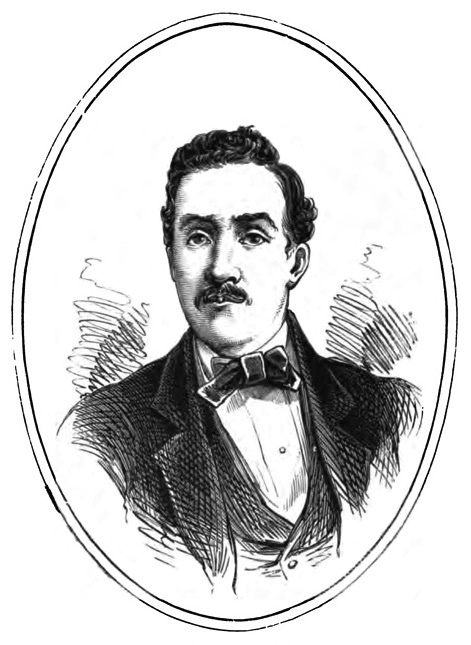
TOM KING (Champion), 1863.
From a Photograph.
Tom King first saw the light on the 14th of August, 1835, in Silver Street, in the “maritime district” of Stebonheath, or Stepney; an East London parish in which, by an ancient popular tradition, all children born on the high seas have their “settlement.” Among the amphibious population of this region of docks, wharfs, stairs, and jetties, Tom’s earlier days were passed, and here, with “a brother Tham,” he grew in due time to the stature of six feet two inches in his stockings, and the weight of twelve stone and some odd pounds; as active and straight and “pretty a piece of man’s flesh” as a recruiting sergeant ever cast eyes on, and tempted with the “Queen’s shilling” to become a bold dragoon or a stately grenadier. But Tom’s inclination by birth, parentage and education, was all towards “the sister service,” and at an early age he was a “sailor bold” on board of one of Her Majesty’s ships. In this capacity he made a voyage to the coast of Africa, and subsequently another in a trading vessel. On his return his good conduct and character obtained him a position as foreman of labourers at the Victoria Docks, and here, among a very rough class of 491 fellows, Tom, though a giant in stature, and of the mild behaviour which so often accompanies size and strength, could not escape insult. In fact, our hero, instinctively brave, exemplified the wise precept of Laertes’ father:—
“——Beware Of entrance to a quarrel; but, being in, Bear it that th’opposed may beware of thee,”
and so soon found some of the long-shore men who presumed on Tom’s easy temper and mildness of manner. The mode in which, on one particular occasion, he disposed of a half-drunken bully, known in Wapping by the odd nickname of “Brighton Bill,” whose pugnacious propensities and violence had made him a sort of standing terror to his fellow-labourers, got quickly noised abroad, and coming to the ears of Jem Ward, who at this time kept the “George,” in his old quarter of Ratcliffe Highway, the ex-champion sought him out. The pair were quickly on friendly terms, and the scientific Jem, after a few trials of the youngster’s quality with the gloves, in which he quickly perceived the excellent material, in pluck and good temper, he had to work upon, introduced King to some staunch patrons of boxing. Hereupon a notification was published early in 1860, that “’Jem Ward’s big ’un,’ who had never fought in the P.R.,” could be matched for £50 a side against any comer “catch weight.” Of course this modest price was utterly beneath the notice of modern P.R. professors, who condescended to nothing less than five hundreds and thousands, or—save the mark—five thousands and ten thousands when they came to reckon in dollars. So nobody nibbled at the chance, save one Clamp, of Newgate Market, who had fought and won a battle in the London Ring, in October, 1857. A friend of Clamp’s, calling on Jem, posted a “fiver” on his man’s behalf; but, being of an inquisitive turn, Mr. Clamp presented himself at Ward’s sparring saloon, being personally unknown, and put on the gloves, as a casual customer, with the “young sailor.” The result being a “receipt in full” in a single round, the “fiver” was quickly forfeited, Mr. Clamp retired from the public gaze, and Tom was again adrift without an engagement.
As our hero’s fame was principally spread among long-shore men and “the Salts,” Tommy Truckle, of Portsmouth, found friends to back him for a trial with “Jem Ward’s big ’un.” Truckle’s local fame in disposing of dockyarders and fighting “blues” at the great naval port and arsenal was good, and the £50 a side was duly tabled, November 27th, 1860, 492 being the day of battle. King on this occasion was placed by Mr. Richardson, who became his money-finder in the later deposits, under George Woody, the trainer, at Mr. Lyon’s, the “White Hart,” Romford. The “Young ’un” had certainly an alacrity in making flesh, for we were assured by Woody, that when he took him in hand, he drew all 14 stone; but that such was his docility and steady determination in training that he had him down in four weeks to 12st. 10lbs. with great improvement in stamina and activity. Tommy Truckle, a hardy fellow, seemed always in condition at about 12st. but fought at 11st. 6lbs., and his 5ft. lOin. of stature seemed long enough for anything. He trained at Portsmouth, under the watchful eye of George Baker. On this occasion Truckle started from Mr. Tupper’s “Greyhound,” Waterloo Road, and his colours, a black kerchief with puce and gold border, seemed to be pretty liberally taken by his friends. An early morning trip per rail conveyed the travellers to the water-side, below bridge, where a steam tug was in waiting, by which the principals and their friends were conveyed to the Kentish marshes, where a good ring was quickly formed by Fred Oliver and Co., a large accession of spectators arriving by another tug and numerous row boats.
On the men entering the ring, King being first to show, they were warmly greeted; King being attended by Jem Mace (then called the “coming Champion”) and William Richardson; while Truckle was waited on by Bob Travers (the Black) and Walker, of Stony Stratford. King, who had completed his toilette long before his opponent, whose boots seemed to give great trouble, loomed large as he walked about enveloped in a rug, until, the word being given, Truckle stood up, and King, throwing away his blanket and stripping off his under shirt, displayed a bust and general figure which surprised and delighted his partisans. Truckle, when stripped, looked small and somewhat stale, though hardy and resolute, as he confronted the youthful and symmetrical giant.
THE FIGHT.
Round 1.—As the men stood face to face King looked the pink of condition, and not only did he stand over Truckle, but his attitude was decidedly the more artistic and unconstrained. Truckle stood firmly, his left well out, and his right fore arm covering the mark, so that there was little of the novice in his position. Both men seemed anxious to begin work, and manœuvred in and out when after a few offers on each side, they mutually stepped back, looked earnestly at each other and rubbed their arms. King threw up his hands and advanced, when Truckle cleverly propped him with the left flush in the nose, and drew the carmine. (Cheers, and “first blood for Truckle.”) King again stepped in, and this time got home us right a sounder on Truckle’s ribs, when Truckle got away and down.
493
2.—Each sparred for an opening. Truckle feinted and tried to draw the Young’un, but it was no go. King smiled and shook his head. Exchanges: Truckle on King’s neck, while, on getting near, King again visited Truckle’s ribs a sounder. Truckle, in trying to get back, slipped, but recovering himself, closed, when King, weaving away, fought Truckle clean through the ropes in his own corner.
3.—As yet little mischief was done on either side, and on coming up each man eyed his opponent confidently. After sparring and manœuvring a bit, each trying to find a weak point in his adversary’s defence, Truckle broke ground and retreated, King boldly following him step by step, when Truckle sent in his left at King’s drinking fountain, which at once answered with a crimson spurt; King, without a check, delivered his right sharply on Truckle’s head, and down went the Portsmouth hero; a sort of staggering fall.
4.—On coming to the call of “Time,” Truckle’s left daylight seemed to have a half shutter up. After some rather pretty sparring, Truckle tried his left, which was neatly stopped by King, amidst some applause; the next moment the Young’un let go both hands straight as a dart, visiting Truckle’s kissing and olfactory organs with a one, two, which tapped the homebrewed copiously. Again he invested on Truckle’s left ear with the right in a heavy exchange, and bored Truckle down in the hitting at the ropes.
5.—Truckle came up bleeding from nose and mouth, and some sparring took place for position, the sun shining brightly in King’s face. They, however, soon got together, Truckle leading off, and getting his left on to King’s mouth, inflicting a cut on his lower lip, which compliment the Young’un returned by another crack on the left listener, which was also cut, and the Portsmouth man found his way to grass in a hurry. (7 to 4 on King.)
6.—Truckle, first to the scratch, led off, but was short; King went in with both hands, and Truckle fell on both hands and one knee, looking up at King, laughingly; it was a bid for a “foul,” but “no go,” as King withheld his hand, nodded, and walked away to his corner, amidst applause.
7.—A very short round. King, as soon as his man faced him, let go both hands, which alighted heavily on Tommy’s cheekbone and kissing-trap, and Truckle went down to escape a repetition of the dose. (2 to 1 on King.)
8.—After a short spar the men rushed to a close, embraced, and Truckle tried to bring his man over. He did not succeed, for King shifted his hold and threw him.
9.—Both up together, when King cleverly ducked his head aside, and avoided Truckle’s left, then rushed to a close, during which he administered some rib-roasters to his adversary’s corpus, and ended by throwing him cleverly, not, however, without getting some sharp half-arm punches about the head and body from the Portsmouth man’s busy right.
10.—The fighting had up to this time been unusually fast for big ones, yet both were active and spry as ever. King went to his man resolutely, and after two or three exchanges with little attempt at stopping, Truckle went down, King standing over him.
11.—King seemed determined to give his opponent scant breathing-time. No sooner was he at the scratch than he went across the ring, and let go both mauleys on his man’s os frontis, who slipped down at the ropes.
12.—Truckle popped his left sharply on King’s peeper as he came on; King immediately closed, and tried to get on the lock, but Tommy slipped through his hands, and was on the grass. (18 minutes only to these 12 rounds.)
13.—King’s left came in contact with the left side of Truckle’s knowledge-box. Tommy retorted on King’s mouth, but next moment went down with a flush hit on the forehead, falling partly by his own consent.
14.—Tommy short with his left, when King measured him and dropped his right, a wax melter on his man’s left auricular, which was already badly swollen. In the close both were down side by side. This was the first time, as yet, that King had measured his six foot length on the ground.
15.—King, who had certainly been making all the fighting, seemed a little blown, as they sparred for a few seconds, and Truckle feinted with the left; King once again got on a rattler on Tommy’s nob, and Truckle got down. (An appeal was made to the referee, that the Portsmouth man had fallen without a blow, but the fiat was “Fight on.”)
16.—Good counter-hits. King on the side of the brain-pan with his right; Truckle on King’s forehead, raising a visible bump. The men closed, when King forced Truckle down. (Some confusion, and a cry of “Police.” It was a false alarm.)
17.—King got home his left on Truckle’s mazzard. Truckle rushed to an embrace and seized King round the waist, but he could not throw him, and got down without harm on either side.
18.—King first at the mark. Truckle sparring, tried his left, but, as usual, was short. King avoided Truckle’s second delivery by throwing his head aside, caught Tommy on the ribs, and the Portsmouth man got down somehow.
19.—King with the left on the mark, and the right on the jaw, received two ineffective returns. Truckle slipped on his knees and hand, and looked up as if expecting a “foul,” but the blow was not delivered.
494
20–28.—Similar in character, except that King twice threw Truckle.
29.—King got twice on to Truckle’s head, whose returns were wild and ineffective. (Another appeal on Truckle’s style of getting down. “Fight on,” was the renewed order.)
30–40.—Of similar character. More than one appeal from King’s umpire, but disallowed. Truckle receiver-general, and apparently getting more and more “abroad” in each succeeding round.
41.—Truckle game as a pebble, but without a chance of turning the tide of battle; King hit Truckle so sharply on the ivories that he drew a fresh supply of Chateau Margaux, and Tommy fell as if shot.
42–47.—King strong and fresh; Truckle sinking under repeated doses of punishment; in the last-named round King hit poor Tommy clean off his feet with the right hand. “Take him away;” but Tommy refused to strike his colours, and came up for Round
48.—When the Young’un sent him to grass with a right-hander on the jaw. Still he would come again for Round
49, and last.—As Tommy stood at the scratch, in a somewhat puzzled condition, King dropped into him left and right, which brought Truckle forward. His head came against King’s cranium with some force, and Truckle immediately saluted his mother earth. George Matthison, who was one of Truckle’s backers, here stepped into the ring and, by consent of Tommy’s seconds, threw up the sponge, as his man had not the remotest chance of winning. King was accordingly hailed the winner of this hard-fought battle after a bustling contest of one hour and two minutes.
Remarks.—There was but one opinion on both sides, that, for novices, both men had acquitted themselves in a first-rate manner. King is undoubtedly the finest made young fellow it has been our lot to behold for many a long day. He is, in our opinion, far finer and more symmetrical in frame than Heenan, not being so clumsily legged as the Yankee Champion, and his weight (ordinarily 12st. 12lbs.) more proportionately distributed; and we cannot help thinking, if ever they should come together (and it is reported that Heenan challenges the belt) that our “novice” is just the sort of man to give a good account in a passage of arms with that redoubtable and over-boasted gentleman. King does not use his left in leading off, as more practised pugilists do, but that is a fault he has full time to amend, and as his pluck, endurance and presence of mind, seconded by undebauched wind and a fine constitution, were fully demonstrated in this trial, we do not know where to look for his master. Throughout the battle the Young’un behaved in the most manly manner, refusing to fall on his antagonist on several occasions, when he had clearly the right to do so, and resisting the temptation to deliver a blow, though sorely provoked by his opponent’s shifty getting down. Truckle has little pretensions to science; but is a rough and ready fighter. It must be admitted that, from the first round to the last, he tried his utmost to get a turn in his favour, but was overmatched and outfought at all points. His friends must have been satisfied that he only succumbed to a superior man in all respects, and then only when nature could do no more. A subscription for the beaten man was collected on the spot by the winner, which was added to at the giving up of the stakes. King exhibited on the following Monday night, at the Rotunda, Blackfriars Road, at Tom Paddock’s benefit (after the latter’s defeat by Sam Hurst), showing but trifling marks of his recent encounter.
Early in 1861, there was much tall talk of a match with Heenan, whose intention of returning to England and claiming the championship from Sam Hurst, the holder of the new belt, was loudly boasted, but all ended, as it had begun, in mere talk.
The tough and gallant Harry Poulson, of Nottingham, was proposed as a competitor, and articles were signed in February, to fight for £100 a side, May 23rd being fixed for the encounter, and £12 a side posted; but the backers of the veteran Harry took second thoughts, and at the second deposit (of £20) failed to put in an appearance, and King pocketed the forfeit.
After the defeat of Sam Hurst by Jem Mace, King lost no time in challenging the new champion, for the “regulation stake” of £200 and the belt, which trophy had been duly handed over by Hurst to the stakeholder. 495 A match with Young Broome, however, intervened, and came off in October, the championship battle being fixed so far forward as January 31, 1862.
Of the way in which the Ring, even when the Championship itself was involved, was made subservient to the quackery of benefit gaggery, the puffery of the Circus, and the gobemoucherie of the gaping rustics and sightseekers, the following from a leading contemporary sporting paper will show:—
“The deposit this week of £15 a side, making £130 a side down, was duly posted yesterday, and another of like amount must be staked on Friday next. The big event for the belt does not excite much interest, from the fact of the Young Big’un (King) having a previous engagement with Wm. Broome (Young Evans), on the issue of which, we need hardly say, must rest his claim as a competitor for the belt and its contingent honours. Young King, we can say, is taking every care of himself for the approaching encounter. Jem Mace is still starring it in the provinces with Pablo Fanque’s circus, but on Monday week he will re-appear in one of his superior qualifications at Birmingham, he having matched himself to run ten miles within the hour for a bet of £100 to £50, on Monday week, Oct. 21st. The ex-champion, Tom Sayers, we are informed, has also entered into business on his own account as a circus proprietor, having bought (?) the three well-known circuses, including Messrs. Howe and Cushings’, and Jem Myers’s Great American Circus (!). Tom intends commencing his tour this day, &c., &c., &c.,” [We omit the rest of the “gag.”] “Mr. Edwin James (not the Q.C.), a New York gentleman, called at our office on Wednesday last, immediately after his landing, and informed us that, owing to the war, business is almost at a dead standstill in the United States; nevertheless, J. C. Heenan, the gallant competitor of Sayers, is driving a lucrative trade in his profession (?). Heenan repudiates the fulsome praises of himself and the absurd tirades against Sayers inserted in several of our Transatlantic contemporaries.”
To return to the “trial fight” between Young King and William Evans (known as Young Broome), which came off on Monday, October 21st, 1861, on a spot not far from where the International Contest was left undecided in 1860, we may say, in partial contradiction of our quotation, that there was a lively interest in pugilistic circles, whether “a line” could not be drawn from the event as to the capabilities of the “Novice” to wrest the laurel from the brow of the scientific Jem Mace. Immediately 496 after the match was made King was placed under the fostering wing of Nat Langham, who took him out of town, and placed him at Tom Salter’s, “The Feathers,” at Wandsworth, where he had the combined advantages of the river and the road, and from time to time the preceptorship of “Ould Nat” in imparting “wrinkles” from his own practical experience. His walking and rowing exercises were carefully superintended by John Driver, and the condition of King was a credit alike to himself and his trainer.
We must here devote a paragraph to the boxer who was thought good enough to risk 50 sovs. and expenses upon, as a “trial horse” for Young King.
William Evans (whose Ring alias was “Young Broome”) was born in August, 1836, stood 5 feet 10 inches, and, on this occasion, weighed 11st. 2lb. He had fought twice before in the P.R.—viz., with a gentleman of colour, called Kangaroo, whom he defeated, for £15 a side, 18 rounds, 30 minutes, down the river, on March 13, 1858. He next fought and beat Tom Roberts, for £25 a side, in 30 rounds, 50 minutes, down the river. He afterwards received £10 forfeit from Tyson, who could not get to weight; and £10 forfeit from Joe M’Gee; but, on the other hand, forfeited £10 to Joe Goss. Young Broome, having expressed a depreciatory opinion of King’s pugilistic capabilities, and finding some friends who shared his views, challenged the Young One to fight at catch-weight for £50, which was accepted, and Broome, after getting his patrons to rally round him, went to train at Mr. Packwood’s, the “Boileau Arms,” Hammersmith Bridge, at that time weighing about 13st., which bulk was reduced by hard work to 11st. 2lb. Dando, the well-known trainer of Tom Paddock, looked after Broome, and most certainly did his duty to his man. Alec Keene had the management of Broome, who showed the night previous to the fight at the “Three Tuns,” Moor Street, Soho, from which he took his departure in the morning.
There was but little betting on the event, only a few speculations being made at 2 to 1 on King. A very early hour was arranged for the departure, which was made from London Bridge with unusual quietness and absence of bustle; and, after a pleasant trip by rail over about sixty miles of ground, by no means in a direct line, a spot was found in the county of Surrey fit for the amusement. No time was lost in the ring being formed, by Fred Oliver and assistants, when Broome was the first to throw in his cap, attended by a well-known retired pugilist, and Bob 497 Travers. King quickly followed suit, with Joe Phelps and Bos Tyler as his attendants. As both parties meant business, the referee was quickly chosen, and the colours tied to the stake, Broome sporting a salmon-coloured handkerchief, with a narrow magenta stripe and border, for his flag. King had for his standard a chocolate handkerchief, with white, blue, and yellow lozenge, and blue border. During the progress of the toilets of the men, a large number of the neighbouring farmers and gentry assembled on horseback, and, altogether, the gathering was of a superior order. The ring was well kept by Billy Duncan, the P.B.A. Inspector, assisted by Young Shaw, Tom Paddock, and Dan Collins. At length, all the preliminaries having been arranged, the men stood up at 9h. 44min. for
THE FIGHT.
Round 1.—King was, of course, the first to attract the eye of the cognoscenti, and his condition was immediately a moot point, many, who are by no means bad judges, stating that he was some pounds too heavy; while others thought that he was in very good trim, but no doubt without the polish which could have been shown had his finishing touch been given by a first-rate proficient. As King placed himself in attitude, his commanding height showed to great advantage, while the free play of his shoulders and arms indicated that, whatever artistic skill he might be deficient in, still there was propelling power sufficient to compete with a greater amount of talent than was generally credited to his opponent. The Young’un certainly exhibited a wide spread of shoulder, combined with great development of the muscles on the back; his chest well arched, showing that there is plenty of room for the play of his lungs when in work; his loins are rather narrow, while his legs are worthy the proportions of the upper part of his frame. His attitude was very erect, his right hand well across his chest, and the left well advanced, but low. Young Broome looked, in comparison, small, but, on scanning his proportions, a great amount of power could be discovered in the muscles, which stood out fairly developed, each as sharply defined as in an anatomical study. His attitude was rather stiff, with the left well in front, but with no forcible action, the position of the right rather showing a determination for mischief with that weapon. The way in which Broome stood as he sparred, prepared the spectators for an exhibition of “trotting,” of which they were most pleasingly disappointed. No time was lost in sparring, for, both being in the mind for serious business, hostilities were commenced at once, by King getting close to Broome and feinting with his left, but Broome was “wide oh,” and got out of danger. Broome, who was more than eager, dashed his left at the head, but, in consequence of his great hurry, he was short. King, who would be busy, got his left fairly on the front of Broome’s head, receiving on the chest. This led to good exchanges, in which both fought very last, until Broome went down.
2.—On time being called Broome came up first, amidst the cheers of his friends, who were taken by surprise at his cleverness in avoiding punishment. King, who appeared determined to finish the affair off-hand, went straight to his opponent, who, nothing loth, met him, and they fought right and left with both hands, King getting well on the nose and forehead, Broome landing on the chest and neck, the “pepper-box” being freely handed from one to the other. This bout was finished by Broome getting to close quarters, when King picked him up in his arms, and by sheer strength threw him, after a good struggle, and fell upon him.
3.—Both came up piping when time was called; nevertheless, they commenced as soon as they were within distance by right and left deliveries, Broome getting fairly on to King’s neck and forehead; King delivering his left on the nose and jaw; Broome getting his left on the neck heavily, grazing the skin and drawing the blood. King at the same time landing his left on Broome’s forehead, made the first event (first blood) equal. They then closed, and exchanges took place until Broome went to grass.
4.—As Broome came up, the effects of the blow delivered by King upon his forehead were very apparent, there being a lump with a cut, while King had his right cheek and chest flushed. Broome, who evidently thought he had only to go in and win, fought very fast, which tactics met the ideas of the candidate for the championship, for they fought furiously with both hands, 498 until Broome was knocked down by a right-hander on the jaw. The quick fighting that had taken place, and the eagerness of the combatants, can be well explained by stating that the time occupied in the four rounds was only four minutes.
5.—Broome, who appeared to have had the worst of the previous round, came up smiling, and, in point of fact, forced the fighting by leading off with his left at the head, which was rendered ineffective by King getting home with his left on the nose. This brought on some heavy exchanges with both hands, King getting well on the forehead and nose, receiving on the chest and cheek until they got to the ropes, where the same tactics were pursued until they closed, when King proved himself much the stronger man, as he picked up Broome, and, after a short struggle, threw him, landing his right on the chest as Broome fell.
6.—When time was called, both came up with a determination to settle the matter “off-hand,” which was evident from the manner in which rapid exchanges were delivered on both sides. King landed his mauleys on the nose, forehead, and right ear; Broome getting well on the cheek and chest twice, and falling from the force of his own blow at the finish.
7.—Both were blowing as they left their seconds’ knees; nevertheless, the game was kept alive by their simultaneously delivering their left on the face and chest, King having the best of the exchanges. Broome missed a couple of well-intended right-handers, for which mistakes he was fought down, after a good rally.
8.—The same tactics were pursued as in the previous rounds, the right and left exchanges being of the same character. Broome, after breaking away, got his right on King’s jaw twice, steadying the rush of the “big ’un,” who reached Broome’s forehead with his right. This forced a rather wild rally, in which King missed one or two well-intended shots with the left. Broome, who got on a right-hander on the forehead, fell from the force of his own blow.
9.—Broome, who was first up, was blowing very freely, and had a cut on the left eyebrow. King had no prominent mark, with the exception of his right cheek being slightly swelled. No time was lost in sparring, for they commenced proceedings as soon as they met. Both being eager for work, they closed, and some fast and wild exchanges took place, Broome getting on the cheek and forehead, King on the nose and cheek; they then closed, and after a short struggle, were down side by side.
10.—The equal fighting of the previous round had decidedly roused the energies of both, as they missed their first deliveries, being too eager to get on. On steadying themselves they countered neatly with the left, Broome getting upon the cheek, but King more effectively on the nose. Broome, who was determined to make the pace good, tried to land his right twice, but without avail, getting at the third attempt on King’s neck, who retaliated by sending his left on Broome’s nose; the latter hit out at a venture with his right, which reached the side of King’s head, and Broome went down rather suspiciously from the “wind” of King’s right hand.
11.—No sooner were the opponents at the scratch than they commenced proceedings by countering with the left flush on the front of the head, after which King got his left on the cheek; Broome, in retaliation, sent his left on the jaw, and popped his right under the left eye. Exchanges followed, in which King proved himself the stronger by forcing Broome down in his own corner.
12.—Broome was first up, and as King faced him, took the initiative by leading off with his left, which was rather short, landing on the chest. King, who was equally eager to try conclusions, rushed in, delivered a couple of heavy blows on the nose and shoulder, receiving a right-hander on the forehead, a left ditto on the cheek, which was followed by Broome delivering a fair smack with the right on the eye, which forced King backward against the ropes. (Offers to take 7 to 4 that Broome would prove the winner.)
13.—Broome, when time was called, came up bleeding from the cut under the eye, administered in the previous bout, but, nothing loth, met King with great determination, and, both being equally bent upon mischief, the exchanges which took place were wildly delivered, until they closed, when Broome twisted King off his legs, who, nevertheless, was uppermost when they reached the ground.
14.—Both again eager, were up on time being called; King showing with a lump on his cheek, which was open under the left eye; Broome had his nose sadly out of shape and his forehead swelled. No time was lost in sparring, each commencing by sending out his left, and each missing from over impetuosity. Broome, who tried his left and missed, got down cleverly.
15.—This round was remarkable for the quickness of the exchanges, both getting it on the head and chest. When they closed, King held Broome by sheer strength, and got on his right three times, twice on the nose and forehead, and the third time on the shoulder. King stumbled against the stakes, and Broome went down.
16.—This round was commenced by each sparring for wind, King putting his hands down and walking round the ring. Broome, who was advised by his seconds to force the fighting, went to work resolutely, got his left well on the mouth, catching it in return on the nose. He, nothing daunted, rushed in, and got his right on the cheek, then 499 fell, apparently from the force of his own blow.
17.—A cry that the police were coming was raised, and both men being confident and eager to settle the business, they commenced by delivering counters on the eye and nose, which led to exchanges at close quarters, Broome receiving on the nose, King having one on the same spot—“a hot ’un.” This stirred the Young One up, and he sent his right straight on the mark, Broome planting in return on the cheek. They then closed, and some very heavy exchanges took place, Broome twice visiting King’s head, but not heavily, while King, who was very busy, planted his left between the eyes, cutting to the bone, then taking hold of Broome, he delivered three straight right-handers nearly on the same spot, and Broome was eventually fought down. Twenty minutes.
The alarm of the arrival of the police was now realised. Several of the county blues appeared at the ring side, but were waiting orders from their superiors, who had not kept pace with them. The men and seconds skedaddled from the ring, and the spectators moved off. They passed across the border of the county, and there the attentive escort left them. In twenty minutes after, as this invasion was unexpected, a ring was formed in a retired spot, and at half-past ten the men were in position for
THE RENEWED FIGHT.
Round 18.—On the men again appearing, Broome had his nose strapped with a bit of adhesive plaster, his mouth was swelled, and his left eye discoloured. King had his jaw swelled, and a cut beneath his left eye; but seemed as strong as at the commencement. Broome, who still looked confident, commenced the proceedings by leading off with his left at the head, getting it on the nose in return. This led to exchanges, both delivering heavily on the head and chest, until Broome was fought down in his own corner.
19.—King came up with alacrity, and commenced proceedings by planting his left on the sore spot, receiving on the forehead. Broome succeeded in planting his left on the cheek and neck, receiving some heavy returns on the nose and right ear, and was finally fought down at the ropes.
20.—The battle from this time took a decided turn in favour of King, who, notwithstanding the pace at which they had been fighting, was as fresh as at the beginning of the battle. Broome, who was suffering from repeated visitations on the nose, tried all he could to turn the tables, but without avail, as, on his forcing the fighting, King hit him away; and notwithstanding all the left-hand visitations of Broome, succeeded in delivering severe right and left blows; the round was concluded by King knocking down Broome with a right-hander on the jaw.
21–30.—The fighting in these rounds was of precisely the same character; notwithstanding all the game and determined efforts of Broome, who never at any time flinched, and in several instances surprised his backers and the spectators by the manner in which he struggled against the fate, which, though slowly, was surely declaring against him. In the last of these rounds Broome tried to get away from the repeated visitations of King, and cleverly slipped him; but King followed him closely, and finally knocked him down with the right. Time in the second ring, fourteen minutes.
31.—Broome, as game as man could be, came up bleeding from the cut on the nose, and with his ears much swelled from the blows administered by King, who had few marks except some red patches on the ribs and shoulders, and the left eye nearly closed. Notwithstanding the punishment Broome had received, he persevered to turn the tables, and met the determined onslaught of King as well as he was able. It was evident at this time that his (Broome’s) left hand was going or gone, as he several times gave his head in an attempt to bring the battle off in his favour by a cross-counter with the right. King forced the fighting, and some good exchanges took place in favour of King, who, after a spirited rally, fought Broome down.
32–34.—The same tactics were displayed by both opponents, King, now by far the stronger man, forcing the fighting as fast as he could, and the seconds of Broome sending him up to fight, knowing that it was only a matter of time, unless their man could land the victory by an accident This he most strenuously endeavoured to do by getting his right on the jaw; but King bored Broome down in each round until the 34th, when Broome landed his right on the temple, which staggered King, who fell on his knees.
35.—Broome, who came up resolutely, but 500 weak, met the rush of King with great determination, but was, as before, the chief recipient of the punishment. His left hand could not be administered with effect; nevertheless, he closed, and, after a good rally at the ropes, threw King, but not heavily.
36.—The cheers and encouragement given to Broome, as he came up, had decidedly nettled King, for, the instant he had left his second’s knee, he rushed to close quarters, and, despite all the efforts of Broome, fought him down at the ropes.
37.—Broome, who came up slowly, was bleeding from the cut between the eyes, which were fast closing, and, with his mouth, much swelled. Despite his weakness he was resolute, and did not flinch from the onslaught of his opponent, who sent his left on to the old spot. Broome sent in his right well upon the ribs, but King, not to be stalled off, bored in, and fought Broome down in the latter’s corner. Time in second ring, twenty minutes.
38.—Broome came up this round apparently better than heretofore; he was quicker on his legs than in the last eight rounds. King rubbed his ribs as he came up, and, getting within reach, rushed to close quarters, when some very heavy hitting took place; King fighting at the head, and Broome at the body. On breaking away, Broome landed his left on King’s nose, for which he was fought down at the ropes, despite all his endeavours to “hold his own.”
39.—Broome, in this round, slightly revived the failing hopes of his friends, as, on King missing his left, he planted his left neatly on Tom’s nose, and his right immediately afterwards on the jaw, King dropping on his knees.
40.—It was but a transient gleam of hope. Despite the turn in his favour in the last round, it was apparent that Broome was fast falling weak from exertion and loss of blood. The seconds of King, seeing the state of the case, cried out to him “to go in and win,” and he fought Broome down in his own corner.
41–43, and last.—In each of these rounds Broome only came up to be hit down. In the last but one he was knocked down as he came game, but staggering, to meet his opponent. In the last, King walked straight to Broome’s corner, as the latter retreated before him, and, delivering a spank on the head, Broome fell forward on his face. His seconds, finding it was useless to prolong the contest, threw up the sponge in token of his defeat, Young King being hailed the conqueror, after fighting forty-two minutes in the two rings.
Remarks.—The resolute and unflinching manner in which this splendid contest was carried out from start to finish, invested the forthcoming encounter for the Championship with greater interest. The manner in which King put up with the right-handed deliveries of Broome (which were by no means light), raised him in the estimation of all who witnessed the fight, and already speculation on that event has commenced. King has improved in his fighting greatly since his encounter last autumn with Truckle, of Portsmouth, and no doubt he has learned a lesson or two in this encounter with Broome. He is too impetuous in his rushes, in one of which he got the cut under the left eye, as well as several right-hand props, which at all times are dangerous, a chance blow having, in many instances, brought off a battle when all chance was apparently gone. That he is thoroughly game there can now be no question, and his steadiness in training, &c. is a certain proof that he will in the eventful contest for the Championship be as fit as man can be possibly trained. Young Broome, although defeated, is by no means disgraced, and his friends, to a man, are satisfied with his performance, which has taken even his warmest admirers by surprise. Rumours had been flying about respecting Broome’s gameness, and he having heard of the same, stated his determination to be game on this occasion; that he most faithfully kept his word, a perusal of the above account must prove. After the sponge had been thrown up, Broome was carefully attended to by his seconds, but, notwithstanding all their attention, he soon became blind. On reaching the first convenient domicile, he was put to bed, when, despite the usual remedies, he was attacked with a severe fit of cold shivers, which could not be subdued for some time. At a late hour of the afternoon he was recovered sufficiently to take his departure for town, where, on his arrival, he met with a hearty reception. His friends expressed their intention to pay him for his colours the same as if they were winning ones, and a benefit was arranged for as a solace for his defeat. King left for town at an earlier period than his opponent, and passed the evening amidst his friends at the east end, but little the worse for the encounter.
Both Broome and King rapidly recovered from the effects of their battle, Broome being able to visit Aldershot, on the Thursday, with Alec Keene. He was also present at the deposit for the Championship, which took place on Thursday, when he received some substantial recompense for his gamely contested fight.
501
The stakes were given up to King on the ensuing Tuesday, at Joe Phelps’s, the “Blakeney’s Head,” High Street, Islington, when a few admirers of Tom King ventured to lay evens on their pet for the great event in perspective; though 5 and even 6 to 4 was the price in the east as in the west.
King trained for the great encounter at Hastings, Mace near Norwich; the latter coming to town to be present at the fight between Bob Brettle and Jack Rooke, on the 31st December, 1861, for £200 a side and a bet of £300 even,[41] the moderate sum of £1,000 being dependent on the issue.
“Time and tide speed on their course, and wait for no man,” and the month of January, 1862, had reached its 28th day, when, on as cheerless and miserable a winter’s morning as combined damp, drizzle, mizzle, snow, sleet, and marrow searching cold could mix up, our bold aspiring young sailor met the practised and scientific Norwich boxer. How his “greenness,” despite his gameness, fell before superior skill, tact, and experience, may be found fully set forth in the preceding chapter.
As we have already said, there was one person, and that one a most important factor in the question, who thought he was beaten by an accident—his name was Tom King. Tom maintained, without any intention of disparaging for one moment the credit due to Mace for his skill and also his courage, that he felt convinced, if his friends would stand to him, he should be able to reverse the first verdict, or, at any rate, he would then acknowledge that Mace was the better man.
After the long and undecided battle between Joe Goss and Ryall, Goss was brought forward by his Wolverhampton backers, as a competitor with Mace for the belt. In April also, “the Benicia Boy” arrived from America, bringing with him a brother “Jem,” who was said by some Yankee paragraphists to have come “to pick up the belt.” We have already noted, in our life of Mace, that Heenan repudiated this newspaper bounce; and here, to avoid repetition, the reader is referred to the memoir of Mace for the circumstances under which the second match between King and Mace was brought about and carried to a conclusion.
Mace, at the time the articles were signed, was making hay after the 502 manner of Tom Sayers, in travelling with an equestrian circus—that being the only ring in which he appeared to have a chance of a job. This employment he kept up for some time after the match was made. King, too, for a few weeks was tempted to “do the mountebank” with a travelling company; but Tom did not take kindly to the business of “busking,” and threw it up, returning to his London patrons.
As the time drew on, each man found it expedient to mingle more decidedly in sporting circles, and thus create a greater interest than had heretofore been exhibited, and this wise discrimination gradually had the desired effect. The match began to be talked about in all quarters, flocks of admirers followed the rival champions on every race course, or at any place of public resort, and soon the discussion of their respective merits led to a comparison of their deeds and their appearances with those of the heroes of the old ring.
The nearer the time approached the mystery observed as to the actual “where” tended not a little to foster anxiety, many of the intending spectators being kept in a ferment of funk lest they should be thrown over at the last. It was known it must be either at the end of November or the beginning of December, and as the fights between Hicks and Gollagher and Dillon and Reardon, both for high stakes, were fixed for about the same time, the chance of being put on a wrong scent, and arriving at the wrong ring side, redoubled the fears of the fidgety. The men themselves even were not made acquainted with the actual day until within a week of the time, and so well was the secret kept, that, until the previous Monday, we believe the number of persons “fly” to the arrangements might be numbered upon the fingers of the two hands.
Both Mace and King being sober, steady fellows in their habits, and both being pretty well in their prime, and accustomed to hard work, there was no inconvenience felt by either in their training in consequence of the uncertainty as to the day of milling—both being well up to the mark, and, indeed, almost fit to fight before they went into training, which they did some seven weeks before the eventful Wednesday; Mace at Newmarket, at the old training quarters of Tom Sayers, under the care of Howard, the Bradford jumper; and King at the “Baldfaced Stag,” near Woodford, Essex, under Harry Harris. It is creditable to the respective mentors of the men, that nothing was left undone which could ensure the respective champions being in a meet state for the arduous task they had set themselves.
503
Although there was so much excitement, and so much pleasurable anticipation of the mill, it cannot be concealed that mixed up with it was a taint of suspicion that all was not quite serene and square, arising from the fact that the respective backers of the men had changed sides since January, and that King, formerly an Eastern sage, and then an enlightened West Ender, had relapsed into his original form; while Mace had, after a fall from West to East, once more started Westward, and was backed from the Haymarket, with at any rate a side wind help from his former patrons. Some people imagined that nothing could be square under such circumstances as these. They shut their eyes to ascertained facts, and then, by a series of winks and knowing grins, strove to create a prejudice which spread, no one knows how, and finally gained for the Ring and its protégés that pleasing character they labour under among those who at all seasons, and on all possible occasions, do all they can to decry the old manly sports of their country.
The acting representatives of the men on this occasion were Mr. Richardson, of the “Blue Anchor,” Church Street, for King, and Mr. Coney, of Panton Street, for Jem Mace, who was partly backed by some old fanciers. To these diplomatic managers the stakeholder in due course communicated the actual day he had determined for the fray, but he declined to fix a scene for the performance, as he considered an arena could be better settled by the agents themselves, who could consult other parties likely to have a finger in the pie, and without whose aid there would certainly be no getting to the rendezvous, and without whose judgment that rendezvous could not be determined on without great risk. The plan turned out a wise one, and thanks to the energy and discrimination of those concerned, all was satisfactorily arranged without let or hindrance.
We have alluded already to the difficulties which beset the managers of Ring affairs at this period, and on the Monday morning Messrs. Richardson and Coney received the unwelcome information, that the officials of a certain railway company, with which they had made all pleasant for the “excursion,” had decided to cancel the arrangements, and that no special train would be provided. Here was a pretty fix for the executive. An alternative line was immediately decided on. All ticketholders would be conveyed by ordinary train to Thames Haven, where two commodious steamboats would be ready for the conveyance of the voyagers to a terra incognita. While these arrangements were perfecting on the Monday and Tuesday, the uncertainty added to the excitement, and telegrams flew over 504 the wires from every point of the compass from “country cousins” seeking the “straight tip,” and town friends anxious to communicate the same. The sporting houses, East and West, were thronged, reminding some of the olden days when “Le Boxe,” as Alphonse calls it, was an “institution.”
As we have given an instance of “clerical” interest in Ring sports, on another occasion, in the sister island, we may here note that a high Anglican Church authority entered itself among the “tipsters” on this; the Record giving a prominent place to the following paragraph:—
“The fight between James Mace and Thomas King is to take place on Tuesday next in the neighbourhood of Aldershot.”
We hope the “tipster” who so egregiously sold the reverend editor, as to day and place, did not add dishonesty to his pious fraud. At any rate we fear, as we did not see him in his accustomed position, that our right reverend friend, “the Bishop of Bond Street,” may have been misled by ecclesiastical authority; we believe the police were—of course we were not.
By four o’clock on Wednesday morning the approaches to Fenchurch Street were alive with intending excursionists, who on arriving at the station found the entrance crowded by a strong posse of roughs and thieves, always to be found at their posts on such occasions. These gentry had a good time of it, and so strong and daring were their forces, that the few ring keepers engaged to protect the public were completely overpowered, and, in many instances, eased of their own property. Bob Travers, among others, was attacked and forcibly deprived of all he had about him. Many lost their tickets, and many gentlemen were so intimidated that they declined facing the ordeal, and returned home. The scene was, on the whole, disgraceful. The managers of the undertaking were great sufferers, and were loud in their complaints that the conduct of these roughs prevented their reaping the harvest they had anticipated. Although the company commenced assembling at four o’clock, it was fully seven before there were any signs of a start, and the impatience of the early birds, although extreme, was fully justifiable. There was no help for it, however, as all was in the hands of the railway officials.
Fortunately the ring forces when concentrated were strong enough to exclude most of the undesirables from the platform; still some few managed to penetrate the ranks of the officials, and by their presence caused considerable annoyance, although the force of ring keepers was sufficiently strong to prevent their attempting any combined mischief. At length at seven o’clock the whistle sounded, and we were off for the appointed spot, 505 where two vessels were found in waiting, and on board these the travellers, nearly 300 in number, at once repaired. It was now suggested that it would be well to try and get the fight off on the spot, instead of going further afield, where the Bobbies might be in force. This recommendation was accepted with promptitude, and while the Corinthians were luxuriating in a hot and comfortable breakfast on board, provided in admirable style by their old caterer, Dan Pinxton, the ring was pitched, and soon after eight all was in readiness. Through the exertions of Billy Duncan and his pals such admirable arrangements were made for the comfort of the inner ring ticket-holders that all were seated without difficulty, and, so far as we could perceive, the whole thing was carried out in a manner to reflect the highest credit on all concerned. As soon as the office was given by Fred Oliver the men approached the magic circle; Mace being the first to drop his castor within the ropes. He was attended by his old opponents Bob Brettle and Bob Travers, while King, who was somewhat behindhand, was waited on by Bos Tyler and Macdonald. Both men were welcomed with loud cheers from their partisans, which each acknowledged in a suitable manner. There was a good deal of lively betting at 6 and 7 to 4 on Mace, and his backers, we believe, would have gone on to any extent at that figure. A brisk business was done by the sale of inner ring tickets, but by no means to the extent we have known on former occasions. The sum received was nearly £37. Among the spectators were Tom Sayers, Heenan, and many other fistic celebrities, who eyed the tourney throughout with curiosity. And now the men stand up, approach each other and grasp hands, then separate; the seconds retire to their corners, and all eyes are fixed upon them as they upraise their daddles, and square their elbows for
THE FIGHT.
Round 1.—The moment so fraught with interest and excitement to the partisans of the belligerents had now arrived; the busy and careful work of the seconds was at last completed to their entire satisfaction, and the men were delivered at the scratch. While their toilettes were being arranged, the “making ready” had been eagerly watched by all with almost breathless silence. As Jem turned to face his opponent, he gave a momentary glance at the sky, whose dull, cheerless aspect was anything but calculated to enliven the combatants. Both advanced to the scratch with that firm, confident step which denotes the action of well-drilled practitioners. Perhaps the first thing that riveted the attention of the spectators, as the men stood front to front, was the striking difference in height that existed between them. It had been confidently stated Mace had never been in better condition; certainly as he stood thus confronting his antagonist there was nothing in his appearance that even the most fastidious could for a moment find fault with, and in all things he looked a far superior man to what he did at their former meeting. In weight Jem, when he last poised the beam, pulled down 11st. 4lb., and with inward confidence beaming in his every look, he stated it was impossible for a man to feel better, and this assurance there can be no 506 doubt had great weight with his admirers, many of whom from over-caution had waited for this “opinion” from Mace himself before they had ventured to “put it on.” If condition of itself could alone endow a man with the requisite “resin” to tune the first fiddle in such a grand pugilistic overture, Tom might well put the thing down as a “certainty,” for it must be admitted he was all the most critical could desire, and spoke of the result with a confidence devoid of anything in the shape of braggadocia. The moment the men had been “set” by their seconds, there was perceptible that twitch and shrug of the shoulders which denote a disapproval of the morning air. Jem having put up the prop in proper order drew from range, and of his position it may be said the skill of the master was at a glance displayed, for he was well covered at all points. Tom also stood remarkably well, and although by some good judges he is stated to be a little too fine about the loins, and by no means deep set enough in the jaw and neck, yet we think it was conceded by all impartial persons that he looked a most formidable opponent. Mace, as he manœuvred, looked at his man with a sharp, penetrating glance, as though he was mentally summing up “the King’s affairs.” The result seemed satisfactory, for Jem gave one of his well-known jerks of his nob, as much as to say, “Tom, I intend to give you another dressing.” King smiled at his man, as to intimate, if he really imagined he was capable of dressing him again he would oblige by being quick about it, as there needed something in the shape of excitement to warm up the system. After a little sparring, Mace drew from range and dropped his mauleys, and then with his right rubbed his breast and arms. King imitated his action, as he felt numbed about the arms, and thought it necessary to do the burnishing to promote the circulation. Jem, with a cautions step, drew into range, and then by way of a feeler slightly let go the left, but Tom, who was decidedly quicker on his pins than we had found him in any of his preceding battles, got well away with the back step, thus showing that these efforts on the part of his opponent to draw out his guard were not likely to be successful. As Mace broke for the purpose of getting from distance, King dashed at him in a most impetuous manner, and missed administering a fine right-handed shot from the fore-arm. Mace, as Tom came on for the purpose of forcing the fighting, retreated, but just opposite the referee and umpire the men closed, when Jem, finding he was likely to get in an awkward position, ducked his head and went down, King looking at him. Both men were loudly cheered, and as there was just a shade of commotion among those who formed the uprights of the outer circle, Professor Duncan, attended by the “faculty,” promptly administered a mild dose of his efficacious remedy for disorder—the “syrup of whips”—and the cure was instantaneous.
2.—At the call of “Time,” both men, with the eagerness of swimmers for the first plunge, rushed simultaneously from the knees of their seconds, and threw up their hands at the scratch. After toeing the mark each again drew back from range, and began rubbing himself, looking meanwhile at each other like two game-cocks. Mace then led with the left, but did not get it home, as King got well from range. Tom now dashed at his man, and delivered the left on the top of the head, and put in another from the fore-arm on the mouth, which had the effect of producing a slight show of the crimson. (“First blood,” as on the former occasion, for Tom.) Jem, after getting home slightly with the left and right on the face, closed with his man, when, finding he was likely to get into an awkward position, he slipped from him and got down, there being so far not much harm done on either side, King fighting with remarkable fairness; his opponent decidedly more crafty and shifty, though, as Jack Macdonald said, “We’ll give him all that in.”
3.—Jem was the first from his corner, but no sooner did the busy seconds of King see that his antagonist was on the move than they gave the office, and with that impetuosity of action so characteristic of him, he at once advanced to the scratch. After shifting, changing position, and taking fresh ground, King went dashing at his man for the purpose of forcing the fighting, and, getting partly over Jem’s right cross-guard, planted the left on the right cheek, and with a wild, slinging round hit from the right also got home on the side of the knowledge box. Mace, in the counter-hitting, administered one with his stinging left on the jaw, when, as Tom was not to be kept out, they closed. In the struggle for the fall King got his right arm round his man, and they went down near the referee in a curious, awkward fall, Mace, who had his head bent down, hitting the top part of it against the ground. It was imagined by many at the moment that Jem might have received some severe harm, but they were soon convinced to the contrary, for when the men had become disentangled and Jem with his usual agility had righted, he looked up with a broad grin, as much as to say, “Don’t be uneasy, I’m all right.” There was in the excitement again a slight manifestation of pressure in “Court,” the “special jury” being the least bit inconvenienced, but Duncan, as head usher, brought up his efficient corps to point, and the weight of this legal element was on the instant sufficient to restore matters to their proper balance, and the business of this admirably kept ring went on as smoothly as ever.
4.—While the combatants were in their corners every movement of their seconds 507 was watched with the utmost minuteness, and it was a treat to observe in what fine order they sent them up to the mark. Tom was the first to present his towering height at the scratch, but was almost on the instant met by his opponent. Bos Tyler pointed at Mace, in a good-humoured manner, as much as to intimate Jem had had some of the burnishing powder. Mace feinted with the left, but, finding he could not get in with artistic effect, he did not let it go freely from the shoulder. Tom, for the purpose of taking better range, followed up and with the left got home on the right cheek, and also put in one from the right. As Mace broke to get away, Tom hit out with both mauleys, but did no execution, as Mace threw the left off well with the right guard. After slight sparring and manœuvring Tom led the left, but it was not sent sufficiently well in to be effective, nor did he meet with any better success in following up with a wild hit from the right, for Jem drew well out of range. On again coming to distance, King worked with his right arm backwards and forwards, as though he intended to let it go, but did not. As Jem shifted Tom followed, when Mace got home a fine left-handed hit on the jaw. The combatants in the most spirited manner fought across the ring, Mace administering some of the cayenne with both mauleys. In the close both struggled for the fall, when Tom got from his man and went to grass in his own corner.
5.—Mace was the first to come from his corner, but he had not long to wait before Tom faced him. Both men were considerably pinked, and their physiognomies now possessed more touches of beauty than are to be found in their photographs in George Newbold’s collection of celebrities. Jem, as he came from his corner, bent his head forward, as though he was mentally debating in what new manner he should try to get well at his man, who by the rapid style in which he had been fighting, had given proof that he was a dangerous antagonist. King, the instant he had put up his hands, went dashing to force the fighting. With the left he administered a stinger on the right cheek, and followed up with a half round hit from the right. Mace, as his opponent rushed at him to close, drew out, but Tom, not to be denied, followed up, when, in a rally, Jem pegged away with both mauleys, left and right, with astonishing rapidity, doing a great deal of heavy execution. In the close they struggled for the fall, when Mace threw his man in clever style, near the ropes. (The friends of Mace were in ecstasies, and long odds were offered on their pet.)
6.—Tom in the first two or three rounds had unquestionably had a shade the best of it, from the style in which he had gone dashing at his man, and the quickness he had displayed. Mace did not exhibit that steadiness in his practice he afterwards did. Now, however, that Jem had got the true measure of his man there was a total change in his tactics, and the manner in which he now fought proved that he was in all respects superior to the “big-’un” in science. Both, on presenting themselves at the mark, bore evidence of having been by no means idle, for Jem was swelled about the ivories in a very conspicuous manner, while King, from the appearance of his left peeper, gave unmistakable proof of having been warmed up; he was likewise slightly bleeding from the nose. Still there had been no serious damage done on the part of either. After some little manœuvring, the combatants changing and shifting position, King dashed at his antagonist in his usual style, getting home left and right on the head. Mace met his man as he came with the rush on the milling suit, and, in one of the finest rallies that could be witnessed, the combatants fought right across the ring; there was something delightful to the admirers of boxing in Jem’s style of fighting his man with both hands, left and right, at the nob. These blows were delivered with a rapidity that was quite electrifying, being sent ding dong, straight home, so that Jem was all over his man in an instant, the blows making an impression as though Tom had been stamped with a couple of dies. Tom was by no means idle, but also pegged away at his man with the left on the head and the right on the body in merry fashion. In the close they got on the ropes, when Jem for the moment touched the top cord with his right hand, but Tom having shifted his position, the men struggled for the fall, when Tom, as a termination to this well-fought round, was under.
7.—As the battle progressed, so did it increase in interest, for there was a marked speciality about the manner in which it was being fought that could not possibly fail to enhance its importance among the admirers of bold and genuine boxing. There can be no disputing, both men had been from the commencement fighting remarkably well, and the battle, as will be seen, had already presented two striking and prominent features; for though, until Jem had thoroughly got the measure of his man, King had in the opening bout been considered to have a slight lead, yet the style in which Mace was now performing was sufficient to convince all that there had not been the slightest mistake made in his merits as regards milling excellence. The combatants came simultaneously from their corners. Tom, as he stood at the scratch, opened his mouth and rubbed his hands, and then, on again putting himself into position, drew out and retreated to his own corner, Mace following. Both, as they again drew to range, steadied themselves, and in a fine counter with the left got well home, Jem doing execution on the snout, Tom on the top part of the 508 cranium. Mace, on breaking, got to the ropes, when, as Tom came boring in to close, he slipped from the embrace of the young giant and got down.
8.—From the manner in which the tints had been rubbed in it was apparent the colours had been well worked up, though this was much more conspicuous on Tom’s dial than his opponent’s, for King’s left peeper had a small lump on the side of it, while the nose and mouth looked a good deal puffed. Tom, as usual, taking the initiative, lunged out the left, but did no execution, as he was not well to distance. Mace, after King had opened with this wild hit, took up fresh position, and in doing so, as he was followed by his antagonist, he hit the back part of his head against the stake. As Tom pressed in, Jem pulled himself together, and after some fine left-handed counter-hitting, in which Mace delivered very heavily on the middle of the head, they closed and went down, Mace through the ropes. The battle had now lasted 22 minutes, and it had been nothing but downright hard fighting and no mistake.
9.—King made another dash at Jem, “on hostile thoughts intent,” and got home apparently a hot-’un on the right eye, but there was no sign of injury, evidently owing to Jem’s excellent condition. Jem instantly returned a severe prop on the dial with the left, and then countered a second effort on the part of King, who essayed his right. Tom, desperate, now dashed in with headstrong determination, and bored his man through the ropes, to the delight of the Kingites, who, however, declined to take 6 to 4, freely offered by the backers of Mace.
10.—Mace, the instant the signal was given, came forth with the utmost alacrity to renew the struggle. King, as an opening to the attack, lunged out the left, and administered a telling spank on Jem’s right jaw; and then, as Tom came dashing on, the men fought in a fine two-handed rally right across the ring, when King got his man’s nob for an instant in the right arm lock, and pegged away in the fibbing beautifully. Jem, like a good tactician, extricated himself; and after some severe milling, in which Mace got in the most telling manner on his man’s mouth, cheek, and nose—going, in fact, all over the dial with his clenched digits in a rapid and surprising manner—the men closed at the ropes right opposite to the umpire and referee, when Jem got his man in position, and gave him a fair back-heel fall. Immense cheering for Mace.
11.—King’s left eye looked worse than ever, while his good-looking mug was knocked out of all symmetry. Nevertheless he was again first to begin the attack, and in leading got home the left on the right cheek, following it in with one from the right on the side of the pimple. Jem, who timed his man beautifully, administered another tremendous left-hander on the mazzard, when Tom’s nob, from its effect, went waving back. On the instant, however, he pulled himself together and dashed in to renew the struggle, when Jem met him, and delivered a tremendous left-hander on the nose, which produced a copious flow of blood. As Mace took fresh ground Tom again dashed in, and they fought a regular ding-dong, slogging give-and-take to a close. Tom, with his usual style of bending his head slightly forward, went dashing at Jem, and got more than one straightening prop. They again fought in regular ding-dong to a close, when Tom, while receiving Jem’s props on the dial, made use of the right once or twice in a very efficient manner on the body, upon which Mace got from his man and went down. The referee here called the attention of Tom’s seconds to the fact that their man had struck Jem while he was down, which was true; but Mace was just on the go, and King could not help the hit, which was evidently unintentional, and no harm was done.
12.—Another splendid rally in this round, Mace again in a telling manner doing execution with both mauleys, but evidently forced back by King’s irresistible advance. The men, who had fought right across the ring, closed in Mace’s corner, when Jem got down, Tom falling on him. During this round the referee had several times to caution the seconds, who, in a most reprehensible manner, followed their principals as closely as frequently to be in the way of the combatants.
13.—The men again went to work in a spirited and determined manner. Jem, with his left, got well home on the front of his man’s dial, and jumped back; when Tom, with his right, administered some sounding spanks on the ribs. As Jem broke to get away, King followed him up, and Mace went down to end the round.
14.—Mace commenced operations by getting well in range and delivering a pretty left-hander full on the nose, knocking Tom’s head round as though it had been shaken off its connections; nevertheless Tom again tried to force the fighting, when, after some merry exchanges, they closed, and in the fall went down together in the centre of the ring. King’s friends cheered him heartily, as he fully deserved.
15.—Some sharp fighting, rather in favour of Mace, who, in the end, went down in the hitting, and King fell over him.
16.—Tom dashed in viciously, and after a fine exchange of compliments, in which each did execution, they closed, and Jem, who had had the best of the exchanges, fell under.
17.—Tom again forced the fighting, but though he delivered with his left, he was a little too round with his right to be effective. Mace, after countering with his antagonist, and getting well home with the left in the middle of the head, and following 509 up at half measure with the right, got cleverly away from his man. As Jem took fresh position, Tom followed him up, and the men in a rally fought to the ropes. In the close both got under the top rope, and fell nearly out of the ring.
18.—Such a certainty was the battle looked upon by some of Jem’s admirers that Johnny Gideon here offered £30 to £5 on him, but there were no takers. Indeed, Tom’s umpire, a good judge, said that, bar accident, Mace could not lose. After some more severe fighting, in which Mace again delivered in a telling manner on Tom’s dial with both mauleys, Tom made a slip in getting from his man, and fell on his knees. On the instant the game fellow recovered his perpendicular, and as Jem noticed this he beckoned him to renew the round. King was willing, but his well-skilled seconds, seeing the fast work he was doing, refused to allow him.
19.—It now seemed “all over, but shouting,” to the partisans of Mace, who called out any odds, without response. As the men came up it was easy to see that Jem, thinking himself already victorious, was anxious to finish off the business, lest the appearance of the police, which had been rumoured, should rob him of his conquest at the last moment. He worked in with both hands in weaving style to get well to distance, and as he took up his position he got into a slight hollow of the ring. Jem, who had repeatedly tried to land a clipping cross-counter with his right, had just opened himself for the purpose of trying it on, when Tom, who stood firmly to his guns, met him with one of the most tremendous hits we ever saw. It was a cross-counter on the left cheek with his right hand—a blow that seemed to go all over Jem’s face with crushing effect. Jem, bleeding from the mouth and nose, reeled and staggered from the effect of this visitation, and then, to the consternation of friends, fell in the middle of the ring all of a heap. So sudden a change in the aspect of affairs had hardly ever been witnessed in the memory of the oldest ring-goer, and Jem’s seconds were working with a zeal which told how serious was the position. Down came the odds. “The Champion’s licked,” said twenty voices in a sort of stage whisper, and all eyes were strained in the direction of the busy group in Mace’s corner.
20.—King walked up to the scratch, watching the referee with ill-concealed anxiety to hear the call of “Time.” When, however, that functionary had twice repeated his summons, Mace, who had by no means recovered from the settler he had received, came unsteadily from his corner. Tom walked up to him, and Mace tried a wild delivery with his left, Tom retorted with a hot blow on the nose, and Mace, in getting away, went down close to the referee’s seat like a lump of lead. There was now the greatest commotion and excitement all round the ring. It was now as clearly King’s victory as it had previously been Mace’s. Brettle and Travers worked with a will, doing for their man everything possible, and he gallantly seconded their efforts, resolutely refusing to allow them to throw up the sponge.
21 and last.—Before Mace left his corner Tom was waiting for his man, and no sooner did Mace come up than King went to him, and, with a slight push on the head, sent him down. Jem, who was weak and exhausted, and who had the right side of his phiz swelled in an extraordinary manner from the effects of King’s right-hander, was now clearly hors de combat, and his friends, seeing he had not the remotest chance of winning, threw up the sponge in spite of his protests. This token of defeat was hailed with loud shouts by Tom’s friends, who were, of course, doubly delighted at the bravery and good fortune of their man, and they crowded enthusiastically round King to hail him as the last addition to the roll of brave men who have borne the proud title of Champion of England. The battle lasted exactly thirty-eight minutes.
Remarks.—There can be little question as to the fact that King’s decisive victory was more immediately due to the tremendous hit to which Mace laid himself open by his over-eagerness to plant what he considered a sort of coup de grace on his gallant adversary. His skill in administering, as well as avoiding punishment, had given him an apparent best, but he had not reduced the courage and confidence, nor exhausted the strength of his dangerous antagonist. The “hit” that King “had left in him,” was, as Jem found to his cost that day, worth the Championship of England. That this is no disparagement of King’s victory all must admit, and a more gallant display of skill and bravery could not have been witnessed in any day present or past. King’s fairness of style in the finish of several rounds, when the lead trembled in the balance, shone conspicuously, and was warmly acknowledged by the spectators.
At the giving up of the stakes, on the Thursday night week, King once again announced his intention of not contesting the Championship. This was generally understood as owing to obligations of another description in which a “ring” also had a part, and not a few of Young Tom’s intimates 510 drank a toast to his matrimonial felicity, in the old formula of “The single married, and the married happy.”
A curious telegraphic contretemps, which may serve as a caution to the over-clever, occurred on this occasion. Mr. William Wright, of Fulwood’s Rents, who was at this period an immense authority, had arranged with his London clerks that, to prevent surreptitious use of the earliest intelligence, for which he had incurred a large outlay, his telegram would give the losing man as winner, and they were to read it and manifold it accordingly. Having therefore sent off, at the earliest possible moment, “Mace beat King,” with the number of rounds, &c. the telegraph clerk on the spot, thinking he knew to the contrary, innocently set the message right, and, out of kindness, sent over the wire, “King beat Mace;” whereon the clerks dutifully followed their instructions, and the wrong result was extensively circulated to clubs, subscribers, &c. and for some hours a bewildering uncertainty prevailed.
The Young Sailor, however, had excited too great an interest in the public mind to be allowed to sink quietly into oblivion. He had distinctly stated that he did not seek the distinction, if distinction it was, of the Championship, and he resigned the belt into the hands of the Editor of Bell’s Life. Heenan, however, having made some good friends among gentlemen of the turf by his civility, intelligence, and good conduct, intimated to several of these, that if there was any “big one” desirous to try conclusions with him, he was ready to make a “quiet match” for not less than £500, and he had friends who would make it £1000 if required. This was formally communicated to the Editor of Bell’s Life, with a wish that no bouncing or offensive challenge should be inserted. The Editor at once put these facts in circulation in proper quarters, and the proposition, like most American notions, “a big thing,” made some of Tom King’s friends prick up their ears. Mace was engaged “two deep,” and moreover was not “their man.” A conference was held at Owen Swift’s, to which Tom King was invited, and he, with ready gallantry, declared the opportunity was most inviting and welcome. Money was forthcoming on both sides, and as both sides meant business, the paper subjoined was soon formulated—
“Articles of Agreement entered into this 17th day of March, 1863, between John Camel Heenan and Thomas King. The said John Camel Heenan agrees to fight the said Thomas King a fair stand-up fight, according to the new rules of the ring, by which the said John Camel Heenan and the said Thomas King hereby agree to be bound. The said fight shall be for the sum of £1,000 a side, and shall take place on the 8th day of December, 1863, within 100 miles of London. In pursuance of this agreement, £100 a side are now deposited 511 in the hands of Mr. John Coney, who shall transmit the same to the Editor of Bell’s Life, who shall be final stakeholder; the second deposit, of £50 a side, shall be made at Mr. W. Richardson’s, “Blue Anchor,” Shoreditch, on Thursday, March 26; the third, of £50 a side, to be made on April 9; the fourth, of £50 a side, on April 23; the fifth, of £50 a side, on May 7; the sixth, of £50 a side, on May 21; the seventh, of £50 a side, on June 4; the eighth, of £50 a side, on June 18; the ninth, of £50 a side, on July 2; the tenth, of £50 a side, on July 16; the eleventh, of £50 a side, on July 30; the twelfth, of £50 a side, on August 13; the thirteenth, of £50 a side, on August 27; the fourteenth, of £50 a side, on September 10; the fifteenth, of £50 a side, on September 24; the sixteenth, of £50 a side, on October 27; the seventeenth, of £50 a side, on November 5; and the final deposit, of £100 a side, on November 26, at Mr. W. Richardson’s, “Blue Anchor,” as above, when the men shall mutually agree to the place of fighting. The said deposits to be made between the hours of eight and ten p.m. on the days and at the houses named; either party failing, to forfeit the money down. The houses at which the deposits shall be made shall be named by each party alternately, and to be made in London. The place of the next deposit to be named as the staking of the previous one, Heenan having to name the place of the third deposit. The men to be in the ring between the hours of ten a.m. and one p.m. on the day named, or the man absent to forfeit the money. But, in the event of magisterial interference, the referee shall decide the next place and time of meeting, the same day, if possible. The expenses of the ropes and stakes shall be borne mutually. Mr. Dowling, the Editor of Bell’s Life in London, to be referee. Two umpires to be chosen on the ground; and, in case of dispute between them, the decision of the referee to be final.
“In pursuance of this agreement, we hereunto attach our names—
“John Camel Heenan.
“Charles Bush, for Thomas King.
“Witness: H. A. Reed.”
The match made, each man at once proceeded to make trading capital out of it by travelling the provinces, and this at first led to a belief that the match would never come to anything, but was merely got up for this purpose. On the other hand it was asserted, that the match was sure to come off, but the result had been cut and dried; that the backers of the men intended to make a trading speculation out of the “Special” which was to convey the belligerents to the scene of action. It was known that a sum of more than £1000 had been divided between Sayers and Heenan out of the profits of the train for their match, and the supposition was, perhaps, not unnatural that £500 would be very good interest upon £100 for a few months, setting aside the off chance of something else turning up into the bargain. As the day approached for the men to go into training fears as to the affair not being genuine quickly subsided, and in racing circles the match created much interest, numerous bets of 6 to 4 being laid on the Benicia Boy, whose appearance at Newmarket during the October Meetings fully justified the confidence reposed in him. Heenan took his breathings almost entirely at Newmarket in company with his own brother Jem, and Macdonald, but required very little, if any, looking after. His feats as a pedestrian during his work were something extraordinary, six miles and a “bittock” did he generally turn in ordinary walking, and many a spin and a tie up did he give to some of our crack jocks, among whom are to be found no mean specimens of fair toe-and-heel walkers. Jack’s spins at the top of his speed, too, not a little astonished the Browns, and 512 we have been credibly informed he could on a pinch do his quarter in 56 seconds—not bad for a 14 stone man, standing nearly 6 feet 2 inches. When stripped his frame was a model for a sculptor. Every muscle was developed to a gigantic size, every tendon and sinew was distinctly visible; and, taken altogether, we doubt whether such a specimen of a Hurculean frame has been witnessed in the British P. R. for very many years. That Heenan possessed every confidence in himself may be gathered from the fact that some three weeks previously he sent a message to the stakeholder, requesting him to state that if he did not lick King the public ought to stigmatise him as the greatest impostor who ever entered the Ring. The Editor tells us that he declined to insert this statement at the time, as not being fair to either party, and considering that should the result justify the observation it would be time enough to make it when the battle was over. Heenan, as may be recollected, was born in 1834, at Troy, United States, of Irish parents. His fighting weight on stripping on the present occasion was, as near as possible, 14 stone 2lb.
As the time of battle drew near the difficulties of a mode of transit to the ground increased. One after another refusals of accommodation were returned, the powers and authorities having experienced the disorders which seemed inseparable from the gathering of such a crowd as had now made it a custom to gather on such an occasion. During Saturday, Monday, and Tuesday, the offices of the sporting newspapers, to say nothing of the “houses of call” for sporting men, were besieged by questioners; but beyond the fact that tickets at three sovereigns a head were procurable, no definite tip was to be had.
Tuesday evening was a night of festivity at all sporting pubs. The public fully believing that on the following morning the mill would come off, and all being agog to get the necessary tip. It was not until well into the small hours that many would believe that Wednesday was not the day. The same scene was repeated on Wednesday, with the exception that delay had doubled the excitement, and the houses, which on Tuesday were crammed, were on the following night well nigh overwhelmed, and the ordinary business could scarcely be transacted. At Owen Swift’s much anxiety was expressed as to whether a bet of £600 to £400 appointed to be put down the night before the fight would really be forthcoming, certain half-sceptics pinning their faith on this ceremony as calculated to prove the genuine nature of the match. It was also expected it would materially affect the betting, many considering that the staking would show such 513 confidence on the part of King’s backers as would justify his being backed for money.
On our arrival at London Bridge Station a few minutes before five in the morning, we found that the “rasping” division had dwindled away to an insignificant few. The fact is, the busy tongue of rumour had sent them so often to the various stations on a Will o’ the Wisp errand, that the detrimentals were completely tired out, and, after the lesson of Tuesday and Wednesday nights, without anything turning up, they denounced the whole affair as “a sell,” and stayed at home. Never was a secret of such a kind better kept, and the wide-awakes who “knew the exact spot to a yard,” found themselves neck deep in the mire, after a fashion they little calculated on; the cut-purse family wiping the frosty icicles from their noses in the west, when they should have been looking out for squalls in the South Eastern horizon. The delightful result was that the congregation of the fistic art passed through the thin dark line of worn and weary snapper-badgers. The arrangements of the legitimate “conveyancers” were most excellent; everybody was comfortably “taken in and done for,” whilst the presence of the ring-constable volunteers set the foot of authority down with a crash upon all attemps at “rigging the market.” In fact, one might have thought that he was going to see an early ploughing match, whilst the “Yahoo” business didn’t rise as high as the song of an old tea-kettle. Indeed, that ugly element was wise in the course it was constrained to adopt; had it done otherwise there was force enough present to have brought every atom of it to grief. Both the men reached the ground in good time, and both had their fair quantity of supporters, who would persist in blocking up each carriage door, so that the entrance of a breath of air was almost next to an impossibility.
The train consisted of thirty carriages, in each of which, to use a theatrical phrase, there was not standing room. We were “horsed” by two powerful engines, and, at about a quarter past six glided out of the station without the least confusion, and with the greatest regularity. The morning stars were just beginning to show signs of that glimmering faintness which indicates the approach of daybreak. Once the train got in motion, not a sound was to be heard save the outburst of some occasional hearty laugh at the jocularity going on inside. But even this was of the mildest possible character, and there was an entire absence of that reprehensible boisterous outpouring which has too often awoke the slumbering people along the route, filling their half-dreamy imaginations with the horror that the 514 Philistines were upon them. We were more than half afraid that the new plan of paying at the doors would have been productive of the direst confusion, but our apprehensions were agreeably dispelled.
On casting a quiet running glance through the interior of each carriage, before we started, we found the genuine patrons of our national manly “trial by battle” in very strong force indeed. We heard one and all join in a universal chorus of satisfaction at the way in which we had been “got off.” On and on we rolled through the fair county of Kent, and as the grey dawn of morning rose eastward on our track the mild fresh breeze played upon our half-sleepy faces, waking us up to a sense of life and activity that was as agreeable as it was invigorating. The morning was beautiful and mild, and away now to our left the bright blue-tinged light of early day could be seen breaking gently and softly, widening and lengthening as it imperceptibly spread over the landscape in a manner that would have excited the admiration of a Gainsborough or a Creswick. Still on and onward we go through deep cuttings and over high embankment; anon the iron horses slacken their speed, and the next instant the reverberating sounds of our whirling wheels tell us that we are passing through the bowels of mother earth. On emerging from the tunnel into open country our ears were saluted with voices that unmistakably marked the owners as denizens of the aristocratic regions west of Regent Street. Speculation made itself heard, and 6 and 7 to 4 on the Benicia Boy seemed to be the chorus of the song. Just as we could distinguish houses and buildings sufficiently, the train glided noiselessly into Reigate Junction, where we were “regaled” by the sight of a strong covey of early “blue birds” belonging to the Surrey County Constabulary. It is needless to say that they were not there on our invitation. We considered them more free than welcome, and following the prudent and time-honoured example of those philosophic predecessors of theirs, Masters Dogberry and Verges of blessed memory, we stole ourselves out of their company with all possible alacrity and despatch. A thin white frosty veil of mist floated over the landscape as we again got in full swing, whilst the leaden coloured clouds as they lay heavy and motionless overhead gave us cause for grave anxiety, but, as our fears were rising to an uncomfortable grade on our nervous thermometer, in we rushed to another tunnel. When we issued forth we made a series of weatherwise surveys all round us, and were joyed to find the dark curtain lifting evenly and gradually up on our right, whilst on the opposite side bright broken patches encouraged our most earnest hopes, 515 Another turn of the steam valve, and away we sped at over forty miles an hour; wood and dell, hamlet and village, cottage and mansion flew by like the magic of the kaleidoscope, and the question of our journey’s end took the place of other topics for the moment. A few miles further on and we shot by Tunbridge Wells. By this time we could see that the “bold peasantry” were discussing their breakfast, but as we rattled on at the rate of a mile a minute and a half, we did not take particular notice of what they ate. At length we drew up in a secluded and well-selected spot, where we got out, yawned, stretched ourselves, and gulped in the sharp morning air most voraciously. On account of the extreme softness of the ground it was some time before a decent place could be found. At this hour, about a quarter past nine o’clock, the sun was shining out as magnificently as on a fine May morning, and as we toiled some mile and a half up a steep clayey hill, the “stuff” was taken out of many. At length a chosen spot was taken possession of, and the ring pitched in a field at Wadhurst, near Frant, below Tunbridge Wells. King first dropped in his castor, amid loud cheers, accompanied by Jerry Noon and Bos Tyler, and was immediately followed by Heenan, who was similarly received, being esquired by Jack Macdonald, and, for the sake of theatrical effect, Tom Sayers. Colours were now unfolded on both sides, and the combatants began to dress. The choice of ground was won by Heenan, and then came the referee. Some wrangling here took place in respect to that functionary, during which the betting went on with offers at 40 to 20, &c. on Heenan, but there did not seem to be any takers. Confusion now became the ruling element, wasting away precious time on the top of a hill that could be seen for twenty miles around. There were the men and their seconds ready, while the referee was expected to come from the clouds. Three quarters of an hour was spent in this way before matters were finally closed, and the referee originally proposed was ultimately agreed to. The men then began the important duty of the toilet, and in the hands of their respective valets that operation was soon completed. The ring was then cleared, and the men showed themselves ready in battle array. Heenan was the first to exhibit, mid the loud cheers of his admirers, and was instantly followed by King, for whom another salvo rose up from the throats of his party. Exactly at ten o’clock the men were delivered at the scratch, shook hands, and prepared to commence