Chapter II
Reading edition
JEM MACE, OF NORWICH (CHAMPION). 1855–1864.
None who have witnessed the public appearances of this accomplished boxer will dispute that he was one of the cleverest, smartest, and most skilful pugilists that have sported buff in the 24-foot. Indeed, had Jem appeared at an earlier and better period than the latter days of the failing and moribund P.R.; and (another if) had he chosen honestly and manfully to exert his powers, the fame that accompanies the championships of the two elder Jems—Jem Belcher and Jem Ward—might have shone on the career of Jem Mace. As we have already more than once said, such as the patrons of the Ring (or, indeed, of the turf and any other sport) are, such will the character of its professors or exponents be. If horse owners are mere mercenary speculators, can we expect jockeys to go straight? When the patronage of the P.R. had fallen from noblemen, gentlemen, and the admirers of courage and fair-play into the hands of the keepers of night houses, “hells,” and even resorts yet more detestable, whose sole object was to fleece the dissipated and unwary by the sale of high-priced railway passes for “special excursions,” and bring customers and victims to their dens of debauchery and robbery, could it be expected that boxers would remain honest and brave? The encouragement of bravery and skill being as nothing to these debased speculators. This, we regret to say, was the degradation into which the Ring had fallen, or was fast falling, when Jem Mace first became known as a boxer, and to these influences some of the “shady” incidents of his career are easily traceable.
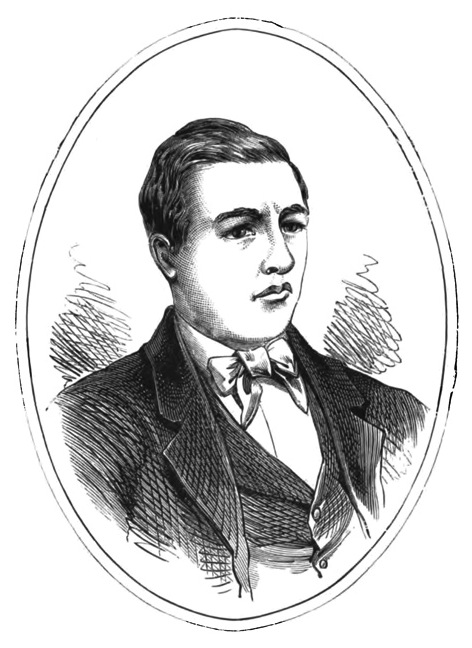
JEM MACE, of Norwich (Champion) 1855–1864.
Jem, who was born at Beeston, near Swaffham, in Norfolk, made his first appearance on the stage of life in May, 1831, and, like St. Patrick, “came of dacent people.” His “forebears,” as transpired incidentally in evidence at the Commission de lunatico inquirendo known as 445 “The great Windham scandal,” which was tried at Gray’s Inn, in 1861, seem to have been tenants on the Windham estates for more than a hundred years. We have mentioned this fact, as a general impression prevailed, from Jem’s nomadic antecedents and propensities, that he was a born Bohemian; indeed, we more than once read in newspapers that he was of gipsy extraction. Of Jem’s youth we know nothing, except that he “growed,” like Topsy, and we should say rather wild; for when we first heard of him he was proprietor of a travelling booth, wherein, at fairs, races, and public gatherings he not only played the violin—on which he is a tolerable performer—and supplied refreshments, but was acknowledged as a skilful professor of the art of self-defence. Indeed, he had not long been in this line of business before Jem Mace’s booth was the resort of numerous admirers of glove-practice, and Jem himself was famed for his readiness and success in polishing off any aspiring yokel who might desire to try a bout with the mittens. As Jem’s youthful weight did not quite balance ten stone he was of course often “overweighted,” though never overmatched in these encounters, and as he was always ready “to accommodate” without regard to size or avoirdupois, Jem’s early career taught him how to deal with “big ones,” as his after-fights with Tom King and the gigantic Sam Hurst bear witness.
Jem was not a precocious pugilist, having attained his twenty-fourth year before engaging himself to strip with a local boxer, bearing the formidable name of Slack, in October, 1855. Of this “illustrious obscure” we need only say that Fistiana has but one line chronicling his defeat by one Jack Baston (fighting as Mace’s Novice) in September, 1857, when Slack broke his arm. Mace’s fight with Slack, which took place at Mildenhall, October 2, 1855, was a one-sided affair, Jem snuffing out his adversary’s pretensions in nineteen minutes, which included the 9th and last round, and leaving off without a mark of punishment. From this time, for more than a year, Jem pursued the even tenor of his way, increasing his fame as a fistic practitioner and professor, when the rumour of his “gift” of hitting reached the great metropolis, and with it came an announcement that Mace would be happy, upon finding a suitable customer, to exhibit his talents in the London Ring with any 10 stone practitioner, and give a few pounds.
Bill Thorpe, a fine made and well-proportioned 10 stone man, standing about 5 feet 9 inches in his stocking-feet, had crept into favour with some “over-the-water” sporting circles by his defeat of a man named Bromley, 446 in the same ring in which Dan Collins (Sayers’s early opponent) beat Patsy Daly, on September 28, 1856. Thorpe, being on the look-out for a job, was considered a fit match for Jem Mace, and his friends placing him in the hands of Dan Dismore, the articles were drawn and signed to fight on the 17th February, 1857, for £50, neither man to exceed 10 stone. This limitation of weight suggests a rather curious reflection as to the remarkable manner in which some modern pugilists may be said to have increased in weight by “leaps and bounds.” Jemmy Massey, who fought at 8st. 10lbs., could not latterly scale under 10 stone. Sayers increased from 9st. to 10st. 12lbs., yet he was twenty-four years old when he fought Dan Collins; Harry Broome in two years grew from 10st. to 12st.; he, however, began unusually young, while Jem Mace, who was twenty-six when he first appeared in the London ring, increased from 9st. 10lbs. to 11st. 4lbs. just as Tom Sayers did. The affair came off, after a shift from the Kentish marshes, on Canvey Island, and although the men were termed novices, there was a better muster than usual of the patrons of the ring, owing to the popularity of Dan Dismore and Keene, who severally backed the men. The weather was genial and more like a May day than February, and a pleasant voyage was followed by an easy debarkation, and well-kept ring. Thorpe first threw in his hat, esquired by Jemmy Welsh and Tom Sayers—the appearance of the latter bearing testimony to the wonderful strength of his constitution, one week only having elapsed since his renewed and tremendous battle with Aaron Jones! Mace was not long in following Thorpe’s example, being accompanied by the accomplished Bill Hayes and a Norwich amateur. At three o’clock, all being in apple-pie order, the men and seconds crossed hands, and the former were left face to face to begin
THE FIGHT.
Round 1.—As Mace threw himself into attitude there was a general expression of admiration among the best qualified judges at the style of “the countryman,” and the easy grace with which he moved in and out, as if measuring his opponent, without the least hurry or nervousness. Thorpe, who, as we have already said, is a fine straight young fellow, stood with his right leg foremost à la Bendigo, and by his steady coolness showed he too was a practitioner in the sparring school, and not easily to be got at. Mace, however, filled the eye as a longer and altogether bigger man, though there was but three pounds difference in their weight. Thorpe, as his opponent tried to draw him, declined the temptation and retreated, closely and warily followed by Mace, who, at length seeing an opening, instantly planted a right-hander on Thorpe’s nob with a swiftness that completely astonished the Londoners. Thorpe did not shrink, but tried to cross-counter Mace’s left, when dash went in Jem’s mauley such a spank on Thorpe’s proboscis, that the Londoner was hit clean off his legs, a fair and indisputable “knockdown,” thus scoring the first event. On being carried to his corner, Thorpe was seen to be distilling the crimson from his olfactory organ, and “first blood” was also awarded to the member for Norwich. Thus early the odds were offered on Mace, but no response 447 was made even to an offer of 6 to 4, followed by 2 to 1 from a Norwich speculator.
2.—Mace lost no time in getting to work; he lashed out his left before he was well within distance. Thorpe retreated, but Mace did not get near enough for a prop, and Thorpe appeared to be confused at the manner in which his antagonist had planted on him in the opening bout, and was by no means desirous to have a second dose. In his tactics, however, he did not display science, for he neither hit with precision nor judgment. In his former battle with a 12st. opponent Thorpe fought with steady resolution, but the quickness and cleverness of Mace seemed to unnerve and puzzle him, and he hurriedly missed both hands, while after a little manœuvring, Mace let fly left and right in rapid succession on the head, and then got cleverly away. Thorpe, after following his man up, dashed out wildly with the right, and just missed getting home a stinger. Mace, in returning the compliment, again delivered a rattling spank on the nose, when Thorpe went down.
3.—Thorpe, acting under the instruction of his seconds, led off, but was neatly stopped. Determined not to be denied—Jemmy Welsh seeing that out-fighting would never do, urged his man to go in, and go in he did in an impetuous manner, just reaching Master Jem on the top part of the cranium. In the counter-hitting, Mace had all the best of it, and after a scrambling kind of rally, they closed at the ropes, when both went down, Mace rolling over his opponent.
4.—The countryman administered a pretty one-two on the front of his opponent’s nob, who did not appear to have the least idea of how to stop these telling visitations. In returning the compliment, Thorpe hit out wildly, and succeeded in getting slightly on Jem’s brain canister. This brought the combatants to a close, when Mace threw his man and fell on him; the London division looked blue at this proof of superiority at close quarters, and the “Norwich novice” was pronounced a “stunner,” by more than one good judge.
5.—The Londoner led with the left and right, but without precision. Mace, in the countering, planted the left on the cheek, and in a bustling rally fought his man to the ropes, when Thorpe succeeded in getting home a heavy spank with the right on the top of the knowledge-box, and Mace slipped and went down.
6.—Bill, in opening the ball, tried the right, but again missed. The London party vociferously encouraged their man, declaring the countryman was “half-licked.” Mace retreated as his antagonist came dashing in; but Thorpe was not to be denied, though, in the exchanges that ensued, he had all the worst of it, for Mace delivered the left and right full on the os frontis, when Thorpe went down in the middle of the ring, bleeding profusely.
7.—On coming up, Thorpe displayed considerable marks of punishment, having a cut over the left peeper, and one under the right, a proof that his antagonist was a hard hitter, as well as a quick and rapid fighter. Bill again tried to take the lead, and to put in a hot ’un on the nob with the right, but the intended compliment was not within the mark. Mace, as Thorpe dashed to him for in-fighting, sent both mauleys full in the middle of the Londoner’s dial, but, in stepping back, slipped, and partly went down on his knees. On the instant, however, he recovered his equilibrium, and, after some spirited exchanges, in favour of the countryman, they closed, when Thorpe went down against his will.
8.—Thorpe was unsteady on coming up; Mace had no sooner been met by his antagonist than he delivered the left with telling force right on the mark, following it up with a one-two on the nob, and then, to avoid his opponent’s rush, being near the ropes, went down cunning.
9.—The supposed success of Thorpe in fighting down his man in the last round led to encouraging cheers from his partisans, who declared the countryman was “cutting it.” Thorpe, after leading off with little or no effect, closed, and got home a heavy thwack on the side of the head with the right, when, after a little fibbing, Mace broke ground, and went down.
10.—Mace came from his corner with a smiling countenance. Thorpe had all the will to be dangerous, but lacked the judgment, for, in commencing the attack, he was again out of distance. Mace, when he had worked his way well to his man, administered the left and right once more on Master Bill’s damaged pimple, and then, as Thorpe rushed in for the close, went down easy.
11.—After two or three ineffectual attempts, Bill went in resolutely and got home with both mauleys on the side of the nob; Mace, after returning the compliment, with a slight addition by way of interest, closed with his opponent, and both went to grass, Thorpe under.
12.—Thorpe with the left got home slightly on the head, but in trying to improve upon this he was well stopped. In a wild rally the Londoner fought his man to the ropes, when the countryman with both the left and right gave him an additional dose of punishment on the nob, drawing another supply of claret. After these exchanges the men closed and fell.
13.—Thorpe, after leading off, napped a stinger on the side of the nob, when he immediately closed with his opponent. Some half-arm fighting ensued, all in favour of Mace, and both were down.
14.—Bill, in a wild impetuous manner, went dashing in at his man, but in the counters did little or no execution. Mace, 448 after steadily planting both mauleys on the head, retreated, and in breaking ground slipped and fell.
15.—The Londoner made an attempt with the right, but was well stopped. As Mace broke ground, Thorpe followed him up with much gameness and resolution, and in the exchanges delivered a tidy spank with the left on the side of the head, when Mace went down to avoid the close, with more prudence than pluck.
16.—Mace, who had been allowing his opponent to do all the work, now saw he had him in hand; with great quickness and precision he let fly with both hands at the head, and repeated the dose without a return. Thorpe rushed at his man for the close, when Mace went down laughing.
17.—Thorpe met his antagonist with much resolution, and with the right planted a stinger on the side of the head. Mace, in retreating, slipped and went down, but on the instant he was again on his pins, and renewed the battle. In the counter-hitting he got home with telling effect, and in retreating from his man he again slipped and went on his knees, but instantly jumped up and faced his opponent. Bill, though, as usual, receiving all the punishment, stood his ground manfully, until they closed, when, after some little fibbing, Mace went down.
18 and last.—Mace in this bout gave his antagonist the coup de grace in the most off-hand and masterly manner. Thorpe came up desperate, and Jem, after stopping the opening shots of his opponent, delivered his left and right with stinging force on the middle of Master Bill’s nob, the last hit with his right being full on his nasal prominence. This immediately sent Thorpe to grass, and when “time” was called, it was found that he was in no condition to renew the contest. Hereupon Jemmy Welsh throw the sponge up in token of defeat, the battle having lasted twenty-seven minutes.
Remarks.—There was but one opinion among the cognoscenti as to the winner—namely, that he was one of the best boxers that we have seen for many a day. He is a quick and rapid fighter, and hits with judgment, precision, and remarkable force, as the condition of poor Thorpe’s head strikingly manifested. The Londoners knew by repute that he was considered to be a good general; but we are confident that they never for a moment imagined that he was anything like the man he turned out. As will be seen by our description of the rounds, he fights remarkably well, and when in danger has the ability to get out of it in clever style. From first to last he had the battle entirely in his own hands, Thorpe never having the remotest chance of winning, for he was out-fought and out-manœuvred in every round. Mace at the weight is a strong-made, powerful man, and if his pluck and bottom are in any way equal to his other qualifications, we can only say that it will require an opponent of first-rate ability to beat him. This tournament, however, is by no means a fair criterion of those qualities, for he had the fortune and skill to get in no way punished, absolutely winning the contest without so much as a black eye. Thorpe, the unfortunate loser, is, there can be no doubt, a very game man, but he will never be able to obtain a front position in the P.R. It must, however, be borne in mind that, as a game and determined fellow, he did his best, and it is to be hoped that he will not be forgotten either by his friends or by the winners. All being over, the company returned to the metropolis, which was reached before seven o’clock in the evening.
The money was given to Mace, at Mr. G. Smith’s, King Street, Norwich, on the following Thursday, when several matches were talked of, but nothing came of them. After a sparring tour, we find our hero in London, making Nat Langham’s his headquarters, and offering to do battle either with Mike Madden or Bob Brettle, of Birmingham, at 10st. 3lbs., for £100 a side. He was also “nibbled at” by Job Cobley (nicknamed by Baron Nicholson “the Elastic Potboy”) whose victories over Webb, Bob Travers (the black), and George Crockett, had brought him into the front rank of middle-weights; Cobley’s engagement with Mace going off, owing to the former being matched against Bob Brettle. Some pourparlers with Jack Grant also ended in talk, until, early in the month of September, Mace having left a deposit in the hands of the Editor of Bell’s Life, Mike 449 Madden covered the same, and articles were signed for a fight for £50, to come off in the Home Circuit, on the 20th of October, 1857.
Mace was now in business as a publican, keeping the Swan Inn, Swan Lane, Norwich; and at the final deposit at Nat Langham’s on the previous Thursday we heard an ominous whisper to the effect that there would be “no fight;” while, per contra, we were assured by both parties that each meant fighting and nothing else. On the Friday Mr. Lockwood, of Drury Lane, on the part of Madden, and Langham, on the part of Mace, attended at the Editor’s Office, and were there informed, as that gentleman could not be present, he should exercise the power vested in the stakeholder by the articles of naming the referee, and further that he should appoint Dan Dismore to that office, to which neither of the parties made the slightest objection. On the Monday the men went to scale at Mr. Lockwood’s, and here there were loud complaints on the part of Mace’s friends about Madden’s style of weighing, they stating him to be overweight, also that he jumped off the scale before the balance was fairly ascertained, and, putting on his clothes, refused to return. On the other hand Madden and Co. averred that Mace never meant fighting, that after the weighing he went out of the house in his shirt sleeves, and did all in his power to attract the attention of the police; and that in the evening he went to Gravesend, where he ostentatiously paraded himself, and even proclaimed the whereabouts of the coming mill.
On the Tuesday morning, on reaching the ground, we found an excellent ring, which was quickly surrounded by a large number of Corinthians and other Ring patrons, prepared to witness what many expected—a real good battle. To their disappointment and surprise, however, when all other preliminaries were arranged, Mace and his friends stepped forward, and formally objected to Dan Dismore as referee, on the ground that he had money on the fight. Dan instantly replied that he had not a shilling on the result, and that he should not have been present had he not received the letter appointing him referee. Mace’s party persisted in their objection, and various propositions were made, among others one by Mike Madden himself, who said he was willing to fight with two umpires and without any referee; but to this Mace objected, as “contrary to the articles.” Several gentlemen were proposed for the onerous and thankless office, who either declined or were objected to; so at last what was to have been the second fight (between Clamp and Gibbs) was got off amidst disgraceful confusion, Clamp proving himself the best man in one 450 hour and thirty minutes. Both Madden and Mace remained in or at the side of the ring while the men were fighting, and after some more discussion of the vexed question of a referee, all returned to London. On the Wednesday, after a patient hearing of both sides, the stakeholder declared that Mace having refused to go to the scratch, when called upon by the duly-appointed referee, had thereby deliberately violated the articles and forfeited the stake, £100, which in due course was handed over to Madden. An unusual amount of irrelevant correspondence, statements as to shares of stake-money, training expenses, unpaid bets, promises and defalcations, from Mace, Madden, and Messrs. Lockwood, Hayes, Dismore, Keene, &c. followed. Finally, after six months’ quibbling, a new match was agreed on, and the 10th of March, 1858, named as the day of battle.
Well do we remember the early muster on that spring morning at the Eastern Counties Railway terminus at Shoreditch. There was “old Mike,” whose deafness, solidity, and stolid look had already earned him the prefix of “old,” though he numbered but thirty summers; he was buttoned up to the chin, in an old-fashioned drab box-coat, with a deep-red neckerchief, and a sealskin cap, the ears of which completely covered his ears and cheeks. He was anxiously inquiring of the group around for his “friend the enemy,” as the time for starting was near. We entered the station. Could it be true? We had the word of the traffic station-master for it. After a brief conversation on the platform, in which some “d—d kind friend” inopportunely alluded to the lamentable result of “ould Mike’s” last battle—that with Jack Jones, of Portsmouth—Jem, with a nod of the head and a cheerful expression, left his friends, and seating himself in an Ipswich carriage just about to steam out of the station, coolly waved a “good-bye” to the astonished group! Another account states, that after Madden and Co. had gone down by the appointed train, Mace was found in a neighbouring coffee-house, whither he had taken refuge from an impending arrest by the police! It is not of much consequence which is the correct version, as the claim of Madden to forfeit from the absence of his opponent was made and fully admitted.
That the pugilistic qualifications and cleverness of Mace were still believed in by some of the best judges of boxing is shown by the fact that “George Brown’s novice,” as Jem was now called, was thought good enough to back against Bob Brettle of Birmingham, whose conquests of Roger Coyne, Sam Simmonds, and Bob Travers were then fresh in the memory of Ring-goers. George Brown, Billy Richardson, and Jack Macdonald were 451 sponsors, and these knowing ones declared that the 21st September, 1858, would show “the coming champion.” Nevertheless, serious misgivings haunted the public mind, not only when the last deposit of the £200 stakes was “tabled,” but even on the short railway journey which preceded the voyage per steamer to Shell Haven, odds being taken that there would be “no fight that day.” Great, therefore, was the satisfaction when it was found that Mace was on board the boat, not only well but cheerful, and apparently confident. After a pleasant run down the river, a fitting spot was selected on the banks of the Medway, where Tom Oliver and his assistants pitched an excellent ring on a lovely piece of greensward.
The Champion of the Midlands was first to cast his beaver into the ropes, amidst hearty cheering, Alec. Keene and Jem Hodgkiss attending as his esquires. Mace soon after showed, advised by Jack Macdonald and Jemmy Massey. It wanted ten minutes to twelve when the men shook hands, the seconds retired to their corners, and the men threw themselves into position for
THE FIGHT.
Round 1.—There was very little time lost in manœuvring, both men surprising their friends by an almost nervous eagerness to get at it. Mace at once made play, and let go both hands in the style that had so disconcerted Thorpe; Brettle, however, making a good stop or two, and returning wildly, getting two or three severe cracks, one on the ear so specially heavy that the blood appeared from his auricular organ, and the first event was scored to Mace. After a short rally Brettle closed; Mace hit up sharply, but Bob got the crook and fell over him. The friends of Mace thought their man meant fighting, and the odds which had been offered—5 and 6 to 4 on Brettle—subsided to evens.
2.—The men threw themselves into good form; Brettle tried to lead off with the left, but was stopped neatly, and after another offer and a shift, Jem landed his right smartly on Brettle’s left ear. Again there was a stop or two, and Mace got home slightly; Brettle retreated, and measuring his man as he came in, let go his right on the left side of Mace’s head, on the temple; down went the Norwich man, and the round was over. Alec Keene claimed “first knock-down” for Brettle, and the referee awarded it. Mace was picked up by his attentive seconds, when a strange commotion was seen in his corner; he glared round for a few seconds, then suddenly swooned in Jack Macdonald’s arms. Mac and Massey shook him, and the latter bringing a stool into the ring, tried to seat him thereon. In vain: his legs fell about like Mr. Punch’s, or the nether limbs of a fantocchino, and his toes determinedly found their way under the ropes. The syncope was so determined that the Brums began to roar and jeer, and the Eastenders to swear; when the enraged Mac administered such a vice-like pinch to his man’s ear, that he roared lustily, but the next moment was as insensible as ever to all outward things. “Time” was now called, and “Time!” was repeated by the referee. Jem was set up in a perpendicular position, but those recalcitrant legs sent up their heels, and Jem would have assumed a devotional attitude, but that the “stunted lifeguardsman” held him up by main strength, while his head fell sideways on Macdonald’s shoulder. “Time!” the eight seconds’ “grace” were counted. “There are none so deaf as those that won’t hear,” was once more verified, and Bob Brettle was declared the conqueror, the actual fight having lasted three minutes. On the boat it was observed that Brettle’s last hit had raised a very blue mouse on Jem’s cheek-bone, but that it had knocked him out of time—credat Judæus Apella—indeed we are sure no Sheeny from Houndsditch would believe it.
The elation of Brettle’s friends at this victory led them into a mistake. 452 They matched their man against Tom Sayers, and on September 20th, 1859, in a short quarter of an hour, seven rounds disposed of the Brum’s pretensions, as may be fully read in our last chapter.
Mace’s next match remains a yet-unexplained riddle. He was backed on this occasion by Bob Brettle—the man who had defeated him with such apparent ease—against one of his own townsmen, Posh Price, at 10st. 10lbs., for £50 a side. Price was a boxer of proved game and no mean capabilities. The deposits were posted by Brettle in the name and on the behalf of a man called in the articles “Brettle’s Novice,” and it was not until the last deposit that it was declared that Jem Mace was the “Novice” thus described.
On the 25th of January, 1859, after the gallant battle between Dan Thomas (the Welshman) and Charles Lynch (the American), in which the former was victorious, a special train having conveyed the spectators and combatants from London Bridge to Aldershot Common, the ring was cleared and re-formed by Fred Oliver and his assistants. No sooner, however, had the ropes been tightened, and the stakes driven firm, than, to the chagrin of the expectant assemblage, a detachment of the rural constabulary made their appearance, and a move into the adjacent county of Surrey became imperative. The transit was quickly and safely effected, and no sooner was the ring adjusted, than “Brettle’s Novice,” attended by his backers, tossed his cap into the ropes in token of defiance, and stood revealed to all as Jem Mace of Norwich. His condition and bearing not even the most prejudiced could find fault with. The men went to scale on the previous day at George Brown’s, “The Bell,” Red Lion Market, both being well within the 10st. 10lbs. Posh Price, who was born in 1832, and won his first victory in the Ring at eighteen years of age, was as yet unbeaten. He had successively defeated Mush, Boucher, Leighton, Benson, Holland, Liddy, and lastly the once renowned Ben Terry, who fought a draw with Harry Broome. In all these battles he had borne himself bravely, and showed no mean amount of skill. It was not, therefore, to be wondered at that Price was favourite in the betting at 5 and 6 to 4. The Birmingham man was seconded by Sam Simmonds and Joe Wareham, while Mace had behind him Jem Hodgkiss and Brettle. Price, whose age was twenty-seven—Mace being one year older—was all his friends could desire in point of condition, and his hardy, good-natured mug wore a smile of confidence in the result of
453
THE FIGHT.
Round 1.—On the retirement of their seconds the belligerents at once threw themselves into attitude, the superior freedom of Mace’s style being quite evident to the initiated. He played round his man, watching him keenly; Price looking somewhat puzzled how to begin. Presently Posh broke ground, and retreated, keeping a good guard; Mace followed his man closely, and, getting well within distance, popped in his left on Price’s mazzard, but was countered by Price’s left on the forehead. Mace stuck to his work, and caught Price right and left in the head. Posh fought determinedly in the exchanges, but Mace drove him back, planting the left on Price’s right eye with such severity that the ruby streamed down his cheek. (First blood for Mace.) After a break and a little wincing they again got within striking distance, when some heavy exchanges ended in Price being on the grass.
2.—The men went at once to work, and some slashing exchanges followed, in which Mace, partly from a hit, and partly from a slip, was down. In an instant he was on his feet again, and as the Brum, somewhat surprised, retreated before him, followed him close. Near the ropes Posh made a stand, and hit out with both hands. After some fine two-handed fighting in favour of Mace, Price was on the ground, Mace walking smilingly to his corner.
3.—Mace forced the fighting. He led off with astonishing rapidity, doing terrible damage to the Brum’s dial and cranium. Posh stood to his guns like a man, but Mace’s metal was too heavy for him. Nevertheless, in the exchanges, Price got in a hot ’un on Mace’s jaw, and another on his neck, that made Master Jem look serious, and although the odds had changed, the Brums took heart from the general opinion of Mace’s deficiency of game. In the close both were down at the ropes.
4.—Mace led off rather short, and as he got nearer Price planted his left in the middle of his opponent’s nob. (Tremendous cheering from the Brums). Mace drew himself together, and fighting rapidly, got heavily on Posh’s eye and mouth. The gallant Brum paused a moment, then dashed in, and after a magnificent rally, in which Mace astonished the spectators by the straightness and rapidity of his hitting, Price went down against his will.
5.—Jem lunged out his left, delivering an enlivener on his adversary’s brain pan, and getting cleverly away from the Brum’s returns. After a little sparring, Mace got again within distance, and in some clipping left-handed exchanges got with tell-tale force on the Brum’s dial. Posh, scorning to retreat, stood his ground, and fought up. In the fall both were down, Price undermost.
6.—Mace opened the ball with a shot from the left, when the Brum retreated. Jem followed, and again got in the left with telling effect. They closed at the ropes, when Posh, who was catching pepper, got down.
7.—Heavy counters, each doing execution on the head. As Price retreated, Mace followed, and as the Brum turned on nearing the ropes, Mace caught him a terrific right-hander on the head, just behind the ear, opening a cut from which the carmine ran copiously; Posh, who appeared dazed by the effect of this rasper, went down on his knees in the middle of the ring.
8.—Price came up slowly but steadily; in an instant Mace dashed in with electric rapidity, right and left, in his opponent’s damaged frontispiece; Price was, however, by no means idle, and stuck to Mace in the counter-hitting. In a rally Posh was down.
9.—Mace came with alacrity from his corner; he was almost unmarked, while poor Posh’s countenance was out of shape in every feature. Still he kept his form—such as it was—and tried to stop his man, too often ineffectually. Mace drove him to the ropes, and would have screwed him up for fibbing, but Posh slipped down through his hands.
10.—Posh made a desperate attempt to lead off, but Mace stopped him artistically, and caught him a smasher on the proboscis for his temerity; Posh in turn retreated, when Mace followed him. Price, to avoid a heavy right-hander, ducked his head, and in doing so caught his foot in the grass and fell.
11th and last.—The combatants came up readily. The Brum seemed determined upon a last effort to stem the tide, and the Norwich man at once accepted the attack. The exchanges were effective and sharp, and while the men were thus fighting, Mace hit his man a terrific blow on the left arm, which caused Price to drop his hand, and stagger to his corner. A swelling on the fore arm was instantly visible, and it was stated that the small bone of the limb was fractured. Sam Simmonds stepped forward and declared that his man was disabled, and he would not permit the game fellow (who had risen to his feet to renew the contest) to fight any longer. The sponge was accordingly thrown up, and Mace hailed the winner, the battle having lasted exactly 17 minutes.
Remarks.—We do not remember to have seen such severe and cutting punishment administered in so short a time in any battle of modern times. Mace, in this contest, not only justified the high opinion of his scientific quality which we always entertained, but displayed a steady resolution for which none had given him credit. True, he was 454 never in danger of losing the fight, and as round succeeded round his superiority became more manifest. He fought throughout with wonderful quickness; and that his hitting was as hard as it was precise poor Posh’s battered mug and bruised carcase fully testified. Of the gallant Brum, we can only say he was out-classed, out-generalled, stopped, foiled, and punished at all points; and, as he did all that became a man, he deserves the respect of all who admire pluck and resolution; and it should not be forgotten that at last his defeat was due to an unfortunate and disabling accident, not to a surrender. The £100 was given over to Mace on the Tuesday following, at Bob Brettle’s “White Lion,” Digbeth.
Mace was now a publican, hanging out his sign at the Swan Inn, Swan Lane, Norwich, and exhibiting his talents almost nightly at the “Baronial Hall,” West End, Norwich. In the early months of 1859 we read, “Jem Mace, wishing to try his hand once again in the London P.R., will fight any man at 10st. 7lbs., in four months from the first deposit, for £100.” This was answered by Job Cobley; but for a time the friends of the “Elastic Potboy” hung back, and George Crockett offered himself at 10st. This weight was simply preposterous as a limit for Mace. Dan Collins, too, Sayers’s first opponent, proposed; but, doubtless fortunately for himself and friends, the match went off upon a question of amount of stakes.
At length in November, 1859, Bob Travers (then known as “Langham’s Black”) responded to Mace’s cartel, and articles were drawn to fight on the 21st of February, 1860, for £100 a side.
The character and antecedents of Travers left no doubt in the minds of the patrons of pugilism that Massa Bob would fully test the stuff of which Jem Mace was really composed. With the exception of a solitary defeat by Job Cobley, Travers’s reputation had been well won. In his first battle, October 29th, 1855, he beat Geo. Baker, in two rings (after an adjournment from October 19th) in twenty-three minutes, for £25 a side, at Tilbury. In February, 1856, he conquered Jesse Hatton, at Combe Bottom, in 76 minutes, during which 39 hard rounds were fought. George Crockett succumbed to his arm at Egham, in 37 rounds, occupying 114 minutes, on May 13 in the same year, in which also (he was fighting too often) he suffered his first defeat by Job Cobley, after a tremendous battle of 3 hours and 27 minutes, in which 110 rounds were fought. In January, 1857, he beat Cleghorn for £100 a side, on the Medway, in 36 rounds, 87 minutes, and in May 13th of the same year defeated the accomplished Bill Hayes, in 3¾ hours (!), the stakes being £100 a side. Beaten by Bob Brettle (Travers fell without a blow), January 27, 1858, he received a forfeit of £90 from Johnny Walker, who did not show, on the 25th May, 1858; and in April, 1859, beat the game and unflinching Mike Madden in 455 45 rounds, 97 minutes, at Ashford, Kent; and this brings us to his present engagement.
With such a deed-roll Travers’s chance was booked as a certainty by the circle at the “Cambrian,” where Massa Ebony was a “bright, particular star,” especially as many persisted in asserting the visible “white feather” in Mace’s plumage.
The men injudiciously delayed their departure from town until nine o’clock, and after a long journey by rail much time was lost before the excursionists got on board the “City of Rochester” steamer. John Heenan, the Benicia Boy, was among the voyagers, attended by Jack Macdonald, and was, as may be imagined, “the observed of all observers.” After a long water trip a debarkation was attempted in Essex, on an oft-visited spot, and there the ring was pitched, and all in readiness, when the police came in sight, and all were compelled to go on board again. After another steam trip of five miles a landing was effected in Kent. Travers, who won the toss for choice of corners, had for seconds Jerry Noon, and, to the mystification of many, Jem’s whilom patron Bob Brettle, with whom a feud had arisen. Bos Tyler and Jack Hicks attended upon Mace. Travers at the opening was an immense favourite, 2 to 1 being offered on him. It was five minutes to five o’clock when the men’s toilettes were completed and they stood up for
THE FIGHT.
Round 1.—As they faced each other there could be no doubt that the condition of the combatants was faultless. Travers’s skin shone with an unmistakable lustre, resembling a dark piece of fine old Spanish mahogany. His massive and deep chest and broad lines displayed a grand development of muscularity, denoting the possession of exceptional strength. The only circumstance that detracted from his general appearance was his legs, and the looseness with which, like most niggers, he was put together. He looked all over smiles and grins, and as if perfectly confident he must be the winner. Mace, possessing the superiority in height and reach, with his keen eye, symmetrical frame, and graceful freedom of attitude, looked from head to foot an athlete to whom, if the heart were there, anything might be possible. His friends declared that he had “screwed his courage to the sticking place, and could not fail,” and the event proved their trust to be well grounded. Travers, after a little manœuvring round the ring, tried to lead off with the left, but was short. Mace was awake, and as Bob jumped back, Mace followed him, and Bob again hitting out, Mace nailed him with the left on the cheek, and then with the right on the left peeper. In the close, after a smart dose of fibbing, they struggled for the fall, when Mace threw Bob, but not cleverly. There was an attempt to claim first blood for Mace, but it was not admitted.
2.—The ice being fairly broken, the men were no sooner up than at it. Bob again led off, out of distance, with the left, then retreated with rapidity; Mace followed him up, and some sharp exchanges followed; the Black getting home on Jem’s mouth, while Mace was home with both hands on the Woolly-one’s nob. In shifting position, Travers got with his back on the ropes and rolled down.
3.—Both men came eagerly from their corners, and at once sparred for an opening. The Black, who was as lively as a young kangaroo, hopped about the ring; Mace kept to him, so at last, after hitting out without effect, Travers got down. (Disapprobation.)
4.—The combatants came up smiling. As yet there had been little harm done 456 Travers, as usual, opened the ball, planting the right on the body; in return, Mace timed his man with fine precision, landing both left and right effectively, the latter on the point of the chin, when the Black went down on his hands and knees.
5.—After manœuvring and breaking ground, the men got to the ropes in Travers’s corner; the Black, after slight exchanges, getting down cunning. (There was an appeal of “foul,” which the referee disallowed, saying “Go on.”)
6.—As the Darkey, in somewhat ungainly fashion, was dancing about the ring, Mace went to him, and at the ropes planted both mauleys on the head with rattling precision. In the close Travers had his back on the ropes, when Mace tried to put on the hug; Travers got down.
There was here a general cry of “Police!” and a posse of these unwelcome intruders came to the ropes, when Bob, in his anxiety to “make tracks,” nearly ran into the arms of the Philistines. Jerry Noon had also a narrow squeak for it, and had he not jumped into the river and swum to a boat, he would certainly have been nailed, as the Bobby who had singled him out did not give up the chase until up to his middle in water. The escape so pleased several of the lookers-on who had reached the steamer in boats safely, that a subscription was made to “dry Jerry’s clothes,” and liberally presented to him when on board. The battle thus interrupted had lasted 21 minutes, and as darkness would soon come on, the steamer’s prow was directed homewards, and the referee ordered a meeting for the next day.
At an early hour on Wednesday morning, the men and their backers were on board, and at a few minutes after nine Fred Oliver announced all to be in readiness. Mace was first to throw his castor in the ring, which action was immediately followed by Travers, who entered with the same grin of nonchalance as on the preceding day. Mace had scarcely a visible mark, while the black’s ebony complexion concealed all but a cut over the left eyebrow. A rumour was spread that Mace’s left arm was partially disabled; but this proved a canard, no doubt flown to influence the betting, the Black still being backed at 2 to 1. The seconds were the same as on the first day.
THE RENEWED FIGHT.
Round 1.—Just before the commencement of hostilities, Travers proposed to back himself to any amount at evens, and produced a roll of notes about as thick as the steamer’s shore-rope for that purpose; but Mace politely declined, regretting that his exchequer was not so flourishing as to permit him to indulge in such speculation. Travers, in taking the initiative, broke ground with more haste than judgment. Jem again followed him, got home with both hands, and, after a close at the ropes, the Black slipped down anyhow.
2.—After a little sparring Mace got home beautifully on Bob’s black-letter title-page, when Travers retreated, hitting out wildly. Mace counter-manœuvred and followed, when Bob paused a moment, then rushed in hand-over-hand, but did not get home. Mace planted his left with fine judgment, following it with a job from the right; there was a little fibbing in the close, and both down by the ropes.
3.—Travers again led with the left, the blow alighting on Mace’s breast, when Mace caught him on the side of the head. Bob 457 retreated, and went down to avoid. (Bos Tyler here appealed to the referee, who declined to notice the get down. “Go on.”)
4.—The Black, all activity, was all over the ring, Mace watching his gyrations keenly and following him close up. After a little fiddling, Mace got near enough, and planted his left sharply, but Travers, ducking his head at the instant, caught the blow on the top of his impenetrable skull. The Black tried to take a lead, but did not get home; Mace, getting to distance, planted a sharp left-hander in Bob’s face, who fell immediately in the middle of the ring. (Loud cries from Mace’s partisans of “Stand up! remember the 13th rule!”)
5.—Both men went eagerly to work, Mace got on a stinger over the left eyebrow; after some wild exchanges, in which Jem peppered the nigger handsomely, both were down, Travers first to earth.
6.—Travers dashed to in-fighting, when Mace again propped him beautifully, and after a scramble in the close, Bob got down anyhow.
7.—Travers, leading with the left, again reached Mace’s breast, when Mace stepped back and recovered guard. As Bob now broke in turn Mace followed as usual, and taking exact measure, popped in his left on the Darkey’s thick lips; Bob again sidled and skipped about the ring and as Jem was letting go a straight one the Black fell, as a bystander observed, “with the wind of the blow.”
8 to 14.—Similar in character, and an appeal by Hicks to the referee followed by a “caution” to Travers from that functionary. From the 15th to the 30th round Travers pursued the same dropping tactics, getting home with little effect at the opening of each round, but unable to prevent Mace’s stinging deliveries, from which his left eye was now fast closing, besides other serious disfigurements. Loud disapprobation was expressed at the Black’s shifty tactics, and in the 32nd round the referee got into the ring and went to Travers’s corner to warn him of the danger he was incurring. Bob assured him his fall was accidental, from the state of his shoes and the ground.
33.—Travers fought his man foot to foot in a fine rally, the hitting all in favour of Mace, and both down.
34.—Bob tried to lead once more, but Jem countered him beautifully, and the Black in getting away fell.
35 to 40.—Travers at the old game again, leading off, getting home slightly, and then scrambling or slipping down to avoid the consequences of standing up to his man. That Mace was winning as fast as his opponent’s shiftiness would allow was manifest. In the 57th and last round, after hitting out, the Black shifted his position, and as Mace was delivering his blow deliberately threw himself down. The referee now decided the battle against him, and Mace was hailed the victor at the end of one hour and thirty-one minutes. A scene of disgraceful confusion followed; Travers’s friends assailing the referee with the foulest abuse, and refusing to accept his decision. Travers shed tears, and declared he was ready to fight on, refusing to shake hands with his opponent. Travers was severely punished; Mace’s bruises were unimportant.
After some acrimonious disputation and letter-writing, the referee’s decision was properly upheld by the stakeholder, and the money handed over to Mace at Mr. Smithers, “Golden Cross,” Charing Cross, Norwich, on the ensuing Friday week.
We have already noted the fact of the disruption of friendly relations between Mace and his quondam conqueror and subsequent friend and patron Bob Brettle. In the early months of 1859 this ill-feeling took the form of a challenge from Mace to Brettle, and some haggling between the disputants on minor details and conditions. Mace’s last two exhibitions had so far restored the much-shaken confidence of his admirers as to satisfy them, however otherwise inexplicable his “in and out running” might be, that, at his weight, none could “live with him,” when he really meant “to stay.” So they listened to his solicitation to give him a second trial “with the only man who had ever beaten him, and that by a fluke”(?). In reply to Jem’s challenge for £100 Brettle replied that being now a “bung” 458 in a good way of business it would not pay him to train under £200. Holywell Lane and Club Row, and a “voice from Norwich” preferred a bigger stake, so the prelims. were soon settled. The 19th September, 1860, was named as the day, and Oxfordshire, as (half-way between London and Birmingham) the locus in quo. Accordingly, the London division took their departure from Euston Square, meeting Brettle and Co. at Wallingford Road; there all alighted, and, under the pilotage of a local amateur, a charming spot was selected. Many of the older Ring-goers, however, expressed doubts as to the judiciousness of the selection, and foreboded an interruption, which came all too soon. No time, therefore, was lost, and at a few minutes before noon the men shook hands, and began.
THE FIGHT.
Round 1.—As the men toed the scratch it was clear to all that they were both all that could be wished in point of condition. Mace had three or four pounds’ advantage in weight, and also a trifle in height and length. Brettle, who looked rounder, bore a smile of self-satisfaction on his good-natured mug, and as he swung his arms in careless fashion, and raised his hands, he nodded to a friend or two, as if quite assured of the result. Brettle tried to lead off, but Mace stopped him coolly, and tried a return, which was prettily warded off by Brettle, who shifted ground. Bob offered again, but was stopped, and Jem popped in a nose-ender in return which drew Bob’s cork, and established a claim of “first blood for Mace.” Bob shook his head as if annoyed, and in he went ding-dong; the exchanges all in favour of Mace, who hit straightest, hardest, and oftenest. Brettle closed, and Mace was under in the fall.
2.—Brettle exhibited some red marks indicative of Mace’s handiwork, while Mace showed a mouse under the left eye. Bob again opened the ball, but he was baffled, and as he persevered Jem popped him prettily on the nose, and then on the mouth, Brettle, nevertheless, giving him a rib-bender with the right, and on Mace retorting on his kissing organ Bob got down.
3.—Brettle’s countenance bore increasing marks of Mace’s skill as a face-painter, but he lost no time in going to work; Mace stood to him, and sharp counter-hits were exchanged; Mace on Brettle’s left eye, Brettle on Mace’s jaw. Exchanges and a close; the men separated, and Mace, in getting away, fell.
4.—Brettle was more cautious. He waited, and tried to draw his man. After a little manœuvring Brettle, amidst the cheers of the Brums, dropped on Mace’s conk a rattler, producing the ruby. Jem looked rather serious, and the Brums were uproariously cheerful. Bob tried it again, but failed, for Mace was first with him with a smasher on the mouth. Brettle bored in, but Mace threw him cleverly, and fell on him.
5.—Brettle slow, being shaken by the blows and fall in the last round. Mace waited for him, delivering right and left straight as an arrow, and getting away cleverly from the return. Bob followed him wildly, getting more pepper; and in the end Brettle was down in the hitting.
6.—Brettle’s left daylight was nearly obscured, and the right showed a distinct mouse. His mouth too, was out of symmetry, and his nose, naturally of the Roman order, resembled a “flat-fish.” Notwithstanding, he went in, and got it on the nose and mouth, returning in a wild and ineffective fashion, until a hot left-hander brought him to his knees in anything but a cheerful condition. At this point a cry of “Police,” was followed by the appearance of a posse of “blues,” headed by a magistrate from Didcot. Hostilities were immediately suspended, and all returned to the train. On a council being held, the “manager” who had deprecated this landing, declared that there was now no hope of pulling up at any part of the line; so there was nothing for it but to order the men to meet the referee on the following morning. “Book agen” was the mot d’ordre, which was doubly vexatious for the Birmingham division, who nolens volens had to journey to London, with very doubtful prospects of getting back their money at the next meeting.
After some discussion, all parties agreed to a renewal of the combat on 459 the 20th of the month. The day proving exceptionally fine, the men and their friends started at an early hour from Fenchurch Street, concluding the rail part of the journey at Southend, where a couple of steam-tugs were in waiting, and a voyage to ground on the sea-coast of Essex, never before visited by the Fancy, was chosen. The odds on Mace were not taken, Brettle’s friends being few, and lacking confidence. At five minutes to one, all being in order, the men stood up.
THE FIGHT.
Round 1.—Brettle had not entirely got rid of the marks of the previous week’s encounter; besides a cut under the left eye, the right optic was “deeply, darkly,” but not “beautifully blue,” and his face looked somewhat puffy. Mace had no more than a skin-deep scratch or two. No sooner had Brettle toed the scratch, than instead of forcing the fighting he stepped back, as if to try whether an alteration in tactics might change the fortune of war. Mace appeared fora few seconds doubtful, then drawing himself together, he slowly followed his man. Getting closer, Brettle let fly his right, and got home on Mace’s head, too round to be effective, while Jem’s counterhit caught him flush on the dial. Brettle broke ground, Mace after him; Bob got home on Mace’s body, but fell at the ropes in retreating.
2.—Mace came up smiling, and was met cheerfully by the Brum. Mace was no sooner within distance than he made his one two on the nose and eye, Brettle’s returns being short and ineffective. As Bob shifted position he slipped down on one knee, but instantly rising renewed the battle. In the struggle at the ropes, Mace was under, and a “foul” was claimed, on the allegation that Brettle had tried to “gouge” his man. The referee said “Go on.”
3.—Mace came up with a slight trickle of claret from his proboscis. Brettle’s face looked as if Mace “had been all over it.” Brettle fought on the retreat, but Mace was too clever at long shots for him to take anything by that manœuvre. As Bob broke ground, Mace nobbed him so severely that his head nodded like a mandarin, and on a second visit down went Bob, staggering from something very like a knock-down.
4.—The Brum came up bothered; yet he faced his man boldly—it was observed that he hit with the right hand open. Mace timed him with a straight prop and retreated. The Brum bored in; the men got across the ropes, when Brettle, lest Mace should fib him, slipped down, as quickly as he could.
5th and last.—Brettle came up quickly, but Jem, perceiving he had got his man, stood to him, and delivered both hands with marvellous rapidity. Bob hit away desperately, fighting his opponent to the ropes, where Jem delivered two more punishers, and Bob was down “all of a heap.” His seconds carried him to his corner. “Time” was called, when Mace sprang rapidly from Johnny Walker’s knee. Brettle’s seconds were still busy at their man, until, the given eight seconds having expired, Jem Hodgkiss threw up the sponge, and Mace was hailed the conqueror; the second fight having lasted seven minutes, the first twelve—nineteen minutes in all.
Remarks.—These shall be as brief as the battles. From first to last Brettle was out-classed, over-matched, and out-fought, Mace fully proving that once on a winning track, at a winning pace, he was not to be beaten.
In the summer of 1860, a gigantic Lancashire wrestler, 6ft. 2½in. in stature, and balancing 15 stone, put forth a claim to the Championship, and to do battle with this Goliath no better man was found than the once-hardy Tom Paddock, now on his last legs. They met on November 5th, 1860, when poor Tom was knocked out of time by the clumsy Colossus in the 5th round (see ante p. 307). With Sam Hurst—having formed a very low opinion of his boxing capabilities—Jem was most anxious to try conclusions, rightly estimating that a triumph over such a “man mountain” 460 would dissipate any lingering doubts in the public mind of his personal pluck and prowess.
Accordingly, articles were drawn for a fight for £200 a side, Waterloo Day, the 18th of June, 1861, appointed for this interesting combat, and a trip down the river agreed to by both parties. It was determined that, to avoid interruption, an early start should be effected, and so well was this arrangement carried out that at a quarter before nine o’clock the queerly-matched pair stood facing each other in a marshy field on the river-shore, in the centre of a well-surrounded ring; Bos Tyler and Woody being entrusted with the care of Mace, Jem Hodgkiss and Jerry Noon nursing the North Country “Infant.”
THE FIGHT.
Round 1.—The old comparison of “a horse to a hen,” was not so fully verified as might be supposed, there being five stone difference in their relative weights, though the discrepancy in size was certainly remarkable. There was another point of contrast which, to the eye of the initiated, was fully worth consideration in any calculation of the chances of victory, and that was, the condition of the men. The Norwich champion’s compact symmetrical figure, well set-on head, bright keen eye, and finely-developed biceps, with tendons showing like knotted whipcord, muscle-clothed shoulders, square bust, flat loins and rounded hips, the whole supported by a pair of well-turned springy-looking pedestals, looked a model gladiator. Hurst, on the other hand, loomed big, heavy, clumsy, while a slight lop-sided lameness, the result of a broken leg, which accident had befallen him since his battle with Tom Paddock, did not improve the naturally ponderous slowness of his movements. His skin, though clear, seemed loose in parts, and the flesh looked flabby on his back and sides. There was an ungainliness in every movement, too, which suggested a second edition of the Tipton Slasher, considerably enlarged. His face, however, was tolerably hard, and he had a look of determination which augured well for his own opinion of success. His friends depended much upon the effect of any single blow he might get in in the course of the mill, feeling a kind of confidence that any damage he might incur from Mace he would put up with without a murmur, and that he certainly possessed an amount of game which, had it been backed by an ordinary share of the other attributes of a pugilist, must have rendered him invincible. On taking position Hurst at first stood well, with his left rather low, and, if anything, his elbow a little too close to his side; his general attitude, however, was good, and all fancied he had improved since his appearance with Paddock. This, however, lasted for a very brief period. Mace appeared steady, serious, and cautious, and fully aware of the difficulties he would have to face. He sparred round his man, in and out, feinting with all the skill of a perfect master of the art, but for some time did not venture near the gigantic arms of Hurst which swung like the sails of a windmill. At last he crept up, and after a quick feint led off on Sam’s left eye, but not heavily. Hurst made a chop in return, but out of distance. Jem again crept near, feinted then hit Sam heavily, left and right, on the cheek and nose, without a return. Hurst, not liking this, lumbered after his man, and a sharp exchange followed, Mace on the cheek and Hurst on the ribs. Mace retreated, looking serious, walked round his man, jobbed him swiftly on the nose, and got away laughing. Hurst tried another rush, and made one or two chopping hits which Mace easily avoided and then planted a straight right-hander on the nose, gaining “first blood,” amidst the uproarious cheers of his friends. Hurst still bored in, but only to receive another smack on the left eye; he just succeeded in reaching Jem’s lips, and the latter fell, laughing.
2.—Sam came up with the claret trickling from his nose, and his left eye swollen and discoloured; he commenced business at once by rushing at his man, slinging out his arms with no sort of precision. He caught Mace on the ribs and back, close to the shoulder, rather heavily with his right, which made the latter look very solemn, and caused him to retreat awhile, stopping right and left, and avoiding close quarters. At length he shook himself together, and again playing round, put in a heavy hit on the left cheek, and then got home with great force on the nose, drawing more blood; 461 this he followed with a straight job in the mouth, drawing the ruby from the giant’s lips. The spectators were astonished at Sam’s inertness. Hurst let go both hands, when Mace with ease stepped between his arms, and delivered both hands with the quickness of lightning, and with tremendous force, upon the nose and eye. Again and again did he do this, and then step away, inflicting fearful punishment, and laughing defiance at Hurst’s ungainly attempts at retaliation. Hunt, who was clearly a mere chopping block to Mace, seemed bewildered by the severity of the hitting, but still persevered, only, however, to be jobbed heavily on the mouth, nose, and left eye, which latter was quickly shut completely up. Still the game fellow persevered, until it seemed perfectly cruel to let him go on. Mace did exactly as he liked without a return, and at length in a close both were down. It was a dog fall (side by side), but it proved that Hurst’s supposed superiority of power was destroyed, probably by the weakness of his leg. Mace was almost scatheless at the end of the round, while Hurst, as may be imagined, was fearfully punished.
3.—Hurst, notwithstanding his injuries, was first to the scratch, his left eye closed, and the whole of the left side of his cheek bruised and cut; his nose too was swollen and bleeding. Mace, with the exception of a slight scratch on his mouth, was little the worse for wear. Hurst, in desperation, immediately rushed at his man, but Jem met him with a stinger from his right on the nose, drawing a fresh stream, and jumped back, covering his head completely. Sam, furious, persevered, but the more he swung out his arms the more did he lay himself open to an attack. He hit round, he sawed the air, he chopped, and, in fact, did everything that a perfect novice would do, but it was only to expose him to more attacks from his artistic foe. At length he succeeded in planting a heavy blow on the jaw, which almost knocked Mace down, but Jem steadied himself, and returned desperately on Goliath’s mouth. Mace got away, stepped quickly in again, and hit Hurst severely in the face, left and right, without a return. Hurst, thoroughly confused, tried another rush, but Mace retreated all round the ring, repeatedly jobbing him with impunity as he lumbered after him. At length Jem caught his foot against a stake, and fell, but was up in an instant, and after a feint or two got home on Sam’s good eye twice in succession. Hurst’s returns were ridiculously short; in fact they were not like blows at all, and never seemed to come from the shoulder. At length he got a little right-hander on the body, but received two heavy left-handed hits in quick succession on the cheek. Sam, in rushing in, here stepped on to Mace’s toe, the spike in his boot entering the flesh, and inflicting a severe wound. Jem drew back his foot in pain, and pointed to it, but Hurst shook his head, as if to say it was unintentional. After Mace had inflicted a little more punishment he slipped down; poor Hurst, who was completely blown by his exertions, panting like an overdriven dray-horse, stood in the middle of the ring. Some influential friends of Hurst’s wished him here to give in, but his principal backer would not bear of it.
4.—Jem merely showed a slight bruise under the left arm, while Hurst was awfully punished about the face, but was still strong. He rushed at his man at once, who laughed, got away, and then, after leading him a dance, turned, and delivered another tremendous hit on the blind eye. Again and again did Hurst follow him, and as repeatedly did Mace hit him with stinging effect in every direction. Mace at last seemed tired of his exertions, and stood for a short time with his arms down. Hurst also rested a little from sheer exhaustion; at length he made another rush, and Jem, in getting away, slipped down. Hunt pointed at him, as much as to say it was deliberate, but Jem was up at once, and offered to resume the round, but Hurst’s seconds took him away. Thirty minutes had now elapsed.
5.—Sam, whose face was coloured all over, made another rush and got slightly home on the body, when Jem again slipped down. Once more he jumped up to renew the round, but Sam walked away to his corner at the call of his seconds.
6.—Jem made the fighting, and planted heavily on the cheek and nose, getting quickly and easily away. Again did he do this, and then again, hitting Hurst with stunning force in the middle of the head with both hands, until the poor fellow turned away completely bewildered. Nevertheless, he quickly rallied, and again tried his rush, but only to get into more difficulties, until everybody round the ring cried “Take him away!” (Hodgkiss here appealed to his backers to be allowed to throw up the sponge; they refused, indeed, it was evident that Sam himself would not yet consent to own that he was licked.) Sam made another rush, and after slight exchanges, closed; a brief struggle took place, when both fell, Hurst undermost. It was claimed by Mace’s friends as a cross-buttock, but it scarcely amounted to that, although Jem certainly had the advantage in the fall.
7.—Bob Brettle now appealed to Sam’s backers to give in, but in vain. Bob tried to get into the ring, and did throw up his hat, but was forced away by Sam’s backers. Mace offered to shake hands, and seemed unwilling to inflict more punishment, feeling that it was useless cruelty. Sam would not hear of surrender, but made his rush, and succeeded in getting home his right on the body, when Jem fell.
8th and last.—Hurst came up staggering, his face much disfigured; Mace also seemed 462 rather tired. Sam made a final effort, letting go both hands, but was short, and received two more very straight hits on the cheek and nose, drawing claret in fresh profusion. Sam blundered in almost blind, and Mace pushed, rather than hit him, several times in the head, looking at him steadily and stepping back after each delivery. The “big ’un” was evidently powerless, and Jem was commendably forbearing. Another attempt was made by Brettle to throw up the sponge, and the referee stepped into the ring to remonstrate with Sam’s principal backer, but neither he nor Hurst would listen to reason. The consequence was that Jem was reluctantly compelled to hit him again, which he did with perfect impunity; and finally Jem Hodgkiss, finding it useless to reason with either Sam or his backer, took the responsibility upon himself, and threw up the sponge, forcing the unwilling giant to his corner, where Mace went up to him, and shook hands, although sorely against Hurst’s will, who could not even now reconcile to himself his defeat by one upon whom he looked with contempt. Mace was then proclaimed the victor, after fighting for fifty minutes. He bore his honours modestly, and as soon as possible went round with the hat, and collected the sum of £35 for his unsuccessful antagonist.
Scarcely was this done, when the police made their appearance, fortunately too late to prevent a satisfactory conclusion.
Remarks.—Volumes could not prove more demonstratively the value of skill in the art of boxing as turning the scale against mere weight and strength, than this one-sided contest of Mace and Hurst. Poor Hurst, who had been trained by Turkish Baths, instead of hard work, ought not to have fought this battle. Apart from his want of condition, however, it was quite manifest he was not cut out for a fighting man. He had little knowledge of the art of self-defence, could not hit straight from the shoulder, and it was obvious that a man of his build and gait—even when endowed with the uncommon powers he displayed as a receiver—cannot hope to contend with success against extraordinary cleverness and activity, even though possessed by a man of far lighter calibre than himself. The unfortunate Sam was, however, a remarkably straightforward fellow, and from the first it was clear he had the interests of his friends more at heart than his own, and the greatest credit is due to him for his manly perseverance. No credit, however, is due to those who allowed him to go up after every possible chance of success had vanished.
As to Mace, his fighting was faultless; he was not called upon to display any great amount of gameness, though the mere facing such a giant and exchanging shots at close quarters involves a confidence and coolness that shows no small amount of personal courage. As to Mace’s attack and defence, they were in every respect indicative of the master. It redounds to his praise that he abstained from making a more rapid finish, as he certainly might have done, unless restrained by a desire to spare his almost helpless antagonist. This battle elevated to the Championship of England one of the most finished boxers who had ever gained the title.
Jem Mace was now on the pinnacle of success, and as—
“Envy doth merit as its shade pursue, And by the shadow prove the substance true,”
so the newly fledged Champion was carped at, criticised, challenged, and unfavourably compared with all sorts and sizes of preceding and even contemporary heroes of the Ring. As to the unconquered little Champion, who had, after his great battle with John Heenan, in April, 1860, finally bid farewell to the fistic stage, he had left no immediate successor; so “the world seemed left” for Jem Mace “to bustle in,” and the question of the cynical Cassius was for a time unanswered—
“When went there by an age since the great flood, But we were famed with more than with one man? When could they say, till now, that talked of Rome, That her wide walks encompassed but one man?”
“Time and the hour,” however, never fail to bring “the man,” and in these latter days of the Ring he came, in the person of Tom King, whose 463 first appearance in November, 1860, and subsequent career, will form the subject of the concluding chapter of our history.
The form displayed by King in his first two battles, although neither of his opponents stood high in the pugilistic roll, was thought to give promise that the belt might again revert to a Champion of the traditional 12-stone calibre and stature.
There can be no dispute that after the retirement of Tom Sayers, the public sympathy with the Ring and favour with its professors had completely faded away, just as, in the preceding century (in 1760), after the defeat of Slack by Stevens “the Nailer,” the title of Champion was dragged through the dirt by a set of unworthy “knights of the dirty cross,” until its restoration by the brave Tom Johnson. At a later period came its reestablishment in more than its former renown by John Jackson,[34] George Humphries, Mendoza, John Gully, the Belchers, Tom Cribb, and Tom Spring, and their successors, who live only in these pages which record its “decline and fall.”
To return from digression, we may state that the challenge of Tom King, and the signing of articles for £200 a side, for a meeting on the 28th of January, 1862, excited but faint interest even in those circles where a struggle for the Championship was wont to set all upon the qui vive. Indeed, those who were anxious that a change for the better should take place, and a removal of the disgraceful disorder which had driven from the ring-side those on whom both pugilism and pugilists depended for their existence, were fain to confess that pugilism was dead—dead by the hands of its own pretended friends, and the misconduct of prizefighters themselves. Still a few of “the old guard” rallied round the colours; and the good character of Tom King, with the now well-earned reputation of Mace, gave them hopes of a revival of honesty, manliness, skill, and “a fair field and no favour” for both men.
The morning of the 28th of January, 1862, dawned—if such dim light as struggled through the dense masses of dark clouds deserved the name of dawn—wet, cold, cheerless and miserable, and to add to this unpromising look-out, there were added unpleasant rumours that the “authorities” of half a dozen home counties had taken sweet counsel together how to frustrate the fight; that the magnates of the railway boards had been notified and communicated with on the subject of sinful “specials,” and the complicity 464 of conveying company to the field of blood; that every police inspector and superintendent had been put on his mettle by the solemn warnings of “My Grandmother,” the Record, Watchman, and a host of “unco guid” newspapers and puritanical preachers, of “the awful responsibility to God and man” they incurred in not “stamping out” this “national sin.” We quote from a Sheffield print and preacher, who thus charitably described a fair and manly contest for the belt—the symbol of skill and courage in the exercise of the most humane mode of often unavoidable encounter between man and man, especially among the lower orders. We name Sheffield, because it was not long after infamous for the “organised assassination” council of Messrs. Broadhead and Co.; whilst its “public instructors” were denouncing and suppressing an art which certainly does not include ginger-beer bottles charged with blasting-powder placed under the beds of the wives and children of obnoxious parents; cylinders of dynamite thrown through the fanlights or windows of humble dwellings; the use of loaded bludgeons and fire-arms from street corners or behind dead walls; the splitting of grindstones; or the cutting of driving-bands, as modes of settling personal or popular disputes. Yet from all these murderous and treacherous cruelties the anti-fistic teachings of the Reverend Mr. Lilyliver failed to wean and guard his “lambs.” We return from this digression to our own “muttons,” whom, we opine, even in their last and worst days, were as unlike “lost sheep,” and perhaps less like “goats,” than their saintly slanderers.
Thus pleasantly forewarned by the croaker pessimists, the “managers” prudently declined to give any hint of the “whereabouts” until the Monday night previous to the encounter (January 28th), when tickets were purchasable at Jem Mace’s house (Jem was now landlord of the “Old King John,” Holywell Lane, Shoreditch), and at Nat Langham’s new house, the “Mitre,” St. Martin’s Lane, merely conveying the facts that the rendezvous was at London Bridge, and at the unusually early hour of six o’clock. The difficult point of choosing a referee was also judiciously arranged for. Arrived at the terminus of the South Eastern, we found a more numerous gathering of the “right sort” than we had anticipated; a proof that “still in their ashes lurked their former fires,” and that a well-conducted mill had yet attractions for the legitimate patrons of the sport. The last two championship battles (those between Tom Paddock and the Staleybridge Infant, Hurst, and Jem Mace and the same clumsy giant) were not, viewed as battles, anything but exposures of the lamentable lack of 465 good men; while the disgraceful confusion, and double interruption of the police, of the yet more recent fight between Bob Brettle and Rooke, almost extinguished the last hope of the survival of the Provincial Ring.
It was nearly seven when the bell rang for departure, and the train steamed away on its journey. Owing to the excellent arrangements of Nat Langham, who acted for King, and Mr. Moss Phillips, who attended to the interests of Mace, all parties were duly deposited at their destination at a little after eight o’clock, Mace attended by Jack Hicks and Bob Travers the Black, his late opponent, and King by Bos Tyler and Jerry Noon. King, who had trained at Mr. Packwood’s, at Hammersmith, was in first-rate fettle; nor was Mace, who had taken his breathings near Norwich, and latterly near Newmarket, one whit behind him in respect of condition; each was “fit to fight for a man’s life.” “It is a long lane that has no turning,” and as we looked at the orderly array of the inner and outer ring, and the attentiveness of the ring-constables, armed with their brass-bound whips and their badges, we flattered ourselves for a time that the turning-point had been reached, and that “a fair fight and no favour, and may the best man win,” might once again be a phrase with a meaning. Thus dreaming, as “hope told a flattering tale,” we addressed ourselves to the duty of observing the fight we here chronicle.
THE FIGHT.
Round 1.—Having gone through the customary friendly salutation at the scratch, each man drew back and threw himself into position. There was at this moment a silence that might be felt, and the eager glances directed by all toward the combatants evinced the interest with which every movement was being watched by those surrounding the ring. There was undoubtedly much to rivet the attention of the patrons of the art; for though both were unquestionably fine fellows, yet there was that disparity between them which could not fail to impress itself even on the uninitiated. Mark the towering height of King, standing a clear 6 feet 2 inches in his stockings, and, as he faces his opponent with attentive watchfulness, but without a sign of nervousness or anxiety, how immense and preponderating appear the advantages in his favour. Tom, we were informed by Langham, when he last scaled, pulled down 12st. 8lbs., and taken for all in all must be declared a model man, although some judges of athletes declared his loins too slender for a man of his height Tom, like Mace, has a bright, keen eye, but he lacks the square-out jaw bone and hard angular contour which some judges of “points” declare to be always found in the “thoroughbred” boxer. Be that as it may, King’s length of reach, firm, round muscle, skin ruddy with the glow of health, and cheerful, courageous aspect gave promise of a formidable opponent, even to the scientific Champion, Jem Mace. As to the Champion, who pulled down 11st. 4lbs. on the preceding Monday, he was “all there,” and as he himself said, felt “fit as a fiddle.” After keeping on guard a few seconds, during which Mace was keenly scrutinising him, Tom dropped his hands, resting his left upon his left thigh; Jem, being out of range, and seeing that Tom had lowered his daddles, followed suit, and the position of the pair at this moment caused some astonishment. Tom rubbed his left forearm with his right hand, and Jem, who also felt the chilly effects of the morning air on coming out of his flannels, rubbed his breast with his right palm. Tom, in shifting, had got nearer his own corner, when Jem advanced, and, from the manner he gathered himself together, evidently intended mischief; his left was admirably poised, while his right played with firm elasticity, ready as a guard, or, if occasion presented itself, a shoot. Tom, however, 466 was on the alert, and Mace, after putting out a feeler or two, sprung back to tempt Tom to follow. King, who at first seemed a little puzzled, smiled and retreated, cool as a cucumber in an ice-well. There was more than one repetition of the movement we have here described, the men shifting, changing position, and manœuvring all over the ring without coming to business. King had heard so much of the ability of Mace that he felt he was standing before the best tactician of the day, and would not lead off. Mace, on the other hand, with the perception of a practised general, found that he had before him a dangerous and determined antagonist; one whom it would not do to treat in the style he had made an example of big Sam Hurst. At length, after a display of almost every sort of drawing and defensive tactic, Mace got well in, delivering a neat nobber with the left, stopping the return, and getting away. King dashed at him, his height enabling him to hit over Jem’s guard, and Tom got one in on Mace’s head with the right; the men closed and fibbed, then getting on to the ropes, both went down. The seconds were instant in their attendance, Bos Tylor claiming “first blood” for King, which was admitted, as the cochineal was trickling from a cut on the Champion’s shin. King’s partizans were in ecstasies, and “Who’ll lay 2 to 1 now?” met no response.
2.—The cold rain now came down in earnest, and did not much abate throughout the rest of the mill. With ready alacrity each man came from his corner and scratched simultaneously with his opponent. Mace, who was still bleeding, looked flushed. After a little sparring, Mace popped in his left. His second hit was prettily countered, but notwithstanding King’s length, Jem’s blow seemed hardest, reaching home a “thought” before his adversary’s poke. Another exchange, Tom getting on the side of Mace’s head, but not severely, and Jem’s smack in return sounding all round the ring. In the close both were down.
3.—The ball had now been fairly opened, and each bout improved the spirit of the performance, on which even the pitiless rain could not throw a damper. Jem, on coming from his corner, was still distilling the elixir vitæ from the old spot, which as yet seemed the only mark made. King went dashing in to force the fighting, and the hot haste of the onslaught marred the pretty position of Jem. Tom, who seemed to hit from the forearm rather than the shoulder, got home his left on the jaw, and then, with the right, reached Jem’s head; his superiority of length of reach being fully demonstrated. Jem, however, quite balanced accounts by two severe props in the nob; King closed, and Mace got down easy.
4.—The rapidity of King’s fighting seemed somewhat to surprise Mace, and he moved right and left in front of his man, his point well covered. Tom dashed in left and right, and went to work, his counsel advising the forcing principle; King, in hitting out, had his left hand partially open; Mace cross-countered with the left a smasher, but a second attempt passed over King’s shoulder. Jem broke away, and in retreating got to the centre stake. Tom, following, dashed out his right, when Mace ducked his head and slipped down, thereby escaping a rasper.
5.—Mace first to scratch, King promptly facing him. As Tom tried to lead off with the left, Mace showed how well he was fortified by his left-hand guard, and then retaliating with the right. King, in turn, retreated. Tom, in shifting, got to the ropes, when Jem weaved in, getting both hands on head and body. Tom lashed out both hands defensively, but could not keep Jem off until he chose to retire to his own corner, where he got cleverly out of difficulty and was down.
6.—King had evidently got home at the close of the last round, for Jem came up with his proboscis tinted with the carmine. Tom dashed at his man with more determination than judgment, hit from the forearm without doing execution; Jem, hitting up as he made the backward break, gave Master Tom a straightener, who, persevering, got his man down at the ropes; no harm done.
7.—Jem advanced to the scratch with a firm step and determined bearing, as if the difficulties of his position had only produced a concentration of the resolute “I will.” The men stood eyeing each other in the pelting rain; Jem rubbed his chest, which had a large red mark as though a warm plaster had recently been removed. After manœuvring round the ring, Mace got to range, delivering a well-aimed shot on King’s cranium. As Jem broke ground he nearly lost his equilibrium from the slipperiness of the grass, but quickly steadied himself. After a feint or two, they got well together and countered splendidly, Mace sending home his left on Tom’s right cheek, King getting his right on the Champion’s left peeper, raising a small bump, and causing him to blink like an owl in sunshine. The men, with mutual action, broke away, and manœuvred all over the ring. At last Jem, measuring his man accurately, gave him such a left-hander on the snuff-box that claret du premier crû was copiously uncorked. As Mace retreated after this smack Tom went in rather wildly, and closing, got his left leg between Mace’s and threw him. (Cheers for King.)
8.—Tom no sooner faced his man than he made play, and got his right arm round Mace; he then tried to lift him by main strength for a throw, but the Champion put on the head-stop, with his hand on Tom’s face, and King had to let him go down an easy fall.
467
9.—King, by the advice of his seconds, again forced the fighting, slung out both hands, and closed, when Mace cleverly put on the back heel, and down went Tom undermost.
10 to 14.—The ropes had now got slack, and Puggy White busied himself in driving the stakes deeper, and tightening them. In this and the following four rounds, King still led off, and though his hits did not seem severe, he had got as often on Jem’s eye and nose, that his friends were confident of his pulling through.
15.—The odds seemed melting away like butter in the sun, and the backers of the Champion were just becoming “knights of the rueful countenance;” while Tom’s partisans were as merry and chirpy as crickets; Jerry Noon, especially, dispensing an unusual and unseemly store of chaff among the despondent patrons of Mace. King once again went at his man, and both were down at the ropes. King’s seconds claimed the battle for a “foul,” alleging that Mace had tried to force his fingers into King’s eye in the struggle at the ropes; the referee crossed the ring to caution Mace, who indignantly denied any intention of so unmanly an action.
16.—King seemed determined to lose no time. He rattled in, and Mace, nothing loth, stood up and hit with him, certainly straightest and swiftest. In the close both were down at the ropes.
17.—In sparring, the combatants changed positions, and paused in the centre of the ring. King had been fighting very fast, and wanted a breathing time. On resuming, he went in, and after some exchanges Mace got down easy at the ropes.
18.—Sharp exchanges, left and right, on the cheek, mouth, and jaw, when Jem, in shifting, dipped down. His seconds ran to him, but he motioned them away, resumed his perpendicular, and beckoned Tom with a smile to renew the bout. The challenge was cheerfully accepted, and fighting into a close both were down.
19.—The men were admirably seconded in both corners, and both came up clean and smiling, though each had the contour of his countenance seriously altered by his opponent’s handiwork. In a close both fibbed away merrily and both were down.
20.—There was an objection by Jerry Noon that Mace had some “foreign substance” in his left hand, King opened his hands before the referee, and Mace, following his example, merely showed a small piece of paper in his palm, which, however, he threw away. Mace’s left hand seemed somewhat puffed, and Tom’s leading counsel, observing this, told King that his adversary’s “left was gone,” which it was not, for Mace, this time, took the initiative, and landed the left sharply on Tom’s cheek. As Mace broke ground Tom followed, and when near the stake he landed a round hit from the right on Jem’s left jaw that sent him to grass—a clean knock-down blow.
21.—Tom, eager to be at work, went in, but he did not take much by his motion; after several exchanges, Jem retreated. Mace slipped and got between King’s legs in a defenceless position, holding himself up by the handkerchief round Tom’s waist. King gallantly withheld his hand, threw up his arms and smiled, walking to his corner amidst general cheering.
22.—King was now the favourite, odds being offered on him of 6 to 4, but no takers. King, as before, began the business, and Mace was down to close the round.
23.—This was a harmless bout. King bored in; Mace missed as he retreated, backed on to the ropes, and got down.
24.—Both men came up with alacrity, despite the pelting rain which streamed down their faces and limbs. King was evidently slower, and Mace tried a lead. He did not, however, get quite near enough, and Tom pursued him round the ring until both were down, Mace undermost.
25.—A curious round. Tom dashed at Mace, who stopped him, then twisted round and got away. Tom followed, and Mace propped him; at the ropes, when down, both men patted each other in a good tempered manner.
26.—Mace came up determinedly, but exhibited ugly punishment off the left eye and mouth. Still he was steady, and met Tom’s onslaught cleverly. King closed and tried to hold up Mace, but he slipped through his hands.
27.—Tom administered a right hander on the jaw, and down went Mace against his will for the second time.
28.—Mace recovered from the effects of his floorer in an amazing manner. Tom had now a serious bump on his right eye the size of a walnut, and had otherwise lost his facial symmetry. His friends were, however, more than sanguine, and urged him to keep his man at it. Tom tried to do so, but got nothing at it, and in the fall hit the stake.
29.—King got a round right-hander on Mace’s back of his head, and both were down—a side fall.
30.—Mace seemed wonderfully steady, and in good form. King, as before, made play; the ground was so soddened, cut up, and pasty, that a good foothold was impossible. Tom sent in his right, and Jem, with well-judged precision, returned with both mauleys, when King embraced him, but Mace put on the back-heel, and threw Tom cleverly on his back; as Mace rose first from the ground he patted King in a good-tempered manner, amidst cries of “Bravo, Mace!”
31.—King, as he sat on his second’s knee, seemed much distressed. His sides heaved like a forge-bellows; his seconds were most assiduous, and sent him up clean and fresh. Tom came slowly from his corner; not so 468 Jem, who advanced quickly to the scratch, and then tried to entice his man to lead off. At last he did so, and gave King as good as he sent, when Tom forced Mace to the ropes. The latter turned himself round, reversing their positions, and, after a short wrestle, threw Tom with the back-heel a fair fall.
32.—Exchanges; King on the body, Mace on the head, and both down.
33.—King still forcing the fighting; Mace as lively as a grasshopper. After some pretty exchanges, Mace got home the left on his opponent’s right cheek—a cutter—a close, some fibbing, and both down, King over the lower rope, and partly out of the ring.
34.—Mace first from his corner, but had not long to wait for his opponent. Tom hit out with better intention than judgment, and failed to do execution. A close, Mace again got King with the back-heel, and threw him heavily.
35.—The sun of success was brightening in the East, though the clouds were pouring heavily. King was suffering from his protracted exertions, and “bellows to mend” was the case in his corner. His heart was good, and he fought gallantly into a close, catching pepper; Mace, after delivering a flush hit, falling in the middle of the ring.
36.—After a little manœuvring, the men got on the ropes, when King slipped down by a pure accident. As King’s friends had objected to Mace’s style of getting down, there were derisive counter-cheers and cries of “foul!” followed by enthusiastic cheers for both men.
37.—Tom’s seconds found that their plan of forcing the fighting had miscarried, and now gave opposite advice. King waited for Mace, who manœuvred and feinted, until Tom let go his left, and was countered artistically. Mace then stepped in and delivered his left full in King’s dial and in an exchange both were down in the middle of the ring.